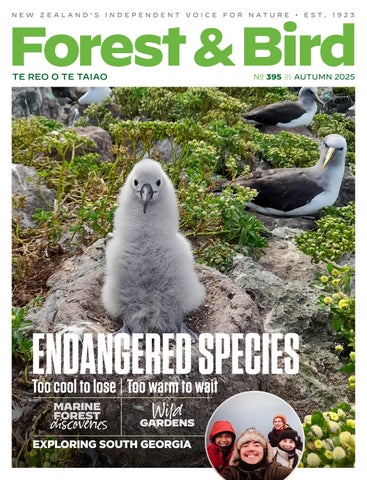
Forest & Bird Magazine 395 Autumn 2025

Page 1


ENDANGERED SPECIES

Editorial

2 Nature essential

4 Letters + competition winners

News

6 Wetland win + Notice of meeting + Force of Nature book win

8 Into the blue + Save our endangered species + Jobs for Nature

10 Mining giant backs off + Predator-free Rakiura + Our $3 trillion bioeconomy + Forest & Bird archive digitised

Cover

12 Too cool to lose: Coastal and alpine plants

15 Mutton bird plants

16 Too warm to wait: Mountain daisies, rock-loving rarities, Wakanui woollyheads

Community

18 Saving taīko: West Coast petrel patrol

Arts

20 Into Ocean & Ice: Exploring South Georgia

8

COVER SHOT Hopo toroa Buller’s albatross chick with Chatham Island button daisies. Mike Bell

PAPER ENVELOPE Hoiho yellow-eyed penguin. Ross Mastrovich

RENEWAL Waiū atua shore spurge (Euphorbia glauca). Rob Suisted

EDITOR Caroline Wood E editor@forestandbird.org.nz

Predator-free New Zealand

22 Rātā rebounds

War on nature

23 Oceans under threat

28 Standing up for stewardship land + DOC consultation

46 Te Tiriti and nature

Biodiversity

24 Wild gardening

26 Dig for the future

27 Creating critter-friendly gardens

48 Tree of Life 12

Thank you for supporting us! Forest & Bird is New Zealand’s largest and oldest independent conservation charity.

ART DIRECTOR/DESIGNER Rob Di Leva, Dileva Design E rob@dileva.co.nz

PRINTING Webstar webstar.co.nz

PROOFREADER David Cauchi

ADVERTISING ENQUIRIES Karen Condon T 0275 420 338 E karen.condon@xtra.co.nz

MEMBERSHIP & CIRCULATION T 0800 200 064 E membership@forestandbird.org.nz

Forest & Bird is published quarterly by the Royal Forest and Bird Protection Society of New Zealand Inc. Registered at PO Headquarters, Wellington, as a magazine. ISSN 0015-7384 (Print), ISSN 2624-1307 (Online). Copyright: All rights reserved. Opinions expressed by contributors in the magazine are not necessarily those of Forest & Bird.

Join today at forestandbird.org.nz/joinus or email membership@forestandbird.org.nz or call 0800 200 064

Every member receives four copies of Forest & Bird magazine a year.

F&B project

30 Trapping in action

Climate

32 Fire devastates frost flats

34 Reducing wildfire risk

45 Planning for climate change

Profile

36 Wild at heart: Paul Donovan Freshwater

39 Save freshwater

40 Precious peatlands

42 Keep wetlands wet

44 The story of one

Marine

50 Ode to Māui dolphin

58 Red coral forest discovery + new sea squirt species

Seabirds

51 Mystery solved + bird flu watch

In the field

52 On the inside lane

History

54 Taking up the tripod

Youth

57 Bay of Plenty award winners

Books

60 Sooty beech rebels

Market place

62 Classifieds

Last word

64 Tagging monarch butterflies

Parting shot IBC 58

CONTACT A BRANCH See forestandbird.org.nz/branches for a full list of our 45 Forest & Bird branches. 54

CONTACT NATIONAL OFFICE Forest & Bird National Office Ground Floor, 205 Victoria Street Wellington 6011 PO Box 631, Wellington 6140

T 0800 200 064 or 04 385 7374

E office@forestandbird.org.nz W forestandbird.org.nz

facebook.com/ ForestandBird

youtube.com/ forestandbird @Forest_and_Bird @forestandbird

Royal Forest and Bird Protection Society of New Zealand Inc. Forest & Bird is a registered charitable entity under the Charities Act 2005. Registration No CC26943.

PATRON Her Excellency The Rt Honourable Dame Cindy Kiro, GNZM, QSO Governor-General of New Zealand CHIEF EXECUTIVE Nicola Toki PRESIDENT Kate Graeme DEPUTY PRESIDENT Mark Hanger TREASURER Nigel Thomson BOARD MEMBERS Chris Barker, Bruce Clarkson, Romilly Cumming, Ben Kepes, Kate Littin, James Mackenzie, Eugenie Sage CONSERVATION AMBASSADORS Sir Alan Mark, Gerry McSweeney, Craig Potton DISTINGUISHED LIFE MEMBERS Graham Bellamy, Linda Conning, Ann and Basil Graeme, Philip Hart, Joan Leckie, Hon. Sandra Lee-Vercoe, Carole Long, Peter Maddison, Sir Alan Mark, Gerry McSweeney, Craig Potton, Fraser Ross, Eugenie Sage, Guy Salmon

NATURE ESSENTIAL

The need for nature hardly features in our current political dialogue, where all talk is about economic growth and opening up public conservation land for mining. One would think that safe freshwater, healthy oceans, and bountiful birdlife don’t loom large as priorities for ordinary New Zealanders.

Of course, this doesn’t reflect the reality – we know Kiwis care deeply about the environment. We are a country of nature lovers. We are proud to be home to thousands of quirky critters found nowhere else in the world. Our wonky beaked wrybill, cheeky alpine kea, and tiny Māui dolphins to name just three.

New Zealanders of all politial stripes love getting out into nature, whether it’s wandering along unspolit beaches, swimming in their local rivers and lakes, heading into the mountains, or marvelling at ancient majestic forests. Destroying such places risks our common future and our very identity. This is a message we need to get across to our MPs more clearly.

Yes, our country is privileged, compared with much of the world, to still enjoy relatively healthy freshwater, oceans, natural places, and wildlife. But all is not right in our paradise. Water quality is declining, marine fish stocks are alarmingly low, feral deer numbers in our forests are at unprecedented levels, and we have the highest proportion of species at risk of extinction in the world.

The government’s legislative agenda for the environment this year is alarming. Forest & Bird is particularly concerned about the future of the public conservation estate, which so many fought so hard to protect in the 1980s. Then there’s the watering down of freshwater protections and reversal of sustainable marine management.

Ministers are allowing vested interests to set the political agenda while simultaneously rolling back decades of hard-fought conservation gains and blocking public consultation in the name of economic development. There is a very real risk that many wild places and native species will be lost forever as a result.

But there is another way forward. Nature-based solutions, such as making room for rivers, restoring wetlands, planting native trees, and coastal dune restoration projects provide vital services such as capturing carbon or reducing flooding risk. They can protect nature while underpinning our economic and social prosperity for generations to come.

Forest & Bird will be working hard to show that New Zealanders care deeply about the environment and want to see it properly protected. Politicians listen to their constituents and numbers count. Adding your support to Forest & Bird’s submissions this year will amplify their weight. Decision-makers will pay even more attention if you can make a detailed individual submission on a particular issue. Talking to your local MP and others can go even further towards making it clear that our environment is a core concern.

Now is the time for action. Let’s make nature’s voice heard.

Paul Donovan

Heritage Expeditions have been sharing the wilds of New Zealand with like-minded guests for more than 40 years and invite you on the voyage of a lifetime. Explore Fiordland’s world famous Acheron Passage and Breaksea, Dusky and Doubtful Sounds; the tranquil waterways of historic Queen Charlotte and Pelorus Sounds, French Pass and d’Urville Island; and Stewart and Ulva Islands, Paterson Inlet, Kaipipi Bay, Port Pegasus and Lords River – all only accessible by sea. Join us for an unforgettable, intimate exploration of some of Aotearoa’s most remote, and iconic, locations aboard our 18-guest expedition yacht and by Zodiac, kayak and on foot with New Zealand’s own expedition cruise pioneers.

LETTERS

YOUR FEEDBACK

Forest & Bird welcomes your thoughts on conservation topics. Please email letters up to 200 words, with your name, home address, and phone number, to editor@ forestandbird.org.nz, or by post to the Editor, Forest & Bird magazine, 205 Victoria Street, Wellington 6011, by 1 May 2025. We don’t always have space to publish all letters or use them in full. Opinions expressed on the Letters page are not necessarily those of Forest & Bird.

FORESTRY SLASH

We have seen how forestry slash has choked eastern beaches. This photo shows the Mākara coast, west of Wellington. I first dived and tramped this area in the early seventies. At that time and for a couple of decades after, the beach was clear gravel from the hill to the water’s edge. If you wanted to cook seafood, you could, but you had to forage for firewood. This photograph, taken recently, shows driftwood/slash up to two metres deep and with no exposed gravel or rock remaining – for kilometres. It is likely that much of this waste originated from forestry operations in Port Underwood across the Cook Strait. In the adjacent Marlborough Sounds, heavy sedimentation from run-off from the same clearfelling is the unseen destroyer of the seafloor and sea life. It is just one more distressing example of how inappropriate land use by a few is creating long-term damage that is adversely affecting the quality of life for us all.

Greg Billington, Picton

BEST LETTER WINNER

WRITE AND WIN

The best contribution will receive a copy of A Wild Life: Photographs from the backcountry of Aotearoa by Shaun Barnett (Potton & Burton, RRP $59.99). A stunning photographic tribute to the late Shaun Barnett, the leading tramping author of his generation.

CLEVER KERERŪ

Unlike David Hill (“Feather brains”, Summer 2024 issue), I do think that the kererū is versatile. They have spread from their forest habitat to become a familiar sight in parks and gardens. They have expanded their original diet to include many introduced plants. In Dunedin, I have seen them eating over 100 foods. Being strong fliers, they can travel to areas with a temporary abundance of food. They may sometimes look clumsy as they seek their food on thin branches, but there isn’t much that they can’t reach. They are not tied to a particular breeding season but can breed whenever sufficient food is available. Their approachability, so useful to birdwatchers and photographers, could be seen as a sign of bravery. It certainly shows a level of trust in us which we would do well to justify.

Alan Baker, Dunedin

ON ROCKY GROUND

I know what I am writing is not a Forest & Bird issue per se, but we fight to keep our landscapes unspoilt and as pristine as possible, so it does have some relevance. I am somewhat perturbed by the overseas craze of mostly young tourists to Aotearoa building rock cairns and driftwood sculptures in scenic spots to mark their presence, which should be discouraged. Over the years, I remember seeing many rock cairns at spots like the Blue Pools in Westland, on some Great Walk Tracks and roadside wetlands in the Nelson area, and driftwood sculptures on some of our beautiful ocean beaches. DOC and local councils should dismantle them when first put in place before others copy them. As the old saying goes, give them an inch and they will take a mile.

Grant Svendsen, Hamilton

Forest slash, Mākara Beach. Greg Billington

GE TECHNOLOGIES

Our family shares the concerns of many other Kiwis about the controversial Gene Technology Bill, cynically released by the Science Minister Judith Collins just before Christmas. We support Forest and Bird’s excellent precautionary GE/GMO policy. We note with dismay that the Bill proposes the removal of all ethical considerations and the precautionary approach to outdoor GE/GMOs. The Precautionary Principle is enshrined in the European Commission’s policies and in other international treaties that New Zealand is a signatory to. These include the Cartagena Protocol on Biosafety to the Convention on Biological Diversity. We don’t need GE or so-called “gene drive” (dangerous sterility technique) to protect our native birds and other valuable indigenous biodiversity. We do need to ensure adequate funding for the Department of Conservation for core biodiversity work, prioritise truly sustainable primary production, and stop all new coal mines on public conservation land. We already have the tools we need to address environmental concerns like climate change. Outdoor genetic engineering experiments and field trials are too high risk: they can result in contamination via pollen, seeds, vegetative material, soils, waterways, wind, machinery, animals, insects, and extreme weather events, including floods.

Rolf Mueller-Glodde, Kerikeri

BOOK GIVEAWAY

We have two copies of A Naturalist’s Guide to the Fungi of Aotearoa New Zealand by Ruben Mita (John Beaufoy Publishing, RRP $29.99) to give away. The perfect pocket guide to the 267 species of New Zealand’s fungi. Easy to use, informative, and with fabulous colour photographs.

To enter, email your entry to draw@forestandbird. org.nz, put FUNGI in the subject line, and include your name and address in the email. Or write your name and address on the back of an envelope and post to FUNGI draw, Forest & Bird, PO Box 631, Wellington 6140. Entries close 1 May 2025.

The lucky winners of Geckos and Skinks by Anna Yeoman were Frances Anderson, of Alexandra, and Theo Rodink, of Wellsford.

FORCE OF NATURE

Force of Nature is the landmark history of Forest & Bird, celebrating 100 years of groundbreaking effort. This magnificent publication is one of the most important books about conservation in Aotearoa to have been written in decades. It is guaranteed to make you proud to be a supporter of Forest & Bird. For more information – see forestandbird.org.nz/forceofnature.

WETLAND WIN

Irreplaceable” rare dune habitat has been saved from the bulldozer, and another 5ha of wetlands will be restored after Forest & Bird raised concerns about a new solar farm in Northland.

Northland Regional Council granted resource consent for stage 2 of Meridian’s Ruakākā Energy Park Northland last year. Our legal team sought consent be declined or amended to prevent the solar farm from locating within wetlands.

Following negotiations with Meridian, new consents have been issued by the Environment Court. This will see 9ha of wetlands saved and another 5ha restored.

The wetlands were described by the council’s ecologist as “dune slack wetlands, which are rare and nationally threatened ecosystem types and are considered irreplaceable.

“These ecosystem types cannot be readily offset given that they rely on a range of complex ecological, geological, and hydrological conditions.”

Meridian’s ecologists took a different view, suggesting they did not need to be protected as their importance was reduced because some areas were modified or degraded.

Forest & Bird’s ecologist Dr Philippe Gerbeaux disagreed with the energy company, pointing out that only 7% of historic wetlands remained in Northland.

“In regions where there is less than 10%, councils should pay extreme attention to not lose what’s left, regardless of their condition,” he said.

“It is also always preferable to retain what is left than trying to re-create wetlands that would never be true offsets.”

Following “constructive discussions” with Meridian, new consents were signed off by the Environment Court. The solar farm will still provide up to 250,000 solar panels across 200ha – but with less impact on the environment.

Forest & Bird lawyer May Downing said: “We were concerned about the area of wetland that was going to be removed. We also felt more had to be done to comply with national direction that protects our wetlands.

“We worked with Meridian on revised consent conditions, which has led to a larger area of wetlands and associated dunelands being protected from solar farm development and improved restoration and monitoring requirements.

“Wetlands are incredible ecosystems and critical habitats for many of our most threatened native species. They also improve water quality and are carbon sinks. But only about 10% of our original wetlands remain. This means every wetland counts.”

The 2025 Annual General Meeting of financial members of the Royal Forest & Bird Protection Society of New Zealand will be held online at 9am on Saturday, 28 June 2025. All members are welcome to attend.

OCKHAM AWARD LONGLISTED NOTICE OF MEETING

Forest & Bird was thrilled when our book Force of Nature Te Aumangea o te Ao Tūroa by David Young and Naomi Arnold was longlisted for the Ockham New Zealand Book Awards (BookHub Award for Illustrated Non-Fiction). We have sold out of our copies, but it is still available in good bookshops or direct from potton&burton.co.nz

Ruakākā energy farm. Meridian
Paul Donovan

INTO OCEAN & ICE

Artists explore a changing Antarctica

NATURE NEWS

INTO THE BLUE

It’s wild, wonderful, and just a little bit cheeky – the second season of TVNZ’s Endangered Species Aotearoa is beaming into living rooms right now.

The six-week show, which premiered on 3 March, features Forest & Bird staff and volunteers who are working to protect marine species in the Hauraki Gulf, create new seabird habitats in Kaikōura, and restore wetlands around the motu.

There is one bit of the first episode you really don’t want to miss – it involves an up-close encounter with majestic manta rays that make their home in Tīkapa Moana the Hauraki Gulf.

This touching moment is one of many nature highlights for the show’s charismatic co-presenters –our very own chief executive Nicola Toki and Auckland comedian Pax Assadi.

Pax, a self-confessed city slicker, bravely dons a wetsuit to venture into his own blue backyard and learn about the marine taonga that lives there. We won’t spoil the episode, and if you missed it you can watch the show on TVNZ+.

Nicola and Pax also visit one of the Gulf’s island taonga, Tiritiri Matangi nature sanctuary, where Pax gets to meet some of our at-risk forest birds, including titipounamu riflemen, kōkako, and the hihi.

Here they catch up with Forest & Bird’s Hauraki Gulf advocate

Bianca Ranson (Ngāpuhi, Ngāti Kahu ki Whangaroa), who lives on Waiheke Island.

“The Hauraki Gulf is a globally significant marine area, home to rich biodiversity, including dolphins, whales, and seabirds,” says Bianca, who has been leading the Society’s campaign to save the Hauraki Gulf.

“It’s also under significant ecological pressure due to pollution, overfishing, habitat loss, and climate change. It was an honour to share my knowledge and personal connection to this taonga.

“My hope is that, through the episode, people have a greater awareness of the wonders of Tīkapa Moana and feel inspired to take action.”

While Pax is a local, he tells Bianca he had no idea the Hauraki Gulf was so special or that so many species living there were at risk of extinction.

Throughout the six-part series, the pair meet conservationists in New Zealand and the Pacific who are passionate about saving endangered species and their habitats, and working hard to give nature a voice in their local communities.

Forest & Bird is proud to be partnering with TVNZ’s Endangered Species Aotearoa this year.

“Forest & Bird is a voice for nature – and we have been for 100 years,” says Nicola Toki. “So it was a nobrainer to come on board with this show that brings Kiwis face to face with our most vulnerable – and most incredible – creatures.”

Bianca, Nicola, and Pax, Tiritiri Matangi Island, Hauraki Gulf. TVNZ/Endangered Species Aotearoa
Nicola and Pax after their manta ray encounter Supplied

In their search for a host of fascinating, quirky, and elusive critters from mountain parrots to black mudfish, Nicola and Pax go well off the beaten track. They get nipped, chased, and pooped on and pushed to their physical limits.

It’s great fun and required viewing for every nature lover in Aotearoa.

Watch Endangered Species Aotearoa, Mondays, 7.30pm, TVNZ 1 and TVNZ+. Made with support from New Zealand On Air.

Snapper have declined in the Hauraki Gulf

Darryl Torckler

SAVE OUR ENDANGERED SPECIES

Forest & Bird has been working to protect endangered species in the Hauraki Gulf for more than 60 years. In that time, we’ve secured new marine and island reserves, removed rats from tiny Maria Island (a world first), and advocated for seabirds, snapper, crayfish, dolphins, whales, and the complex inter-connected marine habitats they rely on to survive.

Right now Forest & Bird is trying to stop commercial fishing in the Gulf’s new high protection areas, an unprecedented decision by the Minister of Conservation. We are also campaigning for an end to bottom trawling. Help protect the precious and fragile wildlife of the Hauraki Gulf by making a gift today at forestandbird.org.nz.

OUR BATS THANK YOU

With record 205 pekapeka tou-roa longtailed bats captured and banded over the summer, Forest & Bird’s Te Hoiere Bat Recovery team has marked the end of a highly successful three-year Jobs for Nature project.

Part of the Labour government’s economic response to the Covid-19 pandemic, Jobs for Nature funding enabled Forest & Bird’s staff, volunteers, and the local community to protect and restore native forest in the Rai Valley and Pelorus Bridge, Marlborough.

The $1.3m grant in 2022 allowed the Society to recruit conservation specialists to carry out pest plant control, restorative planting, bat monitoring, and predator control in four Department of Conservation nature reserves.

Over the course of the project, significant conservation outcomes were achieved:

n A total of 20,400 native trees and plants were planted.

n Staff and volunteers controlled weeds over 24ha of reserves.

n The Forest & Bird team installed 958 trapping devices that reduced rat occurrence to less than 5% in the controlled area (down from 35%–55%).

n More than 200 bats were banded for individual monitoring.

These outcomes would not have been possible without the invaluable contributions of our dedicated trapping volunteers, Ngāti Kuia, Marlborough District Council, the Department of Conservation, Te Hoiere Project, and Kotahitanga mō te Taiao.

To acknowledge this collective effort and celebrate the project’s success, a gathering was held in Rai Valley in February, bringing together many supporters and partners.

While the Jobs for Nature funding has concluded, Forest & Bird remains committed to maintaining momentum and ensuring the continuation of vital conservation efforts in the region.

Trapping in action: Te Hoiere Bat Recovery knocks bat rat numbers ☛ see page 30.

Mobula birostris is the largest ray species in the world and reaches reach up to 7m wide. Manta Watch NZ/Mark Erdmann
Pekapeka with tracker on its back. Franco Elgueta Rivera

NATURE NEWS

MINING GIANT BACKS OFF

Locals who campaigned against plans to mine Whangaroa district in Northland are celebrating after the Australian company involved applied to surrender 15 of its 16 New Zealand mining permits.

Mineralogy International Limited, which is owned by controversial mining billionaire Clive Palmer, had been given permission to prospect for gold and rare earth minerals, such as lithium, on 225,000ha in Northland, Waikato, the West Coast, and Canterbury.

A local campaign led by the Whangaroa Stop Toxic Mining Alliance (KATI) was supported by Forest & Bird. We attended protests in April 2023 to highlight the threat of toxic mining on kauri forests at Puketī and at Whakarara Conservation Area, Northland.

“This victory belongs to the people of Whangaroa. It is a testament to the strength of our collective voice and our commitment to protecting our sacred lands,” said KATI spokesperson Dannie Samuels-Thomas.

KATI also expressed gratitude to the people of Ngāi Tupango, Ngāti Ruamahue, Ngāti Kura, and Te Rūnanga o Whāingaroa, numerous leaders from around the district, Forest & Bird and Greenpeace.

The Ministry for Business, Innovation and Employment, which issues mining permits, told RNZ the company had withdrawn from most of its New Zealand operations to “refocus” its portfolio strategy. Mineralogy’s 16 prospecting permits covered Māori, public conservation, and private land.

“This campaign was a clear reminder that, when tangata whenua are respected and supported, there is no force more powerful than a community united in purpose,” said KATI strategist Mike Smith.

Meanwhile, the government has added coal and gold to its new Critical Minerals List and signalled it will allow new mines to be built on conservation land.

“Forest & Bird acknowledges the great local work Whangaroa hapū have done as we’ve worked together to expel this global mining giant,” said Forest & Bird’s Northland regional manager Dean Baigent-Mercer. “That’s 15 exploration permits down but a heck of a lot more to go.”

PREDATOR-FREE RAKIURA

The pukunui southern New Zealand dotterel population on Rakiura is facing extinction, despite extensive efforts from the Department of Conservation’s Pukunui Recovery Team (see the story in our Summer 2024 issue).

There are only 101 individual birds left due to predation from feral cats. Ground control methods, including trapping, have not been effective enough to reverse their steep decline.

Predator Free Rakiura plans to eradicate feral cats, possums, rats, and hedgehogs from the island for good in the long term. But it says the situation is urgent and conservationists need to act now to save pukunui.

DOC wants to complete a predator control operation this winter using aerially applied 1080 bait to suppress predator numbers, particularly feral cats. This would be delivered with support from ZIP.

Then the recovery team, with technology supplied by ZIP, will be able to monitor the threat of feral cats reinvading the pukunui breeding grounds and respond quickly when they are sighted. This will give pukunui the greatest chance to recover.

The exact boundaries of the 2025 proposed predator control area are yet to be finalised, but the aim is to cover the pukunui breeding grounds in the Tin Range.

Decades of predator control operations in New Zealand show that aerially applied 1080 is the most effective method for protecting native species across large, remote wilderness areas.

Predator-free Rakiura says the operation will be subject to a robust consultation process over the coming months with community stakeholders that may be affected.

Protesting at Manginangina kauri forest, Northland, 2023. Forest & Bird
Pukunui with chick, Rakiura. Craig Stonyer

OUR $3 TRILLION BIOECONOMY

Local, regional, and national parks are vital to building wealth in Aotearoa New Zealand, according to new research by Lincoln University’s Agribusiness and Economics Research Unit.

Green spaces are often considered a “nice to have” when infrastructure funding is concerned. Now, a new study proves the sector plays a significant role in Aotearoa New Zealand’s economy, contributing $12bn per year.

The Economic Value of Parks: A Framework and Preliminary Estimate report shows how the economy relies on parks in many ways, including attracting international and domestic tourists, delivering recreational, cultural, and other ecosystem services, and providing wellbeing benefits that reduce public health costs.

“Green spaces are not just places for people to enjoy physical and mental health, sport, and social engagement,” said Geoff Canham, convenor of the New Zealand Parks Leaders Forum.

“Parks underpin the whole bioeconomy. An investment in parks helps our economy grow, while a budget cutback would have a detrimental economic impact.”

The study estimated the current value of our network of parks, assuming benefits for eight generations (200 years). This produced an economic value of national, regional, and local parks estimated as $3 trillion.

“Now is an ideal time to discuss the opportunities delivered by our national, regional, and local parks so we can keep moving the economy forward,” added Geoff.

“Whether it be tourism, resources, wellbeing, climate change, biodiversity, freshwater, property values, or social cohesion, funding levels determine our economic performance.”

For more information, see parksmanagers.org.nz/ economicvalueofparks

100 YEARS FOREST & BIRD DIGITISED

We’re delighted to announce the entire back catalogue of Forest & Bird magazines from 1923 to 2023 have been digitised and are now available online.

The final Papers Past release went live in February with magazines from 1976 to 2004 being added to New Zealand’s national magazine archive.

A huge thank you to the digitising team at Te Puna Mātauranga o Aotearoa the National Library of New Zealand, which has supported this project since it was first mooted in 2018.

This addition means the first 80 years of Forest & Bird magazine (1923–2004) are now available on Papers Past at paperspast.natlib.govt.nz/periodicals/forest-andbird. The past 20 years (2005–2024) can be downloaded from issuu.com/forestandbird/.

“I’m delighted the entire 100-year Forest & Bird magazine archive is now accessible to anyone interested in nature conservation and environmental history,” says Forest & Bird’s President Kate Graeme.

“It means we can share a century of fascinating stories and images about te taiao nature and the thousands of New Zealanders working to protect and restore our wild places and endangered species.” The five-year project was led by Forest & Bird editor Caroline Wood together with Michael Pringle and volunteers Casey Spearin, Casey Rosa, Gyle Bascon, and Rosa Pillay. We thank Melanie Lovell-Smith, Sarah Jacobs, and Charlotte McGillen, who steered phase 1, 2, and 3 of the project through the National Library’s digitisation process.

“It’s easy to search for specific people, places, or native species and download articles for future reference,” said Caroline Wood. “We hope this resource will be useful for historians, genealogists, schools, and scientists.”

Originally titled Birds, the magazine initially focused on New Zealand’s forests and birdlife, and educated adults and children in the importance of conserving them. Over time, the magazine increased in size and mana, reflecting the evolution of Forest & Bird into a large modern-day conservation organisation. Many leading nature writers and photographers have contributed content over the decades.

Today, Forest & Bird is the only dedicated conservation magazine in Aotearoa and one of the country’s longestrunning publications.

Magazine cover from 1991.

Colleen Tunnicliff

Abel Tasman National Park. Jeremy Wood

TOO COOL TO LOSE

Some of our unusual and fascinating coastal and alpine plants are vulnerable to climate change, but there are things nature-lovers can do to help them become more resilient. Caroline Wood

On a few sandy beaches in the Far North lives one of Aotearoa New Zealand’s rarest coastal plants, a prostrate annual herb with fleshy deep green leaves that look like they have been been frosted with sugar.

Once locally common in parts of Te Ika-a-Māui the North Island, they are now exceptionally rare. With only about 50 plants left, few would be lucky enough to come across a Holloway’s crystalwort “stranded” just above the high tide mark where it germinates and lives out its

entire plant life among the driftwood and dead fish.

Atriplex hollowayz is one of only two crystalworts found on our shores and the only endemic species. It has been in a constant fight for survival for decades and has many problems to contend with, including encroaching weeds, vehicles, and browsing/trampling animals.

The lastest risk added to the list is climate change – in particular, sea level rise and increasing storm surge frequency, leading to erosion and habitat damage.

Holloway’s crystalwort is one of 39 native vascular plants to be assigned the new qualifier “Climate Impact” by an independent panel of New Zealand experts led by Professor Peter de Lange, of Unitec. It is the first time climate change has been given as a risk factor for specific vascular plant (trees, shrubs, herbs, grasses, and ferns) species.

The panel assessed the conservation status of 2844 vascular plants native to Aotearoa New Zealand, and their report was published last October.

Prof. Peter de Lange
Coastal plants are vulnerable to climate impacts such as rising sea levels, storm surges, erosion, and habitat loss. Pictured: Chatham Island forget-me-not Myosotidium hortensia Peter de Lange
Holloway’s crystalwort (Atriplex hollowayz) Peter de Lange

It shows the status of 161 vascular plant species has worsened since 2017, while 110 have improved.

Many of the species assessed as being vulnerable to climate change have predominantly coastal populations, such as waiu-atua shore spurge (Euphorbia glauca), which are impacted by sea level rise and extreme weather events.

This poses an existential risk to plants such as the Chatham Island button daisy (Leptinella featherstonii), aka the “mutton bird plant”, which depends on seabird guano to provide to provide optimal growing conditions (see overleaf).

At the other end of the topographical scale, alpine and sub-alpine species, including mountain daisies, braided river forget-me-nots, and sun-loving hebes, are also highlighted in the report as being particularly vulnerable to climate change impacts (see page 16).

Drought, for example, is becoming an increasing problem for Macmahon’s rock daisy. As these plants already live near the tops of mountains, they have little room to spread to escape the heat. Warmer temperatures also allow weeds to invade their habitat.

The impact of other climate events, such as flooding, is less clear, say the report’s authors. For example, Cyclone Gabrielle, in January 2023, saw high rainfall and devastating floods throughout the northern and eastern North Island, which impacted ewekuri the large-leafed milk tree (Streblus banksii).

“We have been seeing evidence of our changing climate on the coast for quite some time,” said Peter de Lange.

“Sea level rise is a serious concern not only for Holloway’s crystalwort but also for other plants, such as Chatham Islands scurvy grass, which is almost extinct as a naturally occurring plant on Rēkohu.

“We are also seeing more tropical plants typical of the coral cay and coastal beaches of Pacific Islands turning up.”

These include viable coconuts along our northern coastline, and tropical nicker nut seeds (Guilandina bonduc) being found in the Chatham Islands. Another tropical invasive, beach morning glory (Ipomoea pescaprae subsp. Brasiliensis), has been found germinating as far south as the Waitākere Ranges.

Since the full impacts of climate change on many Aotearoa New Zealand plants are currently unknown, the panel says it was conservative in using the qualifier Climate Impact.

“However, it is likely that use of this qualifier will become more widespread in future assessments as our knowledge of climate change impacts improves,” it adds.

HELPING OUR FLORA ADAPT

The Department of Conservation says the Conservation Status of Vascular Plants report demonstrates how active conservation management can turn species decline into recovery, even in a warming world.

Independently-researched portfolios

2022 & 2023 Mindful Money

Ethical Financial Adviser

Expert advice Call 09 337 0997 to talk to one of our advisers or find out more at

Mountain daisies (Celmisia sp), Mt Stokes. Rob Suisted

DOC’s technical advisor ecology Andrew Townsend says the report includes several examples of flora recovery following conservation action such as browsing mammal control.

“This report is evidence that a range of activities, including pest animal management, weed control, fencing, collection and storage of seeds, and propagation at botanic gardens and nurseries, are among the most effective tools we have for protecting taonga plant species,” he said.

For example, Castle Hill forget-me-nots have benefited from weed removal and the discovery of new populations. Their threat status has improved, moving from “Nationally Critical” to “Nationally Endangered”, although DOC says pigs and drought remain a problem.

Effective possum and browsing mammal control has seen an improvement in the fortunes of koheriki (Scandia rosifolia) in the northern part of its range. The discovery of new populations on Te Hauturu-oToi Little Barrier and Aotea Great Barrier islands also helped it move from “Nationally Critical” to “Nationally Vulnerable”.

But when we stop actively managing species, they can rapidly decline, with the report containing a cautionary tale from Rekōhu the Chatham Islands.

From 1996 to 2016, conservationists successfully increased the endemic Chatham Islands scurvy grass (Lepidium rekohuense) from just five plants in 1996 to nearly 600.

However, after hands-on management of the species ceased, the plant population plummeted. By January 2019, there was only one plant left, and it was diseased.

The plant’s seed had been held in storage, and three plants were discovered at a site where seed had been broadcast a decade earlier. Since 2019, intensive in situ management and translocations saw the number of known plants rise to 80 by November 2023.

“But storm damage and higher than normal seas –possibly due to climate change – have rendered the only known natural population scarcely viable,” say the report’s authors.

“The future for this nationally critical species resides in translocations to a range of sites in the hope that some will prove secure.

“At several of these sites, initially promising results have subsequently failed due to high sea levels, and at the time of writing (November 2023), L. rekohuense remains far from secure.”

The report assesses other threats our 2850 native trees, shrubs, herbs, grasses, and ferns face in the wild, including including human-induced habitat loss and fragmentation, browsing mammals, invasive weeds, disease, and climate change.

It confirms the impacts of myrtle rust, with some myrtle species showing “serious decline and ramarama facing possible regional extinction in parts of the country”. Other myrtle species don’t appear as heavily impacted, but this could change, say the report’s authors.

“The assessment underlines what we’re seeing around the country,” added Andrew. “Native plants are under increasing pressure from deer, pigs, goats, and other ungulates, as well as wallabies, possums, hares, and rabbits. Exotic plants are also spreading in the wild and can outcompete native plants for habitat.”

Wilding pines and exotic grasses are a huge threat to native plants as they smother native plants in their habitats. Veldt grass, for example, is responsible for the loss of some North Island forget-me-not populations and is putting a coastal mahoe species under pressure.

Another invasive weed, chewings fescue, is a significant problem in eastern dryland limestone ecosystems, the habitat of some of New Zealand’s most threatened plants.

While this report makes it clear our botanical treasures are under pressure from a range of threats, it’s heartening to know that active conservation management can help our precious plants move from a declining to recovering species.

Conservation status of vascular plants in Aotearoa New Zealand is the latest report under the New Zealand Threat Classification System (NZTCS).

The NZTCS is an independent assessment tool led by the New Zealand scientific community and administered by DOC.

Chatham Islands scurvy grass (Lepidium rekohuense).
Peter de Lange/iNaturalist
Castle Hill forget-me-not (Myosotis colensoi).
Jane Gosden/iNaturalist

MUTTON BIRD PLANTS

Jess MacKenzie, from the Chatham Islands Landscape Restoration Trust, shares her fascination with a botanical wonder only found in the islands, where locals are working to restore this special daisy.

The endemic Chatham Island button daisy* is a perfect example of the biological phenomenon known as “island gigantism”, where a lack of environmental constraints allows a species to grow much larger than its mainland relatives.

While most button daisies in Aotearoa are small creeping ground cover plants, Leptinella featherstonii is a woody shrub that reaches a maximum height of one metre – pretty darn impressive for its kind.

It’s known as the “mutton bird plant” as it grows coastally, normally near tītī sooty shearwater, (muttonbird), toroa albatross, and other seabird colonies, where the ground is enriched by the nutritious and delicious seabird poop.

The species, which is endemic to the Chatham Islands, is a good indicator of ecosystem health –plenty of button daisies indicates plenty of seabirds. Conversely, we’ve seen populations of button daisy die out after a year or two when seabird numbers drop.

Being a coastal plant, they’re also vulnerable to storm surges, coastal erosion, and sea level rise. Other

threats include grazing and trampling, predation by possums, erosion, and weed invasion.

Button daisies are struggling on our main islands, where habitat loss and pest species have disrupted the ecosystem. The species is seriously threatened on Rēkohu Wharekauri, the main Chatham Island, where it’s hanging on by a thread, with just one known remaining wild population.

Fortunately, they’re doing pretty well over on some of the Chatham islets where there are albatross colonies.

In Mike Bell’s photo (left), you can see healthy button daisy plants scattered throughout this hopo toroa Buller’s albatross colony. Hopo are impacted by climate change too. Storms damage their breeding sites, while chicks covered with down can overheat easily in summertime as temperatures increase. One of our Trust’s long-term visions is to see the islands’ natural seabird-driven ecosystem thriving again. As we and our community carry out more conservation and restoration work, Leptinella featherstonii is likely to be an indicator species of how well things are going.

It is one of 39 plants from the daisy family on our islands, with around 7–10 considered endemic. Our other giant daisies include akeake (Olearia traversii), one of the largest tree daisies on Earth.

The islands are lucky to have a conservation-minded community. Trapping, restoration planting, and fencing areas to keep out stock are all ways locals are helping to protect unique flora and seabirds like this.

Jess MacKenzie is a nature nerd, providing communications and project support for the Chatham Islands Landscape Restoration Trust. The Trust formed as a group of islanders working to bring conservation and ecosystem restoration projects to life. For more information, see chathamrestorationtrust.org.nz

*The Chatham Island button daisy is one of 39 species identified as being at risk from climate change in the most recent Conservation status of vascular plants in Aotearoa New Zealand

Jess MacKenzie
Chatham Island button daisy. Dave Boyle
Hopo Buller’s albatross chick on its nest surrounded by critically engandered Chatham Island button daisies. Mike Bell

TOO WARM TO WAIT

Five precious plants that experts say are, or will be, adversely affected by long-term climate trends, including extreme weather events.

WAKANUI WOOLLYHEADS

The critically endangered endemic daisy (Craspedia diversicolor) was once widespread across the Canterbury Plains but is now reduced to two remaining plants at one site in the wild at Wakanui, coastal Canterbury. The rosette-forming perennial daisy, also known as puatea or woollyhead, is one of the fragments of native biodiversity of the Canterbury Plains. Over several years, a dedicated team of volunteers from the Ashburton

Branch of Forest & Bird worked with Dr Illse Breitwieser and her team of botanists from Manaaki Whenua Landcare Research to increase the captive population by undertaking manual crosspollination of plants held at Landcare’s Lincoln nursery with the wild plants. The resulting C. diversicolor seedlings have been grown on and planted at two other sites and hopefully will go on to establish self-sustaining populations.

Back from the brink: Read how Val Clemens and Edith Smith, of our Ashburton Branch, worked heroically over several years to save the last Wakanui daisies from extinction in this 2023 magazine article forestandbird.org. nz/resources/back-brink

ROCKIN’ RARITIES

The riverbed forget-menot (Myosotis uniflora) is unique in its preference for growing in stony and shingle riverbeds, including braided rivers, from Canterbury to Otago. This distinctive perennial herb’s dark green rounded cushions are topped with clusters of cheerful yellow flowers. Its Climate Impact qualifier acknowledges the increased risk of flooding events throughout its braided river habitats. This endemic species is “Threatened – Nationally Vulnerable”.

Another rock-loving rarity, Veronica lavaudiana, is only found in the Te Pātaka-oRākaihautū Banks Peninsula, where it lives in open rock outcrops and cliff faces, often growing in the most exposed sunny habitats. This small bushy shrub topped with light pink flowers is commonly known as the Banks Peninsula sun hebe. It earns a Climate Impact qualifier due to the increased risk of drought in its habitat. It is “At Risk – Declining”.

Dr Ilse Breitwieser with Craspedia plants at Manaaki Whenua’s experimental nursery, Lincoln. Kim Triegaardt
Banks Peninsula sun hebe (Veronica lavaudiana). Jane Gosden/iNaturalist
Riverbed forget-me-not (Myosotis uniflora), Ashburton River Warren Jowett

MOUNTAIN DAISIES

Forming creeping compact cushions of silvery green foliage, the endemic Macmahon’s rock daisy (Celmisia macmahonii var. macmahonii) is so rare it’s only been found at the top of two peaks in the Marlborough Sounds, including Mt Stokes. This fragile species will have nowhere to retreat as temperatures increase. It is further threatened by the presence of goats at one of the places it grows in the wild, which appears to be resulting in the loss of plants, according to the report. Sites containing C. macmahonii var. macmahonii are rarely visited by botanists, but a visit in February 2023 yielded a single plant.

Further south, the Akaroa daisy (Celmisia mackaui) is another range restricted sub-alpine species only found on Te Pātaka-o-Rākaihautū Banks Peninsula. This mountain daisy prefers damp, south-facing habitats that are increasingly affected by drought. Both these species

of Celmisia are increasingly threatened in our warming world – they were moved from “At Risk – Naturally Uncommon” to “Threatened – Nationally Endangered” in the latest vascular plan assessment, in part for reasons related to climate change.

*These five examples of Too Warm to Wait native plants were extracted from DOC’s Conservation status of vascular plants in Aotearoa New Zealand 2024 report. For examples of how conservationists can help protect and restore native flora and fauna using proven nature-based solutions, see pages 22, 24, 34, and 44.

HELPING HANDS

Forest & Bird members have been working for years to save critically endangered kānuka trees (Kunzea toelkenii) in Ōhiwa Harbour from storm surges and coastal erosion – see forestandbird.org. nz/resources/death-1000-wavesrare-kānuka

Macmahon’s rock daisy (C. macmahonii var. macmahonii) Jane Gosden/ iNaturalist
Akaroa daisy (Celmisia mackaui). HamishG/iNaturalist

PETREL PATROL

Conservation volunteers helped save nearly 60 grounded Westland petrel chicks over the past summer. Forest & Bird’s West Coast Branch chair Suzanne Hills was one of them.

Sometimes, it is necessary to be the ambulance at the bottom of the cliff for our precious wildlife and give them a helping hand. For tāiko Westland petrels, this human intervention takes the form of a nightly community patrol over the summer fledgling season.

From late November to mid January, members of the local community undertook a nightly check of State Highway 6 and the streets, beaches, and rivers of the Punakaiki–Barrytown Flats area.

Our task was to search for grounded Westland petrels and prevent their deaths from vehicle strikes, predation, and exhaustion. This special endemic seabird only breeds here on the West Coast. It is the largest burrowing petrel on the Aotearoa mainland.

The volunteer-led Coast Road petrel patrol started in 2023 and was the brainchild of late Forest & Bird member Bruce Menteath. He

dedicated many years of his life to looking after the tāiko. They return year after year to their breeding grounds, including Forest & Bird’s Dick Jackson Memorial Reserve, above Barrytown Flats.

Last year, the community decided to run an expanded service for the 2024/25 fledgling season. Twenty-five local people, several of them Forest & Bird members, made the commitment to late nights for seven weeks searching for downed seabirds and rescuing them.

In November, young Westland petrels start leaving their dark burrows in the forests above the Barrytown Flats. Their maiden nocturnal flight to reach the Tasman Sea is a “trial by lights”.

The fledglings have to navigate across a strip of coastal land peppered with lights from Punakaiki village and its businesses, rural houses, and headlights of vehicles on the Coast Road.

Naturally attracted to light, artificial lights create havoc and result in many fledglings becoming disorientated and crash landing. Even outdoor Christmas lights or the glow of campervans at a popular freedom camping spot can disorientate them.

They cannot take off from ground level because of their wing structure and will succumb to exhaustion, predation, or injury or be killed by vehicles on the road.

Local people have long retrieved grounded Westland petrels as they come across them on the road and beaches.

However, the population is currently on a knife edge and under multiple threats, including industrialisation of the Barrytown Flats by mining company TiGa and its 30-year fast track project. This means an organised community patrol is an important safety net. Collectively, the patrol had rescued 57 fledglings by January, many of them in good condition, partly because they were picked up soon after grounding and had not spent hours, or days, exhausting themselves in attempts to get airborne.

Suzanne Hills (left) with other Coast Road petrel patrol volunteers and their “rescue kits” at Punakaiki River lagoon, a hotspot for grounded fledglings. Peanut the dog found a couple of birds by sitting and nose pointing. Supplied
“Flyffy”, who was rescued on SH6, gets a health check in the local DOC office before being released back to the wild. Supplied

Westland petrel coming in to land.

Bruce Menteath

It meant these robust birds could be released from a sea cliff the next day (check out this great video of one of the birds being released at https://bit.ly/3Qjjjns).

Released petrels are dubbed the “twink heads” because they are marked with a dab of twink on the top of the head to identify any fledglings that have trouble and ground again.

Despite it being a huge ask of people to search for fledglings at 11pm for 1½ hours in all weathers for seven weeks, local people willingly stepped up to the task. Every roster slot was filled, even on Christmas and New Year Days.

We set up a WhatsApp group to communicate daily, as most people would patrol alone. It enabled the real-time sharing of information on grounding hotspots and problem lights. This proved to be a powerful tool in maintaining a strong sense of collective motivation and responsibility over the seven weeks of patrolling.

Sharing nightly rescue experiences helped to bond volunteers, and many dramatic stories emerged. For example, one volunteer swam out into the Punakaiki River, where the stranded petrel promptly climbed onto her shoulder!

Another patroller came across the wonderous moonlit sight of a fledgling on top of a driftwood log with wings fully extended. Intimate unique experiences,

and no doubt every rescued bird received a reassuring calming peptalk. Many people described helping individual petrels in peril as a great privilege.

Along with the rescues, sadly another 16 birds were found dead. Over half of those were killed on the State Highway. Heartbreaking fatalities on the cusp of these young birds beginning their life at sea and the great migration to South American waters.

WHAT IS FOREST & BIRD DOING?

Forest & Bird’s West Coast Branch is advocating for the tāiko, including calling for better signage, fewer lights, and a dark sky reserve to protect this precious petrel, which is also threatened by commercial fishing, dogs, and feral cats.

The 4km high-risk section of the highway running below the breeding colonies is signposted, but we would like Waka Kotahi to put up new road signs warning drivers to “slow down for the next 4km (November to January) for Westland petrel fledglings”.

Many of the road fatalities would have been avoided had people driven slowly. Speed is a significant factor, as with human road injuries and deaths.

We are also advocating for considerate lighting practices that follow the five principles of useful, targeted, low level, controlled, and warm coloured.

We can help the Westland petrels by shielding and directing lights downwards, using timed motion sensors, closing curtains and blinds at dusk, and applying plastic films on existing lights to remove the problematic blue spectrum.

Many exterior lights are not necessary and could be

permanently switched off. This is what happens with the Punakaiki streetlights during the fledgling season, but this should happen year-round to protect the adult birds.

Together with other likeminded groups and concerned locals, Forest & Bird’s West Coast Branch is hoping to make an initial application to DarkSky International for a Dark Sky Reserve or Sanctuary. As we farewell the fledglings of 2024/25, we will strive to ensure that, on their return in the early 2030s as mature adults, it will be to dark protected skies brimming with stars to the benefit of petrels and people alike.

Forest & Bird’s West Coast Branch is calling for better road signs to alert drivers to the grounded Westland petrels. Suzanne Hills
Tāiko Westland petrel. John Oates

Exploring

OCEAN AND ICE

An exciting exhibition at the New Zealand Maritime Museum features works by young artist and Forest & Bird staffer Charlie Thomas.

Caroline Wood

Self-confessed nature nerd Charlie Thomas (Ngāpuhi) was a founder member of Forest & Bird Youth in 2016 and last year joined our Pest Free Hibiscus Coast restoration project as a community activator and social media lead.

Charlie, 23, who has been passionate about conservation all his life, travelled to South Georgia Island last year as part of the Antarctic Heritage Trust’s Inspiring Explorers Expedition, a journey in honour of Sir Ernest Shackleton’s final expedition, The Quest, 100 years ago.

This once-in-a-lifetime opportunity allowed Charlie and three other young New Zealand artists to experience the rich wildlife and epic glacial landscape of South Georgia, in the South Atlantic Ocean, where Shackleton met his fate, signifying the end of the heroic era of Antarctic exploration.

Charlie says visiting South Georgia – and experiencing some of the places the explorer visited and where he is buried – was truly humbling. It was here that Shackleton sought rescue after his failed Endurance expedition left his crew stranded on Elephant Island.

“Growing up, I was captivated by stories of expeditions and wild remote places, but this experience pushed me into the uncomfortable and unknown in a way I hadn’t expected,” he said.

“South Georgia challenged my perspective on my own life, urging me to think and act in new ways. That, to me, is what true exploration feels like.”

Charlie created five artworks that feature in Into Ocean & Ice: Unveiling Antarctica’s past and present at New Zealand Maritime Museum Hui Te Ananui a Tangaroa, which opened in Auckland last November and runs until 31 August 2025.

Petrel is a linoprint of a steam-powered whaling boat that operated out of South Georgia. A total of 175,250 whales were slaughtered in its waters between 1904 and 1957. When stocks started running low, Petrel and other ships in South Georgia’s whaling fleet went on to harpoon 6000 seals annually from local breeding grounds.

Charlie’s other finely detailed watercolour artworks depict bird species he encountered on South Georgia: king penguins heading noisily to an island with 900,000 hollering mates and a scavenging giant petrel, the only Procellariiformes capable of walking on land, “bloody survivors in a tough land”, as Charlie describes them.

Finally, there’s the South Georgia pintail duck encountered near Sir Ernest Shackleton’s grave. This species, along with the South Georgia pipit, were almost lost to the brown rats introduced by whalers

Charlie Thomas (centre) with Tegan Allpress, Rose Lasham, and Peregrin Hyde.
Charlie's artworks on display at New Zealand Maritime Museum.

and sealers. Enter the world’s largest eradication programme ever undertaken, which cost $20 million. By 2018, the rats were gone and the pintail duck and pipit saved from extinction.

“I’m grateful to the conservationists and the explorers that came before us,” writes Charlie in the text that accompanies the artwork.

Into Ocean & Ice is divided into two parts. The first introduces Charlie and the other three young artists: Tegan Allpress (Rongowhakaata), Peregrin Hyde (Ngāti Maniapoto), and Rose Lasham.

Each shares their own interpretation of this remote region, where warming oceans and melting glaciers are a stark reminder of our world’s threatened state.

Through photos, paintings, sculpture, and video, Into Ocean & Ice explores the icy continent as the artists see it today, while honouring Shackleton’s legacy.

“South Georgia profoundly changed my photography practice and the way I connect with te taiao the natural world,” said Tegan Allpress. “I heard the call of our precious planet so loud and clear; we must do better, we must protect the voiceless.”

The second part of the exhibition features the work of Italian artist Paola Folicaldi Suh, who reimagines Shackleton’s 1914–1917 Endurance expedition, one of the most dramatic survival stories in Antarctic history.

Inspired by Frank Hurley’s original photographs, Paola’s paintings portray the journey of Shackleton and his crew as their ship became trapped and crushed by Antarctic pack ice and their gruelling 36-hour trek across South Georgia that ultimately saved them.

Displayed alongside Paola’s paintings are reproductions of Hurley’s photographs, stories from Shackleton’s time, and the original Aurora logbook, documenting the vessel’s role in Shackleton’s 1914–1916 Trans-Antarctic Expedition.

Vincent Lipanovich, Tātaki Auckland Unlimited Director of the New Zealand Maritime Museum, says Into Ocean & Ice speaks to the spirit of exploration, but it also reminds us of our responsibility to conserve these extraordinary places.

“We’re proud to share Shackleton’s legacy alongside the voices of our emerging artists, who offer a fresh perspective on what it means to protect these remote environments.”

INTO OCEAN & ICE: UNVEILING ANTARCTICA’S PAST AND PRESENT

New Zealand Maritime Museum, corner of Quay & Hobson Streets, Viaduct Harbour

29 November 2024 – 31 August 2025

Free with museum entry (museum entry is free for Auckland residents). www.maritimemuseum.co.nz

Charlie Thomas with his artwork Petrel.

RĀTĀ REBOUNDS

Ongoing 1080 operations contributed to a stunning display of red rātā flowers in Paparoa National Park this summer.

West Coast conservationists, including many Forest & Bird members, have been battling the mining threat at Barrytown (see page 18) and last year organised a raffle to support their campaign.

I bought a few tickets to support the cause as the bushy cliffs above the proposed mine are the only place in the world that tāiko Westland petrels nest.

Much to my surprise, I won a guided walk of the Paparoa Track, in Paparoa National Park. This 55km Great Walk opened in 2020 as a memorial to the 29 miners who lost their lives in the Pike River disaster.

Late January was the perfect time to experience southern rātā flowering in Parapora National Park. This summer locals proclaimed that southern rātā were having their best flowering in eight years. At peak bud burst, the West Coast hills were ablaze, blanketing slopes with different tones of blood red to scarlet. Whole Paparoa ridges in the Pororari river catchment turned red. It was a sight to behold.

Building from the many years

Dean Baigent-Mercer

of 1080 operations, the birdlife was also incredible. Over four days tramping the Paparoa Track, I heard tītīpounamu riflemen during the day, with kea and weka at dusk. I spotted ngirungiru tomtits, korimako bellbirds, tūī, and the fresh poo of roroa great spotted kiwi.

The combination of ongoing aerial 1080, alongside deer and goat control, allows the rātā and bird populations to thrive because they aren’t being eaten by introduced pests. Forest plants can also recover as browsing mammals have been removed. Regular pest control helps establish a healthy forest understorey and recovery from storm events, such as cyclones.

This summer’s stunning rātā displays in Paparoa and at Otira Gorge, Arthur’s Pass, another area that sees regular 1080 operations, show our native forests can be restored using existing predator control methods.

DOC’s Great Walks get this kind of priority treatment, but we need for this to be expanded to other parts of the mainland to protect native biodiversity, lock in carbon,

and protect downstream homes, infrastructure, and businesses.

During the tramp, I thought of all the people in the generation before mine who fought hard for years to end native forest logging and create Paparoa National Park.

The spectacular rātā and birdlife of summer 2025 would make them proud. Hats off to them and the people who have looked after these native rainforests since!

FORESTS FOR CLIMATE

Climate Change Minister Simon Watts says nature-based solutions are a key part of the government’s climate strategy.

Last December, he announced Cabinet had agreed to explore public–private partnerships to plant trees on Crown land. He said this would support New Zealand’s climate targets, including Net Zero by 2050.

Welcoming the policy, Forest & Bird said the government could be onto a winner – but only if the trees planted are natives.

“Positive outcomes of this new policy hinge on ensuring that native biodiversity and the climate benefits,” said Dean Baigent-Mercer, our Forests for Climate campaign spokesperson.

“This means planting permanent carbon sinks with native species only. Planting exotics like pine will not help reverse biodiversity loss, but it will create fire-prone landscapes during droughts and deplete groundwater in vulnerable catchments.”

Dean (right) and fellow trampers, Paparoa Track. Janae Fitzgerald
Rātā on Paparoa Track. Janae Fitzgerald

OCEANS UNDER THREAT

The government’s controversial fisheries revamp could undo 35 years of hardfought marine protection for our fish, seabirds, and dolphins. Caroline Wood

One of Forest & Bird’s recent significant wins for the ocean is under threat from the government’s proposals to overhaul fisheries legislation.

In 2024, the Supreme Court agreed with Forest & Bird that the Fisheries Minister had to set the catch limit for tarakihi based on what the population could actually sustain – not on economic factors. It was an important point of law that applies all other overfished species too. The Minister must take into account scientific and environmental impacts and not just economic ones when deciding the timeframe for rebuilding depleted stocks.

But the government’s proposed shake-up of fisheries management, announced in February, would remove this essential safeguard, making it much more likely that overfishing of our precious marine species will continue. Forest & Bird strongly opposes this proposal and has made a submission against it.

The tarakihi roll-back is one of several proposed amendments to the Fisheries Act 1996 set out in a consultation document that also includes possible options to address fishing industry concerns about the use of cameras on boats.

Oceans and Fisheries Minister Shane Jones said video footage from on-board cameras should be exempted from the Official Information Act (OIA). He said this

was his opinion as a New Zealand First MP and was not the view of Cabinet.

Forest & Bird has campaigned over many years to get cameras on commercial fishing boats and has used the OIA to gather evidence of bycatch species being killed.

Last year, fishers reported catching dolphins and seabirds much more frequently than before, according to information released by the Ministry for Primary Industries.

Geoff Keey, Forest & Bird’s strategic policy advisor, says it’s vital for the footage to remain subject to the OIA to ensure public confidence in New Zealand’s fishing industry.

“New Zealanders really care about our about our critically endangered Māui dolphins, Antipodean albatross, and hoiho yellow-eyed penguins, all of whom are at risk of becoming bycatch,” he said.

“Cameras on boats are critical to ensuring the fishing industry is doing all it can to stop catching them and are only reeling in the boat’s target fish species.

“It’s vital for public confidence in the camera programme the footage remains subject to the Official Information Act. Commercial sensitivity is already protected by the Official Information Act and the Privacy Act.

“If fishers don’t want the public

to see footage of dead dolphins and seabirds, the solution is to catch only food and not protected species.”

SAVING OUR SEAS

The Society launched its first bycatch campaign in 1989 to stop kekeno fur seals being killed by hoki boats off the West Coast. Attracted by fish spilling from the boat, the seals would get caught up in the fishing nets and drown. Once mitigation measures were put in place, seal populations bounced back and now number more than 100,000.

Over the next 35 years, the Society went on to successfully campaign for better protections for sea lions, dolphins, and seabirds. In 2004, it published the country’s first Best Fish Guide, showing which fish species were sustainably caught and which weren’t. Thanks to our supporters, volunteers, and donors, Forest & Bird has also secured new marine reserves while protecting and restoring seabird habitats on the mainland.

Tarakihi.
Forest & Bird members protest seal slaughter in hoki fishery, Lyttelton, 1990. Forest & Bird archives

Wild

GARDENING

Encouraging insects and other critters to your urban garden is key to creating a healthy habitat for birds, lizards, and other native wildlife

Geraldine Canham-Harvey

Would you like your garden to be welcoming to our native wildlife? Would you, your whānau, or flatmates like to see tūī, pīwakawaka fantail, tauhou waxeye, or kōtare kingfisher fly in and hang out in your yard?

There are many ways to put out the welcome mat to native birds. Providing sources of food is a given, as are natural habitats to roost and hide in, most typically trees and shrubs.

However, the best way to attract the birds into your garden is to make it biodiverse, meaning it supports a variety of life. Think of your garden as an ecosystem – because it is or can be.

Yolanda van Heezik, professor of zoology at the University of Otago, says invertebrates are super important when it comes to attracting birds into urban gardens.

millipedes, worms, snails, and slugs.

As well as pollinating bees and butterflies, we also need ladybugs and spiders that feed on what we humans consider “pest” insects, such as aphids and wasps.

For many native birds, invertebrates are an important food source. Pīwakawaka, along with many other native birds, are omnivores, eating both plants and animals. You might be familiar with fantails following you in the bush to pick off the flying insects disturbed as you walk.

Think of your garden as an ecosystem –because it is or can be.

“Overseas studies show that, when urban bird populations aren’t doing well, it’s often because there aren’t sufficient numbers of invertebrates in the area,” she said.

“However, if we can provide enough of the right kind of invertebrate-friendly vegetation – the kind of plants they need for a safe habitat and to provide plenty of food – they will come back.”

It’s not hard to create a biodiverse garden if you’re willing to make it attractive to a wide range of critters – insects, spiders, centipedes and

Other examples include nectar drinkers, such as tūī and korimako bellbird, who will hunt insects to provide protein to their young. For carnivorous native birds, such as kōtare kingfisher or ruru morepork, insects are also an important part of their diet.

But our gardens can be unfriendly places for insects to hang out.

Some of our garden practices, including having immaculately manicured lawns or using pesticides and herbicides, are squeezing the wild out of our gardens and, according to the experts, may lead to fewer birds in our cities and towns.

The good news is that there are lots of things we can do to attract more insects to the garden.

Insect behavioural expert Dr Jenny Jandt, of University of Otago, has

Native bee (Leioproctus maritimus). Danilo Hegg
Yolanda van Heezik

created a home garden teeming with insects and other invertebrates in Ōtepoti Dunedin.

“To attract and keep insects and other invertebrates in your garden, you just need to have the right pieces in place to really maximise the habitat, to make it as attractive as possible for them,” she said.

“In turn, that maximises the chances of birds returning too. Once the native birds discovered my garden, I found they were sticking around because they’ve got all of these other natural food sources to eat, lots of bugs to eat.”

It’s possible to add a bit of wild to any urban garden – large or small – all you need to do is offer native species the right kind of habitats for them to live, eat, and hide in (see overleaf).

Fortunately, this is simple and can take little effort – you might even find you save time and money, compared to how you garden now. Importantly, you don’t need to tear up your garden or stop using it for

kicking the ball around the back with the kids.

Jenny says you can begin with what you have, start small, maybe in one particular area of the garden, and see what happens. As well as birds, you may find skinks, geckos, and even bats might also move in.

Another benefit of increasing insect and bird populations in your garden is the pollination of backyard vegetables and fruits.

Jenny explains that, if you have flowers blooming in your garden all year around, then the pollinators will start coming early and often, and keep coming. This means they will be around in your garden when your crops start to bloom and need pollinating.

Biodiverse gardens can look a bit messy and neglected to some, but there are ways you can signal deliberate intention to the look of a wildlife garden.

For instance, mowing paths through (or edges around) it or intentionally planting flowers as a border. These provide obvious cues that the garden is cared for and not neglected.

Despite this, social norms about what a skilled gardener’s garden should look like can come to the fore, and you may find yourself engaged in conversations with neighbours about what you are doing and why.

Herein lies another wellbeing benefit of wildlife gardening: the potential for human connection. Talking to people about why you are designing and managing a wildlife garden can both inform but also potentially inspire others to follow suit.

The health benefits for wild gardening + how to create a wildlife-friendly garden, see overleaf ☛

Feed tūī, bellbird, hihi, kākā, silvereye & more

● Cat proof! 360 degrees of visibilty while birds feed

● Provides sugar water, fruit & energy truffles

● Feeder can go anywhere, it’s on a waratah

● Stainless steel nozzle ensures safe, hygienic feeding & easy cleaning to prevent the spread of avian pox.

Buy a feeder at PFNZ shop.predatorfreenz.org

For more info go to our website pekapekabirdfeeders.nz

Monarch butterfly. Sally Phillips
Kōtare in a Whanganui garden. Johanna Taylor
relaxation, socialising, or

DIG FOR THE FUTURE

Wild gardening is good for people too.

Geraldine Canham-Harvey

Studies have shown numerous mental health benefits of wildlife gardening, such as the joy of experiencing nature close to home and surprise encounters with birds and lizards.

Being in nature is relaxing and mood-enhancing, and we can boost these feelings by practising wildlife gardening, knowing our mahi is also helping protect native species from local (or national) extinction.

There are other benefits too – the chance to be creative, providing pretty places in your garden as you experiment with new kinds of native plants and flowers. Plus there’s the enjoyment of sharing the results of your hard work with friends, whānau, and neighbours.

Gardening can foster social connections too. For example, residents in a townhouse development might work together to create mini native habitats as stepping stones for urban wildlife, such as bees and butterflies, to move through and pollinate flowers throughout the neighbourhood.

Yolanda van Heezik says creating more biodiverse living environments is a win–win for gardeners as they boost our physical and mental wellbeing while also helping the planet.

“We can be protecting biodiversity, contributing to mitigating against the impacts of climate change, and helping our community adapt to our warming world,” she said.

Gardening is gaining recognition “as critical to enhancing and conserving urban biodiversity”, according to a recent study published by Andreas Samus et al in New Zealand in 2023.

Your backyard could play its part in this – and you would also reap the personal benefits, along with the native wildlife.

Geraldine Canham-Harvey is Forest & Bird’s Kiwi Conservation Club administrator. This article was inspired by a science communication project she recently completed at Victoria University of Wellington. References available on request.

KILLS FOES NOT FRIENDS

PINDONE PELLETS are a cost-effective way to control possums and rats, approved for use in sensitive environments. Very low risk of primary or secondary poisoning to domestic pets and native wildlife. For more information, go to keyindustries.co.nz

Jenny Jandt’s wild garden, Dunedin. Supplied

GARDEN TIPS

Creating critter-and-climate friendly backyards in New Zealand. Wild

THINK LIKE A LOCAL: Native insects feed on specific native plants, as do some native birds. Try kōwhai, hebe, harakeke, mānuka, and pōhutukawa to keep local critters happy.

SPICE ME UP: Choose trees and plants that fruit and flower through different times of the year – they don’t all have to be native plants.

CROWD PLEASERS: Plant fruit trees to give flowers for bees and birds in spring and fruit for humans in summer/ autumn.

LOOK UP: Try growing plants up trellises or trees. New Zealand’s native white flowering clematis is spectacular in spring.

GO POTTY: Native plants can be grown in pots too –hanging baskets of native creeping fuchsia will provide colourful flowers and berries.

PLANT VARIETY: Grow kawakawa, dwarf mānuka, kōwhai, or harakeke flax in pots or garden beds to attract insects who will love dining on their leaves or flowers.

LAYER UP: Critters need an “understorey cover” to hide in. Have plants growing under taller plants and trees, to provide safe spaces.

Yellow Admiral butterfly. Shutterstock

BEE HAPPY: Native bees often nest in the ground and appreciate some bare soil or clay.

GO LOW: Groundcover plants provide hiding places. Some, such as pōhueuhue, will attract certain kinds of insects and native lizards.

SAFE SPACES: Build piles of logs or rocks to create habitats or hang up an “insect hotel”. Garden ornaments can also provide hiding places.

NO SWEAT: Leave fallen branches and leaves to rot on the ground to provide food, nutrients, and cool, dark hiding places.

KEEP ‘EM SAFE: Avoid using pesticides and insecticides anywhere near where you intend to put out the welcome mat for invertebrates and birds.

LESS LABOUR: If you’re really keen, don’t mow the lawn – long grasses provide habitats for multitudes of invertebrates.

Check out insect behaviouralist Dr Jenny Jandt’s website jandtlab.com for more wild gardening advice and inspiration.

Stewardship Area

National Park

LET’S BE CLEAR

Stewardship land is beautiful and important publicly owned conservation land – don’t let anyone tell you any different.

You can put one foot in stewardship land and another in a national park and never tell the difference. Take this stunning image of the Haast River valley, in Westland. Mount Brewster is to the right, with Kā Tiritiri o te Moana the Southern Alps in the distance.

To the right of the river valley is Mount Aspiring National Park, part of a UNESCO world heritage area. To the left is stewardship land, another category of DOC-managed conservation land waiting to be assessed for its final protection status.

Both are cloaked in stunning native forest containing endangered mohua, kākā, and many other rare native birds and plants. Can you tell the difference?

There are some who will have you believe that DOCmanaged stewardship land, which is protected under the Conservation Act, is worthless, is full of pests and weeds, and should be made more available for mining and other economic purposes.

The Minister of Economic Growth, Nicola Willis, told RNZ listeners in late January that stewardship land “is not these pristine environments, often it’s just scrubby land.”

“That is just plain wrong,” says Forest & Bird chief executive Nicola Toki. “Much of the public conservation land held as stewardship land has values just as high as the national parks that Minister Willis says won’t be mined.

“Let’s be clear. Stewardship land includes New Zealand’s mountain peaks, ancient rainforests, wetlands, and wild rivers. Many areas are, in fact, pristine and of immense value, home to threatened or at-risk birds such as kea, kiwi, mātātā fernbird, or whio blue duck.

“It’s disingenuous for politicians to dismiss these areas as a wasteland. We are writing to Minister Willis to clarify this.”

Two weeks’ later, the chief executives of Forest & Bird, the Environmental Defence Society, Greenpeace Aotearoa, and the World Wide Fund for Nature presented the Prime Minister with a memorandum about stewardship land. They also called out some of his Ministers for misrepresenting the quality of stewardship land in public.

“We clarified that far from being ‘scrubby’ land as one Minister has said publicly, most stewardship land has outstanding ecological and landscape values,” said Environmental Defence Society CEO Gary Taylor.

Earlier in January, Minister for Resources Shane Jones said he wanted to let commercial interests mine stewardship land. In December 2023, he had misled Parliament telling MPs “...stewardship land is not DOC land”.

This is incorrect. Stewardship land, which makes up about 9% of our country, is public conservation land in law. It has been “parked” pending decisions as to its

Caroline Wood
Haast River valley taken from the Thomas Range on the northern side of the Haast River looking east, Mount Brewster right, Southern Alps distant. Rob Suisted

final classification and protection.

Some of it will become national park or be given another kind of high protection, rendering it unavailable for mining under Schedule 4 of the Crown Minerals Act.

A recent review of 644,000ha of stewardship land on the West Coast recommended the vast majority be reclassified as conservation park, historic reserve, or national park. Only 0.01% was recommended for disposal. Final decisions by the Minister of Conservation are expected in mid 2025.

A large proportion of Te Wāhipounamu South West New Zealand World Heritage Area is stewardship land. It is described by UNESCO as the largest and least modified area of New Zealand’s natural ecosystems and the world’s best intact modern representation of the ancient biota of Gondwana.

SHOULD WE MINE HERE?

The rare coal measure ecosystems of Denniston Plateau and their native species are under threat from new mines. Forest & Bird wants this stewardship land at Denniston reclassified as scientific reserve to protect it in perpetuity.

Forest & Bird’s chief executive Nicola Toki and Scott Burnett, regional manager for Nelson, shared their concerns about the mining threat on conservation land at Denniston when they were interviewed for Q + A with Jack Tame in February.

Q + A reporter Whena Owen also interviewed entomologist Brian Patrick about the endangered critters found on the plateau, including the Avatar moth, a new species he discovered during a Forest & Bird bioblitz at Denniston in 2012.

You can watch the episode “Should we mine here?” on TVNZ’s Q + A at https://bit.ly/41rTk3I.

STAND UP FOR CONSERVATION LAND

Thank you to the thousands of you who made a submission telling DOC you don’t want public conservation land sold off or developed to make a quick buck.

DOC is consulting New Zealanders on its plans to significantly change the way it manages the conservation estate, including making it easier to exchange or sell land. It also wants to charge for accessing some national parks.

Our mountain peaks, ancient rainforests, high tussocklands, and wild rivers are owned by every New Zealander, and Forest & Bird believes it should stay this way.

In a warming climate, it’s more important than ever to restore and grow our native forests and wetlands. But the landscapes New Zealanders love are at risk from poor decisions and ministerial overreach, as well as government underfunding.

After budget cuts, the government provides about $650m to DOC to look after native species and habitats, as well as provide facilities, such as huts and campsites, to visitors. We believe $2.3bn is needed to adequately protect our unique ecosystems.

Forest & Bird shared organised a Future of Conservation Land webinar in February, where our lawyers and advocacy staff explained the DOC proposals and provided information to help people make a submission.

Forest & Bird’s submission on Modernising Conservation Land Management can be downloaded at forestandbird.org.nz/media/3938. The Society’s submission on Exploring Charging for Access to Some Public Conservation Land is at forestandbird.org.nz/media/3937

Public conservation land with the lowest level of protection (stewardship land) at the mouth of Cook River, West Coast. Neil Silverwood
Brian Patrick with Q+A reporter Whena Owen on Denniston Plateau. Scott Burnett

TRAPPING IN ACTION

Forest & Bird volunteers and staff worked hard over summer to protect and monitor precious long-tailed bat roosts in Marlborough. Lynn Freeman

Forest & Bird’s Te Hoiere Bat Recovery Project in Pelorus Bridge-Rai Valley, Marlborough, demonstrates the value of a well-managed and intensive trapping programme.

Earlier this year, I travelled there to see the team’s work at first hand and hear about some of the challenges of carrying out predator control in a remote area of stunning native forests and wild rivers.

Their conservation mahi is improving the survival chances of the charismatic pekapeka tou-roa long tailed bat, our “Bird of the Year” winner in 2019.

At DOC’s Pelorus Bridge Scenic Reserve, thanks to our generous donors, Forest & Bird has been protecting the pekapeka tou-roa for more than a decade.

At the nearby Rai Valley, a new Forest & Birdmanaged trapping programme, funded by Jobs for Nature, began in November 2023. It was designed by DOC and implemented by Ngāti Kuia in DOC’s Carluke and Ronga Reserves.

Shannon and Sarah Huntley, of Ngati Kuia, established the initial trapping grid infrastructure, and the Society recruited Abigail Hill to oversee the trapping programme.

She ran the project’s traplines in the Rai Valley last year, monitoring 259 rat and possum traps on 20ha in the two reserves.

This hard work has paid off. Over the past summer, our bat recovery team caught and banded the highest number of individual pekapeka bats in the Pelorus, Carluke, and Ronga Reserves since monitoring began seven years ago.

The Carluke and Ronga reserves pose a particular challenge for those trapping the predators that threaten

the bat population. They have a habit of flooding.

“When the river overflows its banks, it pushes dead logs across the forest floor and risks dislodging the traps,” Abi explained.

“Some of the traps that we placed on the ground we attached to a large peg. We have still had a few traps ripped out of the ground and carried away, stake and all.”

Even when there’s no flooding, the densely forested reserves are prone to pervasive dampness, which can turn bait used in the traps mouldy.

“Keeping the traps as clean as practical is the goal,” added Abi. “They may be associated with filth, but rats keep themselves clean and like a tidy home.”

There’s a good reason why ship rats are “enemy number one” in this piece of paradise. They are arboreal, and running up tall branchless trees to grab young bats in their roosts is all in a day’s work.

Former Te Hoiere team member Jessica Armstrong crosses a river in Ronga Reserve to set up a new trapline. Forest & Bird
Abigail Hill (second from right) with members of Te Hoiere Bat Recovery team: Henry Neas, Aubrey Tai, Flynn Cowie, Oren CrannaPowell, Daria Erastova, and Clare O’Rourke (front). Supplied

In 2023, the team got footage of two rats zooming up a tree as bats were emerging from a maternal roost. It’s disconcerting to watch, especially knowing that maternal roosts can host 50 or more bats during the breeding season and there would be no escape if a rat snuck in.

Possums are also nocturnal tree climbers, but at this stage, while it’s good to get rid of them, they are not known to pose nearly as big a threat to the area’s pekapeka tou-roa.

Abi uses a combination of Victor rat traps, DOC 200s, and Goodnature A24s in the Carluke and Ronga Reserves.

“The first two are conventional snap traps of different sizes, both set off when the target animal applies pressure to a trigger plate. They’re found on the ground in extra-long wooden boxes to keep out weka,” she explained.

“The A24s are self-resetting, tree-mounted traps well suited for rodents.”

Abi has numerous rat bait options, including cinnamon-based, peanut butter-based, and treaclebased baits, plus Erayz freeze-dried rabbit, and an egg supplement that is so whiffy she dares not spill any on herself or her vehicle.

Generous donations from keen volunteers and supporters have allowed dozens of AT220 traps to be installed in a block in the Pelorus Scenic Reserve where a large number of bat roosting trees have been identified.

These trees are protected by a Forest & Bird ecoteam, a group of dedicated local volunteers assisted by three staff members led by Clare O’Rourke, who carry out predator control in the Pelorus Scenic Reserve.

An added bonus of the AT220s is that they are self-resetting, so they don’t require constant servicing, reducing the volunteer time required to keep the network in tip-top shape.

Testing the density of traps needed to effectively protect pekapeka tou-roa has been another aspect of Abi’s work.

The local DOC office recommended a 25 x 25m trap grid in areas with known bat roost trees. This is a super high-density grid, but with little known about how much predation pressure pekapeka tou-roa can handle and the importance of this habitat for the taonga

species, caution was warranted.

It’s paid off. Rat catches were initially high but plummeted within a few months of the traps being set. By January 2025, rodent presence had fallen to below detectable levels.

“The reduction of rats, the ship rat in particular, and the following decrease in mustelid numbers will have a positive effect on bats,” Abi added.

SAVE OUR TAONGA BATS

n Make a gift to Forest & Bird’s Te Hoiere Bat Recovery Project. Your generous donation will help with predator control, planting, weeding, and pekapeka monitoring. Donate today at forestandbird.org.nz/donate

n If you live locally, volunteer to be a trapper. Please contact Budyong Hill, volunteer group lead, at budyong@bushhouse.nz or Mandy Noffke, m.noffke@forestandbird.org.nz

n Give a trap: Jump online at www.giveatrap.org.nz and see what trapping equipment the Te Hoiere Bat Recovery team needs. Your chosen item will be delivered directly to our volunteers to use.

Donate a trap to a specific group

Pekapeka tou-roa. Franco Elgueta Rivera

FIRE DESTROYS FROST FLATS

A unique plant collection nurtured by “people power” in Canterbury as been decimated by fire. Local conservationist Gerry McSweeney is heartbroken.

Decades of careful conservation work involving thousands of volunteer hours at Craigieburn Saddle, north-west of Christchurch, were destroyed in just two days, consumed by a massive 1000ha bush fire.

It will take our community much time, energy, and money to restore the botanical treasures that used to inhabit these precious frost flat and red tussock ecosystems.

Since we opened Wilderness Lodge Arthur’s Pass in 1996, our guests have worked with us to protect a unique frost flat of subalpine Dracophyllum species and other native plants.

These plants were growing over 100ha at the unusually low altitude of only 800m or so on the Craigieburn Saddle alongside State Highway 73.

The greatest threat to these plants over the last 28 years was that they would be smothered

by weed lodgepole pines (Pinus contorta), the seed of which blew down from Forest Service plantations on nearby Helicopter Hill.

Each year, on our Craigieburn Basin guided trips with lodge guests, we removed around 40,000 pine seedlings by hand and with loppers.

We were overjoyed 10 years ago when the Department of Conservation and Ministry for Primary Industries made Helicopter Hill a priority area for mature wilding pine removal. Other community groups have done great work alongside us to keep these special frost flats free of invasive pines and lupins.

Other threats to the Craigieburn frost flat were Transpower’s work on its 33,000KW transmission poles through the flat, roading expansion from the highway, and the ever-present danger of fire that was realised late last year.

There were great results from all this conservation work. The Craigieburn Saddle frost flat contained a diverse mosaic of native plants rarely seen growing together and particularly rare at this relatively low altitude.

These included five species of Dracophyllum and many hybrids, three species of mountain daisy, four species of hebe now called Veronica, slim snow tussock normally found 500m higher in altitude, an array of primitive

AFTER: All that remains of the Craigieburn Saddle frost flat. This unique ecological site is now scorched embers. FENZ
Slim snow tussock and Dracophyllum shrubland beneath Helicopter Hill. All now destroyed by fire. Gerry McSweeney
BEFORE: Looking across Craigieburn Saddle’s frost flat vegetation to Highway 73 and Craigieburn Cutting beech forest. Gerry McSweeney

club mosses (Austrolycopodium), several Aciphylla species and a diversity of native orchids, particularly Thelymitra species.

This unique plant collection of the Craigieburn Saddle nurtured by “people power” over decades has now been lost in the Bridge Hill fire of 5–6 December 2024.

Some of the plants may regenerate depending on how deep down into the roots the fire reached. The Dracophyllums and hebes almost certainly will not regenerate here.

It is too early to make firm

conclusions, but here are some ecological thoughts from this disastrous fire fought by a team of brave and dedicated firefighters from FENZ, our district council, DOC, and many others.

Much of the country burned in the fire is private rangeland, and much of it was grazed. In strong winds, fire will spread across all rangeland regardless of whether it is conservation or private land.

Green grass is less flammable, but it is simply not feasible, economic, or environmentally sound to replace all the native plants on Southern Alps rangeland with green grass.

If we are to save treasured ecological communities, such as the Craigieburn Saddle Frost Flats, we need as many as possible of these special ecological sites protected so that all our ecological

eggs aren’t in one basket and at risk from a single fire.

There are still abundant, firetolerant Contorta pine seeds in the ground here. Many will be still viable and will germinate after the fire. Weed control will be essential post-fire.

The earlier weed conifers can be removed the better. The dead felled trees on Bridge and Helicopter Hills provided a huge fuel source for this fire.

Fire is an ever-increasing threat to people, livelihoods, and ecological treasures such as Craigieburn Saddle frost flats.

FENZ and local authorities need to keep up their public education programmes about the dangers of fires and be more proactive with enforceable restrictions and prohibitions. At the time of this fire, there was still no ban on open fires in Canterbury.

Gerry McSweeeney is a Forest & Bird conservation ambassador and co-owner-operator of two eco-tourism lodges in Aotearoa New Zealand.

CRAIGIEBURN TRAPPERS ALLIANCE

In the last issue (394), we profiled the Craigieburn Trapping Alliance, which has been carrying out important conservation work in the Craigieburn Basin since 2019.

Its volunteers have been working with local landowners to trap rats, stoats, weasels, feral cats, possums, and hedgehogs. They were rewarded by increased birdsong and the return of species such as kea.

Speaking a few days after the fire, a devastated chair Louise Porteous said it had ripped through the project area and reached Castle Hill Village, where some of the volunteers are based.

“The devastation from the fire is significant, but we all keep telling ourselves it could have been far worse. There was no loss of human life and only one building (which was already condemned) burnt.

“We have lost up to three complete trapping lines – it’s scorched earth country now – and probably parts of eight or so others.

“Much of Craigieburn Forest Park is closed, so we can’t access some of our traps or assess what has been lost. Making matters worse, it’s looking like a mast year, with lots of flowering beech.”

Louise said there is limited research in New Zealand about this kind of wild fire and the effect it will have on future predator control efforts.

“We have received lots of supportive messages and have been encouraged by others more expert than ourselves to use this time to reflect and think what we might do next,” she added. “We won’t simply be replacing the traps.”

Working with nature can reduce the risk of wildfires in Aotearoa, see overleaf

Dracophyllum prostratum and D. acerosum Gerry McSweeney
Gentians, Craigieburn Saddle Gerry McSweeney
Veronica brachysiphon Gerry McSweeney
Louise Porteous

REDUCING WILDFIRE RISK

There are

things conservationists

can do make our land more resilient to fire risk in the future.

As the deathtoll rose from the devastating wildfires in Los Angeles in January, local experts warned that rising temperatures will see some parts of New Zealand becoming hotter and drier.

“We really need to be more prepared for wildfires in the future,” researcher Dr Nicole Day, of Victoria University, told RNZ in January.

“If you think of Otago, it is full of those beautiful iconic tussock grasslands, and those catch fire really quickly and will help a fire travel really fast.”

Climate change modelling suggests that, over the next few decades, New Zealand will have a climate that is similar to parts of Australia.

As greenhouse gases build up in the atmosphere, we will see the emergence of a new kind of more severe, or possibly extreme, wildfire climate this century, (see box right). The highest risk areas are Mackenzie Country, Upper Otago, and Marlborough. We asked Forest & Bird’s climate advocate Scott Burnett for help in understanding the drivers and solutions to climatedriven wildfires.

SCOTT, WHAT CAN CONSERVATIONISTS DO TO REDUCE THE RISK AND SEVERITY OF WILDFIRES IN AOTEAROA?

Conservationists can play a role by participating in native habitat restoration and advocating for land management practices that enhance climate resilience. Specific actions include:

n Restoring native vegetation: Native ecosystems are generally more fire-resistant than exotic monocultures.

Forest & Bird emphasises the importance of replacing fire-prone exotic species such as pine with indigenous forests, which reduce fire risk and improve biodiversity and carbon sequestration. This is particularly important on the more drought-prone east coast of the country.

n Integrating nature-based solutions: By restoring wetlands and other ecosystems, conservationists can create natural firebreaks and buffer zones, reducing the likelihood and impact of wildfires.

n Public education and advocacy: Conservationists can raise awareness about the link between climate change, biodiversity loss, and increasing wildfire risks, advocating for systemic changes that address these interconnected issues.

WHAT IS FOREST & BIRD DOING TO REDUCE THE RISK OF DEVASTATING BUSHFIRES SUCH AS CRAIGIEBURN?

We are putting pressure on national and local government to take urgent action to reduce planetheating emissions and work with nature to help our communities become more resilient to wildfires and other extreme weather-related impacts.

Our climate advocacy directly addresses the

Scott Burnett

underlying causes of bushfires through a multi-pronged approach with four key “asks”.

n Gross emissions reductions: Forest & Bird advocates for a shift from reliance on fossil fuels and high-emission activities to sustainable energy and agricultural practices. By addressing climate change at its source, we aim to mitigate the extreme weather patterns that exacerbate wildfire risks.

n Reforming the Emissions Trading Scheme: The Society wants to see reforms that discourage exotic afforestation and instead prioritise indigenous planting. This would reduce the prevalence of fireprone exotic trees like pine, which were significant contributors to the Craigieburn fires.

n Nature-based solutions: By protecting and restoring native forests and wetlands, Forest & Bird promotes ecosystems that naturally regulate fire risks while enhancing biodiversity and community resilience.

Forest & Bird volunteers grow thousands of native plants and gift them to local conservation groups. Pictured is Lower Hutt’s nursery north of Wellington. Caroline Wood

n Systemic integration of climate and biodiversity goals: Forest & Bird emphasises the need to embed both climate mitigation and biodiversity conservation into national policies. This would ensure that landuse decisions prioritise the need to reduce fire risks and enhance long-term ecosystem health. By championing these strategies, Forest & Bird’s climate advocacy addresses not only the immediate risks but also the systemic drivers of wildfires, ensuring a more resilient and biodiverse landscape for future generations.

You can help make our natural world a safer place for your children and grandchildren by making a donation to support Forest & Bird’s climate advocacy at forestandbird.org.nz/donate.

SOUNDING THE ALARM

Wildfires are a highly variable natural phenomenon, but climate change is already making wildfire conditions measurably worse around the world. Detailed knowledge about Aotearoa New Zealand’s future wildfire climate is limited, but we do know lowering emissions would reduce the risk. A 2022 study combined weather observations with regional climate model projections to assess the country’s future wildfire climate.

“We find that, in the 21st-century, the emergence of a new – more severe – wildfire climate will occur. Detailed analysis of observed and simulated wildfire weather finds that ‘very extreme’ wildfire weather conditions matching the levels observed in Australia’s 2019/2020 ‘Black Summer’ bushfires are possible in regions formerly unaffected.

“While the extent of emergence is dependent on future emissions, the frequency of very extreme conditions for the areas affected can occur at any time and is independent of projected 21st-century climate changes. Our findings have significant implications for many rural fire authorities, forest managers and investors, and climate mitigation and afforestation programmes.”

Excerpted from Aotearoa New Zealand’s 21stCentury Wildfire Climate by N Melia, S Dean, HG Pearce, L Harrington, DJ Frame, T Strand. First published 28 May 2022. Read the full study at https://doi.org/10.1029/2022EF002853.

Whangamarino wetland fire, October 2024. FENZ

Wild

AT HEART

Retired wildlife cameraman Paul Donovan shares highlights from a long and memorable career with TVNZ’s Natural History Unit. Lynn Freeman

Working 50 years ago, well before current health and safety rules, Paul Donovan pushed himself and his camera gear to the limit so he could capture dramatic footage of his chosen species in their native habitat.

Paul has filmed penguins in Antarctica, toroa albatross in the Auckland Islands, and redcrowned cranes in China. He’s been on location all over the world, including Chile and Borneo.

Paul has also made marine documentaries, going in search of crayfish, octopus, dolphins, orcas, and whales.

But one of his top career highlights took place closer to home, when he documented Don Merton and his Wildlife Service team’s increasingly desperate

efforts to save the Chatham Island black robin in the 1980s.

This story went on to become one of the best-loved conservation stories in New Zealand history, and Paul was right there.

He travelled to Rēkohu the Chatham Islands three times to follow the ambitious project’s progress – and ultimate success – so it could be beamed into New Zealanders’ sitting rooms.

One of the young viewers was Forest & Bird’s chief executive Nicola Toki.

“Nicola Toki once told me that it was watching the black robin documentaries on television while still at school that first got her hooked on conservation work,” says Paul proudly.

The young Paul Donovan grew up in Taranaki, at Hāwera, in the 1950s and 1960s.

“My parents often took me up Mount Taranaki,” he remembers. “I loved getting out in the bush.”

“When I was 10, my grandmother gave me a camera. Seeing photographs in magazines like American National Geographic and Life had helped foster my love of photography.

“Around that time, I also switched on to documentaries

like Nanook of the North and Sky Above, Mud Below that were shown at the local movie theatre.”

When Paul left school, he knew he wanted to get into filmmaking, but he was more interested in documenting true stories than making movies.

His father drove him to Wellington and arranged for Paul to be shown around the National Fim Unit, where he hoped to work, but there were no jobs.

Instead, he became a trainee cameraman at TVNZ. After a year’s training in Wellington, he was transferred to Dunedin. Here, he honed his skills working across a broad range of programmes for DNTV2, from the news and Country Calendar to Spot On and Play School.

By the time the Natural History Unit of Television New Zealand (NHNZ) was set up in the 1970s, Paul was a senior cameraman. He was asked to shoot the first documentary and asked what kind of equipment he would need.

“I knew nothing about filming wildlife, and we didn’t have all the specialist equipment we really needed to do the job,” he says.

“While this specialist field was totally new to us, we were already

Filming an albatross chick, Otago Peninsula. Supplied
Documenting the race to save Chatham Island black robins. Supplied

very experienced camera operators and up for the challenge.”

When you’re filming nature in the wild, Paul says you need (a lot of) patience as well as ingenuity, determination, quick reflexes, and the ability to work in extremes of climate and habitat.

He quickly realised that he had the right temperament for filming wildlife. People assume hide filming is boring, but you have to really concentrate or risk missing a key shot.

“I found, as many other camera operators have, that if you take your eye off a bird, if only for a second, that’s when they do what you have been waiting the past hour to film,” says Paul.

“It’s as if they have another sense that tells them when they are and aren’t being watched.”

Filming the karure kakaruia Chatham Island black robin’s fight to come back from the brink of extinction was one of Paul’s first and toughest assignments for TVNZ’s newly formed Natural History Unit.

The camera team had to take a generator – and fuel to run it – so they could charge their batteries. TVNZ only had one telephoto lens at the time, and it was kept in Wellington, so Paul had to request it for the shoot. It was heavy and

cumbersome but did the job.

The plan was to follow the Wildlife Service’s 1976–77 rescue mission to capture robins on Little Mangare Island and transfer them to and release them on nearby Mangere Island, where 120,000 trees had been planted to provide better shelter.

“Until I read Force of Nature, which tells the Forest & Bird story, I had no idea that the Society had such a huge role to play in the black robin recovery programme,” Paul adds.

Forest & Bird helped to buy Mangere Island in the 1960s so it could be turned into a bird sanctuary. Then, in 1976, the Society raised $14,000 from generous New Zealanders (more than $140,000 in today’s money) to help restore it.

Paul remembers that getting to the top of Little Mangere, where the last birds were living, was a perilous climb.

“The patch of bush the robins were in was very small and was slowly being destroyed by wind. The tree roots were being undermined by burrowing sea birds, and creeper was growing up and smothering the trees.

“Don Merton took me into the bush. We spotted the seven remaining black robins, including

the last surviving two females,” Paul remembers.

“That’s when it hit me in the chest, what extinction actually means. This species was right on the brink.

“The downside to my wonderful career was that I got to see, film, and realise that many of the world’s species are facing extinction. It not just in New Zealand, it is worldwide.”

Paul and sound recordist Merv Aitchison filmed the capture of the robins using mist nets, bird calls, and lures.

A single male robin was the first to be translocated. One of the team strapped the carry box containing the robin to their pack and climbed down the cliff face, handing the precious cargo to boat handler Rodney Russ, who took it across to Mangere Island.

“I really admired Don Merton, Brian Bell, and the rest of the team for allowing a TV crew to accompany them when they transferred the robins,” Paul says.

“They were incredibly brave because this opened them up to scrutiny, and something could so easily have gone wrong.”

Another of the recovery programme’s daring innovations was using a foster bird species to

Scaling trees in Chile. Supplied
On location for kea documentary. Supplied

incubate the eggs of the black robin female who saved her species, Old Blue.

Riroriro grey warblers were first used as foster parents, but their nests were enclosed, whereas the robin’s nests were open. So miromiro tomtits, with their more open nests, were recruited as foster parents. Paul later went on to capture the first footage of the interaction between foster parents and black robin chicks.

The Chatham Island black robin recovery programme showed that Aotearoa New Zealand could lead the world in island restoration and bird recovery.

You can still see the Wild South documentaries on NZ on Screen – Seven Black Robins (1981), The Robin’s Return (1982), and The Black Robin – A Chatham Island Story, which screened in 1989.

One of the biggest issues for him and his team in the early years was carrying the gear through difficult terrain.

“The camera was so big it had to be broken down to carry it from place to place,” Paul recalls. “This meant there was always a delay while you reassembled it and rethread the film.

“I had the idea to get one of our engineers to modify an old steel pack frame so we could bolt the camera, in one piece, onto it, and it worked a treat.

“I also asked wardrobe for a shower cap to slip over the lenses to save us time because we were constantly using blower and paint brushes to clean lenses after we pushed through scrub.”

Eventually, the Natural History Unit invested in state-of-the-art film cameras and lenses that were the envy of camera crews around the country.

Paul had to learn how to abseil to film the caving documentary Two Days To Soft Rock Café in Takaka with (now Sir) Ian Taylor.

He needed to build temporary platforms high up in trees so he could sit and film nest activity. So he used a slingshot technique –flinging a lead weight on a nylon wire attached to the climbing rope over a branch.

Once he’d jumared (climbed) the rope to the branch, he’d haul up timber planks to build the platform. He would be roped on while working because it was a long way down!

Paul captured a number of “firsts” during his career, such as documenting a kea drag a Hutton’s shearwater chick from its burrows and dining on it.

He was also the first to film an adult kea using the tip of its lower beak to hook into a dimple at the base of its chick’s beak to support its head during feeding. Kea chicks are too weak to hold their heads up to feed when very young.

But things didn’t always go to plan, and sometimes he missed a cracking shot completely.

“I was filming kea in Haast at a rubbish pit, alongside director Rod Morris. We’d been told kea would often hang out there. I filmed them ripping holes in the rubbish bag and eating the food scraps,” he recalls.

“But when I took a breather, a female kea made a hole, pulled out

a crust of bread, and took it to her chick to nibble on. Then she took back the crust, flew back to the pit with the chick in tow, put the crust back in the hole, and encouraged the chick to take it out.”

She was giving the chick a lesson on how to find food in the rubbish dump.

Reflecting on his long career behind the camera, Paul pays tribute to everyone who is working to protect te taiao, our natural world, in Aotearoa.

“We, the filmmakers, could not have made any of our programmes without the expertise and support of scientists, DOC staff, and students throughout the country,” he says.

a collection of nature photographs to support Forest & Bird’s conservation work. They will help us show some of the wildlife and wild places that need to be protected and restored for future generations. We’d love to hear from you if you have any high quality images or video footage you would be willing to let us publish (with credit) in our magazine, website, and social media. Please contact Lynn Freeman at l.freeman@ forestandbird.org.nz

Paul has donated
Waiting for a total eclipse, Chile. Supplied
Albatross. Paul Donovan

SAVE FRESHWATER

There’s still time to tell the Prime Minister you want our rivers and lakes to be properly looked after –now and for future generations.

More than 4000 Forest & Bird supporters have sent a letter to the Prime Minister and his Ministers asking them not to destroy existing freshwater protections.

Thank you for supporting our freshwater campaign over the summer. We know you appreciate jumping into a cool clean river or lake, especially at this time of year.

We’ve had some terrific photos in response to our manu divebombing call over the holidays, with nature lovers leaping off wharves, piers, and bridges to showcase their favourite rivers and lakes.

Last year, we shared two lake and river posters to support the letter-writing campaign. These have been going up in high-visibility areas around the motu. You may have seen them on billboards or noticeboards in your region.

“We created these posters to make New Zealanders aware of the threats to communities and wildlife if the Government’s planned changes to freshwater regulations go ahead,” said Tom Kay, Forest & Bird’s freshwater advocate.

“These changes will see more lakes, rivers, streams, and wetlands polluted, dewatered, or built over. Our freshwater fish, birds, insects, and plants need your help.

“Please write to the Prime Minister and ask him to keep existing freshwater regulations in place so people and wildlife can flourish.”

BE A VOICE FOR NATURE.

What lake or river have you been swimming in over the summer? Do you have a secret swimming spot? Shh... don’t tell us where it is... just sign our letter telling the PM to protect it. You can find it at forestandbird.org.nz/petitions/stopdestroying-our-freshwater-protections.

Forest & Bird’s river and lake posters can be downloaded from our website forestandbird.org.nz/campaigns/ protect-our-freshwater.

WORLD WETLANDS DAY

Wetlands used to cover 9% of Aotearoa New Zealand, but a whopping 90% have been destroyed. Most of these wetlands were drained for development – for houses in towns and cities, and farmland in rural areas.

How many wetlands have been lost in your region? Check out this video that shows wetlands before human settlement and today https://t.co/pGZb035CnU.

These amazing ecosystems were teeming with life, were rich with flora and fauna, and provided a wealth of mahinga kai (food gathering places).

If you follow Forest & Bird on Facebook and Instagram, you’ll know that we ran a wetland haiku pātai challenge for World Wetlands Day this year.

We had some beautifully crafted haiku, including this one from Rachael Mitchell: Where wet and dry meet Undervalued yet vital Lifeblood of the world. The government is looking to roll back freshwater protections and potentially allowing commercial interests to pollute, drain and destroy many of our remaining wetlands.

It’s time to show our wetlands some aroha. Every wetland counts –now and for future generations.

☛ Read more about Aotearoa New Zealand’s precious peatlands and the tiny swamp helmet orchid on page 40.

Kawatiri Wetlands, Nelson. Beccy Creswick
Kāki black stilt, Mackenzie Basin. Connor Hines

PRECIOUS PEATLANDS

It took nine days for a wildfire to destroy a huge swathe of one of New Zealand’s most important peat wetlands.

The fire broke out in the shallow peatlands last October and rapidly swept through Whangamarino, an internationally significant Ramsar wetland.

Fire and Emergency New Zealand battled to control last October’s blaze supported by Department of Conservation staff and mana whenua.

In a secret location in the wetland, a population of swamp helmet orchids lay in the fire’s path. With only 300–400 known individuals left on Earth, all living at Whangamarino, their future was on a knife edge.

Corybas carsei is a tiny plant with a heart-shaped leaf about the size of a fingernail. In spring, a single maroon flower appears and the plant grows to its maximum height, about 30mm.

While the wildfire ripped

Caroline Wood

through 1000ha of the 7000ha wetland, thankfully it didn’t reach the critically endangered swamp helmet orchids. But it was a stark reminder of how our warming world can impact a native species already in deep trouble.

This globally rare habitat is one of the few remaining raised peatlands in the southern hemisphere, and its soils store large amounts of carbon. The burnt area contained the largest and most intact part of the raised peatland habitat.

The Whangamarino wetland’s unique ecosystem supports a high diversity of threatened native wetland species, including waikaka black mudfish, matuku-hūrepo Australasian bittern, and pūweto spotless crake.

“Individual animals will have perished in this fire, and there has been an enormous loss of habitat,” said DOC’s regional director Tinaka Mearns after the fire.

“However, we protected around 148ha of peatland, thanks to the quick response and co-ordinated effort of everyone involved. This area will be critical to the vegetation recovery as it provides a seed source.

“After taking a breath, we will move towards creating a recovery

plan with the same collaborative approach. It will likely take decades to achieve the work.”

DOC worked closely with Ngā Muka (linking to Ngāti Naho, Ngāti Tamaoho, Ngāti Pāoa, Ngāti Māhuta) to ensure ecologically and culturally sensitive areas threatened by the fire were prioritised for protection.

“The kaitiaki implementation was well received and deemed important across all sectors,” said Ngā Muka Trust’s Kelvin Tupuhi. “Mana whenua will continue to advocate matauranga Māori throughout the recovery process.”

One of the issues DOC will need to contend with is the risk of weed incursion caused by the loss of native vegetation in the fire. Surveillance and control of invasive plant species will be of critical importance in coming years.

Whangamarino wetland. Markus Stirnemann
Aftermath of the October 2024 Whangamarino fire. DOC
Swamp helmet orchid.
Carlos Lehnebach

The fire released an estimated 96,000–181,800 tonnes of greenhouse gases back into the atmosphere. This would have been worth $5.1–$9.6m based on the carbon markets at the time, according to DOC.

“Wetlands can be a source of carbon emissions when degraded –

for example, by draining peatlands – but are effective in storing carbon and removing CO2 if maintained or restored,” added Tinaka.

“Bringing water back into wetlands, restoring them, and controlling any fires in their vicinity will reduce their risk to future fire damage. This protects unique plants

SAVING SWAMP HELMETS

Forest & Bird asked DOC how climate change is impacting peat wetlands and what is being done to save the critically endangered swamp helmet orchid.

The Waikato district is home to two vast and internationally important peat wetlands, Whangamarino and the Kopuatai Peat Dome.

The district is predicted to see more dry and hot days, and less rainfall, for the rest of this century, based on data compiled by the Ministry for the Environment.

“Climate change will increase the potential for more fires at Whangamarino wetland and other peatlands, including the extensive Kopuatai Peat Dome, as drier wetlands are more prone to fires,” says DOC’s Whangamarino ranger Lizzie Sharp.

Fortunately, the recent burn at Whangamarino wetland was shallow, with low impact on peat soils and plant seeds and propagules, meaning that plants, including orchids, can recover quickly.

“The burn was shallow because the peatland (bog habitat) is not actively drained. It is a mostly intact peatland with water levels near the soil surface,” added Lizzie.

“However, under a warming climate, the peatland will become more susceptible to human-induced fires – especially if the fires burn deeper into the peat soils and reduce the potential for plant recovery.

“Warmer temperatures, drier periods, and the risk of fire is a threat to the long-term survival of

swamp helmet orchid.”

DOC is working with the Te Papa science team led by Carlos Lehnebach to understand the reproduction strategies important for the survival of the swamp helmet orchid.

Research is examining the mycorrhizal fungal associations needed for pollination of Corybas carsei and management methodologies to increase the recovery of the species.

“Although fire may promote a flush of new shoots (clonal growth), fire events will reduce genetic diversity due to the absence of sexual reproduction (pollination) from the loss of mycorrhizal fungi,” Lizzie added.

and animals, plus keeps carbon out of the atmosphere.”

☛ See page 42 for new research on the importance of keeping wetlands wet.

Healthy wetlands help protect communities from flooding, act as carbon sinks, and provide safe homes for more native species.

Protecting and rewetting wetlands is a nature-based climate solution that’s been proven to work. It’s vital we don’t lose any more as 90% of our historic wetlands have been drained to make way for homes, farming, and other land uses.

Forest & Bird’s freshwater advocate Tom Kay is asking nature lovers to support wetlands this year by making a submission in a vitally important public consultation on freshwater policy reform.

At the time of writing, the National-led coalition was preparing a discussion document on the future of the National Policy Statement for Freshwater Management and associated national environmental standards. The government wants to weaken existing freshwater protections, including potentially making it easier for private commercial interests to destroy wetlands.

Keep an eye on your emails, as we will be in touch when we need your help.

☛ Ode to swamp helmet orchids, see page 44.

Carlos Lehnebach and team collecting orchids in a wetland in 2020. Te Papa

WET KEEP WETLANDS

More than 600,000 tonnes of carbon worth an estimated $32m were lost in fires at two of New Zealand’s most important wetlands. Caroline Wood

Extensive peatland fires took hold in the northernand southernmost parts of the country in 2022. In Kaimaumau-Motutangi, Northland, the burnt area was over 2900ha, while at Awarua, Southland, it was 980ha.

These wetlands are “peatlands”, which have an incredible ability to store carbon in the peat that has built up over tens of thousands of years.

Natural peatland fires occurred in New Zealand before human arrival, but the recent increased frequency is due to human activities and is concerning, say experts.

DOC freshwater scientist Hugh Robertson says calculating carbon loss really brings home the impact of wetland fires on New Zealand’s stores of carbon.

“Carbon emissions from the 2022 fires were large, estimated at more than 515,000 tonnes of carbon dioxide emissions from Kaimaumau and more than 104,000 tonnes from Awarua. All of that carbon was released into the atmosphere,” he said.

Hugh says peat soils are highly flammable, particularly when they are dried out.

“If we reduce drainage and protect our wetlands, we’re supporting an important nature-based solution to climate change. Re-wetting our wetlands will make them less likely to burn and will reduce greenhouse gas emissions.”

Manaaki Whenua Landcare Research scientist Jack Pronger says the loss of carbon due to the two fires represents about 5% of New Zealand’s annual target for the 2026–2030 emissions reduction period.

“Year-on-year vegetation growth in peatlands removes carbon dioxide from the atmosphere and stores it as peat soil,” he explains.

“Fire stops this process by releasing carbon back into the air, which then contributes to greenhouse gas emissions.”

If the carbon losses for the two fires had to be paid for, the estimated cost would be about $32 million based on current carbon markets, according to a landmark report published last October.

The report on carbon emissions from the 2022 fires was a collaboration involving DOC and Manaaki Whenua scientists and supported by local iwi, in particular Ngāi Takoto and Awarua Runaka.

It was the first detailed study on peatland fire carbon emissions completed in New Zealand.

The report notes that carbon loss from the fires was probably higher than calculated.

The fires also caused a loss of over 3000ha of native vegetation and damaged habitats of the critically threatened matuku-hūrepo Australasian bittern and atrisk freshwater fish.

“Recovery and restoration of the Kaimaumau and Awarua wetlands will require extensive weed control, as the bare burnt ground allows exotic plants to establish,” Hugh says.

Wetlands aren’t currently included in New Zealand’s emissions trading scheme or carbon accounting.

The research highlights the significant potential of wetlands to contribute to our response to climate change. This potential is also noted in New Zealand’s Emissions Reduction Plan.

You can download the report

Estimating carbon emissions from peatland fires at Kaimaumau–Motutangi and Awarua wetlands at www.doc.govt.nz

Awaroa fire seen from Bluff, April 2022. Tony Jewell

PLANNING FOR CLIMATE CHANGE

Nature-based solutions, such as habitat protection, making room for rivers, restoring wetlands and coastal areas, pest and weed control, and planting native trees and shrubs can all help mitigate the impact of climate change on our unique and fascinating plant life.

Active conservation measures

that protect and restore native habitat results in ecosystems that are more resilient to climate impacts. Healthy, intact, wellconnected habitats will protect and restore our native plants and wildlife. Helping te taio nature become more resilient to climate change helps people too – for example, healthy native habitats

HOW CAN YOU HELP?

Join your local Forest & Bird branch and volunteer on a local nature restoration project that is carrying out planting, weeding, or pest control.

RECHARGE IN THE WILD

Escape the hustle of modern life and sail into the serene on a remote, bespoke adventure into Fiordland. The Breaksea Girl your home in the wild, has all the creature comforts, a small family of expert guides and hosts a collection of multi-day adventures customised to get you closer than ever before.

mean less flooding and coastal erosion.

Forest & Bird is working to raise awareness about the impact of climate change on all aspects of our natural world and urging decision-makers to take action by choosing nature-based solutions that will help us adapt to our changing world.

Donate to support Forest & Bird’s conservation mahi We are advocating for more funding for the Department of Conservation and taking legal action to stop habitat loss and degradation.

Support our campaign asking decision-makers in local and national government to choose nature-based solutions to deal with climate risks such as flooding. This includes planting trees, making room for rivers, restoring wetlands, and coastal care programmes.

THE STORY OF ONE

New Zealand writer Jayne Workman has been helping raise global awareness about one of our rarest orchids. Her work featured in the UK’s Bloomsbury Festival last year, part of an international effort by writers to highlight plant species impacted by human activity, habitat loss, and climate change.

SECRETS OF THE SWAMP HELMET ORCHID

If we can’t see it, does it exist?

If we don’t understand, does it matter? Like the butterfly in the Amazon, the tiny swamp helmet orchid seems to hold secrets –about life, nature, our future, how we’re all connected.

So, how did I find her? The Department of Conservation’s list of “nationally critical” plants offers plenty of choice. Through a maze of Latin names and “endangered” qualifiers (an education in itself), I was drawn to rarity, smallness –and flowers. Meet Corybas carsei, named after Harry Carse when “discovered” in 1912. There’s a handful left in one location (a closely kept secret), in one wetland (Whangamarino), in one region (Waikato), in one country (Aotearoa New Zealand) in the world. At just 10–30mm tall too, hers is an extreme kind of invisibility.

Her clunky colonial names belie her unique provenance and refinement – intricate petals in delicate hues of crimson and lilac, a single heart-shaped leaf, and stem elegantly bowed, each edge, frill, and band of colour as perfectly reproduced as if she were full size. Mysterious too. Like the eels of the Sargasso or Atlantic, she’s kept us guessing about her reproductive chemistry. Unlocking its secret is the key to her survival – a difficult task made more so by one flower blooming once a year. Harder to find. Fewer opportunities for study. Home is one of Aotearoa’s seven internationally important Ramsar sites and Te Ika-a-Māui’s second-largest wetland. A 7ha complex of swamps, bogs, and fens, Whangamarino, jewel of our remaining ten percent, is now finally respected as taonga, as Māori

This tiny rare native orchid so few of us will ever see represents nature’s mystery, its more-than-human intelligence, its intricate networks and reciprocal communities, pulsing with vibrancy and life, a kind of liminal space in which nothing is known but everything connected.

culture has for centuries. I imagine her cushioned among luxuriant liverwort, velveteen moss, cradled by a criss-cross of pūrekireki. Can I write, I wondered, without crouching, as Te Papa botanists do, carefully parting raupō to see a tiny crimson flower, damp soil beneath my knees?

I have to accept I probably never

Swamp helmet orchid. Georgia
Pele Hughes

will. Most of us won’t. And that’s for the best. Orchid thieves and habitat erosion have encroached on her delicate ecosystem so much she was already considered extinct once. And, while the mystery of her dust-like seeds that germinate with one unique mycorrhizal fungal partner in one small area, despite travelling its westerlies, is still only partly understood, there’s a risk she could disappear forever.

Does it matter? This tiny rare native orchid so few of us will ever see represents nature’s mystery, its more-than-human intelligence, its intricate networks and reciprocal communities, pulsing with vibrancy and life, a kind of liminal space in which nothing is known but everything connected. Who knows what part she plays? Maybe that’s our lesson.

THE STORY OF ONE*

Maybe one day, there’ll be more than one meadow of tiny swamp helmet orchids, embroidering the wetland grass of Whangamarino, taonga of our last ten percent, where botanists seek, on hands and knees, elusive lilac blooms, rarest of the rare.

Mysteries lie within one leaf, heart-shaped of course, one stem, millimetres high, one flower, once a year, crimson-hued petals pouting, to sigh out seeds as fine as dust, coasting sunlit westerlies, to alight on damp soil, where one secret suitor waits, exquisite chemistry and sparkling networks beyond, allowing new life to unfurl.

Then we’ll learn about oneness, maybe one day.

Four local writers highlighted some of New Zealand’s special flora during last year’s Bloomsbury Festival, in the UK.

As you’ve read earlier in this issue, many of Aotearoa New Zealand’s coastal, wetland, and subalpine plants are threatened by human activity, habitat loss, and climate change.

International writers’ group 26 UK wanted to show some of the unique flora that is at risk of extinction. It teamed up with the UK’s Wildlife Trusts to randomly assign 24 British writers a native plant to become acquainted with and share their stories with the world.

Seven writers in the US and New Zealand were also asked to write about a plant in their own country. Jayne, who lives in Whanganui, agreed to take part, along with Jane Berney, who wrote about shore spurge, Paul White, who focused on pīngao, Leah Royden, who highlighted Graham’s buttercup, and Hayden Maskell, who celebrated the colourful kākābeak.

All four writers have previously collaborated with Forest & Bird to share the wonders of New Zealand nature in two creative conservation projects: 26 Habitats NZ and 26 Forest & Bird Centennial. Whether rare, common,

*This is a centena poem, which must be exactly 100 words, with the same three words at the start and end.

undervalued, or loved, there are reasons for each of the plants to be on the list. Each had a story to tell – unfortunately, this story was often about a struggle to survive.

Each writer was asked to write a centena, share a 400-word description of their research journey, and provide an image of their plant. Their writing was published during last year’s Bloomsbury Festival in London, a 10-day creative explosion of arts, culture, and science. The festival’s theme last year was “grow”.

You can read about all 31 plants at bloomsburyfestival.org.uk/26plants/

WRITER Jayne Workman
Swamp helmet orchid. Catherine Beard/iNaturalist

TE TIRITI & TE TAIAO

Forest & Bird’s constitution states that we should take all reasonable steps within the power of the Society for the preservation and protection of the indigenous flora and fauna and the natural features of Aotearoa New Zealand.

In her oral submission to the Justice Committee in February, chief executive Nicola Toki told MPs the Society believed the draft Bill would pose a risk to nature conservation in three ways.

n The changes proposed by the Bill would create significant uncertainty and disruption across the legal and regulatory system that is in place to protect the environment.

n Forest & Bird and others have been able to secure environmental protections through working with iwi and hapū, and these achievements have been possible due to Treaty principles.

n Environment protection has improved due to the application of Treaty principles – for example, through approaches such as Te Mana o Te Taiao the Aotearoa New Zealand Biodiversity Strategy 2020 New Zealand and Te Mana o te Wai, a concept that underpins our Essential Freshwater protections. “Forest & Bird undertakes legal and advocacy work every day as part of our mahi,” Nicola told MPs.

“Sometimes, this is very obviously about the environment so you’ll hear from us, for example, on conservation law reforms, and we’ve been pretty rowdy about fast-track legislation.

“Other times, like with this Treaty Principles Bill, the connection might appear less obvious, but it is of significance and importance.

“We know that approaches based in the Treaty, such Te Mana o te Taio and Te Mana o te Wai, have enormous potential to help us rebalance New Zealanders’ relationship with the natural world, which is at great risk right now given the amount of biodiversity loss, with the goal of helping humans and nature grow and prosper.”

You can watch Nicola’s full oral submission on Forest & Bird’s YouTube channel youtube.com/watch?v=s7E0Xg-DSM8

SPEAKING UP FOR NATURE

In her oral submission, Ngā Māhuri Tiaki Forest & Bird Youth leader Petra Cogger, 15, said the Bill, if passed into law, would leave the environment more vulnerable to exploitation.

“I whakapapa to Taranaki. If this bill goes ahead, it will directly affect me and my iwi and silence our voices to protect our whānau and whenua,” Petra told the Justice Committee.

“In my iwi’s moana off the coast of Taranaki, seabed mining has been a longfought battle. It has had a strong opposition from my iwi and Forest & Bird, and one of the ways we’ve fought hard has been through the Treaty.

“Now under fast-track law seabed mining is being proposed again and if this bill is passed alongside it, we will lose our ability to speak to our taonga. If we lose this ability to fight, seabed mining will rip up our ocean floor. It will destroy an area roughly three times the size of Rangitoto Island sucking up the top 11m of seabed...”

“The Treaty of Waitangi is one of our biggest legal protections against environmental exploitation, allowing tangata whenua to hold the Crown to account for breaches of Te Tiriti across key laws like the Conservation Act and the Resource Management Act.”

Read Forest & Bird Youth’s written submission at https://bit.ly/4bpWLv0. Petra’s oral submission is here youtube.com/watch?v=vetMBZ2sG2Q&t=1s.

Nicola Toki
Surveying takahē, Snag Burn, Murchison Mountains, Fiordland National Park. Jake Osborne
Petra Cogger. Supplied

TREATY PRINCIPLES BILLQ+A

WHY IS THE TREATY PRINCIPLES BILL A PROBLEM FOR NATURE AND CONSERVATIONISTS?

Forest & Bird believes the narrow focus on property rights in the draft Bill will lead to ecosystems and habitats being treated as commodities and therefore exploitable by commercial interests.

In addition, Principle 3 of the Bill, which is supposedly about equality, would be incompatible with minority rights and potentially restrict the adoption of mātauranga Māori-based practices.

Forest & Bird’s founder Captain Val Sanderson established Forest & Bird in 1923 and led the Society for 20 years. His approach to conservation was deeply influenced by his respect for Māori knowledge and practices.

Today, Forest & Bird believes mātauranga Māori has great potential to encourage and support a wider societal shift towards care and responsibility for our natural environment, and especially our indigenous biodiversity.

We say the Treaty Principles Bill is a trojan horse that will undermine the ability of New Zealanders to protect te taiao nature and care for each other.

HOW DOES FOREST & BIRD’S WORK FIT IN WITH THE TREATY OF WAITANGI?

Over the past 50 years, Treaty principles have been developed as Māori and other New Zealanders have turned to the courts and the Waitangi Tribunal to protect the places that are special to all of us.

Today, key pieces of legislation, core to Forest & Bird’s advocacy work, include Treaty principle clauses. The Resource Management Act 1991 (RMA) and the Conservation Act 1987 are two examples.

In the RMA, the relationship of Māori with their ancestral lands, water, sites, wāhi tapu, and other taonga are listed as a matter of national importance. This clause, Section 6(e), has been instrumental in protecting significant environmental values in numerous legal cases.

One example is the Motiti Natural Environment Management Area (Marine Protected Area) in the Bay of Plenty. Forest & Bird and Mōtītī Island hapū were able to use Section 6(e) and other RMA provisions to secure the establishment of three no-take areas. Today, these are protecting the ecological values of the rocky reefs off Mōtītī Island.

Some of New Zealand’s recent, most progressive, and promising policy directions, such as Te Mana o te Wai and Te Mana o te Taiao, which Forest & Bird and other organisations have put considerable effort into, have been supported and guided by existing Treaty principles.

WHY IS FOREST & BIRD GETTING INVOLVED IN THIS DIVISIVE DEBATE?

Forest & Bird has a long proud history of being independent and working with anyone who wants to protect and restore te taiao nature: governments, mana whenua e-NGOs, and communities. The Society’s mission and values are set by our Board and a volunteer-led Council. We are unashamedly in nature’s corner and have been for 100 years.

In that time, we’ve worked with both National and Labour to achieve huge wins for nature. For example, the National Parks Act 1952 was secured by National Minister Ernest Corbett MP (a Forest & Bird member). The world-leading Department of Conservation was established in 1987 by the Labour government after a long campaign by Forest & Bird and five other e-NGOs. More recently, we’ve seen John Key’s ambitious Predator-free New Zealand 2050 and Jacinda Ardern’s Jobs for Nature. The Society campaigned for both initiatives because they would lead to huge biodiversity gains, as well as supporting local communities.

Forest & Bird has worked over many decades with iwi and hapū across the motu on shared conservation goals. We led a joint campaign with Ngāi Tahu and the Department of Conservation to secure one of New Zealand’s first World Heritage Sites Te Wāhipounamu, in 1990. The Society worked with Ngāti Kuta and Te Uri o Hikihiki over many years to establish Marine Protected Areas in Mimiwhangata and the Bay of Islands. We’ve also supported Ngāti Hine Ngāpuhi to protect kūkupa and address forest collapse due to introduced pest species in Te Tai Tokerau Northland.

We are not alone in raising our voices against the Treaty Principles Bill. Other conservationists and environmental groups that have opposed the Bill include Dame Ann Salmond, Greenpeace, and Federated Mountain Clubs.

Forest & Bird’s submission was written by our environmental lawyer, Tim Williams, and Hauraki

Gulf advocate Bianca Ranson (Ngāpuhi, Ngāti ki Whaingaroa). You can find it at https://bit.ly/3Xk3u3X

Te Toki a Rātā Annemieke Hendriks

Tree of Life

Hope and despair. Conservation advocates walk a tightrope between the two. Overwhelm people with all the bad stuff threatening to our wildlife and wild places, and people will feel it’s too hard and take no action. Feed them only good news stories, and we risk apathy too.

When I saw Annemieke Hendriks’ highly detailed drawing of native birds, insects, tuatara, and lizards all working together to rebuild a tree that had been hacked to bits with an axe, I stopped and looked at it, transfixed, for around half an hour.

It spoke to me of hope in the face of destruction. It achieves that fine balance we strive for here at Forest & Bird. A kiwi holding up a piece of the tree for a pīwakawaka to put in place was an image I kept returning to. Every time I looked back at the drawing, another critter would come to light, each playing its part.

I saw it as a call to action. Give te taiao a fighting chance, and it will regenerate. By working together, we can make a genuine difference. Never give up. All very much Forest & Bird approaches to conservation.

Tāne, the god of ngahere forests and manu birds, to request permission.

Multiple times, he takes an adze to the tree, only to return the following day to find it rebuilt, as if nothing had occurred. Eventually realising his mistake, Rātā asks for forgiveness and permission to chop it down and is able to build his waka.

A conservationist by day, Annemieke works at the Department of Conservation as part of the banding team, with ecology and biodiversity, evolutionary biology, and palaeontology among her specialist areas.

She has hands-on experience with many rare and endangered native species, including kākāpō, kākāriki karaka, Archey’s frogs, tuatara, kakaruia/karure

All our actions have consequences.

Annemieke is a Wellington-based ecologist and nature photographer. She believes turning nature into art is a great way to engage people with conservation and raise environmental awareness.

Her work Te Toki a Rātā is inspired by a Māori proverb where a man named Rātā needs to cut down a tree to carve a waka. However, he forgets to pray to

Chatham Island black robin, kākī, and pekepeka bats. You’ll find many of these species in Te Toki a Rātā.

She says her drawing portrays what the tree rebuild process might have looked like. This piece, she says, is a reminder that all our actions have consequences.

As one of the Forest & Bird’s wordsmiths, this artwork expresses ideas that I would struggle to know how to describe. That’s the power of art.

Lynn Freeman is Forest & Bird’s communications and media manager and RNZ’s former arts specialist. You can see Annemieke’s artworks on Instagram @mieke_masterpieces and her nature photography @annemiekeconservation.

Do you have any favourite nature artworks that resonate with you? Email editor@forestandbird.org.nz with the name of the artist and the work and a short explanation of what the picture means to you.

Annemieke Hendriks with rowi. Hugh Robertson
When a picture paints a thousand words. Lynn Freeman

ODE TO

MĀUI DOLPHIN

Jigsaw Puzzle Auction

This revised edition by the Red List Company is entitled ‘Incomplete: The Animal Kingdom’–these are rare and valuable objects –they are animals you have never seen or ever will;

on this bright and beautiful cover they swim, they walk, they fly –all these have been lost & are irreplaceable;

& this second box too is called ‘Māui Dolphins of New Zealand’ –here on the cover they frolick, they show a fin, they submerge, they roll, they disappear –fascinating –this is an easier puzzle, there are only 54 pieces –what am I bid?

Rangi Faith (Kāi Tahu, Ngāti Kahungunu) is a long-time member of Forest & Bird and a widely published poet. Rangi was moved by the perilous state of our Māui dolphins to write Jigsaw Puzzle Auction, which is published here for the first time.

Māui dolphins are in big trouble, with the International Union for Conservation of Nature’s Red List estimating there are fewer than 54 mature individuals left on Earth, all living off the west coast of the North Island, from Dargaville to Whanganui.

“It was alarming to read that the next two steps for the Māui Dolphin on the Red List are EW (Extinct in the Wild), and then EX (Extinct),” says Rangi.

“In the poem, I am suggesting that unless something is done to protect these animals they may eventually be seen only as a jigsaw puzzle in a brightly decorated box that we all played with as children.”

The government’s fast-track legislation is likely to make things worse for Māui and their close relatives Hector’s dolphins. Projects such as seabed mining, offshore wind farms, aquaculture, and intensive dairy all have impacts on New Zealand’s native dolphins.

Māui and Hector’s dolphins are the smallest of the world’s 30 dolphin species. Māui have grey bodies with black and white markings and a distinctive rounded dorsal fin.

They look very similar to Hector’s dolphins as they are a subspecies of the same dolphin.

Hector’s dolphins are only found off the coast of Te Waipounamu the South Island. Their current

population numbers around 15,000 mature individuals.

Fishing, toxoplasmosis and other diseases, oil and gas exploration, boat strike, mining, tourism, and noise are threats to both subspecies.

Forest & Bird has been advocating for Māui and Hector’s dolphins for decades.

In that time, the Society has helped secure several wins, including getting cameras on commercial fishing boats to protect Māui dolphins from being killed as bycatch.

For dolphins to survive and flourish, they need to be protected from trawling and set netting out to 100m depth throughout their range.

Māui dolphin Richard Robinson

MYSTERY SOLVED

Hundreds of seabirds washed up along the west coast of the North Island are likely to have died from starvation due to climate change impacts.

It was the biggest die-off for tītī sooty shearwaters in northern New Zealand since the shearwater “wreck” of 1999, which followed a large El Nino event in 1997–98.

DOC received reports about unusually high numbers of dead seabirds on North Island west coast beaches throughout November and early December last year.

“Starvation was confirmed as the cause of the bird deaths, not Highly Pathogenic Avian Influenza H5N1 (HPAI), which was the initial concern, and we suspect the starvation is related to climate change-induced ocean warming,” said DOC Principal Science Advisor Graeme Taylor.

“Our initial assessment is that

the deaths are probably associated with unusually warm seas off the coast of Japan affecting the birds’ food stocks.

“In the spring migration, juvenile birds are returning from the coast off Japan to New Zealand in poor condition and dying when they get here.”

Sooty shearwaters, considered an at-risk species, were the most affected, followed by Buller’s shearwaters and fairy prions. All three species are dependent on conservation management measures to prevent further declines.

Graeme said past tracking of sooty shearwaters revealed 70% of the New Zealand population migrates to seas north and east of Japan.

“A tagged bird we recaptured in 2024 showed an interesting change in route, departing New Zealand in May, heading towards Japan, then changing tack and heading east to the Gulf of Alaska,” he said.

“We presume the change resulted from unfavourable sea conditions off the coast of Japan.”

Graeme says reports of dead birds were expected to decline over summer as the birds disappeared from our beaches.

“However, we’re likely to see a higher frequency of seabird die-offs like this as oceans continue to get warmer and there’s less available food in their northern hemisphere foraging grounds,” he added.

BIRD FLU WATCH

Graeme Taylor cautions people to be careful around any dead birds on the beach.

“HPAI has decimated seabird populations around the globe, and there are concerns it will get here eventually through infected migrant seabirds or marine mammals. It’s important to be careful.

“We normally ask people to weigh freshly dead birds, and we’d confirm if they’d died from starvation. However, due to the risk of HPAI, don’t touch, handle, or collect dead or sick birds to avoid spread of the virus and protect yourself.”

Members of the public should report groups of three or more sick or dead birds, marine mammals, or other wildlife to the MPI exotic pest and disease hotline: 0800 80 99 66.

In the meantime, DOC says it will continue to keep an eye on the situation and work with the Ministry for Primary Industries on monitoring dead seabirds around our coastlines.

HPAI (the highly infectious H5N1 strain) has decimated seabird populations around much of the globe but has not yet reached New Zealand or Oceania. This strain differs from the H7N6 strain of bird flu found last November on the chicken farm in Otago. For more information, see www.doc.govt.nz/ avian-influenza

Tītī sooty shearwaters, off the Snares Islands Jake Osborne
Tītī sooty shearwater. John Oates

ON THE INSIDE LANE

Ann Graeme looks at the new Takitimu North Link expressway and the efforts under way to mitigate its environmental impact, including creating new wetlands and streams, and planting 1m plants.

This article is not an endorsement of motorways, nor is it an apology for them. We all drive on the roads and so, to a greater or lesser extent, we are all part of the problems they create.

The narrow, winding two-lane State Highway 2, linking the fastgrowing communities of Katikati and Tauranga, is one of the busiest and most congested roads in the country. It carries 30,000 cars a day.

To deal with the congestion, the first stage of the Takitimu North Link, a four-lane, 6.8km expressway between Te Puna and Tauranga, is under construction. To commuters creeping into the city stuck in endless traffic jams, it looks like salvation.

To pioneer American environmentalist and philosopher, Aldo Leopold, watching it obliterate orchard, paddock, and drained wetland in its gigantic path, it would have looked like “a world of wounds”.

The influential writer and thinker (1887–1948) promoted the

idea of a “land ethic”, an ethical caring relationship between people and nature.

Today, Leopold might have been mollified to see the efforts being made to remedy and mitigate the damage to the environment from the Takitimu project.

It was consented before the government introduced its controversial “fast track” legislation with its watered-down environmental protections, including removing the right for local community groups to make submissions on proposed developments.

By contrast, Takitimu North Link motorway went through a lengthy consent process involving the Bay of Plenty Regional Council, the local community, and the many hapū whose rohe it crosses or subsumes.

The consent process imposed rigorous environmental conditions, recognising that the streams and wetlands should be the focus of protection and remedial work. Kaitiaki chosen by their

Aerial photo of the Takitimu North Link under construction Supplied hapū oversee the cultural and environmental remediation, and it, in turn, is audited by the regional council.

We learned about this when our granddaughter Pipi came to stay. She had an engineering placement for the summer holidays on the expressway’s dedicated Environment Team.

She would arrive home after work, sweaty and mud splattered, and tell us what her team of eight had been doing.

This stage of the project involves eight bridges, 29 culverts, eight stream diversions, and seven wetlands and will shift three million cubic metres of dirt.

Unmanaged earthworks can generate dust and silt, which are the enemies of wetlands. Dust coats the water surface, clogging the gills of fish and filter-feeding invertebrates and starving the water of oxygen and sunlight.

Pipi explained how dust control in this dry, windy summer is one of the top foci for the team. Water trucks are on constant rotation, spraying the ground as giant road excavators rumble along doing their work.

When it rains, there is a risk of sediment runoff from the road works, so sediment retention ponds are built and maintained during construction.

First a small forebay pond catches the run off, allowing heavier coarse particles to bind together and sink to the bottom. Flocculants are added which make the smaller, finer particles bind together and sink as well.

Then the surface water is allowed to overflow into the main pond to settle before a floating T-bar moves the cleaner water into a waterway. The ponds must be regularly maintained so accumulated silt does not clog the system.

To reduce dust and erosion, and loading on the sediment ponds, bare banks are mulched for winter

planting or sprayed with a mixture of wood fibre and seeds.

Drains and streams that lie in the path of the advancing expressway must be “de-fished” to allow culverts to be installed.

In a step-by-step process, each waterway is dammed upstream and its water flow diverted to a temporary by-pass channel. Then the environment team moves in, using fyke nets and Gee’s minnow traps to capture the native fish below the dam and shift them to safety.

Trapping is carried out over several nights. They catch tuna long and short-finned eels, inanga, banded kōkopu, smelt, redfin, common bullies, koura freshwater crayfish, and even giant kōkopu. It is remarkable that such a modified environment is still

home to remnants of native fish biodiversity.

The natural waterway is then “mucked out” as some fish, especially tuna, will be hiding in the mud. A machine operator scoops out the mud and lays it gently on the side of the waterway. The environment team swarms over the piles of mud and vegetation, catching any fish that evaded the earlier operation. Thousands of fish are being caught and relocated using this technique.

Culverts are being constructed beneath the new roadway. Existing drains are being diverted and new streams constructed in their place. The new stream beds will

be enhanced with boulders and lengths of timber to provide shelter and habitat, their banks covered with biodegradable coconut fibre cloth and planted with wetland plants.

Finally, the upstream bund is removed, and the stream is “relivened”, redirecting the water flow back to the original path and allowing fish to swim freely through the culvert.

It is early days, but over the five years of the project a million native plants will be planted along the road verges, enhancing the habitat for wildlife and the landscape, where previously there were few trees and little native vegetation.

This is environmental mitigation and enhancement following best engineering practice in New Zealand, and it deserves to be applauded.

It is likely that Leopold would admire these efforts while pointing out it is simply a bandage on a selfinflicted wound. While the bandage enhances healing, it cannot entirely remedy the damage, which is the price the natural world pays for our society’s demand for unimpeded movement and economic growth.

Leopold would have witnessed hugely damaging road-making in the early part of the 20th century, with highways slicing through native forest and wilderness. The Takitimu expressway landscape is not like that.

Its biggest ecological effect is on the wetlands and waterways, so

that is where the greatest attention is given and where the greatest remediation is being achieved. It is, however, fragmenting the wetland ecosystem and presenting a barrier to some species – as future road-killed pūkeko will bear witness.

Going forward, new highways deemed of national importance are likely to proceed under a fasttrack consenting regime devoid of scrutiny from the community, tangata whenua, and regional council.

It’s essential these kinds of high environmental standards continue to be employed for future roadway builds. They are not “nice to haves” – these are vital measures if we are to protect and restore local biodiversity for future generations.

Netting eels in the “muck out”. Supplied
Culverts can be the bane of native fish. If they are too small, the current flows too fast. If they are perched, they create waterfalls that fish cannot leap up. This box-shaped culvert is wide, its base flush with the stream bed, and lined with concrete riffles, spaced to let small fish rest when swimming upstream. The central barrier is designed to intercept logs or branches. Regularly inspected and maintained, it should provide well for fish movement. Supplied
Pipi Kendal helped save thousands of fish and other critters during the building of the new Takitimu North Link expressway. Supplied

TAKING UP THE TRIPOD

The incredible legacy of Cherry and Richard Kearton, who pioneered the art of bird photography in the wild.

Photography has played an important role in wildlife conservation, and in its early days birds were among its greatest beneficiaries.

German photographer Ottomar Anschütz’s images of white storks from 1884 are believed to be the first photographs of birds in the wild (see top right).

Anschütz’s photographic interests led him elsewhere, but soon thereafter two English

Brett Bowden

brothers, Richard and Cherry Kearton, took up the tripod and ran with it – quite literally.

“On the tenth day of April, eighteen hundred and ninety-two, my brother photographed the nest and eggs of a Song Thrush in the neighbourhood of London, and the result appeared to me to be so full of promise that I at once determined to write a book on British Birds’ Nests and get him to illustrate it from beginning to

end by photographs taken in situ,” recalled Richard Kearton in 1907.

The result of this project, British Birds’ Nests, was published in 1895, acclaimed as the “first book of its kind to be illustrated throughout by means of photographs taken direct from Nature”.

Soon after its publication, the ornithologist Dr Bowdler Sharpe, curator of the bird collection at the British Museum, declared it “marked a new era in natural history”.

The book’s popularity prompted a revised and expanded edition of 1907, for which the Kearton brothers “travelled by railroad and steamboat alone upwards of thirty thousand miles, and exposed over ten thousand plates in pursuit of bird photography”.

National Geographic didn’t publish its first wildlife photographs until July 1906, a series of images captured by George Shiras III, which saw two of the Society’s board members “resign in disgust” for fear of turning a reputable magazine into a “picture book”.

Like the Keartons, Shiras was a conservationist who advocated what he called “camera hunting” as an alternative to gun hunting. Shiras had a powerful supporter in the form of hunter-

Cherry Kearton, abseiling down a cliff with camera in 1903 to photograph seabirds. Richard Kearton
Tree pipit feeding a young cuckoo. Cherry Kearton

cum-conservationist President Theodore Roosevelt, who would later find friendship and a common cause with Cherry Kearton.

In British Birds’ Nests, the Keartons implored those with an interest in birds and their eggs, especially those “collectors who are doing so much harm to our rarest breeding birds”, to either follow their “worthy example” or at least “moderate their depredations to the taking of one clutch”.

They argued it “is far more interesting to any man who can be called an ornithologist and not a mere collector of bric-a-brac to see the living representative of a species soaring majestically over a mountain top than to gaze at its empty egg shells in a cabinet”.

By taking up a camera instead of a gun, as Richard wrote elsewhere, the challenge was “to pit one’s skill and ingenuity against the shyness and cunning of a wild bird, or summon the courage and endurance to descend to its home in the face of some dizzy ocean cliff”.

As he went on to explain to a growing audience of converts, along with “being bloodless and consequently harmless, this new form of sport also possessed the additional advantage of yielding permanent trophies of the skill and endurance of its votaries, whilst leaving the originals to enjoy their wild free lives”.

There were few, if any, more skilled or enduring than his younger brother Cherry, himself the subject of a dizzying array of photographs in all manner of precarious positions in pursuit of the perfect shot.

It is worth keeping in mind here that camera equipment in the early 20th century was anything but compact. They also used highly innovative and eye-catching hides from hollow cows to hollow logs, and artificial rocks to artificial haystacks so they could take their photographs without the birds noticing.

Cherry was, in fact, responsible for a number of firsts: along with the first book illustrated exclusively by photographs, he was among the first to use a telephoto lens.

In 1900, he made the first recording of birdsongs in the wild using a phonograph – a nightingale and a song thrush.

Three years later, he captured the first moving pictures of birds in the wild. As a pioneer of aerial photography, in 1914 he captured the first footage of hostilities in the First World War over Antwerp.

By the end of his career, Cherry Kearton had contributed photographs to 17 of his brother Richard’s books, authored and

illustrated another 17 of his own, and produced more than 30 wildlife and documentary films, including With Roosevelt in Africa in 1910.

Among those books are With Nature and a Camera: Being the Adventures and Observations of a Field Naturalist and an Animal

The world’s first photograph of birds in the wild. White storks (Ciconia Ciconia), Germany, 1884 Ottomar Anschütz
The Keartons use ladders and ropes to reach and photograph a bird’s nest in a tree Unknown.

Photographer (1898), Wild Life at Home: How to Study and Photograph it (1898), Baby Birds at Home (1912), Our Bird Friends (1913), and The Island of Penguins (1931).

In 1967, the Royal Geographical Society created the Cherry Kearton Medal and Award in his honour, to be bestowed annually on “a traveller concerned with the study or practice of natural history, with

a preference for those with an interest in nature photography, art or cinematography”.

A more enduring legacy is the Kearton brothers’ desire to inform and educate by using photography and, in doing so, help to conserve the natural world they took so much pleasure in sharing. As they explained, it was their “earnest desire to help others … to read the great book of Nature”.

CHERRY IN NEW ZEALAND

One of Cherry Kearton’s final photographic adventures was visiting New Zealand for the first time, when he heard about the work of the Native Bird Protection Society (later Forest & Bird).

Having travelled and photographed much of the world, after the passing of his brother Richard in 1928 and just four years before his own death, Cherry Kearton arrived in Australia and then New Zealand for the first time. It was 1936, and he was 64.

This final adventure led to Cherry’s last book, I Visit the Antipodes (1937), in which he declared, “without exaggeration, that despite the majesty of the endless African jungles, and the

unending pageant of creatures which I have encountered all over the world, I have never set eyes on so many extraordinary oddities as I found in Australia and New Zealand”.

In New Zealand, he started out in Auckland before making his way to Wellington by car, as he “wished to explore the highways and, more especially, the byways” of what he called the “Scenic Playground of the Pacific”.

Kearton wrote at length about glow-worm caves and the thermal and volcanic regions, exploring them extensively on foot, but he was captivated by the “distinctive forms of bird life” along with “rare plants and reptiles”, observing how the tuatara lives “in complete harmony with petrels, shearwaters, and penguins”.

Among the many photos he personally took of lakes, mountains, geysers, hot springs, and the local people are a pair of kea. Birds were where he begun with his camera more than 40 years earlier and clearly remained close to his heart.

In I Visit the Antipodes, he writes about New Zealand’s

vanishing birds, including “priceless specimens of a past age”, including kiwi, tuatara, and seabirds. “Some species, such as kiwi are, sad to relate, becoming seriously rare, and consequently it is pleasing to learn of the existence of the New Zealand Native Bird Protection Society [later Forest & Bird],” he said.

As his ship for home left port, Kearton “realised that the finest way to describe Australia and New Zealand was to say they bring poetry to life”.

He concluded that it is “only in the realms of poetry” that one finds the “words which do justice to the wonders of Nature” he beheld in Australia and Aotearoa New Zealand.

Brett Bowden is a professor of history at Western Sydney University, a conservationist, and a regular visitor to New Zealand. He has written five books and published articles in many popular magazines and newspapers.

Song thrush eggs, 1892, Enfield, London. Cherry Kearton
Cherry Kearton with chimpanzee, 1923. Richard Kearton

NATURE’S FUTURE

Forest & Bird’s Eastern Bay of Plenty Branch says Isaac Lamb and Quinn Geenty are young conservationists with a bright future.

From a young age, Isaac Lamb’s interest in the environment came from family trips into nature – exploring the bush, rivers, lakes, and the beach.

He says that living in Whakatāne has allowed him to explore the coast and sea, and he loves swimming, snorkelling, and gathering kai moana.

Isaac has been awarded a Marine Studies Scholarship by Forest & Bird’s Eastern Bay of Plenty Branch. The scholarship, valued at $2000, is for students from the Eastern Bay of Plenty, to encourage and enable study of the marine ecosystem and to foster greater awareness, knowledge, and appreciation of the values of the coastal environment.

Branch chair Linda Conning says Forest & Bird is committed to supporting young people in conservation who will provide the next generation of leaders. The marine scholarship is funded from donations and sales from the branch’s native plant nursery.

Isaac is studying marine biology at Victoria University of Wellington, having done marine and land sustainability courses at Whakatāne High School, which included school trips to Moutohora Whale Island, Whitianga, and the Heron Island Marine Research Station on Great Barrier Reef.

At the research station, he was inspired by the scientists working on issues such as coral bleaching and climate change, and he wants to gain more knowledge about these and other aspects of marine biology.

“The Eastern Bay of Plenty’s natural environment is a great place for young people to grow up and learn about nature,” said Linda.

“The branch is delighted and proud to be able to help young people with their studies to contribute to the natural world, and Isaac was an outstanding applicant.

“Isaac’s interest in nature is not just confined to the sea. He has done tree planting for local restoration projects as well as running a trap line.”

Forest & Bird has a Kiwi Conservation Club for primary-aged children and a network of Youth Hubs for teenagers and young adults. For more information, see www.forestandbird.org.nz.

YOUTH AWARD WINNER

Primary school student Quinn Geenty, of Whakatāne, is the recipient of the 2024 Forest and Bird Youth Award, presented by Eastern Bay of Plenty Branch.

The award is usually given to a high school student, but this year Quinn, a member of the James Street School Green Team, impressed with his knowledge of, and commitment to, the environment.

“He is a person who walks the talk at home with his family and within the wider environment and is likely to be seen picking up rubbish or pulling out weeds in the local reserves,” says branch chair Linda Conning.

The award includes a trophy to be held for one year, a three-year subscription to Forest & Bird’s junior Wild Things magazine, and a native plant suitable for their whenua.

It was Quinn’s second to last day at primary school, and this year he is across the road at intermediate school, where he is looking forward to the Enviro classroom and joining the HALO Kaitiaki Kadets.

Quinn with Eastern Bay of Plenty Branch chair Linda Conning. Supplied
Branch committee member Peter Fergusson with Isaac in Whakatāne. Supplied

Red & White

DISCOVERIES

New Zealand researchers have made two exciting finds in rarely explored deepwater reefs off Fiordland and Rakiura – a huge red coral forest and a new white sea squirt species. Caroline Wood

Arare window of good weather allowed a team of marine experts from Te Herenga Waka Victoria University of Wellington and DOC to explore the entrance to Pātea Doubtful Sound, off the coast of Fiordland, where they made an exciting firstof-its-kind discovery.

“We’ve been exploring these deep reefs in Fiordland for many years, but we’re rarely able to work on the open coast outside the fiords because of the weather,” said marine biology Professor James Bell, of Victoria University.

“On our most recent trip in January, the weather was finally on our side. We were filming at depths of 80m to 130m and found amazing marine communities.

“The most incredible find –unlike anything we have seen elsewhere – was about 4km kilometres north of the entrance to Doubtful Sound/Pātea. On the ocean floor, we saw forests of bright red coral.”

The coral species, Errina novaezelandiae, is commonly

known as red coral, although it is not a true coral but a related animal called a hydrocoral.

A breakthrough discovery was made while the team was working on a project to explore and map marine life in Fiordland’s deep waters. They were on board the Department of Conservation vessel Southern Winds

Using a remotely operated vehicle (ROV), the research team collected video footage of reefs at depths of greater than 100m in areas that have not previously been filmed.

“We’ve deployed the ROV more than 100 times in deep waters around New Zealand, but we have not seen communities like those we found off the open coast outside Pātea Doubtful Sound,” added James.

“In other parts of the country, we usually find reefs at these depths are dominated by sponges. In this area off the Fiordland coast, red corals dominated.

“The water was also incredibly clear down at 100m, and we could

see the reef from a distance of about 30m to 40m.”

Red corals are known to live in some places inside the fiords and are considered to be associated with the sheltered fiord conditions. The population discovered around the open coast was distinguished by its massive size, with tens of thousands of corals seen.

“What’s special about it is that it’s a hydro coral, so not really a coral, and not a true coral at all as it has separate polyp types, some for feeding, some for defence.

“This is also likely the shallowest species we find around New

Forests of bright red coral discovered recently off Fiordland. James Bell
Close up of Errina novaezelandiae. James Bell

Zealand. Most are in much deeper water. I also think its colour is super special as it looks like nothing else!”

However, along with other corals, the red coral forest could be impacted by ocean acidification in the future as it has a carbonate skeleton.

Video footage of the reefs shows numerous red corals, along with a range of other animals, including larger black corals. Both red and black corals are protected species under the Wildlife Act.

“These coral forests play a key role in maintaining habitat diversity, supporting many fish and crayfish species,” added James.

“Filming the animals that live on these deep-water reefs provides us with more information about the extraordinary biodiversity in our seas.

“This information is crucial to decisions about the use and protection of our marine environment. While much of Fiordland’s inland waters are protected, this is not the case for the open coast. In fact, most deepwater reefs around Aotearoa are not protected in marine reserves.”

The research was supported by the George Mason Charitable Trust and DOC’s conservation services programme. DOC also provided logistical support.

Richard Kinsey, a DOC senior ranger who was on the trip, said: “You just never know what you are going to find. For DOC, increasing our understanding of where these protected species are helps us to understand the potential threats to them.”

DOC senior science advisor Lyndsey Holland added: “Our understanding of protected coral distribution in Fiordland is dominated by black corals. Other protected corals in the area haven’t been studied as extensively, so this finding is a breakthrough.

“We do know that New Zealand boasts a diverse array of cold-water corals offshore, so this discovery validates the need to survey and monitor Fiordland corals so we can best protect them.”

NEW SEA SQUIRT SPECIES

While exploring the ascidian gardens off Rakiura, marine researchers came across an unusually shaped white sea squirt sitting on the deepwater reef.

“We were off Port Pegasus at the southern end of Rakiura, and we could see all these really unusual ‘egg’ shapes on the seafloor. Closer inspection revealed they were large 30cm tall sea squirts that we haven’t found in any other part of Aotearoa,” explained Professor James Bell, from Victoria University of Wellington.

NIWA marine ecologist Mike Page confirmed the sea squirt, which was found at a depth of 115m, is likely to be a new species yet to be named.

Also known as ascidians, sea squirts are filter feeders (creatures that feed on nutrients in the water column) and play a key role in maintaining water quality.

“Unusually, sea squirts dominated the marine communities on the deepwater reefs that we explored off Stewart Island. We typically find sponges are the dominant player on deep-water reefs in other parts of the country,” added James.

“The water off Stewart Island was really clear down at this depth. This probably reflects the fact there are no major rivers draining into the sea and there are still large areas of native forest on the island.

“Finding this sea squirt is a reminder that we still have so much to learn about the rich diversity of life in the ocean. It’s also a reminder of the need to ensure we protect our marine environment and the unique species it supports.”

The new as yet unnamed species of sea squirt. James Bell
Professor James Bell. Supplied
The team was diving at depths of up to 30m. Matteo Collina
Remotely operated vehicle, Fiordland. Matteo Collina

SOOTY BEECH REBELS

How a team of entomologists secretly worked nights to uncover new facts about a mysterious insect integral to the life force of native beech forests. Paul Bensemann

Government scientists had to rebel against their bosses to make a key scientific discovery in beech forests, according to a new book.

Up the Lake, the Story of Rotoiti, by Annette Walker, makes public for the first time how a group of scientists had to work after-hours and in secret to research the sooty beech scale, Ultracoelostoma assimile, often described as the basis of life in South Island beech forests.

If you’ve spent any time in these forests, you will have seen sooty beech mould, a black fungus that grows on beech trees in Aotearoa New Zealand. It’s caused by sooty beech scale insects that feed on the tree’s sap and secrete a sugary substance called honeydew.

“In the 1970s and early 80s, the official focus was on farming,” Annette says. She was working on thrips,

which were deemed horticultural pests, at Entomology Division, Department of Scientific and Industrial Research (DSIR), Auckland. However, she had a deep interest in the sooty beech scale because “almost nothing was known about them”.

Although common, the insect’s lifestyle was mysterious. It was a member of a family with one of the most complex life histories but lived disguised under hard protective brown bubble-like coverings spread over beech trunks. “Before anyone could understand the beech forests, we needed to know these insects, which were and are the forests’ driving force.”

At the time, she said, “all the stars were aligned” because of specialist researchers in Auckland. First, Annette had the fieldwork experience, based mostly from her holiday bach at Rotoiti, Nelson Lakes; her colleague Garry Hill had worked in the Seychelles with other insects in the Margarodidae family; while Clare Morales was a young graduate “hungry for knowledge”, who had decided to specialise in scale insects. They approached Entomology Division managers, who refused to allow the research.

“So, under the cover of darkness, and fuelled with some amber liquid and bribery of the cooperative night watchman, possibly with the same liquid, we

Sooty beech scale insects are permanently plumbed into the beech tree and hide within a hard protective exterior. The anal threads guide a sticky excrement from the insect’s body, forming a droplet on the end. Rebecca Bowater

A scanning electron microscope image of a sooty beech scale, Ultracoelostoma assimile, with the hard exterior broken away. For the first time, in the 1980s, entomologists were able to see detail of the anal tube and the lines of waxy filaments that guide the honey dew to form droplets on the end.

gathered each month on a Wednesday in our Mt Albert, Auckland, laboratory,” Annette says in her book.

Ecology Division, DSIR, scientists Peter Gaze from Nelson and Mark Belton from Canterbury air-mailed the group specimens wrapped in damp tissue. For two years, the Auckland researchers “worked undercover”, with the aid of scalpels, slowly and tediously breaking open the hard covering, examining and recording hundreds of specimens under the microscope. A wellstocked first-aid kit was always close by, because they often cut their fingers.

“However, the males eluded us,” Annette said. “Eventually I found the critical missing link at Rotoiti

– a mass of bright, brick-red prepupa males crawling over a roadside tree. I was in the right place at the right time.”

For a very short period in spring, she said, this active stage of the insect, just 3–4mm in diameter, hunted for a site to settle and pupate among the masses of sooty mould at huge risk in the middle of the day when birds were feeding.

“We had cracked these little nuts. Now we could publish their life cycle. The tree is still there, although fallen over. It reminds me of a small but significant triumph.”

The published findings in 1988: “Life history of the sooty beech scale (Ultracoelostoma assimile) (Maskell), (Hemiptera: Margarodidae) in New Zealand Nothofagus forests” became a “keystone paper”, Annette says, and the foundation for much subsequent research.

Her book describes the insect as tiny, pink, and soft-skinned, spending most of its life with its mouth permanently plumbed into the tree, sucking sap. Through a hole in its hard protective exterior, a delicate but strong thread emerges through the bark that guides a sticky excrement from the insect’s body.

The tip holds a glistening droplet of nectar, no bigger than a rain drop, called honeydew. The associated black sooty mould that grows on this sticky substance, often smothering the ground and shrubs under the trees, has for many thousand years provided a rich habitat for all kinds of caterpillars and other insects.

This nectar forms the main food source for specialised birds with a brush-tongue, including tūī and korimako or bellbirds, which lick the honeydew droplets. Kākā and parakeets meanwhile use their parrot beaks to not only lick the honey dew but to crack open the hard coverings and pick out the soft-bodied insects.

Up the lake, the story of Rotoiti is published by No Catchem Press and produced by Potton & Burton. It was written with the help of Paul Bensemann, author of Fight for the Forests, Potton & Burton (2018).

The secret life of beech trees. iNaturalist/mmorgan

Okarito Boat EcoTours

Rich in biodiversity, the landscape stretches from the Tasman Sea to the glaciers – one of the West Coast’s truly special places. Please join us as we share predator control efforts for our birds, regenerative planting programs for our waterways – all while being present to the sights and sounds of this beautiful wetland.

03-753 4223 OkaritoBoatTours@gmail.com www.okaritoboattours.co.nz

Join our knowledgeable local guides on walking tours in the stunning Glacier Country region.

Learn about glaciology, flora & fauna, geomorphology, geology & history of this world renowned landscape. We cater for all ages & abilities, with 2 hr, half day & full day tours in our small groups, at your pace.

0800 925 586 www.glaciervalley.co.nz

FOREST & BIRD’S WILDLIFE LODGES

Arethusa Lodge

Near Pukenui, Northland

Sleeps 6 herbit@xtra.co.nz 03 219 1337

Ruapehu Lodge

Whakapapa Village, Tongariro National Park Sleeps 32 office@forestandbird.org.nz 04 385 7374

Mangarākau Swamp Lodge

North-west Nelson Sleeps 10 mangarakauswamp@gmail.com 03 524 8266 www.mangarakauswamp.com

Forest & Bird members can book all of these lodges at reasonable rates. Join today and feel good knowing you are making a difference for New Zealand’s nature. See forestandbird.org.nz/joinus

Tai Haruru Lodge

Piha, West Auckland Sleeps 5+4 hop0018@slingshot.co.nz 09 812 8064

Tautuku Forest Cabins

Owaka, Otago Sleeps 16 tautukucabins@gmail.com 0273764120

TAGGING

Butterflies

Butterfly enthusiasts can play a vital role in gathering data to help New Zealand’s monarch population, as Jacqui Knight explains.

Did you know it’s possible to tag a pēpepe butterfly? In the name of science of course!

The tagging of monarchs in New Zealand began shortly after the formation of the Monarch Butterfly New Zealand Trust in 2005 to explore potential migration patterns.

By 2007, widespread tagging was under way and continued for 13 years. But analysis in 2021 revealed no consistent migration patterns or common destinations.

Most tagged butterflies were recovered near the area where they were released, leading to the project’s temporary pause.

This year, we are starting up the programme again to see whether we can find where monarchs go to overwinter.

Reports of overwintering sites around Aotearoa New Zealand are at present sketchy. In the early 2000s, Dr Stephen Pawson and Dr Lisa Berndt researched monarchs overwintering in Christchurch.

The information was utilised by the Christchurch City Council to create a map showing major overwintering locations, but since the earthquake in 2011 many of these overwintering locations have changed.

Tagging resumed nationwide in February 2025 and will likely run through until May, when monarchs are assumed to enter reproductive diapause and overwinter across the country.

We hope to clearly identify more overwintering sites and encourage volunteers living in the vicinity to monitor the overwintering populations.

This will help us undertake population counts, observe flight patterns on warm, sunny winter days, and observe any evidence of mating behaviour.

We will also be able to record any evidence of predation of the overwintering colony – rats are known

to be a major problem – and undertake trapping.

We would love to hear from anyone who would like to take part in this exciting citizen science project.

By joining the tagging programme, you will be helping deepen our understanding of monarch butterflies in New Zealand and support their conservation. Together, we can make a difference for these iconic insects!

HELP YOUR LOCAL MONARCHS

Each tag has a unique code number, prefixed by two or three letters indicating the year (eg, T series = 2020). The tags are linked to a short form of our website, www. mb.org.nz. They cost $8.50 per sheet (25 tags), plus $2.30 postage per order.

When participants order tags, their details are added to the tagging database. After a butterfly ecloses and is ready to fly, a tag is carefully attached to its hindwing (see our how-to video on the website). The tagger records the weather and time of release on our website.

When a tagged butterfly is recovered, the finder enters the tag code, location, and site description into our website, along with other relevant details like weather conditions.

The journey of the butterfly is then shared with both the tagger and the reporter, and recorded in a database available for use by scientists, schools, and conservationists.

To participate, register and request tags at https:// bit.ly/413i692. Tags can take one to two weeks to arrive via NZ Post, so be sure to order early.

Jacqui Knight is chair of the Moths and Butterflies Trust of New Zealand.

Tagged monarch butterfly. Janelle Bell

Parting shot

This spectacular kōtuku has become a bit of a Kāpiti Coast celebrity and real favourite of Waikanae Beach locals. Unfortunately, it had a human-caused mishap when fishing this summer, when it inadvertently speared a plastic ring. The ring has worked its way down the bird’s neck, and is now partially concealed under its feathers (as seen in this photo). DOC has advised it can’t do anything to remedy the situation without risking injury to the bird during capture. It seems to be surviving well so far, feeding and flying without any difficulties. Fingers crossed for its long-term survival.

WILD ABOUT NATURE | PHOTO COMPETITION

How to enter: Share your images of native birds, trees, flowers, insects, lizards, marine animals, or natural landscapes, and be in to win.

Send your high-res digital file and brief details about your photo to Caroline Wood at editor@forestandbird.org.nz

The best entry will be published in the next issue of Forest & Bird magazine.

The prize: The winner will receive: New Zealand: Untouched Landscapes, a beautiful collection of landscape photographs by Petr Hlavacek (Potton & Burton) and Kiwi, A Curious Case of National Identity by Richard Wolfe, a fascinating history of our most iconic bird (Oratia).

we ARE climbing

For over thirty years Bivouac Outdoor has been proudly 100% New Zealand owned and committed to providing you with the best outdoor clothing and equipment available in the world. It is the same gear we literally stake our lives on, because we are committed to adventure and we ARE climbing.

Lucy Sinclair sending the ultra classic Eat Yourself Fitter (25), Wye Creek
Photo: Guillaume Charton
Supporting Aotearoa's Backcountry Heritage

Turn static files into dynamic content formats.

Create a flipbook