Humiliation and Transformation: The Islamic Republic After the 12-Day War
Saeid Golkar
The 12-Day War between Iran and Israel in June 2025 exposed critical weaknesses in the Islamic Republic’s military, strategic, and ideological frameworks, marking a turning point for the regime. The Iranian government’s failure to achieve its political and military objectives undermined the regime’s credibility, revealed the limits of its deterrence, and intensified internal debates about its future. This paper examines the war’s causes, conduct, and consequences, analyzing its impact on Iran’s governance, ideology, and regional standing. This report argues that the conflict accelerated the regime’s loss of strategic coherence, prompting increased repression, a nationalist pivot, and institutional restructuring, while leaving Iran vulnerable to future crises.
Historical Trajectory to the Twelve-Day War
The 12-Day War transformed a 45-year proxy struggle into direct confrontation. For more than four decades, Iran and Israel had been locked in a rivalry defined less by territorial disputes than by ideology and strategic competition.
Since the 1979 Islamic Revolution, the Islamic Republic has built much of its identity and legitimacy on opposition to Israel, supporting the Palestinian cause, backing armed groups such as Hezbollah and Hamas, and vowing to eliminate the “Zionist regime.” Israel, in turn, sought to contain Iran’s regional influence and nuclear ambitions through covert operations, targeted assassinations, and strikes against Iranian assets across the Middle East.
October 7, 2023, marked a turning point in the relationship. The Islamic Republic’s support for Hamas, Hezbollah, and proxies shifted the conflict from a shadow war to direct escalation. Israel responded in April 2024 with an attack on Iran’s Damascus consulate, killing Islamic Revolutionary Guards Corps (IRGC) commanders. The Iranian government retaliated with Operation True Promise I, Iran’s first direct missile and drone strike on Israel, which was rebuffed mainly by Israeli defenses with US help.1 A cycle of retaliation followed: Israel assassinated Hezbollah’s Fuad Shukr, Hamas leader Ismail Haniyeh, and Hezbollah’s Hassan Nasrallah. These prompted Operation True Promise II in October 2024, a significant Iranian missile and drone
1 Uzi Rubin, “Operation ‘True Promise’: Iran’s Missile Attack on Israel,” BESA Center, June 18, 2024. https://besacenter.org/operation-true-promise-irans-missile-attack-on-israel/.
assault, but Israeli defenses limited damage, exposing Tehran’s strategic frustration. Israel concluded that Iran’s missile program, while vast, was far less accurate and destructive than feared, more a “toothless tiger” than a strategic game-changer.
This cycle of tit-for-tat escalation created the combustible backdrop for the open conflict of June 2025. Iran’s continued enrichment of uranium beyond 60 percent heightened Israeli and American concerns that Tehran was edging toward nuclear weapons capability. On June 13, Israel launched Operation Rising Lion, striking Iran’s nuclear and military infrastructure, crippling key sites such as Natanz, and killing senior commanders. Iran retaliated rapidly with an unprecedented barrage of nearly 900 ballistic missiles and 1,000 armed drones. Although some Iranian missiles penetrated Israeli defenses, killing more than 28 civilians, the damage was limited compared to the scale of the assault.2 The asymmetry was stark: Iran unleashed its largest-ever missile campaign, only to see it mostly neutralized. A pivotal moment came when the United States entered the fight, striking Iran’s deep underground facilities at Fordow and Natanz a week after Israel’s opening salvo.
The Hollow Power of the Islamic Republic
Despite the Iranian government’s propaganda, the war was a humiliating defeat. More than anything, the 12-Day War exposed the Islamic Republic and its ideological armed force, the IRGC’s structural weaknesses,
and demonstrated Israel’s technological superiority. Iran’s military doctrine has long emphasized asymmetry, utilizing proxies, cyber tools, and missiles to offset conventional inferiority.3 Yet during the 12-Day War, Tehran abandoned creativity in favor of predictable barrages of missiles and drones, most of which were neutralized.4
The cause of the humiliation of the regime and its ideological armed force, the IRGC, can be ascribed to the ideological nature of the Islamic Republic, which resulted in what scholars have called a “dumbification” of the state and massive corruption among the regime’s elites.5 Over the last four decades, since its inception, the Islamic Republic’s leadership has lost its ability to learn, adapt, and govern effectively, despite maintaining coercive power. Since its inception, the Iranian regime has relied heavily on ideology, patronage, and repression rather than strategy and competence. Instead of fixing failures, the Iranian regime has doubled down on rigid slogans, undermining meritocracy. Government positions are filled based on loyalty, rather than skill, eroding effectiveness. In the IRGC, the most ideological body of the regime, recruitment, education, and promotions are heavily influenced by the level of loyalty to the Supreme Leader and the level of ideological commitment.6
One famous example of the loss of competence and “dumbification” of the IRGC happened in 2020 during the Covid-19 pandemic. At the height of the pandemic, the IRGC unveiled a device called the Corona
2 Amy Spiro, “These Are the 28 Victims Killed in Iranian Missile Attacks During the 12-Day Conflict,” The Times of Israel, June 29, 2025, https://www.timesofisrael.com/these-are-the-28-victims-killed-in-iranian-missile-attacks-during-the-12-day-conflict/.
3 Matthew McInnis, The Strategic Foundations of Iran’s Military Doctrine (International Institute for Strategic Studies, December 2017), https://www.iiss.org/globalassets/media-library---content--migration/images/comment/analysis/2017/december/2-mcinnis2125.pdf.
4 Emanuel Fabian, “The Israel-Iran War by the Numbers, After 12 Days of Fighting,” The Times of Israel, June 24, 2025, https://www. timesofisrael.com/the-israel-iran-war-by-the-numbers-after-12-days-of-fighting/.
5 Saeid Golkar, “Personalization of Power in Iran: Regime Incompetency and Protests in Iran,” Journal of Peace and War Studies, 5th ed., 2023, Norwich University https://archives.norwich.edu/digital/collection/jpws/id/57/.
6 Saeid Golkar, The Supreme Leader and the Guard: Civil-Military Relations and Regime Survival in Iran, Policy Note 58 (Washington Institute for Near East Policy, 2019), https://www.washingtoninstitute.org/uploads/Documents/pubs/PolicyNote58-Golkar.pdf.
Finder (Mostaan) and claimed that it could remotely detect the virus within seconds. Just two days later, however, it became clear the device was a hoax—essentially a fraudulent invention that someone had tried to sell to the IRGC, exposing both the desperation of the moment and the susceptibility of the institution to pseudoscientific claims.7 The “dumbification” of the state and IRGC, with the substitution of propaganda and ideology for meritocracy and competence, paralyzed the IRGC, as seen in their poor performance during the 12-Day War. Corruption and patronage further weaken the state, and Iran’s military enriches elites while starving the public sector.
The 12-Day War’s Consequences
The 12-Day War was not merely a shortlived confrontation: It was a rupture that is producing profound consequences for the Islamic Republic’s internal architecture, ideology, policymaking, and long-term transformation.
The most immediate and visible outcome was, of course, the devastating blow dealt to Iran’s nuclear and military infrastructure. Israeli and US precision strikes severely damaged enrichment facilities, weapons depots, and command centers, setting back Iran’s nuclear program by years while simultaneously exposing glaring weaknesses in its air defense and command structures.8
The hundreds of billions of dollars that the Islamic Republic spent on its nuclear program disappeared in minutes, leaving the regime and its supporters in shock. The losses extended beyond hardware. The deaths of more than 30 senior commanders, tens of scientists, and hundreds of IRGC personnel
eroded the credibility of the regime, its leader, and his praetorian guard, the IRGC.
For decades, Iran’s regional policies aimed to establish regional hegemony and position Iran as Umm al-Qura, or “Mother of Cities” of the Islamic world, through the destruction of Israel and the liberation of Palestine. To achieve this, shaping the Axis of Resistance, proliferating Islamist militias, and advancing missile programs were tools used to reach these goals. However, everything has greatly evaporated since October 7, as the 12-Day War massively disrupted Iran’s proxy networks. Israel’s superior defenses and Western support limited the impact of Iran’s regional allies. The proxies’ inability to change the war’s course highlighted both the usefulness and vulnerability of Iran’s “Axis of Resistance.” While the interception of missiles and drones shows their low technology and impact in a real battle, the war additionally exposed the limitations of Iran’s partnerships with Russia and China. Despite Tehran’s rhetoric of a “Look East” strategy, Moscow and Beijing offered only symbolic support during the crisis. Their reluctance to confront Israel or the United States underscored that Iran’s alliances were transactional, not strategic.
The Disappearance of Khamenei
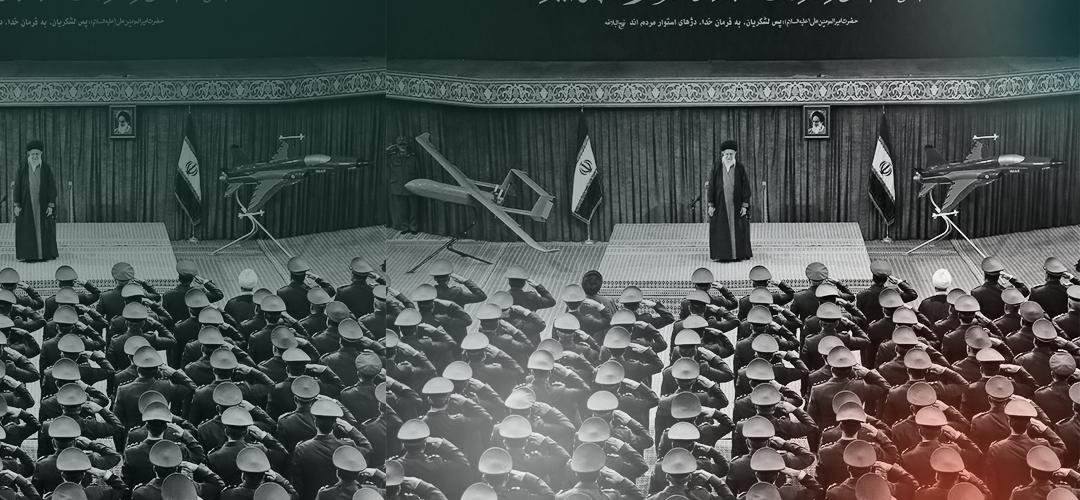
Perhaps the most consequential outcome of the 12-Day War was the accelerated erosion of Supreme Leader Ali Khamenei’s authority. The conflict arose at a time when questions of succession were already looming due to his age and declining health.
7 "Fact Check: How Big of a Lie Is the Guards’ Coronavirus Detector?” IranWire, April 18, 2020, https://iranwire.com/en/fact-checking/66940/.
8 Naimeh Namjoo, “Why Did Iran ‘Rapidly’ Lose Control of Its Airspace?” BBC Persian, June 23, 2025, https://www.bbc.com/persian/ articles/cq6mg4p3j4zo; Robert Czulda, “The Cost of Weakness: Iran’s Air Defense Failures in the Face of Israel,” MENA Research Center, September 23, 2025, https://mena-studies.org/the-cost-of-weakness-irans-air-defense-failures-in-the-face-of-israel/.
For decades, the regime carefully cultivated a cult of personality around the leader, casting him as a quasi-sacred, infallible figure.9 The humiliating military defeat of June 2025 shattered this image, exposing his miscalculations and strategic vulnerabilities. What had long been portrayed as invincibility now appeared fragile, shaking the confidence of even staunch loyalists. The fallout also disturbed parts of the regime’s social base, many of whom had internalized state propaganda that Israel would never dare attack Iran. The war’s outcome not only shattered that illusion but also created doubt among younger hardliners who once unquestioningly trusted Khamenei’s narrative of strength and dominance.
Part of the failure of his cult of personality was his disappearance from public view as soon as the war started. Once a dominant, handson figure, Khamenei largely disappeared from public view during the conflict, reportedly relocated to a secure bunker out of fear of assassination as Israel targeted Iran’s military and security elites. His absence is not physical but in terms of policymaking. For more than three decades, Khamanei has wielded power in Iran, becoming the man who interferes in any decision, no matter how small, such as selecting the name of a new car manufactured in Iran or ordering the cancellation of a television show that he dislikes. The fading of his presence in public has fueled speculation both inside and outside Iran about a possible power vacuum at the heart of the regime.10 The disappearance of Khamanei as the unifying axis of the state signaled the unraveling of the theocratic model of governance that had dominated since 1979.
The Decentralization of Decision-Making
After Khamenei disappeared from the public eye, his office, Bayt, attempted to maintain its grip on both the military-security establishment and the political class. The 12-Day War increased the importance of the unelected bodies, specifically the Supreme Leader’s office. It also led to more decentralization of power locally. According to Iran’s First Vice President Mohammad-Reza Aref, the Iranian government has officially delegated a range of executive authorities to provincial governors, marking a significant step toward administrative decentralization.11 At the beginning of the war, the Pezeshikan administration issued a directive transferring responsibilities formerly held by the Council of Ministers to provincial governors. These powers included issues of national security and broader national policymaking. Decisions made by provincial governors under this arrangement carry the same weight and validity as those made by the president and the cabinet. While ministerial and vice-presidential roles retain delegated authority, this shift aims to empower regional governance, reduce bottlenecks, and improve efficiency, decision-making, and service delivery by aligning governance with local needs.12
This delegation of power to local authorities is also evident in security issues, where the IRGC’s provincial units have gained more influence in maintaining the political order, preparing them for times when the central chain of command is disrupted, such as during war. Established in 2008, the IRGC Provincial
9 Saeid Golkar “The Developing Cracks in Khamenei’s Cult of Personality,” Washington Institute for Near East Policy, May 14, 2025, https://www.washingtoninstitute.org/policy-analysis/developing-cracks-khameneis-cult-personality.
10 “The Supreme Leader Is Fading into the Shadows,” The Economist, July 30, 2025, https://www.economist.com/middle-east-and-africa/2025/07/30/irans-supreme-leader-is-fading-into-the-shadows.
11 Iranian Students’ News Agency, “Aref: The Governor Can Be the Province’s President,” May 13, 2025, https://www.isna.ir/xdTpDD.
12 “Delegation of Powers to Governors by the President / Pezeshkian: Governors in Provinces Represent the President,” Khabaronline, July 8, 2025, https://www.khabaronline.ir/xnLkY.
Corps (Sepah-e Ostani) is responsible for localizing the IRGC’s authority and maintaining tighter control over Iran’s provinces.13 During the 12-Day War, these provincial corps actively controlled and surveilled Iranian society in fear of a mass uprising, ensuring the survival of the regime.14
Unifying Elite
Khamenei has also sought to reinforce elite cohesion around his regime following the 12-Day War, particularly in response to fears of internal fragmentation within the ruling establishment.15 A telling example is the recent appointment of Ali Larijani as the head of the Supreme National Security Council (SNSC). For much of the past four years, Larijani, once a central figure in the regime, had been politically sidelined. His candidacy for the presidency was twice disqualified by the Guardian Council, in both 2020 and 2024, signaling a sharp decline in his influence. Larijani’s return to a key post suggests that Khamenei is seeking to reintegrate marginalized elites and consolidate loyalty amid growing rifts among political, clerical, and security factions. His appointment as head of the SNSC reflects not trust but necessity—an effort to project unity, contain dissent, and signal a shift toward prioritizing state survival and economic recovery over ideological confrontation.
The SNSC is the top national security body responsible for shaping Iran’s security, defense, and foreign policies. Therefore, its restructuring represented an institutional manifestation of the broader recalibration of
the regime. The appointment of Larijani is also a sign of the supreme leader’s dissatisfaction with the previous head, Gen. Ali Akbar Ahmadian. The war and Iran’s weak response were partially seen as a failure of the SNSC and Ahmadian, a hardliner IRGC general.16
The reemergence of Larijani was facilitated partly by the weakening and elimination of hardline elites following the war. Most of the people who were assassinated, including IRGC commanders, belonged to the hardline camp of the Islamic Republic, including the head of the intelligence organization and his deputies, as well as the IRGC commander, Gen. Hossein Salami, people who engineered the disqualification and marginalization of pragmatist people like Larijani.
The elimination of the IRGC commander and the shrinking of its credibility embolden reformists to believe they have an opportunity to voice their concerns and call for a paradigm shift. A few days after the war, former Foreign Minister Mohammad Javad Zarif published an essay in Foreign Policy urging a major “paradigm shift” toward domestic reform and negotiation. There were similar calls for political openness, regime restructuring, and policy changes from other programmatic figures, such as former President Hassan Rouhani and the reformist front. Issuing an 11-point plan, they urged the regime to halt uranium enrichment voluntarily and allow International Atomic Energy Agency inspections in exchange for sanctions relief.17
13 Saeid Golkar, “Taking Back the Neighborhood,” The Washington Institute for Near East Policy, Policy Notes 81, June 4, 2020, https://www.washingtoninstitute.org/policy-analysis/taking-back-neighborhood-irgc-provincial-guards-mission-re-islamize-iran.
14 Kasra Aarabi and Saeid Golkar, “Why Don’t the Iranian People Rise Up?,” Foreign Policy, July 3, 2025, https://foreignpolicy. com/2025/07/03/iran-regime-security-military-israel-war/.
15 “Khamenei Calls for Unity as Hardliners Attack Iran’s Reformist Government,” Amwaj Media, July 17, 2025, https://amwaj.media/en/ media-monitor/khamenei-calls-for-unity-as-hardliners-attack-iran-s-reformist-government.
16 Saeid Golkar and Kasra Aarabi, “Ahmadian’s Appointment Completes Khamenei’s Purification Project,” Middle East Institute, June 6, 2023, https://www.mei.edu/publications/ahmadians-appointment-completes-khameneis-purification-project.
17 “Iran’s Reformists: Regime Should Voluntarily Halt Uranium Enrichment,” Asharq Al-Awsat, August 18, 2025, https://english.aawsat. com/world/5176289-iran%E2%80%99s-reformists-regime-should-voluntarily-halt-uranium-enrichment
Khamenei’s office and the IRGC media and affiliates have immediately denounced these proposals as treasonous and a capitulation to the West. These demands have also been met with fury from hardliners, including the head of Iran’s judiciary, a direct appointee by Khamenei. Mohseni Ezhei called it a statement in line with the enemy’s wishes in a situation where the enemy has invaded and continues to threaten the country.18 The IRGC political deputy also criticized Zarif and reformists, saying that they are the group that should change their ideas and join people in resisting America and Israel.19 Despite hope that the war might lead to moderation and normalization of the regime, the likelihood of this scenario remains slim thanks to hardliners in power.
National Security Council
As in the past, the regime’s response to any crisis involves both institutional change and personnel shifts. The 12-Day War led to the establishment of the National Defense Council, tasked with centralizing military planning, enhancing inter-agency coordination, and facilitating rapid crisis response.20 This was a critical decision. Initially, this council was created during the Iran-Iraq War and was replaced by the SNSC in 1989. Reconstituted in the aftermath of the June war, the National Defense Council, formed under the SNSC, reinforces the leadership’s push for a more agile, wartimeready structure capable of addressing both external threats and domestic instability. According to its charter, the council is chaired by the president. It is composed of the parliament speaker, the head of the judiciary, top military commanders, and ministers of
defense, intelligence, and foreign affairs. In brief, the new National Defense Council reflects the Islamic Republic’s priorities in addressing the vulnerabilities exposed in its defense system. This move suggests the Islamic Republic is less concerned with broad political reform and more focused on fortifying its command structure to survive future crises, preserve regime unity, and project resilience in the face of external pressure.
Shift Toward Nationalism
In addition to consolidating the elite and creating new institutions, the Islamic Republic sought to rally nationalist sentiment by portraying the war as a heroic stand against “Zionist aggression.” As its revolutionary legitimacy eroded, the leadership increasingly leaned on nationalism as an alternative source of authority, emphasizing Iranian pride, sovereignty, and historic victimhood. This marked a tactical and short-term shift away from clerical absolutism toward a more nationalist appeal aimed at unifying a fractured society.
A striking example came when the IRGC’s cultural branch launched a propaganda campaign linking the Islamic Republic to Iran’s pre-Islamic myths, which had long been suppressed under the regime since its inception in 1979. Central to this effort was the legend of Arash Kamangir, the archer who sacrificed his life to secure peace for his people by firing a divinely guided arrow that set the border between Iran and Turan. In state propaganda, after the 12-Day War, Arash was recast as launching missiles at Israel, symbolically positioning the Islamic Republic as the inheritor of ancient Iranian heroism and continuity in struggles against foreign
18 “Ejei: The Reform Front’s recent statement was in line with the enemy’s wishes,” Mehr News Agency, August 25, 2025, https:// www.mehrnews.com/news/6569879.
19 “General Javani: Who Should Return to the People?,” Basirat, August 24, 2025, https://tinyurl.com/yj6zf942.
20 Alexander Grinberg, “Iran’s New Defense Council Will Not Resolve Tehran’s Pressing Security Issues,” Jerusalem Institute for Strategy & Security, September 15, 2025, https://jiss.org.il/en/grinberg-irans-new-defense-council/.
enemies.21 Khamanei, a longtime critic of Iranian nationalism, tried to present himself as a nationalist by promoting patriotic songs over religious ones after the war. The IRGC even has, in some pieces published on its website, tailored its messaging to appeal to Iranian national pride.22
Yet this transformation carried risks. By diluting its revolutionary identity, the regime has weakened the ideological glue that had bound its hardline base for decades. Also, the gap between propaganda and lived reality was glaring for many Iranians who didn’t believe the regime’s propaganda. Ordinary Iranians criticized the leadership for both provoking confrontation and failing to defend the homeland.
That is why the regime has intensified political repression at home to tighten control over society. In the wake of a military humiliation, a regime often cracks down on internal dissent to project an image of strength, scapegoating intellectuals to distract from its own failures. According to reports by Amnesty International and Human Rights Watch, the Islamic Republic has launched a severe crackdown on its own citizens under the guise of national security. Over 20,000 people, including dissidents and activists, have been arrested, with targeting of ethnic and religious minorities who are being scapegoated as spies for Israel.23
Despite mounting pressure, the regime also sought to open up culturally and socially, for instance by organizing public music concerts. A leaked letter from the Ministry of Culture and Islamic Guidance reveals how the government attempted to use cultural
tools as instruments of social control. By coordinating concerts, theater performances, and street shows across urban and rural areas, the authorities sought to promote unity and mitigate social tensions. The ministry framed these artistic activities not merely as entertainment but as tools of national security.24
However, the initiative faced backlash from hardliners, ultimately leading to the dismissal of the deputy director for arts who had championed the program. Her removal underscores the hardliners’ ability to block even limited reforms and highlights the regime’s internal contradictions, where competing factions make it nearly impossible for new initiatives, no matter how small, to survive.
Future Scenarios for Iran
Iran is at a turning point. Nearly two months after the conflict ended in June, the Islamic Republic is struggling to recover from the war. The Supreme Leader described the situation as neither war nor peace, leaving the country and society paralyzed, bracing for another round of conflict since none of the issues that sparked Israel’s attack have been resolved.
The Islamic Republic still maintains its antiZionist stance, urging the Islamic world to unite and liberate Palestine. More than 400 kilograms of 60 percent enriched uranium has not been recovered. Although Iran’s missile program and Axis of Resistance have weakened, they are not entirely out of the picture and could be renewed if Iran finds the time and resources to do so. In fact, it is the
21 “Municipality installs banners of Arash Kamangir with rockets on the streets of Tehran; Iranian historical myths defend the homeland,” Khabaronline, April 14, 2024, https://www.khabaronline.ir/photo/1894975.
22 Patrick Clawson, “How Iran’s Turn to Nationalism Affects US Policy,” The Washington Institute for Near East Policy, July 8, 2025, https://www.washingtoninstitute.org/policy-analysis/how-irans-turn-nationalism-affects-us-policy.
23 Human Rights Watch, “Iran: Authorities Unleash Wave of Oppression After Hostilities with Israel,” Human Rights Watch, September 2, 2025, https://www.hrw.org/news/2025/09/02/iran-authorities-unleash-wave-of-oppression-after-hostilities-with-israel.
24 “Deputy Minister of Islamic Guidance: The National Security Council has approved holding street concerts,” Asriran, September 10, 2025, https://www.asriran.com/fa/news/1091533.
beginning of a post-shadow war era, where deterrence failures and ideological rigidity push adversaries into open warfare. In this situation, three potential scenarios emerge:
Limited Tactical Reform: Reformist pressures lead to minor changes, such as renewed nuclear negotiations, but hardliner dominance restricts their scope. In this scenario, Khamenei’s primary strategy for survival will be to tighten the belt, increase suppression, and wait for Donald Trump and Benjamin Netanyahu to leave office within the next three years. This might stabilize the regime temporarily, but it won’t resolve underlying tensions.
Prolonged Stagnation: The regime doubles down on repression and social manipulation, maintaining power but failing to address structural weaknesses. Since the Islamic Republic is institutionally paralyzed, and its leaders are not interested in changing their ideology, negotiation will not be fruitful because the regime lacks the desire to dismantle its nuclear program. This risks further isolation and economic decline.
Escalation and Collapse: Continued defiance, including unaccounted-for enriched uranium or a lack of genuine collaboration with the International Atomic Energy Agency, and rebuilding nuclear capabilities, could provoke further Israeli or US action, potentially triggering internal unrest or regime collapse. This is less likely but possible if elite cohesion fractures further.
Conclusion: Confused State, Paralyzed Society
The war exposed the Islamic Republic’s vulnerabilities, from its ineffective military to its eroding legitimacy. The regime’s response, repression, nationalism, reshuffling the elites, and institutional restructuring reflect a desperate bid for survival but cannot mask its declining competence and strategic isolation. The war marks the onset of a post-shadow war era, where deterrence failures and ideological rigidity risk further conflict. While reformist calls for change offer a glimmer of hope, hardliner resistance and systemic inertia suggest a trajectory of continued crisis. Iran’s future hinges on whether it can adapt to these pressures or succumbs to them, with profound implications for the region and beyond.
About the Author
Saeid Golkar is the UC Foundation Associate Professor of Political Science at the University of Tennessee at Chattanooga, specializing in the politics of authoritarian regimes, with a particular focus on Iran and the broader Middle East and North Africa. He earned his Ph.D. in Political Science from the University of Tehran and has previously held research and teaching positions at Stanford University and Northwestern University. Golkar is the author of Captive Society: The Basij Militia and Social Control in Post-Revolutionary Iran (2015), which received the Washington Institute’s Silver Medal Prize. His forthcoming book, Dictators and the Higher Education Dilemma, will be published by Rutgers University Press in Spring 2026.