Reordering Central Asia
China’s Emerging Economic Hierarchy
Edward Lemon
Bradley Jardine
Edward Lemon
Edward Lemon is the President of the Oxus Society for Central Asian Affairs and Research Assistant Professor at The Bush School of Government and Public Service, Texas A&M University, Washington D.C. Teaching Site. He is a Global Fellow at the Wilson Center and previously served as a Mellon Postdoctoral Fellow at Columbia University’s Political Science Department. He received his doctorate in Politics and International Relations from the University of Exeter in 2016. His research focuses on authoritarianism and security in Central Asia, with over three years of fieldwork across Tajikistan, Kazakhstan, Kyrgyzstan, and Russia. He edited Critical Approaches to Security in Central Asia (Routledge, 2018) and has published in Democratization, Central Asian Affairs, Caucasus Survey, Journal of Democracy, and The RUSI Journal.
Bradley Jardine
Bradley Jardine is the Managing Director of the Oxus Society. He manages the Oxus Society’s research portfolio and is a Fellow at the Wilson Center’s Kissinger Institute on China and the United States. His journalism background includes roles as Moscow Times editor and Caucasus correspondent for Eurasianet, covering Armenia’s Velvet Revolution. He holds dual master’s degrees in Russian and Eurasian Studies and Baltic Sea Region Studies from the University of Glasgow, plus an MMS in Global Affairs from Tsinghua University. His research examines surveillance technology proliferation in Central Asia and China’s expanding security role in former Soviet territories. He authored the Kennan Institute monograph Great Wall of Steel: China’s Strategy to Secure Central and South Asia. His byline appears in the Washington Post, Guardian, Wall Street Journal, Foreign Policy, BBC, CNN, New York Times, Atlantic, and TIME
Introduction
For much of the post–Cold War period, Central Asia was framed as a space of SinoRussian coordination, institutionalized through the Shanghai Cooperation Organization (SCO) and underwritten by a tacit division of labor: Russia provided security, and China delivered mutually beneficial capital.1 That division, which was an oversimplification of their roles, has nonetheless been rapidly eroding since Russia’s full-scale invasion of Ukraine in 2022. Since then, Beijing has accelerated a strategy of economic and technological consolidation that increasingly sidelines Moscow—not through confrontation, but through structural redundancy. Rather than co-managing the region with Russia, China is now building parallel corridors, technological dependencies, and trade architectures that make Central Asia progressively less reliant on Moscow.
China’s core economic interests in Central Asia can be understood as a layered effort to secure overland connectivity, access critical resources, and reshape regional economic structures to support its broader strategic trajectory. The region serves as a vital corridor linking China’s western provinces, particularly Xinjiang, to markets in Europe and the Middle East, thereby reducing reliance on vulnerable maritime routes. At the same time, Central Asia provides important sources of energy and critical minerals, with pipelines from Kazakhstan and Turkmenistan playing a key role in diversifying China’s hydrocarbon imports. Beyond transit and extraction, Beijing has increasingly sought to embed itself
within local economies through infrastructure financing, industrial relocation, and digital connectivity, positioning Chinese firms at the center of logistics, telecommunications, and manufacturing networks. The result is a growing, though uneven, pattern of economic integration that both deepens regional interdependence and reshapes the balance of economic influence across Central Asia.
China’s core economic interests in Central Asia can be understood as a layered effort to secure overland connectivity, access critical resources, and reshape regional economic structures to support its broader strategic trajectory.
The report will begin by assessing the extent of Russia’s relative economic decline in Central Asia and examining the structural factors likely to constrain any meaningful resurgence. While Moscow retains important historical, security, and cultural linkages across the region, its economic footprint has weakened relative to China. The analysis highlights how limited capital, technological constraints, and shifting regional priorities have reduced Russia’s ability to compete as a driver of trade, investment, and infrastructure development. Taken together, these dynamics suggest that Russia’s role is likely to persist, but in a diminished and increasingly secondary capacity within Central Asia’s evolving economic landscape.
The study then outlines the expansion of Belt and Road rail corridors, the development of the Trans-Caspian “Middle Corridor,” and the growing eastward energy exports, which are reorienting supply chains toward Chinese markets. This emerging architecture represents more than incremental diversification; it signals a structural realignment in which Beijing is embedding Central Asia into China-centered trade networks.
The report also examines China’s expanding technological footprint as a deeper and more durable vector of Beijing’s influence on the region. Chinese firms now anchor much of Central Asia’s telecommunications backbone, fiber-optic networks, smart-city platforms, AI-enabled surveillance systems, and e-governance infrastructure. This shift is not merely commercial since it reshapes standards-setting power, data governance frameworks, cybersecurity dependencies, and long-term training ecosystems. Over time, these technological dependencies create path dependence that is far more difficult to unwind than shifts in trade volume or diplomatic alignment.
China’s Economic Rise in Central Asia
After the collapse of the Soviet Union in 1991, Russia held a near-monopoly over trade with the former Soviet republics. Almost all the region’s infrastructure, its roads, pipelines, and railways, were centered on Moscow. But over time, Russia’s monopoly has been eroded. By 1995, trade with Russia had fallen to 58 percent of the regional total.2
This decline continued over the next two decades as the region engaged with other partners and developed new pipelines and trade corridors, most notably with China. By 2015, trade with Russia was 16 percent of the regional total.3 Since Russia’s invasion of Ukraine in 2022, trade surged to reach $51 billion in 2025 or 19 percent of the region’s external trade.4 But this uptick is contingent on Russia’s continued aggression towards Ukraine; should sanctions be lifted then trade will decrease sharply.
Meanwhile, in 2025, trade between Central Asia and China reached a record high of $106.3 billion according to Chinese government data.5 This was an 11 percent increase compared to 2024 and represented a threefold increase over the past decade. Kazakhstan is Beijing’s largest partner, accounting for almost half of China’s trade ($48.7 billion). China is the largest trade partner for each of the region’s five republics. Levels of dependence on trade with Beijing vary across the region, with Turkmenistan the most dependent due to its significant gas exports to Beijing (see Table 1).
As Table 1 on the next page shows, there are vast discrepancies between the trade figures offered by Beijing, which seeks to reaffirm China’s position as the world’s largest trader, and those offered by the Central Asian republics, which seek to downplay their reliance on their eastern neighbor. These discrepancies were most stark in Kyrgyzstan, where both figures are likely wrong. It is likely that the figure lies between the two, with the Kyrgyz government trying to cover up the
Table 1: China’s Trade with Central Asia (2025)
i Carly Brant and Sean Kearin, “China Reinforces Its Trade Dominance in Central Asia, but Numbers Don’t Always Align,” Eurasianet, January 26, 2026, https://eurasianet.org/china-reinforces-its-trade-dominance-in-central-asia-but-numbers-dont-always-align. ii Carly Brant and Sean Kearin, “China Reinforces Its Trade Dominance in Central Asia.”
iii “Стала
[The Amount of Customs Discrepancies Between Kyrgyzstan and China in 2025 Has Been Revealed],” Kaktus.media, February 23, 2026, https://kaktus.media/doc/541167_stala_izvestna_symma_tamojennyh_rashojdeniy_kyrgyzstana_i_kitaia_v_2025_gody.html.
iv “Внешняя торговля Таджикистана выросла на 20,2%, достигнув $10,7 млрд
2025 году [Tajikistan’s Foreign Trade Increased by 20.2%, Reaching $10.7 Billion in 2025],” StanRadar, February 12, 2026, https://stanradar.com/news/full/59258-vneshnjaja-torgovlja-tadzhikistana-vyrosla-na-202-dostignuv107-mlrd-v-2025-godu.html.
v “China’s Trade Dominance in Central Asia Hits New Heights,” Caliber.az, December 12, 2025, https://caliber.az/en/post/china-s-trade-dominance-in-central-asia-hits-new-heighthets.
Table 2: Trade (Im)Balancesi
i Carly Brant and Sean Kearin, “China Reinforces Its Trade Dominance in Central Asia.”
smuggling of goods into Russia through its territory. One estimate from 2022 claimed that $60 billion in Chinese goods were smuggled into Kyrgyzstan over a 20-year period.6
This has only increased as Central Asia has become a hub for Russian sanctions evasion. China is a central player, using the region to send dual-use goods, spare parts, and military resources to Russia.7 Trade with China spiked by 44 percent in 2022 as Russia was hit with sanctions following its invasion of Ukraine.8 Chinese exports to Kyrgyzstan skyrocketed by 178 percent, while exports to Russia more than doubled. Military products are exported to Central Asia, reclassified as consumer goods, routed through shell companies, settled in financial institutions in third countries, and then re-exported to Russia to conceal the sanctions evasion.9 Kazakhstan, with its large border with Russia and developed financial sector, and Kyrgyzstan, with its high levels of corruption, have become the key nodes in these networks. In 2022 alone, Kyrgyzstan saw exports of “nuclear reactors, boilers, and machines” increase by 41,105 percent, and metals increase an astounding 1,245 times.10 This increase in imports from China has only exacerbated trade imbalances, as shown in Table 2.
The story with investments is similar. There are more than 11,000 enterprises with Chinese capital operating in the region.11 China is the leading investor in Central Asia, with stock investments standing at $36 billion.12 Traditionally, the lion’s share of this capital has flown into the region’s resourcerich largest economy, Kazakhstan, which
still hosts the largest investments of $11.4 billion.13 China is currently implementing 224 projects in Kazakhstan worth $66.4 billion, employing 50,000 people.14 But Chinese investment in Uzbekistan has also surged as the country has opened up under President Shavkat Mirziyoyev, who came to power in 2016 to replace the isolationist policies of his predecessor, Islam Karimov. Since 2016, FDI from China has swelled from $300 million to $10.7 billion in 2025.15 According to Uzbekistan’s National Statistics Committee, China accounted for nearly 40 percent of all foreign investment and external financing absorbed by the country in 2025.16
Gas-rich Turkmenistan is the other major destination for Chinese investments, with $9.5 billion in current investments.17 Energy is at the center of investments. In 2006, Turkmenistan granted the China National Petroleum Corporation exploration rights to its gas fields. They also signed an agreement to construct a network of pipelines linking the countries with a capacity of 85 billion cubic meters (bcm), the first of which opened in 2009. But in recent years, efforts have been made to diversify.
A March 2026 meeting between former President Gurbanguly Berdimuhamedow and Chinese leader Xi Jinping led to a pledge to expand investments “in non-resource fields, including connectivity, agriculture, artificial intelligence, digital economy, and clean energy.”18
Alongside this growing investment, debts have been rising. Public external debt now stands at around one quarter in Kazakhstan, one third in Uzbekistan, and half of GDP in
Kyrgyzstan and Tajikistan.19 This is a particular problem for Kyrgyzstan, where debt service now absorbs between 18 and 22 percent of government revenues. In Tajikistan, the story is similar. Loans from China partially explain their growing indebtedness; 30 percent of Kyrgyzstan’s external debt20 and over a quarter of Tajikistan’s are owed to China Eximbank.21 These figures have lowered over the past five years as the countries have taken on a wider array of creditors. Yet China has not been shy about leveraging these debts to extract rewards. As debts to China peaked in 2019, Tajikistan’s Committee on Investments and State Property inked a secretive 20-year deal giving China’s Kashgar Xinyi Dadi Mining Investment Company a license to develop the Yakjilva silver deposit in the remote eastern district of Murghob.22
Upstream Control and Industrial Integration
Central Asia is one of the world’s most critical mineral-rich regions and has been actively leveraging its substantial resource wealth to engage major economies. Notably, the region has engaged in a flurry of diplomatic engagements with the United States in recent years by playing up the importance of its supplies in the emerging AI arms race between China and the United States.23
Part of the region’s motivation is to break its growing dependence on China.
Beijing’s interest in Central Asia’s critical minerals is rooted in the need to secure reliable upstream inputs for its industrial and energy transition supply chains, and this has translated into a growing on-the-ground presence across the region. Kazakhstan sits
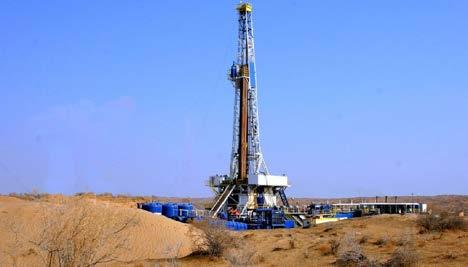
A rig at the Uzynada field in Turkmenistan. (turkmengaz.gov.tm)
at the center of this effort: it hosts significant rare earth deposits and remains a major producer of uranium and copper, resources that are increasingly tied to Chinese demand and investment.24 At the same time, trade flows have deepened. Central Asia has become an important supplier of industrial metals—such as copper, zinc, and rare earthrelated materials, with China accounting for just under half of critical mineral exports according to the Oxus Society’s Central Asia Resource Tracker.25 This helps China cement its dominance of the global market for critical minerals. China accounts for around twothirds of global critical mineral extraction domestically and through mining operations abroad.26 It imports critical minerals to refine, accounting for 90 percent of global separation and processing. Taken together, these patterns point to a clear trajectory—one in which Central Asia is becoming more tightly integrated into the lower tiers of China’s industrial value chains, even as competition over these resources intensifies.
The region has also seen some eye-opening discoveries in recent years. In early April 2025, geologists in Kazakhstan announced the discovery of a mineral field in the Karaganda region with an estimated one to twenty million metric tons of rare-earth elements.27 Minerals included neodymium, cerium, lanthanum, and yttrium, found in magnets, electric cars, wind turbines, and smartphones. If proven, this would make Kazakhstan the third-largest source of critical minerals in the world. Central Asia’s reserves are extensive, as shown in Table 3.
Kazakhstan is already a global critical minerals powerhouse, with 5,000 deposits valued at $46 trillion by the World Bank.28 It hosts the lion’s share of the deposits listed in Table 3. Kazakhstan has been the world’s largest uranium producer since 2009, supplying over 40 percent of the world’s uranium in 2025.29 In addition to those listed in Table 3, Kazakhstan has significant deposits of nickel (1.5 million tons, in the top 20 globally), gallium, dysprosium, terbium, lanthanoids, used in data storage, electronics, lasers, electric vehicles, as well as niobium, zirconium, rhenium, tungsten, used in construction, electronics, aerospace, superconductors, and manufacturing. Kazakhstan’s rare earth mineral exports have nearly quintupled since 2020.30 Mining is a central pillar of the country’s economy, accounting for 12 percent of GDP and one third of export revenues.31
Kazakhstan’s rare earth mineral exports have nearly quintupled since 2020.
While Kazakhstan is the country with the most critical minerals, other countries in the region boast their own in-demand deposits. Turkmenistan, which hosts the fifth-largest natural gas reserves, also has abundant reserves of critical minerals, including sulfur (17th-largest producer), bromine, and iodine (sixth-largest reserves), which are essential to various industries, including clean energy technologies. Mountainous Tajikistan,
Table 3: Critical Mineral Reserves in Central Asiai
Manganese ore 38.6%
Uranium 31%
Chromium 30.1%
Antimony 24%
Lead 20.0%
Zinc 12.6%
Titanium 8.7%
Aluminum 5.8%
Copper 5.3%
Cobalt 5.3%
Molybdenum 5.2%
Stainless steel, aluminum alloys, rechargeable batteries (lithium-ion), fertilizers, animal feed
Nuclear power
Stainless steel, chromium plating
Flame retardant in plastics and textiles, semiconductor manufacturing, solar panels, and liquid metal batteries
Lead-acid batteries, radiation shielding, building materials, solder, electronics, ammunition, cable sheathing
Galvanizing steel and iron, die-casting, producing industrial alloys (brass, bronze), batteries
Aerospace, medical implants
Transportation (aircraft, automobiles), packaging (cans, foil), construction (windows, doors, facades), electronics (laptop casings, smartphone bodies), power transmission
Electrical wiring, plumbing, and industrial machinery
Lithium-ion batteries for electric vehicles (EVs), smartphones, and laptops
Strengthening steel and superalloys
i R. Vakulchuk and I. Overland, “Central Asia is a missing link in analyses of critical materials for the global clean energy transition,” One Earth, 4, 1678-1692.
meanwhile, has significant mineral resources, with over 600 documented deposits of around 50 minerals, including silver, gold, lead, lithium, nickel, and zinc.32 However, these resources are located in hard-toreach and remote areas, creating significant barriers to their effective development. It is the second-largest producer, accounting for one quarter of global production, and holds the 11th-largest reserves of antimony, a vital material for batteries and various defense technologies.
Kyrgyzstan has significant reserves of antimony (13 percent of global reserves, the fourth-largest in the world), beryllium, bismuth, copper, tungsten, fluorine, lithium, cobalt, manganese, gallium, indium, graphite, uranium, and molybdenum. Gold accounts for 40 percent of Kyrgyzstan’s export revenues.33 Uzbekistan holds significant, largely untapped deposits of critical minerals— including tungsten, copper, lithium, vanadium, scandium, yttrium, niobium, tantalum, uranium (top-10 producer), rhenium, molybdenum, graphite, titanium, and germanium. In March 2025, the government announced a $2.6-billion initiative to develop the country’s substantial mineral resources at 76 sites.34
With such mineral wealth, Central Asia has become fiercely contested by external powers seeking to secure its resources and develop independent supply chains.35 As demand for nuclear energy surges, uranium is becoming a key commodity for the region. Russia retains a firm grip on Central Asia’s uranium sector by pairing upstream ownership with dominance over enrichment. Of Kazakhstan’s 13 uranium mining projects, three are wholly-
owned by Kazatomprom and 10 are joint ventures with foreign equity holders, four of which are controlled by Uranium One, a subsidiary of Rosatom.36 Chinese-owned SNURDC Astana Mining Company Limited bought Uranium One’s stakes in two further deposits, Zarechnoye and Kharasan, in 2024.37 After Kazakhstan elected to develop a nuclear energy program in 2024, Rosatom was chosen to lead a consortium constructing the country’s first nuclear power plant.38 Russia also has a stranglehold on enrichment, controlling 40 percent of global capacity, and processing almost half of processing.39 Half of EU uranium imports come from Kazakhstan via Russia.40 This creates a clear bottleneck: even where extraction is locally controlled, processing still runs through Russian facilities. In 2024, 40 percent of uranium exports went to Russia.41
With such mineral wealth, Central Asia has become fiercely contested by external powers seeking to secure its resources and develop independent supply chains.
China, the world’s second-largest producer of nuclear energy, has moved primarily into mining, securing equity stakes and long-term supply for its expanding nuclear sector. China has been laying the groundwork to surpass Russia, buying its stakes in uranium deposits and securing contracts that mean that it now controls almost 60 percent of future Kazakh
production.42 China General Nuclear Power Group (CGNPC) entered the market in 2006 and controls a majority stake in the Mynkuduk and Zhalpak deposits. It also holds minority shares in Semizbay-U, as well as Ortalyk.43 China is investing in processing capacity as well. Joint venture the Ulba-FA plant produces 200 metric tons of low-enriched uranium annually, enough to fuel six Chinese reactors.44 China now accounts for 39 percent of uranium exports from Kazakhstan and looks set to overtake Russia in the near future.45 This reliance on Russia and China creates vulnerabilities for Kazakhstan.
Kazakhstan has tried to diversify, pursuing partnerships with Western and Asian firms and exploring alternative export routes. The United States, Canada, and France collectively accounted for 19 percent of Kazakh exports in 2024, with the share roughly evenly divided among them. In March 2026, President Emmanuel Macron of France called on Kazakhstan to boost exports to the European Union.46 KATCO, a joint venture between Orano Mining of France and Kazatomprom, will help boost production, undermining Russia’s near monopoly. But barriers to exporting uranium remain, not least the need to avoid dependence on sanctioned Russia for processing and transit.
China’s growing presence in Central Asia’s mining sector reflects a deliberate effort to secure upstream control over critical minerals while integrating the region into its broader industrial supply chains. In Central Asia, this has translated into both formal investment and operational control. Chinese firms hold a significant share of mining licenses in
countries such as Kyrgyzstan and Tajikistan and have expanded their footprint across a range of mineral sectors, while China imports just under half of the region’s critical mineral exports according to the Central Asia Resource Tracker.47
China’s growing presence in Central Asia’s mining sector reflects a deliberate effort to secure upstream control over critical minerals while integrating the region into its broader industrial supply chains.
Nowhere is this more visible than in Uzbekistan, where Chinese companies have moved aggressively into both extraction and processing. Firms such as China Mining Energy Group and China Baoli Technologies are involved in multiple projects, including a $200 million copper mining and processing facility in Namangan and a non-ferrous metals plant in the Ipak Yuli Free Economic Zone.48 Additional projects remain in the pipeline, including a proposed $2.7 billion development of copper and silver deposits in the Bobotog area and a series of joint ventures targeting tungsten, molybdenum, and copper extraction in the Samarkand region.49 These investments reflect a clear focus on minerals, particularly copper and iron ore, as China remains structurally import-dependent and seeks to diversify supply chains away from more
exposed global sources. Navoiyuran, a stateowned uranium producer in Uzbekistan, is in talks with China Nuclear Uranium on the development of two mines, Jantuar and Madanli.50
Kazakhstan has likewise become a central node in China’s mineral strategy, particularly in copper, tungsten, and chromium. In 2024, Astana and Beijing agreed to construct a $1.5 billion copper smelting facility, while the launch of a tungsten production plant in partnership with Jiaxin International Resources Investment marked a further step toward downstream integration.51 Chinese firms are also moving into highervalue processing segments, including a $150 million investment by Suzhou Hunan New Materials to develop chrome ore processing capacity in the Aktobe region.52
These projects build on an already dense trade relationship: China accounts for a significant share of Kazakhstan’s mineral exports, around $4.3 billion annually, and absorbs the overwhelming majority of certain outputs, including nearly all tungsten ores and concentrates.53
In Tajikistan, the least developed country in the region, Chinese involvement has been especially pronounced in strategic minerals such as antimony and gold. Over one third of mining operations in the country operate with Chinese capital.54 China controls 75 percent of Tajikistan’s gold production.55 The Sovietera Saritag antimony mine, now operated through a joint venture between Tajik and Chinese entities, produces over 5,000 tons of concentrate daily and is undergoing further expansion through a $359 million Chinese-
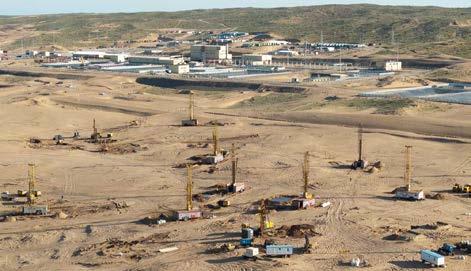
In southern Kazakhstan, South Tortkuduk is part of the Muyunkum uranium deposit, which is already mined by KATCO and has considerable reserves of 46,000 tons of uranium. (Orano Group)
backed purification project designed to move production further up the value chain.56 Yet Tajikistan exports 78 percent of its antimony to China for processing, constrained by limited infrastructure.57 This gives China the ability to drive a hard bargain with Tajikistan and the benefit of selling the processed product, which offers higher profit margins.
Elsewhere, China dominates the Kyrgyz market, importing half its antinomy, and 40 percent of its gold. Over 100 companies with Chinese participation work in Kyrgyzstan’s mining sector, controlling one quarter of the mines in the country.58 China imports a plurality of Turkmenistan’s critical minerals, including one third of its iodine and three quarters of its sulfur.59
Due to historical ties, Russia was the main importer of minerals from Central Asia in the 1990s and the 2000s. But over the past 15 years China has surpassed it. Russia now lags behind China in the extraction and processing of critical minerals apart from uranium, chromium, manganese, titanium and rhenium. Its critical minerals imports from the region account for one quarter of the total.60 Russian companies own majority shares in two mines in Kyrgyzstan and just one in Uzbekistan.61 It is only a major player in Kazakhstan. Roughly 16 percent of Kazakhstan’s total mineral exports are exported to Russia (compared to 27 percent sent to China).62 Russia plays a key role in processing; almost all uranium is processed there before international shipment, as well as significant amounts of copper, zinc, and aluminum (bauxite).63 But its role in the critical minerals sector across the region is eclipsed by China.
Taken together, these developments point to a consistent pattern. Chinese engagement in Central Asia’s mining sector is not limited to extraction but increasingly spans the full value chain, from upstream resource acquisition to downstream processing and industrial integration. This approach allows Beijing to reduce supply vulnerabilities, secure longterm access to critical inputs, and embed regional producers within China-centered production networks, even as it deepens local dependencies on Chinese capital and markets.
From Extraction to Production
China’s relationship with Central Asia is simultaneously shifting from pure resource extraction to localized production and industrial integration. This transition reflects both economic logic and strategic intent: producing closer to end markets lowers costs, reduces exposure to trade frictions, and embeds Central Asian economies more deeply within China-centered supply chains.
The most visible example of this shift is in the automotive and electric vehicle (EV) sector. In Uzbekistan, Chinese-backed facilities have moved from planning to operation, with production underway at a $160 million plant linked to BYD.64 Uzbekistan was not chosen randomly. It already had a flourishing automotive industry. South Korea-based Daewoo opened a plant in Asaka in Uzbekistan’s Fergana Valley in 1996. GM Uzbekistan, a subsidiary of USbased General Motors, took over the factory in 2008, employing 10,000 people and producing 250,000 units a year.65 Kazakhstan
is following a similar trajectory, with Chinese firms including Great Wall Motor, Changan, and Chery advancing plans for local assembly and manufacturing.66 These investments are not aimed solely at domestic consumption. Instead, they position Central Asia as a regional production hub serving neighboring markets, including Russia, the Caucasus, and parts of the Middle East.
This industrial push is reinforced by changing consumption patterns. In Uzbekistan, electric vehicles now account for a growing share of imports (seven out of every ten passenger cars entering the country), with Chinese brands dominating the market. China exported over $1 billion worth of electric vehicles to the country in 2024 alone, underscoring both demand and the depth of commercial ties.67 As local production capacity expands, these trade flows are likely to evolve into more integrated manufacturing ecosystems.
Alongside physical production, China is investing in the human capital needed to sustain this transition.
Alongside physical production, China is investing in the human capital needed to sustain this transition. The expansion of Luban Workshops across Kazakhstan, Kyrgyzstan, Tajikistan, and Uzbekistan reflects a deliberate effort to train local workers in technical fields tied to Chinese-led industries, including
EV maintenance, automation, logistics, and AI. Unlike earlier educational initiatives focused on language and cultural exchange, these programs are explicitly aligned with labor market needs and industrial policy. They equip local workforces with practical skills while familiarizing them with Chinese technologies, standards, and operational practices.
At a September 2025 meeting between Xi and Kazakh President Kassym-Jomart Tokayev, the pair announced the opening of two new Luban Workshops in the Central Asian country.68 Over the past two years, Beijing has launched a flurry of these technical training centers (named after a legendary Chinese craftsman) in Kazakhstan, Kyrgyzstan, Tajikistan, and Uzbekistan. While much of Beijing’s engagement with the region has focused on the extraction of critical minerals and energy resources and construction of infrastructure, the Luban initiative spearheaded by the Tianjin municipality, is a marked shift: an effort to win hearts and minds by equipping local youth with high-demand skills in AI, logistics, electric vehicle maintenance, hydropower, and automation, which helps Central Asia move up the value chain.69
Unlike the earlier wave of Confucius Institutes, which faced criticism for pushing Chinese state narratives rather than addressing practical concerns, the Luban Workshops offer tangible value: certified skills in fields that matter to local economies. They create pathways for young Central Asians to participate in high-tech sectors that are otherwise dominated by foreign
labor, and they subtly acclimate them to Chinese technological standards, tools, and educational norms.
Taken together, these developments mark a clear shift in the structure of China’s engagement with Central Asia. The region is no longer treated solely as a source of raw materials or a transit corridor, but as a site of production embedded within broader Chinese industrial networks. This deepens economic integration while extending China’s influence beyond trade and investment into the organization of production itself.
Financial Integration
China’s growing economic presence in Central Asia is increasingly accompanied by efforts to expand the use of the renminbi (RMB) and embed regional financial systems
within Chinese-led monetary and payment infrastructures. This push reflects a broader strategic objective: to reduce reliance on the US dollar, insulate Chinese firms from external financial pressure, and facilitate crossborder trade and investment through RMBdenominated channels. At the global level, China now settles nearly one-third of its $6.2 trillion in trade in yuan, up from roughly 20 percent in 2022, while continuing to expand institutional mechanisms such as the CrossBorder Interbank Payment System (CIPS), which by early 2026 counted 193 direct and 1,573 indirect participants.70 However, China still remains far behind the United States.
According to the International Monetary Fund, the dollar still accounts for around 50 percent of global reserves, while the yuan holds roughly 2–3 percent. These developments provide the structural foundation for deeper financial integration with Central Asia.
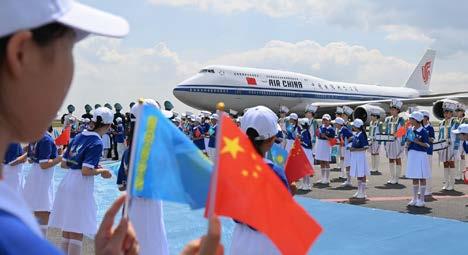
A welcome ceremony for President Xi Jinping upon his arrival in Astana for a June 2025 visit. (X via @aqorda_press)
The latest development is China’s plan to issue yuan-denominated bonds. The region’s economic powerhouse, Kazakhstan, is at the forefront of these developments. Yuandenominated loans have been issued in the past year. Kazakhoil producer KazMunayGas National raised 1.25 billion yuan ($182 million) in October 2025.71 Five months before, ForteBank secured a 750 million yuan ($109 million) loan, the first-ever Chinese yuandenominated syndicated loan secured by a commercial bank in Kazakhstan. The agreement noted the funds were intended for “fostering business flows with China.”
A number of developments help explain the rise of yuan loans in Central Asia. Lower interest rates in China have made yuandenominated financing more attractive than US dollar equivalents. Coupled with this, as trade and joint projects increase, there is an increased need for yuan liquidity.72 China has also been expanding its bond issuance in Central Asia. In September, the Development Bank of Kazakhstan (DBK) raised 2 billion yuan ($291 million) on Hong Kong’s offshore market through a dim sum bond issuance.73 This was the first-ever yuan bond offering by a Central Asian issuer. Kazakhstan’s government is planning to sell its first yuandenominated “panda” bond worth $500 million in 2026.74
Yet China has a long way to go before it can supplant the dollar. Even in Kazakhstan, which is at the forefront of China’s yuan push, yuanrelated transactions grew from the equivalent of $592 million-worth of sales in 2023 to $2.7 billion in 2025, whereas dollar sales grew
from $38.6 billion to $75 billion, an almost thirty-fold discrepancy.75 This reflects global trends, where although the yuan is gaining on the dollar, it still lags far behind, accounting for only 5 percent of foreign currency sales, compared with the dollar’s 75 percent.
Energy and Infrastructure
China’s engagement with Central Asia’s energy sector reflects a sustained effort to reorient the region’s resource flows eastward, reducing reliance on traditional Soviet-era infrastructure and embedding Central Asian producers within Chinacentered supply chains. Since the late 1990s, Beijing has pursued a strategy that combines upstream investment, long-distance pipeline construction, and complementary transport infrastructure to physically and structurally redirect hydrocarbons toward Chinese markets. The result is not simply diversification, but a gradual reconfiguration of the region’s energy geography.
This process began with large-scale pipeline diplomacy. China’s first major project in Central Asia, the Kazakhstan–China oil pipeline, was agreed in 1997 and became fully operational in 2009, stretching roughly 1,380 miles and capable of transporting 10 million tons of oil annually. This was followed by the far more consequential Central Asia–China gas pipeline network, launched in 2009 after a 2006 agreement with Turkmenistan. Designed as a multi-line system with a combined capacity of approximately 85 billion cubic meters (bcm) of gas per year, the pipeline has become one of the most
important energy corridors linking Central Asia to China, with Turkmenistan now ranking among Beijing’s largest external gas suppliers.
Russia was the number one buyer of Turkmen gas until 2010, when the Central Asian nation began exporting to China. Russia was the number one buyer of Turkmen gas until 2010, when the Central Asian nation began exporting to China. Russia then cut back imports and halted them completely in early 2016, contributing to a drop in Turkmenistan’s hard currency revenue. They resumed briefly in 2019. Turkmenistan stopped exporting natural gas to Russia on June 30, 2024, following the expiration of a five-year contract and the failure to reach new pricing terms with Gazprom. Together, these projects have provided China with direct overland access to hydrocarbons while bypassing Russiancontrolled transit routes that historically dominated the region.
Alongside infrastructure development, Chinese firms have expanded their upstream presence in key producing states.
Alongside infrastructure development, Chinese firms have expanded their upstream presence in key producing states. In Kazakhstan, Chinese companies now control approximately one quarter of national oil production, reinforcing their ability to influence both extraction and export patterns, even as a significant share of output (over
80 percent) continues to flow westward via the Caspian Pipeline Consortium. Since 2022, Kazakhstan’s primary export route via the CPC pipeline has faced repeated disruptions—including storm damage, courtordered suspensions, and inspection-related shutdowns—documented across multiple Reuters reports, underscoring the vulnerability of export dependence on Russian transit infrastructure and the need to diversify in favor of partners such as China.76
More recently, China has extended this strategy into the renewable energy sector, positioning itself not only as a consumer of Central Asian energy but also as a central actor in shaping its future production mix. Since around 2018, Chinese involvement has shifted from large hydropower projects toward wind and solar development across the region. Flagship projects include the 100 MW Zhanatas wind farm in Kazakhstan, large-scale solar installations in Uzbekistan’s Andijan, Navoi, and Tashkent regions, and a growing pipeline of projects in Kyrgyzstan and Tajikistan backed by Chinese financing and engineering firms.77 Agreements signed between 2023 and 2024 alone encompass several gigawatts of planned capacity, including a 2,000 MW solar program in Uzbekistan and major wind investments exceeding $2 billion.78
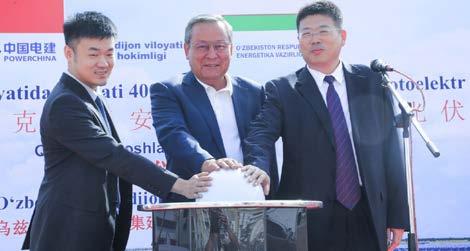
In April 2024, work started on a 400 MW solar plant in Balykchy, Kyrgyzstan, on the shore of Lake Issyk-Kul.79 A Chinese consortium was providing $400 million for the plant’s construction. Also in April, Uzbek President Mirziyoyev participated in the launch ceremony for a 500 MW solar power plant in Jizzakh Province that China
Poly Group and China Electric are building at a cost of $350 million.80 While these projects support regional decarbonization goals, they also deepen technological and financial dependence on Chinese firms, which dominate project development, financing, and equipment supply. Other major renewables deals have also been signed across the region in recent years.
These energy investments are closely tied to broader infrastructure initiatives that facilitate eastward integration. Railways such as the Angren–Pap line in Uzbekistan, the expansion of logistics hubs like the Khorgos Gateway dry port, and the construction of the China–Kyrgyzstan–Uzbekistan railway, long envisioned and now underway, serve to connect energy-producing regions with Chinese markets more efficiently.81 Kazakhstan is significantly expanding its
railway connections with China to boost trade, primarily through the new Ayagoz-Bakhty line and border crossing, expected by early 2028.82
Digital Infrastructure and Information Control
As Central Asian states look to deploy AI for economic development and improved governance, China has positioned itself as an active partner. In Kazakhstan, for example, the Academy of Sciences secured a $143 million investment from Zhejiang University of Technology to establish a Laboratory of Spatio-Temporal Artificial Intelligence and Sustainable Development. The project aims to develop AI capacity and boost computing speeds. Chinese tech company LinkWise is partnering with Uzbekistan’s Ministry of Digital
President of the Republic of Uzbekistan Shavkat Mirziyoyev with President of the People’s Republic of China Xi Jinping on a 2023 visit. (Office of the President of Uzbekistan)
Technologies to build a Modular Intelligent Computing Center and plans to open two data centers in the country.83 These moves address local needs and move China beyond extraction towards more valuable investments.
On the technological front, China has been leveraging its tech know-how and scale to rewire Central Asia, creating significant information asymmetries. Under the framework of an “information panopticon,” states like China can supercharge their information-gathering and informationgenerating activities by utilizing wide networks of semiprivate actors. The state with the most control over information hubs maintains a strategic advantage, using its privileged information sources to counter rivals and negotiate from a position of strength.
Beijing has been achieving these goals in Central Asia in a number of ways. It has rewired global information flows within its Digital Silk Road (DSR) framework.84 A major node in this project is the “smart city,” a catch-all term for cities with advanced dataprocessing capabilities. These projects also have a security dimension. For example, Kyrgyzstan opened a new police command center in its capital, Bishkek, which makes use of facial recognition software supplied by the China National Electronics Import and Export Corporation.85 The information asymmetry in this case is clear: Kyrgyz officials have very little insight into where the video data is stored or who has access to it. In effect, Kyrgyzstan’s security services have offered live feeds of their capital to a company with well-documented ties to the Chinese military.
These same patterns have played out across the region.
China is also positioning itself as the central node for AI development and big data processing in Central Asia.
Beyond the physical infrastructure of cameras and cables, China is also positioning itself as the central node for AI development and big data processing in Central Asia. Many of the systems described above rely on AI facial recognition algorithms, pattern analysis, predictive policing software often developed by Chinese firms. By supplying these high-tech analytics, China ensures that the information generated in Central Asia (whether video feeds, biometric databases, or network traffic) is processed through Chinese platforms, further enhancing its information dominance.
The concept of an “information panopticon” extends here into data centers and cloud services. Chinese companies have financed and built national data hubs that store critical government and citizen information. A striking case is Uzbekistan’s new national data center for e-government operations, which was built by Huawei and now handles everything from citizen records to public services on a Chinese-made cloud.86 In Kyrgyzstan, a Chinese tech consortium (IZP Group) was even authorized, before the project eventually stalled, to manage an entire governmental database and opened a regional data center, highlighting Chinese interest in Central Asia’s
information repositories.87
China has also been moving fast on frontier technologies such as AI. In 2025, at a regional summit in Astana, China and the Central Asian republics agreed to create a China-SCO AI Cooperation Center in Kyrgyzstan.88 This center is poised to train personnel, develop AI solutions, and set standards in fields like facial recognition, cybersecurity, and data analytics – almost certainly guided by Chinese technical expertise. Such initiatives will also shape the region’s data governance norms in a manner favorable to China. Even in consumer-facing tech, Chinese influence is growing—for instance, Chinese fintech and e-commerce platforms are making inroads, offering Central Asian governments integrated systems for digital payments, financial transaction surveillance, and e-commerce logistics. Under the DSR banner, companies
like Ant Group (Alipay) and Tencent (WeChat) have explored partnerships in the region.89
China’s technological presence in Central Asia is explicitly tied to Beijing’s strategic initiatives, especially the DSR—the digital arm of the Belt and Road Initiative. The DSR aims to build digital infrastructure and enhance connectivity across BRI partner countries. By one count, Central Asia hosts about 84 DSR projects (completed or planned), including 26 projects in Uzbekistan alone.90 These encompass telecommunications networks, e-government platforms, tech parks, and digital commerce initiatives. High-level agreements over the past few years underscore the priority of digital cooperation. For instance, during Xi’s state visit to Uzbekistan in October 2023, the two countries signed a memorandum of cooperation between Uzbekistan’s Ministry of Digital Technologies and China’s Ministry
A 2023 meeting to commemorate a Powerchina energy project in the Andijan region of Uzbekistan. (Press service of the Andijan regional administration)
of Industry and IT, aimed at bolstering collaboration in ICT and innovation.91 PRC firms have played a significant role in modernizing Uzbekistan’s telecommunications network Between 1997 and 2008, Huawei modernized Uzbekistan’s mobile networks in a $21.2 million project,92 partly financed by the China Development Bank, and later signed another $18 million agreement in 201193 Following President Mirziyoyev’s visit to Huawei’s Research and Innovation Center as part of the Belt and Road Forum in April 2019, China’s Export-Import Bank financed the construction of 2,800 4G base stations and 1,800 radio relay lines for Mobiuz.
China has significantly reshaped Central Asia’s telecommunications and digital infrastructure landscape in recent years, embedding its firms across the region’s core connectivity systems. Under the framework of the Digital Silk Road, launched in 2015, Chinese companies, particularly Huawei, have come to dominate key segments of the telecoms value chain, from network equipment and data storage to training and consumer technologies. In Kazakhstan, Huawei controls an estimated 70–80 percent of the network equipment market, working closely with major providers such as Kazakhtelecom, Kcell, Beeline, and Tele2, while Chinese smartphone brands including Xiaomi, Oppo, and Huawei together account for a substantial share of the consumer market.94 In Kyrgyzstan, Huawei has played a central role in expanding connectivity, with estimates suggesting it helped bring internet access to roughly 80 percent of the population, while Chinese brands now dominate mobile handset markets. According
to StatCounter, the leading mobile phone provider in Kyrgyzstan as of February 2026 is Xiaomi, at 32 percent of the market.95
Across the region, Huawei’s influence extends beyond hardware into institutional capacity-building, with plans to establish 50 ICT academies by 2025, including at least 20 already operational in Kazakhstan, training local engineers within Chinese technological ecosystems.96 At the infrastructure level, Chinese firms have been deeply involved in network modernization projects, particularly in Uzbekistan, where Huawei, supported by financing from the China Development Bank and China’s Export-Import Bank, has upgraded mobile systems and constructed thousands of 4G base stations and radio relay lines. More recently, Tajikistan has signed agreements with Huawei to install 7,600 base stations as a foundation for future 5G networks.97 Over 90 percent of Tajikistan’s telecoms hardware is provided by Huawei.98 Tajikistan is actively constructing a direct fiberoptic link to China to boost internet speeds and reduce costs, with over 100 km laid in regions such as Shamsiddin Shokhin and Darvaz as of September 2025. This project, connecting Dushanbe to the Chinese border via Khorog, aims to break dependence on existing, often congested regional routes and improve local digital access.99 Kazakhstan and China are strengthening digital connectivity through fiber-optic links, with over 10 Tbit/s of traffic passing between them via land lines.100
These developments are reinforced by expanding cross-border connectivity, including terrestrial fiber-optic links between
Kazakhstan and China at key nodes such as Khorgos and Dostyk, which anchor regional data flows within China-facing corridors. A key project, the Trans-Caspian Fiber-Optic Cable (part of the Digital Silk Way initiative), will connect Kazakhstan to Azerbaijan, providing a new data route from China through Kazakhstan to Europe by late 2026.101
Conclusion
China’s growing role in Central Asia is best understood not as a sudden shift in influence, but as a steady reordering of the region’s economic structure. Since 2022, Beijing has not displaced Russia outright; instead, it has built alternative systems that make Moscow less central. Trade, energy flows, finance, and digital infrastructure are being redirected in ways that bind Central Asia more closely to China while reducing reliance on Russian transit and institutions.
This shift has been incremental but cumulative. China has focused on areas where influence is most durable: infrastructure, standards, and production. As supply chains, data systems, and industrial capacity take shape around Chinese firms and technologies, they create dependencies that are harder to unwind than changes in trade volume alone. The move from extraction toward local production, coupled with investment in technical training and digital systems, suggests a deeper level of integration than earlier phases in their interaction.
At the same time, this process is uneven and not uncontested. Central Asian governments continue to seek alternatives, whether through the Middle Corridor, partnerships with Western and regional actors, or efforts to diversify export routes and investment sources. But these efforts face clear limits, not least the scale of China’s economic presence and the speed at which its networks are expanding.
What is emerging is a more contested regional order. Russia remains relevant, particularly in security and parts of the energy sector, but its economic role is narrowing. China, by contrast, is moving from a major external partner to the primary organizer of economic activity across much of the region. This transition is still unfolding, but its direction is clear: Central Asia is being integrated into a set of systems in which China, not Russia, plays the central role.
1 Janko Šćepanović, “The Sheriff and the Banker? Russia and China in Central Asia,” War on the Rocks, June 13, 2022, https://warontherocks.com/2022/06/the-sheriffand-the-banker-russia-and-china-in-central-asia/; Maximilien Hess, “Russia and China in Central Asia: Potential for Direct Competition,” Foreign Policy Research Institute, April 2024, https://www.fpri.org/article/2024/04/russia-and-china-in-central-asia-potential-for-direct-competition/; Bruce Pannier, “Russia and China in Central Asia,” Foreign Policy Research Institute, April 2024, https://www. fpri.org/wp-content/uploads/2024/09/updated-41024rsi-1.pdf
2 World Bank, “Europe & Central Asia Trade Summary (1995),” World Integrated Trade Solution (WITS), accessed March 21, 2026, https://wits.worldbank.org/CountryProfile/ en/Country/ECS/Year/1995/Summary
3 This is based on World Bank data from the World Integrated Trade Solution (WITS).
4 Alexander Thompson, “Breaking Down the Dynamics of Russian–Central Asian Relations,” Eurasianet, October 31, 2025, https://eurasianet.org/breaking-down-the-dynamics-of-russian-central-asian-relations
5 “China-Central Asia Economic, Trade Cooperation Achieves Remarkable Progress in 2025,” The State Council of the People’s Republic of China, January 18, 2026, https://english.www.gov.cn/archive/ statistics/202601/18/content_WS696c9e63c6d00ca5f9a08a1d.html
6 Joanna Lillis, “Kyrgyzstan, Kazakhstan: Billions vanish into black hole on border with China,” Eurasianet, February 17, 2022, https://eurasianet.org/kyrgyzstan-kazakhstan-billions-vanish-into-black-hole-on-border-with-china
7 Dilfuza Mirzakhmedova, Shakhriyor Ismailkhodjaev, and Kamila Fayzieva, “Following China’s Export of Sanctioned Goods Through Central Asia to Russia,” The Diplomat, January 9, 2024, https://thediplomat.com/2024/01/following-chinas-export-of-sanctioned-goods-through-centralasia-to-russia/
8 Dilfuza Mirzakhmedova, Shakhriyor Ismailkhodjaev, and Kamila Fayzieva, “Following China’s Export of Sanctioned Goods Through Central Asia to Russia.”
9 Kate O’Riordan, “From Silk Roads to Backdoors: EU sanctions evasion in Central Asia,” Big Europe, December 18, 2025, https://big-europe.eu/publications/2025-12-18from-silk-roads-to-backdoors-eu-sanctions-evasion-incentral-asia
10 Dilfuza Mirzakhmedova, Shakhriyor Ismailkhodjaev, and Kamila Fayzieva, “Following China’s Export of Sanctioned Goods Through Central Asia to Russia.”
11 Temur Umarov and Roman Vakulchuk, “China Has Flooded Central Asia With Electric Cars—the Impact Will Be Long-Lasting,” Carnegie Politika, September 2, 2025, https://carnegieendowment.org/russia-eurasia/politika/2025/08/china-central-asia-electric-cars
12 Aida Haidar, “EDB: China’s FDI Climbs in Eurasia as
Global Investment Slows, Kazakhstan Leads Central Asia,” The Astana Times, December 25, 2025, https:// astanatimes.com/2025/12/edb-chinas-fdi-climbs-in-eurasia-as-global-investment-slows-kazakhstan-leads-central-asia/
13 Aida Haidar, “EDB: China’s FDI Climbs in Eurasia as Global Investment Slows, Kazakhstan Leads Central Asia.”
14 “Is the Yuan Really Replacing the Dollar in Kazakhstan?” Orda.kz, October 2, 2025, https://en.orda. kz/is-the-yuan-really-replacing-the-dollar-in-kazakhstan-8604/
15 Djoomart Otorbaev, “China’s Big Bet on Central Asia Is Paying Off,” Project Syndicate, March 9, 2026, https:// www.project-syndicate.org/commentary/china-central-asia-foreign-direct-investment-infrastructure-industrialization-by-djoomart-otorbaev-2026-03
16 “China to Invest $500M in Massive Paper Plant in Uzbekistan,” The Caspian Post, January 28, 2026, https:// caspianpost.com/uzbekistan/china-to-invest-500m-inmassive-paper-plant-in-uzbekistan
17 “China’s investment expansion in Central Asia: what it means for the region,” Asia Plus, December 26, 2025, https://asiaplus.news/en/2025/12/26/chinas-investmentexpansion-in-central-asia-what-it-means-for-the-region/
18 Carly Brant and Sean Karin, “Turkmen leader Berdymukhamedov basks in Beijing’s embrace,” Eurasianet, March 23, 2026, https://eurasianet.org/turkmen-leader-berdymukhamedov-basks-in-beijings-embrace
19 Eldaniz Gusseinov, “The Risks of the High Government Debt for Central Asia,” Eurasian Research Institute, May 27, 2020, https://www.eurasian-research.org/publication/ the-risks-of-the-high-government-debt-for-central-asia/
20 “China May Lose Its Status as Kyrgyzstan’s Main Creditor,” Akchabar, October 25, 2025, https://www.akchabar. kg/en/news/kitaj-mozhet-lishitsya-statusa-glavnogo-kreditora-kyrgyzstana
21 “Tajikistan’s Debt Web: Who Holds the Strings?” AsiaPlus, January 10, 2026, https://asiaplustj.info/en/news/ tajikistan/economic/20260110/tajikistans-debt-web-whoholds-the-strings
22 Farangis Najibullah, “Silver Lining? Tajikistan Defends Controversial Decision To Give Mine to China,” Radio Free Europe/Radio Liberty, October 4, 2019, https://www. rferl.org/a/silver-lining-tajikistan-defends-controversial-decision-to-give-mine-to-china/30199786.html
23 “U.S. and Uzbekistan Sign Critical Minerals Pact,” Reuters, February 18, 2026, https://www.reuters.com/ world/asia-pacific/us-uzbekistan-sign-critical-minerals-pact-2026-02-18/.
24 Galiya Khassenkhanova, “Kazakhstan Discovers Rare Earths Reserve Said to Be Third-Largest in the World,” Euronews, April 10, 2025, https://www.euronews. com/2025/04/10/kazakhstan-discovers-rare-earths-reserve-said-to-be-third-largest-in-the-world; Shairee Mal-
hotra, “Kazakhstan’s Critical Minerals in the Global Power Shift,” Observer Research Foundation, February 7, 2026, https://www.orfonline.org/expert-speak/kazakhstan-s-critical-minerals-in-the-global-power-shift
25 “Central Asia Resource Tracker,” https://oxussociety. org/viz/resource-tracker/
26 Gracelin Baskaran, “China’s New Rare Earth and Magnet Restrictions Threaten U.S. Defense Supply Chains,” CSIS, October 9, 2025, https://www.csis.org/analysis/ chinas-new-rare-earth-and-magnet-restrictions-threatenus-defense-supply-chains
27 Galiya Khassenkhanova, “Kazakhstan Discovers Rare Earths Reserve.”
28 “Kazakhstan’s hidden treasures,” Caliber, July 13, 2024, https://caliber.az/en/post/kazakhstan-s-hidden-treasures
29 Shairee Malhotra, “Kazakhstan’s Critical Minerals in the Global Power Shift.”
30 “Kazakhstan and Russia Face Critical Mineral Supply Shocks.” Evrimagaci, https://evrimagaci.org/ gpt/kazakhstan-and-russia-face-critical-mineral-supply-shocks-497293
31 “KZT 16.1 trillion, or 12% of the country’s GDP, was contributed by Kazakhstan’s mining sector to the economy: data from the AIFC analytical report,” AIFC, October 23, 2025, https://aifc.kz/news/kzt-16-1-trillion-or-12-of-thecountrys-gdp-was-contributed-by-kazakhstans-miningsector-to-the-economy-data-from-the-aifc-analytical-report/
32 “Tajikistan Country Commercial Guide,” US Trade Administration, https://www.trade.gov/country-commercial-guides/tajikistan-mining-and-refining-and-heavy-equipment
33 “Kyrgyzstan bolsters gold exports in 2024,” Trend. az, February 17, 2025, https://www.trend.az/casia/kyrgyzstan/4006359.html
34 “Uzbekistan launches $2.6B initiative to bolster minerals sector,” Mining, March 18, 2025, https://www.mining. com/uzbekistan-launches-2-6b-initiative-to-bolsterminerals-sector/
35 For an overview of the export destinations for these critical minerals, see The Central Asia Resource Tracker, https://oxussociety.org/viz/resource-tracker/
36 These are Akdala (70%), South Inkai (70%), Karatau (50%), and Akbastau (50%).
37 “Russia sells stakes in some Kazakh uranium deposits to China,” Reuters, December 17, 2024, https://www.reuters.com/markets/commodities/russia-sells-out-vast-kazakh-uranium-deposits-china-2024-12-17/
38 Jennet Charyyeva and Yanliang Pan, “Kazakhstan’s Nuclear Future Depends on More Than a Referendum,” Carnegie Endowment, October 7, 2024, https://carnegieendowment.org/russia-eurasia/politika/2024/10/kazakhstan-nuclear-referendum
39 “Rosatom official: Russia remains world leader in uranium enrichment,” China Daily, September 23, 2025, https://www.chinadailyhk.com/hk/article/620451
40 “The EU is dependent on Russian nuclear fuel – but not for long,” Hague Research, November 2025, https:// hagueresearch.org/the-eu-is-dependent-on-russian-nuclear-fuel-but-not-for-long/
41 “Kazakhstan Natural uranium and its compounds, etc exports by country in 2024,” World Bank, https:// wits.worldbank.org/trade/comtrade/en/country/KAZ/ year/2024/tradeflow/Exports/partner/ALL/product/284410#
42 “Russia and China maintain grip on Kazakhstan’s uranium supply amid US and EU high reliance on it,” IntelliNews, January 19, 2024, https://www.intellinews.com/ russia-and-china-maintain-grip-on-kazakhstan-s-uraniumsupply-amid-us-and-eu-high-reliance-on-it-307963/
43 Tang Shishua, “China’s CGN Mining to Pay USD435 Million for Kazakh Uranium Miner Stake,” Yicai Global, April 23, 2021, https://www.yicaiglobal.com/news/chinacgn-mining-to-pay-usd435-million-for-kazakh-uraniumminer-stake
44 Bruce Pannier, “Central Asia in Focus: Chinese-Kazakh Nuclear Fuel Production Hits Capacity,” RFE/RL, January 14, 2025, https://about.rferl.org/article/central-asia-in-focus-chinese-kazakh-nuclear-fuel-production-hits-capacity/
45 “Kazakhstan Natural uranium and its compounds, etc exports by country in 2024,” World Bank.
46 John Dyer, “Macron eyes more Kazakh uranium for European reactors,” SightLine, March 11, 2026, https:// sightlineu3o8.com/2026/03/macron-eyes-more-kazakh-uranium-for-european-reactors/
47 “Central Asia Resource Tracker,” https://oxussociety. org/viz/resource-tracker/
48 Aida Haidar, “EDB: China’s FDI Climbs in Eurasia as Global Investment Slows, Kazakhstan Leads Central Asia.”
49 “Chinese Companies to Extract Tungsten, Molybdenum, and Copper in Uzbekistan,” The Times of Central Asia, accessed March 2026, https://timesca. com/chinese-companies-to-extract-tungsten-molybdenum-and-copper-in-uzbekistan/
50 “Navoiyuran Official Telegram Channel, Post No. 14080,” Telegram, 2025, https://t.me/Navoiyuran_official/14080
51 Galiya Khassenkhanova, “Kazakhstan Discovers Rare Earths Reserve.”
52 “Chinese Enterprises Enter Kazakhstan’s Chromium Industry,” Shanghai Metals Market, accessed March 2026, https://news.metal.com/id/newscontent/103731740-chinese-enterprises-enter-kazakhstans-chromium-industry
53 Shairee Malhotra, “Kazakhstan’s Critical Minerals in the Global Power Shift.”
54 “Mining Output Grows in Tajikistan,” Times of Central Asia, May 30, 2024, https://timesca.com/mining-output-grows-in-tajikistan/
55 “Dead Fish And Dirty Air: Chinese Firms Leave Waste As They Mine Tajikistan’s Gold,” RFE/RL, July 22, 2024, https://www.rferl.org/a/china-tajikistan-mining-pollution-environment-corruption/33041345.html
56 “China Tightens Grip on Tajikistan’s Antimony Industry,” MINEX Forum, September 24, 2025, https:// minexforum.com/2025/09/24/china-tightens-grip-on-tajikistans-antimony-industry/
57 Aruzhan Meirkhanova, “Can Central Asia Secure Growth With Rising Critical Minerals Investments?” Carnegie Endowment, January 27, 2025, https://carnegieendowment.org/russia-eurasia/politika/2025/02/centralasia-crm-offers
58 “111 companies with Chinese capital work in Kyrgyzstan’s mining sector: Committee,” AKI Press, September 22, 2017, https://akipress.com/news:597044:111_companies_with_Chinese_capital_work_in_Kyrgyzstan_s_mining_sector__Committee/
59 “The Mineral Industry of Turkmenistan in 2022,” US Geological Survey, https://pubs.usgs.gov/myb/vol3/2022/ myb3-2022-turkmenistan.pdf
60 “Central Asia Resource Tracker,” https://oxussociety. org/viz/resource-tracker/
61 R. Vakulchuk and I. Overland, “Central Asia is a missing link in analyses of critical materials for the global clean energy transition.”
62 Gracelin Baskaran and Kamal Aubakirov, “Ten Years of C5+1: U.S.–Central Asia Minerals Cooperation,” CSIS, November 4, 2025, https://www.csis.org/analysis/ ten-years-c51-us-central-asia-minerals-cooperation
63 Kate Mallinson, “Russia’s influence in Kazakhstan is increasing despite the war in Ukraine,” Chatham House, February 29, 2024, https://www.chathamhouse. org/2024/02/russias-influence-kazakhstan-increasing-despite-war-ukraine
64 Andrew Gundal, “Chinese Electric Car Production Kicks Off in Uzbekistan,” Vlast.kz, August 28, 2024, https://vlast.kz/english/61607-chinese-electric-car-production-kicks-off-in-uzbekistan.html
65 “M Uzbekistan» JV - car production,” ttps://web. archive.org/web/20160331042213/http://uzavtosanoat.uz/ en/Assembly-plants.html.
66 Бекбосын Токтар, “В 2025 году
[“In 2025, Kazakhstan Is Expected to Produce 150,000 Vehicles”], Forbes Kazakhstan, June 13, 2025, https://forbes.kz/articles/v-2025-goduv-kazahstane-ozhidaetsya-vypusk-s-konveyera-150tysyach-avtomobiley-34f1d4
67 Temur Umarov and Roman Vakulchuk. “China Has Flooded Central Asia With Electric Cars.”
68 “President Xi Jinping Meets with President of Kazakhstan Kassym-Jomart Tokayev,” Embassy of the People’s Republic of China in the United States of America, August 30, 2025, https://us.china-embassy.gov.cn/eng/ zgyw/202508/t20250830_11698941.htm
69 “Luban Workshop—China’s Vocational Education Going Global,” Ministry of Education of the People’s Republic of China. May 11, 2018, http://en.moe.gov.cn/Specials/Specials_40th/Achievements/201805/t20180531_337956. html
70 Nik Martin, “China’s Yuan Tops Dollar in Trade but Struggles Persist,” Deutsche Welle, November 3, 2025, https://www.dw.com/en/china-yuan-us-dollar-tradecurrency-trump-tariffs-graphics/a-74593975; “China’s Financial Power Strategy Opens New Prospects for Kazakhstan,” The Astana Times, March 2026, https:// astanatimes.com/2026/03/chinas-financial-power-strategy-opens-new-prospects-for-kazakhstan/
71 “NC ‘KazMunayGas’ JSC Successfully Priced a Debut CNH 1.25 Billion (Chinese Yuan) 5-Year Dim Sum Eurobond with a Coupon Rate of 2.950%,” KazMunayGas, October 24, 2025, https://www.kmg.kz/en/press-center/ press-releases/dimsam-debyutniy%20vipusk-23102025/
72 Igor Ushakov, “Kazakhstan Increases Yuan Borrowing, Reduces Reliance on Dollar Settlement,” Kursiv Media, December 22, 2025, https://kz.kursiv.media/en/2025-1222/engk-tank-kazakhstan-increases-yuan-borrowing-reduces-reliance-on-dollar-settlement/
73 “Development Bank of Kazakhstan Issues 2 Billion Yuan Inaugural Dim Sum Bond in Hong Kong,” The Standard, September 2025, https://www.thestandard.com.hk/ finance/article/310591/Development-Bank-of-Kazakhstanissues-2-billion-yuan-inaugural-dim-sum-bond-in-HongKong
74 “Xi’s Central Asia Outreach Pays Off with a Fundraising Blitz,” The Business Times, March 9, 2026, https:// www.businesstimes.com.sg/international/xis-central-asiaoutreach-pays-fundraising-blitz
75 “Казахстанцы активно скупают китайский юань в обменниках” [“Kazakhstanis Are Actively Buying Chinese Yuan in Exchange Offices”], Ulysmedia.kz, February 6, 2026, https://ulysmedia.kz/news/67568-kazakhstantsy-aktivno-skupaiut-kitaiskii-iuan-v-obmennikakh/
76 “Kazakh CPC Oil Exports Suspended Due to Storm Damage, Ongoing Bad Weather,” Reuters, March 23, 2022, https://www.reuters.com/business/energy/kazakhcpc-oil-exports-suspended-due-storm-damage-ongoingbad-weather-2022-03-23/; “Caspian Pipeline Consortium Says Court Orders Suspension of Operations for 30 Days,” Reuters, July 6, 2022, https://www.reuters.com/ business/energy/caspian-pipeline-consortium-says-courtorders-suspension-operations-30-days-2022-07-06/; “CPC Suspends Oil Loadings from Two Black Sea Mooring Points, Sources,” Reuters, August 20, 2022, https://www.reuters.com/markets/commodities/cpc-suspends-oil-loadings-two-black-sea-mooring-points-sources-2022-08-20/; “Kazakhstan Export Loss to Ease Global
Oil Supply Glut, Vitol Executive Says,” Reuters, January 28, 2026, https://www.reuters.com/business/energy/ kazakhstan-export-loss-ease-global-oil-supply-glut-vitolexecutive-says-2026-01-28/; “Kazakhstan Crude Output Restored After CPC Disruption, Energy Minister Says,” Reuters, March 24, 2026, https://www.reuters.com/business/ energy/ceraweek-kazakhstan-crude-output-restored-after-cpc-disruption-energy-minister-2026-03-24/.
77 “Uzbekistan’s First Green Hydrogen Project Breaks Ground,” Power Construction Corporation of China (POWERCHINA), December 1, 2023, https://en.powerchina. cn/2023-12/01/c_828614.htm
78 “Узбекистан подписал соглашение с китайской компанией о строительстве солнечной электростанции” [“Uzbekistan Signed an Agreement with a Chinese Company to Build a Solar Power Plant”], UzNews.uz, 2023, https://uznews.uz/ru/posts/62449
79 “Uzbekistan Signs Agreement with Chinese Company to Develop Energy Project,” Daryo.uz, 2023, https://daryo. uz/en/ultiAomN
80 “Chinese Companies to Construct Solar Power Plants in Uzbekistan,” Trend News Agency, April 9, 2024, https:// www.trend.az/casia/uzbekistan/3886726.html
81 “China Company to Build Solar Power Plants with Total Capacity of 1000 MW in Two FEZs in Khatlon,” Asia-Plus, May 23, 2024, https://www.asiaplustj.info/en/news/tajikistan/economic/20240523/china-company-to-build-solarpower-plants-with-total-capacity-of-1000-mw-in-two-fezsin-khatlon; “Китайская компания построит солнечную электростанцию в Узбекистане” [“A Chinese Company Will Build a Solar Power Plant in Uzbekistan”], Trend News Agency, 2024, https://ru.trend.az/casia/uzbekistan/3897939.html; “Uzbekistan and Chinese Company Sign Agreement on Energy Project,” Daryo.uz, 2024, https://daryo.uz/en/gqovhZ0U; Меруерт Сарсенова, “Китайский производитель ветрогенераторов построит завод в Казахстане” [“A Chinese Wind Turbine Manufacturer Will Build a Plant in Kazakhstan”], Forbes Kazakhstan, July 3, 2024, https://forbes.kz/articles/kitayskiy-proizvoditel-vetrogeneratorov-postroit-zavod-vkazahstane; Дробны, Никита. “Китайский нефтяной гигант построит ветряную электростанцию в Казахстане” [“A Chinese Oil Giant Will Build a Wind Power Plant in Kazakhstan”], Orda.kz, July 8, 2024, https://orda.kz/ kitajskij-neftjanoj-gigant-postroit-vetrjanuju-jelektrostanciju-v-kazahstane-388759/; “Wind Power Plants Under Construction in Bukhara Region,” UzDaily.uz, December 10, 2024, https://www.uzdaily.uz/en/wind-power-plantsunder-construction-in-bukhara-region/
82 “Kazakhstan Launches Construction of New Railroad to China,” The Times of Central Asia, June 27, 2024, https://timesca.com/kazakhstan-launches-construction-of-new-railroad-to-china/
83 Qing Zhu, “Shanghai AI Firm to Build ‘Digital Brains’ in Uzbekistan,” City News Service, June 27, 2025, https:// www.citynewsservice.cn/articles/shanghaidaily/news/ shanghai-ai-firm-to-build-digital-brains-in-uzbekistan-
pk8aglen; “Chinese Company May Build Data Centers in Bukhara and Surkhandarya,” Kun.uz, July 25, 2025, https://kun.uz/en/news/2025/07/25/chinese-companymay-build-data-centers-in-bukhara-and-surkhandarya
84 Joe Luc Barnes, “The Battle for Control Over Central Asia’s Digital Future,” The Times of Central Asia, June 23, 2025, https://timesca.com/the-battle-for-control-over-central-asias-digital-future/
85 Niva Yau, “China Taking Big Brother to Central Asia,” Eurasianet, September 5, 2019, https://eurasianet.org/ china-taking-big-brother-to-central-asia
86 Joe Luc Barnes, “The Battle for Control Over Central Asia’s Digital Future”
87 Tsz Yan Yau, “Smart Cities or Surveillance? Huawei in Central Asia,” The Diplomat, August 7, 2019, https://thediplomat.com/2019/08/smart-cities-or-surveillance-huawei-in-central-asia/
88 Vagit Ismailov and Stephen M. Bland, “China Strengthens Partnerships Across Central Asia at Landmark Summit,” The Times of Central Asia, December 19, 2025, https://timesca.com/china-strengthens-partnershipsacross-central-asia-at-landmark-summit/
89 Yunis Sharifli, “Digital Silk Road 2.0: How China Is Shaping Central Asia’s AI Ecosystem,” China-Global South Project, October 10, 2025, https://chinaglobalsouth. com/analysis/china-central-asia-ai-cooperation/
90 Dilfuza Turaeva, “Prospects of the ‘Digital Silk Road’ for Further Enhancing Uzbek-China Relations,” Diplomat Magazine (China), January 11, 2024, https://diplomatmagazine.cn/list_102/845.html
91 Yunis Sharifli, “Digital Silk Road 2.0.”
92 Sergey Sukhankin, “Tracking the Digital Component of the BRI in Central Asia, Part One: Exporting ‘Safe Cities’ to Uzbekistan,” China Brief 21, no. 3 (February 11, 2021), https://jamestown.org/program/tracking-the-digital-component-of-the-bri-in-central-asia-part-one-exporting-safecities-to-uzbekistan/
93 Tsz Yan Yau, “Smart Cities or Surveillance?”
94 Dylan Welch, “Russia and China in Central Asia’s Technology Stack,” German Marshall Fund of the United States, June 5, 2025, https://www.gmfus.org/sites/default/ files/2025-06/Russia%20and%20China%20in%20Central%20Asia%E2%80%99s%20Technology%20Stack.pdf
95 “Mobile Vendor Market Share Kyrgyzstan,” StatCounter Global Stats, accessed March 21, 2026, https://gs.statcounter.com/vendor-market-share/mobile/kyrgyzstan
96 Andrew Beklemishev, Oleg Sek, Alexandr Timoshenko, and Vassily Pimenov, “Kazakhstan as a Regional Digital Hub,” International Data Corporation, April 2023, p.23.
97 “Tajikistan Advances Digital Infrastructure With Help From China,” OilPrice.com, January 11, 2024, https:// oilprice.com/Geopolitics/International/Tajikistan-Advances-Digital-Infrastructure-With-Help-From-China.html
98 Bradley Jardine, “China’s Surveillance State Has Eyes
on Central Asia,” Foreign Policy, November 15, 2019, https://foreignpolicy.com/2019/11/15/huawei-xinjiang-kazakhstan-uzbekistan-china-surveillance-state-eyes-central-asia/
99 Emomali Saidzoda, “Internet from China: Tajikistan Is Laying Fiber-Optic Lines to China,” Asia-Plus, September 4, 2025, https://asiaplustj.info/en/news/tajikistan/economic/20250904/internet-from-china-tajikistan-is-laying-fiber-optic-lines-to-china
100 “Kazakhstan, Uzbekistan Putting Digital Distance Between Themselves and Russia,” Eurasianet, October 22, 2025, https://eurasianet.org/kazakhstan-uzbekistan-putting-digital-distance-between-themselves-and-russia
101 “Kazakhstan, Uzbekistan Putting Digital Distance Between Themselves and Russia.”
The Foreign Policy Research Institute (FPRI) is a nonpartisan Philadelphia-based think tank dedicated to strengthening US national security and improving American foreign policy.
Established in 1955 by the noted 20th century geopolitical strategist, Ambassador Robert Strausz-Hupé, FPRI was founded on the premise that an informed and educated citizenry is essential for the United States to understand complex international issues and formulate foreign policy. FPRI remains committed to this principle and strives to inform both policymakers and the general public through FPRI research and educational programs.
FPRI is a nonpartisan 501(c)(3) non-profit organization and takes no institutional positions on issues andt conducts no advocacy. The organization has four main research programs, covering US National Security, Eurasia, Asia, and Africa. Each program produces reports, articles, public events, and private briefings for policymakers, FPRI members, and the general public.
Author
Edward Lemon
Bradely Jardine
Editor
Emma Salisbury
Layout and Design
Natalia Kopytnik
Cover photo by Evgeny Matveev on Unsplash
© 2026 Foreign Policy Research Institute
FPRI Editorial Team