Anat Shapira, Dr. Idit Shafran Gittleman, Yarden Assraf, Dana Karniely
Introduction
Operation Rising Lion, Israel’s military campaign against Iran, commenced on June 13, 2025, the 615th day of the ongoing Swords of Iron war against Hamas. The launch was immediately felt on the Israeli home front: Air raid sirens sounded nationwide in the early hours of the morning, directing citizens into shelters, while the defense minister announced that Israeli forces had struck targets deep inside Iranian territory. The declaration placed the country under a formal state of emergency. The initiation of Rising Lion occurred within a domestic context already marked by acute political polarization and prolonged societal strain. Public debate in Israel had been dominated by disputes directly linked to the war in Gaza — most notably over government policy toward Gaza itself and the unresolved hostage crisis. At the same time, the war had exacerbated older structural controversies within Israeli society, such as the contentious question of ultra-Orthodox military service. The day before the operation began was marked by political turbulence, with fears of the government’s collapse sparked by the ongoing conscription law crisis. Thus, while the campaign against Iran represented a new strategic phase in Israel’s external conflict, it took place alongside pre-existing internal divisions, which shaped the conditions under which Israeli society would experience and respond to the escalation.
This chapter examines the domestic response of the Israeli public to Operation Rising Lion through the lens of public opinion surveys conducted by the Institute for National Security Studies (INSS) Data Analytics Center during and after the campaign, combined with media and social media monitoring and other indicators.1 The analysis proceeds in four stages. First, it documents the immediate “rally around the flag” effect, reflected in overwhelming support fot the war, heightened trust in political and military institutions, increased perceptions of social solidarity, and confidence in the preparedness of the home front. Following that, it explores the limits of this effect by situating the operation within the broader context of the ongoing Gaza war, demonstrating how the persistence of attritional conflict constrained enthusiasm and reinforced public skepticism. Third, it analyzes perceptions of the operations achievements, with particular attention to the shifting official objectives, the conditional nature of public support, and the influence of U.S. involvement in shaping expectations. Finally, it considers the aftermath of the
1 For the full surveys, please see: https://www.inss.org.il/publication/?ptype=1570
October 2025
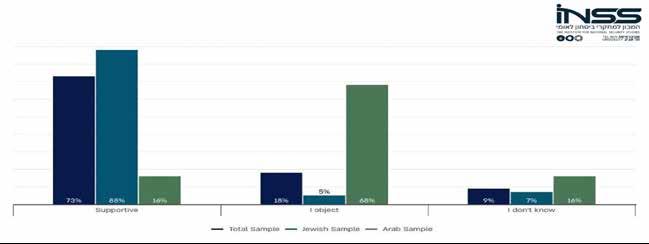
Figure 1 – Do you support or oppose Israel’s attack on Iran
(data collected June 15-16, 2025)
ceasefire, highlighting the rapid reemergence of polarization around Gaza policy and structural societal divisions such as ultraOrthodox conscription. The chapter’s findings point to the conclusion that short successful military operations such as Rising Lion may well have positive short-term effects on public trust and social cohesion, but the persistence of such effects will remain constrained by the wider context of protracted war in Gaza. So long as the Gaza war persists, and even expands — with its ongoing casualties, unresolved hostage crisis, and mounting societal strain — short, high-profile campaigns abroad are unlikely to produce lasting change in domestic dynamics.
Initial Response Among the Israeli Public
Alongside fears and heightened tension, the first days of Rising Lion were accompanied by a pronounced “rally around the flag” effect. Broad public consensus framed the strike on Iran as both legitimate and necessary, reflected in survey findings from the INSS. In
a survey held days after the operation began, only 18 percent of the general public, and fewer than 10 percent of Jewish respondents, judged the decision as primarily politically motivated. This contrasted sharply with earlier episodes in the Swords of Iron war — for example, in a survey conducted at the beginning of Operation Gideon’s Chariots, in March 2025, 54 percent of the general sample and 46 percent of Jewish respondents attributed renewed fighting in Gaza to political considerations. Support for Rising Lion was correspondingly high, with 73 percent of the general public and 88 percent of Jewish Israelis in favor (see Figure 1).
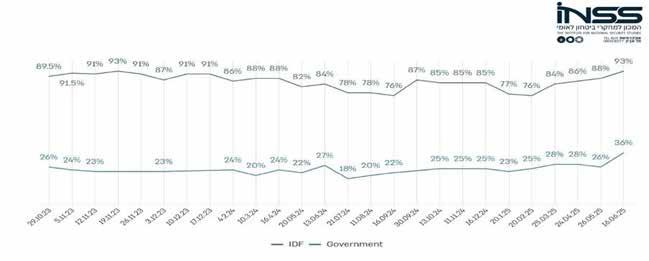
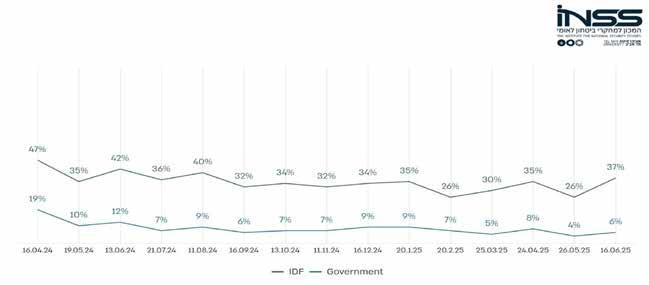
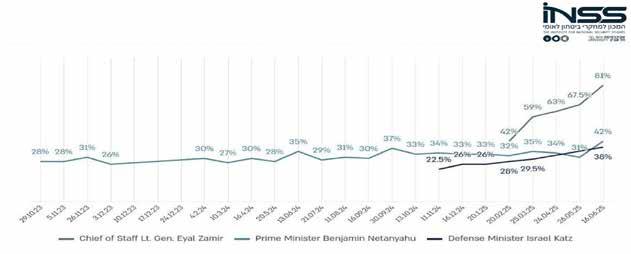
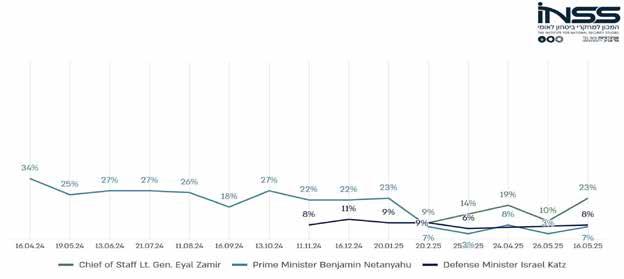
This surge of support translated into marked increases across all major public trust indicators. Trust levels rose not only in the Israel Defense Forces (IDF) and the government (see Figure 2 and Figure 3), but also in key leadership positions — including the chief of staff, the prime minister, and the defense minister (see Figure 4 and figure 5), and extended even to the IDF spokesperson. It is notable that the rise in trust levels was mostly reflected within both the Jewish and the Arab population, though the starting point for both groups was different, for obvious reasons.
Figure 2 – Percentage of respondents expressing high and very high degrees of trust in various institutions – Jewish Population
(data collected June 15-16, 2025)
Figure 3 – Percentage of respondents expressing high and very high degrees of trust in various institutions – Arab Population
(data collected June 15-16, 2025)
Figure 4 – Percentage of respondents expressing high and very high degrees of trust in various public figures – Jewish Population
(data collected June 15-16, 2025)
Figure 5 - Percentage of respondents expressing high and very high degrees of trust in various public figures – Arab Population
(data collected June 15-16, 2025)
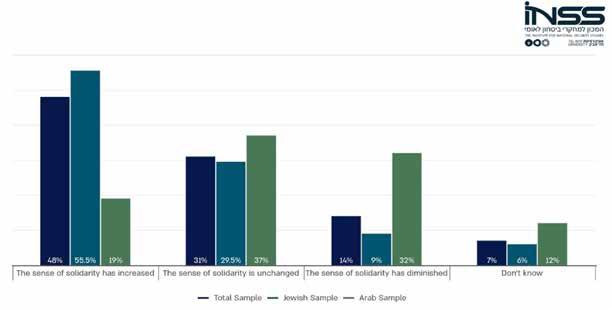
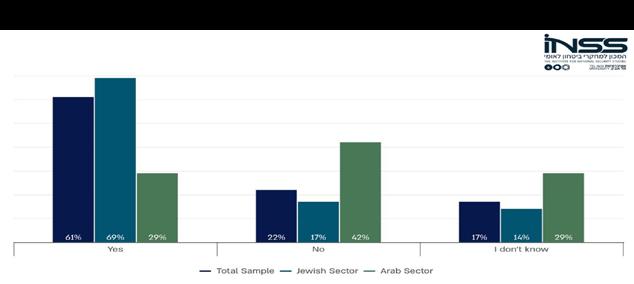
Figure 6 – In your opinion, has there been a change in the sense of solidarity in Israeli society at this time?
(data collected June 15-16,
2025)
The onset of the operation also contributed to a rise in perceived social cohesion within the Israeli public, consistent with patterns typically associated with the “rally around the flag” effect. Nearly half of survey respondents indicated that they believed the sense of solidarity among Israelis had strengthened following the start of the war (see Figure 6).
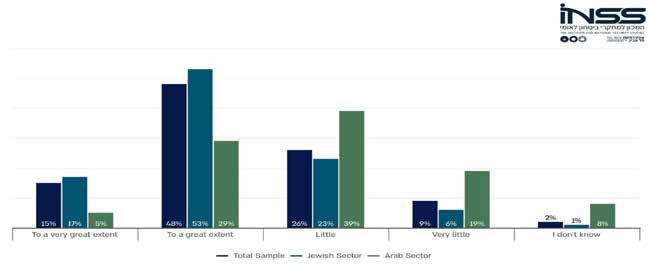
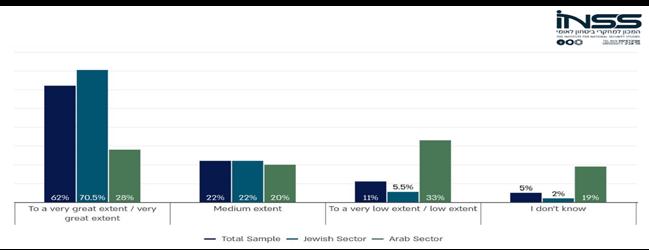
Furthermore, while in the first survey held during the operation, approximately 70 percent of the public were very or somewhat concerned about the campaign against Iran would unfold, nonetheless 60 percent believed that the Israeli home front was well or very well prepared for the conflict, contrasting with 35 percent who thought it was poorly or very poorly prepared. The belief that the Israeli home front was prepared for the conflicted also manifested itself in the fact that nearly 80 percent of the Israeli public were generally satisfied with the functioning of the Home Front Command in the same survey. In a flash survey held a week later, the percentage of those believing that the Israeli home front was
well or very well prepared for the conflict even increased slightly, to 63 percent (See Figure 7).
Between Gaza and Iran: A War Within a War
However, the “rally around the flag” effect and the general public confidence regarding the war with Iran was not without its constraints. The fact that Operation Rising Lion took place alongside ongoing fighting in Gaza, where soldiers continued to fall, intensified the contrast between the glamorous, long-range strike in distant Iran and the grinding, day-to-day combat in Gaza’s metaphorical mud. Efforts by the military and government to frame Rising Lion as a distinct operation failed to gain significant traction with the public. Instead, much of the discourse, particularly on social media, highlighted the continuity of a war that had already persisted for more than 600 days and opposition to framing the war as “The 12-Day War.” Public skepticism intensified following the chief of staff’s June 20 statement, which
Figure 7 – In your opinion, to what extent is the Israeli home front prepared and ready to cope with the war against Iran?
(data collected June 22-23, 2025)
emphasized both the unique timing of the strike and its immediate achievements, but also warned that “preparation for a prolonged campaign is required.” For an exhausted and wary public, the notion of an extended conflict undercut the framing of Rising Lion as a distinct, high-adrenaline mission. The gap widened between official portrayals of the operation as a strategic success and the lived experience of a protracted, costly war on the home front.
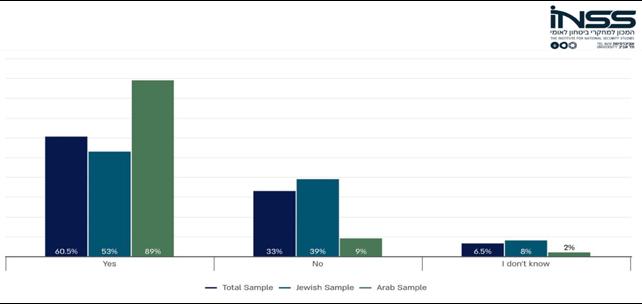
Survey evidence further underscores this divergence. While Rising Lion was broadly perceived as successful, these perceptions did not translate into increased confidence regarding the outcome of the Gaza war. The proportion of Israelis who believed the IDF would win the war in Gaza remained unchanged. At the same time, support for ending the Gaza campaign rose sharply: 60.5 percent of the general public favored termination of the conflict, compared to 49 percent in January 2025. For the first time since the war began, a majority of Jewish
respondents also expressed support for ending the war (see Figure 8). Together, these findings point to the limits of the rally effect: While Rising Lion temporarily boosted support for leadership and institutions, it did little to alter the public’s increasingly skeptical and war-weary attitudes toward the conflict in Gaza.
Public Perception of the Achievements
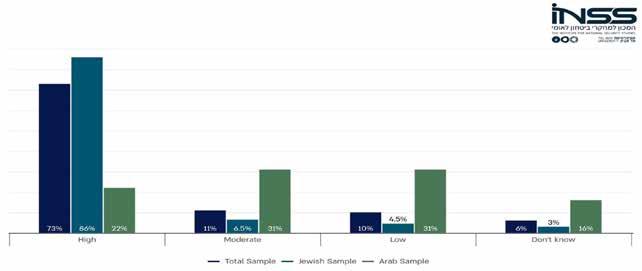
Public opinion in the early days of Operation Rising Lion combined strong approval with clear signs of conditionality. Surveys conducted on June 15 and 16 showed broad satisfaction with the performance of Israel’s defense establishments — 73 percent among the general public and 86 percent among Jewish Israelis (see Figure 9). Yet beneath this approval lay more complex and ambivalent attitudes shaped by shifting objectives. Before the strike, Iran’s nuclear threat dominated Israeli
Figure 8 – In your opinion, is it time to end the war in Gaza? (data collected June 15-16, 2025)
Figure 9 – How satisfied are you with the defense establishment’s activity in Iran so far?
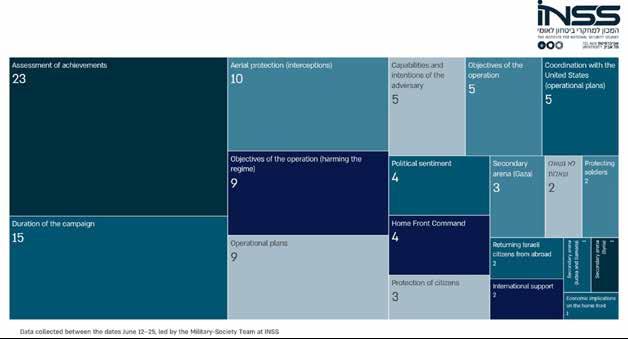
Figure 10 – Subjects of questions posed to the IDF spokesperson
(data collected June 12-25, 2025)
concerns. This was part of the reason for the overwhelming support of the war. Initially, the prime minister declared that the operation aimed to eliminate Iran’s nuclear program this goal was later revised to disrupting Iran’s nuclear project and its ballistic missile capabilities, and the public debate often also mentioned the possibility of toppling the Iranian regime.
Opinion data revealed this duality. In the survey held at the beginning of the operation, 9 percent of the Israeli public believed that the Iranian nuclear threat would be fully removed after the operation, while nearly half the public thought it would be mostly removed. Yet the perceived success of the operation led 61 percent of the Israeli public to support the contention that Israel should aim not only to neutralize the nuclear threat but also to topple the Iranian regime, while only 28 percent thought the focus should remain on the nuclear threat alone.
Public expectations for meaningful achievements were further evident in repeated questions to the IDF spokesperson regarding whether Iran’s nuclear project had been set back (see Figure 10). This appetite for demonstrable success was reinforced by senior political and military leaders who framed the strike as a response to the magnitude of the Iranian threat. Yet at the same time, a parallel discourse stressed the limits of Israel’s independent capabilities. Commentary across traditional and social media underscored that without U.S. government backing — particularly explicit authorization from President Donald Trump — the operation’s objectives were unlikely to be met. Thus, optimism about short-term achievements coexisted with concerns over feasibility and escalation.
Figure 11 – To what extent are you satisfied with the military achievements in Iran?
(data collected July 24-28, 2025)
On the ninth day of Operation Rising Lion, public tension peaked due to uncertainty over whether the United States would join the fight against Iran. The American decision to join the campaign and deploy B-2 bombers to strike Iranian nuclear facilities alleviated public fears somewhat, yet it also increased the Israeli public’s appetite for more significant achievements. In a flash survey conducted on June 22 and 23, 2025, after the U.S. attack on Iranian nuclear facilities, 42 percent of Israeli public favored intensifying strikes, 22 percent supported pursuing regime change, and only 32 percent preferred a rapid termination. Nearly two-thirds endorsed a negotiated nuclear agreement that would secure Israel’s security interests, while just 23 percent supported a ceasefire and sanctions. These stances likely stemmed from both a sense of momentum and confidence in American backing, as well as from messages conveyed by the IDF’s senior command, which emphasized that the military still possessed a broad “target
bank” and that more time was needed to achieve the operation’s objectives.
On June 24, roughly 48 hours after the U.S. strike on Iran’s nuclear facilities, a ceasefire came into effect. Survey data reported by the i24 news channel indicated that a majority of the Israeli public supported the move.2 In the final hours before the ceasefire, however, Iran launched a major missile strike on Be’er Sheba that caused severe casualties and damage. Despite these consequences, Israel refrained from a significant retaliatory response or a resumption of hostilities — reportedly under American pressure. Nevertheless, a survey conducted in July 2025 showed that a large majority of Israelis continued to express high satisfaction with the military achievements in Iran (see Figure 11).
2 See the survey at: https://www.i24news.tv/he/news/israel-at-war/artc-c9043c1a
Figure 12 – In your opinion, will Israel need to relaunch the war against Iran in the coming year?
(data collected July 24-28,
2025)
The Day After: Returning to the Larger War
Despite the apparent widespread public support for the ceasefire and the high levels of satisfaction from the military achievements of the campaign, it seems that significant parts of the Israeli public remain concerned that the campaign ended before achieving its objectives. It is worth recalling that at the outset of the operation, a large majority of the Jewish public believed the Iranian nuclear threat would be entirely or largely eliminated, which to this day is yet to be confirmed. As a result, in the survey held in July 2025, the majority of respondents believed that Israel would have to renew the war against Iran in the coming year (see Figure 12).
At the broader societal level, Operation Rising Lion did not produce lasting change in public perceptions of the war in Gaza. The day after the ceasefire, reports of seven Israeli soldiers killed in combat underscored the ongoing
and grueling nature of the Gaza conflict. Opinion data indicates that assessments of the Gaza front remained largely unaffected by the strike against Iran. In surveys held in July and August, there was no increase in the share of respondents who believed the IDF would win the war in Gaza. Moreover, as the conflict dragged on, confidence in both the government’s and the IDF’s approach steadily eroded. Survey data from July 2025 reflected growing skepticism: 61 percent of the public believed that the IDF’s strategy was not advancing the return of hostages, while 40.5 percent judged it ineffective in achieving either of the war’s stated goals. Only 25.5 percent believed the military campaign was advancing both the collapse of Hamas rule and the return of hostages. Following the Cabinet’s August decision to occupy Gaza, a majority (65 percent) concluded that the policy was not promoting the return of hostages, and 43 percent judged that it failed to advance either objective. Only 22 percent believed that both goals were being achieved.
This divergence between the perceived success of the Iran campaign and persistent skepticism toward the Gaza war was reflected in broader measures of social resilience. Indicators such as trust in the IDF, the government, the chief of staff, and the prime minister, which had risen during Rising Lion, returned to pre-operation levels soon thereafter.
A similar pattern appears to have occurred with respect to social cohesion. Although we do not have direct survey data, public discourse in both mainstream and social media suggests that the temporary perceived surge in solidarity quickly dissipated, giving way once again to longstanding cleavages and disputes. One particularly salient source of tension was the exemption of the ultraOrthodox from military service, a controversy that continues to deepen as the war in Gaza continues and the burden on serving sectors of society becomes unbearable.
Conclusion
The domestic response to Operation Rising Lion reveals both the enduring power and the inherent fragility of the “rally round the flag” effect in the context of protracted conflict. In its opening days, the air campaign against Iran generated a surge of unity, legitimacy, and confidence. Public opinion surveys captured striking levels of approval, not only for the decision to strike Iran but also for the defense establishment and political leadership more broadly. Trust in institutions rose, perceptions of social solidarity strengthened, and even longstanding skepticism toward government decision-making receded temporarily. All this, despite the heavy price of the war — 32 casualties, thousands of wounded, harm to houses, infrastructure, and military bases, and much more. These patterns were consistent with the classic “rally around the flag” effect:
In a moment of acute external threat, the public closed ranks, suspending divisions in favor of national cohesion.
Operation Rising Lion received wide support within Israeli society and was largely regarded domestically as both justified and effective. At the same time, in a wider perspective, it was framed by the public as yet another campaign in the seemingly endless Swords of Iron war.
Against this backdrop, however, the endurance of the “rally around the flag” effect proved limited. From the outset, Rising Lion was nested within a wider, grinding conflict in Gaza that continued to claim soldiers’ lives and drain public morale. While the Iranian campaign was celebrated as a bold, hightechnology strike, the daily reality of attritional warfare in Gaza served as a constant reminder of other fronts and their costs. Survey data demonstrated this divergence clearly: Confidence in the Gaza front remained stagnant and support for ending the conflict rose to unprecedented levels. For the first time, a majority of Jewish Israelis endorsed terminating the Gaza war, even as they lauded the achievements in Iran. This disconnect underscores the difficulty of sustaining “rally around the flag” effects when short, highimpact operations unfold alongside long wars of attrition.
Public expectations also introduced new complexities. Initial support for Rising Lion was grounded in the hope that it would decisively reduce or eliminate Iran’s nuclear threat. As the operation unfolded, however, official objectives shifted — from eliminating the nuclear program, to disrupting nuclear and missile capabilities, and occasionally, in some public discourse, to the prospect of regime change. The perception of early success, combined with the U.S. military involvement, further increased the appetite of the Israeli public for significant accomplishments and opinion data showed that a majority of Israeli
public supported pursuing regime change. Yet this same ambition sowed the seeds of disillusionment. By the time a ceasefire was reached, many Israelis felt the campaign had ended prematurely before achieving its goals.
The consequences of this disappointment were visible in the months that followed. Indicators of trust in the IDF, government, and senior leaders, which increased during the campaign, quickly returned to pre-operation levels. The temporary surge in social cohesion likewise dissipated, with public discourse once again dominated by political polarization and unresolved structural cleavages. In this sense, Rising Lion functioned as a momentary respite from domestic divisions rather than a catalyst for sustained unity.
Looking ahead, these dynamics suggest that future Israeli operations against external adversaries may well reproduce similar shortterm rally effects, but the persistence of such effects will remain constrained by the wider context of protracted conflict. As long as the Gaza war continues — and with it the burdens of casualties, hostage uncertainty, and societal strain — short, dramatic campaigns abroad are unlikely to generate durable domestic consensus.
Ultimately, the domestic response to Operation Rising Lion illustrates both the resilience and vulnerability of Israeli society under conditions of extended war. While capable of rallying in moments of acute crisis, the public’s patience is finite and its divisions quickly reassert themselves once the immediate adrenaline of success fades. This suggests that Israel’s leaders face not only the external challenge of managing simultaneous wars but also the internal challenge of sustaining public legitimacy in a society increasingly fatigued by conflict.
About the Authors
Anat Shapira is a researcher at the “Israel’s National Security Policy” program at the Institute for National Security Studies (INSS), focusing on army and society relations and the Israeli society, as well as a Ph.D. candidate in the Philosophy department of Tel Aviv University.
Dr. Idit Shafran Gittleman is a senior researcher at the “Israel’s National Security Policy” program at the Institute for National Security Studies (INSS). Before joining the institute, she headed the Army and Society Program at the Israel Democracy Institute, was a postdoctoral fellow at the Minerva Center for the Rule of Law and Extreme Conditions at the University of Haifa, and a fellow of the GlobalTrust program at Tel Aviv University’s Faculty of Law. She is also a visiting lecturer at Reichman University and serves on the board of the Israeli Association for the Study of Armed Forces and Society, as well as the Deborah Forum.
Yarden Assraf is the coordinator of the “Israel’s National Security Policy” program at the Institute for National Security Studies (INSS), as well as a researcher of army and society relations in Israel and an M.A. candidate at the Public Policy department of Tel Aviv University. Dana Karniely is a research assistant at the “Israel’s National Security Policy” program at the Institute for National Security Studies (INSS), and a B.A. student in Criminology and International Relations at the Hebrew University of Jerusalem.