
AI Spending Clash in Fordham LC’s Congressional District
By ANDREW MCDONALD Contributing Writier
President Donald Trump ordered every federal agency to “immediately cease” all use of Anthropic’s artificial intelligence (AI) technology on Friday evening after the company refused to meet a 5:01 p.m. deadline set by
Secretary of War Pete Hegseth to remove safety guardrails on its technology. This ethical standoff, and the money from members of the American AI industry backing both sides of the debate, have been funneling into a congressional primary unfolding in New York’s 12th Congressional District, where Fordham’s
Fordham Theatre Debuts ‘A Lunar Rhapsody’
By SOFIA CAMMARANO Contributing Writer
“A Lunar Rhapsody,” written by José Rivera, centers around a Brooklyn community awaiting the lunar eclipse on the local basketball court, unfolding through three distinct storylines that are connected through the presence of the time-travelers that appear throughout the entire show.
Sara Koviak directed and choreographed the play, shaping the movement and staging to reflect the characters’ relationships and interactions. Koviak’s version, performed at Pope Auditorium, is the first ever student production of “A Lunar Rhapsody” in New York City.
When the doors opened for the audience, the actors were already setting the scene, and all remained on stage throughout the entire show. Through detailed warm lighting that mimics a summer evening and the textured set design of a lived-in basketball court, viewers were immediately transported into the setting of a group of five teens — Abel, Clara, Lola, Mia and Piri — playing basketball, dancing and teasing each other.
Their friendships felt organic as they delivered their lines with ease and confidence, showing not only strong stage presence but also genuine trust in one another.
see LUNAR RHAPSODY page 15
Lincoln Center campus sits.
Trump called Anthropic, the company behind the popular chatbot Claude, “a radical left, woke company” that made “a disastrous mistake” in defying the Department of War.
Anthropic CEO Dario Amodei published a statement on Thursday stating that the Pentagon’s
Fordham Celebrates Ramadan
By ROOP SOMAL Asst. Layout Editor
As the sun set on Feb. 27, over 200 people gathered to break their fast during iftar, share a meal and listen to a series of inspirational speeches and prayers in the Great Hall at Fordham Rose Hill (FRH).
The Community Iftar Dinner is an annual event co-hosted by the Muslim Student Alliance (MSA), Campus Ministry and five other clubs. It is one of a larger series of events across both campuses celebrating the beginning of Ramadan organized by MSA and other clubs.
The event began with student-led prayers, which were followed by several speeches reflecting on how Fordham as a university and its students can practice values of gratitude and service. The speakers highlighted organizations students could give to as their Zakat, a mandatory charity Muslims must pay by the end of Ramadan.
Ramadan, the holiest month on the Islamic calendar, is observed by Muslims worldwide. It is a time for spiritual development and increased prayer and reflection. Ramadan also commemorates the revelation of the Quran to the Prophet Muhammad.

latest contract language “made virtually no progress” on his company’s two conditions: that its AI will not be used for mass domestic surveillance of Americans and that it would not power fully autonomous weapons that select and kill targets without any human oversight.
War in Iran Sparks Protest
By MICHELLE WILSON News Editor
On March 2, a few days after the U.S. and Israel bombed Iran on Feb. 28, around 300 protestors gathered to demand an immediate end to the war and U.S. divestment from conflict in Israel and throughout the region. The U.S./Israel airstrikes marked the beginning of a war in the Middle East on multiple fronts that has already killed more than 800 people (as of March 3).
The protest, organized by a loose coalition of close to 30 activist organizations, began at 5 p.m. at Columbus Circle, just a few minutes from Fordham’s Lincoln Center campus, and consisted of approximately 40 minutes of chants and speeches before the group marched down to 5th Ave and through Midtown.
President Donald Trump justified the attacks in his Feb. 28 announcement that the United States would launch “major combat operations” in Iran by accusing the nation of building nuclear missiles that could reach the U.S. and endanger U.S. allies.
By CORA COST Sports & Health Editor
The Fordham swimming and diving program made a splash at the 2026 Atlantic 10 (A10) Championships with eight medaling athletes across both the women’s and men’s teams. David Vargas, Gabelli Graduate School of Business ’26, came away from the weekend in Virginia as the A10’s Most Outstanding Diver after his firstplace finishes in both the one and three-meter dives. Vargas's finish in the one-meter is a first for a Ram since 1996.
Hayley Clark, Fordham College at Rose Hill (FCRH) ’27, also took home gold in the 200-meter butterfly. This was her first A10 Championship appearance.
Karina Kanary, Gabelli School of Business at Rose Hill (GSBRH) ’28, came in second in the 400-meter individual medley. The women’s 200meter relay took home bronze medals with a time of 1:39.96 and was swam by: Kanary; Lexi Lundell, FCRH ’27; Saskia Aikman, FCRH ’29; and Ella Montgomery, FCRH ’29.
DURGA DESAI/THE OBSERVER
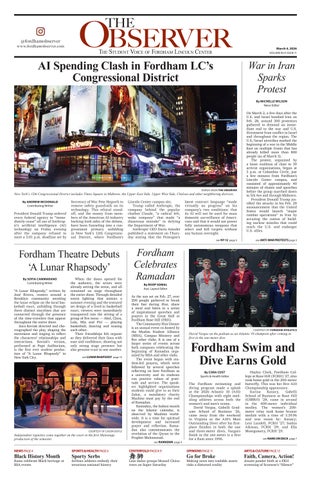
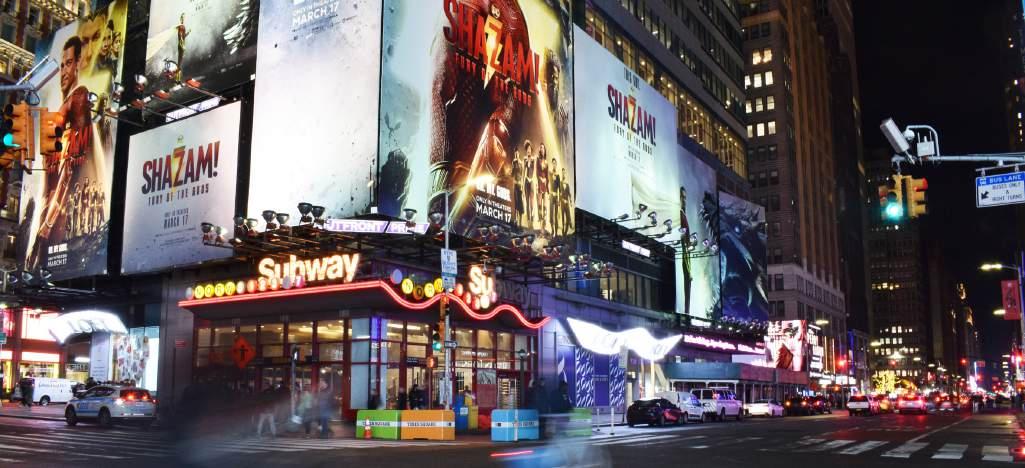
New York’s 12th Congressional District includes Times Square in Midtown, the Upper East Side, Upper West Side, Chelsea and other neighboring districts.
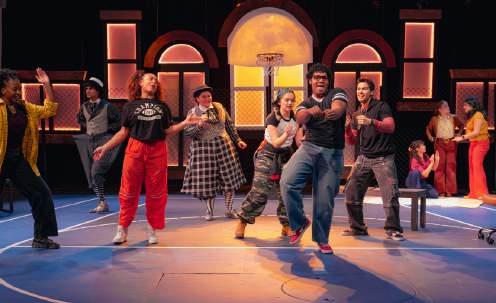
COURTESY OF CASON DOYLE Independent vignettes come together on the court in the first Mainstage production of the semester.
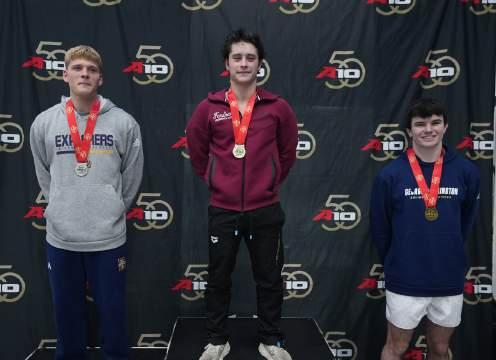
COURTESY OF FORHDAM ATHLETICS David Vargas on the podium as an Atlantic 10 champion after coming in first in the one-meter dive.
Students and Alumni Uncover Women in Christianity
Fellowship recipients and theological scholars presented on the role of women in biblical contexts
By SOPHIA STEPHAN Asst. News Editor
The Graduate School of Arts and Sciences (GSAS) hosted scholars from the Mary Magdalene Fellowship with Impact program to examine representations of female figures in Christian liturgies, specifically exploring the influence of Mary Magdalene on past, present and future Christian women. The event was held on Feb. 27 in the Lowenstein Center’s 12th-Floor Lounge.
The Mary Magdalene Fellowship with Impact award provides summer funding and support for graduate students conducting research on women in Christianity, according to the GSAS website.
Mary Magdalene was a loyal disciple of Jesus and the first to proclaim his Resurrection, making her one of the most prominent female figures in the Bible and the subject of much feminist theological discourse.
The six-hour event featured two panels of experts, one composed of faculty and the other of PhD candidates, each of whom presented overviews of their research. The panelists’ projects ranged from the examination of Christian art to the daily lives of nuns in medieval Europe.
The faculty members who appeared on the first panel to discuss their research included: Emanuel Fiano, associate professor of theology and co-director of the Center for Jewish Studies at Fordham; Karina Martin Hogan, associate professor of theology at Fordham; Michael Peppard, professor of theology at Fordham; and Sarit Kattan Gribetz, associate professor of religious studies and Jewish Studies at Yale University.
Hogan discussed how feminism features in the Book of Ruth between different geographical and cultural contexts.
The Book of Ruth tells the story of Ruth, a Moabite widow who moves to Bethlehem with her mother-in-law Naomi after the deaths of both their husbands. There, Ruth marries Boaz, an honorable and wealthy man, and becomes part of the lineage of King David and Jesus Christ. In many interpretations, the story is taken to represent God’s ultimate plan for redemption, even for ordinary people, and love for outsiders.
Hogan described how her interpretation of the story has been influenced by scholars and laypeople she has encountered thanks to the fellowship program.
“My own interpretation of (the Book of Ruth) has certainly been greatly broadened and enriched by reading the perspectives of biblical scholars from different global contexts, but also by reading it with groups of lay readers who bring their own concerns and experiences to the book,” Hogan said.
Gribetz and Peppard both emphasized the reciprocal relationship between depictions of early Christian women and the development of contemporary perspectives. Gribetz presented Helena, an empress and prominent Catholic saint called “Equal to the Apostles,” as an example of a Christian woman who used her wealth to service the poor. Gribetz noted the employment of “Helena’s memory as an inspirational model for contemporary wealthy women.”
Peppard described how “positive images of Magdalene as an apostle will only multiply in
contemporary Christian art as former generations who knew her only as a vented sinner give way to newer ones.” Peppard was referring to the misinterpretation that Magdalene was a prostitute, which persisted for centuries. The Church dismissed the claim in 1959, but the idea has remained in popular memory, only recently giving way to new, different representations.
The faculty panel was followed by a keynote address given by Ashley Purpura, associate professor of religious studies at Purdue University, whose work was described as being at the forefront of scholarship exploring the intersection of feminist theology and Orthodox Christian tradition. Purpura earned her PhD in theology from Fordham in 2014, and she “remains quite active within the Fordham community” as the co-editor of the Fordham “Orthodox Christianity and Contemporary Thought” book series.
Purpura’s speech focused on the diverse voices and figures represented in Christian liturgy, using Magdalene as an example of how acknowledging female perspectives in the literature can reveal a source of empowerment for its early female readers.
“Even though singing about Mary Magdalene as disciple, minister and apostle has not historically led to a widespread recognition of women’s authority and vocations … they may still yet offer affirmation of women’s voices, ministries and witnesses in ways that are particularly empowering and relatable to women,” Purpura said.
Yet, Purpura states that it is “not enough to historically find the voices of women … because the historical record will always to some degree be limited.” To go beyond these limitations, she encouraged scholars to practice “imagining what might have been said … reading against the grain … (and) considering how women might have perceived and continued to perceive women’s voices in ways different from what men, particularly clerical men, have told them.”
“Women’s voices speak across and break down barriers by the mere fact that they are offered by women,” Purpura said.
The second panel gave an independent scholar and a series of PhD candidates the opportunity to explain the research projects they have been able to conduct as recipients of the fellowship. They presented their individual areas of interest, such as medieval clerical concubines and the portrayal of domestic violence in hagiography (writings about the lives of saints).
In medieval times, it was relatively common for priests to have long-term monogamous relationships with women called clerical concubines. This practice emerged across Europe after clerical celibacy was officially mandated by the Church in the 12th century. These women’s lives were deeply intertwined with their churches, and they performed a great deal of domestic labor which has not been historically recognized.
Hillary Bylund, a PhD candidate in theology and social ethics at Fordham, expressed her gratitude for the fellowship program for providing crucial support for her dissertation, which explores how artistic representations of figures like Magdalene can act as a form of resistance and inspire change. Bylund looked particularly at advocacy for women to hold ministerial positions.
“The only reason this (project) was possible was because this Mary Magdalene Fellowship filled that very critical gap of summer funding, and so I’m very thankful for this because I think that it not only allowed me to explore my own questions which have turned into my dissertation … but it also has introduced me to a network of other people that are really passionate about advocating for women’s inclusion in ministry, and that’s been really amazing,” Bylund said.
Anna Irwin, a PhD candidate in theology at Fordham, shared a similar sentiment regarding the significance of the fellowship program in making her research on spousal abuse of Byzantine female saints possible. In her research, she looked at how domestic violence was represented in hagiographies (biographies on the lives and venerations of saints) of the time.
Irwin’s research centered on Saint Thomais of Lesbos, a Byzantine woman who was raised to sainthood for her piety and service in her everyday life while enduring severe abuse from her husband.
“It is my hope though that this project will not only shed some light on the entanglement between embodiment, sanctity and storytelling in Byzantium, but will also help us continue to examine the manner in which violence is depicted, particularly gendered violence,” Irwin said.
Hagiographies of Thomais portray her abuse as beautiful, comparing her bruises to pearls and other precious jewels.
This discovery is somewhat analogous to other panelists’ research on the highly visual portrayal of violence, particularly sexual violence, against female saints. For instance, Natalie Maria Reynoso, a PhD candidate at Fordham, examined the Persian Martyr Acts, a series of Greek and Syrian texts recounting the persecution of Christians by the Sasanian Empire. Reynoso argued that the hagiographers of these texts “construct an idealized notion of holiness for Christian women, which necessitates the perseverance of virginity unto death.”
Closing remarks were given by: Brenna Moore, chair of the department of theology at Fordham; Ann Gaylin, dean of GSAS; and Rita Houlihan, who established the fellowship program.
Moore thanked the panelists and attendees for their engagement in theological discourse and research in higher education, engagement which Moore said enables us to “resist traditions of Christianity that want to squelch out mystery and multi-valence. Instead, we cultivate attention to detail, openness to surprise (and) a willingness to encounter newness where we did not expect it.”
Gaylin reiterated Moore’s point on the event’s significance, stating that herself and the attendees are “all a little wiser for these scholars’ meticulous work to uncover the past and help us understand (that) the past (has) tremendous implications for how we live in and respond to the present moment.”
Houlihan is a confirmation teacher, serves on the Future Church Board of Directors and is a founding member of the “Catholic Women Preach” project. Her sponsorship of the fellowship program is part of her efforts to “restore our historical memory of Biblical women leaders … counter demeaning legends and touch the public’s imagination.”
Houlihan directly addressed the Fordham community, urging scholars to move away from traditional, patriarchal depictions of women in liturgical texts, particularly naming Augustine and Aquinas.
“My challenge and my request for Fordham going forward is to look at some … really good sources about women and theology,” Houlihan said. “How do we get artists interested in taking what you all have studied and bringing it into a contemporary setting? How do we inspire the next generation of biblical scholars?”
This feminism-focused event occurred in the last days of February before Women’s History Month in March. Fordham’s Women’s Herstory Committee has begun their annual “Pitstop for a Purpose” drive to collect donations for the non-profit organization “I Support the Girls,” which distributes bras and menstrual products to those experiencing homelessness. The committee will officially kick off the month at their “Brew and Bites” event, which will take place on the Plaza on March 5 at 1 p.m. Fordham’s ninth annual Women’s Luncheon will take place at the McShane Center on March 26, 1-3 p.m.
PHOTOS BY KAITLYN SQUYRES/THE OBSERVER
Speakers at the event discussed new interpretations of prominent female Biblical figures.
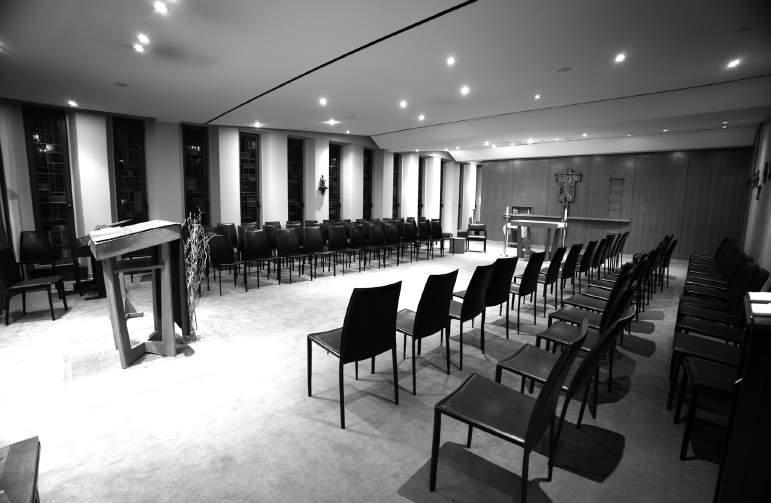
The Rupert Mayer chapel is located on the second floor of the Leon Lowenstein building at Fordham Lincoln Center.
Fordham Clubs Host Town Hall
Club leaders organized first-ever town hall to foster open dialogue and connect with students
By MICHELLE WILSON News Editor
United Student Government (USG), Campus Activities Board (CAB), Commuter Students Association (CSA) and Residence Hall Association (RHA) hosted the first-ever “Core Four Town Hall” to share their recent initiatives, foster collaboration between the clubs and provide a space for students to voice their concerns on Feb. 26 in G76.
Many of the concerns expressed at the event centered around policies in residential halls, the possibility of a student MTA discount (an initiative USG is currently working on) and the lack of “third spaces” on campus for students to hang out.
Daphne Mei, president of USG and Fordham College at Lincoln Center (FCLC) ’26, delivered opening remarks outlining the ethos of the town hall, which is to recur every semester.
“We’re here to build a campus culture that reflects the needs, voices and values of our students,” Mei said. “We hope (the town hall) becomes a space where dialogue is open, where ideas are welcome and collaboration grows stronger each semester.”
The nearly two-hour event allowed the presidents of each club to explain what their club does, clarify how each is distinct and recap their recent achievements and ongoing initiatives.
USG is the governing body of Fordham Lincoln Center (FLC) and advocates for student needs, oversees club funding and mediates between students and the administration. Some recent projects they highlighted include extending library hours to 24
hours during exam times and launching Ram Perks — a network of student discounts in cafes and restaurants near campus.
CSA represents the commuter student population of FLC — which makes up about 50% of students — and aims to build community through events and programs.
CAB organizes large-scale, campus-wide events like Winterfest and outings that give students discounted tickets to live performances and cultural events. Upcoming events by CAB include a 2016 bingo on March 5 at 6:30 p.m., the spring farmers market on April 9 outside Ram Café and “Fordham’s Got Talent” on April 16 at 6:00 p.m.
RHA funnels residents’ grievances to the administration, organizes on and off-campus events and works with Fordham’s community partners. Some of their
recent projects include fixing the stairs in McMahon (which were broken in several places) and the installation of new laundry machines.
Anna Eckelkamp, FCLC ’26 and secretary of CAB, attended the event and expressed her enthusiasm about RHA’s initiatives, particularly the stairs.
“I think I submitted that complaint,” Eckelkamp said. “(With) all the broken stairs, I was like, ‘I’m going to fall,’ (so) I’m glad they’re doing something about it.”
RHA is working on adding irons and ironing boards in the laundry rooms in McKeon and getting music in the dining halls.
After a break for food, attendees were given the floor for an hour of questions.
Mackenzie Saenz De Viteri, an event manager for the Office of Student Involvement (OSI) and FCLC ’27, said that
the prospect of MTA discounts stood out to her amongst all the initiatives mentioned.
While still in the beginning stages, the program would likely involve Fordham putting down a lump sum to the MTA and students paying around $300 a year as part of their tuition for discounted transport. While constituting a small tuition increase, the fee, like the student activities fee, would only be used for this program, and would cut overall commuting costs.
“I’m very excited. … I’d rather walk 30 blocks than pay for the subway at this point because it’s $3. That’s so much money. And I know other schools around us like the CUNY schools all have OMNY card(s), so bringing that to this school is really fun,” Saenz De Viteri said.
Right now, USG is sending around a campus-wide survey to
collect data on how much students spend on transit per month.
Some other audience questions centered around residence hall policies, such as why McMahon and McKeon residents cannot freely access both buildings. Christina Frankovic-Sepsi, director of OSI, explained that the policy comes from concerns about safety and security should residents have access to both.
Frankovic-Sepsi said the Commuter Student Affiliate Program is an exception that allows commuter first-year students to access McKeon without having to be signed in. However, commuters in the affiliate program also must leave residence halls by 6 p.m., around the time a lot of on-campus events happen.
A couple other questions also reflected the needs of commuter students. One audience member requested that the lockers at Fordham be free so commuters can have an easy place to deposit their belongings.
Linda McGrory, FCLC ’28, described the need for third spaces on campus. Other than Saxbys and the residence hall lounges, which can be a hassle for commuters to access, McGrory said, there’s nowhere “where you can just sit down and have fun.” One solution USG is working on is implementing napping pods in the library.
Around 40 students and members of the host organizations attended.
Leaders of the Core Four all reflected fondly on the success of their first-ever town hall and looked forward to improving efficiency and collaboration between their representative clubs to best serve the student body.
New Yorkers Protest Attacks Against Iran
Demonstrators gathered at Columbus Circle after the U.S. and Israel launched a series of airstrikes against Iran
“It has always been the policy of the United States, in particular, my administration, that this terrorist regime can never have a nuclear weapon … (Iran has) rejected every opportunity to renounce their nuclear ambitions, and we can’t take it anymore,” Trump said.
Trump has estimated the conflict may last four to five weeks and possibly longer.
Gabriela Silva, an organizer and activist, spoke at the protest and emphasized her belief that the war in Iran does not reflect the interests of the American people. This was in response to Defense Secretary Pete Hegseth’s remarks that the war is about “ending the threat once and for all” and “protecting American interests and our allies.”
“The interests that the United States is protecting by this war on Iran is not that of the Americans. It is the interest of a tiny elite,” Silva said. “The people of the United States do not want another U.S. war. The people of the United States want to see the over $1 trillion spent on war, death and destruction to be spent on sustaining life.”
Silva went on to discuss a broader desire for the reinvestment of U.S. military spending into healthcare, education and other civic goods. She also criticized other recent U.S. foreign policy, including the blockade on Cuba and U.S. intervention in Venezuela. This sentiment, which Silva called an “internationalist movement of solidarity,” was widely shared by protestors, many of whom also have organized and/or attended

pro-Palestinian demonstrations. Nuclear talks between the U.S. and Iran had been ongoing for weeks, and the Omani Foreign Minister said on Friday, just hours before the strikes, that they had made “substantial progress.” Negotiations have focused on the nation’s enrichment of its uranium stores. CBS reported that Iran has enriched uranium to “near-weapons grade level” in recent years, and Trump envoy Steve Witkoff said on Monday that Iran has enough enriched uranium to create 11 nuclear bombs.
However, the claim that Iran posed any kind of imminent threat to the U.S. has been contested by a number of politicians, news sources and nuclear
weapons experts. A May 2025 press release by the Defense Intelligence Agency claimed that Iran would not be able to develop long-range ballistic missiles until 2035.
Several officials of the Trump administration have offered differing perspectives on the imminence of the threat Iran posed. Chants at the protest rejected the claim entirely.
“The biggest threat in the world today: Donald Trump and the USA,” the chants said. “Money for jobs and education, not for war and occupation. … We want justice, you say ‘How?’ Hands off Iran now.”
Some protesters held signs bearing statements like, “No more war for big oil profits!” and
“Defend Iran against the U.S./ Israel war.”
Trump has outlined several objectives for the war, which include destroying Iran’s missile capabilities and navy and enacting a regime change. This marks a reversal from Trump’s campaign promises for peace and long-standing criticism of foreign entanglements.
The U.S. has destroyed the majority of Iran’s naval assets, having sunk nine warships so far, Trump claimed. An Israeli strike killed Ayatollah Ali Khamenei, Iran’s supreme leader, on Feb. 28 — a controversial action that has sparked responses from world leaders and mixed reactions within Iran, with crowds taking to the streets in mass displays of
celebration and grief.
Khamenei’s death marks an escalation of the conflict, which has spread across the Middle East. The U.S. has shut its embassies in Saudi Arabia, Kuwait and Lebanon. Hezbollah, the Iranian-allied militia in Lebanon, attacked Israel on March 2, sparking a wave of retaliatory attacks that have caused widespread displacement across Lebanon. Kuwait shot down three American planes in what the U.S. called a “friendly fire incident,” and Dubai has suffered Iranian airstrikes against its international airport, a hotel and other infrastructure.
Mohammad Ehsan Khatami, an organizer with No Tech for Apartheid who identified himself as a Persian-American, spoke at the protest in criticism of the idea that Iranians like himself support the bombing of their nation.
Khatami expressed hope for the coming midterm elections and grassroots organizing as opportunities for a shift in U.S. foreign policy in the Middle East. Silva shared a similar view on the power of the people, saying an end to the war “will take the millions of people that have been expressing discontent with the United States’ foreign policy to be a part of this movement.”
The March 2 demonstration is a part of a series of protests related to the conflict in Iran in New York City this week. A smaller iteration of the March 2 protest was held on Feb. 28, while a separate demonstration calling for a regime change in Iran also took place in Times Square on March 2. Nearly 1000 people marched through Midtown as part of a National Day of Action on Feb. 28.
ANTI WAR PROTEST from page 1
GRACE SANTOLI/THE OBSERVER
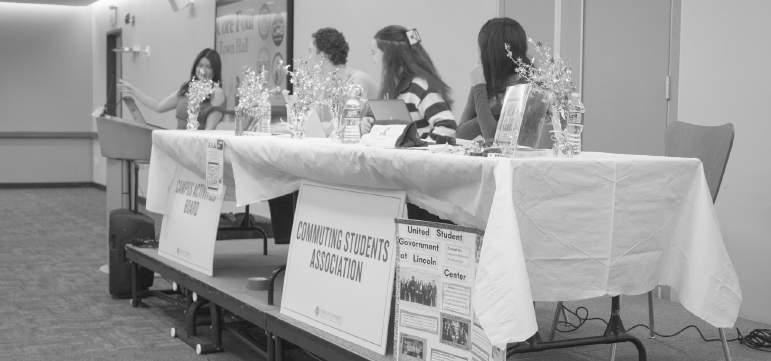
The presidents of United Student Government, Commuter Students Association, Residence Hall Association and the vice president of Campus Activities Board directed conversation at the town hall.
MICHELLE WILSON/THE OBSERVER
Organizers passed out signs with messages like “Stop the war on Iran!” and “No new U.S. war in the Middle East” to attendees, as well as flyers and hand warmers.
Ramadan Unites the Fordham Campuses
Student organizations host celebrations for the holy month on both campuses
During this period, Muslims are meant to fast during sunlit hours and break their fasts with water and a date, followed by a meal known as iftar.
During the event, plates filled with dates and bottles of water were arranged across the tables in preparation for iftar. Students enjoyed a variety of dishes from Muslim communities around the world, including cuisine and dessert from South Asia to the Middle East.
“ We live in our own silos and we live in our own individualistic lives, but events like this bring us all together and it makes us seen. It allows us to see each other, and it also allows others to see us. ”
The evening also featured remarks from community leaders, including Council Member Pierina Sanchez of District 14 and representatives from the Office of Bronx Borough President Vanessa L. Gibson, who recognized the role of faith communities in strengthening the Bronx.
Father Philip Judge, executive director of Campus Ministry, was also in attendance and spoke on
the importance of building community and being in solidarity with one another.
“This is a great testament here at Fordham to what you do to build community, to what you do to show you are proudly here at Fordham, and be part of this family,” Father Philip said.
These events aim to foster a sense of belonging for students, giving them an opportunity to break their fast together and grow spiritually, noted Imam Ammar Abdul Rahman, director of Muslim Life.
“We live in our own silos and we live in our own individualistic lives, but events like this bring us all together and it makes us seen. It allows us to see each other, and it also allows others to see us,” Ammar said.
Ammar added that
celebrating and having iftar dinners are just a few of the many ways to build community and bring families together.
Noora Zakaria, Fordham College at Rose Hill (FCRH) ’26, said she met her best friend and has connected with other Muslim students at such Fordham events.
“I’ve been here for a few years and I’ve been coming to these events, and I think it’s really great to kind of connect with the Muslim community and to just make friends,” Zakaria said.
Hafsah Ziauddin, FCRH ’26, shared a similar sentiment as to how such gatherings facilitate connection between Muslim students.
“Not being at a school with a lot of Muslims, this gives you an opportunity, obviously, to meet more people,” Ziauddin said.
In addition to the FRH event, a
variety of student clubs organized similar gatherings at Fordham Lincoln Center (FLC). MSA held its student iftar on Feb. 25 in the Student Lounge in Leon Lowenstein. The evening was centered on faith and advocacy as it gave students an opportunity to support “Hearts for Sudan,” a community-led Ramadan initiative raising funds for aid in Sudan.
MSA President Lalleyah Camara, Fordham College at Lincoln Center (FCLC) ’27, emphasized that hosting these get-togethers allows students to observe Ramadan in a communal and supportive setting.
“It’s very, very isolating to have to do that alone, especially for the first time, especially for a freshman. It can be very sad, so we like to do these kinds of events as much as we can during the
month,” Camara said.
Ramadan is meant to foster a sense of collectivity through the communal breaking of fast, which is what campus events have been providing, especially for those who may be alone, far from home or seeking companionship.
Students like Ala’a Attareb, FCLC ’28, find ease in fasting when surrounded by Muslim peers.
“When I see people that are also like me, fasting, I feel like it makes me stronger and it makes it easier for me and seeing the people I love around, I just love it,” Attareb said.
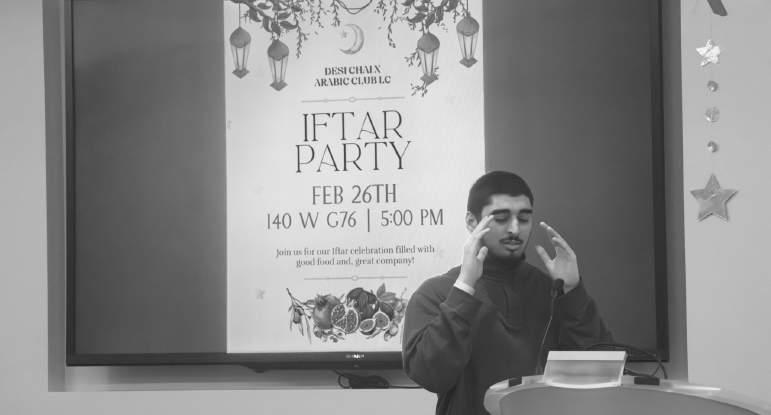
Continuing the week’s celebrations, Desi Chai and the Arabic Club hosted their Iftar Party on Feb. 26 in G76, providing students with a variety of food and great company. Arabic Club President Basma Laassel, FCLC ’26, described the significance of recognizing and celebrating Muslim life at a Jesuit university.
“Especially because in a Jesuit university, you are prone to think that there will be no Muslim students and that you will be singled out as a Muslim student, but having these events fosters a sense of community and belonging,” Laassel said.
Many students, like Laassel, have expressed gratitude for these gatherings, which have become meaningful traditions centered on faith and connection.
Other events at FLC included the MSA’s Ramadan Workshop, which was hosted in collaboration with John Jay College of Criminal Justice’s MSA, and the Fordham Community Iftar hosted by Campus Ministry and five other clubs. Future events across both campuses will follow to celebrate Eid and the completion of Ramadan.
BSA Hosts Black History Month Reception
The Black Student Alliance’s BHM celebration was a night of networking, celebration and community
By ABBIE WONG Staff Writer
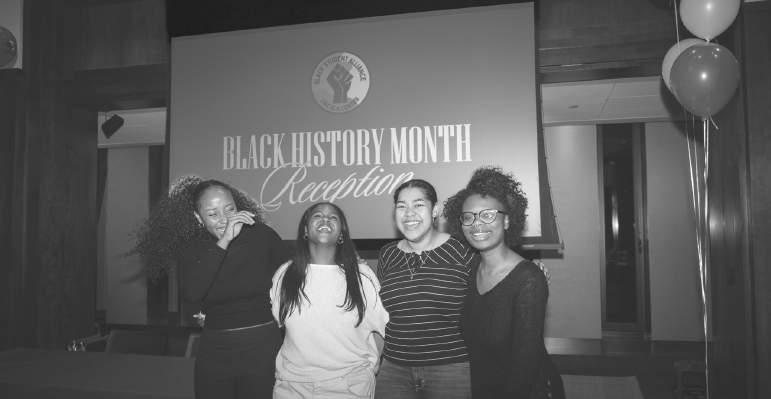
Black Student Alliance (BSA) hosted their Black History Month (BHM) reception in the Leon Lowenstein Center’s 12th-Floor Lounge on Feb. 25. The event was an opportunity for students to share a meal, network with alumni and celebrate community.
The reception was held in collaboration with the United Student Government’s Diversity, Equity and Inclusion Committee, the Department of African American Studies and the Office of Multicultural Affairs.
Members of the BSA e-board kicked off the reception by introducing the night’s itinerary.
“(We’ll) go speed-networking with the alums and then we also have a BHM jeopardy, feel free to grab food and then we’ll start the interviews,” Olatoni Akinbomowo, Fordham College at Lincoln Center (FCLC) ’26 and secretary of BSA, said.
BSA filled the room with six circular tables for students and alumni to sit together and share a meal. Lining the edges of the room were bundles of red, yellow, green, black and white balloons to celebrate BHM.
The event centered around community-building and networking opportunities, with alums responding to prompts provided by BSA about diversity at their current companies, what qualities are most important in the workplace and their work experiences post-graduation. Fordham alum Isaac Mullings, FCLC ’24, attended last year’s BHM reception and shared his excitement to be back.
“This is my second time coming to it. Last year I was able to come and I spoke as a panelist, so when I was reached out to again, I said yes, I will definitely come back (to) catch up with everybody else coming up from the university,” Mullings said.
Gabriel Guy, FCLC ’28, similarly said that he came to the event seeking to catch up with peers and meet returning alumni.
“I attended the event tonight because it felt like a nice way to end out Black History Month with some friends and food while also taking advantage of the networking opportunities it provided,” Guy said. “I really appreciated the chance to see some people I haven’t caught up with in a while.”
Guy also emphasized community as a part of such events. “(BHM) honestly just makes
me really proud of who I am, especially in times like this when community matters more than anything,” Guy said. “It was good to connect with everyone and it felt like a fun way to get back into the semester, greet familiar faces and meet new ones.”
Another alum, Elaine E. Daly, FCLC ’19, is pursuing her masters in social work at Fordham Lincoln Center, and shared a similar sentiment about how events like BSA’s reception provide much-needed spaces for the Black community.
“I think, unfortunately, even as diverse as we are in New York City, the public schools are very monolithic in some of the things that they do. Unfortunately, sometimes they’re very anti-Black as well. So events like this show that there are spaces for people that look like me,” Daly said.
Nylas Burgess graduated from FCLC in 2025 and is now studying at the Fordham School of Law. He shared his experience applying to law schools as a Black man after affirmative action was banned.
“I applied to (the) cycle right after affirmative action was struck down and then post Trump being sworn in, (when) a lot of the law firms were having attacks on diversity programs,” Burgess said.
“I was definitely happy to get into law school post-affirmative action because there was that concern of, ‘Do schools feel like they need to drop their numbers of diverse candidates?’”
Several current Fordham students reflected positively on the success of the event and the connections it fostered between them and the alumni in attendance.
Layla Barber, FCLC ’26, shared that she gained a lot of insight from alums about applying to jobs and navigating primarily white institutions and workplaces. She related this to her current experiences as a Black student.
“They have all had such unique paths so hearing about the range of futures available to me was really inspiring. I enjoyed hearing their takes on complex issues related to race in the work place. A lot of it is similar to what I experience in academia but there are some differences that I found interesting,” Barber said.
Several alumni shared this view on how the reception benefited the Black community at Fordham. Mullings, for instance, emphasized the importance of alumni showing up to these events and sharing such experiences.
“We are Black History Month, so being able to show up, represent and be visible in any space in which we find ourselves to be in came back to why we’re also coming back to these programs: so that (students) are able to see the various fields and career paths that each of us are individually on. And to see how to support each other throughout the process,” Mullings said.
BSA’s reception was only one part of an extensive list of Fordham’s BHM events, including their annual BHM Art Showcase. The Fordham Black History Committee hosted multiple celebratory events, such as the Love Your Hair Event on Feb. 21. The last celebration took place on March 2, and consisted of BHM trivia hosted by the Office of Residential Life at Lincoln Center.
RAMADAN
Imam Ammar Abdul Rahman, director of Muslim Life
GRACE SANTOLI/THE OBSERVER
Students from the Lincoln Center campus came together for an iftar hosted by Desi Chai and the Arabic Club.
GRACE SANTOLI/THE OBSERVER
Fordham’s Black Student Alliance celebrated Black History Month by hosting a reception on Feb. 25.
The AI Industry’s Internal Financial Standoff Has a Front in NY-12
As Trump cuts ties with Anthropic over AI safety, fallout is running through Alex Bores’ congressional race in New York District 12, where FLC students will vote in June
Hegseth met with Amodei at the Pentagon on Tuesday and, according to Axios, CNN and NPR, threatened to invoke the Defense Production Act (DPA) — a Korean War-era law allowing the federal government to force private industry to bend in the name of national security — or designate Anthropic a “supply chain risk,” a label typically reserved for firms tied to foreign adversaries of the United States. Anthropic’s Amodei called the two threats “inherently contradictory,” writing that “one labels us a security risk; the other labels Claude as essential to national security.”
U.S. strikes in Iran used Anthropic’s artificial intelligence models, hours after Trump’s ban, according to the Wall Street Journal.
On Friday, Hegseth chose the latter, writing on X that he is “directing the Department of War to designate Anthropic a Supply-Chain Risk to National Security,” ordering that no military contractor or partner, such as Boeing or Lockheed Martin, may conduct commercial activity with Anthropic. In response, Anthropic issued a statement that they will not bend and will challenge any supply chain risk designation in court.
U.S. strikes in Iran used Anthropic’s artificial intelligence models, hours after Trump’s ban, according to the Wall Street Journal.
Pentagon spokesperson Sean Parnell pushed back at Anthropic, writing on X that the Department of War “has no interest in using AI to conduct mass surveillance of Americans” and that they “will not let ANY company dictate the terms regarding how we make operational decisions.”
Sen. Thom Tillis, a Republican from North Carolina, offered a different view, saying the Pentagon has been handling the matter “unprofessionally,” while Anthropic is “trying to do their best to help us from ourselves.”
New York’s 12th Congressional District, the seat representing central Manhattan and Fordham University’s Lincoln Center campus, is being vacated
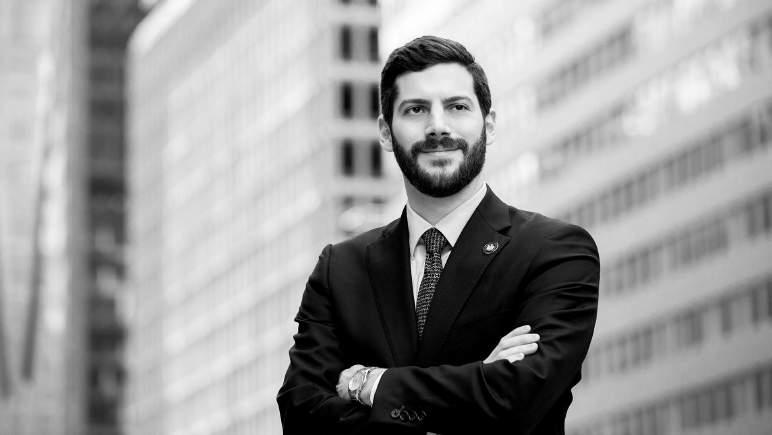
by retiring Democratic Rep. Jerry Nadler after 34 years and has become ground zero for a proxy war between rival factions of the AI industry. The crowded Democratic primary features candidates including Former President John F. Kennedy’s grandson, Jack Schlossberg, and West Side assemblymember Micah Lasher, Nadler’s endorsed successor. But it is East Side assemblymember Alex Bores, running on a platform that includes AI regulation aligned with the guardrails Anthropic is currently fighting to preserve, who has made the race nationally significant.
Bores is a 35-year-old former Palantir engineer with a master’s in computer science from Georgia Tech, and the author of New York’s Responsible AI Safety and Education (RAISE) Act, one of the first state-level AI safety regulatory laws, signed into law last December. His current congressional opponent, Lasher, also co-sponsored the bill. For the RAISE Act, Bores drew the attention of Leading the Future, a super political action committee (PAC) network backed by more than $125 million from figures including OpenAI co-founder Greg Brockman, Palantir co-founder Joe Lonsdale and tech-focused venture capital firm Andreessen Horowitz.
A Leading the Future spokesperson told NBC News that Bores’ RAISE Act is “a clear example of the patchwork, uninformed, and bureaucratic state laws that would slow American progress and open the door for China to win the global race for AI leadership.” The group’s Democratic primary-oriented affiliate, Think Big PAC, which targets pro-AI-regulation Democrats, has spent over $1.1 million on attack ads, most recently tying Bores to Immigration and Customs Enforcement (ICE) through his Palantir employment, a claim he disputes and sent a cease-and-desist to the PAC over.
As The New York Times noted, the irony is that Palantir co-founder Lonsdale is himself funding the Leading the Future network running those ads. Even current Palantir employees have told Fast Company they view the campaign as a misrepresentation of Bores’ record. Leading the Future spokesperson Jesse Hunt countered to Politico that Bores’ donors represent “an extreme ideological dark money network” and that he is beholden to “a broader movement that seeks to control innovation to fit their personal ideological and business interests.”


Bores himself says he left Palantir in 2019 over the company’s contract with the Department of Homeland Security, which oversees ICE, and has recently called for the federal agency to be abolished.
Bores has drawn support from the “AI safety” side of the divide. His campaign raised over $364,000 from AI lab employees in the last quarter of 2025, including $168,500 from Anthropic workers alone, per FEC filings. Public First Action, a PAC that received a $20 million donation from Anthropic, launched a $450,000 ad buy in support of the assemblymember. This is part of a broader schism within the AI and tech sector, where the engineers
building AI are funding the very candidate that investors behind AI companies are trying to defeat.
The past week’s events have sharpened these lines. As of Monday, more than 900 employees at Google, OpenAI and their peers have signed an open letter urging their companies to stand with Anthropic’s stance and refuse the Pentagon’s demands.
On Friday morning, OpenAI CEO Sam Altman broke ranks with the Pentagon’s attacks on Anthropic, telling CNBC that OpenAI shares similar red lines to their competitor, but has reached a new agreement with the Department of War to deploy OpenAI's models on classified networks.
“For all the differences I have with Anthropic, I mostly trust them as a company, and I think they really do care about safety. … I don’t personally think the Pentagon should be threatening DPA against these companies,” Altman said in an interview with CNBC.
While Google has not issued a formal corporate statement, Jeff Dean, chief scientist of Google DeepMind, posted personally on X opposing mass surveillance, writing that it “violates the Fourth Amendment and has a chilling effect on freedom of expression.” However, both companies have agreed to “all lawful use” terms for unclassified military work and are in accelerating negotiations for classified access.
Altman’s public support for Anthropic’s position against a supply chain risk designation is notable given recent shifts in AI-safety policy at both companies. Last year, Google dropped its pledge not to use AI for
weapons development, reversing the position it took in 2018 when employee protests forced it to abandon Project Maven, a Pentagon drone-imagery program. OpenAI has similarly removed “safety” as a core value from the company’s mission statement. Elon Musk has already agreed to allow xAI to be used for full, classified access under the Pentagon’s current terms.
This matters at Fordham, specifically in the case of Google. The university provides all students with access to Google Gemini through Google Workspace for Education, partnering with the same company whose employees are now petitioning leadership to refuse the Pentagon’s demands, even as its corporate leadership is not firm in what direction they’re heading.
For all Fordham students registered in the 12th District, the June 23 Democratic primary offers a direct say in this debate. Bores, if elected, would be the first member of Congress to hold a computer science degree, and would be a likely champion for regulatory AI legislation in the House. His eightpoint federal AI platform includes independent safety testing of frontier models, a national data privacy law, deepfake penalties, and data center energy regulations. A Gallup poll from September of last year found 80% of Americans support AI safety measures even if they slow development.
Whether corporate money can overcome that sentiment nationally, whether it will backfire, or whether AI regulation is electorally salient are questions this district’s election results may help answer.
GRAPHIC BY KAITLYN SQUYRES
Anthropic, the AI safety and research company that created the chatbot Claude, has recently clashed with the Trump administration over AI safety regulations.
Fordham Lincoln Center students can vote in the congressional race in New York District 12 in June.
COURTESY OF ALEX BORES
Alex Bores, one of the democratic candidates for New York ’s 12th Congressional District is running on a platform that includes AI regulation.
Sports & Health
Small Country, Big Champions
The mentality, culture and perseverance behind Serbia’s athletic talent
By LARA POPOVIĆ
Copy Editor
Serbia, located in Central-Eastern Europe, is home to approximately 6.6 million people. Their presence on the world stage, in comparison to their small population, however, is substantial. In the 2000s, it was Novak Djoković who brought worldwide attention to Serbia as he made his way into the “big three” of tennis, standing between the on-court rivalry of Switzerland’s Roger Federer and Spain’s Rafael Nadal. Since then, he has spent a historic 428 weeks ranked first in the world and has become the most decorated player in tennis history with 24 Grand Slams. However, Djoković is not the only Serbian tennis player to have held the world’s number one spot. Ana Ivanović and Jelena Jan ković both reached a No. 1 ranking in 2008. Serbian basketball player of the Denver Nuggets Nikola Jokić is currently one of the top candidates to receive the NBA’s MVP Award for the 2025–26 season. The honorific would be Jokić’s fourth MVP win of his professional career. Los Angeles Lakers’ Luka Dončić (ethnically Serbian on his father’s side), Los Angeles Clippers’ Bogdan Bogdanović, Miami Heat’s Nikola Jović, Oklahoma City Thunder’s Nikola Topić and Washington Wizards’ Tristan Vukčević are five other notable Serbian figures currently in the NBA. Serbian heritage runs deep within the history of the professional basketball league, with former play ers like Vlade Divac, Boban Marjanović and Predrag Stojaković all previously gracing NBA courts.
“ It’s just a huge thing (in Serbia). There are (sports) terrains everywhere. Basketball, tennis, volleyball. … (Serbs) start training from a very young age, and it’s way more intense.”
Most Outstanding Performer in women’s tennis.
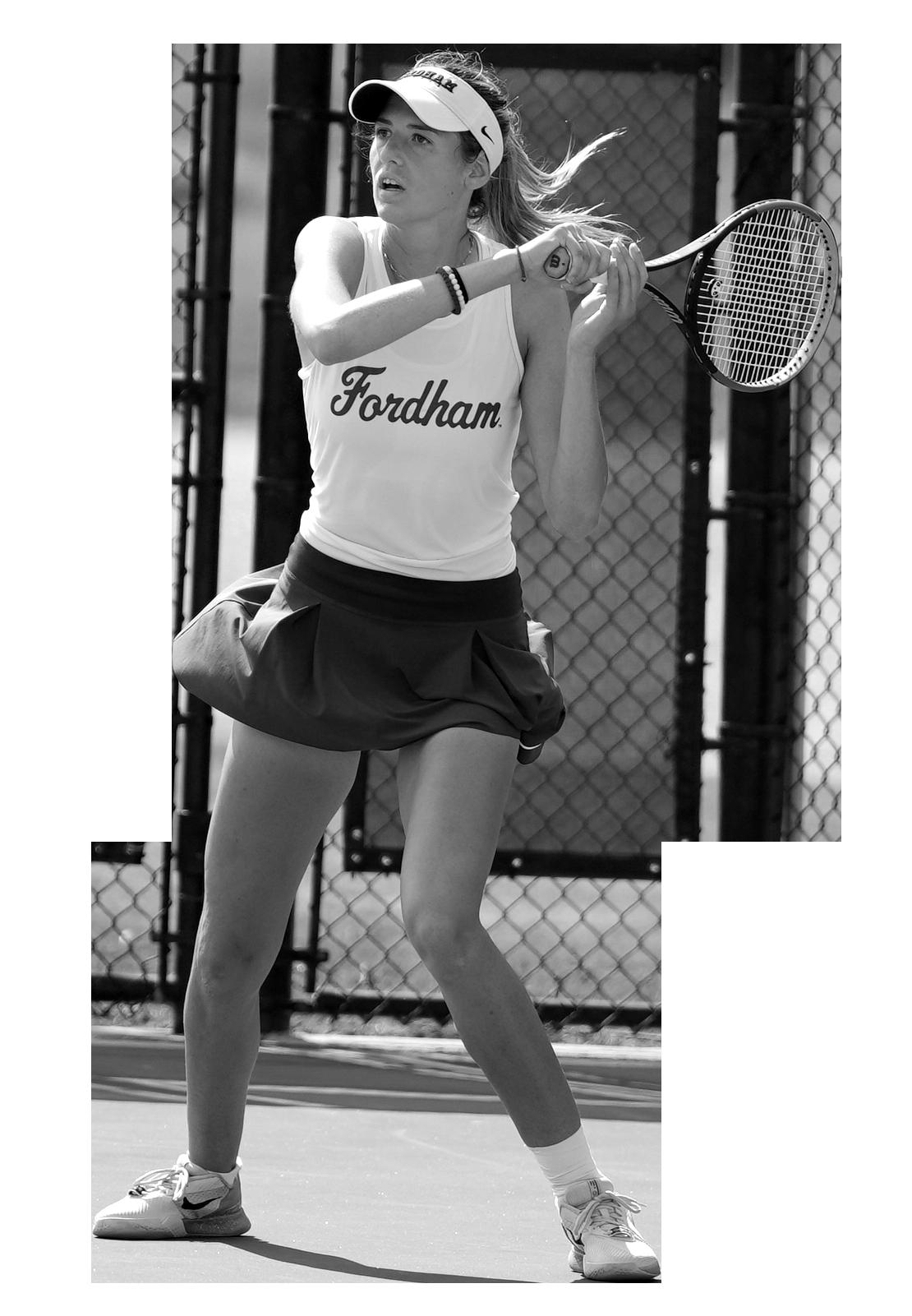
During her childhood in Serbia, Kolarević’s brother introduced her to tennis at the age of five, and her parents encouraged her to further pursue the sport.
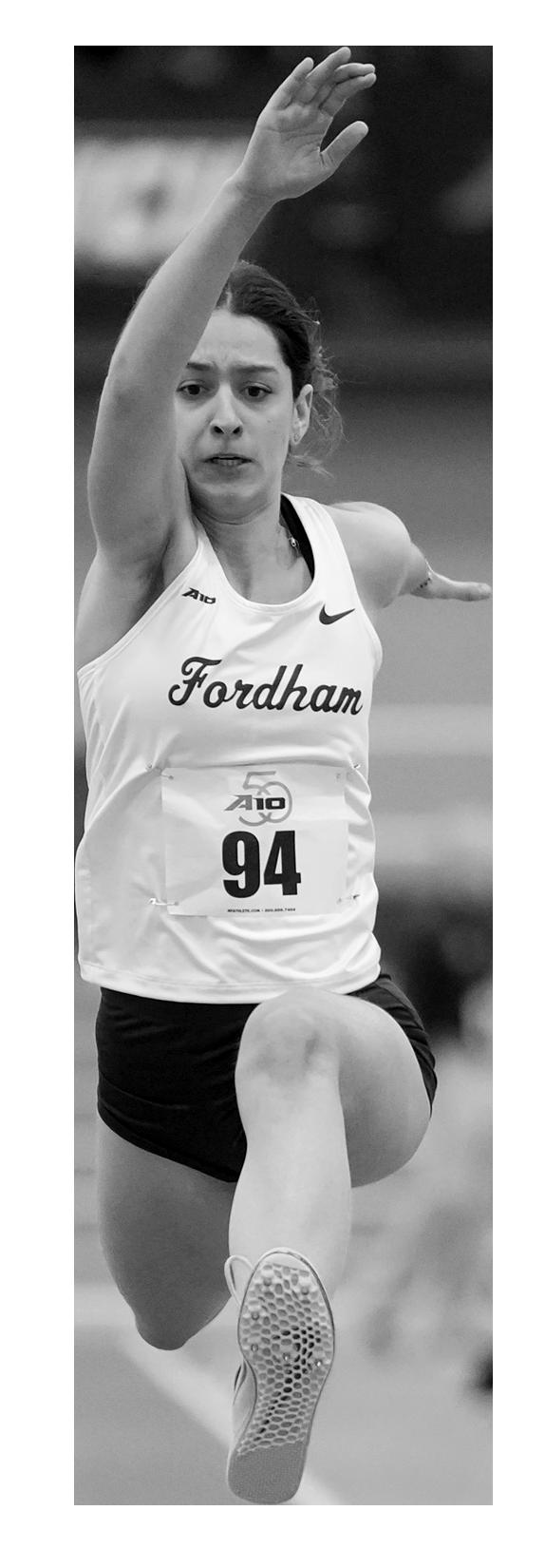
Alexandra Manetović, FCRH ’26, is a diaspora Serb born to immigrant parents and a Division I athlete on the Fordham women’s track and field team. Growing up in a family that embedded sports into her life, Manetović got into
Olympics and bronze at the 2020 Tokyo Olympics. They have also won two back-to-back Fédération Internationale de Volleyball World Championship titles in 2018 and 2022, and three consecutive European Volleyball League golds.
Although Serbs play sports recreationally, their passion goes beyond just having fun, with a cultural emphasis on excelling.
However, Davidović is not the only Serbian coach at Fordham, with Ilija Duretić assistant coaching the men’s water polo team. Prior to coaching, Duretić was a four-time Junior National Champion of Serbia. More recently, he was bestowed with a USA Water Polo Zone award recognizing his leadership, dedication and impact as a coach.
tomorrow brings, not just for yourself, but for your entire family and for your entire city, for your country, and whether you will be able to survive the next day, facing a match point in a Grand Slam is not that hard,” Djoković said in an interview with Piers Morgan.
Alexandra Manetović FCRH ’26
Serbia is known as a feeding ground to colleges and universities for young athletes. Nevena Kolarević, Fordham College at Rose Hill (FCRH) ’26, is one of them. As a Division I athlete on the Fordham women’s tennis team, Kolarević is originally from Belgrade, Serbia. At Fordham, Kolarević has reached the highest tennis ranking ever achieved by a Ram and was named the 2024–25 Atlantic 10 Conference’s
“Both my parentsing for sports and athletics,” Manetović said.
“It’s just a huge thing (in Serbia). There are (sports) terrains everywhere. Basketball,ball. … (Serbs)ing from a very young age, and it’s way more
With a culture deeply rooted in family andmunity, the Serbian passion for sports is passed down generationally.
ić’s 13-year NBA career, his son Andrej Stojaković has picked up the torch of his father’s basketball legacy at the University of Illinois, with the Fighting Illini currently ranked fifth in the NCAA.
Coming from the Dinaric region, Serbs are known for being tall — a huge advantage in sports such as basketball, volleyball and water polo.
“When I am on the court, or on the field jumping, I do feel … like I am definitely pulling from a European line, which is interesting,” Manetović said.
Serbia’s national men’s basketball team reached heights on the international stage, winning a silver medal at the 2016 Rio Games and more recently bronze at the 2024 Paris Games. The men’s national basketball team does not stand alone in their international success; Serbia’s women’s national basketball team has also won the EuroBasket championship twice in 2015 and 2021.
In volleyball, Serbia excels with star players like Tijana Bošković. Serbia’s national women’s volleyball team has previously won silver at the 2016 Rio
“In Serbia, when you play sports, it’s to be really really good, to get to the professional level,” Manetović said. “That’s my impression.”
Beyond their passion for athletic skill, Serbs are also incredibly passionate as sports fans. Serbian sports often feature unbelievably massive turnouts, relentless chanting and pyrotechnics in incredibly loud and intimidating environments. With a passion so strong, Serbian sports clubs such as Crvena Zvezda (Red Star) and Partizan are known for their historic rivalry.
With an immense pride in their heritage and a deep reverence for teammates, Serbia specifically excels in team-based sports. Serbia is not soft-spoken regarding their star athletes, with pictures and murals of them plastered all over the country. Cultural emphasis on “igraj i pobedi” — “play and win” — fuels Serbian athletic drive.
Major sports victories feature Serbians gathering in masses within town squares to celebrate, honking their horns in unison, waving flags, lighting fireworks, singing patriotic songs and partying. A win for one athlete or team is a win for all Serbs, showing a value of oneness and community. After the Paris Olympics, Serbians celebrated athletes like water polo player Dušan Mandić, who led Serbia to their third consecutive Olympic gold. From 2014 to 2017, Serbia’s men’s water polo team held every major title simultaneously, including World League, European, World Cup and World Championships.
Serbian coaches are also known for their intensity, enforcing discipline and drive into their athletes to prepare them for success.
“I remember once I was playing this match and I lost the first set. I went to the bathroom and my coach came up to me and he was like, ‘You either win or you die winning on the court.’ … That gave me motivation and I can say that I ended up winning the match,” Kolarević said about her coach in Serbia.
Milan Davidović, the assistant coach of the Fordham men’s soccer team, is originally from Novi Sad, Serbia. He started playing soccer at the age of five, encouraged by both his family and community.
“Back home, soccer is religion. It’s more than just a game,” Davidović said.
Eventually, Davidović made his way to coaching soccer in Serbia for youth clubs, senior clubs, men’s second division and women’s first division teams, making him well-versed in Serbian coaching styles.
When asked to characterize Serbs in sports, Davidović highlighted their hardworking nature, while Kolarević described them as “stubborn, passionate, resilient and just very straightforward.”
“I call this our ‘blood problem’ — we are very competitive as a country. We want to be the best … It comes from the history; we had a lot of wars behind us, starting from the First World War, Balkan Wars, Second World War, and then bombings and everything. We want to show everyone that we are a small country, but we can still fight. … We don’t care how strong you are, we will at least give you a fight,” Davidović said.
Djoković has brought light to this struggle, being open about his childhood spent in poverty and hiding in bomb shelters, from which he still experiences post-traumatic stress today.
“That is probably the foundation of my mental strength and resil- ience because when you are in doubt of what
With this strength and resilience, Djoković has become a prime example of Serbian “inat.” He is known for his match comebacks when crowds boo him, claiming it fuels his mentality to stay strong and succeed. “Inat,” a word difficult to translate into English, captures the defiant stubbornness it takes to never give up.
“ Small country, bad neighborhood, but we can make something. ... Everything is possible. ... If you want to put your 120%, you will be successful in anything you do in your life.”
“Inat … a combination of many emotions and resolvement to fight in spite of all odds. … Inat kept (Serbians) alive throughout history … (Belgrade) was destroyed to the ground and rebuilt 44 times … more than 115 times there
were battles for the city,” said former Serbian NBA player Miroslav Raduljica in an interview with American former NBA player Joakim Noah.
Even now, the 38-yearold Djoković is the oldest player to be ranked among the top players in tennis, with many having doubted his ability to keep up with his younger competitors. However, the tennis legend has continuously proved them wrong, winning gold at the 2024 Paris Olympics against 22-year-old Spanish player Carlos Alcaraz, and finished second at this year’s Australian Open after beating 24-year-old Italian player Jannik Sinner.
“Every time I think of Novak Djoković, I think about that word — inat. … He had been through so much, but he still kept going and never gave up in any situation,” Kolarević said.
Accomplished Serbian athletes can be found in nearly every sport; their accomplishments emphasize the power of “inat,” in which a fierce spirit and hunger for success trample adversity.
“Small country, bad neighborhood, but we can make something. … Everything is possible. … If you want to put your 120%, you will be successful in anything you do in your life,” Davidović said.
Milan Davidović, Assistant men’s soccer coach
PHOTOS COURTESY OF FORDHAM ATHLETICS
By CATHERINE RAIMONDI Staff Writer
The Verona Arena’s Olympic torch was extinguished on Feb. 22, bringing the 2026 Milano Cortina Winter Olympics to an official close. Although Italy has handed over the Olympic torch to France, who will host the Games in four years, Italy has not yet completed their hosting duties.
Milano Cortina will host the Paralympic athletes competing in the 2026 Winter Paralympic Games from March 6 to 15. This year is the Games’ 50th anniversary; the first Winter Paralympic Games held in Sweden in 1976. Since then, the Games have been held every four years, and in 1992, they began taking place at the same location as the Winter Olympics to demonstrate the congruence between the two games.
The “para” in the term “Paralympic” comes from a Greek preposition translating to “beside” or “alongside,” demonstrating the equality between the games, however viewership decreases significantly from about 31 million Olympic viewers to 15.4 million Paralympic viewers.
A paper written by Rosemarie Garland-Thomson, a bioethicist, disability justice researcher and professor at Emory University, explores the visibility of people with disabilities within society.
“As both a generative concept and a fundamental human experience… disability generates circuits of meaning-making in the world,” Thomson said.
Leah Zelaya, Fordham College at Lincoln Center ’29, is a skier
The 2026 Paralympic Games Begin
Paralympic Games bring visibility to athletes with disabilities
and dancer. She has a neuromuscular disease and is a strong advocate for people with disabilities. She spoke to her experience as a disabled athlete.
“Once I learned and embraced myself for who I was and I got involved with communities like dancing. … that really changed my mindset and opened my eyes because I saw so many other people my age and older doing these sports and feeling confident and doing what they love at the end of the day,” Zelaya said.
For Zelaya, the Paralympics are more than just games: They are an inspiration and a demonstration that a disability is not limiting.
“It inspires so many other people — young kids, as well — growing up who want to pursue something and they can turn on their TV and see someone who looks like them,” Zelaya said.
This year, about 650 athletes are representing their countries at the Paralympic Games, including 68 American athletes. Among the U.S. team is decorated athlete Brenna Huckaby, who is set to compete in snowboarding.
The fight for inclusion in sports for people with disabilities has always been at the core of Huckaby’s career and advocacy. Huckaby was not always a snowboarder; she began her athletic career in gymnastics. At 14 years old, Huckaby was diagnosed with osteosarcoma, which led to the amputation of her right leg. During her rehabilitation, she was introduced to snowboarding and has been riding ever since.
In her Paralympic debut in 2018 in PyeongChang, she
received two gold medals in both snowboard cross and banked slalom. However, as she was training to defend her titles in the Beijing 2022 Winter Paralympic Games, she noticed that Beijing had cut her events.
The International Paralympic Committee (IPC) changed the guidelines of the sport to be geared towards more impaired athletes, only allowing those of the SB-LL2 class to compete. SB-LL2 means having an impairment in both legs, whereas Huckaby falls under the SB-LL1 class with impairment to only one leg.
Huckaby refused to let her training be sidelined, developed an inclusivity campaign, and fought to earn her right to compete. She filed against the IPC in Germany’s Düsseldorf Higher Regional Court, where she underwent a lengthy legal battle until they finally allowed her to compete.
“While this was a big win, there is always more work to be done, and I hope that this reminds adaptive athletes and the disabled community more broadly to never give up on our fight for inclusion,” Huckaby said.
At the 2026 Winter Paralympics, Huckaby will return to the slopes to compete in the banked slalom, as well as the snowboarding cross event.
Competing alongside Huckaby on Team USA is 19-time Paralympic medalist Oksana Masters. She is a true testament of overcoming adversity, having spent the first seven years of her life between orphanages in Ukraine, struggling with birth defects caused by a Chernobyl nuclear accident

that caused her to have both her legs amputated.
“When I’m training … I zone out,” Masters said. “A lot of times, I’m going back to those darker moments to process everything and it helps me regain power. In those moments in my life, I did not have power over my body and myself. And to this day, sports for me, it’s therapy.”
At the Milano Cortina Games, Masters is looking to add to her collection of Olympic medals by competing in cross-country skiing and biathlon.
The Paralympics challenge the societal notions of disabilities and platform the stories of incredible athletes like that of
Swim and Dive Competed at the Atlantic 10 Championships
Huckaby or Masters, stories that resonate with all athletes.
“For me, it’s not about proving what I can do to other people. It’s just more about doing what I love and just doing that with my whole heart and putting my passion into it and just encouraging other people like me as well,” Zelaya said.
As the Milano Cortina 2026 Winter Paralympic Games begin, the athletes will emulate Zelaya’s passion, playing the sports they excel at and love. Viewers can stream performances of all Paralympic athletes, including Huckaby and Masters, on Peacock and give them the viewership they deserve.
Swimmer Hayley Clark and diver David Vargas came in first at the A10s
The Rams also went the distance with two more bronze medalists in both the men’s and women’s 1650 Freestyle. Swimmers Campbell Stever, FCRH ’29, and Quinn Macphail, FCRH ’29, set a Fordham record of 15:13.65.
The A10 Championship marked the start of the postseason for the Rams and the end of their five-month regular season, which began in October.
“This season taught me a lot about resilience. There are highs and lows in swimming, but staying consistent, having fun and trusting the process really paid off,” Clark said.
The weekend in Virginia was the first and last A10 Championship for Vargas, who transferred to Fordham this year to complete his finance graduate degree.
“ You earn these awards during practice; you just show up to the meet to pick them up, (so) don’t expect to do something better that you’ve been doing during practice.”
David Vargas, GGSB ’26
Vargas grew up in Mexico City and came to the United States to pursue collegiate diving. He began his undergraduate career

COURTESY OF FORDHAM ATHLETICS
Hayley Clark on the podium as the Atlantic 10 champion after coming in first on the 200-meter butterfly.
at Auburn University and transferred after one year to finish his degree at Florida State University (FSU). During his senior year, Vargas qualified for the NCAA Championship. Vargas is no stranger to the pressure of big competition. Along with his prior collegiate experience, Vargas began diving at a young age and represented Mexico at junior international competitions. This experience led to the understanding that the culmination of training is reflected in championship performance, Vargas said.
“You earn these awards during practice; you just show up to the meet to pick them up, (so) don’t expect to do something
better that you’ve been doing during practice,” Vargas said. “Just trust the process. I know what I’ve been doing and I know what to expect (in) trying to use the nerves or the anxiety of the meet in your favor.”
This was a sentiment shared by Clark, who went into her first A10 Championship with trust in all the training she had put in throughout the season.
“I trusted all the work I had put in this season, like the early morning practices, tough sets and pushing through days when I was exhausted, but those moments built the confidence I carried into A10s,” Clark said. “It’s reassuring knowing you’ve done everything you can to prepare and it makes
it easier to trust that it will pay off when it matters most.”
Clark made a strong statement by not only taking first in the 200-meter butterfly but also being named to the A10’s All-Academic Team. The athletes on the Fordham swimming and diving team were not the only ones who came away from the A10s with accolades. Fordham’s head diving coach, Zhihua Hu, was named the A10 Coach of the Year.
Hu has been a member of the Fordham diving program for almost 30 years. Originally from China, Hu had an incredible career as a coach for the Chinese National Diving Team before coming to Fordham. For three
decades, Hu has been a wealth of knowledge and experience for the Rams’ diving program.
“Zhihua, he’s been very supportive of me and very empathetic,” Vargas said. “In diving, it’s very important to have trust with the coach because when you’re on the board, you realize you are not there by yourself, you are there with the coach and all this hard work.”
The women’s swimming and diving team took fifth place and the men’s team came home in seventh after the final day of competition at the A10 Championship. In addition to the athletes who made the podium, several Rams ended their season with season-best finishes.
“The energy on deck is on another level compared to regular-season meets. Every session feels important, and you can feel how much everyone cares about each other’s races and accomplishments. There’s something really special about scoring points not just for yourself but for Fordham as a whole,” Clark said.
From March 9 to March 10, the Fordham swimming and diving team will head to the NCAA Zone Diving Championship in Annapolis, Maryland, where Rams like Vargas will be competing to secure a spot in the NCAA Championship in Atlanta, Georgia, at the end of the month.
“I’m going to do my best over there to represent at the highest level. I want to take it as far as I can over there, finish strong and be grateful and enjoy it,” Vargas said.
GRAPHIC BY KAITLYN SQUYRES/THE OBSERVER
Brenna Huckaby and Oksana Masters are set to represent the United States in the upcoming Paralympic Games in Milano Cortina.
RAMS ON DECK from page 1



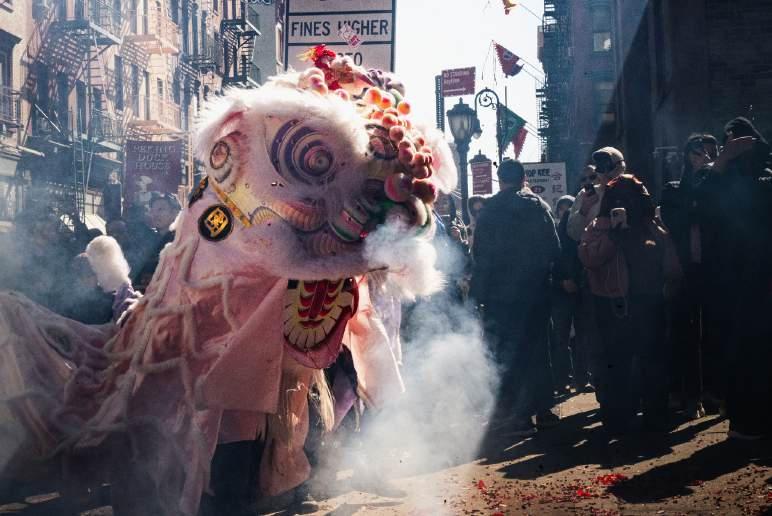
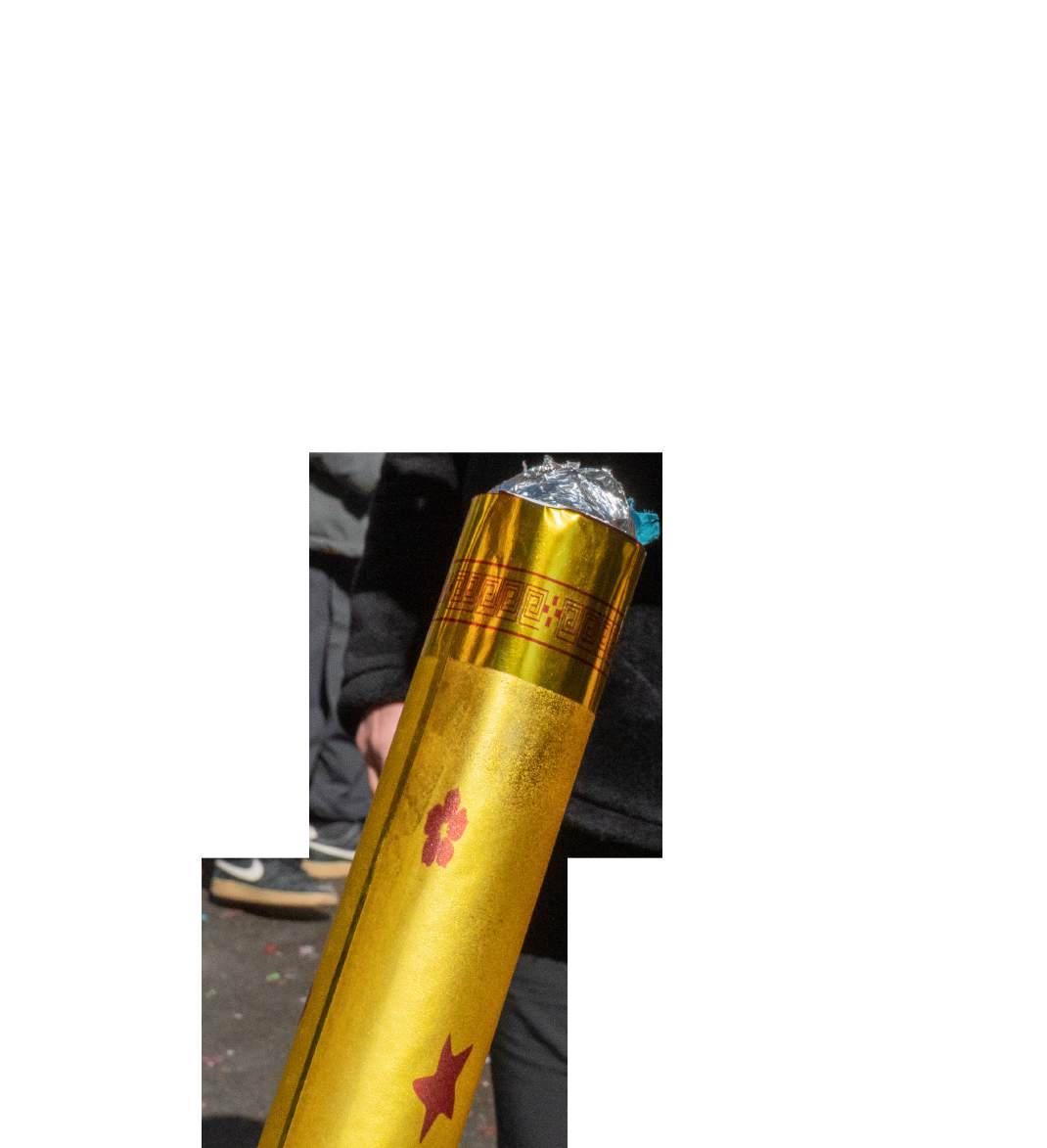
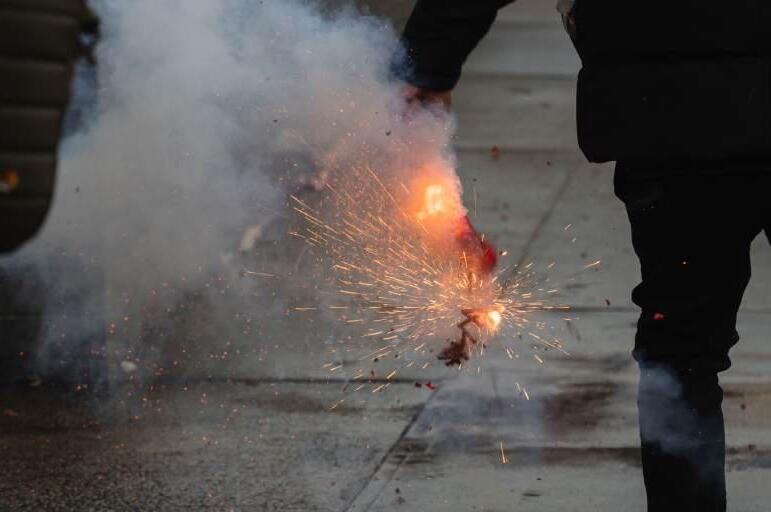


BY GRACE SANTOLI Head Photo Editor
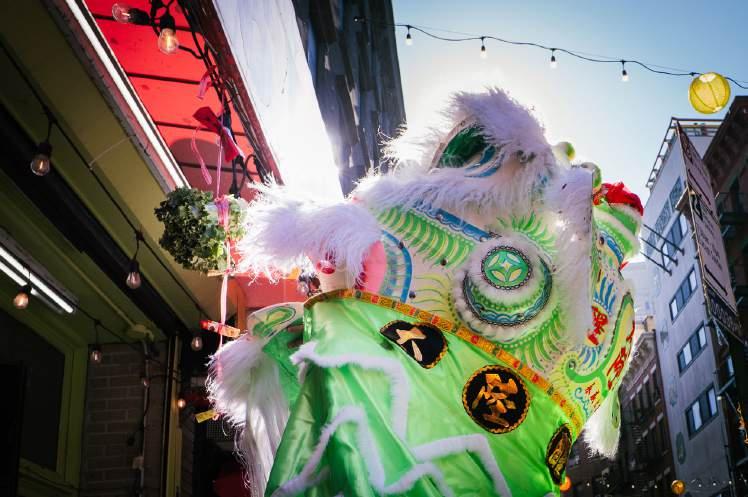
“LION DANCE”

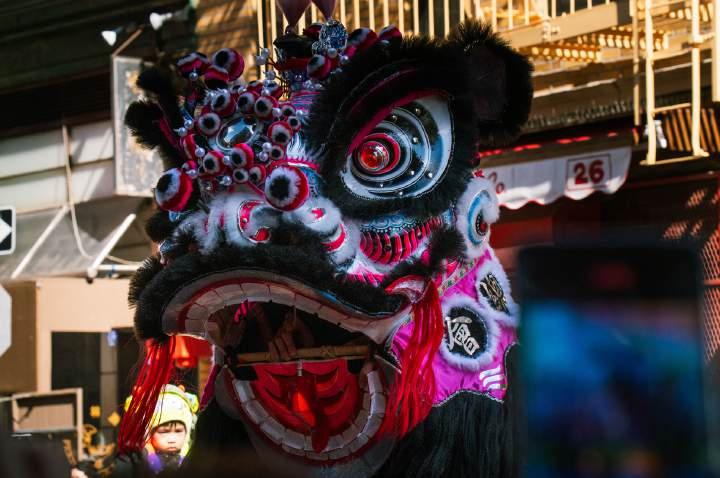






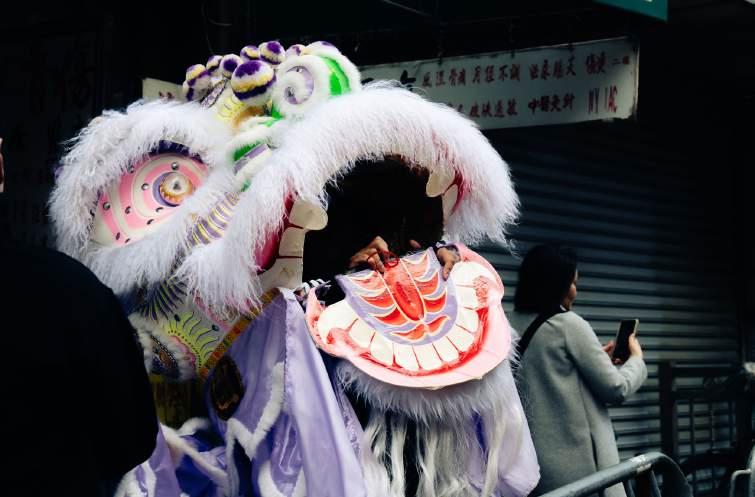

“HAPPY NEW YEAR” “GOOD LUCK & PROSPERITY”
Opinions
Dancing on Borrowed Ground: A Fight for Lesbian Spaces
The displacement of lesbians and their nightlife scene in New York City

Every Wednesday, a Williamsburg bar called The Woods changes form. Lesbians travel from far and wide; as they flow through the bar’s entrance, what was a regular Brooklyn bar in the daytime transforms into what lesbians know as a “Wednesday at The Woods.”
The Woods and I have a weird relationship. I swing back and forth from forbidding myself from ever going back to then planning a night out two weeks in advance. Our turbulent past goes back to when I first moved to New York City, and among other Fordham lesbians, I started to hear the mumblings of the two W’s. After first being introduced to The Woods, I felt a pull to go back every week. Now, any mention of a “Wednesday at The Woods” sends me back into a dizzying frenzy under neon lights as I’m sandwiched between a former lover and a Hinge date.
Despite my love for The Woods, it isn’t a lesbian bar. This was a revelation to me. According to The Lesbian Bar Project, there are only 36 lesbian bars across the United States, six of which are in New York City: Henrietta Hudson, Cubbyhole, Ginger’s Bar, Boyfriend Co-Op, The Bush and Gladys Books & Wine. This made me think, “What bars should I go to when it’s not a “‘Wednesday at The Woods”? And what are the ramifications of prioritizing “lesbian nights” rather than brickand-mortar locations?
I’ve always considered Manhattan to be a very queer place — especially the West Village and Hell’s Kitchen. Realistically, a majority of the bars in this area are catered to queer men. While Henrietta Hudson and Cubbyhole are lesbian bars based in Manhattan, the other four bars are scattered around Brooklyn.
I’m located on the Upper West Side, so it would be a lie to say that going to Brooklyn for a night out isn’t a trek. Usually, I make that trek for The Woods because I know that I’ll be satisfied with the night. There’s a great sense of excitement knowing that if I spend a “Wednesday at The Woods,” I’ll likely meet other young lesbians who go to Columbia University, Pace University and even Fordham. Most of them run in the same circles I’m in, but we never had a chance to formally introduce ourselves until then. After considering my struggle to reach Brooklyn, I started to realize there aren’t that many bars where I can find people like me and have a good time out.
One of the nights that I ventured out from The Woods, I ended up finding myself in the West Village. Along with a friend, we decided to go to Cubbyhole. The famous bar has a rich history involving the queer rights movement of New York City in the 1970s. Living up to its name, it sits at only 824 square feet. The intimacy I found myself in wasn’t what I initially had hoped for:
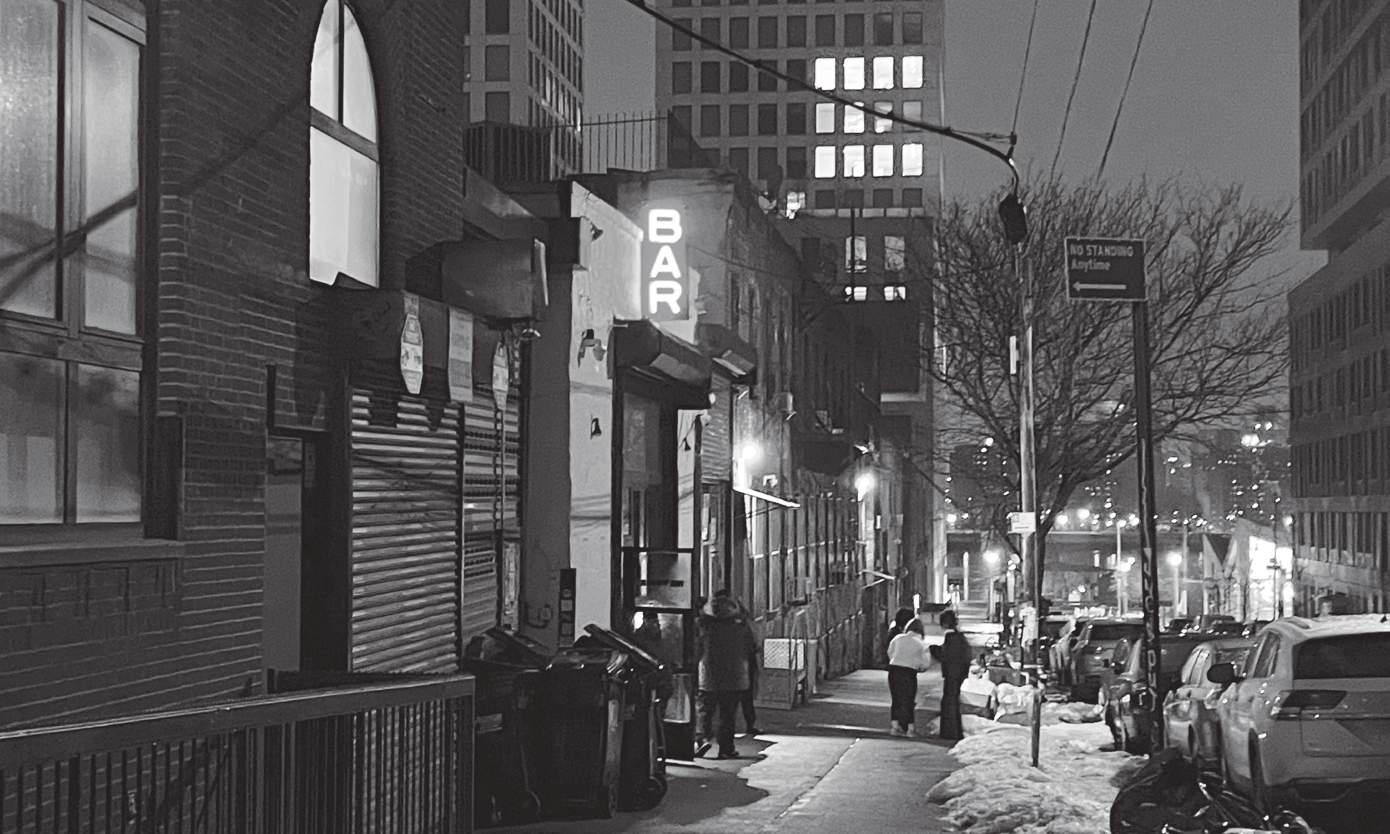
squished between other bodies during the summer night heatwave. It didn’t help that when I tried to flirt with someone and then attempted my great escape with a classic Irish goodbye, I only made it a couple of inches until I was absorbed into the massive crowd as if it were gay oobleck. I hate to take the tone of an ignorant Gen Zer, but I like to get a little lit, and Cubbyhole’s relatively older crowd and small space make for a night more relaxed than lit.
I was so used to my nights at the Woods; with two bars, a dance floor and even a backyard, I couldn’t be more satisfied. So, I continued to go to The Woods on Wednesday nights. It wasn’t until I did my own research into Cubbyhole and the history of its lesbian nightlife scene that I realized a “Wednesday at The Woods” was never really serving my community. This entire time, we were dancing on borrowed ground like gay couch surfers. The Woods hosted us only for one night, and then let us scatter across the different boroughs in an attempt to find our next space.
The precarious nature of nightlife is that it’s the people that make a space what it is, but we are as impermanent as spaces themselves. Think of Studio 54: Despite being open for only 33 months, stories of the space and its wild nights live on through those who encountered it firsthand. So while I adore the charm of a “Wednesday at The Woods,” a singular night creates a complacency where its guests inherently know what to expect. The whimsy and spirit is taken from the experience. On the same note, the crowd that congregates every Wednesday is a concentrated version of other lesbian bars’ regular crowds. But if it is the crowd that makes it undeniably special, in 20 years, when the crowd has long moved on, will there be anything worth remembering about it?
In 2022, when lesbian bars hit a record low, it was Cubbyhole, Henrietta Hudson and Ginger’s Bar that kept lesbian nightlife afloat. It wasn’t until 2023 that The Bush opened, followed by the opening of Gladys Books & Wine and Boyfriend Co-Op. But 38 years ago
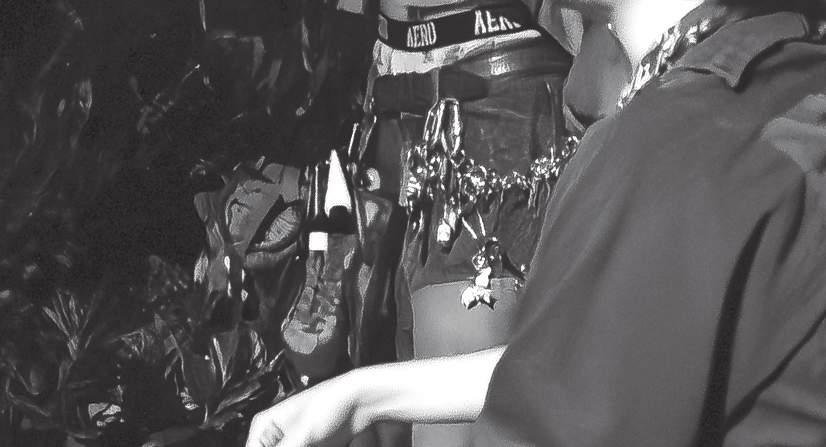
— when Cubbyhole had just reopened its doors to the public — one of Cubbyhole’s patrons and bouncers was queer rights activist Stormé DeLarverie, a butch lesbian drag king. Compared to other queer activists of the time, DeLarverie has never gained much recognition despite being rumored to have thrown the first punch during the Stonewall Uprising of 1969.
It wasn’t until the early 2000s, when DeLarverie was in her 90s, that this historic event and her name came to share the same sentence. In a 2008 interview with Patrick Hinds for the magazine Curve, Hinds asked DeLarverie about the “Stonewall Lesbian” and she outright debunked any suspicion of it being a rumor, stating, “they were talking about me.”
Without queer figures like DeLarverie and their stories being publicized, it may take one a long Google search and time sifting through historical moments in order to finally learn about the lesbians that have been discounted and left out to dry by their own community. Take the Lavender Menace action on May 1, 1970, as an example. Lesbian defectors from the Gay Liberation Front formed a group called the Radicalesbians, who stormed a conference. Excluded from the second-wave feminist movement by the National Organization for Women, in fear that they would bring about the stigma of being “man-haters,” their disruption of the conference was a call to action for their inclusion. The nascence of the Radicalesbians and the group’s tribulations on that day persist into the present day as queer people continue to fight to have dedicated spaces for our community.
This issue is even more pressing under the Trump administration, with the recent removal of the pride flag from the Stonewall Monument. It raises the troubling thought that queer spaces are easily malleable to external forces, possibly jeopardizing the spaces themselves. Queer activists of the 1970s, like DeLarverie, fought for the security of these spaces and their history should be respected. While the monument is still holding strong in the West Village, the physical presence of a flag was missed for the time that it was removed.
Although I’ve had one poor experience at Cubbyhole and a couple of great experiences at The Woods, I’ll never dismiss the relevance of Cubbyhole as a safe haven for lesbians and queer people. The fact that it has withstood the test of time since the 1980s is commendable. Its space is always there for lesbians, old and new. Permanent spaces will afford my community an insurmountable amount of support that it desperately needs right now. While new lesbian bars continue to pop up in Brooklyn, and The Woods will always have Wednesday nights, if there’s one thing we should prioritize right now, it’s the history and permanency of the spaces we share.
OLIVIA IANNACCONE/THE OBSERVER Queer women in Brooklyn aren’t out of the woods yet!
OLIVIA IANNACCONE Contributing Writer
GRACE SANTOLI/THE OBSERVER
of queer spaces, flagging is used to signal queerness to those in the know.
Don’t Bet On It
Just because you can bet on anything these days doesn’t mean you should

JEREMY CARBO Contributing Writer
Imagine two college students arguing over whether or not the United States will confirm the existence of aliens by the end of the year. One of the students, amused at the other’s confidence, asks their friend if they’d be willing to put $5 on it. Both agree on the wager, the bet is made, and the two students are now engaged in a gamble.
It seems obvious that this is exactly the kind of activity that occurs on platforms such as Polymarket and Kalshi. Rather than making a bet with a friend, one can instead use their $5 to buy yes/no shares on a prediction market. These websites enable users to gamble by placing bets on whether or not real-world events will occur. If you want to bet that the existence of aliens will be confirmed in 2026 or that the temperature in New York City will reach 40 degrees Fahrenheit on March 4, there is a market for that.
The growth of prediction markets into a multibilliondollar industry is part of a general rise in speculative risktaking behavior among Americans.
But that is not how Polymarket or Kalshi would describe their services. As states such as Nevada and Massachusetts fight to regulate prediction markets as gambling sites, these platforms are defending themselves by claiming to be financial exchanges subject to federal regulation rather than state gambling laws. In their eyes, buying “yes” or “no” shares on whether Fordham’s basketball team will win their next game is “futures trading,” akin to buying and selling stock rather than actual sports betting.
It is true that what Polymarket and Kalshi offer is distinct from traditional sports betting. Rather than keeping gambling localized to the binary outcomes of sport (Fordham will or won’t win), these platforms transform all real-world events into markets with binary outcomes. Prediction markets can thus be viewed as a symptom of late-stage capitalism, the byproduct of a society in which every aspect of life is consumed by market logic. But before the effects of prediction markets can be ascertained, their rise in popularity must be contextualized.
The growth of prediction markets into a multibillion-dollar industry is part of a general rise in speculative risk-taking behavior among Americans. The rise of retail trading illustrates this phenomenon. Retail trading is when individuals buy and sell securities (such as stocks) for their personal accounts. As reported by CNBC, retail trading “has risen to nearly 20% of daily trading volume” since the COVID-19 pandemic. As exemplified by the popularity of large online communities such as Reddit’s r/wallstreetbets, more individual traders than ever before are opting to play the stock market rather than wait for long-term investments

to pay off.
Similarly, the rise of online sports betting shows how speculative risk-taking behavior is becoming normalized to an unprecedented degree. Since the Supreme Court’s 2018 decision to strike down the federal law prohibiting sports betting, legalized sports gambling has grown into a multibillion-dollar industry. One cannot watch an NFL or NBA game without being bombarded with advertisements from companies such as DraftKings and FanDuel, even as players complain about how gambling has intensified harassment from fans. These companies freely promote the idea of speculative risk-taking, even as gambling addiction grows as a public health issue. Retail trading, sports betting and prediction markets: the holy trinity of high-risk, easy-entry speculation. Anyone with internet access can log on to their online brokerage, sportsbook or prediction market of choice, and the more they risk, the more they stand to gain. It has never been easier to gamble on the stock market, sports, or — in the case of prediction markets — any event that can gather sufficient interest.
When the majority of Americans believe that the economy is rigged, making it big through making a few smart trades or predictions becomes an attractive prospect.
It doesn’t take a genius to know why these kinds of highrisk speculative acts have grown in popularity. Between the rising cost of living, mounting student loan debt, unaffordable housing and stagnant wages for the majority of Americans, the notion of “getting ahead” through hard work and dedication seems increasingly ludicrous. When the majority of Americans believe that the economy is rigged, making it big through making a few smart trades or predictions becomes an attractive prospect. Even if nearly 70% of Polymarket traders do not make a profit, economic precarity can push people into overestimating their odds of success, especially when they look online and see stories of people making life-changing money on a lucky bet. These
success stories obfuscate the much larger number of testimonies of loss and devastation brought on by high-risk gambling.
In effect, our late-capitalist society, marked by its wealth inequality and decreasing social mobility, is now burgeoning with industries profiting off of Americans’ structurally motivated desire for easy-entry payouts, regardless of the risk. Prediction markets are the most expansive of these industries, transforming any real-world event into an opportunity to make a financial stake.
This transformation has two effects that fundamentally distort the relationship we usually have with reality.
First, prediction markets commodify belief. This is actually the stated goal of Tarek Mansour, the co-founder of Kalshi, who said last year that, “the long-term vision is to financialize everything and create a tradable asset out of any difference in opinion.” On its face, the idea of a future where every prospective war, natural disaster or pandemic is treated as a financial opportunity seems abhorrent. But on Polymarket, the future is now. I can bet on whether the United States will invade Iran, whether there will be a major earthquake by June 30 and how many measles cases there will be in the United States by the end of the year. To “financialize everything” is to allow tragedy and destruction on one side of the world to become a tradable asset for those on the other side.
The commodification of belief is distortive in two ways. Firstly, it ties belief to a financial stake,
which encourages cognitive biases that lead to rigid beliefs rather than open-mindedness. If I believe that my political party will win in the coming election, then I am susceptible to a natural confirmation bias and may favor information that supports what I already believe. But by tying my belief to a bet, I have an extra bias to search for information that supports my position. I am now twice committed to my belief, as being wrong would mean both an intellectual loss and a financial one.
The transformation of real-world events into monetizable opportunities further distorts our relationship with reality by reframing real-world events as yes/ no spectacles.
Secondly, the commodification of belief can lead to the normalization of the otherwise outlandish. For example, it is not constitutionally possible for President Donald Trump to run for a third term. But when prediction markets do not disqualify him as the potential Republican presidential candidate in 2028, it legitimizes the possibility of him running. Prediction markets present the price of yes/no shares as probabilities for outcomes. Since the market places a non-zero price on “yes” shares for Trump
being the Republican candidate in 2028, it lends some legitimacy to the idea that such an event is, at the very least, plausible.
The transformation of realworld events into monetizable opportunities further distorts our relationship with reality by reframing real-world events as yes/no spectacles. In his book “The Society of the Spectacle,” Guy Debord describes spectacle as “a social relation between people that is mediated by images.”
Prediction markets represent real-world events as images. After all, many events cannot be reduced to yes or no outcomes without flattening their underlying complexity, causes and context. When I see the odds of which movie will win best picture at the Academy Awards fluctuate on my screen, I am not engaging with any of the reasons for why the odds are what they are. I do not need to be part of the greater dialogue of why the Academy picks the way that they do, nor do I even need to consider the artistic merit of the films for myself. I am instead engaged with an artificial number that claims to accurately represent the probability of events in the real world.
As Debord says, “When the real world is transformed into mere images, mere images become real beings.” When we become wrapped up in the image of probability, we come to treat the representation of reality as more real than reality itself. The need to analyze realworld events for ourselves is displaced by a market that claims to be doing so for you.
For these reasons, the rise of prediction markets is of paramount interest to Fordham students. After all, many of us are grappling with the kind of economic uncertainty that largely motivates speculative behavior such as betting on prediction markets. As the cost of living increases and the job market runs dry, the pressure to secure financial stability only grows, and the prospect of making “easy money” on sites like Polymarket and Kalshi becomes enticing. But in engaging with these sites, we make ourselves susceptible to distortions in the way that we view events in the real world. As students learning how to think critically about real-world events, we know how reducing these events to a simple “yes” or “no” flattens their complexity and context. If we want to critically analyze real-world events, we must not let the “odds” substitute engaged understanding with the topic at hand.
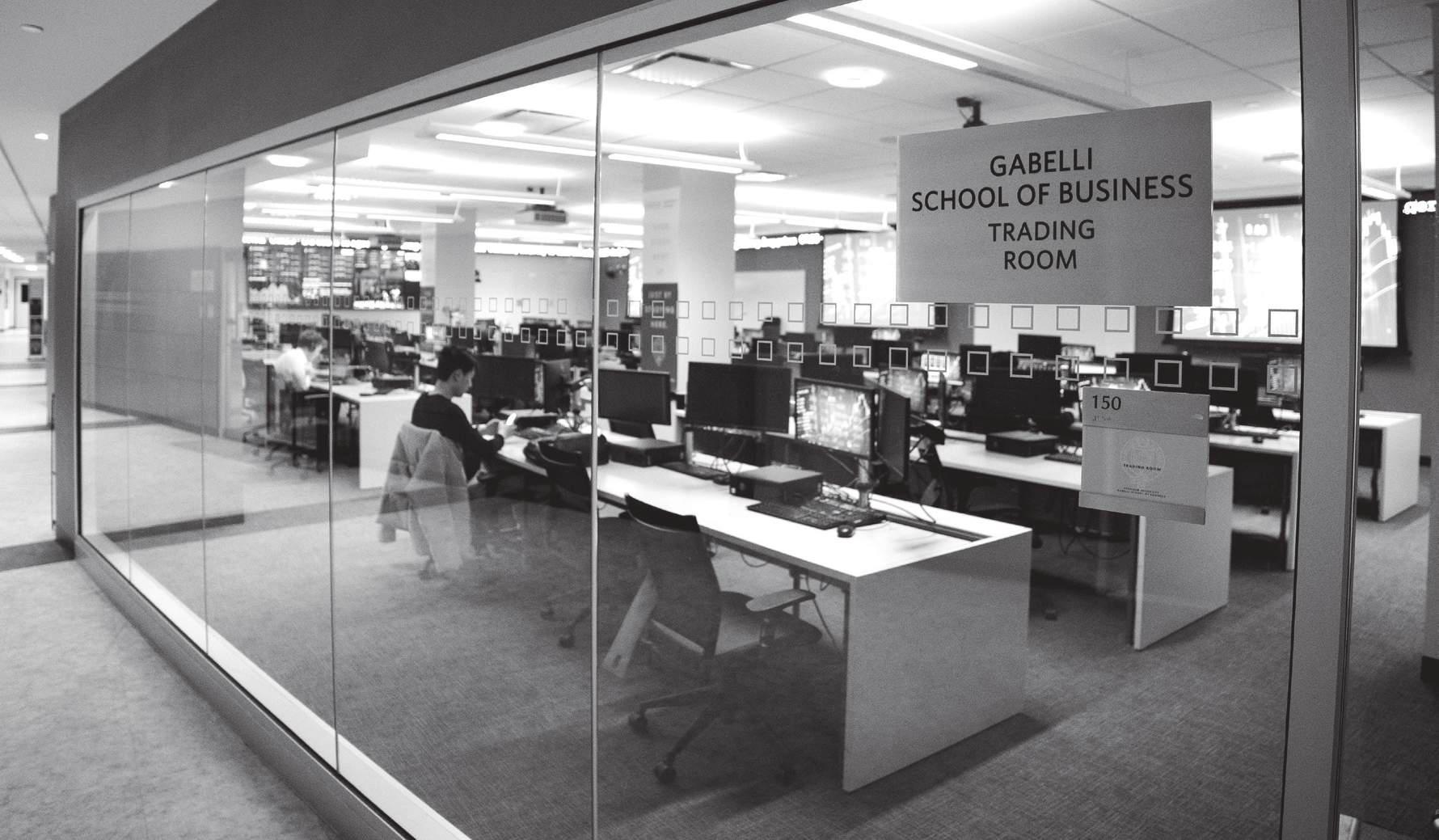
GRAPHIC BY GRACE SANTOLI/THE OBSERVER
Millenial-founded Polymarket and Kalshi prove that boomers can’t be blamed for everything.
GRACE SANTOLI/THE OBSERVER Need money for rent? Make ends meet by gambling your last dollar!
I’m Not Really Listening
Reducing noise contributes to personal growth through self-contemplation

When people ask about my favorite music genre or artist, I most often pause before saying I simply prefer quiet. My preference for quiet does not stem from a deep cynicism toward music, but rather, from a strong appreciation for silence.
While sound offers the body a unique source of gratification, I contend that silence can be a powerful source of comfort if we only learn to seek it out.
The world we live in makes it unusually difficult to identify things that require our undivided attention. Instead, we are expected to com- partmentalize every one of our senses and process various types of input simultaneously.
In New York City, it is quite easy to locate this dilemma on any street with passersby: AirPods in ears, phone in hand.
It can be tempting to satisfy our minds with constant stimulation, even allowing others’ ideas to replace our own when we listen to a podcast or talk on the phone.
It can be tempting to satisfy our minds with constant stim ulation, even allowing others’ ideas to replace our own when we listen to a podcast or talk on the phone. Nonetheless, exer cising the restraint required to eliminate background noise is an invaluable skill.

find that reflective silence is most necessary today. It refers to the silence created when we make time for purposeful introspection.
Noise is never just noise. No matter how much we like to admit it, there is a reason we blast music on our way to class or listen to a self-help audiobook on our way to the grocery store.
We often find it difficult to reduce noise because we treat it as a condition of life rather than a valuable addition. When we eliminate this assumption from our routine thoughts, limiting distractions becomes simple.
The first step I would advise anyone struggling with silence to take is to set aside mornings, evenings or a specific time of day as a silent
deliberate choice rather than an unconscious habit.
Moving yourself away from the source of distraction allows you to move closer to your ultimate source of peace, whatever that may be. It could be writing, baking or creating something with your own two hands.
The absence of noise, both literal and symbolic, creates the desire to fill a void. Consider fasting, a practice integral to many religions. Fasting opens up a space for reflection by replacing physical nourishment with spiritual nourishment. Silence similarly starves the body of its immediate needs, which can foster personal growth.
Silence presents a way for me to engage with my faith. It allows me to discern truth among many other voices. Like in many religious and cultural traditions, I value the sanctity of stillness. Silence is not just a core principle of meditation; it can, in and of itself, be a form of meditation.
St. Ignatius of Loyola, Jesuit founder of the Society of Jesus, who is memorialized in a statue outside of Fordham Lincoln Center, regarded silence as a necessary discipline. He advised, “Be slow to speak, and only after having first listened quietly, so that you may understand the meaning, leanings, and wishes of those who do speak. Thus, you will better know when to speak and when to be silent.”

Among the different types of silence scholars have identified, I
Reducing noise is a reliable way to build intentionality. Intention can translate from the way we hear media content to the way we hear other people.
How many people do you know who actually listen when you speak? Or better yet, try to understand you? Rather than giving simple one-line responses or nodding along, they hang on to every word you say and its meaning.
Many people accept that a world where we all care about
others have to say is preferable, yet unrealistic. I think it becomes possible
when we choose to be silent, even for a moment.
Noise is never just noise. No matter how much we like to admit it, there is a reason we blast music on our way to class or listen to a self-help audiobook on our way to the grocery store. It could be that we are in need of a pick-me-up, but it is also plausible that we are avoiding a deeper issue.
In an age of generative artificial intelligence and anti-intellectualism, it is critical that we limit distractions to make room for the origination of thoughts and ideas.
Whether the reason is positive or negative is not the matter. The problem arises when we lose sight of the reason altogether and fail to recognize our overreliance on auditory stimulation.
Demonizing the consumption of audio media content is not my intent. There is a place for sound in our lives just as there is a place
for work, rest, exercise, eating and drinking. Pursuing avenues for silence involves moderation.
Despite my dislike of constant noise, I do make time for the occasional sound wave or two. I find that my listening experience is enhanced by my intentionality — that is, when I do engage my ears, listening to music or content is one of, if not the only, activities I am doing. It is in this way that I can appreciate what I consume more carefully.
Preserving silence also preserves the sacredness of our innermost thoughts. We develop a reverence for contemplation and a hunger for thought when we are quiet. Being quiet allows us to produce ideas rather than solely inheriting them from other people or sources.
In an age of generative artificial intelligence and anti-intellectualism, it is critical that we limit distractions to make room for the origination of thoughts and ideas. We must place ourselves in environments where mistakes are viewed as sources of motivation rather than
condemnation. Silence gets us one step closer.
I would urge you to allow for at least five minutes of quiet today. It can be spent brainstorming, going on a walk or doing absolutely nothing.
Silence, if you let it, becomes a force that demands curiosity while at the same time gently inviting peace. This does not mean that quieting parts of your life immediately guarantees comfort with your thoughts, but that is the ultimate goal. Giving yourself permission to think loudly

question that Fordham asks of its students:
“What does it mean to be more and do more for the world now?”
Sit- ting in silence is not a form of disengagement from the outer world. We seek silence in order to engage with the deep - est parts of ourselves so that we may be better for others. I would urge you to allow for at least five minutes of quiet today. It can be spent brainstorming, going on a walk or doing absolutely nothing. Silence is what you make it. However you choose to spend the time, know that silence is the first step toward a healthier, more engaged and intentional lifestyle.
Reducing noise as a distraction from your life is more significant than you may have otherwise realized. Remember that silence is golden.
GRAPHICS BY KAITLYN SQUYRES
GENESIS SALGUERO Asst. Copy Editor
Arts & Culture
March 4, 2026 THE O
‘The Secret Agent’ Debriefed at Lincoln Center
Kleber Mendonça Filho on framing a political record through childhood memories in his latest feature
By NORA KINNEY Arts & Culture Editor
The opening shot of “The Secret Agent” features on-screen text introducing the setting — Brazil, 1977 — as “a period of great mischief,” a translation of the original Portuguese word “pirraça.”
Writer and director Kleber
Mendonça Filho stressed the cultural context of “pirraça” that is elided in translation at a post-screening discussion at Film at Lincoln Center on Feb. 28.
“‘Pirraça’ is an elusive word because … it’s been retired by most people. It sounds a little old, but it does imply a sense of mischief, but almost in a childish way,” Mendonça Filho said. “I really thought that ‘pirraça’ would perfectly undersell the whole notion of an authoritarian regime.”
Mendonça Filho’s latest is set during the military dictatorship in Brazil, but largely skirts the upper echelons of power. Instead, the movie focuses on everyday people as they go about their lives — commuting, partying and working in their community — while the abuses of local political jockeys soil the margins of each sun-drenched frame.
The film’s protagonist is Armando, played by Wagner Moura, a former professor turned political refugee who recently arrived in Recife, the capital city of the state of Pernambuco. There, he covertly shelters among other asylum seekers under the alibi Marcelo.
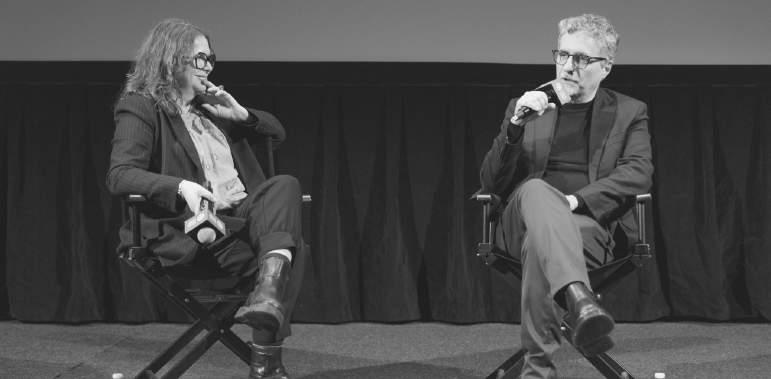
For the first hour of the film, the details of Armando’s persecution are unknown. He is a widower with a young son named Fernando who lives nearby with his grandparents. Everything left unsaid is evoked through Moura’s pitch-perfect emotional composure. Marcelo, as he is known to his new neighbors, seems worldweary, and yet he carries on with apparent fortitude like the rest of them.
Only during a recorded testimony is it revealed that Armando’s publicly-funded research entangled him with a corrupt industry leader who, in service of the austere government, seeks to destroy him.
This is one way in which Mendonça Filho masterfully controls the film’s tension. He is loath to appease those he jokingly referred to as “client support people,” or audiences who “really want the film to tell them exactly what is going on.”
Mendonça Filho’s reticence lends “The Secret Agent” a crucial sense of realism. As the film moves through scenes of daily life in Recife, what emerges is not a clear-cut tale of folk heroism nor a caricature of life under tyranny, but a complex recreation of the relationships that both sustain and threaten us amid great social precarity.
The film’s producer Emilie
Lesclaux spoke about the casting for the film led by casting director Gabriel Domingues.
“(Domingues) is always looking in little cities for unknown actors, and it’s a very beautiful process of giving opportunities to these actors that nobody knows,” Lesclaux said.
Standouts in the supporting ensemble include the 79-yearold actress Tânia Maria, who steals scenes as Dona Sebastiana, the keen safehouse matriarch, and the actor Robério Diógenes, who plays the rotten police chief Euclides.
Early filmic influences, such as a young Mendonça Filho’s fixation on Steven Spielberg’s “Jaws,”
heighten the film’s sense of personal nostalgia. Armando’s son Fernando is similarly obsessed, recreating the poster in crayon on the back of notes addressed to his dad. The reception of “Jaws” in Recife devolves into mania when an actual human leg is discovered inside a beached shark’s stomach, which invigorates the local press.
The film glimmers with these talismanic references belonging to a lost era. It is no wonder Mendonça Filho chose an anachronistic word to introduce the film — “The Secret Agent” is preoccupied with time and how stories tether us across infinitudes in ways we cannot perceive.
Interlaced with Armando’s timeline is a future in which two graduate students are listening to his voice on a digitized recording, wondering about his fate.
Mendonça Filho mused about what it means to leave an archive in your wake.
“Even this conversation this afternoon here, if it’s being recorded, maybe in the future — let’s say, 2067 — someone will access this (question-and-answer session) and look at it from a different perspective,” he said.
Considered a standout in the ongoing movie awards race, “The Secret Agent” was the most awarded film at the 2025 Cannes Film Festival and is in contention for best picture, best actor for Moura, best casting and best international film at the upcoming 98th Academy Awards on March 15.
Professors and Priests Unpack Martin Scorsese’s ‘Silence’
Speakers discussed struggles of faith and conscience for the most recent installment of an ongoing film screening series
By NORA KINNEY Arts & Culture Editor
A screening of Martin Scorsese’s “Silence,” based on the 1966 epic historical novel by Shūsaku Endō, was held at Keating Hall on the evening of Feb. 26. It was followed by a discussion with Father George Drance, an artist-in-residence in the theatre program; Father Michael Zampelli, associate professor of theatre; and Professor James McCartin, a Dean Fellow who teaches theology.
As attendees helped themselves to complimentary pizza and settled into their seats, an enthused Stephan Apicella-Hitchcock introduced the night’s agenda. Apicella-Hitchcock, head of the visual arts program, organizes and moderates the “Films Worth Talking About, Even if Difficult” series sponsored by the Office of the Dean.
“Silence,” released in 2016, follows two 17th-century Jesuit priests from Portugal on a mission to find a lost mentor and spread Catholic Christianity in Japan. They travel to the country during a time of intense religious persecution, in which Christians are made to renounce their faith through torture or else be mercilessly killed.
Young priests Sebastião Rodrigues and Francisco Garupe, played by Andrew Garfield and Adam Driver, find initial acceptance in small coastal villages where the Christian faith is still intact. But word of the priests and their travels imperils the very communities they seek to help.
The men splinter off from each other, and soon, bloodshed
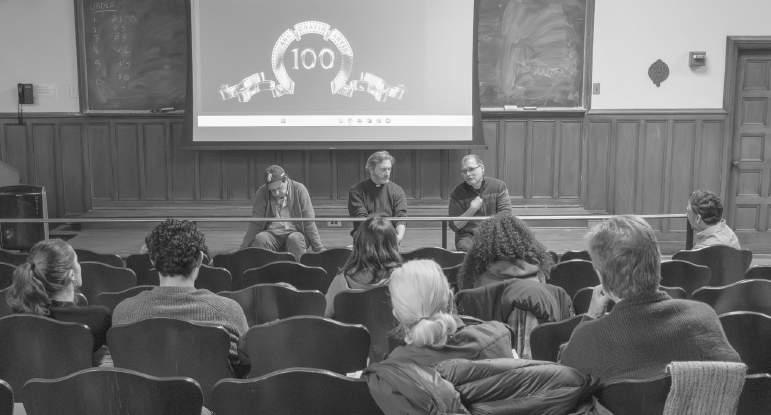
fills their days and nights. They watch as peasants are rounded up and given an ultimatum by the inquisitor (played by a delightedly villainous Shinya Tsukamoto): Stomp on a stone engraving of Jesus Christ, thereby condemning your belief, or die.
One man named Kichijirō repeatedly tramples on Jesus to save his life, but crawls back to Rodrigues begging for forgiveness for his sins. He is a morally ambiguous character with an even more uncertain relationship to God — something that resonated with Father Zampelli.
“I feel like I see myself in him a lot, especially that line (Kichijirō says): ‘I would have been fine if they weren’t in persecution,’
right? ‘I would have been fine 20 years ago, but it’s just too hard now. I’m just not strong enough.’ And I feel like I get that somewhere inside of me,” Zampelli said.
McCartin touched on another point of complexity, which was the oft-misunderstood idea of finding grace through suffering.
“The unity of one suffering … (with) the suffering of the God who became human, the suffering of Jesus on the cross, has been experienced by people across history as edifying, as transformative and as somehow enabling them to have some sort of dignity,” McCartin said. “I want to suggest that perhaps part of it is because they already know they’re undergoing suffering.”
William Holland, Fordham College at Rose Hill ’29, had seen “Silence” four previous times before that night’s screening. He offered poignant insight on what the movie meant to him.
“The first time I saw it, I was on a bus coming back from a mission trip with my church, and I felt like all the things discussed in this — about doubt, and how you can feel just how heavy the silence is and how painful it is to not know if God is really there — I felt like that’s the kind of stuff they don’t teach you in Sunday school,” Holland said. “It’s something that I felt like was represented really well here.”
By the third act of the film, Rodrigues is a shadow of the man he once was, who has formally
apostasized after years of relentless intimidation. Christianity, he is told, does not grow in Japan, where the only god they worship is the sun. All of those people who died did so for him — he who pressed rosary beads into their hands, listened intently to their pent-up confessions and forgave them, over and over for their sins — not God.
Yet something sustains Rodrigues to the very end of his days. The final shot of the film pushes in on the loosely clasped hands of his corpse, where, hidden to those carrying out his Buddhist funeral rites, rests a small wooden crucifix.
Drance invoked the philosophical and ethical principle of “epikeia” — which in simple terms means a law can be broken in the pursuit of a greater good — to rationalize Rodrigues’ extreme subjugation of his faith.
“What was most interesting about Rodriguez is that his journey of epikeia was constantly transforminged,” Drance said. “What might seem like a flip, or what might seem like a 180, is just, ‘I think I understand this context,’ and then it changes.” Zampelli voiced his agreement, saying that inhabiting identity is never static.
“Rarely do we know who we are and then go out in the world and act, right? Maybe that’s some kind of fantasy that we have. I feel like we’re always discovering who we are in the process of acting in the world,” he said. Next up in the “Films Worth Talking About, Even if Difficult” series is Kleber Mendonça Filho’s “Pictures of Ghosts,” which will be screened on April 16.
KAITLYN SQUYRES/THE OBSERVER
Students and community members gathered to hear Professor James McCartin, Father George Drance and Father Michael Zampelli speak.
COURTESY OF FILM AT LINCOLN CENTER
Kleber Mendonça Filho and Emilie Lesclaux fielded questions at the Elinor Bunin Munroe Film Center.
‘Painting the Border: A Child’s Voice’ Opens in Fordham’s Refuge
Gallery
Curator Diana Barnes’ traveling exhibit tells young migrants’ stories of the border
By MARGO CRAVEN Arts & Culture Editor
The Trump administration implemented the Migrant Protection Protocol (MPP) or “Remain in Mexico” policy in January 2019, which required non-Mexican asylum seekers who crossed the U.S.-Mexico border to return to Mexico to await immigration court hearings.
Skidmore College teaching professor and border studies expert Diana Barnes traveled to Ciudad Juárez, Mexico, in August of 2019 with the hope of giving some of the youngest asylum seekers trapped in Juárez a fun day — a chance to just be kids amid trauma and uncertainty. Local children’s author and World Organization for Peace representative Lucero de Alva organized the project to take place at the Rodadora Interactive Space in Juárez, a nonprofit organization and museum where young migrants staying in shelters could play, eat pizza and make art.
Their paintings and short written responses became the traveling exhibit “Painting the Border: A Child’s Voice,” curated by Barnes with the help of her students at Skidmore College, who translated the descriptions into English and gave the exhibit its name.
El Paso muralist and graffiti artist Jesús “Cimi” Alvarado crossed the border into Juárez alongside Barnes, armed with plenty of paints, palettes and canvases to give kids the opportunity to paint their experiences based on a single question posed by Alvarado: “¿Qué opinas de la frontera?” (“What do you think of the border?”).
“You’re here at the border … you’ve left your grandparents, you’ve left your bed … you’ve left your friends, your teachers, your classroom, the grass outside your house … and then you walked and walked … people spat at you, and they didn’t like you … they told you you had an awful accent. They told you they knew you didn’t belong there. You got robbed, you had to run away and hide … (and) behind that question is, and now you’re at the border. Well, what do you think about all this? Without saying all of those things,” Barnes said.
In response to Alvarado’s question, 33 young migrants, ages four to 21, most of whom had come from Guatemala, Nicaragua, Honduras and El Salvador painted their stories, feelings and experiences from both sides of the border. Their paintings and short written responses became the traveling exhibit “Painting the Border: A Child’s Voice,” curated by Barnes with the help of her students at Skidmore College, who translated the descriptions into English and gave the exhibit its name.
“To have a student take the words of a child … and be charged with conjugating the verbs, and using the appropriate vocabulary, is really important. It’s a big responsibility, and I felt like the

students really did take it very seriously,” Barnes said.
The exhibit is currently on view at the Institute of International Humanitarian Affairs (IIHA) Refuge Gallery, located in Canisius Hall at Fordham College at Rose Hill (FCRH).
Some of the paintings capture excitement and hope for a better future, others express the pain of leaving home, but many fall in between.
“What happens with this exhibit … is you have practice that evolves into theory that evolves into practice,” Barnes said on the functionality of art.
She explained the process began with the practice of giving a child the means to tell their story under extremely traumatic circumstances — with gentle guidance from Alvarado, who explained the power of a paintbrush. Those stories came to fruition through the paintings they created.
Barnes then brought the paintings back to the United States to be curated, which “was a mesmerizing concept to the children, because they could not cross, but I promised that their stories would cross, and I would tell their stories,” Barnes said.
The project took place on Aug. 21, 2019, less than three weeks after a gunman opened fire in an El Paso Walmart, killing 23 people in an attack targeting Mexican shoppers. Some of the young artists were aware of the attack and referenced the violence in their paintings.

By SOFIA LAJE Staff Writer
“MIROIRS NO. 3” DIR. CHRISTIAN PETZOLD (2025)
Film at Lincoln Center & IFC Center via 1-2 Special - Opens March 20
Petzold’s latest follows Laura, who, after a car crash kills her boyfriend, is taken in by the woman who witnessed the accident. As grief curdles into suspicion, Laura begins to question her benefactors’ intentions.
For fans of: moral unease, modern European auteurs, suspenseful silence German with English subtitles
“ALL ABOUT MY MOTHER” DIR. PEDRO ALMODÓVAR (1999) Quad Cinema on 35mmMarch 24-25
After an unimaginable loss, Manuela leaves Madrid and heads to Barcelona to retrace her past. Along the way, she gathers a chosen family, each navigating their own fragile reinventions. For fans of: primary colors, complicated women, “Pose” Spanish With English Subtitles
“ANDRÉ IS AN IDIOT” DIR. TONY BENNA (2025) Film Forum via Joint VentureOpens March 6
Faced with devastating news about his health, André decides to meet the inevitable on his own terms. Benna’s film follows his attempts to script a meaningful exit, balancing logistical realities with moments of absurd levity. For fans of: life-affirming stories, “Ikiru,” irreverence, Bo Burnham English
“My drawing represents Mexicans trying to get to a better place in their lives, but what is sad is that there are people who discriminate against them, mentally ill people, who are killing them,” wrote Brithany, then 18 years old. Her painting depicted migrants on either side of the border wall, with some attempting to swim across the Rio Grande River, which flows through both Mexico and the United States and has claimed the lives of thousands of migrants since 1998. On the U.S. side of the wall, Brithany portrayed the El Paso shooting, painting small figures of gunmen and victims covered in blood against a background of tall buildings.
“ People really wanted to know what was going on at the border, and so many students came through there. … I would find them just sitting in there every day, just sitting, looking at the paintings. It had a tremendous impact on them.”
“Painting the Border” is organized in three sections: “Nuestra Realidad” (“Our Reality”), “La Esperanza” (“Hope”) and “El Viaje” (“Journey”). Some of the paintings capture excitement and hope for a better future, others
express the pain of leaving home, but many fall in between.
“I am happy in this museum and that’s why I have a smile but outside of the museum I am not happy,” José wrote, who was four years old at the time.
Alejandra, a 12-year-old from Guatemala, represented the complexity of her emotions through a black and red heart with a “G” and “M” written on either side.
“Confusion, confusion. The black heart represents the sadness for my mom who is still in Guatemala, ‘G.’ And the red heart represents the happiness that I have while being in Mexico,” she wrote.
When the exhibit debuted at Skidmore College’s case gallery in 2019 in the throes of the Trump Administration’s MPP, the student response was incredibly strong, with hundreds coming to view the gallery.
“People really wanted to know what was going on at the border, and so many students came through there. … I would find them just sitting in there every day, just sitting, looking at the paintings. It had a tremendous impact on them,” Barnes said.
“Painting the Border: A Child’s Voice,” has since traveled to various galleries throughout the Northeast, and its message remains poignant in the midst of the second Trump Administration’s attacks on migrants.
“The essence of division … it is still very much alive, and these paintings are still very relevant. I don’t know if the children are in this country. I don’t know if they went back to their home country. What I do know is that their stories continue to be told,” Barnes said.
“Painting the Border: A Child’s Voice” is on view at the IIHA Refuge Gallery in Canisius Hall, FCRH, until April 10.
“ALPHA” DIR. JULIA DUCOURNAU (2025)
Streaming on MUBI via Music Box Films
Lund’s directorial debut is set during the final game at a soonto-be-demolished baseball field, focusing on casual conversation and the experience of something familiar coming to an end. For fans of: humorous melancholy, slice-of-life, America’s favorite pastime English
“IDIOTKA” DIR. NASTASYA POPOV (2025)
Roxy Cinema via UtopiaMarch 13-14
Set amid the glossy storefronts and tight-knit circles of West Hollywood’s Russian-speaking community, Popov’s satire follows a young woman chasing fame and financial stability through reality television.
For fans of: influencer-era absurdity, “The Bling Ring,” messy ambition English, French, Spanish with English, Russian with English Subtitles
“KONTINENTAL ’25” DIR. RADU JUDE (2025)
Film Forum via 1-2 SpecialOpens March 27
Winning the Berlinale “Silver Bear for Best Screenplay,” Jude delivers another razor-edged examination of contemporary Europe, pairing moral inquiry with deadpan humor.
For fans of: satire, “Parasite,” modern societal ills
“At once incisive and ambiguous, it’s proof that Jude is operating on a completely different level than most of his contemporaries.” - Nick Schager, The Daily Beast
Romanian, Hungarian and German with English Subtitles
Diana Barnes, Skidmore College, border studies expert
PHOTOS BY KEI SUGAE/THE OBSERVER
The exhibit is on display until April 10 in the IIHA Refuge Gallery on the Rose Hill campus
El Paso muralist and graffiti artist Jesús “Cimi” Alvarado gently guided 33 young migrants in painting their stories..
Indian Dance Festival is a Lesson for Artists Everywhere
Curator Rachna Nivas puts tradition and its modern connections in the spotlight at ‘What Flows Between Us’
By INDIRA BUSH Asst. Arts & Culture Editor
To understand the magic of the “What Flows Between Us” dance festival, just look at its name. Held on Feb. 23 at 92NY — an over 150-year-old cultural center and performance space on the Upper East Side — the event showcased the profound impact that cross-cultural appreciation and conscious collaboration can offer.
Dancer, educator and activist Rachna Nivas curated the festival’s lineup of female performers as part of 92NY’s season titled “Women Move the World.” The event highlighted the connection between traditional Indian Kathak dance and American tap, as well as the broader interaction between traditional Indian arts with global and newer works. The result: a day for both honoring tradition and utter joy.
“Nobody is trying to change one another. No one culture is trying to dominate another culture. No culture is absorbed into another culture,” Nivas said on how the event exemplified what “multiculturalism should look like.”
The day-long program included dance and music performances, an arts market, Indian buffet-style meals and “SPEAK,” an unforgettable culminating performance featuring Nivas herself, alongside fellow Kathak dancer Fukhmani Mehta and tap legends Michelle Dorrance and Dormeshia.
In between shows and at intermission, attendees strolled through the artisanal marketplace and treated themselves to a hot chai. The catered dinner
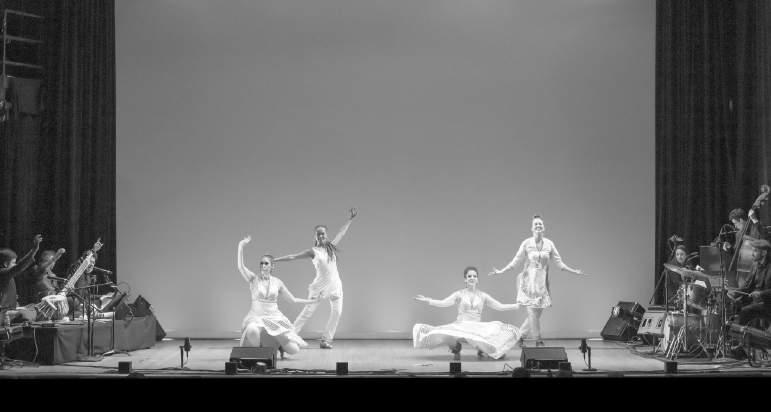
Percussive movement and improvisation are just some of what connect Indian Kathak dance and American tap; for the artists on stage at “SPEAK,” it goes much deeper.
provided an opportunity for audience members and the artists themselves to come together, sharing what brought them to the festival that evening — whether they traveled across Lexington Avenue to experience a new form of dance or across state borders to see their cousin perform.
The highlight of the day, however, was undoubtedly “SPEAK,” an extraordinary showcase of the connection between kathak and tap, accompanied by classic Indian vocals and tabla, and American jazz piano, kit drums and bass. For Nivas, the piece serves as an example for her belief in what cross-cultural collaboration should look like. It’s strictly not “fusion,” Nivas said,
but instead, “a very calculated type of expansion.”
That expansion began many years ago, when Nivas’ guru, Chitresh Das, collaborated with tap artist Jason Samuel Smith. A connection between a 65-yearold Indian dance guru and a 24-year-old Hell’s Kitchen tapper is unexpected, but it highlighted something special between the two styles and brought Nivas into the tap world, where she met female tappers and developed her interest in exploring the cross-genre connection from the female perspective.
There are many elements on the stylistic level that lend themselves to kathak and tap’s fruitful combination (notably, their
percussive feet movement and use of improvisation), but Nivas said it is a lot deeper than that.
The connection involves a “common reverence that we have for lineage, a reverence that we have for elders, and for rigor of practice and rigor of philosophy, and being cultural historians,” she said.
Alongside her appreciation, however, Nivas is conscious of her relationship with the word tradition.
“The word tradition can be abused a lot. It can be used as a way of hanging onto something that’s actually not good. … It can be used as a way to lean on it despite it being a form of oppression, despite it being something
that’s causing harm,” Nivas said.
That awareness is why she prefers to call herself a “radical traditionalist.” She said that figuring out how to honor one’s traditions requires a “fine-tuned brush” and a deep understanding of not only tradition itself, but of one’s own intention in highlighting it.
This intensity of study was the source of “SPEAK”’s magic. For Nivas, as well as for Mehta, Dorrance and Dormeisha, their collaboration was never about compromising.
“I think collaboration is very powerful, very transformative, and can be a profoundly spiritual experience, and that can only happen if you are deeply deeply rooted in your own form,” Nivas said.
The performancer’s complete assurance — a willingness to share the stage and appreciate, while simultaneously moving with complete ease and grace — was obvious on stage throughout “SPEAK.” The choreography, which contained solos and duets and culminated with the whole cast onstage, felt more like a conversation than a performance.
“We are finding commonalities that remind us of our shared humanity,” Nivas said.
Is that humanity not the backbone of all art? At “What Flows Between Us,” it definitely was. Whether over dal at dinner, between dancers and drummers or among excited audience members during the dancer’s final bow, every attendee left the festival knowing that the only true way to judge good art is by the connection it creates. In that measure, “What Flows Between Us” was off the charts.
Comedy Meets Intensity in ‘A Lunar Rhapsody’
José Rivera’s play examines the dynamics of people in and out of our world, using physical movement and tonal shifts to drive the story
LUNAR RHAPSODY from page 1
Zara Dautruche, Fordham College at Lincoln Center (FCLC) ’28, plays Mia. The role is Dautruche’s first in a mainstage production at Fordham.
“It was very collaborative, as this was a new show for us and we were building it from the ground up,” Dautruche said. “It felt great to be listened to in the room and for all ideas to be allowed.”
Dautruche spoke to the cast’s harmony as an ensemble throughout the entire show.
“We really connect off of each other’s energies, even if we don’t have dialogue directly with each other,” she said.
Among the teens gathered on the court, Abel emerges as a quiet, yet affected presence, carrying a loss that sets him apart and holds the challenge of tackling the deep emotions of grief and loss. The teens teasingly remind him of his place on this planet and stage a punching match to “knock out” his feelings and thoughts of doing the same.
In discussion of female friendships, Clara, Lola and Mia explore the struggles of being a woman, commenting on “being touched or looked at.” The group emphasizes the difference between “if my future” and “when my future,” underscoring the uncertainty that shapes their outlook.
In between scenes, time travelers from another planet called Dimensionals 1 and 2 constantly surveilled the scenes and often added comedic relief with their dramatic emotions and overly long physical skits, including handshakes and synchronized dances. Their silly energy drew
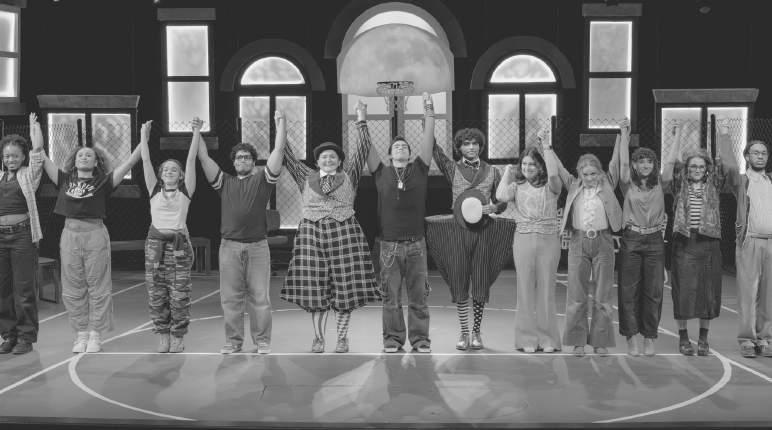
the audience in. Their parts naturally intertwined with the scripts of the scenes, as they would react to and judge the humans for their choices.
Dimensional 1, played by Nicholas Matos, FCLC ’27, explained that although the role was playful at times, it was also physically demanding.
“I would come into rehearsal with some new ideas of weird, wacky movements I could do that would work with certain moments,” Matos said.
Rather than continuing the teens’ narrative, the play distinctly shifts into the second storyline, slowing its pace to focus on an older couple’s conversation, where bickering and subtle jabs added levity. As the audience
tuned into this couple also awaiting the lunar eclipse, they dove into the life the characters share and what they advocated for.
“This scene is filled with so much on their mind, so it’s good to sit and reminisce and see how things evolve through all this time,” Luis Ovando, FCLC ’28, who plays Piri, said.
Ray, a former public school teacher, is attempting to settle into retirement after the death of five of his students. Due to this loss, he is hesitant to connect with Abel and his friends, who he meets through Felicity, his free-spirited wife. She gently peels back those layers, allowing the audience to glimpse the depth of their relationship.
Their storyline ends with a
lunar eclipse that Felicity insists on watching with Ray, who is indifferent at first. She uses the eclipse as a way of expressing her anxiety about their time together running out. It becomes a bittersweet moment as they slowly dance, reflecting on 40 years together. Ray apologizes for mistreating Felicity while running from his grief, finally facing his emotions in a moment of growth.
The next storyline follows three roommates, Isla, Catalina and Paloma, who bonded over being queer Latinas pursuing careers in law. Tensions rise when Catalina and Paloma reveal they have been secretly together, while Isla is still in love with Catalina, her ex-girlfriend. At a picnic celebrating Paloma’s
promotion to partner and their plans to leave the city, Isla swallows her pride, congratulates Paloma and reflects on who they once were: independent fighters for justice and equality.
Catalina, played by Amanda Sofia Rodriguez, FCLC ’26, highlighted the strain of the trio’s relationship.
“I do think the more you know about people, the more complicated it can get, but it’s your job to choose whether or not you want to embrace that complexity with people,” Rodriguez said.
The scene powerfully captures the depth of friendship, reminding the audience that while relationships can be messy and confusing, growth depends on the decision to move forward together. “A Lunar Rhapsody” drives home the idea that everyone, no matter their age, gender or ethnicity, deals with their own inner challenges. Yet, we are all placed under one moon for a brief moment, much like a lunar eclipse.
“All three groups are going through such different things. At the end they come together, they all intermingle with each other and it just feels like the basketball court is a metaphor for the world,” Matos said.
Each character navigated personal struggles while striving for a sense of salvation and love, whether through relationships, friendships or internal battles. No matter if you were a dimensional time traveler or a high school student, you could feel the raw emotions of these characters on paper that truly came to life beneath the Pope Auditorium lights.
COURTESY OF CASON DOYLE
The cast takes its final bow, closing out a full week of performances together on stage.
COURTESY OF RICHARD TERMINE

un & ames

Crossword: Breakup Season

37. Triumphant cry (2 Wds.)
39. How some stocks are sold (2 Wds.)
41. Typical taco day (Abbr.)
42. Gene editing technology that’s a homophone of a refrigerator drawer
44. Actress Swenson of “Benson”
46. Prefix with centennial
47. “At ____!” (military command)
49. Resident of Iran’s capital
51. Chopin specialty
54. Counterpart of “ooh”
55. Fish often served jellied across the pond
56. Respite for 11-Down, or a description of the shaded letters?
60. Zapped
62. Source of embarrassment for 35-Down
63. World’s fair (Abbr.)
64. Cloudless
65. ____ as a pin
66. Fly high
67. Cognac brand, informally
68. ____ leches cake
69. Palindromic explosive

1. In ____ (left as found)
2. King in “Hamilton” (2 Wds.)
3. BOGO, slangily
4. It has a score of one on the Mohs scale
5. Censor, on a radio broadcast (2 Wds.)
6. Technology akin to echolocation
7. Illinois city symbolizing middle America
8. Razed
9. Here, to Hugo
10. “The Hunchback of ____ Dame”
11. May honorees (Abbr.)
12. Some binary digits
13. Word on either side of à
20. “F” ___ ___ Fordham (2 Wds.)
21. Zoom in
25. Exam taken by many political science majors (Abbr.)
50. Like Feb. 29, among all birthdays
51. Anthropologist Zora ____ Hurston
52. Mary-Kate or Ashley
53. Higher on Santa’s list, perhaps
55. Engrave with acid
57. Comprehends
58. Give __ ____ on the back (2 Wds.)
59. Asian peninsula (Abbr.)
61. End to Caesar?

1. “____ Pepper’s Lonely Hearts Club Band”
4. Baking recipe measurement (Abbr.)
8. Starr of the band that wrote the album in 1-Across
13. Enviable feature of a McKeon dorm
14. Soothing gel
15. What a squirrel buries
16. Langston Hughes poem (2 Wds.)

17. “The Tonight Show” host before and after O’Brien
18. The “V” in C.V.
19. The formula for that of a sphere is 4πr² (2 Wds.)
22. Counterparts of sts. or aves. (Abbr.)
23. Some appliances (Abbr.)
24. Potato chips in a can
26. Italian explorer Vespucci
29. Pub orders
30. Mai ____
31. ____ Galerie: Upper East Side home for Klimt’s “The Woman in Gold”
33. Evolves



26. Problem’s conclusion?
27. One of the Seven Sisters: Bryn ____ College
28. Gets ready (2 Wds.)
32. Prefix with Pen
34. Cursed, as an Etsy witch might (4 Wds.)
35. Adolescent (Abbr.)
36. Common form of antidepressant medication (Abbr.)
38. Tiny fraction of a minute (Abbr.)


Word Search
BY DIVYA NARAINE
Instructions: Search up, down, forward, backward and on the diagonal to find the hidden words.