Annual Review 2012
INTRODUCTION The Football Foundation is a charity that funds the improvement of this country’s community sports infrastructure. This vital investment is made possible by the generosity of our funding partners, the Premier League, The FA and the Government (via Sport England). We also deliver award-winning community sport programmes funded by Barclays and the Mayor of London. Foundation grants are awarded to a range of organisations, including grassroots football clubs, local authorities and sports associations, to develop artificial or real grass playing surfaces, changing rooms and other facilities. These upgraded community sites sustain and increase participation by enabling more people to play sport. They also improve the quality of sporting experience
2
that local people enjoy, making it more likely they will continue to stay active. This has a positive impact on the health of the nation and increases participation in our national game. Our main purpose is to increase participation in football and other sports, but Foundation projects also benefit the country by helping support the economy. The building of new pavilions, sports pitches or other facilities provides crucial work for thousands of contractors, sub-contractors and suppliers across the country during this difficult financial period. So, the Foundation’s unique partnership between football and Government is working for the good of grassroots sport, public health and our economy.
The Football Foundation’s Board of Trustees The Foundation’s Board has Trustees appointed by our funding partners: the Premier League, The FA, Government and Sport England, along with an independent Chairman. Board of Trustees: Gary Hoffman (Chairman) Roger Burden (The FA) The Rt Hon Richard Caborn (Government) Jonathan Hall (The FA) Peter McCormick OBE (Premier League) Richard Scudamore (Premier League) Phil Smith (Sport England) President: The Rt Hon Lord Pendry PC
Contents
4 CHAIRMAN’S INTRODUCTION
5 CHIEF EXECUTIVE’S FOREWORD
8 BUILDING BETTER FACILITIES
18 BUILDING A LINK BETWEEN CLUBS AND THEIR COMMUNITIES
ONGOING SUPPORT
OUR FUNDING PARTNERS
14
16 GROW THE GAME
BUILD THE GAME
20 EMPOWERING YOUNG PEOPLE AND STRENGTHENING COMMUNITIES
24
6
22 BUILDING AN OLYMPIC LEGACY FOR LONDON
26 BUILDING THROUGH SOUND BUSINESS SYSTEMS
27 FINANCIAL SUMMARY
The Football Foundation Annual Review 2012 3
Chairman’s introduction
Looking back at my first year as Chairman, I can honestly say that this role is one of the most satisfying that I have ever had. During my travels representing the Foundation I have been bowled over by the passion and effort of the thousands of volunteers that devote their time to supporting their local sports teams. It is truly astounding. The role of the Foundation is to support this effort by providing expertise and finance for new facilities or to provide clubs with development grants. A key part of this is to ensure that whatever funding is made available, is distributed to where it will have the greatest impact, in terms of football development and community enhancement. To do this, the Foundation has developed sophisticated business systems to measure and illustrate the impact it is having in terms of increasing participation levels across the country. The aim is to be as effective and efficient as possible in everything we do and I have been mightily impressed at how we do this.
4
In this Review you will see just a few examples of some of the many thousands of projects funded by the Foundation and how these are supporting local communities, in terms of sports infrastructure provision. However, it is important to recognise the wider impact that Foundation funding is having. Foundation sites are increasing participation amongst local communities which enriches football and other sports, as well as improving the health of the nation and helping to reduce the burden on the National Health Service. Something that often gets overlooked, because our focus is on increasing participation in sport, is the positive economic impact that Foundation projects have. When a Foundation grant provides a city, town or village with a new or refurbished sports facility, it also provides work for a range of small businesses, from roofers and architects to electricians and plumbers who may be struggling in the current economic climate.
None of this would be possible of course, if the Premier League, The FA, the Government, and Sport England had not had the foresight to create the Foundation in 2000 and to fund it over the past 12 years. Therefore, I would wish to place on record our thanks and appreciation for their continued support. I hope that you enjoy reading this Review. We look forward to another busy and successful year in 2013.
Gary Hoffman Chairman
Chief Executive’s foreword A year ago, I used this space to highlight the desperate state of this country’s grassroots football facilities, which demonstrated just how critical Foundation investment is, in terms of developing new spaces to play and rejuvenating sites that have fallen into disrepair. One year on, there is still a lot more work to do and the challenge is greater because there is even less funding going towards building better community sports facilities for local people. This only increases the importance of the investment that the Foundation can offer and creates challenges for us in terms of sourcing partnership funding; challenges that we need to meet. We have demonstrated that as a country we can stage stunning sporting spectacles at the elite level, in the shape of the Olympic and Paralympic Games. With Chelsea FC triumphing in the Champions League last season, and the Premier League producing such phenomenally exciting and successful entertainment, our national game at the top level is in rude health. As a country we must now ensure that football and other sports enjoy a strong grassroots – crucially, with local sporting facilities of which we, as a country, can feel proud. This is the most effective method to increase participation because it improves the quality of their sporting experience. Over our 12 years of operation, we at the Foundation have developed incredibly sophisticated business systems to address this, sharing our knowledge and expertise with organisations around the world that have approached us, including those from France, Germany, Holland, the United States, Australia and South Africa. In this Review you can read about our monitoring and evaluation systems, which evidence how more people are taking up sport at sites that Foundation cash has enhanced, and about our unique performance management processes that we have developed in-house. The most satisfying part of my job, however, is when I get out to the launch of a facility and see the sheer joy on the faces of local youngsters as they race out onto a brand new third generation artificial pitch. Or the pride in the volunteers that have worked for years to build their community a pavilion; a dream that a Foundation grant has helped turn into a reality. The thousands of facilities that we have helped to build are only possible thanks to the generosity of our funding partners, the Premier League, The FA and the Government (via Sport England). I would like to take this opportunity to thank them on behalf of the grassroots game. Please enjoy reading this Annual Review and thank you for your support.
Paul Thorogood Chief Executive
The Football Foundation Annual Review 2012 5
OUR FUNDING PARTNERS Since 2000, the Foundation has awarded £401m worth of grants towards grassroots sports projects. When combined with the partnership funding that our grants have attracted, a total of £957m has been invested into developing thousands of new or refurbished sports facilities. These facilities benefit more than 700,000 people each year. The amazing difference that the Foundation makes to improving our local sports infrastructure would not be possible without the support of our funding partners: the Premier League, The FA and the Government (via Sport England).
Premier League “I am proud to have been a Trustee of the Foundation since we launched it in the garden of No 10 Downing Street back in 2000. It is a very special and unique partnership that links the very top of the game to its roots and ensures a quality experience for thousands of grassroots players who play the game simply for the fun and enjoyment of doing so. “Foundation facilities not only ensure that more people enjoy a better experience playing football and other sports, but they also often act as the catalyst for creating and strengthening links between clubs and their local communities.” Richard Scudamore, Chief Executive, Premier League
The FA “I have visited hundreds of grassroots football clubs in the last two years since becoming FA Chairman and have seen at first-hand the difference that Foundation investment is making. “It is essential that we continue to improve this country’s community football sites. I regularly hear better facilities cited as the number one priority for grassroots clubs when I travel around the country. “The provision of quality facilities supports the superb work of the volunteers across the country. Without their dedicated efforts, grassroots football could simply not exist.” David Bernstein, Chairman, The FA
6
Department for Culture, Media and Sport “The money that the DCMS invests into the Foundation, through Sport England, is helping us to create a lasting Olympic and Paralympic legacy of sport facilities in communities across the country. “Foundation facilities are helping to generate a significant increase in community sports participation. This not only supports the development of a wide range of sports, but also helps to improve public health through encouraging an active population. “A further, often-overlooked, by-product of building these stunning new facilities is the contribution this work makes to the local and national economy, providing vital jobs and employment for local contractors and suppliers in these challenging economic times.” The Rt Hon Hugh Robertson MP, Minister for Sport and the Olympics
Sport England “Our long-standing relationship with the Football Foundation is a very effective partnership. Together with the other football partners, we’re striving to increase participation in football and improve grassroots facilities throughout the country. We will continue to work together to make sport a habit for life for as many people as possible.” Jennie Price, Chief Executive, Sport England
The Football Foundation Annual Review 2012 7
8
With an annual budget of £17m, our Facilities Scheme provides financial support to large-scale grassroots facility projects, awarding grants of over £100,000. These projects can range from building new changing rooms to installing the latest floodlit third generation artificial grass pitches.
The Football Foundation Annual Review 2012 9
AFC Urmston Meadowside in Manchester received £521,178 for a new pavilion
Manchester-based AFC Urmston Meadowside started in 1977 with just one team. Since then it has grown beyond all expectation, boasting 50 teams and 650 players, both male and female, across all age groups, very much embodying its simple mission statement: ‘To support the local community by providing football opportunities for all.’
training venues and, most importantly, somewhere that youngsters and adults can change in comfort and safety.
IMPACT IN NUMBERS 2011/12: Building sports facilities
The icing on the cake was when the club was able to celebrate their success in style as England and Manchester City FC goalkeeper, Joe Hart, officially unveiled the new facility.
The one snag in their impressive success story was the appalling state of the changing facilities at their site. The club was determined to rectify this and, after help from the Manchester County FA, they managed to secure a £521,178 grant from the Foundation’s Facilities Scheme.
“Grassroots football is where we all start out, including me, so it is important that investment goes into community sports sites. And of course there are lots of wider benefits sport has for young people and society.” Joe Hart, England and Manchester City Football Club goalkeeper
144 facility projects £11m worth of grants £27.7m total project cost 18 artificial grass pitches 35 grass pitches 23 changing facilities
In place of the rotting changing block, there now stands a stunning new community pavilion which provides a function room, coach and referee
10
BUILDING BETTER FACILITIES
The Priory School in London received £400,000 for a new sport and leisure facility A stunning new sport and leisure facility in Orpington, South East London, opened its doors just two weeks before the start of the London 2012 Olympic Games, thanks in part to £400,000 of investment from the Foundation. The new complex is based at The Priory School and includes: two brand new third generation artificial grass pitches; eight purpose-built changing rooms; two reconditioned grass pitches; and a community hall facility with integrated offices, a training suite, a hall for hire, a sports hall, a gymnasium, a fitness suite, a dance studio and conference spaces. The site is improving sporting opportunities for pupils at the school. It is also supporting the growth of Orpington Football Club, who are forming an
additional 12 teams through the five-year Football Development Plan that they and the London County FA submitted as part of the application for Foundation funding. Five local youth football teams and one senior team will also use the new facilities for training, with forecasts estimating that over 2,400 new users will play sport at the site on a weekly basis.
“This new complex will provide the School and the local community with a highly desirable facility that will impact hugely on both the health and fitness of our students and local community.” Neil Miller, Head of School, The Priory School
The School has also been achieving its aim of making regular sport and exercise in Orpington affordable for all sections of the community and improving the quality of community life on the Ramsden estate and beyond.
IMPACT IN NUMBERS 2011/12: Increasing participation in sport
Over 740,000 people played sport at Foundation sites Over 555,000 of these participants played football Overall participation increased by 8.8%
The number of football players increased by 7.3% The percentage of Black and Minority Ethnic players was 6.7% higher than the national average The Football Foundation Annual Review 2012 11
Poppleton Junior Football Club in York received £225,000 for a new clubhouse Poppleton Junior Football Club is one of only two Charter Standard clubs in York. After their two very old green wooden cabins eventually gave in to the elements, the club’s team of volunteers set about achieving their dream of building their own permanent clubhouse. After years of effort towards attaining planning permission, as well as fundraising, Poppleton Juniors and the North Riding County FA secured a grant of a £225,000 from the Foundation. Once all of these hurdles were cleared, the first shovel of earth was dug by York City FC Manager, Gary Mills, in September 2010. The building stage had begun! The new facilities – opened last year by the Archbishop of York Dr John Sentamu – make the site unrecognisable from its dilapidated predecessor. The four-changing room clubhouse is benefiting around 390 players and more than 20 teams who play at the site. Meeting and training areas, as well as officials’ changing rooms and catering facilities, make the clubhouse a real community venue rather than simply a place for players to get changed. “We had fantastic pitches but lacked the facilities to go with it. The facilities now are the best in our league and we are grateful to the Foundation for their kind help in funding this project.” Megan, Club Captain, Poppleton Tigers Ladies Team
IMPACT IN NUMBERS 2011/12: Volunteers, coaches and qualifications
6,580 courses were delivered at Foundation sites Which led to 63,700 volunteers gaining qualifications Over 70% of projects seen via face-to-face Support Day meetings in 2012 scored highly A further 22% scored fair – meaning they had achieved the majority of their objectives
12
BUILDING BETTER FACILITIES
Evesham United in Worcestershire received £945,457 for a new community football complex Evesham United worked with the Worcestershire County FA to secure a massive £955,457 worth of funding from the Foundation towards building a new community football complex at their new home ground that the club and the local community could be proud of. After years of hard work, fundraising, and various challenges to overcome, the Robins Spiers & Hartwell Jubilee Stadium opened in style this year, with a match against a Manchester United XI that included former stars, Dennis Irwin, Sammy McIlroy, Clayton Blackmore and Andy Ritchie. Evesham’s new site includes six changing rooms, seven community grass pitches, and a space for social functions. The facility enables the club to provide proper facilities to host matches. More importantly, they can now meet the growing demand for football in the local community and deliver a five-year Football Development Plan, which will see their number of teams increase from 22 to 42 – bringing the total number of club members to 670. “The project has taken years of planning and to see the stadium complete and ready to use makes it all worth while.” Jim Cockerton, Chairman, Evesham United
The Football Foundation Annual Review 2012 13
Our Build the Game scheme provides smaller grants of up to £100,000 towards local sports facility projects and has an annual budget of £1.5m. It is very popular with applicants that need to refurbish changing rooms, resurface a multi-use games area, or even replace a boiler or a tractor. This year the Foundation also awarded Build the Game grants towards installing junior goals for small-sided football matches, which complemented The FA’s youth football plans, making matches more enjoyable for youngsters and more beneficial in developing their technical ability.
14
BUILD THE GAME
Hickling Recreation Ground Charity in Norfolk received £20,026 to help build a new changing pavilion Footballers using Hickling Recreation Ground enjoyed excellent full size and junior pitches that drained well and very rarely became waterlogged. The changing rooms, however, were an entirely different story! Having been converted from a public toilet built in 1976, they had since fallen into an extremely poor state of repair. The Hickling Recreation Ground Charity set about demolishing the old block and constructing a modern pavilion that provided changing areas and services for lots of other community groups. A multi-purpose community hall and a large snooker room now stand where the old converted toilets once were. Thanks to a £20,026 Build the Game grant from the Foundation, the hall also incorporates two dual-gender changing rooms, which Hickling Football Club and other clubs can
use, as well as an officials’ changing room. The football club will also have use of the kitchen and servery, male, female and spectator toilets and storage areas. The new site is also supporting the Norfolk County FA’s aims of retaining the number of adult male 11v11 football teams across the county, as well as supporting the game’s growth as Hickling Football Club has now expanded from one team to three. “The new changing room facilities have meant that we have a greater chance of securing the future of the club, enabling teams of all ages to benefit.” Adam Mayhew, Manager, Hickling Football Club
Whaley Bridge Parish Council in Derbyshire received £97,048 to install a modern third generation artificial grass surface on an existing sports facility The town of Whaley Bridge has just one community sports facility to service its 8,000 population. This was made up of a pavilion and a multi-use games area (MUGA) with a macadam-surface.
The nearest third generation artificial pitch is located eight miles away in Buxton – a Foundation-funded small-sided pitch, already operating at full capacity – making this project all the more vital for the area.
Whilst the pavilion remained a modern, functional building, the MUGA surface and surrounding fencing had become very much out of date and was considered dangerous by the local football teams, such as Whaley Bridge Football Club. They were forced to desert the facility.
The new site is a fantastic success benefiting Whaley Bridge Football Club and its 16 teams, from the Under-8s to the adult first team, and its many girls’ teams. The club’s Football Development Plan, which it submitted as part of the funding application to the Foundation, shows that in five years it will increase its number of teams from 16 to 22 thanks to the new surface.
Whaley Bridge Parish Council wanted to rescue the site from abandonment and encourage users back to it, which would provide revenue to pay for its maintenance and eventual replacement through a 12-year sinking fund. The Council worked with the Derbyshire County FA and successfully secured a £97,048 Build the Game grant from the Foundation to install a modern third generation artificial grass surface, complete with shock pads – which made for a much softer landing than macadam!
“Generations of children will benefit and Whaley Bridge can be proud to have one of the best artificial grass surfaces you can get.” Councillor Jon Goldfinch
The Football Foundation Annual Review 2012 15
Our Grow the Game scheme is a very popular fund that increases and sustains football participation by providing grants of £5,000 that help support the creation of new male and female teams of all ages. The money can help to pay for coaching qualifications, which strengthen and deepens the quality of our coaching talent. It can also go towards facility hire, FA league affiliation, Criminal Records Bureau checks, publicity, First Aid provision and referees’ fees. So, the nature of what Grow the Game funds also means the new players are not ‘here today, gone tomorrow’ players, but fully engaged in the FA-affiliated league system.
16
GROW THE GAME
Kempton Girls’ Football Club in Middlesex increase its number of football teams A Grow the Game grant was awarded to Kempton Girls’ Football Club to increase the number of girls’ football teams at the club and help promote the club in the local community to recruit new players. The grant has assisted Kempton Girls’ increase the number of qualifications that their coaches have, and improve the club’s standard of coaching over the coming years.
An extra bonus was their Grow the Game cheque was presented to them by former Chelsea Ladies goalkeeper Sarah Quantrill! “The funding has allowed the teams to be coached by experienced coaches and also our own coaches to receive additional training, and has also helped more girls to join the club.” Georgie, Under-15 player, Kempton Girls’ Football Club
Aller Park Rangers Football Club in Somerset received £5,000 to develop three new teams providing football opportunities for more players Aller Park Rangers Football Club is based at Somerton Sports Ground in the South West of England. The Foundation presented them with a Grow the Game grant that is enabling them to continue to provide football opportunities for more players from across South Somerset. Rangers will develop three brand new teams over the next three years: a new Mini-Soccer team for local young players, an additional youth team and an adult side, for those players who are moving from youth into adult football. “This funding will enable the club to continue to grow and offer football opportunities to players of all ages and abilities.” Steve Morrison, Chairman, Aller Park Rangers Football Club
The Football Foundation Annual Review 2012 17
The Premier League Community Facility Fund (PLCFF), funded by the Premier League and delivered by the Football Foundation, is investing £18m over three years to develop new or refurbished sports facilities for local people across the country. The new PLCFF-enhanced sites will also help to strengthen links between professional football clubs and their communities, and will become venues for the clubs’ outreach work. The Fund is open to all football club community-led organisations from the Premier League, Football League, and Football Conference, including the Conference North and South Divisions.
The Zone in Wigan received a £350,000 PLCFF grant for a new state-of-the-art facility One of the first projects that the PLCFF is supporting is the Wigan Youth Zone, a huge new state-of-the-art facility that is being built at Mesnes Field in Wigan town centre.
Wigan Athletic Football Club’s players have also dipped into their pocket to support the project, donating £1m from their Premier League bonus towards the build.
The Zone will provide high quality sports, arts and recreational facilities for up to 3,000 of the city’s young people, seven days a week, 52 weeks a year.
The Zone is due to open its doors to Wigan’s young people around Easter 2013.
Funded with £350,000 from the PLCFF, the site will include outdoor football pitches and a wide range of indoor leisure and other activities, including a recording studio and a gym.
“It’s absolutely fantastic. This building will bring together all the young people in Wigan and allow them to make a great start to life.” Dave Whelan, Chairman, Wigan Athletic Football Club
The centre will go much further than simply providing enjoyable activities for young people. It will also provide health and employment services to support young people’s personal and professional development. The Zone will even offer job opportunities and work experience in the management and delivery of those services.
“We put £18m into a facilities fund delivered by the Foundation; it’s really to support clubs to empower them to develop their work in their communities.” Emma Joussemet, Senior Community Development Executive, Premier League
18
BUILDING A LINK BETWEEN CLUBS AND THEIR COMMUNITIES Funded by
Premier League Community Facility Fund
Stretford Sports Village in Manchester received a £350,000 PLCFF grant for a new community multi-sport complex The Stretford Sports Village now boasts a full-size floodlit third generation artificial grass pitch after the Manchester United Foundation (MUF), in conjunction with Stretford High School and Trafford Borough Council applied to the PLCFF. The school had always suffered from a very poor provision of sports facilities, despite being situated in the shadow of two of the city’s major sporting landmarks: Manchester United and Lancashire County Cricket Club’s Old Trafford stadiums. The Sports Village is based right next to the school, meaning that its pupils and the wider local community now have the benefit of some of the finest sports facilities in the region. As well as the artificial grass pitch, additional partnership funding has been secured which has developed a four-badminton court sized sports hall; a fitness suite; a dance studio; changing accommodation and a junior-size real grass pitch. A Football Development Plan has been developed by MUF and the Trafford Leisure Trust to outline how the facilities will be used. It also details how MUF will deliver community cohesion, education, health and
sports participation outreach work at the site. The Sports Village will also be a venue for the Manchester County FA Coach Education programme. “The Premier League Community Facility Fund is all about providing sports facilities that reinvigorate local communities. So this £18m of funding, which is available to 160 clubs, across seven divisions of English football, is investment that will have a lasting impact. “Stretford High School will also be Manchester United Foundation’s eighth base for their magnificent Hub of the Community work.” Richard Scudamore, Chief Executive, Premier League “The great thing about the Premier League is that they’ve been doing this kind of work for a long time now. The Stretford Sports Village is a fantastic facility for young people.” Sir Alex Ferguson, Manager, Manchester United Football Club
Tottenham Hotspur FC and the Tottenham Hotspur Foundation in London received a £258,795 PLCFF grant for three new community grass pitches Tottenham Hotspur FC’s new, world-class training ground will provide 70,000 hours of community programmes that engage some of the area’s most vulnerable and disadvantaged people. A centre of excellence that will provide sports participation and education for disabled athletes is also being developed on-site. The Tottenham Hotspur Foundation’s (THF) community work will also benefit from having access to the artificial grass pitch, the learning centre, the educational space and the changing rooms.
The funding was jointly awarded to Tottenham Hotspur Public Limited Company and the THF, which delivers community projects on behalf of the club. “The new state-of-the-art training centre, combined with the club’s commitment to the area through the section 106, will provide a massive boost to the local community and ensure that more local people can have access to high quality sports facilities.” Alex White, Community Development Manager, Tottenham Hotspur Foundation
The Football Foundation Annual Review 2012 19
Barclays Spaces for Sports is a community-based sports programme, which uses sport as a platform to help young people develop life skills and revitalise disadvantaged communities in a sustainable way. In the UK, 200 sites have been developed since 2004 in partnership with the Football Foundation. A further thirteen sport-for-development programmes have been launched globally. “Central to our approach to Citizenship is the way we, as Barclays, contribute to the communities where we live and work.
20
“Our community investment programmes, such as Barclays Spaces for Sports, help young people improve their chances in life. As well as being great sports facilities, they provide a platform to develop life skills and build foundations for future employment. “Barclays is committed to working in partnership with the Football Foundation to ensure the long-term sustainability of the sites.” Antony Jenkins, Chief Executive, Barclays
EMPOWERING YOUNG PEOPLE AND STRENGTHENING COMMUNITIES
Encouraging wider developments Practical, hands-on help to ensure site sustainability is delivered by the Barclays and Football Foundation Activity and Sustainability Advisors (ASAs). By drawing on their expertise, experience and local connections, including the Barclays network, they are able to assist in ensuring the long-term sustainability of the sites.
The Barclays Spaces for Sports site at Bransbury Park was developed in 2007, following investment from Barclays and the Foundation worth £600,000. The site boasts tennis courts, grass football pitches, basketball courts, a multi-use games area and a large skateboarding ramp.
In the last year, the ASAs have facilitated new investment in 19 sites across the UK, including the Portsmouth FC Flagship Site, Bransbury Park.
With ASA support, the site secured sustainability funding from Barclays and has introduced new netball sessions, street20 cricket and LTA led tennis coaching, as well as a girls-only disability football project.
A new programme targeting young women that do not go to school regularly, or have behavioural issues, to make the right choices in life, has also started. Run by Portsmouth FC’s charitable foundation at Bransbury Park, this programme helps participants increase their confidence and raise their aspirations by completing Sports Leaders qualifications and gaining employment experience by volunteering on-site. As a result in 2011/12, 57 young women completed Level 1 and 2 Sports Leaders qualifications.
“I’ve increased in confidence and got a better understanding about volunteering and working in the community.” Amy, Sports Leader Level 1 course graduate
Participants from another Barclays Spaces for Sports site
Building sustainable sports sites In 2011, Gurnos in South Wales received additional investment from Barclays Spaces for Sports. £23,500 enabled them to resurface a dilapidated hard court multi-use games area with a new third generation artificial grass pitch. Barclays Spaces for Sports originally invested £22,000 to resurface and install floodlights at the only multi-use games area in the town but due to popularity and high usage this lead to serious wear and tear. Previously only used a few hours each week, the resurfaced Barclays Spaces for Sports site is now fully booked on week nights and used by over 500 players. 15 football clubs now regularly hire the popular facility.
IMPACT IN NUMBERS: Barclays Spaces for Sports
Each week:
In 2011/12:
53,000 attendances at 200 UK sites
An additional £327,000 invested in site sustainability programmes, leading to:
18,600 people playing sport at the 26 flagship sites Over 2,600 volunteers deliver or support activities at sites
30% increase in participation; 31% uplift in revenues
The Football Foundation Annual Review 2012 21
This year saw the truly stunning spectacles of the 2012 Olympic and Paralympic Games take place on our soil. Questions have inevitably been asked about what the legacy of the Games will be. One answer is the Mayor of London: Facility Fund (MoL: FF), a sporting legacy programme that the Foundation is proud to deliver with funding from London Mayor, Boris Johnson, and his Commissioner for Sport, Kate Hoey. The overall aim of the MoL: FF is to raise participation levels in sport in London through the funding of sports facilities. Since 2010, a total of 77 grants worth £5.5m have been awarded, helping to develop affordable, good quality, multi-sport sites within local communities across the Capital. “After the truly mesmerising show that the Capital put on for the world in the shape of the London 2012 Olympic and
22
Paralympic Games, I am delighted that we have also created a lasting legacy in the shape of a new inventory of community sports sites. “Our partnership with the Foundation, who have done a superb job working with my Commissioner for Sport, Kate Hoey, has ensured that every single London borough has benefited from new or refurbished multi-sports sites for local people to enjoy for decades to come. “The Games at the elite level may have finished; but they can continue at the grassroots level for a whole new generation of Londoners thanks to this vital Olympic legacy.” Boris Johnson, Mayor of London
BUILDING AN OLYMPIC LEGACY FOR LONDON
THE ASPIRE NATIONAL TRAINING CENTRE IN WEST LONDON RECEIVED A £13,705 MoL:FF GRANT MAKING AN ENTIRE VENUE MORE ACCESSIBLE On average 1,200 people become paralysed each year. Aspire is a charity that supports the 40,000 people living with a spinal cord injury in the UK. For many years the Aspire National Training Centre in Stanmore, West London, has been a lifeline for people suffering these disabilities, where they can enjoy integrated leisure activities such as gym work, swimming, wheelchair rugby, Powerchair Football and wheelchair basketball.This improves their physical health and mobility, as well as personal esteem and confidence. The existing equipment at the Centre’s sports hall had been in place since 1991 and had become so out-of-date that it was often not working properly or even safely. Improvement was also required to aid
wheelchair access to the sports hall itself. Many of the staff and the majority of the sports hall users are wheelchair users who need to be able to operate the equipment independently. Typically wheelchair players arrive at the centre with two wheelchairs – one for everyday use and the other to play sports. Previously the players had to negotiate the manual sports hall doors with both chairs and this is often not possible independently. Now, thanks to a £13,705 MoL: FF grant, the current doors have been replaced with automatic doors for easy access to wheelchairs, making the entire venue far more accessible. In addition, the grant also contributed towards new basketball nets and a new scoreboard.
The London Nautical School received a £36,000 MoL: FF grant to increase accessibility for all The London Nautical School (LNS) was founded in 1915, as a result of the official report into the loss of The Titanic.The School has traditionally offered its dinghies, kayaks and motorboat to external organisations along the various mooring spots on the River Thames. Whilst these were in decent condition, they did not cater for disabled and inexperienced participants, which had led to a lack of involvement from those groups.There were also very few opportunities for the Lambeth area’s young people in general to experience the type of adventurous water-based activities that LNS had planned. MoL: FF funding of £36,000 has helped fund the purchase of: two Gigs (which are12 men sailing and
rowing boats); four RS Feva’s racing boats (which carry two people); and one competition multi-boat trailer.The grant has also helped to pay for Automatic Identification System (AIS) and very high frequency (VHF) equipment. The Mayor’s Fund has also provided a revenue grant to part-fund instructor costs to maintain the school’s working ratio of one instructor for every eight students afloat on the water. LNS’ new MoL: FF-funded fleet was used in the London Youth Games and formed part of the Queen’s Diamond Jubilee ‘flotilla’ celebrations on the River Thames earlier this year.
IMPACT IN NUMBERS 2010 TO 12: MAYOR OF LONDON: FACILITY FUND
77 MoL:FF grants worth £5.5m awarded At least one new sports facility in all 32 London boroughs 24 different sports catered for across the MoL:FF sites The Football Foundation Annual Review 2012 23
A core objective of the Foundation is to increase participation in sport, predominantly football. As you will know by now after reading this Review, we do this primarily by developing better facilities with enhanced capacity. It occurred to us that if existing sites were not operating at full capacity, one cost effective method to increase participation would be to provide expertise that would ensure that we ‘sweated the assets’. Combined with the necessity of ensuring that facilities were sustainable – in terms of being financially viable and generating enough revenue to maintain their upkeep into the future – it became clear that a unique solution had presented itself. From there, we developed the concept of Activity and Sustainability Advisors (ASAs). ASAs now provide this dual role of maximising Foundation-funded facilities’ usage throughout the week and ensuring their maintenance and finances are kept on track. As these examples demonstrate, ASAs have proven to be both a hugely successful development, and a characteristically pioneering Football Foundation-developed solution.
24
ONGOING SUPPORT
In 2005, Heysham High School Sports College in Lancashire received £467,902 for a new third generation artificial grass pitch and changing rooms In 2005, Heysham High School Sports College in Lancashire received £467,902 for a new third generation artificial grass pitch and changing rooms. Whilst the new facilities proved to be hugely popular, the overall usage figures were lower than originally predicted on the original application. The Football Development Plan (FDP) had also become outof-date and the sinking fund was off course. Our Monitoring and Evaluation therefore highlighted the Heysham site as under-performing financially and on participation, and thus in need of assistance from our ASAs. An ASA set about identifying available time slots and working with the site manager to target new bookings from individuals, groups and the community in general. The ASA then advised on marketing and promotion methods, and also helped the site to write a new FDP to bolster usage. The site manager has also invested in new banners advertising the site, adverts in a national magazine and worked with local media to gain publicity in the local press.
The Heysham site has now engaged a range of new community users from seven year-olds to adults, with new football teams and new partnerships established. This includes a local soccer skills business that not only now runs weekend and holiday sessions on site, but also rents office space at the school to use as the company base, generating an additional income for the school.
Overall, there has been a 39% increase in income generated by the artificial grass pitch from £539 a week to £753. This will assist the school in raising the necessary funds towards replacing the artificial grass pitch when required.
Morecambe Football Club and the local police continue to be engaged at the site and run ‘Kickz’style social inclusion sessions on Friday evenings for young people. Following our ASA’s expert assistance, there has been an 11% increase in the number of participants now totalling 3,050, and a 39% increase in the income generated on the artificial grass pitch. Through casual bookings alone, the school takes between £100 and £120 on average per week. Holiday camps now run during half term, Easter and summer holidays, involving 665 participants each year.
In 2006, Northgate High School in Norfolk received £398,495 for a third generation artificial grass pitch The project dramatically improved the school’s facilities and increased participation in terms of both curriculum and community use.The project also received revenue funding for a part-time Football Development Officer (FDO), who oversaw the implementation of the Football Development Plan (FDP).
the pitch can now be split, so it can be hired out more effectively with two different users at any time.
However, following the departure of the FDO, the Foundation’s Monitoring and Evaluation system identified Northgate as being in need of ASA intervention: the FDP was not being implemented and a steering group meeting had not taken place for a long period. Participation numbers were lower than had been predicted and there was also some spare capacity at the site.
Through improved partnership work, and the use of the Foundation’s Marketing and PR Toolkit, additional bookings have been generated. As a result, bookings for this season are at 100% capacity during the week. This includes Charter Standard club bookings, ‘pay-and-play’ sessions, a County FA small-sided adult league and a Player Development Centre.
Thanks to ASA guidance, Northgate successfully applied for funding to Sport England, resulting in a grant to purchase a dividing net across the pitch and some new goal posts. The dividing net means that
A new FDP, in line with The FA’s National Game Strategy, has been written, a steering group has been re-established and a new pricing structure agreed.
hosting 9v9 matches on the third generation artificial grass pitch and grass pitches, with up to six fixtures per weekend next season.
At the weekends, the FDO has been working with Norwich Community Sports Foundation and the County FA to see the introduction of a new Disability League. Furthermore, as part of the new FA Youth Development Review the facility will be
The Football Foundation Annual Review 2012 25
The Foundation is not your normal charity. In the last 12 years we have developed highly sophisticated and unique financial and business processes that would grace any private company, let alone charity. Our bespoke performance management systems have been created entirely in-house through years of honing our organisational skills of directing investment into developing sports facilities and increasing participation.
Another important factor that distinguishes the Foundation from the average grant-giving body is this: we do not simply walk away once the facility has been built and the ribbon cut. Our monitoring and evaluation system measures the impact that the site is having across a range of areas, such as sport participation and skills-development. Where we detect that a facility we have funded can be performing to an even higher standard, our Activity and Sustainability Advisors step in and help the grantee make that happen.
These innovations have helped us to become recognised as one of the world’s leading sports charities and are the reason that we regularly receive requests from governments and sports associations around the world to share our blueprint with them – and indeed, why we are often the deliverer of choice for companies’ Corporate Social Responsibility programmes.
Consistently reducing administration costs
We continue to be a lean, efficient organisation.
13%
18% decrease
18%
in administration costs, in real terms, over the last two years.
decrease of 21% by the end of 2012/13.
21% 2010/11 2011/12 2012/13
26
The Football Foundation 2012
4 8 5
Co
s
grant
e par
l d to
ast
s are now up and running t c e j o r p year,
m 5 2.
m
ooner s s h t on
year t s a l ded awar
esses c o r p Grant ciencies & effi ually contin red. o monit
The last four years has seen a 46% reduction in processing time, with an improvement of 12% over the last year alone.
Every £1 that we invest generates an
additional £2
in funding from other sources.
FINANCIAL SUMMARY
FINANCIAL SUMMARY Summary Financial Statements for the year ended 31 May 2012
Independent Auditors’ Statement to the members of the Football Foundation
Trustees’ Statement
We have examined the Summary Financial Statements which comprise the Summary Consolidated Statement of Financial Activities and Summary Balance Sheet.
The Summarised Financial Statements are not the full Annual Report and Financial Statements but a summary of information derived from group’s Statement of Financial Activities and the charity’s and group’s Balance Sheet. The Summarised Financial Statements do not contain additional information derived from the Directors’ Report. The full Annual Report and Financial Statements, from which the Summarised Financial Statements are derived, were approved by the Trustees on 19 September 2012 and copies have been filed with the Charity Commission and with the Registrar of Companies. The independent Auditors have issued an unqualified report on the full Financial Statements and on the consistency of the Trustees’ Report with those financial statements. The Statement in the Independent Auditors’ Report, under section 496 of the Companies Act 2006, was unqualified. The full Independent Auditors’ Report contained no statement under sections 498(2)(a) and (b) or 498(3) of the Companies Act 2006. The full Annual Report is available from the Football Foundation’s website: www.footballfoundation.org.uk/AnnualReport2012. On behalf of the Board of Trustees
Gary Hoffman Chairman 10 December 2012
Respective responsibilities of Trustees and Auditors The Trustees are responsible for preparing the Annual Review in accordance with applicable United Kingdom law and the Statement of Recommended Practice: Accounting and Reporting for Charities (revised 2005). Our responsibility is to report to you our opinion on the consistency of the Summary Financial Statements within the Annual Review with the full Annual Report and Financial Statements and the Trustees’ Report, and its compliance with the relevant requirements of section 427 of the Companies Act 2006 and the regulations made thereunder. We also read the other information contained in the Annual Review and consider the implications for our statement if we become aware of any apparent misstatements or material inconsistencies with the Summary Financial Statements. The other information comprises only the other items listed on the contents page. This Statement, including the Opinion, has been prepared for and only for the company’s members as a body in accordance with section 427 of the Companies Act 2006 and for no other purpose. We do not, in giving this opinion, accept or assume responsibility for any other purpose or to any other person to whom this Statement is shown or into whose hands it may come, save where expressly agreed by our prior consent in writing. We conducted our work in accordance with Bulletin 2008/3 issued by the Auditing Practices Board. Our report on the company’s full Annual Report and Financial Statements describes the basis of our audit opinion on those Financial Statements and the Trustees’ Report. Opinion In our opinion the Summary Financial Statements are consistent with the full Annual Report and Financial Statements and the Trustees’ Report of the Football Foundation for the year ended 31 May 2012 and comply with the applicable requirements of section 428 of the Companies Act 2006, and the regulations made thereunder. We have not considered the effects of any events between the date on which we signed our report on the full Annual Report and Financial Statements on 19 September 2012 and the date of this statement.
Notes: (a) The maintenance and integrity of the Football Foundation’s website is the responsibility of the Trustees; the work carried out by the Auditors does not involve consideration of these matters and, accordingly, the Auditors accept no responsibility for any changes that may have occurred to the full Annual Report and Financial Statements or the Summarised Financial Statements since they were initially presented on the website.
PricewaterhouseCoopers LLP Chartered Accountants and Statutory Auditors London 10 December 2012
(b) Legislation in the United Kingdom governing the preparation and dissemination of Financial Statements may differ from legislation in other jurisdictions.
27
Summary Balance Sheet as at 31 May 2012 Group 2012 £’000
Charity 2011 £’000
2012 £’000
2011 £’000
Total Assets
47,966
56,491
48,432
56,877
Total Liabilities
(29,541)
(44,279)
(29,406)
(44,218)
Net Assets
18,425
12,212
19,026
12,659
Total Capital and Reserves
18,425
12,212
19,026
12,659
Summarised Consolidated Statement of Financial Activities for the year ended 31 May 2012 Restricted funds
Unrestricted funds
Total funds
Total funds
2012 £’000
2011 £’000
2012 £’000
2011 £’000
Total Incoming Resources
881
26,646
27,527
35,793
Total Resources Expended
(881)
(20,294)
(21,175)
(22,271)
(139)
(139)
(32)
Realised and Unrealised Losses
-
Net Movement in Funds
-
6,213
6,213
13,490
Fund Balances Brought Forward
-
12,212
12,212
(1,278)
Fund Balances Carried Forward
-
18,425
18,425
12,212
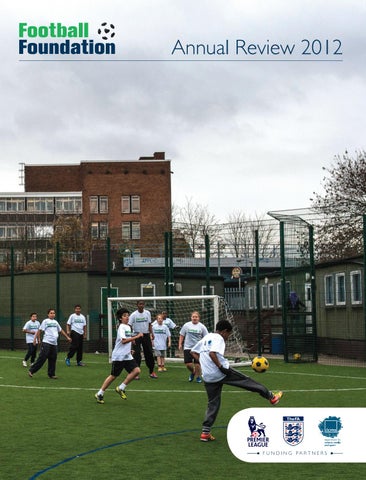
The Football Foundation Annual Report is available at: www.footballfoundation.org.uk/AnnualReport2012. To view our award winning interactive online version of this Annual Review called Annual Review +, go to: www.footballfoundation.org.uk/AnnualReviewPlus2012. This features interviews and videos of the projects included in this Review. Cover photograph was taken at Chestnut Grove High School in London who received £74,201 towards a new artificial grass pitch. The Football Foundation Annual Review 2012
28
The Football Foundation
Whittington House, 19-30 Alfred Place, London, WC1E 7EA T 0845 345 4555 E enquiries@footballfoundation.org.uk W www.footballfoundation.org.uk @FootballFoundtn
improving facilities • creating opportunities • building communities Registered Charity Number 1079309 Registered in England and Wales Company limited by guarantee Company Number 3876305