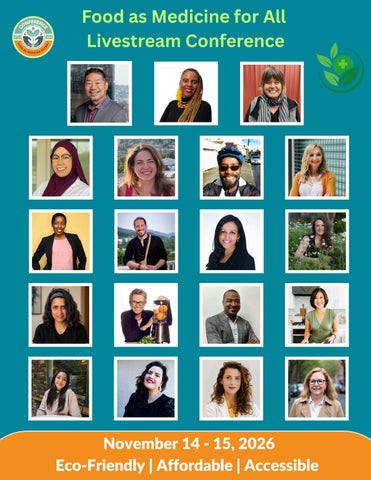
Food as Medicine for All Livestream Conference
November 14 - 15, 2026 Eco-Friendly | Affordable | Accessible
Uniting Agriculture and Healthcare to Support Food as Medicine for All Agriculture broadly defined for a diversity of food ways to include farmers, foragers, fishers, subsistence hunters, ranchers, wild-crafters, pastoralists, forest producers, and more. Healthare broadly defined for a diversity of health ways to include all those engaged in health and healing practices.
What We Do Food as Medicine Global (FAMG) was created to increase engagement in positive food system solutions by growing a global community of farmers, fishers, foragers, ranchers, subsistence hunters, wild-crafters, pastoralists, forest producers, healthcare providers, healers, hospitals, clinics, educators, schools, academic centers, students, cooks, consumers and more - united in a vision of food as medicine for all.
Activities Include Hosting an Annual Conference and other events for continued cooperative engagement and information exchange Facilitating a Members Online Community Site promoting information exchange and shared learning Stewarding the Food as Medicine Global Resource Directory to increase awareness, collaboration, and engagement to benefit individuals, communities, and the planet
Our Why The idea of food as medicine resonates with many in health care and food production. Nutrition is increasingly integrated into health professional training, patient care, and discussions around farming, fishing, ranching, and other food systems. However, people across many communities who want to eat well cannot access healthy or even enough food. Many of those producing and providing our food and health care navigate a multitude of inequities.
Join us in creating a more equitable and inclusive Food as Medicine movement!
Schedule At-A-Glance Saturday November 14
Please note that all times are in Pacific Standard
The Real Power of Fighting Hunger Ja'Sent Brown 7:00 - 7:45 AM Pacific
Sunday November 15
Bridging Food and Medicine: Empowering Healthcare Professionals to Advance Food as Medicine Kerstin Plehwe 6:00 - 6:45 AM Pacific
Food, Farming, and Health: The Care Farming Movement Kate Mudge and Care Farming Team 8:00 - 8:45 AM Pacific
TBA
From Soil to Spoon: Food as Medicine Across Communities Annie Lin 9:00 - 9:45 AM Pacific
When Food Fails to Heal: Food-System Determinants in Applying an African-Caribbean Centered Integrative Model to Reclaim Food as Medicine in Tanzania, Uganda and Kenya Chimene Castor 8:00 - 8:45 AM Pacific
From Pharmacy to Farmacy: Cellular Healing Through Food, Rhythm, and Land Sharon Yeh 10:00 - 10:45 AM Pacific
Tradition to Transition: How Diet Drives Inflammation and Immunity in Tanzanian Populations Godfrey Temba 9:00 - 9:45 AM Pacific
BiGu (Grain-Free Fasting) as Equitable Healing David Gaseor 11:00 - 11:45 AM Pacific
Advancing Food Is Medicine Through Research and Policy Sharone Munroe, Arianna Gomez Lopez, Megan Cermak, Kritika Ramesh 10:00 - 10:45 AM Pacific
Translating Online Interest into Food as Medicine Practices Griffin McMath 12:00 - 12:45 PM Pacific
Unlocking the Power of Food as Medicine for Preconception and Fertility Care Rashmi Kudesia 11:00 - 11:45 AM Pacific
Soil to Soul Shannon Gowland 1:00 - 1:45 PM Pacific
Pleasure as Part of the Nutrition Prescription Stephanie Voytek 12:00 -12:45 PM Pacific
When Food Sovereignty Isn't Enough: Lessons from Rural India Elizabeth "Cedar" Louis, PhD 2:00 - 2:45 PM Pacific
TBA
Urban CSA: Healthy Food Options, Healthy Farms Sheryll Durrant and Ruth Katcher Seattle Parks and Recreation's 12:00 - 12:45 PM Pacific Urban Food Systems Program Paris Yates 3:00 - 3:45 PM Pacific
Overcoming Barriers/Bridging Gaps at the Speed of Trust John Kim, JD, CEO of HealthierHere 2:00 - 2:45 PM Pacific
Special Guest
Dr. Ja’Sent Brown
Dr. Ja’Sent Brown, is the Chief Impact Officer at DC Central Kitchen, spearheading the organization’s programming, including implementation, workforce development, education, healthy food access, and measuring impact on the community. Dr. Brown, affectionately known as Dr. Ja' (pronounced Jahhh), joined the DC Central Kitchen team in 2020, bringing with her a successful track record of program implementation, grants management, programmatic “start-up to success”, government and community relations, and addressing social determinants of health including access to nutritious foods and gainful employment in under resourced areas of the city. Prior to DC Central Kitchen, Dr. Ja’ has worked for over thirteen years in DC Government programs addressing the needs of underserved families and individuals including serving as the Homeless Education State Coordinator and the inaugural Director of the Reengagement Center, the District's coordinated onramp to education and services for youth who have dropped out of school. Dr. Ja’ received her BA in English at her beloved HBCU, the University of the District of Columbia, and a Master of Social Work and Doctor of Public Health at Walden University. Outside of DC Central Kitchen, Dr. Ja’ spends many volunteer hours serving the community through her sorority, Alpha Kappa Alpha Sorority, Incorporated, and her board service at One World Education and Infinite Minds. She is the proud mother of two children, and wife of a DC police officer.
The Real Power of Fighting Hunger Food is a basic necessity that can bring people together, but hunger has the ability to drive communities apart. Hunger is a profound, primal, and spiritual force, acting as nature's strongest motivator for survival, productivity, and personal growth. Physically, it dictates brain activity to prioritize food acquisition, while metaphorically, a hunger for success drives intense focus, sacrifice, and deep personal transformation. But what happens if you can’t access food or opportunities? How then, do you address hunger and the root cause…poverty? DC Central Kitchen (DCCK) is an iconic nonprofit and social enterprise that combats hunger and poverty through job training and job creation. The organization provides hands-on culinary job training for individuals facing high barriers to employment while creating living wage jobs and bringing nutritious, dignified food where it is most needed. DCCK’s social ventures include serving scratch-cooked farm-to-school meals in DC schools, delivering fresh, affordable produce to corner stores in neighborhoods without supermarkets, and operating fast-casual cafes throughout the District of Columbia. In this presentation, we will learn more about how DCCK uses food to address five core values: 1. We believe that hunger is a symptom of the deeper problem of poverty, and that food is our chosen tool for changing individual lives while addressing systemic failures. 2. We believe in the transformative power of a job, and that everyone deserves the chance to share in the dignity of work while contributing to our community. 3. We believe in building a more equitable food system that ensures access to healthy, dignified food and economic opportunity for all. 4. We believe that waste is wrong, be it the waste of nutritious food, productive minds, or charitable dollars spent on unsustainable, redundant, and ineffective efforts. 5. We believe that food is medicine, and that everyone has a right to access healthy food and the education on how to use healthy food, because it is as essential as access to a medical professional.
Food can’t be medicine if it is inaccessible!
Saturday 7:00 - 7:45 AM Pacific
Food, Farming, and Health: The Care Farming Movement Care farming uses therapeutic farming practices to promote health, well-being, and belonging by engaging people of diverse ages, abilities, and life experiences in meaningful agricultural activities. Care farms support and connect people, (including people with intellectual and developmental disabilities, veterans, youth, elders, people in recovery, those navigating mental health challenges, and others) seeking community, purpose, and skill-building. In turn, care farms grow food, connection, and resilience. This session from Care Farming Network will share real examples from care farms across the US, illustrating how farms are integrating healing, inclusive employment, food production, and community care in ways that expand access and strengthen local food systems. Participants will engage through visual storytelling, examples of practice, and brief reflection on applications to their own work.
Kate, Mudge, BA Kate Mudge is Co-Director of the Care Farming Network (CFN), a national organization supporting the growth of care farms across the United States. She lives on a 40acre farm in rural west-central Minnesota with her wife, where she is beginning the groundwork to establish her own care farm. Kate brings over 20 years of nonprofit leadership to her work at CFN, along with a long-standing commitment to food systems, nonprofit organizations, and community well-being. A creative and land-based practitioner, she can be found foraging, baking, spending time with her animals, and hosting community events on her farm.
Saturday 8:00 - 8:45 AM Pacific
From Soil to Spoon: Food as Medicine Across Communities From Soil to Spoon: Food as Medicine Across Communities presents an integrative, kitchencentered approach to food as medicine that is practical, culturally responsive, and adaptable across diverse community settings. This session connects food preparation, everyday plant use, and cultural foodways with evidence-informed clinical and integrative nutrition to support health without overmedicalizing food or relying on products. Drawing from clinical practice, integrative and functional nutrition, culinary medicine, and community health education, participants will learn how simple, food-level strategies—such as cooking methods, teas, spices, and broths—can be responsibly incorporated into health education and care while maintaining safety and clinical boundaries. Real-world examples from kitchens and community-based settings will illustrate how food as medicine can remain accessible and effective across cultural and socioeconomic contexts. The session includes guided reflection and applied tools participants can immediately use in clinics, classrooms, and community programs. Attendees will leave with a clear framework and practical strategies to advance equitable, culturally grounded food-as-medicine practices across communities.
Annie Lin, DCN, CNS, LDN, IFMCP Dr. Annie Lin, DCN, CNS, LDN, IFMCP is a clinical nutritionist and integrative, functional medicine–trained practitioner, educator, and community health advocate. She is an Assistant Professor of Nutrition at Nova Southeastern University’s Kiran C. Patel College of Osteopathic Medicine, where she teaches nutrition assessment, medical nutrition therapy, functional nutrition, and applied food-as-medicine frameworks to future health professionals. Her work integrates evidence-informed integrative and functional nutrition, culinary medicine, culturally rooted foodways, and plant-based learning to translate food as medicine into realworld practice. Dr. Lin emphasizes practical, kitchen-centered strategies—including food preparation and everyday plant use—while maintaining clinical rigor, safety, and ethical boundaries. She is particularly interested in how kitchens and community-based settings where food is prepared, shared, or taught can serve as accessible entry points for food as medicine, and how simple plant preparations—such as teas, spices, and broths—can be responsibly incorporated into health education and care to support cardiometabolic and gut-immune health across diverse communities.
Saturday 9:00 - 9:45 AM Pacific
From Pharmacy to Farmacy: Cellular Healing Through Food, Rhythm, and Land This session shares a lived, place-based exploration of healing through food, rhythm, land, and relationship, using the farmers market as an unexpected doorway into cellular health. Drawing from her background as a Doctor of Pharmacy and Certified Nutrition Specialist, alongside lived experience within local food systems, Dr. Sharon Yeh reflects on how healing emerged through regular engagement with farmers markets, outdoor environments shaped by natural light and seasonal timing, and hands-on farm work alongside her daughter. Rather than focusing on nutrients or prescriptions alone, this talk invites participants to consider health as a relational and environmental process that supports the body’s ability to regulate, generate energy, and repair. Participants will gain insight into how locally grown food, alignment with environment and seasons, and human connection can influence cellular vitality beyond nutrient content alone. Interactive elements include guided reflection and prompts, encouraging participants to explore their own relationships with food, place, and daily rhythms and to seek their own local “farmacy.”
Sharon Yeh, Pharm. D, M.S, CNS Dr. Sharon Yeh is a Certified Nutrition Specialist and Doctor of Pharmacy with over two decades of experience in clinical pharmacy and advanced training in integrative nutrition and functional medicine. Her work explores health through a cellular and environmental lens, focusing on how food, light, rhythm, and relationship shape human vitality. Drawing from both scientific training and lived experience, Dr. Sharon bridges modern nutrition science with approaches to healing rooted in local food, environment, and human connection. Her work invites a return to foundational conditions that support cellular energy and resilience across the lifespan.
Saturday 10:00 - 10:45 AM Pacific
BiGu (Grain-Free Fasting) as Equitable Healing BiGu, a classical Chinese medicine practice often translated as “avoiding grains,” combines therapeutic fasting, specific food selection, and Qigong to support metabolic and energetic regulation. This session introduces BiGu through the lens of modern clinical care—examining its historical roots, physiological mechanisms, and potential role alongside contemporary nutrition, lifestyle medicine, and emerging conversations around food access and food equity. This talk explores BiGu not only as a fasting method but as a broader philosophy connecting the vitality of soil, the quality and accessibility of food, and the resilience of the human body. It considers how disparities in access to nutrient-dense, culturally appropriate foods shape metabolic health, and how traditional practices like BiGu can be thoughtfully adapted without reinforcing inequities. Drawing parallels between regenerative agriculture and Chinese medical views of “post-natal qi,” the presenter will discuss how periods of simplified eating or grain abstention can recalibrate appetite signaling, microbiome balance, and stress physiology, while also inviting dialogue about how such practices can be made inclusive, safe, and relevant across diverse populations and food environments.
David Gaseor, DACM, LAc Dr. David Gaseor first met and began training with his teacher Grandmaster Fu Wei Zhong in 2008 while studying Physical Therapy in Northern California. Later he deepened his understanding of Emei Qigong by formally studying Eastern Medicine and received first his Master of Science in Traditional Oriental Medicine and later his Doctorate of Acupuncture and Chinese Medicine while learning how to use Qigong clinically. In 2019 after years of practice and an intensive month-long training with Grandmaster Fu, David was accepted by him as a senior student and honored to be selected as a 14th generation Emei teacher. David is humbled and grateful to have been among the last few students outside of China to receive this high level of training from Grandmaster Fu.
Saturday 11:00 - 11:45 AM Pacific
Translating Online Interest into Food as Medicine Practices As interest in food, health, and sustainability increasingly spreads through digital culture, many people are seeking ways to turn online curiosity into meaningful, offline participation. This presentation explores how Food as Medicine can move beyond awareness and into real-world practice by leveraging the same forces that make cultural food trends compelling—desire, identity, and shared experience. Drawing from applied work in food systems education and community-based health practice, this session introduces a participatory Food as Medicine model designed for everyday settings. Rather than relying on prescriptive guidance or clinical optimization, the model invites people to engage their local food systems through three tangible experiences: connecting with food producers or sources, navigating food access points like grocery stores and markets, and coming together for shared meals. Grounded in regenerative and whole-food principles while accounting for cultural, geographic, and economic realities, the model emphasizes learning through doing. The session will share lessons from piloting this approach in libraries, schools, and community spaces, highlighting what helps people move from interest to action—and why lived experience is key to sustaining Food as Medicine practices over time.
Griffin McMath, ND
Griffin McMath, ND is a naturopathic doctor and founder of Atelier Gryphon, a creative–intellectual studio working at the intersection of food systems, health, culture, and public education. Her work focuses on translating complex food, agriculture, and health science into grounded, ethical, and accessible practices for individuals, communities, and institutions. She brings clinical training in whole-person care alongside systems-level experience in food access, health literacy, and community-based education. Her work emphasizes regenerative and whole-food principles while remaining attentive to real-world constraints related to cost, geography, culture, and access. She specializes in designing Food as Medicine approaches that avoid moralizing food choices or overextending clinical claims, prioritizing dignity, inclusion, and repeatable action. Her background includes collaboration with farmers, producers, educators, and community organizations to develop participatory models that connect food production, access, and human health in practical, culturally responsive ways.
Saturday 12:00 - 12:45 PM Pacific
Soil to Soul Reflecting on Our Food System Let’s take a moment to examine the journey of our food system. How did we arrive at this juncture, and is it possible to return to a state of healing? Healing is not a straightforward process; it intertwines with our daily choices. Our health is inextricably linked to our external environment. We will delve into the significance of soil, food, choices, and our bodies. We can only be as healthy as our external environment.
Shannon Gowland, CEO Shannon’s journey began on indigenous land, where she learned that the Earth itself is a teacher. There, she absorbed the principles of Earth & Plant Medicine, indigenous agriculture through knowledge passed down by generations long before she entered formal scientific study. Her training spans Biology, Chemistry, Medical QiGong, Reiki, Yoga, and Biodynamic Agriculture, giving her a rare perspective at the crossroads of modern healthcare and ancestral wisdom. As an Indigenous practitioner, herbalist, and naturalist, Shannon integrates Native and Eastern philosophies to guide people toward the root of imbalance rather than masking isolated symptoms, a holistic approach that reconnects body, mind, and spirit to the living Earth that sustains them.
Saturday 1:00 - 1:45 PM Pacific
When Food Sovereignty Isn't Enough: Lessons from Rural India Food sovereignty has emerged as a powerful framework for reimagining food systems by emphasizing local control, ecological sustainability, and the rights of communities to define their own agricultural futures. Based on 18 months of ethnographic fieldwork with smallholder farmers in the Telangana region of India, this presentation examines how these ideals align—or fail to align—with the everyday realities of rural livelihoods. Drawing on interviews, life histories, participant observation, and household surveys, I explore the tensions between food sovereignty principles and the economic, social, and environmental challenges facing small farmers. While food sovereignty movements offer an important critique of industrial agriculture and global food systems, my research found that many farmers prioritized livelihood security, income stability, and economic opportunity over localized subsistence agriculture. Rather than rejecting markets, they sought ways to navigate them while managing risk and improving their quality of life. This presentation argues that achieving food sovereignty requires first ensuring secure and viable livelihoods. By centering farmers' lived experiences, it offers a nuanced perspective on the relationship between food sovereignty, food security, rural development, and health, with implications for researchers, practitioners, and policymakers working to build more equitable and resilient food systems.
Elizabeth "Cedar" Louis, PhD Elizabeth "Cedar" Louis, PhD is a social scientist, human geographer, and UX researcher with over 15 years of experience conducting interdisciplinary research across food systems, rural livelihoods, land rights, and health. Her work has spanned academia, international development, and technology, using qualitative and mixed-methods research to understand how people navigate complex social and institutional systems. Cedar's doctoral research in Human Geography at the University of Hawaiʻi at Mānoa examined food sovereignty and rural livelihoods in India through the lens of political ecology. She has conducted extensive fieldwork in India and has worked across South Asia, Africa, and Latin America on issues including food security, land tenure, gender, and community resilience. As a Senior Research and Evaluation Specialist at Landesa, she led research, monitoring, and evaluation initiatives supporting land rights and agricultural development programs in India, Nepal, Liberia, and Myanmar.
Saturday 2:00 - 2:45 PM Pacific
Seattle Parks and Recreation's Urban Food Systems Program Seattle is undergoing rapid growth and change, and a denser population coupled with historic racialized systemic challenges places pressures on open space and urban forests, affordable housing, and food security. An essential strategy for reducing these pressures is better utilizing urban land to connect communities and strengthen resiliency. Given its responsibility for managing urban land for food production, the Urban Food Systems Program (UFS) plays a vital role in this effort. Since its inception, UFS has worked closely with internal and external partners, community-based organizations (CBOs), and food systems specialists. This broad-scale collaboration has consolidated healthy food, garden, and kitchen activities throughout the Seattle Parks and Recreation system into a comprehensive learning community based on mutual support, equity, cultural relevance, and sustainability. The presentation will describe the Urban Food Systems Program (brief history, program description), discuss how it partners with internal City of Seattle (COS) agencies and external community partners, and the programs impact on local communities' food justice and environmental health issues.
Paris Yates, A.A.S. in Horticulture, B.A. Environmental Studies, M.A.E in Urban Environmental Education Paris Yates is a Planning and Development Specialist with Seattle Parks and Recreation’s Urban Food Systems Program. Born and raised in Seattle, Washington, Paris has spent more than 30 years working in state and local government, including roles with King County Parks, the State of California, and the City of Seattle. His work focuses on advancing communitycentered approaches to urban food systems, environmental education, and equitable access to healthy food.
Saturday 3:00 - 3:45 PM Pacific
Bridging Food and Medicine: Empowering Healthcare Professionals to Advance Food as Medicine The pivotal role healthcare professionals play in advancing food as medicine through nutrition education, clinical practice and systems change.
Kerstin Plehwe, CEO and President of the Physicians Association for Nutrition (PAN International) Kerstin Plehwe is an award-winning entrepreneur, bestselling author, philanthropist, and passionate advocate for personal and planetary health. Born in Munich and having lived across several countries, she brings a truly global perspective to leadership, health, and innovation. Recognised as one of Europe’s foremost female keynote speakers and thought leaders, Kerstin has delivered more than 900 talks in over 20 countries. As CEO and President of the Physicians Association for Nutrition (PAN International), a fast-growing medical and nutrition-focused organisation, she is dedicated to combating the global rise of obesity and non-communicable diseases such as diabetes, heart disease, and cancer. A firm believer that food is the most underestimated instrument in public health and longevity, Kerstin champions sustainable dietary shifts and global healthcare transformation. She has authored eight books, advised political parties and organisations worldwide, and been featured in leading international media. Kerstin lives with her family and Dachshund Anton in Germany and the United States. She cherishes world travel, cooking, and reconnecting with nature in the South African wilderness and the Swiss alps.
Sunday 6:00 - 6:45 AM Pacific
When Food Fails to Heal: Food-System Determinants in Applying an AfricanCaribbean Centered Integrative Model to Reclaim Food as Medicine in Tanzania, Uganda and Kenya Food is increasingly recognized as both medicine and a foundational determinant of health. However, when food is unsafe, inaccessible, inadequately produced, consumed or situated within inequitable systems, it may contribute to disease rather than promote healing. In low- and middle-income countries, structural food insecurity, weak policy environments, limited nutrition literacy, and fragile food systems render food a driver of malnutrition, micronutrient deficiencies, and dietrelated noncommunicable diseases.
Chimene Castor, Ph.D., EdD, RDN, LDN, CHES, FAND Dr. Chimene Castor is an Associate Professor of Nutritional Sciences at Howard University. She earned her Ph.D. in Nutrition from Howard University and both an Ed.D. and M.A. in Health Education from Teachers College, Columbia University. With over 20 years of experience as a clinical dietitian and global health leader, her current research focuses on Food as Medicine, linking nutrition, health literacy, and sustainable food systems to the prevention and management of chronic diseases.. She is also the co-author of Complete Nutrition: I Don't Want Any More Salad: Caribbean and African Vegan and Vegetarian Holiday Cuisinesand owns Complete Nutrition Therapy and Counseling, LLC, in addition to the Julio Rameaux Farm.
Sunday 8:00 - 8:45 AM Pacific
From Tradition to Transition: How Diet Drives Inflammation and Immunity in Tanzanian Populations This presentation explores how rapid nutrition transition driven by urbanization in sub-Saharan Africa reshapes immune and metabolic health, with implications for noncommunicable disease (NCD) prevention. Using data from a controlled dietary intervention among rural and urban Tanzanian men, the session demonstrates that replacing traditional, plant-based heritage diets with Western-style processed foods induces low-grade systemic inflammation and adverse metabolic reprogramming. These changes included pro-inflammatory lipid and aminoacid pathways, altered cytokine responses, and activation of inflammatory gene networks linked to cardiometabolic disease. Importantly, reverting to indigenous diets-rich in whole grains, legumes, vegetables, and fermented foods such as the traditional banana beverage Mbege-reversed many of these effects and enhanced immunoregulatory pathways. Several benefits persisted weeks after the intervention, highlighting the potential for short-term, culturally grounded dietary strategies to yield lasting health gains. The session will emphasize how preserving and promoting local food systems can be integrated into national nutrition policies and urban health planning to mitigate the growing NCD burden. Interactive discussion will focus on translating immunometabolic evidence into scalable, culturally acceptable public health interventions.
Godfrey Temba, BSc, MSc, PhD Dr. Godfrey Temba, PhD, is a distinguished expert in nutrition immunology and a Senior Lecturer at KCMC University in Tanzania. With a robust academic foundation, he earned his PhD in Nutrition Immunology (Cum Laude) from Radboud University Medical Centre, Netherlands, specializing in the interplay between nutrition, immune function, and metabolic health. He also holds an MSc in Biomedical Sciences (with distinction) from the same institution and a BSc in Biotechnology and Laboratory Sciences from Sokoine University of Agriculture. Dr. Temba’s research focuses on urbanization-driven nutrition transitions and their impact on diet-health dynamics in Tanzanian populations. He has extensive experience in designing and conducting diet intervention studies, notably in the TransInf and TransMic projects, evaluating the health benefits of Kilimanjaro heritage diets compared to Westernized diets on immune responses, inflammation, and metabolic outcomes in transitioning communities. As Principal Investigator of the TransInf Project and coordinator for multiple international collaborations, he integrates multi-omics approaches with community dietary assessments to inform context-specific interventions for noncommunicable diseases. His findings, published in prestigious journals including Nature Medicine (2025), Nature Immunology (2021), and Nature Communications (2022), contribute significantly to global understanding of dietimmune interactions. Dr. Temba is committed to advancing nutrition research, mentoring students, and developing evidence-based strategies to address public health challenges in urbanizing Africa. ORCID: 0000-0002-1093-3037
Sunday 9:00 - 9:45 AM Pacific
Advancing Food Is Medicine Through Research and Policy The Central Health Equity Policy Council’s (CHEP) Food Is Medicine (FIM) initiative recognizes that health outcomes are shaped far beyond the clinic walls. Through systematic screening for food insecurity and strengthened referral pathways, organizations are working to ensure that no one’s health suffers due to unmet food needs. This presentation examines how research on national Food Is Medicine best practices, combined with qualitative findings from key informant interviews and perspectives from U.S. FIM leaders, are informing the development of new clinical and systems-level policy recommendations in Travis County, Texas. These recommendations are designed to support safety-net healthcare systems and sustain FIM programs over time. Presenters will share the research-to-policy process, key policy-relevant themes that emerged, and a clear pathway toward implementing Food Is Medicine policies across local healthcare and community partner organizations.
Sunday 10:00 - 10:45 AM Pacific
Presenters Sharon V. Munroe, DrPH, MPH, MBA, CHWI, MCHES® Dr. Sharon Munroe is a public health teaching faculty member at the University of Texas Rio Grande Valley (Brownsville, TX) and a health policy researcher. She is a recent graduate of the Doctor of Public Health program in Health Promotion and Health Education at UTHealth Houston School of Public Health in Austin, Texas. Her doctoral practicum was conducted with the Travis County, TX Central Health Equity Policy Council (CHEP) and focused on developing healthcare for all, as well as recommending equity and access policies, earning national recognition through the American Public Health Association Annual Meeting (2024) and the peer-reviewed International Journal of Health, Wellness, and Society (2025). Dr. Munroe has partnered again with CHEP leaders, including Megan Cermak, Arianna Gomez-Lopez and Kritika Ramesh, on the Food Is Medicine initiative designing and conducting research to determine national best practices for clinical Food Is Medicine policy development that are being recommended to Council member organizations, including clinics and hospitals across Travis County. Arianna Gomez Lopez, MPH Arianna Gomez Lopez is a public health and policy professional whose current work focuses on Food Is Medicine and healthcare-based approaches to addressing food insecurity. More broadly, her work includes health policy, public health strategy, cross-sector partnerships, and initiatives that strengthen how healthcare systems serve underserved communities. She is a Public Health and Policy Advisor at Central Health in Austin, Texas, where she works on policy and program initiatives related to food insecurity, community health, and healthcare delivery. She holds a bachelor’s degree in Public Health from Baylor University and a master’s degree in Global Health from Emory University, and previously worked with the Centers for Disease Control and Prevention on international public health response efforts.
Megan Cermak, MS Megan Cermak is the Senior Director of Public Health at Central Health in Austin, Texas, where she leads public health strategy, policy, and community health initiatives for Travis County’s safety-net healthcare system. She has more than 20 years of experience in public health policy, disaster response, and program implementation at the local and state levels. Her work has included managing large-scale public health initiatives, leading policy and ordinance campaigns, and supporting the development of state and federal grant-funded programs. She played a key leadership role in the Travis County Healthcare District’s COVID-19 response and has helped secure significant public health funding to support community health initiatives. She is the recipient of the American Public Health Association’s Vision in Health Policy Award.
Kritika Ramesh Kritika Ramesh is an undergraduate student at The University of Texas at Austin in the Health Science Scholars Honors program studying Neuroscience and Healthcare Reform. Her work centers on advancing community-based solutions to address health disparities. She currently serves on the Central Health Policy Council in Travis County, where she contributes to one of the region’s first Food Is Medicine policy initiatives. More broadly, Kritika is passionate about leveraging policy, innovation, and collaboration to improve healthcare access. She aspires to pursue a career that integrates medicine, innovation, and public policy to drive systemic change in healthcare delivery.
Unlocking the Power of Food as Medicine for Preconception and Fertility Care Over the past fifty years, the trend of reproductive-aged women and men moving towards a high-stress lifestyle characterized by poor diet, insufficient physical activity and sleep, and worsening mental health has accelerated. Though the topics of infertility, declining birth rates, and food or lifestyle as medicine are discussed more frequently, there remains much confusion around the optimal ways to eat for ideal fertility and pregnancy outcomes. This understanding is often inaccessible to those with less access to the healthcare system, lower health literacy, language or cultural barriers, and other social determinants. Dr. Kudesia will present a rationale for why we must specifically invest in the notion of preconception health as a key to reversing decades of decline in reproductive health and longevity, and a blueprint for how we might unlock the potential of food as medicine for all.
Rashmi Kudesia, MD, MSc, FACOG, DipABLM Rashmi Kudesia is a board-certified specialist in Obstetrics & Gynecology, Reproductive Endocrinology and Infertility, and Lifestyle Medicine. She has many years of experience in treatment of infertility, polycystic ovary syndrome, and other similar conditions, however her passion is around utilizing culinary and lifestyle medicine approaches to improve preconception and reproductive health. After completing her Baccalaureate degree in Biology & Medicine magna cum laude from Brown University, she received her M.D. with honors from the Duke University School of Medicine, where she was selected into a clinical research training program co-sponsored by the National Institutes of Health. Her residency training in Obstetrics & Gynecology at the New York Hospital-Weill Cornell Medical Center was followed by subspecialty training in Reproductive Endocrinology and Infertility (REI) at the Albert Einstein College of Medicine-Montefiore Medical Center, alongside a Masters’ of Science degree in Clinical Research Methods. he subsequently served as a Clinical Assistant Professor at the Icahn School of Medicine at Mount Sinai, as well as the Research Rotational Director for the REI fellowship, and Medical Director of the Brooklyn office of the Reproductive Medicine Associates of New York. She joined CCRM Houston in 2018, and annually receives multiple clinical awards, including Top Doctor by Houstonia Magazine, Castle Connolly Top Doctor, and the like. Dr. Kudesia is a Fellow of the American College of Obstetricians and Gynecologists, and an active member of the American Society for Reproductive Medicine (ASRM), Society for Reproductive Endocrinology and Infertility, Androgen Excess & Polycystic Ovary Syndrome Society, and American Medical Association (AMA). She has served in multiple local and national leadership roles in organized medicine for over 20 years, including current positions with ACOG, ASRM, Harris County Medical Society and Texas Medical Association, the American College of Lifestyle Medicine, and more. She also hold multiple leadership roles within the academic branch of her practice, serving as a postgraduate rotational director for multiple residency and fellowship programs in OB/GYN, family medicine, and medical endocrinology. Dr. Kudesia has presented scientific research at national and international conferences, has received multiple awards and grants for her work, and is a recognized key opinion leader in the realm of reproductive and preconception health. She has published peerreviewed articles and book chapters, including in leading journals such as Fertility & Sterility and the American Journal of Obstetrics & Gynecology, as well as editing a theme issue on reproductive medicine for the American Medical Association Journal of Ethics. She is also author of the book, “Understanding Fertility Awareness Methods: Gaining Control of Your Fertility.” Her current areas of focus include improving access to comprehensive fertility counseling and care, promoting evidence-based approaches to preconception and polycystic ovary syndrome care, and advocacy for reproductive choice and autonomy.
Sunday 11:00 - 11:45 AM Pacific
Pleasure as Part of the Nutrition Prescription Pleasure as Part of the Nutrition Prescription begins with the simple observation that people return to what feels good. The pleasure provided by food is not simply born from gluttony, but is our body's way of orienting us toward vitality. Eating is not an act of consumption, but an act of collaboration that encourages our bodies to recognize and be rewarded by the nutrients found in food. Pleasure helps us recognize nutrients, not only supporting the survival of our species, but survival of the food eaten. This presentation encourages providers to step away from recipes and education built from the assembly of key nutrients, and toward helping clients and the general public identify nutrients in their favorite foods. Pleasure first nutrition recommendations focus on body attunement, intuitively enhancing nutritional knowledge and discernment. Additionally, they enhance an individual's connection to their community, local, and heritage foodways. This presentation will draw from the presenter's range of experiences working in food systems, agriculture, and nutrition counseling to teach providers language and strategies they can use to joyfully help clients embrace nutrition as part of the human experience.
Stephanie Voytek, RDN Stephanie Voytek is a Registered Dietitian with a range of experience working to enhance folks' connection to food. From working with food access programs, providing community education, and working in the fields and kitchens on farms, counseling folks with eating disorders, and more. Her range of work experience allows her to understand people and find the entry point for nutritionrelated behavior change in each community and individual, emphasizing pleasure and connection as the foundation of nutrition education.
Sunday 12:00 - 12:45 PM Pacific
Thank you to The Institute for Functional Medicine for your support as a Community Sponsor!
Overcoming Barriers/Bridging Gaps at the Speed of Trust HealthierHere, the Accountable Community of Health for King County WA, operates a community care hub that supports and knits together community based organizations who have deep trusted relationships with underserved populations. The network offers case management and community care navigation to social care services such as nutrition support, housing, behavioral health, and more. In this interactive session, we will explore the challenges of maintaining relationship driven care at the client level while operating at scale to demonstrate the need for systems transformation to make care delivery more effective.
John Kim, JD, CEO of HealthierHere John Kim is the CEO of HealthierHere, a cross-sector Accountable Community of Health collaborative, which elevates community voice into system transformation to achieve health equity. He is also a Community Advisory Board member for the Health Promotion Research Center at University of Washington and a board member of the YMCA of Greater Seattle. John’s professional experience includes a diverse mix of settings from a national healthcare law practice to hospital senior management to social justice and equity focused community organizations. Mr. Kim graduated with a JD from New York University School of Law and a BA in Government from Dartmouth College.
Sunday 2:00 - 2:45 PM Pacific
Thank you to Silicon Valley Natural Health for your support as a Community Sponsor!
Recommended Reading
Continuing Education This activity is approved by the Board for Certification of Nutrition Specialists℠ (BCNS℠) to provide Continuing Education (CE) credits for Certified Nutrition Specialists® (CNS®) for a maximum of 10 CE Credits.
Additionally, to support a diverse global community, a Certificate of Attendance will be available to attendees who participate in the live event. These certificates may be used to apply for continuing education credits through professional associations. Please note that requirements for continuing education credits vary. We recommend consulting your professional association to determine whether the certificate meets their criteria. Currently, we do not offer Continuing Medical Education (CME) credits but hope to provide them in the future. Please contact the ACCME to determine if any credits from this educational offering can be applied toward your CME recertification.
Thank you! Conference Supporters
Thank you! Conference Supporters
Acknowledgments Logo Graphic Design by Cassandra Lee Houston. Cover collage photos by Anda Ambrosini, Melanie Anderson, David Clode, Gabriel Jimenez, Taylor Kiser, Brook Lark, Nadine Primeau, Andrew Ridley, Joanie Simon, Markus Spiske, and Marek Studzinski on Unsplash.
Thank you!
PO Box 1153, Vashon Island, WA 98070 Traditional lands of the sx̌ʷəbabs people info@foodasmedicine.global Food as Medicine Global, LLC 2026 © All rights reserved.