MUSIC MATTERS TO YOUR CUSTOMERS NEW STUDY CONFIRMS MUSIC CAN INCREASE REVENUE AND BUILD CUSTOMER LOYALTY
89%
OF MILLENNIALS SAID THAT GOOD MUSIC MAKES A MORE MEMORABLE EXPERIENCE
NEARLY
86%
70%
WOULD RECOMMEND THE ESTABLISHMENT IF THEY ENJOY THE MUSIC
86%
WOULD RETURN TO AN ESTABLISHMENT IF THEY LIKED THE FEATURED LIVE MUSIC
80%
OF MILLENNIALS SAID THAT HAVING NO MUSIC NEGATIVELY IMPACTS THEIR EXPERIENCE
SAY THAT MOST OF THE RESTAURANTS AND BARS THEY FREQUENT HAVE MUSIC PLAYING
IF GOOD MUSIC IS PLAYING FOR MORE INFORMATION ON HOW TO OBTAIN A BMI MUSIC LICENSE, PLEASE VISIT WWW.BMI.COM/EDE
NEARLY 80% WILL STAY LONGER
NEARLY 60% WILL BUY MORE FOOD OR DRINKS
70% MILLENNIALS 63% GEN X 56% GEN Z
BAR AND RESTAURANT OWNERS WEIGH IN
“
CHECK AVERAGE TENDS TO GO UP 5 TO 10% JUST BECAUSE PEOPLE ARE GETTING THAT 2ND OR 3RD DRINK. REVENUES HAVE JUMPED ALMOST 25% ON THE NIGHTS THAT WE HAVE LIVE MUSIC. -BRIAN BREWERY OWNER, COLORADO AND UTAH
”
“
WITH LIVE MUSIC (…) THERE WERE MORE LIQUOR SALES, AND THAT’S A 75% PROFIT MARGIN. -THOMAS OWNER, FAMILY ITALIAN RESTAURANT ATLANTA, GA
”
“
THE MORE UPBEAT, THE BETTER CHANCE FOR AN UPSELL, THE BETTER CHANCE THEY WANT TO STAY A LITTLE LONGER.
-CHRISTOPHER VINEYARD OWNER AND TASTING ROOM OPERATOR LOS ANGELES, CA
”
TO VIEW THE COMPLETE SURVEY, VISIT https://www.bmi.com/pdfs/publications/2023/bmi-value-music--research-analysis.pdf * A QUANTITATIVE ONLINE STUDY BY BMI AND NATIONAL RESEARCH GROUP (NRG) WAS ANSWERED BY 1,000 NATIONALLY REPRESENTATIVE PEOPLE AGE 21+ WHO REGULARLY VISIT EDES (AT LEAST 3X PER MONTH). TO REPRESENT THE B2B PERSPECTIVE, NRG CONDUCTED SIX IN-DEPTH-INTERVIEWS WITH OWNERS, OPERATORS AND MANAGERS OF BARS AND RESTAURANTS.
!""#$%&'#"( )#$*+
Page 3 | Food & Beverage Magazine v July Issue 2026
July Issue 2026 v Food & Beverage Magazine | Page 4
,*-&%.+%"& /*0-
Building the Future of Commerce:
+2: 648$5( ,6 5('(),1,1* %86,1(66 ,1 7+( ',*,7$/ $*( By Lauren Kane
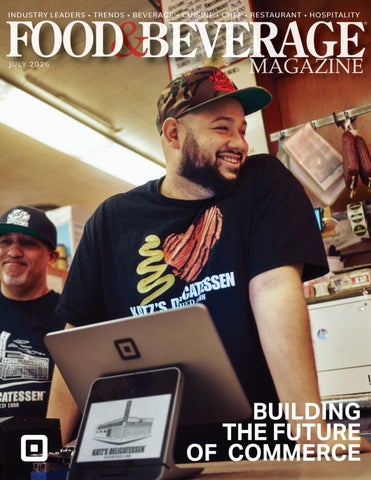
In an era where commerce is no longer defined by a single channel, device, or transaction, the infrastructure behind how businesses operate has become just as important as the products they sell. The most influential companies in financial technology are no longer simply facilitating payments. They are reshaping the entire operating system of modern business. Among them, Square has emerged as one of the clearest and most compelling examples of what it means to lead with both vision and execution. Since its founding in 2009, Square has evolved far beyond its original premise of enabling card payments through a mobile reader. What began as an elegant solution to a singular problem has become a comprehensive, deeply integrated commerce ecosystem. Today, Square supports millions of businesses with a platform that spans in-person payments, e-commerce, payroll, inventory, customer engagement, and access to capital. This expansion has not been incremental. It has been intentional, guided by the belief that businesses should not have to stitch together fragmented tools to operate effectively.
Page 5 | Food & Beverage Magazine v July Issue 2026
That philosophy is increasingly resonant in a market
This emphasis on cohesion is particularly evident in
defined by complexity. Operators, particularly in
Square’s evolving point-of-sale experience. Rather than
sectors like food and beverage, are managing more
offering rigid, industry-specific systems, Square has
variables than ever before. They are navigating
moved toward flexible, adaptable interfaces that allow
omnichannel sales, fluctuating labor conditions, rising
businesses to tailor functionality to their needs without
costs, and rapidly evolving consumer expectations. In
sacrificing simplicity. This is a subtle but important
this environment, disconnected systems do more than
shift. It reflects a deeper understanding that modern
create inefficiency. They create risk. Square’s answer
businesses do not fit neatly into predefined categories.
has been to collapse those silos into a single, cohesive
They are dynamic, often blending retail, hospitality, and
platform that allows businesses to move with clarity
digital commerce in ways that require equally dynamic
and confidence.
technology.
What
its
A clear illustration of this adaptability can be seen in
commitment to building an ecosystem rather than a
distinguishes
Square’s
approach
is
brands like Van Leeuwen Ice Cream. What began as
suite of standalone products. Its platform is designed
a single scoop truck in New York City has grown into
so that each component strengthens the others,
a nationally recognized premium ice cream company
creating a unified experience that is both powerful
with brick-and-mortar locations, grocery distribution,
and intuitive. A restaurant operator, for example, can
and a cult-like following. This kind of growth demands
manage orders across dine-in, takeout, and delivery
more
channels while simultaneously tracking inventory,
operational infrastructure that can scale seamlessly
analyzing performance, and engaging customers
across channels while preserving brand integrity and
through integrated marketing tools. The result is not
customer experience.
than
just
product
excellence.
It
requires
just operational efficiency, but a more intelligent and responsive business model.
July Issue 2026 v Food & Beverage Magazine | Page 6
For a brand like Van Leeuwen, the ability to unify in-store transactions, retail inventory, and customer data is critical. High-volume storefronts, particularly in dense urban markets, require speed and reliability at the point of sale, while packaged goods expansion introduces an entirely different layer of logistics and reporting. Square’s integrated ecosystem allows businesses operating at this intersection to maintain consistency, streamline operations, and access real-time insights across every touchpoint. Equally important is the role of data in sustaining growth. With a loyal and highly engaged customer base, Van Leeuwen benefits from tools that provide visibility into purchasing behavior, peak demand periods, and product performance. These insights empower teams to make informed decisions around staffing, inventory, and new product launches, ensuring that the brand remains both agile and responsive as it expands. In a category where experience is as important as product, the technology supporting that experience cannot be an afterthought. For emerging and scaling brands alike, Square provides a foundation that not only supports growth but enhances it, allowing companies like Van Leeuwen to focus on what they do best while operating with the sophistication of a much larger enterprise. Equally important is the company’s relentless focus on usability. Square has long recognized that technology only creates value when it is accessible. Its hardware is intentionally designed to feel familiar, removing the intimidation that often accompanies new systems. Its software prioritizes clarity, offering dashboards and insights that are immediately actionable rather than overly complex. This design philosophy has played a critical role in broadening access to sophisticated tools, enabling small and mid-sized businesses to operate with capabilities that were once reserved for large enterprises. That democratization of technology is central to Square’s identity. By eliminating traditional barriers such as high upfront costs, long-term contracts, and technical complexity, the company has redefined what it means to enter and scale within the marketplace. This has had a particularly meaningful impact on independent operators and underserved communities, where access to reliable financial infrastructure can determine not just growth, but survival.
Page 7 | Food & Beverage Magazine v July Issue 2026
Square has demonstrated a clear willingness to invest in what comes next. Its JOUFHSBUJPO PG BSUJmDJBM intelligence into its platform signals a shift toward more predictive and adaptive commerce.
“Katz’s Delicatessen exemplifies how iconic establishments can embrace technology to create new pathways for growth while preserving their authenticity,” said Nick Molnar, Global Head of Sales and Marketing at Block, which includes Square and Cash App. “Square’s integrated commerce solutions are designed for premium quick-service restaurants operating in dynamic, high-volume environments – including those like Katz’s that need seamless integration between in-person and online sales channels.
Square empowers Katz’s to serve its legendary pastrami to the next generation of customers while maintaining the traditions that have made them a culinary institution in New York and beyond.”
At the same time, Square has demonstrated a clear willingness to invest in what comes next. Its integration of artificial intelligence into its platform signals a shift toward more predictive and adaptive commerce. By leveraging real-time data, including local trends, customer behavior, and external factors, businesses can make more informed decisions about everything from staffing to inventory. This moves operators beyond reactive management and into a more strategic, forward-looking mode of operation. The company’s exploration of emerging capabilities, from advanced automation to new forms of digital payment, further
reinforces
innovator. Importantly, these
its
position
as an
advancements
are
not introduced in isolation. They are woven into the broader ecosystem, enhancing its overall value rather than complicating it. This discipline is what allows Square to innovate without losing the simplicity that has become one of its defining strengths.
Page 9 | Food & Beverage Magazine v July Issue 2026
Scale, of course, matters in assessing influence, and Square’s footprint is substantial. The platform processes hundreds of billions in annual payment volume and serves a remarkably diverse customer base, from independent storefronts to high-growth, multi-location brands. Yet its impact cannot be measured by volume alone. More significant is the way it has shifted expectations across the industry. Competitors are no longer judged solely on transaction fees or hardware design. They are evaluated on their ability to deliver integrated, end-to-end solutions that support every aspect of a business. In many ways, Square has helped establish this new standard, demonstrating that the future of commerce lies in platforms that are as cohesive as they are capable. For the food and beverage sector, this evolution is particularly meaningful. The demands placed on operators continue to intensify, requiring tools that can keep pace without adding friction. Square’s ability to unify frontof-house and back-of-house operations, streamline order management, and provide real-time visibility into performance offers a blueprint for how technology can elevate the entire dining experience. It allows operators to focus less on managing systems and more on delivering quality, consistency, and innovation to their customers. Looking ahead, the trajectory is clear. Commerce will continue to blur the lines between physical and digital, local and global, transactional and experiential. Businesses will need infrastructure that is not only reliable but adaptable. Platforms that can evolve in step with their users will define the next generation of industry leaders. Square is positioned firmly within that group. Its evolution reflects a broader transformation within financial technology, one that prioritizes integration, intelligence, and accessibility. More importantly, it reflects a deep understanding of the people it serves. By aligning its growth with the success of its customers, Square has moved beyond the role of service provider and into that of a strategic partner. For an industry navigating constant change, that distinction is critical. It is what separates companies that respond to the future from those that help shape it. As the future of commerce continues to take shape, the advantage will belong to businesses equipped with systems that are as dynamic as the environments they operate in. Square has positioned itself at the center of that evolution, not by chasing trends, but by building infrastructure that anticipates them. By unifying technology, simplifying complexity, and empowering businesses at every stage of growth, Square is helping define what modern commerce looks like in practice. In doing so, it is not only supporting the next generation of operators but setting the pace for an industry that is still catching up. Follow Square at : squareup.com
July Issue 2026 v Food & Beverage Magazine | Page 10
SIP, SAMPLE, SEAL THE DEAL CURATED, FACE-TO-FACE MEETINGS BETWEEN THE RIGHT BUYERS AND SELLERS AT THE RIGHT TIME. FEATURING OUR 2ND ANNUAL GOLF OUTING AND THE GRAND TASTING EVENT! THE ON & OFF PREMISE ADULT BEVERAGE, FALL SESSION August 24 - 26, 2026 PGA National Resort & Spa Palm Beach Gardens, Florida
FOR MORE INFORMATION CONTACT:
Amanda Tomsik Director of Foodservice & Adult Beverage at atomsik@ECRM.MarketGate.com or call 440-528-0474
JULY ISSUE 2026 COVER/MAGE Terry Crews hosts Food Network's 100 Cooks
PUBLISHER MICHAEL POLITZ Michael@fbmagazine.com DIRECTOR & EDITOR-IN-CHIEF LAUREN KANE Lauren.Kane@fbmagazine.com ACCOUNT MANAGERS SHELBY POLITZ Shelby.Politz@fbmagazine.co AMY MONTANO Amy.Montano@fbmagazine.co LEAD DIGITAL COMPLIANCE OFFICER LISA NORQUIST lisa.norquist@fbmagazine.co TRADESHOW EDITOR MICHELE TELL Michele@proofawards.com CONTRIBUTING EDITORS MICHAEL POLITZ STEPHANIE BLITZ CONTRIBUTING WRITERS AMY MONTANO SUSAN GOLD SHELBY POLITZ ETHAN BALSAMO
We honor and remember the support of Chef Kerry Simon, Gary Cantor, Robin Leach, Chef Paul Prudhomme, & Gary Coles
Food & Beverage Magazine® is owned and published electronically by Beautiful People, LLC. Copyright 1995-2016 Beautiful People LLC. All rights reserved. Food&: Beverage J\fagazine® and distinctive logo are trademarks owned by Beautiful People. LLC. ·'fb!Ol.com" is a trademark of Beautiful People, LLC. No part of this electronic magazine may be reproduced without the wriuen consent of Food 8.:. Beverage Magazine. Requests for permission should be directed to: Lauren.Kane@fbmagazine.com. The information contained has been provided by such individual, event organizers or organiza tions. The opinion expressed in each article is the opinion of its author, organization or public relation firm. Food & Beverage Magazine is not affiliated with any other food and beverage or hospitality publication.
PAGE 5
VISIONARY COVER
Contents July 2026
Inside this issue 5
Visionary Cover
Terry Crews
13
Industry News
Miznon
15
Event Highlight
Panda Fest
19
Cutlery
Shun’s Shiranami Chef’s Knife
23
Food News
SkinnyDipped
25
Beverage News
Snow Capped Cider
29
Case Study
Stravito x Givaudan
Page 3 | Food & Beverage Magazine v July Issue 2026
31
Industry Leaders
Lotus Energy Drinks
35
Industry Leaders
Il Borro Relais et Châteaux
41
Cocktail Recipes
Milos Summer Cocktails
43
Editor’s Top Pick
47
Industry Tech
Instafarm
51
Cutlery
Paudin
57
Innovation Cover
Square
PAGE 13
31 PAGE
PAGE 15
PAGE 1 9
July Issue 2026 v Food & Beverage Magazine | Page 4
1'-'#"%+2( )#$*+
Page 5 | Food & Beverage Magazine v July Issue 2026
July Issue 2026 v Food & Beverage Magazine | Page 6
THE RISE OF THE HOME COOK:
TERRY CREWS HOSTS FOOD NETWORK’S NEWEST CULINARY COMPETITION Food Network premiered 100 Cooks on June 7, providing viewers with a culinary spectacle unlike anything television has attempted before. The show features 100 of America’s most talented home cooks competing in a massive arena kitchen, facing high-pressure challenges, creative twists, and the opportunity to prove that extraordinary culinary talent isn’t limited to professional chefs. At the center of the action is host Terry Crews, whose larger-than-life personality has made him a fan favorite across television, film, and live competition formats. Yet even with a resume as impressive as his, Crews says 100 Cooks immediately felt special. “I am a huge fan of the whole Food Network,” Crews said. “I keep it on in the background all the time. Watching people make and enjoy food is one of the most satisfying things. I actually thought I was going to go to culinary school at one point…it’s an art.”
Page 7 | Food & Beverage Magazine v July Issue 2026
July Issue 2026 v Food & Beverage Magazine | Page 8
That personal passion for food made the decision easy
That spirit transformed the competition into something more
when producers approached him about hosting the series.
personal than viewers might expect from a high-stakes
What separates 100 Cooks from other cooking shows is its
elimination series. According to Crews, it was a genuinely
singular focus on home cooks rather than trained culinary
warm atmosphere filled with people that couldn’t wait to
professionals. The contestants come from every corner
prove what they could do in the kitchen. He left the show
of American life—teachers, firefighters, lawyers, college
feeling like every one of the contestants was an extended
students, parents, and countless others united by a shared
family member.
love of cooking. For Crews, that diversity became one of the show’s greatest strengths. Just like on America’s Got Talent, it’s about spotlighting individuals who would otherwise never get to be seen or discovered.
Amidst all the sentimentality, 100 Cooks delivers intense challenges designed to test creativity, adaptability, and skill under pressure. One challenge tasked contestants with reimagining the humble rotisserie chicken, a staple found in
More importantly, Crews believes home cooks bring
grocery stores across America. What sounds simple quickly
something uniquely powerful to the kitchen. “Being a home
became an exercise in innovation. The challenges reveal
cook is different from being a chef,” Crews explained. “Chefs
an important truth about what makes a great home cook.
often tell you what’s good, whereas home cooks find out
Technical skill matters, but creativity and resourcefulness
what you love. They are all about pleasing their guests and
often matter more.
have a heart focused on feeding and nourishing people. They don’t care about the money. They just want to watch others enjoy themselves.”
Page 9 | Food & Beverage Magazine v July Issue 2026
“A great home cook takes whatever is in the refrigerator and makes a masterpiece,” Crews said. “They are able to work with whatever they’re given and use their creativity to craft
delicious meals.” Those qualities proved critical as contestants navigated food trivia, timed cooking battles, and unexpected twists that pushed them beyond their comfort zones. For these home cooks, the stakes were high. Crews admitted to getting emotional at times. “I tend to get very invested. Every time someone had to go home, my heart broke,” said Crews. “These are some of the sweetest, most beautiful people. And this is their dream.” Allowing the audience to get to know the contestants, have their favorites, and cheer them on makes for a great show. The way they cook, the style, the ingredients—every meal tells a story. Helping guide those stories are two of the food world’s most recognizable personalities: Iron Chef Alex Guarnaschelli and culinary YouTube creator Nick DiGiovanni. The pairing creates a fascinating balance of perspectives. Nick comes from a very technical background, whereas Alex comes from a much more emotional place. Together, they made a great team. Their differing approaches often led to a more comprehensive evaluation of the cooks’ performances. At the end of the day, 100 Cooks provided the contestants with encouragement and real, caring feedback. The judges also bring educational value that extends beyond the competition itself. While viewers tune in for entertainment, Crews believes they’ll leave with practical knowledge they can immediately apply in their own kitchens. “This is quality television that families can enjoy together,” stated Crews. “The audience will learn things that change the way people cook. Just because something has been passed down for generations doesn’t make it right. The best entertainment is when you gain some educational insight without even trying.”
July Issue 2026 v Food & Beverage Magazine | Page 10
100 Cooks arrives as a celebration of the everyday people driving America’s food culture. The show recognizes that culinary influence doesn’t only come from restaurants and professional kitchens—it also comes from family recipes, neighborhood potlucks, weeknight dinners, and passionate home cooks experimenting after work.
Page 11 | Food & Beverage Magazine v July Issue 2026
At a time when food content dominates social media
He envisions this show being as big as America’s Got Talent
feeds, streaming platforms, and television schedules, 100
and to become a worldwide sensation. Can you imagine 100
Cooks arrives as a celebration of the everyday people
Cooks Brazil? 100 Cooks Italy? 100 Cooks Mexico? Crews
driving America’s food culture. The show recognizes that
is confident this is just the beginning. His enthusiasm is
culinary influence doesn’t only come from restaurants and
contagious, and after spending time with the contestants,
professional kitchens—it also comes from family recipes,
judges, and challenges that make up the inaugural season,
neighborhood potlucks, weeknight dinners, and passionate
Crews is convinced audiences are about to discover
home cooks experimenting after work.
something special.
For Crews, that broader cultural significance is part of
Whether viewers tune in for the competition, the cooking
what makes the series so compelling. “Food is a universal
techniques, the emotional stories, or simply the joy of
language,” said Crews. “It’s one of the main ways we show
watching talented people do what they love, 100 Cooks
people we love and care about them. Just like music, it
promises to serve up something increasingly rare in reality
has the power to take you back to a moment in time.” That
television: genuine heart.
universal appeal is also why Crews believes the format has enormous potential.
With all the right ingredients coming together, June 7 may mark the beginning of television’s next great food phenomenon.
July Issue 2026 v Food & Beverage Magazine | Page 12
!"3.-&+2(/*0-
MIZNON BRINGS ITS SIGNATURE STREET FOOD TO BARCLAYS CENTER Arena dining has evolved well beyond the days of standard concession fare. As guests increasingly expect the same quality and culinary diversity inside venues that they enjoy throughout their cities, hospitality operators are partnering with chef-driven brands that offer a stronger sense of identity and authenticity. From local institutions to internationally recognized concepts, food has become an essential part of the live-event experience rather than simply a convenience between periods or performances.
Page 13 | Food & Beverage Magazine v July Issue 2026
This fall, Miznon joins that movement with the opening of its newest location at Barclays Center, marking the globally recognized pita concept’s first location inside a major sports and entertainment venue. Founded by acclaimed chef Eyal Shani, Miznon has grown to more than 25 locations worldwide, earning a loyal following for its fresh-baked pitas, Mediterranean-inspired street food, vibrant vegetables, and bold, ingredient-driven approach to casual dining. The Barclays Center outpost brings many of the brand’s signature dishes to one of New York’s busiest entertainment destinations, serving a menu built around fresh ingredients and made in-house preparations. Staying true to Miznon’s philosophy
of simple cooking with bold flavors, the concept delivers an elevated fast-casual experience that feels equally at home before tip-off, between concert sets, or after the final encore. The opening also reflects a broader evolution within venue hospitality. Rather than relying solely on traditional concession offerings, stadiums and arenas are increasingly collaborating with established restaurant brands to create dining experiences that reflect the culinary culture of the cities they serve. Guests have come to expect more than convenience—they’re looking for recognizable brands, fresh ingredients, and menus worth seeking out, regardless of the event.
MIZNON BARCLAYS CENTER MENU FALAFEL BURGER (VG, V)
CHICKEN SCHNITZEL PITA
Tomato, pickles, sour cream, spicy green peppers
Tahini, matbucha, pickles, Israeli coleslaw
FOLDED CHEESEBURGER
BAG OF GREEN BEANS (V)
Cheddar, aioli, sour cream, tomato, pickles
Lemon garlic vinaigrette
THE BEST HUMMUS PLATE YOU WILL EVER EAT! (V)
MIZNON’S SAGE & MINT ICED TEA
Chickpeas, tomato seeds, olive oil, spicy green peppers
As arena food continues to evolve into a true extension of the city’s dining scene, Miznon’s arrival at Barclays Center demonstrates how chef-driven concepts are reshaping expectations for venue dining. With its fresh, ingredientforward menu and approachable Mediterranean flavors, the brand brings the same quality and energy that have made it a favorite around the world to Brooklyn’s premier destination for sports, concerts, and live entertainment.
July Issue 2026 v Food & Beverage Magazine | Page 14
4$*"&( 5'678'67&
PANDA FEST AND THE NEW BUSINESS OF EXPERIENTIAL HOSPITALITY By Lauren Kane
Hospitality has always been about bringing people together, but today’s consumers are looking for more than a meal. They want discovery, interaction, and experiences that feel rooted in authenticity. Restaurants have responded with chef’s counters, open kitchens, tasting menus, and immersive concepts, while cities across the country have embraced festivals that blur the lines between dining, entertainment, and cultural celebration. Few organizations have captured that shift as quickly as Panda Fest. Launched in 2024, Panda Fest has expanded from a single event in New York City into one of the nation’s fastest-growing Asian food and cultural festivals, producing events in multiple markets and welcoming more than half a million attendees during its first year alone. Its growth has been remarkable, but the numbers only tell part of the story. What distinguishes Panda Fest is not simply its scale, but its understanding of what today’s audiences are seeking when they choose to spend an entire day around food. Founder BiuBiu did not set out to build the country’s largest Asian food festival. She recognized a gap within an already crowded event landscape. While food festivals were plentiful, few represented Asian cultures through a contemporary lens or created meaningful opportunities for the small businesses behind the cuisine. What began as Panda Day—a one-day celebration of Chinese food and entrepreneurship—quickly evolved into Panda Fest, a multi-city platform showcasing food, music, art, performances, retail, and community in a way that felt approachable for longtime enthusiasts and first-time visitors alike.
Page 15 | Food & Beverage Magazine v July Issue 2026
The timing proved significant. Consumers have increasingly gravitated toward experiences that extend beyond traditional dining. Rather than making reservations for a single restaurant, many are choosing destinations where they can sample dozens of concepts, interact directly with chefs and vendors, and experience multiple cultures within one event. For hospitality businesses, festivals have become valuable opportunities not only for revenue but also for brand discovery. Independent operators often introduce their businesses to thousands of potential customers over the course of a single weekend. That opportunity has become central to Panda Fest’s mission. Many participating businesses are family-owned, immigrant-owned, or first-generation entrepreneurs operating on a relatively small scale. For some, the festival represents their first opportunity to serve audiences at such high volume. According to BiuBiu, supporting those businesses often extends well beyond booth placement, including operational guidance, production planning, and even helping vendors communicate unfamiliar dishes to broader audiences. The objective is not simply filling vendor spaces; it is creating an environment where small businesses can succeed long after the festival concludes. That philosophy reflects an increasingly important conversation within hospitality. Diversity has become more than representation on a menu. Consumers are interested in understanding the people behind the food, the traditions that shaped it, and the stories connected to each dish. Operators who can create those connections are often the ones building lasting customer loyalty. Panda Fest approaches programming with that perspective in mind. Rather than relying solely on viral food trends, vendor selection emphasizes authenticity and cultural storytelling. Familiar favorites such as soup dumplings, soufflé pancakes, tanghulu, and shaved ice may generate excitement on social media, but the broader goal is introducing visitors to the depth and diversity of Asian cuisines while allowing vendors to present recipes that reflect their own backgrounds and experiences.
July Issue 2026 v Food & Beverage Magazine | Page 16
What distinguishes Panda Fest is not simply its scale, but its understanding of what today’s audiences are seeking when they choose to spend an entire day around food. Executing that vision across multiple cities requires a level of operational planning comparable to many large-scale hospitality organizations. Every market presents unique logistical considerations, from venue selection and permitting to local partnerships, vendor recruitment, crowd management, and programming. Rather than duplicating the same event from city to city, Panda Fest adapts each experience to reflect the surrounding community while maintaining consistent standards for quality and guest experience. Feedback collected after every festival directly informs future layouts, vendor mixes, and operational improvements. The company’s digital strategy has also played an important role in its rapid expansion. Rather than relying on broad national marketing campaigns, Panda Fest develops localized content for each destination, collaborates with creators who have established relationships within their communities, and highlights participating vendors before tickets ever go on sale. The approach builds anticipation while allowing attendees to connect with the businesses they will encounter during the festival itself. Beyond operations and marketing, Panda Fest demonstrates how hospitality can generate meaningful economic impact. Numerous participating vendors have returned after previous festivals to share how the exposure helped expand their businesses, reach new customers, and establish lasting momentum. Those outcomes remain among the organization’s greatest measures of success and continue to shape its long-term vision as it expands nationally.
Page 17 | Food & Beverage Magazine v July Issue 2026
That vision extends beyond individual events. The organization has announced additional markets across the United States while exploring new ways to build year-round engagement through merchandise, creative collaborations, and expanded opportunities for AAPI-owned businesses, artists, and culinary entrepreneurs. The goal is to create a platform that exists beyond a festival weekend while continuing to celebrate culture through hospitality. For the hospitality industry, Panda Fest offers a valuable reminder that memorable experiences are rarely built around food alone. Guests remember environments that feel welcoming, stories that feel genuine, and moments that encourage exploration. The meals may bring people through the gate, but authenticity, thoughtful programming, and meaningful human connection are what inspire them to return. As experiential hospitality continues evolving, festivals like Panda Fest illustrate where the industry is headed. Consumers increasingly value events that celebrate culture rather than simply showcase products, creating opportunities for operators who understand that hospitality is ultimately about building communities as much as serving meals. Panda Fest’s rapid rise suggests that when those elements come together with intention, the experience resonates far beyond a single weekend.
).&8*+2
WHERE CRAFT BECOMES PERFORMANCE:
THE STORY BEHIND SHUN’S SHIRANAMI CHEF’S KNIFE By Lauren Kane Long before a dish reaches the dining room, every great meal begins with a series of small, nearly invisible decisions. The first cut of a tomato. The paper-thin slice of yellowtail. The precise chiffonade of basil that lands effortlessly atop a finished plate. While guests remember flavors, chefs understand that exceptional cooking is often built upon exceptional tools. For more than a century, Seki City, Japan, has remained one of the world’s most respected centers of blade-making, a legacy dating back to the craftsmanship of traditional samurai swordsmiths. Today, that heritage continues through companies like Kai Corporation, whose Shun Cutlery line has become synonymous with Japanese precision, meticulous craftsmanship, and functional artistry. Page 19 | Food & Beverage Magazine v July Issue 2026
Every Shun knife is still handcrafted in Seki through a process involving more than 100 individual manufacturing steps—a level of detail that remains increasingly uncommon in today’s world of large-scale production. This year, Shun expanded that legacy with the introduction of the Shiranami collection, an elevated series that represents one of the company’s most ambitious releases to date. Named after the Japanese word shiranami, meaning “white-capped wave,” the collection draws inspiration from
THAT LEVEL OF REFINEMENT MATTERS MORE THAN MANY CONSUMERS REALIZE.
the movement of ocean surf, translating that natural rhythm into a blade whose flowing Damascus pattern is as functional as it is visually striking. The centerpiece of the collection is the Shiranami Chef’s Knife, an eight-inch workhorse that demonstrates how thoughtful engineering and traditional craftsmanship can coexist. Rather than relying on decorative Damascus layering alone, Shun employs a dual-core construction composed of alternating VG10 and VG2 high-carbon stainless steels. Seventy-one micro-layers are forgewelded and roll forged together before being hand-sharpened to a precise 16-degree edge on each side. The result is a blade engineered for remarkable edge retention, exceptional sharpness, and clean, effortless cutting. That level of refinement matters more than many consumers realize. Within professional kitchens, consistency is measured in fractions rather than inches. A cleaner cut preserves delicate herbs. Less cell damage means vegetables oxidize more slowly. Fish maintains its texture. Proteins portioned more evenly. While diners rarely notice the knife itself, they experience its influence throughout every course. It is this philosophy that has long distinguished Japanese knife-making from many Western traditions. Rather than emphasizing weight and brute force, Japanese blades are designed around precision, balance, and efficiency. The knife becomes an extension of the chef’s hand, reducing unnecessary effort while increasing control. Shun has spent more than two decades introducing that philosophy to North American kitchens, successfully bridging centuriesold craftsmanship with the demands of modern culinary professionals. The Shiranami collection pushes that philosophy even further through its industrial design. The wave-inspired Damascus pattern is more than an artistic flourish. The etched surface helps reduce drag while encouraging food to release more easily from the blade during slicing. A forward-tilting bolster naturally supports the pinch grip favored by professional chefs, while the resin-stabilized jute micarta handle offers a tactile, water-resistant surface that remains comfortable through extended prep sessions. Every detail reflects careful consideration of both ergonomics and performance.
July Issue 2026 v Food & Beverage Magazine | Page 20
That attention to detail has not gone unnoticed. Before many consumers had the opportunity to experience the collection firsthand, the Shiranami Chef’s Knife was named Best New Chef’s Knife in the 2026 Esquire Home Awards. The Shiranami 6 Piece Alock Set also earned recognition in the 2026 Robb Report Home Awards, while the collection previously received Best New Kitchen Knife honors at the 2025 BLADE Show—one of the industry’s most respected showcases for knife innovation. Those accolades reflect a broader evolution occurring throughout hospitality. As open kitchens become more common and chefs increasingly engage directly with guests, professional tools have taken on greater visibility. Knives are no longer hidden behind the line; they have become part of the culinary experience itself. Much like handcrafted cookware or custom wood-fired ovens, premium cutlery now communicates craftsmanship before a single plate leaves the pass. Luxury, after all, is rarely defined by excess. More often, it is found in restraint—in selecting fewer tools that perform exceptionally well over many years. That philosophy has become increasingly relevant as restaurants invest in equipment capable of improving consistency, reducing fatigue, and supporting craftsmanship rather than replacing it. For Shun, that commitment remains rooted in the same principles that have guided Japanese blade-making for generations: respect for materials, obsessive attention to detail, and the belief that beautiful objects should also serve a meaningful purpose. The Shiranami collection does not attempt to reinvent the chef’s knife. Instead, it refines it through thoughtful engineering and uncompromising execution. In an era where culinary innovation often centers on technology, automation, and artificial intelligence, there is something refreshingly timeless about a tool perfected by the hands of skilled artisans. The Shun Shiranami Chef’s Knife serves as a reminder that while the future of hospitality will undoubtedly embrace new technologies, excellence will continue to depend on craftsmanship— one careful cut at a time.
Page 21 | Food & Beverage Magazine v July Issue 2026
9##3(/*0-
THINLY DIPPED, DEEPLY ROOTED How SkinnyDipped Stayed True to Its Mission While Scaling Nationwide
Ten years ago, when Val Griffith and Breezy Griffith, the mother-daughter duo behind SkinnyDipped, began experimenting in their Seattle kitchen to create a snack that was both wholesome and delicious, it was never just about launching a product. It was about building something meaningful and spending quality time together. What followed was a return to what mattered most: food, connection, and creativity. SkinnyDipped emerged not from a formal business plan but from a genuine craving they wanted to bring to life and share with others. “We didn’t come from a traditional CPG background by any means, but we figured it out,” Breezy explains. “The best part is that we enjoy each other; we laugh a lot, even during stressful moments. The hardest part is separating business from personal.” As they navigated their new work relationship with communication and trust, they enlisted family and friends to be the taste-testers, which still holds true a decade later. “From day one, quality was nonnegotiable,” Val says. “If it didn’t taste exceptional, it didn’t make the cut. That philosophy has guided every decision we’ve made.” With Breezy adding, “We wanted to build the product and brand we wish existed. We saw a gap in the market when we couldn’t find a satisfying sweet snack in the grocery store that wasn’t filled with sugar or junk. We set out to create exactly that and build a brand around it that was bright, bold, modern and ultimately, very ‘us.’”
Page 23 | Food & Beverage Magazine v July Issue 2026
Their first product was the thinly dipped almonds which is now joined by 20 additional SKUS like Dark Chocolate Peanut Butter Cups and Dark Chocolate Coconut Almond Bites. “Execution came from doing, not overthinking,” Breezy shares. “We learned on the fly figuring out manufacturing, packaging, and distribution step by step.” Though Breezy admits the beginning wasn’t perfect, especially when national retailers like Target came calling early on forcing the company to scale at an accelerated pace, they never wavered from their commitment to real ingredients, less sugar and each other. “We’ve learned to trust each other’s strengths, so whoever is closest to the decision typically takes the lead,” Val explains. Their dynamic is fluid but grounded, with each bringing a distinct perspective and, as Breezy jokes, a shared ability to be persuasive when it matters. One thing they will always agree on is their unwavering commitment to quality. “We’ve turned down opportunities that didn’t align with our standards,” she notes. “It’s tempting to cut corners when you scale, but we’ve always believed that trust with the consumer is everything. Once you lose that, you lose the brand.” SkinnyDipped can now be found in over 30,000 stores nationwide including Walmart, Costco and its newest retailer Starbucks as well as on Amazon. Looking ahead to the next 10 years, their focus remains consistent. “There’s been a huge shift toward transparency and betterfor-you options,” Breezy says. “The bar is higher now, which we think is a good thing. We’re expanding in ways that stay true to our roots but go beyond the candy and nut aisle.” As Val concludes, “We stay relentlessly focused on quality, innovation, and purpose. Those three pillars keep us grounded and differentiated.” July Issue 2026 v Food & Beverage Magazine | Page 24
:*$*+%6*( /*0-
SNOW CAPPED CIDER BRINGS ESTATE-GROWN EXCELLENCE TO AMERICAN CIDERMAKING By Lauren Kane
American cider has experienced remarkable growth over the past decade, but much of the conversation has focused on expanding consumer interest rather than the agricultural practices that ultimately determine quality. As more producers invest in heirloom fruit, estate orchards, and traditional cidermaking techniques, cider is beginning to establish itself as a category defined as much by craftsmanship as by accessibility. Colorado-based Snow Capped Cider has emerged as one of the country’s strongest examples of that evolution. Operating from the Surface Creek Valley on Colorado’s Western Slope, the family-owned cidery has built its reputation by maintaining complete control over its fruit, from orchard management through fermentation and bottling. The approach reflects a philosophy more commonly associated with respected wineries than with American cider production.
Page 25 | Food & Beverage Magazine v July Issue 2026
The Williams family’s history in western Colorado extends back more than 100 years, with five generations cultivating fruit in the region. Today, fourth-generation orchardist Ty Williams works alongside head cidermaker Kari Williams to oversee more than 100 apple varieties, including traditional European cider apples, heirloom cultivars, dessert apples, and perry pears. Rather than sourcing fruit from multiple growers, every cider produced by Snow Capped begins in orchards the family owns and manages themselves. That level of vertical integration allows the cidery to make decisions in the orchard that directly influence the finished product. Fruit is harvested based on maturity rather than shipping schedules, and individual varieties can be fermented to showcase their distinct characteristics before being blended or bottled as single-varietal releases. The result is a portfolio that places as much emphasis on the expression of individual apple varieties as it does on the cidermaking process itself. The company’s commitment to orchard-driven production has translated into widespread recognition within the cider industry. Earlier this year, Snow Capped was named GLINTCAP MidSize Cider Maker of the Year for the third consecutive year while also establishing a new competition record with 14 Best in Show awards at the Great Lakes International Cider and Perry Competition. Widely regarded as one of the industry’s most respected competitions, GLINTCAP evaluates thousands of entries from producers around the world, making consistent recognition particularly significant. The momentum has continued throughout 2026. At the Cidercraft Awards, Snow Capped received 23 medals spanning a wide range of cider styles, including Platinum, Double Gold, Gold, Silver, and Judges’ Pick honors. The diversity of those awards reflects the breadth of the cidery’s production, which ranges from traditional English-style ciders to single-varietal bottlings, barrel-aged releases, fruit ciders, and perries. Several of the company’s ciders have also been recognized by the Good Food Foundation, further reinforcing its reputation among producers focused on agricultural quality and responsible production.
That level of vertical integration allows the cidery to make decisions in the orchard that directly ÀØİøØ£Ňö½ŇįØÀゥŇèëÝ©ø£öʼn July Issue 2026 v Food & Beverage Magazine | Page 26
Much of Snow Capped’s success begins with its location. Situated at elevations exceeding 6,000 feet beneath Colorado’s Grand Mesa, the orchards benefit from warm days, cool nights, mineral-rich soils, and abundant snowmelt irrigation. Those growing conditions encourage apples to develop bright natural acidity while maintaining the sugar levels necessary for balanced fermentation. The climate also allows many traditional cider varieties to perform exceptionally well despite being more commonly associated with European growing regions. As beverage programs continue evolving, cider is finding a larger role in restaurants that previously viewed the category as seasonal or limited in scope. Beverage directors are increasingly introducing dry, tannic, and single-varietal ciders that pair naturally with seafood, pork, cheeses, roasted vegetables, and contemporary American cuisine. For operators focused on regional sourcing and producerdriven storytelling, estate-grown cider provides many of the same attributes that have long made estate wines attractive additions to thoughtful beverage lists. Snow Capped’s portfolio reflects that versatility. Traditional bittersweet cider apples such as Dabinett and Yarlington
Page 27 | Food & Beverage Magazine v July Issue 2026
Mill appear alongside heirloom American varieties, carefully blended expressions, and limited-production specialty releases. Rather than producing cider to fit a single consumer preference, the company has developed a range that demonstrates the diversity of both apples and fermentation styles. That diversity mirrors the broader direction of the American cider industry. Consumers have become more interested in understanding where beverages originate, how ingredients are grown, and the people responsible for producing them. Estate-grown cider fits naturally within that conversation because it places equal importance on farming and fermentation. For Snow Capped, that philosophy has remained consistent as the company has expanded its national reputation. While awards continue to validate the quality of its products, the cidery’s greatest strength may be its ability to connect exceptional orchard management with disciplined production. In doing so, it has helped demonstrate that American cider is no longer simply an alternative beverage category—it has become an increasingly sophisticated expression of regional agriculture and craftsmanship.
A COMPLETE HOW-TO GUIDE WITH ALL YOU NEED TO KNOW TO OPEN AND RUN A SUCCESSFUL RESTAURANT.
E
ACH MONTH, COUNTLESS NEW RESTAURANTS OPEN THEIR DOORS as others fail. Despite continuing industry growth, many new restaurants struggle to succeed. Even established restaurants are challenged to stay open. These businesses may have great food and amazing service, yet some still face uncertain futures. Now, help has arrived for restaurant owners and managers! Food and Beverage Magazine’s Guide to Restaurant Success is written by an industry expert who has opened numerous restaurants and provided valuable restaurateur guidance in the role of a trusted consultant. This restaurant success guide provides vital information on how to protect the significant investment— sometimes ranging from $250,000 to $425,000— that’s required to open a restaurant and keep it running during the first six months. Author Michael Politz started his career with an ice cream business and went on to found a number of restaurants, a frozen food distribution business, a restaurant consulting service, and a respected online magazine for the food and beverage industry. Politz shares his extensive knowledge gained through both success and failure. With his indispensable guide, you can easily double-check to make sure you’re doing things right. Get guidance from a restaurant owner’s handbook of what to do and not do Refer to handy tips and checklists that help you launch your business Discover insight into the triumphs of Wolfgang Puck, Bobby Flay, Emeril Lagasse, and more Gain food industry knowledge with a comprehensive restaurant how-to guide Whether you want to open a burger joint or a fine dining restaurant, this advice-filled resource will help you cover all the details that make a difference. You’ll be better prepared before, during, and after your restaurant launch! Set your establishment up for rave reviews with Food and Beverage Magazine’s Guide to Restaurant Success.
MICHAEL POLITZ is the founder and publisher of Food & Beverage Magazine, the leading online magazine and resource in the industry. Michael has developed and branded multiple celebrity bar and nightlife concepts, and has consulted for Fortune 500 Companies such as Hallmark and Safeway Foods. Michael was recognized as one of Entrepreneur Magazine’s Top Forty Executives Under 40.
978-1-119-66896-1 | $30.00 | Hardcover
AVAILABLE WHEREVER BOOKS AND EBOOKS ARE SOLD
)%-*(;&.32
Givaudan Accelerates Insight-Led Innovation with Stravito Case Study by Stravito x Givaudan
Givaudan’s Taste & Wellbeing Marketing & Consumer & Ƌɤ˷ͣ̇ͅζ ڑÅ˷ͣʧʊʔʹͣ ڑՄIƋÅՅʹ ڑɤǸ˰˓̻ ڑǸζͣ ڑǸ ڑɆͅʧʹʧɆǸ˓˓̇ͅ ڑɤ ڑʧ˷ ڑʔɤ˓̻ʧ˷ʊڑ some of the world’s largest food and beverage brands develop products that align with evolving consumer preferences. Supporting categories that span beverages, dairy, sweet goods, savory, snacks, and healthcare, the team relies on consumer, category, and sensory research to inform everything from flavor development to longterm innovation strategies. As the volume of available research continued to expand, however, accessing the right information quickly became an increasing challenge.
Page 29 | Food & Beverage Magazine v July Issue 2026
The Challenge Like many global organizations, Givaudan found its research dispersed across multiple platforms, external providers, internal systems, shared folders, and individual teams. Responding to a customer brief often required employees to know not only where information was stored but also who might have access to it. Valuable insights frequently existed somewhere within the organization, yet locating them consistently required significant time and effort. As a result, projects moved more slowly, existing research was sometimes duplicated, and teams occasionally relied on inference when relevant evidence could not be found quickly enough. Rather than generating more research, Givaudan needed a way to better leverage the knowledge it already possessed by creating a single, searchable destination for trusted insights.
The Solution After evaluating several knowledge management platforms, Givaudan selected Stravito to serve as its centralized insights platform. The decision was based on several factors, including the platform’s intuitive user experience, rapid implementation, ability to integrate with existing research providers, strong customer support, and overall business value. The goal was to create a solution that employees across marketing, sensory, technical, and commercial teams could begin using with minimal training while making trusted research significantly easier to access.
Rather than generating more research, Givaudan needed a way to better leverage the knowledge it already possessed by creating a single, searchable destination for trusted insights.
Internally, the team named its Stravito platform “Genie,” reflecting its ability to surface relevant research quickly and simplify access to existing knowledge across the organization. By consolidating internal and external research into a single point of entry, Givaudan reduced the time employees spent searching for information and increased the time available for analysis, collaboration, and innovation.
July Issue 2026 v Food & Beverage Magazine | Page 30
The Results The impact was measurable almost immediately. According to Givaudan, many projects now move three to ten times faster than before implementation, with research that previously required days—or even weeks—to locate becoming accessible in minutes through Stravito’s AI-powered search capabilities. Easier access to existing insights has also reduced duplicated work, allowing the CSI team to support more customer briefs while directing research resources toward genuinely new opportunities rather than recreating work that already exists. The platform has strengthened collaboration throughout the organization as well. Whether supporting proactive innovation initiatives or responding to customer requests, marketing, sensory, and technical teams now work from a shared foundation of consumer and market intelligence. Regional teams are also able to better understand unfamiliar markets by accessing centralized research instead of relying solely on local expertise, leading to more informed internal discussions and greater confidence in customer conversations. Beyond measurable productivity gains, Givaudan views the platform as a way to create more time for higher-value work. By reducing the time employees spend searching for information and synthesizing research, teams can focus more attention on strategic thinking, creativity, and developing new ideas that ultimately benefit customers.
Page 31 | Food & Beverage Magazine v July Issue 2026
Whether supporting proactive innovation initiatives or responding to customer requests, marketing, sensory, and technical teams now work from a shared foundation of consumer and market intelligence. Looking Ahead Today, Stravito is available to Givaudan’s regional and local Marketing and Consumer & Sensory Insights teams across Europe, with plans to extend access to additional commercial and technical stakeholders. As the company continues evaluating broader global expansion, leadership views faster access to trusted insights as an increasingly important competitive advantage in an industry where consumer preferences, product development cycles, and innovation timelines continue to accelerate. For Givaudan, the value of Stravito extends beyond organizing research. It has transformed existing knowledge into a more accessible business asset, enabling teams to make faster, better-informed decisions while creating more capacity for innovation. In today’s food and beverage landscape, where speed and confidence are becoming just as important as creativity, that ability may prove to be one of the company’s most valuable competitive advantages.
!"3.-&+2( <*%3*+-
WHAT DOES YOUR ENERGY SAY ABOUT YOU? How Lotus Built a Premium Beverage Brand Around Plant-Powered Energy, Personal Expression, and the Pursuit of Balance
July Issue 2026 v Food & Beverage Magazine | Page 32
7RGD\·V FRQVXPHUV GRQ·W MXVW FKRRVH EHYHUDJHV EDVHG RQ FDIIHLQH ÁDYRU RU IXQFWLRQ 7KH\ FKRRVH SURGXFWV WKDW UHÁHFW WKHLU OLIHVW\OH YDOXHV DQG SHUVRQDO LGHQWLW\
7KDW VKLIW KDV KHOSHG FUHDWH D QHZ HUD RI HQHUJ\ RQH WKDW LQFRUSRUDWHV EHWWHU LQJUHGLHQWV EHWWHU WDVWH DQG SURMHFWV D PRUH SHUVRQDO UHODWLRQVKLS ZLWK ZKDW IXHOV XV /RWXV ZDV EXLOW IRU WKDW IXWXUH
:KDW ZH GULQN LQÁXHQFHV KRZ ZH IHHO EXW LW DOVR FRPPXQLFDWHV VRPHWKLQJ PRUH SRZHUIXO :KDW \RX GULQN WHOOV WKH ZRUOG who you are DQG what you care about. /RWXV ZDV EXLOW DURXQG D VLPSOH EHOLHI $ EHYHUDJH LV DQ DFFHVVRU\ ,W VKRXOG EH LQWHQWLRQDO VW\OLVK H[SUHVVLYH DQG GHOLYHU RQ LWV SURPLVH RI HIÀFDF\ %\ FRPELQLQJ SODQW SRZHUHG LQJUHGLHQWV SUHPLXP GHVLJQ DQG WKH LFRQLF /RWXV SKLORVRSK\ RI Life in Balance /RWXV KDV FUHDWHG PRUH WKDQ D EHYHUDJH ,W KDV FUHDWHG DQ LGHQWLW\ 7KDW EHOLHI EHFDPH WKH IRXQGDWLRQ IRU HYHU\WKLQJ WKDW IROORZHG )RU GHFDGHV WKH HQHUJ\ GULQN FDWHJRU\ KDV EHHQ EXLOW DURXQG VSHHG VWLPXODWLRQ DQG SHUIRUPDQFH &RQVXPHUV ZHUH WUDLQHG WR FKRRVH SURGXFWV EDVHG RQ FDIIHLQH FRQWHQW ÁDYRU QDPHV RU WKH SURPLVH RI JHWWLQJ WKURXJK WKH QH[W ZRUNRXW VKLIW VWXG\ VHVVLRQ RU ORQJ GD\ /RWXV VDZ DQ RSSRUWXQLW\ WR DSSURDFK HQHUJ\ GLIIHUHQWO\ $V FRQVXPHU SUHIHUHQFHV HYROYH SHRSOH DUH EHFRPLQJ PRUH LQWHQWLRQDO DERXW ZKDW WKH\ SXW LQWR WKHLU ERGLHV 7KH\ UHDG ODEHOV PRUH FORVHO\ 7KH\ ORRN IRU LQJUHGLHQWV WKH\ FDQ IHHO JRRG DERXW 7KH\ ZDQW SURGXFWV WKDW UHÁHFW WKHLU OLIHVW\OH
Page 33 | Food & Beverage Magazine v July Issue 2026
$W WKH FHQWHU RI HYHU\ /RWXV 3ODQW 3RZHU GULQN LV 3ODQW 3RZHU 33 WKH EUDQG·V SURSULHWDU\ EOHQG RI FHUWLÀHG RUJDQLF SODQW EDVHG LQJUHGLHQWV 7KH IRUPXOD EULQJV WRJHWKHU IXQFWLRQDO ERWDQLFDOV LQFOXGLQJ JUHHQ FRIIHH EHDQV JXD\XVD JUHHQ WHD H[WUDFW FRIIHH IUXLW HOGHUEHUU\ -HUXVDOHP DUWLFKRNH DQG DVKZDJDQGKD .60 7KH EUDQG DOVR XQGHUVWRRG VRPHWKLQJ HTXDOO\ LPSRUWDQW EHWWHU LQJUHGLHQWV RQO\ PDWWHU LI SHRSOH DFWXDOO\ ZDQW WR GULQN WKH SURGXFW &RQVXPHUV GRQ·W MXVW ZDQW FOHDQ ODEHOV 7KH\ ZDQW SURGXFWV WKDW ÀW WKHLU OLIHVW\OH UHÁHFW WKHLU LGHQWLW\ DQG FUHDWH DQ H[SHULHQFH WKH\ HQMR\ UHWXUQLQJ WR 7KDW LV ZK\ /RWXV ZDV GHVLJQHG WR GHOLYHU PRUH WKDQ IXQFWLRQDO HQHUJ\ 0DQ\ FRQVXPHUV KDYH FRPH WR UHIHU WR LW DV WKH /RWXV *ORZ WKH LGHD WKDW HQHUJ\ LV PRUH WKDQ D IHHOLQJ ,W LV UHÁHFWHG LQ KRZ SHRSOH FRQQHFW FUHDWH PRYH DQG H[SUHVV WKHPVHOYHV WKURXJKRXW WKH GD\ )RU /RWXV WKH LQJUHGLHQWV FUHDWH WKH IRXQGDWLRQ 7KH HQHUJ\ H[SHULHQFH FUHDWHV WKH JORZ
More Than a Flavor. A Form of Expression 7KH WLPHOHVV SKLORVRSK\ RI WKH ORWXV ÁRZHU LV QRW MXVW WKH IRXQGDWLRQ EXW EHFDPH WKH LQVSLUDWLRQ IRU HYHU\WKLQJ WKDW IROORZHG LQFOXGLQJ WKH EUDQG·V GLVWLQFWLYH FRORU GULYHQ SDFNDJLQJ V\VWHP EXLOW DURXQG SHUVRQDO H[SUHVVLRQ LQGLYLGXDOLW\ DQG FKRLFH 0RVW EHYHUDJH EUDQGV EXLOG SDFNDJLQJ DURXQG VSHFLÀF ÁDYRUV 2QH FDQ LV ZDWHUPHORQ $QRWKHU LV FKHUU\ OLPH $QRWKHU LV WURSLFDO FLWUXV 7KH ÁDYRU EHFRPHV WKH LGHQWLW\ /RWXV WRRN D GLIIHUHQW DSSURDFK 7KH EUDQG·V FRORUV DUH QRW WUHDWHG DV WHPSRUDU\ ÁDYRU ODEHOV 7KH\ DUH WUHDWHG DV SDUW RI D ODUJHU YLVXDO ODQJXDJH 3LQN /RWXV %OXH /RWXV *UHHQ /RWXV 5HG /RWXV 3XUSOH /RWXV *ROG /RWXV (DFK FRORU EHFRPHV LQVWDQWO\ UHFRJQL]DEOH ZKLOH VWLOO JLYLQJ FRQVXPHUV URRP WR GHFLGH ZKDW LW PHDQV WR WKHP )RU RQH SHUVRQ 3LQN /RWXV PD\ IHHO EULJKW H[SUHVVLYH DQG IXQ )RU DQRWKHU LW PD\ VLPSO\ EH WKH FRORU WKH\ DUH GUDZQ WR WKDW GD\ %OXH PD\ IHHO UHIUHVKLQJ WR RQH FRQVXPHU DQG SRZHUIXO WR DQRWKHU 7KH LQWHUSUHWDWLRQ EHORQJV WR WKH LQGLYLGXDO $QG WKDW LV H[DFWO\ WKH SRLQW /RWXV LV EXLOW DURXQG WKH EHOLHI WKDW HQHUJ\ LV SHUVRQDO :KDW SHRSOH GULQN FDQ UHÁHFW KRZ WKH\ OLYH KRZ WKH\ FUHDWH KRZ WKH\ FRQQHFW DQG KRZ WKH\ VKRZ XS LQ WKH ZRUOG
Where Color Meets Meaning 7KH FRORU SKLORVRSK\ EHKLQG /RWXV LV URRWHG LQ WKH V\PEROLVP RI WKH ORWXV ÁRZHU LWVHOI
7KH ORWXV ÁRZHU KDV ORQJ EHHQ DVVRFLDWHG ZLWK EDODQFH YLWDOLW\ DQG JURZWK 7KRVH TXDOLWLHV FRQWLQXH WR LQVSLUH WKH /RWXV EUDQG WRGD\ LQÁXHQFLQJ HYHU\WKLQJ IURP SURGXFW IRUPXODWLRQ WR WKH YLEUDQW FRORU V\VWHP WKDW GHÀQHV WKH SRUWIROLR 7KDW VDPH SKLORVRSK\ LQÁXHQFHV WKH ZD\ /RWXV WKLQNV DERXW FRORU 7KH EUDQG GUDZV LQVSLUDWLRQ IURP WKH UHODWLRQVKLS EHWZHHQ FRORU HQHUJ\ DQG VHOI H[SUHVVLRQ ZKLOH NHHSLQJ WKH FRQVXPHU H[SHULHQFH PRGHUQ DFFHVVLEOH DQG PDLQVWUHDP 7KH UHVXOW LV D SDFNDJLQJ V\VWHP WKDW IHHOV YLEUDQW DQG H[SUHVVLYH ZLWKRXW EHFRPLQJ RYHUO\ FRPSOLFDWHG 5DWKHU WKDQ FUHDWLQJ D FRPSOHWHO\ GLIIHUHQW YLVXDO LGHQWLW\ IRU HYHU\ ÁDYRU /RWXV EXLOW D FRQVLVWHQW SDFNDJLQJ DUFKLWHFWXUH WKDW DOORZV FRORU WR EHFRPH WKH KHUR ,Q D FDWHJRU\ ZKHUH SDFNDJLQJ RIWHQ FKDQJHV GUDPDWLFDOO\ ZLWK HYHU\ ÁDYRU ODXQFK /RWXV KDV FUHDWHG D PRUH HQGXULQJ V\VWHP 7KH DSSURDFK KDV UHVRQDWHG QRW RQO\ ZLWK FRQVXPHUV EXW ZLWK LQGXVWU\ OHDGHUV DV ZHOO HDUQLQJ UHFRJQLWLRQ IRU SDFNDJLQJ GHVLJQ DQG VKHOI SUHVHQFH ZLWKLQ RQH RI WKH PRVW FRPSHWLWLYH FDWHJRULHV LQ EHYHUDJH
Packaging That Creates Identity *UHDW SDFNDJLQJ GRHV PRUH WKDQ FRPPXQLFDWH LQIRUPDWLRQ ,W FUHDWHV DQ LGHQWLW\ /RWXV ZDV GHVLJQHG WR GHOLYHU D SUHPLXP EHYHUDJH H[SHULHQFH VRPHWKLQJ D FRQVXPHU ZDQWV WR KROG SKRWRJUDSK FDUU\ DQG LGHQWLI\ ZLWK 0DNLQJ HDFK FDQ IHHO OLNH DQ DFFHVVRU\ 7KH JRDO LV QRW MXVW WR VWDQG RXW 7KH JRDO LV WR HYRNH FXULRVLW\
Packaging Drives Trial. Identity Builds Brands. 7KH IXWXUH RI HQHUJ\ LV QRW VLPSO\ DERXW PRUH FDIIHLQH ,W·V DERXW D GLUHFW UHODWLRQVKLS ZLWK WKH FRQVXPHU WKDW SURMHFWV WKHLU LPDJH DQG YDOXHV %\ FRPELQLQJ 33 ZLWK D FRORU GULYHQ SDFNDJLQJ V\VWHP /RWXV FRQQHFWV ZKDW LV LQVLGH WKH FDQ ZLWK KRZ SHRSOH H[SUHVV WKHPVHOYHV RQ WKH RXWVLGH %\ GHVLJQLQJ HQHUJ\ DURXQG FRORU SODQW SRZHUHG LQJUHGLHQWV SHUVRQDO H[SUHVVLRQ DQG D SKLORVRSK\ FHQWHUHG RQ OLIH LQ EDODQFH /RWXV KDV FUHDWHG VRPHWKLQJ LQFUHDVLQJO\ UDUH LQ WKH EHYHUDJH DLVOH D EHYHUDJH DFFHVVRU\ WKDW ORRNV DQG IHHOV DV LQWHQWLRQDO DV WKH SHRSOH ZKR FKRRVH LW July Issue 2026 v Food & Beverage Magazine | Page 34
!"3.-&+2( <*%3*+-
Il Borro Relais et Châteaux and the Evolution of Modern Luxury Wine Hospitality By Lauren Kane, Food & Beverage Magazine
Just as Tuscany’s influence on global wine, food, and hospitality continues to evolve, one of its most prominent ambassadors has received one of the region’s highest academic honors. This spring, Ferruccio Ferragamo was awarded a Laurea ad Honorem, or Honorary Degree, from the University of Florence in recognition of his extraordinary contributions to the preservation of Tuscan heritage, ethical tourism, sustainable agriculture, and cultural stewardship. The distinction reflects decades of work dedicated not only to building businesses, but to protecting the traditions, landscapes, and communities that define Tuscany itself. Few properties embody that mission more completely than Il Borro Relais et Châteaux. Under the stewardship of the Ferruccio Ferragamo family, the historic estate has become an international benchmark for luxury hospitality rooted in authenticity, where regenerative agriculture, world-class winemaking, culinary excellence, and responsible tourism operate as parts of a single ecosystem. What began as a commitment to restoring a medieval Tuscan village has evolved into one of Italy’s most respected wine and hospitality destinations, attracting discerning travelers, collectors, and industry leaders from around the world. Today, as the next generation of leadership guides the estate’s continued expansion, that philosophy remains firmly intact. Under the direction of Salvatore Ferragamo Jr., Il Borro is demonstrating how heritage brands can embrace innovation and global growth while remaining deeply connected to the land, traditions, and values that built their reputation. In many ways, Ferruccio Ferragamo’s honorary degree is more than a personal recognition; it is a validation of a model that the luxury hospitality and wine industries are increasingly striving to emulate: one where success is measured not
Page 35 | Food & Beverage Magazine v July Issue 2026
only by commercial achievement, but by stewardship, sustainability, and the preservation of place. In the hills of Tuscany, where heritage often defines reputation, Il Borro Relais et Châteaux is proving that tradition alone is no longer enough. Under the leadership of Salvatore Ferragamo Jr., the estate has evolved into one of the wine and hospitality industry’s most compelling examples of how luxury brands can balance legacy, sustainability, and global expansion without compromising authenticity. Owned by the Ferruccio Ferragamo family, Il Borro has quietly built an identity that extends far beyond wine production. Today, the estate represents a fully integrated luxury ecosystem spanning hospitality, regenerative agriculture, culinary excellence, and premium wine innovation, all rooted in a distinctly Tuscan sense of place. As luxury hospitality continues shifting toward experiential travel and sustainability-driven consumer expectations, Ferragamo believes the industry is entering a new era where authenticity carries more weight than excess. “In a world where almost anything can be accessed instantly, true luxury lies in simple and genuine things,” Salvatore Ferragamo Jr. says. That philosophy is increasingly resonating with modern luxury travelers and wine consumers alike. Rather than chasing trends or reinventing itself for broader appeal, Il Borro has focused on refining and protecting its identity while carefully expanding internationally, particularly into the U.S. market. “For us, it’s about preserving the integrity and authenticity of what Il Borro stands for,” Salvatore Ferragamo explains. “The priority is not to adapt to trends, but to remain consistent with our identity.” That consistency is visible throughout every aspect of the estate’s operations. At the vineyard level, Il Borro continues to invest heavily in regenerative and organic farming practices designed to improve long-term vineyard health while reducing environmental impact. The estate spans approximately 1,200 hectares, including more than 500 hectares of protected woodland that naturally absorbs carbon and supports biodiversity.
“For us, it’s about preserving the integrity and authenticity of what Il Borro stands for,” Salvatore Ferragamo explains. “The priority is not to adapt to trends, but to remain consistent with our identity.”
July Issue 2026 v Food & Beverage Magazine | Page 36
Unlike many brands positioning sustainability as a marketing initiative, Ferragamo approaches the subject with notable restraint and emphasis on measurable accountability. “Sustainability, to be credible, must be measurable,” he says. The estate has steadily expanded its renewable energy infrastructure over the last decade, growing from eight photovoltaic systems in 2013 to eighteen today. In 2024 alone, Il Borro produced 2.4 GWh of renewable energy while avoiding ʔ˷ɒͅɤɒͣ̇ ڑʅ˷˷̇ʹ ڑɤͣ̇ ڑʅ ڑIŀؐ ڑɤ˰ʧͣͣʧ̇˷ͣռ ڑƙʔɤ ڑɆ̇˰̻Ǹ˷ζ ڑʔǸͣڑ also begun comprehensive Scope 3 emissions assessments to better understand the full environmental impact of its operations and supply chain. Importantly, Ferragamo avoids overpromising before the data supports larger claims.
“WE WILL NOT SAY IT UNTIL THE NUMBERS SUPPORT IT,” HE NOTES. “THAT IS THE DIFFERENCE BETWEEN THOSE WHO TELL THE STORY AND THOSE WHO BUILD IT.” That same measured philosophy defines Il Borro’s evolving wine portfolio. While many luxury wine brands pursue expansion through volume or diversification, Il Borro’s strategy centers on deepening identity and strengthening regional authenticity. Wines like Petruna, the estate’s amphora-aged Sangiovese, reflect a growing interest in ancient winemaking techniques paired with modern precision. The use of amphora aging connects the wine to historic Tuscan traditions while delivering a contemporary expression increasingly appreciated by sommeliers and collectors seeking originality.
Page 37 | Food & Beverage Magazine v July Issue 2026
At the same time, the estate’s expansion into Brunello di Montalcino through the historic Pinino property signals a long-term investment in one of Italy’s most globally respected appellations. “The logic is always the same,” Salvatore Ferragamo says. “Each project has to bring something unique. Not just more wines, but a clearer, stronger identity built over time.” The culinary program at Il Borro follows the same philosophy of authenticity and integration. Led by Andrea Campani, the estate’s farm-to-table dining concept emphasizes seasonality, local sourcing, and direct relationships with producers across the region. For Campani, access to the estate’s vineyards, vegetable gardens, olive groves, cheese production, and local agricultural network creates an entirely different approach to menu development. “We don’t start from what we want to put on the menu,” Campani explains, “but from what nature offers us at that specific moment.” That flexibility allows the culinary team to create menus that evolve naturally with the seasons while reinforcing a stronger sense of place for guests. Transparency has also become an increasingly important part of the luxury dining experience, particularly among younger travelers who value traceability, sustainability, and ethical sourcing alongside culinary quality. This season, that philosophy finds new expression at Osteria del Borro, where Chef de Cuisine Andrea Godi is refreshing the restaurant’s culinary offerings with two new tasting menus: “Omaggio al Borro” and “Armonie Vegetali.” Designed to complement the à la carte menu, the new offerings continue
the estate’s commitment to dishes that balance textures, contrasts, and seasonality while allowing the ingredients themselves to lead the experience. The starting point remains produce from the Il Borro Relais & Châteaux estate, supported by a thoughtful selection of small local producers and suppliers whose work reflects the same respect for quality, territory, and sustainability. Also debuting this season is an intimate Chef’s Garden experience, limited to just two tables per evening and set directly within the vegetable garden that inspires Osteria del Borro’s cuisine each day. Surrounded by the aromas, colors, and ingredients that will appear on their plates, guests are invited into a dinner that feels both immersive and deeply personal. The exclusive tasting menu and dedicated table setting offer a privileged view of the chef’s work while bringing the restaurant’s philosophy into sharper focus: respect for seasonality, a commitment to the local area, sustainable sourcing, and a constant pursuit of excellence. At Il Borro, those values are not presented as curated talking points but as lived experiences embedded into the guest journey itself—from truffle hunting and vineyard tours to estate-grown ingredients, garden-led dining, and direct interaction with the surrounding landscape. As the luxury hospitality sector continues evolving, Il Borro’s approach may offer a blueprint for where the industry is heading next. Consumers are increasingly seeking experiences that feel personal, grounded, and emotionally lasting rather than performative or standardized. For Ferragamo, that shift represents an opportunity to return luxury to something more enduring: craftsmanship, authenticity, and meaningful connection. And in an industry increasingly crowded with brands trying to manufacture heritage, Il Borro possesses something far more difficult to replicate—the real thing.
July Issue 2026 v Food & Beverage Magazine | Page 38
WHERE FLAVOR MEETS PHILANTHROPHY
Supporting and Empowering Latino Youth in the U.S.
CREATING SEASONED LEADERS The Aarón Sánchez Impact Fund empowers Latino youth with culinary arts scholarships, mentorship, and access to food and wellness resources. Since 2016, we’ve invested over $1.5 million to expand food education and create opportunities to thrive in the culinary world and beyond. The Fund also partners with nonprofits to provide culinary education and improve food access, ensuring Latino youth have the tools to succeed while honoring their roots. www.aaronsanchezimpactfund.com
Photo Credit: Emeril Lagasse Foundation.
LEARN MORE. GET INVOLVED.
Scan the QR code or visit www.aaronsanchezimpactfund.com to learn about our programs and support our mission.
The Aarón Sánchez Impact Fund is a program of Emeril Lagasse Foundation, working together to create opportunities to inspire, mentor, and enable youth to reach their full potential. Through culinary education, food access, and cultural celebration, we’re building brighter futures and stronger communities.
)#=>&%'8( ,*='?*-
Mediterranean Summer, Poured by the Glass
Summer has long been synonymous with crisp whites and refreshing rosés, but few destinations celebrate the season quite like Greece. Across the country’s islands and coastal vineyards, wine has always been more than an accompaniment to a meal. It is an expression of place, tradition, and the ingredients that define Mediterranean living. As American diners continue seeking authentic regional experiences, Greek wines are finding a well-deserved place on some of the country’s most thoughtful beverage programs. This season, Estiatorio Milos invites guests to explore that heritage through an expanded beverage program that extends beyond its new collection of signature spritzes. Alongside the cocktail menu, the restaurant has introduced a curated Greek Rosé program showcasing bottles from Greece and Cyprus, highlighting indigenous grape varieties
Page 41 | Food & Beverage Magazine v July Issue 2026
including Xinomavro, Assyrtiko, Agiorgitiko, and Mandilaria. Sourced from celebrated wine regions such as Santorini, Crete, Naoussa, Nemea, and Paphos, the collection offers a refreshing perspective on Mediterranean rosé while introducing guests to varietals rarely encountered outside the region. Whether enjoyed alongside Milos’ celebrated seafood or as an aperitif overlooking the city, each selection reflects the vibrant acidity, mineral character, and coastal influence that have made Greek wines one of the fastest-growing categories among sommeliers and wine enthusiasts alike. Together with the restaurant’s seasonal “Meet Me At Milos” spritz collection, the program captures the effortless elegance of a Mediterranean summer, one glass at a time.
Naxos
Bright citrus and aromatic herbs (thyme, oregano)
Mastiha Yuzu Amalia Brut Roots Divino Bianco Garnish: fresh oregano and lemon twist
Kythira
Honeyed and floral, inspired by the island’s thyme honey and wild botanicals
Mezcal Vida St-Germain Otto’s Vermouth Peach Purée Honey Syrup Amalia Brut Club Soda Garnish: dehydrated blood orange
Mykonos
Crisp, refreshing, and vibrant, capturing sun-soaked energy and seaside aperitivo culture
Dobel Blanco Watermelon Juice Aperol Fresh Lime Juice Mint Syrup Amalia Rosé Garnish: fresh mint
Symi
Fragrant citrus and delicate herbal notes, inspired by coastal gardens and sea breezes
Votanikon Gin Grapefruit Juice Italicus Limoncello Amalia Brut Club Soda Garnish: dehydrated chrysanthemum
Aegean
A regional expression highlighting Greek citrus and herbal aromatics
Ginger Beer Luxardo Fresh Lemon Juice Kydonitsa Wine Mastiqua Pink Grapefruit Club Soda Garnish: lavender
July Issue 2026 v Food & Beverage Magazine | Page 42
43'&#+@A#?(B'=>
Page 43 | Food & Beverage Magazine v July Issue 2026
‘NDULGE® ‘ndulge® was created to redefine the frozen dessert aisle by proving that high-protein treats can feel just as satisfying as traditional ice cream. The packaging was designed to emphasize a bold, flavor-forward look that immediately communicates craveability. Rich product photography, flowing ingredient visuals, and a bold color palette create a premium dessert experience, while front-of-pack claims clearly highlight 10g of protein per bar, 160 calories, and real indulgence. Every design element balances enjoyment with better-for-you nutrition to create a distinctive shelf presence that prioritizes flavor over restriction. The result is a package that captures attention in the freezer, creates irresistible appetite appeal, and reflects the brand’s mission to make protein feel like a truly indulgent experience.
CALUMET FARM Calumet Farm 18-Year-Old Centennial Bourbon truly shows the patience and dedication it takes to be a champion. This premium bourbon celebrates the 100 Year Anniversary of Calumet Farm. Crafted at peak convergence for a robust, traditional Kentucky profile, this rare bourbon comes from the depths of a private reserve. The bourbon is offered in the custom-designed, one-of-a-kind Centennial Trophy Decanter and plush outer gift box. The Trophy Decanter’s design serves to highlight the inner spirit; The heavy foot draws in ambient light, then casts that light upwards utilizing vertical channels. The bottle is adorned with cast-metal labeling and solid hardwood closure. The decanter comes in a well-appointed gift box. Inside, the brand’s messaging is set with gold foil, and falls against a background of “Devil’s Red”. These feature choices connect to Calumet Farm’s original racing silks and the many trophies won over the century of thoroughbred racing and breeding.
July Issue 2026 v Food & Beverage Magazine | Page 44
LOTUS PLANT POWER Lotus Plant Power reimagines energy drink packaging as more than a beverage — it becomes a form of personal expression. Built around the philosophy that energy is not one-size-fits-all, Lotus created a premium color-driven packaging system where each can, from Pink Lotus to Gold Lotus, becomes instantly recognizable while allowing consumers to connect with the color in their own way. Rather than relying on traditional flavor-led packaging, Lotus uses color as the hero, creating a cohesive visual identity across the portfolio while standing out in a crowded energy category. The design reflects the brand’s foundation: plant-powered energy, balance, vitality, and modern self-expression. With its proprietary Plant Power 7™ blend inside and bold, elevated packaging outside, Lotus connects function with identity. The result is a beverage consumers want to hold, photograph, carry, and choose as an extension of who they are.
OCEMIAM Inspired by the original 19th-century French financier, Ocemiam’s Almond French Baby Cake delivers the timeless elegance of classic French baking in a naturally gluten-free treat. Made with 35% almond flour, each 65g cake offers a delicate crumb, rich almond flavor, 7g of protein, and 2.6g of fiber—all derived from simple, highquality ingredients. Each cake is individually baked in a custom round mold and packaged in a vibrant, flavor-coded box featuring Ocemiam’s signature almond character, creating a playful presentation that stands out on store shelves. Founded in Oregon by a French baker, Ocemiam is dedicated to making authentic French pastries more accessible without compromising craftsmanship or quality. The Almond French Baby Cake offers a modern take on a beloved classic, combining traditional baking techniques with clean ingredients and everyday convenience. Available at select grocery retailers and online.
Page 45 | Food & Beverage Magazine v July Issue 2026
SOTO SAKE As consumers continue exploring premium sake beyond the sushi bar, SOTO Junmai Daiginjo is helping redefine how the category fits into modern dining. Crafted in Japan using all-natural ingredients, SOTO is vegan, gluten-free, and made without additives, preservatives, sulfites, or added sugar. At 15.5% ABV, it offers a clean, balanced profile that transitions effortlessly from aperitif to dinner pairing. Its versatility makes it an ideal companion for summer menus, pairing naturally with seafood, grilled vegetables, sushi, light pastas, and Mediterranean-inspired cuisine while complementing contemporary cocktail programs.
July Issue 2026 v Food & Beverage Magazine | Page 46
!"3.-&+2( A*=7
INSTAFARM’S Fresh Take On The Future Of Food By Lauren Kane, Food & Beverage Magazine
Freshness has become one of hospitality’s most valuable currencies. Guests want transparency, operators want consistency, and both sides are increasingly focused on where food comes from and how it reaches the plate. Against that backdrop, a growing number of companies are attempting to rethink food production itself. Among them is Instafarm, a Colorado-based food technology company developing automated growing systems designed to bring nutrient-dense microgreens and herbs directly into homes, restaurants, resorts, wellness facilities, and other commercial environments. While the controlled-environment agriculture sector has attracted significant attention over the past decade, many solutions have remained industrial in scale or difficult for everyday users to adopt. Instafarm’s approach is different. The company has built a system that combines soil-based growing with automation, allowing users to cultivate fresh
Page 47 | Food & Beverage Magazine v July Issue 2026
greens on-site with minimal labor and oversight. Through a combination of intelligent lighting, automated watering, environmental monitoring, and pre-seeded grow trays, the platform simplifies a process that has traditionally required both expertise and time. The concept arrives at a moment when the food industry continues to grapple with challenges that extend well beyond sourcing. Rising ingredient costs, labor shortages, transportation expenses, and supply chain disruptions have pushed operators to reconsider how food is produced and delivered. At the same time, consumers have become increasingly selective about freshness, nutritional value, and sustainability. These pressures have created an environment where innovations that shorten the distance between production and consumption are receiving renewed attention.
}ìÐ ĨďĴÐĊĴðă ÅÐĊÐťĴĮ include reduced waste, fewer transportation miles, greater consistency, and access to ingredients at peak freshness.
For Instafarm, the opportunity extends far beyond the consumer market. The company has recently expanded its focus into commercial foodservice with systems designed for restaurants, hospitality properties, corporate campuses, healthcare environments, and wellness-focused businesses. Rather than relying entirely on outside suppliers for delicate herbs and microgreens, operators can grow select ingredients onsite and harvest them as needed. The potential benefits include reduced waste, fewer transportation miles, greater consistency, and access to ingredients at peak freshness. That vision has resonated throughout the industry. Instafarm’s Commercial Unit was recognized as a CES 2026 Innovation Awards Honoree in the Food Tech category, placing the company among a select group of technologies identified for advancing the future of food production. The company also earned a 2026 Kitchen Innovations Award, a distinction widely regarded within foodservice as a benchmark for practical innovation and operational value.
July Issue 2026 v Food & Beverage Magazine | Page 48
The recognition reflects broader shifts taking place across hospitality and foodservice. Concepts such as hyperlocal sourcing and farm-to-table dining are no longer niche differentiators; they have become expectations among many consumers. Yet sourcing locally is not always easy or economical, particularly in markets with limited agricultural infrastructure or seasonal growing cycles. Technologies that allow ingredients to be grown directly where they will be consumed offer a compelling alternative. For chefs, that may mean harvesting microgreens moments before service. For resorts and wellness destinations, it creates opportunities to showcase freshness in a highly visible and tangible way. Instafarm’s decision to utilize soil-based growing also distinguishes it from many competitors operating within the indoor agriculture space. While hydroponic systems have become increasingly common, the company has Page 49 | Food & Beverage Magazine v July Issue 2026
positioned soil as a more natural growing medium capable of producing consistent results while remaining accessible to users who may have little agricultural experience. The technology works largely behind the scenes, allowing the focus to remain on the quality of the harvest rather than the complexity of the process. The company’s ecosystem extends beyond the physical growing units. Through its companion mobile application, users can monitor growing cycles, adjust settings, manage lighting schedules, and receive updates remotely. As with many successful food technology platforms, the goal is not simply automation for automation’s sake. Instead, the technology serves to remove friction from a process that has historically required significant attention and expertise.
Another factor driving interest is the growing emphasis on nutrition and wellness. Microgreens have become increasingly popular among chefs, nutritionists, athletes, and health-conscious consumers because of their concentrated nutrient profiles and versatility. Once considered a fine-dining garnish primarily, they are now finding their way into wellness programs, sports performance facilities, and everyday home kitchens. As consumer interest in functional foods continues to grow, the ability to reliably produce fresh greens on-site becomes increasingly relevant across multiple sectors of the hospitality industry. Of course, the controlled-environment agriculture market remains highly competitive, and long-term success will depend on execution. The company must continue demonstrating value for both consumers and commercial operators while scaling production and maintaining accessibility. Yet its recent momentum suggests that the market is responding to the practical nature of its offering.
Rather than presenting a distant vision of the future, Instafarm is focused on solving challenges that operators face today. For hospitality leaders, the larger takeaway may be less about one company and more about the direction of the industry itself. The definition of local sourcing continues to evolve. Increasingly, it is no longer limited to partnering with nearby farms or regional producers. In some cases, it may mean growing ingredients within the same building where they are ultimately served. Whether in a restaurant kitchen, luxury resort, corporate dining facility, or private residence, technologies like Instafarm are helping redefine the relationship between food production and consumption. As operators continue searching for ways to improve freshness, sustainability, and operational efficiency, the idea of bringing the farm closer to the plate is becoming less of a novelty and more of a viable business strategy.
July Issue 2026 v Food & Beverage Magazine | Page 50
).&8*+2
PAUDIN
AND THE RISE OF ACCESSIBLE CULINARY CRAFTSMANSHIP By Lauren Kane For years, premium kitchen cutlery occupied a relatively predictable space within the culinary world. Professional chefs invested heavily in handcrafted Japanese blades or legacy European brands, while home cooks often settled for mass-market alternatives that prioritized affordability over performance. Today, that distinction is becoming increasingly blurred as a new generation of cutlery brands challenges traditional assumptions about quality, accessibility, and value. Among those brands is PAUDIN, a rapidly growing knife manufacturer that has built a global following by delivering professional-inspired design and materials at prices that appeal to everyday cooks. While the company may not carry the century-old heritage of some of the industry’s most recognized names, its growing presence among home chefs, culinary enthusiasts, and TSQNSJ HTTPNSL HTRRZSNYNJX WJܫJHYX F GWTFIJW XMNKY THHZWWNSL YMWTZLMTZY the kitchenware market. Founded in 2017, PAUDIN entered the industry with a relatively straightforward mission: produce high-quality kitchen knives that combine modern craftsmanship, premium materials, and attainable pricing. Rather than relying on traditional retail distribution, the company embraced a direct-to-consumer model, allowing it to position its products competitively while expanding into international markets at a rapid pace. Today, PAUDIN’s catalog spans everything from individual chef’s knives and santoku blades to full knife blocks, carving sets, and specialty collections designed for both home and professional kitchens.
Page 51 | Food & Beverage Magazine v July Issue 2026
What distinguishes the brand is its ability to occupy a space between entrylevel and luxury cutlery. Many of PAUDIN’s knives incorporate high-carbon German or Japanese steel, ergonomic handles, and design elements YWFINYNTSFQQ^ FXXTHNFYJI \NYM XNLSNܪHFSYQ^ RTWJ J]UJSXN[J UWTIZHYX (TQQJHYNTSX KJFYZWNSL )FRFXHZX NSXUNWJI ܪSNXMJX UFPPF\TTI MFSIQJX FSI HTSYJRUTWFW^ GQFIJ UWTܪQJX MF[J MJQUJI YMJ HTRUFS^ FUUJFQ YT HTSXZRJWX seeking elevated kitchen tools without the premium price tags often attached to heritage brands. That positioning has proven particularly relevant as cooking habits continue to evolve. The pandemic-era resurgence of home cooking introduced millions of consumers to techniques and equipment once reserved primarily for culinary professionals. As interest in cooking content exploded across social media, consumers became increasingly aware of the role quality tools play in food preparation. Sharpness, balance, comfort, and durability suddenly became mainstream conversations rather than niche culinary topics. 5&:).3 MFX GJSJܪYJI KWTR YMFY XMNKY &HWTXX XTHNFQ RJINF UQFYKTWRX creators regularly showcase the knives in recipe demonstrations, cooking tutorials, and product reviews. The brand’s visual appeal—clean lines, UTQNXMJI ܪSNXMJX FSI UWJRNZR NSXUNWJI UFHPFLNSLџMFX RFIJ NY UFWYNHZQFWQ^ \JQQ XZNYJI KTW INLNYFQ HTSYJSY \MJWJ UWJXJSYFYNTS TKYJS NSܫZJSHJX UZWHMFXNSL decisions as much as performance.
Beyond aesthetics, however, the company’s success speaks to a larger movement within the culinary industry. Consumers are becoming more discerning, but they are also becoming more value-conscious. Rather than automatically gravitating toward the most expensive option available, many shoppers are evaluating products based on functionality, user experience, and practical performance. This has created opportunities for brands capable of delivering professional-style features at approachable price points. 9MJ HZYQJW^ HFYJLTW^ NYXJQK MFX ZSIJWLTSJ XNLSNܪHFSY YWFSXKTWRFYNTS 4SHJ dominated by a handful of established manufacturers, the market now includes a diverse range of global brands leveraging modern manufacturing techniques, direct-to-consumer distribution, and digital marketing to reach audiences worldwide. In this environment, newer companies must compete not only on craftsmanship but also on storytelling, customer experience, and accessibility. PAUDIN has embraced that challenge through a product portfolio designed to meet consumers wherever they are in their culinary journey. Whether UZWHMFXNSL F ܪWXY HMJKѣX PSNKJ ZULWFINSL F MTRJ PNYHMJS TW NS[JXYNSL NS a complete knife set, customers are presented with options that feel aspirational without becoming inaccessible. The company’s emphasis on affordable quality has become a cornerstone of its identity, particularly among home cooks seeking performance without the intimidation often associated with premium culinary equipment. That said, the brand operates within a highly competitive category where expectations continue to rise. Serious knife enthusiasts often scrutinize
steel composition, heat treatment, edge retention, blade geometry, and manufacturing consistency. As with many emerging cutlery brands, comparisons to long-established German and Japanese manufacturers remain inevitable. Yet PAUDIN’s objective appears less focused on competing with ultra-premium artisans and more centered on serving the vast middle market of consumers who want reliable, attractive, and capable tools for everyday use. Perhaps that is where the company’s greatest strength lies. While professional chefs and collectors will always pursue specialized knives YFNQTWJI YT MNLMQ^ XUJHNܪH FUUQNHFYNTSX YMJ RFOTWNY^ TK HTSXZRJWX XNRUQ^ want tools that perform consistently, feel comfortable in hand, and inspire HTSܪIJSHJ NS YMJ PNYHMJS 2JJYNSL YMTXJ J]UJHYFYNTSX FY XHFQJ NX ST XRFQQ achievement. As the culinary world continues to democratize through social media, online education, and growing consumer interest in cooking at home, brands like 5&:).3 FWJ MJQUNSL WJIJܪSJ \MFY VZFQNY^ PNYHMJS JVZNURJSY HFS QTTP QNPJ The conversation is no longer solely about prestige or legacy. Increasingly, it is about accessibility, usability, and delivering meaningful value to cooks of all skill levels. For an industry that has traditionally placed heritage above all else, that evolution may be one of the most important trends shaping the future of PNYHMJS\FWJ 5&:).3ѣX WNXJ NX STY XNRUQ^ F XYTW^ FGTZY PSN[JX NY NX F WJܫJHYNTS of changing consumer expectations and a reminder that innovation often comes from making quality more attainable rather than more exclusive.
July Issue 2026 v Food & Beverage Magazine | Page 52