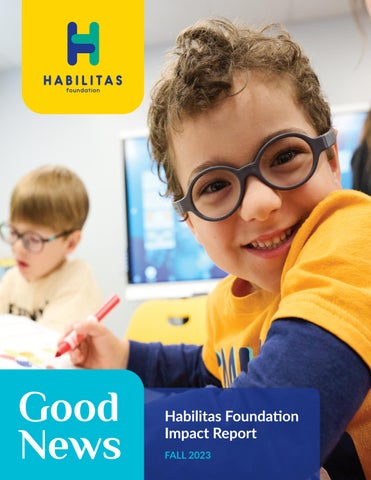
Good News
Habilitas Foundation Impact Report FALL 2023
Letter from our Chair & Executive Director THEODORA BRINCKMAN EXECUTIVE DIRECTOR
KIPPY WIEGAND, CHAIR, BOARD OF DIRECTORS
Dear Friend, We hope this message finds you in good health and high spirits. As we do each fall, it is once again our pleasure to share with you our annual Impact Report, a brief but inspiring overview of the life-changing work happening across our partner organizations. Habilitas Foundation’s mission has always been to empower positive change in the physical disability space by working alongside dedicated partners. We are proud to be the official foundation for the Action Centre, Camp Massawippi, the Lethbridge-Layton-Mackay Rehabilitation Centre (formerly MAB-Mackay and Constance Lethbridge centres), and the Quebec Federation of the Blind.
To our partners, we extend our deepest gratitude for their innovative ideas, and the passion they bring to our shared mission. To you, the donor, please know how profoundly grateful we are for the trust and generosity you continue to show. Your steadfast belief in our mission has allowed us to expand our reach, support vital initiatives, and touch the lives of countless people young and old. On behalf of the Habilitas Foundation staff, and of our Board of Directors, our heartfelt gratitude, Sincerely,
We are equally gratified by our long-standing partnership with the English School Board of Greater Montreal’s (EMSB) Philip E. Layton and Mackay Centre schools. As both a fundraising and granting foundation, we are in the privileged position of being able to work directly with donors, helping them make a tangible difference in the areas most meaningful to them, as well as with those on the front lines, providing the services, programs and resources that so deeply impact clients and members. Being able to watch this philanthropic cycle play out in full, in real time, is a gift in itself. We hope the stories in this report allow you to share in this experience. Of course, none of this would be possible without the generosity of donors like you. Thanks to the contributions of individuals, foundations, and corporations, together we have achieved incredible things. As they say, it takes a village, and we recognize that it is only through collaboration, trust, and mutual respect that we can create lasting impact.
2
IMPACT REPORT 2023
Want to get in touch? Habilitas Foundation 7010 Sherbrooke St. West Montreal, QC H4B 1R3 info@habilitas.ca Learn more about our work at habilitas.ca
Norm
Using his voice to empower others Voice banking is a unique and increasingly popular tool used by people with speech disabilities, or whose capacity to speak is expected to degenerate due to a medical condition. The procedure, whereby individuals record a selection of standard and personalized phrases, allows for the creation of a synthetic voice. This synthetic replica of their voice is then loaded into a special device that is then used to communicate by pressing just a few simple buttons. By being able to express themselves in their own voice, the speaker maintains an increased sense of identity and the capacity to express themselves more authentically. For their loved ones, the intimacy of hearing the familiar voice helps maintain a deeper emotional connection. Available through the Lethbridge-Layton-Mackay Rehabilitation Centre, this continuously evolving technology has had a special impact on one family in particular… Norm’s decision to bank his voice at the age of 53 following an ALS diagnosis was one that would turn out to be particularly meaningful. A couple of years later, he upgraded his synthetic voice based on the latest technology, just in time for his daughter’s wedding.
For clients affected by neurodegenerative diseases, voice banking is a game changer. It allows them to hold on to a key aspect of their identity - their own unique voice. Funding for voice banking is very limited in Quebec, but together with help from the Habilitas Foundation, we are working to make it more widely available for those who would benefit from it.
Years after he originally recorded his voice, Norm’s capacity to speak for long periods, particularly at full volume and with clarity, was waning. By using the bank of words he had previously recorded, Norm was able to speak his hopes and wishes to his daughter and wedding guests in a way that reflected his warmth and personality. He was also able to read a special passage by poet Khalil Gibran – the very same one that was read at his wedding years before, to all in attendance. Special moments, large and small, are what make up the story of our lives, and Norm and his family are grateful for the voice banking services offered through Habilitas Foundation partner, the Lethbridge-Layton-Mackay Rehabilitation Centre. A former international development worker, and impassioned advocate for those seeking to change their lives for the better, Norm has long been using his voice in support of grass-roots empowerment and bottom-up change. Now, living with ALS, he continues to use his voice in service of others, including the extended ALS community. With all that he has to say however, Norm explains that the most precious phrases he has in his collection are of him saying ‘I love you’ along with the names of his wife and children. For him, there is the comfort of knowing that even when his capacity for speech has faded, he will continue to be able to communicate this most fundamental of feelings to those he loves most.
Watch Norm’s 2019 TedX talk Norman MacIsaac: Surthriving with ALS. A bottomup approach to ALS advocacy.
- OLIVIER LAMALICE-AQUIN SPEECH-LANGUAGE PATHOLOGIST
habilitas.ca
3
Camp Massawippi was just the start for
LiliJeanne
There are moments that change the course of our lives without us even knowing it. For Lili-Jeanne, arriving at Camp Massawippi at the age of 14 was one of those moments – though she didn’t know it then. Lili-Jeanne went from being a visitor at Camp, to being a camper, a volunteer, and as of the last few years, a member of staff. As a child, Lili-Jeanne was diagnosed with juvenile polyarticular rheumatoid arthritis, a severe form of pediatric arthritis that affects five or more joints. Because of her physical limitations, Lili-Jeanne’s environment and routines had to be modified to make everyday life more manageable. The same was true for her extracurriculars, including summer camp. Despite her initial trepidation about leaving the security of home for a full week, Lili-Jeanne’s emotional reaction to Camp, which sits on 19 acres along the shores of Lake Massawippi, was immediate. She recalls feeling “an instant connection to the place”, a connection that is now 8 years strong, and counting. To most, Camp Massawippi is more than a camp. It’s a home-away-from-home conceived of and run entirely with its population in mind. Every aspect of Camp is tailored for ease of use and camper success; sleeping quarters, the dining hall, waterfront
4
IMPACT REPORT 2023
activities, sports. Camp Massawippi is a magical place where the seemingly impossible becomes possible, and campers, who spend most of their year adapting to the world around them, can move, and play, and explore in greater comfort, and with a strong sense of belonging in spaces adapted to them. Lili-Jeanne explains that her years as a camper, with all the collective experiences, shared adventures, and mutual support they offered, were transformative. At Camp Massawippi, where being different is the norm, she learned to embrace and celebrate uniqueness, in herself and in others. In recent years, as a member of staff, Lili-Jeanne has been in the position to be able to spread that message of self-acceptance and possibility among campers and staff alike. Today, Lili-Jeanne is officially in remission and has her sights set on an international backpacking trip. She also has ambitions of one day running for political office, and integrating her personal experience with physical disability into her work. Giving back is very important to Lili-Jeanne, and seeing how proper accessibility and inclusion, the likes of which she experienced at Massawippi, changes lives, has left its mark. Looking back on her hesitance all those years ago, Lili-Jeanne doesn’t “regret having gathered [her] courage in both hands”. When asked, she says her advice to first-time would-be campers would be to make the most of this unique experience, and “most importantly, always be yourself.”
1%
With experience and compassion, Habilitas Foundation partner organizations transform donor generosity into tangible and meaningful support for people living with physical disabilities and sensory impairments. The inspirational stories featured in this year’s Impact Report are made possible thanks to the support from the individuals, foundations, and corporations we have the privilege of working with.
Mackay Centre & Philip E. Layton Schools
4%
0.7%
Constance-Lethbridge
76%
MAB-Mackay
Action Centre
19% Camp Massawippi
Your Generosity at Work
Leave a Legacy When her mother passed, Joan knew she wanted to honour her memory in a meaningful way. There are many ways Joan might have supported her chosen cause, but what made the most sense for her was to leave a gift in her will. She opted to support the MAB-Mackay, an organization that she says was amazingly supportive of her mother in the later years of her life.
Meet Joan and hear about why she chose to include charitable giving in her estate planning.
Gifts of pre-determined support like Joan’s have lasting and sustainable impact. If you are interested in learning more about legacy giving, please reach out to Sean Zikman at sean.zikman@habilitas.ca or (514) 488-0043 ext. 1410 for a confidential conversation.
Today’s planning. Tomorrow’s impact. habilitas.ca
5
Acquired vision loss isn’t stopping
Anoushka
Anoushka is fifteen years old and has one of the most infectious smiles you’ve ever seen. When she speaks, her words dance with a hint of laughter. From the moment you meet her, you just know you’re in good company. Like many girls her age, Anoushka loves reading novels, dancing, and singing. For as long as she can recall, she dreamed of becoming an actor or artist. Unlike many girls her age, she’s spent the greater part of her young life on the move and precariously housed. And as of recently, she is also completely blind. Anoushka was born in the Democratic Republic of Congo, a beautiful but troubled area, which eventually resulted in her family being forced to flee to Botswana. Upon arrival, they were housed in an asylum-seeker prison where they lived for two years, until being granted refugee status, and moved to a camp. During this time, Anoushka was diagnosed with a brain tumor, and within three short months lost her vision completely. While Anoushka and her family tried to maintain a positive outlook, their refugee status and lack of resources meant surgery wasn’t an option. Eventually the tumor worsened, causing Anoushka to become paralyzed and fall into a coma. At long last, in December 2021, the Canadian government extended assistance and brought Anoushka and her family to Canada, where she underwent successful surgery at the Sainte-Justine Hospital. Anoushka then began working with specialists at the MAB-Mackay, where she learned compensatory life skills for her vision loss. In addition to learning how to walk using a white cane, Anoushka received assistance with applications on her smartphone and computer (such as screen readers and voice commands), which help her communicate effectively and plan her outings. With these skills and tools, Anoushka is able to maintain her independence and engage with the world in ways best suited to her needs.
6
IMPACT REPORT 2023
The team at MAB-Mackay has expanded the possible, and given me the tools to pursue my dreams.
She’s also mastered kitchen skills and the use of appliances so she can prepare herself a quick breakfast safely, as well as the ability to identify money so she doesn’t have to rely on others. Step by step, skill by skill, Anoushka is moving toward an ever-increasingly autonomous life. It’s an on-going process, but one that she feels confident about achieving with the help from her MAB-Mackay team. Meeting Anoushka now, still shy of 18 months into her journey with MAB-Mackay, one is struck not only by how confident and self-assured she is, but by how genuinely joyful she seems to be. When asked about her seemingly boundless optimism, Anoushka explains that support from the staff of the MAB-Mackay has revitalized her, and has allowed her to do things she never thought she would be able to after losing her vision.
To others starting on a similar journey, Anoushka shares that while it’s natural to feel sad after losing something as significant as one’s sight, that it’s important not to give up on one’s dreams. In her own words,
“even if the approach needs to change, you can still pursue your passions.” Last year, the MAB-Mackay helped more than 1,300 people who are blind or have visual impairments. Many of its essential services are made possible through donor support, including the low vision clinic, Day Centre for seniors, the technical aids boutique, Braille Production, as well as the optician and orientation & mobility specialists, among others.
habilitas.ca
7
Jazmine
A young poet’s perspective on hearing lost and recovered
In mid-February of this year, a then 21-year-old multi-instrumental musician, choral singer, and university student named Jazmine woke up to near silence. Since that day, her life has been a rollercoaster of emotions and steep learning curves, but also one of important victories. Losing her hearing abruptly was a life-altering experience. In the midst of a global pandemic, separated from the majority of her support networks, she initially reacted with anger. Since then, with time and the support of her loved ones and therapists, Jazmine has moved swiftly from fear and uncertainty to determined optimism, in large part thanks to her cochlear implant. Until this past spring, the only option for cochlear implantation in the province was in Quebec City. The process was multi-step and required several days-long visits. Possible for some, but certainly difficult and inconvenient, even under the best of circumstances for most. As luck would have it, this March Jazmine became the first person in Quebec to undergo the sophisticated and life-changing surgery right here in Montreal. Now, just months later, the young teacher, author, and music enthusiast is back on her game. It’s hard to imagine ricocheting from relative normalcy, to medical uncertainty, to rehabilitation within just a few months, so in May, the Habilitas Foundation sat down with Jazmine to learn about her journey and experiences with hearing loss and recovery.
A cochlear implant consists of a small electronic device that is surgically implanted just behind the ear. It effectively bypasses damaged or inactive portions of the ear and directly stimulates the auditory nerve.
Jazmine shared with us her love for music, the joy it brings her, and the immense grief the prospect of living without it brought up. She also spoke of how the sudden change forced her to drop out of her Master’s program, and about how disappointed she was not to be able to finish her studies on time as planned.
This technology provides reliable access to sound for people who are profoundly deaf or severely hard-of-hearing, allowing them the opportunity to participate more fully in society and enjoy an enhanced quality of life.
She spoke of how, like most ailments, it impacted not only her, but those around her. About how her sadness and fear became her loved ones’ anger, and about how the healing journey was not just hers, but everyone’s.
8
IMPACT REPORT 2023
But she also shared with us the stories and poems she’s since written, and about how as a teacher she now feels well-placed to help her typically-abled students become more empathetic, and her disabled students feel more supported and safe. Jazmine is infinitely grateful for the second lease on life her cochlear implant has given her, and for the therapy and emotional support she’s received from her team of therapists at the MAB-Mackay. In the past months since losing and regaining her hearing, Jazmine has made sure to surround herself with the support and tools necessary to move forward with confidence. She continues to work with speech therapists and audiologists at MABMackay, re-training her brain to recognize and emulate sounds. Jazmine is also learning how to best ask for and receive support when out in the world. How to confidently request that people please speak more slowly, or that they not cover their face and mouth when speaking with her. During our conversation, Jazmine shared how her rehabilitation has had to go farther than just the physical and sensory. While she trains her body to do what it needs to in order to hear and communicate effectively, she’s also working on feeling beautiful and making peace with the new and unfamiliar accessory that sits behind her right ear. She’s getting to know this new version of herself, and these days is focusing on writing music and creating poetry from the sounds she hears in the world.
In a poetic turn of events, her first book of poetry Now that I’m Older was published on the same day she had her cochlear implant surgery. She also currently has two other collections in publishing, and a fantasy Young Adult series in the works.
Jazmine has big dreams for herself, and is quick to point out how the training and self-confidence she’s received through MAB-Mackay has been instrumental in her being able to pursue them.
Before wrapping up our chat, we asked Jazmine if she remembered the first song she listened to after her cochlear implant was installed. After a beat, and through a sheepish grin she replied Boston’s More Than a Feeling. That feels like an appropriate choice.
Listen Here
Each year, the MAB-Mackay helps more than 1,000 people like Jazmine who are Deaf or have hearing impairments. Many of its services are made possible through donor support, including the ultra-specialized cochlear implant program, American Sign Language instruction, and assistive technology services, among others.
habilitas.ca
9
Meet
Margot Twenty-five years ago, the parents of identical twins Margot and Anik faced a challenging situation. Thirty-four weeks into the pregnancy, one of the babies' hearts started slowing down, prompting their mother Bryceidee to undergo an emergency C-section. After delivery, it was discovered that throughout the ordeal one of babies had experienced significant oxygen deprivation. It would be some time before the family would come to understand exactly what that would mean. During the first few months of the babies’ lives, it become clear that the twins were developing differently. Whereas Anik was meeting all her typical milestones, Margot, who had experienced oxygen deprivation, was not. Grasping, sitting, and babbling were all proving very difficult. By age two, the family’s concerns were significant enough to lead them to have Margot evaluated. The diagnosis was clear: cerebral palsy with spastic quadriplegia and left hemiplegia. Essentially, this meant that the damage from the oxygen deficiency at birth was causing the delay in speech and would likely impact memory, as well as rigidity in the muscles on the left side. The doctors told Margot’s parents they would never be able to walk.
Early Years at MAB-Mackay Following the diagnosis, the family sought support from the MAB-Mackay, whose team immediately began working with young Margot. The approach was multi-pronged and included not only therapeutic and rehabilitative interventions, but also skill-building and education for the family so that they could actively participate in their child’s progress. This holistic approach is standard practice at the MAB-Mackay, and gives caregivers a greater sense of empowerment and control in uncertain and often destabilizing times.
At the MAB-Mackay Centre, the therapists were amazing. They celebrated each and every little achievement, which made me feel so supported and encouraged. They always motivated me to push myself and believe in what I could do. They saw my potential, and helped me see it too.
10
IMPACT REPORT 2023
School Years At age four Margot began schooling at the Mackay Centre School, and for the next nine years continued to make remarkable progress. By age 11, Margot was walking independently with the assistance of a walker, and was well on the way to dressing independently and using a computer. During this period, Margot participated in the school’s innovative therapeutic horseback riding program, often referred to as hippotherapy. Embracing their increasing strength and mobility to the maximum, Margot, who was displaying an obvious talent for adapted sport, decided to represent the school at annual Défi Sportif competitions. By age 17, they had won 3 gold and 2 bronze medals in the 60-meter bike race. Thanks to the unwavering support of their family and team of rehab specialists and teachers at school, Margot was systematically surpassing the expectations set by doctors. They were also maturing emotionally, building the confidence and sense of self necessary to live life to its fullest.
HIPPOTHERAPY Hippotherapy is horseback riding and horse interaction for rehabilitative and therapeutic purposes.
During a hippotherapy session, a specialized occupational therapist integrates movements and exercises specifically designed for the participant into the horseback riding session. The rhythmic and three-dimensional movements of the horse’s pelvis mimics those of a human’s, providing physical and sensory input and allowing the therapist to grade the degree of input to the rider. BENEFITS OF HIPPOTHERAPY Physical: Improves balance, coordination, body awareness, upper body and leg strength. Speech and Language: improves focus, attention to instructions, and language skills, including volume regulation, formation of simple sentences, and breath support for speech.
Meet an enthusiastic mom!
Psycho-social: positively impacts self-esteem, self-confidence, interpersonal skills, attention, concentration, autonomy, and initiative. Habilitas foundation is proud to fund this and other adapted sports initiatives.
habilitas.ca
11
Growing Together Through Life’s Transitions Adolescence; a time when youth start grappling with their identity, their understanding of the world, and with their place within it. It’s a rough few years for anyone, but this phase of life has added layers of complexity for people living with disabilities. This is particularly true for those who age out of school, but are not yet ready or able to participate in higher education or professional life. This in-between phase leaves those affected with limited options for socializing, particularly with other young adults in similar situations, Margot was no exception. Thankfully, Margot was able to join TranXition, a pioneering program funded by Habilitas Foundation through the immense generosity of the Pathy Family Foundation. TranXition understands the particular challenges and needs of this cohort and caters directly to it. By bringing youth together with their peers in a supported environment the program provides participants with the social and emotional skills to navigate social dynamics with greater ease, and sets the stage for meaningful and often candid conversations among peers about life skills, hygiene, romantic relationships, and dreams for the future. It also facilities outings and other skill-building social events and activities that Margot credits for their poised and easy manner.
Being part of a supportive community that understood and embraced me as I was, gave me a strong sense of belonging and self- acceptance.
12
IMPACT REPORT 2023
Participating in different therapies that were designed specifically for my needs and goals made a big difference. The therapists at the centre were really committed and they taught me how to have better control over my body and work with my physical challenges. As I mastered those techniques, I started feeling more and more confident and better about myself.
Next Steps Margot is on a mission - that much is clear. Deeply self-confident and incredibly well spoken, Margot is mapping out their future with confidence. While recently asked to join the Quebec boccia team, Margot has opted to take some time to further hone their skills, and then try out for Team Canada in a year or two. In the meantime, Margot is keeping active with swimming and power-wheelchair soccer and is looking forward to revisiting their volunteer work. Having themselves benefited from the positive support and encouragement of others, most
notably fellow athletes and their coach, Margot hopes to one day serve as a mentor and role model for others in similar situations, and is committed to “becoming that encouraging someone to someone else”. Margot’s journey is theirs alone, but the challenges they faced are shared by many. Habilitas Foundation is incredibly grateful to the donors who support the MAB-Mackay, the Mackay Centre School, TranXition, and the myriad programs and services that have accompanied Margot throughout their life. Your generosity has made all the difference.
habilitas.ca
13
Gordon The Importance of Community
There are things we can prepare for in life, and then there are things we cannot possibly see coming. In 2009, while vacationing in Mexico, Gordon, then 56, suffered a stroke that would forever change his life. Newly retired from a career performing maintenance for Air Canada, Gordon was primed to spend the next phase of his life focusing on his favourite things; swimming, sailing, and his family – in particular his two granddaughters. Then, following significant trauma from the stroke, Gordon was diagnosed with hemiplegia, a condition that would leave his left leg, arm, and hand paralyzed, and which caused permanent blindness in his left eye. Clearly his plans for the future would need to be reset. Without a doubt his new reality impacted every part of his life, which is why he says he is so thankful for the Action Centre, a unique day centre for adults with physical disabilities. The Action Centre offers a variety of activities and recreational programming including art, language, cooking and computer classes that are all designed to help mitigate participant isolation and support them realizing their full potential. Despite the wide array of activities, it’s the sense of community and belonging that Gordon values most.
Hear Gordon share his thoughts on the Action Centre. Scan here for a short video. EXCITING NEWS! The Action Centre recently moved and is now located in VSL in a brand new and completely renovated space. The new location is over 11,000 square feet and includes a games room, computer lab, classrooms and more. Scan here for a tour.
At first, Gordon was unsettled by his new reality of living life in a wheelchair, but he says that spending time with others in similar situations helped him transition into his new life. Having previously been very active, the day trips and outings (trips to the museum, bowling, and BBQs in the park) organized by the Action Centre provide Gordon with the physical and social experiences he missed and that were unavailable to him prior to joining. A longtime fan of water and water-based sports, he particularly enjoys the swimming and adapted sailing outings. Gordon is enthusiastic in his praise of the Action Centre, saying that the good energy and camaraderie at the Action Centre there are contagious. “Don’t be afraid to come on down! We’re a welcoming bunch, and no one gets turned away.” Donor support helps to sustain the Action Centre and its exceptional programming that stimulates the mind and soul for so many in Montreal living with physical disabilities.
I don’t stand out at the Action Centre. People don’t ask ‘will you be normal again? I feel accepted.
14
IMPACT REPORT 2023
Eytan
is Making Great Strides
In a world filled with uncertainties, Eytan’s is a story of determination and triumph. A sweet boy with an infectious personality and an unyielding love for life, Eytan’s journey is a testament to the transformative impact of early intervention and wide-ranging support. According to his mother, from the moment he entered the world, Eytan was a force to be reckoned with. Social and vibrant, he possessed an innate curiosity that fueled his desire to be part of everything around him. Despite his good nature and enthusiasm, Eytan’s path was not without challenges. Diagnosed as an infant with global developmental delay, the usual milestones of crawling, sitting, and walking seemed distant as he struggled to reach them. At 18 months old, an MRI revealed the presence of polymicrogyria, a condition characterized by abnormal development of the brain before birth that would affect his speech, balance, and motor skills.
ITP is a therapeutic approach that incorporates treadmill and suspension systems to target gross motor skills, balance, visual motor integration, as well as speech and language abilities.
Despite the shock, Eytan’s family approached the news with unwavering resolve. They knew that the journey would be difficult, and were committed to providing him with the tools needed to thrive. These tools were found at the MAB-Mackay, where Eytan has been working, since the age of two, with speech, motor, physio and occupational therapists. The Mackay Centre School where Eytan is currently enrolled, is a haven of support and understanding, and plays a pivotal role in his day-to-day growth. The love and assistance he receives there also lightens the load for his family, allowing them to focus on the more emotional and interpersonal aspects of his growth and development. A key component of Eytan’s progress is a novel therapy approach. The Interdisciplinary Treadmill Program or ITP, has proven transformational for him. Major improvements were seen within the first ten weeks, and thanks to well-tailored therapy plans, and the capacity to personalize the exercises on the machine, this sort of accelerated advancement is not uncommon. Eytan’s therapists say that the advancements in his speech and coordination have been incredible, not to mention the improvement in his self-confidence and social skills. Eytan’s family is grateful for the opportunities and support their son has received at both the MAB-Mackay, and the Mackay Centre School. As Eytan’s capacity to inhabit his body and the world continues to expand, so too does his family’s vision of a full and fulfilling life for their son.
habilitas.ca
15
Major Projects
Thanks to your support Habilitas Foundation has been able to make amazing things happen. Below are some of the recent major projects and purchases made possible by donor generosity:
• Fully inclusive playground for the children of the Mackay Centre and Philip E. Layton schools (to be launched Spring 2024) • Newly relocated and fully renovated Action Centre (see page 14) • Paediatric Low Vision Clinic, Lethbridge-Layton-Mackay Rehabilitation Centre, MAB site • Integrated Training Classroom for hands-on pre-academic preparation, Lethbridge-Layton-Mackay Rehabilitation Centre, MAB site • Fully renovated Dining Hall, Camp Massawippi, complete with specialized food prep stations for tube feeding. • New generator, to ensure continuity of service and security for all and specifically for those with electricity-dependant medical devices, Camp Massawippi
Research
• Major updates to the Early Intervention Clinic, including the sensory pathway, Lethbridge-Layton-Mackay Rehabilitation Centre, Mackay site • Acquisition of Immersion 360, a new state-of-the-art technology used for audiology evaluation as well as Orientation and Mobility training for the visually impaired, Lethbridge-Layton-Mackay Rehabilitation Centre, Mackay site • Expansion of the Toys Like Me collection, Mackay Centre and Philip E. Layton schools • Purchase of a Nustep machine for physical activity and endurance in children with limited mobility, Mackay Centre and Philip E. Layton schools • Purchase of augmentative communication tools and technology, Mackay Centre and Philip E. Layton schools
The Research Team at Layton-Lethbridge-Mackay Rehabilitation Centre spearheads research and forms partnerships with other leaders in the physical disability space. Areas funded by the Habilitas Foundation include technological solutions and aids, medical interventions and therapies, and more.
Habilitas Foundation donors have helped: • Lower barriers and increase access for research assistants requiring additional support or accommodation through the supported hiring grant; • Install site-specific representatives tasked with, among others: – Supporting the clinical research coordinator; – Integrating best practice in the social participation and integration of people living with disabilities across LLMRC sites; – Tracking client satisfaction; – Implementing the most appropriate and effective therapy approaches and technologies; • Fund a study focused on evaluating the effectiveness of neuromuscular electrical stimulation for children with dysphagia • Fund Jooay, a free app that helps children with disabilities and their families locate nearby, accessible leisure opportunities suited to their needs and abilities • Fund the LLMRC’s membership with the Centre for Interdisciplinary Research in Rehabilitation of Greater Montreal (CRIR)
Follow us for stories of impact, partner updates, foundation announcements and more! @habilitas.fondation fondation-habilitas-foundation @habilitas4037