GOOD NEWS Habilitas Foundation Newsletter • Spring 2021
INSIDE How donor support helps to disable physical disabilities at:
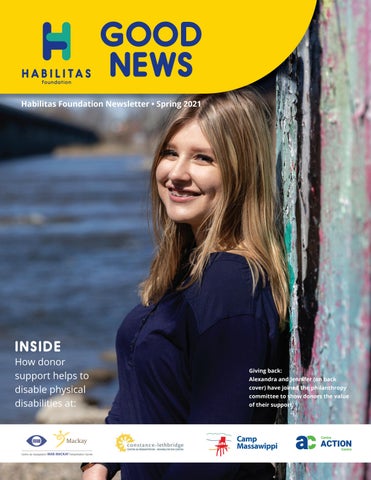
Giving back: Alexandra and Jennifer (on back cover) have joined the philanthropy committee to show donors the value of their support.
TABLE OF CONTENTS Welcome to the Foundation
3
A word from our Leadership
4
Staying active with the Day Centre
5
Summer magic is back!
6
Mackson finds his voice
7
Alexandra's story
8
Jennifer's story
9
Online connection breaks the isolation
10
Virtual wheelchair clinics: a real success!
11
Empowering people to live life without limits
12
Research internship for a visually impaired student
13
A Daughter’s Loving Tribute
14
Keeping visually impaired clients moving in the right direction
15
WHERE YOUR SUPPORT GOES
WELCOME TO THE HABILITAS FOUNDATION
The former MAB-Mackay, Constance-Lethbridge, Camp Massawippi and Action Centre foundations are now stronger together as Habilitas.
Habilitas is a Montreal-based foundation whose dream is to build a society where no one is left behind.
Your valued support makes a difference in so many ways. You empower people struggling with vision loss or blindness. You make life more inclusive for people who are Deaf or hard of hearing. You help people with mobility challenges to move. You give children a voice so they can play with their friends, succeed at school, and share with their families. You open the world up to all people living with physical disabilities, one opportunity at a time.
Our name, Habilitas, is Latin for “ability.” It represents our goal of giving a person the means to develop maximum independence in their daily living. Guided by our core values of impact, stewardship and love, we strive to provide a brighter future for people who are blind or visually impaired; deaf or hard of hearing; living with a motor impairment or mobility challenges; or with communication disorders – of all ages, lifestyles and cultures, in their homes, schools, workplaces, and leisure environments.
It continues to be our privilege to give donors the opportunity to make good things happen. The stories in the pages that follow show how the compassionate and generous support of donors change the lives of real people, giving them hope and opportunities for a brighter future. Thank you for your truly valuable support and for touching the lives of so many. MAB-MACKAY SITES.............................................64 % CAMP MASSWIPPI..................................................23 %
This is achieved through the funding of important programs and services at the Lethbridge-Layton-Mackay Rehabilitation Centre (representing the former MAB-Mackay and Constance-Lethbridge rehabilitation centres); Camp Massawippi; the Action Centre, the Mackay Centre and Philip E. Layton schools; and the Quebec Federation for the Blind. We are proud to celebrate the heritage of these organizations, their rich history, and all the exemplary work they do.
THE JOURNEY TO HABILITAS The Mackay Centre is created to support Deaf children.
The Mackay Centre expands its services to include children living with physical impairments.
The Mackay Centre Foundation is founded to help Deaf and physically impaired children.
The ConstanceLethbridge Foundation is founded to enhance services for adults with motor impairments.
The MAB-Mackay Foundation is formed from the merger of the Mackay and MAB Foundations.
The MABMackay and ConstanceLethbridge foundations merge.
Action Centre joins the Habilitas family of partners
RESEARCH .....................................................................7 %
CONTACT US 7010 Sherbrooke Street West Montreal QC H4B 1R3 (514) 488-0043 info@habilitas.ca habilitas.ca
ACTION CENTRE ......................................................4 % SPECIALIZED SCHOOLS .......................................1 %
1908
CONSTANCE-LETHBRIDGE SITE ....................1 %
1937
1869
1916
The Montreal Association for the Blind (MAB) is founded by Philip E. Layton as a social club, Braille lending library, and sheltered workshop.
ConstanceLethbridge Rehabilitation Centre is created to support adults with motor impairments.
1951 1940
1978 1969
2015 2007
2019 2016
2019
Follow us on:
2 | Spring 2021 Newsletter
Mackay Centre Camp for Deaf and Crippled Children (later known as Camp Massawippi) opens for its first summer.
The Montreal Association for the Blind (MAB) Foundation is founded to help those of all ages living with vision impairment.
The Alexandre Bilodeau Fund for Adapted Sports is launched to promote physical activity for children with disabilities
Creation of H a b i l i t a s , allowing us to expand our reach and have an even greater impact in the field of physical rehabilitation.
habilitas.ca | 3
STAYING ACTIVE WITH THE DAY CENTRE
A WORD FROM OUR LEADERSHIP Carlos is so grateful for the renewed hope and purpose he gained since he first began attending the Day Centre at the MAB-Mackay four years ago. His plans to enjoy his golden years were derailed when he began to lose his eyesight. Despite his doctors’ efforts, there was nothing more that could be done to save his vision. This left him feeling alone, helpless, and scared. This is a love letter. Our worlds have shifted seismically - so much so that it is often hard to recognize what is normal anymore. That “mask couture” would become a thing; that we would instinctively dash out into the street to avoid being too close to a person passing us on the sidewalk; that a social media post of us receiving the vaccine is THE highlight; that respecting a curfew is accepted as part of our new life; or that the vulnerable among us are even more so than ever before. So many changes, and yet... As we continue to live through unprecedented times, a constant is your continued incredible generosity and compassion that comforts and sustains us, as we adapt to even better serve the clients at the Lethbridge-Layton-Mackay Rehabilitation Centre, the campers at Camp Massawippi, and the members of the Action Centre. The ingenuity, commitment, and perseverance of the health care professionals in our partner organizations are humbling. They have all pivoted to ensure that service and care continue even when they might not be able to do so in person. They continue to bring humour, compassion, and care even when separated by a computer screen, a plexiglass barrier, or PPE. They are even closer emotionally than ever to those they treat.
4 | Spring 2021 Newsletter
You, our supporters, fill us with tremendous gratitude, and we are buoyed by how our community pulls together to help each other. Even in the darkest of days, empathy and generosity will prevail, lightening our spirits and lifting us up, bringing positive change and meaningful impacts. None of this happens by chance. It comes from within each of you and us; the kindness, caring and shared belief that together we can make better things happen. Please delve into the stories in this newsletter and learn what you have made possible. It was not easy to choose from so many stories, and we hope that those that we feature will offer you a moment of optimism and a faith that all will indeed be okay, and that even more than before, together we make a difference to those who need us. Together, we will keep finding hope. Thank you for every action you take to bring goodness into someone else’s life.
Kippy Wiegand Chair, Habilitas Foundation
Theodora Brinckman, Executive Director, Habilitas Foundation
The MAB-Mackay stepped in, helping Carlos maintain his independence and quality of life. He also joined a weekly group at the Day Centre, and found that being around others who understood his situation made him feel more connected. His time at the Day Centre quickly became the highlight of his week. First launched 25 years ago, the Day Centre program helps seniors who are coping with the struggles and isolation brought about by their vision loss. Participants attend once a week for a day of activities and programming, including vision rehab follow-up, technical aids training, exercise, cognitive stimulation, and peer support.
“It’s about getting them up and active,” says Dana. “We’ve found that they walk less and are having difficulty doing many of their usual things at home. Our kinesiologist created activities to get them up and moving, to prevent them from going downhill and losing their abilities.” For Carlos, his sessions with the kinesiologist have helped him learn new exercises to stay active, and have also created a welcome break from the isolation. Donor support has helped the Day Centre make many crucial adjustments during the last year possible. “The experience of the pandemic showed us just how valuable our program is in the lives of our members,” says Dana. “We can’t wait until we’re able to open up our doors again, and welcome everyone back!”
The pandemic put an abrupt stop to this beloved in-person program. “Many of our members haven’t left their homes since March of last year,” explains Dana Benoit, manager of the Day Centre. “As they’re unable to come to our centre, we’ve instituted conference calls to ensure outreach, exchange and discussion. In fact, 95% of our members participate in these calls, which is much higher than the usual participation rate.” While these calls have proven successful, the Day Centre staff discovered that many of the seniors had experienced a deterioration of physical capacity. In response, a kinesiologist (a specialist in physical exercise and flexibility of the body) joined the team, working with those more vulnerable seniors in one-on-one sessions at the centre or in their homes, while respecting the necessary sanitary measures.
Carlos with the Day Centre’s kinesiologist Eric.
habilitas.ca | 5
SUMMER MAGIC IS BACK!
Camp Massawippi
With the green light from Quebec public health, Camp Massawippi is pleased to announce that it will once more welcome campers for overnight respite camps this summer. Families of vulnerable youth with physical challenges welcome this news, as many have been confined since March 2020. The camp will operate at a significantly reduced capacity, offering a oneto-one ratio to ensure that all health and safety measures are followed.
Revitalizing the Dining Hall will realize many important updates while preserving the magic of the past. Among the enhancements are improved accessibility for mobility-challenged campers, a new accessible deck overlooking the lake, the creation of a life skills learning kitchen, modernized accessible washrooms, improved accessibility and circulation for campers in wheelchairs, and additional space for social distancing.
Carolina was among the first campers to register for summer 2021. She deeply missed her time at camp last year, and enthusiastically participated in the virtual programming the camp offered to break the isolation.
As Camp embarks on this new and exciting chapter, it will be led by Clea Corman, the new executive director. “I’m very excited be part of this new era of Camp Massawippi’s extraordinary history,” says Clea. “We simply could not offer this amazing experience to our campers without the donors and the Habilitas Foundation. They make the magic possible!”
As the camp celebrates its 70th year in the face of the pandemic, it looks to the future with great purpose and vision. Consistent with its mission to provide its services for generations to come, Camp recently embarked on a capital campaign to restore and modernize its central structure – the dining hall.
For more information about Camp Massawippi, please visit www.campmassawippi.com
Considered to be the heart of Camp Massawippi, the dining hall is where the magic of camp truly comes alive, where the entire camp family gathers three times a day to fill their appetite for laughter, camaraderie, story-sharing, to play bingo, dance or sing karaoke, and of course, to eat. For Carolina, the dining hall holds a special place. She’s able to feed herself, but requires an adapted spoon and a specially-shaped plate so she can scoop her food. She can’t cut by herself and needs someone by her side. Her counsellors put a basket under her plate to provide her with proper posture while eating. These accommodations help Carolina function with dignity and allow her to enjoy the excitement and activity during mealtime. Many other campers require assistance to be fed, must have their food pureed, or have a feeding tube inserted.
Carolina's favourite activity at camp is adapted water skiing.
MACKSON FINDS HIS VOICE Mackson’s parents first noticed their son’s communication disorder when he was in daycare. All the other children around him were speaking, but Mackson wasn’t saying a word. “I would often hear kids asking their parents what’s wrong with him, or why does he speak like that,” remembers Nicole. “I used to feel a pang in my heart, not for myself, but through fear of his happiness. I wondered how he would make it in the real world. We’ll forever be indebted to his speech therapists at MAB-Mackay. All the positive reinforcement and assurances that Mackson will do great in life, made us feel at ease.”
"Mackson went from a little boy who no one could understand, to a young kid who won’t stop talking! What an incredible gift!"
Rania worked for many years with Mackson, and gave his parents lots of tips to practice at home. She also introduced Alternative and Augmentative Communication strategies (such as gestures and sign language) and aids (picture symbols, computers and voice-output communication devices) to support his learning. “The payoff is when they’re finally understood when talking about anything from basic needs – to express if they’re hungry or feeling sick, to how to play their favorite game, or to explain what they learned in school ," says Rania. Nicole is so grateful for the progress her son has made: “Mackay Centre School is an absolute treasure of a place.” Each year, the MAB-Mackay serves approximately 450 children with communication disorders, both in the community and the adapted school. To learn more about Mackay Centre School, visit the Habilitas website at www.habilitas.ca.
Mackson has Childhood Apraxia of Speech, a disorder in which the brain has difficulty coordinating the oral movements needed to create the sounds necessary for speech. While he can understand language and has many thoughts to communicate, he has difficulty planning the movement sequences required for speech. Since he was four years old, his parents took him two or three times a week for speech therapy at the MAB-Mackay. As the age of kindergarten approached, Mackson was accepted at Mackay Centre School, which serves the educational and rehabilitation needs of children with physical disabilities who can benefit from special support not available in a mainstream elementary school. Rania has been Mackson’s Speech-Language Pathologist since he entered the school. “He runs, plays, dances and looks like any typical child,” explains Rania. “This condition is a ‘hidden disability’ that greatly impacts the social, emotional and academic aspects of life for children like Mackson.”
Mackson in his classroom at Mackay Centre School
habilitas.ca | 7
ALEXANDRA'S STORY
JENNIFER'S STORY
Philanthropy and giving back take many forms. Habilitas Foundation is very proud to have the involvement of two dynamic young women whose lives have been touched by donor support. Here are their stories. Alexandra creating another post on social media
My name is Alexandra and I have cerebral palsy. I'm currently studying media and cinema at CEGEP, and I enjoy music, spirituality and crystals, and jewellery. I'm very invested in social media, which I’ll tell you about soon. When I was very young, I didn't realize the impact cerebral palsy would have on my life. As I became a teenager and wanted to do things on my own, I realized how much I would actually need to adapt my everyday life. Learning how to cook, taking care of myself in terms of hygiene – even doing my own hairstyle – were very difficult. When I was very young, I didn't realize the impact cerebral palsy would have on my life. As I became a teenager and wanted to do things on my own, I realized how much I would actually need to adapt my everyday life. I never wanted to rely on others, but I often had to ask for help. Learning how to cook, taking care of myself in terms of hygiene – even doing my own hairstyle – were very difficult. Cutting food is something I still struggle with to this day, and I continue to try to adapt as best as I can. Knowing how difficult it is feeling alone, I've always wanted to help others to feel accepted. About a year ago I created a TikTok account to spread awareness about what it’s like to live with my condition. I honestly didn’t expect to reach so many people! I have almost 12,000 followers, mostly from 8 | Spring 2021 Newsletter
Jennifer with her family
Canada and the US, even from Australia and the UK. My videos have over a quarter of a million likes, and I continue to push out content almost daily. I feel really valued when I read feedback from others explaining how I’ve helped them. I’ve received some mean-spirited commentary, and that’s always hurtful. But the number of notes calling me courageous for speaking candidly about living with a disability reminds me why I do this. I’m proud to be involved with the Habilitas Foundation today. I was three when I first started going to the MAB-Mackay Centre. My mom told me how excited I was to go to there to “play” – I didn’t know this was actually rehabilitation!!! I remember when new toys became available to play with during my occupational and physiotherapy. A donor had provided those toys. I had no idea then, but in hindsight I recognize how powerful that was. From cooking classes, arts and crafts, Défi sportif, braces for my wrist, even checking my first bicycle to ensure it was set up correctly for me – these are all ways the Centre helped me. I’m happy to help the foundation produce content that shows how donors are not only impacting the lives of kids that have it harder than most, but are also making life brighter for their parents. Their generosity offers inspiration, hope and affirmations that people are good.
I recently started volunteering my time with the Habilitas Foundation. I felt it was time for me to give back, in appreciation for all the support I received from the MAB-Mackay – which made a real difference in my life. I have a condition known as Ushers Syndrome, which affects my hearing and vision. Except for wearing hearing aids since the age of three, I don’t remember it affecting me very much. It never stopped me from doing what all the other kids were doing, like cheerleading or waterskiing when I was young, or travelling to Australia alone when I was in university. I first heard of the MAB-Mackay when I moved into my first apartment. They installed a system of flashing lights that told me when the doorbell or phone rang, or if the smoke alarm went off. That was it. In the years that followed, I didn’t really pay a lot of attention to the gradual changes in my sight and hearing. I found my own shortcuts and adapted my routine to things I was comfortable with. Over time, I started finding things a little more difficult. My sensitivity to light became greater, and I found it hard going to shopping malls or places that were very bright. My night vision was limited and I had little peripheral vision too. My eye specialist referred me to the MAB-Mackay, where they opened files with the hearing, mobility
and vision departments to update my services. I explained that by 7 pm, I’m usually exhausted because my eyes and ears have been working so hard throughout the day. They really understood my situation, and offered me training in skills to compensate, as well as little tools to make things easier and safer. I learned how to walk with a white cane and tricks to read street signs from a distance. They made sure my home was properly adapted for my low vison, and adjusted my workstation. The audiology department got involved as well, offering to assist me in exploring how a cochlear implant could enhance my access to sound. Everyone was so supportive, patient and helpful. They’ve helped me to be more confident and productive with my time at home and at work. Looking back, I wish I had sought the help of the MAB-Mackay earlier. I’ve always been a big believer in showing gratitude, an example I want my children to follow. This is why I started to get involved with the Habilitas Foundation, specifically on creating ways to show donors the impact of their gifts. I’ve even started calling some donors to thank them personally, which I really enjoy. I’m happy to share my story to show how their support helped to make my day-to-day life easier, so I can focus on what I can do – rather then what I can’t.
habilitas.ca | 9
ONLINE CONNECTION BREAKS THE ISOLATION It was heartbreaking for many of our clients, remember the therapists in the MAB-Mackay’s audiology department when asked about the changes of the past year. People who are Deaf or who live with a hearing impairment were among those most affected by the move to video interactions and mask-wearing, two solutions to curb the spread of the virus, but which further widened the chasm of communication challenges these people already face.
"Many people with hearing loss have found they’re actually on a level playing field now."
VIRTUAL WHEELCHAIR CLINICS: A REAL SUCCESS!
a noisy space, and the protective Plexiglas at the cash register further decreases the sound. Wearing masks not only distorts the sound, but eliminates the possibility of speech-reading. Conversely, teleconferencing technology like Zoom have helped in unexpected ways. “For the first time, many people who are hard of hearing can fully participate in family conversations, they feel less isolated. Everyone is getting used to taking turns, speaking one at a time, so our clients actually have the chance to interact more easily," says Kenneth Cooper, social worker in the program. "In addition to being able to lipread, some platforms also feature excellent captioning tools, making it even easier to follow the conversation.”
Audiologist Liliane Brunetti recalls one instance that particularly moved her. “We had one elderly gentleman who would visit his wife in her assisted living facility every day. He woke up on March 15th and was suddenly cut off from all contact with her. Although he has a cochlear implant, he was unable to communicate on the phone. For the next three months, he had no news at all from his wife. “Social isolation brought about concerns that she was deteriorating cognitively. By the time we were finally able to arrange a face-to-face video call for them with iPads, we worried that she may not even recognize him. While he was able to see her on the tablet, his wife didn’t understand that she could actually speak to him. She was given a telephone handset from an old phone, and they succeeded in speaking to each other again. The reunion was emotional for everyone involved.” The mask-wearing requirements and limitations of in-person contact have also affected people with hearing loss. Many of the strategies these individuals have worked so hard on don’t apply as a new set of barriers have arisen. Take for example a visit to the grocery store. It’s already 10 | Spring 2021 Newsletter
Connecting with clients through online video platforms
Although it will never replace the warmth of gathering with friends and family, the technology provides new opportunities to connect with others, especially for those with a hearing impairment. Each year, the MAB-Mackay helps more than 1,000 people who are Deaf or have hearing impairments. Many of its services are made possible through donor support, including the ultra-specialized cochlear implant program, American Sign Language instruction, and assistive technology services, among others
“I was so relieved when my upgraded wheelchair finally arrived,” reports Bernice. “Thanks to the amazing people at Constance-Lethbridge, I’ve regained much of my ability to get around by myself. I spend such a big part of my day in my chair, and it feels great to have my comfort and dignity back again.” Bernice lives in a long-term care facility for seniors, and she cherishes her independence. When she started to experience decreased strength in her legs and found herself losing balance, she was visited in her residence by specialists from the Constance-Lethbridge Rehabilitation Centre. They designed and delivered a customized wheelchair, which has given Bernice back a quality of life she thought she’d lost. The team returned routinely to adjust and update her chair, install a headrest and additional supports for her weaker leg. “Without my wheelchair, I’d be spending the whole day in my bed. Now I don’t have to depend on others to get about or to bring me things – I can do it on my own!” Each year, this special department provides thousands of mobility aids (including wheelchairs, walkers, positioning systems and orthotic braces) to people like Bernice. Each system is carefully built to fit the unique size, weight and needs of each patient. Since the pandemic hit, it was no longer safe for the team to enter the residences and rehabilitation hospitals. Recognizing the risks to people awaiting a wheelchair, mobility aid, or an adjustment to their systems, the team quickly developed a solution. A virtual clinic was proposed, which would allow the specialists to interact remotely with their clients and to coach the support staff in the residence on how to take the detailed measurements of the
An Occupational Therapist and Orthotic/Prosthetic Technician from the Constance-Lethbridge Centre connect via Zoom to a long-term care facility to custom-design a wheelchair for the client.
client. Using large-screen monitors and interactive software, the team is able to see the patient’s capacity to move their arms and legs, and to gather the information they require to create the best system for mobility and function. The technology was made possible through generous support of the Habilitas Foundation’s COVID-19 emergency fund last summer. The centre operates multiple clinics simultaneously, which cuts down significantly on the waiting time for a new wheelchair or to make repairs. More than 250 clinics have already been performed, which made it possible to prepare and deliver new wheelchairs and positioning systems to more than 800 people in need. The success achieved by this virtual clinic at Constance-Lethbridge is unique in Quebec. For more information on this program and how it truly enhances quality of life for people with disabilities, please check out the video on our website at www.habilitas.ca.
habilitas.ca | 11
EMPOWERING PEOPLE TO LIVE LIFE WITHOUT LIMITS
When Benita accepted the role of chair of the Action Centre last fall, she was eager to enact her bold vision for the Centre to be better known, to help more people, and to elevate the level of programming the organization offers. Born out of the Constance-Lethbridge Rehabilitation Centre (part of the Habilitas family) in 1998, the Action Centre is the only bilingual day centre serving adults with disabilities in Montreal. The Centre helps to keep its more than 170 members meaningfully engaged in the community, challenged and productive. More importantly, it offers them hope and pride while building self-reliance and dignity.
New chair Benita Goldin has a bold vision for the Action Centre’s future.
"I want every social worker, occupational therapist, physiotherapist, nurse, case manager, family doctor, and family caregiver to know about the Action Centre."
“My vision is clear – to make the Action Centre feel like a second home to our members,” explains Benita. When they have a patient or family member who meets our criteria, I want them to call us. For adults living with physical disabilities, having a place to learn, socialize, and connect with others with similar life experiences, is truly life-changing.” The Action Centre ensured that its members stayed connected during the pandemic through virtual programming that was meaningful and relevant. The team developed new content and offered 32 online sessions each week, which had a major impact on the isolation that members were feeling. They also used this time to enhance their active-learning and recreational activities for the return of in-person operations. “I’m honoured to have the opportunity to make a real difference for all who are part of the Action Centre family,” says Benita. To learn more about the Action Centre and the important role it plays in the lives of so many adults with disabilities, please visit the Habilitas website www.habilitas.ca
12 | Spring 2021 Newsletter
RESEARCH INTERNSHIP FOR A VISUALLY IMPAIRED STUDENT Behind the scenes of the therapies offered at our centre is a team that examines how helpful these therapies are. Researchers pull together detailed information to evaluate how effective the centre’s services are in enhancing the quality of life, the social participation, and the activities of daily living of clients. The Habilitas Foundation plays an important role in supporting many studies aimed at innovating and improving programs, which contributes to the centre’s reputation as a leader in the sector. "We’re constantly pushing to discover ways that haven’t been thought of before to improve clients’ lives,” explains Dr. Walter Wittich, Resident Researcher at the Lethbridge-Layton-Mackay for more than ten years. “We systematically evaluate outcomes in order to make them better, more efficient, and faster – essentially to see how we can do more of what we do in less time with the resources that we have. There’s nothing more exciting than seeing how we’re able to improve the existing services and help create new approaches." The team often engages research assistants to help compile and summarize information and to review academic literature. Allison Lee, herself a visually-impaired client and university student, joined Dr. Wittich’s group as a summer intern. “It was wonderful to have Allison be a part of this study, which was on how to improve services for people with visual impairments. Besides the research, we were able to give a chance to someone who would greatly benefit from the employment experience. Habilitas Foundation made this win-win possible.” Allison will return to the team again this summer. Moreover, another student will be hired this year to support a project on the development of a web site that provides information for people living with deaf-blindness. This quadra-lingual hub
Allison Lee worked on a study looking at ways to improve services for the visually impaired.
"It was a great experience to learn how low vision and blindness research is conducted. It was also very rewarding because it’s something that’s so close to me." (French, English, American Sign Language, and Langue des signes québécoise) will put Montreal in a leadership position for knowledge translation and deaf-blindness rehabilitation. The Habilitas Foundation is in a unique situation to influence the practice of physical rehab, as it touches multiple areas of impairment and works within a bilingual and truly diverse health care network. Dr. Wittich explains that “in this context, through our research we get to make an impact locally in Montreal and potentially a large difference internationally.”
habilitas.ca | 13
KEEPING VISUALLY IMPAIRED CLIENTS MOVING IN THE RIGHT DIRECTION
A DAUGHTER’S LOVING TRIBUTE All these years later, Joan still remembers the special care her mother received from the MAB-Mackay. “My mother had always been very socially active before her vision problem developed,” recalls Joan. “When her vision deteriorated, she was unable to go about her usual daily activities on her own. Her world began to shrink, and Mom became more and more isolated.” Gradual or sudden loss of one’s eyesight can be devastating. The effects can be overwhelming, especially for seniors. Many feel afraid, isolated, distressed, and simply don’t know where to turn. The loss of autonomy and increased dependency on family members create additional stress and shame. Since 1908, the MAB-Mackay has been assisting people in our community with visual impairments or blindness, helping them to develop the life skills and strategies that empower them to regain their independence and quality of life. Joan’s mother benefitted from many of the centre’s services, including the Day Centre. “They provided her with helpful and empowering tools, including a walking cane and devices that gave her the ability to manoeuver at home and outdoors. These little things allowed Mom to live alone and feel a sense of independence,” says Joan. “For over fifteen years, Wednesdays were the highlight of her week. It was this day that she went to the Day Centre. It was a place where Mom felt normal. She was able to forget about her disability, if just for a little while.” When it was no longer possible for her mother to live on her own, she was welcomed to the Gilman Residence, a long-term care facility for seniors with blindness that was located at the MAB-Mackay’s facility on Sherbrooke Street at
14 | Spring 2021 Newsletter
The Birks Family Foundation’s support for the programs for the visually impaired at the MABMackay dates back to the 1970’s.
Joan plans to leave a legacy in honour of her mother.
the time. “I remember the staff at the Gilman helped my sister and I organize a surprise party for my mom’s 90th birthday. Everyone was there, including her friends, staff and residents, and her children and grandchildren. The experience filled all of our hearts!
"I remember how caring and supportive all the staff were. They truly understood what my Mom was going through." “The wonderful staff made every effort to address her and my concerns. In appreciation, I decided to leave a gift in my will to the MAB-Mackay. There was a moment when it just felt right to make my intention official. It feels great to know that I can help ensure that others facing vision loss would receive the same incredible level of care and support my Mom and I did.” To learn more about Habilitas Foundation’s Legacy Program, visit our website at www.habilitas.ca or contact Ron De Paola for a confidential conversation at (514) 488-0043 ext. 1408 or ron.depaola@habilitas.ca.
Jonathan Birks, currently President of the Foundation, recalls how the relationship strengthened with the MAB-Mackay. “My wife, who is from Peru, introduced me to a couple who were friends of hers in Lima. They had two sons who were born blind, and were desperately seeking help. They had done a great deal of research and discovered that the Montreal Association for the Blind (or MAB, as it was known at the time) was one of the leading institutions of its kind in the world. “As my wife and I were living in Montreal, we helped them emigrate to our city and enroll their sons in the MAB’s school program. We were greatly moved by the sacrifices they made, and our family did all it could to make the relocation and adjustment to life in Canada easier.” Luis was six years old when he was started attending Philip E. Layton School, the specialized school at the MAB. “My older brother and I did most of our elementary school here,” remembers Luis. “Braille was taught for reading and grammar. We were trained in Orientation and Mobility, which included how to use a white cane. We also learned skills for activities of daily living – things like tying our shoelaces, personal hygiene, and how to identify money. These skills increased my personal independence and helped prepare me for a mainstream high school and life beyond.” Luis went on to Loyola High School before moving to Toronto to study music. He currently enjoys a successful career as a drummer, percussionist, vocalist, arranger, and producer, and has worked with hundreds of artists including Stevie Wonder and Oscar de León. He’s also a sought-after teacher who has worked with universities and festivals around the world.
The MAB was the first centre in Canada to offer training in Orientation and Mobility. Thanks to the skills taught in this program, people with visual impairments are able to travel safely in all types of environments (home, work, subways, or stairs), in day, at night, and under different weather conditions. The Birks Family Foundation maintains a close relationship with the MAB-Mackay, supporting the Orientation and Mobility training program, which relies on donor support to continue. “Our family is both honoured and proud to support an organization that has done – and is doing – world class work,” says Jonathan. “It feels great to know that our foundation’s support has made a difference in the lives of Luis and his family and so many others with visual impairments.” To learn more about the MAB-Mackay’s Life Skills training programs for people with visual impairments, visit the Habilitas website at www.habilitas.ca.
Keeping visually impaired clients moving in the right direction
habilitas.ca | 15
10
GREAT THINGS OUR DONORS HAVE MADE POSSIBLE
Teach American Sign Language to people who are Deaf, helping to break their isolation Provide custom-designed wheelchairs for babies and children with disabilities Help people with cochlear implants train their brains to understand and process sound Transcribe textbooks, exams and educational material into Braille for students who are blind Empower hundreds of children with disabilities through access to adapted sports Offer training in adapted computer software to people who are blind Loan specially-adapted therapeutic toys to babies with multiple impairments to promote motor development at home Provide employment training to teenagers and adults who are blind or deaf Help preschool-aged children with communication disorders gain essential language skills Offer a unique summer camp experience to children with physical impairments in a safe and empowering environment
habilitas.ca