Banco Nacional de México, through Patrimonio y Fomento Cultural Banamex, present the exhibition:
CLAY AND CERAMICS IN MEXICO: UTILITARIAN POETICS
For more than three millennia, clay has been the basis of one of the most enduring cultural technologies in the territory known as Mexico. Before nations, before borders, before industry, earth shaped by human hands gave rise to symbolic systems, domestic economies, and exchange networks. From the start, clay has been a container for water and memory, food and ritual, simultaneously a utilitarian and poetic material.
Clay and Ceramics in Mexico: Utilitarian Poetics showcases this production from a holistic perspective eschewing traditional hierarchies between art, folk art, and design. The exhibition brings together 690 pieces and groups of objects allowing us to trace a sweeping historical arc: from Pre-Columbian traditions to contemporary practices; from Majolica and Talavera in New Spain to highfire wares, from folk art to experimental pieces signed by artists and modern industrial production.
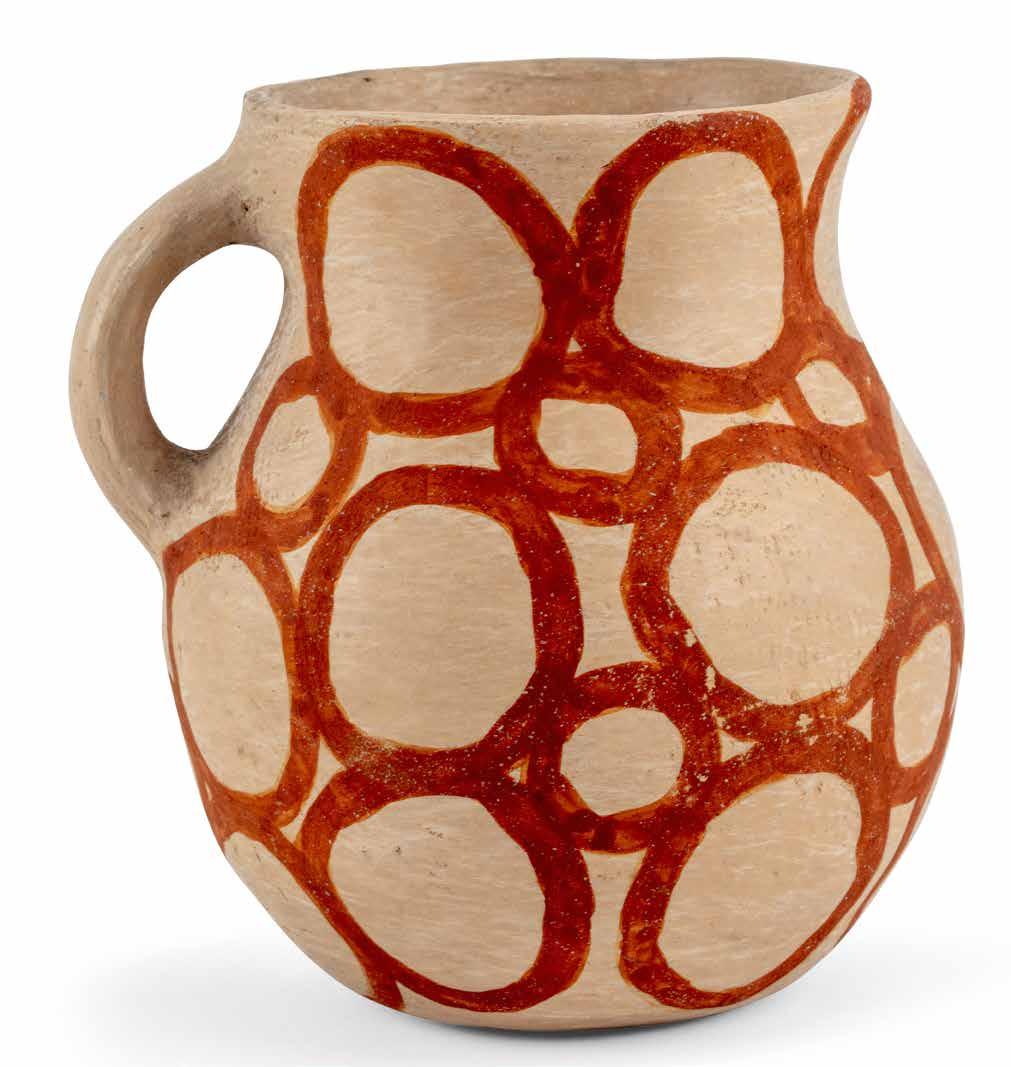
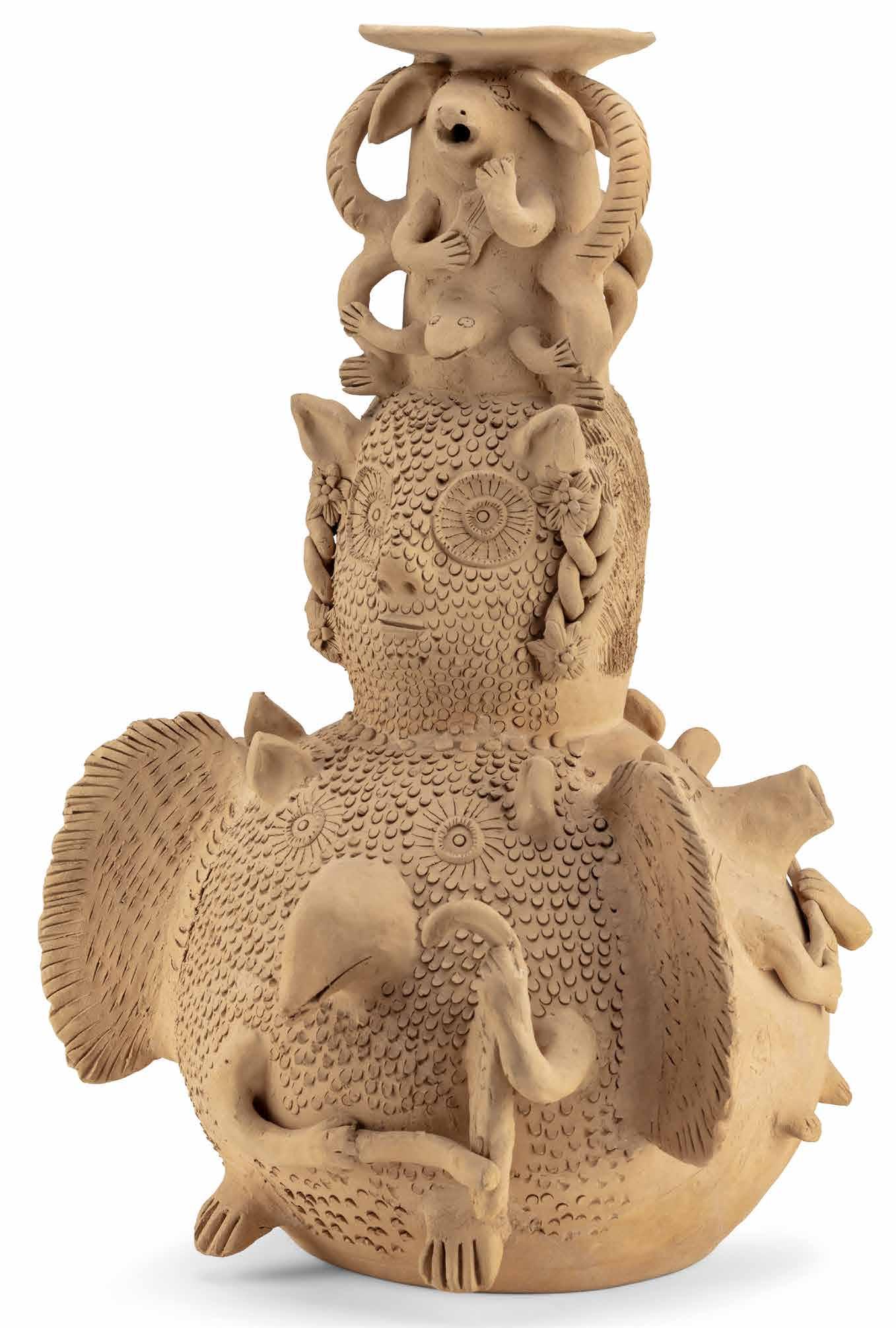
Unidentified artist | Pulque jug, ca. 1960
Pame | Modelled, smoothed, cold-painted | Santa María Acapulco, San Luis Potosí Coll. Banco de México, Fiduciario en el Fideicomiso de los Museos Diego Rivera y Frida Kahlo Donation Juan Rafael Coronel Rivera
To begin with, ancient Indigenous cultural groups differ from today’s geopolitical divisions. Their pottery expressions must be understood from the perspective of a dynamic of expansion linked to the Pacific Basin, and processes involving migration and ancient cultural sedimentation. Ancestral forms, techniques, and decorative systems are the foundations of knowledge that, far from disappearing, has been transformed. The earthenware tradition introduced in New Spain—Majolica, Talavera, glazed pottery—incorporated Mozarab, Asian, and African influences, shaping a mestizo language that would mark later production. The Nao de China (Manila Galleon) and trade routes brought Mexico into channels of material and symbolic exchange worldwide.
In the nineteenth century in the early period of Mexico’s independence, pottery played a role in the construction of patriotic imagery. Between 1900 and 1960, daily life and industrial processes redefined pottery’s scope. Manufacturing, tourism, and cultural nationalism boosted centers such as Oaxaca,
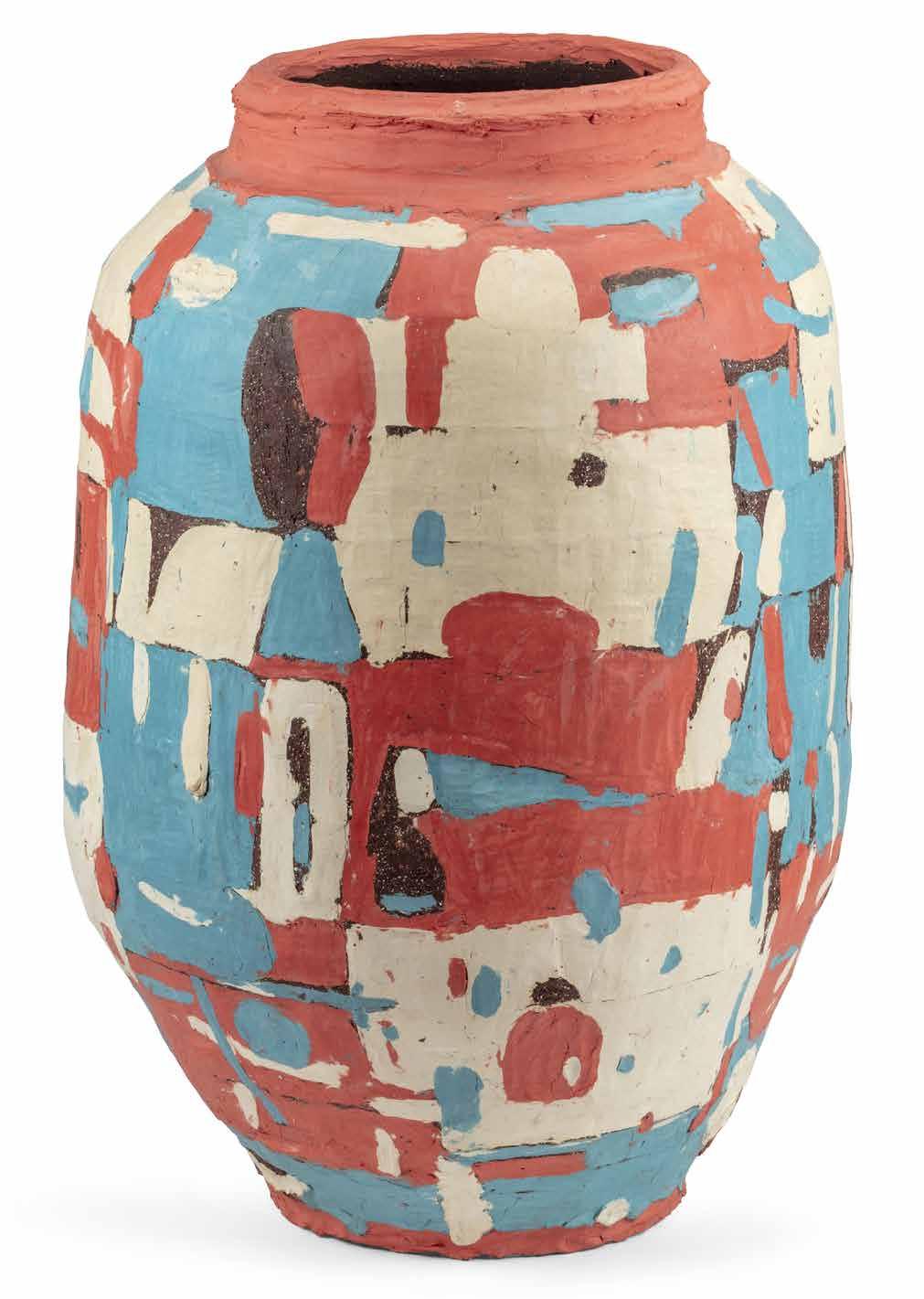
Mono Rojo (workshop) (in collaboration with Rodrigo Treviño)
Afternoon at the Bathing Resort, 2022
High-fire | Mexico City Coll. AGO Projects
Taxco, and Tonalá, as factories and workshops experimented with production on new scales. Starting in 1921, ceramic artists appeared on the scene, leading to conscious reflection on the clay’s role in the modern cultural project. This context saw the emergence of individuals and studios that regarded clay as a platform for modern design and artistic experimentation that went beyond tradition. Aesthetic consolidation in the midtwentieth century, the arrival of high-fire technology, and revised historical readings between 1960 and 1980 led to a new way of seeing ceramics as an autonomous artistic language. Later, the spread of pottery expertise democratized everyday objects, as contemporary artists developed the material’s formal, technical, and conceptual possibilities.
Today’s diverse, polyphonic production, bold in its use of materials, engages in dialogue with past genealogies without being subordinated to them. New languages, materialities, and narratives demonstrate that clay continues to be a rich field for exploring notions of identity, territory, and globalism.
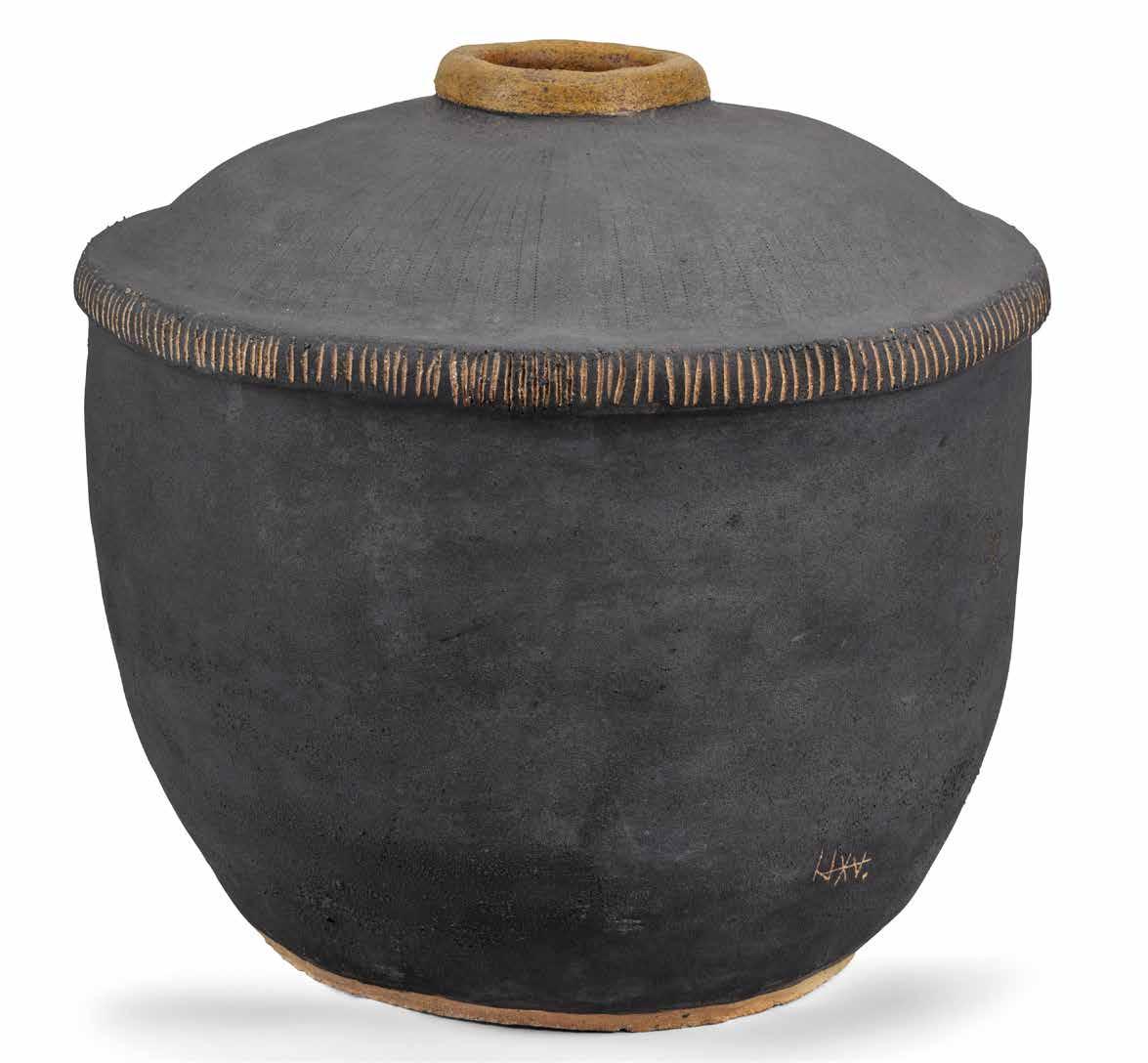
Hugo X. Velásquez | The Black Night, 2005
High-fire, formed with coils
Taller Tornavuelta Cerámica al Humo, Cuernavaca, Morelos Coll. Velásquez Suárez family
This exhibition has been devised as a space of encounter, interweaving the curators’ perspectives. Far from establishing classifications, the layout of the pieces prompts a direct dialogue involving Indigenous and popular creation and innovation in modern and contemporary design. Formal, gestural, and symbolic echoes emerge from this juxtaposition, revealing profound continuities in Mexican material culture.
Beyond historical contexts or academic categories, vessels appear time and again as a core inspiration: an archetype that reiterates the relationship between material, form, and use. Containing, serving, storing, offering are primary functions that have given rise to a vast repertoire of visual solutions. Thus, far beyond mere utilitarian objects, vessels express themselves as silent cores of virtually all ceramic creation, as points of convergence where tradition, design, and daily life are mutually recognized.
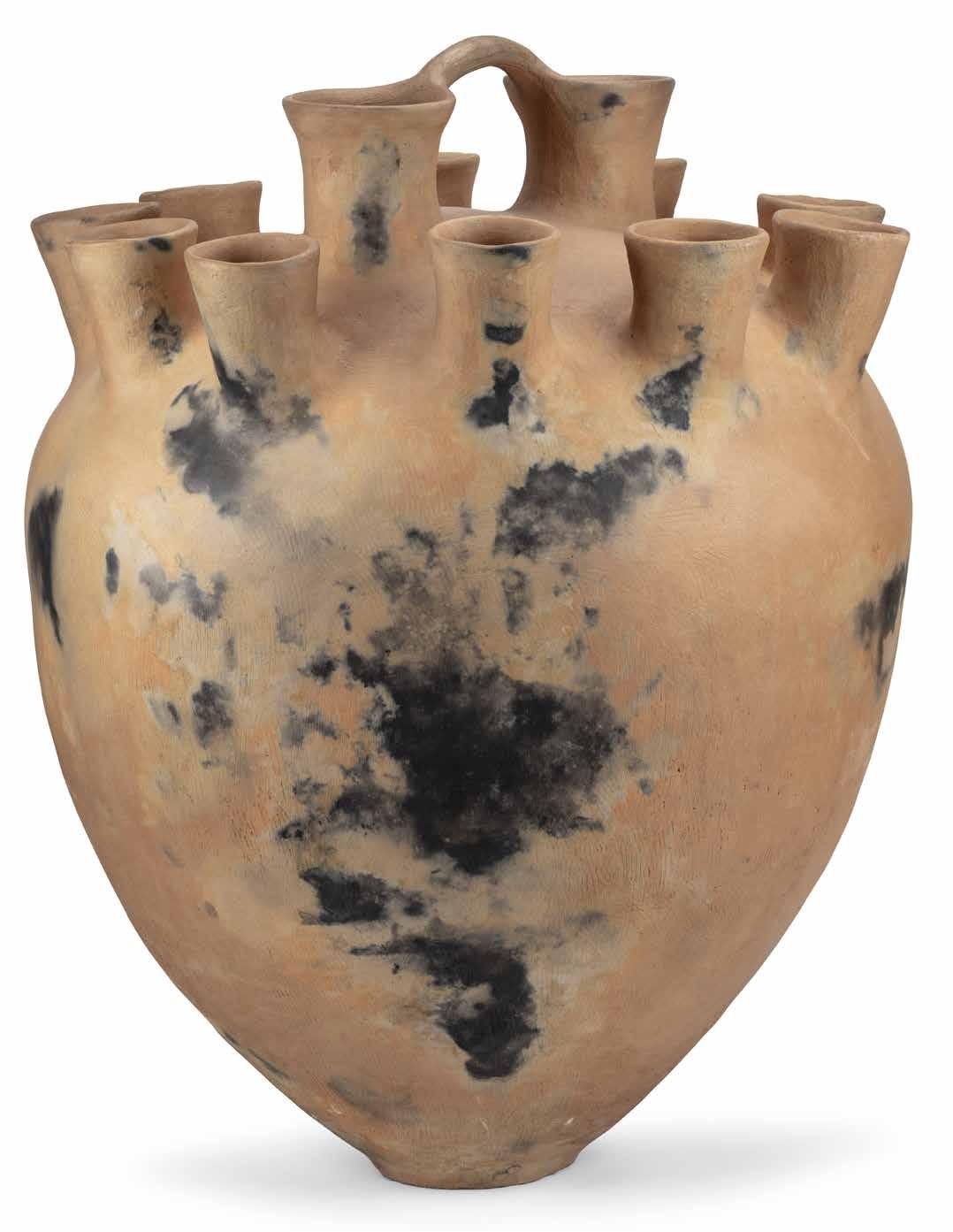
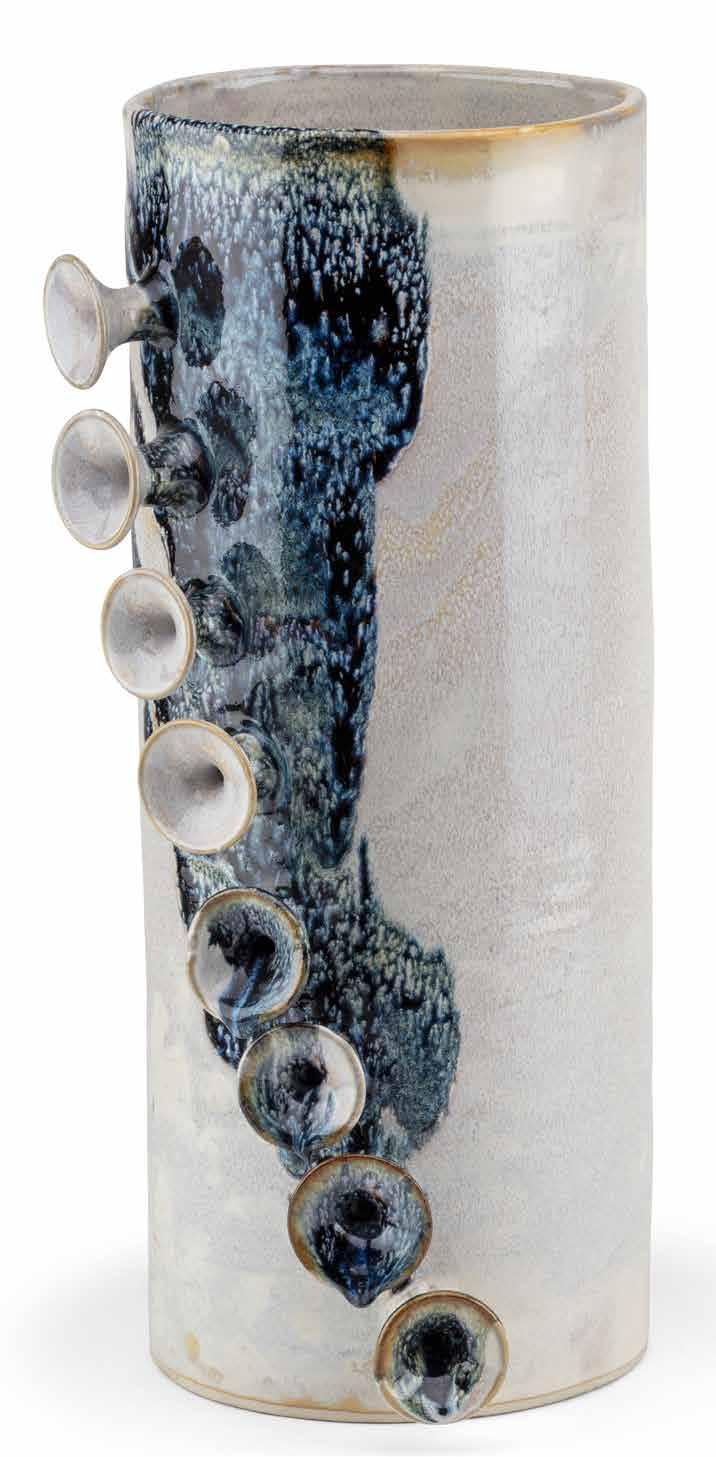
Rosa Juárez Cruz | Twelve Mouth Vase, 2006
Natural-colored clay modeled with the rolling and smoothing technique
Tamazulápam del Espíritu Santo, Oaxaca Coll. Fomento Cultural Banamex, A.C.
This exhibition does not propose a linear reading. Instead, it offers a constellation of moments in which Indigenous tradition, folk art, modern industry, and contemporary artistic practice understood from the perspective of design intermingle to reveal an overarching totality. Earth, water, and fire merge in each piece; each object expresses a tension between utilitarian and transcendental.
More than a closed history, Clay and Ceramics in Mexico: Utilitarian Poetics raises an open question: how has an ancestral material been able to adapt to the political, economic, and aesthetic projects of each period while preserving its symbolic power? In ceramics and clay, the everyday is turned into form; function becomes language; and material, active memory.
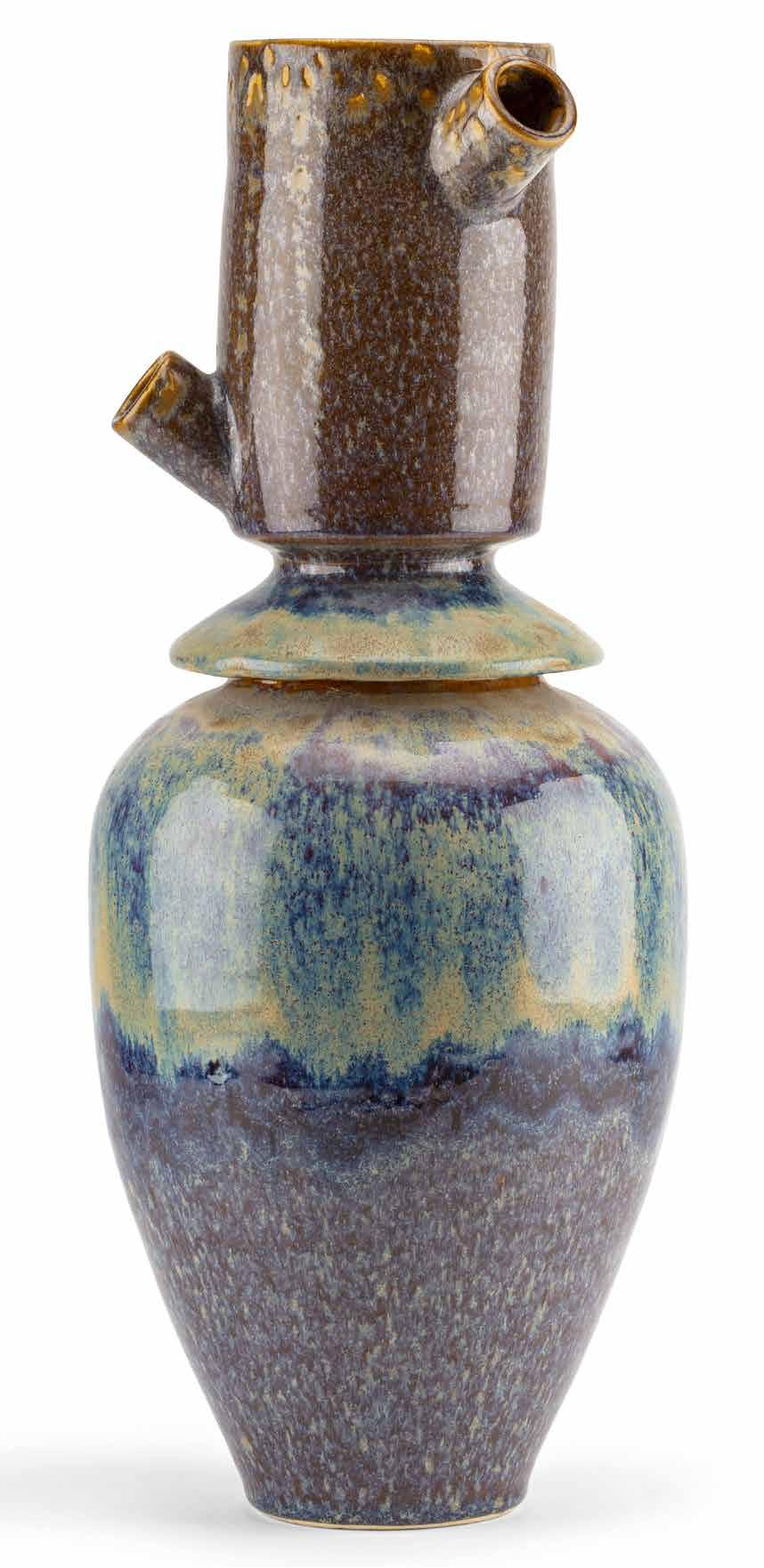
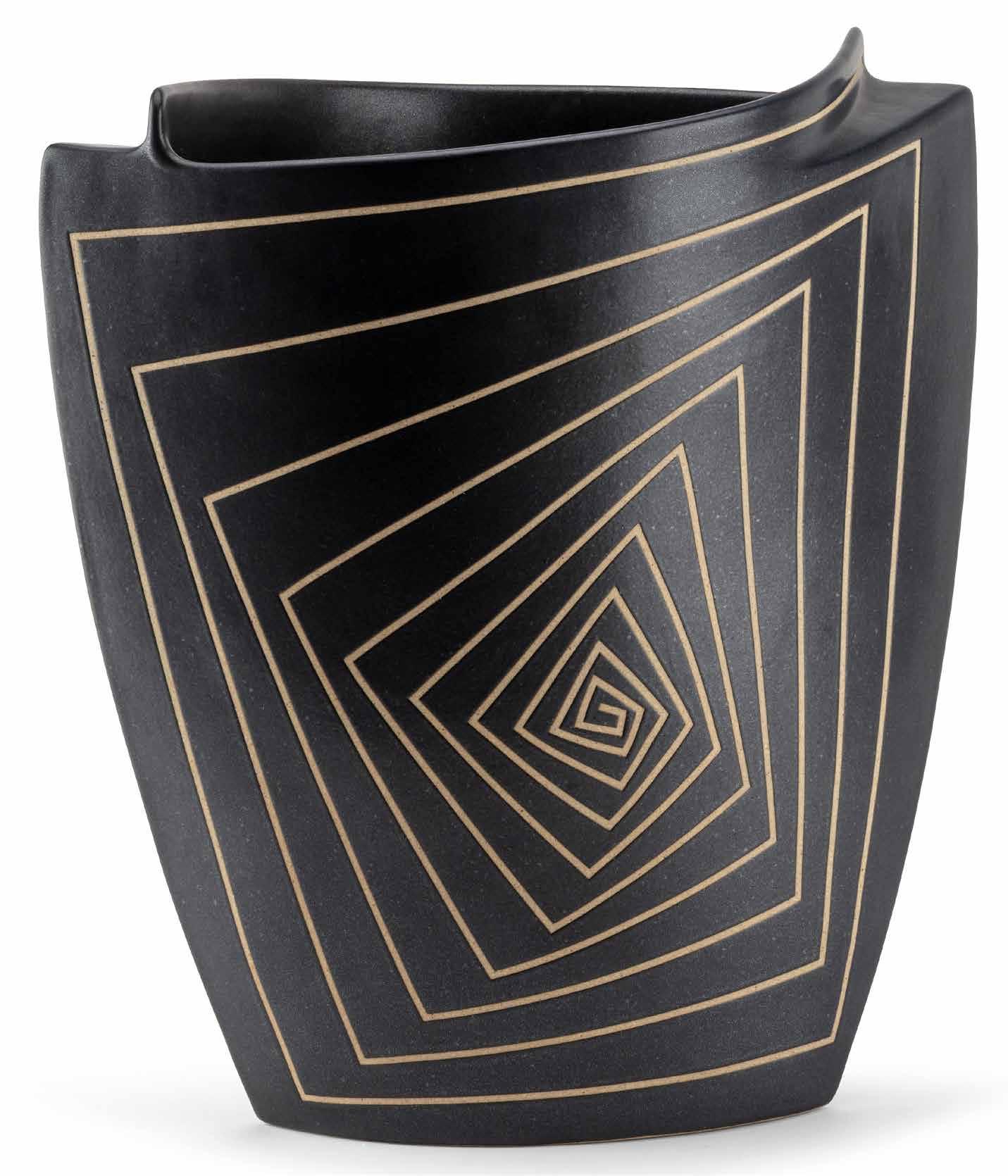
Jerónimo Sainz de Agüero | Vase/Sculpture VI, 2025
High-fire, electric kiln, with glazes developed and produced by the artist | El Engaño, Mexico City Coll. Jerónimo Sainz de Agüero
ORIGINS: INDIGENOUS CERAMICS
Is there iconographic continuity in Indigenous pottery; in clay arising from folk art; in ceramics made in a studio? The foundational idea of this exhibition emerges from this question. The selection of works is organized in three stages of Mexican ceramics: historical (1810–1910), modern (1911–1986), and contemporary (1987 to the present) periods.
To determine whether Pre-Columbian art is the product of a legacy, we need to go back to its origins: human migration across the Bering Strait suggests that Asian roots have been present from the start. These ceramics express modernity and timeless perspectives.
Mexican pottery has its roots in migration and tradition. For many years, it was assumed that a unique form—the patojo —had been created in Mexico. However, these pieces have been manufactured in China with the same function for millennia. Under this premise, we have given these works a particular place in the Pre-Columbian worldview: they have been interpreted as showing causality.
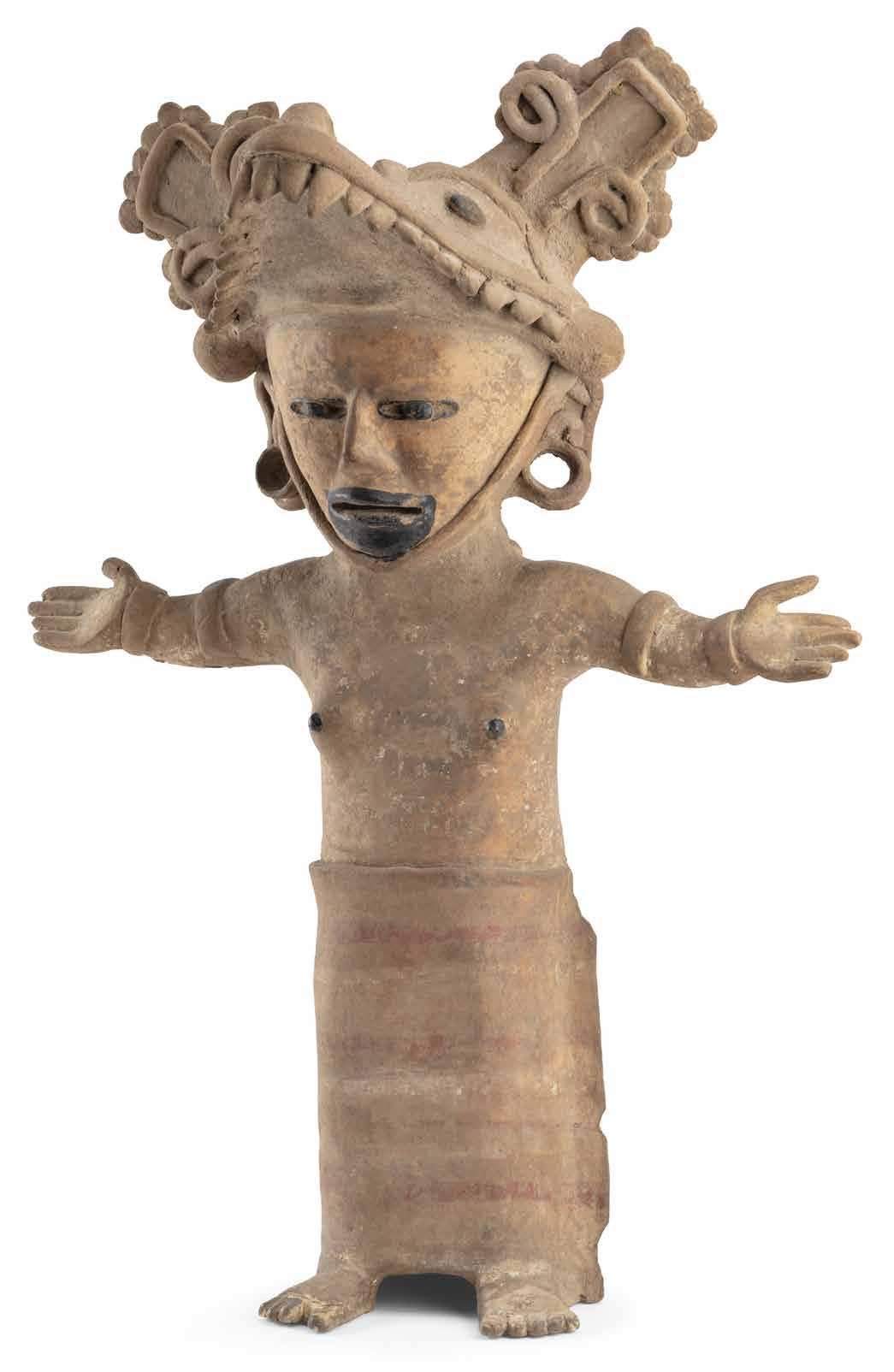
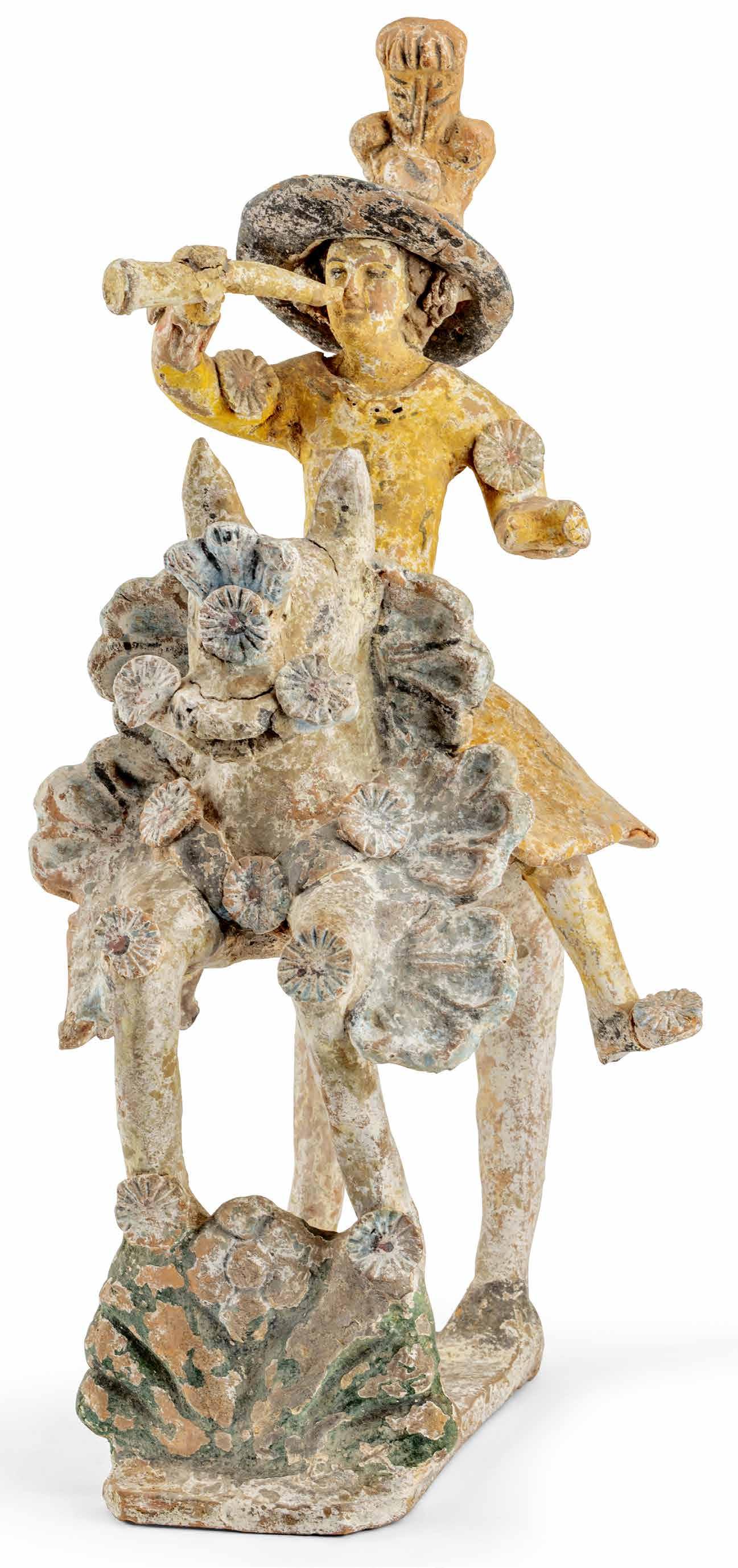
Unidentified artist | Female anthropomorphic figure, pre-Hispanic Totonac/Tének culture | Modeled, with appliqué, slip, and chapopote (bitumen) Gulf of Mexico Cultures
Private collection | Piece registered in the Registro Público de Monumentos y Zonas Arqueológicos e Históricos del INAH under number 2721 P.F. 156
TRADITION IN NEW SPAIN
In the eighteenth century, Mexico City was the most cosmopolitan metropolis in the world. Although it had a counterpart in Venice, the capital of New Spain integrated a living Indigenous heritage that enriched its global vision. Modernity in this city went through three basic moments in ceramic art: the eighteenth century; the so-called “Mexican Miracle” (1940–1970); and the current stage, beginning in 2010.
The finest pieces of the eighteenth century came from the pottery wheels of Tonalá, Jalisco. Its jugs, chocolate cups, and tibores were the most refined ceramics of the time, highly coveted by the middle class, even more than Chinese porcelain. One of these vessels appears in Diego Velázquez’s Las Meninas, and some of these remarkable pieces are also depicted in Francisco de Zurbarán’s still lifes. It is important because many of the decorations feature Indigenous iconography; done in the Tequitqui style—a term coined by historian José Moreno Villa— these pieces were painted with designs derived from codices.
This section also displays a group of works from the eighteenth to twentieth century known as Cures for Bad Air. These pieces, whose style remained the same throughout history, demonstrate that Indigenous medicine and healing practices were tolerated by viceregal authorities.
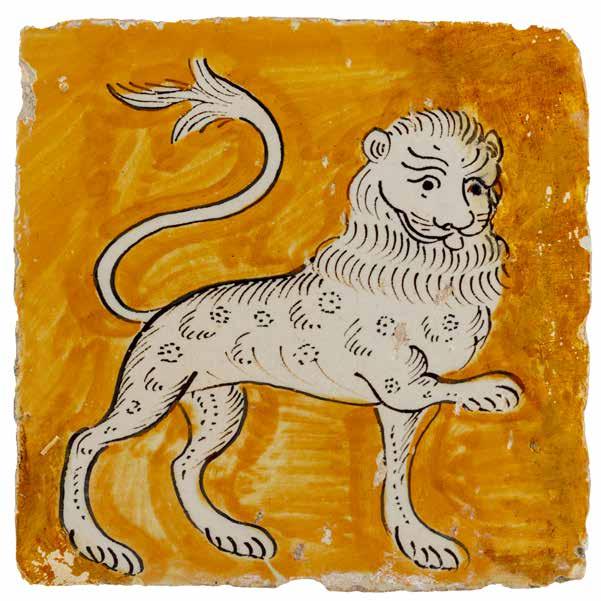
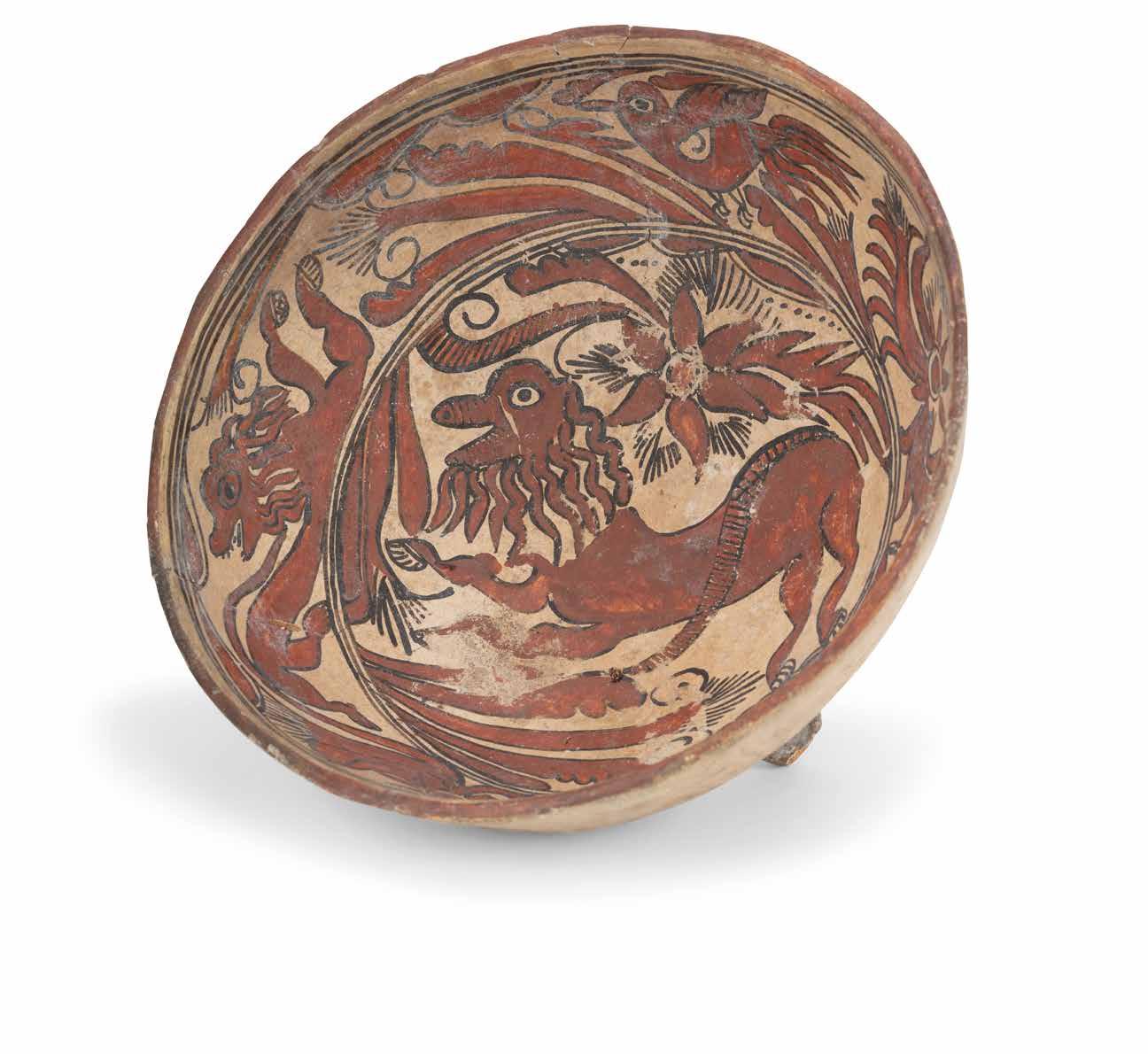
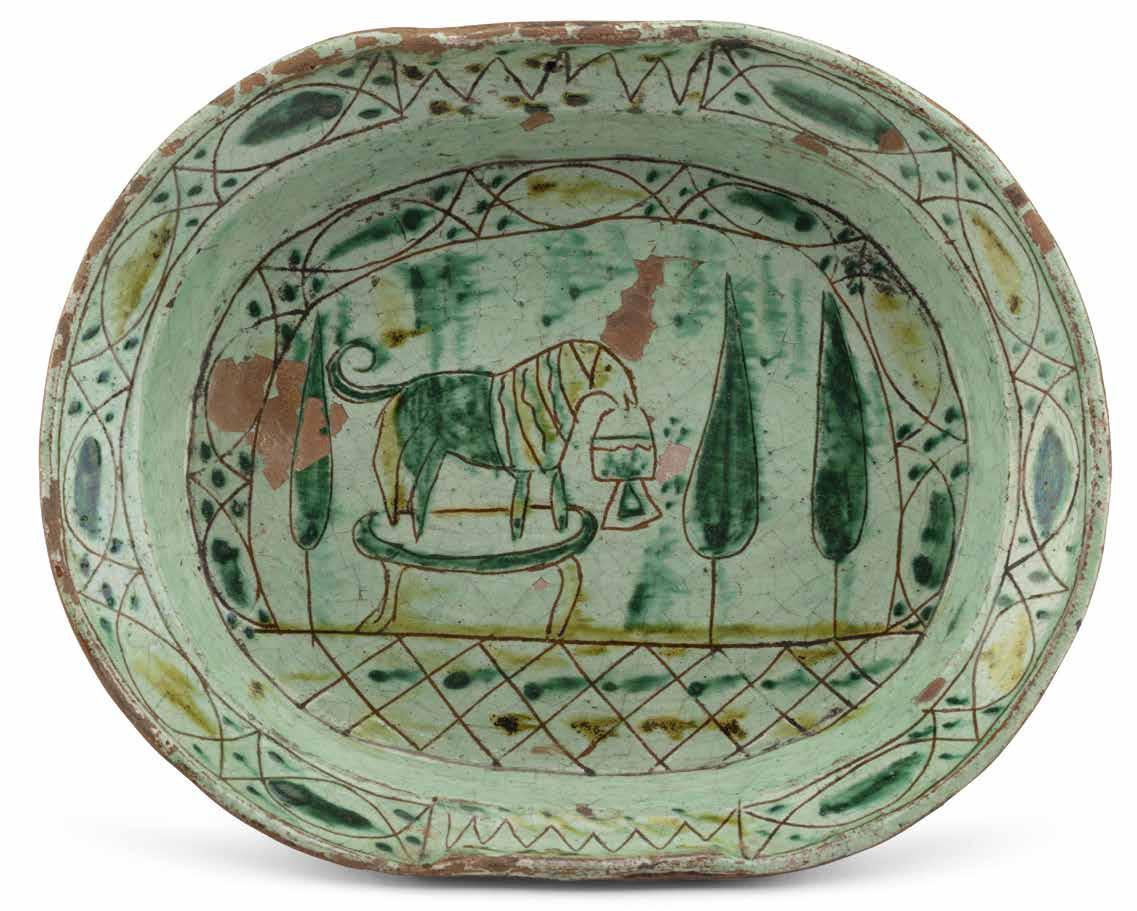
Unidentified artist | Lion mosaic, second half of the 17th century
Modeled, tin-glazed | Puebla, Puebla
Coll. Banco de México, Fiduciario en el Fideicomiso de los Museos Diego Rivera y Frida Kahlo
Donation Juan Rafael Coronel Rivera
Unidentified artist | Saint James the Greater, 18th century Molded, appliquéd, cold-painted | Basin of Mexico
Coll. Banco de México, Fiduciario en el Fideicomiso de los Museos Diego Rivera y Frida Kahlo Donation Juan Rafael Coronel Rivera
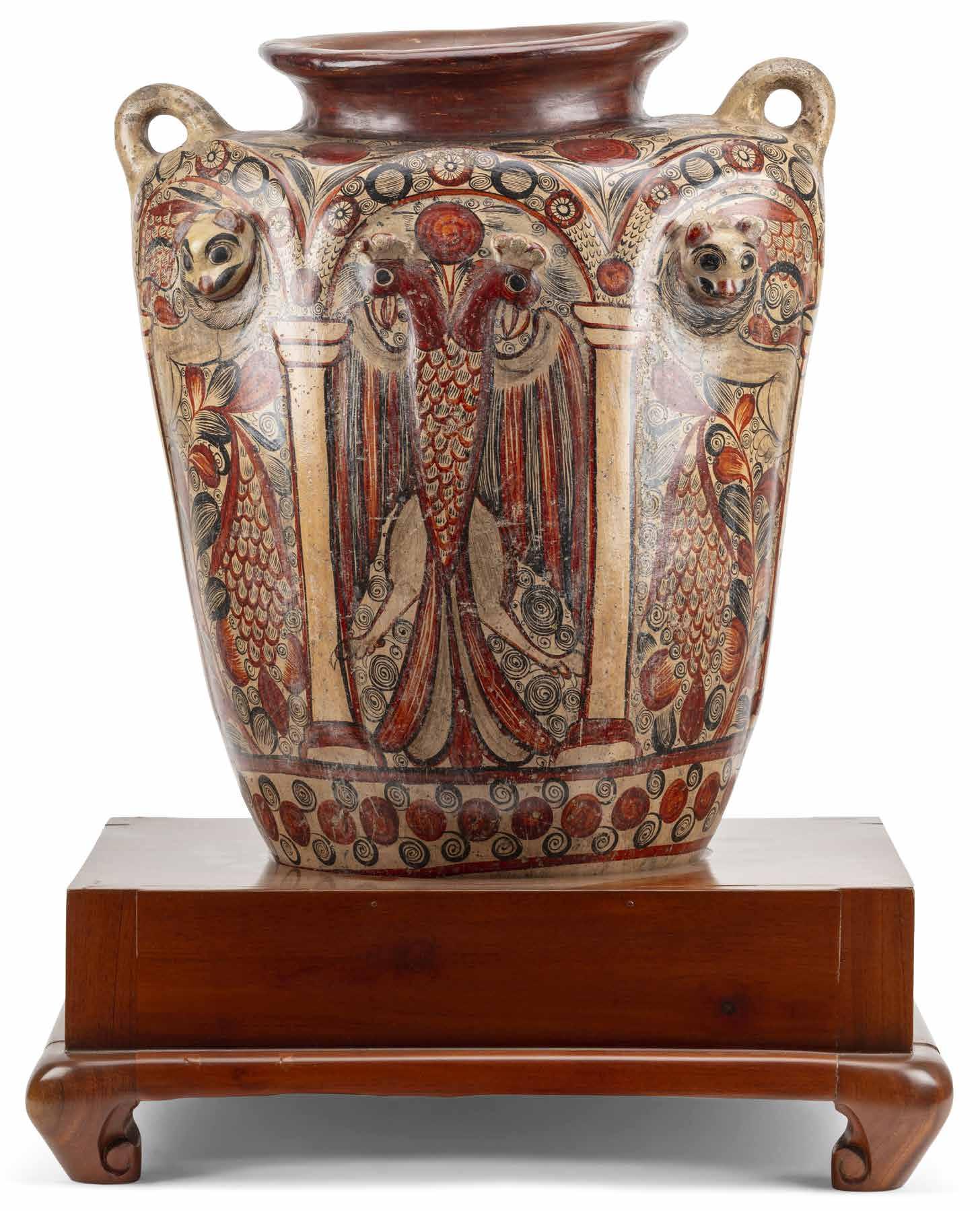
Unidentified artist | Tonalá jar, 19th century Molded, decorated, and painted | Tonalá, Jalisco
Coll. Banco Nacional de México | On loan to Fomento Cultural Banamex, A.C.
CULTURAL CONTINUITY
These works are primarily analyzed for their aesthetic qualities. Their utilitarian character does not detract from the creative trends of their time; they possess sculptural and visual attributes that allow us to regard them as works of art. From this perspective, they depart from cultural assessments that emerged in the West following Denis Diderot’s Encyclopédie, categories inherited from colonial thought that are exclusionary.
The eighteenth-century anthropological focus is dispensed with to position these pieces in their creative context worldwide. They are visual works comparable to those done in other cultural spheres. As a whole, they comprise a global and egalitarian vision of human creation in a specific period: even though they belong to different traditions, they are equivalent in their conception. In this way, the works in this section engage in a dialogue with Pacific cultures.
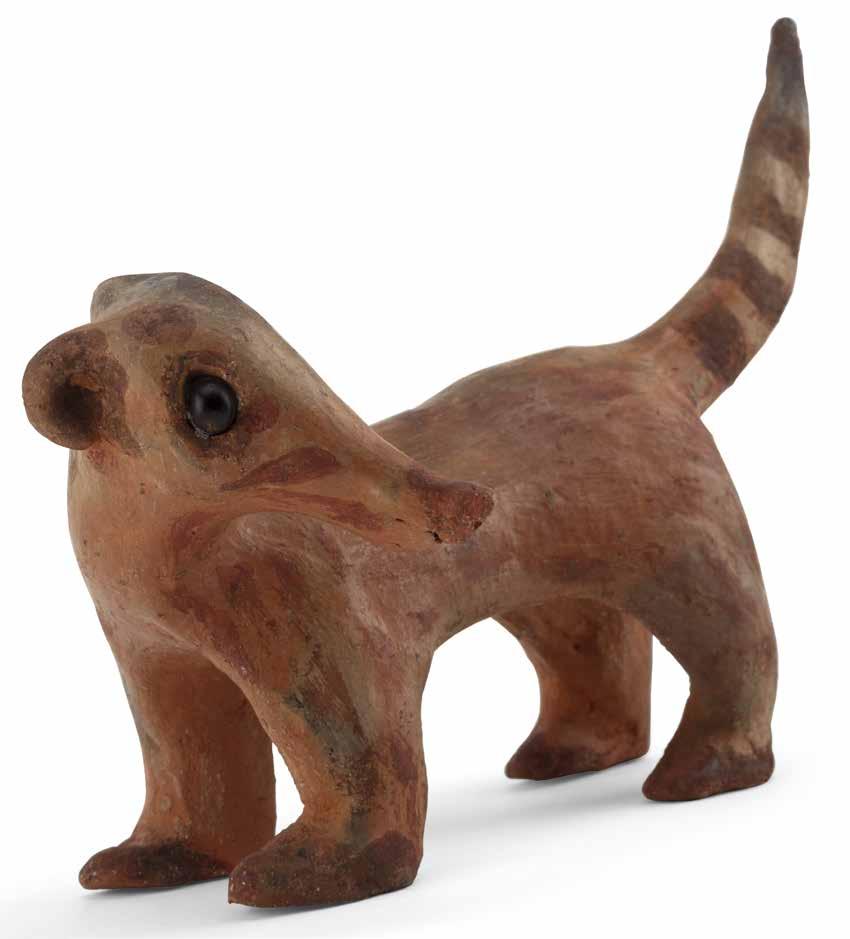
Unidentified artist | Bexe (Coati), ca. 1970
Tének [Totonac] culture | Modeled, decorated with pigment | Aquismón, San Luis Potosí Coll. Acervo de Arte Indígena, Instituto Nacional de los Pueblos Indígenas
CULTURAL ENCOUNTERS:
THE MOZARAB WORLD
The history of the Iberian Peninsula consists of cultural phases defined by the civilizations that exerted political control over the territory and imposed their aesthetic vision. This region was under Arab rule for 781 years, from A.D. 711 to 1492, when the conquest of the Nasrid Kingdom of Granada brought the occupation to an end. This long period explains the strong cultural influence that still persists in the area.
During the Andalusian period, Christians who were living in Al-Andalus (medieval Muslim Spain) were referred to as Mozarabs. The most advanced glazing techniques were inherited from Arab culture, leading to a taste for geometric and plant forms, and especially the inclusion of calligraphy on pottery. Glazing became popular on the Iberian Peninsula during those centuries, and in the sixteenth century, it was introduced to New World domains under Spanish control.
|
Unidentified artist
Pitcher, ca. 1960
Purépecha | Molded, modeled, slip-decorated | Quiroga, Michoacán Coll. Banco de México, Fiduciario en el Fideicomiso de los Museos Diego Rivera y Frida Kahlo Donation Juan Rafael Coronel Rivera
CULTURAL ENCOUNTERS: TRADE
What we understand today as a globalized market originated in the commercial structure that the Spanish Empire established through the Manila Galleon route, also known as the Nao de China. One of the most successful in history, this mercantile system operated from 1565 to 1815.
The exchange of goods—many of them cultural—proved to be decisive, for it explains the transformation of the aesthetic order of Mexican ceramics. To better understand this phenomenon, the exhibition invites viewers to distinguish between Indigenous art and folk art as two distinct entities, because their difference becomes clearer through this commercial flow.
Indigenous art corresponds to a system composed of native peoples. Today, sixtyfour different Indigenous cultures are recognized and defined by their language and iconography, although they have been influenced by external factors. In contrast, folk art is composed of an aesthetic blend stemming from the racial and cultural exchange derived from these galleons, which defines our identity as a mestizo nation.
Despite prior interoceanic connections, the magnitude of this cultural traffic was unprecedented.
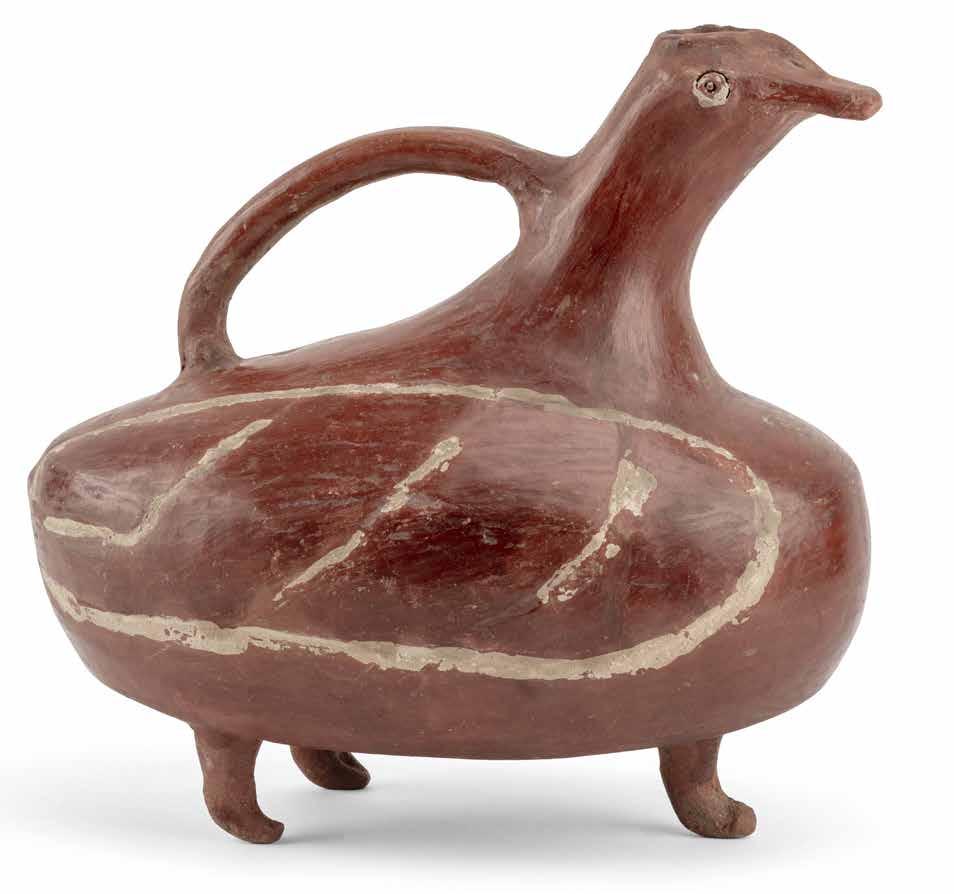
Unidentified artist | Patojo (Duck vessel), ca. 1940
Popoloca | Modeled, slip-covered , burnished with beeswax
Cold painted with mineral pigments | Zapotitlán, Puebla
Coll. Banco de México, Fiduciario en el Fideicomiso de los Museos Diego Rivera y Frida Kahlo
Donation Juan Rafael Coronel Rivera
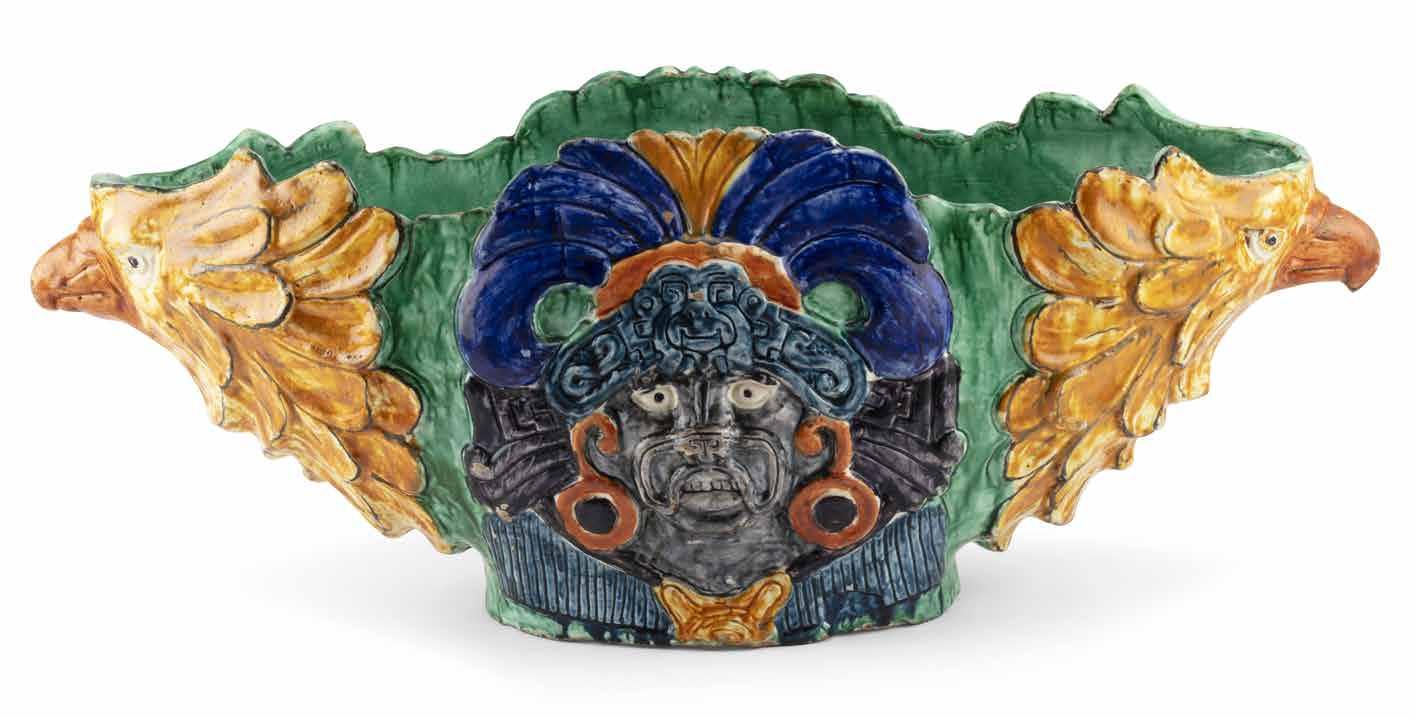
The succession of ceramic influences between distant regions can be seen in these works. By comparing the Chinese “famille noire” (black family) porcelain fish bowl— made for export—with the Tonalá, Jalisco, tureen, it is evident how Asian pottery modified the patterns, shapes, and aesthetics of Mexican pieces. It is worth noting that much of this Mexican ceramic production, conforming to folk art canons, was in turn manufactured for export, intended primarily for the United States.
CULTURAL ENCOUNTERS:
AFRICAN CULTURES IN THE COLONIAL PERIOD
It is estimated that close to 350 thousand individuals from West Africa—primarily from regions such as Angola, Guinea, and Senegal and belonging to Yoruba, Mandinga, and Fon cultures—were brought to New Spain as slaves. Runaway slaves who managed to escape to remote mountains and inaccessible coasts, where the Spanish Crown lacked influence—especially in the modern-day states of Veracruz, Guerrero, Oaxaca, and Tabasco— were known as cimarrones or maroons.
In this context, Gaspar Yanga (or Nyanga), a member of an African royal family, stands out. Enslaved in Veracruz, he led one of the first successful slave rebellions and founded an autonomous Black settlement in the late sixteenth century.
For this exhibition, observing the ceramic impact of African cultures is fundamental in the context of what has been regarded as Indigenous art. This presence in Mexico received little scholarly attention until the 1980s, when its cultural expressions began to be recognized as autonomous aesthetics under the notion of the “third race” (Afro-Mexicans). Certain ceramic forms from the areas mentioned lack an Indigenous tradition; their aesthetic order is African, which explains the iconography featuring lions, elephants, and native flora from those cultures.
In this section, pieces such as the ChamMwana vessels are displayed alongside Tulimán water jars to bear witness to a mixed origin that is quite unlike Indigenous art, a subject that has been largely unexplored.
THE WESTERN IMPOSITION ON REGIONAL CERAMIC
LINEAGES
Anthropology in the Americas, whose scientific origins were shaped by GermanAmerican Franz Boas who wrote The Mind of Primitive Man (1911), has posited a core idea set forth in that book: that no culture is superior to another, only different. These notions resonated strongly in Mexico among scholars such as Manuel Gamio. From this perspective, it is unacceptable to label Teotihuacan or Inuit cultures as “primitive.” This categorization makes it possible to see that Eurocentric education, still prevalent to this day, studies the arts of the world from a parameter that must be overcome.
One of the main aims of this exhibition is to display other aesthetics that are of equal importance and beauty as those that were long considered leading models, rooted in the Greco-Roman vision. Coatlicue and the Venus de Milo are masterpieces comparable in their visual importance and aesthetic conception, but they correspond to different canons. This should be the new way of seeing art.
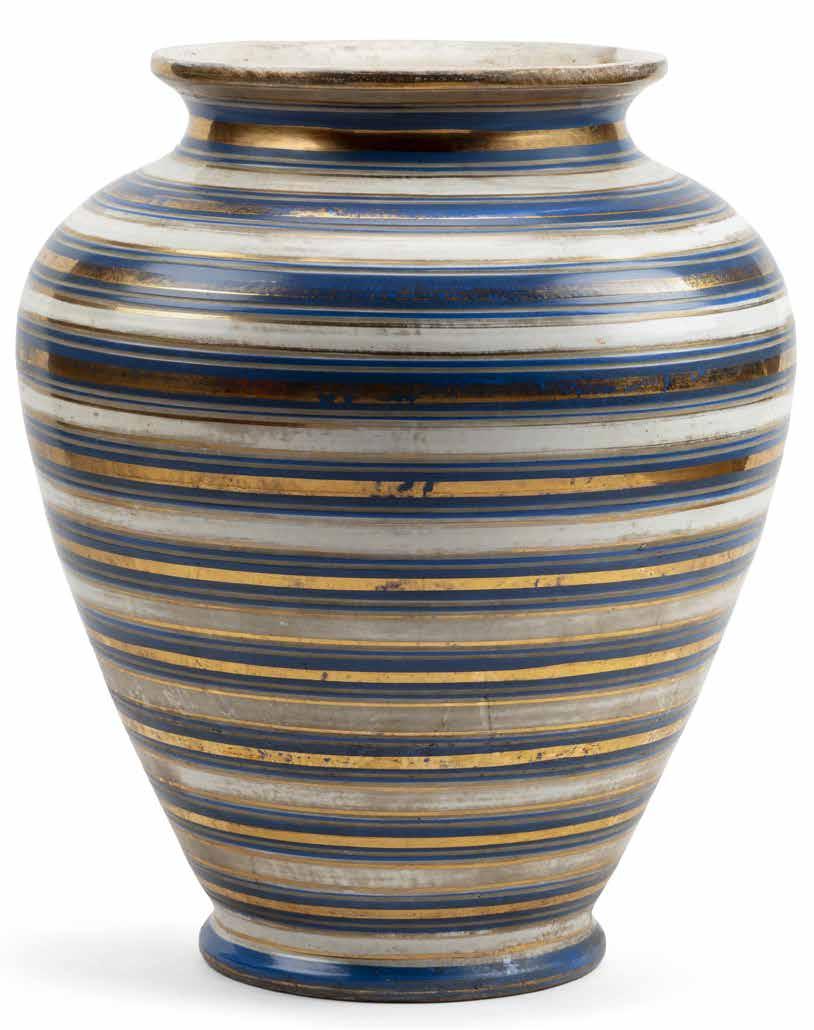
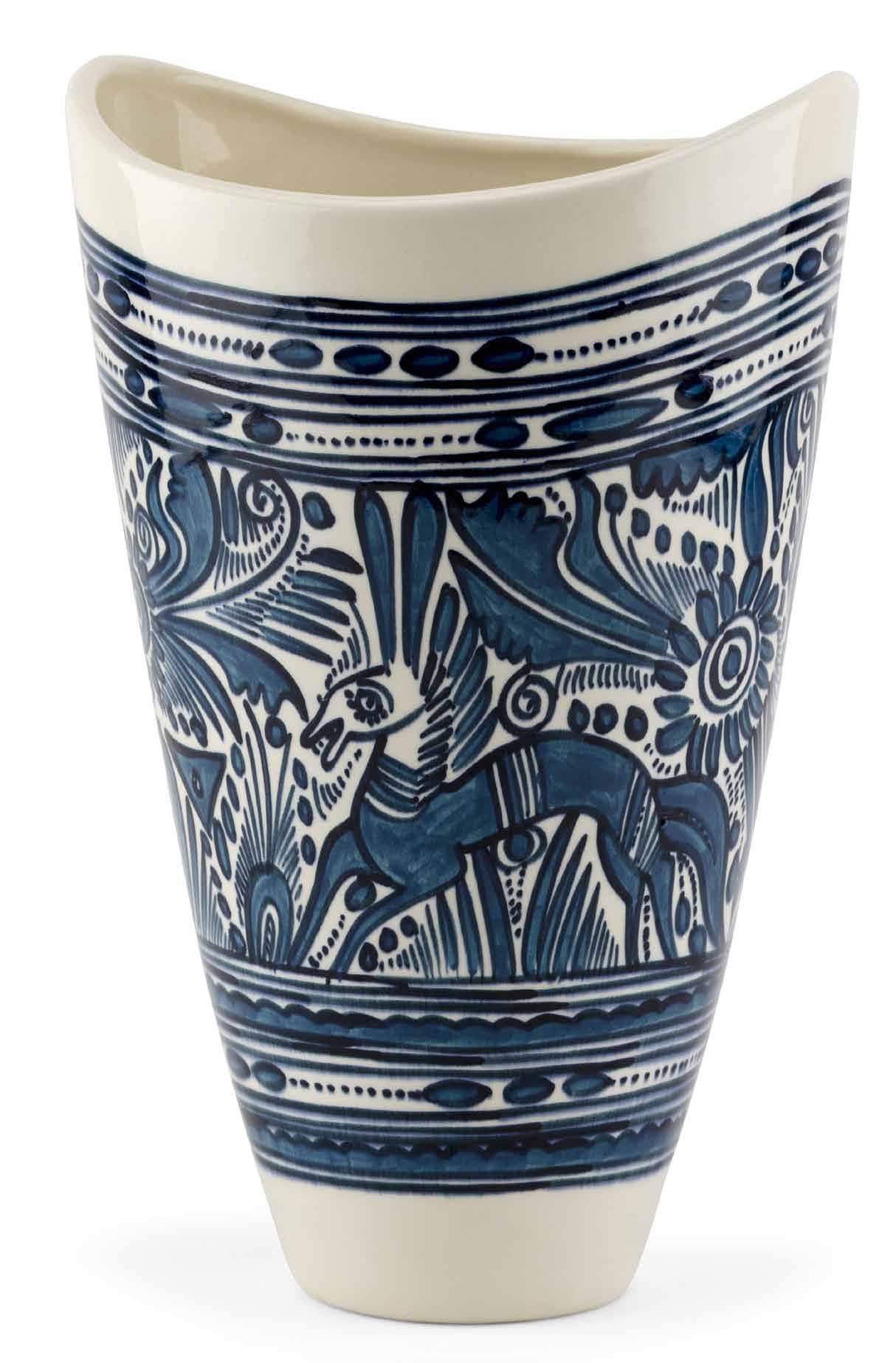
Alfarería Jiménez | Vase, ca. 1930-1940 Molded and glazed, contemporary Majolica type Atzompa, Oaxaca Private collection
It is also necessary to analyze the idea that limits native cultures to our current geography, under the mistaken premise that these peoples did not engage in significant cultural exchange. Isolationist theories from the 1940s were undermined by discoveries such as the Zapotec barrio in Teotihuacan. Ancestral settlements on today’s American continent respond to a series of migrations that took place over the course of centuries; from Alaska to Patagonia, these populations exchanged knowledge and aesthetics. This raises the question of whether cultures like the Zuni or Acoma, who inhabited Mexican lands from 1821 to 1848, should be regarded as Mexican or American after the cession of land resulting from the Treaty of Guadalupe Hidalgo. The ceramics presented in this section were produced by those native cultures when the lands were part of Mexico. They beg the question: from what historical perspective should these pieces be studied?
ACKNOWLEDGING THE ARTISTS
After the exhibition Las artes populares en México (Folk Arts in Mexico; 1921), coordinated by Gerardo Murillo—Dr. Atl—a large group of artists championed these cultural expressions, granting them the status of art. It was the people’s art, an expression that represented the exceptional mastery of its creators. Under the guidance of Dr. Atl (age 46), figures like Jorge Enciso (42), Roberto Montenegro (36), Diego Rivera (35), and Miguel Covarrubias (17) set out to collect, treasure, and amass these pieces, placing them on par with their own creations. Although that early effort included objects that we would now classify as handicrafts, that impetus consolidated the vision of identity sought by the State to build national unity, a strategy that continues to this day.
In this integration of Indigenous peoples into the national ideology, recognition of the importance and cultural quality of the works was not initially raised by institutions, but rather by young visual artists of the time.
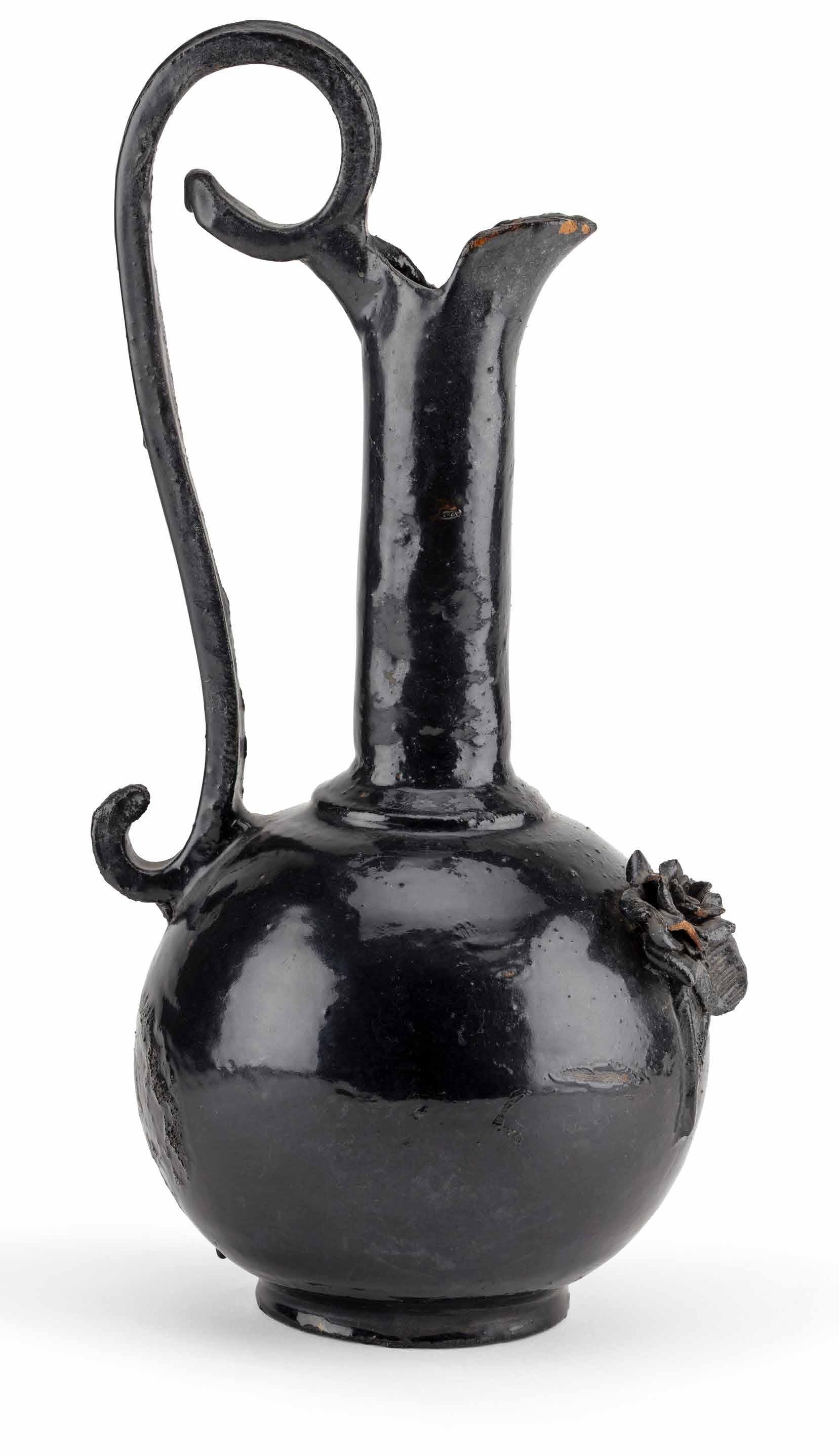
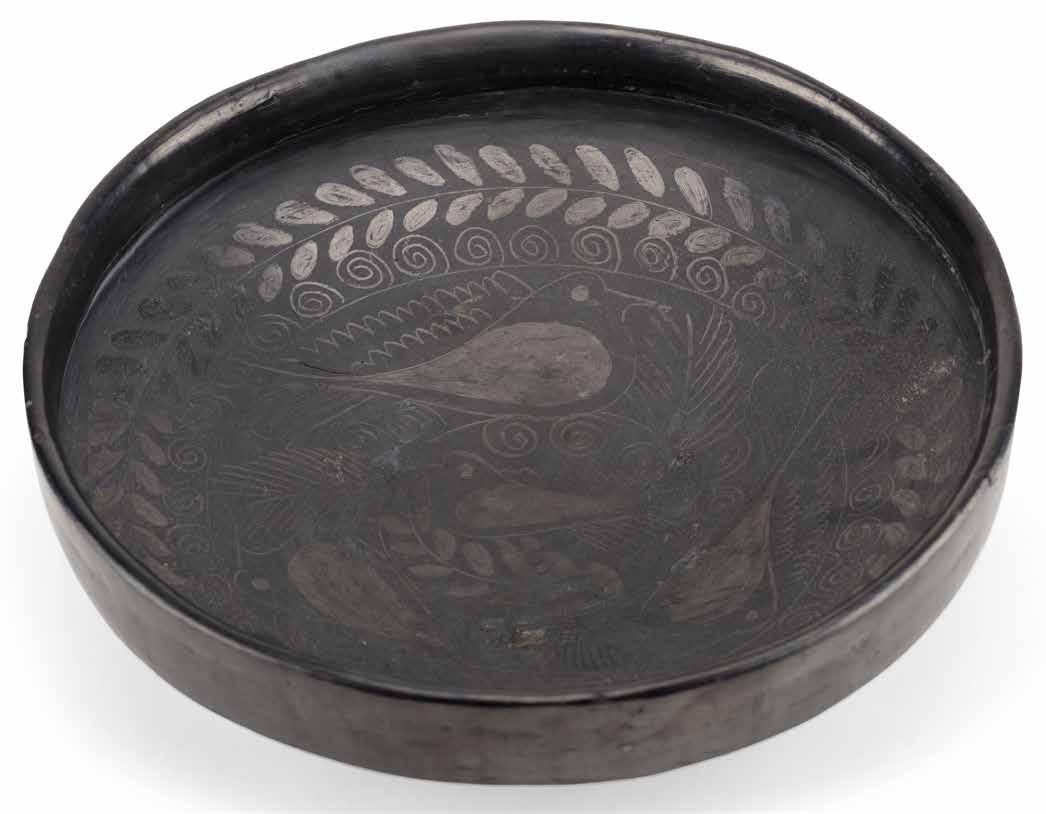
Rosa Real Mateo de Nieto | Xicalpextle (gourd vessel), ca. 1950
Zapotec | Molded, modeled, smoothed, black clay technique | San Bartolo Coyotepec, Oaxaca Coll. Banco de México, Fiduciario en el Fideicomiso de los Museos Diego Rivera y Frida Kahlo
Donation Juan Rafael Coronel Rivera
In the late 1920s, Diego Rivera and Frida Kahlo formed one of the earliest private collections of Indigenous and folk art, now held in the Frida Kahlo Museum (Blue House) and the Diego Rivera and Frida Kahlo House Studio Museum. They began to make these artists known by name. Take for example, the close friendship they had with the potter from Metepec, Modesta Fernández (b. 1914). Diego Rivera portrayed her in the mural in San Francisco Pan American Unity (1940) alongside figures like Charlie Chaplin, Paulette Goddard, Frida Kahlo, and Mardonio Magaña, positioned as equals: they were portrayed as the people’s artists of their time. Modesta Fernández embodies a fact that should not be overlooked: most pottery artists are women. In these final sections, we highlight the presence of female artists: Rosa Real Mateo de Nieto, a pioneer in black ware, and Teodora Blanco, whose work was presented in this museum in dialogue with works by Maria Izquierdo, back in 2023.
This exhibition constructs a visual discourse in which ceramics is the star. The curatorship and exhibition design interweave aesthetic coincidences, iconographic influences, and temporal similarities, but above all, they celebrate the divergent approaches that define each creative vision.
Teodora Blanco | Tecolote (Owl), ca. 1970
Zapotec | Modeled and incised, with appliqué | Santa María Atzompa, Oaxaca Coll. Banco de México, Fiduciario en el Fideicomiso de los Museos Diego Rivera y Frida Kahlo Donation Juan Rafael Coronel Rivera
THE CHINA GALLEON:
CLAY, DESIRE, AND MOVEMENT
From the sixteenth to eighteenth century, the so-called Nao de China (Manila Galleon)— the circuit joining Manila with Acapulco—was one of the most intensive commercial routes in the early modern world. Silk, ivory, and above all, Chinese porcelain—pristine white, sonorous objects previously unknown in New Spain—filled its holds. These entities were not merely merchandise because they had a transformative effect on tastes, tables, and imagery of the time.
In China, export ceramics incorporated shapes and coats of arms for customers in New Spain, while local workshops—such as those in Puebla—produced Talavera, adopting tin-glaze wares and ornamental repertoires with Asian roots. Pottery in New Spain engaged in dialogue with Asian porcelain vis-à-vis a translation process that went beyond simple imitation. This section explores that material and symbolic exchange: the process by which the Pacific Ocean ended up serving as an aesthetic bridge, allowing ceramics in New Spain to become a realm of cultural fusion, technique, and global desire.
Unidentified artist | Dutch West Indies Company tibor (vase), 17th century
Molded, hand-painted | China
Coll. López Mateos. Giuliana and Alfredo Marín
THE CERAMIC LEGACY: TALAVERA AND MAJOLICA IN MEXICO
Talavera and Majolica in Mexico are the result of a long cultural journey that began in the Islamic Mediterranean world. Tinglazed techniques—giving whiteness and sheen to the ware’s surface—were developed in Mozarabic and Andalusian contexts, where the Islamic and Christian worlds shared forms, ornaments, and technical expertise. From there they spread to Italian workshops, especially in Faenza (Italy) and to Spanish centers, such as Talavera de la Reina and Seville, consolidating the European tradition of fine pottery.
With the arrival of Spanish artisans to the viceroyalty in the sixteenth century, these techniques spread in New Spain, especially to Puebla and Tlaxcala. In those centers, the local clay, New World minerals, and Indigenous sensibility transformed the European heritage. Talavera in Puebla and Tlaxcala incorporated floral motifs, Mudejar geometries, and later, Asian influences arriving from the Pacific coast.
This section explores how Majolica was not merely transplanted from the Old to New World. It underwent a translation: from being an inherited ware to becoming a tradition that gained its own identity on Mexican soil.
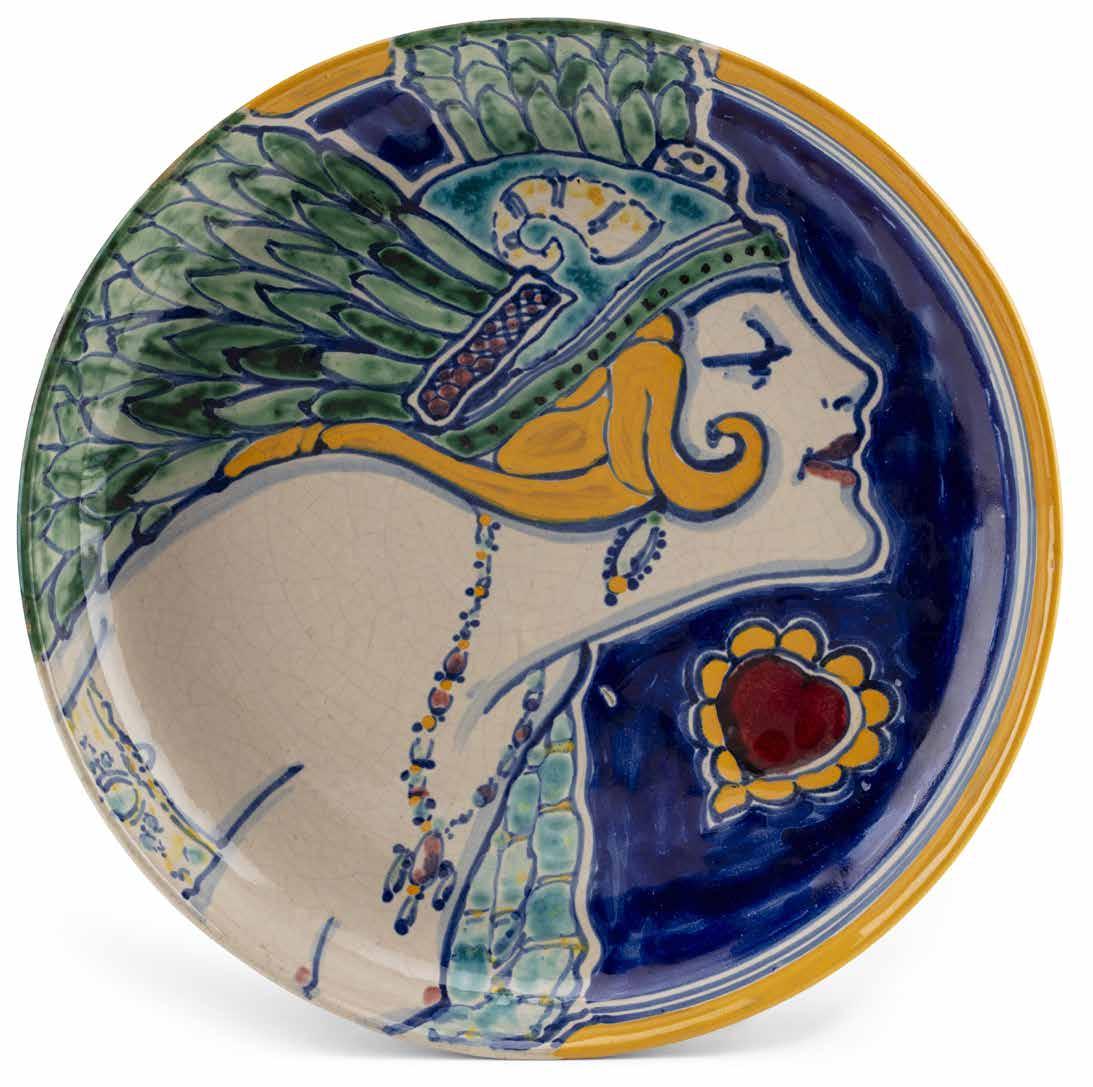
Enrique Luis Ventosa Fina | Art Nouveau platter with female portrait, ca. 1920 Thrown on a wheel, tin-glazed, polychromed (Majolica) | Puebla, Puebla Coll. Museo Amparo
ENLIGHTENED CLAY: HIDALGO AND THE BIRTH OF A CREOLE INDUSTRY IN GUANAJUATO
In the late eighteenth century, Majolica in Guanajuato became part of the intellectual and business vision of Miguel Hidalgo y Costilla, a figure who, besides being a leader of the Independence movement, was one of the first modern Mexican figures of the Enlightenment. A Creole landowner and priest, educated in scholasticism and attentive to contemporary debates, Hidalgo understood industry as a “practical theology”: a way to dignify the people through work.
Miguel Hidalgo y Costilla Workshop | Plate, ca. 1800 Majolica | San Felipe, Guanajuato Coll. Acervo de Arte Indígena, Instituto Nacional de los Pueblos Indígenas
Miguel Hidalgo y Costilla Workshop | Plate, ca. 1800
Majolica | San Felipe, Guanajuato Coll. Acervo de Arte Indígena, Instituto Nacional de los Pueblos Indígenas
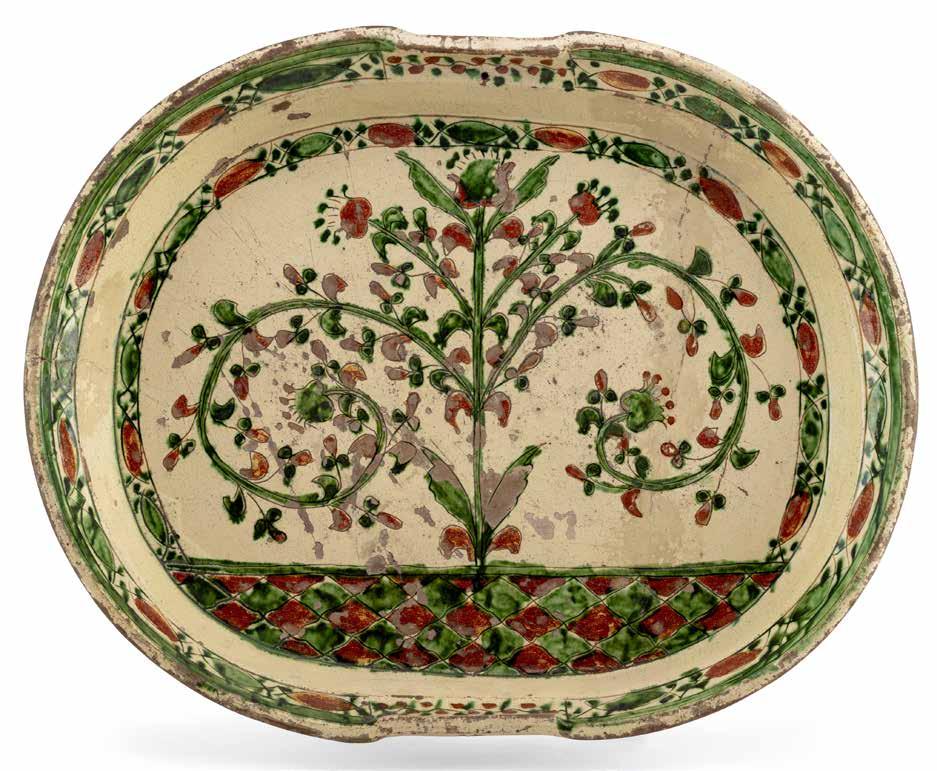
While he was serving in the town parishes of San Felipe and especially Dolores (1803–1810), he promoted family workshops—tanneries, saddleries, and potteries—where he encouraged experimentation with metal for glazing, devised new shapes, and sought to produce “superior” earthenware, close to foreign porcelain. The ageold Majolica tradition, a legacy of the Mudejar world, was thus reinterpreted in the Bajío region. The decisive factor was not solely the manufacturing process, but also the deliberate inclusion of Indigenous people—particularly Otomis—as draftsmen and designers. By incorporating local motifs in the commercial aesthetics of New Spain, Hidalgo affirmed a Creole identity, heir to both the Spanish and Indigenous worlds, and ceramics as an industry, pedagogy, and early expression of nationhood. In these pieces, with a cream background decorated with green and yellow slips, the Bajío clay acquired a new symbolic density. Far from being mere utilitarian objects, they constituted material expressions of economic autonomy: each piece condensed technique, experimentation, and political project.
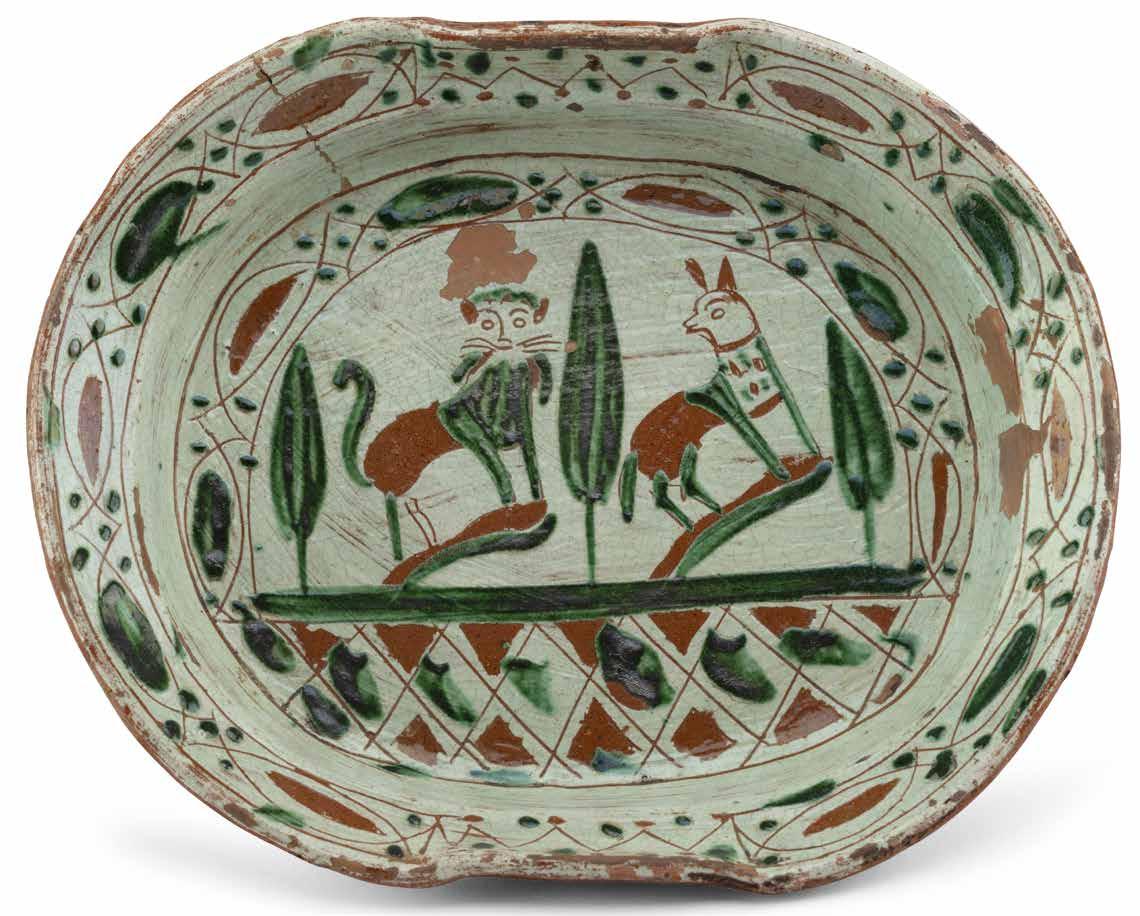
Unidentified artist | Ceramic platter with plant motifs, 18th century Thrown on a wheel, tin glazed, polychromed (Majolica) | Puebla, Puebla Coll. Museo Amparo
CERAMICS AND DAILY LIFE: MANUFACTURING PROCESSES
The history of the modern ceramic industry in Mexico originated in the Niño Perdido factory, one of the earliest efforts to produce fine pottery on an industrial scale in Mexico City in the nineteenth century. Founded by British businessmen with European technical knowledge, the plant introduced systematic production methods and trained Mexican apprentices; it employed dozens of workers and manufactured quality pieces comparable to European porcelain. By the early twentieth century, it had modern machinery, numerous pottery wheels, large-capacity kilns, and departments specializing in clay preparation, manufacturing, and decoration. Other businesses emerged from these industrial foundations, such as El Ánfora, a company founded in 1920 by German immigrants, who consolidated the production of dishware and toilets, and later modernized the factory’s technology to compete on international markets. The mid-twentieth century saw the rise of companies like Loza Fina in Guadalajara (LOFISA), while factories such as Nueva San Isidro, Santa Anita, and Cerámica y Porcelana de Cuernavaca expanded production nationwide. As a whole, they formed an industrial network that transformed Mexican ceramics into a strategic sector in design, manufacturing, and material culture.
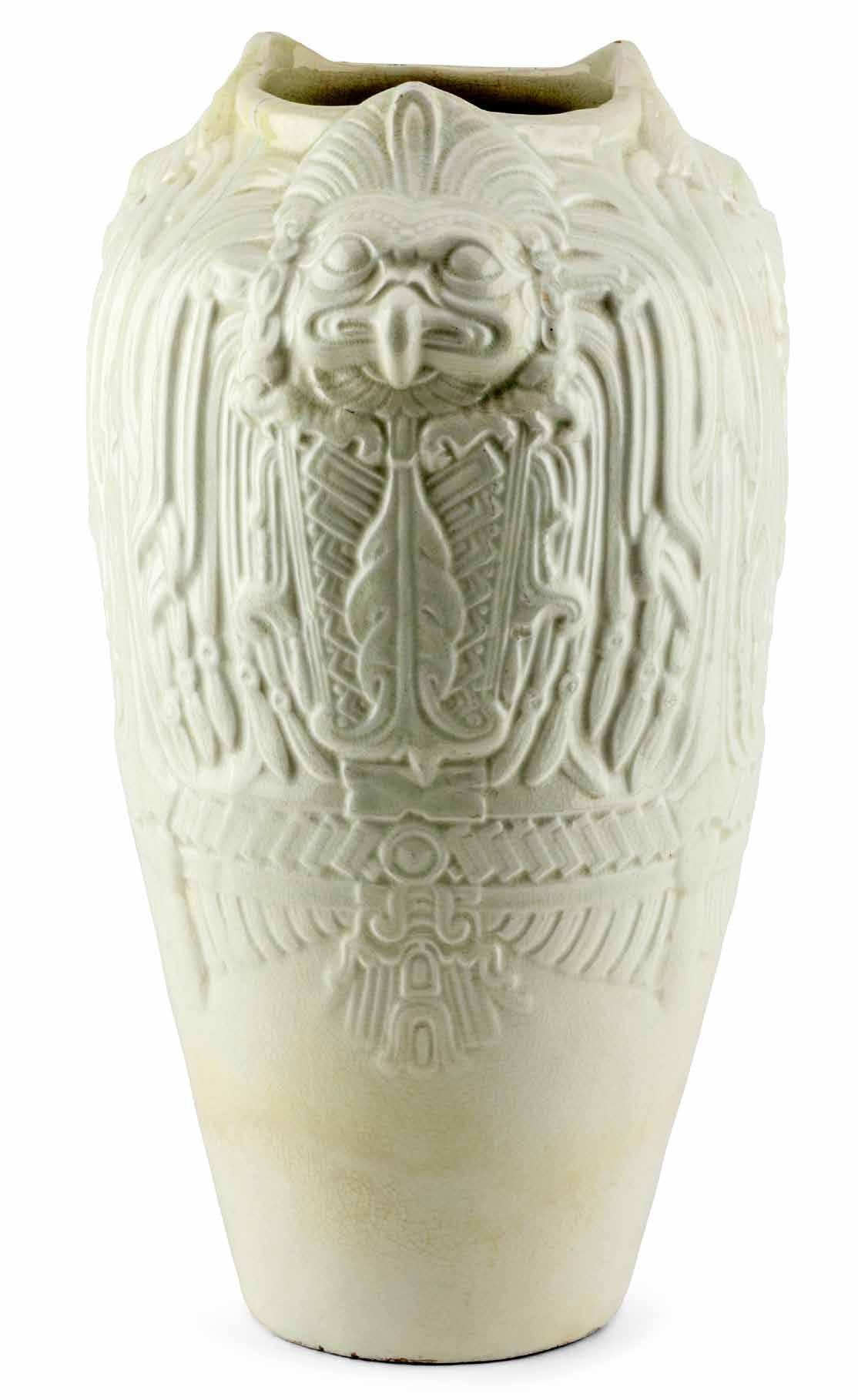
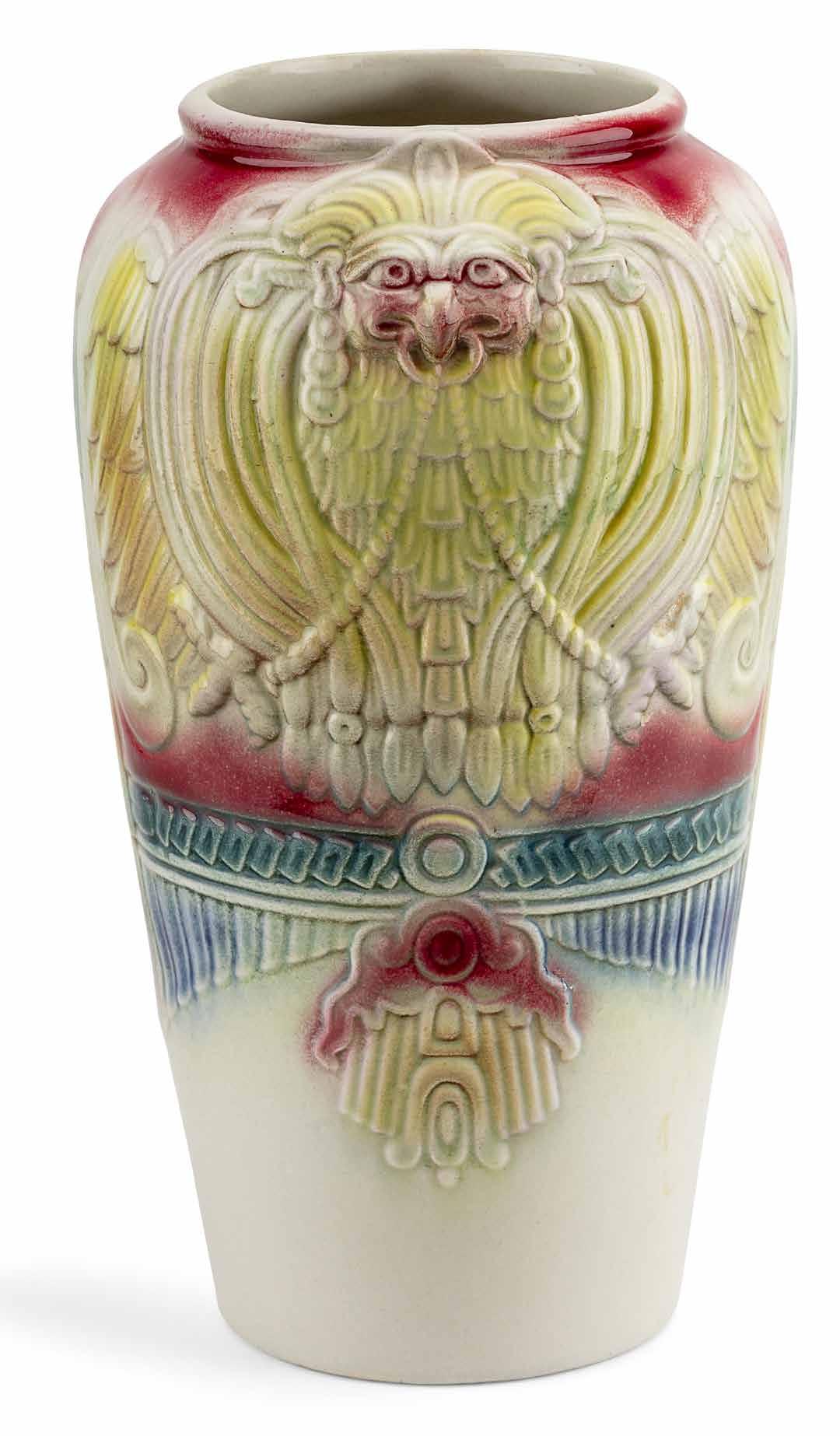
Perdido (factory) Ware | Neo-pre-Hispanic vase, ca. 1920
Glazes, high-fire porcelain, with bas-relief, and spray glazed
Mexico City
Coll. Centenario Anfora
NATIONALISM AND TOURISM
Between the 1930s and 1950s, Mexican ceramics developed hand in hand with the nationalist cultural project and tourism boom. New highways and the promotion of Mexico internationally consolidated an image in which archaeology, landscape, and folk art became integral parts of the travel experience. In this context, focal points of neo-folk art— later understood as artisanal design—emerged in regions like Oaxaca, Taxco, and Tonalá, where local crafts were reinterpreted for a national and foreign tourism market.
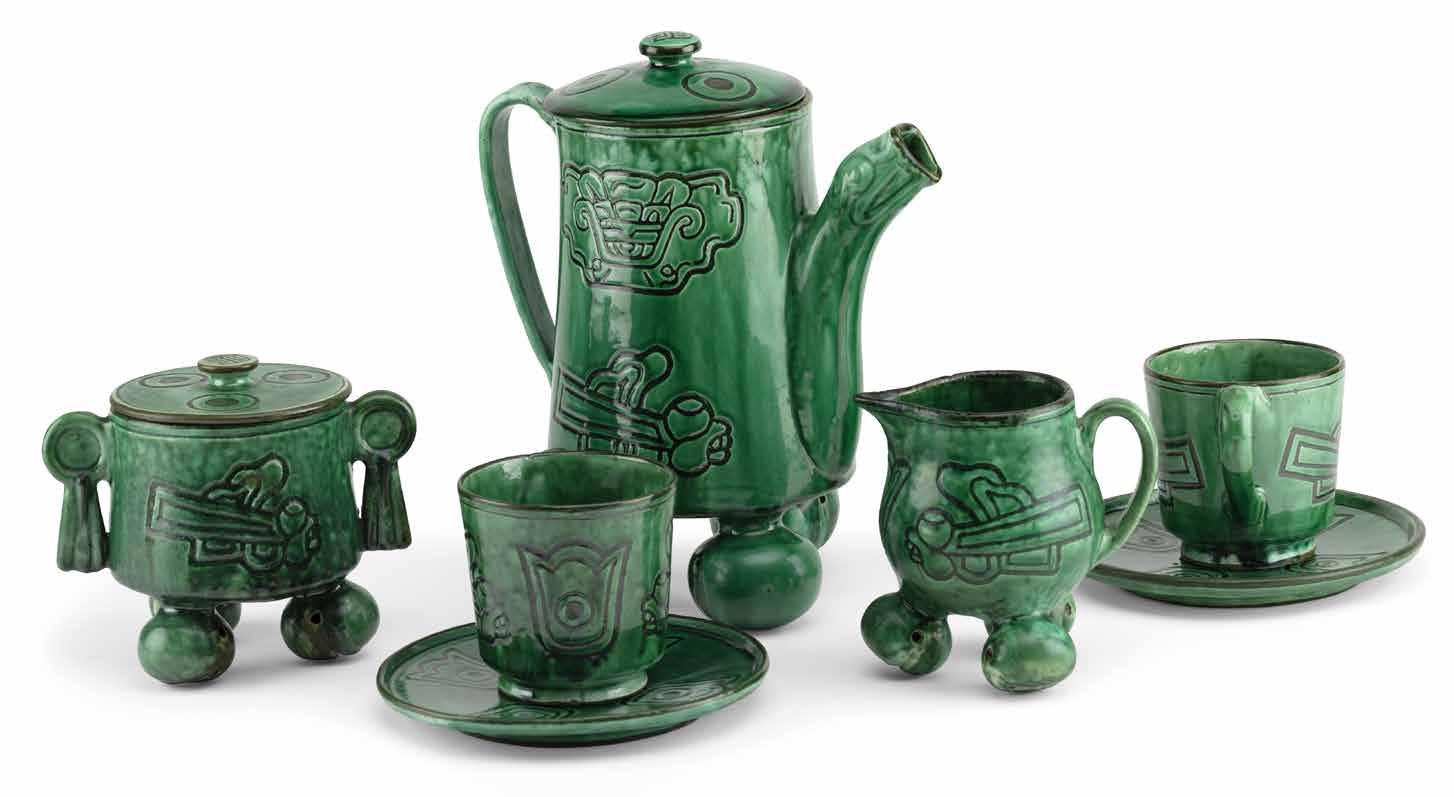
In Oaxaca, workshops such as Alfarería Jiménez, founded by Ignacio Jiménez in 1926, developed dishware inspired by Zapotec iconography. The Monte Albán series, with bright green glaze with echoes of Art Deco, and Mitla line, featuring stylized stepped frets on a milky white background, became objects coveted by visitors. The Brena family also produced dish sets with black glyphs, and gilded and cobalt blue details that were in popular in California and New Mexico.
In Taxco, a tourism enclave boosted by William Spratling’s silverwork, ceramist Félix Tissot introduced a signature ware that engaged in dialogue with international tastes in the 1950s. His Fantasía line linked artisanal production and community work with modern design and tourism; the pieces had whimsical shapes and decoration inspired by the amate paper paintings of Nahua communities in the Balsas River area, whose motifs were added by those groups to ceramics that Tissot finished in his workshop.
In Tonalá the Jalisco pottery tradition was adapted to this market with so-called “ceramics for Gringos”: decorative pieces with Mexican motifs and stereotypes devised for export. These ceramics contributed to consolidating the international style of Mexican housewares.
Alfarería Jiménez | Monte Albán coffee set, ca 1950 Thrown on a wheel, molded, decorated with copper oxide | Oaxaca de Juárez, Oaxaca Coll. Rodrigo Flores
Félix Tissot | Fantasía Line vase, ca. 1970
Low-fire ware, hand-painted by artisans from Ameyaltepec, Guerrero | Taxco, Guerrero Modern and Contemporary Design Collection of the Museo Universitario Arte Contemporáneo MUAC (DiGAV, UNAM)
INDUSTRY, CERAMIC ART AND EXPERIMENTATION
During the second half of the twentieth century, ceramics in Mexico found fertile ground where art, industry, and material experimentation converged. Painter José Feher, founder of Cerámica de Texcoco, explored the visual potential of the medium by transferring a language close to modern painting to dishes, murals, and utilitarian objects. In his work, color and formal synthesis turned surfaces into pictorial fields. Granted permission by the Instituto Nacional de Antropología e Historia (National Institute of Anthropology and History) to make reproductions of archaeological pieces, Feher directly approached shapes from the preHispanic past; this experience permeated the vocabulary of part of his personal production, where silhouettes, relief decoration, and textures evoke the Mesoamerican ceramic tradition from a modern sensibility.
In parallel, ceramist and engineer Ian Knizek, trained in Europe and living in Mexico since the late 1930s, combined scientific research on refractory materials with intense artistic experimentation. His pieces explored the effects of glazes, firing atmospheres, and chemical reactions in the kiln, a quest that generated surfaces of great chromatic richness in which controlling fate became an essential part of the creative process.
In the field of production, Noé Suro Olivares founded Cerámica Suro in Guadalajara in 1951, initially devoted to the production of white pottery for commercial fairs and department stores. In turn, Taller Maja—a workshop founded in San Ángel by Maja Gruebler and later directed by Margaret Bryan Hartshorne de Carrasco— developed refined dishware with costumbrista scenes that were widely disseminated in tourist and international markets.
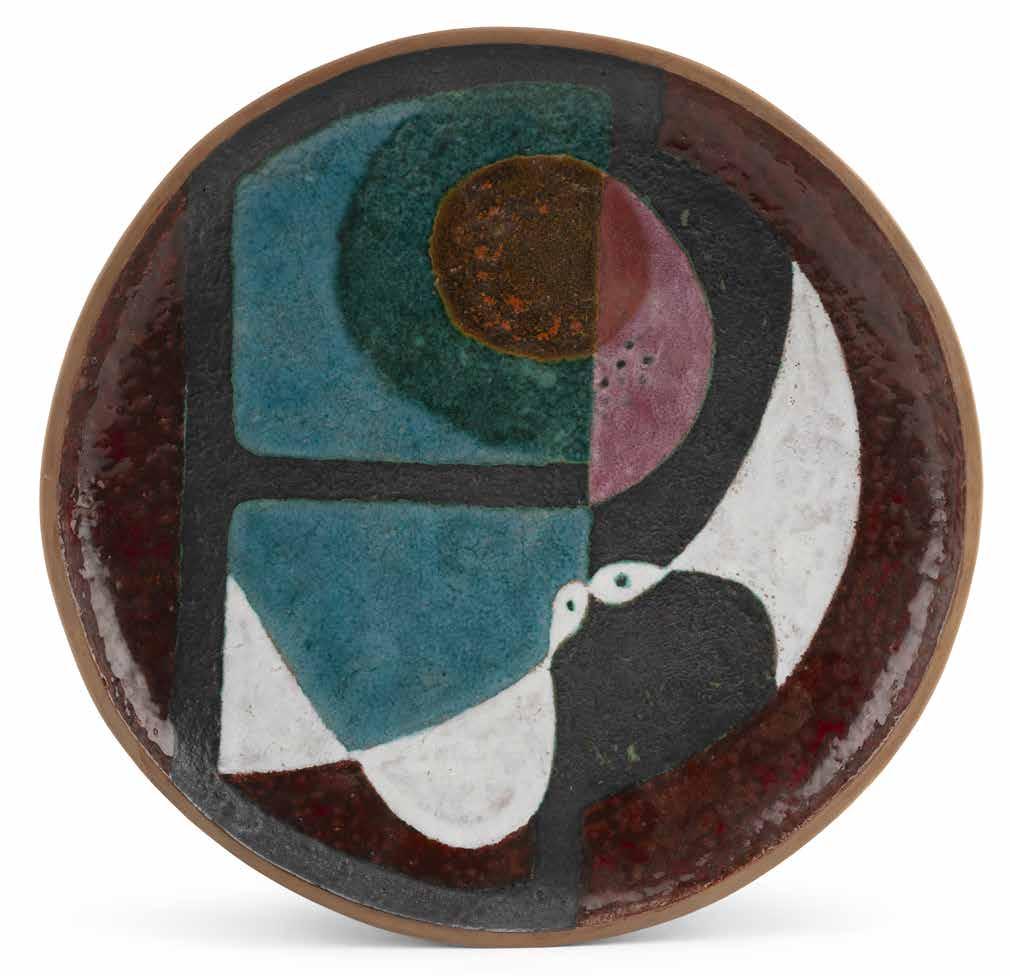
José Feher (for Cerámica Texcoco) | Plate, 1957
Painted and glazed | Texcoco, State of Mexico
Coll. Daniel and Pablo Feher
THE ARRIVAL OF HIGH-FIRE WARE IN MEXICO
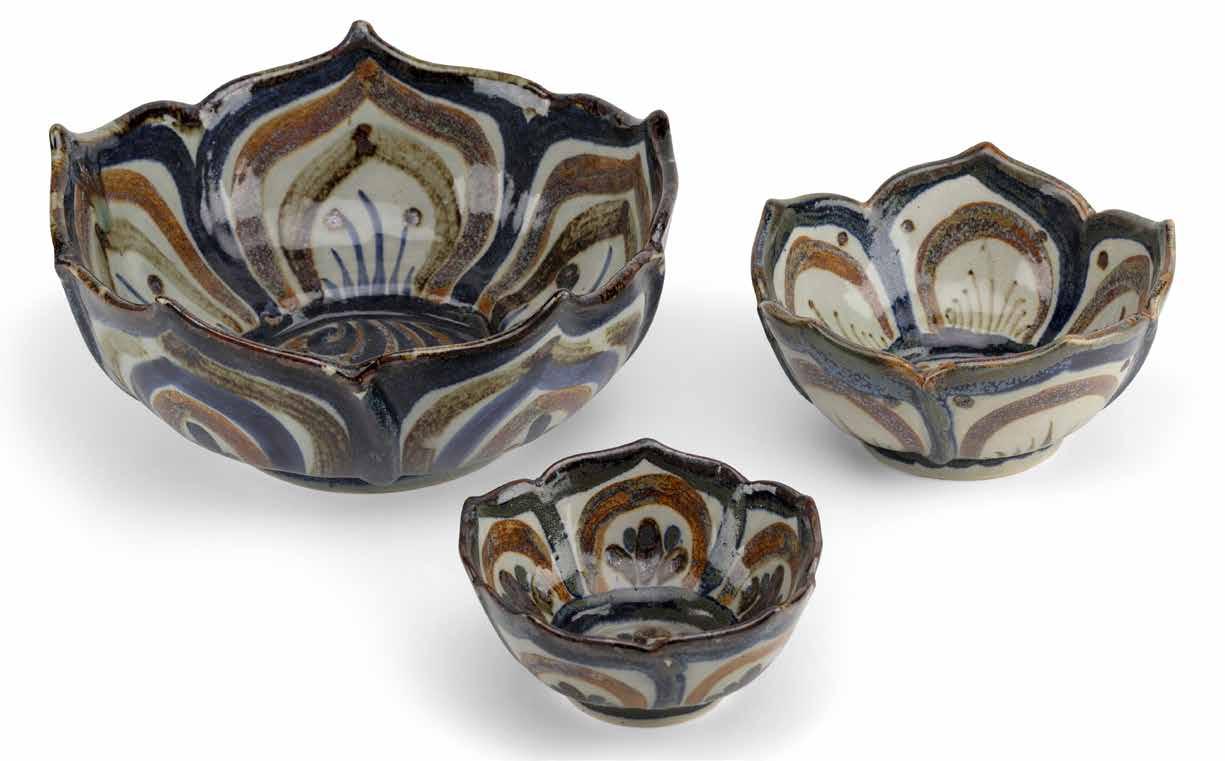
In the late 1950s, the pottery tradition of Tonalá underwent a decisive transformation with the introduction of high-fire or stoneware ceramics. This change was prompted by the meeting of two key figures: Mexican ceramist Jorge Wilmot and American artist Ken Edwards. Edwards came to Mexico in 1955 and initially settled in Guadalajara. Between 1957 and 1958 he constructed the region’s first high-fire kiln, where he began to experiment with glazes and new ways of firing. Interested in the technical knowledge of local artisans, he moved to Tonalá, collaborated with traditional pottery painters such as Magdaleno Ramírez, and incorporated techniques such as burnishing into his stoneware pieces. His objects—plates,
Ken Edwards | Set of bowls, ca 1970
Hand-painted stoneware | Tonalá, Jalisco
Private collection
pitchers, lamps, and figures—were filled with motifs from flora and fauna. Each of his pieces was distinguished by the signature “KE,” accompanied by monograms that identified each artisan in the workshop.
In turn, Jorge Wilmot, trained at the Academy of San Carlos in Mexico City and with ample experience in European workshops, arrived in Tonalá in 1959, interested in studying local traditions. Fascinated by the decoration of burnished pottery, he organized the cooperative Talleres Tonalá together with various artisans from the region. His meeting with Edwards in 1960 showed him the possibilities of the high-fire kiln. From then on, Wilmot developed new glazes and perfected techniques inspired by Japanese ceramics, such as celadon.
The introduction of stoneware not only transformed the technical processes of Tonalá pottery, but it also opened new markets and cultural circuits. During the 1960s, these pieces began to be exhibited in galleries, museums, and popular centers such as the Bazaar Sábado, thus consolidating high-fire ceramics with an artistic discipline within the panorama of design and modern folk art in Mexico.
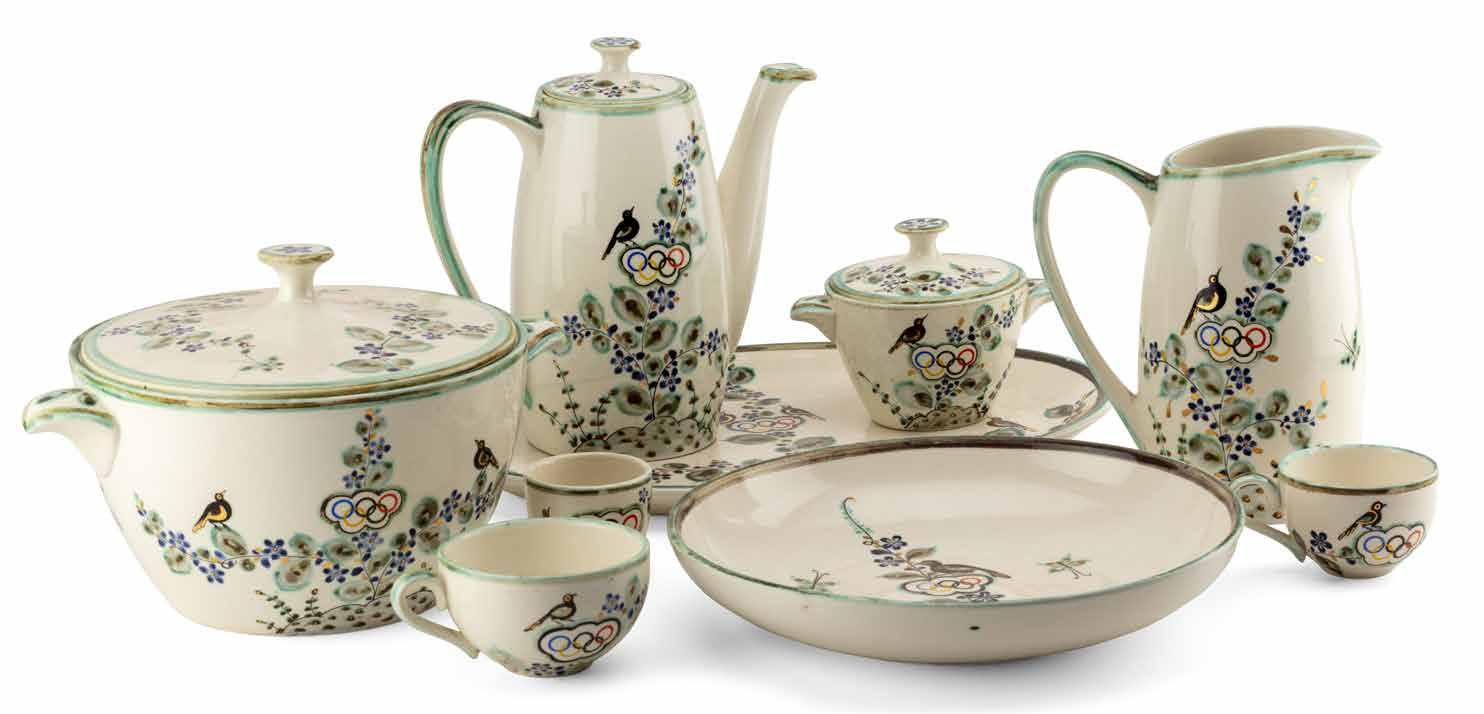
Jorge Wilmot | Olympic Games tableware 1968, 1968
Stoneware, decorated with glazes | Tonalá, Jalisco Coll. Cocina Cinco Fuegos/Lilia Martínez
TRADITION REVISITED: MAJOLICA FROM GUANAJUATO
Parallel to the exploration of high-fire stoneware, some creators undertook a critical revision of historical glazed ceramic traditions in Mexico. Noteworthy examples include Gorky González and Javier Hernández Capelo. From Guanajuato they promoted a new reading of Majolica, a technique that was originally introduced in Mexico during the viceregal period.
Born in Michoacán, González came to San Miguel de Allende at an early age. There he studied at the Instituto Allende and participated in the workshops promoted by Canadian artist and designer Gene Byron. After collaborating with her on the production of molds for terracotta pieces, he did in-depth research on the history of Majolica in Mexico, traveling to historical centers of production such as Jalisco, Puebla, Aguascalientes, and Dolores Hidalgo. Later, he perfected his technical knowledge in Japan, where he stayed for more than two years. Returning to Mexico in 1967, he settled in Guanajuato and opened a workshop devoted to recovering pottery practices from the Bajío region in utilitarian and decorative pieces.
In 1979 in the same city, architect and designer Javier Hernández Capelo founded the workshop Alfarería Mayólica de Guanajuato, where he promoted the recovery of this tradition in murals, sculptures, and utilitarian objects. In a context where Majolica had declined notably in quality and prestige, both creators contributed to recovering its shapes and elevating its techniques. By incorporating the use of high-fire technology into some pieces, they positioned Guanajuato as a contemporary landmark of Mexican pottery.
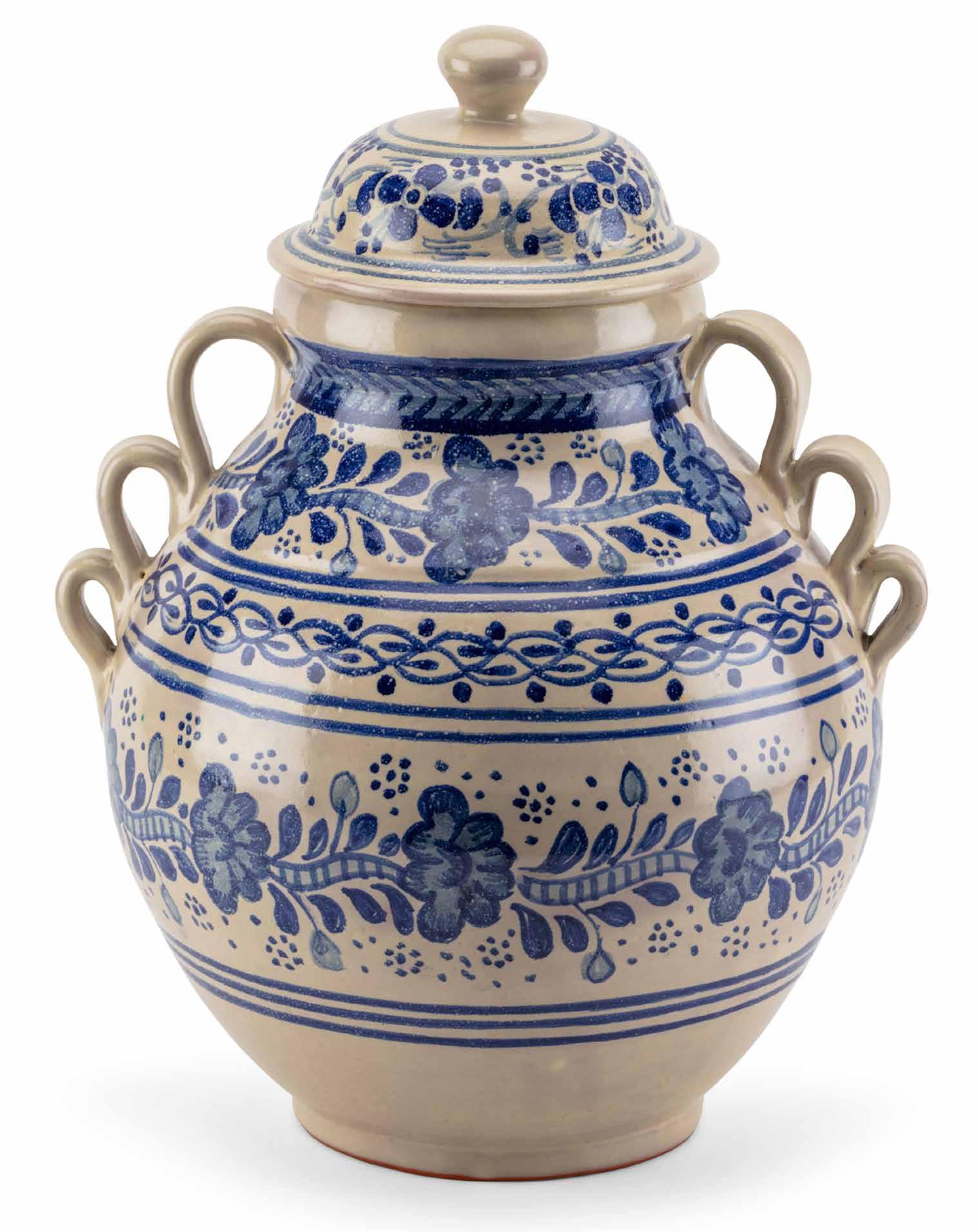
Gorky González Quiñones | Tibor (vase) with lid and handles, 2000
Thrown on a wheel, tin glazed, polychromed (Majolica) | Guanajuato, Guanajuato
Coll. Fomento Cultural Banamex, A.C.
CERAMICS AS ARTISTIC LANGUAGE
In the 1960s and 1970s, high-fire wares in Mexico ceased to be solely a technical innovation to consolidate their position as an autonomous artistic language. This process was advanced by the group Cono 10, composed of Graziella Díaz de León, Manola Ruiz, Hilda Sustaeta, Hugo X. Velásquez, Aurora Suárez, Irma Peralta, Eglantina Ochoa, Enrique Rangel, and Alberto Díaz de Cossío. Its members understood that stoneware— introduced by Ken Edwards and refined by Jorge Wilmot—offered fertile ground for formal experimentation.
Trained in dialogue with stoneware and with the rise of the Studio Craft Movement in the United States, these artists and designers understood that ceramics could be a means of formal and conceptual exploration comparable to painting or sculpture. In this context, Alberto Díaz de Cossío stood out; since the late 1960s, he cultivated systematic research on high-fire ware and established the Taller Experimental de Cerámica in Coyoacán. This space, dedicated to exploring pastes, glazes, and firing atmospheres became a benchmark for the development of stoneware in Mexico.
Alberto Díaz de Cossío Carbajal | Vase with bagpipe drones, 2019 High-fire ware | Mexico City Coll. Taller Experimental de Cerámica Díaz de Cossío
Hugo X. Velásquez | Seagull, Seagull, Balance Whiz . . . , 2005 Porcelain, shaped with a slab and thrown on a wheel, glazed Taller Tornavuelta Cerámica al Humo, Cuernavaca, Morelos Coll. Velásquez Suárez family
In turn, Hugo X. Velásquez—trained in New York and close to ceramic communities connected to the Black Mountain College legacy—opened workshops in Tacubaya and later in Cuernavaca together with ceramist and architect Aurora Suárez. From there he promoted the production and dissemination of contemporary ceramics.
EXPANDING THE PROFESSION AND DEMOCRATIZING EVERYDAY OBJECTS
Throughout the twentieth century, the formal teaching of ceramics was fundamental for strengthening the profession and bringing utilitarian pottery objects closer to a wider public. Diverse educational institutions championed this transformation, including the Taller de Artesanos Carlos Lazo (1952), Centro Superior de Artes Aplicadas (1958), and the Escuela de Diseño y Artesanías del INBA (1961), by incorporating technical ceramic instruction into academic programs aimed at design and the applied arts. Similarly, the ceramic workshop of the Department of Visual Arts of the Universidad Iberoamericana, opened in the mid-1950s, contributed to educating new generations of designers interested in clay as a means of expression and production. From these training centers, workshops emerged that also served as schools and spaces to share techniques, knowhow, and experimental processes. The Taller Experimental de Cerámica de Coyoacán, Hilda San Vicente’s workshop El Olvido, and the Patamban pottery project—promoted by Ricardo Calderón and Catalina Bony with state government support to install highfire kilns—exemplified this learning network. They modernized forms and decoration, while preserving local traditions.
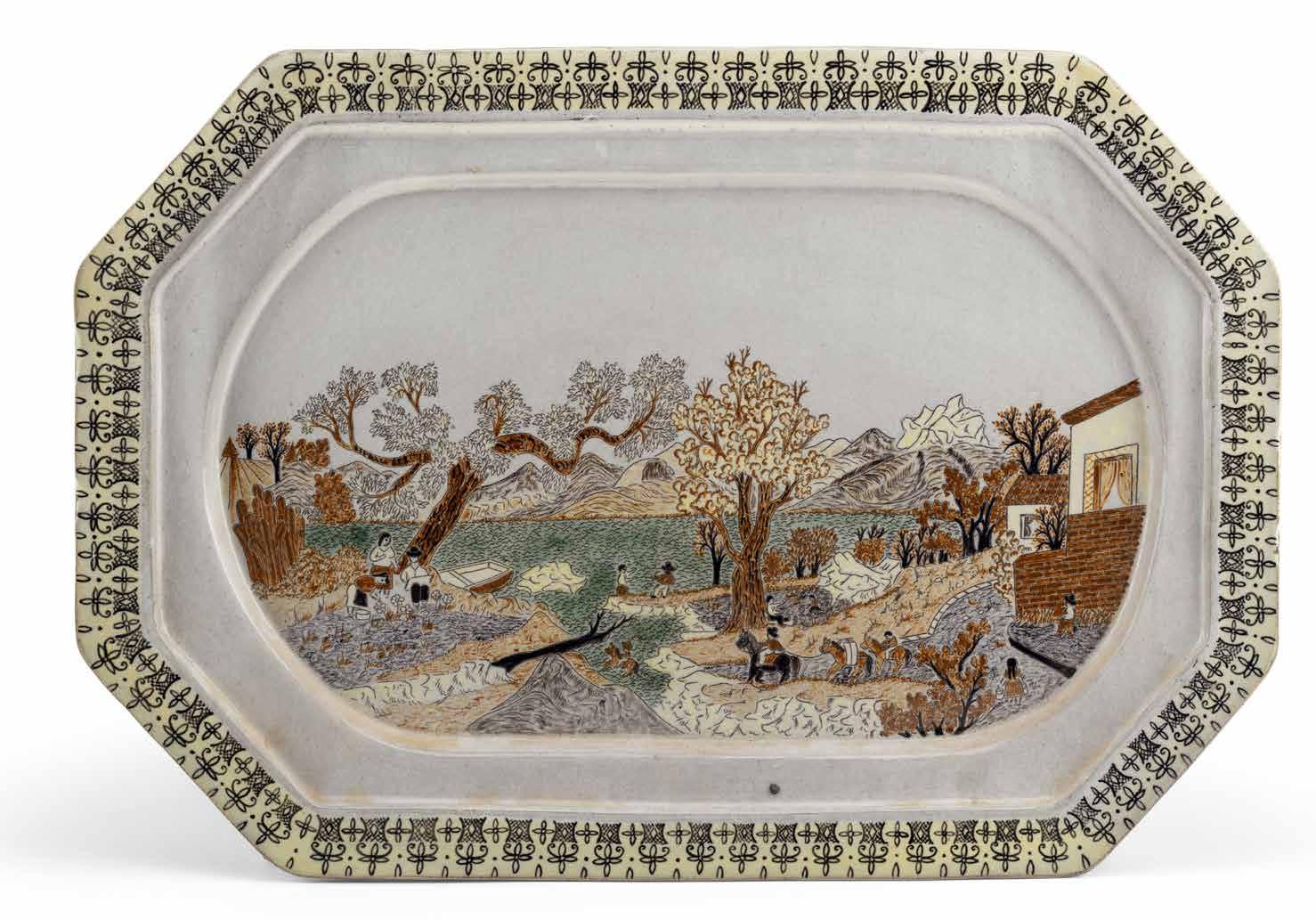
Martín Alonso (for the Cooperativa Alfareros de Patamban, social solidarity partnership)
Rectangular platter with traditional landscape, 1987
Patamban red high-fire ware, traditional decoration | Patamban, Michoacán Coll. Taller 36
These projects fostered the wider circulation of utilitarian ceramics—dishware sets, pitchers, plates, and containers—in a dynamic consolidating the democratization of everyday objects and reinforcing the continuity of this work in new generations.
GUSTAVO PÉREZ: A BRIDGE BETWEEN
TWO WORLDS
Gustavo Pérez’s work represents a turning point in the recent history of Mexican ceramics; a true pivotal moment between pottery tradition and contemporary pursuits in art and design. Initially trained as an architect at the Universidad Nacional Autónoma de México (Autonomous National University of Mexico), Pérez approached clay in the 1970s and discovered the capacity to articulate thought, matter, and form through this medium.
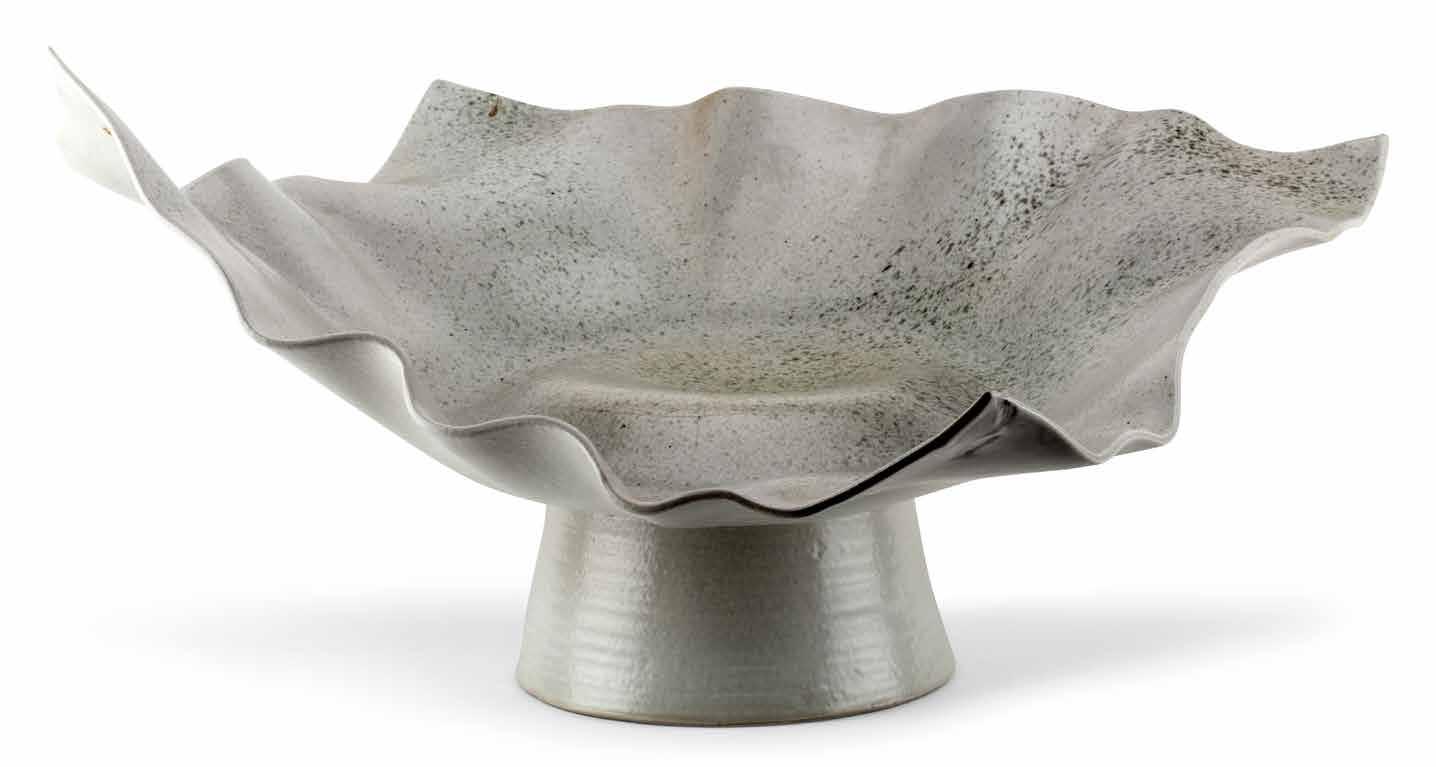
His arrival in Xalapa, Veracruz, marked a decisive moment. There he developed a profoundly experimental practice that took the traditional vessel to new formal heights. In his pieces, the geometry of the vessel is stressed, folded, or split: the surface of the clay is torn, cut, or opened to reveal inner tensions. Accidents—cracks, breaks, irregularities—become an essential part of the creative process.
Pérez meticulously explores the qualities of clay and control of fire through the use of slips and glazes that accentuate textures and underscore fracture lines. His works alternate between container and sculpture; equilibrium and rupture.
Internationally renowned, Gustavo Pérez has positioned Mexican ceramics on the contemporary art and design stage. His career shows that clay can be, at the same time, an ancestral memory and a radically contemporary language.
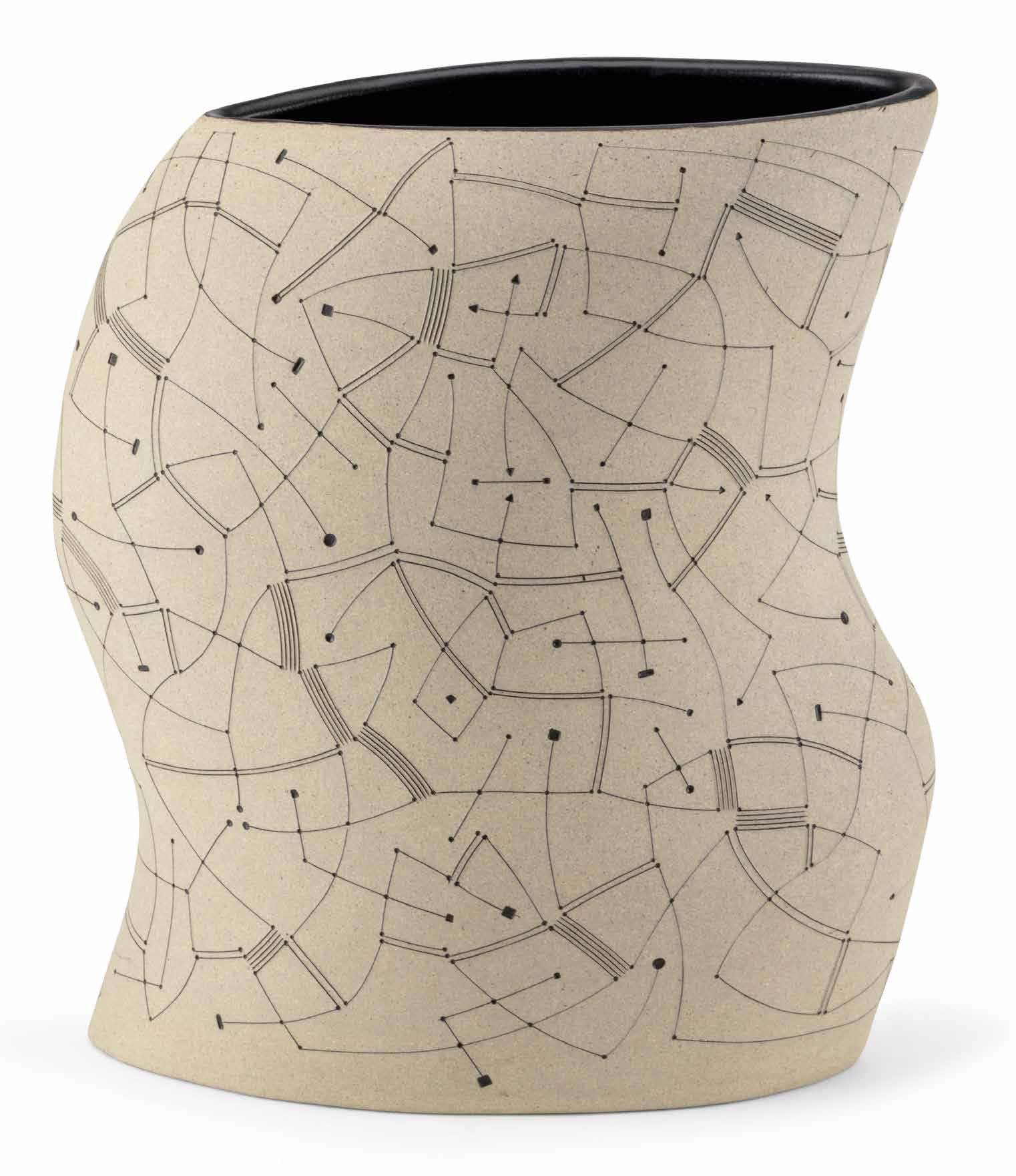
Gustavo Pérez | 75-92, 1992
Stoneware | Coatepec, Veracruz
Coll. Gustavo Pérez
Pérez | 19-78, 2019
Gustavo
Stoneware | Coatepec, Veracruz
Coll. Gustavo Pérez
Gustavo Pérez | 22-53, 2022
Stoneware | Coatepec, Veracruz
Coll. Gustavo Pérez
POLYPHONY: NEW LANGUAGES, NEW PATHS
In recent decades, ceramics has gained renewed interest in the panorama of international art and design. What was long regarded primarily as an artisanal or utilitarian practice has become a privileged field of experimentation. Today, it can be said that clay stands in a fertile, hybrid territory where tradition, innovation, and material thought coexist in tension.
To understand this shift it is worth revisiting the concept of “confrontational ceramics,” proposed by historian and curator Judith S. Schwartz, which describes practices that challenge the disciplinary limits of the medium. In the Mexican context, this notion allows us to observe the transformation of utilitarian ceramics—historically linked to daily life—to a critical space where hierarchies between art, design, and folk art are reexamined.
Ceramics, traditionally thought of as a collective practice—with shared creation in family or community workshops—is now also a field where notions of authorship, discipline, and gender are being rethought. In the workshop, former divisions between masculine and feminine labor are being questioned; the pottery wheel, historically associated with male strength, today exists parallel to strategies of assemblage, manual construction, and material experimentation making it possible to achieve new scales and innovative forms.
In this contemporary polyphony, utilitarian pottery is displaced from the everyday realm to become a critical language capable of articulating not only memory, but also design and material thought.
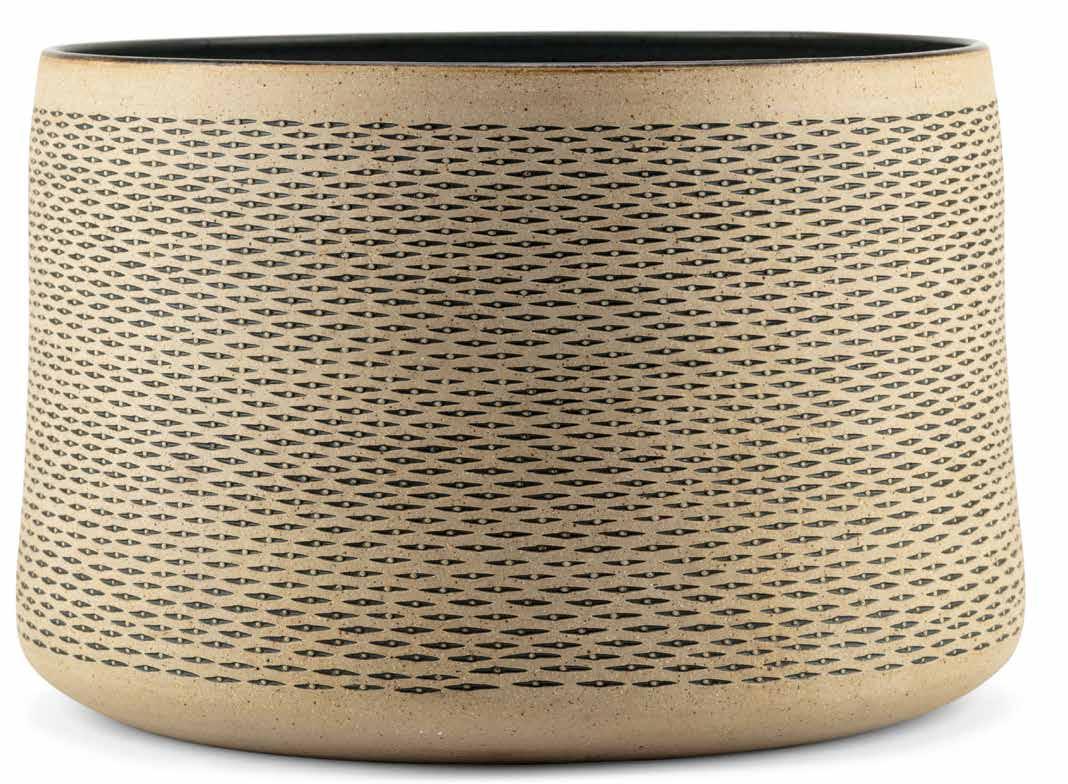
Uxi [Eugenia Díaz Peón] | Untitled, 2021
Mixed clays from Yucatán, low-fire ware, hand-thrown, natural finish
Mérida, Yucatán
Coll. Eugenia Díaz Peón / Uxi
Uxi [Eugenia Díaz Peón] | Untitled, 2021
Mixed clays from Yucatán, low-fire ware, hand-thrown, natural finish
Mérida, Yucatán
Coll. Eugenia Díaz Peón / Uxi
MATERIAL AND MATERIALITY
IN CONTEMPORARY MEXICAN CERAMICS
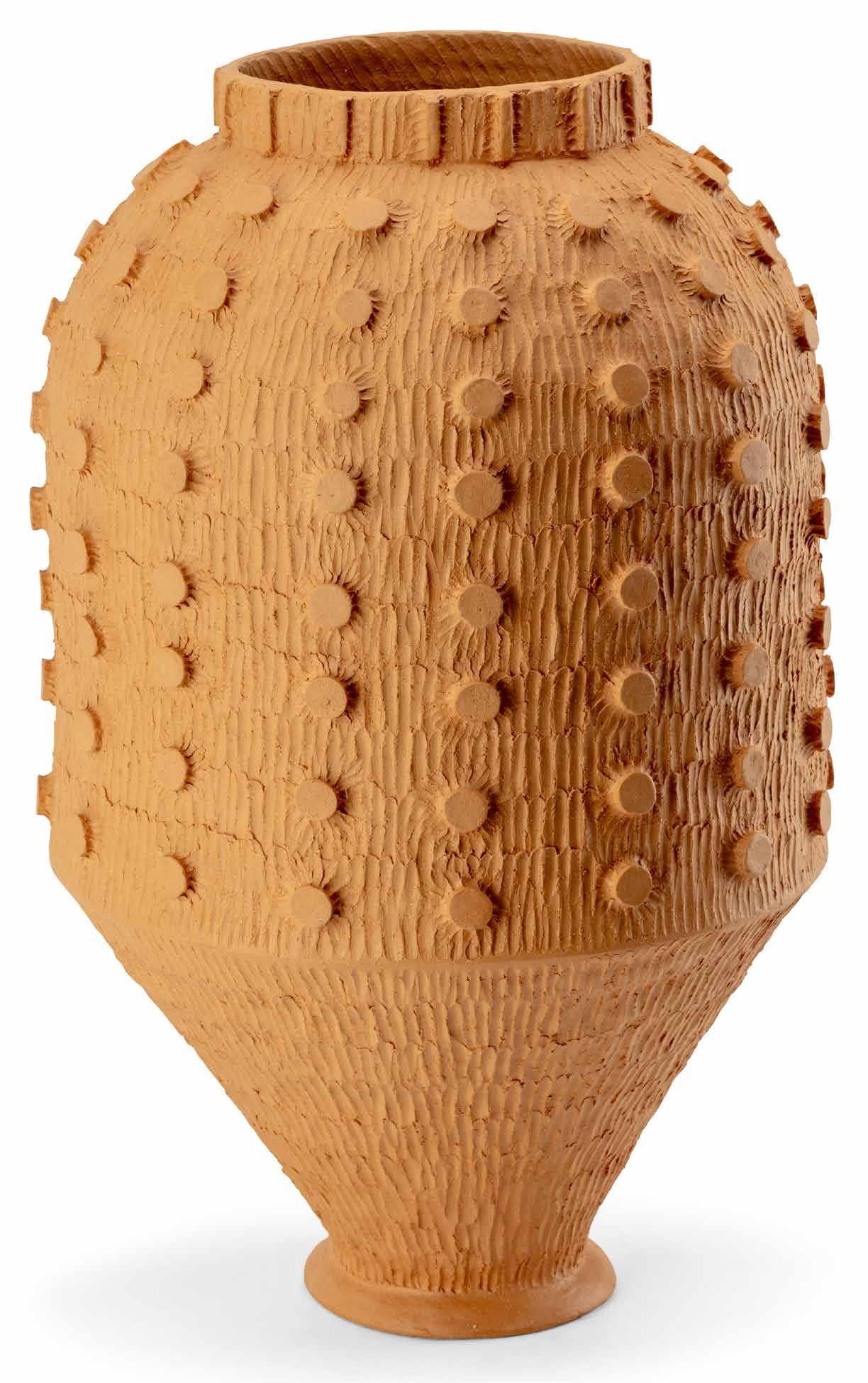
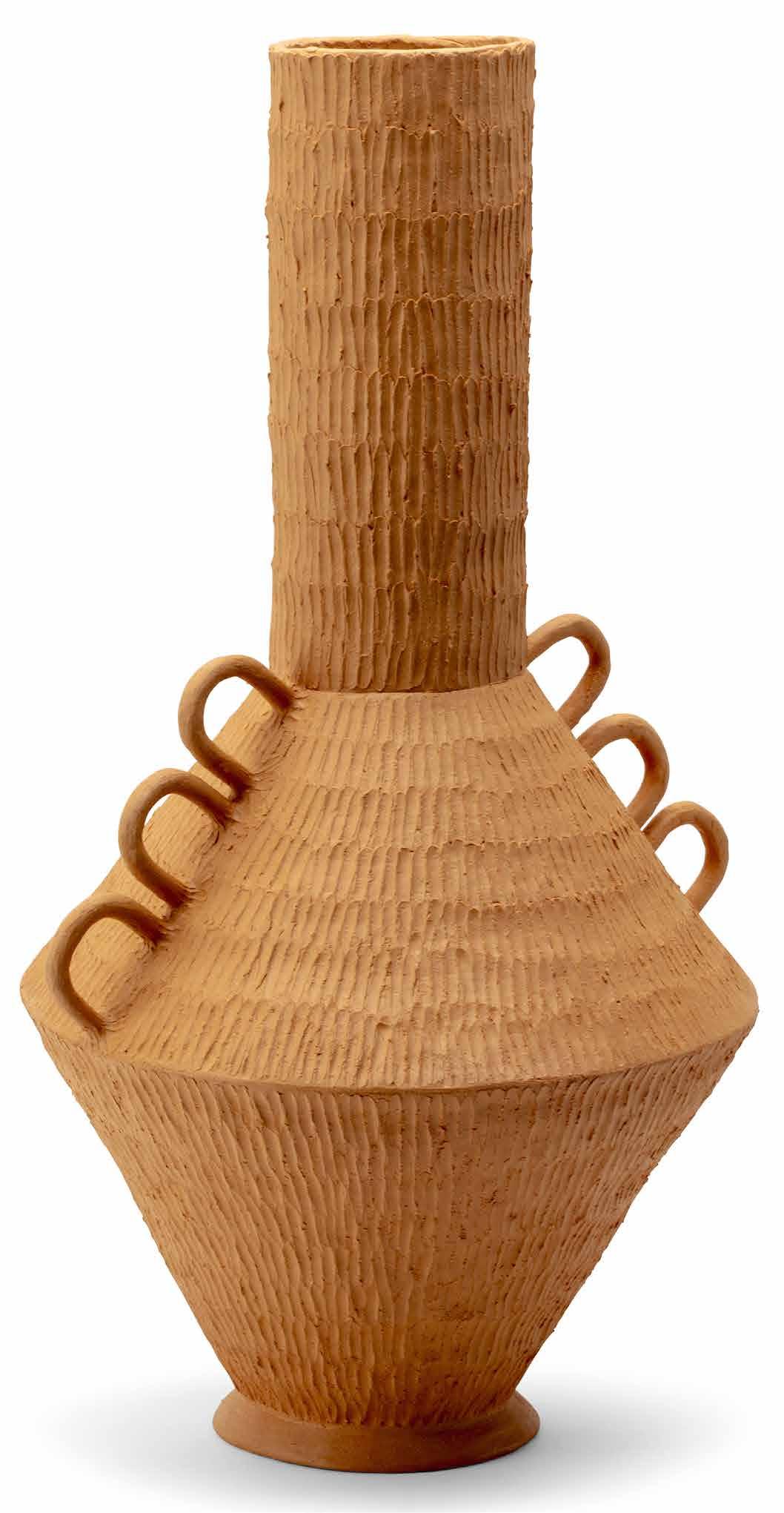
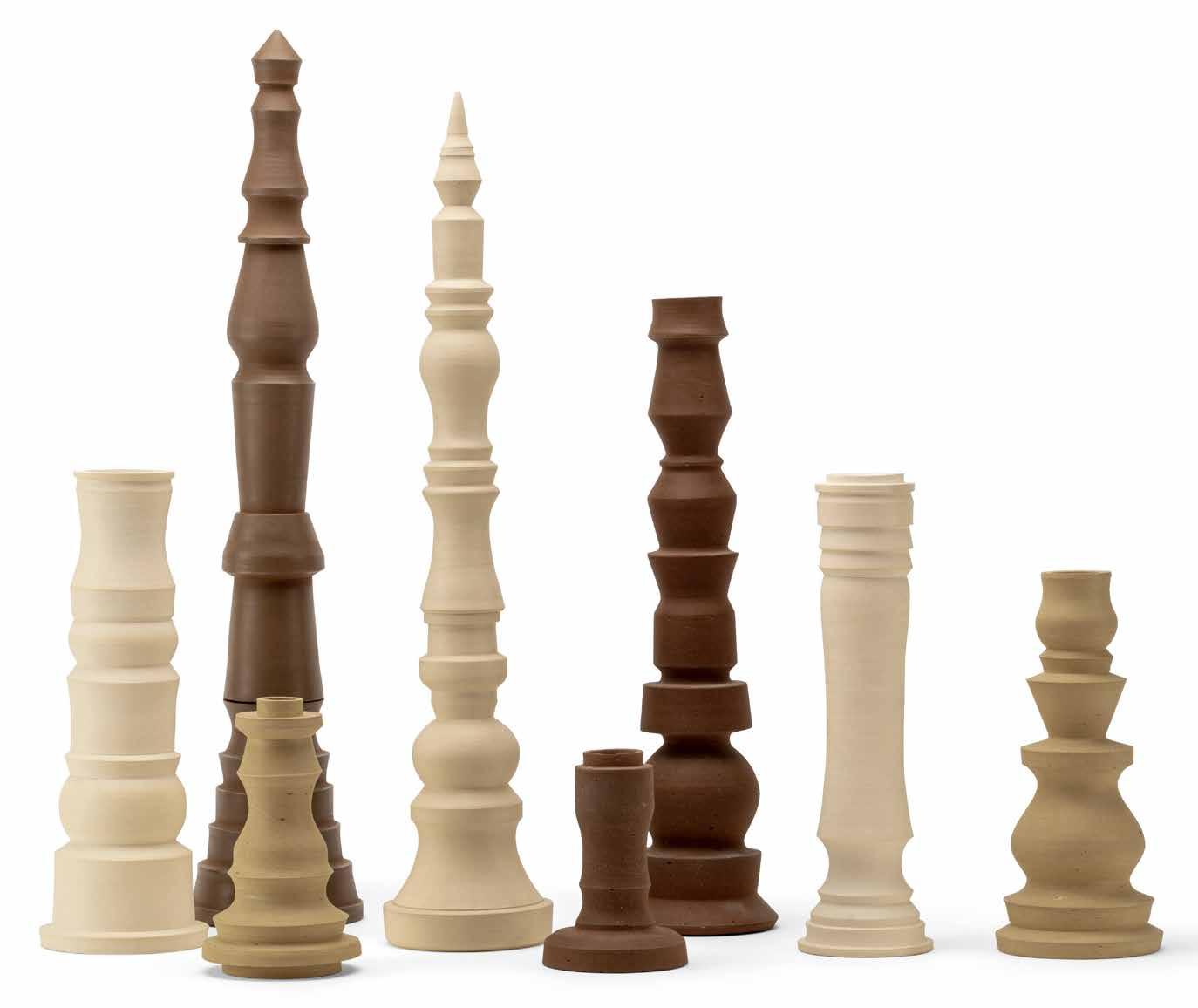
In contemporary Mexican ceramics, the material has ceased to be solely a support and has taken on a starring role. Clay—earth transformed by hands and fire—is presented as a field of experimentation where texture, weight, color, and fractures reveal the material’s expressive possibilities. Far from concealing the process, many of these pieces make it visible: from traces of modeling and stresses of drying to accidents of the kiln.
Within this framework, the creators assembled in this section explore ceramics from the perspective of diverse languages that blur the limits between art, design, and utilitarian object. Some pieces recapture the intimate scale of the vessel; others extend into the realm of furniture, installation, or the architecture of space.
Surfaces are torn, folded, pigmented, or assembled with other materials, revealing the intelligence of the material. In these works, ceramics tells the story of its own evolution beyond its container function. Each piece bears witness to the convergence of earth, action, and fire.
Popdots [Melissa Aldrete, Luis Cárdenas] | Sleepless Days (series 2) (a candle pun),, 2023 High-fire ware, hand-thrown | Zapopan, Jalisco Coll. Popdots
ENLIGHTENED CERAMICS
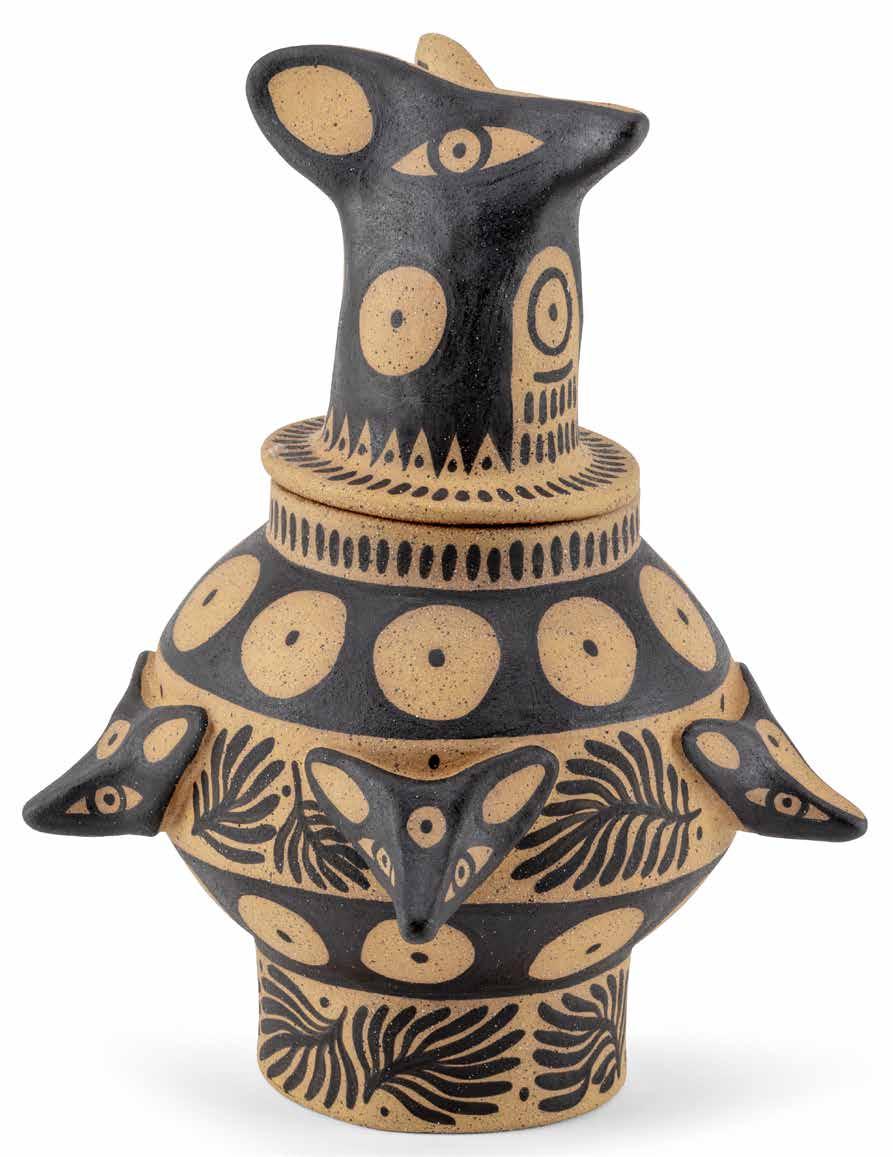
Enlightened ceramics proposes an encounter between drawing and the everyday object. On surfaces of mugs, plates, or bowls, clay is turned into a narrative support where lines, human figures, symbols, or texts unfold like stories accompanying the rituals of everyday life. More than mere ornamentation, these images are part of the very process of creation and intervene directly in the modeling and firing of the clay.
In this practice, the ceramist works simultaneously as a potter and an illustrator, designing, sketching, and drawing directly on the piece before its final firing, utilizing pigments, slips, or transfer techniques such as screen printing. Thus, each object preserves the spontaneity of the line and the trace of the artist’s hand, qualities that celebrate imperfections in the artisanal process.
In Mexico this language has received major impetus in recent years. A growing number of visual artists, illustrators, and designers have discovered an additional support in ceramics for drawing narratives that formerly inhabited paper, transforming them into three dimensions. Urban workshops, design studios, and small independent projects have found rich opportunities for experimentation with the image on utilitarian pieces.
Therefore, enlightened ceramics transforms drawing into a habitable object: a surface where utility, storytelling, and graphic action come together to accompany daily life with new forms of visual expression.
Perro y Arena [Sócrates M. Medina Ahearn] Coyotes Guardians of Secrets and Silence container/urn and incense burner, undated Medium-high fired ware, hand-modeled and painted with underglaze and interior glaze Tijuana, Baja California
Coll. Perro y Arena
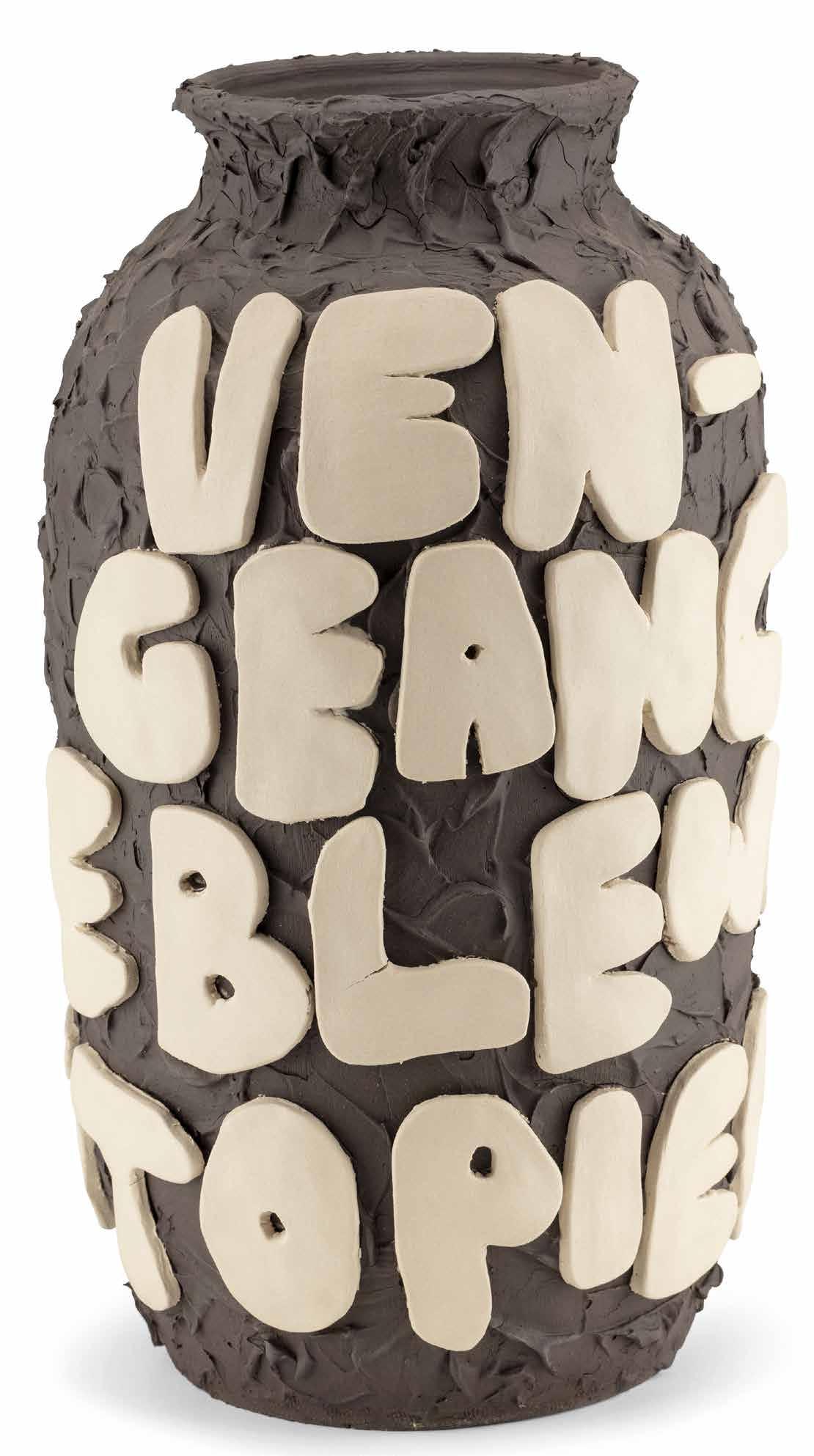
Lucila Rodarte Escobar | Vengeance Blew Us to Pieces, 2025
High-fire ware | Guadalajara, Jalisco Coll. Galería Enrique Guerrero
MAY – SEPTEMBER 2026
Monday to Sunday from 10:00 am to 7:00 pm
Monday to Sunday at 12:00, 2:00, and 4:00 pm
Saturday and Sunday at 12:30 pm
Silvia Verónica Heras Baro ja | 55 1226 0091 silvia.veronica.heras@banamex.com
Javier Ramírez | 55 1226 4574 francisco javier.ramirez@banamex.com https://fomentoculturalbanamex.org
Palacio de Cultura Banamex Palacio de Iturbide
Francisco I. Madero 17, Centro Histórico, Mexico City