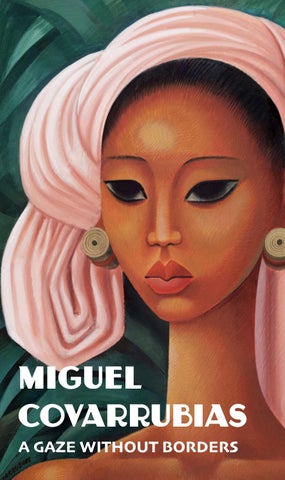
MIGUEL COVARRUBIAS A GAZE WITHOUT BORDERS
Banco Nacional de México, through Fomento Cultural Banamex, A. C., and the Fundación Diez Morodo, A. C. present the exhibition Miguel Covarrubias: A Gaze without Borders. Miguel Covarrubias (Mexico City, 1904–1957) was the most multifaceted Mexican artist of the twentieth century. His enormous talent in the visual arts, his interest in understanding the role of art in the modern world, his systematic use of industrial materials and media in his extraordinary career in publishing, his key role in anthropological, archaeological, museum exhibition, theater, and dance projects, as well as his irrepressible sense of humor are signs of an intelligence and wit that accompanied him in every chapter of his life. In the postrevolutionary period, when nationalism dominated culture and education in Mexico, Covarrubias was a keen, insightful observer of his country who strove to broaden his horizons to understand a world that was unfolding beyond the physical and cultural limits of his homeland. After a formative period working in the Mexican press—far from any form of academia—in 1923 he set out for New York, the metropolis where he brought new life to the world of caricature and drawing through his use of stylized lines, bold undulating forms, and geometric combinations, with spare strokes conveying the essential features of a vast typology of individuals constituting American society of the time. His portraits bolstered recognition of the image of the New Negro movement in what was known as the Harlem Renaissance. Then, starting in 1930, he delved into the geography of the Pacific and the island of Bali as he embarked on one of the most dazzling ethnographic undertakings of the time. It is where he zealously studied the ritual meaning of artistic and religious expressions of local communities as testimonies to the human condition. When he returned to Mexico in the late 1930s, now one of the most noteworthy illustrators in publishing worldwide, he channeled his creative energy to researching Indigenous art and archaeology, as well as to teaching, exhibition design, and the performing arts. With his quick intellect, his pioneering work enhanced knowledge of pre-Hispanic art with a special emphasis on Olmec culture, and he expanded our understanding of its origin and influences in the Mesoamerican world that has been the foundation of research to this day. This exhibition offers a wide-ranging panorama of the many creative facets he explored, in order to shed light on the central place that he occupies in the history of art from Mexico and beyond. Miguel Covarrubias was a cosmopolitan artist who never wanted to see human limitations in borders.
Taylor Gordon Singing to New York’s High Society (detail), 1929 Private coll.
1 ORIGINS Miguel Covarrubias Duclaud was born into an upper middle-class family near the end of the era of Porfirio Díaz. His father, José Covarrubias Acosta, was a civil engineer highly respected by scientists and intellectuals of the time who was appointed director of the Post Office during the Madero administration and director of the National Lottery, named by Venustiano Carranza in 1920. His father’s love of painting led him to teach drawing to young Miguel, who demonstrated notable skill from an early age. Covarrubias was a rebellious student. At the age of fourteen, he put an end to his formal education and began to work as a cartographic draftsman in the Ministry of Communications and then in newspaper offices, which gave rise to the nickname “Chamaco” (The Kid). His penchant for the bohemian life of the city center led him to cross paths with artists like Ernesto García Cabral, Dr. Atl (Gerardo Murillo), José Clemente Orozco, and Diego Rivera. Some of his earliest graphic collaborations in the press display the impressive freedom of his handling of line and his sharp visual acuity. At that time, he collaborated with Adolfo Best Maugard in illustrating the latter’s Método de dibujo (1923), an innovative book devoted to teaching elementary drawing methods based on the use of motifs taken from ancient art.
Vaudeville Team (also known as Strutt and Walker, The Dancin’ Fools), 1925 Private coll.
2 WORKING CLASS CHARACTERS The designation tipos populares (common people) is known especially from chroniclers and travelers during the final stages of the viceroyalty and into the nineteenth century. This section features drawings of working-class characters—for the most part anonymous—through whom he wished to portray people from different parts of the country with a picturesque touch. In this group of works, the painting The Bone—featuring a rural figure, whose coat bears a tricolor pin signaling his affiliation with the official party, founded in 1929—offers a biting commentary on Mexican political culture. Covarrubias painted a bone on the floor to allude to a system that favored political ties over individual abilities. The Bone, ca. 1940 Coll. Museo Nacional de Arte, inba, Mexico City
3 HARLEM RENAISSANCE After moving to New York City in 1923 and with the support of José Juan Tablada and Adolfo Best Maugard, Miguel Covarrubias employed his talents as a draftsman and visual art essayist. In 1925 he met the dancer Rosemonde Cowan Ruelas, who would later be known as Rosa Rolando. As jazz was in full swing, the world of Afro-American culture became a laboratory where the young artist experimented with materials like gouache and oil paints, producing stylizations and portraits that linked him to African-Americans artists of the time, such as Archibald Motley, Palmer Hayden, and Hale Woodruff. It would be fair to say that his earliest incursions into ethnography took place in Harlem, where he captured the mood of bars and theaters. Negro Drawings (1927), his second book published by Alfred A. Knopf, evokes a beautiful and singular universe composed of works with full aesthetic and conceptual unity. In that atmosphere, charged with naturalism and humor, the young Covarrubias created several of his early masterpieces.
Jazz Orchestra, ca. 1925 Private coll.
4 METROPOLITAN GLITTER Now in full command of his skills as a draftsman ably applying color to journalistic design, Miguel Covarrubias became a renowned illustrator in widely circulated magazines underpinning New York modernity (such as Vanity Fair, Vogue, and The New Yorker). At the dawn of the age of technical reproduci bility, his work was integral to materials that defined the state-of-the-art publishing industry. The materiality of the resources he employed—primarily synthetic gouache and elements related to the graphic printing of magazines— promoted the contemporaneity of his work, linked to the methods and ways his production was disseminated. The manifestos-caricatures-drawings that circulated throughout the United States gained enormous popularity. The “Impossible Interviews” series (done between 1932 and 1936) show an artist fully integrated into the metropolis and an innovator who interconnected multiple themes and characterizations, referencing different latitudes and an advanced vision of the process of comprehending cultural diversity as a fundamental value of all humanistic endeavors, in which humor played a decisive role.
Impossible Interviews: Sigmund Freud vs. Jean Harlow (detail), 1935 Coll. Prints and Photographs Division, Library of Congress, Washington, D. C.
Our Changing Tastes . . . in 1938, 1938 Coll. Prints and Photographs Division, Library of Congress, Washington, D. C.
5 AN ETHNOGRAPHER IS BORN: BALI In the early 1930s, Miguel Covarrubias and his wife, the dancer Rosa Rolando, took two trips to Bali, a small volcanic island in Southeast Asia, at that time under Dutch colonial control. During their first stay, which lasted nine months, to celebrate their honeymoon, Covarrubias discovered a colorful and sensual world in Bali inhabited by powerful Hindu deities and traditional ways of life, completely different from the urban world they came from. In addition to the European intellectuals who were living on the island, Gusti Alit Oka, a carpenter prince, and other Balinese friends introduced them to local ritual life and artistic traditions. In 1933 they returned to the island, this time staying for twelve months, during which they undertook intense work documenting activities in the realm of theater and dance, as well as lavish ceremonies surrounding cremation. The experience of closely studying a foreign culture transformed the young draftsman into an ethnographer. His book, Island of Bali (1937), marked the start of a new stage for Covarrubias as a scholar of Indigenous arts by putting to use his enormous capacity for communicating the foundational values of a culture through text and image.
Balinese Woman (detail), ca. 1934 Private coll.
6 THE PACIFIC IN THE CENTER In 1939 Covarrubias produced a series of six map murals for the main pavilion of the Golden Gate International Exposition in San Francisco, California, a cultural fair that celebrated the construction of the emblematic bridge and consolidated the coastal city as a port extending the reach of the United States towards the Pacific. A noteworthy feature of these maps was the positioning of the Pacific Ocean in the center of the composition, which made it possible to situate the basin as a dynamic and historically interconnected space. In his maps of the Pacific, Covarrubias offered an alternate vision of geopolitics, also associated with didactic purposes that accompanied his subsequent cartographic work. The project was also tied to his participation in the iconic exhibition on the arts of the South Seas at the Museum of Modern Art in New York (1946) and to the exchange program carried out with the Field Museum of Chicago, between 1948 and 1952, which enabled Mexico to acquire its earliest ethnographic collection of materials from Pacific and North American cultures.
The Flora and Fauna of the Pacific, 1938 Private coll.
7 RED AND SILK Miguel Covarrubias visited China on two occasions, both times on a stop over on his way to his final destination: Bali. The first visit, in 1930, was brief but significant because it enabled him to collect material to illustrate Marc Chadourne’s book, Chine (1931). During his second visit, in 1933, he forged friendships with Chinese artists and intellectuals, who were familiar with his work thanks to its publication in Vanity Fair; his drawings were highly popular, to the point that they were often imitated. His interest in China endured and was expressed in his political commitment to the new China of Mao Zedong and his membership in the Mexican Society of Friendship with Popular China in 1953. What stands out from that period is his remarkable use of brush calligraphy to illustrate the great novel of the Ming dynasty, Shuihu zhuan, published under the title All Men Are Brothers, in 1948. 8 MAPS AS TOOLS In educational cartography, Covarrubias conceived of maps as a visual tool for understanding the cultural dynamics of different territories. The successful formula that he developed for his maps of the Pacific was later applied to the geographic representations of Mexico and the United States. In the 1940s and 1950s, Covarrubias carried out several commissions for map murals of Mexico highlighting different subjects. An outstanding piece from this period is his work Geography of Folk Art in Mexico of 1951, a dismountable map- mural created for the newly inaugurated National Museum of Popular Arts and Crafts, and intended to offer an overview of the wealth and diversity of Indigenous arts of the time through the hands of their creators.
9 LAND OF THE SUN Between 1926 and 1942 Covarrubias went on more than a dozen trips to the Isthmus of Tehuantepec, driven by his interest in exploring the ethnology, archaeology, and history of the region that he came to regard as the origin of Mesoamerican culture. With great ethnographic diligence, he gathered information on the Huave, Zapotec, and Mixe-Zoque peoples. The result of that comprehensive research was Mexico South: The Isthmus of Tehuantepec (1946), a book profusely illustrated with drawings, maps, and paintings complemented by photographs taken by Rosa Rolando. In the text on Zapotec culture, Covarrubias described an egalitarian society in which women played a predominant role in the social order. The sumptuousness and bright colors of Tehuana women’s attire are presented as fundamental components of a culture that continues to be a source of the affirmation of cultural identity.
Huapango (detail), ca. 1942 Private coll.
10 THE EAGLE, THE JAGUAR, AND THE SERPENT This section is on one of the most ambitious intellectual projects ever undertaken by Covarrubias: a trail-blazing three-volume history of art from the Americas intended to present an overarching panorama of Indigenous art on the continent. Covarrubias devised three major areas: North America (the eagle), Mexico and Central America (the jaguar), and South America (the serpent). However, his premature death in 1957 only allowed him to complete the first two volumes illustrated with rigorously detailed paintings, myriad ink drawings, diagrams, and maps, giving us insight into a continental dimension, historical perspective, and visual richness of the Indigenous world of the Americas. On its pages, he addressed the possibility of trans-Pacific contacts, a subject that he never lost interest in. His analysis of form and archaeological drawings, created with millimetric precision, make it possible to approach these works with the gaze of a polymath, capable of answering questions raised by the study of cultures of the past.
Female Figure, ca. 1942–1957 Coll. The Metropolitan Museum of Art
11 OTHER FORMS, OTHER WORLDS By the 1940s the priorities of Covarrubias shifted to the study of the Indigenous arts of the Americas. Archaeology and collecting were his means to approach the morphology and past of Indigenous cultures. Covarrubias assembled a refined collection of pre-Hispanic art, which he used primarily as study material. His passion focused on the art of the Preclassic period, whose sculptural values were characterized—as he put it—by the “simplicity and sensual realism of forms” (1946). His treatise, a pioneering work on the stylization of Olmec art, in which he observed “enormous visual strength,” contributed to determining the antiquity of this culture in Mesoamerica many years prior to the use of radiocarbon dating. His collection, which highlighted pieces from the Mezcala and Tlatilco cultures, was donated by his family to the National Museum of Anthropology. 12 LETTERS AND LINE The work of Covarrubias as a book illustrator should in no way be seen as secondary production. In it his images are not mere visual complements, but rather rigorous contributions that add interpretational and conceptual depth to all inquiries, particularly to their educational potential. These publications perhaps serve as one of the most brilliant sources showcasing the artist’s imagination and ability in book illustration. The narrative and geographic horizon where Covarrubias operated distills a sweeping cultural panorama where different regions of the planet intersect. It reveals his idea of humanity’s unity, as well as multiple expressions that enrich the existence and history of cultures. The illustrations constitute additional proof of his unlimited cosmopolitanism. Carl Van Vechten, Fania Marinoff, Taylor Gordon (detail), 1929 Coll. Prints and Photographs Division, Library of Congress, Washington, D. C.
Natives in Ceremonial Dance (detail), 1948 Coll. Los Angeles County Museum of Art, Los Angeles
maría izquierdo Cibeles Henestrosa niña, 1943 Col. Galería Óscar Román
13 THE STORY AND THE BODY: THEATER AND DANCE Miguel Covarrubias was always connected to theater and dance. Ever since his participation in the spectacular event Noche Mexicana (1921), staged by Adolfo Best Maugard, and during his long stay in New York, he continued to be intensely active in theater and dance—followed by his systematic interest in documenting Balinese ritual celebrations—which he continued in his projects from the final stage of his life as a governmental official. In 1953 he was appointed coordinator of Dance of the National Institute of Fine Arts. Covarrubias traced a long searching arc in these disciplines, in which Rosa Rolando and Rocío Sagaón (his first and second wife, dancers by profession) played a role and with whom he participated in diverse projects. He designed several stage sets, including Antigone, The Four Suns, and Tonantzintla, with choreography by José Limón, and the ballet Zapata, headed by Guillermo Arriaga.
Sketch for costumes in the ballet Tózcatl, ca. 1952 Coll. Pilar Fosado
Self-Portrait, 1946 Coll. Museo Soumaya. Fundación Carlos Slim, Mexico City Ernest Hemingway as Tarzan (detail), ca. 1933 Coll. Prints and Photographs Division, Library of Congress, Washington, D. C. ,
14 PORTRAITS AND HUMOR: REVELATIONS Portraiture was one of the genres most often employed by Covarrubias, a line that connects him to classical traditions of representation. His contributions to this ample segment of his work are of enormous importance, because they are part of a corpus of artistic production that blurs the boundaries between drawing-caricature, regarded by some as a minor art compared to more consecrated art forms. In the creative field of caricature, he unleashed a humor that took on multiple nuances and expanded the stylization of drawings by underscoring the character represented, without resorting to degrading or blatant mockery, instead by always drawing on resources linked to the personality and social identity of the subjects. Through a varied cast of characters, Covarrubias developed a formidable inventory of images, which unrelentingly displays creative imagination, along with visual virtuosity attesting to his desire to probe meaning in his work as a way of understanding the present.
CREDITS general direction and exhibition project Cándida Fernández de Calderón curatorship Sergio Raúl Arroyo Anahí Luna Velasco exhibition coordination Leticia Gámez Ludgar María Itzel Brito Barrera José María Lorenzo Macías curatorial assistance María Estela Duarte Diego Flores Olmedo coordination of academic and outreach development Juan Carlos Almaguer Meléndez Yadira I. Vázquez Jiménez Erika Hernández Garduño Andrea Behar Bustos
exhibition furnishings La Mano Diseño Emreytza
editorial coordination Carlos Monroy Valentino Gerardo Rivera Cuervo José Octavio Hermman Cortés
lighting Roberto Díaz
coordination of educational services Javier Ramírez Mancera conservation Straulino Restauración insurance management Karla Solache Guadarrama
framing Fábrica de Marcos Josali
transportation ArtPack Córdova Plaza audiovisual content Maizz visual Focal Arts graphics and acrylics Quadrante Plástico Hugo Domínguez Pichardo
installation José Monserrat Barbosa Méndez Adrián Ochoa Martínez Luis Zamora Pérez Fomento Cultural Banamex, A. C. is grateful to the collectors for their valuable collaboration in making this exhibition possible.
APRIL–SEPTEMBER 2025 FREE ADMISSION | Monday to Sunday from 10:00 to 19:00 Guided tours (free of charge): Monday to Sunday 12:00, 14:00 and 16:00 Family tours: Saturdays and Sundays 12:30 Palacio de Cultura Banamex | Palacio de Iturbide Francisco I. Madero 17, Centro Histórico, Ciudad de México FOR ADDITIONAL INFORMATION
Javier Ramírez | 5512264574 | jramirezma@banamex.com https://fomentoculturalbanamex.org
credits Agustín I. Emperor, ca. 1950 Private coll. back page Woman from Yucatán (detail), ca. 1945 Private coll. On loan to Fomento Cultural Banamex, A. C., Mexico City cover Balinese Head (detail), 1935–1936 Coll. Dallas Museum of Art, Dallas