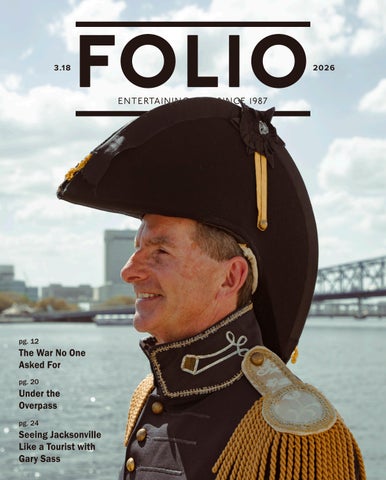
Folio Vol. 40, Issue 6

Page 1


FOLIO STAFF:

Subject:

Councilman Diamond,

I am writing to express my support for the request made by Jake Jacobs regarding the proposed study on sediment accumulation in Hogpen Creek and the potential contribution from the City’s Sandalwood Canal.

As a homeowner along Hogpen Creek, I have personally witnessed the steady sediment buildup over the past decade. When we purchased our home, the creek provided navigable deep-water access. Over time, however, the creek has filled with sediment to the point that much of the nav igable water has effectively disappeared.

This change has had significant consequences for homeowners along the creek. Properties that were historically considered deep-water homes can no longer realistically be marketed or sold as such due to the loss of navigable water access. Residents have also observed declines in wildlife and overall water quality in the creek during this same period.

The financial impact to homeowners is also becoming significant. Because the creek is no longer navigable, I am currently in the process of disputing my property tax assessment since the property can no longer be valued consistently with other deep-water homes in the area.

In addition to the environmental concerns, the sediment buildup may also have implications for stormwater conveyance if material from the Sandalwood Canal is contributing to the problem. Hogpen Creek historically functioned as an important tidal drainage system for the surrounding area, and continued sediment accumulation may reduce the creek’s ability to convey water effectively during heavy rainfall events.

For these reasons, I strongly support the request for the City to fund an independent geotechnical study to determine the cause of the sediment buildup and whether the Sandalwood Canal is contributing to the issue. Understanding the source of the sediment is an important first step toward identifying a long-term solution.

Thank you for your attention to this important issue affecting Hogpen Creek residents.

Sincerely,

BOUQS & BRICKS BOUQUETS

To the 10,278 women in Jacksonville who represent the workforce in the construction field. Thanks for making our great city rank No. 1 among the 100 major U.S. metros according to a recent study conducted by Lattice Publishing.

To Florida Power and Light for providing area high school seniors scholarships related to robotics and drone programs. Two $20,000 and $5,000 scholarships will be awarded. For details, visit fpl.com/education.

BRICKBATS

To President Donald Trump for not following our nation’s rulebook, known as the Constitution: starting a war isn’t supposed to be a solo act. Yet somehow, once again, the drumbeat of conflict starts thumping without the people’s elected representatives ever getting a proper say. It is not legal nor is it acceptable to be treating military action like an executive privilege rather than what it actually is: one of the most serious decisions a nation can make.

Aries

H oroscopes

March is basically a cosmic “Do Not Disturb” sign for you, and honestly, you need it. With the Sun, a messy Mercury retrograde and a new moon all camping out in your twelfth house, the universe is practically begging you to go into hibernation. Look, you’re already the reigning champ of introspection, so treat these 31 days like a soul-deep detox rather than a social marathon.

Taurus Gemini

Even a stubborn Bull needs a matador or at least a supportive group chat. You’re realizing that while you can do it all alone, it’s significantly more fun (and much less exhausting) to have some help. With the sun in Pisces and your eleventh house of friendships and alliances, expect your social battery to go from a flickering 5% to a full-blown neon sign. You’re entering a new era of networking.

Your ego and your paycheck are finally on the same page this March. With the Sun, a pesky Mercury retrograde, and a retrograde Mars all crashing in your tenth house of “Getting It Done,” your career is under the high beams. Throw in a Pisces new moon on the 18th, and the universe is basically handing you a megaphone. Take center stage and get it all out.

Cancer

You’re on the brink of a big change, Cancer. With the Sun, passionate Mars, a Mercury retrograde and a Pisces new moon floating through your ninth house of growth, expansion and adventure, you are feeling called to step beyond your comfort zone. Take chances and say “yes” to experiences that may scare you.

Leo

It’s time for another deep dive — bleh, but it’s the only way out of this rut you’ve been finding yourself in. With the Pisces new moon and Mercury still off kilter, you will be finding yourself feeling more introspective than usual. What (or who) do you need to let go of to grow? Some doors have closed for a reason, and not every open door deserves to be passed through.

Virgo

It takes two to tango, Virgo. This March, with the Sun lighting up your seventh house of partnerships, you’re taking a closer look at current connections and maybe even seeking new ones. But because this party is happening in Pisces (your opposite sign) and Mercury is currently doing its retrograde moonwalk there, things are getting a little ... blurry. You’re feeling uncharacteristically social, yet your inner forensic investigator is working overtime. You aren’t just looking for a spark; you’re checking its references and running a background check.

It’s time to fine-tune your routines, Libra. You’ve been lax for far too long, and it is starting to catch up. Life might have slipped into chaos recently, but that’s nothing a little workshop can’t fix. Try to figure out which aspect of your life needs a little extra oil, and pour some in. No funnel needed — get messy.

It’s finally time to start having fun, Scorpio! Thank God. In the upcoming weeks, you will find yourself seeing every glass as half full (ever the optimist). You might also find yourself eager and ready to get back in the saddle — casual hookups are only fulfilling for so long. You’re finally craving something real and long-term. Hell has officially frozen over. But don’t worry, your seat is still warm.

Libra Scorpio Sagittarius

Some flowers bloom early, Sagittarius, and you are a true Snowdrop (look it up). On March 20, the Sun enters Aries and blazes your passionate fifth house of self-expression and optimism. For the next four weeks, while everyone is slowly getting out of hibernation, you are on a confident and charismatic rise.

Capricorn

On the off chance that you don’t already own one, it’s time to buy a planner and fill it up. You have big ideas this month, thanks to the planetary game of chess happening around your third house of communication. Dive into your think tank and brainstorm freely; odds are, there’s a million-dollar idea floating around in there.

Aquarius

We love a slow-burn romance, Aquarius, but not when it comes to your goals. You’re the monarch of “great ideas,” yet you often find yourself eternally stuck in the thinking phase. The good news? As Pisces season wraps up and we drift into the fiery Aries, you’re finally ready to stop overthinking and actually take the leap. Just a word of advice: don’t let your creative “flow state” turn into a hermit era. Spring is for open windows and long-overdue chats with your favorite people.

Pisces

Before you take down the birthday party decorations, Pisces, the universe has one final gift for you—an end to the 3-week-long Mercury retrograde. The fog has finally lifted, and you can get back into your normal groove as the Sun enters Aries and your second house of practicality and stabilization.

Lighting Up to Chill Out: A Field Guide to Anxiety and the Almighty Exhale

Anxiety has a way of creeping in like a bad headline. Loud, relentless and impossible to ignore. For a lot of folks, the modern antidote isn’t a stiff drink or a prescription bottle. It’s a lighter, packed bowl and a long exhale. (Or a bong, vape pen, gummy or maybe even a good ol’ fashioned joint if that is your personal preference.)

Cannabis has earned its reputation as the green room for the nervous system. The reason? cannabinoids. THC and CBD tap directly into the body’s endocannabinoid system, the internal regulator that helps balance mood, stress, sleep and that tight-chest, can’t-catch-your-breath feeling we call anxiety.

CBD is the smooth operator. No high, no paranoia, just a mellowing effect that can take the sharp edge off social jitters or racing thoughts. THC is the wild card. In low doses, it can feel like a warm bath for the brain. Loosening muscles, softening edges, making the world a little less hostile. But push it too far and the vibe flips. Heart pounding. Thoughts racing. That harmless text you sent three hours ago suddenly feels like a federal offense.

Here’s the part nobody talked about in the ’70s: Today’s cannabis is potent. Very potent. Lab-grown, dialed-in, turbocharged flower can hit far harder than the backyard stash of decades past. For anxiety relief, less is usually more. A microdose can soothe. A mega-dose can send you pacing your living room questioning your life choices. Or in some cases an ambulance ride to an emergency room in full-blown panic attack mode. (I told you… you should never have eaten a 50 milligram gummy as a first timer!)

For some, cannabis becomes a ritual. A nightly decompression chamber after long days and longer headlines. Used intentionally and sparingly, it can be part of a wellness toolkit. Used reflexively, every single time stress shows up? That’s not stress relief, that’s avoidance dressed in a cloud of smoke.

Scan here!

To read the rest of this month’s Folio Weed

Parking Nightmares: A Temporary Solution for Parking Issues at Beaches Town Center

Late last year prices for parking at Beaches Town Center increased from $2 an hour. The increase went to $2.50 an hour from 11 a.m to 5 p.m. and leapt to $5 an hour from 5 p.m. to midnight. The new prices garnered pushback, and a decision in early January decreased the price back down to $2.50 an hour for the entire day. Though this solution is temporary, leaving the conversation open for what should be done about the parking situation in Beaches Town Center.

The price increase comes for a reason, according to Deanne Dunlop, Beaches Town Center Merchant Association president. “They had to raise it because all of the software and all of the hardware had to be replaced [on the parking kiosks] because, you know, how things deteriorate at the beach. It just happens. And so they had to pay for all of that, so they raised the rates,” she explained

Some businesses worry that the increase in price could deter foot traffic, impacting their revenue. While other businesses expressed concern on their employee’s behalf. Whit’s Frozen Custard took to their Instagram in response to a letter from Neptune Beach Mayor Cori Bylund. The mayor’s letter pointed to the businesses’ responsibility for arranging their employee parking, to which Whit’s responded, “The reality is that parking in all beachfront towns is scarce. The businesses that make up the Central Business District will always rely on collaborative effort with the city to find parking solutions.”

Some employees at the restaurants and stores took issue with the fact that the rates for parking cut into their earnings. While others, who park farther to avoid the fees, raised questions about safety issues leaving late night shifts. One employee commented on Whit’s Instagram post stating, “I was chased by a man while walking to my car parked at Kmart around 11 p.m. Ensuring employee safety doesn’t seem like a concern to this mayor.” As the city works to find a solution, employees are seeking out new ways to park. One employee noted her new route to work, “The church by Bank of America lets us park in their lot unless it’s Sunday or Wednesday or if they’re having an event.”

As for concerns of residents paying for parking, a system has been implemented which the Merchant Association President feels is being underused. For residents of Atlantic and Neptune Beach, parking is free for up to four hours per day. The vehicle needs to be registered with the North Beaches Parking Program to qualify and then the resident does not need to interact with the kiosk once parked. Their license plate will be registered in the ticket operating system so once scanned by the parking officers, the four-hour timer will begin.

This month the issue will be revisited at a town hall meeting in Neptune Beach as the city attempts to balance the concerns of residents, employees, business owners, beach goers and the general public.

Deanne Dunlop expressed the need for an extension of the $2.50 increase for at least a year so businesses can accurately gauge the effects on their revenue, noting “It’s hard to evaluate in three months what the impact is going to be.”

The town hall meeting will allow residents, merchants and visitors to discuss the parking issue.

BLOSSOMS, ART, COMMUNITY. ONE MAGICAL EVENING.

Join the Cummer Museum of Art & Gardens for a spectacular fundraising event inspired by our current exhibition Art in Bloom. This enchanting evening will feature live music, interactive art experiences, and delectable bites and libations under the stars and among our gardens.

Photo by Gregory Brainard on Unsplash

World Cup in Disarray: Why the North American Hosted Tournament is Worrying Fans Abroad

The World Cup is coming to America this summer with Mexico, Canada and the United States coming together to host the biggest stage for the world’s game. On the pitch, it promises to be a tournament for the ages, with 48 nations represented and a planned 104 games to be played across 16 different cities. It will be the biggest soccer festival ever. And an unpredictable one at that, it is an open field on who will be crowned champions, with several teams in contention to go all the way.

Led by Kylian Mbappé, France’s golden generation is expected to continue its dominance. Perennial heavyweights Brazil have brought in the legendary Italian manager Carlo Ancelotti to mold their new generation of wonderkids. Argentina went on to win it all in Qatar with a miracle run that will be hard to replicate, but anything is possible with Lionel Messi playing in what will almost certainly be his last dance. Then there’s England, who have their strongest combination of coach and squad in over two decades — so expect them to flame out in the quarter finals. Not to mention Spain, Germany and the numerous other teams taking part, who would consider themselves contenders or at least potential dark horses to go down in the record books. And of course, as one of the hosts, the U.S. will get to play at least the games.

Off the pitch, the world’s disarray threatens to muddy the whole affair. Unrest in Mexico has created anxious headlines surrounding cartel violence. While here in the States, the current administration’s policy toward immigration enforcement has drawn criticism both at home and abroad for empowering federal agents to use excessive force on individuals who are not sufficiently “American passing.” And concern will only grow as Todd Lyons, the acting director of Immigration and

Customs Enforcement, has ensured that the agency will play “a key part in the security” for an event that will draw thousands of visitors from around the globe.

Condemnation of ICE’s methods reached a fever pitch following the shootings of Renee Good and Alex Pretti in Minneapolis, with every possible angle of the incidents being weighed in on in some capacity. In the wake of the tragedies and analyses of the federal agents’ role in them, discussions are taking place about what can be done to prevent similar events from happening in the future, and whether or not a reportedly underqualified and undertrained police force can facilitate a safe and secure environment in everyday life, let alone during a high-profile international event. The issue of ICE involvement has turned to trepidation for supporters considering making the journey. Fan interest group Football Supporters Europe released a statement expressing their concerns for the “ongoing militarization of police forces in the U.S.,” among other issues surrounding the tournament. Anxiety surrounding the issue is so great that in January, the European Democratic Party of the European Parliament said it may ask national football federations to consider pulling out of the tournament altogether if safety guarantees are not made, an unprecedented scenario that is unlikely to happen, but could result in a snowball that ends FIFA’s prized showcase being abruptly abandoned.

The most likely outcome after all the hand wringing and think piecing, however, is that once the first ball is kicked, all the noise surrounding the issue will be drowned out by the cheers of enraptured fans seeing the world’s greatest players play on the biggest stage, while the Trump administration becomes the latest beneficiary of the sports-washing magic that only the beautiful game can conjure.

Photo by Alan Jiang on Unsplash

THE WAR NO ONE ASKED FOR

There are wars that march in with brass bands and congressional votes. And then there are the ones that slide in sideways with no parade, no formal declaration, just missiles lighting up the night sky while the rest of us are still arguing about grocery and gas prices.

The escalating conflict between the United States and the Islamic Republic of Iran is the latter. No one campaigned on it as a first priority. No one held a national referendum. And yet here we are: American forces striking Iranian targets, Iranian missiles and drones answering back, oil markets twitching like a live wire, and a region that was already volatile now balancing on a knife’s edge.

This didn’t begin last week. It didn’t begin last year. The roots go back to 1979; revolution, hostage crisis, sanctions, shadow warfare. Decades of hostility hardened into a familiar rhythm: rhetoric, sanctions, proxy skirmishes, nuclear negotiations, collapse, repeat. It became background noise in American life. Serious, yes, but distant. Until it wasn’t.

The latest chapter erupted after direct military operations targeted Iranian strategic assets. What was framed publicly as a limited action to degrade military capability quickly expanded. Iran responded with missile and drone strikes aimed at U.S. positions and regional allies. The cycle accelerated.

And here’s the uncomfortable truth: once both sides are trading fire openly, semantics don’t matter. You can call it a “campaign,” a “defensive action,” a “stabilization effort.” If aircraft are flying combat sorties and soldiers are dying, it’s war.

The strategic objective from Washington has been framed around preventing Iran from acquiring nuclear weapons capability and degrading its missile infrastructure. On paper, that’s a focused goal. In practice, airspace dominance, sustained strikes, and leadership destabilization blur the line between containment and something more ambitious.

Tehran, for its part, frames the conflict as resistance to foreign aggression, a language designed to rally domestic unity and regional sympathy. It’s a playbook as old as geopolitics itself. When a nation is struck, it consolidates.

The ripple effects are immediate. The Strait of Hormuz which is that narrow artery through which a significant share of the world’s oil flows becomes a pressure point. Markets spike. Gas prices climb. Global shipping recalibrates. Wall Street reacts before most Americans finish their morning coffee.

Meanwhile, diplomatic channels strain. European leaders urge restraint. Nations in the Global South criticize what they see as destabilizing intervention. China and Russia watch carefully, publicly condemning escalation while measuring advantage. The conflict may be regional, but the consequences are global.

And yet, for many Americans, this war feels oddly abstract. There’s no draft. No ration cards. No nightly air raid drills. The fighting is technologically advanced and geographically distant. It’s visible through satellite imagery and 30-second clips, not through neighborhood sirens. That distance is deceptive.

Modern warfare doesn’t always demand total mobilization. It runs on precision strikes, cyber operations, economic pressure and drone swarms. It is cleaner on television than in reality. The human cost is civilian casualties, displaced families, young soldiers sent into hostile skies which rarely fits neatly into a headline.

The deeper question isn’t just how this started. It’s where it leads. If the objective is strictly deterrence, then escalation becomes a dangerous paradox: the more you demonstrate strength, the more the adversary feels compelled to respond. If the objective is regime destabilization, officially denied but often implied in rhetoric then history offers sobering lessons about unintended consequences.

The Middle East has seen power vacuums before. They do not remain empty for long. So what makes this conflict especially precarious is not simply the military exchange. It’s the strategic ambiguity. There has been no formal declaration of war by Congress.

There has been no sweeping national debate. Instead, decisions unfold at the executive level while the public absorbs developments in fragments.

Wars without consensus tend to age poorly historically. None of this suggests that threats aren’t real. Iran’s regional influence, missile capabilities, and nuclear ambitions have concerned policymakers for decades. But acknowledging threat is not the same as endorsing open-ended confrontation.

The American public has a long memory when it comes to prolonged entanglements. Iraq. Afghanistan. Two decades measured in trillions of dollars and immeasurable human cost. Voters eventually ask hard questions: What was the mission? When does it end? Was it worth it? Right now, those questions are just beginning to surface. There is still space for de-escalation. Back channels exist. Diplomacy often works in silence before it works in public. But every additional strike narrows that window. History tends to judge wars less by how decisively they begin and more by how wisely they end.The conflict between the United States and Iran may not yet qualify as a global war. It has not triggered a formal alliance cascade. But it has crossed the line from shadow hostility to overt combat. And once that threshold is crossed, the path back is rarely simple.

The war no one asked for is here. The only real question now is whether cooler heads can prevent it from becoming the war no one can control.

MERCYME THE WONDER + AWE TOUR WITH BIG DADDY WEAVE, TIM TIMMONS & SAM WESLEY

MARCH 15

107.3 PLANET RADIO PRESENTS PLANET BAND CAMP

FEATURING THREE DAYS GRACE WITH SLEEP THEORY & THE FUNERAL PORTRAIT

MARCH 18

WIDESPREAD PANIC

MARCH 20-22

SPRING NIGHT MARKET

MARCH 24

PARKER MCCOLLUM

WITH SPECIAL GUESTS

MAX M C NOWN & LACI KAYE BOOTH

MARCH 27 & 28

BILLY STRINGS

APRIL 2-4

SANTANA ONENESS TOUR 2026

APRIL 7

DWIGHT YOAKAM WITH SPECIAL GUESTS FLATLAND CAVALRY & CHAYCE BECKHAM

APRIL 9

MT. JOY

HOPE WE HAVE FUN PART II TOUR

APRIL 11

TRACE ADKINS

30TH ANNIVERSARY TOUR

WITH SPECIAL GUEST CONFEDERATE RAILROAD

APRIL 16

FOREIGNER

SPECIAL APPEARANCE BY LOU GRAMM WITH VERY SPECIAL GUEST NIGHT RANGER

APRIL 17

AN EVENING WITH GOOSE APRIL 18 & 19

RUSSELL DICKERSON THE RUSSELLMANIA TOUR WITH SPECIAL GUESTS DASHA & ATLUS

APRIL 24

SATCHVAI BAND

FT JOE SATRIANI & STEVE VAI WITH ANIMALS AS LEADERS

APRIL 25

ALABAMA SHAKES

WITH SPECIAL GUEST

LAMONT LANDERS

APRIL 26

GEORGE THOROGOOD & THE DESTROYERS “THE BADDEST SHOW ON EARTH” WITH SPECIAL GUEST THE MARSHALL TUCKER BAND

MAY 7

ETHEL CAIN THE WILLOUGHBY TUCKER FOREVER TOUR WITH SPECIAL GUEST 9MILLION

MAY 8

LIVE WILDLY PRESENTS JJ GREY'S BLACKWATER SOL REVUE FEATURING JJ GREY & MOFRO WITH SPECIAL GUESTS WAR & BIG BAD VOODOO DADDY

MAY 16

IRATION & SOJA WHERE IT ALL BEGAN SUMMER TOUR 2026 WITH SPECIAL GUESTS TRIBAL SEEDS & ARTIKAL SOUND SYSTEM

MAY 17

SAM BARBER THE AMERICAN ROUTE TOUR WITH SPECIAL GUESTS MICHAEL MARCAGI & BEBE STOCKWELL

MAY 23

THE BLACK CROWES

SOUTHERN HOSPITALITY TOUR WITH SPECIAL GUEST SOUTHALL

JUNE 2

CLAYPOOL GOLD FEAT: PRIMUS, LES CLAYPOOL’S FROG BRIGADE & THE CLAYPOOL LENNON DELIRIUM

JUNE 19

VINCE GILL

50 YEARS FROM HOME TOUR

JUNE 27

MEN AT WORK

WITH SPECIAL GUESTS TOAD THE WET SPROCKET & SHONEN KNIFE

JULY 17

DIERKS BENTLEY OFF THE MAP TOUR WITH RICKY SKAGGS & KENTUCKY THUNDER & COLE GOODWIN

JULY 18

LINDSEY STIRLING WITH SPECIAL GUEST PVRIS

JULY 20

THE BLACK KEYS PEACHES ‘N KREAM WORLD TOUR WITH SUPPORT FROM EDDIE 9V

JULY 29

THE FRAY WITH SPECIAL GUESTS DASHBOARD CONFESSIONAL & COLONY HOUSE

AUGUST 8

BUDDY GUY 90 TOUR

AUGUST 22

SLIGHTLY STOOPID ROAD TRIPPIN SUMMER TOUR 2026 WITH SPECIAL GUESTS THE ELOVATERS & DENM AUGUST 23

BLUES TRAVELER & GIN BLOSSOMS WITH SPIN DOCTORS SEPTEMBER 4

JOHN FOGERTY & STEVE WINWOOD THE LEGACY TOUR SEPTEMBER 18

JAMES TAYLOR AND HIS ALL-STAR BAND SEPTEMBER 22 & 23

TEDESCHI TRUCKS BAND FUTURE SOUL TOUR 2026 OCTOBER 9 & 10

ALABAMA OCTOBER 17

O.A.R.

THREE DECADES TOUR WITH SPECIAL GUESTS GAVIN DEGRAW & KT TUNSTALL NOVEMBER 14

Voter Turnout in Florida

Florida’s political machine is currently grinding through a highstakes game of musical chairs, as a wave of special elections this month serves as a high-pressure stress test for the state’s shifting loyalties.

While the 2024 cycle saw Florida voters show up in droves — nearly 79% of active voters cast a ballot — the state is now bracing for the inevitable midterm hangover. Historically, Florida’s turnout falls off a cliff during “off-years,” dropping as low as 48% in recent midterms. This massive gap creates a ghost town effect where a tiny sliver of the population — mostly the hyper-partisan and the retired — effectively decides the representation for everyone else.

The current slate of special elections is a direct result of the reshuffling in Tallahassee and Washington. When the Trump administration pulled high-profile Florida figures like Marco Rubio and Mike Waltz into federal roles, it triggered a domino effect back home. From the suburbs of Tampa to the coast of Palm Beach, local officials have resigned their seats to pursue these sudden openings, leaving several districts to hold mid-March votes to fill the gaps, on a random Tuesday, no less.

In Jacksonville, the stakes are particularly high. Duval County remains Florida’s “purple pulse,” a rare pocket of the state where a Democratic mayoral win in 2023 was followed by a sharp shift back toward the GOP in 2024. For Jacksonville residents, the road to the 2027 municipal elections — where the mayor and the entire city council are on the ballot — begins with these smaller 2026 contests. The city’s geography often dictates its politics: While affluent areas like Ortega consistently see turnout north of 80%, the urban core frequently struggles to hit 60%, leaving local outcomes to be decided by whoever is most successful at getting voters to the polls in a down year.

The upcoming November 2026 ballot will be the final test of this transition, featuring a special election for the U.S. Senate seat formerly held by Rubio. Appointed incumbent Ashley Moody is preparing to defend that seat against a field of challengers that includes Jacksonville’s own State Representative Angela Nixon.

Ultimately, Florida’s political future is being shaped by the friction between two distinct forces: Donald Trump’s national movement has turned the state a deeper shade of red, but it is Governor Ron DeSantis’ administrative influence that is currently managing the vacancies left in his wake (boo). Whether the state remains a Republican fortress or provides a window of opportunity for Democrats depends entirely on which version of the Florida electorate decides to show up.

In a state where political trends can shift as fast as the weather, the only certainty is that these low-turnout off-year elections often have the longest-lasting consequences.

So, get off your couch and vote.

March 24, 2026: Special General Elections (Filling vacancies in State House Districts 51 and 87 and State Senate District 14.)

August 18, 2026: Statewide Primary Election (Gubernatorial/Senate nominees).

November 3, 2026: General Election (Governor, U.S. Senate, Congress).

March 9, 2027: Jacksonville Unitary Primary (Mayor, Sheriff, City Council).

The Wild Heart

eigh e NBmy D ! a bor y

Join us to celebrate WJCT ’s annual Be My Neighbor Day.

Saturday April 11

10AM TO 2:30PM

Meet Daniel Tiger and his friends Visit with community helpers & learn how you can help too Every child receives a goodie bag & books

Enjoy face painting, balloon art, food trucks & so much more

WJCT

STUDIOS

100 Festival Park Avenue Jacksonville, Florida 32202

To register for this day of tigertastic fun, visit

Exploring the Timucuan Ecological and Historic Preserve

Visitors to the preserve say “ it’s a quiet little slice of heaven in the hustle and bustle of a big city like Jacksonville” Many residents of Jacksonville are surprised to learn that a nationally protected preserve exists within their own city. Yet the Timucuan Preserve remains one of Florida’s most underrated natural destinations.

Unlike the crowded theme parks and tourist-heavy beaches often associated with the state. From ancient shell rings to marshes alive with wildlife, the Timucuan Preserve reveals the deep connection between people and place that has shaped the region for thousands of years. Despite its protected status, the Timucuan Preserve is not a distant wilderness,it is a public landscape designed to be experienced.

Visitors can explore the area through hiking trails, kayaking routes, fishing spots, and scenic overlooks. Kayakers often paddle through winding tidal creeks where marsh grass towers above the water, creating narrow natural corridors filled with birds and marine life. On quiet mornings, the only sounds may be the splash of fish or the distant call of a heron.

The Timucuan region also witnessed some of the earliest European colonization attempts in what is now the United States. One of the most significant sites within the preserve is the Fort Caroline National Memorial. In 1564, French Huguenot settlers established a colony along the St. Johns River at Fort Caroline. Their goal was to create a Protestant foothold in Spanish controlled Florida. The colony, however, lasted only briefly. A year later, Spanish forces from St. Augustine attacked and destroyed the settlement, marking one of the earliest

conflicts between European powers in North America.

Another historically significant site within the preserve is the Kingsley Plantation on Fort George Island. Built in the late 18th century, it is the oldest surviving plantation site in Florida. The plantation tells a complex story of agriculture, slavery, and cultural interaction between African, European, and Native American communities. Visitors can still see the plantation house, the remains of slave cabins built from tabby concrete, and the surrounding agricultural landscape. These structures stand as reminders of the difficult and layered history of the region.

As coastal development continues across Florida, places like the Timucuan Ecological and Historic Preserve become increasingly important. Rising sea levels, habitat loss, and urban expansion threaten many coastal ecosystems across the country. By protecting thousands of acres of wetlands and historic landscapes, the preserve ensures that future generations can experience the natural and cultural heritage of Northeast Florida.

For visitors walking its trails or paddling its waterways, the preserve offers something rare: a landscape where the past and present exist side by side. Here, beneath the wide Florida sky and the sweeping marsh grasses, the stories of ancient civilizations, colonial struggles, and modern conservation continue to unfold.

And just beyond the edge of the city, Jacksonville’s wild heart still beats.

PUT YOUR MONEY WHERE YOUR MOUTH IS: SMALL BUSINESS ALTERNATIVES FOR A SOCIALLY CONSCIOUS SHOPPER

Cancel culture has successfully ruined the careers of many problematic celebrities. Though this social phenomenon is known more for the takedown of TikTok Stars and YouTube has-beens, some other popular victims are corporations in the form of boycotts. The increasingly volatile socio-political situation leads the everyday shopper to think twice about where they are spending their hard-earned dollars. Although the names of the companies upsetting the masses are easily accessible thanks to social media platforms like instagram and specialized apps like Goods Unite Us, knowing where to shop instead can be overwhelming.

The big chains make this more difficult through their convenient locations, so when it is 9:47 p.m. on a Saturday you know where to pick up pizza bagels and a pack of Trulys (Target) because that glowing, red sphere appears every two miles. There are plenty of locally-run grocery stores to go to instead, though, they may not have the marketing of a $100 billion company. But through the support of the community, they will not need it.

Why Boycott?

There are many companies that act in ways customers may morally oppose, whether that be directly or through the political views of their owners. Popular retail chain, Target, recently faced backlash for scaling back their Diversity, Equity and Inclusion efforts. They also faced scrutiny for allegedly allowing ICE officers to arrest employees as seen in a viral video of two U.S. citizens being violently detained during their shift. Another controversial business is Starbucks. The popular coffee company’s unfair labor practices and union-busting tactics have led to even their workers supporting boycotts against the company. In the past, restaurants like Chick-fil-A and Jimmy John’s have also received backlash for the actions of their executives. All of these companies and more like them weaponize their convenience against the consumer, making it easier to spend money there than somewhere else. This is money that could be going back into the community that consumers can trust.

LOCAL ALERNATIVES

Coffee

Coffee

Sippers

Round

Salt

The

DOWNTOWN

MARCH

Coffee

Grocery

Coffee

Grocery Café

If you’re looking to be more intentional with your money, put them into the small business that make this city great. Though some are listed here, there are hundreds of other restaurants, coffee shops and stores across the city which simply would not fit in one article. For those looking to branch out further into the local business scene, check out our Best Of Jax list or seek out local influencers like @teresa.thanh that highlight the hidden gems of Jacksonville more frequently.

UNDER THE OVER PASS

The weekly magic of the Riverside Arts Market

Each week, the shadow of the Fuller Warren Bridge plays host to a bustling riverfront market that draws crowds from across the city and beyond. Whether they are hunting for fresh produce and weekly groceries or searching for a unique, last-minute birthday gift, visitors can find it all here. Some come simply for a fresh cup of local coffee, while others commission a custom portrait of their favorite pet. No matter the reason, hundreds come out and show support for one of Jacksonville’s biggest and best local artisan hubs.

As a city deeply rooted in tradition, RAM has become an early Saturday morning ritual for most. And while the saying “if it ain’t broke, don’t fix it” is widely regarded, the bright minds that bring us RAM have a few new tricks up their sleeves, some of which they are rolling out this year.

During a recent coffee date at Steady Coffee in Avondale, “Folio” spoke with Chloe Kuhn, the market director for the Riverside Arts Market, about the year ahead. Reflecting on her time with the organization, Kuhn laughed, “Gosh, I think it’s been three years. I should know this.” A quick look at the calendar confirmed her hunch: Kuhn has officially been with RAM for over three years, continuing to lead one of Jacksonville’s most iconic community cornerstones.

“I think the biggest change for RAM is that we have grown. So everyone’s used to our usual spot underneath the bridge, but we now have a whole new stretch with the completion of the artist block,” Kuhn explained. “So this is that space in between where RAM has been held and the skate park — where the ice skating rink was this December. It’s a way that we can sort of take on bigger projects. We just had one this past Saturday — the Melanin Market. They had over 50 vendors that came out to join us.”

With that newfound space, the possibilities for the market feel as vast as the riverfront it sits on. Kuhn and her team have never been short on ambition; they’ve even toyed with the idea of inviting local chefs to transform their usual concrete footprint into an intimate evening dinner experience. However, the reality of hosting a white-tablecloth affair in a parking lot tucked under a massive overpass eventually brought the dream back down to earth —for now.

“It’s not really the most elegant location for an evening dinner, but with that plaza space, it kind of opened up a lot for us,” Kuhn mentioned.

With the added breathing room, the team is looking beyond the traditional Saturday morning window. They recognize that for many, work schedules, religious commitments or a busy calendar of kids’ sports make the usual hours a tough sell.

“That’s part of what’s so exciting about looking at other types of events in the evening or throughout the week,” Kuhn noted. “We’re dreaming of bringing food trucks down there during the lunch hour — giving people a way to mix things up when they finally get a break from the office.”

Kuhn explained that they are steering the market toward more collaborative efforts, particularly with local nonprofits and smaller groups. By inviting these organizations to RAM, they aim to introduce them to a high-energy crowd they might not reach on their own.

“We get to bring them to RAM and show them to a group of people that may not have come across them,” she said, also noting these partnerships often draw new visitors to the riverfront for the first time.

Words & photos by Carmen Macri

Looking ahead to the end of March, the market will host a celebration for World Theater Day, marking a shift toward more diverse programming, partnering with River City Theatre, Greenlight Theatre Company and Theatre Jacksonville. While the market has long been a home for music, ceramics, and culinary arts, Kuhn admitted, “We have been neglecting our theater performers.” This event serves as a deliberate move to ensure the performing arts are finally given their fair share of the spotlight under the bridge.

“They’ll be doing selection performances on the stage. We do something really similar every fall with National Dance Day, where we’ll have dance companies come out and do different performances on the stage,” Kuhn explained. “And so this for World Theater Day will be kind of like snippets of different performances with the idea of, you know, maybe people that don’t know we have a local theater scene or don’t think they’re interested in in theater, maybe they catch a glimpse of it and think, ‘Oh, I want to see the end of that.’

While new programming is on the horizon, the market remains committed to the fan favorites that have become part of its identity. A standout for the animal lovers in Jacksonville is the “Arf Barket”—a dedicated dog-themed day held each fall. Building on that success, the team introduced the “Art Meowket” two years ago, a feline-focused event centered around cat adoptions.

Kuhn has high hopes for the upcoming season, noting, “We’re hoping to break the record this year.” To make it happen, the market partners with Animal Care and Protective Services (ACPS), which brings a large mobile adoption van to the riverfront. The event has proved almost too popular in the past; Kuhn recalled how they actually ran out of kittens last year and had to send the van back to the shelter to get “refills.”

They are also looking at hosting a big Earth Day event this year, partnering with the St. Johns Riverkeeper and the Green Chamber as a return to form type of event filled with eco-friendly vendors.

“It’s cool for us to say it gets new ideas coming our way, and it just makes every day a little bit different,” Kuhn shared. “We understand people want to come around and see different things every time. And this is a way that we can provide that by making every time you come to feel different. We don’t want it to be stale. We don’t want it to start feeling like just your, you know, weekly grocery run or something. It needs to stay fun, exciting.”

Kuhn views the market as a catalyst for more intentional consumerism, aiming to shift how Jacksonville residents approach their Saturday morning hauls. She hopes the experience encourages shoppers to consider the origin and purpose of their purchases, fostering a deeper connection between the community and local makers.

“I like to think that RAM is making people think about what they buy, why they buy it, and who they buy it from,” she said, expressing her wish that the market serves as the starting point for a lifelong “love with supporting small businesses.”

Following the adrenaline of the Gate River Run last Saturday, the natural next stop was beneath the bridge to catch up with the vendors who have made RAM Jacksonville’s favorite weekend sanctuary.

Meet The Vendors

Burnt Glassworks

Based in Jacksonville, Jessica Peters’ Burnt Glassworks is a full-service glassblowing studio that brings the ancient, fiery craft of glass manipulation to the local community. Through their signature “hot shop” on Philips Highway, they specialize in creating everything from delicate hand-blown ornaments to striking sculptural pieces that have become a staple under the bridge at RAM.

If your business were a song, what would the title be?

“Oh, man. ‘Hot, hot, hot.’”

What is the secret ingredient — literal or metaphorical — that makes your work uniquely you?

“That’s a tough one, and I would say that since we have multiple people working in our studio. It’s kind of always a collaborative process, and sometimes we’re doing the same thing all the time, but then sometimes we get great ideas, and it’s really neat to have a studio space where we can try those out. If there’s a whim and we’re thinking, ‘Oh, this week we want to play around and make some mushrooms,’ we can. In terms of a literal secret ingredient, it’s kind of a boring answer, but I think having someone who has been blowing glass for over 20 years. That helps.”

Root Cove Bindery

Root Cove Bindery, led by artisan Heather Callahan, breathes new life into the traditional craft of bookbinding through her collection of meticulously hand-stitched journals and sketchbooks. Based in St. Augustine, Callahan brings a “slow-made” sensibility to the market, offering beautifully bound workbooks designed to hold a lifetime of sketches and stories.

If your business were a song, what would the title be?

“Oh, my god. That is so hard. Can I look at my Spotify playlist really quickly? I’ve been listening to so much punk-goes-pop at the gym, and my whole personality is like 2010’s pop music right now. Okay, I would title it ‘Bad Romance.’”

What is the secret ingredient — literal or metaphorical — that makes your work uniquely you?

“I don’t cry a lot in my books, so there’s a lack of tears. That’s my secret ingredient — a lack of tears.”

Describe your business personality in three words

“Romantic, fantasy and… I don’t know how to put this into one word. Women taking back power. I do a lot of [book covers with] women in history or in the medieval renaissance. So, I guess repurposing old iconicism.”

MAMRamics

Mamramics, the creative outlet for Jacksonville native Michael Anthony Miller-Riley, is the result of over two decades of technical dedication to the art of clay. Since launching the business in 2009, Miller-Riley has combined his background in industrial design with a passion for functional pottery, creating durable, high-quality wares that are as much a joy to use as they are to look at.

If your business were a song, what would the title be?

“Do people answer these pretty quickly normally? Hmm, if my business were a song… I think the title would be ‘Free Flow.’”

What is the secret ingredient — literal or metaphorical — that makes your work uniquely you?

“I do a lot of my twisted things, like you can see here on some of these mugs. So what I like to do is, I make a weak spot in the clay and let the wheel kind of twist the clay. I let it do its own thing, even though I’m still kind of controlling it, I don’t have complete control of it, if that makes sense.”

To read the rest of this feature

SEE JACKSONVILLE LIKE A TOURIST

with Gary Sass

When I first moved to Jacksonville, about six-ish years ago, I remember the city feeling so new and exciting, as new places often do. It was nothing like the Florida down south that I grew up in; it was a city of brick, moss and possibility. My mother and I stayed in an Airbnb on College Street, spending our afternoons on electric scooters, tracing the veins of Riverside and Downtown. When I wasn’t at school for orientation, we were exploring the city that would soon become my home — wandering through the galleries at the Cummer Museum, browsing the racks at Midnight Sun and Five Points Vintage, watching sunsets at the beach and sharing pizza at Casa Dora on Forsyth Street or grabbing tacos at Lola’s Burrito and Burger Joint. The nights always ended with a walk back to our Airbnb, stopping here and there to admire the historic houses lining the quiet streets.

Back then, every street corner, building and shop had a story. But six years is enough time for the newness to wear thin. Today, it’s common to hear that Jacksonville has “nothing to do,” but I suspect we’ve simply stopped looking.

Twenty-one years ago, Gary Sass stood at the same precipice I did, though he landed in Jacksonville for entirely different reasons. While I arrived chasing a degree, Sass arrived for a career only to discover a calling he couldn’t have foreseen.

A software engineer and consultant by trade, Sass was facing a promotion that would have sent his family to Wisconsin. His wife, however, wasn’t sold on the Midwest.

“She said, ‘What? Wisconsin? Why would we ever want to move to Wisconsin ?’” Sass remembers. “I told her it was a really good job, and she says, ‘Why don’t we pick a great place to live?’”

For the next six months, they scouted potential hometowns until a digital quiz on FindYourSpot.com pointed them toward the First Coast. “And I’ll never forget. She says to me, ‘Gary, what do you know about Jacksonville, Florida?’” he shared. “I said two things. One, they have the Jaguars. Second thing, you drive through it to get to Orlando. She goes, ‘Well, you better look at it because I took a test and it came up as Jacksonville, Florida was the best place to live.’”

So Sass booked a two-week trip to the Bold City and was pleasantly surprised. The move happened quickly, but when he began applying for software roles, he hit an unexpected snag: he was told he was overqualified. He had found the perfect place to live, and now had to find the perfect job.

With time to kill, Sass fell back on his old habits. Whenever he visited a new city, he took a tour.

“My wife and I met on a walking tour in London, and everywhere we went, we did tours. I mean, I was a consultant traveling to all sorts of different places, places for weeks at a time. What else am I gonna do when I’m there? I want to learn about the area. I want to tour places and some places like London, because, you know, I was there for a year. I probably did 20 tours when I was in London,” Sass said. “And while I’m trying to get a job and all that, I’m trying to learn the area, so I started looking for a personalized tour guide. There was nothing I could find right here because, in fact, there wasn’t even a tour guide in Jacksonville.”

It was a classic “two birds, one stone” scenario: Sass didn’t have a job, and Jacksonville didn’t have a tour guide. So he decided to become both the solution and the city’s first real storyteller.

Words & photos by Ambar Ramirez

To do this, he had to look at Jacksonville through the eyes of a stranger. To be a guide, you must first be a tourist. While the local consensus was that Jacksonville lacked history and that anyone seeking a tour should head south to St. Augustine, Sass ignored the noise. He looked at the skyline and the quiet streets of Downtown and knew these buildings had stories; he just had to find them.

Like all great research projects, his began at the library. It was there he discovered Wayne Wood’s book “Jacksonville’s Architectural Heritage.”

“It’s written almost for a tour guide. There’s a building and a story behind the building. So when I create a new tour in Jacksonville, I start with Wayne Woods’ book, and I look up that area and I get a feel for what that area has based on an architectural standpoint,” Sass explained. “Once I come up with my route, then I look at it from a tourist and say, OK, what do the tourists see? What are they going to ask? Oh, there’s a mural over here. Oh, I need to learn about that mural. So once you get your route, you determine what are people going to be looking at? What’s going to draw their attention? What are the more entertaining stories to tell?”

And the stories are everywhere. Fittingly, I met with Sass at one of the first spots he would take an out-of-town guest: Bold City Brewery Downtown. While Sass explains the false general reputation that there is no history in Jacksonville, my eyes keep falling to a photograph hanging in the brewery. It is one of Jacksonville’s most famous photographs from Consolidation Day. It’s October 1, 1968, and Mayor Hans Tanzler is standing on a ladder, placing a new city limit sign at the border of Florida 13 and Julington Creek. Beside him, actress Lee Meredith arches her back, kicking one leg into the air. A playful, iconic image of a city redefining its boundaries. A piece of Jacksonville’s history and a moment that actually inspired one of Sass’ tours. The tour was on an Oct. 1 and finished at the bar we were sitting in with a Consolidation Year party.

“The mayor’s relatives came and everything,” Sass shared.

Sass’s first walking tour happened almost by accident. At the time, he was running tours in St. Augustine to bring in some money, but when he got a call that a travel writer was visiting Jacksonville and wanted a walking tour, he jumped at the opportunity, even though he had never actually given a personalized tour of the city before.

“I looked at the buildings as being characters that you meet along the way. You’ll meet these characters, and each building’s got a story, and I just got to figure out how the story can all play out. So I write the story and all. That travel writer comes, and I give her a walking tour,” Sass shared. “First walking tour I ever did. Then I forget all about it. A few weeks later, somebody sent me a link to the story that the travel writer wrote, and the headline of the story was ‘Jacksonville’s Walking Tour.’”

When Sass called her to ask why she chose that title, she told him it was quite simply the best tour she had ever taken.

From then on, Sass kept exploring the city with the same narrative curiosity. He treated the skyline like a cast of characters, leading to his most famous excursion: the “Top to Bottom” tour. On this route, he takes visitors — and locals, who surprisingly make up 90% of his clientele — down into the subterranean banking tunnels that have served as the city’s foundation since 1909, before ascending to find the best view in Jacksonville. Though that “best view” is constantly changing, it used to be the restaurant atop the Bank of America building.

And it isn’t just the architecture that inspires Sass; it’s pieces of Jacksonville’s stories already written for him. Knowing Jacksonville is the birthplace of Southern Rock, Sass created a driving tour through Green Cove Springs. He blasts Lynyrd Skynyrd and other local legends as he leads the way to “Hell House”, the remote, non-airconditioned rehearsal shack where the band’s iconic sound was forged.

Then there are the “ghosts” of the city, like Isaiah Hart. Despite being Jacksonville’s founder, Hart is a man without a plaque or a statue, yet the city wouldn’t exist without him. To ensure that story doesn’t fade, Sass occasionally dons a period costume, stepping into Hart’s shoes to narrate the city’s founding from a first-person perspective.

“The point of the story really is I looked at it differently, and the travel writer really confirmed what I was thinking, that Jacksonville has a lot,” Sass said. “We’re just not using it.”

Maybe the secret is simply to look at Jacksonville like a stranger would. To let your eyes wander until they catch on a detail. Maybe it’s a mural, a new restaurant or a park. If you pull the thread, what story will unravel? If Gary Sass can find a world of inspiration in these streets, surely we can, too.

The Great Fire of 1901

Nearly 125 years ago, one of the most catastrophic fires in American history struck the city of Jacksonville.

Imagine waking up on a normal weekday. You make some coffee, get ready for work, and leave your house. The weather is still with no wind in sight. After a few hours, you go on your lunch break, but as you step outside, you begin to see glowing flames all around you. Downtown Jacksonville is on fire.

The Great Fire of 1901 overtook 146 blocks of the city and consumed over 2,000 buildings in a span of just eight hours. More than 10,000 residents were left homeless.

Around noon on Friday, May 3, 1901, workers of Cleveland Fibre Factory, located on the corner of Beaver and Davis streets, laid out Spanish moss to dry, to later be used as mattress cushions. The fire first started when a worker had fallen asleep, leaving the moss unattended. The fiery debris from their stove caught the plant and quickly began to take over the building. After engulfing the factory, a nearby wooden storage facility, filled with even more moss, feathers and horsehair, went up in flames.

The tragedy struck Jacksonville quickly due to wind speeds gusting up to 15 mph. In the span of just eight hours, 90% of Downtown was destroyed. Smoke from the catastrophe could even be seen in Raleigh, North Carolina. Buildings such as the Duval County Courthouse were left standing … but with their interiors entirely gutted. The horrific event changed our city and its story forever. But within just one day, city workers and residents began to work. In the course of 24 hours, the Jacksonville Relief Association, started by the Board of Trade, fed over 2,000 people, and 6,500 on the following day. The same organization also created seven different committees, each focusing on various issues. The Board of Trade also created a Colored Relief Association due to the Jim Crow laws at the time.

Whether someone needed help with their finances or had problems with transportation, there was a committee to assist. With a little over one-third of Jacksonville residents being homeless, help was desperately needed. Florida Governor William Sherman Jennings imposed martial law in hopes of avoiding violence. As Jennings heavily focused on recovery efforts, the City Council and City Boards made their No. 1 priority the scattered civilians.

Photo Courtesy of Florida Times Union

With thousands of displaced residents seeking shelter, it was entirely inevitable that doors began to open. Churches and schools were used to house many Jacksonville families. Within just three days of the fire, building permits were already being issued to rebuild homes in affected areas. More than 2,000 tents, sent via train, were placed by the Jacksonville Relief Association and Hemming Park, now James Weldon Johnson Park. The new development of our city began, only this time, the structures contained way more stone, steel and brick. As many people waited, some were fortunate enough to have a place to stay. While many homes did not make it, the community of Springfield persevered and saved a handful. Even today, you can see some of the Victorian structures still standing.

Some people were able to rescue their houses, while others had smaller treasures to preserve. Due to the fire, important documents, such as city records, were destroyed. Luckily, a local resident had hand copied many of the county’s deeds. After hearing about the disaster, the man collected all of his duplicates, many of which are the foundation of Jacksonville’s titles.

Thanks to the municipal government boards, the regrowth of Jacksonville was immediate and rapid. Within just four months of the devastation, a significant portion of Downtown was already rebuilt, including City Hall, formerly known as the St. James Building. With resilience and protection being architects’ top priority, many new structures lacked wood and shifted to fireproof materials. Approximately two years later, the same area that was once rubble and ash became home to even more buildings than before.

The city’s population growth was quick, and in less than three months, it increased by nearly 5,000.

It’s hard to think of our city, and it once being consumed by such a horrific event. The deep-rooted history of Jacksonville is far from ordinary, and the story of our rebirth is such an inspiration. As we approach the 125-year mark of this local disaster, it’s important to appreciate the hands that came together to recreate the place we now call home.

Photo Courtesy of Jacksonville.com
“WHAT’S

YOUR FAVORITE SCARY MOVIE?... PROBABLY NOT THIS ONE.”

The “Scream” series loses its voice with its latest installment, which has few good ideas but feels like a franchise desperately clinging to life. Films ending with the number 7 are rarely good; “Se7en” being the most obvious exclusion to the rule. So the deck was stacked against “Scream 7” from the word go, but it was off to a very bad start when there was more drama in the production than what ended up on screen. For those not in the know, “Scream” was relaunched with a new creative team following the passing of the late, great Wes Craven, who helmed the original Neve Campbell-starring trilogy. The reboot brought in new stars in Melissa Barrera and Wednesday’s Jenna Ortega, alongside the old guard of Campbell and Courteney Cox, and when that film hit at the box office, a sequel was promptly greenlit. Cox agreed to return for the sixth time, while Campbell felt lowballed by the offer to return to the series she’d led for three decades and declined to take part in a “Scream” movie for the first time. Audiences didn’t seem to mind, as “Scream VI” became the biggest hit for the series yet, and Ghostface’s series looked set to go on as one of the few franchises to successfully pass the torch on to a new, younger cast who brought their own fresh take to the world that audiences were on board with. But these best laid plans were swiftly derailed in an unexpected twist, when at the height of people caring about Israel and Palestine, Melissa Barrera tweeted in condemnation of the IDF’s war crimes. Soon after, Spyglass, the production company behind the series, fired Barrera from the in-development “Scream 7” on the grounds of anti-Semitism, and Ortega swiftly left the project over “scheduling conflicts.”

And now, in a bed of their own making, the producers were left with no choice but to come crawling back to their discarded old star in Campbell, who held all the power to negotiate whatever deal she deemed fit, becoming the only victor from this whole fiasco.

At their core, the “Scream” movies are whodunnits, and it’s no surprise that the best have a satisfying killer reveal and a Ghostface whose unveiled motivations at least make sense. “Scream 7” has no such climax, with the final revelations landing like a drunk pilot. The killer’s identity is so obviously telegraphed that it’s frustratingly easy to call who it is. The only reason to doubt the prediction is that it’s just so stupid that you’ll be telling yourself there’s no way that’s what they’re doing — until it is.

Most, if not all, “Scream” fans would agree that the original is definitively the best one and is among the most fun and purely entertaining horror films ever made. And with “Scream 7,” most, if not all, fans would agree that it is definitively the worst one.

Perhaps Ghostface should put down the phone and take a breather for a while.

Photo Courtesy of © 2026 Paramount Pictures

Crate Diggers & Salt Air

Inside Soul Waves Vinyl at Jacksonville Beach

There’s something rebellious about walking into a record store in 2026. It’s not loud. It’s not algorithm-fed. It doesn’t push notifications. It just waits. Quietly. Confidently. Like it knows it was here before streaming and will still be here after your Wi-Fi goes down. Tucked into the beach grid a few blocks from the Atlantic Ocean sits Soul Waves Vinyl Records, a small but soulful record shop that feels less like retail and more like ritual. The kind of place where you don’t “shop,” you dig. Where you don’t scroll, you flip. Where time slows down to 33⅓ revolutions per minute.

My first time visiting and shopping this vinyl paradise back in December, I was literally smitten with the unique selections they offer. I ended up leaving with more than 30 records. All genres, dating back to the early ’70s all the way up to a few new releases with prices ranging from a few bucks up to col lectibles valued at thou sands of dollars.

Owner Joe Rukab and his partner Theresa Hicken Dunbar didn’t build a mega-store with neon lights and overpriced nostalgia. They built a sanctuary. The racks are curated, not crammed. Classic rock, deep soul, jazz sta ples, ’90s hip-hop press ings, modern indie releas es. They’re cleaned, graded and ready to spin. No mystery scratches. No junk filler. Just re cords that deserve a second life. And that’s the point.

Vinyl isn’t about convenience. It’s about commit ment. You drop the needle, and you’re in it. No skipping around, no half-listening while doom-scrolling. At Soul Waves, that ethos lives in the air. Album art lines the walls like a museum for rebels. If you want to hear something before buying, they’ll spin it. Imagine that … trying before buying. Revolutionary.

It was clear that his passion for music and the sound that only vinyl can provide is what really prompted him to open this store. He told me that the retail space itself was once his father’s construction office, and after retirement he wanted to make the space useful for something rather than just shutting it down. The space offered nostalgia, and why not carry it on — but in a new way. So Rukab and Hicken Dunbar decided to take their hobby to the next level by opening the store.

The shop keeps beach hours: open Fridays, Saturdays and Sundays or by appointment, which somehow makes it feel more intentional. You don’t “run in.” You make a trip. You plan it. Maybe you hit the water first. Maybe you grab a coffee. Then you wander into a room full of history pressed into wax.

Regulars talk about the vibe the way surfers talk about a clean swell. Friendly. No ego. No gatekeeping. Whether you’re hunting an original pressing or buying your first turntable companion, you’re treated like you belong. That’s rare. Especially in music culture, which can sometimes turn snobby faster than a prog-rock drum solo.

Soul Waves also buys collections, which means stories walk in the door every weekend. Divorce sales. Estate clear-outs. Lifelong collections downsized. Music changes hands, but it never really leaves. That’s the magic of vinyl; it carries fingerprints and memories.

And here’s the larger truth: living in a world that compresses everything — audio, attention spans, human connections — it is places like Soul Waves that refuse to shrink. Records are big. They take up space. They demand shelf room and patience. They ask you to sit still.

It is a little bit of nostalgia and resistance all wrapped into one.

Of course, while I shopped, I got caught up in some casual conversation with Rukab.

This little gem in Jacksonville Beach supports a stubborn undercurrent of people who still believe music should feel physical. Tangible. Earned. As Rukab mentioned when we spoke, Soul Waves Vinyl Records isn’t trying to save the industry. It’s just keeping the flame lit. One needle drop at a time. And honestly? That’s cooler than any playlist you’ll find online.

Offseason Moves

Who Will Be a Jaguar in 2026?

With the start of the new league year, there has been a lot of media buzz surrounding the Jacksonville Jaguars. Who will they be re-signing? Who will get released or traded? We’re gonna take a deep dive into the moves that the Jaguars have been making.

Jungle Departures:

It is an unfortunate fact about the NFL that no matter how hard you try, it is nearly impossible to retain all of your talented players due to the salary cap and the competitive market that exists through free agency.

Words by Kaleb Stowell & photo by Aaron Berkshire

The Jaguars have been no strangers to prominent names leaving the team this offseason, specifically running back Travis Etienne, linebacker Devin Lloyd and cornerback Greg Newsome.

Travis Etienne Jr.

Etienne had been with the Jags since he was drafted to the team in 2021. In the four seasons he spent with the Jaguars, he had 3,798 yards on the ground, 1,338 through the air and 32 touchdowns. He was certainly an integral part of the Jaguars’ offense while he was healthy, if Etienne played well, it seemed like the whole team would follow suit.

However, Etienne’s departure isn’t incredibly shocking as the Jaguars’ fourth-round pick from last year, Bhayshul Tuten, showed immense promise during his rookie campaign, despite him receiving the minority snapshare between him and Etienne.

Etienne signed a four-year, $52 million contract with the New Orleans Saints. While it’s incredibly disheartening to watch him go, many Jags fans are still hoping for his continued success, even if he won’t be donning black and teal anymore.

But there isn’t anyone in the world who is more frustrated about him leaving than quarterback Trevor Lawrence. Lawrence and Etienne played together at Clemson before they were both drafted to the Jaguars in the first round of the 2021 draft. This coming season will be the first time in six years that these two don’t play together.

Devin Lloyd

A huge topic of discussion in the 2025 season was how the Jaguars were going to handle the emergence of defensive 2nd-team All-Pro linebacker Devin Lloyd, and unfortunately, the answer was pretty obvious the entire time.

Lloyd was coming to the end of his rookie deal with the Jaguars after being drafted to the team in 2022, and Lloyd knew he really had to show out this year if he wanted a good offer, either from the Jags or elsewhere. He most certainly showed out, becoming one of — if not the best off-ball linebackers in the NFL. He recorded 81 tackles, five interceptions and a pick-six in 2025, easily making him the most talked-about Jaguar free agent coming into this offseason.

Lloyd signed a three-year contract with the Carolina Panthers for $45 million and $25 million guaranteed, tying him at fifth for the highest-paid linebacker in the NFL. While this is a lot of money, many Jaguars fans were shocked at the value of the deal, confused as to why the Jaguars didn’t make a stronger push if a contract of this size was enough to appease Lloyd.

Scan here!

The Psychology of “The Junk Drawer”

CARMEN: Why does every single person have a “junk drawer” with one dead battery, a mystery key and a coupon that expired in 2022? Is it a human nesting instinct, or are we all just hoarding “just in case” items for an apocalypse we aren’t prepared for?

AMBAR: Why did you say that as if we aren’t those types of people? We literally have a dedicated drawer for dead batteries (yes, dead), lightbulbs, long forgotten crafting supplies, unsharpened pencils and thirty instruction manuals for items we don’t even have anymore, mind you. And for what?

CARMEN: I like to think of our junk drawer as a time capsule. Because once upon a time, those batteries weren’t dead, those craft supplies were in use, and those instruction manuals instructed us manually.

AMBAR: Wow. Well said. End of story!

CARMEN: Anyway, as the world-renowned Carrie Bradshaw once said, I couldn’t help but wonder, why do we, as a society, all have a designated drawer filled to the brim with junk? Are we all secret hoarders? Are we all that sentimental? There has to be an answer out there.

Words by Ambar Ramirez and Carmen Macri

AMBAR: Or are we too lazy to put things back where we found them?

CARMEN: Funny you should say that, because half the time, these items had no real home until we shoved them into an empty kitchen drawer. Believe it or not, there have been actual studies about the junk drawer phenomenon. And according to said studies, 90% of Americans admit to having one, and while it’s widely regarded as disorganization, that could not be further from the truth.

AMBAR: As someone who teeters between being type B and type C, a junk drawer is my best friend. And according to the Smithsonian, we are neither lazy nor hoarders; despite popular belief, we are actually taking part in a phenomenon that reflects human ingenuity and resourcefulness. These spaces are essentially impromptu “solution centers,” allowing us to tackle life’s random problems without the stress of a formal search party or another trip to the store. Imagine that! Ingenuity, who would’ve thought.

CARMEN: Where else am I supposed to put my leftover mini disco balls you used as cake decorations for my surprise birthday party two years ago? You never know when you will need mini disco balls. And lucky for us, I know exactly where to find them. In the second drawer to the left of the kitchen sink.

AMBAR: The junk drawer isn’t just a collection of keepsakes; it’s a survival instinct. Like, where else am I supposed to find the single Command Strip required to re-hang the picture frame that refuses to stay on my wall? It’s a life-or-death scenario every time it falls and scares my cats (usually at 3:00 AM). You truly never know when you’ll need to resurrect a device with an iPod charger from 2007, or, again, in my case, save my pets from the terror of falling home decor.

CARMEN : Justice for the junk drawer, honestly. Who were we to look down upon it? We are no better than the scraps of life we keep hidden, tucked away, safely stuffed in a random cabinet drawer. I am feeling very sentimental about our junk drawer now. Should we name her?

AMBAR: We dedicate this piece to you, Greg, the junk drawer.

CARMEN: We love you, Greg.

Solve this puzzle like a regular sudoku, but instead of using numbers, use the letters (and symbol) K-E-G-&C-O-I-N (for the Riverside craft beer bar and arcade) to fill each row, column and box.

Turn static files into dynamic content formats.

Create a flipbook