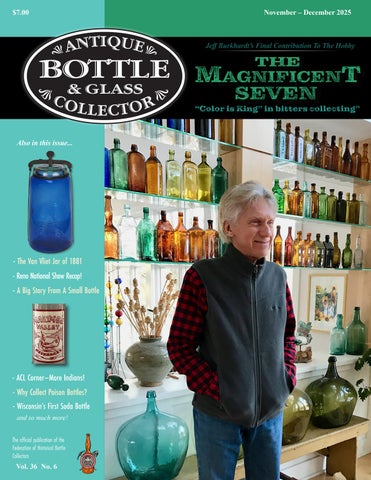
$7.00
November – December 2025
Jeff Burkhardt’s Final Contribution To The Hobby
THE
MagnificenT SEVEN
“Color is King” in bitters collecting”
Also in this issue...
- The Van Vliet Jar of 1881 - Reno National Show Recap! - A Big Story From A Small Bottle
- ACL Corner–More Indians! - Why Collect Poison Bottles? - Wisconsin’s First Soda Bottle and so much more! The official publication of the Federation of Historical Bottle Collectors
Vol. 36 No. 6
Vol. 36 No. 6
November – December 2025
No. 82
TABLE OF CONTENTS
To Advertise, Subscribe or Renew a subscription, see pages 71 and 72 for details.
FOHBC Officers | 2024–2026 ...................................................................................... 2
To submit an article, send a letter, or share comments, contact:
FOHBC President’s Message ............................................................................................ 4 FOHBC News–From & For Our Members .......................................................................... 6
Alice Seeliger, Editor N8211 Smith Road Brooklyn, WI 53521 phone: 608.575.1128 email: FOHBCmembers@gmail.com
FOHBC Regional News ..................................................................................................... 8 Virtual Museum News by Richard Siri ................................................................................ 11 ACL Corner #19–A Few More Indians by Mike Dickman ..................................................... 12 A Big Story From A Small Bottle by Andrew Rapoza ........................................................... 16
12
Young Collectors’ Corner by Alice Seeliger ...................................................................... 20 The Van Vliet Jar Revealed by Greg Spurgeon & Michael Seeliger ......................................... 24 William F. Swasey And His California Bonzest by Eric McGuire ......................................... 28 Why Collect Poison Bottles? by Tim Adams & Vern Huffstetler .................................................. 34 The Magnificent Seven – “Color Is King” In Bitters Collecting by Jeffrey Burkhardt .............. 36 Chasing Dr. Parker by Peter Jablonski .............................................................................. 42
24
FOHBC Reno 2025 National Antique Bottle & Glass Convention Recap ......................... 48 Wisconsin’s First Soda Bottle by Tod Von Mechow ................................................................. 54 Lost & Found ................................................................................................................. 60 Member Photos ............................................................................................................ 64 Classified Ads ............................................................................................................... 67 FOHBC Sho-Biz–Calendar of Shows ............................................................................... 68 Membership Benefits, Display Ad Rates, Donations to the FOHBC .................................... 71
So you don’t miss an issue of Antique Bottle & Glass Collector, please check your labels for expiration information.
34
Membership Application, Classified Advertising & Article Submission ............................... 72
Fair use notice: Some material in Antique Bottle & Glass Collector has been submitted for publication in this magazine and/or was originally published by the authors and is copyrighted. The Federation of Historical Bottle Collectors, Inc., a non-profit 501 (c)(3) educational organization, offers it here as an educational tool to increase further understanding and discussion of bottle collecting and related history. We believe this constitutes “fair use” of the copyrighted material as provided for in Section 107 of the U.S. Copyright Law. If you wish to use this material for purposes of your own that go beyond “fair use,” you must obtain permission from the copyright owner(s). Antique Bottle & Glass Collector (ISSN 1050-5598), Copyright © 2025 by the Federation of Historical Bottle Collectors, Inc., is published bi-monthly (6 issues per year) by the Federation of Historical Bottle Collectors, N8211 Smith Road, Brooklyn, WI 53521. Business and Editorial Offices: N8211 Smith Road, Brooklyn, WI 53521. Accounting and Circulation Offices: the Federation of Historical Bottle Collectors, Inc., N8211 Smith Road, Brooklyn, WI 53521. Call (608) 575-2922 to subscribe. Periodicals postage is paid at Stoughton, Wisconsin 53589, and additional mailing offices. Pub # 005062 Postmaster: Send address changes to Federation of Historical Bottle Collectors, c/o Michael Seeliger, N8211 Smith Road, Brooklyn, WI 53521. Phone 608-5752922; email: fohbcmembers@gmail.com. Annual subscription rate is: $40 for Standard Mail or $65 for First Class, $85 to Canada, $120 other countries, $25 Digital Membership [in U.S. funds]. Life Membership: Level 1: $1,000, Level 2: $500. The Federation of Historical Bottle Collectors, Inc. (FOHBC) assumes no responsibility for products and services advertised in this publication. See page 72 for details.
“Reno 25 Chair, Richard Siri, takes home top honors.”
36
The names Federation of Historical Bottle Collectors Inc. (FOHBC), and Antique Bottle & Glass Collector ©, are registered ® names of the Federation of Historical Bottle Collectors Inc., and no use of either, other than as references, is permitted without expressed written consent from the Federation of Historical Bottle Collectors Inc. Certain material contained in this publication is copyrighted by, and remains the sole property of, the Federation of Historical Bottle Collectors Inc. while others remain property of the submitting authors. Printed by Modern Litho, Jefferson City, Missouri.
48
November – December 2025
54
Visit us at: FOHBC.org & Facebook
3
FOHBC Board of Directors Director-at-Large: Richard Siri, PO Box 3818, Santa Rosa, California 95402, phone: 707.542.6438, email: rtsiri@sbcglobal.net Northeast Region Director: Charles Martin Jr., 5 John Hall Cartway, Yarmouth Port, Massachusetts 02675, phone: 781.248.8620, email: cemartinjr@comcast.net
Federation of Historical Bottle Collectors
The Federation of Historical Bottle Collectors is a non-profit organization, founded in 1969, for collectors of historical bottles, glass and related collectible items. Our primary goal is educational as it relates to the history and manufacture of historical bottles and related artifacts.
Midwest Region Director: Henry Hecker, W298 S10655 Phantom Woods Road, Mukwonago, Wisconsin 53149, phone: 262.844.5751, email: phantomhah@gmail.com Southern Region Director: Tom Lines, 1647 Olivia Way, Auburn, Alabama 36830, phone: 205.410.2191, email: Bluecrab1949@hotmail.com Western Region Director: Eric McGuire, 1732 Inverness Drive, Petaluma, California 94954, phone: 707.481.9145, email: etmcguire@comcast.net
FOHBC Officers 2024–2026 FOHBC Virtual Museum:
President: Michael Seeliger, N8211 Smith Road, Brooklyn, Wisconsin 53521, phone: 608.575.2922, email: mwseeliger@gmail.com
FOHBCVirtualMuseum.org
Vice-President: Position Open
Requires FOHBC membership, access through FOHBC.org
Secretary: Alice Seeliger, N8211 Smith Road, Brooklyn, Wisconsin 53521, phone: 608.575.1128, email: AliceSecretaryFOHBC@gmail.com
Auction Price Report: Facebook:
Federation of Historical Bottle Collectors
Treasurer: Kathie Craig, 1037 Hazelwood Avenue, Campbell, California 95008, phone: 408.591.6511, email: kathie.fohbc@gmail.com
Antique Bottle & Glass Collector, the Official Publication of the Federation of Historical Bottle Collectors.
Business Manager: Position Open
Publisher: The Federation of Historical Bottle Collectors, Inc.
Membership Director: Position Open. (Interim) Michael Seeliger, N8211 Smith Road, Brooklyn, Wisconsin 53521, phone: 608-575-2922, email: mwseeliger@gmail.com
Editor: Alice J. Seeliger, alicesecretaryFOHBC@gmail.com
Marketing Director: Craig Cassetta, 12 Marlin Court, Chico, California 95973, phone: 530.680.5226, email: ccassettafohbc@gmail.com
Digital Director/Webmaster: Doug Simms, dsimms@FOHBC.org
Special Projects Director/Webmaster: Doug Simms, 1317 Tullahoma Drive, Prattville, Alabama 36066, phone: 334.318.1965, email: dsimms@fohbc.org Director-at-Large: Matt Lacy, 3636 State Route 307, Austinberg, Ohio 44010, phone: 440.275.5017, email: mlacy28@yahoo.com Director-at-Large: John O’Neill, 1805 Ralston Avenue, Belmont, California 94002, phone: 650.619.8209, email: Joneill@risk-strategies.com
4
Design / Layout: Michael George, earlyglass@gmail.com Sales Manager: Alice J. Seeliger, alicesecretaryFOHBC@gmail.com Social Media: Craig Cassetta, ccassettaFOHBC@gmail.com Featured Writers: Jeffrey Burkhardt, Mike Dickman, Andy Rapoza, Eric McGuire, Vern Huffstetler, and Tim Adams
FOHBC (Federation of Historical Bottle Collectors) N8211 Smith Road Brooklyn, Wisconsin 53521-9789 General Contact: FOHBCmembers@gmail.com
Antique Bottle & Glass Collector
November – December 2025
5
President’s Message Michael Seeliger President Federation of Historical Bottle Collectors
N8211 Smith Road, Brooklyn, Wisconsin 53521 • 608.575.2922 • mwseeliger@gmail.com
T
his fall/winter bottle show season has been busy with FOHBC representation at many shows including Circle City in Indiana, the outdoor Coventry Show (expensive, beautiful bottles on tables in a field), Keene, Forks of the Delaware, Findlay (OH), Nashville (Lebanon),1st Chicago and finally a nearby Portage, Wisconsin show. Whew! Kathie and Michael Craig, Bills Mitchell and Taylor, and Henry Hecker attended several with us along our 3000+ miles of travel. Federation members are excited about the new website and more benefits to come, and those benefits are bringing in new members.
We offered Affiliated Clubs sets of Houston 24 Exhibition books, donated to the Federation by Joel Bartsch, to use for fundraisers. [Interested clubs please contact me to participate.] While visiting several museums and historical societies, we presented sets of books for their libraries, thereby carrying out Joel’s wish to get them into as many hands as possible so they can be enjoyed. Looking forward to 2026, we have a special promotion in the works. Ideally, we would have had our National Antique Bottle & Glass Expo in St. Louis to celebrate the 50th anniversary of the Federation’s first national event held in that city in 1976, but we just could not make that happen. It’s also America’s 250th Anniversary (Semiquincentennial). Watch for announcements about how we will commemorate these milestones. We are putting our efforts into the FOHBC Nashville 2027 National Antique Bottle & Glass Expo to be held July 29-31, 2027 in Lebanon, Tenn. Great facilities, free parking, easy in-easy out, large airport within driving distance, numerous hotels, and so much enthusiasm from Greg and Elise Eaton and Stanley Word from the Nashville host club that you’re sure to have a great time. There’s space for 400 tables with the best lighting you’ll ever see! Seminars, informal banquet and keynote speaker, awards presentation, displays and even a distillery tour will complement the Expo. Pre-orders for the Tennessee Orange Commemorative Drake’s bottle have already begun. After the Expo, there’s the 1000-mile garage sale from Alabama to Michigan…plan an extended vacation! Also, in 2026, we will continue building on the Federation’s best features: the new FOHBC.org website, new features in the Antique Bottle & Glass Collector magazine with Michael George providing design and layout, additions to the Virtual Museum, update of the Auction Price Report, and the continuation of monthly webinars. Check out the “Young Collectors Corner,” a new feature in each issue of AB&GC. If you know a young collector to include, send him/her our way. We hope you enjoy this issue and welcome your feedback. Of course, you’ll note this issue is later than usual due to the transition, but we’re working on getting back on schedule in 2026. To maintain the Federation as a primarily volunteer organization, we are dividing many administrative tasks into more manageable segments. We are much more in line with best business practices with checks and balances and the overlap of duties built into the system. Kathie Craig is doing an admirable job as Treasurer, Doug Simms is doing a stellar job with the new website, including on-line membership with auto-renewals, as well as upgrading systems and programs on all sites to be more efficient and less costly. 6
Antique Bottle & Glass Collector
Craig Cassetta achieved more than 50,000 views on the FOHBC Facebook page last month (just imagine!) and he keeps the page active and interesting. Alice and I have taken on numerous management tasks to learn the systems to pass them on to other volunteers. We are looking for a membership director (assisted greatly by on-line membership), AB&GC magazine assistance including coordination, advertising, and proofreading, and several positions on an editorial board. There are also some other general administrative duties that keep the organization running smoothly. Let me know where you can help! To re-invigorate the Virtual Museum, several eager members have come forward to help with research and writing to get over 700 items added to the site, almost doubling its current content. Alan DeMaison has led the imaging with help from Angelina Pellegrini-Ott and Eric McGuire. Let’s put their work to good use! Why not take a Wing under your wing and share your expertise—we’ll provide a list of pending entries, and you can write descriptions to go with the spinners. Can we get all 700 of these on the Virtual Museum this year??? The Auction Price Report key people are eager to begin updating the auction listings. They have been doing background work, and a former auction house cataloguer will be joining them to get that ball rolling. We have high hopes that the complete update will be accomplished in 2026 also…at least that’s an admirable goal. My thanks to all board members for their continued support of the organization. They earned the coveted “President’s Award” that was announced at the FOHBC Reno 2025 National Antique Bottle & Glass Convention this past July/August. The 2024-2026 term ends in July 2026, and I hope you will remain on the board to continue your great leadership. There are open positions for those of you out there who want to join the fun. We’ll be setting up a nominating committee soon. Throw your hat in the ring! In this issue, enjoy a recap of the successful FOHBC Reno 2025 National Antique Bottle & Glass Convention brought to you by Richard Siri, Craig Cassetta, DeAnna Jordt, Bev Siri and a host of others. Plus, there are many interesting articles, tidbits, and photos submitted by members. Send in your articles and photos for future issues! In closing, we must bid a sad farewell to Jeff Burkhardt, who passed away on October 24. This issue includes his final gift to the bottle-collecting community. We wish he could have seen it in print before his passing. Jeff will be missed. We offer our sincere condolences to his wife, Jeanine, and children. Our successful search for a Graphic Designer brought this great talent to AB&GC. Michael George is a well-known collector and premiere antique glass dealer from New Hampshire. With decades of experience writing articles, attending and coordinating shows, and performing lectures, Michael is always willing to share his knowledge while coaching new collectors in the hobby. Michael also has a Bachelor’s Degree in Marketing from Notre Dame College, and has strong experience in magazine design. These qualities make him an excellent fit for our publication, Antique Bottle & Glass Collector. Welcome Michael! Michael can be reached at earlyglass@gmail.com November – December 2025
7
FOHBC News
From & For Our Members The Federation was pleased to be welcomed at many shows that took place during the month of October around the East Coast and Midwest. Michael Seeliger, President; Alice Seeliger, Secretary; Kathie Craig, Treasurer, and Michael Craig put on over 3,000 miles as they visited shows, Tom Paskiewicz’s collection, Rick Carney’s stained glass studio, The New Bedford Museum of Glass, and Warner’s headstone in Skaneateles, NY along with a few libraries and museums along the way. They were able to personally present awards won at Reno 25 to two recipients who were not able to be at the Awards Ceremony: Tom Haunton—First Place for Best Original (Research) Story and Best Original True Story; and Michael Majewski—First Place for Best Social Media. Michael Seeliger visits the Warner Headstone in Skaneateles, NY Michael Seeliger presented Thomas Haunton with two FOHBC Contest plaques at the Coventry Show.
Michael Seeliger visits the Warner Headstone in Skaneateles, NY
Michael Seeliger presented Michael Majewski with a FOHBC Contest plaque at the 1st Chicago Bottle Show. A visit with Tom Paskiewicz and his vast Lowell, Mass. collection, figural bottles, and rare medicines. 8
The Coventry Show where dealers offered many beautiful bottles and glass on the grounds of The Museum of Connecticut Glass in Coventry. Antique Bottle & Glass Collector
Mike & Kathie Craig present The New Bedford Museum of Glass Executive Director, Kirk J. Nelson, with a Reno Red Commemorative Drake’s.
The Nashville Show Crew gathered around the Jack Daniel’s raffle barrel.
Michael Seeliger with Ray Buch, Chair of the Forks of the Delaware show.
Tom Lines, Southern Region Director set up at The Nashville Show. But we hear he had time to buy also!
The Forks of the Delaware crew paused for a photo with Alice and Michael Seeliger, L-R: Jim Etheredge, Brad Tucker, Matt Brady, and Mike Black.
The Keene Show is always well-attended with great bottles and glass from dealers who fill up the space; and there’s always a waiting list. November – December 2025
9
FOHBC
Regional News Southern Region Report – Tom Lines
T
he collector spotlight this month is on Arkansas’ Larry Childers. I first met Larry 25-30 years ago at one of the old Memphis Bottle Shows. Though we don’t get to see each other as much as we used to, when we do, it’s like we never missed a beat. Here’s what Larry has to say about his decades in the hobby…. “Once a collector, always a collector.” Right? Like all boys in the 1950s, I had a rock collection and a baseball card collection, so it was only natural that I progressed further into antiques, which tied right into history! I blame it all on my Papaw, Charley Maier, who gave me a metal advertising corkscrew from a saloon in Fort Smith along with a paper advertisement from another saloon also from Fort Smith. He had had the experience of traveling there with his father who sold milk and butter from a wooden covered mule-drawn wagon on Saturdays. Fast forward a few years, after a stint in the U S Navy, while I was finishing college, I happened upon my first Arkansas bottle! It was a little beauty embossed ‘Blackburns Drug Store, Ozark, Arkansas.’ It was just laying on the riverbank waiting to turn me into a bottle addict! On those rare free afternoons when I was not having class, studying, or working one of my two part-time jobs, (I had a wife and a young daughter and in those days we paid our way through college along with the G I Bill. Forgiving student loans had not been conjured up!) I was walking that riverbank or rummaging through antique shops. Along the way I met a man who became a lifelong friend, Dean Marvel, who was putting on a bottle show in Fayetteville. What the heck was a bottle show? I had to go! Man was I surprised! A whole room of sales tables with bottles from all over the country, and there I was gawking at all of the fruit jars, soda bottles and more. All the talk in 1975 and the spring of 1976, those early days of our hobby, was the St Louis Expo! The first and biggest bottle collecting event to ever be held! I had finished school and was working for a CPA firm which afforded me more gas money. So I loaded up my family and headed to see the greatest bottle show on earth! And it not only met but exceeded all expectations! Bottles! Bottles! Bottles! There were more treasures than you can imagine that exchanged hands that weekend. There I was with a beer budget wallet running around looking at a 10
champagne world! There’s not too many of us around who made that 1976 show. I attended many Expos since but that was the granddaddy of them all! In those early years we dug, or tried to dig, most of our bottles. If you knew someone who knew of a dump, he would become your instant friend! My collection would be considerably larger if I had known anything about privy digging, especially if I were as good with a probe as another Arkansas collector, Ed Tardy, who is the best probe man I have ever seen. Along the way, I have met and befriended people from across America. Just to name a few: Gene Bradberry, Ed Provine, Tom Phillips, Gene Kelly, Curt Falkenberry, Digger Dave Beeler, James McNeil, Ben Wood, Jerry McKinley, Tom Lines, Ferdinand and Elizabeth Meyer, Sheldon Baugh, Ralph Van Brocklin, Brad Seigler and others too numerous to list here. But two of the best were my friends and running mates, Dean Marvel and Rufus Buie. Together we three were a common sight at most local shows and close to a dozen or so National Shows or Expos. Traveling together saved us enough extra money to buy just one more bottle! We also got to go to baseball games together in St. Louis and Cleveland, which also had the Rock and Roll Hall of Fame. We visited cities like Augusta, Nashville, and Memphis several times…the only downside being which one of us snored the loudest last night. We even got to the point of believing each other’s lies, before losing Rufus to cancer two years ago. It seems that there is a new grass roots movement with a new younger group of collectors coming up in Arkansas. It looked like the hobby had died there for a while. These new young men remind me so much of us old over-the-hill guys 30-40 years ago! All of this is good for several reasons. We cannot just become a hobby where money and greed dictate who and what we collect. The baseball card collectors experienced this…and the bottom fell out! Only perfect graded cards were sought. I hope that this never happens to our little addictions. That new man or woman with an ACL soda or a screw top 1950s hair oil bottle are what will be our future…keep ‘em coming! Back to me…I am a little older now, retired, a papaw myself, but still collect almost all antique Arkansas bottles, jugs, and go withs, signs, all types of old 19th and 20th century advertising, photos, cans, etc. So, if you have anything of this nature from Arkansas stuck back in a box or corner of a closet, please consider me. For an old man with a long grey ponytail who wants so badly to go back down in one of those 26 deep privies in Memphis (if Randy Yarberry will pull me Antique Bottle & Glass Collector
The Four Regions of The Federation: Western, Midwest, Southern, and Northeast
out!) and who still looks for new bottles just like I used to 40 years ago...help me out! Give me a fix! Just last week I walked into an antique mall in Little Rock and found a mint Strong, Ark hutch! My fix for at least a week! But a new week starts on Monday!!! And I am still In Good Standing with American Express!” Thank you, Larry! Your story reflects the beginnings of many a collector in this great hobby of ours. We all started out collecting something and that progressed to where we are today! As you said at the start, “Once a collector, always a collector!” Elsewhere, looking across the Southern Region, a recent weekend was apparently bottle show weekend with three separate events going on that spread out across this 11-state region…Biloxi, Mississippi and Pickens, South Carolina and Richmond, Virginia. I attended the Biloxi Show and had a great time buying and selling and especially talking! My best purchase was a plum amethyst Patent whiskey cylinder that another friend (David Hughes) talked me out of before the end of the show. I understand the Pickens and Richmond Shows were also good, drawing lots of people. Next up was the Lebanon, Tennessee Show to round out the year…another year with eight shows and I missed two that were actually right here in Alabama!
I certainly hope the club finds a solution as it is a welcome piece of mail to find in my mailbox. Vincent Grossi of the Kalamazoo Bottle Club just announced that the club members have ratified new by-laws, an exercise every club should do every decade or so. Our local historical society went through the exercise last year and, as you know, FOHBC updated the by-laws in the last year as well. Some common updates that reflect the changing times include electronic meeting attendance and voting, remote membership, liability insurance, show chairperson duties and other job descriptions. The North Star Club (Minnesota) newsletter included this gem, “During our brief September business meeting, Mike K. suggested the club make a donation toward the preservation of the large Gold Medal Flour sign recently uncovered during renovations on the side of a south Minneapolis home. The club gave unanimous approval to the motion.”
Midwest Region Report – Henry Hecker
F
irst of all, if you haven’t checked out the new FOHBC website, do so right now, before you read the rest of this column. Kudos to Doug Simms and to all collaborators!
Like many clubs, producing newsletters has become a challenge. If your club can find a volunteer to be the editor, and then authors to regularly contribute content, the costs to print and mail keep escalating to jeopardize the continuation of “hard copies.” The easy answer is to go digital, except the harsh reality is that a significant number of collectors “skew old” and don’t have a computer. (This issue will resolve itself eventually.) Raising club dues is another solution but that has drawbacks as well. Reducing the number of issues per year is another approach or finding a cheaper print method, or both. The mighty Ohio Bottle Club, creators of the glossy, “eye candy” loaded Ohio Swirl, is facing this dilemma right now. November – December 2025
Ralph and Janet Finch brought a great piece of advertising to a recent meeting of the Detroit Club, as reported in the club’s newsletter, Slug Plate.
11
The 1st Chicago Club newsletter had an interesting tidbit about a dug round-bottom soda shown at a meeting recently. After all the recent furor over the green egg Milwaukee bottle found this summer (see Von Mechow article this issue), Ray Komorowski reports, “Of special interest was a round bottom soda, embossed Dublin, which also had W. H. H. ground into the glass. Apparently, the bottle was ‘recycled’ for use by the W. H. Hutchinson Company.” Enterprising Hutchinson found a cheaper way to bottle his ginger ale (?) than purchasing a gross from Lockport.
Western Region Report – Eric McGuire
A
s we soon end 2025 and then begin a new year in which to celebrate our Nation’s Semiquincentennial, it is unfortunate that the FOHBC will not be planning a national show for 2026. Let’s hope our regional shows will lift our spirits, and our great country, to an unprecedented level. Focusing on bottle-related affairs in our western region, I believe it is appropriate to welcome a relatively new bottle-related player on the “left coast.” GOLDEN GATE BOTTLE AUCTIONS, based in San Rafael, California, is led by long-time collector Andrew Koutsoukos. Having had two successful auctions in its inaugural year, it specializes in bottles made for the western states – with a healthy amount of non-western items represented in the mix as well. Andrew is highly regarded for his knowledge of western glass and we wish him the best in this new venture.
Northeast Region Report – Charlie Martin, Jr.
A
s we prepare to wrap up another year of successfully adding new pieces to our collections, I wanted to take this opportunity to extend my thank you and deep personal gratitude to each and every Bottle Show Chair, Club President and Newsletter Editor for their kindness and willingness to share with me the information that I depend upon to create the Northeast Region Reports. Without your active participation, our magazine readers would not be as informed as they are and certainly they would be less knowledgeable about this region’s bottle show activity. May I wish you and yours a Merry Christmas and Happy New Year. I trust that the New Year 2026 will be a great year for you in building your growing collection. Hopefully, you will add that special piece to your collection. If you do, please reach out to me to let me know about the piece and your hunt to obtain it! September 14, 2025, has come and gone and my bottle 12
club, The Merrimack Valley Antique Bottle Club, held its historic Fiftieth (50th) Annual Antique Bottle Show and Sale. (We would have reached this milestone sooner except for the suspension of shows during the Covid Pandemic.) The day could not have been more enjoyable. We had great Fall weather, comfortable temperatures and large attendance. In recognition of our 50th Annual Show, the club awarded $50 door prizes to several lucky attendees. For the first time in Club history, the early admission crowd of thirty-four (34) collectors ponied up the $20 entrance fee to shop early. Our previous shows never exceeded twenty-four (24) early attendees. Show Chair and Club President, Kevin Cantrell, reported that every table available for this event was sold out weeks before the show. There was a great mixture of returning dealers as well as several dealers new to the show. Several dealers had to be placed on our wait list. Coffee was provided for all dealers and helpers during set up. And all dealers and helpers were able to have a complementary free lunch from a local food truck. The atmosphere was electric all day. Customers streamed through the show event from opening until closing. By all accounts this event was enormously successful for all who attended and went home with special treasures to add to their collections. As a dealer/club member I could not be more proud of our club’s success. It bodes well, in my thinking, for the future of our hobby. On a side note, I brought gifts from the Federation (FOHBC) of magazines and t-shirts, that were well-received and appreciated by all who received them. In recognition of the MVABC’s 50th Show and Sale, the Federation donated two coffee table books from the Houston 24 Expo to add to the club’s library. Remember, that no matter where you live, there is a bottle club nearby that would benefit from your participation. So, if you’ve thought about making a New Year’s Resolution why not include a membership in the FOHBC and your local bottle club. You will thank me for urging you to do so. Just check out our magazine, Antique Bottle & Glass Collector, for all the benefits of membership. Until next time, happy bottle collecting!
Tom Paskiewicz, Merrimack Valley Club’s most senior member from the club’s formation, displayed milk bottles from Lowell and Billerica, Mass., two towns he has spent his entire life researching. Antique Bottle & Glass Collector
Virtual Museum News By Richard T. Siri, Santa Rosa, California
The FOHBC Virtual Museum was established to display, inform, educate, and enhance the enjoyment of historical bottle and glass collecting by providing an online virtual museum experience for significant historical bottles and other items related to early glass.
Please help us fill our PHASE 4 “Wishart’s Pine Tree Tar Cordial” bottle.
Phase 4
An important update for FOHBC members.
$30k Phase 1 Flask Filled Dec. 2018
The Virtual Museum is ready to kick off the project of adding over 700 images to the various galleries, and some new ones. Alan DeMaison, assisted by Terry Crislip, imaged all of the “Masterpieces” and “Barber Bottles” collection on exhibit at the Houston Museum of Natural Science at the FOHBC National Expo in 2024. Several other personal collections are also included in this group.
$25k
$20k
After preparing 36 photographs of each item, they are ready to be placed into the software program that produces the “spinners.” Descriptions are added and then they go live for everyone to see and enjoy.
$15k
Phase 2 Jar Filled Dec. 2021
$10k
Training several new volunteers for this phase of the project will take place soon and you will begin seeing new entries in early 2026.To participate in this project and share your expertise, contact: Doug Simms, Webmaster, at dsimms@FOHBC.org.
$5k
Phase 3 Barrel Filled Dec. 2022
Thank you to all who have contributed to the Phase 4 capital campaign to continue development of the FOHBC Virtual Museum, a project of The Federation of Historical Bottle Collectors, a non-profit 501(c)(3) educational organization. We still have a way to go to reach our Phase 4 Goal. Donations are tax deductible and all donors are listed on the Virtual Museum Recognition Wall.
$
There is a $5,000 matching grant pledged by an anonymous donor!
$
Now on a dedicated high-speed server, with minimal maintenance costs, there are no salaried technicians. All donated funds are used for additions to the Museum.
F
HI
ST O R I C AL
BO
T
O
E FE
O LLEC T O
D E R AT
EC
IO
N
TL
TH
RS
VI
RT
U A L M U SE U
FOHBC VIRTUAL MUSEUM OF HISTORICAL BOTTLES AND GLASS
M
FO H B C V ir tualMuse um. org For gift information: Alan DeMaison, FOHBC Virtual Museum Treasurer, 1605 Clipper Cove, Painesville, Ohio 44077, a.demaison@sbcglobal.net November – December 2025
13
ACL CORNER #19 [Mike Dickman]
T
A Few More Indians
he first humans to inhabit North America were Indians. Archaeological evidence suggests they came from Siberia, probably following herds of animals across a natural land bridge (which no longer exists) into Alaska, approximately 24,000 years ago. The people then spread south and east and eventually populated the continent. Over the centuries, they formed culturally distinct groups which evolved into nations, tribes and bands. Some of them lived peacefully alongside their neighbors while others became bitter enemies engaged in constant warfare. Because the Indians did not develop written records, nobody knows how many of them were living in America when Christopher Columbus discovered the New World in 1492. Estimates range from as few as eight million people to as many as 112 million. In the United States, bottlers of soda pop in the twentieth century frequently used images of Native Americans on their applied color labels (ACL). The dramatic and often colorful labels were designed to catch the eye and help sell the product. Today, Indianthemed ACL soda bottles are among the most popular categories to collect and one of my personal favorites. We examined several of these bottles in ACL Corner # 3 [March-April 2023], but let’s look at a few others. One of the rarest and most interesting ACL soda bottles depicting an Indian is Wah-Pah-Sha, Chief of the Sioux [FIG. 1]. The beverage was made in
14
1938 in the small town of Wabasha, Minnesota, which lies along the Mississippi River in southeast Minnesota and had a population of just 2,368 in 1940. There actually were three Indian chiefs of that name: Wapasha (1718-1806), his oldest son Wapasha II (d. 1855) and his grandson Wapasha III (d. 1876). “Chief of the Sioux” is a bit of exaggeration, too, since they were chiefs of the Mdewakanton band of the Dakota subtribe of the Sioux. Their group fought against FIG. 1 the United States during the Wah-Pah-Sha, Chief of the Sioux, Wabasha, Minnesota, 1938. Photo War of 1812 but switched courtesy of an FOHBC member. sides and fought with the Americans in the Black Hawk War of 1832. Wapasha III signed treaties in 1851 and 1858 that ceded away their ancestral lands in Minnesota and moved his people to South Dakota and then to Nebraska. There are only three examples of the bottle known, although others (hopefully) may be waiting to be found. In 2025, a mint example of the Wah-Pah-Sha traded hands privately for $2,500, which is quite pricey for an ACL soda bottle. The unused condition of the few known bottles makes me wonder whether the product ever was sold commercially, or if the bottles instead were just prototypes.
Antique Bottle & Glass Collector
Another rare Indian ACL soda bottle is Tecumseh Beverages, a twelve-ounce beverage put up in 1939 by the Tecumseh Bottling Works of Tecumseh, Nebraska [FIG 2]. I’ve been able to document only 6-8 of these bottles extant today. A 10-ounce version with a different, all-white ACL was made in 1965 but it is far commoner and much less attractive, in my opinion [FIG. 3]. It seems strange that Tecumseh (1768-1813) would have been honored by an American town and a soft drink in his name, since he devoted his life to fighting the USA. Tecumseh was a Shawnee chief, fierce warrior and gifted orator who formed an inter-tribal confederacy and a large, multi-tribal community called Prophetstown in what is now Indiana. (The “prophet” was his younger brother, who preached a return to the ancient ways of the pre-contact Indians.) Tecumseh fought many hard battles against United States troops and sided with the British during the War of 1812, in which he was killed in 1813. Following his death, Prophetstown was destroyed and his confederacy collapsed. But in the two centuries since he died, Tecumseh has become something of an American folk hero and the subject of novels, plays, movies and a recent videogame called Civilization VII.
FIG. 2 Tecumseh Beverages, Tecumseh, Nebraska, 1939
FIG. 3 Tecumseh Beverages, Tecumseh, Nebraska, 1965 FIG. 4 Heep Good Beverages, Wenatchee, Washington, 1940
The Heep Good Beverages pictorial series are fascinating ACL soda bottles. Put up in 1939 and 1940 by the Wenatchee Bottling Works of Wenatchee, Washington, there are eight ACLs in the series. All of the bottles are seven ounces in size and have identical shapes, but each has a different, detailed scene depicting some aspect of Native American life, such as “The Painter” [FIG. 4]. Other themes include “War Dance” and “Buffalo Hunt” and all of the bottles are exceedingly rare [FIG. 5]. Wenatchee sits near the eastern foothills of the Cascade Range in central Washington State and FIG. 5 Five of the eight Heep Good picture bottles, (left to right), War Dance, The Painter, Buffalo Hunt, Kneeling Indian, Canoe. Photograph courtesy of Tim Miller
November – December 2025
15
FIG. 6 Heep Good Beverages, Wenatchee, Washington, (left to right): 12 ounces, 1939, 6-1/2 ounces, 1948
FIG. 7 Rare and early Heep Good soda bottles, 1937 and 1938. Why did the company create so many different ACLs for a market of less than 12,000 consumers? Photo courtesy of James Campiglia
is known as the “Apple Capital of the World” for its many apple orchards. The area was the ancestral home of the Wenatchi Tribe, which presumably is the group portrayed on the ACLs. But the city is isolated and had a population of only 11,620 people in 1940, according to the U.S. Census, so why did the bottler go to the considerable expense of creating eight different ACLs for its beverages? And in addition to this series, the company made numerous other Indian-themed ACLs, which makes absolutely no sense from a financial perspective [FIGS. 6 and 7]. Whatever the reason, however, we collectors are happy they did!
FIG. 8 Sioux Beverages, Minot, North Dakota, 1954 FIG. 9 Sioux Brand Beverages, Sioux Falls, South Dakota, 1951
Sioux Beverages has a wonderful ACL showing a proud, noble-looking chief in his war bonnet, wearing a bear-claw necklace and staring unflinchingly into the distance [FIG. 8]. The bottle was made in 1954 by the Northern Bottling Company of Minot, North Dakota, and has unusual colors of dark red and tan. It’s another rare ACL soda bottle with just six to ten examples known to exist today. A far more common Sioux Beverages was made by the Seven-Up Bottling Company of Sioux Falls, South Dakota in 1951 [FIG. 9]. Mint examples of this bottle typically sell for $50-$75. Its ACL depicts a detailed and realistic portrait of a fierce, determined-looking Sioux warrior 16
Antique Bottle & Glass Collector
with eagle feathers knotted into his braided hair. The Sioux Tribe originally inhabited the Great Lakes region but were forced westward due to constant warfare with the Iroquois and Ojibwe, and ultimately resettled throughout the Great Plains. Today they are one of the most populous Indian tribes in the United States. This is a good place to make an important point about ACL soda bottles. Because they are of recent vintage (made from 1934 through the mid-1980s) and initially were not considered valuable or even collectible, it is possible that cases of any brand of ACL soda may be hiding in old warehouses, defunct bottling works or grocery store basements. That was the situation with the black-and-orange Heep Good Beverages bottle shown in Figure 6. The bottle was considered scarce until FOHBC member James Campiglia, as an enterprising teenager in Las Vegas around 1987, found and bought four cases of them (96 bottles), all in mint condition. James started selling them for $7.50 each and eventually disposed of his hoard; the market absorbed the bottles and mint examples now bring $50-$75. But the story may be a cautionary tale about spending lots of money on a “rare” ACL soda bottle, although monetary value is a relative concept when da Vinci’s Salvator Mundi painting brought $450+ million at auction and one pound of Beluga caviar can cost $10,000.
FIG. 10 Maumee Valley Beverages, Ft. Wayne, Indiana, 1957
Let’s end with a great Indian-themed ACL soda bottle that is uncommon but available for a reasonable price, less than $40. Maumee Valley Beverages is an 8-ounce bottle that was put up in 1957 by the Maumee Beverage Company of Ft. Wayne, Indiana [FIG. 10]. The ACL of the bottle depicts an Indian paddling his birch bark canoe down the Maumee River. The river originates in Fort Wayne and then flows northeastward for almost 150 miles, emptying into Lake Erie near Toledo, Ohio. Its shores and adjacent valleys were home to the Miami Tribe of Native Americans, one of whom is shown on the ACL. In addition to the detailed and artistic graphics of the bottle’s label, which includes two arrows on either side of the canoe, the rustic-looking typography and shape of the glass bottle are unique and highly pleasing. The bottle is almost 70 years old and a heck of a nice collectible for forty bucks!
ACL soda bottles depicting Indians are uniquely American and open a window into the history and culture of our great nation. God bless America! The author welcomes comments, questions and suggestions at mikedickman@yahoo.com
BIBLIOGRAPHY: The Painted Soda Bottle Collectors Association website contains a wealth of information about ACL soda bottles including hundreds of photos, an ongoing compilation of recent auction prices and an archive of all ACL Corner articles. www.PSBCA.org Sweeney, Rick, “Collecting Applied Color Label Soda Bottles” (3d ed. 2002, PSBCA) VintageSodaCollector.com by FOHBC member Tom Pettit, a great resource containing hundreds of color photographs as well as interesting, useful articles about all things ACL “Weide’s Soda Page” (ca-yd.com), by FOHBC members Chris and Catherine Weide, is another outstanding, useful resource for ACL soda bottles Wikipedia.com November – December 2025
17
A Big Story From A Small Bottle! S By Andrew Rapoza
everal years ago, I went to the illustrious Baltimore Bottle Show. Traveling from Texas to Maryland for a long weekend cost me several hundred dollars, but, although the show was fabulous, I only purchased one little bottle – and I mean little. It measures just 3½ inches (8.89 cm). It only cost $30 USD, but adding in all the trip expenses it took to get the bottle, I claim this pipsqueak cost me almost a thousand dollars. Dr. Haynes’ Arabian Balsam – trial size bottle. Some residue of the medicine can still be seen clinging to the inside shoulders of the bottle. Rapoza collection.
I surveyed the show with the diligence of a revenuer hunting for contraband. This little, labeled bottle was unveiled early on in my reconnaissance, but I kept coming back to it, even when I had wandered hundreds of bottles away. It was the sad, tired face on the label that kept calling out to me. It had all the elements I look for in a bottle: a great label that hints at an interesting story, a historical connection to Lynn, Massachusetts, no cracks in the glass, and a price I can afford. This bottle of Haynes’ Arabian Balsam might have held only a thimbleful of medicine, but it checked off all my boxes … and that face looked so lonely! I have seen this medicine advertised many times in my research, but really didn’t know anything about it, other than it was made in Providence, Rhode Island, and had that exotic name, accompanied by the haggard, haunting face. Why was it called Arabian Balsam, not Providence Balsam, and for 18
heaven’s sake, instead of using an image of a genie on a flying carpet or a sultry harem girl, why was the illustration THAT FACE? Here’s what I found out.
Haynes’ Arabian Balsam was the creation of Aaron Haynes, while living in South Braintree, Mass. (a little south of Boston). He was born in Vermont and after attending 30 weeks of classes at the Vermont Academy of Medicine, he graduated in 1830. He then married and got busy having children. As late as August 1850 he was still living in Vermont not as a physician, but as a Baptist clergyman, suggesting he wasn’t fully committed to medicine as a career at that point. Over the next few years, the Haynes family moved to South Braintree and Aaron was focusing on his knowledge of medicine to make the balsam that bore his name. It was a remarkable remedy, some might say miraculous, since it possessed qualities fit for internal and external use, and for man or beast. In 1855 he produced a brochure that claimed it brought relief in “all cases of pain and inflammation,” such as burns, bruises, sprains, gunshot and other wounds, earache, deafness, piles, sore lips and throat, lost motion of the limbs, and much more. From poisoning to hiccups, this was the answer. The brochure included testimonials from grateful South Braintree neighbors dated December 1854 and, notably, the stories of the balsam’s successful use focused on its external application. One wrote of a daughter who sat immobilized for five days because of “pain like a dagger piercing through her hip.” After one day using the amazing Arabian Balsam, “she was almost entirely free of pain” and within three weeks she was “perfectly well.” Another told of a year-old toddler who spilled a teacupful of boiling hot tea on herself; “she was in such agony.” Her parents Antique Bottle & Glass Collector
stripped off her clothes and found her skin “as red as a blaze all over her neck, bosom and bowels.” The Arabian Balsam was applied over the entirety and within ten minutes the baby had relief. A third story told of a mother who had no use of her right arm for two years, but the visiting Dr. Haynes prescribed his Arabian Balsam, telling her that “he thought it would cure it.” When the doctor visited her five or six weeks later, he found her “sewing with her right hand as tho’ it was perfectly well.” The endorsement also revealed that the doctor’s visit had occurred over four years earlier, showing that he was practicing medicine in South Braintree just a few months after he was censused as a preacher in Vermont. Dr. Haynes was cautiously optimistic about the successes of his medicine – cautious because he didn’t want others to copy his success, and optimistic because he wanted to brand his medicine and have it sold in stores – so in 1859 he sought trademark protection of his product name, Haynes’ Arabian Balsam, and he added his face to prove that it was the genuine article. According to his advertising, 40,000 bottles sold over the period from 1856 to1857. Maybe one or two zeroes had been added, but his success had attracted the attention of a fellow named Jesse Miller. Known as both a physician and a peddler, he lived in Wrentham, Mass., about 25 miles away, on the way to Providence, Rhode Island.
The Arabian balsam tree is a shrub, also referred to as the Balm of Gilead. November – December 2025
Miller had a wife and two young sons, but not much else. It’s hard to imagine how he was able to negotiate a deal with Dr. Haynes to purchase the formula and the rights to take over the Arabian Balsam business, but he did, in 1859. He named his business J. Miller & Sons, but with his two boys being only 15 and 10, fame and fortune would be largely his own responsibility for a while. There were at least two parts to Miller’s plan to grow his new business. He added his own concoction, which he dubbed, Dr. J. Miller’s Vegetable Expectorant, and he advertised both medicines in Connecticut and Maine newspapers, hoping to expand their market. When Lydia Pinkham’s son, Daniel, had his grocery store, he stocked Haynes’ Arabian Balsam. I get a kick out of imagining all those little tiny faces somberly staring out from his shelf. As hard as it may be for us to imagine today, medicines named Arabian Balsam and Vegetable Expectorant were anything but original; there were many others using these designations, much like we use the terms “toothpaste” and “cough syrup” today, differentiating them by the brand or maker. Lady Perrott’s Arabian Balsam was being sold in 1821 and Cheeseman’s, Prince’s, and Bennet’s peppered Arabian balsam, were advertised over the next several decades, and many others were added to the competition throughout the century. Store advertising frequently referred to Arabian balsam generically rather than specifying exactly which brands they were selling. Arabian balsam gets its name from Flavius Josephus, an ancient historian who claimed that among the spices that the Queen of Sheba presented to King Solomon (1 Kings 10:2) “was some of the real Arabian Balsam ….” It was an aromatic gum from the bark of a balsam tree – more of a shrub – found in Arabia and, he wrote, it was one in the same as the Balm of Gilead. It wasn’t just tree sap – it was the stuff miracles are made of, and it seemed to be the miracle cure of the 19th century – at least that’s what Jesse Miller was praying for. But his formula wasn’t made from the aromatic resin of a rare Arabian shrub; its principal ingredient was turpentine, the pungent – and toxic – oil of the pine tree. Now we know it can cause kidney failure, blood in the urine, low blood pressure, vision loss, chest pain, vomiting, severe coughing, hemorrhaging, and even death. But Victorians swallowed and slathered on the Arabian balsam to kill a universe of pains. It was even a trusted cure for pets and farm animals:
19
A cat will catch cold, sneeze, and have all the symptoms of influenza … if she has a sore throat wrap it with flannel wet with Arabian Balsam and keep her away from the children. (1889) Where fowls [chickens] have swellings on heads and feet bathe the affected parts with Arabian Balsam …. (1897) Jesse Miller gave the business everything he had, trying to raise up his three young sons in the business and leave them a legacy of riches. His legacy turned out to be one of loss. He lost a daughter, a grandson, his wife, and one of three sons to various sicknesses over the next twenty years. Then he lost the business. The costs of the company had exceeded his profits and resources, so he mortgaged his business and kept making the products to sell through one of his sons in Boston. But the creditors, a company named E. Morgan & Sons, claimed sole rights, not only to the goods and materials, but to the trademark. The court ruling found in favor of Morgan’s company, so Miller’s new attempt at a trademarked label was not allowed to launch the business in Boston.
Jesse Miller was left with nothing but broken dreams. The bad news was eagerly broadcast through newspapers across the country:
The Proprietor of the Arabian Balsam Buried From an Insane Asylum.
Franklin, Mass., August 27 [1885]. – Jesse Miller, celebrated as the proprietor of the Arabian Balsam, the manufacture of which he carried on at Sheldonville and later at Providence, was buried at Sheldonville yesterday. He died in the Taunton Insane Asylum, where he has been confined for several years. He suffered extended litigation with the originator of the balsam and other interested parties. He 20
Aaron Haynes, M.D., creator of Haynes’ Arabian Balsam. had accumulated a large property only to lose it again. These troubles, with a hereditary tendency to brain trouble, unsettled his mind. Various members of the Morgan family kept making Haynes’ Arabian Balsam deep into the 20th century. Government prosecution meant court cases, fines, reduced promises and claims, and less-offensive ingredients, but the Arabian Balsam continued being sold until 1961, over a century after Dr. Aaron Haynes started healing his patients with his version of the ancient, biblically inspired remedy. His face now poses as a silent witness to a long and storied history and to the many, many wounded and sick people, cats, chickens and other creatures that were thankful for that little bottle of medicine. Seems like that should make the doctor’s face smile at least a little bit.
The West Lynn Cash Store, belonging to James Tarbox, advertised the sale of Arabian balsam of unspecified brand. He was likely selling so cheaply in order to corner the local market, driving customers to his store for the strong-selling medicine category. Due to his constant advertising of the medicine, townsmen nicknamed his horse (actually named “Smuggler”) “Arabian Balsam.” [Advertisement “The Daily Item,” (Lynn, Massachusetts) 24 December 1879] For more on Haynes’ Arabian Balsam and other types of Arabian Balsam, see: PROMISING CURES, Vol.3, Chapter 8: Heroin Addiction Lynn Massachusetts history - History of medicine 19th-Century Health Remedies - Vintage Medical Ephemera - 19th-century medicine Antique Bottle & Glass Collector
Glass Works Auctions proudly presents an important upcoming auction event
The Dick Watson Collection of Saratoga type Spring Water Bottles!
g n i Com
! 6 2 0 2 n i
Widely accepted as the largest and most complete collection of Saratoga type bottles ever assembled. The collection contains over 500 examples including many rare moulds and important colors, many never before offered at auction.
Watch for future announcements about this important offering. For more information contact:
Glass Works Auctions, P.O. Box 180, East Greenville, PA 18041
PH: (215) 679-5849 - Email: glswrk@enter.net - Website: www.glassworksauctions.com November – December 2025
21
Young Collector’s
CORNER
Interviewed by Alice Seeliger
Eli Lane, our first Young Collector Corner subject. When Eli, now 18, was about 13 years old, he went on his first bottle dig following in the footsteps of his brother and best digging partner, Ezra—then 20 years old, who had been in the hobby for many years. Fascinated by the history of the bottles he was unearthing, it didn’t take long before he was hooked. A year into the hobby, Eli began to focus on research and the study of old maps which led him to his digging spots — privies, cisterns, and dumps.
Currently living in Jonesboro while studying Biology at Arkansas State University, Eli hasn’t had much of a chance to travel to any bottle shows. He has had lots of different displays over the years, but his bottle collection outgrew his whole room. Now he has turned one whole wall of his room into shelving that he has filled top to bottom with his finds.
Most of Eli’s collection consists of bottles he has dug that are pre-1920s from his local area, Mountain Home, Arkansas; the state of Arkansas; or any that are related in some way to Arkansas. One of his favorite bottles is probably a Diamond C Bottling Works Newport Arkansas hutch that he dug out of a dump. Before he got into bottle collecting he was especially interested in Native American artifacts. He took up the hobby of metal detecting and collecting primarily Civil War artifacts but loved finding and collecting anything “cool and old.”
22
Antique Bottle & Glass Collector
What is Eli’s favorite bottle? “Probably my unknown druggist bottle from Batesville Arkansas…just because of how local it is to me, and the fact that I dug it!” Another favorite is a sheriff’s badge from pre-1900 with the name of the sheriff and the county – Shelby County, Tennessee. What does Eli enjoy most about the hobby? Exploring and meeting new people. He has met some of the most incredible people during his journey and he hopes to meet many more. He does note that some parts of this hobby are dangerous and are not worth risking your life over and we hope he continues to take his own advice. And with that, Eli is off to go metal detecting!
Welcome to the hobby, Eli, we hope to meet you at a bottle show sometime soon!
Each featured Young Collector will receive a one-year subscription to AB&GC along with membership in the Federation. Do YOU know a Young Collector we should feature?
September – October 2025
23
24
Antique Bottle & Glass Collector
$1,000 June 2021 Glass Works Auctions #167 Lot 141: June 2021 · Glass Works Auctions “ST / DRAKE’S / 1860 / PLANTATION / X / BITTERS - PATENTED / 1862”, (Ring/Ham, D-108), New York, ca. 1862 - 1875, black olive amber color 6-log cabin, 10”h, smooth base, applied tapered collar mouth. Perfect condition, extremely bold impression, no wear or scratches. A very rare color and as dark as any we’ve sold! Also four heavy ‘beads’ are embossed on the base, something we have not seen in any other Drake’s! Dan Catherino Collection.
$180 May 2012 American Glass Gallery #8 “ST / DRAKE’S / 1860 / PLANTATION / X / BITTERS - PATENTED / 1862”, (Ring/ Ham, D-105), New York, ca. 1862 - 1875, medium salmon pinkish puce 6-log cabin, 10”h, smooth base, applied tapered collar mouth. A 1/2” in diameter in-making chip extends from beneath the applied collar down into the neck. Pure puce color that looks great in any lightning.
$2,400 November 2020 American Glass Gallery #121 Lot 185: ““S T / DRAKE’S / 1860 / PLANTATION / X / BITTERS - PATENTED / 1862”, 1862 - 1880. Medium-to-deep pinkish raspberry, cabin form with 6 logs above the label panel, applied sloping collar - smooth base, ht. 9 7/8”, near mint; (just the slightest trace of minor wear, and the embossing is a little weak in the upper shoulders as is not uncommon with this mold, otherwise perfect). R/H #D106. A gorgeous, rare, eye-appealing color that passes plenty of light, and having plenty of pink!
$15,690 September 2020 Glass Works Auctions #121 251: “General Washington” And Bust – “E Pluribus Unum / T.W.D.” And Eagle Portrait Flask, Kensington Glass Works, Philadelphia Pennsylvania, 1820-1830. “Firecracker” Medium amber with a strong olive tone, sheared mouth – pontil scar, pint; (light exterior high point wear). GI-14. Tremont Labeth collection.
$14,000 September 2020 Glass Works Auctions Lot 172: “ST / DRAKE’S / 1860 / PLANTATION / X / BITTERS - PATENTED / 1862”, (Ring/Ham, D-105), New York, ca. 1862 - 1875, medium moss green cabin, 9 7/8”h, smooth base, applied tapered collar mouth. Recently ‘picked’ at the ‘Elephant Trunk’ flea market in Connecticut (a favored venue of the ‘Flea Market Flip’ reality television show), and possibly only the second known example in this very unusual moss green color. In 1993 we auctioned the collection of Elmer Smith of Shelton, Washington. Lot 20 in that collection was at that time the only moss green Drake’s Plantation Bitters known to exist, it sold for $10,000!
Drake’s Plantation Bitters
Available to FOHBC Members Only! Online Auction Price Report. Search on your smartphone, tablet or desktop computer. Includes 10 years of results from American Bottle Auctions, American Glass Gallery, Glass Works Auctions and Heckler in Phase 1. The Auction Price Report is only available to FOHBC members. Being a FOHBC member will give you 24/7/365 access. What a great tool this is for the collectors, diggers, pickers, researchers and the generally curious! Phase 2 updates will include images! Visit the FOHBC.org Members Portal for instructions. 23
THE VAN VLIET JAR OF 1881 By Michael Seeliger & Greg Spurgeon
W
e have all heard about the oneof-a-kind cobalt blue Bitters so famously displayed at the Houston 24 Expo last year, but another fantastic oneof-a-kind jar has been found that rivals the three in beauty and rarity. We asked Greg Spurgeon of North American Glass Auctions to comment on this rare jar that recently turned up and will be a feature item in one of his auctions soon.
THE - VAN VLIET - JAR - OF 1881
26
Antique Bottle & Glass Collector
“A very recent find that we are still researching, this jar was found in Stroudsburg, Pennsylvania, and is suspected to be a take-home piece made by a glass-house worker in the 1880s, most likely at the East Stroudsburg Glass Works (opened in1877). This mold is only known in aquamarine green glass, as the glass house would have called it. The lid is aqua, and most likely original. The pressed glass lids are known to exist in clear and aqua, and were probably jobbed out and pressed by a tableware plant elsewhere. The Van Vliet series also includes the ‘VAN VLIET IMPROVED’ mold, which is known rarely in shades of amber. But this mold, ‘THE VAN VLIET JAR OF 1881,’ to the best of our knowledge, has never been found in any color except aqua”. An exerpt from the Federation’s Virtual Museum states the following: “Our red-amber quart example of a ‘Van Vliet Improved Patd May 3-81’ jar is an extremely rare embossing variant that commands five-figure numbers when auctioned or sold privately. The patentee for the fruit jar was Warren R. Van Vliet of East Stroudsburg, Pennsylvania. The patent was approved on May 3, 1881. The jar maker is uncertain but was probably made between 1880 and 1885 by the East Stroudsburg Glass Company and probably other glassmakers.
VAN VLIET - IMPROVED - PATD MAY 3 – 81 Warren R. Van Vliet, Stroudsburg, Pennsylvania Reddish Amber Quart Jar Provenance: Darrell Plank Collection
November – December 2025
Van Vliet & Blake calling card, circa 1881
The jar was made for Van Vliet & Blake of Boston and Van Vliet Fruit Jar Company of Philadelphia, Pennsylvania. The calling card above says 27
‘Van Vliet & Blake, Proprietors, Manufacturers and Dealers in the Van Vliet Fruit Jar of 1881. Simple, Neat, Effectual and Cheap. Sales Office, G. B. Blake, 913 Washington St., Boston, Mass. W. R. Van Vliet at Factory, East Stroudsburg, Penn.’”
“The design for the Van Vliet jar was intended to advance the preservation of fruits and other foods by improving the jar’s seal. The jars were narrow at the top and flared to a wider, more stable bottom. To seal the jars, Van Vliet developed a baling device that wrapped the jar with wire. The wire then secured a yoke-shaped clamp that tightly held the lid of the jar when they were closed, creating an air-tight seal. Van Vliet’s jars came in a variety of sizes from a one-half pint to half gallons. Our museum example is a red amber quart that was competing with the Trademark Lightning fruit jars, also represented in our museum. This jar is in immaculate condition and is embossed in three centered horizontal lines ‘VAN VLIET’ (1st line), ‘IMPROVED’ (2nd line), and ‘PATD MAY 3 – 81’ (3rd line) in a sans serif typestyle. The jar has the embossed letters ‘VA’ ‘NV’ ‘LI’ ‘ET’ arranged around the base of the jar to act as the footing for the jar. This embossing variant can be found in aquamarine, amber and yellow-green glass.
Aqua Version of “THE - VAN VLIET - JAR - OF 1881”
28
Van Vliet Improved Patd May 3-81mixed yellow and green jar Antique Bottle & Glass Collector
Two Trademark Lightning jars with a centered Van Vliet Improved Patd May 3-81 jar
Unfortunately, the Van Vliet jars were only made for four years as the factory burned down in 1885, and the storeroom, fasteners, and jars were lost. The factory was never rebuilt. Because the Van Vliet canning jars were only made for a short time, there are very few in existence.” Primary Image: Van Vliet Improved jar imaged on location by Alan DeMaison, FOHBC Virtual Museum Midwest Studio
color. The glass displays some beautiful character with tons of seed bubbles and some swirling. There are also some very subtle amber swirls visible through the jar. The base of the jar has “feet” comprised of the 8 embossed letters “VAN VLIET”. Original iron clamp assembly and original wire. The Van Vliet glass lid is more yellowish than the jar but looks very good on the jar. The base has an embossed mold number “13”. We believe this is one of only two known colored Van Vliet jars. – Greg Spurgeon, North American Glass, November 2007
Support: Reference to Fruit Jar Annual 2020 – The Guide to Collecting Fruit Jars by Jerome J. McCann. Use of calling card image also from Jerry McCann.
Support Images: Auction Lot 44: “The / Van Vliet / Jar / Of 1881” Fruit Jar, America, circa 1881. Cylindrical, tapering from bottom to top, aquamarine, ground mouth with glass lid, wire and thumb screw closure – smooth base with embossed “1”, half-gallon; (potstone between the J and A in “Jar” has several 1/8 inch radiations. L #2878 An appealing jar with the unusual closure and odd tapering form. Generally fine condition. – Norman C. Heckler & Company, Auction #177
Support: Reference to Red Book #11, the Collector’s Guide to Old Fruit Jars by Douglas M. Leybourne, Jr.
Support Image: Two Trademark Lightning jars with a centered Van Vliet jar together – Greg Spurgeon, North American Glass
Support Images: Auction Lot 45: Quart “VAN VLIET IMPROVED” jar in an extremely rare (or singular) yellow-green
Join the FOHBC: The Virtual Museum is a project of the Federation of Historical Bottle Collectors (FOHBC).
Support: Reference to W. R. Van Vliet’s Canning Jars, Monroe County Historical Association, 900 Main Street, Stroudsburg, Pennsylvania 18360-1604
November – December 2025
29
WILLIAM F. SWASEY
By Eric McGuire
Swasey penned a culinary reminiscence of which he had partaken many years prior in a newspaper article he titled “Christmas Dinner Eaten At Sutter’s Fort in 1845.” I know nothing of Swasey’s interest in food, but his patented sauce must be an indication of his epicurean affinity. “One of the most interesting recollections of my life was a Christmas dinner which was eaten at Sutter’s Fort in 1845. On the occasion referred to there were present besides myself Captain Sutter, John Bidwell, P. B. Reading, S. J. Hensley and two or three others who I do not now recall. I was then acting as assistant clerk at the fort and had determined to assay a Christmas dinner.”
S
wasey was an epic figure in the settling of the West. His biography was, at least, partially documented in his well-known book, The Early Days and Men of California, by William F. Swasey, Oakland, California, 1891. After arriving overland to California in 1845, he became an assistant bookkeeper for John Sutter, of “old rush” fame. But his story is far more grand. Swasey was a man of many talents whose story and exploits seem larger than life when placed in the context of early California history. This review covers just a few of his exploits, including a food product he called BONZEST. One of his early, pre-Gold Rush advertisements from Napa City, California as a purveyor of general merchandise. Swasey’s partner, Charles Coffin Southward, did not remain in Napa for long. He came to California in 1846 and laid out the town of Trinidad in 1850. (Californian, San Francisco, May 10, 1848) Swasey associated with several partners in much of his business life. After he wrote his book about historical events of California,
30
“The cook was an English Cockney, but a good fellow withal, who, when approached upon the subject, declared that he could get up a menu that would rival Delmonico’s best efforts, if I would only leave the whole matter in his hands. I agreed to his terms, but did not quite see how he could do it, as our commissariat consisted wholly of beef, frijoles (brown beans), unbolted flour, Mexican panoche sugar, about the color of natural beeswax and of about the same consistency, with an abundance of chile colorado (red peppers), plenty of salt and black pepper, with coffee and tea. There were no vegetables, butter or milk, but he was so confident I let him have his own way.” “He also promised to top off the whole with a dessert consisting of a real John Bull plum pudding. I again became a little incredulous, for the only ingredients at hand necessary to construct that delectable dish were some unbolted black flour and panoche sugar; no spices, butter, milk, eggs or raisins. To be sure, the river was lined with a profusion of a small, black wild grape, a little more sour Antique Bottle & Glass Collector
And His
CALIFORNIA BONZEST than concentrated vinegar. He went to work, but kept his doings so secret that we were utterly conjectureless as to what might be the result of his culinary machinations.” “We took our seats at the table with expectancy and no little curiosity. The first course was beef soup, garnished with frijoles, chile colorado and garlic; the second course was roast beef; the third course was baked beef pie; the fourth course was stewed beef, and the fifth course was fried beef, accompanied with black, unbolted flour bread. All these dishes were garnished with the same condiments as the first, but the chile colorado dominated over all the others, and our bodies were aglow with heat, and our stomachs were like a boiling cauldron. We were all very anxious for the plum pudding to counteract the artificial heat created by the red pepper. He soon brought it in with an air of great self-gratulation, and such a pudding! It is doubtful if another, to compare with it, has ever been or ever will be concocted. In its construction the cook had used common beef tallow liberally, and filled it with the aforesaid sour grapes, and seasoned it unsparingly with chile colorado, black pepper, salt and garlic. He also made a sort of sauce with the panoche sugar and tallow, and black peppers. He said he had been in the country some time, and had learned the Mexican way of cooking, which he pronounced the most healthy and delicious in the world, and that having no spices he used the same condiments in all his dishes.”
Bridge – San Francisco about the time when Swasey first arrived, circa 1846 November – December 2025
31
“Captain Sutter was a singular man about his food. He would partake of anything set before him without a remark, but this dish bothered him. He ate it, however, without saying a word, although his manner betrayed some curiosity as to its composition. As he would gulp it down, he would look around at us, with a sort of dazed and helpless look, evidently to see if we were really eating it, and how the thing was affecting us. But he was too well bred and dignified in his manners to say a word. We had all been helped plentifully to the dish, but after taking a mouthful or two we were as perplexed as the captain, and gazed at each other and at the dish in silent astonishment, until Reading broke the silence by asking: “Cook, what is it?” “Why, sir,” replied the cook, “it is a regular Christmas plum pudding, Mexican style.” “We soon concluded it was a little too rich for our American palates, and as we moved back from the table Captain Sutter looked up with a sigh of relief. From politeness he had continued trying to eat of this wonderful production so long as he thought we were doing so. And thus ended our Christmas dinner at Sutter’s Fort in 1845” (The San Francisco Call and Post, December 25, 1892)
The enterprising Swasey initially made money by establishing merchandise stores, with one in Yerba Buena (now called San Francisco), and one in the fledgling Napa City, which could be easily reached by boat from Yerba Buena, via the San Francisco Bay. Goods would certainly vary depending on what he could purchase or trade with the ships visiting Yerba Buena that were primarily interested in purchasing beef hides and jerked beef. (The Napa Register, February 10, 1883) Yerba Buena officially changed its name to San Francisco on January 30, 1847. Just how Swasey circulated within the infant “territory” of California is truly amazing. He seemed to be present at many significant events. Some were not as important as others, but he often made the playlist. Just one item of interest is that Swasey chose not to return to Coloma even
Ships in foreground - Rendering of Sutter’s Fort as it appeared about 1846
32
Antique Bottle & Glass Collector
after the gold discovery and is not known to have mined for the precious metal. One example of his many exploits was at Yerba Buena (San Francisco). He attended the first religious “church service” in San Francisco during its formation even before a church was constructed. A Chaplin, the Reverand T. Dwight Hunt, was spirited away from Honolulu to officiate at Portsmouth Square every Sunday morning and evening. The Trustees of the new church recognized Swasey. “A vote of thanks was tendered to W. F. Swasey, Esq. for the present of a very handsome and richly finished Bible for the Chaplaincy.” (Californian, San Francisco, November 4, 1848) The growing pains of the new City of San Francisco were a tumultuous challenge to say the least. The first electorate based on a new charter, which was passed in February 1849, placed fifteen individuals into the position of “District Legislature” for the new city. That body was initially required to oversee the removal of members of the Town Council previously elected on January 15, 1849, and a replacement with new members of the Town Council elected just one month later on February 15, 1849. Swasey was one of fifteen committee members who oversaw this change, which occurred due to the passing of a new city charter.
to become the governor of the state of California. (1856 to 1858). At thirty years of age, Johnson was the youngest person to ever assume that position. Politics was part of Swasey’s passion and he became well ensconced in the California Democratic Party, becoming a member of the Democratic State Central Committee in 1853. The end of that year witnessed Wm. Neely Johnson buy out Swayse’s interest in their partnership. His next paying position was Port Warden of San Francisco, at least until 1857 when he was acting as a notary public. Swasey became a key witness in the famous case of the “United States vs. Andres Castillero,” that attempted to determine who actually owned the New Almaden mercury mines. (Daily Alta California, June 22, 1860) Mercury was a critical commodity at the time since it was such an important element in the amalgamation process of extracting gold, which was California’s most important commodity. That is a story in itself. Testifying in favor of Castillero, he was an avid opponent in the way that long standing “Californio” residents of California, who owned valid land grants under the regimes of both Spain and Mexico, were treated after 1850, when they became citizens of the United States. Swasey was next noted in the newspaper as being a Depot Quartermaster in Col. Lippitt’s regiment, probably at Fort Humboldt, because of the Civil War. (Weekly Humboldt Times, January 18, 1862) He had gained the rank of U.S. Assistant Quartermaster by November 26, 1862, via the California Volunteers. Actual combat with rebel forces was non-existent in California, although some skirmishes did occur with the native Indian population. However, Swasey was involved in some excitement in early 1863 while stationed at Fort Humboldt when he provided aid to two incidents of shipwrecks just offshore of the fort.
The list of the committee members who oversaw the “changing of the guard” of the new San Francisco city council, which included Swasey, and which could have created quite a political uproar. Apparently, it went smoothly. (Weekly Alta California, February 22, 1849) In 1849 he was partnered with J.C. Leighton with this association ending on March 8 of that year. It is assumed this business was another example of selling general merchandise. (Weekly Alta California, March 15, 1849) During the early 1850’s Swasey was partnered with Wm. Neely Johnson in San Francisco as real estate, stock and money brokers. (Sacramento Daily Union, August 1, 1853) Johnson’s brother, John Neely Johnson, was soon November – December 2025
He was then stationed at Benicia, California, and then at Drum Barracks, which was the Union Army’s headquarters for Southern California and New Mexico during the war. The end of the Civil War witnessed him at Los Angeles, where he was one of several military dignitaries who gave speeches. (Los Angeles Daily News, October 22, 1864) And, a few months later, Swasey gave another speech, this time on the occasion of the assassination of Abraham Lincoln on April 15, 1865. (Wilmington Journal, Los Angeles, California, April 22, 1865) In May 1865, an article states, “We regret to learn that Capt. W. F. Swasey, Quartermaster at this post, has sent his resignation to Washington. The ability and fidelity with which he has performed his duties must render it difficult for the Government to supply the place he vacates with as an efficient an officer. The kindness and courtesy which characterized his intercourse with the citizens is universally acknowledged; and it is their sincere wish that his future days may be as pleasant 33
and useful as those spent in Wilmington.” (Wilmington Journal, Wilmington, California, May 13, 1865) He left in September 1865 for the new military subdivision of Plumas, located in Quincy, California, where he was relieved of duty. Wasting little time in his business life, Swasey purchased stock in the San Francisco Central Pacific Railroad Company — Benicia to Sacramento route, and was elected one of the directors. (The Sacramento Bee, Oct 2, 1866) With a decidedly refined palate, Swasey was determined to try something different in his business life. By 1870 he chose to market a condiment that was likely a product of much experimentation on his part. He gave it the name of BONZEST. Swasey went so far as to cover his legal protection bases by trademark and copyright of the name.
Bonzest could have been introduced to the market in early July 1870 and completely disappear after September of the same year. What may have caused this is unknown. It can only be speculated that the market demand for Bonzest was acting below sales expectations and Swasey “pulled the plug” to cut his losses.
One of the earliest of Swasey’s advertisements for his Bonzest. (Daily Alta California, July 9, 1870)
Swasey took his product protection even further. He patented the contents of his “invention.” In what seems an unlikely proposition, the U.S. Patent Office actually granted him a letters patent on July 19, 1870, for what amounts to a food recipe, with ingredient quantities that could be adjusted according to taste. My first thought is that he must have known a very important person at the patent office. The last noted action of Swasey regarding his Bonzest was his entry of two cases of the relish as an exhibit at the 1870 Mechanic’s Institute Fair in San Francisco. (San Francisco Chronicle, August 30, 1870) The last use of the word, Bonzest, was a newspaper ad mentioning that it was stocked at Starr’s Grocery Store in Vallejo, California, on September 8, 1870. It seems nearly incredulous that 34
Just as Swasey exhibited his Bonzest at the 1870 Mechanic’s Institute Fair in San Francisco, which gained him good product exposure, many “would-be inventors” did the same. For the 1872 State Fair, one newspaper noted, “…there were a few very good inventions exhibited. One of the most important present was the Goodwin Pump… We understand that quarter of a million of dollars has been offered for one-third interest in the patent.” (The Pajaronian, Watsonville, California, October 10, 1872) It was of simple design and rugged, said to be well suited for mining operations. Swasey apparently saw a future in the pump. Along with Austin M. Thompson he opened a San Francisco agency for the product. As with the lack of success with his Bonzest, The Goodwin Pump agency didn’t do much better and was short lived. So ends a brief history of an illustrious individual who was a giant in carving out a piece of history in the settlement of the West, and who left a little glass bottle as a relatively unknown artifact of his life. While the collector / author Betty Zumwalt, first introduced this bottle in her book, Ketchups, Pickles & Sauces, (1980), little was revealed about Swasey’s life and his connection to California Bonzest. I can’t help but wonder if Swasey didn’t reminisce about that Christmas dinner at Sutter’s Fort back in 1845, when the “chef” served up a beef meal with a sour grape and “hell fire” chile colorado sauce. Surely Swasey could successfully market something better than that. Or, maybe Antique Bottle & Glass Collector
not! Once commenting on his lack of wealth, in a half-humorous way, he was accustomed to attribute this to what he called “an ingenuity in devising unfortunate schemes and speculations which amounted almost to genius.” (San Francisco Call and Post, December 27, 1896) Certainly, his California Bonzest is a perfect example. William Swasey was born February 25, 1823 in Bath, Maine, to Nathaniel Swasey and Hannah Plaisted Horne. He died December 25, 1896, in San Francisco. He was buried in the Pioneer Plot of the Masonic Cemetery in San Francisco. Unfortunately, that cemetery was exhumed of its bodies which were reburied outside the city limits of San Francisco, and most were reburied in common pits with no headstones. Swasey’s original stone was probably used for nearby beach stabilization like so many others in San Francisco. William Swasey’s wife was Henrianna Bascom, born October 18, 1834, in Kentucky, and died August 24, 1909, in Alameda, Alameda County, California. They married on November 1, 1853 in Santa Clara County, California.
Perhaps Swasey’s last known documentation of his California exploits was the retelling of witnessing the raising of the American flag at Monterey, California, on July 7, 1846. The San Francisco Examiner created a number of sketches to accompany his tale, including this one, which acknowledged the event’s semi-centennial. (San Francisco Examiner, July 5, 1896) Swasey noted the turn of events was driven much by timing. He noted that there was a general consensus in Monterey that England was the “front-runner” to claim California for its own. The Mexican General Vallejo, was the lone dissenting party who made a passionate plea for America to become the ruling entity over California. U.S. Commodore Sloat had just arrived in Monterey with the English on its way. The Commodore decided to make his move in the interest of the United States and hoisted our flag. In his article Swasey notes, “I regard this as the most critical period in the turning point of California’s history.” Swasey continued by noting, “It is upon record that the English Admiral said to Commodore Sloat November – December 2025
on receiving him: ‘Sloat, if your flag was not flying on shore I would have hoisted mine there.” So it was that William H. Swasey was witness to this historic event. Included in the same article is this sketch of William F. Swasey
For more information about Swasey’s life I recommend going to https:// www.findagrave.com/memorial/272378146/william_francis-swasey It is somewhat remarkable that we have artifacts in the form of bottles from a person who was so important to the history of California, and they have been unnoticed. Perhaps because they are rare, and they are such a small element of his life, they are virtually unknown to collectors. The Bonzest bottles are known in two sizes, quart and half quart. The quart is 8.5 inches in height and 3.25 inches in diameter. The base is smooth with a slight dome. The top is an applied rolled lip. All known examples are blown in a medium aqua glass, most probably at the Pacific Glass Works of San Francisco. The only local competing firm, the San Francisco Glass Works, suffered a devastating fire in 1868 and didn’t resume operations until September 23, 1870, which would have just missed the time for blowing the Bonzest bottles. Unless the bottles were blown toward the end of the failed Bonzest business, which is unlikely.
35
Why Collect Poison Bottles? By Tim Adams and Vern Huffstetler
A
ntique poison bottles often appeal to collectors for their historical significance, unique shapes, bright colors, and a drop or two of deadly mystique. The Industrial Revolution grew urban populations. By 1870, deadly substances were available over the counter at the pharmacy, grocery, and hardware store. Household medicine cabinets of the era often contain toxic substances such as laudanum, liniments, antiseptics, and pesticides. Reuse of bottles, Immigrant language barriers, inadequate lighting and illiteracy all contributed to accidental poisonings. To combat the increased accidental poisoning, glasshouses, pharmaceutical companies, and inventors began patenting poison bottle designs in 1871.
The unique forms go well in any bottle collection and add a nice splash of bright color.
embossed on the bottles. Telling shapes like skulls and coffins along with tactical patterns including diamond lattices, hobnails and ridges warned users in the dark. Cobalt blues and shades of green were used to catch the eye of the user in the light. Red labels or printing were also used to help identify these substances.
Many forms of American poison bottles were patented between 1871 and 1938. Some of the bottles patented are yet to be found. Treasure awaits the lucky collector to find them. American poison bottles were produced by a multitude of glasshouses from the 1870’s to the 1940’s. The word “POISON” or skull and crossbones are often 36
A beautiful collection can be assembled on any budget. These cost less than $200. Antique Bottle & Glass Collector
Larger and rarer poisons are available to collectors between $200 and $1,000.
Even larger and rarer investment-level poison bottles are available if the budget allows.
The best reason to collect American poison bottles is the fine community of collectors who are willing to help build collections and share information. Addionally, other countries like England, Germany, Poland, Hungary, and Australia also produced poison bottles. This provides even further opportunities for bottle collectors worldwide. Happy Hunting! These beautiful skulls poisons are affordable at less than $200 each.
November – December 2025
37
We are deeply saddened that Jeff will not see the publication of The Magnificent Seven which he researched, wrote, and presented as his final contribution to his beloved hobby. Jeff was known far and wide as a friend, knowledgeable bottle collector, gentle spirit, and “Froggy.” We are honored to present his work here and wish him Godspeed. We offer our heartfelt condolences to Jeanine, his dear wife, and his two children. Jeff will be missed.
THE
MagnificenT
SEVEN
“Color is King” in bitters collecting” By Jeffrey Burkhardt
Ask any antique bottle collector what Bitters bottle comes to mind first. While it might be the common Hostetters, pure eye appeal and color will probably induce the response: DRAKES 1860 X PLANTATION BITTERS. No other Bitters offers such form, appealing embossing, color range, great abundance, and affordable prices. But “Color is King” in bitters collecting, so what color is THE King in the Drakes Plantation bitters? Most will say Green… the connoisseur will say BLUE-GREEN! What do we mean by Blue-Green? Basically, it is a color leaning toward one or the other, Blue or Green, but more distinctly a shade of either one or the other. It is a cool color, lacking the warm yellow tones of what we typically call a GREEN DRAKES. (Fig. 1) 38
Therefore the more Blue examples we identify are more of a sky blue, electric or turquoise blue. (Fig. 2, LH) The examples we identify as more green, we choose to call Teal or MINT-GREEN. (Fig. 2, RH) The Magnificent Seven? No, not the iconic 1960s Western movie, but a saga of seven great Bitters. Having been the proud and fortunate owner of the Bluestof-Blue Drakes (Fig. 3) for over 35 years, my recent acquisition of a second Teal or MintGreen example started my obsessive digging into the complete story of these most-desirable Blue-Green-colored figural Bitters. My first exciting discovery is that I have now identified seven (7) examples extant, where previously it was thought there were only six. FIG. 1 Antique Bottle & Glass Collector
Remembering Jeff
It isn’t unusual to hear bottle collectors comment that what we really collect are friends, and those friends make the hobby that much sweeter. Having a friend like Jeff Burkhardt was just such an experience. We met in 1994 at the FOHBC Cherry Hill show and developed a relationship where we traveled to several other shows together, making memories along the way. So many of us have our own special memories of Jeff. He was a regular at bottle shows around the country, and he made friends from coast to coast. He loved to visit fellow collectors as he traveled to various shows, often trading and buying along the way. Using his keen eye for color, Jeff built beautiful color runs of Drake’s Cabins, Indian Queens, National Corns, and USA Hospital Departments. And while rare and colorful bitters were his main focus, Jeff also collected miniature beers, lightning rod balls, and small demijohns in hues of blue and green. Between shows, many of us spent hours on the phone with Jeff , sharing stories, trading puns, and discussing our latest finds. Seeing Jeff and Jeanine at a show was always a pleasure. Sharing a meal with them during the show weekend was an added bonus. The company of the Burkhardts was something to look forward to, and the shows just won’t be the same without seeing Jeff there, chatting with a fellow collector while carefully examining and appreciating a fine old bitters bottle. Rest in peace, Jeff. —Steve Ketcham
Example #1 (Figs. 3 & 4) My own Blue-Green D-105 6-log, is much more blue than green and is a color that Jim Hagenbuch of Glass Works Auctions coined as Cotton-Candy Blue (see Example #4). As Jim owns a similar example which I have not seen in person, I will just say my Example #1 is the Bluest of the bluegreens extant.
FIG. 2
Ferdinand Meyer’s Peachridge Glass on-line site well documented the existence of those six blue-green Drakes in his 2012 account, “The Blue-Green Drakes Mystery.” Now, 13 years later, using that same numbered order, we will re-examine each of these fabulous Blue-Green Drakes examples. Starting with their earliest known origin within the hobby, we will track each bottle right to its current ownership, or shall we say guardianship. Clearly these gems will someday pass onto another serious Bitters collector; maybe even you! November – December 2025
I acquired my B-G Drakes back in 1987 from the elusive closet-collector Frank Kurczewski, then of Marcellus, NY. Frank was going through a rough patch in his life and needed to sell some of his prized Bitters. I say prized, because Frank collected only the best of the best; rare and desirable Bitters examples in color, FIG. 3 condition and character (the 3-C’s) unmatched by other known examples. Few people knew Frank. He did not attend shows and I believe was only known by bottle auction houses and a few shrewd, behindthe-scenes bottle brokers. I paid what was a handsome sum in 1987, but that was a pittance compared to today’s value. 39
Example #2 (Fig. 5) This Teal-Green or Mint-Green Drakes has a long history, changing hands four times over a 39 year period. The provenance starts in 1976 with then-well-known Connecticut mail-order bottle dealer, Bill Stankard, who sold it to the legendary Manistee, Michigan Bitters collector, Chris Batdorff. In the mid-1970’s, well-heeled with family publishing money, Chris assembled an amazing collection of nearly one hundred rare Bitters. Sadly, in the late 1980’s, Chris, with serious heart problems, decided it was time to move the collection on. When the Batdorff collection was sold through Glass Works Auctions in 1990, Chris’ MintGreen six log was purchased by Nor-Cal collector, Mike Henness, who had an eye for color and was himself assembling a fine Bitters collection. (Fig. 6) But collectors are known to shift categories. In the early 2000’s Mike started to let go of his Bitters to pursue another direction: Western Sodas and Squares. In 2012, after 22 years of being well-displayed on his back-lit shelves, Mike received an offer for the Teal Drakes he couldn’t refuse…and didn’t. In that same time period, Denver collector, Sandor Fuss, was assembling a collection of extremely rare Bitters and decided he had
to have Mike’s Blue-Green Drakes. The rumored purchase price was said to be “North of $55,000.” After only three years, in 2015, Fuss shocked the bottle world by snubbing this rare-colored Drakes. He gave it the boot and it traveled all the way to Oregon, making a field goal into one of top Bitters collector Bill Taylor’s display cabinets. Bill, having recently moved back to Wisconsin, proudly displays it in newly made, backlit cabinets. Example #3 (Fig.7) is the second of three known Teal or Mint-Green-colored six-log Drakes. Its color appears somewhat more of a vibrant “Mint” than the other two examples extant, likely having more blue in it. Originally it was in the collection of the late, great Bitters czar, John Feldmann of Amityville, New York. While the provenance prior to John Feldmann is unknown, this Drakes was acquired in the June 2012 big group Bitters purchase which included Ferdinand Meyer, Bill Taylor and me. After gracing Ferdinand’s windowsills for 13 years (Fig. 8), it now resides within the author’s dozen bottle color run of six-log Drakes Plantation Bitters. (Fig. 9)
FIG. 5
FIG. 6
Example #4 (Fig. 10) This Cotton-Candy Blue six log owned by Jim Hagenbuch of Glass Works Auctions is the second of our known Blue blue-greens. Back in the day, Western collector and Bitters book author, Bill Ham, used to “scout” the West Coast vigorously, frequently finding bottles to send to Jim for auction. One day a woman up in Oregon called Bill and said she had one of “those bottles” Bill had apparently listed in a Want Ad. When Bill found it to be a Drakes and in Blue-Green no less, he contacted Jim to determine its value. Jim replied $10,000 at which point Bill promptly went up to Oregon and purchased the bottle. Its color turned out to be decidedly more blue than green and surprised Jim as he opened the box he had received from Bill. That’s when Jim coined the color name after the spun Blue candy-on-a-cone, found at all County Fairs. Example #5 (Fig. 11) The third of four TealBlue six logs, shows much more blue than green. Like his own example, this one was tagged with that Cotton-candy Blue description by auctioneer Jim Hagenbuch when he sold it in January of 2013. Rumored to be found in Connecticut, the happy buyer, Eric Sobaczewski, a notable Eastern Bitters collector, went the distance to $40,000 ($46,000 w/buyer’s premium), to keep the bottle well East of the
40
Antique Bottle & Glass Collector
Mississippi. Eric has an eye for color, having assembled enviable rainbow-runs of Cabins and Barrels. Example #6 (Fig. 12) This fourth and last-known example of our bluer blue-greens, was called “Turquoise” when auctioneer Jeff Wichmann of American Bottle Auctions sold it in the Summer of 2013. It was said to belong to a longtime collector who owned it since 1962…50 years! With a cocked-top and a slightly twisted body, its character, along with the color and great condition, convinced Bill Taylor (yes, again!) to add this second shade of Blue-Green into his growing and notable Figural Bitters collection. (Fig. 13) Example #7 (Fig. 14) The last of our Magnificent 7 and third known example of the Mint or Teal Green examples has a long history. Texas bottle collector and antique advertising king-pin, Kim Kokles, said he bought this bottle for a paltry $1000 back in 1973. Things were different back then and Kim unflinchingly commented that he had to get a bank loan for the bottle. What…a loan for only a grand? Seems Kim was just a college kid paying the most a Drakes had ever sold for back in ’73!
Kim kept this bottle and added six more great Drakes alongside it until an Indian showed up in 1988 and forced him to sell…that is, an expensive Cigar-store Indian. Now let’s briefly visit the incredible 1988 FOHBC Las Vegas Expo bottle show. This was the show-of-all shows with so many great bottles that we all felt like kids in a candy store; you couldn’t have enough money along! Seven shining gems, the only bottles on his table, Kim sold his complete color run of Drakes, six 6-logs and one 4-log for $12,000 to a new rising star in Bitters collecting, the late Elmer Smith of Washington State. $12,000 for the seven Drakes was chump change in comparison to today’s valuation, but no problem for logger Elmer. He put together a fantastic Bitters collection in less than a decade, once telling me that if he needed funds for a bottle, he’d simply go out on his timberland and cut down more trees. Then, surprisingly, only 5 years later, Elmer’s collection came on the block in a Fall 1993 Glassworks Auction. It was singularly presented in a well-done catalog — fitting for such a fine Bitters collection. A little-known Savannah Georgia collector, John Davis, bought the mint-green
FIG. 4
FIG. 7
FIG. 9
November – December 2025
41 41
Drakes. When John passed away, his widow sold his entire collection of Drakes and U.S.A. Hospital bottles in 2013 to Ed Gray and Jeff Noordsy.
FIG. 10
Ed was building a fine color run of Drakes back then and one of the key 6-logs in the Davis buy, the Mint Green example, stayed on Ed’s shelves. Now, twelve years later, Ed and Kathy Gray, well-known and respected antique bottle collectors and dealers, have “hung it up.” No longer into antique bottles, the best of Ed’s Drakes run, the Mint-green example, now resides in the notable Ohio Bitters collection of Ted Krist. Glass House Attribution. It appears all the known Blue-Green Drakes 6-logs are in the Ring/Ham D-105 mold. That could certainly point to a specific glass house. Marketed by P.H. Drake of New York, we know he had the strategy of using many glass houses for his product, wise since his volume ramped up quickly in the 1860’s. As Jim Hagenbuch of Glass Works Auctions pointed out, each glass house would have
FIG. 11
FIG. 8
42
Antique Bottle & Glass Collector
made their own mold, which explains the many variants of the Drakes Plantation Bitters. It would have been nearly impossible for a mold maker in a particular glass house to make an exact copy of the mold already in production at a remote competitor’s facility.
FIG. 12
Focusing on the likelihood of a specific mold variant being used solely by one glass house, we can theorize. The early 20th Century chronicles of Harry Hall White, who excavated known glass house sites and dug into Glass House records, indicate that “Plantation Bitters” were blown at the Lancaster Glass Works in Western New York. We also know that Lancaster’s production included a great many Pine Tree Tar Cordials, which were commonly blown in Blue-Green, Teal Blue, Teal Green, etc. No rocket scientist needed here to draw a conclusion. Moving a mere 20 miles north to the Lockport Glass Works, few among seasoned collectors are unfamiliar with “Lockport Blue.” While that color term has become a catchword for teal blue — causing some questionable attributions through the years -- it is conceivable that Drake may have also used them for our Blue-Green orbs.
FIG. 14
That’s the story as we know it for the rare and fabulous Magnificent Seven Blue-Green Drakes. While we’ve hinted at prices, and auction history is public knowledge, most readers would be disappointed if we didn’t put the frosting on the cake, the current market value of these most desired of colorful St. Drakes Plantation Bitters. A 2025 collector should expect to pay at least $35-40,000 for one of the Magnificent Seven, likely more for one of the Bluer shades. I wish you good luck! Jeffrey Burkhardt, 2025
FIG. 13 November – December 2025
43
CHASING DR. PARKER by Peter Jablonski
The cold winter months are a time for cleaning and Street. His practice was located between the Akron organizing. I came across two bottles from the town House (now Yogi’s bar and restaurant) and the Akron where I reside: Dr. Parker’s Headache Powder and Fire Company. The building is no longer standing. Dr. Dr. Parker’s Dyspepsia Cure Akron NY. I believe Parker practiced until 1891 when he became ill. I dug one in a privy and another was gifted to me. I Here are some snippets of medical emergencies that wondered, who was Dr. Parker? Where was his pracDr. Parker handled... tice? Did his medicines actually work or were they just - On July 30, 1879, a man named Jason Montgomery another quack medicine panacea? My digging partwas threshing grain for a neighbor in Akron when his ner, Dave Potter, had never heard of it. I called Roger left leg was terribly mutilated when it was caught in Brewer, a military memorabilia dealer and the cylinder being pulled by a ten-horse team. a resident of my town who collects Dr. Parker was called to the scene along Who Akron nostalgia. Roger said that he with Dr. Lapp of Clarence. Dr. Lapp amhad several Dr. Parker’s bottles putated the leg. was Dr. Parker? including one large one in amber - On Christmas Eve,1890, Dr. Parker Where was his practice? was traveling with his mother-in-law, for which he received an offer of $500. He refused to sell. Roger Mrs. Sanfor Emery, to attend the once received a call from the late Did his medicines actually funeral of Thomas Beebe in Batavia. Ken Cornell, a bottle collector Mrs. Nathan Holt was debarking the work or were they just from Leroy NY. “Roger I’m at an train when the train started to move. another quack auction and there’s a labeled Dr. She fell into the arms of the brakeman medicine? Parker’s cure from Akron. I’m sure but her legs were badly crushed. Dr. it will go high — over $200. Do you Parker was immediately summoned but want me to buy it for you?” Roger replied, her age of 82 was against her and she died on “Do your best Ken, I’ll take it. Cure bottles are Christmas morning. very desirable to bottle collectors.” Tragedy hit the Parker family on November 25,1894 I found Dr. Parker’s obituary on newspapers.com. when their son, Orlando, was hit by a freight train at Dr. Luman Pettibone Lawrence Parker was born the foot of Ferry Street in Buffalo. He was endeavorin Marysburg, NY in 1828 and graduated from Bufing to board a train for downtown Buffalo when he falo Medical College in 1854. He practiced medicine was struck by the engine and thrown under the wheels. for seven years in Clarence, NY until 1861 and then Both legs were crushed and he did not rally sufficientmoved slightly northeast to Akron, NY where he prac- ly to permit an operation. The shock was too severe ticed medicine for 33 years, right on the village’s Main and although conscious most of the time after the 44
Antique Bottle & Glass Collector
accident his system could not withstand it. Orlando was 33 years old. He left behind his wife and three children. Orlando was the assistant ticket agent of the New York Central Railroad at the Exchange Street Station. His children were W.W. Parker of Batavia, Dr. Parker of Akron, H. & G. Parker and Charles Parker of Akron and Edward Parker of Austin, Penn. What complicates the research is that he had a son who was a doctor as well which I discovered on Worthpoint on images of the Dr. Parker and Sons Sure Cure for Headache Cure bottles from Batavia, NY. Batavia was just 30 minutes east of Akron in Genesee County. In 1898, William Parker started the company of Dr. Parker & Son Pharmaceuticals & Elixirs. He was called Dr. although he actually did not have a medical degree. The first site of his business was 158 Bank St. in Batavia. He offered the public remedies for dyspepsia in bottles for $25 to $50. He sold headache pills in envelopes with one dose for a nickel and five doses for twenty-five cents. In 1900, he moved to 8 North St., Batavia which also served as his residence. He started a laboratory on the third floor of 90 and 92 Main St. and used this as his business space where he made elixirs, mosquito repellant, violet hazel and hair tonic. In 1903, their business had a setback when his laboratory space caught fire. He moved temporarily to a small space at 6 Court Street, so that he had a place to concoct his elixirs. November – December 2025
45
Dr. Parker had bigger plans and was working on building a laboratory and office space at State and Willow Streets. The large brick building was much safer than his previous location and the basement would serve as his laboratory. The building was specifically designed so that it could be converted into apartments for future use. It was at this location that he expanded the business to include perfumes, baking extracts and baking powder. Local people recall it being called the “Vanilla Factory” even though vanilla extract was only one of their many products. His business flourished until 1937 when William Parker passed away. His wife and son continued the business until 1940. (Ryan Duffy, Director of Holland Land Office Museum, Batavia NY. https://www.youtube.com/watch?v=SAdswJlVqkM) The amount of products the Parkers produced was truly astounding: remedies for corns, chapped hands, common cold, talcum powders, Red Cherry Cough Cure for Consumption, Toothache Gum, Pink Laxa-Quinine Cold Tablets, Menthylated Syrup of White Pine, Royal White Rose Perfume, Royal Ruby Punch, Headache Powder, flavoring extracts (vanilla, winter green, pine), toilet articles, mosquito repellant, and baking powder. A billhead dated 1901 showed the business was located at 90 and 92 Main Street, Batavia and the business was Manufacturing Chemists and Perfumers. I found another billhead from 1909 stating Parker’s son, William W. was the manager of their drugstore at 109 and 111 State Street, Batavia and the pharmacist was Dr. Persons. Both buildings are now residences. A 1901 article states the Dr. Parker and Sons Company was started in 1901in Batavia succeeding Dr. Parker’s Sons. Their motto was “How good not how cheap.” Despite keen competition, their products had forged their way into every home in their territories. Their fruit flavor extracts were known as “Parker’s Best” in purple and gold labels. The rapidly rising business achieved during their short time in existence was attributed to their standard of excellence. Their modern, well-equipped laboratory was under supervision of E.M. Jewell, a chemist of twenty years who had been recently elected as an examiner to the New York State Board of Pharmacy. He was exclusively engaged in the production of flavoring extracts, perfumes and druggists’ specialties. Dr. Parker Sons Co occupied a foremost position among the manufacturers of Batavia, NY.
46
Antique Bottle & Glass Collector
Findagrave.com shows a beautiful granite obelisk for Dr. L.P.L. Parker at the Clarence Fillmore Cemetery, 1832-1900. The obituary was dated 1899. His wife, Harriet, preceded him in death. Their children were: Frank, Willie, Edward, Charles, Orlando, and a daughter, Hattie. Also buried in their family plot was their servant, Martha Paske. The fact they had a servant and a huge obelisk indicates they were a family of wealth. Dr. Parker had an older brother, Orlando, who was a doctor as well. The fun of collecting is not just the tangible object but the research of the artifact and sharing the knowledge with fellow collectors and historians.
November – December 2025
47
2024 contest winner
ARTICLES & STORIES
WANTED! for Antique Bottle & Glass Collector
Please consider telling us about your collection or someone else’s. Tell us about your latest digging or picking adventure. Write a fictional bottle story. Tell us about an area or component of antique bottle and glass collecting that you find interesting. Every bottle has a story. Tell us about your favorite medicine man, merchant, or proprietor who is related to our bottles or about a glasshouse. Write an auction or show report. Tell us about a club outing, or maybe a visit to a glass museum. Maybe it is something you have learned in the hobby or have concerns with. Really, the sky is the limit. Don’t be shy. Young or old, new to the hobby or a veteran, please unmask that author that is hiding inside! We’re here to help! Refer to FOHBC.org article contest opportunities!
2024 contest winner
Thank You! To submit a story, send a letter, or share comments and concerns about Antique Bottle & Glass Collector, please contact us at fohbcmembers@gmail.com
48
Antique Bottle & Glass Collector
THE AUSTRALIAN
BOTTLE & COLLECTABLES REVIEW
For all the latest THE AUSTRALIAN BOTTLE & Australian news! COLLECTABLES REVIEW
Quarterly publication of 36 pages. Many of the consumable goods in 19th century Australia were supplied by both England and the United States, resulting in some nice bottles of U. S. origin having been found in Australia.
January-March, 2023
$65 per year.
PayPal: abcr@bigpond.com
Email: travisdunn@bigpond.com
ABCR Auctions often offers items of U. S. interest, such as these upcoming items to the left. Also operated by Travis Dunn, this auction can be found at: Untitled-1 1
9/01/2023 9:28:54 PM
www.abcrauctions.com
Auctions run every three months. Email: info@abcrauctions.com Free to register. Low commissions. Reliable condition assessments. FOHBC Advert.indd 1
EARLY AMERICAN BOTTLES GLASS FRUIT JARS STONEWARE BITTERS INK POTTERY CURES JARS SODAS FLASKS
23/03/2023 4:49:55 PM
KALAMAZOO BOTTLE & GLASS SHOW HOSTED BY KALAMAZOO ANTIQUE BOTTLE CLUB
WHEN: Saturday
April 4, 2026
WHERE: Kalamazoo County
Fairgrounds
Inside the Expo center
2900 Lake Street Kalamazoo, Michigan (Exit 80 off I-94) TIME: 9:30 AM - 2:30 PM
DAIRY BOTTLES SPIRITS INSULATORS MARBLES & MORE
ADMISSION $3.00 SENIORS $2.00 EARLY BIRD ADMISSION $30 8-9:30AM KIDS 12 AND UNDER FREE
FREE APPRAISALS OF ANTIQUE BOTTLES & RELATED GLASS QUESTIONS EMAIL US - KZOOANTIQUEBOTTLECLUB@GMAIL.COM FACEBOOK - KALAMAZOO ANTIQUE BOTTLE CLUB
November – December 2025
49
FOHBC Reno 2025 National Antique Bottle & Glass Convention Recap Another great National event is in the books and it was a great one. Enjoy this brief summary of events and a few photos of the happy participants. Thursday, July 31, 2025
FOHBC Board of Directors Luncheon Meeting The Federation of Historical Bottle Collectors Reno 2025 National Antique Bottle & Glass Convention began on Thursday afternoon with the Board of Directors Annual Meeting. Board members and guests attended in person and via zoom connection. The financial state of the Federation was reviewed, a budget for the fiscal year June 1, 2025 to May 31, 2026 was proposed, sources of future revenue were explored, and the financial loss for the Federation for the FOHBC Houston 2024 National Expo was acknowledged. Special Projects Director, Doug Simms, demonstrated the soon-to-be-launched FOHBC.org new website. He noted that there are three years of data needing to be added to the Auction Price Report. He has several people working on this project. Over 700 spins are ready to be added to the museum and he is preparing to enter these spins as the descriptions are completed.
Craig Cassetta provided an update on the very active FOHBC Social Media accounts. Attendees were reminded to visit, like, and share these postings. Craig also gave an overview of the next National Expo which will be held in Nashville (Lebanon), Tennessee in July 2027, hosted by the Tennessee Bottle Club. The very enthusiastic chairmen are Greg Eaton and Stanley Word. The contract with Peachridge Collections for editorial, website, and social media services will end on September 21, 2025. Though a new contract for just the editorial/magazine production services was discussed, the substantially increased fee would have required a major dues increase. Doug Simms is handling the website maintenance that was previously part of the contract and will be paid $500/ month. Craig is handling the Social Media component on a volunteer basis as long as that is feasible for him. The Board of Directors is actively seeking volunteers to carry out various duties including Membership, Editor, Graphic Designer, Advertising Coordinator, and other administrative activities previously performed by the Business Manager. While some of these positions may be compensated, the Federation is primarily a volunteer organization.
FOHBC Board Meeting Special Projects Director, Doug Simms previewing the new FOHBC website. 50
Antique Bottle & Glass Collector
Reno 25 Photography by Angelina Pellegrini-Ott
Alice Seeliger, Doug Simms, and Martin Van Zant will be producing the November-December issue of Antique Bottle & Glass Collector magazine. They will need assistance in article and photo submissions.
A large crowd gathered for the Early Admission to the show. Stephen Hubble holding an Owen Casey soda bottle.
John O’Neill reviewed the Federation’s current liability insurance, including club events. The cost for clubs wanting insurance was raised to $130/year to help offset some of the Federation’s costs. Coverage is also provided for officers and directors of the Federation. To close out the meeting, President Seeliger requested suggestions for topics and presenters for the monthly seminars, expressed his thanks to all board members for their service, and shared his enthusiasm for the Reno 25 Convention while thanking all those who participated in organizing this event.
VIP Reception / Shoot Out The Silver Legacy Resort in downtown Reno played host to our first event of the 2025 FOHBC National—The Shootout, a much-anticipated and enjoyable bottle competition that has become one of the highlights of a Western National. This year’s contest brought together an exceptional lineup of glass, friendly rivals and collectors. Three groupings took center stage: Teakettle Whiskey, Wormser Flask, and the Owen Casey soda bottle. Judging was tough according to our three judges: Warren Friedrich, Andrew Koutsoukos and Eric McGuire. After careful consideration, Dale Mlas- First Place Winners: L-R Richard Siri, Lou Lambert, Dale Mlasko. ko captured first place in the Teakettle category, Richard Siri earned top honors for the Wormser Flask, Judging these great bottles and Lou Lambert took the prize for the Owen Casey soda. Congratulations to Lou Lambert and Brent Henningsen, second and third place finishers in the Wormser Flask category; Stephen Hubble and Dwayne Anthony, second and third place finishers for Owen Casey; and Larry Westfall and Jerry Forbes, who placed second and third in the Teakettle category. Each winner received a personalized award from Craig Cassetta. It was a fun night for everyone and awesome reminder of why we enjoy this event so much! November – December 2025
was not an easy task.
51
Company and the bottle mold types, sizes, color and rarity of these beautiful glass 19th Century artifacts.
Friday, August 1, 2025
General Membership Meeting and Breakfast The Member Breakfast that is part of all FOHBC National Events was a buffet with a wide variety of items. Over 100 members attended. A brief state of the Federation was presented by President Michael Seeliger and Secretary Alice Seeliger. Then, Special Projects Director, Doug Simms, presented an unveiling of the new FOHBC.org website, updated format of the APR, and the upcoming project to increase the size of the Virtual Museum, all on a new highspeed server that has reduced costs considerably.
Educational Seminars Three excellent and well-attended seminars presented were in the Silver Legacy meeting rooms. “19th Century Ammonia Bottles from the San Francisco Bay Area” by Stephen Hubbell (top right), explored the San Francisco Gaslight
52
Lance Westfall’s “Western Whiskey and Bourbon Bottles: Applied Top Fifths and Flasks from San Francisco” (bottom left) was both memorable and magnificent. His exhibition showcased some of the most popular examples of early Western whiskies and bourbon and mixed in company histories and spectacular dig stories. Lance also presented a short program to honor the collectors and friends who have passed on—people whose passion and dedication helped shape the field of Western whiskey bottle collecting. Last, a behind-the-scenes look at the making of the commemorative Drake’s Plantation Bitters bottles by glassblowers Michael Craig and Treg Silkwood. They shared the unique character and craftsmanship that defined the original 19th-century Drake’s bottles which they recreated with their commemorative Drake’s, clearly marked as a replica. [The making of the Cobalt Blue Commemorative Drake’s Bottle video can be found on the FOHBC.org website.] Mike Craig and Treg Silkwood, glassThese seminars makers of the Commemorative Drake’s. reflected what makes a FOHBC National Convention so special — a blend of scholarship, friendship, and hands-on passion. These sessions perfectly captured the educational spirit and camaraderie of FOHBC Reno 2025.
Antique Bottle & Glass Collector
Dealer Set-Up Across the street, at the Reno Ballroom Show Hall, Richard Siri, Rick Siri and Helm Jordt laid out the floor plan with tape so when the tables arrived it was easy to direct the table set up. Once the tables were set up, the crew added DeAnna Jordt, and Beverley Siri to start covering the tables. Then dealers were allowed to bring in their shelves and displayers were allowed to bring in their display set ups. This was a busy morning for Craig Cassetta, setting up backlit cabinets for the seminars, meeting with dealers in the parking lot, showing them the way into the Reno Ballroom Show Hall, and securing resort staff to remove leftover furniture and trash from a previous night’s concert.
Dealer Access and Early Admission At 12:15 pm Dealers were granted access to their tables for a quick set up of their merchandise. Early buyers want to see the majority of the unveiling of merchandise; this quick set up time gives dealers just a few minutes before the crowds come in. Close to 200 early entrants were poised at the double doors waiting for the clock to hit 12:30 pm so they would be granted entry. When the doors opened, the scene felt electric. Conversation, friendly negotiations, and the awesome sparkle of glass filled the air. The official opening of the National Bottle show and Sale presented a lively start to the weekend.
Sunday afternoon. It is a lot of work for displayers to put these all together and we are grateful that so many were willing to put in the effort. Just outside the main hall, the foyer offered a variety of Federation merchandise including denim hats and short and long-sleeved denim shirts, the official Reno t-shirt, new Federation polos, coffee mugs, Exhibition books and pastshow “collectible” t-shirts. [Merchandise is still available through FOHBCmembers@gmail.com.]
Banquet / Auction / Awards Presentation The Friday evening banquet was a sold-out success, with members and guests enjoying a delicious dinner and fun activities. FOHBC President Michael Seeliger opened the evening with a warm welcome and introduced the Reno 25 co-chair Richard Siri who introduced the live-action auctioneer Fred Holabird of Holabird Western Americana Collections. Fred began by announcing that after decades of bringing rare Western treasures to the block, he would soon be “hanging up his hat.” Fred’s enthusiasm and storytelling made for a spirited and entertaining auction. Among the highlights were a commemorative Reno 25 jug, another in a series made by Jim Healy of Tribes Hill, New York especially for the Federation National Events; a stained-glass window created by Richard Carney, Sea Glass of Maine, fashioned from shards of cobalt blue Drake’s Plantation Bitters commemorative bottles from Houston 2024; and
The 28,000-square-foot, carpeted show hall provided an ideal setting for brisk sales and early trading and all spaces were sold. The room was filled with glass of every shape, color, and provenance. Several dealers reported that Reno ranked among their best weekends of the year for sales, with several collections changing hands over the course of the show. Ten educational displays lined the perimeter, adding a thoughtful and informative element to the event. It would be a tough choice for the judges (attendees) to choose the Best in Show, and Most Educational to be awarded on
One happy dealer...there were many! November – December 2025
53
a stunning one-of-a-kind purple commemorative Drake’s. As a special treat, each attendee received a colored spoon redeemable for a free copy of Ghost Towns of Nevada, generously donated by Fred Holabird. We wish Fred a wonderful retirement! By the end of the evening, several thousand dollars had been raised—all from donated items—with proceeds offsetting Reno 25 expenses. Thanks to all who participated in the auction, including an on-line bidder! The auction winners were: Stephen Hubbell for the oneof-a-kind Drake’s, Richard Siri for the Healy Jug, and Helmut Jordt for the Drake’s stained-glass window. Following the auction, co-chair Craig Cassetta introduced keynote speaker Garrett Barmore, curator of the W.M. Keck Earth Science and Mineral Engineering Museum at the University of Nevada, Reno. Garrett captivated the audience with a vivid presentation about Virginia City and the Comstock Lode—known as the “Queen of the Silver Camps.” His engaging presentation offered a fascinating glimpse into life on Mount Davidson in the 1870s, where fortunes were made and legends born. Next, Alice Seeliger announced the winners of the Club and Member Contests while Michael Seeliger presented a plaque to the winners in each category. For a complete list of the winners in each category, please see FOHBC.org Winners were: Club Newsletter 1st Place, Greater Buffalo Bottle Collectors, Traveler’s Companion, Craig Maefs, Editor. 2nd Place, North Star (MN) Historical Bottle Association, North Star News, Nicole Ketcham, Editor. 3rd Place, San Diego Antique Bottle and Collectors Club, The Bottleneck, Paul Dragos, Editor.
Best Original (Research) Story 1st Place, A Tale of Two Goofus (Jars), Thomas C. Haunton 2nd Place, Clum’s Liver Cathartic, Steve Ketcham Best Original True Story 1st Place, Are you Paying Attention, G. Jack Klotz 2nd Place, A Tale of Two Goofus (Jars), Thomas C. Haunton Best Original Fiction Story 1st Place, Forever Lost, Tom Bostwick Best Website 1st Place, Promising Cures.com, Andy Rapoza 2nd Place, WABOTTLECLUB.ORG, Washington Bottle and Collectors Association (WBCA), Lisa G. Conners Best Social Media 1st Place, 1st Chicago Bottle Club, Facebook Page, Melissa and Michael Majewski Congratulations all around!
Saturday, August 2, 2025
T he Main Event — FOHBC Reno 25 Antique Bottle & Glass Show & Sale After an hour of Early Admission time, the public was welcomed to the Reno25 Bottle Show and Sale at 9 am. The next eight hours were busy ones for dealers and buyers, as a good crowd found treasures and surprises. There was no shortage of bottle discussions and, with a steady crowd, dealers had to sneak in a quick lunch in midafternoon. Dealers were very pleased with sales (and purchases!) And we saw lots of happy buyers carrying bags and boxes out to their cars throughout the day. By 5 pm it was time to meet with friends for dinner, and gather a group to attend a Beatles Tribute Night a short walk away.
Best Show Poster 1st Place, Tennessee Bottle Collector Club, 4th Annual Chattanooga/North Georgia Antique Bottles & Advertising Show, Jason Herron/Buddy Lasater 2nd Place, North Star Historical Bottle Association, 53rd Annual Antique Bottle, Advertising, and Stoneware Show and Sale, Susy Olsen 3rd Place, The Pickens Bottle Club, 3rd Annual Pickens South Carolina Antique Bottle Show & Sale, 2025, Samuel Rhodes 54
Antique Bottle & Glass Collector
A Tribute To The Beatles Saturday evening, a group of FOHBC members gathered at the National Automobile Museum in Reno for a night that was part history and a lot of rock ’n’ roll. Set along the Truckee River and just outside the museum filled with hundreds of classic cars, attendees wandered exhibits, shared stories, reminisced and soaked in the atmosphere. Under a clear sky and beautiful weather, everyone claimed their chairs on the patio surrounding the stage… and the music began. A lively Beatles Tribute Band had everyone clapping, singing along, and grinning from ear to ear. From “Come Together” to “Hey Jude,” the energy on the patio was pure fun. It was a blast watching people dance and boy can FOHBC President Michael Seeliger cut the rug! He and FOHBC Secretary Alice Seeliger set the pace on the dance floor and kept the energy lively. The night wrapped up with a “Beatles” shout-out to the Federation, which was shared on social media to spread the good vibes beyond Reno.
Sunday, August 3, 2025 Sunday proved to be a typical Sunday crowd and was less active but deals were made and sales of raffle tickets for one of two one-of-a-kind Drake’s commemorative bottles were exceptionally strong after the lively bidding for another one-of-a-kind Drake’s in Saturday night’s auction. The raffle tickets were drawn at 1 pm in front of an eager crowd. Winner of the cobalt blue swirl Drake’s Bottle was John DeVolder from Rochester NY. The winner of the puce Drake’s was Craig Cassetta. Winner of the commemorative jug was Richard Siri. Thanks to all who participated in the raffles, which brought in well over $2,000. The show came to an end at 2 pm and soon there were only a few Reno Team members collapsing into nearby chairs. Surprisingly, everyone still looked like they had a good time! Next up — Nashville in 2027!
Reno 25 Photography by Angelina Pellegrini-Ott
November – December 2025
55
Cunningham Egg Bottle
Wisconsin’s First Soda Bottle By Tod Von Mechow
R
ecently a beautiful green torpedo soda water was found and attributed to a Milwaukee druggist who was bottling soda water in the late 1840s. The bottle is embossed “WM M. CUNNINGHAM” on one side and “SODA WATER” on the reverse side. William M. Cunningham was reportedly born in Lockport, New York about 1821 according to his daughter’s death certificate and his obituary notice1. This is supported by an advertisement in The Niagara Democrat and Lockport Balance on September 1, 1841, where he is listed as the secretary of the “Young Men’s Association.” According to James S. Buck, in his book Milwaukee Under The Charter From 1847 To 1853 Inclusive. Volume III, Cunningham … came here from Waukesha, I think in 1846 (sic 1843), and who became quite famous as a druggist. He was a man of great energy of character. In person, he was above the medium height, slightly built, had a thin face, (beardless), dark brown hair, and dark blue eyes. He was of a nervous temperament, walked quick and erect, and had a soft pleasant voice. Had a great love for books, was fond of music, cultivated a taste for the fine arts, and was of morals unimpeachable. Careful of what he said or did, he built up a large business In the September 20, 1848 Wisconsin Weekly Free Democrat Cunningham claimed to have 15 years’ experience “in the legitimate wholesale and retail drug trade,” indicating he started in the business at 12 or 13 years of 56
age. Maybe he was a druggist in Lockport or maybe he apprenticed and worked for George W. Merchant, a leading druggist in that city and then worked a short time in Waukesha before relocating to Milwaukee. In the German Newspaper Der Volksfreund during the spring of 1848, Cunningham claimed to have operated since February 1843 in Milwaukee. The same was stated in the edition of the Free Democrat mentioned above. He would have been 22 at that time he established the Milwaukee business. Cunningham announced the opening of “Cunningham’s New Drug Store” (Figure 2)” on “East Water Street, Milwaukie [sic], W. T. (Wisconsin Territory) directly opposite Dewey’s Commercial Block” and “one door south of the Milwaukee Iron Store,” in the Milwaukee Commercial Herald on June 24, 1844. This advertisement also states that he had purchased goods in New York and Boston during the spring of that year. He was a prolific advertiser and it was common for him to have ten or more ads in a newspaper. Later he had his own newspaper column titled “Cunningham’s Column.” In 1844, he was selling a laundry list of products including all sorts of drugs, paints, varnishes, and oils, Shaker herbs and extracts, druggist and physician glassware, port and choice wines, for medical purposes, and was listed as the Wisconsin agent for many popular Eastern medicines, including “Moffat’s Pills and Phoenix Bitters” and “Merchant’s Gargling Oil,” but there is no mention of soda water for sale (Figure 3). Fig. 2 Cunningham’s New Drug Store Antique Bottle & Glass Collector
Fig. 3 Cunningham Invoice dated December 31, 1847 includes a laundry list of products In July 19, 1845 edition of the Milwaukee Daily Sentinel, Cunningham advertised he was manufacturing and bottling of soda water for the first time. A NEW THING!—SODA WATER PUT UP IN BOTTLES!!! — This article possesses all the properties of that drawn from the Font. Those who prefer different syrups, can be accommodated. The convenient form that this is put in, will admit of being transported to almost any distance, and its flavor unimpaired. By this arrangement, Hotels can serve up Soda Water to their guests, not inferior in quality to that drank at the Fountain. Families who are fond of this pleasant, as well as healthy beverage, can have BOTTLED SODA WATER at their residences.
It is interesting that a cut or molded decanter was used to represent Goodrich’s soda bottles. This was a “stock” image for the paper and was also used in advertisements for wine and liquor dealers. The following year, in the Milwaukee Daily Sentinel & Gazette, on June 9, 1847, Cunningham was again advertising bottled soda water:
It is offered at the low price of 75 cents per dozen bottles. In the same newspaper, he advertised that he was selling “Lemon Syrup in bottles or by the gallon; Sarsaparilla do. do.; Sarsaparilla Mead in bottles.” His continued connection to his home town of Lockport is reinforced in 1846 when he was buying notes for the Canal Bank of Lockport, at a discount, and selling Lockport Glass Works’ pint and half pint flasks on consignment3. Cunningham did not advertise his soda bottling business during 1846, but there was another manufacturer, Isaac G. Goodrich, selling bottled soda water in Milwaukee as advertised in the Milwaukee Daily Sentinel on June 16, 1846: November – December 2025
What is notable is the use of the description of “egg shaped bottles” and the statement that “the bottles subject to be returned when empty.” This indicates that he had a standardized container for his product and had a sizable investment in these bottles that required reuse to cover their cost. Competition appears to have driven the price of a dozen bottles form 75 cents in 1845 to 50 cents in 1847, further requiring the return of bottles to make the business profitable. 57
The following year, 1848, Cunningham is advertising the sale “Sarsaparilla and Lemon Syrup purchased expressly for Soda Fountain use and for sale by the gallon or less quantity” in the June 9, 1848 Milwaukee Sentinel & Gazette. This would seem to indicate that he was no longer selling soda water on a retail basis. In August of 1848, Cunningham traveled to Baltimore, Maryland and was married in Christ Church on August 16 to Anna R. Martin, daughter of John Martin, Esq., of Baltimore, Maryland and sister of James B. Martin of Milwaukee. Her brother was a wealthy Milwaukee landowner with $225,000 of real estate holdings as listed in the 1850 Census and who was listed as a banker in the 1860 Census with real estate holdings of $350,000. Cunningham made good use of his time on the East Coast buying 74 tons (1808 packages) of goods “at Auction sales, or directly from manufactures and importers, and principally for CASH” according to the September 20, 1848 Wisconsin Weekly Free Democrat. Cunningham took ill in 1848, and that illness took a turn for the worse about October of the same year. Cunningham, at an age of 28, was compelled to sell his business, at 151 East Water Street, to Seth Johnson Jr. on March 29, 1849. Johnson never advertised soda water for sale so that branch of the business appears to have been defunct by that time. He returned to Lockport, New York with his wife, where he died a short time later on May 18, 1849, reportedly of overwork by Buck in his previously mentioned book in 1884. His wife Anna returned to Milwaukee, where a daughter, Kate Le Roy Cunningham, was born just a month later on June 15, 1849. Anna in turn died on Oct. 22, 1850, leaving Kate an orphan. Both William and Anna are buried at Cold Springs Cemetery in Lockport. Their daughter Kate was adopted by her wealthy uncle James B. Martin and enjoyed a privileged upbringing. Kate ended up marring Henry Niedecken, Jr., a successful stationer and lived a long life. This bottle is no doubt a product of the Lockport Glass Works of Lockport New York. Being on the Erie Canal, shipping by boat to Milwaukee would have been more convenient than from Pittsburgh or Cincinnati glass factories. Cunningham, being a native son of Lockport and a young leader there, would have had the necessary business connections in that city. As seen, he was selling bottles from this works in 1846 and as this glass factory burned to the ground in September of 18464, perhaps Cunningham’s order for soda water bottles was an effort to help old friends in that city get back on their feet. Lockport Glass Works also manufactured bottles for George W. Merchant. These included bottles for his “Gargling Oil” and later on for his Oak Orchard Acid Springs mineral waters. In 1845, they also manufactured an egg bottle for Merchant’s Carbonic Mineral Water (Figure 4). This product seems to have only been marketed during 1845, which nicely dates this bottle. This bottle is of a stubbier form and has a different lip than the Cunningham bottle. Fig. 4 Merchant Egg Bottle 58
The Cunningham bottle itself is a distinctive green associated with Merchant’s and other bottles known to have been manufactured by this Works. There are two nearly identical bottles that are attributed to the Lockport factory. One is marked “Soda Water” on one side and appears to be of identical embossing to the Cunningham bottle. The second has no embossing, but is of an identical shape. One of these later bottles has a label for “Instant Cure Of Pain” which is also marked as being manufactured by “THE FAR EAST MEDICAL LABORATORY - Establishment Maumee City, Ohio.” This was an early imitation by J. S. Gregory of that place to copy Perry Davis’ Vegetable Pain Killer. Gregory was an agent for Davis, but went rogue. In 1850, Perry was warning the public of Gregory’s inferior product as advertised in the Freemont Weekly Freeman on November 9, 1850:
Gregory went on to have a successful business with embossed bottles of his own. Since: • Cunningham advertised his egg bottles in 1847, • apparently abandoned the retail sale of soda water in 1848, • due to poor health sold the business in early 1849, • his bottles don’t resemble egg bottles made at Lockport in 1845, • similar bottles, with the embossing removed and with labels date 1849-1850, it seems probable that these bottles date to 1847 only. As Wisconsin was admitted to the Union as a state on May 29, 1848, this should be considered a Territorial bottle and coupled with his stoneware jugs (Figure 5), actually marked “W. T.” for Wisconsin Territory make quite a collection of pre-statehood containers. These jugs have Milwaukee spelled “MILLWAUKIE” with a dropped “L” that appears to have been stamped after the initial stamp of “MILWAUKIE” was applied by the potter (Figure 6). This is in addition to the initials for Wisconsin Territory. Potters were notorious for misspellings, missed and backwards letters, offset and upside down stamps. The spelling of Milwaukie is not necessarily incorrect. French fur traders in the 17th century recorded various spellings of Milwaukee: including Milwacky and Millioke. Eventually the spellings of “Milwaukee” and “Milwaukie” were adopted and became a standoff between the early residents of Milwaukee. Those, like Cunningham, who lived east of the Milwaukee River preferred “Milwaukie.” Those on the west side of the Milwaukee River preferred “Milwaukee.” This battle was fueled by postmasters and newspapers who used the “Milwaukee” spelling. The spelling switched back and forth depending on who was the postmaster. The current spelling finally won out during the 1860s. So it makes sense that Cunningham, being on the east bank of the river, had his jugs stamped “MILWAUKEE” albeit a potter who felt it should be “MILLWAUKIE.” Antique Bottle & Glass Collector
Reverse Cunningham Egg Bottle
Fig. 5 & 6 One, Two, and Three Gallon Stoneware Jugs. Similar to other period jugs manufactured in Ohio. (Left) Close-up of Jug Impression
Cunningham Bottle
Reverse of the Cunningham Bottle
Lockport Bottle Marked “Soda Water” only
Unmarked Lockport Bottle
Unmarked Lockport Bottle with Gregory Label
Photos Courtesy of American Glass Gallery, Glass Works Auctions, Henry Hecker, and Peter Maas. Footnotes: 1. Wisconsin Free Democrat-May 16, 1849 2. Milwaukee Courier-June 26, 1844 3. Milwaukee Daily Sentinel And Gazette-August 28, 1846 4. Buffalo Commercial Advertiser-September 11, 1846 November – December 2025
59
visit
60
Antique Bottle & Glass Collector
November – December 2025
61
A Family Found These Rare Tudor Coins Buried in Their Backyard. Now, the Trove Is Heading to the Auction Block Discovered in southern England, the collection features dozens of gold and silver coins dating to the 15th and 16th centuries—including several inscribed with the initials of Henry VIII’s wives. The hoard of gold and silver coins will be sold in Switzerland by the auction house Numismatica Ars Classica. According to coin dealer David Guest Numismatics, they’re worth at least £230,000 (more than $300,000). The coins were found in the village of Milford on Sea in southern England’s Hampshire area. The finders, who have asked to remain anonymous, were adjusting a fence next to one of their flower beds when the husband saw a clump of “clayey soil,” Guest adds. The couple investigated the soil and found small metal discs. When their teenage son ran water over the objects, they realized the discs were coins—63 gold and one silver. The family registered the find with the British Museum’s Portable Antiquities Scheme, which records archaeological discoveries from England and Wales.
Bottle molds for “Dodd’s Nervine” and Star Flask on display in the Coventry Glass Works Museum (CT).
In July 2024, an unusual discovery was made on one of Fort McCoy’s training ranges that sparked interest among archaeologists and workers alike. What was first believed to be a Civil War-era shell unearthed during training was later revealed to be a replica used in reenactments during the 1970s. The artifact was identified as the work of the Paulson Brothers Ordnance Company, based in Clear Lake, Wis. Further inspection confirmed that the artifact was still live, containing black powder, though it hadn’t fully detonated. “Some of the bursting charge went off, but it didn’t blow the shell into fragments,” Howell explained, adding that the markings on the shell, particularly the “10-pounder” inscription, were tell-tale signs of its modern origin. The shell itself, once fully cleaned and prepared, will eventually make its way to be on display at the Fort McCoy History Center, garrison officials said. (U.S. Army Photo by Claudia Neve, Public Affairs Office, Fort McCoy, Wis.) 62
FOLLOW UP! Jeff Mihalik recently had an article published about a pineapple bitters from Pittsburgh which is only the second one known. So now the bottle is cleaned, and looks amazing! AT THE BAR A picture of the bitters at a local bar in close proximity to where it was dug. The bar is in a pre civil war building, so who knows, maybe it was in that bar before!
Antique Bottle & Glass Collector
Miles Gabriele-Burke had been digging a local mid-1920s dump in southern Maine for several years. On October 1st, after digging for several hours and turning up just a few machine-made Bromos, Miles made the find of a lifetime. Deep in the pit, he removed a large piece of metal to reveal a gem of a jug! He pulled it out and wiped the dirt off it. Amazed, he couldn’t believe the large eagle-incised jug he had found! “I never imagined I would dig anything even remotely like this. The jug itself was made by Orcutt & Crafts pottery, the first commercial pottery in Maine, from 1835 to 1837. This is the only known stoneware of any kind from Maine with a hand-incised image. The jug was made for Joshua Durgin a Portland druggist. He was in business as early as 1830 to 1859. He had left the 64 Middle St address by December of 1838.” Way to go Miles!!
Archaeologists recently found a rare blood-red gemstone at the Roman fort of Bremenium, which is located just north of Hadrian’s Wall in Northumberland. This engraved intaglio was likely part of a signet ring and is considered unique in Britain and northeast Europe due to its specific imagery. The find provides new insight into the lives and connections of the people stationed at this remote Roman outpost. (www.livescience.com)
$1M worth of coins recovered in Spanish shipwreck off Florida coast! More than 1,000 gold and silver coins were found along Florida’s Treasure Coast in the 1715 Treasure Fleet shipwreck. The coins are part of the $400 million in worth of gold, silver and jewels lost in a 1715 Spanish shipwreck, the treasure hunters claimed. “This discovery is not only about the treasure itself, but the stories it tells,” said Sal Guttuso, director of operations for 1715 Fleet – Queen Jewels. “Each coin is a piece of history, a tangible link to the people who lived, worked, and sailed during the Golden Age of the Spanish Empire. Finding 1,000 of them in a single recovery is both rare and extraordinary.” (www.1715treasurefleet.com)
Creighton Hall (now 96) discovered a hoard of extremely rare blacking bottles in the 1960s while replacing a clothesline post. Here is a photo of Alene Hall (and children) digging the cache. Only a handful of perfect examples survived. Today, these bottles are worth many thousands, and tucked away in collections. Learn more at the FOHBC Virtual Museum, under “Hutchins & Mason Waterproof November – December 2025
63
BALTIMORE ANTIQUE BOTTLE CLUB th 45 Annual Show & Sale Sunday, March 29, 2026 HOWARD COUNTY FAIRGROUNDS -MAIN EXHIBITION HALL-
2210 Fairgrounds Rd. West Friendship, MD 21794 Exit 80 on Interstate 70
Doors Open 9:00 a.m. until 3:00 p.m. *Food Vendors on site
Bottles, Jars, Insulators, Stoneware, Advertising, Breweriana, Small Antiques, Etc. The Largest one-day Bottle show in the world! — over 300 tables
Donation $5 - Children Under 12 Free
NO DOGS PERMITTED IN BUILDING For Information Contact:
Shawn Peters - Show Director
Telephone: (240)508-1032 Email:: baltimorebottleshow.babc@gmail.com
For Contracts: Micah Dolina
Email:: mdolina@hotmail.com @baltimorebottleshow.babc For More Information see:
www.baltimorebottleclub.org
8
64
Antique Bottle & Glass Collector
November – December 2025
65
Member Photos A collection of spectacular and inspiring photographs from around the world and around the web. Please feel free to submit your images for consideration.
Read and see more in the FOHBC Virtual Museum.
Something you won’t see everyday. A trio of labeled E. Roome snuffs – Brian Commerton
A Few Colorful Saratogas – Tom Lines A Couple Collection Images – Gene McCain
64
Antique Bottle & Glass Collector
Our Serving Chestnut Bottles – John Joiner
A syrupy mini glob on this beautiful autumn morning! – Nathan Scott
Finally getting a break in this umbrella weather for a photo bomb of some umbrellas as a group! Varying ages and colors. 1850s-1900. – Teresa Hatfield In Memory of a Great Flask Collector and Friend! Mark Vuono & son Andrew Vuono – Dana Charlton November – December 2025
67
68
Antique Bottle & Glass Collector
Classified Ads FREE AD FOR NEW / RENEWAL MEMBERSHIP One free “WANTED” or “FOR SALE” ad. See Page 72 for details. PAID AD rates also on page 72. Send ads to AliceSecretaryFOHBC@gmail.com.
FOR SALE FOR SALE: Quality bottles largely from the US, meticulously described and well-priced. Listings with images available on my High Desert Historic Bottle website at historicbottles.com. My email is on the website. Bill Lindsey, Chiloquin, Oregon. (11/26) FOR SALE: 1. Dr. Robacks Barrel, Large size I Pontil $375; 2. Lindsey Blood Searcher Corn Flower Blue, Very Crude $400; 3. Warners Slug Plate Safe Tonic $400. Postage $15. Call Don at 978.994.2629 (11/25) FOR SALE: Collection of Malted Milk items. Tins—100 pounds to 8 ounces. Metal, glass & porcelain soda fountain canisters, glass jars, mixers, bottles, malt machine cups (metal), wooden boxes, a few postcards & one piece of stationery. Products: Bordens, Coors, Horlicks, Carnation, Kraft, Thompson’s, Ovaltine and Walgreens. Selling as a collection. Location: Scottsdale, AZ. Pat Bielat patbielat@comcast.net (11/25)
WANTED WANTED: Embossed pharmacy bottle from Lemoore California. Either of the two known
variants, the W.B. Paulding or the N. M. Leoni. Both would be great. Will pay top dollar. Kim Bakke 415.271.4349, bakkekim@yahoo.com (11/25) WANTED: September-October 2020 issue of Bottles and Extras. 925.372.8743 Joe Silva. (11/25) WANTED: All Dandelion Bitters. (Except Lyman’s L-138). All sizes, shapes and unusual colors. Beggs Dandelion Bitters (B-51, B-52 and B-53). Need B-51, flash shape w/bevels. D-14: XXX/ Dandelion Bitters, square from Chicago. M-52: Dr. J.R.B. M Clintocks Dandelion Bitters w/Monogram. Perfect only, email hawkeye751@outlook. com. Or, call 415.518.4124 and leave a message. “Call now, so you’re not sorry later.” (09/26) WANTED: All Dr. Von Hapf’s Curaco Bitters (V-27) square, (V-28)-flask, V-29 square, O & C variant from Marion/Iowa. Plus, (V-27.4) O & C variant, rectangular, strap sided flask. Perfect only, email hawkeye751@outlook.com. Or, call 415.518.4124, leave message. “Call now, so you’re not sorry later.” (09/26) WANTED: Aqua, rectangular, open pontil medicine. “Dr. Leroy’s Antidote To Malaria Morris Ill.” - Russ Sineni 815.501.6820 or bottlenut@aol.com WANTED: Hobble skirt embossed Coca-Cola bottles: 1915s, 1923s, D-Patent’s 6 oz and 6 1/2 oz. Collector will buy or trade. Jim Georges, georges77@twcny.rr.com or 315.662.7729. (11/27)
WANTED: OWL DRUG bottles, tins, boxes, paper, anything from The Owl Drug Company. Marc Lutsko, Unit 6922, 2300 N. Harris Street, Helena, Montana 59604-7347, letsgo@montanasky.net, 406.291.0861, Box 97, Libby, Montana 59923 TOP DOLLAR paid (01/26) WANTED: Harley bottles of West Chester, Pa. and Philadelphia, Pa. The West Chester bottles (four) display either J. Harley, James Harley, Jas. Harley or E.M. Harley. The Phila. bottles (four) display Edwd. Harley, Schul (Schuylkill) 4th & Market St., Philada. or E. Harley, 802 Market St. or E. Harley, West Market St. or Edw. Harley, 1838 Market St., Phila. Bob Harley, Phone: 610.790.5520, rwh220@Yahoo.com (11/26) WANTED: Milwaukee Pre-Prohibition back bar bottles and shot glasses. Greg Markovic, 262.408.3616, gcmarko@ sbcglobal.net (11/26) STOLEN: 25 top eastern cobalt sodas. Stolen from an 85 yr. old man’s father’s collection within the last year: 5 with EAGLE; 10 New York -- some with multi-sided tops & sides; 1 EX Rare L & V cobalt from Stockton. All are pontilled. Any fancy, high-end, colored sodas coming out of the Sacramento-Stockton, CA area are most likely STOLEN. Contact Dennis Fox, mummysisters@aol.com. Thank you!
FOHBC Affiliated Clubs
Participate in a fundraiser for your club — auction, raffle, door prize — with the Exposition Books from H24. Contact Michael Seeliger, President, at 608-575-2922 or mwseeliger@gmail.com for details. Clubs can also get a set to add to their library or resource materials. November – December 2025
69
Sho-Biz is published in the interest of the hobby. Federation-affiliated clubs Sho-Biz Calendar of Shows FOHBC are indicated in red. Information on upcoming collecting events is welcome, but
space is limited. Please send at least three months in advance, including telephone number to: FOHBC Sho-Biz, c/o Alice Seeliger, Advertising Coordinator, N8211 Smith Road, Brooklyn, Wisconsin 53521-9789; email: fohbcmembers@gmail.com; phone: 608.575.1128. Request event insurance and show ribbons two months in advance. Show schedules are subject to change. Please call before traveling long distances. All listings published here will also be published on the FOHBC.org website.
November 2, 2025 – Newark, Delaware Tri-State Bottle Collectors and Diggers Club 52 nd Annual Antique Bottle & Collectibles Show and Sale, Aetna Hose Hook & Ladder Banquet Hall, 410 Ogletown Road (Route 273), 9:00 am to 2:00 pm. No early buyers! Free Admission. Set-up same day at 7:00 to 8:30 am. Contact: Dave Porter, president, 100 Jarmon Road, Elkton, Maryland 21921, 717.779.8324, daveelle@msn.com. FOHBC Member Club
January 15-17, 2026 – Muncie, Indiana Midwest Fruit Jar and Bottle Club’s 2026 Convention & Show, Horizon Convention Center/Marriott Courtyard, 401 High Street, Muncie, IN 47305. Thursday: Room Hopping, Workshops, Social Networking; Friday: Room Hopping, Club Meeting, Show-N-Tell, Auction; Saturday: Annual Show. Contact Show Chairman Monty Foust, 765.635.4626. MontyFoust@comcast.net, FOHBC Member Club
November 7 & 8, 2025 – Auburn, California ‘49er Historical Bottle Association, Antique Bottle & Collectibles Show 2025 “Best in the West,” Gold Country Fairgrounds & Event Center, 1273 High St, Auburn, California. Show Hours: Friday 12-5, $15 Early Admission; Saturday 9-2 Free. For show dealer applications, contact: Dan Bell 530.305.8794 or Max Bell 530.368.9495, FOHBC Member Club
January 17, 2026 – Jackson, Mississippi The Mississippi Antique Bottle Club presents the 41st Annual Antique Bottle Advertising & Collectible Show, Trade Mart Building, Mississippi Fairgrounds, Jackson, MS, Saturday 9:00 am to 3:00 pm. For details contact: Cheryl Comans, 1211 S. Fifth Ave., Cleveland, MS 38732; Cell 601.218.3505, cherylcomans@gmail.com, FOHBC Member Club
November 8, 2025 – Royal Oak, Michigan Metropolitan Detroit Antique Bottle Club 42nd Annual Antique Bottle Show & Sale, Royal Oaks Elks Lodge #1523, 2401 E. Fourth St., Royal Oak, Michigan. 9:30 am – 2:30 pm Admission $3. Early Admission 8 am – 9:30 am - $25. Free Appraisals. For further information, contact: Mike Brodzik 586.219.9980, bottlemike@outlook.com. FOHBC Member Club
January 17, 2026 – Mooresville, North Carolina 4th Annual Carolinas Antique Bottle & Collectibles Show, The Charles Mack Citizen Center, 215 N. Main St., Mooresville, NC 28115. Dealer set up 7:30 to 8:30 am; Early Bird 8 to 9:00 am $20; General Admission 9:00 am to 3:00 pm. Contact Johnny McAulay 704.439.7634, mcaulaytime@aol.com.
November 16, 2025 – Somers, Connecticut 1 st Annual Connecticut Antique Bottle Show & Sale, Joanna’s Restaurant Banquet Room, 145 Main Street Route 190, Somers, CT. 8 am to 2 pm. Admission $5. No early buyers. Contact: cirallir@gmail.com. Hosted by Rick Ciralli, RCGlass, LLC. November 22, 2025 – Clemmons, North Carolina Clemmons Antique Bottle Show at the Village Inn Hotel & Event Center, 6205 Ramada Drive, Clemmons, North Carolina 27012, Saturday 9:00 am to 3:00 pm. No Early admission. Set up: Saturday 7:00 am to 9:00 am. Free to the Public! Contact: David Erickson, 336.247.1928, dave.erickson111@gmail.com. November 22, 2025 -- Terre Haute, Indiana Wabash Valley Antique Bottle & Pottery Club presents A Bottle, Pottery and Tabletop Antique Show and Sale at the VFW Post 972, 218 N. 12 th Street, Terre Haute, Indiana 47807, Saturday 8 am to 1 pm, Set up: Saturday 7 am to 8 am. Free to the Public! Contact: Marty Plascak, mplascak@ma.rr.com. FOHBC Member Club November 22, 2025 – Maple Valley, Washington Washington Bottle & Collectors Association’s Antiques, Bottle & Collectibles Show & Sale, Cedar Grange #534, 22531 SE 218 th St., Maple Valley, WA 98034. Early entry $ 7:00 am-9:00. Free 9:00-2:00 p.m., Contact: WABOTTLECLUB.org. Show Chairs: Pete, shannoncora@msn.com; Mark collnw@yahoo.com. FOHBC Member Club November 22, 2025 – Metairie, Louisiana New Orleans Antique Bottle Club Bottle & Glass Show and Sale, New Orleans ELKS Lodge 30, 2215 Cleary Ave., Metairie, LA 70001, Dealer Setup: Friday, Nov 21 1pm-5pm. Dealers: Saturday, Nov 22 @ 8am. Free Admission to Public 9am – 4pm. Contact Kirk Diez, 504.214.7869, pontilscar@yahoo.com or kirkjkiez@aol.com. FOHBC Member Club
70
February 1, 2026 – Waukesha, WI. Milwaukee Antique Bottle and Advertising Show Waukesha County Expo Center 1000 Northview Road, Waukesha, WI. Early Admission 8 am - $20. General Admission 9 am to 2 pm -$6. Contact: mabacshow@yahoo.com. FOHBC Member Club February 13-14, 2026 – Phoenix, AZ Phoenix Antiques, Bottles & Collectibles Club’s 2026 Antique Show & Sale New Location and Dates! El Zaribah Shriner Auditorium, 552 N. 40 th St., Phoenix, AZ 85008. February 13: Early Bird 12 to 2 $15; General Admission 2-4 $5. February 14: General Admission 9 to 4 $5. Contact Betty Hartnett 602.317.4438, bettchem@cox.net. Visit: www.phoenixantiquesclub.org. FOHBC Member Club February 28, 2026 – Round Rock, TX. Central Texas Bottle, Jar, Insulator, Pottery/Stoneware, Breweriana, Advertising and Collectibles 9th Annual Show Old Settlers Park Events Center 3300 E. Palm Valley Blvd (E. US 79), Round Rock, TX. Early Bird, February 27 @ 3 pm, $10; February 28 Free Admission, Free Appraisals. Contact Brad Weber, 512-909-8551, webe992@gmail.com February 28, 2026 – Grand Rapids, MI. West Michigan Antique Bottle Club’s 35th Annual Antique Bottle Show & Sale Fonger American Legion Post, 2327 Wilson, S.W., Grand Rapids, MI. Free Admission. No early admission. Dealer set up: 8 – 9:30 am. Contact Elmer L. Ogg, Oggelmer@gmail.com (preferred); 231.557.7526. FOHBC Member Club March 20-21, 2026 – Aurora, OR Oregon Bottle Collectors Association’s Bottle, Antique & Collectibles Show & Sale American Legion Hall, 21510 Main St NE, Aurora, OR. Friday, March 20, 12 - 5 set up; $5 Early Bird Admission. Dealers drop off at 11
am. Saturday, March 21, 9 - 3 by Donation. Contact Wayne Herring 503.864.2009 or Bill Bogynska 503.657.1726 or email: billbogy7@gmail.com. FOHBC Member Club March 21, 2026 – Daphne, AL Mobile Bottle Collectors Club’s 53rd Annual Antique Bottle & Collectibles Show & Sale Daphne Civic Center, 2603 US Hwy 98, Daphne, AL 36526. Dealer setup: March 20, 2 pm to 6 pm; March 21, 7 to 9 am. Free Admission. Contact Rod Vining, 251.957.6725, email vinewood@mchsi.com. Visit Facebook: Mobile Bottle Collector’s Club Show & Sale. FOHBC Member Club March 22, 2026 – Flint, MI Flint Bottle & Collectibles Club’s 56th Annual Show & Sale Dom Polski Hall, 3415 N. Linden Road, Flint, MI. 9 am-2:30 pm. Admission $3. Contact Jeff Scharnowske 989.494.3182. FOHBC Member Club March 29, 2026 – Baltimore, MD Baltimore Antique Bottle Club’s 45th Annual Show & Sale Howard County Fairgrounds Main Exhibition Hall, 2210 Fairgrounds Road, West Friendship, MD, 9 am to 3 pm. Donation $5. Shawn Peters, 240.508.1032, baltimorebottleshow.babc@gmail.com. Contracts: Micah Dolina, mdolina@hotmail.com. For Info: www.baltimorebottleclub.org. April 4, 2026 – Kalamazoo, Michigan The Kalamazoo Antique Bottle Club’s 45th Annual Antique Bottle & Glass Show at Kalamazoo County Fairgrounds, 2900 Lake Street, Kalamazoo, Michigan 49048. General Admission: 9:30 am to 2:30 pm, $3, Early Bird Admission: 8 am to 9:30 am, $30. For more information, email kzooantiquebottleclub@gmail.com. Visit Facebook Page. FOHBC Member Club April 10 - 11, 2026 – Reddick, Florida Deland Antique Bottle Show at Turkey Creek Turkey Creek Auction Building, 15323 NW Gainesville Rd, Reddick, FL. Friday, Early Bird 1-6 $20; Saturday 9 am-2pm. Contact Ronnie McCormick 352.262.8672, oldflabottles@gmail.com; Louise O’Quinn, 386.943.2766,edlouise210@gmail.com. FOHBC Member Club April 10 - 11, 2026 – Antioch, California Golden Gate Historical Bottle Society’s 58th Annual Bottles, Insulators, Antiques & Collectibles Show & Sale Contra Costa Event Park (Fairgrounds) Sunset Hall, 1201 West 10th St, Antioch, CA. Friday, April 10, 12 – 5 pm $10, Saturday, April 11, 9 am – 3 pm Free. Dealer set up Friday 11-noon. Contact Gary or Darla Antone 925.373.6758, packrat49er@netscape.net or www.gghbs.org. FOHBC Member Club April 18, 2026 – Dover, Pennsylvania Pennsylvania Bottle Collectors Association’s 2nd Annual Bottle Show & Sale Dover Township Community Center, 3700 Davidsburg Road, Dover, PA. 8 am – 2 pm. Free Appraisals. $2 admission. For info Gregory Druck 717.792-9050; 717.495.2734 (cell). email gdruck3141@comcast.net. FOHBC Member Club
Antique Bottle & Glass Collector
April 25, 2026 – Columbia, South Carolina South Carolina Bottle Club presents their 53rd Annual Bottle Club Show & Sale, Jamil Shrine Temple, 206 Jamil Road, Columbia, South Carolina 29210, Saturday 9:00 am to 3:00 pm; Dealer set-up Saturday 7 to 9:00 am. Contact Marty Vollmer 803.629.8553 or martyvollmer@aol.com or Eric Warren 803.960.7814 or scbottles@aol.com, FOHBC Member Club May 2, 2026 – Gray, Tennessee State of Franklin Antique Bottles & Collectibles Association’s 28th Annual Show & Sale Appalachian Fairground, 100 Lakeview St., Gray, Tennessee. Early buyers 7-9 am $10; General Admission 9 am – 2 pm. Sfabc.com. Contact Brandon Horne 413.534.3733. FOHBC Member Club May 9, 2026 – Gardendale, Alabama 6th Annual Alabama Bottle & Advertising Show, Gardendale Civic Center, 857 Main Street, Gardendale, Alabama 35071 (10
November – December 2025
minutes north of Birmingham). Dealer set up: 7:00 am; Early Buyer: 8:00 am $20. For dealer information contact Show Chairmen: Keith Quinn, 205.365.1983, klq1812@gmail.com or Steve Holland, 205.492.6864, FOHBC Member Club June 5 - 6, 2026 – Dalton, Georgia 5th Annual Chattanooga & North Georgia Antique Bottles & Advertising Show Dalton Convention Center, 2211 Tony Ingle Pkwy, Dalton, GA. Friday Deal set up 7 – 10 am. Early Buyers 10 am – 4 pm. Saturday, 7 am – 3 pm Free Admission. Contact: Jason Herron 205.913.9748, Buddy Lasater 423.718.3521. 29 - 31 July 2027 – Nashville, Tennessee Area FOHBC Nashville 2027 National Antique Bottle and Glass Exposition. “Down in the Holler” Wilson County Fairgrounds Expo Building, 945 E. Baddour Parkway, Lebanon, TN. (28 miles east of Downtown Nashville). 400 tables available. Many hotels in area. RV parking on site. Greg & Elise Eaton, fohbc.nashville27@gmail. com. FOHBC National Event. See FOHBC.org for more details.
71
Elsecar WinterNational Sat 21 & Sun 22 Feb 2026 5 mins jct 36 M1
Where North meets South
BBR accepts entries at ALL UK Bottle Fairs
Saturday 21 Feb Unreserved Auction Promises a FULL blown extensive offering - single items & group “dealer Doors 9am Auction LIVE & online 11am stock” lots. Full week preview.
Sunday 22 February Major Fair & Auction
Fair E E 8.30 £6 am
10am £2 Bridie catering, hot & cold food
PLUS LIVE Auction @ 11 in BBR saleroom am
Ask for BBR hotel deal £65 inc brekkie Holiday Inn, Rotherham North, Wath, S63 7EQ. t: 01709 760666 Ext 3
to inc. Part 1 of a 900 cream pots collection & Part 1 of a 200+ ink bottles coll’n
ALL Auction LIVE online & in saleroom
Live
BBR, Elsecar Heritage Centre, Nr Barnsley, S. Yorks, S74 8HJ t: 01226 745156 e: sales@onlinebbr.com www.onlinebbr.com
The Phoenix Antiques, Bottles & Collectibles Club
43rd Annual Antique Show New Location and Dates! El Zaribah Shriner Auditorium 552 N. 40th Street, Phoenix, AZ 85008 February 13, 2026 Early Bird from 12 p.m. to 2 p.m., $15 General Admission 2 p.m. to 4 p.m. is $5 February 14, 2026 9:00 a.m.-4:00 p.m. General Admission $5 DEALERS WANTED CONTACT: Betty Hartnett at 602-317-4438 or bettchem@cox.net Visit us at: www.phoenixantiquesclub.org 72
Antique Bottle & Glass Collector
Membership Benefits & Display Advertising Rates The Federation of Historical Bottle Collectors (FOHBC) is a non-profit organization supporting antique bottle and glass collecting. The goal of the FOHBC is to promote the collection, study, preservation and display of historical bottles and related artifacts and to share this information with other collectors and individuals. Membership is open to any individual, club or institution interested in the enjoyment and study of antique bottles and glass. Membership benefits include: –Antique Bottle & Glass Collector (AB&GC), the official publication of FOHBC and the leading publication for those interested in antique bottle and glass collecting and all associated ephemera. Annual subscription includes 6 issues (bi-monthly) of this all-color, 72-page plus covers publication. (Digital memberships also available.) –Free classified advertising in AB&GC. Ads may be up to 100 words for items of $25 or greater value; and one free ad of 60 words each year For Sale, Wanted, or For Trade. (Restrictions apply and free ads are limited to the first received for available space.) Ads appear on the FOHBC website also. See page 67. –FOHBC.org, a comprehensive website dedicated to the organization and hobby, providing access through the Members Portal to the latest news in the collecting world, Membership Directory, archived magazine issues, indexed articles, Federation meeting minutes and announcements, and a vast assortment of research material. –Virtual Museum of Historical Bottles and Glass, the most comprehensive antique bottle and glass experience on the Internet. Spinning images of museum-quality examples of antique bottles and glass, including well-researched history of the manufacture, distribution, and use of each item. –Auction Price Report, an online resource which includes the sale price and description of anything auctioned by the top antique bottle and glass auction houses in the past decade. Easy to use. Updates planned. (Password protected) –National Shows and Conventions, featuring displays, educational seminars, membership meetings, social events, and banquet with interesting speakers, all centered around a firstclass sale event. Members are eligible for discounts on “Early Admission” or table rental. –Newsletter, digital presentation of periodic postings to keep FOHBC members up to date on current issues affecting the hobby. –Webinars, monthly on topics of interest to our members. Register on-line at FOHBC.org for an invitation or copy the link. Webinars recorded and posted within a week. Affiliated Bottle Club Membership brings these additional benefits to your antique bottle and glass collecting group: –Federation-sponsored Insurance Program for your show and any other club-sponsored activities. (Application required for each event.) Value of this is many times more than the cost of club membership. –Club Display Ad in AB&GC at discount of 50%. –Free Club Show Ad on the Federation website to increase your show’s exposure. –Free Links to Club Website; Social Media (Facebook) exposure. –Free Federation Ribbons for Best in Show and Most Educational display at your show. Please order two months in advance of event. For more information, questions, or to join the FOHBC, please contact: Michael Seeliger, President and Interim Membership Director, N8211 Smith Road, Brooklyn, WI 53521-9789; phone 608.575.2922 or email: fohbcmembers@gmail.com Visit us at FOHBC.org November – December 2025
Where there’s a will there’s a way to leave Donations to the FOHBC Did you know the FOHBC is a 501(c)(3) charitable organization? How does that affect you? It allows tax deductions for any and all donations to the FOHBC. You might also consider a bequest in your will to the FOHBC. This could be a certain amount of money or part or all of your bottle collection. The appraised value of your collection would be able to be deducted from your taxes. (This is not legal advice, please consult an attorney.) The same-type wording could be used for bequeathing your collection or part of it; however, before donating your collection (or part of it), you would need the collection appraised by a professional appraiser with knowledge of bottles and their market values. This is the amount that would be tax deductible. Thank you for considering the FOHBC in your donation plans. 73
Membership Application, Classified Advertising & Article Submission FOHBC Individual Membership Application or Renewal (Circle One)
AB&GC Free Advertising
Please complete the following application or sign up at FOHBC.org (Please Print)
Classified Ads: Preferably ad copy should be sent via email to alicesecretaryFOHBC@gmail.com. If mailing, send clearly and legibly written or typewritten copy to Alice Seeliger at address shown below. The FOHBC is not responsible for errors in ads due to poor quality, illegible copy. FOHBC reserves the right to refuse any advertising submittals. Send Free or Classified Ads to:
Name_________________________________ Address________________________________ City ______________ State_______________ Zip ___________ Country _________________ Telephone_______________________________ Email Address_____________________________ Collecting Interests ________________________ ____________________________________
Do you wish to be listed in the online membership directory?(name, address, phone number, email address and what you collect) { } Yes { } No Would you be interested in serving as an officer? { } Yes { } No Would you be interested in contributing your bottle knowledge by writing articles for our magazine? { } Yes { } No
Mail: FOHBC Advertising, c/o Alice Seeliger, N8211 Smith Road, Brooklyn, Wisconsin 53521 Email: FOHBCmembers@gmail.com Provide address for invoicing. For questions, call Alice at 608.575.1128. NOTE AD DEADLINES ON PREVIOUS PAGE.
Would you be interested in volunteering
Additional Comments _______________________ to help on any FOHBC projects? { } Yes ____________________________________ { } No Membership/Subscription rates for one year (6 issues) (Circle One) (All First Class sent in a protected mailer)
United States
- Standard Mail - Standard Mail w/Associate* - Standard Mail 3 years - Standard Mail 3 years w/Associate* Digital Membership (electronic files only)
$40 $45 $110 $125 $25
1st Class $65 1st Class w/Associate $70 1st Class 3 years $175 1st Class 3 yrs w/Assoc. $190
Canada – First Class $85 Other countries – First Class $120
SUBMISSION POLICY – Articles:
Life Memberships:
We welcome the submission of articles and related images pertaining to antique bottle and glass collecting, digging, diving, finding, displaying and other interesting topics related to the hobby.
- Level 1: $1,000, includes all benefits of a First Class Mail Individual
Membership. No promise of a printed magazine for life. - Level 2: $500, includes all benefits of a Individual Membership with a digital subscription. No printed magazine.
*Add an Associate Membership to any of the above at $5 for each Associate for each year. Associate Membership is available to members of the immediate family of any adult holding an Individual Membership. Family members age 21 or older must have their own Individual Membership. Associate Members enjoy all of the rights and privileges of an Individual Membership. Associate Member Name(s) __________________________________
Signature _____________________________ Date __________________ Please make checks or money orders payable to FOHBC and mail to: FOHBC Membership, Michael Seeliger, President and interim Membership Director, N8211 Smith Road, Brooklyn, Wisconsin 53521, 608.575.2922, mwseeliger@gmail. com. To pay by PAYPAL, FOHBCmembers@gmail.com (or register at FOHBC.org). To pay by charge card, call Michael Seeliger at 608.575.2922. Affiliated Club Membership applications are available at FOHBC.org. One year memberships are June 1 to May 31 and payment is due by May 1. $130 includes liability insurance coverage for all club-sponsored events. [Please request Certificate of Insurance two (2) months before show at FOHBCmembers@gmail.com.] $80 is membership only with no insurance coverage. (Payments after May 1 incur a $25 late fee.) Both Affiliated Club Memberships include a 50% discount on advertising in Antique Bottle & Glass Collector. Payment process is same as above.
74
AB&GC Submission Requirements:
All Antique Bottle & Glass Collector articles or material should be submitted via File Transfer Protocol (FTP) or email depending on size. Text files should be submitted electronically in Microsoft Word or similar software. Electronic image files should be in a JPEG, PNG, TIFF or EPS format. Minimal resolution of 300 dpi at actual publication size is preferred but as low as 150 dpi (at double publication size) is acceptable. Please send proposed articles and images to Alice Seeliger at: alicesecretaryFOHBC@gmail.com or mail (if necessary) to Alice Seeliger, FOHBC, N8211 Smith Road, Brooklyn, WI 535219789. For questions, call 608.575.1128.
SUBMISSION POLICY – Classified Ads: All copy should be typewritten, or clearly and legibly printed, or sent via email. The FOHBC will not be responsible for errors in an ad due to poor quality or illegible copy. The FOHBC reserves the right to refuse any advertising. Please send Classified Ads to Alice Seeliger, FOHBC Advertising Coordinator, N8211 Smith Road, Brooklyn, Wisconsin 53521, 608.575.1128, alicesecretaryFOHBC@gmail.com Antique Bottle & Glass Collector
GENERAL ANTIQUES & ADVERTISING FEATURING THE RAY CLARIDGE COLLECTION
DECEMBER 4, 5 & 6, 2025
4520 ARVILLE STREET | LAS VEGAS, NV 89103 877-968-8880 | INFO@MORPHYAUCTIONS.COM
M O R P H YA U C T I O N S . C O M
1890’s S.B. Rothenberg Oakland, CA Oversized Whiskey Bottle in Crate
Commemorative
Drake’s
Exhibition Books $
50 each!
$
275
1890’S to Early 1900’S Ahalt’s Pure Old Mountain Spring Antietam Rye Label Under Glass Bottle
US Shipping Included! Contact:
FOHBCmembers@gmail.com or 608-575-2922 to place your orders. Order early for Christmas delivery.
c/o Michael Seeliger N8211 Smith Road Brooklyn, WI 53521-9789
FOHBC
FOHBC Members. Please check your mailing address and notify us of changes. Note expiration date and renew promptly.
Don’t miss one issue of AB&GC. Keep your FOHBC membership up to date! Visit us at FOHBC.org FOHBC membership with a subscription to Antique Bottle & Glass Collector makes a great Christmas gift.
CROWDE D HOUSE AUC TIO NS WIS HES YOU A HAPPY HO LIDAY SEASO N!
VI S IT US AT CROW DE DH OU SE .NE T
CO N SIGN WIT H US AND MAK E RO O M U N D E R TH E T RE E - AND IN YOU R AT TI C !