VOL. I, NO. 1
VOL. I, NO. 1
FLORIDA NATIVE PLANT SOCIETY 935 Orange Ave., Winter Park, Florida 32789
FEBRUARY, 1981
SOCIETY: What it is, Why Florida needs it, What
it hopes to accomplish, Who's going to help do it.
On Saturday morning, February 7, 198l, ten members of the Florida Native Plant Society met in Winter Park to discuss the future of the yearling organization. Ideas flowed thick and fast as each one expressed his or her interests and concerns about the
loss of the old - the "real" - Florida. Dick Workman, Senior Environmental Scientist for Missimer and Assoc., perhaps said it best: "We are digging up the plants that are native to Florida and throwing them away, and replanting with crotons and Brazilian peppers, and exotics from China and Australia. We need to create an awareness of what's happening, and i what to do about it."
What the Florida Native Plant Society hopes to do about it, then, is: to educate - educate children in public schools, educate officials in municipal and county governments, educatedevelopers,educate the public at large.
to develop guidelines for community ordinances to encourage the use of and protect native plants. to develop resources of information about where and how to get native plants, about relocating native plants, about propagating native plants. to develop guidelines for the management of public lands, wildlife areas, and private woods. to lobby for legislation and for funds to support the legislation as needed. to create a slide show of native
The FLORIDA NATIVE PLANT SOCIETY has been organized for less than a year, but the first statewide Conference and Workshop is already scheduled. It will be held, appropriately, during Earth Week, on April 24th and 25th, in Crummer Hall, Rollins College, Winter Park. The program will be co-sponsored by the Florida Conservation Foundation, the SanibelCaptiva Conservation Foundation, and the Environmental Studies Program at Rollins College.
Dr. F. Wayne King, director of the Florida State Museum in Gainesville, will be the keynote speaker, presenting "The Values of Wild Plants to Native Areas."
Other participants in the Conference will include:
Dr. Gail Baker, U.S. Fish and Wildlife Service, on "Endangered Species" Richard Workman, Senior Environmental Scientist with Missimer and Associates in Cape Coral, on the role of the Florida Native Plant Society.
Norma Jeanne Byrd, manager of the Sanibel-Captiva Conservation Foundation Native Plant Nursery, on "Developing a Native Plant Nursery" in an extended session that will include getting your hands dirty while learning propagation techniques.
Carolyn Ruesch, of the Trust for Public Land, a national organization to acquire land for conservation, on the role of private organizations in preserving wild areas.
And more - on the economics of using native plants; on the role of Florida's institutions in use and protection of native plants; on landscape design with native plants; on control of exotic pests - and more.
The Conference will run from noon to 4:30 P.M. on Friday, April 24; and from 9 A.M. to 5:30 P.M, on Saturday, April 25. Two field trips are planned for Sunday morning.
The registration fee for the weekend is $15 for members, $20 for nonmembers, The fee includes Sáturday lunch. See page 7 for membership and registration form. plants for educational use. to work with developers in saving the existing landscape. to promote chapters throughout the state for local membership, education,
People are needed to help. Can you give some time to make this project succeed? Needed are volunteers for typing, publicity, registration, coffee-making, lunch, and "runners" who can make sure that speakers know where to go and can get into their rooms and have chalk or projectors or whatever. Please contact Bill Partington, Environmental Information Center, 935 Orange Ave., Winter Park, FL 32789. and participation.
continued next page
Page 2, The PALMETTO, February 1981
THE PALMETTO
935 Orange Ave., Winter Park, FL 32789
Peggy S. Lantz, Editor
THEPALMETTOispublishedquarterlyby TheFloridaNativePlantSocietyandThe Florida Conservation Foundation. No part of thispublicationmaybereproducedwithout written permissionof the Editor or the Publisher. Send request or articles to Peggy S Lantz, Editor, The Palmetto, Rt. 3, Box 437, Orlando, FL 32811, (305)299-1472.
IN THIS ISSUE:
An Exotic Pest by Taylor Alexander
The Aeolian Harp Tree by Peggy Lantz
On Dead trees by Ken Morrison
Endangered? Or Exotic? by Daniel Austin
Our Authors
Tiger Creek
p. 2
p. 6
p. 3
p. 4
p. 8
p. 7
A Steering Committee of the following people agreed to help get The Florida Native Plant Society under way:
Education Committee - Barbara and Henry Whittier. Hank is Professor of Biological Sciences, University of Central Florida. Barbara is a teacher at Lyman H.S. in Longwood, in Biology and Environmental Science.
Botanical Committee - Norma Jeanne Byrd, manager of a native plant nursery in Sanibel, and Buford Pruitt, Biologist with Water and Air Research, Inc., in Gainesville.
Library Committee - Clay Thompson, student in botany at University of Central Florida.
Legislative Committee - Dick Workman, Environmental Scientist with Missimer and Assoc., Cape Coral, and Bill Partington, Director of the Environmental Information Center in Winter Park.
Community ordinances CommitteeCarol Lotspeich, Environmental Consultant in Winter Park
Anyone wishing to comment on any of the above items, or add some further suggestions, or serve on any committee, is invited to contact one of the Steering Committee members, or the editor of The Palmetto (see masthead above).
A membership form is on p. 7.
by Taylor R. Alexander
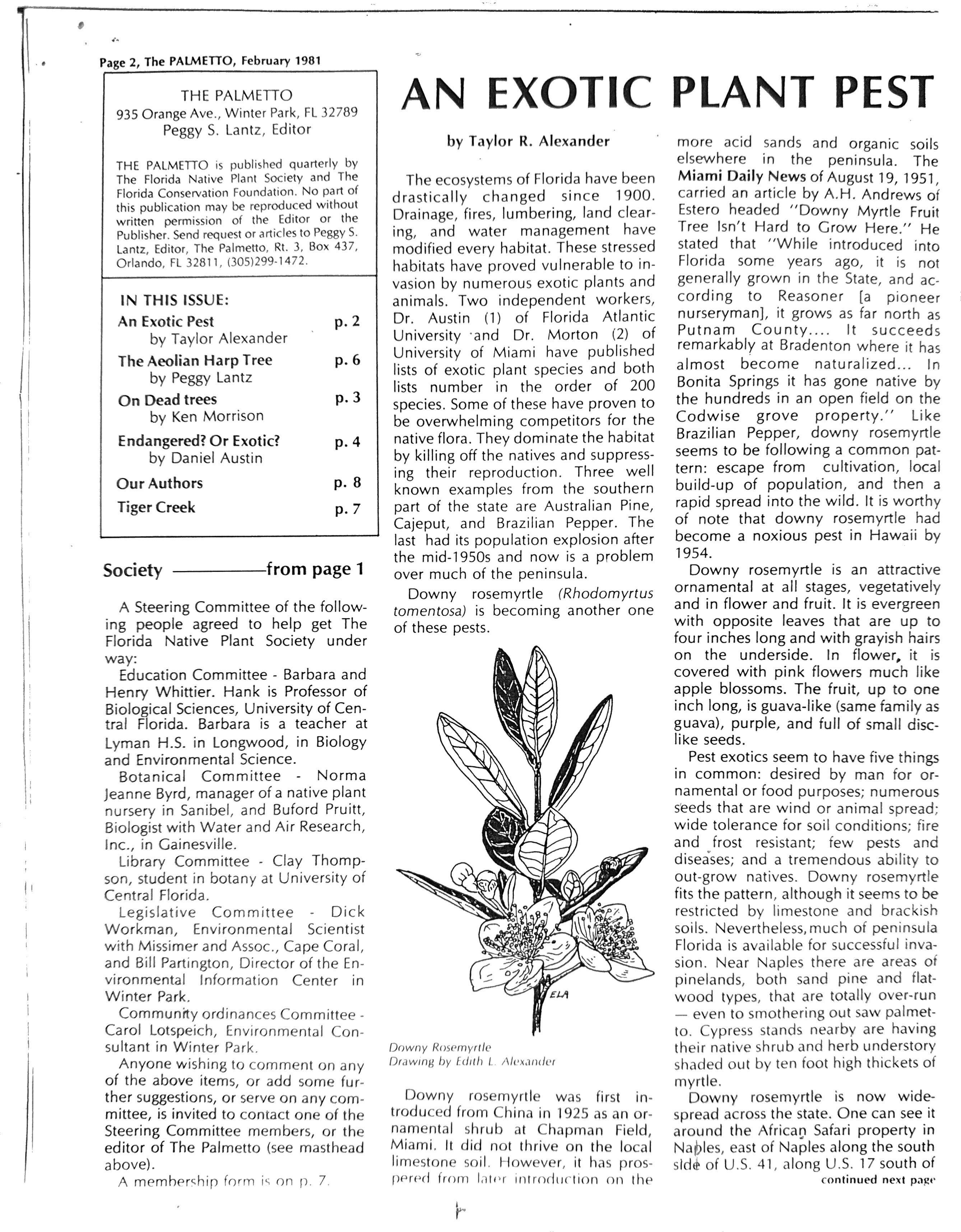
The ecosystems of Florida have been drastically changed since 1900. Drainage, fires, lumbering, land clearing, and water management have modified every habitat. These stressed habitats have proved vulnerable to invasion by numerous exotic plants and animals. Two independent workers, Dr. Austin (1) of Florida Atlantic University and Dr. Morton (2) of University of Miami have published lists of exotic plant species and both lists number in the order of 200 species. Some of these have proven to be overwhelming competitors for the native flora. They dominate the habitat by killing off the natives and suppressing their reproduction. Three well known examples from the southern part of the state are Australian Pine, Cajeput, and Brazilian Pepper. The last had its population explosion after the mid-1950s and now is a problem over much of the peninsula. Downy rosemyrtle (Rhodomyrtus tomentosa) is becoming another one of these pests.
more acid sands and organic soils elsewhere in the peninsula. The Miami Daily News of August 19, 1951, carried an article by A.H. Andrews of Estero headed "Downy Myrtle Fruit Tree Isn't Hard to Grow Here." He stated that "While introduced into Florida some years ago, it is not generally grown in the State, and according to Reasoner [a pioneer nurseryman], it grows as far north as Putnam County.... It succeeds remarkably at Bradenton where it has almost becomenaturalized... In Bonita Springs it has gone native by the hundreds in an open field on the Bradise Pepper, Downerse tike seems to be following a common pattern: escape from cultivation, local build-up of population, and then a rapid spread into the wild. It is worthy of note that downy rosemyrtle had become a noxious pest in Hawaii by
Downy rosemyrtle is an attractive ornamental at all stages, vegetatively and in flower and fruit. It is evergreen with opposite leaves that are up to four inches long and with grayish hairs on the underside. In flower, it is covered with pink flowers much like apple blossoms. The fruit, up to one inch long, is guava-like (same family as guava), purple, and full of small disclike seeds.
Pest exotics seem to have five things in common: desired by man for ornamental or food purposes; numerous seeds that are wind or animal spread; wide tolerance for soil conditions; fire and frost resistant; few pests and diseases; and a tremendous ability to out-grow natives. Downy rosemyrtle fits the pattern, although it seems to be restricted by limestone and brackish soils. Nevertheless, much of peninsula Florida is available for successful invasion. Near Naples there are areas of pinelands, both sand pine and flatwood types, that are totally over-run - even to smothering out saw palmetto. Cypress stands nearby are having their native shrub and herb understory shaded out by ten foot high thickets of myrtle.
rosemyrtle wasfirst introduced from China in 1925 as an ornamental shrub at Chapman Field, Miami. It did not thrive on the local limestone soil. However, it has prospered from later introduction on the
Downy rosemyrtle is now widespread across the state. One can see it around the African Safari property in Naples, east of Naples along the south side of U.S. 41, along U.S. 17 south of continuednextpage
- Pest from page 2 the junction with S.R. 74 toward Punta Gorda,around Estero, on the north shore of Lake Placid, in Delray Beach at Military Trail and Oak Hill road, and near the beach in Palm Beach County. It is also reported in some State Parks: Highlands Hammock near Sebring and Jonathan Dickinson near Hobe Sound. Other reports place it near Orlando, Bradenton, Oneco, Bonita Springs and, as quoted earlier, it is growing as far north as Putnam CounTV.
It is my opinion that this plant is probably at a stage of population explosion comparable to what one would have seen for Brazilian Pepper in the mid-1950s. Unfortunately, there was no concern about Brazilian Pepper then, and I know of no accurate history detailing exactly how Brazilian Pepper spread so quickly and vastly. 1 do suspect winter foraging robins are the prime vector. Animal spread of downy rosemyrtle is also suspected as well as local seeding and root sprouting. It is further my opinion that there is a chance that downy rosemyrtle could be eliminated locally and its spread suppressed, if more action is taken in the near future and existing control programs are supported. Those of us interested in the survival of native plants currently endangered, rare, or otherwise, and the plant communities at large, can help by reporting the locations of new colonies when seen in the wild and especially by supporting wildlife management personnel at the county, state, and federal levels. They need encouragement to establish exotic plant control programs where none exist, and support for the ones that do exist. Support can take the form of taxpayer pressure at the administrative and budget level. And by all means, the programs must have continuity to be successful. Exotic plant control must become a part of our environmental thinking, if our native plant stands are going to survive in anything like present condition, Keep in mind that downy rosemyrtle may have the capacity to invade a greater part of the state than the well known big three: Australian Pine, Cajeput, and Brazilian Pepper. All of Florida seems to be vulnerable for exotic plant invasion and their control programs need statewide support and constant vigil.
by Ken Morrison
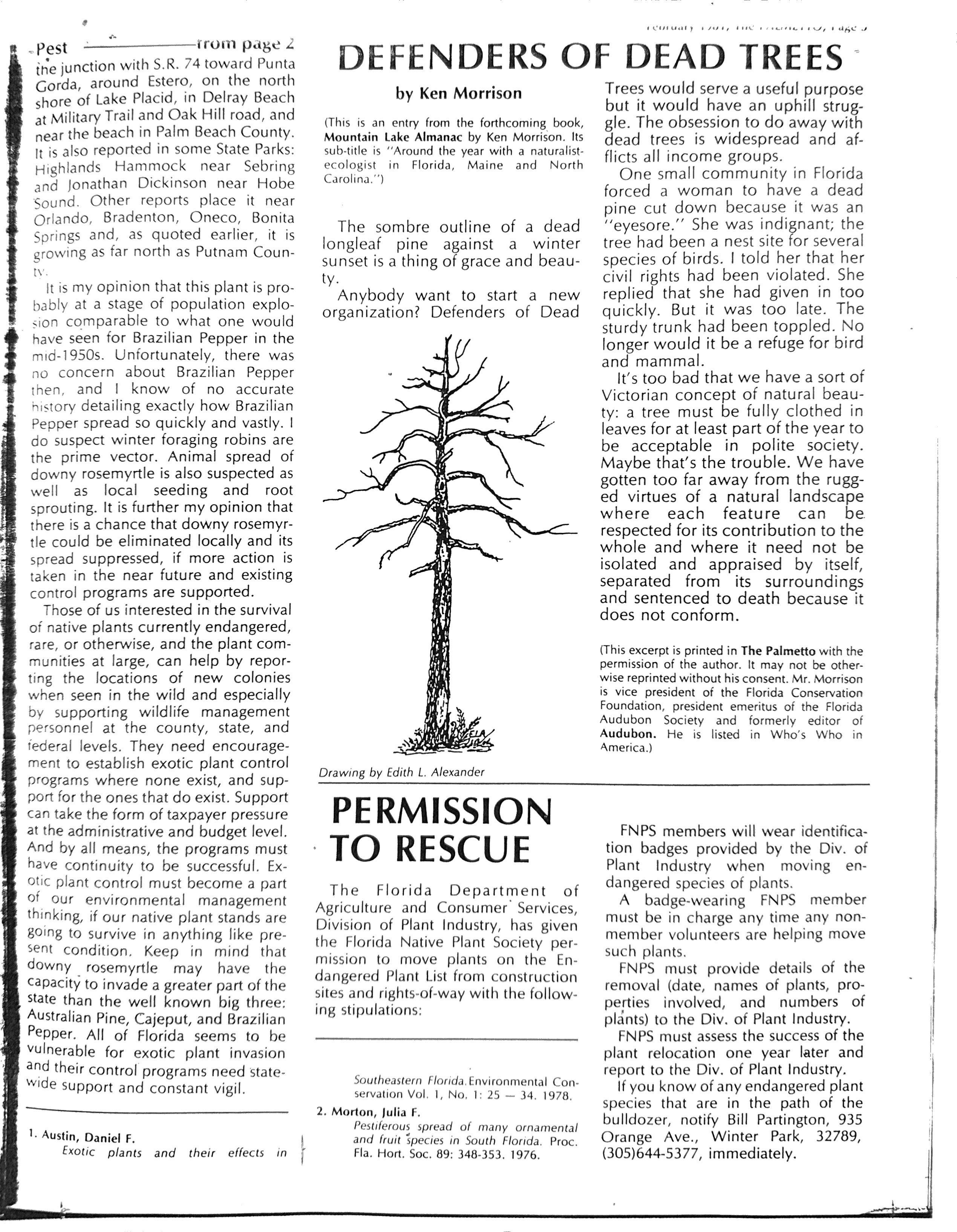
Trees would serve a useful purpose but it would have an uphill strug (This is an entry from the forthcoming book, gle. The obsession to do away with Mountain Lake Almanac by Ken Morrison. Its dead trees is widespread and af- sub-title is "Around the year with a naturalistecologist in Florida, Maine and North flicts all income groups. Carolina.")
One small community in Florida forced a woman to have a dead pine cut down because it was ar The sombre outline of a dead longleafpine against a winter sunset is a thing of grace and beau'evesore." She was indignant; the tree had been a nest site for several species of birds. I told her that her civil rights had been violated. She Anybody want to start a new organization? Defenders of Dead replied that she had given in too quickly. But it was too late. The sturdy trunk had been toppled. No longer would it be a refuge for bird and mammal.
It's too bad that we have a sort of Victorian concept of natural beauty: a tree must be fully clothed in leaves for at least part of the year to be acceptable in polite society. Maybe that's the trouble. We have gotten too far away from the rugged virtues of a natural landscape
respected for its contribution to the whole and where it need not be isolated and appraised by itself, separated from its surroundings and sentenced to death because it does not conform.
(This excerpt is printed in The Palmetto with the permission of the author. It may not be otherwise reprinted without his consent. Mr. Morrison is vice president of the Florida Conservation Foundation, president emeritus of the Florida Audubon Society andformerly editor of Audubon. He is listed in Who's Who in America.)
Exotic plants and their effects in
Drawing by Edith L. Alexander
The Florida Department of Agriculture and Consumer Services, Division of Plant Industry, has given the Florida Native Plant Society permission to move plants on the Endangered Plant List from construction sites and rights-of-way with the following stipulations:
Southeastern Florida, Environmental Conservation Vol. 1, No. 1: 25 - 34. 1978
2. Morton, Julia F.
Pestiferous spread of manyornamental and fruit species in South Florida. Proc. Fla. Hort. Soc. 89: 348-353. 1976.
FNS members will wear identification badges provided by the Div. of Plant Industry when moving endangered species of plants
A badge-wearing FNS member must be in charge any time any nonmember volunteers are helping move
FPS must provide details of the removal (date, names of plants, properties involved, and numbers of plants) to the Div. of Plant Industry.
FNPS must assess the success of the plant relocation one year later and report to the Div. of Plant Industry.
If you know of any endangered plant species that are in the path of the bulldozer, notify Bill Partington, 935 Ave., Winter Park, 32789, (305)644-5377, immediately.
During the years following the passage of the Endangered Species Act of 1973, many biologists, both professional and amateur, have entered the fight to save organisms bordering on extinction. Of the many papers, books, and reports that have subsequently appeared, none seem to have addressed the very real and pertinent question: are the plants really native and endangered or are they exotic?
Perhaps involvement with plants in southern Florida has made me more aware of this question than some others. Or perhaps it is because my approach to Florida botany over the past decade has been strongly oriented toward man as a vector of plants and a modifier of habitats. In any event, there are many Florida plants about which too little is known. Some are indeed native and endangered; others are surrounded by circumstances which make me wonder.
The following discussion will address plants apparently in both of these categories.
CASE 1. Rhipsalis baccifera, mistletoe cactus - nominated as an endangered Florida species. These plants were found in one small region of southern Florida, now within the Everglades National Park, by ).K. Small in 1923. Before Hurricane Donna in 1960, the epiphytic cacti were not uncommon in mangrove forests near the coast, in a belt of a few square miles. Subsequent to the hurricane, the population was drastically reduced, and it was apparently the late 1960s when several people at Fairchild Tropical Garden and Everglades National Park saw wild plants, When Dr. William Robertson (ENP) saw them last he had the impression that they were in a state of decline. No one has been able to find the plants recently (1977 to present) and the wild population may have been extirpated from Florida. It is not known what changes might have taken place if hurricane Donna had not passed directly over the population. There are plants in cultivation originally taken from the wild areas, but in at least one case they have become somewhat weedy. Everyone since J.K. Small in the 1930s, it appears, has taken these
plants as unquestionably native. Yet, it is possible that they were introduced by man. All members of the cactus family (Cactaceae) appear to be native in the New World. One possible ex ception to this is Rhipsalis.
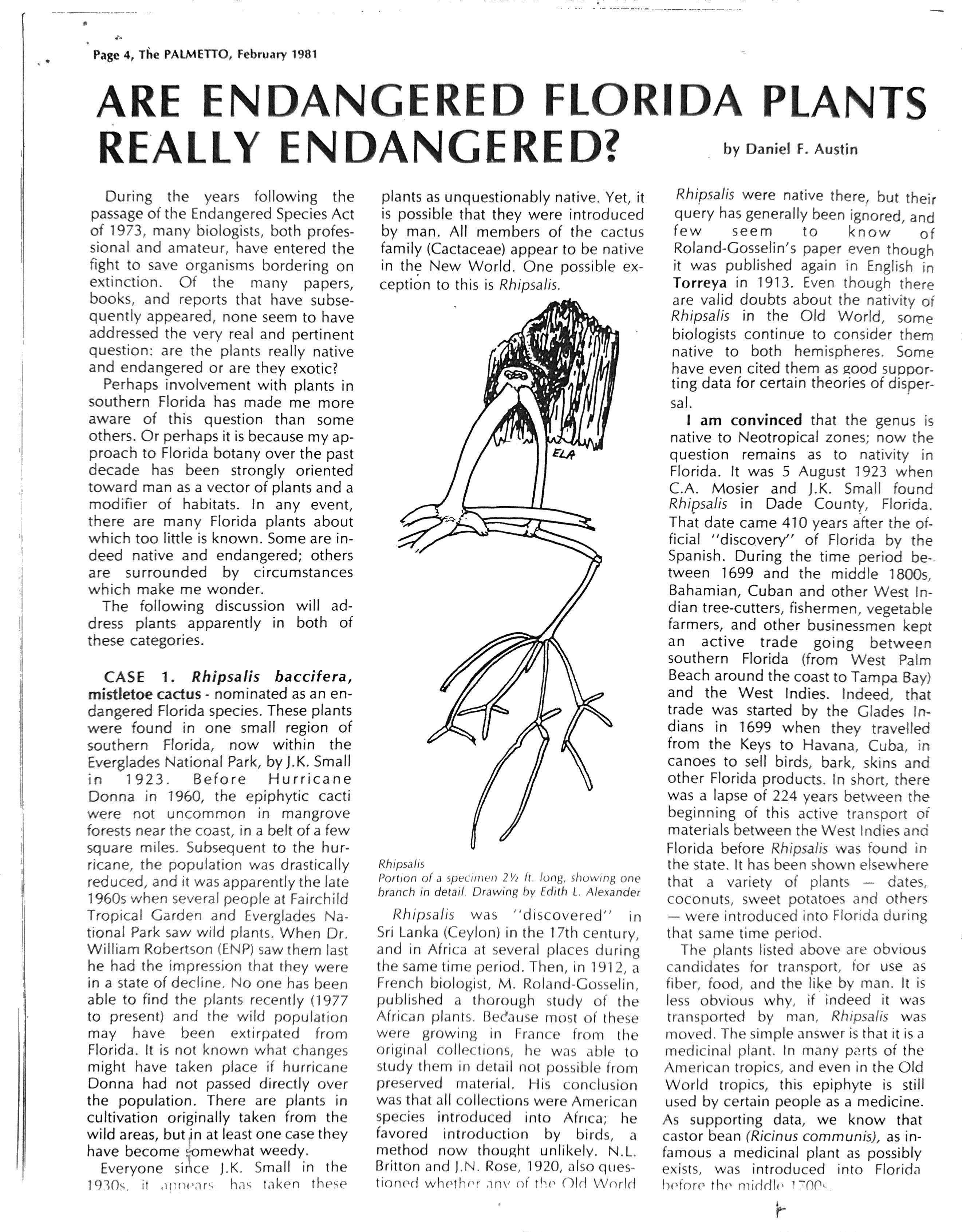
Rhipsalis
Portion of a specimen 2? ft. long, showing one branch in detail. Drawing by Edith L. Alexander Rhipsalis was "discovered" in Sri Lanka (Ceylon) in the 17th century, and in Africa at several places during the same time period. Then, in 1912, a French biologist, M. Roland-Gosselin, published a thorough study of the African plants. Because most of these were growing in France trom the original collections, he was able to study them in detail not possible from preserved material. His conclusion was that all collections were American species introduced into Africa; he favored introduction by birds, a method now thought unlikely. N.L. Britton and J.N. Rose, 1920, also questioned whether any of the Old World
by Daniel F. Austin
Rhipsalis were native there, but their query has generally been ignored, and few seem to know of Roland-Gosselin's paper even though it was published again in English in Torreya in 1913. Even though there are valid doubts about the nativity of Rhipsalis in the Old World, some biologists continue to consider them native to both hemispheres. Some have even cited them as good supporting data for certain theories of dispersal.
I am convinced that the genus is native to Neotropical zones; now the question remains as to nativity in Florida. It was 5 August 1923 when C.A. Mosier and J.K. Small found Rhipsalis in Dade County, Florida. That date came 410 years after the official "discovery" of Florida by the Spanish. During the time period be-. tween 1699 and the middle 1800s, Bahamian, Cuban and other West Indian tree-cutters, fishermen, vegetable farmers, and other businessmen kept an active trade going between southern Florida (from West Palm Beach around the coast to Tampa Bay) and the West Indies. Indeed, that trade was started by the Glades Indians in 1699 when they travelled from the Keys to Havana, Cuba, in canoes to sell birds, bark, skins and other Florida products. In short, there was a lapse of 224 years between the beginning of this active transport of materials between the West Indies and Florida before Rhipsalis was found in the state. It has been shown elsewhere that a variety of plants - dates, coconuts, sweet potatoes and others - were introduced into Florida during that same time period.
The plants listed above are obvious candidates for transport, for use as fiber, food, and the like by man. It is less obvious why, if indeed it was transported by man, Rhipsalis was moved. The simple answer is that it is a medicinal plant. In many parts of the American tropics, and even in the Old World tropics, this epiphyte is still used by certain people as a medicine. As supporting data, we know that castor bean (Ricinus communis), as infamous a medicinal plant as possibly exists, was introduced into Florida before the middle 1700g
surely these data are enough to at least question whether Rhipsalis is native to Florida. One may not exclude the possibility that the plants were brought to the state by "natural" (i.e., non-human) forces such as birds or hurricanes. Still, why were they confined to a small part of southern Florida in apparently small populations, where we know that man has been actively transporting a variety of plants for centuries?
CASE 2. Aristida floridana, Keys wire-grass - nominated as an endangered Florida species. This species was originally described by A.W. Chapmanin 1883 on the basis of specimens from Key West. At the time, Key West was a town at least 100 years old, and a well-known stop-over point for ships for over 200 years. Little is known about the conditions under which the original specimens were found, but we do have data about the modern plants in the Florida Keys. Formerly there was a population on Ramrod Key, but it was extirpated in the past decade by urbanization. It grew on an embankment built for the over seas railway. There is now a single, shrinking patch of these grasses in Key West, also on the embankment for the railroad. It would appear that the wire-grass is confined to highly alkaline, well-drained soils, particularly marl ridges. Perhaps these occurred naturally before the railroad was completed to Key West, but that is debatable. Moreover, any plant growing on a railroad right-of-way becomes immediately suspectsince this transportation method has been as successful for hitch-hiking plants as for people and their cargo. Dr. Viktor Muhlenbach documented the sources and numbers of plants brought Missouri, in just this manner. The figures are astounding.
As long as Aristida floridana was thought to be an endemic species in Florida, there was no reason to suspect that it might not be native. Now it has been shown that the grass Is abundant in the Yucatan peninsula of Mexico, a very notably alkaline area. Since the Yucatan region was an important part of the shipping route between South and Central America, the West Indies and points north, is it not possible that A. floridana may actually be native to Mexico and exotic in Florida?
CASE 3. Lycopodium dichotomum, hanging moss considered en-
dangered by Florida, no status on Federal list. This inconspicuous clubmoss was first found in Florida in 1934 although it had been known scientifically from the American tropics since 1762. Even with all the people who have been searching for rare and endangered plants in Florida" over the past few decades, the species remains known from a single location in Collier County. Up until about 1978 there were two individual plants known in the state. Since then two more have been found, bringing the total known population' to four individuals. Perhaps there are more, but three years of study in the Big Cypress by at least a dozen people have not located them.
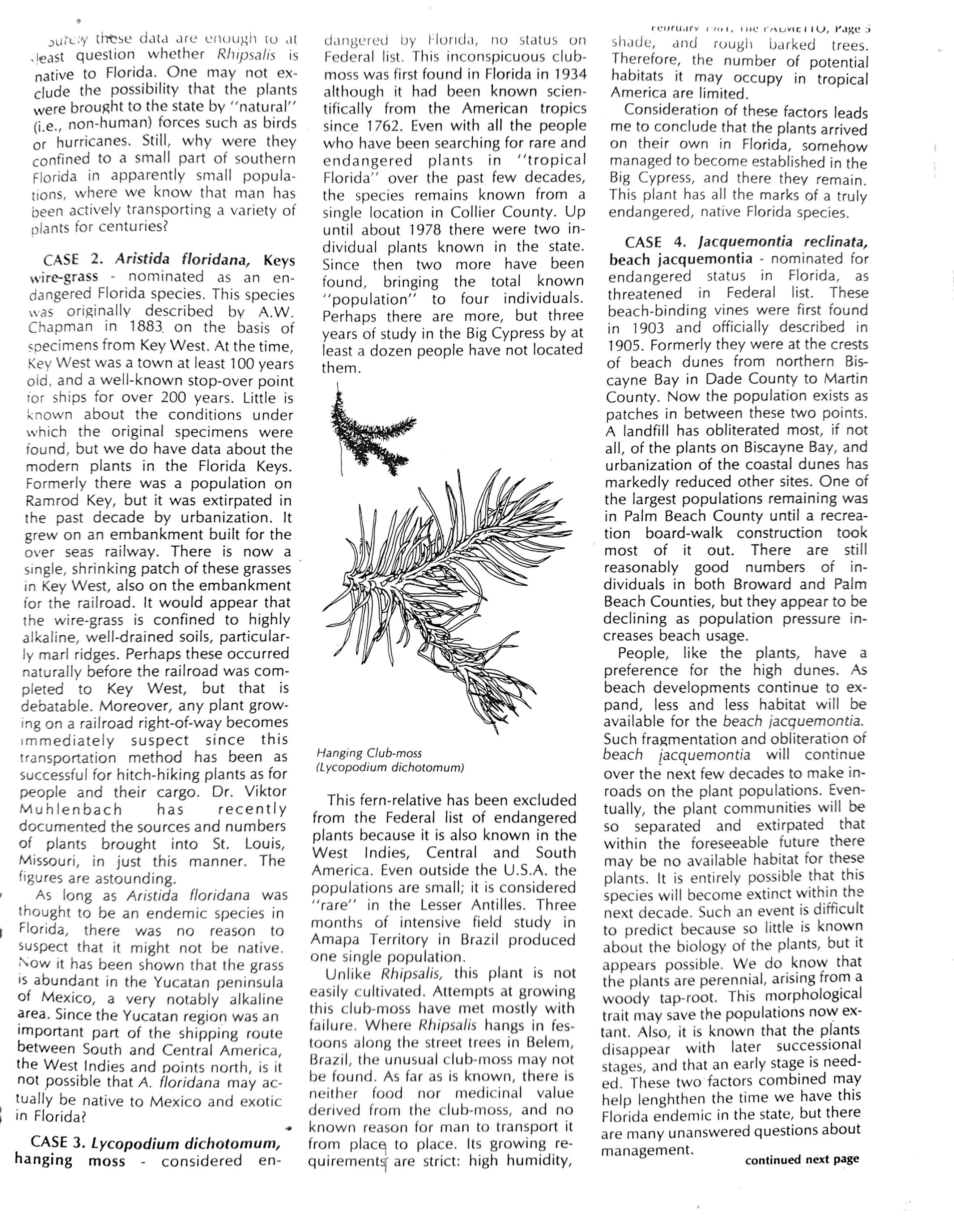
Hanging Club-moss (Lycopodium dichotomum)
This fern-relative has been excluded from the Federal list of endangered plants because it is also known in the West Indies, Central and America. Even outside the U.S.A. the populations are small; it is considered "rare" in the Lesser Antilles. Three months of intensive field study in Amapa Territory in Brazil produced one single population. Unlike Rhipsalis, this plant is not easily cultivated. Attempts at growing this club-moss have met mostly with failure. Where Rhipsalis hangs in festoons along the street trees in Belem, Brazil, the unusual club-moss may not be found. As far as is known, there is neither food nor medicinal value derived from the club-moss, and no known reason for man to transport it from place to place. Its growing requirements are strict: high humidity,
rebruary got, the ravictIo, Page s shade, andrough barked trees. Therefore, the number of potential habitats it may occupy in tropical America are limited
Consideration of these factors leads me to conclude that the plants arrived on their own in Florida, somehow managed to become established in the Big Cypress, and there they remain. This plant has all the marks of a truly endangered, native Florida species.
CASE 4. Jacquemontia reclinata, beach jacquemontia - nominated for endangered status in Florida, as threatened in Federal list. These beach-binding vines were first found in 1903 and officially described in 1905. Formerly they were at the crests of beach dunes from northern Biscayne Bay in Dade County to Martin County. Now the population exists as patches in between these two points. A landfill has obliterated most, if not all, of the plants on Biscayne Bay, and urbanization of the coastal dunes has markedly reduced other sites. One of the largest populations remaining was in Palm Beach County until a recreation board-walk construction took most of it out. There are still reasonably good numbers of individuals in both Broward and Palm Beach Counties, but they appear to be declining as population pressure increases beach usage.
People, like the plants, have a preference for the high dunes. As beach developments continue to expand, less and less habitat will be available for the beach jacquemontia. Such fragmentation and obliteration of beach jacquemontia will continue over the next few decades to make inroads on the plant populations. Eventually, the plant communities will be so separated and extirpated that within the foreseeable future there may be no available habitat for these plants. It is entirely possible that this species will become extinct within the next decade. Such an event is difficult to predict because so little is known about the biology of the plants, but it appears possible. We do know that the plants are perennial, arising from a woody tap-root. This morphological trait may save the populations now extant. Also, it is known that the plants disappear with later successional stages, and that an early stage is needed. These two factors combined may help lengthen the time we have this Florida endemic in the state, but there are many unanswered questions about
by Peggy S. Lantz
To many people, the cabbage palm is just part of the Florida background, like sand, sun, and mosquitoes. The cabbage palm should not be held in such disdain.
Marjorie Kinnan Rawlings, prizewinning author of The Yearling, says in Cross Creek that "there is no more sensitive Aeolian harp than the palm." And Mrs. Rawlings was particularly receptive to its beauty, for her "irriducable minimum of happiness" was a "treetop against a patch of sky."
All of these data combined lead me to believe that beach jacquemontia is declining at an alarming rate. Certainly, in my opinion, the species is worthy of endangered status and any concurrent protection.
SUMMARY. In point of fact, there are many more species facing possible extinction or extirpation than any of the "official" lists include. Those lists, both State and Federal, were constructed with definite goals and restrictions that may or may not reflect current population status. It is my opinion that both State and Federal lists include only about 50% of the plants in trouble in Florida. By using that tact, the lists are reasonable from a legal standpoint. And the bureaucratic system is making listing and enforcement as difficult as possible. Most of the Federal money that goes to the Office of Endangered Species of the Fish and Wildlife Service is ear-marked for animal studies. I fault no one for wanting to study the biology of rare and endangered animals, but without adequate funds, it is impossible to build a biologically and legally strong case for plants. For the past three years the Fish and Wildlife Service has funded my own research on plants proposed as endangered in southern Florida. In spite of that, we have only begun to know what the population trends in these plants might be. Moreover, of what I predict to eventually be about 300 endangered plants in southern Florida, we have been able to study in some depth only about 10%, It is with the input of the Florida Native Plant Society that we may be able to gather enough data on some plants to predict the eventual outcome.
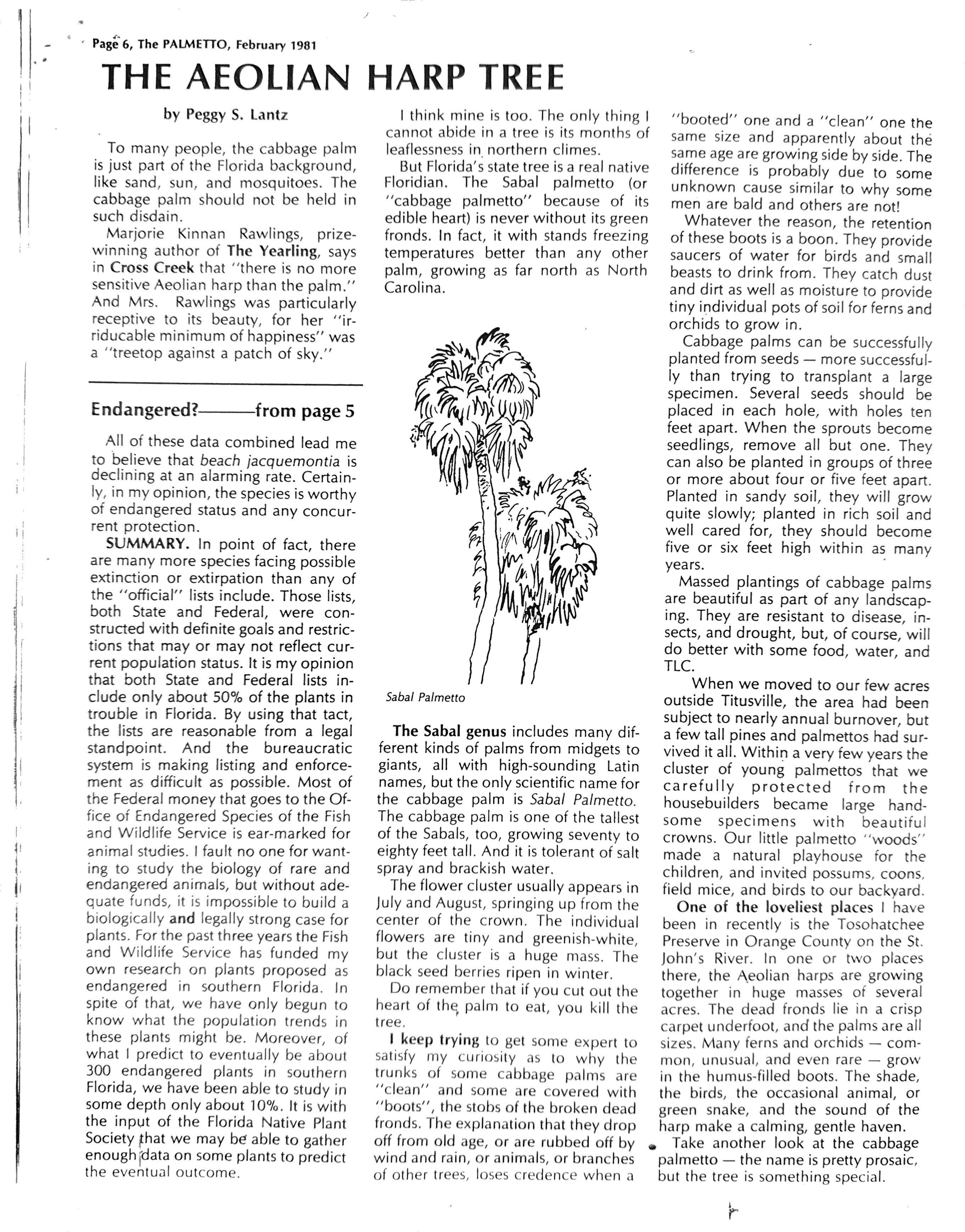
I think mine is too. The only thing ! cannot abide in a tree is its months of leaflessness in northern climes. But Florida's state tree is a real native Floridian. The Sabal palmetto (or "cabbage palmetto" because of its edible heart) is never without its green fronds. In fact, it with stands freezing temperatures better than any other palm, growing as far north as North Carolina.
"booted" one and a "clean" one the same size and apparently about the same age are growing side by side. The difference is probably due to some unknown cause similar to why some men are bald and others are not! Whatever the reason, the retention of these boots is a boon. They provide saucers of water for birds and small beasts to drink from. They catch dust and dirt as well as moisture to provide tiny individual pots of soil for ferns and orchids to grow in.
Cabbage palms can be successfully planted from seeds - more successfully than trying to transplant a large specimen. Several seeds should be placed in each hole, with holes ten feet apart. When the sprouts become seedlings, remove all but one. They can also be planted in groups of three or more about four or five feet apart. Planted in sandy soil, they will grow quite slowly; planted in rich soil and well cared for, they should become five or six feet high within as many
Massed plantings of cabbage palms are beautiful as part of any landscaping. They are resistant to disease, insects, and drought, but, of course, will do better with some food, water, and TLC.
When we moved to our few acres Sabal Palmetto outside Titusville, the area had been subject to nearly annual burnover, but
The Sabal genus includes many dif- a few tall pines and palmettos had surferent kinds of palms from midgets to vived it all. Within a very few years the giants, all with high-sounding Latin cluster of young palmettos that we names, but the only scientific name for carefullyprotected from the the cabbage palm is Sabal Palmetto.
The cabbage palm is one of the tallest housebuilders became large handsome specimens with beautiful of the Sabals, too, growing seventy to crowns. Our little palmetto "woods" eighty feet tall. And it is tolerant of salt made a natural playhouse for the spray and brackish water. children, and invited possums, coons
The flower cluster usually appears in field mice, and birds to our backyard. July and August, springing up from the One of the loveliest places I have center of the crown. The individual been in recently is the Tosohatchee flowers are tiny and greenish-white, Preserve in Orange County on the St. but the cluster is a huge mass. The John's River. In one or two places black seed berries ripen in winter. there, the Aeolian harps are growing
Do remember that if you cut out the together in huge masses of several heart of the palm to eat, you kill the acres. The dead fronds lie in a crisp carpet underfoot, and the palms are all I keep trying to get some expert to sizes. Many ferns and orchids - comsatisty my curiosity mon, unusual, and even rare - grow trunks of some cabbage palms are in the humus-filled boots. The shade, "clean and some are covered with the birds, the occasional animal, or "boots", the stobs of the broken dead green snake, and the sound of the fronds. The explanation that they drop harp make a calming, gentle haven. off from old age, or are rubbed off by? Take another look at the cabbage wind and rain, or animals, or branches palmetto - the name is pretty prosaic, of other trees, loses credence when a but the tree is something special.
Tiger Creek is a winding stream that comes out of the ground west of Kissimmee and meanders south for about seven miles into Lake Lenore. The land, for about a quarter mile on both sides of the creek, is owned by The Nature Conservancy, a publicly supported, non-governmental, scienand educational conservation organization. The Nature Conservancy identifies, buys or protects, and manages unique natural areas throughout North and South America, including 54 such projects in Florida.
The Tiger Creek Preserve, a slice of unaltered Central Florida, includes 2890 acres purchased over several years beginning in 1971. The Nature Conservancy is selling "deeds of gratitude" for $260 per acre to help defray the costs of purchasing the Tiger Creek Preserve. The deed says: "This Deed of Gratitude witnesseth that the grantor certifies that the grantee has been instrumental in preserving - acres of the Tiger
Creek Nature Preserve, to have and to hold all those rare and special places, still in the same unspoiled conditions that existed when Seminole Indians
camped there; and as an example of the development of an ethic that holds land dear and that believes lands of significant ecological value must be preserved. And the grantor hereby covenants with said grantee that the otters,raccoons, bobcats, deer, alligators,scrubjays, ospreys, redshouldered hawks, wood ducks, green herons, sand pines, swamp maples, loblolly bays, tupelos, and all the wild and beautiful plants and all other wild creatures will not perish or be evicted from their homes because you cared enough to give the gift that will grow in value to Americans each year, as your 'Gift to Future Generations'. Deed of Gratitude not to be recorded in the Public Records of Polk County."
Perhaps a thousand of these deeds of gratitude have been purchased. If you'd like to help write off the cost of an acre of Tiger Creek Nature Preserve, write to Dave Johnson or Ken Morrison, P.O. Box 268, Lake Wales, FL 33853.
AND THEN THERE'S TIGER CREEK FOREST, 1600 acres of private enterprise development adjoining the
Preserve on the north and east. But it's a development with a difference. The entire development is a Wildlife Sanctuary. The roads follow old animal, Indian, and/or hunter trails. The "lots" are a minimum of five acres, some going as much as forty acres if some of the land is swampy. But each lot has a high and dry buildable site.
And the people of The Nature Conservancy have put out a leaflet to be given to purchasers of a lot in Tiger Creek Forest that encourages them to leave the site as natural as possible. No more than 60% of any tract may be cleared or partially cleared for any reason, and trees over seven inches in diameter may not be cut down unless they actually interfere with a building. They encourage the use of shovels instead of bulldozers. They encourage pine needle driveways instead of concrete. They encourage leaving dead trees for the owls and woodpeckers. And they offer a "rusty mower" award for the resident who best blends home and natural landscape. Maybe FPS's Local Ordinance Committee can get some ideas from
? I WOULD LIKE TO ATTEND THE CONFERENCE ENCLOSED IS CHECK FOR
? I WOULD LIKE TO BECOME A MEMBER OF FNPS ? Single ? Family Contributing ? Organizational
? I am already a member
NAME
ADDRESS CITY
MY INTERESTS INCLUDE:
CONFERENCE RATES
$15.00 for members
$20.00 for non-members (includes Sat. lunch)
MEMBERSHIP RATES:
? Single, $12
? Family, $15
? Contributing, $25
? Organizational, $50
Taylor R. Alexander is Professor Emeritus, Dept. of Botany, University of Miami. He is currently on a committee evaluating the impact of oil drilling in theBig Cypress Swamp.
Daniel F. Austin is a Professor in the Department of Biological Sciences at Florida Atlantic University in Boca Raton.
Peggy S. Lantz is a free-lance writer, and editor of Horse Country and The Palmetto.
Ken Morrison is director of Environmental Concerns for Bok Tower Gardens.
Richard Workman is the Senior Environmental Scientist with Missimer and Assoc., a consulting firm of hydrologists, geologists, and environmental scientists, located in Cape Coral. He is involved in native landscape design and natural system reconstruction, and has written a book on native plants called "Growing Native"
Thanks also to Edith L. Alexander for the drawings of the Downy Rosemyrtle, and the Rhipsalis, and the dead tree; and to Fred Sias, Jr. the editor's brother, of Clemson, S.C., for the lettering of "The Palmetto."
Allen's Hammock Nursery P. O. Box 224 Homestead, FL 33030
Florida Keys Native Nursery
Donna Sprunt 102 Mohawk Street Tavernier, FL 33070
Native Tree Nursery
Hugh and Chirley Forthman 4845 Hammock Lake Drive Miami, FL 33156
Palm Beach Native Nursery
Terry Mock and Pat Painter 2930 Okeechobee Blvd. West Palm Beach, FL 33409
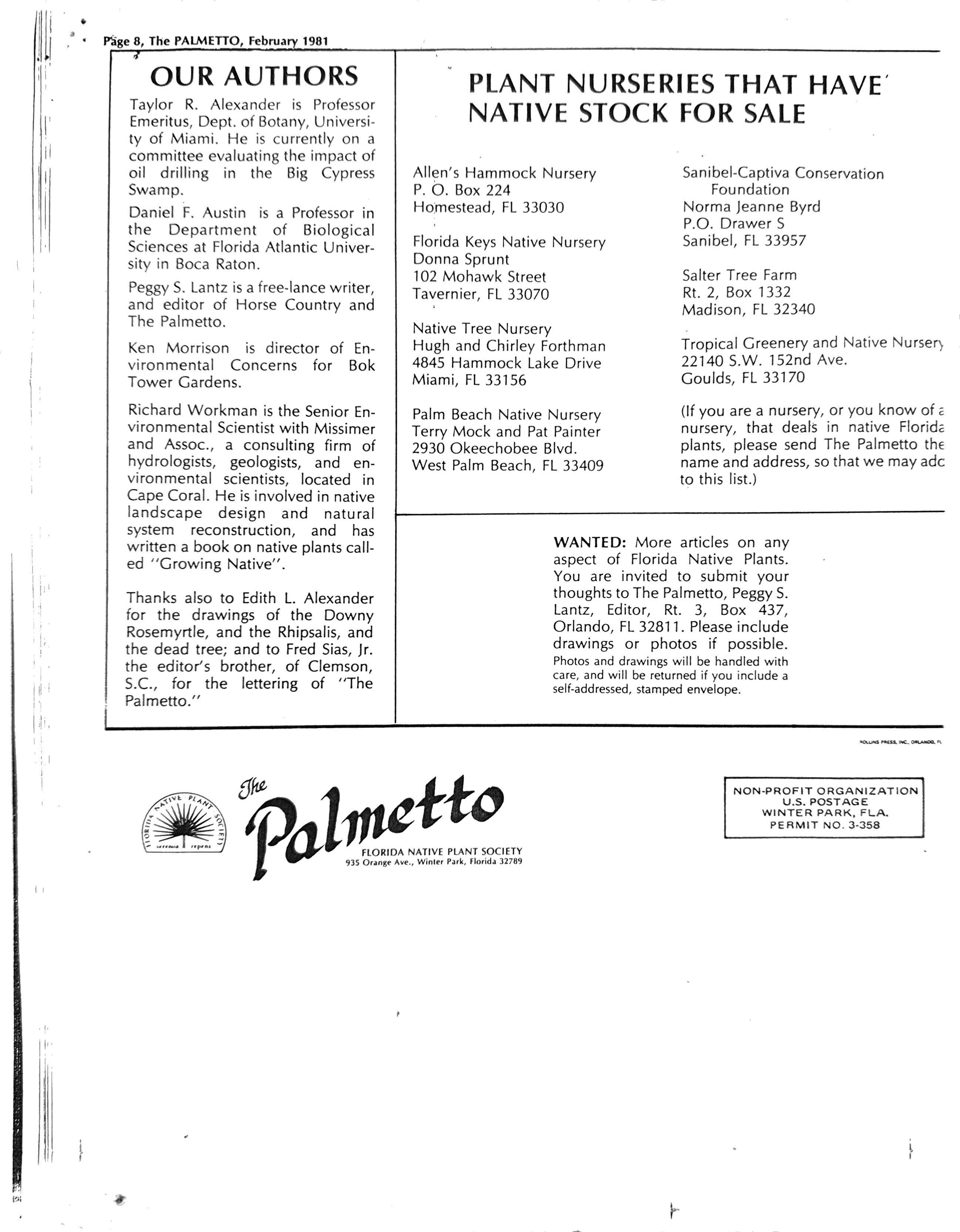
Sanibel-Captiva Conservation Foundation
Norma Jeanne Byrd P.O. Drawer S Sanibel, FL 33957
Salter Tree Farm Rt. 2, Box 1332 Madison, FL 32340
Tropical Greenery and Native Nursery 22140 S.W. 152nd Ave. Goulds, FL 33170
(If you are a nursery, or you know of a nursery, that deals in native Florida plants, please send The Palmetto the name and address, so that we may adc to this list.)
WANTED: More articles on any aspect of Florida Native Plants. You are invited to submit your thoughts to The Palmetto, Peggy S. Lantz, Editor, Rt. 3, Box 437, Orlando, FL 32811. Please include drawings or photos if possible. Photos and drawings will be handled with care,andwillbereturnedifyouincludea self-addressed, stamped envelope.