If you're having trouble viewing this email, you can see it online
Volume 28 Number 1
You can also read issues of the Sabalminoronline here
Table of Contents
Letter from the Executive Director
Notes from the Editors
Society News
New Books Alert: LivingShorelinesforFlorida& TheFloridaMeadowManual
Conradina Chapter - 2025 Landscaping with Florida Natives Tour
2025 FNPS Photo Contest Winners
Hernando Chapter Selects Mascot Species - Cooley's Waterwillow (Justicia cooleyi)
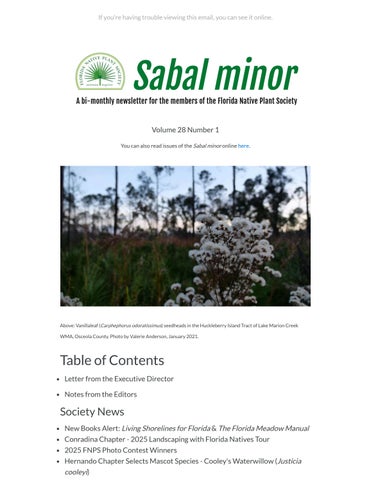
Above: Vanillaleaf (Carphephorusodoratissimus) seedheads in the Huckleberry Island Tract of Lake Marion Creek WMA, Osceola County Photo by Valerie Anderson, January 2021.
Conference Sponsor Feature - Pais Realty
Native Plant Certification Working Group byEugeneKelly
Call for Board Nominations
Call for Palmetto Award Nominations
Features
Sandhill Revival in the Panhandle byDavidRoddenberry
Have we lost the meaning of windows? byMarleneRodak
Featured Members
Members in the News
New Life Members
New and Renewing Business Members
Letter from the Executive Director
Dear FNPS Members,
For the first time in 16 years, FNPS will be adjusting membership dues.
Beginning April 1, 2026, Individual memberships will increase from $35 to $50, and Household memberships will increase from $50 to $90. All other membership tiers will remain unchanged.
Over the past 16 years, the cost of staffing, technology, publications, insurance, and statewide conservation work has steadily increased, while our dues remained flat. In fact, $35 in 2009 would need to be about $52–$53 today just to provide the same level of support. This adjustment is a long-overdue correction that helps stabilize FNPS and protect the work we all care about
Your membership directly supports:
Endangered plant habitat restoration and on-the-ground conservation work
Advocacy in the Florida Legislature to conserve natural lands and protect them in perpetuity
Partnerships with organizations across the state to collaboratively preserve Florida’s native plants
The development of science-backed educational materials that inform and empower the public
Importantly, 26% of every membership dollar goes directly to your local chapter, strengthening local programming and community impact statewide. Our intent is to make a thoughtful, sufficient adjustment now rather than introduce smaller increases year after year In 2026, we are pairing this update
with a phased plan focused on retention, growth, and new giving options to ensure FNPS remains strong, accessible, and mission-driven for years to come.
Thank you for being part of this community and for standing with Florida’s native plants. Your membership makes this work possible.
As we enter a tumultuous spring from an unpredictable winter we at FNPS hope your native plants handled the cold well and you are personally managing the changes our world and country are experiencing. The legislative session is over as of Mar 13 but because no budget was settled, a Special Session is now scheduled for April and our President Gene Kelly, our Governmental Affairs Advisor Travis Moore, and staff are monitoring bills and committee meetings, meeting with partners and legislators, writing letters of support and opposition to bills, and drafting action alerts which finally make it to you. If you're not signed up, you can sign up in the member portal or on the public advocacy page.
Gratefully, Valerie and Cherice (Pine Lily and Paynes Prairie Chapter, respectively)
Society News
New Books Alert: Living Shorelines for Florida & The Florida Meadow Manual
BeonthelookoutfortwonewbooksfromFNPSmembers!
Marjorie Shropshire, editor of The Palmetto and member of Martin County Chapter, and Ginny Stibolt, award-winning garden writer and member of Ixia Chapter, have co-authored a new book with Savanna Barry (Tarflower) and Vincent Encomio (Martin County) titled "Living Shorelines for Florida: A Practical Guide for Building Coastal Resilience," Read the description below and purchase now through the FNPS Bookshop.
A comprehensive resource on ecologically informed shoreline management and its application in Florida
A proven approach to coastal management, “living shorelines” refers to nature-based infrastructure and landscaping that increase shoreline stabilization, mitigate threats that lead to coastal erosion, and improve coastal resilience. This book explains the concept of living shorelines and how to implement them in Florida—a state with the longest coastline in the contiguous United States and a rapidly increasing population that makes this topic critical.
LivingShorelinesforFloridais a resource for homeowners, contractors, landscape professionals, government officials, and environmental scientists, providing the tools to understand Florida’s coastal systems as well as guidance to plan, implement, and maintain ecologically sound, dynamic shoreline protection. This book covers the entire process behind successful living shoreline projects, from design, building, planting, and upkeep to permitting. It features real-world examples, step-by-step guides, insider insights, recommended materials and plants, and helpful illustrations.
Sea-level rise and severe coastal storms have made coastal erosion a growing concern nationally and felt strongly in Florida. As coastal areas become more vulnerable to the impacts of climate change, this book offers more effective and lower cost solutions than traditional “armored” structures such as seawalls. Anyone involved in managing waterfront property in Florida will find the principles and strategies in this book indispensable.
Gage La Pierre, ecologist, FNPS Board member, and Paynes Prairie Chapter member, has published TheFloridaMeadowManualwith Isabella Guttuso Browne (formerly of Tarflower). Read about it below, and click this link to preorder for its March 17th release date!
Learn how to transform lawns and open spaces into biodiverse meadows with this practical and inspiring stepby-step guide
Today’s homeowners and landscapers are increasingly seeking to make a positive impact on the environment through the natural spaces they create. For Florida residents looking for alternatives to traditional turfgrass lawns, TheFloridaMeadowManualis a timely guide. Meadows diverse plant communities of native grasses and wildflowers require fewer resources than lawns and provide critical habitats for pollinators and other wildlife.
This book provides clear, step-by-step instructions for transforming yards, parks, and other open spaces into thriving biodiverse ecosystems. Drawing on the expertise of seasoned professionals and real-world case studies from urban and rural settings across the state, this book details the full process of creating a meadow, from site assessment and plant selection to installation and longterm maintenance Readers will find guidance on design principles that balance ecological function with visual appeal, as well as practical strategies for managing weeds, planning mowing schedules, and addressing invasive species. Color illustrations and sample design plans showcase successful projects and offer inspiration.
Blending ecological insight and hands-on advice, TheFloridaMeadowManualis the perfect resource for home gardeners, land managers, and planning professionals. By making the principles behind meadow creation understandable and actionable, this book empowers readers to contribute meaningfully to Florida’s environmental resilience one meadow at a time.
Conradina Chapter FNPS
2025 Landscaping with Florida Natives Tour
It was another successful year educating people about the importance of native plants! We sold 273 tickets and absolutely couldn’t have done it without our awesome volunteers and homeowners – thank you!! What was unique about the tour this year?
Reps from the Master Naturalists, Master Gardeners, and Space Coast Audubon to highlight the synergy of native plants and wildlife. Thank you to all those folks for coming out!
Artists at many of the sites showcasing their work of native plants and wildlife to add even more beauty to the sites. Thank you for supporting local artists while learning about native plants!
The biggest plant giveaway yet again thanks to Richard Blackford and his team for putting this huge selection together. We will be donating the leftover plants to the upcoming native garden at the Nazarene church and other projects as well as bringing them to our future meeting for you!
QR code plant labels identifying keystone plants and other features, Special thanks to Jamie Snider!
And the best volunteers ever – thank you!
Conradina uses the proceeds from the landscaping tour to fund native plant projects and gardens with our current emphasis at the Melbourne First Church of the Nazarene where we meet monthly! Thank you for supporting native plants!
Advocacy in Action - Sterling Herron, Highlands Chapter
Artistic - Camouflage Western Tanager on Acerrubrum - Mike Franqui, Ixia Chapter
Landscapes
Wide-Scale
Featuring Native Plants - Brian Kamprath, Orlando
Native Plants in Their Habitat - Brian Podlisny, Paynes Prairie Chapter
Wildlife and Plant Interactions - Pileated Woodpecker and Magnolia Tree - Kristina Gavigan, Member At Large
Youth - Merranda Docksey, Crystal River
Hernando Chapter Selects Mascot Species
Cooley's Water-willow (Justiciacooleyi)
Each Florida Native Plant Society Chapter was asked to adopt a Florida native plant as their "Mascot." It will be no surprise to our members that we selected the Cooley's Water-willow (Justiciacooleyi) to represent us. The endemic and endangered Cooley’s Water-willow (sometimes classified as J.pringlei) grows only in Florida, and has been vouchered in Hernando, Citrus, Sumter, Lake and Jackson counties. It is typically found in mesic forests. Where conditions are right, Cooley's water-willow thrives and naturalizes. It spreads by seed to make a nice ground cover in semi-shady to shady areas. It blooms sporadically from spring to fall. The shade garden at the Florida Native Plant Demonstration Garden features a naturalized bed where the Cooley's water-willow thrives. Although some plant scientists suggested that J. cooleyishould be lumped with similar species, the unique genetics of this plant have been analyzed and verified by the Center for Plant Conservation at Bok Tower Gardens. Photoby SharonLaPlante.
Home Landscapes Featuring Native Plants - Shelby Radcliffe, Ocala
Conference Sponsor Highlight - Pais Realty
Continuing our appreciation series, we’re thrilled to spotlight the sponsors who made our 2025 Florida Native Plant Society Conference such a powerful gathering. Their support helped bring together people from all backgrounds to share knowledge and inspire action for Florida’s native plants.
This week, we’re highlighting Pais Realty, a valued sponsor with deep roots in Florida’s conservation and native plant movement.
Founder David has been a champion for Florida’s native plants since attending the first FNPS conference in 1980. From creating Pais Landscapes and serving as FNPS President to helping define “Florida Native Plant,” his impact spans decades.
Today, through Pais Realty, David continues his commitment to conservation by specializing in distinctive Florida properties and historic restorations – all while advancing efforts to protect our landscapes for future generations.
Thank you, Pais Realty, for your support and dedication!
We’re honored to recognize Pais Realty—not only for sponsoring last year’s conference, but for decades of leadership and dedication to protecting Florida’s landscapes for generations to come.
Native Plant Certification Working Group
byEugeneKelly, President
FNPS is recruiting assistance to create our own native landscaping certification program FNPS is seeking members with expertise in landscaping with native plants to participate in a Working Group that will develop our own landscape certification program. We do not envision an FNPS certification program serving as a replacement or competitor for existing certification options like the University of Florida/IFAS Florida Friendly Landscapes, Florida Springs Institute’s Spring Friendly Yard program or Homegrown National Park.
Participation in the program would be a benefit reserved for FNPS members to recognize their individual contributions to exhibiting the beauty, practicality and environmental benefits of landscaping with native plants.
If you are interested in joining the Working Group, please contact FNPS Executive Director Melissa Fernandez at ExecutiveDirector@FNPS.org.
Call for Board Nominations
Do you love Florida's native plants and want to make a real difference for their future? Now is your chance to step up and help lead the Florida Native Plant Society.
We are currently accepting nominations for open Board positions, and we would love to see passionate, dedicated members throw their hat in the ring.
Whether you have a background in finance, communications, conservation, or simply a deep commitment to our mission, there is a place for you on the Board.
Visit our Opportunities page to learn more about the open positions and submit your nomination. The deadline to apply is May 31, 2026.
Voting will take place at the Annual Meeting on July 18, 2026, and elected officers and directors will begin serving immediately following the vote.
Join us in steering FNPS forward. Florida's native plants need advocates like you at the table.
Call for Palmetto Award Nominations
Do you know someone who deserves recognition for their work for Florida's native plants?
Nominations are open for FNPS service awards, and we want to hear from you!
Here's what's available:
Green Palmetto Award for members making major contributions through service, education, or conservation
Mentor Award, our highest honor, for lifelong or career-long dedication to native plant preservation
Emerging Leaders Under 30, celebrating the next generation of native plant champions
Outstanding Chapter of the Year, recognizing chapters going above and beyond for the mission
All nominees must be current FNPS members. Nominations are due May 15, 2026. Visit the link in our bio to learn more and submit your nomination.
Let's make sure the people and chapters doing incredible work for Florida's native plants get the recognition they deserve!
A line of Sarracenia members ascending a sandhill with implements in hand does not evoke the typical chapter field trip. And indeed, this field event in November 2025 was not typical. The mission was direct service in the restoration of a plant community in our backyard restoration occasioned by an important land acquisition.
The State of Florida purchased 17,000 acres in eastern Franklin County in 2020. The larger part was added to Tate’s Hell State Forest, but a 7,700-acre tract was added to Bald Point State Park (SP), the park holding the easternmost of the panhandle’s beaches. The addition would span the six miles between that park and Ochlockonee River SP The park addition would be called the St. Teresa Tract, for a long-established resort area on the coast.
Kristin Ebersol, the manager of Bald Point SP (and Ochlockonee River SP), had come as the featured presenter in the Sarracenia Chapter meeting this past September. In her presentation “Sandhill Revival: The St. Teresa Restoration Journey,” she had discussed the long-term undertaking of restoration of the longleaf pine and wiregrass sandhill community on the new tract. Before concluding, Ms. Ebersol had asked Sarracenia for hands-on aid. Eight members stepped up (joined later by a Magnolia Chapter member). They have now carried out a project with the park staff.
In her presentation, the park manager recounted how, from mid-2024 to early 2025, she had overseen state-funded work accomplishing the foundational part of restoration on a first increment of land. Contractors had cleared away the leavings from sand pine farming down to bare soil, had seeded wiregrass, and had installed longleaf pine seedlings by the thousands.
Ms. Ebersol recognized the need to go further toward ecological restoration than the foundation The commercial stands of sand pine had decimated wildflowers. The endangered Florida endemics zigzag silkgrass (Pityopsis flexuosa) and Godfrey’s blazing-star (Liatrisprovincialis) were only two of them. However, no blueprint or other resources were in hand for restoration of groundcover beyond the wiregrass.
Sarracenia’s involvement in the St. Teresa project goes back four years —when there was not yet a timetable for the start of restoration. Members had assisted Ms. Ebersol in plant surveys of the tract (bringing the late plant taxonomist Dr. Loran C. Anderson with them several times) that so far tally some 370 species. From those species, and by the time contractors completed the foundational restoration on the first land increment in early 2025, Chapter members had produced a target list of 40 sandhill species whose seeds might be collected in one season or another for restoration seeding. Ms. Ebersol, once she had asked the Chapter for assistance, outlined an experimental seeding envisioned as a first step toward eventual, full groundcover restoration.
With the target list, and a state permit secured by Ms. Ebersol in October 2025 for taking seeds of the two endangered plant species at maximum 10%, five Sarracenias were soon fashioning their hands-free collecting pails. They and the park staff took to the field together before that month was out. Distant spots along service roads in the St. Teresa Tract held good relic patches of both endangered plants, with a bounty of seedheads. Other tracts of Bald Point SP held other species. Altogether, we would make four group collecting trips.
Before the November sowing date arrived, the seeds collected were loosely estimated at near 65,000 in 19 species, over 7,000 of them the two endangered species. (Besides the 10% limit for taking those two species, the permit application required a figure for maximum weight of the seed take. A figure of 20 pounds was entered as a mark high enough to be well out of the way.
Irrelevant though the figure was, only later would it occur to us that 20 pounds might be more than all the seeds on earth for those two tiny-range Florida endemics!)
The ground we would seed in the experiment was no longer bare ground at all after mid-2025. A surprising, spontaneous groundcover restoration was already steaming along. A hairsedge (Bulbostylissp.), a Croton (Crotonsp.), and “Poor Joe” (Hexasepalumsp.) made a too-abundant threesome, but some diversity was on display also. In fact, by September Godfrey’s blazing-star was
flowering conspicuously enough to challenge the need for more reintroduction. All this may have come from a long-viable seed bank that had lain under the pine row crop.
Going by the park manager’s prescription, Sarracenias staked six 5-metersquare plots randomly among the seedlings of longleaf pine and wiregrass in one end of a 97-acre restoration zone. While all the plots already had a partial groundcover, all also had plenty of bare ground Species we would seed were scarcely represented in any of the randomly located plots.
We nine FNPS members assembled on sowing day November 20 gave three of the six plots a scratching with leaf rakes. We then sowed all plots heavily, at around 25 seeds a square foot, with the 19 species. We dropped seed mixes on the ground and then walked on them. In addition to the plots, a separate area nearby, with a service road as a boundary, was sown by making myriad, random scratchings and dropping seeds of the same 19 species plus a couple.
With the seeds on the ground at last, and total volunteer time north of 120 hours in the books in service to the FNPS mission, we backed off to await the effects of winter showers and then a warm spring sun.
The park manager anticipates data from this experiment for counsel in planning further increments of groundcover restoration. We all anticipate the fun of checking for results in 2026, to see whether our labors have aided an important ecological restoration here in the panhandle.
The idea of spending our days in a windowless office is the epitome of a dreary job. For so many of us, our Florida home typically has oversized windows in
comparison to what many of us experienced “ up north,” wherever that may be. Why?
The Florida lifestyle means enjoying our sub-tropical weather year-round. So, our homes reflect this by taking advantage of the outdoors with sliding doors and large windows. This lets us enjoy the outdoors while still inside. Although we feel that pain in a cold snap, for the other 99 percent of the time, the windows offer us marvelous views to the outside What we make of that view is up to us.
Are you blocking your view with blinds or draperies or are you opening the indoors to the outside?
Philosophically, the biophilia hypothesis suggests humans have an innate tendency to seek connections with nature and other forms of life. The term, coined by psychologist Erich Fromm, combines Greek words for "life" and "love," reflecting this positive attraction to life and living processes.
This natural view is good for your health, too. In a remarkable study that is available on the National Institutes of Health website, RS Ulrich determined that “patients assigned to rooms with windows looking out on a natural scene had shorter postoperative hospital stays, received fewer negative evaluative comments in nurses' notes, and took fewer potent analgesics” than patients in similar rooms with windows facing a brick building wall.
There are numerous studies validating that natural views are beneficial to our health. From reduced stress and improved mood, enhanced cognitive function, lower risk of depression and anxiety, improved physical health, and better sleep has been shown to improve with that natural view. So, what are you waiting for?
For so many, the biophilic view is of lawn, the street and the neighbor’s house across the street. But you can do so much better by adding plants that will attract wildlife. Would you be happier and healthier watching cardinals eating coral honeysuckle fruits? How about zebra longwing butterflies laying their eggs on corkystem passionvine? Maybe a bunny happily munching on frogfruit will help relax that clenched fist.
By adding native shade trees, you increase interest and habitat and make the outdoor space cooler and more comfortable Strategic shade will also reduce your cooling costs. As the trees grow, adding orchids and airplants stimulates the view more. Perhaps most importantly, enhanced greenspace adds privacy to your indoor space. You can see out, but generally, pedestrians can’t see in. Did you just add a virtual room to your home that buffers the indoors to the street?
Of course, all plants are not created equally. Native plants, those that were already here when the Spanish arrived, have evolved with our native pollinators. Exotic plants were brought in from other places without the
pollinators that enjoyed them. So, if you want the most lively view, plant native plants.
So, open those blinds. Pull those draperies wide open. Take a good look at your view. Can you do better?
Biophilia. After all, it’s in our nature.
In Other News
Members in the News
1. Lavon Silvernell of Lake Beautyberry Chapter quoted in article on Sparkleberry (Vaccinium arboreum) in the Triangle Sun
2. Martin County Chapter member Greg Braun interviewed by WQCS 88.9.
3. Paynes Prairie Chapter President Susan Carr, PhD, Magnolia Chapter board member Helen Roth, and multi-chapter member Annie Schmidt, PhD, were interviewed by WFSU about their collaborative restoration project in the panhandle.
4. Lake Beautyberry Chapter was included as attending Lake County's Eco Expo in February in the Triangle Sun.
5. Naples, Coccoloba, Palm Beach County, and Mangrove Chapters were referenced in a Florida Weekly article, Meadow Making 101.
Featured Supporters
New Life Members
Richard Baker, Eugenia Chapter
Sandra Boylston, Cuplet Fern Chapter
Nancy Dwyer, At Large
Carol Ann Pohl, At Large
David Stone, At Large
Bob and Merrill Horswill, Mangrove Chapter
Jean Seavey, Dade Chapter
New and Renewing Business Members
Botanical Research Institute of Texas Library, Fort Worth, Texas
Missouri Botanical Garden, St. Louis, Missouri
Miami Native Plants, Miami
3o5 Gardens, Miami
Invoka Group, Miami
Key West Tropical Forest & Botanical Gardens, Key West
Anson Nursery, Lecanto
Creative Home Improvement and Repair, Lecanto
Toftegaard Design, LLC, St Petersburg
The Pollinator Shop, St. Petersburg
Hello Flowers, St. Petersburg
Wise Hands Professional Gardening Services, St. Petersburg
Sean Tennant, Realtor, St. Petersburg
Living Roots Eco Design, Clearwater
Landert Landscape Design, Naples
Native Appeal, Naples
Performance Home Inspections, Winter Springs
EcoTech Environmental, LLC, Bowling Green
EarthBalance Corp, North Port
Marie Selby Botanical Garden, Sarasota
UF/IFAS Extension Manatee County MGVs, Palmetto
N2 The Mystic, Gainesville
Rewild Nursery, Gainesville
Bella Jardins Boutique, Starke
The Garden Club at Palm Coast, Inc, Palm Coast
Archbold Biological Station, Venus
Green Isle Gardens, Groveland
Growscape LLC, Clermont
Environmental Consultants, LLC, Thonotosassa
Ticklors, Sarasota
Southern Horticulture, St. Augustine
Native Plant Consulting, St. Augustine
Indian Trails Native Nursery, Wellington
Lopez Group, Palm Beach County
Turkey Roost Nursery, Perry
This email was sent to csmithers@fnps.org. Click here to unsubscribe.