Vol. 1, No. 2
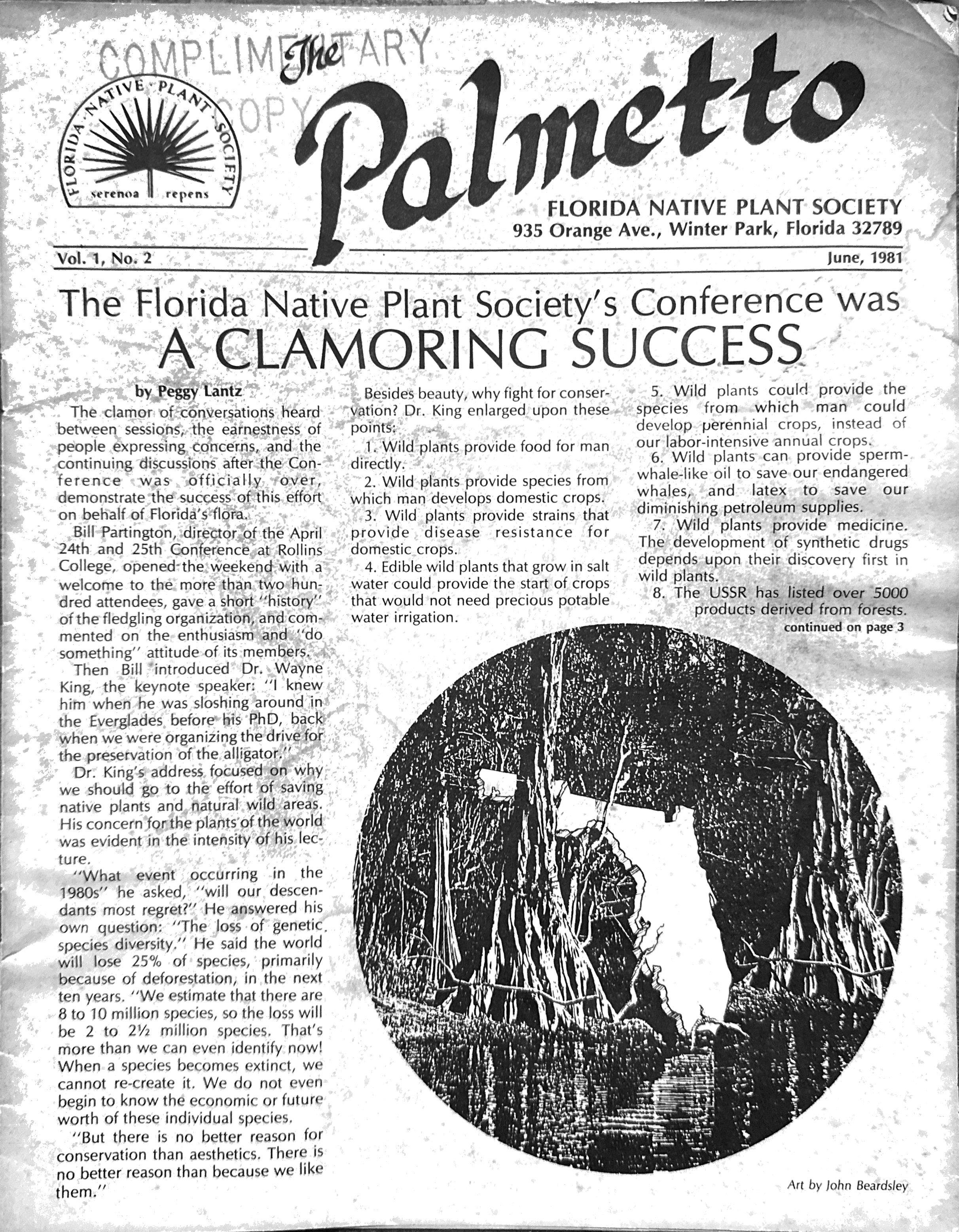
FLORIDA NATIVE PLANT SOCIETY 935 Orange Ave., Winter Park, Florida 32789
June, 1981
Vol. 1, No. 2
FLORIDA NATIVE PLANT SOCIETY 935 Orange Ave., Winter Park, Florida 32789
June, 1981
by Peggy Lantz
Besides beauty, why fight for conser-
5. Wild plants could provide the
The clamor of conversations heard vation? Dr. King enlarged upon these species from which man could between sessions, the earnestness of points: develop perennial crops, instead of people expressing concerns, and the
1. Wild plants provide food for man our labor-intensive annual crops.
6. Wild plants can provide sperm- continuing discussions after the Conferencewas officially over, directly.
2. Wild plants provide species from whale-like oil to save our endangered demonstrate the success of this effort which man develops domestic crops. whales, and latex to save our on behalf of Florida's flora.
3. Wild plants provide strains that diminishing petroleum supplies.
Bill Partington, director of the April provide disease resistance for
7. Wild plants provide medicine. 24th and 25th Conference at Rollins domestic crops.
The development of synthetic drugs College, opened the weekend with a
4. Edible wild plants that grow in salt depends upon their discovery first in welcome to the more than two hun- water could provide the start of crops wild plants. dred attendees, gave a short "history" that would not need precious potable
8. The USSR has listed over 5000 of the fledgling organization, and com- water irrigation. products derived from forests. mented on the enthusiasm and "do continued on page 3 something" attitude of its members.
Then Bill introduced Dr. Wayne King, the keynote speaker: "1 knew him when he was sloshing around in the Everglades before his PhD, back when we were organizing the drive for the preservation of the alligator!
Dr. King's address focused on why we should go to the effort of saving native plants and natural wild areas. His concern for the plants of the world was evident in the intensity of his lec-
"What event occurring in the 1980s" he asked, "will our descendants most regret?" He answered his own question: "The loss of genetic. species diversity." He said the world will lose 25% of species, primarily because of deforestation, in the next ten years. "We estimate that there are 8 to 10 million species, so the loss will be 2 to 2? million species. That's more than we can even identify now! When a species becomes extinct, we cannot re-create it. We do not even begin to know the economic or future worth of these individual species.
"But there is no better reason for conservation than aesthetics. There is no better reason than because we like them."
Page 2, The PALMETTO, June 1981
THE PALMETTO
935 Orange Ave., Winter Park, FL 32789
Peggy S. Lantz, Editor
THE PALMETTO (ISSN-0276-4164) is published quarterly by The Florida Native Plant Society under the auspices of The Environmental Information Center and The Florida Conservation Foundation. No part of this publication may be reproduced without written permission of the Editor or the Publisher.
Articles on any aspect of Florida Native Plants are invited. Include drawings or photos, if possible. They will be handled with care, and will be returned if you include a self-addressed, stamped envelope. Send to Peggy S. Lantz, Editor, The Palmetto, Rt. 3, Box 437, Orlando, FL 32811, 305/299-1472.
Some noble ideas and earnest thoughts came out of this first Conference. Dick Workman, environmental scientist, said the biggest problem to be confronted by the Florida Native Plant Society is ignorance. The FNPS needs to bring attention to Florida's needs, and support those trying to protect the native plant communities. Developers are not sympathetic to Florida's ecosystems, he said. "They cut down all the trees and then name the streets after them.
Duke Woodson, governmental responsibility advocate, asked, "Why are sane suggestions not followed by IN THIS ISSUE: commissioners? Because you are out-
The Saw Palmetto ? page 5 voted by the "bad guys", who attend Florida Grasses ? page 6 the meetings. The "good guys" need
The Champion Tree .. page 8
The Query Corner.. ? page 8
Florida Trees ? page 9
The Sinkhole page 10
Dr. King from page 1
9. Other "free services" offered by wilderness include coastal nurseries for sea creatures, pollution control, pollinators, pest control, siltation and flood control, and knowledge
Dr. King went on. The dodo bird, literally eaten out of existance by 1681, has become the symbol of extinction. But we have only recently discovered the dodo's place in the scheme of things: a tree that grows on the dodo's island, Mauritius, has not reproduced since the dodo died out. Its seeds needed to pass through the dodo's gizzard in order to sprout.
Some of the statistics Dr. King presented were frightening: The world is losing rain forest at the rate of 50 to 60 acres a minute! The world is losing animal species at the rate of three a year. Before man existed, animals became extinct at the rate of one per thousand years.
So besides aesthetics, there are economic,scientific, and cultural reasons for preserving species, and maybe some reasons that we don't even know about yet.
THE INTERIM BOARD OF DIRECTORS will meet on Saturday, June 27, at 10 A.M., at Sanibel-Captiva Conservation Foundation. All interim directors will receive further information. If anyone else wishes to contribute ideas or suggestions for FNPS objectives, policies, and by-laws, or wishes to attend the meeting, call Bill Partington in Winter Park, 305/644-5377. (Suggestions for places to stay: Island Inn, $30/night, advance registration, 813/472-1561. Periwinkle Trailer Park, $10/night for tent, 813/472-1433. Call Norma Jeanne Byrd, 813/472-1932, for more information on lodging.)
On Saturday, April 25, 1981, at the Society's Conference, the following were voted in as Interim Directors. Duties will include drafting policies, objectives, and bylaws for the FNPS. Other activities should include nominating officers and a board of directors, and encouraging the formation of chapters. Insofar as possible, chapter organizers or persons they designate will automatically be included asinterim directors, and their names are starred in this list.
*Thomas Levin 1335 Gary Road Lakeland, FL 33850 813/688-4386
Dr. Daniel F. Austin
2760 N.E. Second Ct. Boca Raton, FL 33431 305/391-6322
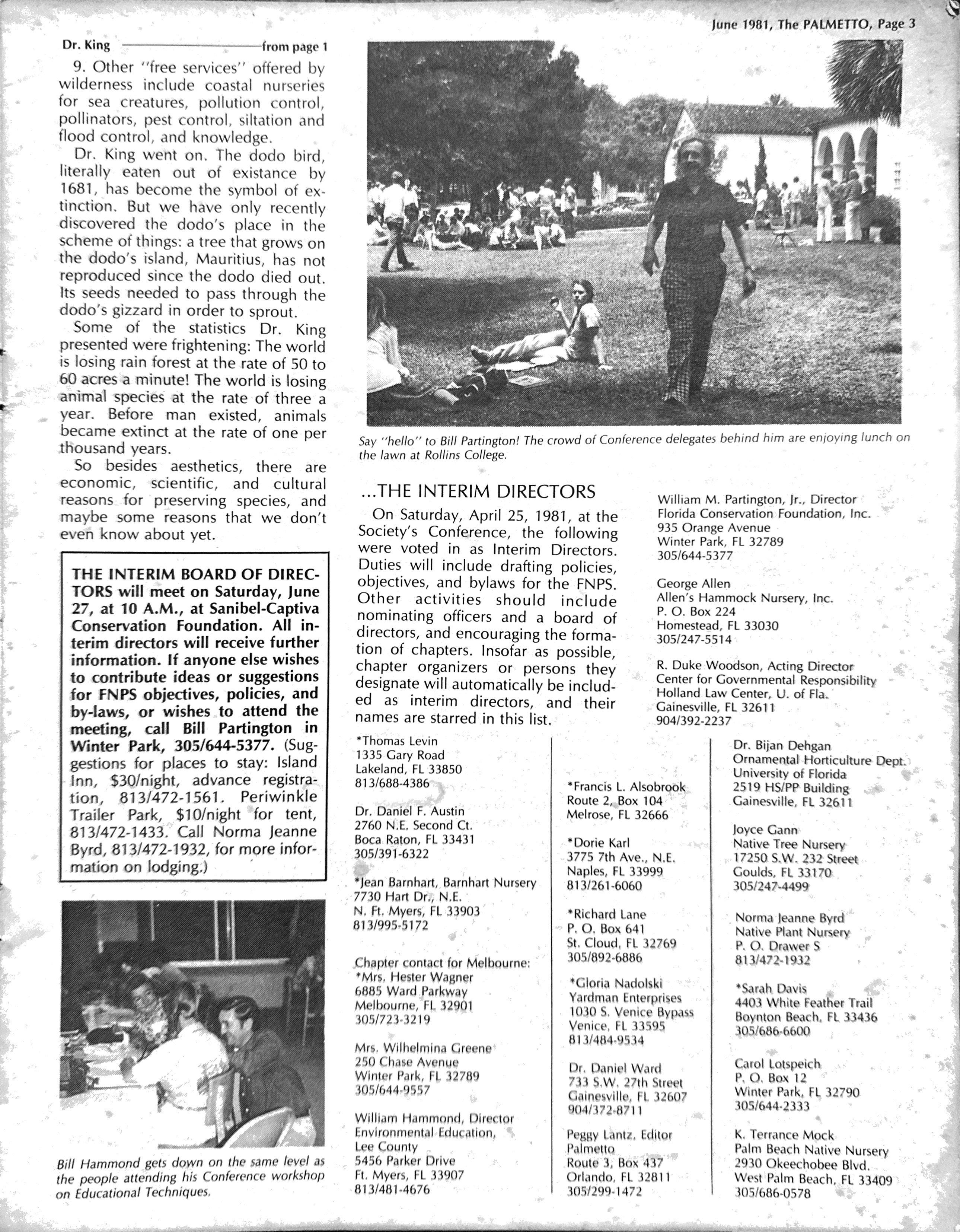
William M. Partington, Jr., Director Florida Conservation Foundation, Inc. 935 Orange Avenue Winter Park, FL 32789 305/644-5377
George Allen Allen's Hammock Nursery, Inc. P. O. Box 224 Homestead, FL 33030 305/247-5514
R. Duke Woodson, Acting Director Center for Governmental Responsibility Holland Law Center, U. of Fla. Gainesville, FL 32611 904/392-2237
*Francis L. Alsobrook Route 2, Box 104 Melrose, FL 32666
Dr. Bijan Dehgan Ornamental Horticulture Dept. University of Florida 2519 HS/PP Building Gainesville, FL 32611
Joyce Gann
*Dorie Karl Native Tree Nursery 3775 7th Ave., N.E. 17250 S.W. 232 Street Naples, FL 33999
*Jean Barnhart, Barnhart Nursery 813/261-6060
7730 Hart Dr., N.E N. Ft. Myers, FL 33903 813/995-5172
Chapter contact for Melbourne:
*Mrs. Hester Wagner 6885 Ward Parkway Melbourne, FL 32901 305/723-3219
Mrs. Wilhelmina Greene
250 Chase Avenue Winter Park, FL 32789 305/644-9557
William Hammond, Director
Environmental Education, Lee County 5456 Parker Drive Ft. Myers, FL 33907 813/481-4676
*Richard Lane P. O. Box 641 St. Cloud, FL 32769 305/892-6886
*Gloria Nadolski Yardman Enterprises 1030 S. Venice Bypass Venice, FL 33595 813/484-9534
Dr. Daniel Ward
733 S.W. 27th Street Gainesville, FL 32607 904/372-8711
Peggy Lantz, Editor
Palmetto Route 3, Box 437 Orlando, FL 32811 305/299-1472
Goulds, FL 33170 305/247-4499
Norma Jeanne Byrd Native Plant Nursery P. O. Drawer S 813/472-1932
*Sarah Davis 4403 White Feather Trail Boynton Beach, FL 33436 305/686-6600
Carol Lotspeich P. O. Box 12
Winter Park, FL 32790 305/644-2333
K. Terrance Mock
Palm Beach Native Nursery 2930 Okeechobee Blvd. West Palm Beach, FL 33409 305/686-0578
Page 4, The PALMETTO, June 1981
by Norma Jeanne Byrd
noted at the conference that South Florida was well represented with At the nursery workshop sessions on native nurseries, Central Florida is April 25, a number of experts in pro- greatly lacking and North Florida has duction of native plants in Florida pro- several active nurseries. South Florida vided information on plant identifica- has been impacted most dramatically tion, propagation, and marketing of by the introduction of exotic plants plants from various natural plant com- and the loss of natural areas by munities throughout the state. development. There the need for pro-
The workshop leaders included the duction of native plants became obmajority of native plant producers for vious. Let's not use South Florida as a the entire state. They and a few others model of how far to go before taking involved in native plant production positive action. Grow Native! are the pioneers of the native plant movement. Many of these growers
have to spend considerable time in
educating their market before they can by sell any plants. They function not only Carolyn Ruesch and Michael Green as growers but as educators too. A communications channel through the Florida Native Plant Society that would provide an educational facility for these growers would allow more time for production to meet the increased demand for native plants. This communications channel would also create a distribution system for native plants throughout the state - so that a grower on the West coast, for example, knows that a grower on the East coast has plants available for some particular project.
The production of native plants in Florida is greatly limited to small scale nurseries scattered throughout the state. The few nurseries that do specialize in native plants generally carry a wide diversity of native plant material. But in most cases they do not yet provide the quantity of native plants that are required for large landscaping contracts at prices which are competitive with large scale growers. All too often, the job goes to the exotic grower. State agencies such as the
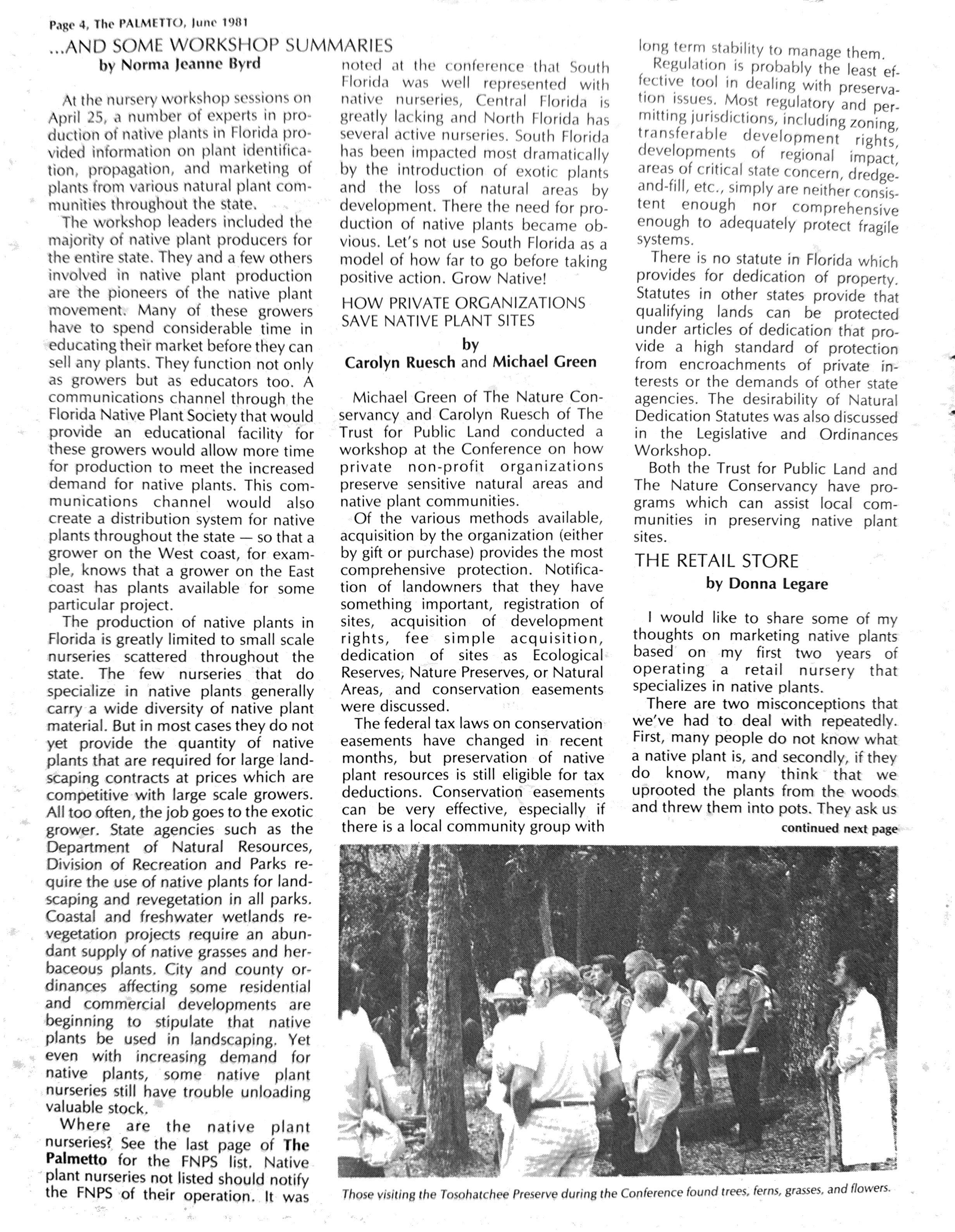
Michael Green of The Nature Conservancy and Carolyn Ruesch of The Trust for Public Land conducted a workshop at the Conference on how private non-profit organizations preserve sensitive natural areas and native plant communities.
Of the various methods available, acquisition by the organization (either by gift or purchase provides the most comprehensive protection. Notification of landowners that they have something important, registration of sites,acquisition of development rights, fee simple acquisition, dedication of sites as Ecological Reserves, Nature Preserves, or Natural Areas, and conservation easements were discussed
The federal tax laws on conservation easements have changed in recent months, but preservation of native plant resources is still eligible for tax deductions. Conservation easements can be very effective, especially if there is a local community group with Department of Natural Resources, Division of Recreation and Parks require the use of native plants for landscaping and revegetation in all parks. Coastal and freshwater wetlands revegetation projects require an abundant supply of native grasses and herbaceous plants. City and county ordinances affecting some residential and commercial developments are beginning to stipulate that native plants be used in landscaping. Yet even with increasing demand for native plants, some native plant nurseries still have trouble unloading valuable stock.
Where are the native plant nurseries? See the last page of The Palmetto for the FNPS list. Native plant nurseries not listed should notify the FNPS of their operation. It was
long term stability to manage them.
Regulation is probably the least effective tool in dealing with preservation issues. Most regulatory and permitting jurisdictions, including zoning, transferable developmentrights, developments of regional impact, areas of critical state concern, dredgeand-fill, etc., simply are neither consistent enough nor comprehensive enough to adequately protect fragile systems.
There is no statute in Florida which provides for dedication of property. Statutes in other states provide that qualifying lands can be protected under articles of dedication that provide a high standard of protection from encroachments of private interests or the demands of other state agencies. The desirability of Natural Dedication Statutes was also discussed in the Legislative and Ordinances Workshop.
Both the Trust for Public Land and The Nature Conservancy have programs which can assist local communities in preserving native plant sites.
by Donna Legare
I would like to share some of my thoughts on marketing native plants based on my first two years of operating a retail nursery that specializes in native plants.
There are two misconceptions that we've had to deal with repeatedly. First, many people do not know what a native plant is, and secondly, if they do know, many think that we uprooted the plants from the woods and threw them into pots. They ask us continued next page
RETAIL from page 4
"Why should I pay $5.00 when I can go get one out of the woods?" These people usually come back to buy after an unsuccessful attempt at uprooting too large a plant the wrong way during the wrong season.
We've approached the education of the customer by creating an image for our nursery and developing advertising, workshops, courses, lectures and landscaping around this image/theme. Our theme is that of creating productive, low energy, low maintenance landscapes by using native plants, edible plants and plants having wildlife food value whenever possible.
Some of our educational techniques in conveying this image have been:
? appearing on television talk shows on rare and endangered native plants, backyard birding, hummingbirds, etc.
?lecturing and presenting slide shows to garden clubs and other community groups.
?offering free workshops and special programs at the nursery. These have proven most profitable. For example, this spring we held a program on hummingbirds every hour during a weekend. We sold hundreds of hummingbird feeders andmany red buckeye and coral honeysuckle plants. In addition to the increased sales for the weekend, the programs brought in many peoplewho previously had not known that we stocked a full line of native plants.
?offering field courses on trees and wildflowers for a fee. The people attending these classes have become long-term customers and several have had us do their landscaping.
?keeping a photo album of flowering native plants at the front desk.
We have found it necessary, as a retail store, to diversify while remaining consistent with our image. We are not only North Florida's native plant specialist but also the local backyard bird supply center.Organic and natural mineral fertilizers, herbs, wildflowers, field guides, and locally made crafts relating to trees and birds are stocked at Native Nurseries. We are not just a store, but an educational center as well. We also do landscaping on a small scale but plan to expand in this area in the future.
An educational program is necessary to convince people of the value of native plants. Without it, plan to continue seeing destruction of native habitat followed by replacement with ligustrum andviburnum hedges covered with white flies.
by Dave Wilson
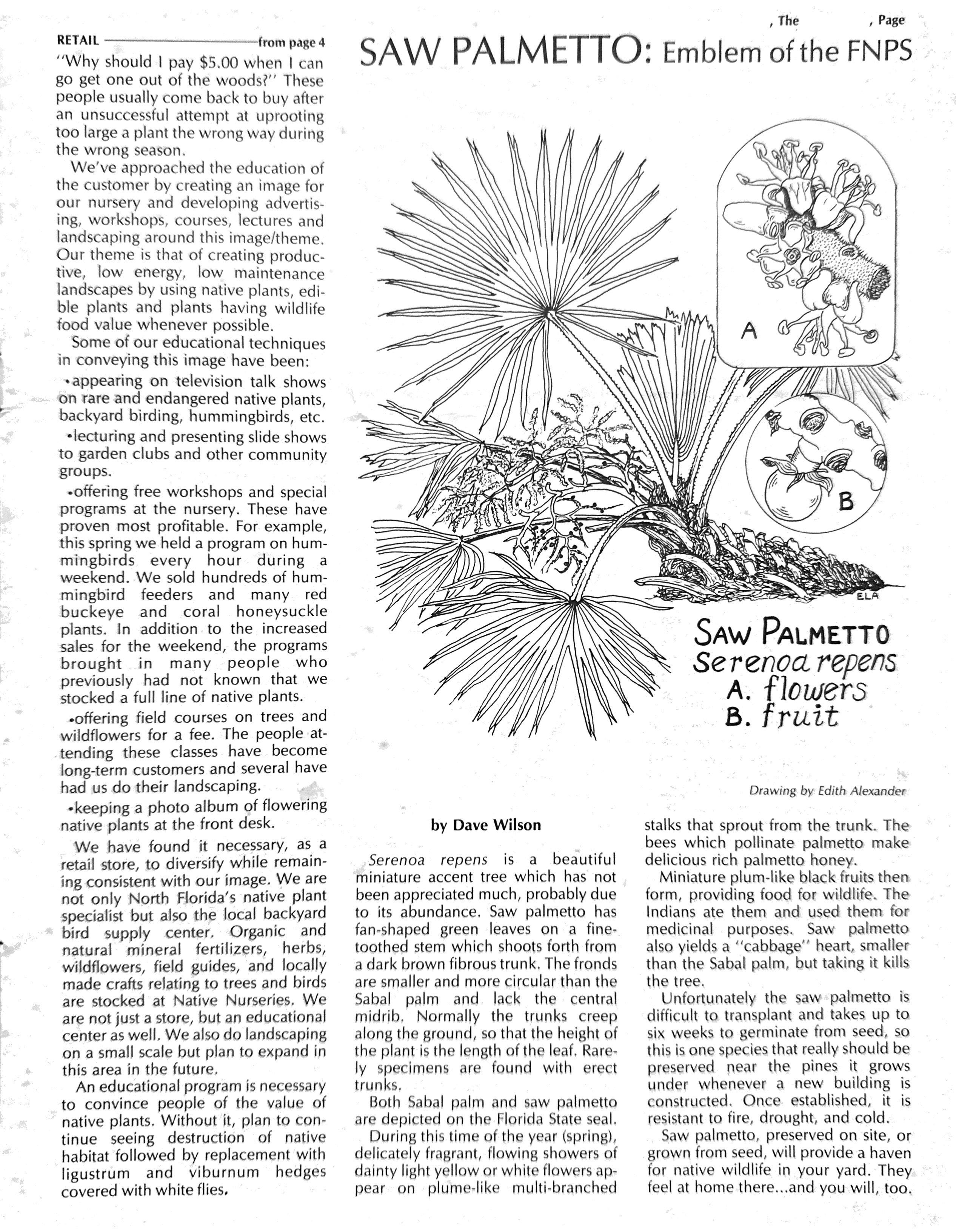
Serenoa repens is a beautiful miniature accent tree which has not been appreciated much, probably due to its abundance. Saw palmetto has fan-shaped green leaves on a finetoothed stem which shoots forth from a dark brown fibrous trunk. The fronds are smaller and more circular than the Sabal palm and lack the central midrib. Normally the trunks creep
ly specimens are found with erect trunks.
Both Sabal palm and saw palmetto are depicted on the Florida State seal. During this time of the year (spring), delicately fragrant, flowing showers of dainty light yellow or white flowers appear on plume-like multi-branched
stalks that sprout from the trunk. The bees which pollinate palmetto make delicious rich palmetto honey.
Miniature plum-like black fruits then form, providing food for wildlife. The Indians ate them and used them for medicinal purposes. Saw palmetto also yields a "cabbage" heart, smaller than the Sabal palm, but taking it kills the tree.
Unfortunately the saw palmetto is difficult to transplant and takes up to six weeks to germinate from seed, so this is one species that really should be preserved near the pines it grows under whenever a new building is constructed. Once established, it is resistant to fire, drought, and cold. Saw palmetto, preserved on site, or grown trom seed, will provide a haven for native wildlife in your yard. They feel at home there...and you will, too.
of growing in only one location in the world. This grass is found on the seepy slopes just off the central Florida ridge in Highlands and Polk counties. Cutthroat grass was first collected in 1917 near the settlement then known as Florinda, located close to the present Indian Lake Estates. Florinda no longer exists.
The threeawn family of grasses are represented by pineland threeawn or "wiregrass", (Aristida stricta). Growing abundantly throughout Florida in the pine and palmetto flatwoods, it has little value for grazing except for a Imm
15 cm
(Lopsided
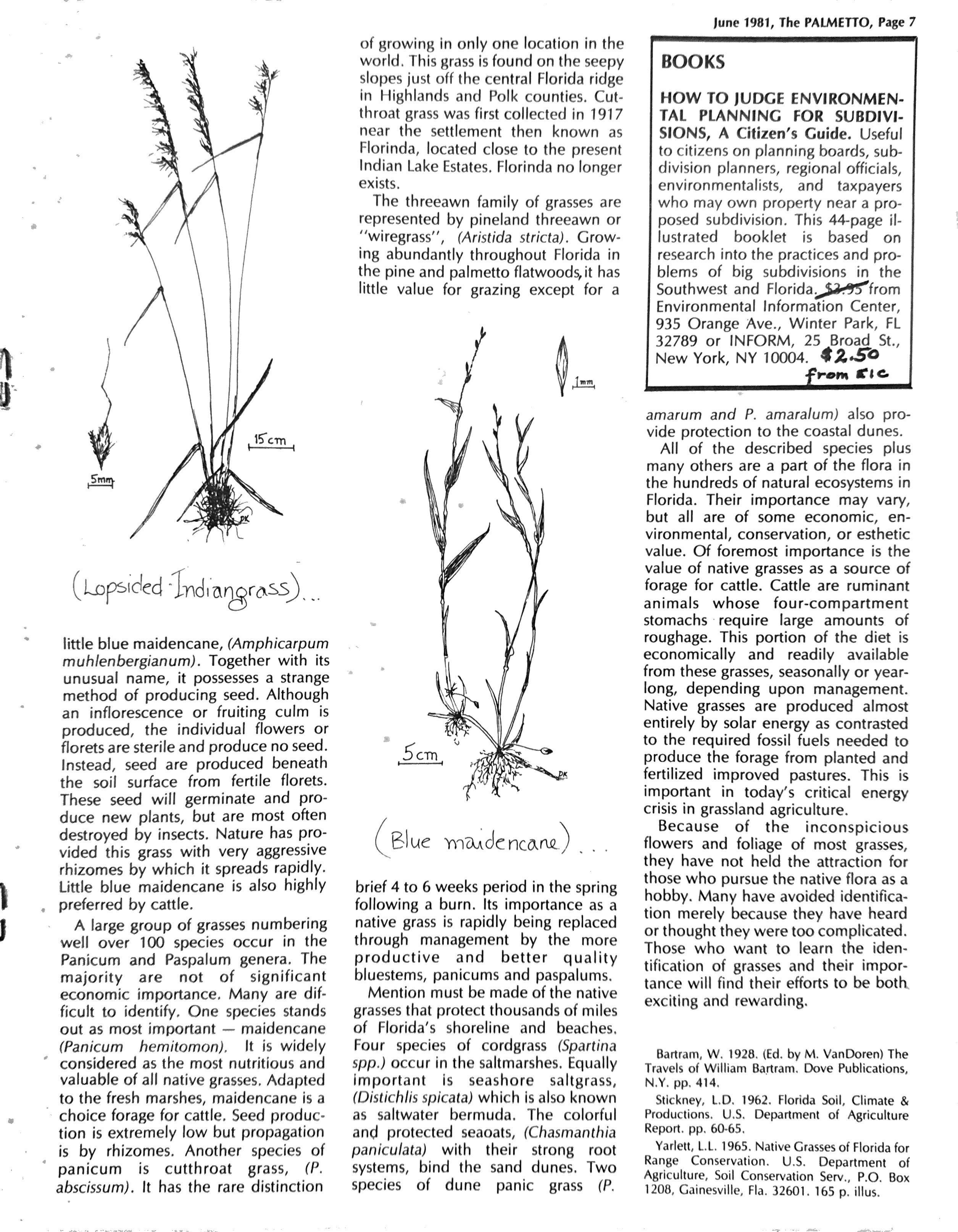
little blue maidencane, (Amphicarpum muhlenbergianum). Together with its unusual name, it possesses a strange method of producing seed. Although an inflorescence or fruiting culm is produced, the individual flowers or florets are sterile and produce no seed Instead, seed are produced beneath the soil surface from fertile florets. These seed will germinate and prodestroyed by insects. Natures prenvided this grass with very aggressive rhizomes by which it spreads rapidly. Little blue maidencane is also highly preferred by cattle.
A large group of grasses numbering well over 100 species occur in the Panicum and Paspalum genera. The majority are not of significant economic importance. Many are difficult to identify. One species stands out as most important - maidencane (Panicum hemitomon), It is widely considered as the most nutritious and valuable of all native grasses. Adapted to the fresh marshes, maidencane is a choice forage for cattle. Seed produc tion is extremely low but propagation is by rhizomes. Another species of panicum is cutthroat grass, (P. abscissum). It has the rare distinction
brief 4 to 6 weeks period in the spring following a burn. Its importance as a native grass is rapidly being replaced through management by the more productive and better quality bluestems, panicums and paspalums. Mention must be made of the native grasses that protect thousands of miles of Florida's shoreline and beaches. Four species of cordgrass (Spartina spp.) occur in the saltmarshes, Equally important is seashoresaltgrass, (Distichlis spicata) which is also known as saltwater bermuda. The colorful and protected seaoats, (Chasmanthia paniculata) with their strong root systems, bind the sand dunes. Two species of dune panic grass (P.
HOW TO JUDGE ENVIRONMENTAL PLANNING FOR SUBDIVISIONS, A Citizen's Guide. Useful to citizens on planning boards, subdivision planners, regional officials, environmentalists, and taxpayers who may own property near a proposed subdivision. This 44-page illustrated booklet is based on research into the practices and problems of big subdivisions in the Southwest and Florida. $2.95 from Environmental Information Center, 935 Orange Ave., Winter Park, FL 32789 or INFORM, 25 Broad St., New York, NY 10004. $2.50 from Kic
amarum and P. amaralum) also provide protection to the coastal dunes. All of the described species plus many others are a part of the flora in the hundreds of natural ecosystems in Florida. Their importance may vary, but all are of some economic, environmental, conservation, or esthetic value. Of foremost importance is the value of native grasses as a source of forage for cattle. Cattle are ruminant animals whose four-compartment stomachs require large amounts of roughage. This portion of the diet is economically and readily available from these grasses, seasonally or yearlong, depending upon management. Native grasses are produced almost entirely by solar energy as contrasted to the required fossil fuels needed to produce the forage from planted and fertilized improved pastures. This is important in today's critical energy crisis in grassland agriculture.
Because of the inconspicious flowers and foliage of most grasses, they have not held the attraction for those who pursue the native flora as a hobby. Many have avoided identification merely because they have heard or thought they were too complicated. Those who want to learn the identification of grasses and their importance will find their efforts to be both exciting and rewarding.
Bartram, W. 1928. (Ed. by M. VanDoren) The Travels of William Bartram. Dove Publications, N.Y. pp. 414.
Stickney, L.D. 1962. Florida Soil, Climate & Productions. U.S. Department of Agriculture Report. pp. 60-65.
Yarlett, L.L. 1965. Native Grasses of Florida for Range Conservation. U.S. Department of Agriculture, Soil Conservation Serv., P.O. Box 1208, Gainesville, Fla. 32601. 165 p. illus.
Are there any books on Wild Edi- traffic to see how they hold up. ble Plants of the South East? Carol Lotspeich of Winter Park suggests these two: Bermuda grass Marvyne Betsch (Cynodon dactylon),
Sure are! Try Julia Morton's Wild Plants for Survival in South Florida, 76 pages, published by Fairchild Tropical Gardens; Living Off the Land in Florida, a four-page flyer by Tony Jensen, available from your County Agricultural Agent; Survival Safari, by Ross Allen, out of print, but available from your public library; Wild Plants of Eastern North America, by Fernald, Merritt, and Kinsey, published by Harper; and Handbook of Florida Edible Wild Plants, by Michalowski, out of print, but available from your public library. That should keep you busy for a few days!
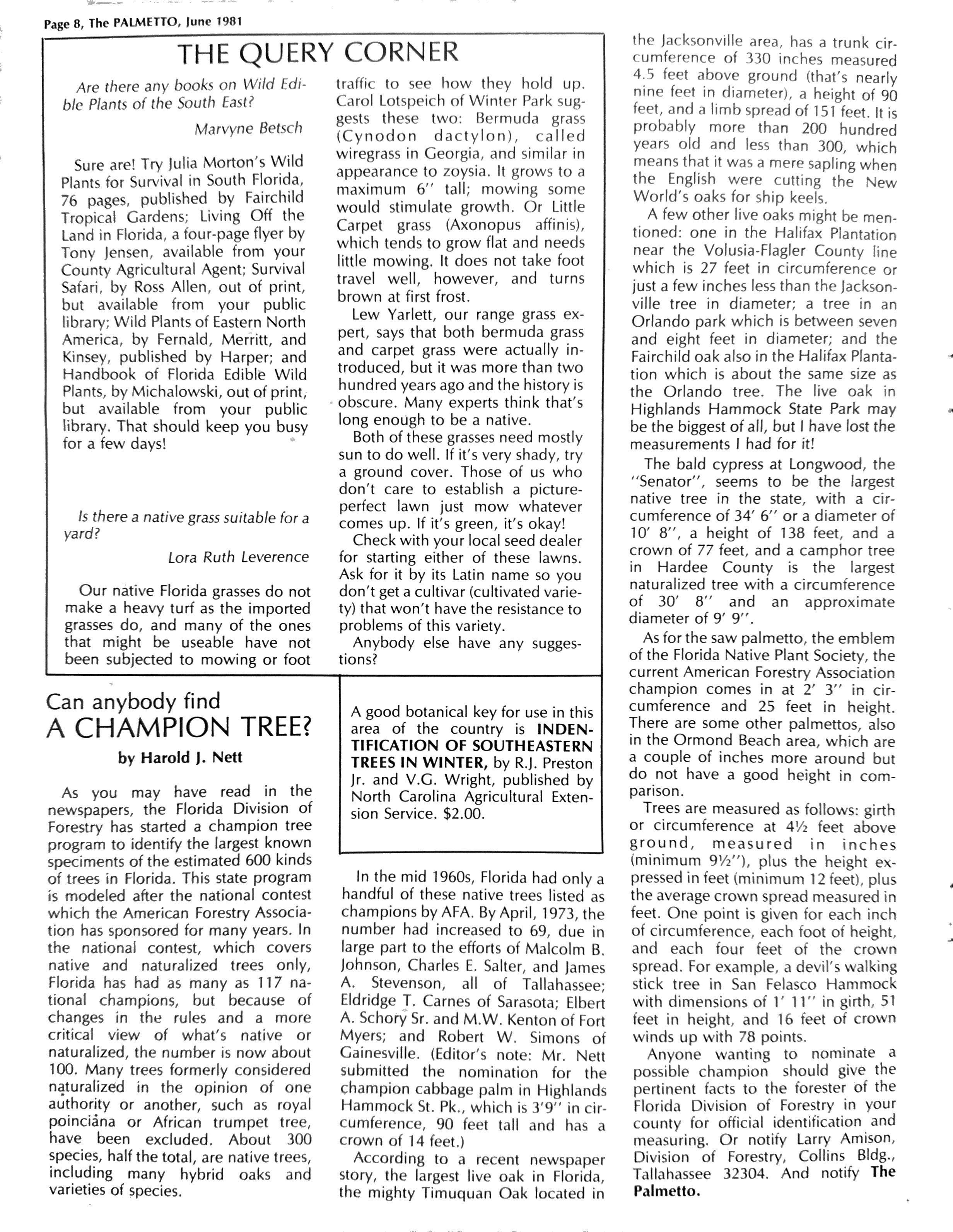
wiregrass in Georgia, and similar in appearance to zoysia. It grows to a maximum 6" tall; mowing some would stimulate growth. Or Little Carpet grass (Axonopus affinis), which tends to grow flat and needs little mowing. It does not take foot travel well, however, and turns brown at first frost.
Lew Yarlett, our range grass expert, says that both bermuda grass and carpet grass were actually introduced, but it was more than two hundred years ago and the history is obscure. Many experts think that's long enough to be a native.
Both of these grasses need mostly sun to do well. If it's very shady, try a ground cover. Those of us who don't care to establish a pictureperfect lawn just mow whatever
Is there a native grass suitable for a comes up. If it's green, it's okay! yard?
Check with your local seed dealer Lora Ruth Leverence for starting either of these lawns. Ask for it by its Latin name so you
Our native Florida grasses do not make a heavy turf as the imported grasses do, and many of the ones that might be useable have not been subjected to mowing or foot
Can anybody find A CHAMPION TREE?
by Harold J. Nett
As you may haveread in the newspapers, the Florida Division of Forestry has started a champion tree program to identify the largest known speciments of the estimated 600 kinds of trees in Florida. This state program is modeled after the national contest which the American Forestry Association has sponsored for many years. In the national contest, which covers native and naturalized trees only, Florida has had as many as 117 national champions, but because of changes in the rules and a more critical view of what's native or naturalized, the number is now about 100. Many trees formerly considered naturalized in the opinion of one authority or another, such as royal poinciana or African trumpet tree have been excluded. About 300 species, half the total, are native trees, including many hybrid oaks and varieties of species.
don't get a cultivar (cultivated variety) that won't have the resistance to problems of this variety.
Anybody else have any suggestions?
A good botanical key for use in this area of the country is INDENTIFICATION OF SOUTHEASTERN TREES IN WINTER, by R.J. Preston Jr. and V.G. Wright, published by North Carolina Agricultural Extension Service. $2.00.
In the mid 1960s, Florida had only a handful of these native trees listed as champions by AFA. By April, 1973, the number had increased to 69, due in large part to the efforts of Malcolm B. Johnson, Charles E. Salter, and James A. Stevenson, all of Tallahassee; Eldridge T. Carnes of Sarasota; Elbert A. Schory Sr. and M.W. Kenton of Fort Myers; and Robert W. Simons of Gainesville. (Editor's note: Mr. Nett submitted the nomination for the champion cabbage palm in Highlands Hammock St. Pk., which is 3'9" in circumference, 90 feet tall and has a crown of 14 feet.)
According to a recent newspaper story, the largest live oak in Florida, the mighty Timuquan Oak located in
the Jacksonville area, has a trunk circumference of 330 inches measured 4.5 feet above ground (that's nearly nine feet in diameter), a height of 90 feet, and a limb spread of 151 feet. It is probably more than 200 hundred years old and less than 300, which means that it was a mere sapling when the English were cutting the New World's oaks for ship keels.
A few other live oaks might be mentioned: one in the Halifax Plantation near the Volusia-Flagler County line which is 27 feet in circumference or just a few inches less than the Jacksonville tree in diameter; a tree in an Orlando park which is between seven and eight feet in diameter; and the Fairchild oak also in the Halifax Plantation which is about the same size as the Orlando tree. The live oak in Highlands Hammock State Park may be the biggest of all, but I have lost the measurements I had for it!
The bald cypress at Longwood, the "Senator", seems to be the largest native tree in the state, with a circumference of 34' 6" or a diameter of 10' 8', a height of 138 feet, and a crown of 77 feet, and a camphor tree in Hardee County is the largest naturalized tree with a circumference of 30' 8" and an approximate diameter of 9' 9".
As for the saw palmetto, the emblem of the Florida Native Plant Society, the current American Forestry Association champion comes in at 2' 3" in circumference and 25 feet in height. There are some other palmettos, also in the Ormond Beach area, which are a couple of inches more around but do not have a good height in comparison.
Trees are measured as follows: girth or circumference at 4? feet above ground, measured in inches (minimum 9?"), plus the height expressed in feet (minimum 12 feet), plus the average crown spread measured in feet. One point is given for each inch of circumference, each foot of height, and each four feet of the crown spread. For example, a devil's walking stick tree in San Felasco Hammock with dimensions of 1' 11" in girth, 51 feet in height, and 16 feet of crown winds up with 78 points.
Anyone wanting to nominate a possible champion should give the pertinent facts to the forester of the Florida Division of Forestry in your county for official identification and measuring. Or notify Larry Amison, Division of Forestry, Collins Bldg., Tallahassee 32304. And notify The Palmetto.
by A.S. (Tony) Jensen Extension Forester
Florida has about 3,000 native plants. Some 300 of these are native trees. Nearly 100 of this 300 tree species are tropical or semi-tropical that are found only in the hardwood hammocks, everglade tree islands or along the coast or Keys of extreme south Florida. Few people except trained botanists seeking these specimens have ever seenthem or known the names of the trees they are looking at in passing.
Note that a number of common introduced or naturalized tree species that are spreading throughout south Florida and rapidly changing the face of the countryside are not included on this list: examples of these exoticsMelaleuca, Brazilian Pepper, Australian Pine, and Eucalyptus. Native vegetation of the cities and developments of south Florida has long since been overwhelmed by exotic ornamentals. Natives are often scarce around cities and towns.
Many of the trees on this list may be seen while riding the roads or boating on the streams of Florida north of Lake Okeechobee. But seeing them and identifying them are different matters. Good references and illustrated books on Florida native trees are not easy to obtain. The following references are available from the various publishers unless it is noted they are out of print. Local libraries usually have a poor to excellent section on Florida tree identification also.
Remember, however, there is no book or picture that is as good as actually learning to know the tree in the field!
Herman Kurz and Robert K. Godfrey. 1962. Trees of Northern Florida. Univ. Fla, Press, Gainesville. 311p. ILL.
Erdman West and Lillian Arnold, 1956, The Native Trees of Florida,Univ. Fla. Press, Gainesville. 218p. ILL (Out-of-Print.)
Division of Forestry. 1977, Forest Trees of Florida. 97p. ILL. Free from Division of Forestry,
Elbert L. Little, Jr. 1974, Checklist of United States Trees (Native and Naturalized). Ag. Handbook 541, USDA Forest Service, 375p. Order from Superintendent of Documents Gov't Printing Office.
Elbert L. Little, Jr. 1978. Atlas of United States Trees Volume 5 Florida. Misc. Pub. 1361. 254p. Range maps of Florida species. Order from Gov't Printing Office.
ASH, CAROLINA or POP-ASH (Fraxinus caroliniana) Swamps and low hammocks
BALD CYPRESS and POND CYPRESS (Taxodium distichum and T.Distichum var. nutans) Swamps, ponds, river and stream banks
BUTTONBUSH (Cephalanthus occidentalis) Ponds and swamps
CABBAGE PALM (Sabal palmetto) Coastal zones, hammocks - planted everywhere
DAHOON HOLLY (Ilex cassine) Swamps and low hammocks
ELDERBERRY (Sambucus simpsonii) Moist areas and ditch banks
ELM, FLORIDA (Ulmus americana var. Floridiana) Wet hammocks and stream margins
HICKORY, PIGNUT (Carya glabra) Hammocks
PINE, LOBLOLLY (Pinus taeda) Old field pine
PINE, LONGLEAF (P. palustris) Flatwoods and high pineland
PINE, SAND (P. clausa) Coastal dunes inland sand pine scrubs
PINE SLASH (P. elliottii, in S. Fla. var. densa) Pine of piney woods and plantation, etc.
RED CEDAR (Juniperus silicicola) Limestone soil areas
SWEET GUM (Liquidambar styracaflua) Hammocks, wood margins
RED MAPLE (Acer rubrum) Wet areas and
HICKORY, WATER (Carya aquatica) Wet ground and swamps swamps
LOBLOLLY BAY (Gordonia lasianthus) Swamps, ditches, bayheads
MULBERRY, RED (Morus rubra) Low hammocks
OAK, LAUREL (Quercus lauri folia) Moist soils
OAK, LIVE (Q. virginiana) Hammocks and lake
RED BAY (Persea borbonia) Hammocks ? swamp bay is in the wet places
SALTBUSH (Eastern baccharis, B. halimifolia) Many places
SWAMP BLACKGUM (Nyssa biflora) Swamps and shallow lake margins
SOUTHERN MAGNOLIA (Magnolia virginiana) Hammocks, front yards
SWEETBAY MAGNOLIA (Magnolia virginiana) Bayheads and swamps margins
OAK, MYRTLE (Q. myrtifolia) Coastal dunes and
SHINING SUMAC (Rhus copallina) Dry soils, old fields scrubs
OAK, TURKEY (Q. laevis) Sandy oak ridges
OAK, WATER (Q. nigra) Hammocks
OAK, UPLANDWILLOW (Bluejack - Q. incana)
Sandy oak ridges
PERSIMMON (Diospyros virginiana) Old fieldsfence rows
WAX MYRTLE (Myrica cerifera) Fields, woods, low hammocks
WILLOW(Salixcaroliniana)Wetareas-roadsides, ditches
SUGARBERRY (Celtis laevigata) Damp woods, stream banks, roadsides state-wide
(Published in Forestry Report, March 1980)
(Editor's note: Tony solicits your corrections or additions to this list. He would also like to see a county-by-county list of the more common trees. Can you help? Send to A.S. Jensen, 118 NewinsZiegler Hall, U. of F., Gainesville, 32611.) -Distinctive Landscape Design
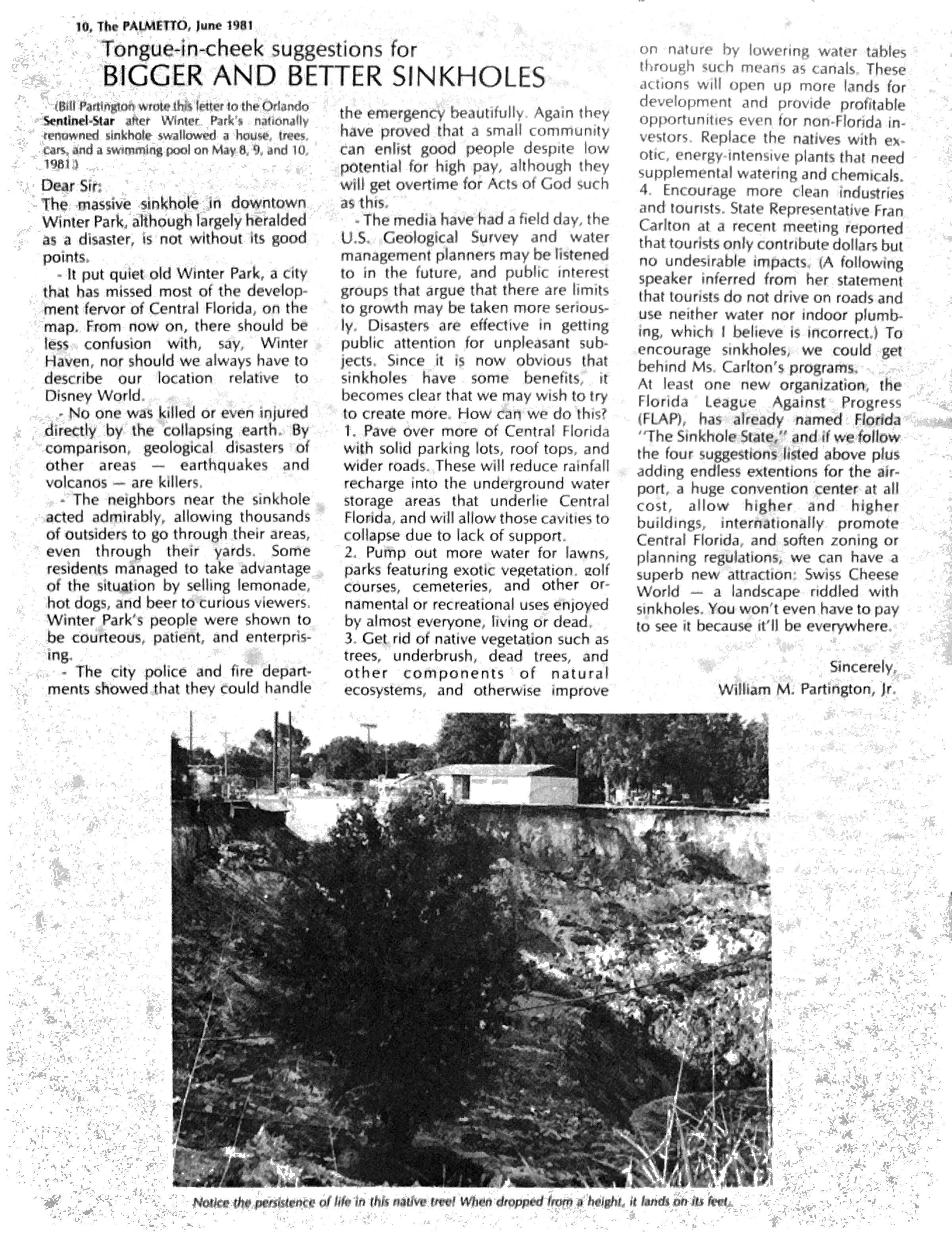
(Bill Partington wrote this letter to the Orlando Sentinel-Starafter Winter Park's nationally renowned sinkhole swallowed a house, trees. cars, and a swimming pool on May 8, 9, and 10, 1981)
Dear Sir:
The massive sinkhole in downtown Winter Park, although largely heralded as a disaster, is not without its good points.
- It put quiet old Winter Park, a city that has missed most of the development fervor of Central Florida, on the map. From now on, there should be less confusion with, say.Winter Haven, nor should we always have to describe our location relative to Disney World
- No one was killed or even injured directly by the collapsing earth. By comparison, geological disasters of other areas- earthquakes and volcanos - are killers.
- The neighbors near the sinkhole acted admirably, allowing thousands of outsiders to go through their areas, even through their yards. Some residents managed to take advantage of the situation by selling lemonade, hot dogs, and beer to curious viewers Winter Park's people were shown to be courteous, patient, and enterprisIng.
- The city police and fire departments showed that they could handle
the emergency beautifully. Again they have proved that a small community can enlist good people despite low potential for high pay, although they will get overtime for Acts of God such as this.
- The media have had a field day, the J.S. Geological Survey and water management planners may be listened to in the future, and public interest groups that argue that there are limits to growth may be taken more seriously. Disasters are effective in getting public attention for unpleasant subjects. Since it is now obvious that sinkholes have some benefits, it becomes clear that we may wish to try to create more. How can we do this?
1. Pave over more of Central Florida with solid parking lots, roof tops, and wider roads. These will reduce rainfall recharge into the underground water storage areas that underlie Central Florida, and will allow those cavities to collapse due to lack of support.
2. Pump out more water for lawns, parks featuring exotic vegetation. golf courses, cemeteries, and other ornamental or recreational uses enjoyed by almost everyone, living or dead
3. Get rid of native vegetation such as trees, underbrush, dead trees, and other components of natural ecosystems, and otherwise improve
on nature by lowering water tables through such means as canals. These actions will open up more lands for development and provide profitable opportunities even for non-Florida investors. Replace the natives with exotic, energy-intensive plants that need supplemental watering and chemicals.
4. Encourage more clean industries and tourists. State Representative Fran Carlton at a recent meeting reported that tourists only contribute dollars but no undesirable impacts. (A following speaker inferred from her statement that tourists do not drive on roads and use neither water nor indoor plumbing, which I believe is incorrect.) To encourage sinkholes, we could get behind Ms. Carlton's programs.
At least one new organization, the Florida League AgainstProgress (FLAP), has already named Florida *The Sinkhole State,." and if we follow the four suggestions listed above plus adding endless extentions for the airport, a huge convention center at all cost, allow higher and higher buildings, internationally promote Central Florida, and soften zoning or planning regulations, we can have a superb new attraction: Swiss Cheese World - a landscape riddled with sinkholes. You won't even have to pay to see it because it'll be everywhere
Sincerely,
William M. Partington, Jr.
Allen's Hammock Nursery
P.O. Box 224
Herren Nursery
Tim Pittman. Supervisor Homestead, FL 33030
Route 2, Box 142 (305)247-5514
Lake Placid, FL 33852
Dave Biggar (813)465-0024 236 NW 14th Street Homestead, FL 33030
Blaser's Nurseries, Inc.
P.O. Box 118
Tellevast, FL 33588 (813)355-8555
Brookstone's Wonderland Citrus Nursery
Harry Brookstone 17401 NW 19 Avenue
Opa Locka, FL 33056 (305)625-0921
East Lake Nursery
Route 1, Box 185
Kissimmee, FL 32741 (305)847-4809
E' Hart's Nursery & Landscaping, Inc
Mike Eisenhart, Supervisor P.O. Box 794
Lake Placid, FL 33852 (813)465-0641
Erhardt Nursery
5099 2nd Road Lake Worth, FL 33460 (305)967-7181
Florida Keys Native Nursery, Inc. 102 Mohawk Street Tavernier, FL 33070 (305)852-5515
Garden Gate, The P.O. Box 281 Homestead, FL 33030 (305)247-3908
Gateway Gardens P.O. Box 6 Oviedo, FL 32765 (305)365-3655
THE FLORIDA NATIVE PLANT SOCIETY invites you to place an advertisement for your company in The Palmetto to help pay for its publication. Rates for camera-ready copy are $200 a full page, $110 a halfpage, $75 for one-third page (measuring 4 7/8" x 47/8), or $40 for onesixth of a page (measuring 2 1/4" x 4 7/8"). Business card special is $20. For running the same ad in two issues, there will be a 20% discount, and for three issues a 30% discount, except for business cards. Copy that needs special photography or setting up will cost extra.
Home Grown Flora P.O. Box 6
St. Cloud, FL 32769 (305)892-3527
Horticultural Systems P.O. Box 70 Parrish, FL 33564 (813)776-1605
Monticello Nursery Co. P.O. Box 190 Monticello, FL 32344 (904)997-3210
Modern Seedlings
Walter A. Gammel, Sr. P.O. Box 570-178 Perrine, FL 33157
Native Nursery
Donna Legare and Jody Walthall, Owners 1661 Centerville Road Tallahassee, FL 32308 (904)386-8882
Native Tree Nursery 17250 SW 232nd Street Goulds, FL 33170 (305)274-4499
Pine Breeze Nursery
Bill or Peg Fritts P.O. Box 3
10W Stringfellow Road (SR 767) Bokeelia, FL (Pine Island) 33922
Salter Tree Farms Route 2, Box 1332 Madison, FL 32340 Home (Tallahassee) (904)385-5210 (Madison) (904)973-6312
June 1981, The PALMETTO, Page 11 SCCF Native Plant Nursery (Sanibel Captiva Conservation Foundation)
Norma Jeanne Byrd, Manager P.O. Drawer S 3333 Sanibel Captival Road Sanibel, FL 33957 (Nursery) (813)472-1932 (Office) (813)472-2329
Sunset Nursery
Bob Perry, Owner 4007 Elrod Avenue Tampa, FL 33616 (813)835-6441
The Tree Gallery Route 1, Box 8536 116th Terrace 5 Boynton Beach, FL 33437 (305)734-4416
Trees for Tomorrow 8862 D Lawrence Road Boynton Beach, FL 33436 (305)588-5806
Tree Seedlings, Inc
Don I. Poling P.O. Box 14245 Ft. Lauderdale, FL 33302 (Phone number unavailable)
Tropical Bioindustries Native Plant Nursery 9869 E. Fern Street Miami, FL 33157 (305)255-5732
Tropical Greenery & Native Nursery 22140 SW 152nd Avenue Goulds, FL 33170 (305)248-5529
Walsh, Robert J. and Co 650 Avenue F, NW Winter Haven, FL 33880 (813)293-8555
This list may be expanded but will not be repeated. FPS urges native plant nurseries to take out advertisements to help support the publication of The Palmetto.
? ENVIRONMENTAL IMPACT ASSESSMENTS
? WETLAND EVALUATIONS
? WETLAND SYSTEMS FOR WATER QUALITY CONTROL
? VEGETATION AND WILDLIFE SURVEYS
? LAND MANAGEMENT PLANNING
? RECLAMATION PROGRAMS
? EXPERT LEGAL TESTIMONY
Edith L. Alexander, illustrator for Donna Legare is co-owner of Native Palmetto, lives in Miami, and is the wife Nurseries in Tallahassee. of Professor Emeritus Taylor Alexander, Dept. of Botany, U. of Miami. An artist and a botanist, Edith has done illustrating for publication and for her hus-
Harold J. Nett is president of the Halifax River Audubon Society. He searches for champion trees as a hobby. band's botany work
Gail S. Baker works for the U.S. Fish and Wildlife Service, Dept. of the Interior, in Jacksonville, concerned mostly with endangered species,
John Beardsley is an editorial illustrator for the Orlando Sentinel-Star. newspaper. His artwork on the front page of this issue of The Palmetto also was on the cover of the program for the FNPS Conference.
Norma Jeanne Byrd is manager of the Sanibel-Captiva Native Plant Nursery.
Dorie Karl, illustrator, is the staff botanist for Wilderness Country Club in Naples.
Bill Partington heads up the Environmental Information Center in Winter Park, from which sprouted the Florida Solar Coalition and FNPS.
Dave Wilson is a dentist, and editor of The White Bird, Peace River Audubon's monthly newsletter. He hasbeen writing "Native Tree of the Month" columns for the newsletter for several years.
Lewis L. Yarlett is a retired Range Conservationist for the Soil Conservation Service. He is presently employed in Range Ecosystem Management, U. of F. School of Forestry and Resource Conservation.
The FNPS Information and Resources Committee is working on setting up a central data bank of information and resources on the flora of florida. The data bank will be available to all members through your chapter or the main office.
Please indicate your field of knowledge: identification/classification; propagation/restoration; native plant nurseries; native plant communities; utilization of native plants; education; endangered, threatened, or rare species; land planning management, legal restraints; land scape design; or other. Be specific. Indicate if your geographic region is northwest, north, central, or south; or coastal north, south, east, or west. Would you be willing to speak to other organizations? Send this information to Carol Lotspeich, P.O. Box 12, Winter Park, FL 32790.
The Palmetto, ENFO, and The Florida Solar Coalition Newsletter are all published under the auspices of the Environmental Information Center of the Florida Conservation Foundation. Copies of these newsletters are available for $1 each as long as supplies last.
Memberships in the Environmental Information Center and The Florida Native Plant Society are $12 for individuals, $15 for families.
FNPS also has $25 contributing memberships and $50 organizational memberships.
The EIC also has $25 sustaining memberships, $50 contributing memberships, $100 supporting memberships, $300 donor memberships, and $500 up patron memberships.
The Solar Coalition offers individual memberships at $15, family memberships at $20. Memberships for groups include $25 sustaining, $50 contributing, and $100 supporting memberships.
Make checks payable to the Florida Conservation Foundation, and mail to 935 Orange Avenue, Winter Park, FL 32789. FLORIDA NATIVE PLANT SOCIETY ENVIRONMENTALINFORMATIONCENTER
935ORANGEAVENUE
WINTERPARK,FLORIDA32789
U.S. POSTAGE WINTER PARK, FLA. PERMIT NO. 3-358