Ashley Morken (Unglued) and Amanda Frost (Folkways) Kellen
Paul Hoefer Paul@SpotlightMediaFargo.com
Al Anderson Al@SpotlightMediaFargo.com
Spencer Hall Spencer@SpotlightMediaFargo.com
Matt Purpur Matt@SpotlightMediaFargo.com
ClientRelations@SpotlightMediaFargo.com
Jessica Ventzke
Tyler Duclos
Missy Roberts
John Stuber
MSUM President Tim Downs Isn't Waiting for "Someday" M State: The Importance of Relationships
& Certificates
of
A THE IMPORTANCE OF EDUCATORS
teacher who believes in you can change everything.
When you’re young, you don’t always know what you’re capable of. You’re still figuring out how the world works, where you fit into it, and whether your voice
matters. In those moments, the words and actions of a teacher can carry more weight than we often realize.
A teacher who believes in you doesn’t just teach lessons from a book. They see something in you. Sometimes, long before you
see it yourself. They notice your curiosity, your effort, your potential. And instead of letting it go unnoticed, they encourage it. They challenge you. They remind you that you’re capable of more.
That belief has a way of sticking with you.
I still think about my fourthgrade teacher, Mrs. Christie. At that age, you don’t always recognize the impact someone is having on you. She believed in her students. She believed that we could do hard things, that our ideas mattered, and that we were capable of growing into something meaningful.
For a kid, that kind of encouragement can be powerful. It builds confidence. It makes you more willing to try, to speak up, to push
yourself a little further than you might have otherwise.
The truth is, most teachers will never fully know the impact they have. Years go by. Students grow up. Life moves on. But the belief they offered, the confidence they planted, often stays with their students far longer than any worksheet or spelling test.
Brady Drake Meet Fargo Editor
Anxiety Isn’t Just in Your Head.
It’s in Your Nervous System.
By Dr. Jake Grinaker, Owner, Strive Chiropractic
If anxiety feels like it’s everywhere right now, that’s because it is.
Teens feel it in classrooms and on social media. Adults feel it in deadlines, finances, parenting, and the constant pressure to keep up. Hearts race. Minds spin. Sleep disappears. And for many, it never fully shuts off.
Anxiety is one of the most common health complaints today. But it’s not just a mental or emotional issue.
It’s about how your body responds to stress.
The World Feels Louder Than Ever
Teens are growing up in a nonstop stream of notifications and expectations. Adults are juggling work, family, and a pace of life that rarely slows down. The result? A nervous system that’s constantly switched on.
When the brain senses stress, the body shifts into fight-or-flight mode. That response is helpful in an emergency. But when it stays activated for weeks, months, or years, it shows up as racing thoughts, shallow breathing, poor sleep, irritability, digestive issues, and constant muscle tension.
At that point, anxiety isn’t just a reaction. It becomes the body’s default setting.
Why “Just Relax” Doesn’t Work
Most anxiety advice targets the mind: think differently, calm down, breathe deeper. Those tools can help. But they don’t answer a bigger question:
Is your body physically able to calm down?
Your spine protects your spinal cord, which controls how your body processes stress. When posture is strained or the nervous system is under constant tension, the body can stay stuck in high alert. Stress hormones remain elevated. Muscles stay tight. Sleep stays light.
That’s why so many people say:
“I don’t even know why I feel anxious.”
“I can’t shut my brain off.”
“I’m exhausted, but I can’t relax.”
It’s not a lack of effort. It may be a nervous system that hasn’t been able to downshift.
Why Getting Checked Matters
At Strive Chiropractic, we look beyond symptoms and ask whether the nervous system is functioning the way it should. We evaluate spinal
alignment, posture, mobility, and patterns of nervous system stress using objective tools.
Many teens and adults are surprised to learn their anxiety isn’t just emotional. Their bodies have been living in survival mode.
When spinal stress is reduced, and the nervous system can regulate again, people often notice better sleep, fewer racing thoughts, less tension, and more emotional stability.
Not because anxiety was chased away, but because the body could finally process stress normally.
Feeling anxious occasionally is normal. Living in constant stress mode isn’t.
If you or your teen are struggling, it may be time for a system reset. Get checked. Get answers. Get your nervous system working for you again.
Elevated Outdoor Living for the Upper Midwest
By Brady Drake | Photos provided by Luxury Outdoor Furniture
Luxury Outdoor Furniture #5
You can look at outdoor furniture all day. You can scroll through photos, zoom in on fabrics, and compare finishes. But with truly great outdoor furniture, none of that tells the full story.
You have to sit in it.
That’s the philosophy behind Luxury Outdoor Furniture, a Midwest-based company built on the belief that outdoor spaces should feel just as intentional, and just as comfortable, as the homes, resorts, and destinations they surround. With roots in landscape and site design, the team understands that furniture is the difference between a space that looks good and one people actually want to use.
That’s why Luxury Outdoor Furniture proudly features O.W. Lee, a nationally respected, Americanmade brand known for unmatched comfort, commercial-grade durability, and timeless design. These are pieces designed to handle Upper Midwest seasons while delivering the kind of luxury that makes people stop, relax, and stay awhile.
Here are five standout O.W. Lee collections that define what elevated outdoor living should feel like.
Horizon Collection
Clean, architectural, and unmistakably modern, the Horizon Collection draws inspiration from mid-century design with bold lines and sculpted metal profiles. It’s an ideal fit for contemporary homes, rooftop patios, and commercial spaces where design clarity matters as much as durability.
Despite its sharp visual presence, Horizon is anything but cold. Plush cushions soften the structure, creating outdoor “living rooms” that feel curated, not cluttered. It’s a collection that proves modern design can still be inviting and built to last.
The Aris Collection strikes a rare balance between modern sophistication and everyday comfort. Inspired by Mid-Century Modern aesthetics, Aris features open framing, clean silhouettes, and deep seating that encourages people to linger.
With swivel lounge chairs and generously scaled seating options, Aris excels in social settings like fire pits, conversation areas, restaurant patios, and hotel terraces. It’s modern without chasing trends, making it equally at home in residential backyards and upscale commercial environments.
#4 #3 Aris Collection Classico Collection
About O.W. Lee
Every O.W. Lee piece is handcrafted in Comfort, TX, using time-tested American manufacturing techniques. From precision welding to a multistep finishing process, each detail is engineered to withstand sun, moisture, and the extreme seasonal swings of the Upper Midwest. This isn’t big-box furniture. It’s commercial-grade construction with residential comfort. Customization is nearly limitless, with 10 frame finishes and more than 100 premium outdoor fabrics available for each piece. All products are made to order, with high-volume items shipping in as little as 5–10 days, and fully customized orders typically shipping within 4–6 weeks. To stand behind that craftsmanship, O.W. Lee offers an industry-leading warranty, including a 20-year structural frame warranty and five-year coverage on finishes and cushions.
Elegant and enduring, the Classico Collection brings Old-World influence into modern outdoor living. Decorative metalwork and subtle detailing give this line a sense of permanence. This furniture elevates a space the moment you sit down.
Classico is particularly well-suited for formal patios, upscale dining areas, golf clubs, and hospitality settings where first impressions matter. It blends seamlessly into both historic properties and luxury destinations, offering timeless appeal without sacrificing comfort.
#2 #1 Pasadera Collection
Monterra Collection
Experience It in Person
Luxury outdoor furniture is hard to appreciate on a screen. The comfort, the scale, and the craftsmanship all click when you sit in it.
That’s why Luxury Outdoor Furniture invites customers to visit their showroom, experience the difference firsthand, and fall in love before they buy. White-glove delivery options ensure every order is delivered, unpacked, placed, and ready to enjoy.
Rich, welcoming, and undeniably luxurious, the Pasadera Collection is designed for outdoor spaces that function as true extensions of the home or the destination. Ornate steel framing paired with plush cushions creates a seat that feels closer to an indoor living room than a patio set.
Pasadera’s sectional-friendly designs allow for highly customized layouts, making it a favorite for lake homes, resorts, clubhouses, and event spaces. It’s bold without being overpowering, refined without being fragile, and the kind of furniture that becomes the centerpiece of how people gather.
Then there’s Monterra—often described as the most comfortable outdoor furniture available today.
Deep cushions, relaxed ergonomics, and unbelievable comfort make Monterra feel unmistakably residential, even in large-scale commercial settings. Inspired by Southwestern and Mediterranean influences, the collection carries warmth and character that translates beautifully to lake country, backyard retreats, golf courses, and luxury resorts.
For commercial clients, the team works directly with owners and designers to create durable, high-impact outdoor spaces built for real use.
Because when it comes to outdoor living, comfort isn’t a detail—it’s the whole point.
Choose Your Lake Mood
By Brady Drake | Photos provided by
Not all lake trips are built the same. Some people want cannonballs and pickleball. Others want quiet mornings on the dock and nowhere to be. Some need space for three generations, while others want a retreat that feels like a reward.
Lake Life Lodging offers options for everyone. Whether your version of “getting away” means classic resort energy, modern luxury, or a riverfront escape with room to spread out, these six destinations let you choose your lake mood.
Lake Life Lodging
Timberlane Resort & Bear’s Den Golf Course | Park Rapids
This is lake life the way many people remember it, or wish they did.
Timberlane Resort sits on 1,500 feet of shoreline along Long Lake, surrounded by towering Norway pines and built around the idea that everyone should have something to do, or nothing at all.
Days unfold naturally here. You can have sandy beach mornings, afternoons in the heated outdoor pool, and evenings gathering at the Grand Lodge, where stone fireplaces, pool tables, video games, and lake views pull people together. Families appreciate the playground, paddleboats, kayaks,
and easy access to fishing, while adults enjoy the relaxed, welcoming atmosphere.
Timberlane is also home to Bear’s Den Golf Course, a scenic nine-hole course located right next door and complete with Minnesota’s only free warm-up hole.
Riverside Point Resort / Motel | Park Rapids
Some lake trips are about balance, including easy water access without giving up dining, shopping, and walkability. Riverside Point Resort delivers exactly that. Located on the Fish Hook River, the property offers direct access to Fish Hook Lake, known for its
multi-species fishing, including walleye, bass, northern pike, and panfish.
With a range of accommodations, from efficiencies to multi-bedroom cabins and homes, Riverside works for quick getaways and longer stays alike. Guests
can take advantage of complimentary paddle boats, kayaks, canoes, rental pontoon, and a dedicated swimming area.
Indoors, a pool table, ping pong, and da artboard round out the experience.
Luxury Home on Long Lake | Park Rapids
This is the kind of place where no one feels cramped, and no one wants to leave. Spanning 6,200 square feet across three levels, this luxury home on Long Lake is designed for large groups who want high-end comfort without sacrificing the lake atmosphere.
Inside, the home features expansive living spaces, a gourmet kitchen, and thoughtfully designed bedrooms that sleep up to 16 guests. Entertainment is built in, with a private indoor basketball court, foosball table, Golden Tee arcade game, and plenty of room to gather.
Outside, a large patio with a hot tub, grill, and lakeside fire pit sets the scene for long evenings by the water. It’s ideal for reunions, milestone celebrations, or group trips that call for space, style, and privacy.
Bear Path House | Fish Hook River
Big, bold, and unmistakably Northwoods, Bear Path House feels like the lake home people imagine when they say “log cabin," only bigger and better appointed. With more than 7,000 square feet of living space, this riverfront retreat blends rustic charm with modern luxury.
Inside, the home features a gourmet kitchen, multiple gathering areas, a home theater, and shuffleboard. Large windows frame views of the Fish Hook River, while bedrooms and open loft spaces comfortably accommodate up to 13 guests.
Outdoor living is just as impressive, with an expansive deck, grill, fire pit, and dock access. Seasonal pontoon rentals, kayaks and firewood bundles make it easy to focus on relaxing instead of logistics.
Bear Path Loft House | Fish Hook River
Sleeker and more intimate than its neighboring counterpart, the Bear Path Loft House offers a modern take on riverfront living. This custom-built home features soaring ceilings, floor-to-ceiling windows, and panoramic views of the sand-bottom Fish Hook River with direct access to Fish Hook Lake.
Inside, guests enjoy high-end amenities including a private bar, sauna, pool table, shuffleboard, and smart TVs throughout. The loft space has its own entrance, offering added privacy for families or smaller groups.
For larger gatherings, the Loft House can be booked alongside Bear Path House, sleeping up to 23 guests total—perfect for extended families or group trips that want proximity without crowding.
Home on Leech Lake | Walker, MN
Leech Lake has a presence, and this Walker Bay home puts you right in the middle of it. With seven bedrooms and five bathrooms, the property comfortably accommodates up to 18 guests while maintaining a warm, inviting feel.
Inside, the home features two fully equipped kitchens, spacious dining and living areas, a fireplace, and lake views throughout. Outside, a private sandy beach and fire pit create classic Leech Lake evenings. Located in the heart of Walker which offers restaurants, the infamous Portage Brewing Company, shops, and
seasonal events all within walking distance. Seasonal pontoon rentals and additional accommodations are available upon request, making this a standout option for large groups who want scale, scenery, and energy.
e d u c a e t M e
s t ! o H E
By Brady Drake | Photos by J. Alan Paul
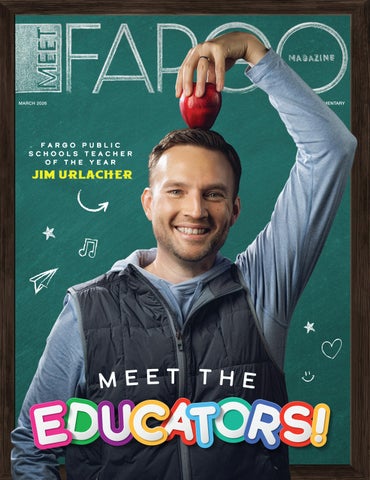
n any given morning at Discovery Middle School, Jim Urlacher stands at the front of a classroom filled with seventh and eighth graders—students who are equal parts confident and uncertain, bold and unsure, trying on identities the way other people try on jackets.
He wouldn’t have it any other way.
“People say, ‘Oh, you’re a middle school teacher—bless you,’” Urlacher said. “And I always say, ‘Well, what do you teach?’ If they say elementary or high school, I bless them right back.”
He means it.
For 21 years, Urlacher has built his career in that in-between space—where kids aren’t little anymore but aren’t quite adults either. It’s messy. It’s emotional. It’s unpredictable. It’s also, in his words, one of the most important seasons of a person’s life.
And this year, Fargo Public Schools named him Teacher of the Year.
He was surprised. Emotional. Grateful.
Fargo Public Schools Teacher of the Year Jim Urlacher is All About Curiosity, Culture, and Second Chances
Photography
From a Farm Near New England,
Urlacher didn’t grow up imagining he’d one day be leading students through Spanish verb conjugations or hiking the Inca Trail with fellow teachers.
He grew up on a farm 20 miles outside New England, ND. His graduating high school class had 26 students.
Travel wasn’t something he thought about.
“It just wasn’t an option,” he said. “Growing up where I did, you don’t necessarily think about seeing the world.”
But he did think about language.
In high school, he took Spanish levels one and two. By senior year, he asked his superintendent if they could offer level three. The answer was that offering another class meant paying another salary, and that wasn’t feasible.
So he stopped—temporarily.
At NDSU, he started as a political science major. But Spanish stayed with him.
“I thought, why would I stop learning something I enjoy?” he said.
He shifted to Spanish education with an English minor. Then came the turning point: a six-week study abroad program in Peru.
He lived with a host family. Studied intensively—two hours each morning with one teacher, two hours each afternoon with another. Immersed himself completely.
And something clicked.
Dr. Paul Homan, then chair of the department at NDSU, strongly encouraged study abroad. Urlacher was working full-time and couldn’t leave for a full semester, so he found a six-week option. Homan approved it.
That decision changed everything.
His host sister was four years old at the time. His host brother was nine. Today, they’re adults. His host sister now lives in Germany—and he visits her there. He’s returned to Peru six times. He’s taken groups of teachers to hike the Inca Trail to Machu Picchu—twice.
“Growing up on a farm, I never would’ve thought I’d one day be leading people to Peru,” he said. “But that one experience opened the world.”
Teaching Beyond the
Travel reshaped how Urlacher sees the world, and how he teaches.
“When you speak another language, you learn how to communicate—even when you don’t have the words,” he said. “It gives you confidence.”
That confidence extends beyond vocabulary. It’s cultural awareness.
He tells his students about the concept of the “Ugly American”—the loud tourist who assumes everyone should speak English.
“When you go somewhere, you’re entering their culture,” he said. “You adapt. Not the other way around.”
He encourages assimilation, respect, curiosity. Free walking tours led by locals. Learning basic phrases. Observing before speaking.
teacher of the year 2025
Why Middle School
Ask Urlacher what he loves most about teaching, and he'll tell you.
“Every day is new,” he said. “And even if a student—or I—have a bad day, the next day is a clean slate.”
Middle schoolers, he explains, are trying to figure out where they fit. Sometimes they perform for peers. Sometimes they push boundaries. Sometimes they act nothing like the kid you meet one-on-one.
“I think when you sit down with a student individually, you often see a completely different person,” he said.
His job isn’t just to teach Spanish. It’s to help them discover themselves. He suggests clubs. Connects students with other teachers.
Listens more than he talks.
“Often, they just need someone to listen,” he said. “If they’re comfortable with you, they’ll share. Then you can advocate for them.”
He exposes them to options. Lets them experiment. Encourages exploration over perfection. If they continue in Spanish, great. If not, that’s okay too.
“What matters is, did I teach them how to be a better student? A better person? Did I help them take advantage of opportunities?”
People Don’t Always See
Teacher of the Year awards are often framed around what happens in the classroom—lesson plans, relationships, the daily rhythm of teaching.
But Urlacher’s impact is also built in the spaces outside the bell schedule: committees, curriculum work, community nights, and the slowand-steady labor of trying to make a school system better than it was yesterday.
When he found out he’d been named Fargo Public Schools Teacher of the Year, he said his first reaction wasn’t pride so much as disbelief.
“I was very surprised,” he said. “Very emotional.”
In his mind, the award reflects years of teamwork—people pulling together, trusting each other, building something that lasts.
He points first to Discovery Middle School, where he’s spent the bulk of his 21-year career.
“We all support one another,” he said. “A lot of us have worked there for the past 20 years. It’s become a family. You take care of each other.”
“It’s Easy to Complain. Be Part of the “
Over the last decade-plus, Urlacher has served on the district negotiations team, helping negotiate the teachers’ contract. He’s worked with district leaders on Spanish and world language curriculum. He’s served on more committees than he can count— building level, district level—where the work is slow, collaborative, and sometimes invisible to anyone outside the room.
His philosophy is to not just identify problems. Instead, bring something forward.
“My goal is to always approach a problem by coming up with a potential solution ahead of time,” he said. “It’s really easy in the world to complain about anything and everything. But if you’re not willing to be part of the solution, it’s difficult to give yourself air time.”.
And he’s the type, he admits, who tends to raise his hand early when something new is being piloted.
“If you bring me a new concept and you’re like, ‘Hey, we want to try this out,’ I’ll be one of the first people to want to try it,” he said. “If it’s eventually going to become something, I’d rather be in the know.”
Bringing the World Into the
Urlacher’s classroom is rooted in language, culture, and curiosity, but he’s also tried to build school-wide experiences that invite families and the community into that same spirit.
Years ago, when Discovery’s principal was Mrs. Herrick, Urlacher helped start an International Arts Night— bringing community members into the school to perform, create art with students, and share food.
They also ran an international club, specifically to engage students who might not normally plug into school activities.
They’ve done family fun nights. He invites parent volunteers into the building for his end-of-year “Fiesta” around Cinco de Mayo.
The Teacher, the Traveler, the
If you want to understand Jim Urlacher fully, you have to step outside his classroom.
Because for him, teaching isn’t confined to four walls.
It shows up in a kitchen and on a mountain trail in Peru.
Urlacher lights up when he talks about food.
“Half of traveling for me is eating,” he said.
He studies restaurant menus the way
some people study museum maps. He seeks out local spots. He pays attention to ingredients. Techniques. Flavor combinations.
Then he comes home and tries to recreate what he tasted.
In his Spanish classes, especially around Cinco de Mayo, he hosts a small end-of-year fiesta. Parents volunteer. Students see him in a different light.
“I’m not a FACS teacher,” he said, “but if I could teach something else, it might be the cooking part.”
What Travel Really
Urlacher has been to Peru six times. Spain multiple times. Italy. Switzerland. Liechtenstein. Luxembourg. Denmark. Austria. France. The Netherlands. England. Germany. Canada.
He’s hiked the Inca Trail twice. Visited Machu Picchu four times—twice by train, twice on foot.
He still calls Cusco magical.
“The world is such a huge place— you’ll never see all of it,” he saif. “But
even the small portion I’ve seen… people are so welcoming. You can learn so much from them.”
Sometimes he plans carefully. Other times, the best experiences come from wandering.
“Sometimes the best things are when you don’t plan something out,” he said. “You just stumble on something and think, ‘Oh my gosh, I never would have thought that.’”
Every Teacher Hopes For
Ask Urlacher about his favorite teaching moment, and he struggles— not because there aren’t any, but because there are too many.
But then he lands on something specific.
“The most satisfying thing,” he said, “is when a student who struggled in middle school—academically or socially—comes back and shares future successes.”
Sometimes they thank him.
Sometimes, they apologize for how they behaved.
Sometimes, they simply show up as proof that the messy middle-school years didn’t define them.
Three of his former seventh- and eighth-grade students are now teachers at Discovery.
“That made me feel old,” he said.
There’s a saying in education: It doesn’t matter what you teach; it matters how you make them feel.
If there’s one thread running through Urlacher’s life, it’s this: Every day is a fresh start.
Middle schoolers will test boundaries. Adults will disagree.
Systems will change. Travel plans will fall through. Students will struggle.
But tomorrow, you get another shot.
remove barriers so leaders can do their jobs more effectively, and to break down silos that slow
Continued>
One initiative Rick points to is the new Honors College launching next fall.
It will begin with 30 undergraduate students, selected through an application process, and grow to roughly 120 students by its fourth year.
“This is brand new,” he said.
The college centers on what he calls an “abundance mindset”— recognizing the volume of information and tools available today, and teaching students how to use them wisely and constructively.
It’s interdisciplinary. Open to students from any major.
But it’s not just academic acceleration.
It’s leadership development. Interpersonal skills. Character formation.
NDSU’s land-grant identity remains central to its mission.
Historically, that meant agriculture, and it still does. But the definition is expanding.
“Back when the land-grant mission started, most people worked in agriculture,” Rick said. “Now it’s about strengthening communities across the entire state.”
That includes business development, rural vitality, and workforce alignment.
“We don’t really have North Dakota without rural communities thriving,” he said.
LAND-GRANT, REIMAGINED NEW HORIZONS AND WORKFORCE ALIGNMENT
One of the initiatives tied to that expansion is New Horizons, funded during the last legislative session.
The program focuses on aligning academic offerings with industry needs, building degrees and programming in collaboration with employers.
“As new programs stand up, it takes time,” he said. “But now we’re seeing real progress.”
RESEARCH, FACILITIES, AND THE R1 IDENTITY
If the Honors College is about cultivating standout undergraduates, research is about reinforcing NDSU’s national footprint.
As a land-grant and R1 university—the highest classification for research activity—NDSU ranks among the top 100 research universities in the country.
“People come here because they need to learn more about something,” Rick said.
Agricultural research has long been a strength—particularly in seed variety development and crop science—but he admits he’s been surprised by the breadth of research happening across disciplines.
“There are things happening here that people don’t even realize,” he said. “Every day there’s something impressive coming out.”
The opportunity, he believes, is connecting those discoveries to private-sector growth—helping businesses leverage research to innovate and expand.
Meanwhile, campus infrastructure reflects that growth.
• The Peltier Complex opened recently.
• The new Bolley Ag Lab is scheduled to open this summer.
• The Richard Offerdahl '65 Engineering Complex will open to students in August—dramatically expanding collaboration space and engineering capacity.
“You can see it on campus,” he said. “There’s always something new happening.”
THE MOUNTAIN WEST MOMENT
Then there’s athletics.
NDSU’s move to the Mountain West Conference has generated visible excitement, but Rick doesn't want people to miss the broader impact.
“What sometimes gets lost is how this affects faculty and students,” he said.
Universities that move up in athletic conferences often see increases in applications, expanded visibility, and stronger faculty recruitment.
ZACHARY LUCY
THE BEST JOB IN THE WORLD
For now, though, he’s focused on these four months.
“It’s probably the best job in the world right now,” he said.
He spoke about campus leadership with admiration—strong teams, trusted leaders, a culture of support.
And he’s energized by the full continuum of education in FargoMoorhead—from K–12 to higher ed—shaping students who will shape businesses.
In a building that feels like a medieval castle, the focus isn’t on stone or legacy.
It’s on continuity.
Momentum.
And making sure that when the next chapter begins, NDSU is
PRESIDENT IRVINE
LOWERING TEMPERATURE
Lowering the Temperature the AI Temperature
No conversation about higher education today avoids artificial intelligence.
At Concordia, it’s not being ignored. It’s being
Last fall, the college held a campus-wide symposium focused entirely on AI. The goal wasn’t panic. It wasn’t prohibition.
“We’re working toward embedding AI as a learning outcome,” Irvine said. “Not as a separate skill, but as part of how students learn and solve
Still, he’s candid about the anxiety surrounding it.
Six months ago, many high schools and colleges were locked in what he calls a “gotcha game”— trying to catch students misusing AI tools.
“The fear was, ‘How do we make sure students
But Irvine wants to move beyond that posture.
“There’s real anxiety, especially among writing instructors,” he said. “AI can produce coherent,
Instead of spending 30 minutes grading a paper alone, what if professors used AI to assist with surface-level analysis, and then used that saved time to sit with students, face-toface, discussing how their thinking is evolving?
“Getting on a treadmill is optional. You don’t have to. But you do it because you know it’s good for you.” In the same way, he said, assignments must evolve. If a student chooses to use AI on an assignment they were asked not to, that’s not just a discipline issue, it’s a design issue.
“What was it about my assignment that didn’t motivate you?” he said a professor might ask. “Was it irrelevant? Did I not give you enough time?”
The presence of AI forces better questions. And perhaps better teaching.
“When we solve cancer and climate change with AI,” Irvine said, “then we can talk about dialing it back. Until then, let’s combine human creativity with these tools.”
About Concordia College
Concordia College in Moorhead, Minnesota, is a private liberal arts college known for its strong sense of community and commitment to academic excellence. Founded in 1891, Concordia offers a wide range of programs in the arts, sciences, and professional fields, encouraging students to think critically and lead with purpose. With a vibrant campus culture and global perspective, Concordia prepares students to make meaningful contributions in their careers and communities.
REAL WORK, REAL PARTNERSHIPS
Concordia’s evolution isn’t happening in isolation.
Irvine spoke enthusiastically about Fargo-Moorhead’s business community, and how unusually collaborative it is.
“I feel incredibly welcome here,” he said. “The borders between institutions are porous.”
Through organizations like Innovate 28, Concordia leaders sit at the table with business executives, nonprofit directors, and civic leaders. The goal isn’t branding. It’s partnership, and internships are the clearest example.
“How do we create internships that benefit the student — but also serve the company in real, tangible ways?” Irvine asks.
He wants Concordia students solving actual problems for local businesses. Analyzing real data sets. Working on active projects. Learning by doing.
Because if a student contributes meaningfully during their internship, the path to employment becomes clearer, and the region keeps talent.
And for companies Concordia isn’t just a place that sends graduates. It’s a thought partner.
“Bring us your problems,” Irvine said. “Bring us your projects. We’re in the business of solving problems.”
THE AFFORDABILITY QUESTION
For all the innovation, Irvine knows one perception still looms large: Private college equals unaffordable.
“That’s our biggest challenge,” he said. “Helping people understand they can afford this place, and they can succeed here.”
That's why the Concordia Promise exists.
Now in its third year, the program covers full tuition for students from North Dakota and Minnesota whose families earn under $90,000 annually, after federal and state grants are applied.
“It’s essentially free tuition for those families,” Irvine said.
And beyond that threshold, Concordia continues to layer scholarships to make attendance realistic.
“We are excellent,” he said. “But we are affordable. And we want everyone who wants to be here to be here. Students often think, ‘I couldn’t afford it,’ or ‘I couldn’t succeed there academically.’ And in 99% of cases, they’re wrong. I don’t think most people can even begin to imagine how great life can be until they come to a place like Concordia.”
30 PROGRAMS IN TWO YEARS
If the stereotype of liberal arts colleges is slow-moving and tradition-bound, Concordia is working hard to rewrite that narrative.
In the last two years alone, the college has launched 30 new academic programs and five new non-academic programs.
The new programs span everything from:
• Cybersecurity
• Human resources
• Project management
• Financial wealth management
• Exercise science
• Athletic training
• Sports management
• Emerging AI-focused curricula
On the student life side, innovation continues with:
• Women’s flag football
• Clay target shooting
• Expanded esports
• Drumline additions within the Cobber music ecosystem
“Our faculty has done an enormous amount of work,” Irvine said. “We’re offering what students are asking for.”
Program development isn’t guesswork. Concordia works with external data firms to analyze workforce trends, listens closely to prospective students, and stays in constant conversation with regional employers.
WHAT MAKES A COBBER THE WORK AHEAD
Ask Irvine what has surprised him most during his time at Concordia and his answer is, “The people.”
As a non-alum leading a college deeply rooted in tradition, he wasn’t sure what to expect.
“Every Cobber I meet is brilliant, authentic, and humble,” he said. “They’re genuinely surprised by their success.”
In an era where personal branding dominates, he sees Concordia graduates who quietly do meaningful work, and rarely make a spectacle of it.
“They’re hardworking. They’re kind. They’re capable. And they don’t necessarily realize how exceptional they are.”
Higher education is under scrutiny nationally. Demographics are shifting. AI is reshaping industries. Public trust in institutions fluctuates.
Concordia must continue proving its relevance— every year, every class, every graduate.
“We have to help people understand what’s possible here,” he said. “And we have to keep innovating.”
That means expanding programs. Strengthening industry ties. Lowering the temperature around AI. Designing assignments that motivate from within—not just reward with grades.
It also means inviting the broader community in.
“Come to campus,” Irvine said. “Come to the concerts. The athletic events. The lectures. Experience the energy.”
Whether you’re a prospective student, a business owner with a dataset that needs analysis, or an alum curious about what’s new—there’s an open door.
“Come understand what it means to be a Cobber,” he said. | CONCORDIACOLLEGE.EDU
MSUM PRESIDENT TIM DOWNS
“We’re not going to come up with the next algorithm for AI,” he said. “That’s not who we are. That’s the California Institute of Technology. That’s
MSUM’s lane is application. They are teaching people how to use the tools ethically, responsibly, and effectively—in the classroom, in careers, and
That starts with faculty. Downs said the university has a group of “faculty fellows” who’ve become deeply knowledgeable about AI as a learning tool, then taken those insights into their own classrooms, and now help other faculty figure out how to adapt. Because whether educators like it or not, students are already using AI.
“It’s not going away,” Downs said. “Students are already using it whether they tell you or not. Let’s help them use it appropriately.”
In our conversation, he compared AI to the early days of the internet that included panic, predictions of job loss, and the assumption that everything would be automated. In reality, it became a tool—powerful, imperfect, and dependent on the person using it.
You still need your brain.
“You look at it and go, ‘No, that’s not it,’” Downs said. “And you have to reframe the question.
Downs wants the university to serve as a regional resource—helping area businesses learn how to implement AI in ways that increase efficiency and strengthen operations.
He described speaking with a CEO at a local economic summit and asking them, “Do you use AI?”
The CEO said yes—barely—and mentioned one engineer trying to become the internal “expert.” Downs did what he naturally does, he connected people. He introduced the CEO to MSUM’s executive director of the Institute of Applied AI and pushed the relationship forward.
“He can help you, and then we can learn from you,” Downs told them. “And then we could use what you’re doing… in teaching our students how to run a business.”
This is an example of the two-way bridge the university is implementing where they're supporting industry, and where industry shapes the university’s understanding of what graduates actually need.
Minnesota State Moorhead's goal, Downs said, is not to be a distant institution tucked away behind closed doors. It’s to be a public asset— accessible, collaborative, and visible.
If you’ve driven past MSUM lately, you’ve seen the construction. Weld Hall, the university's oldest building, is undergoing a $23 million renovation. When it reopens, it won’t just be updated. It will be reimagined.
A 400-seat auditorium. Space for lectures. Performances. Recitals. Public conversations. Thought exchange.
And Downs wants the community inside.
“If it’s a senior recital and your favorite instrument is piano or oboe, just come,” he said. “The door will be open.”
Downs sees universities as places of ideas. Not partisan spaces. Not ideological echo chambers. But venues where people can gather, listen, debate, explore, and learn.
“We stay apolitical,” he said. “But we can host people who have an idea.”
He wants Minnesota State Moorhead to be a magnet. A catalyst. A place where businesses come for workshops,
THE QUESTION EVERYONE IS ASKING
Of course, there’s a larger tension looming over all of this: the national debate about higher education itself.
Is college worth it?
“There’s a big debate out there right now,” he said. “Should you even go to college? I don’t have a one-size-fits-all answer.”
Instead, he frames it differently.
Every person is an “N-of-1” A case of one. A unique trajectory. He talks about failing first grade because he couldn’t read— dyslexic, cross-eyed, and in what schools then called the “turtle group.” Three surgeries later, he could read. He regrouped. He moved forward. That early struggle shaped how he sees students now.
“There’s no linear model,” he said. “There’s no cookie-cutter path.”
Some students aren’t ready for college at 18. Some go into the military. Some work. For some, a gap year turns into a gap decade.
Others go to college immediately and treat it like a four-year party, accumulating debt without direction.
The real issue, Downs argued, isn’t whether college is universally necessary. It’s whether education is aligned with a person’s purpose and responsibility.
“We need welders. We need electricians. We need PhDs,” he said. “We need all of it.”
What he pushes back against is the growing sentiment that no one should go to college.
“That’s wrong,” he said.
In his view, education—whether trade, technical, undergraduate, or doctoral—is fundamentally about human development. Critical thinking. Self-sufficiency. The ability to ask, “Wait a minute. Can we talk about that before we move forward?”
KEEPING TALENT HERE
If education is about development, it’s also about geography.
Downs is acutely aware of what happens when talented students leave the region.
“When you go away, you usually stay away,” he said.
That insight is driving one of MSUM’s most significant initiatives, the Moorhead Scholars program.
Previously, about 40 to 45 students per year from Moorhead High School enrolled at MSUM. This year? 141.
The program operates on a “last-dollar” model. Students apply their financial aid. Whatever remains on the table, Minnesota State Moorhead covers.
The goal isn’t simply access. It’s retention.
“These are talented students,” Downs said. “3.5, 3.7 GPAs. And they were leaving.”
To the Twin Cities. To Denver. Elsewhere.
BUILDING THE THINKERS
If the Moorhead Scholars program is about access and retention, MSUM’s new Honors College is about igniting a fire.
This fall, the university will formally launch its Honors College—expanding what had been a roughly 50-student honors program into a more robust, intentional cohort of around 100 students per year.
But this isn’t just about higher GPAs. It’s about intellectual energy.
“These are the students who raise their hand,” Downs said. “The ones who’ve read the material and are ready to talk.”
The Honors College will be housed in Weld Hall after renovation, with dedicated seminar rooms and collaborative space, as well as an Honors Housing Community. Downs envisions it as something close to a think tank—a place where highly motivated students from different disciplines collide.
He tells the story of a prospective student who wants to be an ornithologist.
“She said, ‘I love birds,’” Downs recalled. “So I told her, we have a regional science center with acres of natural habitat. You could catalog every bird species out there. Study behavior. Publish research. Present at conferences.”
THE LARGER BET
At its core, Downs’ vision for Minnesota State Moorhead is neither flashy nor reactionary.
It’s steady. Strategic. Rooted in the belief that education—when done right—is a regional asset.
“We’re in the human development business,” he said. “And all humans are different.”
In a cultural moment where higher education is questioned, politicized, and sometimes dismissed outright, Downs’ defense is not defensive. It’s practical.
We need people who can think.
We need people who can weld.
We need people who can build businesses.
We need people who can analyze AI output and say, “That’s not it. Let’s reframe the question.”
And we need places that help them do it.
MSUM, in Downs’ mind, is a connector, a catalyst, and a regional partner.
And the university is not waiting for “someday.”
It’s doing the work now.
The Importance of
RELATIONSHIPS
M STATE PRESIDENT CARRIE BRIMHALL IS NAVIGATING CHANGE AND BELIEVES RELATIONSHIPS STILL MATTER MOST
By Brady Drake
Photos provided by M State
igher education right now feels like a constant pivot.
Add a program. Cut a program. Expand healthcare. Explore AI. Strengthen the food pantry. Respond to state budget shifts. Serve more complex student needs than ever before.
“The pace with which we’re trying to change,” Carrie said, “some might say it’s not sustainable. But it’s also our reality.”
Students’ lives are more layered than they were even five years ago. Financial pressure is higher. Mental health challenges are more visible. Technology is accelerating. And institutions are being asked to adapt in real time. So the question becomes: how do you sustain energy for the long haul?
For M State President Carrie Brimhall it's about returning to relationships.
THE REAL WORK HAPPENS IN HALLWAYS
“You can’t get caught up in the craziness of all of it,” she said. “You have to focus on relationships.”
It might be a hallway conversation with a student who doesn’t believe they’re capable. It might be a check-in after a rough exam. It might be reminding someone, again, that they are more than the mistake they just made.
“That’s where we achieve our mission,” she said. “In those moments.”
AI, ANXIETY, AND THE VALUE OF LEARNING
One of the most visible changes right now is artificial intelligence.
Some faculty are excited. Some are wary. Some are deeply anxious.
“What does this mean for critical thinking?” Carrie said. “What does it mean for our ability to disagree and still have meaningful conversations?”
It’s not just about whether students use AI to complete assignments. It’s about a deeper question: Is education about the answer? Or about the learning?
Technical colleges, she said, may feel this shift differently than traditional universities. A nurse will still take your blood pressure. An electrician will still fix your wiring. A plumber will still show up when the pipes freeze.
Those jobs can be enhanced by technology, but not replaced by it.
And that’s reflected in enrollment trends.
Healthcare and trades are growing rapidly. Business and IT? A bit less certain.
“If you get a nursing degree, you know what you’re going to do,” she said. “You know what you’re going to make. There’s certainty.”
Right now, students are drawn to certainty.
Still, the larger lesson isn’t about resisting technology.
It’s about balance.
“How do we show up as real human beings who care about our communities,” she said, “even when we disagree?”
You can’t outsource humanity.
WHY HEALTHCARE AND TRADES ARE BOOMING
At M State, about one in three students is in healthcare or headed there.
The Moorhead campus includes a full simulation hospital environment, where students train in spaces that look and feel like the real thing before stepping into actual hospitals.
At the same time, construction trades are surging:
• Plumbing
• Electrical
• HVAC
• Automotive and engine repair
“These are guaranteed jobs,” Carrie said. “They can’t be replaced.”
Expanding these programs isn’t cheap. The equipment
MEETING STUDENTS WHERE THEY ARE
M State’s student body doesn’t fit one mold.
There’s diversity in age, background, ethnicity, identity, life experience—even in the number of previous institutions attended.
Carrie sees that as a strength.
“Our learning environment represents the communities we live in and serve,” she said.
She’s especially drawn to students who don’t come with tidy narratives.
The ones who are a little feisty. The ones who have made mistakes. The ones who keep coming back.
“Through the years, I’ve seen enough of those students surprise the heck out of everybody,” she said.
WORKFORCE DEVELOPMENT AND PIVOTING FAST
The college is constantly evaluating new workforce needs.
Drone training. Air traffic control simulation. EV technician programs.
Not everything pans out. But ideas surface weekly, often driven by local employers who see emerging needs.
“There’s a whole process to determine if something’s really there,” she said. “But we pivot quickly.”
The academic team is currently exploring nearly 20 potential new programs over the next 18 months.
ADVICE FOR PARENTS
If you’re raising a third grader right now, the job market they’ll enter doesn’t even exist yet.
So what matters?
“Start saving something—even five dollars a month,” she said. “Give them options.”
“Resilience is a skill set,” she said. “Love them through the hard. Don’t take it away from them.”
Because the future, despite the noise, still holds enormous possibility.
EIGHT AND A HALF YEARS IN
The national average tenure for a college president is under five years.
Carrie is eight and a half years into her role, and still believes deeply in the work.
“Our students deserve to be part of the story,” she said. “When people think of college, they often picture the traditional university experience. Our students are just as worthy of being talked about.”
& r T a i n i n g
C e r t i f i c a t e s
CONCORDIA COLLEGE
NDSU
MSUM
BANK MANAGEMENT CERTIFICATE
Minnesota State Moorhead’s Bank Management Certificate, offered through the Paseka School of Business, provides focused preparation for students and professionals interested in careers in banking. Built from finance major coursework, the program strengthens understanding of financial markets, investment principles, and the operational structure of banking institutions. The certificate is designed both for business students exploring banking as a career path and for professionals already working in the field who want to formalize and expand their expertise. By combining academic rigor with practical financial knowledge, the program positions graduates for growth within commercial and community banking environments.
BOOK ILLUSTRATION CERTIFICATE
The School of Art’s Certificate in Book Illustration is an interdisciplinary program designed for students who want to write, illustrate, and publish books. The curriculum emphasizes the integration of visual storytelling, narrative structure, and page layout, preparing students to think holistically about how words and images work together. Students develop illustration skills across a range of media while exploring multicultural approaches to visual and written narratives. The program is well-suited for aspiring children’s book illustrators, graphic novelists, and visual storytellers seeking both creative and technical refinement.
CHEMISTRY PRE-PROFESSIONAL CERTIFICATE
The Chemistry Pre-Professional Certificate bundles foundational chemistry coursework commonly required for admission to pre-medical, pre-dental, pre-chiropractic, and related professional programs. Delivered in an online format, the program offers flexibility while maintaining the rigor expected in laboratory sciences. Designed to streamline preparation for graduate health programs, the certificate ensures students complete the core lecture and lab requirements necessary for competitive applications. It provides a structured pathway for students strengthening their academic credentials in preparation for professional school.
CORPORATE FINANCIAL MANAGEMENT CERTIFICATE
The Corporate Financial Management Certificate prepares students and working professionals for roles in corporate finance and investment strategy. Drawing from finance coursework within the Paseka School of Business, the program builds competency in financial analysis, capital budgeting, and strategic financial decision-making. Students gain a deeper understanding of corporate financial structures and the tools used to manage risk and maximize organizational value. The certificate supports career advancement for those pursuing leadership roles in financial management across industries.
DOING BUSINESS IN CHINA CERTIFICATE
In a business environment defined by rapid change, organizations need professionals who can lead transformation with intention and skill. The Graduate Certificate in Organizational Change Management prepares students to design, communicate, and implement change initiatives that reconfigure structures, processes, and technologies. Through focused study in change management and organizational restructuring—along with leadership or negotiation electives—students develop the strategic and interpersonal tools necessary to guide teams through transition. This program is well-suited for managers, consultants, and professionals tasked with driving organizational evolution.
ECONOMICS OF DATA SCIENCE CERTIFICATE
The Economics of Data Science Certificate equips students with foundational skills in collecting, analyzing, and interpreting economic data. Combining principles of microeconomics, macroeconomics, and global economic issues with upper-level elective coursework, the program emphasizes data-driven analysis and meaningful interpretation of results. Students develop the ability to translate complex datasets into actionable insights, strengthening their preparation for careers in policy analysis, research, finance, and business analytics.
ENTREPRENEURSHIP CERTIFICATE
The Entrepreneurship Certificate at MSUM emphasizes innovation, creativity, and the practical skills required to launch and sustain a venture. Students explore entrepreneurial finance, marketing, leadership, and organizational strategy, culminating in the development of a comprehensive business plan. The program examines both the challenges and rewards of entrepreneurship while encouraging critical analysis of the entrepreneur’s role in society. Graduates leave with a concrete plan and a deeper understanding of what it takes to transform an idea into a viable enterprise.
GEOGRAPHIC INFORMATION SCIENCE (GIS) CERTIFICATE
The GIS Certificate provides students with foundational competency in the theory, technology, and application of Geographic Information Science. Through hands-on experience with industry-standard software and GPS field techniques, students learn to analyze spatial data and create professional-quality maps. GIS skills are increasingly valuable across industries—from urban planning and transportation to agriculture and environmental management. By strengthening spatial thinking and data visualization capabilities, the certificate enhances decision-making and communication in data-driven organizations.
This online undergraduate certificate prepares students to improve healthcare delivery through leadership, strategic planning, and quality improvement methods. Coursework explores health policy, regulatory frameworks, patient safety tools, and systems-based approaches to reducing preventable errors. Students develop the skills needed to enhance care processes, minimize risk, and support better patient outcomes. The program is ideal for those seeking leadership roles in healthcare administration or clinical operations.
HUMAN RESOURCE GENERALIST CERTIFICATES
The Human Resource Generalist Certificate strengthens foundational knowledge in HR management while incorporating perspectives from communication, organizational behavior, and employment law. Designed for both business and non-business majors, the cross-disciplinary program prepares students to manage compensation, benefits, workplace safety, team development, and legal compliance. Graduates gain a well-rounded understanding of the policies and people-centered strategies that drive effective human resource management.
INVESTMENT MANAGEMENT CERTIFICATE
The Investment Management Certificate provides rigorous preparation in asset valuation, portfolio management, and derivatives markets. Students explore capital market theory, bond valuation, security analysis, and portfolio performance evaluation while applying models such as CAPM and Black-Scholes. The program builds the analytical skills required for careers in wealth management, institutional investing, and financial advisory roles. It is available to both students and professionals seeking advanced investment expertise.
JAZZ CERTIFICATE
The Jazz Certificate is designed for Music Education students who want specialized training in jazz performance and pedagogy. Coursework in improvisation, theory, arranging, and ensemble participation strengthens both technical skill and stylistic fluency. By deepening knowledge of jazz history, repertoire, and notation, the certificate prepares future educators to confidently lead jazz ensembles and incorporate jazz studies into secondary music programs.
MARINE AQUARIST CERTIFICATE
The Marine Aquarist Certificate offers hands-on experience in marine organism husbandry and ecosystem management through work at the MSUM Oceanarium. Students study aquatic biology, oceanography, and sustainability while gaining practical experience maintaining marine systems and educating the public about conservation. The program emphasizes understanding marine biodiversity, water chemistry, and the ecological impact of human activity. Graduates are equipped with both scientific knowledge and applied skills relevant to marine science and environmental stewardship.
MUSEUM & CULTURAL HERITAGE PROFESSIONS CERTIFICATE
The Museum and Cultural Heritage Professions Certificate introduces students to professional practices within museums, galleries, and cultural institutions. Coursework in art history, curatorial practice, internships, and cultural management develops both theoretical understanding and applied skills. Students gain familiarity with exhibition planning, collections management, and ethical considerations within the field. The program prepares graduates for careers in museums, archives, and cultural heritage organizations.
MUSIC TECHNOLOGY CERTIFICATE
The Music Technology Certificate equips Music Education students with the technical skills necessary to integrate audio production and digital tools into K–12 curricula. Students study copyright law, audio production, studio recording, and live sound reinforcement while gaining hands-on experience in production environments. The program strengthens both creative and technical proficiency, preparing future educators to incorporate modern music technology into contemporary classroom instruction.
PROFESSIONAL WRITING CERTIFICATE
The Professional Writing Certificate enhances communication skills for students and professionals across disciplines. Coursework in workplace writing, technical report writing, layout and typography, and business communications develops clarity, precision, and audience awareness. Students gain experience producing professional correspondence, proposals, reports, and digital content using current publishing technologies. The program prepares graduates to communicate effectively in corporate, nonprofit, and entrepreneurial settings.
SCIENTIFIC ILLUSTRATION CERTIFICATE
The Scientific Illustration Certificate bridges art and science through focused training in biological illustration. Students develop advanced drawing and digital illustration skills while studying organismal biology and related sciences. The program emphasizes accurate representation of plant and animal forms and the relationship between structure and function. Ideal for those considering graduate study in medical or scientific illustration, the certificate cultivates interdisciplinary expertise and technical precision.
SEQUENTIAL ART CERTIFICATE
The Sequential Art Certificate prepares students for careers in comics, animation, printmaking, and other narrative visual arts. Through coursework in drawing, design, creative writing, and illustration, students develop strong portfolio work and an understanding of visual storytelling structure. The interdisciplinary approach strengthens both artistic technique and narrative development, building a skill set aligned with contemporary creative industries.
WATER QUALITY SCIENCE CERTIFICATE
The Water Quality Science Certificate provides interdisciplinary scientific training for careers in waterrelated fields, including drinking water, wastewater, hydrology, and environmental management. Students study water chemistry, ecology, geology, and sustainability while developing analytical and fieldbased problem-solving skills. The program prepares graduates to evaluate complex environmental issues and communicate solutions within diverse societal and regulatory contexts.
WOMEN & SCIENCE CERTIFICATE
The Women & Science Certificate explores the intersection of gender and scientific inquiry. Through coursework in women’s studies and biology, students examine representation, equity, and inclusion within scientific disciplines while studying the biological and social dimensions of gender. The program fosters critical analysis of systemic barriers and encourages inclusive scientific practices, preparing graduates to advocate for equity in STEM fields.
M STATE
AMERICAN SIGN LANGUAGE AND DEAF STUDIES (CERTIFICATE – 9 CREDITS)
M State’s American Sign Language and Deaf Studies certificate is a short, focused introduction to ASL, Deaf culture, and Deaf community history. It’s built for students who want foundational language skills and cultural context—especially those headed into careers where they’ll work alongside Deaf individuals (note: it’s not an interpreter-prep program).
AMERICAN SIGN LANGUAGE STUDIES (CERTIFICATE – 18 CREDITS)
For a deeper, more skill-building route, M State’s ASL Studies certificate expands into multiple levels of ASL and Deaf culture, helping students build basic conversational ability and prepare for further education in deafness-related fields. It’s positioned as a stepping stone toward more advanced study (and eventual interpreter preparation elsewhere), while still remaining a standalone credential.
CHILD AND ADOLESCENT THERAPEUTIC BEHAVIORAL HEALTH (CERTIFICATE – 16 CREDITS)
This online certificate is designed for entry into the mental health workforce as a Mental Health Behavioral Aide II (MHBAII), with coursework centered on child/ adolescent development, abnormal psychology, and applied behavior analysis. It’s a practical credential aimed at supporting direct patient care under the supervision of licensed mental health professionals.
CORRECTIONAL OFFICER (CERTIFICATE – 24 CREDITS)
M State’s Correctional Officer certificate is built as preemployment education for people pursuing corrections (and it can also serve as continuing education for those already working in the field). The curriculum includes criminal justice foundations, report writing, and physical control tactics—training aligned with the realities of facility-based public safety work.
CYBERSECURITY (CERTIFICATE – 18 CREDITS)
M State’s Cybersecurity certificate focuses on building core, job-relevant skills for today’s security landscape—think foundational defensive concepts, practical tech fluency, and the kind of hands-on learning that helps students move into entry-level IT/ security pathways or stack the credential into longer programs.
DESIGN AND ENGINEERING TECHNOLOGY (CERTIFICATE – 30 CREDITS)
This certificate is geared toward students who want to work in engineering-adjacent roles—especially those involving technical drawing, documentation, and 2D/3D design software. It’s positioned as workforce preparation for industries that rely on accurate parts, assemblies, layouts, and construction/manufacturing documentation.
EARLY CHILDHOOD (CHILD CARE AND EDUCATION CERTIFICATE – 18 CREDITS)
M State’s Early Childhood certificate covers the essentials of working with children from birth through age 8, including child development, behavior guidance, curriculum/environment design, and family relationships. It’s a straightforward pathway for people entering early learning settings or building credentials while they work.
This certificate is designed for students who want the tools to start, run, or grow a small business— with coursework that typically centers on practical business fundamentals like planning, operations, and execution. It’s a good fit for aspiring owners, side-hustle builders, and people who want to add entrepreneurial literacy to another field.
ESTHETICIAN (CERTIFICATE – 24 CREDITS)
M State’s Esthetician certificate prepares students for professional skin-care practice, with training that blends the science (anatomy/dermatology/chemistry basics) and the hands-on salon skill set. The program is also framed around Minnesota licensure requirements, including the clinical hours and state exam pathway.
ADVANCED PRACTICE ESTHIOLOGY (CERTIFICATE – 20 CREDITS)
This program is specifically for already-licensed estheticians/cosmetologists who want to move into advanced services—covering techniques and technologies used in higher-level skin treatments. It’s also closely tied to Minnesota’s advanced practice licensure expectations.
EYELASH EXTENSION TECHNICIAN
(CERTIFICATE – 3 CREDITS)
A short, targeted credential for those seeking licensure to perform eyelash extensions, with training in safety, infection control, eye-area anatomy, and proper application/removal techniques. It’s built as a fast add-on credential—especially relevant for professionals already in beauty services.
GRAPHIC DESIGN (CERTIFICATE – 30 CREDITS)
M State’s Graphic Design certificate emphasizes the integration of digital tools and design fundamentals to create visual communication for print and online platforms—branding, layout, and other industry-facing deliverables. It’s aimed at students who want practical portfolio-building skills and job-ready production experience.
GLOBAL AND INTERCULTURAL STUDIES
(CERTIFICATE – 12 CREDITS)
This interdisciplinary certificate pulls from multiple subject areas to help students build a stronger “global lens”—including how regions interact through trade, institutions, and culture. It’s a flexible add-on credential for students who want broader context for careers that involve communication, communities, and cross-cultural work.
HUMAN RESOURCES (CERTIFICATE – 18 CREDITS)
M State’s Human Resources certificate is designed both for newcomers and professionals already in HR, covering core practices like talent acquisition, benefits administration, and HR management foundations. It’s also structured to stack into longer HR degrees, making it a clean “start here” option for the field.
MARINE,
MOTORCYCLE AND POWERSPORTS TECHNICIAN (CERTIFICATE – 30 CREDITS)
This hands-on technician certificate prepares students to maintain and repair equipment across the powersports industry—marine, ATV, snowmobile, motorcycle, and more. The program emphasizes modern diagnostic/service procedures and dealership-level readiness, with training aligned to real shop environments.
NAIL TECHNICIAN (CERTIFICATE – 14 CREDITS)
Designed for entry into professional nail services, this certificate focuses on the practical skills and required clinical preparation used in Minnesota licensure pathways. It’s a career-launch credential for salon work and related beauty service roles.
PHLEBOTOMY TECHNICIAN (CERTIFICATE – 16 CREDITS)
This one-semester certificate trains students for work drawing and processing blood specimens, then places them into a five-week daytime clinical experience at an affiliated site. Graduates are eligible to sit for the ASCP Board of Certification exam, making it a direct route into medical lab/healthcare employment.
SURVEY
TECHNICIAN (CERTIFICATE – 23 CREDITS)
M State’s Survey Technician certificate introduces civil engineering surveying, including equipment setup, surveying principles, and field training with tools like total stations and GPS. It’s geared toward construction, land/property surveying, and infrastructure work—and the program notes a planned relocation to the Fergus Falls campus effective fall 2025.
CONTINUED >
VISUAL ARTS (CERTIFICATE – 24 CREDITS)
This certificate is an introduction to art-making and art historical research, giving students room to explore mediums like drawing, painting, ceramics, and photography while also building stronger critical and contextual understanding of art. It’s a flexible credential for creative development, skill-building, and academic enrichment.
WORKFORCE DEVELOPMENT SOLUTIONS (NON-CREDIT TRAINING)
M State’s Workforce Development Solutions is the college’s hub for non-credit, skills-focused training— built for employers who want to upskill teams and for individuals looking to add job-ready credentials. Trainings are often customizable (on-site, virtual, or on campus), and many offerings are structured as short courses that end with a certificate of completion.
BUSINESS AND TECHNOLOGY TRAINING
This training track targets the practical digital skills that show up in almost every job: Microsoft Office, data management, digital communication, cloud collaboration, and workflow efficiency. It’s framed as customizable training for organizations that want anything from beginner basics to more advanced tools for analysis and process improvement.
LEADERSHIP DEVELOPMENT TRAINING
M State’s leadership training is positioned as professional development for both individuals and organizations—covering everything from foundational leadership to coaching and team-building strategies. The stated focus areas include communication, collaboration, emotional intelligence, and strategic thinking, with sessions available in person or virtually and tailored to an organization’s goals.
HEALTHCARE TRAINING
The healthcare training catalog is built around continuing education for working professionals (including areas like nursing, medical lab, surgical tech, dental hygiene, and more). M State notes some courses are approved by licensing agencies in Minnesota and North Dakota, and continuing education credits may be available depending on the course.
ELECTRICAL TRAINING
M State’s electrical training is geared toward industrial environments, with topics that range from electrical fundamentals to troubleshooting, motor controls, and PLCs. Their menu includes safety and compliance training like Lockout/Tagout and NFPA 70E electrical safety, along with arc flash training and licensure continuing education options.
FIRE AND EMS TRAINING
This category emphasizes hands-on, standards-based instruction for fire and EMS departments and partners. Offerings include emergency medical courses (CPR, First Aid, EMR/First Responder), industry training like HAZWOPER, and NFPA-aligned firefighter training content (including Firefighter I & II).
MECHANICAL AND TECHNICAL TRAINING
M State’s mechanical/technical training covers core industrial skill sets—machine operation, maintenance, power transmission, hydraulics, pneumatics, and automation. Their listed course topics include blueprint reading, bearings, CNC/CAM, fluid power, alignment, GD&T, and industrial automation/PLCs, with a mix of customizable in-person instruction and some online options.
COMMERCIAL DRIVER’S LICENSE (CDL) TRAINING
M State offers CDL training designed around current federal requirements, with pathways for Class A and Class B. The program blends self-paced online theory with behind-the-wheel range/road training and is offered at multiple campuses (Detroit Lakes, Moorhead, Wadena). They also note endorsement pathways (hazmat, school bus, passenger) and requirements like a learner’s permit and DOT medical card.
CANNABIS INDUSTRY TRAINING (ONLINE CERTIFICATES)
Under its Workforce Development umbrella, M State also promotes 100% online cannabis career certificate programs in specialized areas such as cultivation, product development, retail & sales, compliance, and medical cannabis—plus a shorter “associate” certificate covering industry fundamentals.
Meet The
MAKER
By Ashley Morken, Owner, Unglued
Lilibet Crafty Co.
Photos provided by Ashley Morken
I
t is SO INSPIRING to see someone locally creating a business from what they love doing—and a problem they can solve through it, especially in this crafty world! Bizzy of Lilibet Crafty Co. has been a creative force in the community and has been crafting up a fiber storm through this business she’s created, making useful and creative notions for fiber artists, patterns for cross stitch, and really fun apparel. When she’s not creating for her business, you’ll also find her teaching others to get creative themselves!
Tell us a bit about yourself. I'm from the Red River Valley. I've lived in Fargo-Moorhead since 2010. I have a husband, four kids, and a goldendoodle. I have a background in graphic design, but I spent the majority of the last 10 years as a stayat-home mom. When all my kids were enrolled in school, I knew it was time to get back into something creative that allows me to be around for my kids' sports and activities. My mom taught me to cross-stitch as a kid and gave me free rein of her sewing machine—skills I later used to make dozens of garments for my kids to wear when they were little. I've been knitting for nearly 16 years. I picked up crochet to finish blankets or other knit projects—but really had to learn all the things quickly when I substitute-taught arts and crafts at a high school.
Describe what type of products and work you do under Lilibet Crafty Co. Lilibet Crafty Co. handmakes notions for fiber artists: stitch markers, tools, and gauges. I design cross-stitch pattern kits, embroidered sweatshirts, craftinspired stickers, and prints, too. I've taught a couple of yarn craft classes at the Unglued Craftatorium, and I offer lessons on knitting, crochet, and sewing basics. Last summer, I taught eight kids basic sewing at my house— it was very exciting to witness kids' creativity explode after they learned the fundamentals of how a sewing machine works and fabric construction. I'm excited to create more of those opportunities to help kids (and adults) learn cool skills.
Tell us how you got started with your handcrafted business. What inspired you?
I lost one of my favorite stitch markers a couple of years ago, and the options to replace it were boring. I wanted stitch markers that represented my interests outside of crafting—no more sheep or balls of yarn. I wanted cherry skulls, Pink Pony Club, Down Bad, and cottagecore. I wanted bright, shiny colors and interesting shapes. My idea percolated for a long time while I figured out what materials to use and how to find a laser cutter to meet my needs. Once I got started, my ideas multiplied pretty quickly. I have a TBM (to-be-made) list that is a mile long. It's been really fun to have those ideas spill over into my other skill sets of sewing, embroidery, cross-stitch, and yarn crafting.
What was one of the most difficult pieces you've created so far?
The first set of stitch markers I worked on was probably the most difficult. I had a lot of design practice, too many ideas, and zero experience with laser cutting and engraving. My first set was overdesigned, with too many details, and I burned nearly every piece I put in the laser. It took me a month to whittle my designs down to something that made sense as tiny little charms and that cut cleanly every time.
What's your favorite piece?
I love all the little stitch markers— notions are one of my favorite parts of fiber crafts, especially when they are colorful and glittery. Strangely, I also really enjoyed designing my 3-in-1 tool that is a needle gauge, wraps-perinch gauge, and ruler all in one. It was tedious, and I made plenty of mistakes, but I enjoyed the precision crafting.
Where does your inspo come from for new pieces or notions for crafting?
Books, music, art, pop culture, and inside jokes. I love overlapping themes. I absolutely do want Life of a Showgirlthemed stitch markers on my WIP (work in progress), with my yarn cake twirling on a Y2K alien-themed yarn spinner. I have been crafting with an awesome bunch of creatives every Tuesday for nearly five years now, and a lot of my designs originated because they've said, "That needs to be a sticker!" I have a backlog of ideas that one day will be a T-shirt or a sticker, and most of them are inspired by the crafty group of humans that have kept me creating the last few years.
What has been the most challenging part of starting this handcrafted business?
I had the idea formulating for a long time before I figured out what medium I could best use. I looked into designing enamel charms and resin before finally deciding I wanted to try laser cutting so I could manufacture most of the items myself. Finding access to a laser that would cut all the clear acrylics I wanted was the first big hurdle I experienced. Eventually, I found a space where I could rent time on a CO2 laser and got started. The space also had an embroidery machine and a whole textile studio, so I've spent a lot of the last six months working there.
What has been the most rewarding part so far?
Dusting off old skills and developing new ones has been very rewarding. I never stopped making art over the 10-year career break I took to stay home with my kids, but it had been a while since I made digital art. It's been fun to apply those skills to something that's not so serious—I haven't really been driven by deadlines or print dates and have instead just been focused on what kind of design makes me happy or improves my craft experience.
What advice would you have given yourself five years ago?
Start! I get in my own way pretty often, obsessing about whether or not I'm doing something at the right time or if it will work out the way I want it to. I should have started creating my designs long before I worked out the logistics. I would tell myself to be bold enough to make mistakes. As a perfectionist, that's hard.
You have been teaching others to crochet—do you have any tips you can share for someone wanting to get started with crochet or knitting? What type of pieces tend to be the most helpful to start with?
Start with a project that feels exciting. You don't have to know all the basics before you begin something that will evolve into a perfectly functional and pretty finished product. If you start with swatches and learning all the stitches, you might burn out on learning before getting to the reward of finishing. It's a lot more productive to start with a project that inspires you to finish while also laying foundational skills.
If you want to knit for the first time, knitting hats is a great place to start. It introduces you to knitting in the round and foundational stitches that you'll use in every knit project. If you want to crochet for the first time, granny squares are fast and give an immediate reward but can get monotonous after your fourth or fifth one. I'd recommend starting with a deck of granny square cards, where you can learn dozens of different designs, or amigurumi (the Japanese art of yarn-stuffed figures) that give both the gratification of a finished project and the skill-building that keeps you engaged. Learning from other crafters is priceless. Take an Unglued class with another artist or me, find a stitching circle, ask your aunt to teach you. Nothing beats learning from artists who have spent years honing their craft. YouTube is also super helpful if you need to watch a specific stitch worked on repeat until you nail it.
Where can people find your work or connect with you?
For now, my products and lessons are available via DM on Instagram and Facebook or by email. Keep an eye out for me at future maker markets and classes at Unglued. You'll also be able to find me at the Fiber Arts Festival at the Fargodome, August 1–2. As a board member of the festival, I'm really excited about expanding our outreach and organizing a diverse group of artists to share multiple skills with the community.
Rising Dawn Ceramics is a community pottery studio founded by Kelsey Williams that offers memberships and classes open to the public. The space also functions as Kelsey’s personal studio for her own creative work. “It’s like a gym membership for pottery,” she explains.
Although Kelsey stepped away from the public school system to run her studio full-time, education remains at the center of her work. After seven years working in a high school, she found that teaching prepared her well for studio ownership. “A classroom is like the most busy, intense, chaotic studio you can run,” she says. “Now that I’m out of the school, running this studio feels like a breeze.”
Her experience gave her confidence teaching groups with a wide range of skill levels, and she frequently draws on classroom management strategies, solving how to meet people where they’re at and help them get where they want to go. Community-building is a core value for Kelsey, and both her former classroom and her current studio are intentionally designed as safe spaces for learners to try something new.
STUDIO FRESHLY
rowing up in the public school system, I was surrounded by reminders to stay curious, a message that stuck with me throughout my life. Encouraged by educators to explore ideas and think creatively, curiosity became a through line in my work as an artist, community member, and professional. That same curiosity guides my work at Folkways, where I work with a team dedicated to combating social isolation and loneliness through events like the Red River Market, Night Bazaar, and Christkindlmarkt.
Folkways champions big ideas and supports small business owners who are passionate about sharing their craft with the community. The Red River Market last season helped launch more than 25 small businesses, and vendors earned over $1 million in sales. This impact makes it possible for creatives to pursue their passions while sustaining a livelihood.
I have met many vendors who share their work at Folkways events, and many of them are educators or have backgrounds in education. Their creativity, adaptability, and curiosity extend far beyond the classroom and shape their artistic and entrepreneurial journeys. Educators are natural creatives. Every day they adapt, problemsolve, and spark curiosity in others. Teaching requires imagination, flexibility, and emotional awareness, and many educators carry those skills beyond the classroom into the arts, entrepreneurship, and community leadership.
Here are five local small business owners you can find at Folkways events who not only encourage curiosity in their students, but also pursue creative ventures of their own.
GROWARTISTRY
GrowArtistry, run by Devyn Baldwin, is all about creating magical, interactive experiences for kids and adults alike. Through pop-up art bars, art kits, and face painting, Devyn brings creativity into community spaces beyond the classroom. She jokes, “if it’s artsy, I probably do it.”
Now in her fifth year teaching elementary art, Devyn sees creativity as essential not only to artmaking, but to life itself. Her teaching goes beyond projects and techniques, and she enjoys getting to “teach important life skills.” Being active both within her school district and in the broader community strengthens her connection with students. When they see her at community events, “it makes them feel special and excited that their art teacher painted their face,” she says. “It strengthens that connection beyond the classroom.”
Devyn’s background in education helps her break projects into manageable steps and meet learners where they are. “Teaching has also helped me understand pacing, attention spans, and communication,” she mentions. Creating something can be challenging, and she finds joy in witnessing those “aha” moments. Through her work, she sees how the arts foster confidence, connection, and growth. Creativity, for Devyn, is about building trust in yourself and discovering what’s possible.
STUDIO FRESHLY
JENNY SUE
The local artist, Jenny Sue, draws inspiration from her North Dakota, Minnesota, and Scandinavian heritage. Her work celebrates nostalgia, place, and everyday joy through classic Midwest sayings and northern-inspired design. She creates magnets, ornaments, earrings, tiles, and functional pottery that feel both playful and deeply connected to her roots.
After years in education, Jenny made the leap to running her business full-time. “It was a big decision,” she shares, “but one that has allowed me to fully invest in building something meaningful and sustainable.” Her background as an educator continues to shape how she works, teaching her to build community, embrace diversity, and adapt under pressure.
You can find Jenny during the summers at the Red River Market, where she enjoys connecting with customers. Teaching prepared her to adapt quickly, stay calm under pressure, and keep moving forward even when things do not go perfectly, skills she sees as essential to entrepreneurship. For Jenny, both teaching and art require empathy, curiosity, and meeting people where they are. Building a business, much like building a classroom, means creating spaces where people feel welcomed, encouraged, and inspired.
STUDIO FRESHLY
START SMALL, STAY DISCIPLINED, AND SURROUND YOURSELF WITH COMMUNITY.
Kelsey encourages aspiring business owners to “try it out in small steps.” She balanced teaching and business ownership for four years before transitioning full-time. Running a business, she notes, “takes discipline to get your tasks done when you don’t have to report to anyone.” Finding community, especially among other small business owners downtown, has been one of the most rewarding parts of her journey.
TAKE RISKS AND FIND WHAT WORKS FOR YOU.
Creativity requires risk-taking, and Devyn recommends to other small business owners to lean into personal experimentation. She encourages learners of all ages to “find what works for you or put your own unique spin on it.” As she has trusted the process and explored new ideas, doors have opened in unexpected ways. “It takes a lot of time and effort,” she says, “and when you care about what you’re building, it won’t always feel like work.”
TRUST YOUR CREATIVITY, IT HAS VALUE.
Educators already have many of the skills needed to run a business: multitasking, planning, communication, and problemsolving. Jenny emphasizes focusing on what excites you and the problems you enjoy solving. Through experimentation and curiosity, creativity doesn’t have to remain a side hustle, it can become “a powerful way to build a life and a livelihood.”
USE CREATIVITY TO AVOID BURNOUT. Burnout is a common challenge for many educators, as teaching can feel like a constant, fast-
paced commitment. Jeff encourages educators and creatives alike to find a creative outlet as a way to step away from their day jobs. His advice for anyone starting a business is “to have a clear and reasonable picture of what you consider success.” He also encourages not putting pressure on yourself to be the biggest artist. Running a business requires setting achievable goals if you want to make a living from your work. Art comes with passion, and Jeff suggests using that energy to commit at least a couple of hours each week to the business side of your creative practice.
PROBLEM SOLVING CAN BE CREATIVE.
Being a creative, and spending time with children, was Katie's favorite part of teaching. She challenges herself daily to “turn any hum-drum activity into something joyous but with purpose,” she says. As a small business owner, she not only designs cookies, but also thinks creatively about every aspect of owning a business, such as how to get people in the door, how to handle larger orders, and how to navigate slower summer weekends. She encourages other business owners to also take a creative approach to problem-solving. For any younger entrepreneurs wanting to start out on their ideas, Katie strongly encourages learning financial management. You can be a great content creator or have beautiful products, but she says, “If you don’t know how to keep track of all your income and expenses and how to use those numbers, it will be infinitely harder to be sure you're successful in running your business.”
COPPER SUN CREATIONS
Focusing on wheel-thrown functional ceramics with unique textual elements, Jeff Bodwin, owner of Copper Sun Creations, is a chemistry professor who combines his interests in art and science. His approach to ceramics is experimental, and he is particularly interested in developing glazes that create texture in interesting or unpredictable ways. His functional and decorative pottery offers both visual intrigue and a tactile quality that invites touch.
Ceramics were originally an escape for Jeff, but he now sees a strong crossover between chemistry and creativity. As a chemistry and biochemistry professor at Minnesota State University Moorhead, his scientific background deeply informs his artistic process. “Being a chemist has influenced my creativity more than my creativity has influenced my chemistry,” he says, “but the lines between the two have definitely gotten fuzzier over time.” Jeff challenges the idea that science must be bound to rigid rules, inspiring his students that curiosity is the most important part of being a good chemist, a mindset that often leads to creative solutions.
Chemistry brings a unique set of skills that translate naturally into artmaking. Creating artwork is, in many ways, testing and experimenting to see what works. Jeff thinks of his ceramic creations as research and enjoys discussing his process with others. His background in chemistry helps him test materials in the lab, kitchen, or glaze-mixing room, and he is currently testing ceramic glaze stability under household conditions to see whether glazes leach metal ions when exposed to substances like coffee or water. As a creative and educator, Jeff is familiar with projects that do not work the first time, a lesson that has shaped his teaching style. “They both require persistence and a willingness to be wrong,” he shares. One of the best ways to improve when making a mistake, is to “analyze why it happened, and then jump right back in and try again.”
STUDIO FRESHLY
COOKIE KRUMS BAKERY
Katie Krumwiede, the creator behind Cookie Krums Bakery, chose a playful nod to her last name for her business. She specializes in stuffed cookies and decorated sugar cookies. Each stuffed cookie is “delightful, with each unique flavor having something different in the middle, depending on its flavor,” she says. In her West Fargo storefront she hosts cookie decorating classes and birthday parties, which are especially popular with children. You can also take a cookie decorating class from Katie at the following locations: Vista Center through Moorhead Community Ed, Unglued Maker Space, and various schools and daycares.
Her decade-long background in elementary education is evident in her business. In 2021, Katie made the leap to pursue her cookie bakery full-time, but mentions that, “once you’re a teacher, it never leaves you.” As a teacher she enjoyed being a leader of how her classroom ran, and those skills translated well to making responsible decisions and problem-solving for her business. “Both educators and small business owners are basically professional problem solvers,” she says.
The strategies she uses to teach her cookie decorating classes were first developed in the school setting. She still has the opportunity to interact with children. “I love diving deeper into decorating strategies in my step-by-step classes that are open to all ages,” she shares. Some of those strategies include problem-solving and community building, which were engrained in her in the classroom. Even though she sees many different people in her shop, she takes small moments to make connections, whether that is seeing regulars when she vends at the Red River Market or remembering someone’s favorite sweet treat. It’s especially special for Katie when she has returning customers for birthday cookies, and says “I get to play a small role and almost see the kids grow up as I make their 1st, 2nd, 3rd, etc. birthday cookies.” One of her goals for this coming year is to lean even more into community building by creating a safe gathering place for families to connect and by hosting more unique events, such as craft nights.
Curiosity may begin in the classroom, but as these educators demonstrate, it does not end there. The same creativity, resilience, and problem solving they bring to their students now fuels businesses that strengthen our local economy and deepen community connections. Whether shaping clay, mixing glazes, decorating cookies, or creating interactive art experiences, they continue to teach by modeling what it looks like to take a risk, follow a passion, and build something meaningful. At Folkways, we are proud to create spaces where these entrepreneurs can share their work and connect with the community. We invite you to join us at an upcoming event to meet these vendors, experience their creativity firsthand, and support the small businesses that help our community thrive.