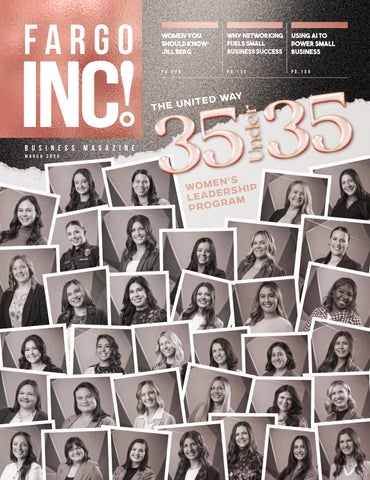
Fargo INC! March 2026

Page 1


PARTNER CONTENT

Are You Asking the Right Insurance Questions?

The Future of Everyday Healthcare Isn't a Waiting Room

Fabricators Unlimited Celebrating 40 Years

Three Tax-Smart IRA Strategies

Customer Service That Travels!

United Way of Cass-Clay's 35 Under 35 Women's Leadership Program

Women You Should Know: Jill Berg

Building Bridges: Why Networking Fuels Small Business Success

Using AI to Power Small Business

10 Questions with John Machacek: Shannon and Aaron Wiedman, Starbird Lounge

35 Under 35

fargoinc@spotlightmediafargo.com

Brady Drake, Fargo INC! Editor

Mike Dragosavich

Brady Drake Brady@SpotlightMediaFargo.com

Kim Cowles

Ty Betts

Jordan Woods (Ladyboss Lifestyle), Wendy Klug (SBA), Michael Danielson (VBOC), John Machacek

Kellen Feeney

Paul Hoefer Paul@SpotlightMediaFargo.com

Al Anderson Al@SpotlightMediaFargo.com

Spencer Hall Spencer@SpotlightMediaFargo.com

Matt Purpur Matt@SpotlightMediaFargo.com

ClientRelations@SpotlightMediaFargo.com

Jessica Ventzke

Tyler Duclos

Missy Roberts

John Stuber

CHECK OUT

SPOTLIGHT MEDIA'S OTHER PUBLICATIONS

We always hear that the people are what make the Fargo-Moorhead community great. So, why not meet them? Each month we cover a different topic led by local voices. We meet advocates, experts, and people just like you!

meetfargo.com /meetfargo @meetfargo @meetfargo

Growth Leaders is one of Spotlight's annual publications dedicated to showcasing our local companies and the services they bring to the Fargo-Moorhead area.

Bison Illustrated is your number one source for all of the behind-the-scenes action inside the North Dakota State University Athletic Department.

bisonillustrated.com /bisonillustrated @bisonmag @bisonillustrated

You may already be familiar with our Faces of Fargo-Moorhead-West Fargo publication which we publish once per year in order to highlight the faces behind all of the great businesses in the community.

Future Farmer is our farming publication which brings great tech-focused content to readers across North Dakota and Minnesota.

futurefarmermag.com /FutureFarmerMag

Are you in need of a new career? The Great Places to Work FargoMoorhead-West Fargo Annual Career Guide highlights amazing businesses in the area that provide great growth opportunities, benefits, and more!

PRECISION PLANNING: FROM IDEA, TO INCREDIBLE

he secret to a flawless event isn't just having the best gear. It’s the invisible architecture that supports it. As project managers, our day doesn't start when the lights go up; it starts the moment you have that first spark of an idea. Every great production begins with that initial "what if," and our first goal is to protect and enhance that vision. During a discovery call, we move beyond simple equipment lists and technology needs to find the "why" behind your event, ensuring our technical capabilities, team, and creative vision are perfectly aligned with the experience you want to create for your attendees.

Once the vision is set, we move into the reality of the event venue. If we are not already familiar with the selected event space, we conduct a site survey to check feasibility, walking the venue and meeting with stakeholders to turn conceptual ideas into a concrete "here’s how." This leads directly into the technical blueprint where we map out every signal flow and floor plan. Following this, we begin the heavy lift of pre-production logistics. This is where we handle the showflow, trucking, crew scheduling, rehearsals, content preparations, and timelines—the complex "invisible work" that allows you to focus on your guests while we manage the moving parts.

When the big day finally arrives, the transition from load-in to showtime

is where the magic happens. We’re known for our ability to transform an empty room into an intentional, elevated space for an event, but we never go in blind.

Through rigorous rehearsals, testing, and sound checks, we consider and iron out every potential variable so that when the first cue hits, it’s perfect. In live events, you only have one chance to make a first impression! Throughout the event, we handle all of the stressors, so you, the event planner, can enjoy and take pride in the event you have been dreaming of. Our team stays actively engaged, ensuring that the execution is as sharp as the initial plan we have cultivated planning together in the early stages.

Even after the final applause, our partnership isn't over. We love the post-event recap: sitting down with you and your team to look at the wins, the challenges, the data, and audience feedback to see exactly what clicked. This leads us into the bridge phase, where we take this year’s momentum, along with everything we learned, to start the blueprint for an even better future event!

At Livewire, we don’t just want to be your AV vendor; we want to make your life easier by being a true partner to you, your event, and your team. If you’re ready to move from a simple idea to something incredible, head to our website or pick up the phone – let’s start planning your next dream event.

2024 Plains Art Museum Gala
2024 Wine & Dine
Corn and Soybean Expo
UAS Summit

United Way of Cass-Clay's

35 Under 35

very year, United Way of Cass-Clay’s 35 Under 35 Women's Leadership Program shines a spotlight on the next generation of leaders who are shaping the future of our community. These women are deeply committed to service, impact, and collaborative problem-solving. This year’s class represents the broad spectrum of talent energizing Cass and Clay counties. These are the people building upward economic mobility, expanding opportunity, and strengthening the social fabric of the region through leadership that is bold, compassionate, and action-oriented.

For Fargo INC!, this yearly issue is a look into the leadership culture that fuels our business community. These are the professionals who lead teams, launch initiatives, and influence outcomes across sectors. They champion innovation in their workplaces, and they bring that same drive to tackle complex community challenges outside of them. Through our 35 Under 35 coverage, we celebrate not just what these leaders have achieved, but who they are becoming: collaborators, advocates, and catalysts for change in a region poised for growth and resilience.

Sandi Piatz

Meet the NEW United Way of Cass-Clay President and CEO

y the time Sandi Piatz walked into United Way of Cass-Clay as President and CEO, she had already been living the organization’s core belief: a community moves forward when people decide show up for one another.

“I’ve always been extremely active in the community, whether it’s been volunteering, serving on boards… I’ve always had a big passion for the community,” Piatz said. “Probably stemmed from ever since I grew up in a small town. I saw my parents serving… and so it’s always been an instilled kind of value of mine that it’s our responsibility to serve where we live.” That sense of responsibility is one part of the story. The other is her résumé—two decades across business, technology, and growth leadership, most recently as Chief Sales and Marketing Officer at Fargo-based OmniByte.

United Way’s board hired her to lead at a moment when community needs are growing, complicated, and intertwined—housing, hunger, child care, mental health, workforce barriers—and when “doing good” also has to mean measuring what works.

Piatz was named President and CEO on July 23, 2025, and began the role on August 25.

Why the United Way

“When this opportunity came along,” she said, “I looked at it as a great opportunity for me to partner my passion for community with my leadership and business experience, and bring those two together… in a greater capacity.”

United Way’s model also stood out because it’s not one nonprofit trying to do everything. It’s a convener and investor—an organization that raises money locally, then funds and supports the partners closest to the work. United Way of Cass-Clay says it invests in “over 40 local programs” and frames its mission as inspiring and activating the community to improve lives.

From Piatz’s perspective, the appeal is the scope—three “Bold Goals” that touch the realities we all see every day through employees, customers, and our neighbors:

• Prevent hunger and homelessness

• Prepare children to succeed

• Strengthen families

“All of those areas are really important in order for us to help support both children and families in providing upward economic mobility.”

In other words, you don’t build a stable workforce, a thriving economy, or a healthy region if families can’t find a safe place to live, can’t access child care, or can’t get help when mental health crises hit.

Listen First

Piatz stepped into a role that’s uniquely exposed. You’re both the new person and the person in charge. People are showing you the ropes—while also asking you where the organization is going.

"My first approach coming in was just to listen," she said "I was calling it a listening tour... meeting with people across the community—business leaders, nonprofit partners. The listening tour was to listen and learn where do we have opportunities and what does the community need from the United Way."

That listening tour showed her that trust is high, but understanding is uneven.

“One of the things that I learned is… there’s some people that know the United Way really well,” she said—how decisions get made, how data guides strategy, how investments align with outcomes. “And then there’s a lot of people… they trust the United Way… but they don’t really know what we do underneath.”

During the listening tour, Piatz also asked, 'what are the biggest challenges people see right now?' The answers came back consistently as hunger and homelessness, child care affordability and access, affordable housing, and mental health

Those themes align tightly with United Way’s stated priorities. They also validate what many employers already know, which is that a “workforce issue” and a “human services issue” are often the same issue, just described from different sides of the desk.

A Data-Driven United Way

Piatz credits the United Way team for groundwork already underway before she arrived:

Historically, many people picture the United Way as a broad annual fundraiser that disperses grants. Piatz explained today’s United Way has to be more precise than that—more like a portfolio manager focused on outcomes.

The organization’s updated approach, as she described it, creates a deliberate balance between urgent needs and longer-term solutions:

• One-year grant needs to help address immediate, short-term pressures

• Three-year, outcome-based granting to fund the deeper work of preventing the same crises from repeating

That structure is meant to prevent the organization from getting trapped in reaction mode while still acknowledging the reality that people need food, shelter, and support today.

It’s also built around a community-facing process that includes a Community Impact Review Panel made up of trained local volunteers who help evaluate nonprofit partners, their grant requests, and their financials.

“United

for ALICE”:

the working population too many systems overlook

One of the clearest examples of a data driven initiative working to meet a community mission is the United Way's launching of United for ALICE.

ALICE stands for Asset Limited, Income Constrained, Employed—a population that is above the federal poverty line but still cannot consistently afford the basics.

In Piatz’s words, United for ALICE is about “leveraging data to identify root-cause challenges or barriers… transportation… workforce… challenges… finding affordable and accessible child care child care for these families.”

United for ALICE is often the invisible middle. They're employees who show up, work hard, and still live one setback away from free fall. They may not qualify for certain supports. They may not look like a “statistic.” But they are everywhere in the day-to-day fabric of the local economy.

United for ALICE is also an attempt to get more precise— solving upstream barriers through “public advocacy or even programming,” as Piatz put it, because “where you can solve those issues is where you can continue to drive upward economic mobility.”

Ending Homelessness

If ALICE represents a new lens, United to End Homelessness represents continuity—work United Way continues to deepen and prioritize.

In the interview, Piatz also acknowledged what people working closest to homelessness have long said, which is that you cannot solve housing instability without dealing honestly with the “wraparound” needs. If you have met one person who is unhoused you have met one unique person with their own unique needs.

Her Leadership Style

“I like to start by listening, being curious,” she said. “I like to begin by listening and staying curious. I’m very collaborative, and servant leadership is a core focus for me... how I can best support the team, help them grow... when we invest in the growth of our people, that’s when we truly grow as an organization.”

When asked what’s fueled her own success, she talked about mentors and advocates—“leaders that have just been great advocates for me”—and then hard work like asking questions, staying persistent, solving problems even when direction isn’t obvious.

And when the conversation turned to focus—how leaders avoid being pulled in a thousand directions—her answer landed right in the tension every mission-driven organization faces: priorities and discipline.

“Prioritizing based upon what our goals and objectives are… it gives us an opportunity to say yes or no,” she said. “Staying true to our mission… so that we don’t get mission creep.”

A Message to the Business Community

Piatz was direct when asked what businesses can do this year:

"Partner with us...from an investment standpoint, from a volunteer standpoint... and if you have ideas on where we can partner to solve challenges, please reach out to us."

She also addressed a misconception she believes still floats around.

“One of the things that is maybe a misconception out there is that the United Way doesn’t need help,” she said. “Every year we fundraise in order to do the work that we do… and we need the community’s help… to understand and solve the problems.”

That message is especially poignant as United Way approaches a milestone. 2027 will mark its 100th year in the Fargo-Moorhead community.

MEET SANDI PIATZ

Brooke Zimmerman

Nurse Practitioner, Essentia Health

Q: Tell us about yourself.

A: My name is Brooke Zimmerman, and I work as a nurse practitioner specializing in Otolaryngology at Essentia Health in Fargo. With a passion for providing personalized care, I treat patients across the lifespan, addressing acute and chronic conditions relating to the ears, nose, and throat. I pride myself on meeting patients where they are and collaborating with the department to develop evidencebased treatment plans tailored to each individual’s needs.

My medical career began at North Dakota State University, where I earned my Bachelor of Science in Nursing. I then gained invaluable experience as a solid organ transplant nurse at the Mayo Clinic. Driven to advance my practice, I returned to NDSU to earn a Doctorate of Nursing Practice in 2022. Since then, I transitioned from a role as an emergency department nurse at Essentia to a specialized nurse practitioner, committed to delivering empathetic, highquality care to the Fargo-Moorhead community. My husband Matt and I, along with our daughter Maeve, call Fargo our home and love getting involved and enjoying all our town has to offer!

Q: What inspired you to get involved in your community at a young age?

A: Growing up in the small, tight-knit community of Grafton, ND, I learned early on that the strength of a community depends on the commitment of its members. I owe much of my inspiration to my parents, who served as primary examples of community and workplace leadership. Whether they were running the youth basketball program or heading church dinners, they taught me by example the importance of giving back and using one’s talents to serve others.

Throughout my school years, I made it a point to remain consistently involved, understanding that showing up is often what matters most. I believe that contributing in any capacity—no matter how small—helps a community remain robust and well-cared for. This foundational belief in the power of dedication and giving back continues to drive my desire to be involved in the community and throughout my work organization, as simply being present and giving of your time and abilities can make a larger difference than you may expect.

Q: Who has been the most influential mentor in your life, and why?

A: I owe nothing but gratitude to the remarkable village of mentors who have shaped me. I hold my parents in the

highest regard; they established the precedent for what it means to be a person of integrity, demonstrating a tireless work ethic and a devoted commitment to family and community. Their example is the cornerstone of my own values in both my personal and professional life.

Beyond my home, I wouldn't be the professional or individual I am today without the diverse group of coaches, professors, friends, and preceptors who have supported and encouraged me. Each one has played a vital role in my education and growth, offering guidance that has helped me navigate every stage of my journey with confidence.

Q: What does success look like to you right now?

A: To me, success is defined by a meaningful balance between my professional commitments and my personal life. It means finding the time and energy to achieve my personal goals while showing up as my best self for both my family at home and my patients.

Achieving this balance requires a disciplined routine, but just as importantly, it requires giving myself the grace to be fully present in whatever space I am currently in. I have come to realize that success is not a universal standard; it is unique to every individual and naturally evolves through different stages of life. Ultimately, I feel most successful when I feel content, knowing that I am providing quality care in the workplace while maintaining a fulfilling and present life at home.

Q: What community issue do you feel deserves more attention?

A: The child care shortage in our community significantly impacts the economic stability of families and the community at large. This crisis forces parents into difficult compromises regarding their family structure, their children's development, and their own career advancement. Addressing this shortage is not merely a family "concern" anymore; it is essential for the long-term well-being and resilience of our entire community.

Q: What’s something people might be surprised to learn about you?

A: People are often surprised to learn that I am a true introvert. While I am deeply passionate about my work as a healthcare provider and genuinely love connecting with others to learn about their unique stories and life experiences, I also find immense value in the quiet comfort of being at home with my family nearby.

This balance allows me to recharge and show up fully for my community.

On a more personal note, I enjoy family and childhood photography as a creative outlet and hope to make it into a little side gig in the years to come!

Q: What’s a lesson you’ve learned that you wish you had known earlier in your career?

A: Looking back, the most valuable lesson I've learned is that being "well-rounded" is just as important as being highly motivated. Early in my career, my fierce desire for achievement and high motivation to meet my goals were my primary drivers. I set my sights high starting in college, meticulously planning short- and long-term goals to reach my full potential.

However, I now realize that the most significant growth came from the moments I stepped outside my comfort zone. By making difficult decisions to challenge myself—whether through job shadowing or taking on various pre-professional roles—I gained a breadth of experience that I couldn't have achieved through a narrow focus alone. I wish I had known earlier that every diverse experience, even those that seemed outside my primary path, was building the foundation for the Nurse Practitioner I am today. Embracing that variety is what truly allows you to provide comprehensive, empathetic care.

Q: Where do you hope to make the biggest impact over the next five years?

A: Over the next five years, my primary goal is to make a lasting, positive difference in the lives of the youth in my life—from my own children, nieces, and nephews to the young patients I treat at Essentia Health. I believe that by being actively present and involved, we can cultivate the next generation of strong, self-assured leaders.

I want every child I interact with to understand their inherent worth and to develop the essential skills needed to achieve their own goals. As my family continues to grow, I hope to serve as a coach and mentor, both within my home and the broader community. For me, making an impact means showing up for our youth and providing them with the support and guidance they need to thrive.

Q: What's the best advice you’ve ever received?

A: One motto that has stuck with me through my young adulthood was a quote shared with my high school basketball team: "Hard work beats talent when talent doesn’t work hard." This resonated with me early on because I recognized that while I may not have always been the most naturally gifted person in the room, I could always be the most dedicated. This mindset shifted my focus from what I

lacked to what I could control—my effort. By leaning into hard work, I opened up opportunities to develop my skills further and reach my personal best, even when the path wasn’t the easiest. Whether in my athletic pursuits or my transition to becoming a Doctor of Nursing Practice, this philosophy has taught me that persistence and discipline are the ultimate equalizers in achieving success.

Q: Why is our local United Way important to you?

A: United Way is important to me because it mirrors the values I was raised with—that a strong community is built on the foundation of stable families and supported children. Organizations that uplift the family unit are essential, as they provide the resiliency needed for the next generation to thrive.

What I admire most about United Way is its comprehensive approach to these challenges. They don’t just address one issue; they focus on goals like preventing hunger and homelessness and preparing children to succeed from the start. By investing in local programs, they create a safety net that ensures every family, regardless of their circumstances, has the opportunity to reach their full potential. For me, supporting United Way is about more than just giving; it's about being part of a collective effort to ensure our community remains a respectable, hard-working, and devoted place for everyone to call home.

Q: What is a hope you have for our community?

A: I hope that we continue to foster a community that actively encourages and uplifts one another. I believe that every individual brings a unique set of talents and perspectives to the table, and it is vital that we provide opportunities for everyone to express, advocate for, and practice those gifts. By creating a safe, robust, and inclusive environment, we can ensure that every member of our community feels empowered to contribute to our collective growth.

When we lead with care and provide these supportive spaces, we not only help individuals thrive but also build a more vibrant and connected region for everyone.

Q: Finish this sentence: Lifting families out of poverty is important to me because ...

A: It allows everyone’s basic needs to be met, creating a foundation for greater resilience, family strength, and future success. When families are no longer in a state of crisis, they can shift their focus from daily survival to long-term goals.

Hailey Wilmer

Program Director, Red River Dance and Performing Co.

Q: Tell us about yourself.

A: I am the program director at Red River Dance. I wear many hats as the program director. From scheduling to teaching, choreographing, planning, hiring, and social media, I do it all! I love that my job allows me to enjoy so many different passions of mine. Every day is a little bit different, and I enjoy that so much. I also help our outreach program and created our Beyond Dance program, which provides free classes to dancers with special needs.

Q: What inspired you to get involved in your community at a young age?

A: I have always felt a tug at my heart to be involved and help people. My love of dance and the arts is mixed into this, and I am so grateful to pursue many of my passions. I love getting to see the positive impact dance and the arts have on so many members of our community. I have always looked up to many inspiring women in my life. Seeing them help others sparked that need in me as well.

Q: Who has been the most influential mentor in your life, and why?

A: My floral boss, Kelly, and my former boss at RRD, Haylee. Both women embody what I strive for every day. Kelly always pushed me to follow my heart and encouraged me in the best ways. Being a florist in college was my absolute favorite, and having her by my side to guide me helped me in so many ways. Haylee has always pushed me to see my potential and is always there for me when I need someone to give a little extra advice. She is now a close friend and I can't imagine not having her in my life.

Q: What does success look like to you right now?

A: Right now, it's about following my passions and doing things that fill my heart with joy. It's not about the money or title. At the end of the day, I want to feel like I made an impact and that I have helped others reach their potential. I love trying to improve who I am as a person in our community and how I can show up better for my staff and families. Being able to accomplish these things is the greatest success for me.

Q: What community issue do you feel deserves more attention?

A: With money being so tight for so many members of our community, I believe financial assistance is what deserves more attention. So many families have the burden of just

making ends meet every month. Being able to lift the burden for families so that their kids can just focus on being kids and enjoy things like dance that they normally wouldn't be able to participate in. The more families that we can impact with this, the better our community will be.

Q: What’s something people might be surprised to learn about you?

A: My bachelor's degree is in multimedia journalism with a minor in theater dance, and I have a publishing certificate from MSUM. I had no idea what I wanted to do after college. Several years after graduating, I finally found my career and haven't looked back since.

Q: What’s a lesson you’ve learned that you wish you had known earlier in your career?

A: Face your problems, issues, and disagreements head-on instead of letting them go. People are going to disagree with you or not like the decisions you make, and that's okay. Communicate with your people and ask for help when you need it!

Q: Where do you hope to make the biggest impact over the next five years?

A: Career-wise, I want to help our studio grow so that we can eventually find a bigger space that better serves our families and needs. I hope to get more funds for our scholarship program to offer our communities' kids opportunities to take dance classes for free or with assistance.

Q: What's the best advice you’ve ever received?

A: Everyone is fighting a battle you might not be able to see, be kind no matter what and look to see the best in people instead of the worst.

Q: Why is our local United Way important to you?

A: United Way continues to help bridge the gap of poverty in our community to help build a better society for all. They continue to put our community first striving to create a better place. They are invested in our leadership and education for the next generation.

Alli Ward

Economic Empowerment Manager, CAPLP - Lakes and Prairies Community Action

Q: Tell us about yourself.

A: In my professional world, I am an Economic Empowerment Manager at CAPLP - Lakes and Prairies Community Action. In this role, I oversee teams of amazing staff who provide coaching and case management services to customers in many different program areas that ultimately support individuals in working to achieve goals and end the cycle of generational poverty for themselves and their families. It is an honor to work for a community action agency and to be a part of the fight in the war on poverty each and every day. In my personal world, I am a proud mama to two wonderful daughters and one sweet dog. I have an amazing partner and the most incredible family and friends. I love staying active with hot yoga, soaking up summer days at the lake, and unwinding with a good book or cozy puzzle. Whether it is game nights, spontaneous adventures, or simple moments together, I value making meaningful memories with family and friends and finding happiness in the little things.

Q: What inspired you to get involved in your community at a young age?

A: My inspiration to serve my community began at a young age, rooted in the environment I was raised in. I grew up surrounded by family members who dedicated their lives to helping others, and I had the privilege of witnessing firsthand the compassion, work ethic, and selflessness they brought to others every day. Watching them care deeply for people— often in moments of vulnerability—left a lasting impression on me and shaped my understanding of what it truly means to serve. As I grew older, that early exposure evolved into a deep personal passion for bettering the lives of those around me in any way that I can. I believe that everyone deserves to be treated with the utmost dignity, respect, and opportunity, regardless of their circumstances. Giving back is not something I see as an obligation, but as a responsibility and a privilege. Being involved in my community allows me to live out those values and contribute to creating spaces where people feel supported, seen, and valued.

Q: Who has been the most influential mentor in your life, and why?

A: The most influential mentor in my life is my mom. She is the embodiment of hard work, resilience, strength, and courage. For nearly 30 years, she has consistently shown up in service of the community action movement, dedicating her life to supporting others and working tirelessly to create lasting, positive change in our community. Her commitment is not situational; it is genuinely deeply rooted in who she is and the values that she lives by every day. Throughout her life, she has faced incredible hardship and endured profound

loss, yet she has never allowed those experiences to define her in a limiting way. Instead, she has grown stronger, more compassionate, and more determined. She is truly the definition of resilience. She is someone who transforms adversity into purpose and continues moving forward with grace and genuineness. Watching her lead with empathy and remain steadfast in her mission has shaped my own values and inspired my passion for service.

Q: What does success look like to you right now?

A: Success to me right now looks like showing up every day fully present for my family, as a supportive, loving, calm, and joyful person. It means creating a home that feels safe, comforting, and peaceful, where my children feel deeply loved and supported, and where happiness is rooted in connection rather than perfection. Building our family on these values of love, stability, and emotional security is the foundation of what success truly means to me. At the same time, success also means continuing to grow and work hard as a professional within my community. I find purpose in serving others and contributing to positive change, and I want my daughters to witness that commitment firsthand. By doing meaningful work and living out these values daily, I hope to instill in them the importance of compassion, resilience, and service—teaching them not only through works, but through example. For me, success is truly built with intention, love, and impact, both at home and in the community.

Q: What's the best advice you’ve ever received?

A: You don't have to have it all figured out to take the next step. So often, we delay growth because we're waiting for clarity, confidence, or certainty that may only come after we begin what is next. This has helped me make very important strides in my life.

Q: Why is our local United Way important to you?

A: Our local United Way is important to me because I believe strong communities are built when individuals and families are supported, connected, and given access to the resources they need to thrive. United Way's commitment to addressing real, everyday challenges, whether related to housing stability, access to healthcare, education, or basic needs, aligns closely with my values and passion for helping others. I admire the way United Way brings people together, strengthens local partnerships, and creates meaningful and lasting change!

Toi Voss

Director of Accounting, Light Consulting

Q: Tell us about yourself.

A: I’m a proud mom to three amazing kids: Nixon (5), Vera (3), and Boone (1); and wife to my husband, Tyler. We live in Moorhead and truly value time together as a family, whether we’re outside enjoying fresh air, gathered around a board game, or relaxing at the lake and soaking up slower moments. Life is full and busy in the best way, and I wouldn’t have it any other way.

I’m originally from Mahnomen, MN, where I grew up on a farm. Some of my favorite childhood memories include helping my dad around the farm and learning to drive tractors and the combine; experiences that still make me smile (and occasionally surprise people). Growing up in a small town shaped who I am and gave me a deep appreciation for community, family, and showing up for one another.

Professionally, I’m the director of accounting at Light Consulting, where we focus on making business and life a little lighter for our clients through CFO services. I love partnering with business owners to bring clarity, confidence, and calm to their financial picture, helping them feel supported and informed as they make decisions. At the end of the day, I’m passionate about people just as much as numbers, and I enjoy being part of a team that truly cares about both.

Q: What inspired you to get involved in your community at a young age?

A: Growing up in a small town, getting involved in my community just felt natural; it was the way everyone around me showed care for each other. I loved joining sports teams, helping with school events, and volunteering whenever I could. I remember feeling proud when even small efforts, like pitching in at a local event, made a difference for others. Those experiences taught me how rewarding it is to work together, support your neighbors, and take pride in the place you call home. They inspired me to stay engaged, give back, and carry that sense of community with me wherever I go.

Q: Who has been the most influential mentor in your life, and why?

A: My parents have been the most influential mentors in my life. They led with love, always generous with hugs, affection, and encouragement, and created a home where support was felt every single day. They taught me the importance of caring for others, staying grounded, and showing up fully for the people and commitments in my life. Their constant presence, kindness, and belief in me shaped who I am and continue to influence how I approach both my personal life and my work.

Q: What does success look like to you right now?

A: Right now, success looks very different from what I once thought it would. I used to believe it meant a certain title, a nice house, or hitting all the milestones on a traditional timeline. What I’ve learned is that success is really about balance and being present. It’s knowing I showed up for the people I care about and stayed true to what matters most to me.

Success now feels like unhurried mornings, meaningful conversations, and ending the day with a sense of calm and contentment. It’s work that feels fulfilling, relationships that feel genuine, and making space for joy in the middle of everyday life. To me, success is the collection of small, ordinary moments that quietly come together to create a life that feels full and meaningful.

Q: What’s a lesson you’ve learned that you wish you had known earlier in your career?

A: One lesson I wish I had learned earlier in my career is the importance of asking for help and leaning on others. Early on, I felt like I needed to figure everything out on my own, and that sometimes slowed my growth or created unnecessary stress. Over time, I realized that reaching out, asking questions, and collaborating not only makes work more manageable but also opens the door to new perspectives and opportunities. Learning to embrace support and teamwork has made me more confident, effective, and ultimately happier in my work.

Q: Why is our local United Way important to you?

A: It brings people together in a way that’s thoughtful, practical, and truly impactful, often supporting needs most of us don’t even realize exist. I love how United Way makes it easy to be part of something bigger, connecting everyday people to meaningful ways to help right where we live. To me, it represents neighbors helping neighbors. It’s comforting to know there’s an organization quietly working behind the scenes to strengthen our community and lift people up, and I’m proud to support something that makes such a real difference so close to home.

Q: What is a quote you would frame on your desk?

A: “Feet on the ground, heart in the moment.”

Kelsey Tobkin

Director of Operations, MINT Brand Marketing

Q: Tell us about yourself.

A: Hi! I’m originally from Spicer, MN, and graduated from the University of South Dakota in 2017 with my Master’s in Business Administration. Soon after, I moved to Fargo and have lived here since! I’m the Director of Operations at MINT Brand Marketing. At MINT, I support our internal team by ensuring our operational processes run smoothly, from payroll and invoicing to day-to-day systems. My favorite part of my role is supporting both the business owner and our team, helping remove obstacles and providing clarity so everyone can do their best work.

My husband, Tanner, and I have two young boys, Decker and Tate, who keep us very busy! We spend a lot of time outdoors, exploring new parks, going to the lake, watching and playing sports, and just being together as a family. We value quality time with our family and friends who mean so much to us. Making sourdough and propagating plants are my new hobbies for 2026, so any tips and tricks are always welcome!

Q: What inspired you to get involved in your community at a young age?

A: Growing up in a small community, I was always drawn to opportunities that focused on helping kids. In high school, I was involved in a peer helper program where we volunteered at elementary schools and helped organize events for kids around holidays and special occasions. That early exposure showed me how much small acts of service can mean to families and children.

In college, that interest continued through my involvement in Dance Marathon, where we raised money to support children facing serious illnesses and their families. While the stories were often difficult to hear, it was incredibly meaningful to know that our time and effort were making a real impact.

Q: Who has been the most influential mentor in your life, and why?

A: The most influential mentor in my life has been Amanda Shilling, the owner of MINT. As her Director of Operations, she has challenged me more than any manager or leader I’ve ever had, in the best way. Amanda has a unique ability to see potential in people before they see it in themselves, and she’s consistently encouraged and coached me to step into roles and responsibilities I didn’t initially believe I was capable of.

Especially early in my role, she pushed me to do the work, take ownership, and trust myself, even when I felt unsure. Looking back, I realize that level of challenge paired with genuine support is what helped me grow the most.

Q: What does success look like to you right now?

A: Right now, success looks like being able to show up fully as both a mom and a professional. It’s about doing meaningful work, leading effectively, and supporting my team, while also being present at home and creating an environment where my kids feel comfortable asking questions, sharing their thoughts, and learning from mistakes.

It’s also about modeling what’s possible for those around me, showing that you can pursue professional goals and personal fulfillment without sacrificing one for the other. For me, success is fostering open relationships, creating resilience in my family, and creating a supportive atmosphere at work where people feel empowered to do their best, even if they don’t have all the answers.

Q: What community issue do you feel deserves more attention?

A: One community issue I believe deserves more attention is awareness around donation-based resources, places where people can give items, and where those in need can access them at no cost. Often, help already exists within our community, but people don’t always know where to donate, depending on what items are needed. Increasing visibility and education around these resources can make a meaningful difference and help ensure support reaches the people who need it.

Q: Why is our local United Way important to you?

A: The United Way plays such an important role in connecting people, resources, and organizations across our community. Growing up in a smaller town, opportunities and access were limited. Being part of a larger community like ours now, I’ve seen how powerful it is when there’s an organization focused on making sure kids and families have access to the resources they need to succeed. United Way works closely with local schools and agencies and has a strong pulse on the real needs of our community. What I appreciate most is that they act as an umbrella, supporting and funding multiple organizations across different focus areas. When it’s hard to know where to give or how to help, United Way makes it easier to have a meaningful impact.

Q: What is a quote you would frame on your desk?

A: "Live in the moment."

Megan Marschke

Senior Lead, Implementation Project Manager, WEX Health

Q: Tell us about yourself.

A: I am a Senior Lead Implementation Project Manager at WEX Health responsible for delivering complex, highstakes client implementations. I bring a project-driven, execution-focused approach to implementation strategy, translating client goals into structured plans with clear milestones, controlled scope, and measurable outcomes. I am known for building pragmatic project frameworks, anticipating risks early, and maintaining tight oversight of timelines, budgets, and dependencies to ensure predictable, high-quality launches.

I hold a Master’s degree in Healthcare Administration and a Bachelor’s degree in Healthcare Administration and Exercise Science, which provide a strong foundation in how benefits and spending account programs operate across diverse healthcare ecosystems. As a certified Project Management Professional (PMP), I apply disciplined, standards-based delivery practices, including work-back scheduling, stakeholder alignment, change and issue management, and proactive status communication.

Q: What does success look like to you right now?

A: For me professionally, success as a driven, competitive, and results-oriented project manager means delivering outcomes that are both measurable and meaningful. It starts with setting clear goals, building a disciplined plan, and executing with focus. With the priority of being on time, within scope, and aligned to business and client objectives while also building a relationship with my client. Hitting milestones matters, but true success goes beyond the project plan.

I measure success by how well my teams are aligned, risks are anticipated, and decisions are made proactively rather than reactively. A successful project is one where stakeholders feel confident, informed, and supported throughout the process, and where challenges are addressed with transparency and accountability.

I’m competitive in the sense that I constantly push myself and my teams to Raise The Bar (to learn from each project and deliver better outcomes than the last). Success also means leaving teams stronger than when the project started: with clear ownership, trust, and a shared sense of accomplishment. When a project launches smoothly, delivers value, and the team feels proud of how it was executed, that’s success to me.

Q: What’s something people might be surprised to learn about you?

A: One thing that often surprises people about me is how competitive I am and how deeply my passion for sports influences my approach to leadership and work. I’ve always been drawn to environments that challenge me to push limits, stay disciplined, and continuously improve and that’s why I love competing in CrossFit. It’s not just about physical strength; it’s about strategy, resilience, and mental toughness. If you are looking for a new gym, EHP Performance in Moorhead is where you need to go!

CrossFit and sports have taught me how to perform under pressure and stay focused on incremental progress. You don’t win every workout, but you show up consistently and compete against your own best performance! That mindset translates directly into how I lead projects and teams.

Q: What's the best advice you’ve ever received?

A: The best advice I’ve ever received is that hard work is the one thing you can always control. Talent, timing, and circumstances may vary, but consistent effort, preparation, and execution set you apart over time.

Q: Why is our local United Way important to you?

A: My local United Way is important to me because it creates meaningful, measurable impact at the community level. I value how United Way brings together businesses, nonprofits, and volunteers to address critical needs like health, education, and financial stability. Supporting United Way aligns with my belief that strong communities are built through collaboration and long-term solutions, not one-off efforts. Knowing that contributions and volunteer time directly support local programs and produce real outcomes for families and individuals - makes it especially meaningful to me.

Q: What is a hope you have for our community?

A: hope for the community to continue progress toward being healthier, more connected, and more resilient. I want to see strong collaboration between organizations, businesses, and local leaders to address root causes and not just symptoms. A successful community is one where people feel supported, opportunities are accessible, and outcomes are measured by long-term impact.

MOTIVATED. DEDICATED. RESPONSIBLE.

Cassie Stockinger

Sales Support Manager, Red River Commodities

Q: Tell us about yourself.

A: My name is Cassie Stockinger. I was raised near the FM area in Glyndon, MN, and later attended North Dakota State University, where I earned a Bachelor of Science in Marketing. I have been with Red River Commodities for over five years and am currently the sales support manager, leading a dedicated team to effectively support our business objectives. One of the most rewarding parts of my job is helping my team grow, both in confidence and in skill.

Outside of work, I love spending time with my friends and family, and you can find me planning a new trip, enjoying coffee, or spending time at the lakes. I recently married my wonderful husband, Riley, and together we have two dogs: Mia, a Golden Retriever, and Luna, an Australian Shepherd.

Q: Who has been the most influential mentor in your life, and why?

A: My most influential mentor is my HR Director at my current workplace, Jess Engel; she demonstrates the importance of active listening and constructive feedback. Her willingness to invest time in coaching me during challenging projects and management lessons has taught me patience and perseverance. Through her example, I learned how to approach setbacks as opportunities for growth and to celebrate small wins along the way. Her mentorship not only shaped my career trajectory but also helped me become more self-aware, empathetic, and understand how my interactions with others affect others. Without her influence, I would not approach challenges with the same optimism and strategic mindset that I do now.

Q: What community issue do you feel deserves more attention?

A: More affordable access to mental health services is a community issue I believe deserves more attention. Mental health affects every aspect of our lives- our relationships, productivity, physical health, and sense of belonging. Yet for many, support remains inaccessible for many due to high costs, long wait times, and limited local resources. There are many helpful resources out there, but too often people delay seeking help or avoid it entirely because therapy or counseling feels like a financial luxury rather than a basic need. Prioritizing affordable mental health care is an investment in prevention, resilience, and overall well-being. When people have timely access to support, communities become healthier, safer, and more connected. Everyone deserves the chance to heal, cope, and thrive, regardless of their income.

Q: What’s a lesson you’ve learned that you wish you had known earlier in your career?

A: One of the most impactful lessons I’ve learned is the importance of approaching situations with curiosity instead of assumptions. People come from diverse backgrounds, each shaped by their own experiences, challenges, and perspectives. These differences influence how we communicate, make decisions, and respond to situations.

By asking thoughtful questions and seeking to understand another person’s point of view, we create space for meaningful connection and understanding. This mindset shift has dramatically improved not only my communication but also my relationships, both professionally and personally. It’s a lesson I wish I had embraced earlier, because curiosity opens doors that assumptions often close.

Q: Why is our local United Way important to you?

A: The United Way is important to me because of its powerful community involvement. Through United Way, I’ve had the opportunity to work alongside people who genuinely care about making a difference and how they connect people, organizations, and resources to meet real needs in the community. I’ve seen firsthand how combined efforts can support families, strengthen education, or help individuals regain stability. Volunteering through United Way has opened my eyes to remind me that even small acts of service can make a lasting difference when they are a part of a larger mission.

Q: What is a hope you have for our community?

A: I hope that people feel connected, not isolated, in our community. It is essential that individuals recognize the significance of looking out for their neighbors. Joined efforts can lead to meaningful change, and we contribute to creating a more welcoming and belonging community for everyone.

Q: Finish this sentence: Lifting families out of poverty is important to me because ...

A: Supporting one another strengthens our community and helps us build a foundation where everyone has the chance to thrive. Through collective action, we can live in a community where everyone has access to opportunity, stability, and hope for a brighter future.

Morgan Siems

Doctor of Physical Therapy and Clinic Manager, Apex Physical Therapy & Wellness Center

Q: Tell us about yourself.

A: Hi! My name is Morgan Siems, and I am a physical therapist and clinic manager at Apex Physical Therapy & Wellness Center. I was born and raised in Aberdeen, SD, and later pursued my undergraduate degree at Concordia College in Moorhead, followed by my Doctorate in Physical Therapy at the University of Mary in Bismarck, North Dakota.

I am deeply passionate about my work and grateful for a career that allows me to positively impact the quality of life of others while building meaningful relationships within our community. Walking alongside patients during some of their most difficult moments is both fulfilling and challenging, and I am grateful for the opportunity to support them during this time. I strive to make a positive difference in their lives—big or small.

Outside of the clinic, I enjoy spending time with my close friends and family. This past year, I married my best friend, Brendon, and we are looking ahead to 2026 with excitement as we prepare to grow our family and continue building a life together.

Q: What inspired you to get involved in your community at a young age?

A: I’ve always had a deep desire to help others—it’s something intrinsic that I just can’t turn off. Growing up, I was fortunate to be surrounded by an environment that encouraged servant leadership and community involvement. Both of my parents were highly active in our church, school, and local community, and my education reinforced strong values, faith, and the importance of giving back. Being immersed in that kind of environment taught me by example—and through a sense of gratitude—the importance of serving others, a mindset I carry with me to this day.

Q: Who has been the most influential mentor in your life, and why?

A: I have been fortunate to have many incredible leaders in my life, but the person who has influenced me the most is my father. He was a quiet leader—a man of integrity, compassion, and selflessness. He taught me some of my greatest lessons, including one I hold particularly close to my heart: Teddy Roosevelt’s 1910 speech, “The Man in the Arena.”

MORGAN SIEMS

My father shared this quote to remind me that it is not the critic who counts, nor the one who points out how the strong stumble. True credit belongs to those who strive to do great deeds—who, at best, triumph, and at worst, fail, yet fail while daring greatly. This lesson has guided me through both challenges and triumphs, reminding me that it’s okay to fail. At least we tried. In life, all we can do is try—try to be better, try to help others, and try to make a meaningful impact.

Q: What does success look like to you right now?

A: My definition of success has changed a great deal over the years. It’s no longer about accolades or accomplishments—now, success is resting my head on the pillow knowing I lived today in a meaningful way. Success is knowing I acted with integrity, pure intentions, and selflessness. It’s telling my family and friends I love them, without expecting anything in return. Success is living life with intention and purpose—being fully present in every moment and making the time we have count. I love Brené Brown’s concept of sliding glass door moments, those small, everyday opportunities where we can make a profound impact on someone’s life. To me, success is recognizing those moments and valuing the difference we can make, no matter how small.

Q: What’s a lesson you’ve learned that you wish you had known earlier in your career?

A: I wish I had learned earlier in my career to depend more on others. As a leader, it’s easy to feel accountable for every operational and functional need of your team. While I was exposed to the concept of servant leadership throughout my education, I’ve come to realize that the best leaders don’t try to do everything themselves—they focus on helping others grow. True leadership means creating space for team members to develop skills, confidence, and independence. By doing tasks for others, we may unintentionally limit their growth and independence. As John C. Maxwell says, leaders “show the way” while empowering others to walk it on their own. I strive to foster a leadership style that serves others while giving them the opportunity to shine independently.

Q: Where do you hope to make the biggest impact over the next five years?

A: Over the next five years, I hope to make the biggest impact by ensuring that every person I interact with feels seen, heard, and valued. In healthcare, it’s easy for patients to feel overwhelmed or alone, and I want to change that by listening deeply, offering guidance, and creating an environment where they feel understood. My goal is to not only help people navigate their challenges but also to empower them to feel confident, supported, and hopeful throughout their journey.

Q: What's the best advice you’ve ever received?

A: I’ve learned that how we experience life—and failure— depends largely on our mindset. Our brains naturally look for confirmation of what we believe, so when I approach challenges seeking learning opportunities or focusing on the long-term lessons from each setback, I notice moments that reinforce growth, connection, and gratitude. In other words, I see what I choose to look for.

This perspective has helped me completely reframe failure. Sara Blakely, the founder of Spanx, has shared that her father would ask her each week what she had failed at—not to shame her, but to teach that true growth comes from taking risks, stepping outside your comfort zone, and learning from mistakes. I remember hearing this story and finding so much value in it. Mindset is key: failure isn’t merely a measure of shortcomings, but an opportunity for growth.

Q: Why is our local United Way important to you?

A: My local United Way is important to me because it embodies the power of community and collective impact. It’s a way to invest directly in the people and neighborhoods around me—to support programs that address real needs, build stronger connections, and create lasting change. Being involved reminds me that meaningful impact isn’t just about big gestures, but about showing up, collaborating, and lifting others in ways that truly matter to our community.

Q: What is a hope you have for our community?

A: I hope our community can be a place where every person feels seen, heard, and valued. A place where people experience genuine connection, support, and opportunity— whether in healthcare, education, or everyday life. I hope we continue to cultivate a culture of empathy, collaboration, and growth, empowering individuals to overcome challenges, embrace learning, and thrive together. Ultimately, I hope our community reflects the very best of what we can achieve when we invest in one another.

Q: Finish this sentence: Lifting families out of poverty is important to me because...

A: It creates the foundation for dignity, opportunity, and growth. When basic needs are met, families can focus on education, health, and personal development, which strengthens the entire community. I believe that everyone deserves to feel seen, supported, and empowered, and helping families rise above financial hardship allows them to build confidence, pursue their potential, and thrive alongside their neighbors.

Three Tax-Smart IRA Strategies

(left to right) Managing Partner
Mark Schiller CPA/ABV, CFP; Mikayla Cargile, CPA; and Jenna Kennedy, Client Service Associate

1: Converting to a Roth IRA

Converting a Traditional IRA to a Roth IRA can be a powerful long-term tax strategy. While the converted amount is taxable in the year of conversion, future qualified withdrawals from a Roth IRA are tax-free. Rather than executing a large, one-time conversion, implementing a multi-year Roth conversion strategy is often wise because it allows you to thoughtfully manage tax brackets, reduce the risk of Medicare premium surcharges, and create flexibility as tax laws and personal income levels evolve.

This strategy may be especially beneficial during lower-income years, early retirement before Required Minimum Distributions (RMDs) begin, or in years when market values decline. Converting when account values are temporarily depressed allows you to pay tax on a lower balance—potentially maximizing taxfree recovery over time.

Roth IRAs also offer estate planning advantages, as they are not subject to lifetime RMDs for the original owner.

2: Proactive RMD Planning

Beginning at age 73 (under current law), Traditional IRA owners must begin taking Required Minimum Distributions. These withdrawals are taxable and can increase Medicare premiums, trigger taxation of Social Security benefits, and push income into higher marginal tax brackets.

Tax-smart planning involves projecting future RMDs well before they begin. Strategies may include partial Roth conversions in earlier years, coordinating withdrawals across accounts, or managing taxable income thresholds to avoid unintended tax consequences.

Early planning creates flexibility and helps prevent large, forced distributions later in retirement.

3: Qualified Charitable Distributions (QCDs)

For charitably inclined individuals age 70½ or older, Qualified Charitable Distributions allow up to $100,000 per year to be transferred directly from a Traditional IRA to a qualified charity

A QCD satisfies RMD requirements (if applicable) and excludes the distributed amount from taxable income. This can be more tax-efficient than taking an RMD and then making a separate charitable donation— particularly for those who no longer itemize deductions.

QCDs reduce adjusted gross income, which may help minimize Medicare premium surcharges and other income-based phaseouts.

IRA strategies are most effective when tax planning and investment management are coordinated—not handled in isolation. Decisions about conversions, withdrawal timing, and charitable strategies should be evaluated alongside your broader income picture, estate objectives, and long-term financial goals.

The Williams & Schiller team specializes in integrating tax and wealth management strategies to help clients make informed, proactive decisions. By aligning investment strategy with forward-looking tax planning, we help maximize after-tax outcomes and create greater clarity and confidence for retirement.

Elisabeth Thoennes

Staff Accountant, Roers

Q: Tell us about yourself.

A: My name is Elisabeth Thoennes. I grew up in Duluth, MN, and moved to Fargo more than a decade ago when I started at North Dakota State University. I’m now an accountant at Roers and also facilitate a group at the Rape and Abuse Crisis Center a few times each month. My husband, Brent, and I have three amazing kids—ten-year-old twin girls, Allison and Emma, and our five-year-old son, Henry.

Q: What inspired you to get involved in your community at a young age?

A: What inspires me most about engaging with my community is the opportunity to offer a simple, yet meaningful resource: time. While specialized skills can certainly enhance our impact, I love that there is a place for everyone to contribute, and every act of service—large or small—strengthens the community.

Q: Who has been the most influential mentor in your life, and why?

A: The most influential mentor in my life has been a former teacher, Jill Lofald. She first knew me when I was an awkward teenager, yet she consistently made me feel included and supported. Her guidance taught me the value of perseverance, and that lesson has continued to shape the way I approach challenges throughout my life.

Q: What does success look like to you right now?

A: I define success as building a healthy, supportive foundation for my family, acting as a reliable resource for my children, and modeling a balanced life where career ambitions and loving parenting coexist.

Q: What community issue do you feel deserves more attention?

A: While our community has made significant strides in accepting and addressing mental health, there is still substantial progress to be made. We need a deeper, more accurate understanding of what mental illness actually entails, how it manifests, and the profound impact it has on an individual's life.

Q: What’s something people might be surprised to learn about you?

A: I’ve always found self-esteem to be a challenge, and for a long time, I assumed it was something I would simply “grow

out of” with age. Now I’m realizing that confidence and genuine self-love aren’t things that just appear—they’re skills you build and practice over time. It’s an area I’m committed to working on as I move forward, and I want to be more intentional about nurturing it.

Q: What’s a lesson you’ve learned that you wish you had known earlier in your career?

A: It’s absolutely okay to lean on others when you need support; everyone—truly everyone—stumbles at times. What matters most is recognizing when something went wrong, taking responsibility for your part in it, and doing what you can to make things right. Each mistake carries a lesson you can use to grow, not a label you have to wear. Accountability matters, but so does kindness toward yourself. Give yourself room to be imperfect, to learn, and to keep moving forward without letting a single moment define who you are.

Q: What's the best advice you’ve ever received?

A: Using the “1%” approach means focusing on small, consistent improvements rather than feeling pressured to make dramatic changes all at once. The small choices we make each day often create the biggest long-term impact, and these incremental steps tend to be far more realistic and sustainable for most people.

Q: Why is our local United Way important to you?

A: The United Way stands out for its distinctive approach to community outreach, taking care to design strategies that genuinely meet people where they are. I value the way they extend resources across so many different parts of our community, ensuring support reaches those who need it most.

Q: What is a hope you have for our community?

A: I hope our community can break the cycle of violence and remain committed to offering education and resources to the groups that need them most. I believe we would benefit from more opportunities for preventive education, giving people the tools to address risks early, before the risks have the chance to grow into something harmful.

CONSISTENT. THOUGHTFUL. CURIOUS.

Emily Skoglund

Senior UX Designer, Microsoft

Q: Tell us about yourself.

A: I’m a Senior UX Designer at Microsoft, where I’ve spent nearly nine years designing experiences that help people work more effectively. In my role, I dig into user needs and collaborate closely with teams to simplify workflows, improve usability, and reduce friction for our customers. I’m highly analytical, but also creative, which makes UX design a natural intersection of both.

I grew up in Truman, MN as the oldest of four girls and earned my Bachelor of Fine Arts in Graphic Design from Minnesota State University Moorhead in 2017. I’ve lived in the FargoMoorhead area for nearly 12 years and now call it home.

Outside of work, I’m married to my husband, Danny, and we recently welcomed our first son, Roman. When I’m not spending time with my family, I enjoy doing puzzles, traveling (or planning the next trip), hosting friends, reading, and playing volleyball. I’m also active in the community through volunteering with ShareHouse, BIOgirls, and serving as a community leader at the Microsoft Fargo campus.

Q: What inspired you to get involved in your community at a young age?

A: Growing up in a small town, I was involved in just about everything I could be from a young age. Being in the middle of what was happening in my community felt natural to me, and that instinct has stayed with me over time. I’ve always been someone who asks “why not?” when it comes to new experiences. When I made Fargo my home, I was intentional about continuing that involvement, seeking out ways to connect and learn. Being active in my community energizes me, and I’m continually surprised by the people I meet and the perspectives I gain along the way.

Q: Who has been the most influential mentor in your life, and why?

A: I’ve been fortunate to have many influential mentors throughout my life, starting with my parents, who encouraged me to do my best. My mom shaped my desire to be a good person first, which continues to ground how I show up.

During my education, my professor and advisor, Tom, was especially influential. He taught me to create with intention and helped me understand that design isn’t just decoration, it has meaning and real impact. He invested deeply in developing my craft, and that foundation still guides my work today.

Early in my career at Microsoft, Monique became an important mentor as well. Fresh out of college, I lacked confidence, and she encouraged me to trust my instincts and be strong in my convictions. My first manager, Kevin, also took a chance on me and helped me discover a career path I didn’t even know existed, but now love. Along the way, I’ve continued to learn from incredible colleagues, especially women like Jasleen, Maggie, Sofia, Juliette, Sogol, and countless others—who have supported and challenged me over the years. I wouldn’t be where I am today without this community of mentors.

Q: What does success look like to you right now?

A: My definition of success has evolved significantly over the past year. I’ve always been driven by achievement, but becoming a parent and taking time away on maternity leave showed me the value of slowing down and being more present. Right now, success looks like feeling at peace with who I am at the end of the day, knowing I did the best I could with the time, energy, and circumstances I had. That sense of satisfaction and alignment matters more to me than any single milestone. I am really working on living my values.

Q: What's the best advice you’ve ever received?

A: One of the best pieces of advice I’ve ever received came from my mom. She taught me that no one else can advocate for you the way you can because no one else has the same knowledge, context, or responsibility. That lesson has guided me throughout my career. Learning to speak up for myself, trust my perspective, and take ownership has helped me grow more confident and therefore, have a greater impact. No one knows your work or your perspective better than you.

Q: Why is our local United Way important to you?

A: United Way is important to our community because it makes getting involved feel approachable and achievable. I know from experience that community participation isn’t always top of mind, especially early in adulthood. Yet being engaged with the greater good of our community has been meaningful for my own sense of connection. United Way creates simple ways for people to contribute in ways that feel manageable and meaningful.

Q: What is a quote you would frame on your desk?

A: "The more prepared you are, the luckier you'll be."

Hannah Schacherer

Human Resources Specialist, SCHEELS

Q: Tell us about yourself.

A: I’m an HR Specialist at Scheels campus. I grew up in Litchfield, MN, and moved to Mankato to attend Minnesota State University Mankato. While I was living in Mankato, I started working part-time at Scheels. At the time, I didn’t realize how big a role the company would eventually play in my career. After graduating, I moved to the Twin Cities and jumped into the world of talent acquisition at a research and development company. It was a great experience, but after a while, I found myself wanting a change. When I came across the opportunity at Scheels campus, it felt like the perfect mix of familiarity, opportunity for growth, and a company where I genuinely saw myself building a career. And now here I am in Fargo, ND! Outside of work, I’m usually doing something active. I love working out and staying busy. I’m also involved in my local church, which has become an amazing community for me. When I’m not doing those things, you’ll find me with family or friends, visiting a coffee shop, or trying a restaurant I haven’t been to yet. Life is extra full lately in the best ways as I’m planning my wedding with my fiancé, Chandler, and training for Grandma’s Marathon.

Q: What inspired you to get involved in your community at a young age?

A: What inspired me to get involved in my community at a young age were several strong influences in my life. First, my parents served as major role models. They were actively involved in volunteering through our church and in community events, and their commitment showed me the value of giving back. Secondly, being part of our church’s faith formation program introduced me to community service early on. We regularly participated in events such as the annual bazaar, fundraising meals, and delivering Christmas cookies to homebound members, which helped me see how meaningful even small acts of service can be. Finally, joining FCCLA in middle school gave me additional opportunities to volunteer, including creating tie blankets for those in need. Together, these experiences shaped my desire to serve and taught me the importance of helping others from a young age.

Q: Who has been the most influential mentor in your life, and why?

A: Two mentors who have been impactful in my life have been my parents and my current leaders at Scheels. My parents have been great examples of teaching me the importance of hard work, volunteering, showing up for others, and following through on commitments. Without their guidance, I would not have the same character and resilience that continue to help me in my personal and

professional life today. My current leader at Scheels has also had an impact on my growth in the workplace. She has shown me what effective leadership is by encouraging me to take initiative, trusting me with responsibility, and providing constructive feedback to help me learn and grow in my role. Her mentorship has pushed me out of my comfort zone and given me the reassurance that I am capable of more than I realize. Without the direction and guidance of my parents and my leader at Scheels, I would not have the same confidence, strong foundation, and motivation as I do today. Their influence has helped me learn and grow in areas of life and work, and I am working to offer that same type of mentorship to others with their help.

Q: What's the best advice you’ve ever received?

A: The best advice I have ever received came from a couple of my leaders at Scheels in the form of a question: “Who would you want packing your parachute if you were going skydiving?” This advice stands out to me because it makes me consider the trust I put in others, and the trust they are able to have in me. I take pride in supporting and caring for others, whether I am directly asked to help or I step in without being asked. I strive to be the person that others can count on to take on and complete any task, meet deadlines, and deliver high-quality work with consistency.

Q: Why is our local United Way important to you?

A: Our United Way is important because it takes a holistic approach to caring for our neighbors—such as working to prevent hunger and homelessness, as well as providing food stability; preparing children to succeed by having access to resources and tools; and strengthening families by providing stable employment, job skills, and access to mental health support.

Q: What is a hope you have for our community?

A: My hope for our community is to one day see an end to hunger, poverty, and homelessness. United Way of CassClay is cultivating solutions and addressing barriers to make meaningful, long-term change. My hope is for our community to continue to support these efforts and address the needs and challenges some of our friends, family, and neighbors face every day.

INCANDESCENT. MERCURIAL. IRREPRESSIBLE.

Tory Queensley

Registered Nurse & Co-Founder of EmpowerHER, Sanford Health & EmpowerHER

Q: Tell us about yourself.

A: I’m Tory Queensley, a lifelong North Dakota resident with a diabolical personality and an unapologetically forward-facing vision. I’m a mother to three wildly remarkable humans who keep me honest, and a partner to a man whose steadiness and depth continually raise the bar for what love and teamwork can look like. I am an RN at Sanford Hospital on the Behavioral Mental Health unit, where caring for people at their most vulnerable is a test of strength. I welcome each shift. When I am not chasing my kids or at the hospital, I run a nonprofit called EmpowerHER dedicated to supporting pregnant women and mothers navigating addiction. Our work centers on holistic support—bridging gaps in care, restoring dignity, strengthening families, and proving that recovery and motherhood are not mutually exclusive. I am currently pursuing my Holistic Nurse Coach certification to expand my practice beyond the typical and ordinary. Everything I pursue and do is intentional, and I believe change isn't built by being the loudest (even though I very much am). It’s built by doing the work that can speak for itself and build a world I am okay with our children existing in.

Q: What inspired you to get involved in your community at a young age?

A: My daughter was the catalyst for everything that followed. Becoming a mother forced me to take an honest look at the life I was living and the generational patterns I didn’t want to pass on. I had navigated addiction for years, and choosing change wasn’t a single moment—it was a decision I recommitted to daily. That spurred a fire that rages every day to make a difference. I am an alumna of the Jeremiah Program, and the support I received while pursuing my nursing degree was transformative.

I wasn’t just given resources—I was believed in, I was valued, and I never experienced that in my life. That experience reshaped my understanding of empowerment: not as rescue, but as partnership. Alongside another JP alum, I recognized something simple and powerful: WE are NOT waiting for someone else to create change, and we hold the power to do it. With this came action, and action became commitment to our community. What inspires my involvement is deep gratitude and deep responsibility. I know what it means to be invested in, and I know what becomes possible when women are met with support instead of stigma. My work is rooted in honoring that gift by helping others recognize their own potential—and building systems that make growth not just possible, but sustainable.

TORY QUEENSLEY

Q: Who has been the most influential mentor in your life, and why?

A: I’ve never experienced mentorship as something that came from a single person. Instead, it has arrived through relationships, lived experience, and moments that required me to grow before I felt ready. My greatest teachers have been my children. They remind me daily that my struggles are not theirs to inherit, and that the most meaningful legacy I can offer is a life led with love, acceptance, and presence rather than control or force.

That understanding continues to shape who I am, not only as a mother but as a leader. My partner has also been profoundly influential. His unwavering commitment to helping others—while courageously facing his own haunts and demons—models a kind of strength rooted in honesty and compassion. It’s a reminder that leadership doesn’t require perfection, only integrity. I’ve been shaped by the communities that held me when I was rebuilding my life. I am forever indebted to the Jeremiah Program for the support that empowered me to believe in my own potential and allowed me to invest in others. My recovery community and sponsor were miracles waiting for me. I’m also inspired by thinkers like Brené Brown, whose work has helped me name vulnerability as strength and connection as a cornerstone of meaningful leadership. I can't say I just follow mentors—I collect wisdom. And I try to honor it by passing it forward.

Q: What community issue do you feel deserves more attention?

A: One community issue that deserves far more attention is how we support women—especially mothers—during crisis, recovery, and transition. Too often, systems address problems in isolation, while real life is layered. Mental health, addiction, trauma, poverty, and parenting don’t exist separately. We ask women to heal while surviving, to recover while parenting, and to navigate systems that were never designed to see them as whole people. When support is fragmented, families fracture—and the cost is generational. What’s needed is integrated, dignity-centered support that keeps families intact whenever possible. When women are met with respect, stability, and real opportunity, the impact reaches far beyond the individual.

Q: What’s something people might be surprised to learn about you?

A: Honestly, I’m usually an open book—people meet me and know exactly where I stand. I’m assertive in presence and personality, but underneath it all, I’m a true softie. I care deeply, feel deeply, and hold space for people in ways that sometimes surprise them when they first meet me. Not that I am predictable, however, people may see my surface and think I am not as genuinely heartfelt and caring as I am. Another fun fact—I do not chemically add my gray streak to my hair. That is ALL natural Tory.

Q: What’s a lesson you’ve learned that you wish you had known earlier in your career?

A: Not everyone will love you—or be happy with the choices you make. You could give a million dollars to a hundred people, and one person will still find something negative to say. Early on, I placed far too much of my worth in other people’s hands.

The moment I learned to anchor my value in myself, everything changed. Once I tell myself, I’ve got this, no narrative, criticism, or external expectation can stop me. That lesson has become a compass for my career—and my life.

Q: What's the best advice you’ve ever received?

A: The best advice I ever received came from a reading that said, “You’re probably doing better than you feel.” It hit me because sometimes life feels heavy, even when things are actually okay. That simple reminder helped me step back, breathe, and acknowledge progress I wasn’t always noticing. It’s a lesson in perspective, patience, and self-compassion that I carry into my work, my family, and my life every day.

Q: Why is our local United Way important to you?

A: It strengthens the backbone of our community. It’s about connecting resources, people, and opportunities to where they’re needed most—and ensuring no one falls through the cracks. For me, it represents the power of collective action: when organizations and individuals come together with intention, real change happens. I’ve experienced firsthand how coordinated support transforms lives—through programs like EmpowerHER, I see how access, guidance, and community investment create lasting impact for women and families. United Way embodies that same philosophy on a larger scale, and being part of that network means I can help amplify solutions, lift up those who are often overlooked, and contribute to a stronger, healthier, and more connected community.

Q: What is a hope you have for our community?

A: I hope for a community where every person feels seen, supported, and capable of reaching their full potential. A place where barriers to opportunity are dismantled, where families aren’t forced to choose survival over growth, and where compassion drives action. I hope we create systems that lift people up instead of leaving them behind—so that hope, dignity, and possibility aren’t privileges, but realities for everyone.

Paige Sauvageau

Critical Care Organ Donation Coordinator, LifeSource

Q: Tell us about yourself.

A: I was born and raised in Fargo. After graduating from Fargo South High School, I pursued my passion for nursing at North Dakota State University. My career in critical care began at Sanford. When the COVID-19 pandemic hit, and hospitals became overwhelmed, I felt a strong call to serve. I expanded my knowledge and skills as a travel nurse, supporting communities across the country during an unprecedented time in healthcare. Those experiences left a lasting impact on me.

When the opportunity to join LifeSource arose, I knew it was the path I was meant to take. I am continually amazed by the work I get to do. I travel throughout North Dakota, South Dakota, and Minnesota to coordinate organ donation cases—a role that allows me to witness extraordinary generosity while giving others a second chance at life. What many people would describe as a miracle is something I have the privilege of seeing every day. Yet I never forget that the gift of life through donation comes at the end of someone else’s story. Donors and donor families exhibit such profound compassion and resilience. Walking beside them during the donation journey is an honor, and they inspire me daily.

I’m eager and excited to continue growing, to deepen my connections within the community, and to build meaningful relationships along the way.

Q: Who has been the most influential mentor in your life, and why?

A: When I look back on the journey that led me to where I am today, I owe so much of it to my mother, Dawn Sauvageau. She has always led by example, showing incredible strength and resilience that continues to inspire me. Her love has never wavered, and her wisdom has been a constant source of guidance. She is the person who keeps me grounded, pushes me to grow, and motivates me to reach further than I ever thought possible. My values, my drive, and my accomplishments all trace back to her.

Q: What community issue do you feel deserves more attention?

A: I will always be a strong advocate for donation. It is one of the most profound acts of generosity a person can offer. Donation also brings comfort to grieving families, even in the midst of darkness; it creates a lasting legacy for their loved one.

Despite its impact, the need for organs still far exceeds the number available. Every day, people die waiting for a

life-saving transplant. Public awareness and support are key to closing that gap. I encourage everyone to learn more about donation and consider registering as a donor. And if you've already made that choice, share your decision with your loved ones. Having that conversation today can provide clarity and comfort when it matters most. We all have the power to save lives.

Q: What’s something people might be surprised to learn about you?

A: At six years old, I was diagnosed with Benign Focal Epilepsy of Childhood, an experience that shaped more of me than I realized at the time. I'm thankful to say I outgrew it in adolescence with no lasting effects. But even in its brief presence, it opened my eyes. It was my first glimpse into what it means to live with a chronic condition. That early experience stayed with me, and throughout my nursing career, I've seen, time and time again, the strength of those who face health challenges. I am beyond grateful every day that I wake up with my health, and I appreciate the incredible things my body can do.

Q: Where do you hope to make the biggest impact over the next five years?

A: At the core of everything I do is one goal: to leave this world better than I found it. I believe that knowledge is power, but with knowledge comes the responsibility to apply it thoughtfully. Rarely are situations truly black and white. Critical thinking and the ability to appreciate nuance are essential. I want to use my voice to speak up more, educate myself and others, and help lift people up whenever I can. I want to spend the next five years doing my best with what I’ve been given to align myself more with my values and know that my effort contributes to something larger than myself.

Q: Why is our local United Way important to you?

A: When one of us suffers, we all suffer, and that is why our local United Way of Cass-Clay is so important to me because it uplifts the community here that I care so deeply about. Their approach focuses on making meaningful changes by consulting experts and evaluating data to ensure they are targeting the root causes of poverty in our community. It is so important that we all come together to prove how strong we are when we unite.

Payton Piatz

Nurse Practitioner, Progress Weight Management

Q: Tell us about yourself.

A: Hi! My name is Payton Piatz. I grew up in Hazen, ND. After high school, I attended the University of North Dakota for my Bachelor of Science in Nursing degree. I worked as a pediatric nurse for several years before going back to school to pursue a Doctorate in Nursing Practice degree from Creighton University. Currently, I work as a nurse practitioner at Progress Weight Management, a role I genuinely enjoy. I'm passionate about helping others feel their best and providing personalized and compassionate care. At our clinic, we prioritize progress over perfection. Outside of work, I am a wife and mother of two young boys, who keep life busy and fun. Family time is incredibly important to me—whether we're spending time outdoors, attending local sporting events, or just hanging out at home. We also have two golden retrievers and a cat who fill our house with a lot of love.

Q: What inspired you to get involved in your community at a young age?

A: Growing up in a small town played a significant role in inspiring me to get involved in my community at a young age. In a close-knit environment, it was impossible not to feel a sense of responsibility toward the people and places around me. Being involved in sports taught me the value of teamwork, discipline, and leadership. Additionally, actively participating in school functions such as fundraisers and volunteer events allowed me to contribute in meaningful ways and see how small efforts could create positive change. These experiences showed me that involvement strengthens both individuals and communities. Seeing the impact of participation in a small town inspired me to stay engaged, give back, and take pride in being an active member of my community from an early age.

Q: Who has been the most influential mentor in your life, and why?

A: My parents are the most influential people in my life, as they have always been my biggest supporters and greatest role models. They are both incredibly hardworking and selfless, going above and beyond for those around them. They have taught me the importance of perseverance and believing in myself, even when life gets hard. Their guidance and support continue to motivate me every day.

Q: What community issue do you feel deserves more attention?

A: I feel that mental health access within our community could use more attention, as many individuals suffer in silence due to a lack of resources and support. Many barriers,

such as cost, stigma, and long wait-lists, prevent people, especially children and low-income families, from receiving timely care. Improving access to mental health resources can help these individuals get appropriate treatment, ultimately leading to a healthier and more resilient community.

Q: What’s something people might be surprised to learn about you?

A: Something that most people do not know about me is that my husband and I struggled with infertility for years before pursuing IVF, which led us to our two beautiful boys! I am a big believer in talking about infertility, as it can be an incredibly lonely and painful journey. I hope that by being more open, others feel a little less alone if they, too, are struggling.

Q: What's the best advice you’ve ever received?

A: The best advice I have ever received is simple but powerful: keep going, never give up. Motivation doesn't come naturally; it's something you build by continuing to show up and put in the work, especially on the days you feel tired or discouraged. Never giving up doesn't mean struggling, but rather learning from setbacks and pushing forward towards meaningful growth.

Q: Why is our local United Way important to you?

A: Our local United Way is important to me because it represents the importance of coming together as a community for our neighbors. The United Way increases awareness about resources that are needed within our town to help those struggling to put food on the table, access stable housing, and provide children with a proper education. By addressing poverty at its source and creating awareness and volunteer opportunities for members within the community, the United Way is helping break cycles that can leave families trapped for several generations.

Q: Finish this sentence: Lifting families out of poverty is important to me because ...

A: Access to education, healthcare, and opportunity should not depend on income. Change is contagious. Several small steps towards decreasing poverty will lead to big changes, allowing for more people to be provided with the safe and stable environment they deserve.

Kerri Petersburg

Risk Manager, SCHEELS

Q: Tell us about yourself.

A: I’m fortunate to be supported by an incredible husband and son who are my biggest cheerleaders. When the weather is warm, you’ll almost always find me outdoors, soaking up the sunshine and staying active. Community, physical activity, animals, and cooking are at the heart of who I am, and I’m always looking for ways to give back—whether that’s volunteering at an animal shelter, preparing a meal for a neighbor, or picking up roadside litter during a walk. My passion for improving the world around me naturally led me to my role as risk manager at Scheels. I love that my work allows me to think creatively and proactively to mitigate risk while keeping both associates and guests safe.

Q: What inspired you to get involved in your community at a young age?

A: My family. For as long as I can remember, my Grandpa would stop to help anyone he encountered who needed it. He'd always say, "Help the next person you see, it might just be me." I've had my fair share of troubles in my life, but when I look back at what got me through those times, it was the community and compassion I received. It was being seen— my Grandfather saw everyone. Always. He filled the cups of others and cultivated community wherever he went. I strive to teach my son that same lesson and have watched him flourish in his relationships out in the community.

Q: Who has been the most influential mentor in your life, and why?

A: My sister, Danielle, has been one of the most influential people in my life. We’ve shared many similar ups and downs, and throughout it all she has been a steady guiding presence—offering support and wisdom in school, parenting, relationships, and beyond. Her unwavering commitment to giving back to her community and her selfless nature continually inspire me and shape the way I approach both my personal and professional life.

Q: What does success look like to you right now?

A: Success to me now looks like balance, purpose, and impact. It means showing up fully for my family while doing meaningful work that keeps others safe and strengthens my community. Success isn’t just about personal achievement— it’s about using my strengths to give back, continuing to grow, and leaving the spaces and people around me better than I found them.

Q: What community issue do you feel deserves more attention?

A: One community issue in Fargo that deserves more attention is homelessness and housing insecurity. As the need for shelter and supportive services continues to grow, addressing this challenge is essential to the safety, health, and long-term well-being of our community.

Q: What’s something people might be surprised to learn about you?

A: I actually enjoy writing! I used to write little stories for my grandparents when I was a kid. For a long time, I've dreamed of writing children's books as a side hobby and hope to publish my first book in 2026!

Q: What’s a lesson you’ve learned that you wish you had known earlier in your career?

A: One lesson I wish I had learned earlier in my career is the value of trusting my instincts and thinking creatively when solving problems. Early on, I sometimes hesitated to speak up or try unconventional approaches, but I’ve realized that innovation and proactive thinking—especially in risk management—can make a huge difference. I also wish I had embraced the idea that asking for help and learning from others isn’t a sign of weakness, but a way to grow faster and make a bigger impact.

Q: What's the best advice you’ve ever received?

A: The best advice I’ve ever received is to focus on what you can control and give your best effort there. When you lead with integrity, kindness, and consistency, everything else has a way of falling into place.

Q: Why is our local United Way important to you?

A: Our local United Way inspires me because it turns community care into real impact—supporting families, strengthening neighborhoods, and helping everyone thrive.

Q: What is a hope you have for our community?

A: One thing I hope for our community is that we continue to grow stronger together—supporting one another, embracing kindness, and creating a place where everyone feels safe, valued, and empowered to thrive.

Shannon Neisen

General Manager, Fetchers

Q: Tell us about yourself.

A: Hi! I’m Shannon, born and raised in Fargo, ND. I’m a mom to two energetic boys, ages 6 and 17 months, so my life is a mix of chaos and cuddles. I hold a bachelor’s degree in Veterinary Technology from NDSU and have had a lifelong passion for animals, which led me to my career at Fetchers.

I’m the General Manager at Fetchers, a full-service dog and cat daycare, boarding, grooming, and training facility, where I’ve had the privilege of working for the past 7.5 years. In my role, I oversee daily operations, ensure pets and their owners receive exceptional care, and work with my team to provide a fun, safe, and stimulating experience for every animal, all delivered with professionalism, honesty, and integrity.

Outside of work, I enjoy spending time with my family, supporting my oldest in his activities, reading, enjoying summers at the lake, and caring for my own animals on our rural North Fargo property—including a dog, two cats, and six chickens.

Q: What inspired you to get involved in your community at a young age?

A: I was inspired to get involved in my community at a young age by a strong belief in helping others, showing kindness, and understanding that small actions can make a meaningful difference. Growing up, I learned the value of showing up, supporting those around me, and being an active part of the community. Those early lessons helped shape my perspective and taught me that community involvement isn’t just about volunteering time. It’s about caring, listening, and being willing to help where there is a need. Over time, that mindset stayed with me and grew into a desire to give back in ways that create lasting, positive impact for individuals, families, and the community as a whole.

Q: What does success look like to you right now?

A: For me, personal success is defined by the impact I have on the people and environments around me. I believe success extends beyond titles, recognition, or individual achievements; it is reflected in how consistently I act with integrity, intention, and accountability in my daily work. I measure my success by the positive contributions I make, the support I provide to others, and my ability to improve the situations around me.

I also measure success through consistency and self-awareness. When my actions reflect my values, my decisions are deliberate, and I am able to support both my own growth and the well-being of those

SHANNON NEISEN

around me. Ultimately, success for me is about consistent progress, meaningful purpose, and creating a positive, lasting impact through my everyday work and interactions.

Q: Who has been the most influential mentor in your life, and why?

A: A mentor who has a profound impact on me is my current boss. He has guided me to live with faith and integrity while embracing servant leadership in the midst of life’s challenges. Through his example, I've learned that when you genuinely invest in the growth and well-being of others, it builds mutual respect, trust, and a willingness to give back. Without his guidance, I may not have developed the confidence to lead by empowering others instead of simply giving direction, an approach that not only strengthens the team but also creates a positive, collaborative environment. Leading by serving others has become both meaningful to me and reflective of my core values of empathy, accountability, and purposeful leadership. His influence continues to shape how I approach my work and relationships, and inspires me to uplift and mentor others in the same way.

Q: What community issue do you feel deserves more attention?

A: Affordable childcare and access to quality education are two community issues that I believe deserve more attention. For many families, especially working parents, the cost of childcare can be overwhelming and directly impacts their ability to maintain stable employment or pursue further education. At the same time, access to quality education is essential for giving children a strong foundation and helping break cycles of financial instability.

When families have reliable, affordable childcare and children have access to strong educational opportunities, parents are better able to work, grow, and provide stability at home. Investing in these areas supports not only individual families but the long-term health and success of the entire community.

Q: What’s something people might be surprised to learn about you?

A: Something people might be surprised to learn about me is that both of my children were conceived through IVF. Because of that journey, I’ve become a strong advocate for infertility awareness and support. Experiencing infertility firsthand taught me resilience, patience, and empathy, and it’s shaped how I show up for others facing difficult or uncertain seasons. I’m very open about my experience and love sharing my story to offer encouragement, hope, and reassurance to those going through similar challenges. Being able to support others by letting them know they’re not alone is something I find incredibly meaningful and important.

Q: What’s a lesson you’ve learned that you wish you had known earlier in your career?

A: A lesson I’ve learned that I wish I knew earlier in my career is that challenges are opportunities for growth. Early on, I sometimes avoided difficult situations, but I’ve learned that leaning into them and reflecting on what I can improve helps me develop resilience and stronger problem-solving skills. Embracing challenges has allowed me to grow as a leader, adapt more effectively to unexpected situations, and gain confidence in my decisions.

Q: What's the best advice you’ve ever received?

A: The best advice I’ve ever received is to treat every person and situation with empathy and respect, even when it’s difficult. I’ve found that taking the time to understand others’ perspectives and needs not only builds stronger relationships but also creates better outcomes in both work and life. This advice has been especially meaningful in my role managing a team and serving pets and their families, because it reminds me to listen carefully, communicate thoughtfully, and lead with compassion while still holding to high standards.

Q: Why is our local United Way important to you?

A: Our local United Way is important to me because it addresses the core challenges that affect families and individuals in our community: education, financial stability, and health. I believe that real success comes from helping others access the resources and support they need to thrive, and United Way provides a coordinated, effective way to do that. By investing in programs and initiatives that strengthen families, empower individuals, and create opportunities, United Way helps build a stronger, healthier, and more resilient community. Supporting this work allows me to contribute to meaningful, lasting change and ensures that everyone has the chance to reach their full potential.

Q: What is a hope you have for our community?

A: I hope to see a community where families are strong, resilient, and empowered, where children have access to quality education, healthcare, and safe environments, and where neighbors support and look out for one another. I believe that when families are equipped with the resources and opportunities they need, it strengthens the entire community.

or years, “customer service” was treated like a buzzword. It appeared in mission statements, marketing campaigns, and employee handbooks, often without much evidence behind it. Today, that has changed. In a fastmoving economy where businesses scale quickly and expectations rise even faster, service has become a measurable advantage. Companies that deliver it consistently win.

That is especially true in industries where performance cannot slip, timelines cannot move, and failure is not an option.

One Fargo-headquartered industrial construction company recently experienced this firsthand. With more than 500 employees spread across the country, its annual all-staff meeting had outgrown the Red River Valley. What once worked locally no longer made logistical sense for a national workforce. The meeting needed to move, and Texas became the next destination for a multi-day gathering that included training sessions, leadership messaging, and an awards program central to the company’s culture. Relocating an event of that scale introduces a new level of complexity. It is not simply a change of venue. It involves freight, travel coordination, technical labor, new facility requirements,

show schedules, staging design, video systems, lighting, and flawless execution across multiple rooms. It also means managing those details in a market where the people, vendors, and processes are unfamiliar.

The company had a choice. It could rebuild its event production partnership in a major metro market, or it could bring along a team it already trusted.

They chose Mobile Pro.

Mobile Pro, based in Fargo, supported the organization not only by delivering the production itself, but by coordinating the logistics required to make a large-scale national meeting run smoothly in a completely different city. The team managed the moving pieces that typically overwhelm internal staff: equipment planning, venue coordination, staging layout, audio and video execution, lighting design, show flow, and on-site support.

The Texas move quickly revealed a common reality. Larger cities have production resources, but they come at a premium. Local proposals came in dramatically higher than what the company had experienced in Fargo, in some cases approaching three times the cost. That pricing reinforced the value of bringing a partner from home, but the larger takeaway was what Mobile Pro brought beyond equipment.

Mobile Pro understood the program cadence because they had supported it before. They knew the leadership team. They understood how the organization communicated internally and which moments in the show carried the most meaning. They recognized the standards expected by both executives and frontline staff. That familiarity eliminated the onboarding period that often comes with new vendors. Instead of explaining how the meeting should feel, the company focused on improving the experience.

That is what modern customer service looks like. It is not a slogan. It is the ability to anticipate needs before they become problems. It is understanding the stakes and acting accordingly. It is showing up prepared, aligned, and invested in the outcome. It is making a complex event feel manageable for the people responsible for it.

Execution in Texas reflected that approach. General sessions started on time. Breakout rooms functioned cleanly. Audio and video reached every seat. Awards moments carried the professionalism and weight they were intended to hold. Most importantly, the internal team was able to focus on content, people, and leadership rather than troubleshooting.

The success of the event established a model that the company can build on. Future meetings may land in Arizona or other growth markets as the workforce continues to expand. The location may change, but the expectation remains the same: consistency, professionalism, and zero surprises.

For companies headquartered in the Red River Valley, the lesson is clear. Growth often requires travel, and travel quickly exposes weak systems on the other end. The right production partner does not simply “show up” in a new city. The right production partner brings with it trust, proven execution, and a service mindset that travels right along with the equipment.

At a time when customer service is no longer a buzzword but a competitive formula, Mobile Pro’s collaborative approach reflects what growing businesses are learning across the country: relationships matter, trust compounds through action, and outstanding customer service produces highquality events every time. When working with Mobile Pro as a production partner, the experiences speak for themselves.

Sydni May

Harm Reduction Division Data Specialist, Fargo Cass Public Health

Q: Tell us about yourself.

A: My name is Sydni May. I was born and raised in Fargo, and (despite our frigid winters) stuck around in the area after graduating from Woodrow Wilson High School in 2014. I obtained my AAS in Healthcare Information Technology & Medical Coding and Billing from M State in 2021, and I am currently finishing my Bachelor’s degree in Healthcare Management and Leadership at MSUM, graduating this winter.

Professionally, I have the privilege of working for Fargo Cass Public Health in my role as a data specialist for the Harm Reduction Division. I have a strong passion for underserved populations, and data and advocacy go hand in hand. My position is the perfect opportunity to flex my analytical skills, while still getting to fill my cup through connecting with the people our programs serve.

Outside of work, I am continuously humbled by my son, Jonas (4), and daughter, Scout (3). Both of my children are strongwilled and hilarious, so my parenting style mostly consists of picking my battles while biting my lip to hold back a giggle.

Q: Who has been the most influential mentor in your life, and why?

A: Professionally, I have been blessed to work as closely as I do with the director of our division, Jan Eliassen.

Jan has developed our division and our programs from the very inception of the Gladys Ray Shelter over 15 years ago. Jan is a visionary for delivering low-barrier, traumainformed care to some of the most vulnerable and deserving populations. She has shown me that even when your most strongly held convictions are not shared at the table you are sitting at, instead of being quiet about them, that’s the time you speak up. She has also shown me what it means to be a courageous leader by accepting responsibility and criticism she often does not deserve, instead of pointing fingers and placing blame.

Jan demonstrates advocacy in action through her determination to fight for the people we serve’s right to access housing, social services, and lifesaving interventions. Through her advocacy, Jan has taught me that I don’t have to separate my passions from my profession. She has also allowed me to show myself that when I get to combine my passions with my work, it doesn’t even feel like a job.

Q: What’s a lesson you’ve learned that you wish you had known earlier in your career?

A: PATIENCE. As cliché as it is, it really is true that Rome was not built in a day. I move with a strong sense of urgency to get projects completed, but life doesn’t always work out the way I plan for it in my head. I used to really struggle going home at the end of the day if I did not feel accomplished about the status of my work. Now, I have accepted that the world will keep spinning, even if my spreadsheet is not finished.

Q: Why is our local United Way important to you?

A: The United Way of Cass-Clay is important to me because its approach to addressing the cycle of poverty is based on data and evidence. Agencies and programs that receive United Way funding are thoughtfully considered based on their proven ability to provide solutions that positively impact our community members who live in poverty.

Investing in our community is in all of our best interests. The United Way invests in our community by supporting programming that strengthens families through preventing hunger and homelessness, and providing children with the tools for success into adulthood. Collectively, with the backing from the United Way, we as a community break down barriers for our neighbors and create positive outcomes that benefit all of us.

I have seen firsthand the impact that United Way funding has provided to individuals experiencing homelessness. Initiatives backed through the United to End Homelessness campaign provide solutions to barriers that agencies otherwise would not be able to solve due to traditional funding restrictions. When agencies are able to immediately respond to urgent needs with flexible funding, system gaps are filled, and obstacles are eliminated.

Q: Finish this sentence: Lifting families out of poverty is important to me because...

A: When one of us does better, we all do better. When we set the standard that we as a community support our neighbors, we eliminate the differences that break us apart and celebrate the circumstances that bring us together. In addition, empowering families to break generational cycles fosters positive outcomes for generations to come.

Jenna Lee

HR Business Partner, TrueNorth Steel

Q: Tell us about yourself.

A: I grew up and attended school in Battle Lake, Minnesota, before moving to the Fargo–Moorhead area in 2010 with a simple goal: to “figure out” what I wanted to be when I grew up. I initially enrolled at MSUM to study Psychology, but after one semester, I quickly realized that traditional university life didn’t fit my work schedule or my reality at the time. I needed flexibility—something that would allow me to keep moving forward without putting life on pause. That realization led me to M State Moorhead, where I earned my Associate of Applied Science degree in Human Resources. While completing my degree, I began working in the HR field as an HR assistant, and that experience sparked what has now become a 16-year career.

Over the years, I’ve held a variety of roles with different organizations throughout the area, continuously learning, growing, and deepening my understanding of the field. When it came time to choose a focus, one thing became clear: I genuinely enjoy being around people and helping them in meaningful ways. Whether it’s through home health care— where I can make a positive impact in someone’s personal space—or through Human Resources—where I support employees at every stage of the employee life cycle—I find fulfillment in work that centers around people. HR has been an especially rewarding path, allowing me to blend problemsolving, empathy, and advocacy into a career I truly enjoy. Above all else, my most important role is being a mother and stepmom. My partner, Mitch, and I are proud parents to four fantastically wonderful kids: Ava, Josh, Lauryn, and Noah. As a family, we love spending time camping, swimming, and enjoying anything zoo-related. And when I’m lucky enough to steal a few quiet moments to myself, you’ll usually find me with a good book or working in my garden.

Q: Who has been the most influential mentor in your life, and why?

A: I can’t name just one person who has shaped me, because so many incredible people have influenced the person I am today. My mother, grandmothers, and aunts have been guiding lights, showing me the value of hard work, compassion, and resilience. Close friends have offered support, perspective, and encouragement during life’s twists and turns. Each of these relationships has contributed to my growth in different ways—teaching me lessons about kindness, perseverance, and the importance of showing up for others. I’m grateful for the collective impact of these voices in my life, as they’ve helped me evolve into someone who values connection, empathy, and the joy of lifting others along the way.

Q: What’s something people might be surprised to learn about you?

A: In high school, I cheered on the sidelines and ran karaoke nights at a local hangout just outside town—basically, I’ve spent my life helping people have fun and letting their voices be heard! Those early days taught me the joy of bringing people together and creating moments full of energy, laughter, and connection.

Q: Where do you hope to make the biggest impact over the next five years?

A: I hope to make the biggest impact at home in the next five years. Raising four children has been the most humbling and rewarding experience of my life, and it has taught me more about patience, empathy, and unconditional love than anything else ever could. As they grow, my goal is to be a steady presence—someone who listens, supports, and encourages them to become confident, kind, and resilient individuals. While my professional life is important to me, the influence I have within my family is the one that matters most, and it’s where I hope to leave my greatest mark.

Q: Why is our local United Way important to you?

A: Our local United Way is important to me because I understand how important it is that we help others in need. Each one of us is a moment away from something lifechanging happening, and when we fall on hard times, it's important to know that there are resources available.

Q: What is a hope you have for our community?

A: I hope our community remains united. The past few years have been challenging for both our country and our local communities, testing our resilience, patience, and compassion. More than ever, I value the strength that comes from neighbors supporting one another, from listening with empathy, and from coming together despite differences. I hope we continue to foster connection, understanding, and a shared commitment to lifting each other up—because it’s in our unity that we find hope, progress, and the true heart of community.

Q: What is a quote you would frame on your desk?

A: "You don't luck into integrity. You work at it." I actually have this one framed at my desk!

CREATIVE. THOUGHTFUL. DETERMINED.

Shelby Layman

Patrol Officer, Fargo Police Department

Q: Tell us about yourself.

A: My name is Shelby Layman, and I am a patrol officer with the Fargo Police Department. I am currently assigned to the night shift. At my core, I'm someone who believes deeply in accountability, professionalism, and doing the job the right way. My work centers on responding to calls for service throughout the city, where I focus on sound decisionmaking, fair policing, and treating people with dignity. I take pride in being thorough, principled, and willing to ask hard questions. Law enforcement carries an immense authority, and I believe that authority has to be matched with integrity and transparency. Outside of work, I enjoy a good coffee, an occasional round of golf, and I'll never say no to a Diet Coke. You'll probably find me with my German Shepherd named Mocha, who is my constant companion and reminds me to slow down and be present.

Q: What does success look like to you right now?

A: Right now, success to me means making time for the things that ground me: personal relationships, quiet moments, and routines that keep me centered. I strive to have a good work/life balance, which means living in a way that reflects who I am and what matters most to me.

Q: What’s something people might be surprised to learn about you?

A: People are often surprised to learn I'm a police officer. As a 5'3" female, I don't exactly fit the stereotype. However, I think that is part of the point. It is a reminder that my job isn't about fitting an image; it's about integrity, skill, and commitment.

Q: What’s a lesson you’ve learned that you wish you had known earlier in your career?

A: I wish I had learned earlier that growth does not come from pleasing everyone. True growth comes from effort, good intentions, and hard work. It means staying grounded in your values and being willing to stand by them, even when it is uncomfortable.

Q: Where do you hope to make the biggest impact over the next five years?

A: Over the next five years, I hope to make the biggest impact by strengthening trust and accountability within the Fargo community I serve. I want my work to show that policing isn't just about enforcement; it's about relationships, fairness, and

consistency. As I continue on in my years of service, I hope to mentor new officers and instill these qualities in them that were instilled in me by my predecessors.

Q: What's the best advice you’ve ever received?

A: The best advice I have ever received is "Always do the right thing, even when no one is watching." I think it is incredibly important to be accountable to yourself. That guidance has shaped how I approach both my work and my life.

Q: Why is our local United Way important to you?

A: The United Way of Cass-Clay is important to me because it strengthens the community from the ground up. It brings people, resources, and organizations together to tackle real challenges and helps ensure that support reaches those who need it most. I value being a part of a community that looks out for one another, and The United Way embodies that spirit of collaboration, care, and impact. Knowing that the work they do can make a tangible difference is what makes it meaningful to me.

Q: Do you have any book and/or podcast recommendations for people out there?

A: I firmly believe everyone should read "The Let Them Theory" by Mel Robbins and "The Body Keeps the Score" by Bessel van der Kolk. These books will change your life; they changed mine.

DEPENDABLE. LOGICAL. SUPPORTIVE.

Katie Kuebler

Technical Architect, Perficient

Q: Tell us about yourself.

A: I'm a technical architect at Perficient, where I specialize in designing and implementing Salesforce solutions that help businesses scale and succeed. I'm passionate about mentoring others and guiding team members in their career growth. I also play an active role in organizing events for Perficient’s Fargo office. One thing I pride myself on is bringing a creative approach to problem-solving. And I believe in turning challenges into opportunities. Away from the office, I love family time with my two-year-old son and the challenge of a good puzzle.

Q: What inspired you to get involved in your community at a young age?

A: My mom was deeply involved in our local community; she ran a clothing closet, and I grew up helping her sort donations and hand out clothes at events. Those early experiences taught me that small acts add up to real support for people who need it. When I left for college and later moved across the country, I drifted away from that volunteering and noticed how much I missed feeling connected. Volunteering became my way to build that bond with my community. Whether I’m organizing a donation drive or mentoring someone for an afternoon, giving back reminds me that community is something you keep alive by doing, not just thinking about.

Q: Who has been the most influential mentor in your life, and why?

A: My first job out of college was as a software developer at a defense company, and Debbie, my boss, was one of only two women on a team of twenty. She pushed me to take on the toughest parts of our projects and was always a second set of eyes or ears, patiently explaining concepts until I felt confident. Seeing a woman lead the team showed me that leadership looked like someone I could be, which gave me real confidence to aim for those roles myself. She also recognized the specific challenges I faced as a young woman in a male-dominated field and taught me practical strategies to help others set aside bias and take my contributions seriously. She coached me on when and how to escalate issues so they would be heard and resolved, and that guidance shaped not just my technical skills but how I show up professionally.

Q: What does success look like to you right now?

A: Success to me looks like growing in confidence and finding steady balance in the day-to-day. Growing in confidence has given me permission to speak up in rooms

where I used to stay quiet and to share my ideas more freely. I trust my judgment more, which saves time and worry, and I rely on the skills I’ve developed over the years to show up as the best version of myself. I also prioritize balance. Work and home life can both get very busy, and lately I’ve been struggling to find time just for myself, so carving out small pockets to decompress has become essential. Maintaining that balance supports my mental health and directly improves how I perform both at work and at home.

Q: What community issue do you feel deserves more attention?

A: I don’t think we talk enough about how essential our local libraries are. They’re more than books: they offer games, movies, puzzles, and social programs that bring neighbors together to learn new skills and meet one another. Libraries provide crucial access to computers, the internet, and printers for people who otherwise couldn’t get online, and their children’s programs foster curiosity while giving kids a safe place to play and grow. I joined a monthly social program there and met people I never would have crossed paths with otherwise. My son has developed a love of reading and knows the library is part of our normal weekend routine. Investing in libraries means investing in community connection, digital equity, and lifelong learning for people of every age.

Q: Why is our local United Way important to you?

A: Our local United Way of Cass-Clay matters to me because it helps children arrive at school ready to learn. By providing classroom supplies, backpacks, and basic essentials, the program reduces barriers that can make school feel intimidating and helps kids connect more easily with their peers. I care about education, so supporting efforts that level the playing field and give every child a fair shot feels practical and deeply meaningful. When we invest in early success, we’re investing in stronger schools and a healthier community for everyone.

Q: What is a hope you have for our community?

A: I hope our community is one that shows up for each other. One where we notice when someone’s hurting and lend a hand, and where we celebrate together when good things happen. Right now, there’s a lot of division, but I believe we’re stronger when we build bridges, listen, and make space so everyone feels welcome. That kind of everyday kindness and mutual support creates safer, healthier neighborhoods where people can thrive.

Addy Kollman

Marketing Strategist, Concordia College

Q: Tell us about yourself.

A: Hi! My name is Addy Kollman. I am 28 years old and live here in Fargo with my husband, Gunnar, our son, Gianni, and our fur baby, Betty Lou. I am a true and spicy Taurus with a fierce amount of love for the people in my life. My husband and I both grew up in Fargo and love this community so much and are so grateful to be raising a family here. Growing up, I was a competitive dancer for 18 years, 2 of which I spent on the NDSU Bison Dance Team, an experience that completely changed my life (thank you tri-college for making that possible). In 2019, I graduated from Concordia College and after about 6 years away from the campus, was able to find my way back when I was hired as a Marketing Strategist in 2024. I absolutely love my job and get to dive into some really fun and creative projects while engaging with students on campus. It has been so fulfilling to give back to the place that helped shape me into who I am today. My husband and I welcomed our first baby, Gianni, in December of 2025. Becoming a mom has been the wildest and best thing to ever happen to me and I'm so grateful for our strong miracle baby boy. When I'm not at work or spending time with my family and friends, I love watching and talking about football, watching and consulting with dance teams, reading, being at the lake and taste testing all of the amazing food my husband cooks.

Q: Who has been the most influential mentor in your life, and why?

A: The most influential mentor in my life has been my mom. What has been so influential to me is not always what she has said to me, but what she has shown me through her actions. She has persevered and pushed through moments in life that would absolutely destroy and crumble others. She has shown resilience and strength while also having emotion and showing my sister and me that it's okay to break down as long as you stand back up and do not give up. She is never the loudest in the room, but will always be in the room to support others. She has the hard conversations with people and stands up for herself but she also makes life so fun and doesn't take things too seriously. I am so lucky to have her as my mom.

Q: What does success look like to you right now?

A: Success to me right now looks like happiness and confidence. Being comfortable with who I am and not being afraid to be my most authentic self. Comparison is the thief of joy and in this last year I have done a lot of self-reflection on what makes me happy and what I want out of life. For me, being surrounded by people I love who love me back

and being true to myself makes me feel so successful. Being a good wife, mother, friend, daughter and teammate is the ultimate pinnacle of success to me.

Q: What community issue do you feel deserves more attention?

A: I truly believe that addiction is an issue in our community that deserves more attention. Addiction affects individuals and families across all backgrounds and affects many of our community members. You would be hard pressed to find someone in your life who hasn't been affected by addiction. But even though it is something so many deal with, it is often misunderstood and stigmatized. Addiction is a complex health issue that impacts mental health, family stability, employment and overall community well-being. This is why it is so crucial to approach addiction with empathy, education and to provide resources so that we are able to create a space for healing and recovery. There are so many benefits to helping support addiction recovery as it strengthens families, reduces long-term harm, and overall, helps build a stronger and better-connected community.

Q: What's the best advice you’ve ever received?

A: The best advice I have ever received is crazy people win. Now, I know how that sounds right off the cuff. It sounds....crazy. But I think it's actually really simple and really impactful. If you look at successful people in all of history, more often than not, they were told they were crazy. Crazy people take chances and risks and they don't fear failure but rather use it as a tool of learning. Crazy people don't let other people's opinions stop them from going after their dreams. They believe in themselves and they push on, no matter the obstacle. So, whenever someone calls me crazy, I usually thank them because it means I am headed in the right direction.

Q: Why is our local United Way important to you?

A: Our local United Way is important to me because from a granular level, they are strengthening our community. Communities who feel supported by their neighbors have the stability and confidence to go out and make a difference. To me, it's all about the ripple effect; one act of kindness can ripple into an entire tidal wave. Not only that, but United Way works directly with helping and empowering children with our local schools, something that is so important to me. This next generation of children can truly be the difference and change that our world is desperately seeking and they should not be underestimated.

Lauren Knutson

Assistant Principal, Moorhead Area Public Schools

Q: Tell us about yourself.

A: My name is Lauren Knutson, and I am the Assistant Principal at Robert Asp Elementary in Moorhead. I grew up in Bagley, MN, and earned my undergraduate degree in Elementary Education at Concordia College—Roll Cobbs! I also hold a Master’s in Educational Leadership from Minnesota State University Moorhead. After 13 years in education—nine in the classroom and four in administration—I view my role as a vital part of the support system it takes to raise and educate a child. I am driven by the connections I build with students, families, and staff, and nothing brings me more pride than following my former students' successes as they reach new milestones.

Outside of school, I have been married to my husband, Luke, for nearly 13 years. Our history runs deep—we have actually known each other since our daycare days! Luke is my biggest cheerleader and a true lifelong learner; he constantly models personal growth and encourages me to keep pursuing my own dreams. Watching him navigate a busy schedule with such grace serves as a daily inspiration for how I approach both my career and our life together.

We stay extra busy chasing after our two-year-old daughter, Mya, whose smile and laugh can truly fill a room. She is a bundle of joy who loves to read, dance, swim, and play with friends. When we aren’t at home, you can usually find our family at the lake or out hiking and biking. While life is certainly a whirlwind, we've learned to truly value the quiet, intentional moments in between.

Q: What community issue do you feel deserves more attention?

A: When a child misses more than 10% of their classroom days, they are considered chronically absent. Last year, almost a quarter of the students in my school met this metric. This is a significant community challenge that deserves more urgent attention because education has the power to change the trajectory of a person’s life. For this transformation to happen, students first have to be present.

In a K-4 elementary setting, attendance is the foundation of everything we do. These early years are when students develop fundamental literacy and math skills; if a child misses these building blocks, the gap only widens as they grow. Beyond academics, school is where children learn social-emotional regulation and build lifelong friendships.

I have found a true passion for this work through my involvement with our District Attendance Team and our ASP HUGS Team. We focus on partnership, working directly with families to identify and remove the specific barriers—whether

they are transportation, health, or navigating home-life obstacles—that keep students from the classroom.

Success in education isn't just about what happens inside the four walls of a school; it is about the community coming together to ensure every child has the opportunity to get there. When we prioritize attendance, we aren't just filling seats; we are ensuring that every child has a fair shot at a bright, successful future.

Q: What’s something people might be surprised to learn about you?

A: I have a stage fright story that still makes my stomach do knots. I was once cast in the musical Pippin and had a solo song. During the performance, I accidentally sang the wrong chorus, which wouldn't have been so bad if our choreography didn't match the lyrics! I completely threw off my partner as our dance moves went one way and the words went another. I haven’t stepped back onto the musical theater stage since, but it taught me a lot about recovering (or at least trying to) when things go off-script in front of a live audience.

Q: Why is our local United Way important to you?

A: The United Way is important to me because it serves as the link between a student's life at home and their success in the classroom. As an educator, I know that academic achievement is only possible when a child's basic needs are met first. The United Way provides the wraparound support—from housing stability to food security—that creates a foundation of safety, allowing our students to show up ready to learn.

Their commitment to education has been deep for years. By investing in early childhood literacy, after-school programming, and mental health resources, the United Way helps to level the playing field for our most vulnerable students. When these supports are in place, the ripple effect is felt directly in our hallways. To me, the United Way represents the village we talk about in education, ensuring no family navigates life’s hurdles alone. By supporting children, the United Way isn't just improving lives today—they are helping us build a foundation for lifelong success and a stronger, more equitable future for our entire community.

Q: What is a quote you would frame on your desk?

A: "Thousands of candles can be lighted from a single candle, and the life of the candle will not be shortened. Happiness never decreases by being shared." -Buddha

ENCOURAGING. DEDICATED. INSIGHTFUL.

Hunter Keller

HR Specialist II, Doosan Bobcat

Q: Tell us about yourself.

A: Hi—I’m Hunter! I grew up in Beulah, North Dakota, and moved to Fargo to attend NDSU, where I earned my degree in business administration. I now work at Bobcat as an HR Specialist in People Relations, supporting the full employee lifecycle, day-to-day relations needs, and community engagement.

Outside of work, I’m happiest spending time with family and friends, traveling, serving at church, playing volleyball, being outdoors, reading, and cooking. Strong, authentic relationships matter deeply to me, and I take every opportunity to connect, listen, and support the people around me.

Q: Who has been the most influential mentor in your life, and why?

A: I’ve been extremely fortunate to have many great mentors throughout my life—both formal and informal—and I could easily list more than a handful of people who have shaped who I am today. From my parents, who always encouraged me to work hard at all I do and to do the right thing, to the colleagues and leaders who have supported and encouraged my growth in the workplace, I’m grateful for each of them.

One mentor I’m continually thankful for is my friend Sarah. She is selfless, caring, honest, and consistently stands up for what’s right. She advocates for those who are underserved or overlooked and challenges others to do the same. Even though we work in different industries, I deeply admire her character and wisdom, and I hope to carry those same qualities forward in my own life and career.

Q: What does success look like to you right now?

A: Right now, success for me looks like learning how to thrive in a business and world that is constantly evolving, continuing to learn, building confidence, making a meaningful impact where I am, and being someone who elevates the people and environment around me.

Q: What community issue do you feel deserves more attention?

A: One issue that weighs on my heart and something I feel deserves more attention is supporting kids who are going through tough circumstances. Foster families play such an important role, and the ones who step up do incredible work. I also know fostering isn’t easy—it takes patience, flexibility, and a lot of compassion. I truly admire the people who take on that responsibility, and I know there’s still so much

opportunity to support both these families and the children they care for.

Q: What’s a lesson you’ve learned that you wish you knew earlier in your career?

A: The lesson I wish I’d learned sooner is to fail fast, own it, and move forward. Early in my career, I found myself being overly cautious and hesitating because I didn’t want to get something wrong, which often slowed things down more than it helped. What truly builds trust is acknowledging a miss quickly, fixing it, and sharing what you learned so it doesn’t happen again. I still feel the pull toward perfection at times, but I've found transparency and honesty are important tools to help with learning and growth. You can’t undo a mistake, but you can turn it into a better process and outcome—and extend that same grace to others so everyone can grow faster.

Q: What's the best advice you’ve ever received?

A: A piece of advice that’s always stuck with me is: “People think about you far less than you think they do.” For a long time, I spent too much energy worrying about what others thought of me for the wrong reasons. I’ve learned it’s far more important to let our values and beliefs guide what we do, rather than the assumptions we make about others’ opinions. This reminder has given me a lot of freedom in how I show up and helps me return to what really matters.

Q: Why is our local United Way important to you?

A: Our local United Way matters to me because it brings together businesses, non-profits, and individuals around shared goals that truly strengthen and uplift our community. So many people want to give back but don’t always know where to start, and United Way creates a clear, trusted avenue to make a meaningful impact. Their ability to unite resources, partners, and people makes a real difference for those who need it most.

Q: What is a hope you have for our community?

A: I hope our community continues to come together to support the needs that matter most. Growing up in a smaller town showed me the impact of people showing up for one another, and it has been encouraging to see that same spirit reflected in the Fargo–Moorhead community. My hope is that we continue strengthening this culture of connection and mutual support.

CURIOUS. GROUNDED. ANALYTICAL.

Hannah Kalka

Assistant Vice President Risk Management Professional, U.S. Bank

Q: Tell us about yourself.

A: I am a Fargo native; I graduated from Shanley High School in 2015, NDSU with a B.S. in Strategic Communication in 2018, and the University of Minnesota Law School in 2022. I work at U.S. Bank in Risk Management, focusing on Sales Practices and Conduct Risk. Outside of work I coach debate at Moorhead High School and am the advisor for Tri Delta at NDSU. My husband and I welcomed our first child last October.

Q: What inspired you to get involved in your community at a young age?

A: My parents inspired my involvement in the community by making service a regular part of our family life. Both of them were active volunteers at our church, and my mom often brought me along when she and her coworkers volunteered each month at Churches United. As I grew older, I continued serving through organizations like Key Club in high school and by tutoring through National Honor Society. Some of my most meaningful experiences came from working alongside the FMWF community to support our neighbors, whether through events like Fill the Dome or sandbagging during the floods. For me, being a neighbor and a member of this community has always meant stepping up to help others when they need it and lending a hand wherever possible.

Q: Who has been the most influential mentor in your life, and why?

A: I have been fortunate to learn from several mentors at different stages of my life. In high school, my debate coaches, Dr. Robert Littlefield and Pennie Fike, helped me develop strong research, critical thinking, and communication skills that shaped my academic path through undergraduate studies and law school. During college, internships with Mark Knutson at the Fargo Marathon and with Jayne Gust at Sanford Health showed me the importance of building relationships and serving the community. Today, my manager at U.S. Bank, Emily Hopkins-Schumacher, encourages me to continue developing my professional skills while helping me apply my natural strengths, grow in confidence, and intentionally build community in the workplace.

Q: What community issue do you feel deserves more attention?

A: Access to quality childcare and early education! For many residents, especially first-time parents, finding affordable, reliable, high-quality childcare is the most stressful part of preparing for parenthood. Long waitlists, high costs, and limited options force families to make difficult compromises that affect their finances, careers, and children’s

development. Strengthening childcare and early education is not just a family issue, it’s essential for workforce stability, economic growth, and the long-term well-being of our community.

Q: What’s a lesson you’ve learned that you wish you knew earlier in your career?

A: You are your best advocate. Don't be afraid to ask for the opportunities you want.

Q: Where do you hope to make the biggest impact over the next five years?

A: I hope to make my biggest impact by intentionally aligning my priorities. Since having my son in October I feel like my priorities have shifted, and any time spent away from him needs to be meaningful and energizing. I want to invest my time and skills into work that fills my cup, aligns with my values, and contributes to positive change in my community. This means focusing on work that allows me to be present, impactful, and fulfilled.

Q: Why is our local United Way important to you?

A: Improving the social determinants of health is crucial for the success of our community. The United Way's focus on education, financial stability, and health helps strengthen each individual, causing a ripple effect in the community. When these foundational needs are met, individuals are better able to achieve physical, mental, and economic wellbeing—meaning, in turn, families thrive and communities are elevated. Addressing these needs reduces disparities, improves multigenerational outcomes, and creates conditions where people can thrive, contribute and support one another.

Q: What is a hope you have for our community?

A: I hope we take care of one another and truly see everyone as our neighbor. When we look out for each other, listen with empathy, and respond with care, we create a community where everyone has the chance to belong and thrive.

Q: Finish this sentence: Lifting families out of poverty is important to me because ...

A: Children deserve stable, positive environments for their wellbeing and development. Stability and opportunities for children ensure stronger outcomes for future generations.

CONSISTENT. CURIOUS. BOLD.

Allison Jacobson

Financial Advisor, RBC Wealth Management

Q: Tell us about yourself.

A: Hi! I am Allison Jacobson, and I’m a Financial Advisor with RBC Wealth Management’s F.I.T. Wealth Management Group in Fargo. I grew up here, and while I didn’t always think I’d stick around, I truly wouldn’t have it any other way.

I graduated from North Dakota State University with a degree in business administration, with focuses in finance and entrepreneurship. I’m drawn to this work because I care about helping people make decisions that support the life they want, financially and personally. I enjoy digging into the details, creating a plan that fits, and walking alongside clients as they follow through on it. Outside of work, I love trying new activities, spending time outside, and enjoying everything a Midwest summer has to offer, especially when it includes good company, good food, or time on the water. Relationships are at the center of who I am. I’m a daughter, sister, dog mom, friend, and teammate. Each of those roles brings out something different in me and helps keep me grounded in what matters most. They remind me why I do the work I do and the kind of person I want to continue becoming steady, present, and always growing.

Q: Who has been the most influential mentor in your life, and why?

A: Some of the most impactful mentors in my life have guided me through different seasons, each offering something unique. My parents, Brady and Carrie Jacobson, have been constant role models, teaching me the value of hard work, staying grounded, and being someone others can rely on. Their support has shaped how I carry myself in every area of life. More recently, my team member Brett Winkelman has become a mentor in my professional world. As a financial advisor, he leads with structure and clarity. Earning his trust took time, but it made his guidance even more impactful. He’s helped me grow more confident and intentional in my role. During high school, my religion teacher, Bob Noel, helped me build the confidence to speak openly about what I believe and encouraged me to continue learning about my faith. Amy Kippen, my youth leader growing up, was another mentor in my faith life. She created space for me to grow spiritually and helped me stay rooted in what matters most.

Q: What community issue do you feel deserves more attention?

A: Mental health for adults and young adults deserves more attention. This age group faces pressure from careers, finances, and life transitions—often without the support or resources to manage it. Many struggle silently due to stigma or lack of access, which can impact every part of their lives.

Prioritizing mental health isn’t optional—it’s essential for building strong families, workplaces, and communities. When people have the tools to take care of their mental wellbeing, they show up more fully in every area of life. We need to normalize asking for help and invest in resources that make mental health support accessible for all.

Q: What's the best advice you’ve ever received?

A: "Work with intention, not just momentum.” Hard work has come naturally to me. I’ve never been afraid to show up, stay committed, or take on a challenge. But that advice helped me think more intentionally about how I direct that effort reminding me that it’s not just about doing more, it’s about doing what matters. Having a clear “why” behind what I take on gives me direction. It helps me prioritize what aligns with my values and let go of what doesn’t. It keeps me grounded when things get busy and gives me a sense of peace knowing my energy is going toward something that feels meaningful. This mindset has shaped the way I move through both work and community involvement. I’m still just as driven—but now there’s a sense of clarity behind it. I care about being thoughtful with my time, making space for the things that truly matter, and staying connected to a bigger purpose through it all.

Q: Why is our local United Way important to you?

A: The local United Way is important because it brings people and resources together to solve real, local issues. By focusing on education, financial stability, and health, it creates longterm impact across the community. United Way listens, responds, and builds partnerships that help individuals and families thrive. It’s a trusted connector that strengthens the place we all call home.

Q: What is a hope you have for our community?

A: I hope my community continues to grow in its ability to respect and value one another’s differences. Whether it’s background, beliefs, or life experiences, we all bring something unique to the table. Even when we disagree, approaching those conversations with empathy and respect is what leads to real connection. Healthy differences make us stronger; they challenge our perspectives and help us grow. We don’t have to agree to show kindness. My hope is that we continue building a community where people feel seen, heard, and supported, and where diversity of thought and experience is embraced as something that brings us together.

Noele Eberle

Project Manager - Robotics & Mobility Operations and Technical Enablement,

Q: Tell us about yourself.

A: Hi! I'm Noele, and I was born in the Central Valley of California but moved to Washburn, ND when I was 12. After high school, I came to Fargo to pursue a dual degree in Elementary Education and Human Development & Family Science at NDSU. Professionally, I am a Project Manager for our engineering teams in the electronics and robotics research and development space at John Deere. My role is to engage, connect, and drive our teams through successful projects and initiatives. Before joining John Deere, I spent most of my career as an English Language & Reading teacher in West Fargo for six years. Outside of work, my husband, Evan and I spend a lot of our free time chasing our two boys, Emmett (7) and Fisher (4), to football, basketball, and baseball practices. You can find us at the lake during the summer, going on a ski trip or two in the winter, and we never pass up a good concert. I enjoy reading (or listening, because let's be real, I don't have time to sit down these days), being with friends and family, and local breweries.

Q: What inspired you to get involved in your community at a young age?

A: My desire to be part of 35 Under 35 comes from a place of growth and connection. I wanted to intentionally build my leadership skills, both professionally and personally. The program's workshops, experiences to building confidence, and peer learning felt like the exact support I was looking for. I'm especially excited to join a group of like-minded women who value connection and are driven by their professional, personal, and community-focused goals.

Q: Who has been the most influential mentor in your life, and why?

A: The most influential mentor in my life has been my manager, Anthony, at Noridian Healthcare Solutions. He truly embodied servant leadership and demonstrated daily what it meant to lead with humility, integrity, and genuine commitment to supporting others. Not only did he model that leadership in every interaction but he also invested deeply in my professional growth. He helped me understand my strengths and areas for development. He consistently advocated for me in every room, even the ones I wasn't in. When I transitioned from education into the corporate world, I often struggled with imposter syndrome. During those moments, Anthony reminded me that I did deserve to be where I was and encouraged me when I felt I was falling short.

Q: What community issue do you feel deserves more attention?

A: A community issue that I feel deserves more attention is the growing number of school-aged students who walk into a school each morning with empty breakfast and lunch balances. No child should have to navigate their school day with an empty belly or carry the weight of hearing their meal account is empty again. Ensuring that we have consistent access to meals is not just about the food but it's about giving everyone the ability to learn, focus, and thrive. Investing in feeding the children of our community allows us to invest in our future generations and their success, regardless of their family's circumstances.

Q: What’s a lesson you’ve learned that you wish you knew earlier in your career?

A: It's okay to dream big. It's okay to be confident. It's okay to know your worth and show up as your authentic self. In the Midwest, we often downplay our achievements to seem humble or polite, but it's so important to own who you are. You are impressive! You have talents that are uniquely yours!

Q: Why is our local United Way important to you?

A: Our local United Way is important to me because I've seen its programs change outcomes for kids and families right here in our area. Two that stand out are the Backpack Program and Early Literacy Kits. A backpack filled with school supplies gives students something they can proudly call their own, packed with all the essentials they will need to start the year. Early Literacy Kits enable younger children in our area to develop foundational reading and writing skills and empower parents with simple, meaningful ways to support learning at home. The efforts that the United Way of Cass-Clay invests in these incredible opportunities for our youngest community members to grow, learn, and become the best versions of themselves are so important for success in our area.

Q: What is a hope you have for our community?

A: I hope our community can invest in and uplift the resources that give families access to to meaningful learning opportunities. Having a children's or science museum right here in the FMWF area would give our kids opportunities to explore, experiment, and fall in love with learning through hands-on discovery. It would be a place where they could spend hours and experience something new each time. A place where parents and caregivers can be active partners in that experience.

PASSIONATE. HARD-WORKING. LOYAL.

Caitlin Hurlock

Assistant Clay County Attorney, Clay County Attorney's Office

Q: Tell us about yourself.

A: I am an Assistant Clay County Attorney and have been since March of 2020. Simply put, I prosecute drug and weapons crimes, but have handled a variety of case types during my career, including child protection and juvenile cases. I represent the State of Minnesota in criminal cases and work closely with law enforcement to uphold the law, protect public safety, bring justice to victims, and hold individuals accountable for crimes they commit. I strive to give victims a voice and bring them closure during difficult times. As a prosecutor, I am tasked with balancing accountability with fairness and punishment with discretion.

Q: What inspired you to get involved in your community at a young age?

A: In my line of work, I see individuals at their lowest points. I have seen all of the work that goes into helping them get back on their feet, helping them heal, and making them whole. I have come to realize how many individuals, organizations, and services make up the justice system. I have seen people through the worst moments of their lives and, through that, have seen the shortcomings and gaps in some services. I want to work to help fill those gaps and make sure that no victim or person goes without everything they need to be successful.

Q: Who has been the most influential mentor in your life, and why?

A: My mother has been the most influential mentor in my life. She was a National Park Ranger and a teacher, and taught me a love for the outdoors and for history. As a teacher, she always went above and beyond for her students to make sure they had a good foundation for their education. Her goal was to make sure that each child was able to read. She showed me that hard work pays off, even if you don't see the payoff right away. That has become more and more evident to me since she passed away in March of 2023. Since her passing, countless former students and teachers have reached out to my family with stories about how she helped them and changed their lives. I want to work hard at the things I am passionate about and be able to make a difference the way she did.

Q: What community issue do you feel deserves more attention?

A: This may be a niche issue, but the misinformation and misunderstanding about the criminal justice system is something that I feel needs more attention. When the news reports about crimes and big cases, a lot of times the information about the procedure and status is wrong.

The news always posts the maximum sentence, which in many cases is hard to get given sentencing guidelines. Individuals are quick to judge and make comments about what should or should not be done with people who are charged with crimes without understanding everything that is taken into account in order to get to a case resolution. I am not sure how we can combat this misunderstanding, as the legal system is very complicated and confusing (even for those who work in it every day) but myself, my colleagues, and local law enforcement work very hard to keep the community safe and it is disheartening to see and hear our hard work criticized due to people not having the full picture.

Q: What’s something people might be surprised to learn about you?

A: It might surprise a lot of people to learn that I am actually very tenderhearted. I have a big personality, can be loud and very extroverted at times, and am no pushover when it comes to my job. I stand firm in my decisions and will defend those decisions tooth and nail. However, I am also very kind; I will drop everything to be there for family or friends in their time of need, no matter what their issue might be. I always want my family and friends to be okay and will do whatever it takes to make sure they are good.

Q: Why is our local United Way important to you?

A: The United Way is important to me because it brings people from all walks of life together to work towards making our community a better place. United Way makes solving social issues a group effort, rather than putting all the work on one person or one organization. Every person, every organization brings a unique perspective and different ideas to the table, and together great progress can be made.

Q: What's the best advice you’ve ever received?

A: "F.I.F.I" which is short for "F**k it, File it." My constitutional law professor gave us that advice in law school when we were deep in our first year appellate brief writing assignments. We were all nervous about the assignment as it made up a majority of our grade for our legal writing class, and he told us that running ourselves ragged on something that we have never done before will not help us in the end, and at some point, we have to file it. While the advice on its face may seem a little cynical or taking the easy way out, it has always stuck with me in many aspects of my life. It reminds me that over analyzing a situation may end up causing a bigger issue. It might not work for everyone, but for me, it instills confidence in me and my abilities.

PASSIONATE. DETAILED. DETERMINED.

Reanna Doele

Healthcare Consultant, Eide Bailly, LLP

Q: Tell us about yourself.

A: For the past three years, I’ve served as a Healthcare Consultant with Eide Bailly, helping healthcare organizations enhance their medical coding accuracy and provider documentation to ensure appropriate medical necessity and compliance.

Outside of work, I’m a devoted mom to my three-and-ahalf-year-old daughter, Cirilla, and a proud “fur mom” to two senior cats and a ninety-pound German Shepherd. When I’m not chasing after my little one or my pets, you can often find me in the kitchen perfecting recipes, out on my motorcycle, enjoying a good movie or TV show, or spending quality time with friends and family.

Giving back to my community is also a huge part of who I am—I’ve proudly volunteered as an EMT with the Kindred Area Ambulance Service for the past three and a half years.

Q: What inspired you to get involved in your community at a young age?

A: I began my Girl Scouts journey in Kindergarten as a Daisy and continued all the way through high school, earning my Bronze, Silver, and Gold Awards along the way. Community involvement has always been a core part of who I am, and I’m passionate about making a positive impact wherever I can. Although I’m no longer active in Girl Scouts, I now volunteer as an EMT with the Kindred Area Ambulance Service. Serving my community while putting my medical training to use is something I truly enjoy.

Q: Who has been the most influential mentor in your life, and why?

A: My Health Information Program Director at the North Dakota State College of Science, Geralyn, encouraged me to run for the Education Co-Director position with the North Dakota Health Information Management Association (NDHIMA). I was elected and went on to serve two terms. During that time, I led planning for our annual conferences, connected with incredible professionals, and significantly expanded my network—experiences that ultimately helped lead me to my dream job.

Q: What community issue do you feel deserves more attention?

A: Currently, in my community and across rural North Dakota, there is a significant shortage of volunteer first responders. Some rural communities rely almost entirely on volunteer fire and EMS services. Response times are increasing, and the remaining responders are stretched thin. Emergency calls

have risen sharply over the past decade, putting even more pressure on an already strained system. As volunteerism declines statewide, many communities risk losing timely access to lifesaving care, making this shortage not just a staffing problem but a serious public safety concern.

Q: What’s a lesson you’ve learned that you wish you had known earlier in your career?

A: The biggest lesson I wish I had understood earlier in my career is that failure isn’t something to fear—it’s one of the most powerful ways to learn. Every misstep, setback, or imperfect attempt has taught me far more than getting things right on the first try ever could. Failure forces reflection, builds resilience, and sharpens skills in a way success simply doesn’t. Looking back, I can see that the moments I once viewed as mistakes were actually the turning points that pushed me to grow, adapt, and ultimately become better at what I do.

Q: Why is our local United Way important to you?

A: The United Way of Cass-Clay matters to me because it strengthens the very fabric of the community I care about. It brings people together—families, local organizations, and volunteers—to tackle the challenges that no one can solve alone, from supporting children and families to improving access to essential resources. Its work creates real, measurable change for the people who live here, ensuring that our neighbors have the support they need to thrive. Knowing that an organization is so deeply committed to lifting up the community makes its mission personal to me, because when our community is stronger, every one of us benefits.

Q: What is a hope you have for our community?

A: I carry a hope for volunteer first responders that comes from seeing firsthand how essential they are to the safety and strength of North Dakota’s communities. I hope for a future where these volunteers feel supported, valued, and never alone in the work they do. I want to see more people step forward to join them, not just to fill shifts, but to share in the sense of purpose and service that defines this role. Most of all, I hope that every volunteer—current and future—has the resources, training, and community backing they need to continue answering the call, because their dedication truly holds rural communities together.

THOUGHTFUL. LOYAL. CREATIVE.

Stephanie D'Ambrosio

Community Relations Director, Fargo Park District

Q: Tell us about yourself.

A: I serve as the Community Relations Director for the Fargo Park District, where I oversee marketing and communications, events, and sales. I began my career with Fargo Parks in 2018 as an Event Supervisor, advanced to Events Manager in 2022, and stepped into my current leadership role in September 2025.

I’m passionate about building connections, telling meaningful stories, and creating experiences that bring people together and strengthen community pride. I believe public spaces and shared experiences play an important role in helping people feel connected and supported, and that belief shapes how I lead and approach my work every day.

Outside of work, I’m a co-owner of Say Less Events, a day-of wedding coordination business I run with one of my best friends, and I love sewing and taking on creative projects in my free time. Originally from Minot and a proud NDSU graduate, I’m married to my husband, Lucas, and I’m a dog mom to a six-year-old black lab named Beretta. Most fall Saturdays, you’ll find me cheering on the Bison, along with my continued loyalty to Philly sports, thanks to my dad’s Philadelphia roots.

Q: Who has been the most influential mentor in your life, and why?

A: The most influential mentor in my life has been my mom. She has always been deeply involved in her community and has modeled what it looks like to show up consistently, care deeply, and give back without needing recognition. Growing up, I watched her pour her time and energy into others, and that example shaped how I think about leadership and service.

She has also been my biggest cheerleader. Whether I was stepping into a new role, taking on a challenge that felt intimidating, or questioning my own abilities, she was always there, reminding me that I was capable and encouraging me to trust myself. Her belief in me often came before my own, and that confidence carried me through moments of growth and transition.

My parents together instilled in me the importance of hard work, loyalty, and staying grounded in my values. They taught me that leadership isn’t about titles or recognition, but about integrity, consistency, and how you treat people.

Because of them, I strive to lead with empathy, authenticity, and intention, and to be the kind of mentor and supporter to others that they have always been to me.

Q: What does success look like to you right now?

A: Right now, success looks like alignment. It’s about leading with intention, staying grounded in my values, and doing work that genuinely serves the community. Success isn’t just about titles or milestones; it’s about building strong teams, creating thoughtful experiences, and knowing the work I’m doing has a meaningful impact.

At this stage in my life, success also means sustainability. I’ve learned the importance of balance and setting boundaries that allow me to show up fully at work while still prioritizing my relationships, health, and personal growth. Being able to lead without burning out feels like a huge win.

Success looks like earning trust from my team, my peers, and the community and creating environments where people feel supported, empowered, and excited to do their best work. It’s continuing to grow, staying curious, and feeling proud of both the work I do and the way I do it.

Q: Why is our local United Way important to you?

A: United Way is important to me because of its ability to bring people, organizations, and resources together to create real, lasting change. What stands out most is the focus on collaboration and long-term impact recognizing that complex issues like poverty, education, and family stability can’t be solved by one organization alone.

I appreciate how United Way of Cass-Clay supports both immediate needs and systemic solutions, while also investing in leadership development and community connection. Programs like 35 Under 35 don’t just highlight leaders; they equip and challenge us to think more deeply about our role in the community and how we can show up with intention.

On a personal level, United Way’s work aligns closely with my values around access, empathy, and creating spaces where people feel supported. I believe strong communities are built when families have the resources they need to thrive and when conversations around challenges are met with compassion instead of stigma.

Q: Finish this sentence: Lifting families out of poverty is important to me because ...

A: When families have stability and support, entire communities become stronger, healthier, and more connected.

Setareh Campion

Director of Programs, FMWF Chamber of Commerce

Q: Tell us about yourself.

A: Hi! I'm Setareh. I currently serve as Director of Programs at the Fargo Moorhead West Fargo Chamber of Commerce, where I help create experiences that bring people together and encourage connection and continued learning. To my core, I am a connector with a passion for leadership, meaningful relationships, and intentional growth. Working at the Chamber has been the best experience as no two days are the same! It's an incredible privilege to serve our community and be part of the Chamber team.

I'm passionate about being people-first and enjoy building spaces where collaboration and personal development can thrive. Outside of work, I value spending time with the people and places that make the Midwest feel like home. I have a wonderful husband and four fabulous kids. Making people smile and laugh is my favorite thing to do! If I'm not spending time with family and friends, you can find me at church, coaching volleyball, or drinking copious amounts of coffee.

Q: Who has been the most influential mentor in your life, and why?

A: It's cliché, but the most influential mentors in my life have been my parents. I often equate influence with consistency. So, in the MANY phases and stages of my life, they've been my North Star—stepping in when appropriate and teaching me the most valuable lessons. They've led by example and taught me how to be a kind, supportive, and fun person. They've modeled when to take life seriously and when to go with the flow. I'm so privileged to have had the best relationship with my parents and to view them as mentors in my life.

Q: What community issue do you feel deserves more attention?

A: A topic gaining traction that I hope continues to be top of mind is civic engagement. Being an employee at the Chamber, I have a front-row seat to the incredible opportunities that are available to our community. Right now, there is a big focus on civic engagement. Recently, the Chamber launched the Center for Civic Engagement (CCE)—a first-of-its-kind regional initiative to inspire, educate, and equip business and community leaders to take active roles in public life. This initiative is meant to be an accessible solution for individuals to learn more about and get more involved in civic engagement. For me, I want people to understand that to be civically engaged, you don't have to be a state or federal official—civic engagement can be getting out to vote, serving on a local school board or park board, or being a resource for others. Opportunities are out there, we have a need, and people need to keep talking about it!

Q: Where do you hope to make the biggest impact over the next five years?

A: In the next five years, I want to make a big impact on the next generation—I see this happening in two places in my life... the first is in my family. As a mom of four young kids, I have the absolute privilege and responsibility of shaping my children. It's a weighty responsibility, and I am so fortunate! I get to teach them how to be kind AND brave, to take a stand, to help their neighbor, and to be a part of the community. The second place I get to impact the next generation is in the gym as a volleyball coach with VOLT Volleyball Club. I get to be a mentor, influence, and coach for a variety of aged kids who will shape our community. It's important to me that I'm not only making strong athletes, but strong people. Both places hold really similar spaces. The next generation of our community has the potential to create impact, and we have the potential to make sure they do!

Q: What's the best advice you’ve ever received?

A: The best advice I've ever received is to learn from the past, but don't dwell on it. Whether you've experienced great success or great hardships, the past has so much to teach us. However, spending all our time dwelling on what happened can derail us from the potential that lies ahead. Now, I like to refer to reflection as taking inventory - looking back at the moments and marking the good and learning from the "bad" allows us to move forward with new goals, a clear vision, and strength.

Q: Why is our local United Way important to you?

A: United Way is an integral part of our community, impacting so many lives, often in ways people don’t even realize. What makes it especially meaningful to me is how the organization brings partners together and invites all of us to be part of the solution to the challenges facing our community. My favorite part of United Way’s work is its focus on the whole family. By addressing multiple, interconnected issues, they help ensure that everyone is supported and served. It’s truly incredible work!

Q: What is a hope you have for our community?

A: I hope we never become complacent. I hope we continue to empower the next generation and strive to elevate those around us. I hope we keep our Midwest spirit of resilience and love our neighbor. And I hope we continue to show up every day!

Ariel Borgen

Marketing and Content Specialist, Dakota Boys and Girls Ranch & Special Projects Coordinator, Churches United

Q: Tell us about yourself.

A: I am a mother to two teenage girls, a wife, and an animal lover. Our home is full of life thanks to our dog, two cats, and a fish. My daughters and I are campaigning to begin fostering dogs as well.

Professionally, I work full-time as the Marketing and Content Specialist for the Dakota Boys and Girls Ranch Thrift Stores, overseeing marketing and social media for eight locations across Fargo, Dilworth, Grand Forks, Bismarck, and Mandan. These thrift stores help fund the Ranch’s mission of providing Christ-centered psychiatric treatment and education for at-risk children and their families, with campuses located in Fargo, Bismarck, and Minot. I’m involved in every aspect of creative communications for the thrift stores, including daily digital content, billboards, radio partnerships, and major campaigns.

I also work part-time as the Special Projects Coordinator at Churches United, connecting departments and keeping organization-wide initiatives moving. Churches United serves the community through Micah’s Mission homeless shelter, the Dorothy Day Food Pantry, and two supportive housing apartments for families, seniors, and individuals who experience chronic homelessness.

Outside of work, I love supporting my husband in his community musical theater productions. I’m an avid reader, a frequent concert-goer, and I try to spend as much time as possible skateboarding in the summer or relaxing at the lake. I also love to travel, especially to maintain my tradition of visiting Las Vegas at least once a year with friends.

Q: Who has been the most influential mentor in your life, and why?

A: I can’t choose just one mentor, because I’ve been fortunate to work alongside several incredible women in leadership who have shaped me in different ways. At the Ranch, my direct supervisor, Tammy Noteboom, VP of Communications, has been a steady source of wisdom. She has a way of helping me stay focused, tuning out the noise, and moving forward with clarity and purpose. Our CEO Joy Ryan is another woman I deeply admire. She led the Ranch through the challenges of COVID and continues to guide our growth. Watching her make big decisions with confidence, compassion, and long-term vision has been inspiring.

At Churches United, Shelley Brooks, our Shelter Director, has also made a huge impact on me. She has completely

rewritten the playbook for staff, centering genuine human connection, meaningful support, and truly being the safety net our guests and neighbors in need deserve. Her leadership is grounded in empathy and action.

Each of these women leads differently, but all with strength, heart, and integrity.

Q: What community issue do you feel deserves more attention?

A: One community issue that deserves far more attention is mental health support, from early intervention to creating a safety net for those who need it most. As a society, we treat people with mental illness differently from those with visible illnesses or disabilities. That stigma prevents people from seeking help until they’re in crisis. If we approach mental health with the same openness, resources, and compassion as physical health, many people will be more successful on their own. We’d see fewer individuals turning to drugs or crime, ending up in jail, or experiencing homelessness simply because they don’t have the support they need. Strengthening mental health services and normalizing treatment will change the trajectory of so many lives in our community.

Q: Why is our local United Way important to you?

A: Our local United Way strengthens programs that lift up people in our community when they need support the most. They help fill critical gaps for families, children, and individuals by connecting them with resources that make a difference. They bring businesses, nonprofits, and community members together in meaningful ways. Their fundraising events and collaborative initiatives create energy, connection, and a shared sense of purpose. To me, United Way represents what happens when a community chooses compassion and action, and I’m grateful for the hope they help build every day.

Q: Finish this sentence: Lifting families out of poverty is important to me because ...

A: No one should have to fight for their basic needs or face the world without stability, dignity, or hope. When a family is supported, their entire future shifts, children can dream bigger, and parents can breathe easier, so they can finally break cycles of struggle. Helping people move from surviving to thriving strengthens our whole community and reminds us that every person deserves a chance to rise.

DRIVEN. THOUGHTFUL. ENCOURAGING.

Jordan Bentz

Program Coordinator, Transition and Access Program, NDSU

Q: Tell us about yourself.

A: Hi! My name is Jordan, and I am originally from Bismarck, North Dakota. I came to Fargo to earn my bachelor’s degree at North Dakota State University and ended up putting down roots as a lifelong Bison. After finishing my degree in psychology, I decided to continue my education and am now wrapping up my PhD in Developmental Science. In my role as the Program Coordinator for NDSU’s Transition and Access Program, I work alongside students with intellectual disabilities to help make college a reality. Seeing students build confidence and a sense of belonging on campus is one of the most rewarding parts of my work. Overall, I’m a researcher and educator who cares deeply about expanding access and inclusion in education. At my core, I’m driven by people and the desire to help people feel supported, valued, and able to thrive.

Q: Who has been the most influential mentor in your life, and why?

A: My most influential mentor was Sara Bohrer, a former teacher of mine and the lead of the Peer to Peer program. She not only showed me the power of inclusion but also the importance of using your voice and actions to create change. She instilled in me the confidence to go against the flow and make a change where I see it is needed.

Without her influence and mentorship, I would never have pushed to create the Transition and Access Program, and the program would not have grown into what it is today. I still seek her guidance and have the honor of celebrating not only my own wins, but also the successes of the many students she has guided who are now making exceptional contributions in the world of disability advocacy.

Q: What does success look like to you right now?

A: Success looks many different ways to me right now, but overall, I feel most successful when I can see the impact of my efforts and when I am able to embrace the good around me. It can be easy to feel like the work is endless and that there is always one more thing to do. I have had to come to terms with the idea that you can always create more work for yourself and more milestones to chase.

Because of that, I have worked intentionally to look back on my past efforts and appreciate what I have already accomplished. Success also does not have to mean changing the world. I have surrounded myself with some of the most amazing people who truly fill my cup, and I feel deeply

successful in the love and friendships I experience. Any selfdoubt or fear of failure is quickly eased by the people who cheer me on and celebrate even the smallest wins.

Q: What’s a lesson you’ve learned that you wish you had known earlier in your career?

A: A lesson I wish I had learned earlier in my career is how to ask for feedback and truly use it to improve. For a long time, I was afraid of making mistakes and of not being perfect. The reality is that none of us is perfect, and there is always room to grow. When you are unwilling to acknowledge your weaknesses, you often end up standing in your own way. It took time for me to become comfortable receiving feedback without being defensive. The most important shift for me was learning to initiate feedback and to do so often. When feedback happens on your terms, it feels less intimidating and more constructive. Over time, consistently seeking feedback helped me build confidence and grow more quickly. I am by no means perfect at accepting feedback, but I am far more open and prepared for evaluation than I once was.

Q: Why is our local United Way important to you?

A: United Way is important to me because it focuses on the conditions people need to live well over time, not just on short-term fixes. So often, efforts to support people focus on isolated problems without addressing broader circumstances that may influence someone’s livelihood. Our well-being is influenced by our environments, including family stability, access to education, economic security, and the strength of our communities. When these systems are lacking or unavailable, there are lasting consequences. United Way’s work recognizes that lasting change happens when families have consistent access to basic needs and realistic pathways to stability. This support is so important at every stage of life, no matter a person’s background. I think what resonates most with me is United Way’s emphasis on structural change. By investing in people and communities as a whole, United Way helps create communities where people can feel secure and supported.

Q: What is a quote you would frame on your desk?

A: The motto I live by is “We are doing it.” Good, bad, or ugly, it reminds me that progress matters and that moving forward is often enough for today.

CREATIVE. ENERGIZED. PURPOSEFUL.

Jamie Behymer

Director of Diversity, Inclusion & Young Agents, Independent Insurance Agents & Brokers of America

Q: Tell us about yourself.

A: I was born and raised in Scottsdale, AZ, and (willingly) moved to Fargo in 2015 to attend North Dakota State University. I earned my degree in Management Communication, and upon graduation, stayed in Fargo because I love the community. Winters wouldn't be too bad... if it wasn't for the wind, but they haven't scared me off yet.

Today, I work remotely for the Independent Insurance Agents & Brokers of America as their Director of Diversity, Inclusion & Young Agents. I am lucky to lead initiatives that empower emerging leaders and help independent insurance agencies become more inclusive. I work closely with the Big "I" Diversity Council and the Big "I" National Young Agents Committee (YAC) to equip agents with tools for long-term success.

When I am not working, I enjoy spending time with my partner, Hunter, and our newly adopted Westie, Juniper. You might also find me crafting with my Cricut, reading the latest NYT bestseller, shopping at West Acres, or enjoying food with friends at JL Beers.

Q: Who has been the most influential mentor in your life, and why?

A: Coach J, my Special Olympics coach, is the most influential leader in my life. She was part of the reason I became so involved in my community and advocating for people with disabilities. At eight years old, she invited me to participate in my first Special Olympics event. From that moment, I was hooked. Cheering on my older brother, watching him compete among friends, and feeling a true sense of belonging lit a spark of lifelong advocacy. She challenged me to think bigger, lead bolder, and advocate louder. For over 20 years, she has helped shape my voice, my confidence, and my sense of purpose. I am the leader and woman I am today because of her encouragement.

Q: What community issue do you feel deserves more attention?

A: Growing up with a brother who has autism, I have noticed many challenges for people with disabilities in everyday life. There are barriers in employment, education, housing, transportation, and even general information that lead to social isolation and limited community participation. These barriers stem from a lack of funding, complex laws, and society's perception of those with disabilities. Addressing these issues will require systemic change, and it starts with community awareness.

Q: What’s a lesson you’ve learned that you wish you had known earlier in your career?

A: Sometimes the best thing you can do is say no. I have learned that saying yes to everything isn't the same as being effective. I want to be someone others can count on, but if I say yes to everything else, I don't have time for myself. Setting boundaries and focusing energy on what you can accomplish are important parts of being a leader.

Q: What's the best advice you’ve ever received?

A: I am a huge Swiftie, and Taylor Swift once said, "If you fail to plan, you plan to fail," in her song "Mastermind." Embracing a strategy for how you want to live your life will help you plan for success. Be intentional with your time and your energy. I buy a planner every year and use it to keep track of my personal and professional commitments. I often reflect on what I am doing and how it will make me the person I want to be in the next five, ten, and twenty years.

Q: Why is our local United Way important to you?

A: The United Way is important to me because they represent the power of the people. Uniting through a common purpose—helping every person in every community thrive—creates a more equitable and inclusive region. Providing financial stability to vulnerable families and investing in children helps create a resilient community that will last for generations.

Q: What is a hope you have for our community?

A: I hope this community continues to welcome others the way they embraced me 10 years ago. When I first moved here, I only knew one person, but the city welcomed me with open arms. Over time, I have built friendships and connections that feel like family, creating my own support network. I look forward to being part of the welcoming committee for future community members.

Q: Finish this sentence: Lifting families out of poverty is important to me because ...

A: Strong families create strong communities. Meaningful change happens when everyone has the chance to thrive, rather than just survive.

PURPOSE-DRIVEN. COMMUNITY-CENTERED. GROUNDED.

Mellisa Bascom

Operations and Brand Coordinator, Midwest Motion LLC

Q: Tell us about yourself.

A: Originally from New York City, I bring a Caribbean heritage rooted in Guyana that has shaped my perspective, work ethic, and creativity. I am currently pursuing a bachelor’s degree in business management with a concentration in human resources and project management, and I am also a Fellow in the Jeremiah Program Fellowship, where I continue to grow as a leader committed to long-term impact.

Professionally, I work as an Operations & Brand Coordinator with Midwest Motion LLC, a startup company where I enjoy working behind the scenes to help build structure, systems, and sustainable growth. I’m drawn to startup environments because they allow creativity, adaptability, and strategic thinking to thrive.

Outside of work, I enjoy writing and am currently working on a self-published book scheduled for release in 2026. I also love cooking and baking, especially Caribbean dishes inspired by my Guyanese heritage.

Q: What inspired you to get involved in your community at a young age?

A: My involvement in the community was inspired by lived experience and the understanding that access to support can change the trajectory of a person’s life. At a young age, I saw firsthand how guidance, resources, and advocacy can make a lasting difference.

Those experiences shaped my desire to give back and to be part of solutions that help individuals and families move forward. Community involvement became a way to ensure that others feel supported, seen, and empowered, especially during challenging seasons.

Being engaged in the community isn’t just about service; it’s about connection and responsibility. I believe when people invest in one another, communities grow stronger and more resilient.

Q: Who has been the most influential mentor in your life, and why?

A: Two women have been especially influential in my life: my mother (Mrs.Bascom) and Mrs.Laetitia. Both have modeled resilience, discipline, and a deep commitment to education. My mother holds two degrees earned in two different countries, and her journey taught me that learning is not limited by geography or circumstance. She instilled in me the belief that education is both a tool for empowerment and a responsibility to oneself.

Mrs. Laetitia has been equally impactful, offering consistent encouragement, accountability, and perspective throughout my educational and professional journey. She has always pushed me to aim higher while reminding me that growth is a process, not a race.

What stands out most about both women is that they are always accessible a phone call away, providing guidance, honesty, and support when it matters most. Their strength and resilience showed me what steady leadership looks like, and their belief in me continues to shape how I approach challenges, learning, and long-term goals.

Q: What community issue do you feel deserves more attention?

A: Homelessness deserves more focused and compassionate attention, particularly through solutions that prioritize stability and long-term support. Housing insecurity is often connected to larger systemic challenges such as limited access to affordable housing, mental health resources, childcare, and livable wages. Addressing homelessness requires collaboration between organizations, businesses, and community leaders to create pathways that move people from temporary relief to sustainable independence.

Inclusivity is also a critical issue. Communities thrive when everyone feels seen, valued, and included, regardless of background or circumstance. Inclusive practices strengthen trust, participation, and overall community well-being. When systems are designed to serve a broader range of experiences, outcomes improve not just for individuals, but for the community as a whole.

Q: Why is our local United Way important to you?

A: Our local United Way is important to me because it plays a critical role in connecting resources, organizations, and people in meaningful ways. The work United Way supports goes beyond immediate assistance; it focuses on long-term solutions that strengthen families and communities.

I value United Way’s commitment to education, financial stability, and health because these pillars create a foundation for sustainable growth. When organizations collaborate rather than work in silos, the impact is deeper and more lasting. United Way’s ability to listen to community needs and respond with intentional programming makes a real difference. Supporting this work means investing in people, opportunity, and a stronger future for our region.

Emily Omberg

Early Career Coordinator, Marsh McLennan Agency

Q: Tell us about yourself.

A: I’m a Fargo native and proud graduate of North Dakota State University, where I earned my degree in human development and family science in 2019. After college, I spent several years exploring my passions and interests, trying to determine how to align them with a meaningful career and ultimately discover my purpose. Now, I’m fortunate to help others navigate their own journeys, providing guidance and support as they grow professionally and personally as the early career coordinator at Marsh McLennan Agency.

In this position, I have the privilege of designing, managing, and supporting our intern and early career programs—both in day-to-day operations and long-term program development. On a personal note, this summer my husband Blake and I celebrated our wedding in Detroit Lakes on what turned out to be the hottest day of the summer! Since then, we’ve been busy turning our new house into a home. In my free time, I enjoy crafting, hunting for treasures at estate sales, and spending time at the lake. Recently, I’ve also discovered a green thumb and have been growing a collection of indoor plants, which brings me a lot of joy and calm.

Q: Who has been the most influential mentor in your life, and why?

A: I first met Rebecca Saari as my freshman year theatre teacher, and she has continued to be a mentor and inspiration in my life since. During a time of transition in my life, Becky gave me the opportunity to lead as the hair and makeup designer for Davies High School’s theatre department. She guided me on the interpersonal dynamics of leading a creative team, encouraged me to voice my ideas, and pushed me to explore my passions to develop a clear vision for my future. If Becky had not invested in me, I would lack the focus and direction I now have for my personal life and career. She has consistently modeled what it means to be a confident leader by setting boundaries with compassion and inspiring me to seek opportunities, ask questions, and learn from setbacks. I am forever grateful for the clarity and stability she has helped me find along my journey.

Q: What's the best advice you’ve ever received?

A: Clear is kind. My personality is rooted in caring and empathy for others, and I’m proud of that. But it hasn’t come without its own challenges. I naturally worry about hurting people’s feelings or causing conflict, so I found myself struggling to be as direct as I needed to be in an attempt to spare someone embarrassment or frustration. One day, I asked my manager, Sam, for advice on handling a difficult conversation, and she simply said, "Emily, clear is kind."

That simple phrase was a lightbulb moment for me. Kindness isn’t about avoiding tough conversations or sugarcoating the truth. It’s about being honest and intentional with your words, so everyone gets the respect they deserve. When we allow someone the chance to fully understand a situation, receive honest feedback, or improve upon a skill, we create opportunities to celebrate growth and build trusting relationships with the people around us. Because of this, I truly believe that choosing clarity is one of the kindest things we can do.

Q: What is a quote you would frame on your desk?

A: “Courage over comfort” is a motto that resonates with me and guides how I approach both my personal and professional life. It’s not about being fearless or never experiencing doubt or anxiety. Instead, it’s about making the conscious choice to move forward despite those feelings. I’ve learned that growth and meaningful change rarely happen within the boundaries of comfort. It’s when we step outside of what’s familiar and safe, when we embrace uncertainty and vulnerability, that we open ourselves up to new opportunities and deeper understanding.

Choosing courage means accepting that discomfort is part of the process. It means acknowledging fear but not letting it dictate our decisions. Over time, I’ve realized that those moments of vulnerability are where I’ve found my greatest clarity, purpose, and connection with others. Whether it’s taking on a new challenge at work, supporting someone else’s growth, or making personal changes, leaning into discomfort has helped me build resilience and confidence.

Q: What is a hope you have for our community?

A: I hope that as our community continues to grow, we hold onto the unique gift Fargo has—a place where we have access to so many opportunities, yet still support each other with the close-knit care of a small town. Growing up here, I always appreciated being part of a community filled with servant hearts. That spirit inspired me to approach others with empathy and understanding, and it showed me how much easier life’s challenges become when we show up for one another during tough times.

I know it can be easy for a growing community to lose that sense of connection and become more disconnected, but my hope is that we never lose sight of our dedication to the people who call Fargo-Moorhead home. Maintaining that commitment to support and uplift each other is what makes this community truly special.

WOMEN YOU SHOULD KNOW

Jill Berg

“If you don’t know what you have, you don’t know what to fix."
-

fter decades of building staffing firms in Fargo, Jill Berg turned her focus to a question many companies don’t ask: Are the right people in the right roles, doing the right work?

Jill’s background runs deep in staffing and recruiting. She co-owned a regional firm that spanned Minnesota, South Dakota, and North Dakota before selling that business earlier this year to focus full-time on her self-started consulting practice. With Insight Consulting, she and a small team help organizations across the U.S. improve how they hire, develop, and align talent.

From Staffing Hustle to Savvy Strategist

Staffing was Jill’s first arena. She built a business from zero, navigated the cutthroat world of recruiting, and learned firsthand what happens when people are mismatched to jobs or disconnected from teams. Her tagline at Insight Consulting sums it up: Business strategy + people strategy = results.

“Most organizations invest in equipment or marketing,” she said, “but the greatest cost is when your talent doesn’t line up.” Jill uses analogies her clients remember:

“If you’re driving down the road and one of your four tires is flat, you’re not going far. If job, team, manager, and culture aren’t aligned, you stall.”

She uses tools like the Predictive Index assessment, emotional intelligence frameworks, and custom coaching to help clients measure and improve alignment.

Why This Work Matters

Think of a manufacturing plant, a dealership, or an engineering firm where productivity is king. In those environments, odds are that the leader recruited someone because they “looked good on paper,” not because they matched the role, manager, or team culture. Jill sees that gap every day.

Her team trains and coaches midlevel managers who are often under pressure, burned out, or simply thrown into roles without support. She’s helped companies reduce turnover and increase output by aligning talent, not just pushing harder.

Steering Clear of Staff‑Only Advice

Jill says one of the biggest mistakes companies make is treating staff strategy as an afterthought. “We’ll hire into chaos and hope for the best,” she

said. “What if you built the strategy first and hired into alignment?”

That’s the kind of thinking Insight Consulting brings. Whether it’s sales training, team workshops, or leadership development, everything starts with data and ends with execution. Jill’s team doesn’t lecture; they ask questions and facilitate conversations to help clients discover what works specifically for them.

Advice You Can Use

For companies: Know what you have before you keep doing what you’ve always done. “If you don’t know what you have, you don’t know what to fix,” Jill said. She advises leaders to measure, align, and then build for growth instead of scrambling when things break.

For aspiring consultants and business leaders: Lace your services with outcomes. “You might love training rooms, but if you’re not selling or servicing, you’re not growing,” Jill explained. Her business model seeks “unicorns,” people who both deliver the work and generate business.

Women You Should Know: Jill Berg

Life Beyond the Coaching Room

The woman behind the strategy isn’t chained to spreadsheets. Jill and her husband have traveled to more than 40 countries and enjoy downtime at their lake home. “Relaxing by the fireplace with a bottle of wine and watching the grandkids is what refills my tank,” she said.

She admits she’s a workaholic, but even she knows it’s all about balance. That’s why she picked up

travel, fine wine collecting, and family time as her fill-ups.

The Bigger Picture

What makes Jill’s story so compelling is that she’s still relevant in a world that keeps changing. She’s not the hero who built a staffing company and rode off into retirement. She’s a builder who sold one business to start a more purpose-driven second act. She uses tools most companies haven’t heard of and asks questions most leaders don’t ask. She takes pride in helping teams and companies

succeed through people, not just processes or profit.

Jill reminds business owners that their greatest lever isn’t marketing spend or equipment, it’s who’s doing the work, how they’re doing it, and why.

The Predictive Index

predictiveindex.com /predictiveindex

@thepredictiveindex /the-predictive-index

WHY NETWORKING FUELS SMALL BUSINESS SUCCESS

the heart of North Dakota, where community ties run deep and local loyalty is a cornerstone of commerce, the success of a small business isn't solely determined by its products or services. In North Dakota, your business's success often isn't just about what you sell, but who you know. Networking is a vital artery pumping opportunities, support, and resilience into your ventures. In communities in North Dakota where word-of-mouth carries significant weight and local partnerships can blossom into enduring success stories, neglecting networking is a surefire way to stunt your business's growth.

In this article, Wendy Klug will share eight essential reasons why networking is the key to growing your small business. Christy Dauer, Director of the North Dakota Women’s Business Center, will share five networking opportunities right here in Fargo to help you grow your network.

1. GENERATING NEW LEADS AND CUSTOMERS THROUGH LOCAL CONNECTIONS

For a small business, attracting new customers is the lifeblood of growth. While digital marketing and broader outreach have their place, local networking provides a direct and often more effective avenue for lead generation. When you connect with other business owners, community leaders, and even potential clients at

local events, industry gatherings, or through community organizations, you tap into a network of individuals who are already invested in the community.

• EXAMPLE: Sarah, the owner of a new organic bakery in downtown, attends the monthly Chamber of Commerce meeting. Through conversations with other members, she connects with the owner of a local coffee shop who agrees to stock her pastries, instantly providing her with a new sales channel and increased visibility within the local customer base. Additionally, a chance encounter with a local event planner leads to a partnership where Sarah's bakery becomes the preferred dessert provider for their events, significantly boosting her catering orders.

• WHAT IT DOES? These direct connections, forged through local networking, yield tangible results in terms of new leads and customers who are more likely to support a fellow small business.

2. BUILDING TRUST AND CREDIBILITY WITHIN THE LOCAL MARKET

In a close-knit community, reputation and trust are paramount. Networking provides opportunities to build these crucial elements for your small business. By actively participating in local events, joining community groups, and engaging with other professionals, you become a recognizable and familiar face. This familiarity fosters trust among potential customers and partners.

• EXAMPLE: Tom, who runs a small IT support business, consistently volunteers at local charity events and sponsors community initiatives. This active involvement, while not directly selling his services, positions him as a caring and reliable member of the community. When local businesses need IT support, Tom's name often comes to mind because he has built a reputation for being trustworthy and communityminded through his networking efforts.

• WIIFT? People are more inclined to do business with someone they know, trust, and perceive as invested in the local area.

3. ACCESSING VALUABLE KNOWLEDGE, ADVICE, AND MENTORSHIP

Navigating the challenges of running a small business can be daunting, especially in a specific local context. Networking connects you with experienced entrepreneurs, industry experts, and seasoned professionals who can offer invaluable knowledge, advice, and mentorship. Learning from their successes and mistakes can save you time, money, and unnecessary stress.

• EXAMPLE: Lisa, the owner of a startup boutique, connects with a retired retail veteran through a local business mentorship program she found through networking at a small business fair. The mentor shares insights on inventory management, local marketing strategies

specific to the community, and navigating seasonal fluctuation in customer traffic.

• WIIFT? This guidance, gained through a direct networking connection, proves instrumental in Lisa's ability to make informed decisions and avoid common pitfalls that new businesses often face in the market.

4. DISCOVERING COLLABORATION AND PARTNERSHIP OPPORTUNITIES

Small businesses can often achieve more by working together than by operating in isolation. Networking opens doors to potential collaborations and partnerships that can expand your reach, share resources, and create mutually beneficial opportunities within the local market.

• EXAMPLE: Mark, who owns a graphic design studio, attends a networking event hosted by a local marketing association. He connects with the owner of a print shop who often needs design services for their clients. This connection leads to a fruitful partnership where Mark's studio becomes the preferred design partner for the print shop, and the print shop becomes Mark's go-to for high-quality printing, allowing both businesses to offer more comprehensive services to their respective clients in.

• WIIFT? Such collaborations, born from local networking, can significantly enhance the value proposition of small businesses.

5. GAINING INSIGHTS INTO THE LOCAL MARKET AND COMPETITION

Understanding the nuances of the local market, including customer preferences, emerging trends, and the competitive landscape, is crucial for making informed business decisions. Networking provides a direct line to this information through conversations

with other local business owners and community members.

• EXAMPLE: Maria, who runs a small bookstore, regularly attends local book clubs and literary events. Through these networking opportunities, she gains valuable insights into the reading preferences of local residents, the popularity of local authors, and the marketing strategies employed by other bookstores in the area.

• WIIFT? This informal market research, gathered through direct engagement with her local network, helps her curate her inventory, plan targeted promotions, and stay ahead of the curve in the Bismarck book market.

6. INCREASING BRAND VISIBILITY AND AWARENESS LOCALLY

For a small business in North Dakota, getting noticed within the local community is essential for attracting customers. Networking provides numerous opportunities to increase your brand visibility and awareness among the people who are most likely to become your loyal patrons.

• EXAMPLE: David, the owner of a local landscaping company, joins a neighborhood association and offers to give a presentation on sustainable gardening practices for North Dakota climates. This not only positions him as a knowledgeable expert but also puts his company name and services in front of potential customers within his target geographic area.

• WIIFT? His active participation in local networking events and community initiatives consistently keeps his brand top-of-mind for residents needing landscaping services.

7. FINDING LOCAL SUPPLIERS, SERVICE PROVIDERS, AND RESOURCES

Operating a small business requires

a network of reliable suppliers, service providers, and access to local resources. Networking within the business community can streamline this process, connecting you with local partners who understand the specific needs and challenges of operating in this region.

• EXAMPLE: Emily, who recently opened a gift shop featuring locally made crafts, attends a networking event for artisans and makers. Through conversations with other attendees, she discovers several talented local craftspeople who are seeking retail outlets to sell their products.

• WIIFT? These direct connections, facilitated by local networking, provide Emily with a unique and appealing inventory while supporting other small businesses in the Bismarck area, fostering a strong sense of community and mutual benefit.

8. BUILDING RESILIENCE AND SUPPORT DURING CHALLENGING TIMES

Every small business faces challenges, and having a strong network of local connections can provide crucial support during difficult times. Whether it's navigating economic downturns, adapting to changing regulations, or simply needing advice and encouragement, your local network can be a valuable source of resilience.

• EXAMPLE: When a major road construction project temporarily reduces foot traffic to his downtown restaurant, Robert reaches out to his network of fellow business owners he has connected with through the local restaurant association. They share strategies for attracting customers despite the construction, offer crosspromotional opportunities, and provide a sense of solidarity during a challenging period.

• WIIFT? This network of support, built through consistent local engagement, helps Robert's business weather the storm and emerge stronger.

Using AI to Power Small Business

How Small Business Owners Can Use AI to Plan and Execute Effective Marketing

Courtesy of VBOC of the Dakotas

About the VBOC

The Veterans Business Outreach Center (VBOC) program is designed to provide entrepreneurial development services such as business training, counseling, and resource partner referrals to transitioning service members, veterans, National Guard and Reserve members, and military spouses interested in starting or growing a small business. U.S. Small Business Administration (SBA) has 22 organizations participating in this cooperative agreement and serving as VBOCs.

Artificial intelligence is rapidly changing the way small businesses approach marketing, and for entrepreneurs across North and South Dakota, it offers an especially valuable advantage. In a region where business communities are closely connected, customer relationships matter deeply, and budgets are often lean, AI can help small business owners create professional marketing plans, produce high-quality content, and execute campaigns more efficiently than ever before. AI is no longer a tool reserved for large corporations with massive advertising teams. Today, even the smallest main street business in urban and rural communities across North and South Dakota can use AI-powered platforms to compete more effectively, reach the right customers, and grow with greater confidence.

Photo

Marketing has always been essential for businesses of all sizes, but it has also become increasingly complex. Business owners are expected to manage websites, social media accounts, email newsletters, search engine visibility, online reviews, digital ads, and community outreach, all while running day-to-day operations. AI helps reduce that burden by acting as both a strategic assistant and a creative partner. Instead of spending hours trying to write and organize campaign ideas, or interpret performance data, small business owners can use AI tools to streamline these tasks and focus on delivering value to customers. When used correctly, AI becomes a productivity multiplier that helps entrepreneurs do more with fewer resources.

The foundation of any strong marketing plan begins with clear objectives. Many small business owners struggle with defining measurable goals, which can lead to scattered marketing efforts that don’t produce results. AI can help clarify priorities from the start. With the right prompts, AI tools can generate structured marketing goals that are specific, measurable, achievable, relevant, and time bound. For example, a business owner might ask an AI assistant to suggest goals for increasing foot traffic during the winter season or boosting online sales ahead of the summer tourist months. By helping entrepreneurs define realistic benchmarks, AI ensures marketing strategies are aligned with business outcomes rather than guesswork.

lson, Veterans Busine

Once goals are established, the next critical step is understanding the target audience. Market research has traditionally been expensive and time-consuming, but AI makes it more accessible. Small business owners in the Dakotas can use AI to analyze customer reviews, identify purchasing trends, summarize competitor activity, and develop buyer personas. This is particularly valuable in rural and regional markets, where customer behavior is shaped by local culture, seasonal needs, and community values. AI tools can quickly surface insights such as what customers care most about, what services they wish were available, and what messaging resonates best. This deeper understanding allows businesses to tailor their marketing in ways that feel authentic and relevant.

With research in hand, AI can also assist in building the marketing plan itself. Writing a complete plan can feel overwhelming, especially for entrepreneurs without a formal marketing background. AI can generate outlines, draft key sections, and organize strategies into a cohesive document. It can help structure plans around essential components such as branding, customer segments, promotional channels, campaign timelines, and budgets. Rather than starting from a blank page, business owners can begin with an AI-generated framework and then refine it with their own local expertise and brand voice. This saves time while ensuring the final plan is detailed, professional, and actionable.

One of the most common challenges small business owners face is deciding where to invest their marketing energy. Should they focus on social media, email, local events, paid advertising, or search engine optimization? AI can help prioritize the most effective channels by analyzing business goals and customer behavior. For instance, a restaurant in Grand Forks may benefit most from strong Google visibility and social media engagement, while a service-based business in Pierre might see better returns through email follow-ups and referral campaigns. AI tools can provide recommendations based on industry trends, customer preferences, and campaign performance data, helping business owners avoid wasting money on tactics that don’t match their audience.

Content creation is one of the areas where AI delivers the most immediate impact. Marketing requires a constant flow of communication, whether through social media posts, blog articles, email newsletters, promotional flyers, or digital advertisements. For many small business owners, producing that content consistently is difficult. AI writing tools can generate drafts for captions, product descriptions, ad copy, and website text in minutes. AI can also help adjust tone and style depending on the platform, whether the message needs to sound professional for LinkedIn or more casual for Facebook and Instagram. While AI should never replace authenticity, it can serve as a powerful starting point that business owners can personalize and polish.

In addition to writing, AI can support visual marketing needs. Many AIdriven design tools can generate graphics, suggest layouts, or create promotional materials for seasonal campaigns. This can be particularly useful for businesses that do not have the budget for professional design services. A boutique in Sioux Falls might use AI to create holiday sale graphics, while a landscaping company in Minot could generate

promotional materials for spring service packages. These tools make it easier to maintain a consistent and professional brand presence without requiring advanced design skills.

Execution is where marketing plans often fall apart, not because of poor strategy, but because of limited time. AI helps bridge that gap through automation. Campaign scheduling platforms powered by AI can automatically post content, send targeted email sequences, manage customer segmentation, and even optimize advertising bids in real time. Instead of manually tracking every campaign element, business owners can rely on AI systems to handle repetitive tasks while they focus on customer service and operations. Automation also helps ensure consistency, which is essential for building trust and brand recognition in local communities.

AI also plays an important role in measuring results and improving performance. Marketing is not a one-time effort but an ongoing cycle of testing, learning, and adapting. AI analytics tools can track engagement across platforms, highlight what content performs best, identify customer behavior patterns, and suggest adjustments before campaigns lose momentum. Instead of waiting until the end of the year to evaluate marketing success, small business owners can make realtime improvements that increase effectiveness and reduce wasted spending. This ability to adapt quickly is especially valuable in markets that shift seasonally, such as tourism-heavy areas or agricultural communities with distinct annual cycles.

Despite its benefits, AI must be used thoughtfully. It is not a substitute for human judgment, local knowledge, or genuine customer relationships. AI-generated content should always be reviewed for accuracy, tone, and relevance. Business owners must also remain mindful of customer privacy and ethical marketing practices, ensuring they use data

responsibly. Over-automation can sometimes feel impersonal, and in communities across North and South Dakota where relationships are built on trust, authenticity remains essential. The best approach is to use AI as a tool that enhances human creativity and efficiency, not one that replaces personal connection.

Small business owners in the Dakotas are not alone in navigating these changes. Regional support organizations such as Small Business Development Centers, Veterans Business Outreach Center, Women’s Business Centers, APEX, and SCORE offer advising, training, and planning support to entrepreneurs. These organizations can help business owners integrate AI tools into broader business strategies, ensuring that technology supports sustainable growth rather than creating confusion or dependency. Combining AI innovation with local expertise and professional guidance creates a strong foundation for long-term success.

Ultimately, AI offers small businesses in North Dakota and South Dakota an opportunity to level the playing field. It empowers entrepreneurs to create structured marketing plans, generate content efficiently, execute campaigns consistently, and measure performance intelligently. When used strategically, AI helps business owners spend less time overwhelmed by marketing demands and more time focusing on serving customers and growing their enterprises. In a region defined by resilience, innovation, and strong community values, AI can become an essential partner in building the next generation of thriving small businesses.

10 Questions

Questions 10

ohn Machacek, Chief Innovation Officer for the Greater Fargo Moorhead Economic Development Corporation, has worked with countless startups throughout our community over the years. He knows their ups, and their downs, but most of all, he knows the questions to ask them. Here are John Machacek’s 10 questions for Shannon and Aaron Wiedman, Starbird Lounge.

Photo provided by Starbird Lounge

01

Will you please tell me

your

elevator pitch to describe Starbird Lounge?

Starbird is a mid-century inspired cocktail bar in the heart of downtown Moorhead. The vibe is a little nostalgic, a little tropical, and very welcoming. We focus on wellcrafted drinks, from tiki-inspired cocktails and rum-forward favorites to really solid classics, so there’s truly something for everyone. Our staff is what makes it special. They’re incredibly talented and genuinely care about creating a great experience for every guest who walks through the door.

02

What made you decide to open a tiki bar?

It was a lot of years of dreaming that started after we visited our first tiki bar back in 2017. We were in the Pittsburgh area and just happened to stumble into one—and we loved everything about it. The vibe, the fun glassware, the creativity behind the cocktails—it just felt like such a unique experience.

After that, anytime we traveled to a new city, we made a point to seek out the local tiki bar. It kind of became our thing. Then in 2020, when we were all stuck at home during the pandemic, we created our own little tiki oasis. We really dove into rum and started learning about the rich history behind tiki culture and cocktails, and spent a lot of time experimenting at home.

We always felt like a tiki-style bar would do really well in the FargoMoorhead area. For a while, we kept hoping someone would open one—but eventually we got tired of waiting and decided to just go for it ourselves.

03
I really love the nostalgia vibes of the lounge. The place feels warm, comforting, cute, and I’d say almost a 50’s or 60’s feel. How did you come up with the design and intentions for the vibe?

The tiki theme was obviously our starting point, but tiki can mean a lot of different things. When we visited other tiki bars, none of them were the same—each one had its own personality. So, we knew pretty early on that we didn’t want to just copy a certain look.

What we really wanted to lean into was the era. We kept asking ourselves, what would a bar that survived in old downtown Moorhead look like today? Almost like a love letter to the bars that were torn down during redevelopment for the Moorhead Center Mall. We were really inspired by mid-century design—a little bit of Graceland, a little bit of old Vegas—that classic, nostalgic feel.

The space itself had some bones from a previous tenant, but otherwise it was a total blank canvas. We went in and took a ton of measurements, brought everything into Adobe Illustrator, and started designing layouts. We even taped things out on the floor and sat in camping chairs

where we thought booths would go, just to understand how it would actually feel from a customer’s perspective.

We worked with a contractor on some of the more technical pieces, but honestly, we probably did about 90% of the finishing ourselves. So much of the vision was in our heads, and it was hard to fully explain that to architects or contractors. In a lot of ways, it just felt easier to build it ourselves and bring it to life the way we were picturing it. 04

Well, I’ll say your Adobe Illustrator, taped floors, and camping chair views did the trick, as it is a cool place. Many people have probably thought about opening a bar or restaurant, so some readers may find this of interest. In fact, my major in college was Hotel-Motel-Restaurant Management, as my 20-year self had thought it might be something I would want to do later. So, as two people who have now opened a new bar, what are some of the early steps to start the process?

I think the biggest step was just deciding to pull the trigger and move forward. At some point, you have to rip off the Band-Aid and jump in.

10 Questions

We kind of laugh about it now, but we signed the lease and ended up occupying the space for about a year and a half before we even opened—and we definitely didn’t have the funding fully figured out when we signed. It wasn’t the most conventional approach, but once we committed, we were all in.

We reached out for help pretty quickly. You connected us with some great resources, and the SBDC was incredibly helpful. One of their advisors, Bill Schalow, had actually run a bar in his younger days, so he really understood the industry. He helped us work through projections and all the “educated guessing” that comes with starting something like this.

We also leaned on a business attorney, our banker—shout out Town & Country Credit Union—and the City Clerk’s office in Moorhead. The clerks were especially helpful in walking us through all the steps and requirements to open properly.

We learned early on that you can’t do something like this entirely on your own. You have to lean on people who know more than you do and be willing to ask questions.

once you get past the initial honeymoon newness period, do you now have a good handle on what normal may be?

In the beginning, we were pretty naïve—we really didn’t know what we didn’t know. We talked to friends in the industry, worked closely with the SBDC, and did a lot of homework. We mapped out what we planned to offer, what ingredients would be required, and what we thought our margins would look like. A lot of it was educated guessing.

Looking back, our projections were off a little, but honestly, not too bad. There were definitely surprises, but nothing wildly out of left field.

Now that we have a full year of operations behind us, we finally have real data to look at. We can compare month to month and see how this January stacked up against last January, for example. It’s helped us understand what we did right, where we stayed on track, and where we might want to make adjustments.

Have there been many surprises or key learning lessons now that you have over a year of an open business under your belt?

Every day feels like a new lesson. The biggest surprise has really been how positive the experience has been and how much support we’ve felt from the community. That’s something we love about Moorhead—people here are fiercely loyal to their local businesses, and we’ve felt that from day one.

The educated guessing and financial forecasting can be tough for a new business, so it’s good to have resources like the Small Business Development Centers to help with that. Between not knowing what to expect and what may be “normal” for Starbird

It’s been really rewarding to see Starbird succeed, especially knowing how much time, thought, and work went into those early projections. And now, having lived through a full year, we actually understand the numbers in a way we just couldn’t at the beginning.

You go into something like this with a plan, but there are always things that force you to pivot. Something unexpected comes up, and you figure out how to adjust and move forward. When we were building the actual bar rail area, for example, we realized the height needed to be higher than we originally planned because of some pipes that we hadn’t anticipated. So instead of a traditional setup, we created a tiered bar with a small rail where guests can rest their drinks. At first, it felt like a setback, but it ended up becoming a design feature people really enjoy—one of those happy accidents.

There have been lots of pivots like that. We originally thought we’d lean even more heavily into the tiki theme, but over time, we realized how important it was to focus on wellcrafted cocktails across the board, whether they’re tiki-inspired or not. We’ve tried to really listen to what customers respond to and evolve from there.

Our staff has also made the experience better than we ever expected. Many of them came in with different types of hospitality experience, and many were brand

new to bartending. That mix has been a strength. People with bartending backgrounds bring valuable knowledge, and those coming from other industries bring fresh perspectives. Together, it’s created a thoughtful, creative approach behind the bar. Watching the team grow in confidence and skill has been one of the most rewarding parts of starting this business.

07

I’m glad you brought up your team, as I planned on asking about that.
As someone who

has

been

to

Starbird quite a few times, I’ve really noticed how friendly your staff

is,

how helpful they

are

with

customer

questions, and

how complementary to the vibe they are. Plus, I have a bit of inside information because my daughter works at Starbird, so I’ve heard about the positive environment and culture. Can you comment on any particular strategies or insights on how you’ve nurtured that?

From the very beginning, our main focus when hiring was “hospitality”. You can have all the bartending experience in the world, but if you don’t take care of people and create a welcoming experience, you’re probably not the right fit for Starbird. Bartending skills can be taught. Hospitality is more of a mindset.

We also try to give our staff the tools they need to be successful and operate with a team-first mentality. We want the bar to feel approachable and comfortable, never intimidating. For us, it’s about confidence without ego—creating an environment where guests feel taken care of and excited to come back.

Interestingly, it wasn’t intentional, but quite a few of our bartenders have coffee barista backgrounds, and some had even worked together before. That’s translated really well into bartending. There’s a similar rhythm, attention to detail, and focus on consistency. It’s also made for a cohesive team that genuinely enjoys working together, and I think guests can feel that.

We’ve all experienced workplaces where it feels difficult to ask for time off or call in sick, and we never wanted to create that kind of culture. This is a job, not someone’s entire life. We want people to enjoy being here, feel supported, and still have balance outside of work.

A lot of the culture has developed organically, and our biggest goal now is simply to protect it and continue building on it.

08

And how about your strategies around your branding and marketing?

Branding was something we took really seriously from day one. With Adam’s background in design and branding, and both of us having years of marketing experience, we were able to come out of the gate with a really strong, very cohesive brand. If we had hired that out, it likely would have cost a significant amount, so that was definitely an advantage.

But branding goes beyond just visuals—it’s about being present and consistent. We try to stay active in the community, understand our demographics, and really pay attention to what our customers respond to. You can have a vision, but you also have to be willing to adjust based on what people are excited about.

A big part of our marketing approach is keeping the drink menu fresh and evolving. Our “Drink of the Moment” gives our bartenders opportunities to create and feature a specialty cocktail for a period of time. It gives guests something new to experience and creates a sense of anticipation around what’s coming next. At the same time, it highlights the creativity and talent of our team, which is really central to our brand.

09

We are getting to the end of my questions, so let’s do my time machine question. If you could talk to Shannon & Adam from some time in the past, what kind of hindsight advice would you give yourself as entrepreneurs?

Shannon: I would tell myself that it’s going to be really hard—harder than you expect—but that’s exactly what makes it so rewarding. There will be long days, stressful decisions, and moments where you question everything, but pushing through those moments is what makes the outcome feel so meaningful.

10 Questions

I’d also say that the support will amaze you. Friends and family will show up in ways you don’t anticipate, and the community will welcome you more warmly than you imagined. You won’t be doing it alone. And when it all starts to feel like a little too much… at least you’ll have a fully stocked bar within arm’s reach.

Adam: I’d remind myself that it’s gonna be incredibly tough, and that there’s going to be a lot of sleepless nights and 18-hour workdays. But never forget what got you here in the first place— community support. Surround yourself with good people, listen to those who are smarter than you, pivot when it’s needed, while never forgetting your goals, and always show up for your community. Always.

10
To wrap it up, what can we do as a community to help the two of you and Starbird Lounge succeed?

The biggest thing the community can do is simply keep showing up— especially this summer. If you’ve been to Moorhead lately, you’ve probably already experienced some of the detours. Center Avenue, right in front of our bar, will be completely closed for a few months during construction, which will definitely make it a little more challenging to get to us and some of the other nearby businesses.

About John

We’re genuinely excited about the improvements coming to Center Avenue and what that will mean long-term for downtown Moorhead. It’s going to be a great investment in the neighborhood. But in the short term, those construction months will be tough.

So, we just encourage people to be patient with the detours and continue to support all of the businesses that will be impacted. A little extra effort to navigate around construction truly makes a big difference for small, locally owned spots like ours.

Starbird Lounge

starbirdlounge.com

/starbirdlounge

@starbirdlounge

John Machacek has been helping local startups with the Greater Fargo Moorhead Economic Development Corporation for over a decade. Before joining the GFMEDC ream, John's career path has varied in areas such as banking, accounting, and management in the nonprofit, food & retail sectors.

Turn static files into dynamic content formats.

Create a flipbook