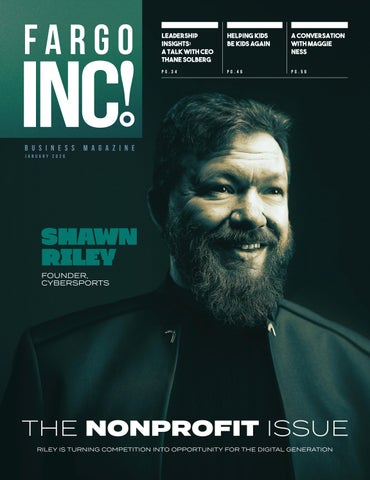
Leadership Insights: A Talk with CEO Thane Solberg
Helping Kids Be Kids Again
A Conversation with Maggie Ness
PG.34
PG.46
PG.56
january 2026
FOUNDER, CYBERSPORTS
RILEY IS TURNING COMPETITION INTO OPPORTUNITY FOR THE DIGITAL GENERATION
// JANUARY 2026
FEATURES
28
Cyber Sports: Learning Through Competition
34
Leadership Insights: A Talk with CEO Thane Solberg
40
Giving Hearts Day: Join the Movement
46
Partner Content: Helping Kids be Kids Again
50
Learn From This Financially Stable Nonprofit
56
A Conversation with Maggie Ness
66
8 Tips For Donating To The Great Plains Food Bank
74
Women You Should Know: Dr. Jessie Lindemann
28
76 Service Beyond The Field: Continuous Dedication 78
Save Your Money
82
10 Questions With John Machacek: Nick Horob (Nerd Out)
86
Supporting Families Through Change
92
Cancer Survivor to Medical Doctor
Follow Fargo INC! on Facebook, LinkedIn and X
50
56
CHECK OUT FARGOINC.COM
ALL OUR STORIES IN ONE PLACE
READ ALL THE PAST ISSUES
SCAN TO VISIT!
E d i t o r ’s n o t e
Giving Hearts Day G
iving Hearts Day has become one of the most important in the Fargo– Moorhead region because it works.
Giving Hearts Day is a large-scale exercise in collective responsibility. For 24 hours, individuals, businesses, and organizations are asked to contribute to the nonprofit infrastructure that supports this community year-round.
Nonprofits across the region rely on Giving Hearts Day funding to operate. These dollars help keep shelters open, food programs stocked, mental health services accessible, arts organizations active, and educational initiatives moving forward. For many organizations, the funds raised are essential.
What makes Giving Hearts Day effective is its simplicity. It removes barriers to participation and concentrates attention into a single day, which encourages many donors to act decisively rather than indefinitely postponing support. It also levels the playing field, giving small and mid-sized nonprofits visibility they may not otherwise receive.
Just as important is the role of local businesses and employers. Matching gifts, team fundraising, and public participation reinforce the idea that community health is not the responsibility of nonprofits alone. It is shared. Giving Hearts Day also reflects the broader reality that public funding and government programs do not cover all community needs. Philanthropy fills critical gaps, often responding faster and
more flexibly than larger systems can. Learn More
Brady Drake Fargo INC! Editor
Brady Drake, Fargo INC! Editor
fargoinc@spotlightmediafargo.com
JANUARY 2026 Volume 11 Issue 1
Fargo INC! is published 12 times a year and is available at area businesses and online at FargoInc.com.
Publisher EDITORIAL Editorial Team Lead Art Director Editorial Graphic Designer Contributor
INTERACTIVE Business Development Associate Director of Creative Strategies Web Project Manager Senior Graphic Designer Web Design Agency Project Manager Director of Agency Social Media Senior Digital Advertising Specialis ADVERTISING VP of Business Development Sales Representative
Mike Dragosavich Brady Drake Brady@SpotlightMediaFargo.com Kim Cowles Ty Betts Jordan Woods (Ladyboss Lifestyle), Wendy Klug (SBA), Michael Danielson (VBOC), John Machacek, Priscila Janjua (SW&L Attorneys), Mark Puppe (Wordwork) Kellen Feeney Megan Suedbeck Matthew Haire Sarah Cabler Sara Jentink Mhairi Christopherson Tammy Fogle Paul Hoefer Paul@SpotlightMediaFargo.com Al Anderson Al@SpotlightMediaFargo.com
Business Development Representative
Austin Cuka AustinCuka@SpotlightMediaFargo.com
Business Development Representative
Spencer Hall Spencer@SpotlightMediaFargo.com
Senior Digital Advertising Specialist Client Relations Director of Client Success Marketing Admin Accounting Specialist DISTRIBUTION Delivery
Matt Purpur Matt@SpotlightMediaFargo.com ClientRelations@SpotlightMediaFargo.com Jessica Ventzke Tyler Duclos Missy Roberts John Stuber
Fargo INC! is published by Spotlight LLC, Copyright 2026 Fargo INC! & FargoInc.com. All rights reserved. No parts of this magazine may be reproduced or distributed without written permission of Fargo INC!, and Spotlight LLC, is not responsible for, and expressly disclaims all liability for, damages of any kind arising out of use, reference to or reliance on such information. Spotlight LLC, accepts no liability for the accuracy of statements made by the advertisers.
Spotlight, LLC 4609 33rd Ave S Suite #304 Fargo, ND 58104 or info@spotlightmediafargo.com ADVERTISING: 701-478-SPOT (7768)
CHECK OUT SPOTLIGHT MEDIA'S OTHER PUBLICATIONS
We always hear that the people are what make the Fargo-Moorhead community great. So, why not meet them? Each month we cover a different topic led by local voices. We meet advocates, experts, and people just like you! meetfargo.com /meetfargo @meetfargo @meetfargo
Growth Leaders is one of Spotlight's annual publications dedicated to showcasing our local companies and the services they bring to the Fargo-Moorhead area.
16
JANUARY 2026
Bison Illustrated is your number one source for all of the behind-the-scenes action inside the North Dakota State University Athletic Department. bisonillustrated.com /bisonillustrated @bisonmag @bisonillustrated
You may already be familiar with our Faces of Fargo-Moorhead-West Fargo publication which we publish once per year in order to highlight the faces behind all of the great businesses in the community.
Future Farmer is our farming publication which brings great tech-focused content to readers across North Dakota and Minnesota. futurefarmermag.com /FutureFarmerMag
Are you in need of a new career? The Great Places to Work Fargo-MoorheadWest Fargo Annual Career Guide highlights amazing businesses in the area that provide great growth opportunities, benefits, and more!
ASK THE EXPERT
By Travis Naegle, Logistics Manager, Livewire
EQUIPMENT RENTAL—THE SECRET WEAPON FOR YOUR NEXT EVENT? ou may have heard about Livewire’s full-scale event production capabilities, but did you know that we provide professionalgrade, à la carte equipment rental solutions as well? Whether you’re planning a big birthday party or simply looking to give the movie night or backyard gathering an extra kick, we have the audio, visual, and lighting gear you need. If you’ve ever wondered how to achieve a “wow” factor without purchasing, maintaining, and storing expensive equipment, read on for the answers to our most frequently asked rental questions.
Q: WHAT KIND OF EQUIPMENT CAN I RENT FROM LIVEWIRE? A: Our inventory covers the full spectrum of gear needed to successfully stage any event, large or small. We offer uplighting and other accent lighting that transforms a venue's ambiance, alongside video essentials like professional video cameras, projectors, and projection screens to create compelling presentations. For audio, you can rent top-tier speakers, mixers, and microphones to ensure rock-solid reception and clear sound. We also stock various televisions that can be used as audience displays. Crucially,
Plains Art Museum
/livewire.fargo
we rent all the necessary accessories alongside our primary items, including cables, stands, and converters, ensuring you have a complete, professional, ready-to-use setup. Renting provides access to maintained, high-quality gear that may be too costly to justify buying for a one-off event.
Q: CAN LIVEWIRE SET UP THE RENTAL EQUIPMENT FOR US? A: Absolutely. We understand that not every client has in-house technical expertise, let alone the time to set up and tear down audiovisual equipment. While our equipment is user-friendly, we recommend taking advantage of our setup and check-in services for complex arrangements. One or more of our certified Livewire experts can deliver, install, and test the equipment at your venue. This service ensures that everything is correctly cabled, calibrated, and working flawlessly before your event starts. Utilizing our experts for setup provides peace of mind! You can focus on your guests, content, and agenda, leaving the technical execution to the professionals.
Microphone and Console
@livewire_now
/company/livewirenow
Q: CAN I PICK UP AND DROP OFF THE GEAR MYSELF? A: Yes, you certainly can. We offer convenient will-call options for clients who prefer to manage their own transportation and setup. If you are familiar with the equipment and need a quick solution for simple items like a few speakers or a projector, this is a great, cost-effective choice. Our sales team will confirm availability, provide technical guidance, and arrange a time for you to pick up the gear directly from our warehouse and return it when your rental term is complete.
Q: HOW DO I GET IN TOUCH TO RENT GEAR AND RECEIVE AN ESTIMATE? A: Getting started is easy! The best way to begin is by contacting our knowledgeable sales team to receive a free estimate. You can reach us directly through our website at LivewireNow.com. Whether you know exactly what gear you need or require guidance on the best solution for your event size and budget, our team is ready to help you unlock your event’s full potential! Livewire
Fargo Music in the Park
Movies in the Park
iving Hearts Day is more than a single day of generosity— it’s a powerful reflection of what’s possible when a community comes together. This magazine highlights the meaningful partnerships between Fargo–Moorhead nonprofits and the businesses, organizations, and individuals who stand alongside them, making vital work possible yearround. Together, these collaborations strengthen our region, amplify impact, and ensure that compassion, innovation, and hope continue to thrive across our community.
Learning Through Competition
28
JANUARY 2026
By Brady Drake |
J. Alan Paul Photography
Friday nights across America, stadium lights flick on and entire communities gather to watch students compete. The rules are clear. The scoreboard tells a story. Progress is visible. In classrooms, the future is quieter. Despite living in a world powered by code, data, and digital systems, most students graduate without ever learning how the technology shaping their lives actually works, or how easily it can be misused against them. Cybersecurity, computational thinking, and digital literacy have become essential skills, yet for many students, they remain invisible. Shawn Riley believes that’s not an accident. And, he believes he knows how to fix it. Instead of asking kids to sit still and care about abstract concepts, Riley turned knowledge into a sport.
CONTINUED
A Different Kind of Origin Story
people pay hundreds of thousands of dollars to learn later.”
Riley’s résumé is long enough to fill a page, tech founder at 16, sold his first company at 19, executive leadership roles spanning biotech, healthcare, government, and national security, including work with the Mayo Clinic and the State of North Dakota. Today, he runs a venture studio working with companies across energy, biotech, cybersecurity, and education.
On his 16th birthday, guided by his mentors, Riley filed paperwork to start his first company. Three years later, he sold it to one of the world’s largest telecommunication companies.
But none of that is the story he starts with.
The money didn’t make his life easier. It made his responsibility heavier. He used it to fight for custody of his younger siblings, becoming their legal guardian while still grappling with his own mental health.
“I don’t care about titles,” Riley said. “The real story is why I didn’t end up dead, addicted, or in prison.”
What he carried forward from that experience wasn’t just technical expertise, it was conviction.
He grew up in a small town in southeastern Minnesota, surrounded by addiction, instability, and trauma. His parents struggled with substance abuse. Home was unsafe. Survival required adaptation.
Someone believed in him when it mattered. Now he wanted to build opportunities that did the same for others.
What changed his trajectory wasn’t a grand intervention, it was a fifth grade teacher who gave him a computer and a book on how to code. That computer became an escape, education, and opportunity all at once. By middle school, Riley was managing the school’s network. By high school, he was demonstrating, in real time, how easily digital systems could be broken. Instead of expelling him, a superintendent and law enforcement officers chose a different path: mentorship. “They didn’t give up on me,” Riley said. “They taught me business, strategy, systems—everything
The Education Problem No One Wanted to Name Years later, while serving in Governor Doug Burgum’s cabinet, Riley saw the same pattern play out at a statewide scale. Technology was everywhere in schools, businesses, farms, healthcare systems, but education lagged dangerously behind. Students were surrounded by digital tools without understanding the risks, ethics, or mechanics behind them. At the same time, traditional STEM education was losing ground. Fewer students, especially girls and underrepresented groups, were engaging with math and science.
FARGOINC.COM
29
Cyber Sports: Learning Through Competition
Meanwhile, sports never lost the parents' attention. Riley noticed something telling during COVID. When schools shut down, the governor’s office received roughly one complaint per hour. When youth sports were canceled, the phones lit up, with over three thousand calls an hour. “That’s when it clicked,” Riley said. “Parents don’t just care about education, they care about competition.” So Riley asked a different question: What if learning looked like a sport?
From Cyber Madness to Cyber Sports Limited That question led to the creation of North Dakota’s first computer
30
JANUARY 2026
science and cybersecurity standards. The standards were integrated across K–12 and higher education, which also led to the launch of Cyber Madness, a statewide cybersecurity competition.
Cyber Madness couldn’t scale.
Students didn’t just learn concepts. They played them.
So Riley spun it out.
They defended networks. They identified attacks. They solved problems under pressure. They worked as teams. And they showed up. North Dakota became one of the only states in the country to formally integrate both computer science and cybersecurity across its education system. Thousands of teachers were trained. Students who had never seen themselves as “tech kids” suddenly had a place to belong. But there was a problem.
It was tied to state infrastructure, limited by geography, and capped by resources. The idea was bigger than North Dakota.
Cyber Sports Limited was born as a nonprofit designed to generate opportunity.
Knowledge as Competition Cyber Sports Limited turns cybersecurity education into a structured, competitive experience complete with seasons, tournaments, rankings, and scholarships. “Name a job today that doesn’t use computer technology. Pretty much the only ones people come up with are related to the Amish”
CONTINUED
Provided by Cyber Sports Limited
Riley said. “We don’t expect, or even want, every player to go into cyber security, but we do want every student in every school to understand the benefits and the risks of technology.” During Cyber Sports competitions, students don’t just learn passively; they compete. They defend systems against simulated attacks. They analyze risks. They adapt strategies. They fail, regroup, and try again. The effect is immediate. “When kids walk into a Cyber Sports tournament, the room is loud,” Riley said. “Then the game starts and it goes dead silent. During this time, the intensity increases and you can see the focus on the players' faces. Cyber Sports reflects the communities it serves. Participation has gradually come to mirror local demographics, with girls competing alongside boys and students from Native American, Black, rural, and urban backgrounds taking part. In recent tournaments, young women have led championship teams, demonstrating that the games and the players truly reflect the community. “It flattens everything,” Riley said. “The game doesn’t care who you are, only how you think.” Importantly, Cyber Sports isn’t about turning every student into a cyber security professional. It’s about literacy. Every student uses technology. Every job relies on digital systems. Yet most students are never
taught about ransomware, social engineering, data privacy, or ethical tech use. “We teach kids how to use a pocketknife safely,” Riley said. “Technology is just another tool but we’ve skipped the safety lesson. This is like reading, writing, and arithmetic for today’s world. Technology is the fourth pillar.”
How to Help “It costs about $2,000 per player per year for a full program. If it were just a game, it’d be about thirty bucks, but this is an education.” -Shawn Riley
A Different Definition of Winning Cyber Sports Limited is expanding nationally, with growth underway in states including Ohio, Texas, Arizona, and Florida, and extending into international markets. But Riley measures success differently. A team of high school seniors once told him they weren’t going into tech at all, one planned to study nursing, another business.
“So why are you here?” Riley asked. Their answer was simple. “We know that no matter what job we end up in, cybersecurity still matters,” one student said. “The choices we make with technology can affect the place we work and the people who depend on it.” That answer, Riley said, is the point. This isn’t about producing coders. It’s about restoring dignity, agency, and opportunity, especially for students who’ve never been told they belong in these spaces. “I was given a chance,” Riley said. “Now I’m just returning it.”
Playing Defense in a World That Never Logs Off Cyber Sports doesn’t exist in a vacuum. It exists in a moment where technology is accelerating faster than ethics, policy, or public understanding. “Cyber education is important because every job these days is a technology job," Riley said. Artificial intelligence writes emails, generates images, and predicts behavior. Social media shapes identity. Ransomware shuts down hospitals. Deepfakes blur the line between truth and manipulation. Most adults don’t fully understand these systems. Most students are expected to navigate them regardless. Riley believes this is the real risk, not that technology is dangerous, but that people are unprepared.
FARGOINC.COM
31
Cyber Sports: Learning Through Competition “We’re asking kids to live in a digital world without giving them a map,” he said.
Teaching Ethics Before Crisis One of Cyber Sports Limited's distinguishing features is its emphasis on ethics. Students don’t just learn how systems fail, they learn what responsibility looks like when they succeed. Scenarios include:
» When to disclose vulnerabilities » How data misuse harms real people
» Why “because you can” is
not the same as “because you should”
These aren’t abstract lessons. They’re embedded into gameplay. “You can’t separate ethics from capability,” Riley said. “The more powerful the tool, the more important the values behind it.” This approach reflects Riley’s own experience in how mentorship redirected him from punishment to purpose. Cyber Sports is designed to create those same inflection points for students who may otherwise be labeled problems instead of potential.
From North Dakota to the World North Dakota plays an outsized role in the Cyber Sports story.
32
JANUARY 2026
The state’s willingness to integrate computer science and cybersecurity standards early, combined with deep rural communities and tribal nations, created a testing ground for scale, access, and equity. “If it works in North Dakota, it works anywhere,” Riley said. Cyber Sports Limited is expanding into multiple states and countries, adapting to local education systems while maintaining its core framework. The nonprofit model allows districts to participate without the profit pressure that often limits access. Expansion is not just geographic, it’s philosophical. Cyber Sports partners with educators, tribal leaders, policymakers, and industry professionals to ensure relevance. Teachers are trained alongside students. Communities are brought into the conversation. The result is not just a program, but an ecosystem.
Redefining Workforce Development There is a common misconception that cybersecurity education is only for future engineers. Riley pushes back on that framing. “Every workforce problem is a technology problem now,” he said. “Healthcare, agriculture, energy, finance, none of it works without secure systems.” Cyber Sports Limited introduces
students to careers they did not know existed: risk analysis, digital forensics, policy, compliance, ethical hacking, and governance. Just as importantly, it teaches collaboration, critical thinking, and decisionmaking under pressure. Employers are paying attention. Scholarships, internships, and pipeline partnerships are emerging as organizations realize that traditional credentials often lag behind real-world ability. Competition reveals skill faster than coursework alone. “I don’t expect the vast majority of players to become cybersecurity analysts. What I expect is that they’ll understand the technology they use every day," Riley said.
Our regional champions have gone on to Microsoft’s cybersecurity defense forces, and others into three-letter agencies. Players at every level go on to get MBAs and work at companies like Target, Caterpillar, and Medtronic.” -Shawn Riley
Provided by Cyber Sports Limited
The program is free for students so they need your help! Scan to Donate today.
The Cost of Doing Nothing
What Winning Really Looks Like
smarter, more equitable digital future.
Riley is blunt about the stakes. Cybersecurity incidents already cost tens of billions of dollars annually. Misinformation destabilizes communities. Data breaches expose children’s personal information long before they can consent.
The most meaningful outcomes of Cyber Sports Limited aren’t trophies or rankings.
“This is about agency,” he said. “About making sure kids are not just consumers of technology, but also become stewards of it.”
Waiting until adulthood to teach digital responsibility, he argues, is like waiting until a car crash to explain seatbelts. “We don’t need more awareness campaigns,” Riley said. “We need education that sticks.” Cyber Sports Limited sticks because it feels real. It’s measurable. It’s competitive. It’s social. And it meets students where they are.
They’re moments. A student who never spoke in class, now leading their team through a complex challenge...a young woman realizing she belongs in a space she was told wasn’t for her...a rural school competing on equal footing with a large urban district.
In a world where the game never stops, Cyber Sports Limited teaches students how to play with skill, integrity, and purpose.
These moments compound. Over time, they shift who feels entitled to opportunity. Riley doesn’t position Cyber Sports Limited as a silver bullet. He positions it as an infrastructure providing a foundation for a safer,
cybersportsltd.org/ /cyber-sports-limited Search "Cyber Sports Limited"
FARGOINC.COM
33
LEADERSHIP INSIGHTS: A TALK WITH CEO THANE SOLBERG any given day in downtown Fargo, the barriers facing people in recovery or reentering society after justice involvement are often invisible to those who don’t encounter them firsthand. A missed bus ride. A $65 licensing fee. A prescription that insurance won’t cover. A $900 housing debt that quietly blocks the door back into stability. For Thane Solberg, CEO of the Justice Well Program, those gaps are the difference between progress and relapse, housing and homelessness, connection and isolation.
By Brady Drake | 34
JANUARY 2026
provided by Thane Solberg
“We’re not here to lecture people on how they should live their lives,” Solberg said. “We’re here to reduce barriers so people can actually move forward.” The Justice Well Program operates at the intersection of behavioral health, justice involvement, and community reintegration, offering low-barrier, highly individualized financial and peer-navigation support to people who are often excluded from traditional systems. The organization is closely aligned with The Ridge, a Fargobased behavioral health treatment provider, but its mission and its structure are deliberately distinct.
“WHEN YOU HELP SOMEONE GET INTO HOUSING AND STAY IN RECOVERY, THAT’S GREAT FOR THEM. BUT IT’S ALSO GREAT FOR THE COMMUNITY. WE’RE TREATING THE WHOLE ECOSYSTEM.” A DUAL STRUCTURE BUILT FOR FLEXIBILITY The Justice Well Program exists under a unique model. The Ridge operates as a for-profit clinical treatment provider, offering residential and outpatient behavioral health services. The Justice Well Program, meanwhile, functions as the nonprofit arm, which is designed to do what insurance, grants, and traditional funding models often cannot. “The nonprofit exists to bridge the gaps,” Solberg said. “If someone needs treatment, medication, transportation, housing support— and their insurance won’t cover it— that’s where we step in.”
LOW BARRIER BY DESIGN Unlike many assistance programs, the Justice Well Program doesn’t operate from a checklist or rigid eligibility formula. There’s no
universal threshold, no one-sizefits-all definition of “deserving.” Instead, the organization works case by case, intentionally keeping barriers low. “There is no beautiful structure we can sell to you,” Solberg said. “It’s very much a ‘come as you are’ model, and that’s on purpose.” Funding is often directed toward small but critical expenses, including bus passes, phones, medication co-pays, medical procedures, housing-related debts, and shortterm emergency support. In one recent case, the Justice Well Program funded a hotel stay so a woman living in a van could safely recover from a medical procedure. “It’s not a long-term solution,” Solberg said. “But it’s a humane one—and it’s something you’re not going to find in many other places.”
TREATING THE WHOLE ECOSYSTEM Most participants served by the Justice Well Program are justice involved, which reflects the population The Ridge already works with through its downtown location and partnerships with the Department of Corrections and Bureau of Prisons. Medicaid makes up roughly 80% of The Ridge’s payer base, naturally aligning both organizations with individuals navigating complex systems. But the Justice Well Program’s mission goes beyond individual outcomes. “When you help someone get into housing and stay in recovery, that’s great for them,” Solberg said. “But it’s also great for the community. We’re treating the whole ecosystem.” That ecosystem includes public safety, healthcare costs, family stability, and taxpayer resources—all of which are affected when people fall through the cracks.
CONTINUED FARGOINC.COM
35
The man is now 18 months out of treatment and continuing to thrive. While Solberg is careful not to attribute success to any single intervention, he’s confident the support mattered. “That’s the hard part to quantify,” he said. “You can put a dollar amount on a raise, but you can’t put a price on family connection.” That ecosystem includes public safety, healthcare costs, family stability, and taxpayer resources—all of which are affected when people fall through the cracks.
THE LOAN-REPAYMENT MODEL One of Justice Well’s most misunderstood tools is its loan-repayment option, designed not to
SMALL DOLLARS, OUTSIZED IMPACT At the Justice Well Program, the most transformative interventions often cost less than a utility bill. Solberg recalled a participant who needed just $65 to obtain a basic driver’s license. With a valid license, the individual received a $10-an-hour raise, regained the ability to visit his children without relying on them for transportation, and reclaimed a sense of independence that had been eroded by years of instability. “That $65 didn’t just increase his income,” Solberg said. “It gave him time with his family. It gave him dignity.”
Leadership Insights: A Talk with CEO Thane Solberg 36
JANUARY 2026
JUSTICE WELL PROGRAM'S GOALS: Reducing Repeat Offenses Securing Stable Jobs & Housing Accessing Mental Health Services Engaging in Recovery Programs
extract money from people with limited resources but to remove structural barriers that keep them stuck. In one example, a participant owed $900 to the Fargo Housing Authority, which was a debt that made them ineligible for housing assistance. Without housing, recovery and stability were nearly impossible. The Justice Well Program stepped in, not with a lecture or rigid repayment demand, but with a conversation. “We sit down and talk about what recovery looks like,” Solberg said. “What’s realistic? What keeps you connected to us and on track?” In many cases, repayment is symbolic rather than financial, especially for individuals living on fixed incomes. The real accountability comes through continued engagement, peer navigation, and alignment with recovery goals. “I’m not going to take money from someone who’s living on $300 a month,” Solberg said. “But getting them housed benefits them, and it benefits the entire community.”
its launch, prioritizing depth over volume. Unlike many programs capped at two years, the Justice Well Program can remain connected to individuals for up to five years. Scaling, Solberg acknowledged, is harder when services are deeply individualized. “But we’re not just handing out money,” he said. “We’re cutting through red tape, reducing barriers, and helping people reintegrate, and that takes time.” The long-term vision includes expansion beyond Fargo and eventually statewide support across North Dakota. Already, the Justice Well Program partners with organizations like ShareHouse, extending services to individuals outside its immediate clinical ecosystem.
A CEO WHO STAYS CLOSE TO THE WORK
“We can’t help 1,000 people a month,” Solberg said “And we’re okay with that.”
Thane Solberg stepped into the role of CEO of the Justice Well Program just over a month ago, a position that was previously filled by Justice Well and The Ridge’s founder and CEO Dr. Jacqualine Gervais. Gervais transitioned into the role of Executive Director of Justice Well Program while Solberg took over the day-to-day operations of the non-profit. Solberg’s leadership philosophy was shaped long before the title. Previously serving as director of engagement and events, Solberg now oversees strategy, fundraising, donor relations, and every funding request that comes through the organization.
The organization has worked with roughly 100 participants since
Yet he’s intentional about staying close to the people
SCALING THE RIGHT WAY The Justice Well Program is trying to grow its impact, but it's trying to do so in a smart way.
the nonprofit serves. “Nine times out of ten, I meet with the individual,” Solberg says. “I want to put a face to the name. What good am I if I’m just sitting in an office looking at numbers and emails? I need to understand what people are actually going through." A practice he admired in Justice Well’s founder Dr. Jacqualine Gervais. Gervais believes in direct client care at all levels of practice, thus laying the foundation of what makes the Justice Well Program unique.
THE LONG-TERM VISION INCLUDES EXPANSION BEYOND FARGO AND EVENTUALLY STATEWIDE SUPPORT ACROSS NORTH DAKOTA. ALREADY, THE JUSTICE WELL PROGRAM’S GOAL IS TO OFFER THEIR SERVICES TO INDIVIDUALS OUTSIDE ITS IMMEDIATE CLINICAL ECOSYSTEM. - THANE SOLBERG
CONTINUED FARGOINC.COM
37
FROM COMMUNITY VOLUNTEER TO NONPROFIT EXECUTIVE Solberg’s career path into nonprofit leadership was anything but accidental, but it wasn’t always intentional either. Raised in Maddock, ND, he spent his early years immersed in community fundraising and event planning. Over time, that involvement evolved into professional roles, including serving as operations manager for a local non-profit, a board position with the Peer Support Alliance of North Dakota and other local volunteer boards. “Nonprofit work just kind of became my career path,” he said. “Especially in behavioral health and mental health—that’s where my heart is.” Solberg believes communities benefit when people with lived experience are empowered to lead. “Bridging the gap between what we call ‘normal’ life and the lives of people in recovery is critical,” he said. That philosophy shows up in unexpected ways, including taking program participants to the Red River Market, the Christkindl Market, or organizing family skate nights and sober dance events.
“These are the things that reintegrate people into society,” Solberg said. “The things they may not feel comfortable doing otherwise.” In 2026, the Justice Well Program plans to expand its slate of sober social events, including partnerships with We Are One Services to host substance-free dance nights. “We live in an alcohol-heavy society,” he said. “That’s not going to change.” As someone in recovery from alcohol himself, Solberg understands how isolating early sobriety can feel. “People avoid events because they don’t trust themselves yet,” he said. “And then it becomes a pattern—they stop participating in community life altogether.” Solberg’s goal is to show people that participation is still possible. “Social connection is what truly heals people,” he said. “Recovery struggles when people are isolated.”
A PERSONAL JOURNEY THAT INFORMS THE MISSION Solberg has been in recovery for nearly seven years. The son of
two parents in long-term recovery themselves, he understands addiction as both personal and generational. “My chances of not having a problem with alcohol were pretty slim,” he said. Unlike stereotypical portrayals, Solberg wasn’t a daily drinker—a reality that made it harder to recognize the problem. “I wasn’t the bar regular,” he said. “So I kept telling myself I didn’t have an issue.” What ultimately forced the reckoning were the accumulating consequences like job losses, financial strain, and emotional instability. He entered treatment at 30. “Something just clicked,” he said. “I still don’t know exactly what made that decision stick, but it did.” Today, Solberg speaks openly about living with bipolar II disorder, ADHD, and substance use disorder. Rather than seeing those diagnoses as limitations, he sees them as sources of insight. “Some of my best ideas come from the same brain that creates challenges,” he said. “The key is knowing when to slow down and not act on every idea.” That self-awareness, he believes, is one of recovery’s greatest gifts.
DID YOU KNOW? Participants can benefit from The Ridge's program for up to 5 YEARS!
Leadership Insights: A Talk with CEO Thane Solberg 38
JANUARY 2026
BUSINESS LESSONS FROM THE NONPROFIT FRONT LINES For business leaders, nonprofits, and for-profits alike, Solberg offers the straightforward advice of staying open.
INTERESTED IN HELPING THE MISSION? REACH OUT!
“Don’t put blinders on,” he said. “You don’t always know what your organization is capable of until you try.”
justicewell.org
He urges nonprofits to explore unconventional funding models, remain flexible with grant criteria, and resist the temptation to define themselves too narrowly.
@justicewellprogram
/justicewellprogram /justicewellprogram
“Everyone’s fighting for the same donor dollars,” Solberg said. “You have to be willing to think creatively.” Equally important, he adds, is maintaining joy in the work. “Have fun,” Solberg said. “This work can be heavy. If you lose the joy, you burn out.”
Scan to donate!
FARGOINC.COM
39
Join the Movement Every February, something special happens across North Dakota and beyond. Families talk about where they want to give. Coworkers rally around causes they care about. Students organize drives, volunteers show up in red, and neighbors support neighbors in ways both big and small. This is Giving Hearts Day. It brings thousands of people together around a shared purpose: supporting the local nonprofits that make our communities stronger, more connected, and more compassionate. Giving Hearts Day isn’t just about one day on the calendar. It’s about who we are, what we value, and how kindness grows when we choose to show up together.
An annual day of giving that supports hundreds of local nonprofits working across nearly every area of community life. From food pantries and shelters to arts organizations, schools, health services, animal rescues, and more, Giving Hearts Day connects people to causes that matter close to home. Since its start in 2008, Giving Hearts Day has raised more than $200 million for nonprofits across
40
JANUARY 2026
the region. That support fuels programs, fills gaps, and helps organizations continue their work long after the day itself has passed. But it's about more than dollars raised. It’s about participation. It’s about shared momentum. It’s about creating a moment when generosity feels possible, accessible, and meaningful for everyone.
$200 MILLION Since its start in 2008, Giving Hearts Day has raised more than $200 million for nonprofits across the region.
Local nonprofits do essential work every day. They provide food, care, shelter, creativity, education, and connection. Often, they do it quietly—meeting needs most people never see. Giving Hearts Day helps make that work visible. It gives nonprofits a platform to tell their stories, connect with supporters, and receive the resources they need to keep showing up for their communities.
It also matters because of how it brings people together. When thousands of people give on the same day, something shifts. Giving becomes contagious. Conversations start. Pride grows. People are reminded that even small actions—when taken together—can create real change. Generosity grows when we practice it together.
You don’t have to give in a single, specific way. Instead, there are many entry points— so everyone can participate in a way that fits their life. Some people give financially. Others volunteer their time. Many host goods drives, spread the word, or encourage their workplace or school to get involved. All of it matters. You don’t need to give a lot. There is no wrong way to participate. What matters most is choosing to take part.
CONTINUED> FARGOINC.COM
41
Donating is one of the most direct ways to participate. Individuals can support one nonprofit or several, depending on what resonates with them. Some give in honor of someone they love. Others involve their children and turn the decision into a family conversation. Businesses often choose to match employee donations or provide Giving Hearts Day gift cards, empowering team members to support causes that matter personally to them.
Many nonprofits welcome volunteers around Giving Hearts Day. Volunteering offers a hands-on way to connect with a cause and see impact firsthand. Even a short time commitment can make a meaningful difference.
Goods drives turn generosity into something tangible. Schools, businesses, and community groups collect items nonprofits have specifically requested—like hygiene products, winter gear, school supplies, or food. These drives help meet immediate needs while bringing people together around a shared goal.
Sharing Giving Hearts Day is powerful. A post, a conversation, or an invitation can spark participation from someone who may not have known about the day otherwise. Awareness builds momentum, and momentum builds impact.
42
JANUARY 2026
Giving looks different depending on where it shows up—and that’s part of what makes it work. For families, it often becomes a tradition. Parents involve their kids in choosing causes, talking about values, and learning what it means to care for others. These moments help shape how young people understand generosity and community. In schools, students lead. Goods drives, fundraising challenges, and service projects give students a chance to see that their actions matter. Giving Hearts Day becomes a lesson in empathy, leadership, and collective impact. In workplaces, Giving Hearts Day builds culture. When businesses participate, they show employees that generosity is part of who they are—not just what they do. Teams connect around shared purpose, and employees feel pride in supporting both their workplace and their community. Strong communities are built when families, schools, and businesses all take part.
CONTINUED> FARGOINC.COM
43
While the day happens annually on the second Thursday of February, its impact reaches far beyond a single date. The funds raised help nonprofits plan, grow, and respond to needs throughout the year. The relationships built between donors, volunteers, and organizations continue. The conversations sparked around generosity don’t end when the day does. It’s a movement. A reminder of what’s possible when people choose to give together.
The purpose remains clear: to strengthen communities through generosity. The movement continues to be shaped by the people who show up—by families making giving part of their story, by students leading with heart, by businesses investing locally, and by nonprofits serving with dedication. Each year adds to the impact. Each participant adds to the momentum. Kindness isn’t a moment. It’s a movement. And Giving Hearts Day is one way that movement comes to life.
44
JANUARY 2026
Whether this is your first Giving Hearts Day or one of many, there’s a place for you. Give if you’re able. Volunteer if you can. Bring one item. Invite one person. Choose one cause that matters to you.
| givingheartsday.org | /givingheartsday | @givingheartsday
When we give together, the impact multiplies. To explore participating nonprofits, find ways to get involved, or learn more, visit:
FARGOINC.COM
45
PARTNER CONTENT
By Brady Drake provided by Berkshire Hathaway HomeServices Premier Properties
BERKSHIRE HATHAWAY HOMESERVICES PREMIER PROPERTIES & THE SUNSHINE KIDS FOUNDATION 46
JANUARY 2026
argo-Moorhead, philanthropy often looks like neighbors showing up for one another. For Berkshire Hathaway HomeServices Premier Properties, that commitment is seen through their long-standing support of The Sunshine Kids Foundation, which is a national nonprofit dedicated to children battling cancer. The Sunshine Kids Foundation was established in 1982 with a mission to offer comfort, stability, and moments of happiness to children whose lives have been interrupted by cancer treatment. Since 2008, the BHHS Premier Properties office in Fargo has embraced
that mission wholeheartedly by raising more than $755,000 to support this amazing cause. What makes The Sunshine Kids program unique is how tangible the impact is. Funds raised locally stay local. Children from our North Dakota and Minnesota region are given the opportunity to attend week-long, allexpenses-paid trips with other kids who are going through similar medical journeys. These trips— whether to Orlando, New York City, Colorado, or New Orleans—are carefully planned and fully supported by licensed medical professionals, including traveling nurses who manage medications and treatment protocols along the way.
HELPING KIDS BE KIDS AGAIN “It’s not about escaping reality,” Marketing Director Cassie Edwards, who helps coordinate fundraising efforts, said. “It’s about giving these kids a chance to just be kids.”
2024 Sunshine Kids Trip to Orlando
Each trip costs roughly $10,000 per child after accounting for medical staffing, supplies, travel, lodging, and activities. Children typically attend once, though in rare cases— depending on diagnosis and treatment cycles—some may attend more than once. Participation is always based on a child’s health and ability to travel safely. For many families, the experience is transformative. There are no parents on the trips, a decision that may seem daunting at first, but often becomes a source of empowerment for the children. They build independence, confidence, and friendships with peers who truly understand what it means to live with cancer. Maureen Bartelt, Broker at Berkshire Hathaway HomeServices Premier Properties, has witnessed these relationships grow over the years. “We’ve watched kids go from little boys to young men,” she said. “They stay connected long after the trips are over. Those bonds are lifelong.”
CONTINUED
FARGOINC.COM
47
PARTNER CONTENT Jaxson Thomsen in New York City, July 2025 One local Sunshine Kid, Jaxson, spent more than three years undergoing active cancer treatment—over 1,300 days. Once an active athlete, his entire high school experience was reshaped by illness. Through The Sunshine Kids, he found community, encouragement, and moments of joy in the middle of a long fight. Stories like his are what keep the Fargo real estate team, and brokerage, committed year after year. Some Sunshine Kids eventually return as mentors or pursue careers in healthcare, inspired by the professionals who supported them during treatment. Others simply carry forward the knowledge that they were never alone. The primary driver behind BHHS Premier Properties' fundraising success is their annual Summer Charity Golf Tournament, now approaching its 19th year. The event consistently sells out and is known not just for its cause, but for the experience it offers—two hot meals, thoughtful details, and an atmosphere that reflects genuine care. In addition to the main tournament, a secondary event in the fall at Suite Shots has helped expand awareness and participation. Last year alone, the tournament raised approximately $70,000 after expenses. That success is powered by community sponsors, business partners, in-kind donations, and the company’s own agents, many of whom contribute a portion of their commissions to the foundation each year. Support doesn’t stop at financial contributions. A committee and staff come together in the days leading up to the tournament to prepare materials, assemble swag bags, and ensure every detail reflects the importance of the cause.
We’re incredibly proud to support The Sunshine Kids, because it represents what community truly means. Being able to bring moments of joy, hope, and normalcy to children and families facing unimaginable challenges is a powerful reminder of why giving back matters.” -Tyrone Leslie, President of BHHS Premier Properties
The 18th Annual Sunshine Kids Charity Golf Tournament, July 2025 48
JANUARY 2026
Jaxson Thomsen (middle) with family and friends. Tyrone (far left) and Maureen Bartelt (far right)
Our son Jaxson was diagnosed with Leukemia in February of 2022 at the age of 13. In the summer of 2023, the Life Specialist with Sanford approached us with wanting to take him on a Sunshine Kids' trip to Vail, CO. We were so excited for him, but were also hesitant, for he was at that time wheelchair bound because of the weakness and other side effects of the chemo. He did go and Sunshine Kids' adapted to everything he needed at that time! He was able to have a wheelchair waiting for him wherever he went, and even got an adaptive ski sled for skiing on the trip! He had a great time and met awesome kids his age who were going through the same thing! In Spring of 2025, the Sanford Life Specialist approached us again and said she felt Jaxson didn't have the best experience that she wanted him to have because of the restrictions he had to have. Therefore, she had spoken with The Sunshine Kid Foundation, and they had agreed to send him on another trip! This time, to New York! He went there in July of 2025, and the memories he has shared with us while he was there will last forever! We are so thankful and grateful for Sunshine Kids and what they have done for our son! For three and a half years, his number one priority was his health and fighting to be with us longer. So he wasn't able to be a kid and do what normal teenagers were doing. So to be able to go on these trips that he enjoyed so much and meet other kids who have been through the same, that he still talks to now, is just so awesome! I hope for all the kids that are able to go on these trips, it is a light for them during a dark time when their whole world stopped for this awful disease.” - Heather Thomsen, Jaxson's mother
“When you know the kids personally—when you’ve met them, watched them grow, seen their families—you show up differently,” Edwards said. Beyond events, community members can support The Sunshine Kids Foundation through donations, sponsorships, prize contributions, or in-kind services that help offset tournament costs. As a registered 501(c)(3), all donations are tax-deductible. “We wouldn’t put this much work into something we didn’t believe in,” Bartelt said. “Seeing the impact on these kids and their families—it’s humbling. It reminds you why community matters.”
WAYS TO SUPPORT THE SUNSHINE KIDS FOUNDATION • Sponsor the Annual Golf Tournament • Participate in Fundraising Events • Donate Prizes or Swag Items • Spread Awareness • Provide In-Kind Donations by Contacting the Team at:
Maureen Bartelt with annual Corporate Sponsors First International Bank & Trust and Ferguson Home
sunshine@bhhspreproperties.com 701-356-3600 Donations can be made out to The Sunshine Kids Foundation and mailed to: 1815 38th Street S, Fargo, ND 58103
BERKSHIRE HATHAWAY HOMESERVICES PREMIER PROPERTIES bhhspreproperties.com /bhhspremier @bhhspremier /bhhs-premier-properties
FARGOINC.COM
49
By Brady Drake |
provided by Detroit Mountain Recreation Area
an industry defined by weather volatility, rising costs, and short operating windows, Detroit Mountain Recreation Area continues to defy expectations. Now entering its 12th year since reopening in 2014, the nonprofit ski and recreation area has maintained positive cash flow while steadily expanding amenities, improving infrastructure, and deepening its role in the community. The formula isn’t flashy. It’s disciplined, intentional, and relentlessly missiondriven. “We have a growth mindset, with the primary goal of expanding access to world class outdoor recreation,” General Manager Tom Thiel said. “Every decision we make has to support long-term stability and the experience we’re providing to our community.” Detroit Mountain operates with a conservative financial philosophy that prioritizes cash stability over overly optimistic projections. Budgets assume variability. Expenses stay tightly managed. Reserves remain protected.
50
JANUARY 2026
“We budget for what could happen, not what we hope happens,” Thiel said. “Weather is unpredictable. Having strong cash reserves allows us to stay focused on operations instead of scrambling when conditions don’t cooperate.” “When we generate surplus revenue, it goes right back into the mountain. We reinvest in the infrastructure and improvements that make Detroit Mountain more reliable, more enjoyable, and ultimately a better experience for every guest.” Recent and Ongoing Reinvestment Priorities Include: Expanded snowmaking capacity to extend season length Enhanced grooming equipment for consistent trail quality Infrastructure upgrades that reduce downtime and operating risk Guest-focused improvements that elevate the overall experience This reinvest-to-strengthen approach ensures that financial health directly translates into better days on the hill.
Key indicators DMRA Monitors Year Over Year: Season pass sales Business bundle participation
Rather than relying solely on daily ticket sales, Detroit Mountain tracks indicators that provide early insight into season health and community engagement. “We pay close attention to extendeduse products,” Thiel said. “They tell us how confident people are in the season and how connected they feel to the mountain.”
Three-pack purchases Ski team registrations These metrics offer predictability in an unpredictable industry, allowing the team to plan staffing, snowmaking, and programming with greater confidence.
Detroit Mountain’s leadership evaluates capital expenditures through a clear priority lens. Annual revenue fluctuates with the weather, so disciplined CapEx planning remains essential. “We base decisions on what the mountain truly needs to operate well and safely,” Thiel said. “That means investing where it counts while keeping reserves strong enough to absorb risk.” This balance allows DMRA
FARGOINC.COM
51
to improve facilities without compromising financial stability, which is a challenge many nonprofits struggle to manage. Ski areas, in particular, face a unique financial paradox that includes strong revenue potential paired with high operating costs. Detroit Mountain mitigates this risk by diversifying revenue streams and building early commitment from guests.
- Tom Thiel, Manager, Detroit Mountain Recreation Area
Revenue-Stabilizing Strategies Include: Season passes and multi-use products Group programs and ski teams Business partnerships and bundled offerings Community and donor support beyond ticket sales "Ticket sales alone can’t carry an operation like this,” Thiel said. “Strong community relationships and diversified income streams are critical.”
Well-groomed alpine runs for all skill levels Terrain features that support progression and fun Ski and snowboard programs for kids and adults A vibrant ski team culture Community events that bring people together A welcoming, family-friendly atmosphere
52
JANUARY 2026
You can find at least one troll on Detroit Mountain!
You can even go tubing at Detroit Mountain!
winter, summer, and shoulder seasons, developing programs that consistently deliver great experiences and support the mountain’s long-term mission. Detroit Mountain’s financial stability is inseparable from how it operates day to day. The organization focuses relentlessly on delivering what it calls a world-class outdoor recreation experience. “Our goal is to create a place where families come to recreate for generations,” Thiel said. “We want Detroit Mountain to be the place people associate with outdoor fun, community, and lasting memories.”Over more than a decade of operation, the team has refined planning across
As a nonprofit, Detroit Mountain faces constant tension between high operating costs and its commitment to affordability and access. Leadership meets that challenge head-on. “We have to focus on revenuegenerating programs to stay healthy,” Thiel said. “But accessibility is always part of the equation. That’s nonnegotiable.”
FARGOINC.COM
53
Bike rentals available.
- Tom Thiel
Looking back, one moment stands above all others in shaping Detroit Mountain’s sustainability: the more than $10 million raised by the community to bring the mountain back to life. “That support was the catalyst for everything that has followed,” Thiel said. “It provided the foundation to build responsibly and intentionally.” Since reopening, consistent reinvestment, paired with Minnesota Legacy Grant funding, has expanded amenities, strengthened infrastructure, and positioned Detroit Mountain for long-term success. Today, Detroit Mountain Recreation Area is more than a place to ski, snowboard, or mountain bike. It stands as a model of how disciplined financial management, operational excellence, and deep community commitment can come together to create a nonprofit recreation destination that truly thrives. detroitmountain.com /DMRAinc @detroitmountain
54
JANUARY 2026
A CON VERSATION WITH
MAGGIE NESS l Va
y le
By
Bra
dy
Dra
ke
pro vid
ed
by M
em
or
yC af e-
of t
he
Re d
Ri
ve r
E XECUT IVE DIREC TOR OF M E M ORY CAFE - OF TH E RE D R IVER VALLEY
memory loss diagnosis can quietly change everything—not just for the person receiving it, but for the family members and caregivers walking alongside them. Too often, those changes come with isolation, uncertainty, and the feeling that the world has grown smaller. Memory Café of the Red River Valley exists to gently push back against that reality. Memory Café creates welcoming spaces where individuals living with memory loss and the people who care for them can show up just as they are. Here, dignity is protected, joy is encouraged, and connection is the focus—no explanations required. Through intentionally
56
JANUARY 2026
social gatherings, education, and communitycentered programs, Memory Café reminds families that meaningful moments, laughter, and belonging are still very much possible. In this conversation, we sit down with the organization’s Executive Director, Maggie Ness, to explore the experiences that led to Memory Café’s founding, how its mission has grown, and why supporting both individuals with memory loss and their caregivers is more critical than ever. It’s a story about redefining what dementia support can look like—and about creating spaces where people feel seen, understood, and never alone.
What experiences led to the founding of Memory Café of the Red River Valley? Memory Café of the Red River Valley was born out of lived experience. Our founders witnessed firsthand how isolating a dementia diagnosis can feel for individuals and for the people who love them. They saw a gap between clinical care and everyday life, and a need for spaces where people could still show up as themselves, connect with others, and feel a sense of belonging. Memory Café began as a response to that gap; a place rooted in compassion, understanding, and human connection.
How has the organization’s mission evolved since its early days? While our core mission has remained the same, supporting individuals impacted by memory loss through connection, education, and joy, the scope of our work has grown significantly. What started as large group gatherings has evolved into a robust network of programs that serve individuals at different stages of memory loss, as well as caregivers and families. We’ve expanded our educational offerings, built stronger community partnerships, and deepened our commitment to creating inclusive, dementia-friendly spaces that truly meet people wherever they are on their journey.
Memory Café often emphasizes dignity and joy—why are those values so central to your work? A diagnosis of dementia can so easily overshadow everything else about a person. We believe dignity and joy are essential because they remind people that they are more than a diagnosis. Joy fosters connection, confidence, and a sense of purpose, while dignity ensures that individuals feel seen, respected, and valued at every stage of their journey. These values guide everything we do, from the language we use to the way our programs are designed.
What misconceptions about memory loss or dementia does the Memory Café want to challenge? One of the biggest misconceptions is that a dementia diagnosis means life, joy, and meaningful connection are over. We work every day to challenge that narrative. People living with memory loss can still learn, laugh, contribute, and build relationships. One of the most common and most harmful assumptions is that caregivers somehow arrive equipped with the knowledge, confidence, and skills needed to support someone living with dementia. In reality, most caregivers are learning in real time, often with no formal training, limited guidance, and little opportunity to pause and catch their breath.
FARGOINC.COM
57
A CONVERSATION WITH MAGGIE NESS
Dementia is not a static condition. Symptoms change, abilities fluctuate, and what worked yesterday may not work today. Caregivers are constantly adapting, figuring out how to communicate when words fade, how to respond when behaviors shift, and how to make decisions that balance safety, dignity, and quality of life. This ongoing problem-solving can be exhausting and emotionally taxing. The expectation that caregivers “should know” can also prevent them from asking for help. Many feel pressure to appear capable and composed, even when they are overwhelmed or uncertain. Questions like “Am I doing this right?” or “Could I have handled that better?” are incredibly common, yet rarely voiced out loud. What caregivers truly need is not judgment or assumptions, but access to education, reassurance, and community spaces, like Memory Cafe, where they can ask questions, share experiences, and learn alongside others walking a similar path. Caregiving is not about having all the answers; it’s about showing up with compassion, curiosity, and
support, especially when the path forward isn’t clear.
What does your role as Executive Director look like on a day-to-day basis? No two days look exactly the same, and that’s part of what I love. One moment I might be meeting with community partners or juggling the behind-the-scenes details that keep things running, and the next I’m welcoming participants, swapping stories, or checking in with caregivers, staff, and volunteers. It’s a role that blends strategy with heart, and that mix of big-picture thinking and meaningful, everyday connection is what makes this work so special to me.
How do you balance strategic leadership with being present for participants and caregivers? Staying present with participants and caregivers grounds our strategy in real experience. My background
in social work has shaped how I lead; it taught me that listening, relationship-building, and being fully present are not extras, but essentials. Those relationships inform every decision we make. I see presence not as separate from leadership, but as central to it. Being in the room, listening, observing, and connecting ensures that our growth remains rooted in the needs and voices of the people we serve.
What leadership skills have been most essential in growing Memory Café? Adaptability, empathy, and collaboration have been critical, along with innovative and strategic thinking as we lead the way in this work within our region. The needs of our community are constantly evolving, and effective leadership requires listening deeply and responding thoughtfully while also anticipating what’s next. Building strong relationships with staff, volunteers, donors, and community partners has been essential to sustainable growth and to advancing new, forward-thinking approaches to dementia support.
"Caregiving is not about having all the answers; it’s about showing up with compassion, curiosity, and support, especially when the path forward isn’t clear." 58
JANUARY 2026
A CONVERSATION WITH MAGGIE NESS
What has surprised you most about leading this organization? What has surprised me most is just how quickly both the need and the community around it have grown. With each new program we introduce, we welcome new individuals and families who are looking for connection, understanding, and support, and each time, it’s a powerful reminder of how many people are navigating memory loss feeling alone. As our programs continue to grow, so does the generosity of our community. Donors, volunteers, and partners step forward with open hearts, making it possible to meet this growing need. Most of all, I’m inspired by the resilience of the individuals and caregivers we serve. Their courage, vulnerability, and willingness to keep showing up for one another are what make this work so deeply meaningful.
What makes a Memory Café gathering different from traditional support groups or clinical programs? Memory Café of the Red River
60
JANUARY 2026
Valley’s gatherings are intentionally social, welcoming, and joyful. Rather than focusing on what’s been lost, we focus on what remains. There’s no pressure to share personal stories unless someone wants to. Participants come to connect, engage in activities, and simply enjoy being together in a space where they feel understood.
How do you design activities that are engaging for people with varying levels of memory loss? We design activities that are flexible, sensory-rich, and success-oriented. Our goal is to meet people where they are and allow for multiple ways to participate. Activities emphasize creativity, movement, music, and conversation, things that tap into strengths rather than limitations.
Why is caregiver support such a critical part of your mission? Caregivers are often the unsung heroes in the dementia journey. They carry emotional, physical, and logistical responsibilities that can be overwhelming. Supporting
caregivers helps sustain the entire care system and ensures they don’t feel alone or invisible in the process.
How do caregiver needs differ from what people often expect? Many assume caregivers primarily need information, but often what they need most is connection, understanding, and permission to take a breath. Emotional support, peer connection, and respite are just as critical as education.
What feedback do you hear most often from caregivers? We often hear caregivers say, “This is the first place where we feel understood,” or “We don’t have to explain ourselves here.” One caregiver shared, “I don’t know what I would do without Memory Café,” a sentiment we hear time and time again. Caregivers frequently describe Memory Café as a lifeline, a place where they can exhale, connect with others who truly understand their journey, and feel less alone.
Are there populations you’re hoping to reach more intentionally in the future? Yes. We’re especially focused on reaching individuals in the early stages of memory loss, younger caregivers, and underserved communities who may face barriers to access. We are also deeply committed to expanding respite opportunities for caregivers; creating spaces and programs that allow them time to rest, recharge, and feel supported. Expanding inclusivity, accessibility, and meaningful respite remains a priority as we continue to grow.
Memory Café has grown significantly—what have been the biggest growing pains? Growth brings incredible opportunity, but also challenges. Ensuring we maintain our personal, relational approach while expanding programs and infrastructure has been one of the biggest balancing acts. We’re intentional about growing in ways that strengthen, not dilute, our mission.
What challenges do nonprofits serving memory loss face? Nonprofits serving individuals impacted by memory loss often operate in the space between growing need and limited resources. Funding sustainability, volunteer capacity, and public awareness remain ongoing challenges, even as the number of families affected by dementia continues to rise. Dementia care is still widely under-resourced, and too often the emotional toll on individuals and caregivers goes unseen. This reality makes advocacy and community education essential not
only to secure support but to shift understanding, reduce stigma, and remind our communities that people living with memory loss deserve connection, dignity, and joy throughout every stage of their journey.
How do donors and community partners typically connect to your mission? Many donors and partners have a personal connection to memory loss through a family member, friend, or colleague. Others are drawn to the mission because they see the tangible impact of creating spaces rooted in dignity, joy, and belonging. Donors often connect to Memory Café because the impact is immediate and deeply human. A gift helps turn fear into understanding, isolation into belonging, and uncertainty into moments of joy and confidence. At its heart, Memory Café is about making moments matter, and donor support ensures those moments continue to exist for individuals and families who need them most.
What role do volunteers play in delivering programs? Volunteers are the heart of Memory Café. They help create welcoming environments, build relationships with participants, and bring warmth and consistency to our programs. Their presence reinforces the sense of community that defines Memory Café.
How can businesses or organizations get involved beyond financial support? Businesses can partner with us by volunteering, sponsoring programs,
hosting educational events, or helping create dementia-friendly environments within their own organizations. Advocacy and awareness are powerful forms of support.
Where do you see Memory Café in five years? In five years, I envision Memory Café supporting more individuals in our community by coming out of isolation. I also envision Memory Cafe of the Red River Valley as a regional and potentially even a nationwide leader in dementiafriendly community building, serving more individuals, offering expanded respite and education opportunities, and continuing to innovate while staying deeply connected to our roots.
What unmet needs do you still hope to address? We hope to expand respite options for caregivers, reach individuals earlier in their diagnosis, and continue reducing isolation for families navigating memory loss. There is still so much opportunity to walk alongside people in meaningful, supportive ways, and that work continues to drive us forward.
memorycaferrv.org /memorycafeoftherrv @memorycafeofthered /memory-cafe-of-the-redriver-valley
FARGOINC.COM
61
8
TIPS FOR DONATING TO THE
It’s always a good time to support your community, but with Giving Hearts Day and other seasonal drives approaching, many people are looking for the best ways to help. To make sure donations have the greatest impact, we connected with Great Plains Food Bank—North Dakota’s only food bank—for updated guidance on what items are most needed right now. Over the years, Great Plains Food Bank has shifted its focus from simply providing food to ensuring access to nutritious, culturally appropriate, and essential household items. In addition to food, the organization distributes hygiene products, diapers, and even pet food—items that are often overlooked but critically important. Below is an updated guide to help you donate thoughtfully and effectively.
THINK BEYOND FOOD
If you’d use it in daily life, chances are someone else could too. Great Plains Food Bank is skilled at finding the right place for a wide range of donated items—even leftover Halloween candy.
66
JANUARY 2026
PROTEIN-RICH FOODS ARE A TOP PRIORITY Protein remains one of the most requested categories. These items help families build balanced, filling meals: • Ground beef • Chicken (whole, parts, or frozen) • Halal meats (beef, chicken, lamb) • Canned tuna or salmon • Beans (canned or dry) • Peanut butter and other nut butters
AVOID GLASS CONTAINERS!
For safety reasons, donations should be packaged in nonglass containers to protect volunteers and staff.
PANTRY STAPLES & BAKING SUPPLIES Pantry basics allow families to stretch meals and cook at home. Baking items are especially helpful for households trying to make food last: • Flour (all-purpose or whole wheat) • Sugar (granulated, brown, powdered) • Baking powder and baking soda • Salt • Cooking oils (vegetable, canola, olive) • Pasta and rice • Canned tomato products (sauce, diced, paste) • Shelf-stable meals like mac & cheese, soups, and stews
FARGOINC.COM
67
FRESH PRODUCE, DAIRY & REFRIGERATED ITEMS Access to fresh food is a growing priority. Great Plains Food Bank works hard to distribute perishable items safely and efficiently. • Fresh produce • Canned fruits and vegetables • Milk (fresh or shelf-stable) • Shelf-stable milk alternatives (soy, almond, oat) • Cheese (blocks, shredded, or slices) • Yogurt (single-serve or multi-pack) • Butter or margarine
OTHER WAYS TO HELP
Volunteer: Individuals and groups of many ages can help at the Fargo warehouse. Donate Funds: Monetary donations allow the food bank to purchase exactly what’s needed. Host a Virtual Food Drive: A great option for workplaces, schools, or families. You can learn more at the Great Plains Food Bank website.
BREAKFAST ITEMS Breakfast foods are especially helpful for families with children: • Hot and cold cereal • Oatmeal packets • Pancake mix and syrup
68
JANUARY 2026
WOMEN & CHILDREN’S ESSENTIALS These items are always in high demand and move quickly through the warehouse: • Diapers (all sizes) • Baby wipes • Baby formula (all types, including specialty formula; must be unopened and unexpired) • Baby food (cereal, purees, jars, pouches) • Toddler snacks
DONATION DROP-OFF LOCATIONS
Fargo Warehouse: 1720 3rd Ave North, Fargo, ND 58102 Bismarck Warehouse: 1315 South 20th Street, Bismarck, ND 58504
HYGIENE, PAPER & CLEANING PRODUCTS These non-food items are rarely covered by assistance programs but are essential for dignity and health: • Body wash or soap • Shampoo and conditioner • Toothpaste and toothbrushes • Feminine hygiene products (pads, tampons) • Deodorant • Lotion • Paper products and basic cleaning supplies All hygiene items should be unopened and donated separately from food.
70
JANUARY 2026
PET FOOD One lesser-known but impactful donation: pet food. Great Plains Food Bank offers pet food because many individuals will share their own food with their pets when resources are limited. Supporting pets helps keep families together during hard times.
| greatplainsfoodbank.org | /GreatPlainsFoodBank | @greatplainsfoodbank | /greatplainsfoodbank
SNACKS & CONVENIENCE ITEMS These items are especially useful for kids, seniors, and individuals on the go: • Single-serve snack items (granola bars, fruit snacks, crackers) • Trail mix or nuts • Popcorn
FARGOINC.COM
71
WOMEN YOU SHOULD KNOW EMPOWERED BY
The Doctor Who Wasn’t Supposed To Be Dr. Jessie Lindemann didn’t plan on becoming a doctor. In fact, growing up in North Fargo, she saw firsthand what it looked like. Her father was a beloved physician in town, but to her, his work meant long hours, missed family moments, and a pager that never stopped. “I didn’t want that,” she said simply. “I wanted to have a family and be able to spend time with them.” So, she took another route: chemistry. With a master’s degree in organic chemistry, Dr. Lindemann worked in Fargo and later at a biotech company in Madison, WI. But life has a way of rewriting plans. At 28, she was diagnosed with Hodgkin’s lymphoma after months of unexplained fatigue. Where some see diagnosis as the end of something, she saw it as a beginning. “It was actually a relief to finally know what was going on,” she said. “At that point, I just wanted to feel better.”
Dr. Jessie Lindemann WILLOW HEALTH
74
JANUARY 2026
Six months of chemotherapy followed, bringing physical and emotional lows that are difficult to articulate. “Around month four, I started bargaining with myself. I was so miserable. I just didn’t want to keep going. But I told myself: finish chemo and, if you survive, go to med school and make it better for someone else.” So, she did.
By Jordan Woods |
The Long Road Back Dr. Lindemann kept that promise, but it wasn’t a quick pivot. She took time to regain her strength, then went back to school to take undergraduate prerequisites she hadn’t needed the first time around. She was accepted to the University of North Dakota School of Medicine and graduated at age 38, the oldest in her class. Residency followed in Eau Claire, Wisconsin, then a return to Fargo in 2016. She entered the world of “corporate medicine,” working at one of the region’s major health systems. It was a valuable step, she said, but not the right long-term fit. “You don’t have much control. The schedule, the patient relationships, even how much time you get with people. It started to feel like a hamster wheel.” Eventually, she left to work at a federally funded community clinic in Moorhead, which later laid her off due to funding issues. But that door closing led to a bigger one opening.
A Practice of Her Own In September 2024, Dr. Lindemann opened her own independent clinic, Willow Health. In November 2025, Willow Health moved to North Fargo, not far from where she grew up. “It just kind of fell into place,” she said. “And it feels like coming home.” She started by sharing space with another doctor in South Fargo to get her feet under her. Now, her new clinic is up and running, and she’s building it in a way that reflects everything she’s learned.
Patients don’t get transferred between departments or sit on hold for 15 minutes. When they call, they speak to someone they know. “I want it to feel old-school,” she said. “You walk in, and you recognize the faces. That kind of continuity matters.”
The Work Behind the Work Running an independent practice, though, isn’t as romantic as it sounds. Dr. Lindemann wears every hat, from hiring a nurse to navigating Google ads. She’s tried TV commercials and outsourced some marketing, but a lot of it comes down to trial and error. Then there’s the business of medicine: billing, credentialing, chasing down insurance payments. “Insurance companies will look for any excuse not to pay. It’s exhausting,” she said. “But I finally outsourced billing, and it’s helped.” Still, for her, it’s worth it. She isn’t aiming to build an empire. “I don’t want to get so big that we lose the personal touch. There’s a point where people say, ‘I can’t get an appointment’ or ‘I don’t even know who I’m talking to.’ I never want to be unreachable.”
A Survivor's Perspective Dr. Lindemann’s cancer diagnosis is what shaped her care philosophy. She started a nonprofit, the North Dakota Cancer Survivorship Foundation, to raise awareness that cancer survivors have unique healthcare needs.
Provided by Ladyboss Lifestyle
emotionally, and medically. Survivors need tailored care, not just the same plan as the average-risk person.” She hopes her clinic can become a go-to place for that kind of thoughtful, survivor-centered rimary care. “I want people to know it’s okay to ask for care that reflects what they’ve been through.”
Looking Forward Right now, Dr. Lindemann is focused on growing her patient base, expanding her small team, and maybe someday bringing on another provider, if only so she can take a vacation. “I’d love to get a lake place one day,” she said with a smile. “Right now, we’re just doing a lot of dog walks.” She and her husband, Art, also have a 13-year-old daughter, Adeline. “I couldn’t do any of this without them,” she said. “They’re everything.” Between motherhood, medicine, and entrepreneurship, Dr. Lindemann isn’t trying to be everything to everyone, but she is trying to be everything a great doctor should be: someone who listens, someone who cares, and someone who’s been there.
Willow Health willowhealthllc.com Search “Willow Health” @willowhealthpllc /willow-health-pllc
“People think once you're in remission, that’s it. But survivorship comes with long-term impacts physically,
FARGOINC.COM
75
BY W E N DY KL U G D E P U T Y D I S T R I C T D I R E C TO R, N O R T H DA KOTA S BA
fter serving their country with unwavering dedication, many veterans find a new mission by applying their unique skills to enriching the community. Whether they're starting a business, leading a nonprofit, or volunteering for a local cause, their resilience and spirit of service are profoundly shaping the city. They're embarking on a new chapter of service, building up Fargo one business, one fundraiser, and one act of service at a time. Their commitment is a quiet force, not always loud, but always present. It's the same dedication that saw them through challenging missions or long deployments, now applied to the fabric of civilian life. From the tactical precision of a military operation to the strategic planning of a small business, the skills they've gained are a powerful asset. They're not just restarting; they're revitalizing. And they're proving that the lessons learned in service, such as teamwork, adaptability, and unwavering resolve, are the building blocks of success.
INDISPENSABLE SKILLS One of the most powerful qualities veterans bring to the table is an unshakable sense of adaptability. In the military, they had to be ready for
76
JANUARY 2026
anything, to think on their feet, and to pivot when plans changed. They're also deeply mission-oriented. They see a goal and they are committed to seeing it through, often working tirelessly until the job is done. This discipline and work ethic are invaluable in any endeavor, a quality that sets them apart. Beyond personal drive, veterans possess exceptional leadership and teamwork capabilities. They have operated in high-stakes environments where successful outcomes hinge on clear communication and the ability to delegate effectively across diverse teams. Their training cultivates a unique proficiency in analytical problem-solving, enabling them to assess complex situations quickly and develop practical, viable solutions under pressure. This translates directly into the corporate world as the ability to navigate complex projects and manage unforeseen challenges with composure. Furthermore, they are masters of resource management, understanding how to maximize limited assets—whether personnel, budget, or time—to achieve the desired organizational objective. The military is a masterclass in leadership, problem-solving, and mission execution, regardless of the obstacles. These aren't just skills for the battlefield; they're the foundation of a
successful career and a fulfilling life.
TRANSLATING SERVICE INTO COMMUNITY IMPACT When transitioning from military to civilian life, it's more than just finding a new job. It's about translating a life's worth of training and experience into a new and purposeful mission. In Fargo, we've seen countless examples of veterans taking their leadership skills and applying them to serve their communities in new and impactful ways after leaving the service. Some are becoming small business owners, while others are working a job that allows them to make a positive impact on others' lives. For many veterans, these careers aren't just a way to make a living. They are a way to give back and continue serving. This successful translation often hinges on leveraging the non-technical skills honed through military service, such as disciplined problem-solving, team cohesion, and high-stakes decision-making. The Fargo-Moorhead entrepreneurial ecosystem is proving to be a natural fit for this skillset, where structure and innovation are prized. Furthermore, the desire for continued service often manifests as civic engagement—with veterans joining local boards, mentoring programs,
and non-profits. They are not just seeking employment; they are actively working to build the next generation of leadership. Their presence adds a layer of invaluable experience and dedication that strengthens both our workforce and our community.
JOINING FORCES TO LEAD THE WAY You'll find veterans who organize fundraisers for local charities, host community events, and dedicate their time and resources to helping other veterans in need. Their involvement often stems from a deep-seated understanding of camaraderie and the importance of looking out for one another. This is a powerful cycle: the skills they learned in service lead to success in their new ventures, and that success is then used to uplift the community that welcomed them home. Top Rank Networking, a premier business organization in Fargo, North Dakota, was officially established in June 2024. The group was founded on the principle that the skills and leadership experience gained in the military are invaluable assets in the civilian world. Their primary purpose is to bridge the gap between military service and professional success. They meet to provide a trusted, supportive network where members can foster professional growth, share meaningful connections, and build lifelong camaraderie, recognizing that their service continues to evolve even after the uniform comes off. Brea Binstock, founder of Top Rank Networking, states, “There’s something truly powerful about the way this group shows up, for each other and for the greater good. It’s a veteran community grounded in service, driven by purpose, and united by a shared commitment to give back. We don’t just network, we inspire one another, open doors to
new possibilities, and remind each other that even out of uniform, our mission isn’t over. It’s simply taken a new form.” The organization's membership is highly focused, as it is composed exclusively of veterans or currently serving members of the military who are also entrepreneurs, business owners, or business professionals. Veterans from any branch of service are welcome to join, regardless of whether they are active duty, separated, or retired. A significant component of the group's mission is giving back to the community through volunteer work and outreach initiatives. This commitment to service extends beyond their network and into the neighborhoods they proudly serve. Two of their most impactful volunteer events this year took place in recognition of Veterans Day. The first was a partnership with Hope Blooms for their Petal It Forward event at the Lisbon Veterans Home, where they distributed flowers and spent time with fellow veterans. The second key event involved sharing their stories and highlighting the value of military skills to over 300 students at Northern Cass High School, serving to inspire the next generation by demonstrating the lasting value of service and leadership in civilian careers. Binstock shares, “Giving back to our community is at the heart of who we are as veterans. Service doesn’t stop when we leave the military; it transforms into new ways of making a difference. By supporting our communities, we honor the values we’ve carried throughout our service: commitment, leadership, and sacrifice. It’s how we stay connected, stay purposeful, and continue serving something greater than ourselves.”
A COMMUNITY UNITED The military instils a simple, profound truth: that a shared mission is a foundation for success. This is the truth veterans bring to every boardroom, every shop floor, and every community meeting. They understand that to achieve a significant goal, you must look out for the person to your left and your right. As Fargo continues to grow and evolve, it is the unseen dedication and untapped potential of its veteran community that will help chart the course. Their presence is a continuous force for stability, innovation, and civic health. By embracing and supporting this community, whether through veteran hiring initiatives, supporting veteran-owned businesses, or simply acknowledging their continued service, Fargo is not just honoring their past; it is actively securing a brighter, stronger future. Fargo is not just a place where veterans come home; it’s a place where they continue their mission, making the entire community better for their presence.
FARGOINC.COM
77
Save Your Money Why Business Owners in the Dakotas Don’t Need to Pay for LLC Filings, EINs, or Bank Account Setup By Michael Danielson, Veterans Business Outreach Specialist Photo Courtesy of VBOC of the Dakotas
About the VBOC The Veterans Business Outreach Center (VBOC) program is designed to provide entrepreneurial development services such as business training, counseling, and resource partner referrals to transitioning service members, veterans, National Guard and Reserve members, and military spouses interested in starting or growing a small business. U.S. Small Business Administration (SBA) has 22 organizations participating in this cooperative agreement and serving as VBOCs.
AS
78
JANUARY 2026
entrepreneurship continues to gain momentum across North and South Dakota, thousands of new founders step forward each year with determination, ideas, and the ambition to start something of their own. Whether launching a construction company in Fargo, opening a boutique in Rapid City, or exploring agricultural innovations in rural communities, business owners across the Dakotas share a common trait: they are resourceful, hardworking, and committed to building something meaningful. Yet despite that resourcefulness, many aspiring entrepreneurs still find
ec
ha e
Sp s iali
Mi c
h
eterans Busin ess on , V Ou els i tre n a ac D l
t
themselves spending unnecessary money on formation services, often without realizing it. A growing number of new business owners are paying companies to file LLC paperwork, obtain their Employer Identification Number (EIN), or even “help” them open a business bank account. While these services are marketed as essential, streamlined, or legally protective, the reality is far different. In most cases, business owners are spending hundreds, and sometimes thousands, of dollars on tasks they could easily complete themselves. Even more concerning is that many entrepreneurs do not know that free, high-quality assistance is available across both states to guide them step-by-step through these processes at no cost. Filing an LLC in North and South Dakota is one of the most straightforward steps a new business owner will take, yet it is one of the areas where entrepreneurs are most frequently misled by paid formation companies. These companies advertise aggressively online, especially to people who search for “how to start a business,” “LLC help,” or similar phrases. Their websites often look official, using language that creates urgency or fear: “Avoid legal mistakes,” “Let us handle the hard work,” or “Protect your assets with our complete formation package.” These packages can include annual fees, unnecessary addons, and services that sound complicated but provide little real value. The truth is that both North Dakota and South Dakota have intentionally streamlined the LLC filing process to be fast, simple, and accessible, even for people starting a business for the first time. In North Dakota, the Secretary of State’s FirstStop portal offers an intuitive digital filing system that walks applicants through each required field. A business owner creates an online account, selects “Register a Business,” and provides basic information such as their business name, address, registered agent, and purpose. The system provides explanations for each step and prevents errors by validating
fields before allowing the user to continue. Filing the Articles of Organization typically takes 10 to 20 minutes, and most people receive confirmation within a day, if not immediately. There is no complicated legal terminology hidden in the process, and no special expertise is required. The state filing fee is the only cost. South Dakota’s system is just as user-friendly. The South Dakota Secretary of State website offers online LLC filing with clear instructions, simple navigation, and fast turnaround. Entrepreneurs input the required information, pay the official filing fee, and receive official documents delivered directly to their email or online account. While third-party companies attempt to sell packages that include “operating agreements,” “compliance alerts,” or “registered agent services,” these offerings are seldom necessary for new businesses, particularly single-owner LLCs. South Dakota’s system is structured specifically to eliminate confusion and reduce barriers for small business owners, making outside formation services unnecessary for most. If entrepreneurs can save money by forming their LLC directly through the state, they can save even more when obtaining their EIN. The Employer Identification Number is issued exclusively by the Internal Revenue Service (IRS), and it is always free. Yet many business owners are unaware of this, and some unknowingly pay companies anywhere from $75 to over $300 just to complete the short IRS form on their behalf. What these companies rarely disclose is that they are simply
FARGOINC.COM
79
entering information into the same system any individual can access for free on IRS.gov. The EIN application takes about 5 to 10 minutes to complete, requires straightforward information that business owners already know, and provides the EIN immediately at the end of the process. There is no waiting period and no approval process. The entire experience is designed to be quick and accessible, even for someone who has never completed IRS paperwork before. One of the most misleading claims made by companies that charge for EIN services is that business owners may accidentally make costly mistakes without expert guidance. This is simply untrue. The IRS system uses plain language, offers examples for each field, and allows applicants to go back and correct information before submitting. If someone is unsure how to answer a specific question, such as their business structure, state business resource partners can help at no cost. There is no reason for an entrepreneur to ever pay a company to obtain an EIN. Another area where entrepreneurs often fall victim to paid formation services is business banking. Some companies market themselves as “specialists” in setting up business bank accounts and charge for what they describe as “bank readiness packages.” These packages often include digital forms or checklists that are available free from local banks themselves. In both North Dakota and South Dakota, opening a business checking account is a simple and direct process. Most banks require just three things: Articles of Organization (the LLC paperwork), the EIN confirmation letter, and a government-issued ID. Business owners visit the
80
JANUARY 2026
bank of their choice, often a community bank or credit union that understands local needs, and meet with a business banker who guides them through account options. Community banks across the Dakotas frequently go above and beyond to support new entrepreneurs. They may provide advice on managing cash flow, explain merchant service options, introduce business credit products, or connect business owners with local resource partners or economic development offices. These valuable conversations come at no cost to the entrepreneur and build relationships that can support long-term business growth. Paid services that claim to “set up” bank accounts rarely add meaningful value, and in many cases, banks still require business owners to appear in person to verify identity. Simply put, no paid service can substitute for the direct, personalized support provided by local banks. When entrepreneurs pay for LLC filings, EIN applications, bank account setup, or other formation services, they are often spending money that could be used far more effectively within their businesses. Startups in the Dakotas, whether rural or urban, benefit from every dollar they can retain. Wasting money early can limit investments in inventory, equipment, marketing, or technology. More importantly, it sets a discouraging tone for the rest of the entrepreneurial journey. Entrepreneurs should feel empowered and informed, not overwhelmed or financially strained. Formation companies often prey on fear and uncertainty, but new business owners deserve better than to be misled into thinking they need paid help for basic startup steps.
Fortunately, entrepreneurs in North Dakota and South Dakota have access to some of the strongest no-cost business support networks in the country. The first of these is the Veterans Business Outreach Center (VBOC) of the Dakotas, which serves veterans, transitioning service members, National Guard and Reserve members, and military spouses. VBOC provides no-cost, one-on-one business advising and guidance through every stage of business startup. Advisors can walk clients through LLC filing systems, help complete the EIN application, explain bank requirements, and provide the foundation needed to begin operations with confidence. VBOC also offers training programs, including Boots to Business and Boots to Business Reboot, which introduce participants to business fundamentals and connect them with local partners. Small Business Development Centers (SBDCs) in both states offer similar high-quality, confidential advising to any entrepreneur, regardless of background or industry. SBDC advisors can assist with registering a business, determining the appropriate legal structure, understanding licensing requirements, crafting business plans, analyzing financial projections, and preparing for bank financing. These services are always free and backed by decades of experience working with thousands of small businesses across the Dakotas. Women’s Business Centers (WBCs), located in both North Dakota and South Dakota, provide training, workshops, and one-on-one advising to entrepreneurs of all genders. Their support ranges from business planning to marketing,
financial literacy, and strategic development. WBCs are particularly effective for business owners seeking mentorship, peer connections, or targeted training opportunities that strengthen long-term success. Entrepreneurs interested in federal contracting can receive specialized help through APEX Accelerators (formerly known as PTACs). These organizations assist businesses with government contracting requirements, registrations, certifications, capability statements, and market research. While not specific to LLC or EIN applications, APEX services are invaluable for businesses planning to sell to government agencies. In addition, local economic development organizations, tribal business resource offices, city chambers, and regional development authorities all contribute to a strong entrepreneurial ecosystem in both states. These organizations can provide community-specific guidance, local business licensing support, and knowledge of incentives or grants that may be available. The bottom line is clear: entrepreneurs in North and South Dakota do not need to pay private companies to form an LLC, obtain an EIN, or open a business bank account. These processes are accessible, straightforward, and supported by an extensive network of no-cost professionals whose mission is to help new business owners succeed. By relying on trusted state systems and free local resources, entrepreneurs keep more money
in their pockets, right where it belongs, and begin their business journey with confidence rather than confusion. Launching a business is one of the most exciting decisions a person can make. It represents vision, independence, and the desire to create opportunity. Entrepreneurs in the Dakotas deserve to start their businesses equipped with accurate information, cost-effective strategies, and the knowledge that they are not alone. With the support of VBOC, SBDC, WBC, APEX Accelerators, and local partners, every business owner can navigate the early steps of business formation without spending unnecessary money. By avoiding overpriced formation services and embracing the free resources available to them, entrepreneurs strengthen their financial foundation and position themselves for longterm success.
VBOC of the Dakotas 701-738-4850 und.edu/dakotasvboc /dakotasvboc @DakotasVBOC 4200 James Ray Dr Grand Forks, ND
10 Questions
10
Questions
ohn Machacek, Chief Innovation Officer for the Greater Fargo Moorhead Economic Development Corporation, has worked with countless startups throughout our community over the years. He knows their ups, and their downs, but most of all, he knows the questions to ask them. Here are John Machacek’s 10 questions for Nick Horob, Founder, Nerd Out.
By John Machacek Photo provided by Nick Horob
82
JANUARY 2026
01 Will you please tell me your elevator pitch for Nerd Out? I've been having more conversations with AI than with friends lately, and I don't love that. That's why I'm building Nerd Out, a place where ideas actually connect you to people. It starts with a free note-taking app that uses links instead of folders, syncs across devices, and lets you collaborate in real time. From there, we're adding courses and communities, so your ideas don't just sit in a vault. They spark conversations and build connections.
02 Will you please elaborate more on where your ideas can connect with each other and with other people? I've gotten into note-taking quite heavily over the last few years, and some of the more popular notetaking tools like Obsidian use this link and tag-based organizational methodology, but the syncing between devices isn't great, and there's no collaborative feature. So, we're making both multi-device syncing and collaboration first-class citizens in Nerd Out.
03 If I remember correctly from a past LinkedIn post of yours, did this Nerd Out note-taking tool somewhat come about because you were building it for yourself first? As I mentioned earlier, I use a variety of tools that I like, but none of them really had everything that I wanted. So, I was fortunate enough to cross paths again with a great developer, Brian Pattison, and decided to bring him on to help me bring this note-taking vision to reality.
04
entrepreneurship. One of the things I wanted to challenge myself with after leaving Harvest Profit was writing more content, so I've started a daily email newsletter called Nerd Out On Business, where I profile one company per day with a goal of giving people actionable insights rather than stock tips. I've used Vibe Coding to build a couple of tools to help me manage that newsletter, and I use them nearly every day. I feel like we're just entering the golden age of where anybody can build the digital tools that they want and need for their lives and businesses. A bit more of an actionable step would be, if you have an idea, go to ChatGPT, give it your idea, and have it ask you some questions. The questions tend to be pretty good. Then ask ChatGPT to turn that into a prompt for you, and then take that prompt and throw it into Bolt.new. It'll be pretty impressive.
And in the same vein of “building it for yourself”, I’ve seen you post a lot about how you’ve used tools to code and develop things, and you advocate for others to learn how. Such as the term Vibe Coding. Can you please tell the readers a bit more about vibe coding, so to speak?
Regarding the newsletter, can you explain a bit more about that, please? And be sure to mention a plug for how people can find it and subscribe.
I've done a pretty crazy amount of "vibe coding" over the last six months. I find it incredible to think up an idea and have a fully functioning application live in five or ten minutes. I personally use a platform called Bolt. new. It’s awesome.
Over the last 20 years, I've spent a ton of time on Yahoo Finance, and I'm not really looking for investments. I'm just trying to learn about businesses and what they do, what their financial statements look like, and how they make money.
I haven't mentioned it yet, but I have an overall passion for business and
I also wanted to challenge myself with some consistent writing. So, I decided
05
FARGOINC.COM
83
10 Questions to take this personal passion for learning about different businesses and business models and write a daily email on it. That's how Nerd Out on Business got started. I started earlier this year. I think I've written about 120. It's free and meant to be a quick 2-3 minute read. Sign up at NerdOutOnBusiness.com.
About Wispr Flow Wispr Flow is an AI-powered voice dictation tool designed to let people write and communicate hands-free, seamlessly converting speech into text across emails, documents, and everyday apps. Built for speed and convenience, it emphasizes natural, low-effort dictation—allowing users to speak normally, even quietly, while the software accurately transcribes and formats their words in real time. By reducing the need for typing and context-switching, Wispr Flow helps professionals stay focused, productive, and in flow throughout the workday.
About Gamma
06 In addition to building new tools, since you’re all about using effective tools, what are some others beyond Bolt.new that have impressed you lately? A couple of tools that I find myself using a lot are Wispr Flow and Gamma. Wispr Flow is a really neat voice-to-text tool that I use a crazy amount. I just hold down a key on my laptop and speak, and it cleans up the grammar, formats it—it's really amazing. I thought the voice-to-text on my iPhone was good until I started using Wispr Flow. I hesitate to even tell you about this one. Gamma is a tool for creating presentations. It's amazing. One of my professional weaknesses is that I have zero ability to create a good-looking presentation, but at the same time, I value good-looking
84
JANUARY 2026
Gamma is an AI-powered platform for creating visually engaging presentations, documents, and webpages without the friction of traditional design tools. It allows users to turn ideas, notes, or text prompts into polished, interactive content quickly, handling layout, visuals, and structure automatically. With built-in collaboration and easy sharing, Gamma helps teams communicate ideas clearly and beautifully— making it simple to go from concept to presentation-ready content in minutes.
designs and presentations. That was a big issue for me until I found Gamma.
07 Now that this time you have 10 years of that entrepreneurial journey behind you from your prior software startup Harvest Profit, have you noticed or thought about the difference in your brain or in your habits or anything from then to now? To be frank, the advances in AI over the last year have had a profound impact on me and my work. I definitely have what I would call entrepreneur ADHD. I have no shortage of business ideas, as you can likely tell via these questions. AI really just is a big jug of gas to pour onto that
Entrepreneur ADHD. It's amazing, but it makes it a bit hard to step away from it. In addition, after leaving John Deere, I have a ton of time on my hands. So, I really have to try hard to put guardrails around my time and effort, so I'm as productive as possible. This is definitely still a work in progress!
08 Speaking of John Deere, you sold your first startup to them. After going through that process, do you have any tactical or operational tips for others, or things you feel like you did right or could have done differently?
First of all, the people at John Deere were great, and my experience was awesome. I'm fortunate to be one of the few people who sell a business and have next to no regrets. A tactical tip for everybody would be to have a central repository for all of the key documents in financials for your company. I would do a quick Google search for "due diligence checklist" and find some examples of due diligence checklists that have been used in the real world. Set up something in Google Drive or OneDrive that mimics what this checklist looks like and keep it up to date. If somebody ever wants to learn about your business, then that's the path you want to go down. You will already have a huge head start in gathering the information that's necessary. Furthermore, you're likely to impress your suitor, and I would be surprised if this organization of your business's information wouldn't lead to a higher. It's a win-win-win. The one regret I do have is that I'm not really a natural manager. I'm more of an individual contributor. When I started working at John Deere, everybody on my team became a direct report to me. Those managerial duties took away from my creative duties, and with the benefit of hindsight, I should have brought somebody on before the transaction to be more of a manager/ operator.
09 Well, aside from that one somewhat pseudo regret you just mentioned, if you could
talk to Nick from years ago, what kind of hindsight advice would you give yourself? A huge benefit for me personally has just been sharing information and ideas on platforms like X and LinkedIn. I hesitated doing that for a number of years, and that was a mistake. In my opinion, the number one thing you can do to grow your business is try to add value to others and find a platform that enables that.
10 To wrap up the interview, what can we do as a community to help you and Nerd Out succeed?
About John
Nerd Out's note-taking platform likely won't be live by the time this interview is published. It's going to come sometime in Q1 of 2026. But if anybody has any interest in business, please sign up for nerdoutonbusiness. com. In addition to the company profiles that I mentioned, I also give updates on the different projects that I'm working on, and so I'd love to have you as a subscriber. Also, back in the day, I used a course called "The Business of Farming" to help fund the final development push for my software product, Harvest Profit. To help bootstrap and “dog food” Nerd Out, I've launched a cohortbased course called AIonYourFarm. com. If you or your customers are in agriculture, check it out!
Nerd Out on Business nerdoutonbusiness.com
FARGOINC.COM
85
SUPPORTING FAMILIES THROUGH CHANGE: How the Parents Forever Course Makes a Difference hen families experience major transitions, especially separation, divorce, or custody disputes, parents face not only legal and logistical challenges but also emotional ones. These changes affect children most deeply, and courts across the country have recognized the importance of providing parents with tools to support their children through these experiences. While the impact on children is often the primary focus, it’s equally important to recognize that parents themselves need support during this transition. Navigating new routines, legal processes, and changing family dynamics can place significant stress on adults who are trying to hold everything together. One widely used resource in both North Dakota and Minnesota is the Parents Forever program, a court-approved educational course designed to help parents navigate family changes in a healthier, more informed way.
86
JANUARY 2026
BY PRISCILA JANJUA Attorney, SW&L Attorneys
WHAT IS PARENTS FOREVER? Parents Forever is an educational course developed to help parents understand the impact of family transitions on children and learn skills to support their well-being. The program is commonly used in district court family matters as part of custody, divorce, or parenting-time proceedings. At its core, Parents Forever teaches parents how to: • Maintain the parent-child relationship during and after significant changes; • Reduce conflict and communicate more effectively with the other parent; • Prioritize children’s emotional and developmental needs; and
• Make informed decisions that lead to healthier long-term outcomes. The curriculum is research-based and designed to give parents practical strategies they can use immediately.
WHEN AND WHY COURTS REQUIRE THE CLASS While some parents choose to take the class voluntarily, many complete it because it is required by a court order. In Minnesota, this requirement is set by Minnesota Statutes § 518.157, which automatically mandates a parenting educational course in all cases involving children. North Dakota, however, does not automatically require such a course unless it is specifically ordered by the judge. Even so, most judges in North Dakota include it in their initial scheduling order because they recognize how beneficial the class is for both parents and children. Notably, each judicial district maintains its own list of approved courses, but one of the most widely accepted and commonly used programs in both states is Parents Forever.
BENEFITS OF COMPLETING THE PROGRAM Even for parents who take the course because “the court says so,” the benefits of the Parents Forever program often go far beyond compliance. Some of the most common advantages include:
• Clearer Understanding of Children’s Needs: Family transitions can be confusing and stressful for children. The class helps parents see changes from their child’s perspective and provides guidance on how to reduce emotional strain. • Better Communication With the Other Parent: One of the biggest challenges divorcing or separated parents face is communication. Parents Forever offers proven strategies for managing conflict, setting boundaries, and keeping conversations productive. • Reduced Stress During the Legal Process: Navigating the court system can feel overwhelming. This course helps parents understand how their choices, reactions, and co-parenting style can affect their case and their children. • Tools for Long-Term CoParenting Success: Parenting does not end at the courthouse steps. The program gives parents long-lasting skills that support healthier co-parenting relationships for years to come. • Improved Environment for Children: Research consistently shows that children fare best when parents minimize conflict, communicate respectfully, and provide safe, stable environments. Parents Forever is designed to support exactly that.
WHAT TO EXPECT DURING THE COURSE Parents complete the course individually, meaning they are not required to attend the same session as the other parent, even if both have been ordered to participate. Depending on your county or court requirements, Parents Forever can be taken in several formats: • In person • Live online (via Zoom) • Self-paced online Each format covers the same core material, though structure and level of interaction may vary. Most versions of the class take 4 to 8 hours to complete. After finishing the program, parents then receive a certificate of completion, which must be filed with the court to show that they have met the requirement.
COST OPTIONS FOR PARENTS The cost of the Parents Forever program can vary based on the provider and format. Fortunately, there are multiple options available to ensure the class is accessible to everyone. • Self-Paced Online Course: his is a 4-hour online course offered through MSUM that parents can complete all at once or spread out over several weeks, depending on the individual’s schedule. The course fee is $69, and registration
CONTINUED
FARGOINC.COM
87
can be completed online or by contacting the Parents Forever team at 612-626-3958 or by email at parentsforever@ umn.edu. Parents filing in North Dakota may also take this course, even though it is provided through MSUM. • Better Communication With the Other Parent: For parents who prefer added guidance and realtime interaction, NDSU offers both live online and in-person options. The live online course is conducted via Zoom, takes approximately 4 hours to complete, and costs $55.00. Participants will need a reliable device with a camera, internet connection, and basic familiarity with Zoom. The inperson class is also $55.00 and runs for 4 hours. Depending on NDSU’s schedule, the in-person course may be offered as a single 4-hour session or divided into multiple shorter sessions over one or more days. They typically try to offer this course at least once a month. In some situations, parents who cannot afford the course may request a fee waiver or reduced fee. Availability depends on the provider and the court’s policies, but many programs offer sliding-scale pricing or financial assistance to ensure that
88
JANUARY 2026
cost does not prevent anyone from completing the required education. Parents should contact the course provider or consult the court for more information on eligibility.
THE IMPORTANCE OF TAKING THE NEXT STEP
WHY IT MATTERS FOR OUR COMMUNITY
Navigating a family is never easy, but with the right tools and knowledge, parents can ensure their children continue to feel safe, supported, and loved. The Parents Forever program exists to guide parents through this process with understanding, practical skills, and compassion.
Families in transition often face heightened stress, uncertainty, and emotional strain. Programs like Parents Forever play a vital role in helping families rebuild healthy routines, reduce conflict, and give children the stability they need to thrive. For our community, this means: • Stronger, more resilient families; • Reduced court conflict and repeat litigation;
If you or someone you know is navigating complex family dynamics, separation, divorce, or custody, consider reaching out to a family law attorney at SW&L Attorneys.
SW&L ATTORNEYS 4627 44th Ave S, Ste 108,
• Children who are better equipped to manage life changes; and
Fargo, ND
• Parents who feel supported rather than overwhelmed.
swlattorneys.com
Whether required by a court order or taken voluntarily, the Parents Forever Course is a valuable resource that empowers parents to make positive, lasting changes.
701-297-2890
/SWLattorneys /company/swlattorneys
By Mark Puppe, Communications Specialist, Wordwork
Hillary Ehlen
CANCER SURVIVOR TO MEDICAL DOCTOR Dr. Jessie Lindemann’s mission-driven transformation and vision for medicine ancer is prevalent, countless people suffer from it, and everyone knows someone with it. In Fargo and far beyond, the Roger Maris Cancer Center is rightfully recognized as one of the top cancer centers in the nation. It makes immeasurable contributions to cancer treatment and is built upon a foundation of dedication to cancer patients and research, proven medical professionals, and comprehensive transparency. Nonetheless, it is important to know that Roger Maris Cancer does not battle cancer alone. The entire community can also be grateful to other medical professionals and specialists leading the fight, especially those who may not be widely known. Jessie Lindemann—cancer survivor, medical doctor, healthcare agency advisor, mission-driven healthcare advocate, and business owner— has emboldened her passion for improving medical care and cancer survivorship by opening her own clinic in north Fargo: Willow Health.
Overcoming cancer Willow Health provides primary care, women’s health, and cancer survivorship services that adapt to every stage of life. By specializing in cancer survivorship, Lindemann builds care around patients’ specific needs, treatments cancer patients receive, and the long-term effects they may cause. The story driving Willow Health began in 2003 when Lindemann worked as a chemist and was diagnosed with Hodgkin lymphoma—a form of cancer affecting organs, bone marrow, and the immune system. Chemotherapy was challenging and led her to reflect deeply on her treatment, resilience, and path forward. Chemotherapy did work for Lindemann, but she did not accept survivorship as her pinnacle. She embraced and acted on her newfound determination to enhance others’ health. Next step? Medical school.
Mid-life medical school Lindemann made the extraordinary yet confident decision to set aside
92
JANUARY 2026
an established career to attend medical school. She enrolled at UND, completed coursework with distinction, and graduated as the most-senior member of her class at thirty-nine years old. Most medical school students graduate at 27. Despite Lindemann’s career shift and age, medical centers promptly invited her to join their team. As intended, she was working with patients directly and doing her best to make sure they understood processes and what to expect. She also assured patients that, as their doctor, she wanted to hear their questions and uncertainties and help them to be confident in the service they receive. However, Lindemann came to believe that existing operational structures don’t always enhance medical care, nor do they enable her to build relationships with patients or personalize care to the levels she and fellow doctors aspire to deliver. "Regular primary care is important, but if your doctor doesn't know what you're like when you’re healthy, they’re less likely to recognize what you’re like when you’re sick," Lindemann said. "Primary care for cancer survivors continues to
CONTINUED
provided by Mark Puppe
be a large, unfulfilled gap in medical care. My life's work is to try to close that gap.” She opened Willow Health in September 2024 so she could work to close those gaps with greater flexibility.
Dedicated doctor, motivated business owner Owning Willow Health enables Lindemann to perform as the physician she wants to be, effectively develop and deliver care that her patients need while building and sustaining personal relationships, empathy, and trust with them. “I'm so happy I made the leap into independent practice,” Lindemann said. “I now have control of my patient panel, schedule, marketing, procedures, spending, and much more.” She also says the need for
independent care is increasingly urgent because the corporate frameworks make those attributes increasingly difficult for patients to find and medical professionals to establish and fortify. Nestled on North Broadway in Fargo, Willow Health operates within a welcoming brick and mortar facility. It hosts a simple yet welcoming environment for patients, a friendly and knowledgeable office manager, four exam rooms, a laboratory, and room to grow. Despite the immense growth potential, patients feel seen and are confident in the personalized care that many people suspect to have been lost in the gaps created by fast-paced, high-volume medicine. Those patients reflect the repeat customers we business owners all strive to enlighten, impress, and retain through excellent service. However, unlike most industries, in medicine, the standard is higher. A customer’s physical well-being and
oftentimes their life depends upon the service provider. Regardless of the inherent challenges of business ownership, Lindemann offers more than ten years of experience as a medical doctor and twenty as a cancer survivor, and leaders across the medical community recognize the potential she offers to their organizations and those whom they serve.
National ambassador as a cancer survivor In March, just six months after launching Willow Health, the National Coalition for Cancer Survivorship, the advocacy branch of Cancer Nation, appointed Lindemann as one of only 11 Elevate Ambassadors selected nationwide during 2025. Cancer Nation represents the millions of Americans who share the survivorship experience—living with, through, and beyond a cancer
Primary care for cancer survivors continues to be a large, unfulfilled gap in medical care. My life's work is to try to close that gap." - Jessie Lindemann
FARGOINC.COM
93
provided by Mark Puppe
diagnosis. Lindemann’s journey attests to Cancer Nation’s belief that a cancer survivor’s experience has value and can be a transforming, positive force. As a Cancer Nation Elevate Ambassador, through training, mentorship, and advocacy, Lindemann will be working alongside leaders from across the country to improve cancer survivorship care right here in North Dakota. She’ll be increasingly busy but no less dedicated to her business or patients. "I think it's human nature to take a terrible life experience and try to change it into something good for other people," Lindemann said. According to Lindemann, being an Elevate Ambassador facilitates attaining her goal to enhance personalized medical care for cancer survivors even further.
94
JANUARY 2026
Fargo Cass Public Health In April 2025, only weeks after her selection as an Elevate Ambassador, Fargo Cass Public Health announced Lindeman as its new health officer. FCPH offers a wide range of services to all Cass County residents, including family planning and STD testing, Immunizations, WIC (the Women, Infants & Children Nutrition Program), Victim Impact Panel, and Server Training. When asked to share her thoughts about moving forward as the health officer, Lindemann outright answered, “Just keep going, keep doing as much as you can. Keep coming up with new ideas and figure out ways to best serve our community together.”
provision of essential public health services and functions, one of which is to assess and monitor population health status, factors that influence health, and community needs and assets.” Further, this position is an opportunity for her to serve the entire community by helping determine how FCHP can best pursue its mission “to prevent disease and injury, promote wellness and protect community health.” A mission that every legitimate medical professional wants to move forward with and considers to be their personal and professional calling. They would never have survived medical school and training if they didn’t.
She’s doing exactly that.
Testament to Lindemann’s perspective
According to FCHP, as health officer, Lindmann “provides guidance to the Board of Health and FCPH for the
My wife, Sarah, battled cancer for over a decade, was relentless in the fight, and immeasurably grateful to and
confident in her own independent doctor, Tracy Martin, M.D. Martin knew Sarah’s health, recognized what the changes meant, and knew when it was time for Sarah to pursue, not just know about, specialized treatment. Sarah passed away nine years ago, but our daughter, now 13, and I recently crossed paths with Martin. Amazingly, though unsurprisingly, Martin greeted our daughter, who has grown considerably over the past nine years, and me by name. She reintroduced herself to our daughter, they chatted a bit, and she asked our daughter to extend greetings to Sarah’s mom. Sarah, nor her mom and daughter, nor I were ever numbers or files to Martin. Don’t get me wrong, exemplary medical care is not exclusive to independent physicians. My own doctor serves from a large medical center, and I’m elated to have been her patient for over twenty years. My confidence in her is rooted in the relationship we have developed, the trust I have confidently placed in her, and her personal understanding of my health. These are admirable and soughtafter attributes and traits that every patient hopes to experience in their medical care, and every doctor aspires to continuously render, but that Lindemann also says are increasingly difficult to find or establish. For that reason, I consider myself fortunate, and I believe they are distinct yet standard at Willow Health.
Just keep going, keep doing as much as you can. Keep coming up with new ideas and figure out ways to best serve our community together.” - Jessie Lindemann
that patients have an authentic relationship with her as their doctor and, as a result, an in-depth understanding of their medical status and care. This character makes Willow Health a living testament to how business ownership catalyzed Lindemann’s conversion of life-threatening medical struggles into efforts that make the world a healthier place, especially for cancer survivors.
The future
Patients feel it, colleagues see it, and the community benefits from it.
Lindemann’s medical expertise, steadfast passion for her personal and professional goals, and entrepreneurial spirit ensure
Willow Health is located at 3101 North Broadway. Visit willowhealthllc.com to learn more.
willowhealthllc.com Search "Willow Health" @willowhealthpllc
wordwork.co /wordworknd /company/mark-puppe
FARGOINC.COM
95