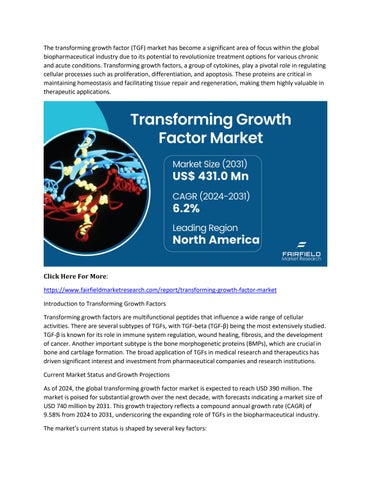
The transforming growth factor (TGF) market has become a significant area of focus within the global biopharmaceutical industry due to its potential to revolutionize treatment options for various chronic and acute conditions. Transforming growth factors, a group of cytokines, play a pivotal role in regulating cellular processes such as proliferation, differentiation, and apoptosis. These proteins are critical in maintaining homeostasis and facilitating tissue repair and regeneration, making them highly valuable in therapeutic applications.
𝐂𝐥𝐢𝐜𝐤 𝐇𝐞𝐫𝐞 𝐅𝐨𝐫 𝐌𝐨𝐫𝐞: https://www.fairfieldmarketresearch.com/report/transforming-growth-factor-market Introduction to Transforming Growth Factors Transforming growth factors are multifunctional peptides that influence a wide range of cellular activities. There are several subtypes of TGFs, with TGF-beta (TGF-β) being the most extensively studied. TGF-β is known for its role in immune system regulation, wound healing, fibrosis, and the development of cancer. Another important subtype is the bone morphogenetic proteins (BMPs), which are crucial in bone and cartilage formation. The broad application of TGFs in medical research and therapeutics has driven significant interest and investment from pharmaceutical companies and research institutions. Current Market Status and Growth Projections As of 2024, the global transforming growth factor market is expected to reach USD 390 million. The market is poised for substantial growth over the next decade, with forecasts indicating a market size of USD 740 million by 2031. This growth trajectory reflects a compound annual growth rate (CAGR) of 9.58% from 2024 to 2031, underscoring the expanding role of TGFs in the biopharmaceutical industry. The market's current status is shaped by several key factors: