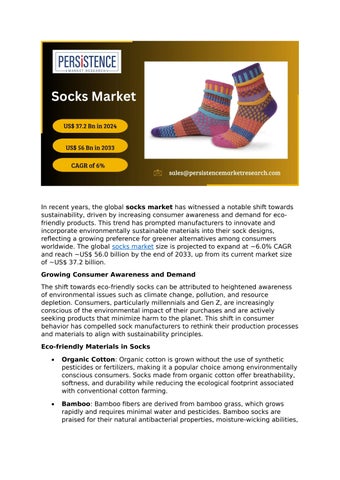
In recent years, the global socks market has witnessed a notable shift towards sustainability, driven by increasing consumer awareness and demand for ecofriendly products. This trend has prompted manufacturers to innovate and incorporate environmentally sustainable materials into their sock designs, reflecting a growing preference for greener alternatives among consumers worldwide. The global socks market size is projected to expand at ~6.0% CAGR and reach ~US$ 56.0 billion by the end of 2033, up from its current market size of ~US$ 37.2 billion. Growing Consumer Awareness and Demand The shift towards eco-friendly socks can be attributed to heightened awareness of environmental issues such as climate change, pollution, and resource depletion. Consumers, particularly millennials and Gen Z, are increasingly conscious of the environmental impact of their purchases and are actively seeking products that minimize harm to the planet. This shift in consumer behavior has compelled sock manufacturers to rethink their production processes and materials to align with sustainability principles. Eco-friendly Materials in Socks
Organic Cotton: Organic cotton is grown without the use of synthetic pesticides or fertilizers, making it a popular choice among environmentally conscious consumers. Socks made from organic cotton offer breathability, softness, and durability while reducing the ecological footprint associated with conventional cotton farming.
Bamboo: Bamboo fibers are derived from bamboo grass, which grows rapidly and requires minimal water and pesticides. Bamboo socks are praised for their natural antibacterial properties, moisture-wicking abilities,