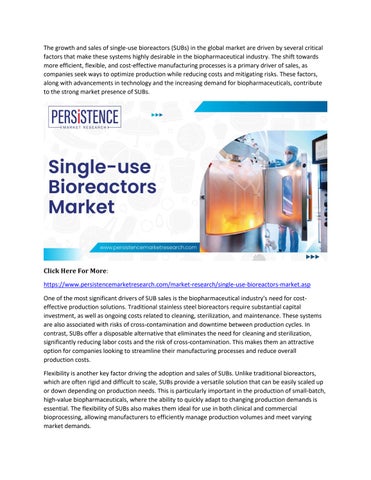
The growth and sales of single-use bioreactors (SUBs) in the global market are driven by several critical factors that make these systems highly desirable in the biopharmaceutical industry. The shift towards more efficient, flexible, and cost-effective manufacturing processes is a primary driver of sales, as companies seek ways to optimize production while reducing costs and mitigating risks. These factors, along with advancements in technology and the increasing demand for biopharmaceuticals, contribute to the strong market presence of SUBs.
𝐂𝐥𝐢𝐜𝐤 𝐇𝐞𝐫𝐞 𝐅𝐨𝐫 𝐌𝐨𝐫𝐞: https://www.persistencemarketresearch.com/market-research/single-use-bioreactors-market.asp One of the most significant drivers of SUB sales is the biopharmaceutical industry's need for costeffective production solutions. Traditional stainless steel bioreactors require substantial capital investment, as well as ongoing costs related to cleaning, sterilization, and maintenance. These systems are also associated with risks of cross-contamination and downtime between production cycles. In contrast, SUBs offer a disposable alternative that eliminates the need for cleaning and sterilization, significantly reducing labor costs and the risk of cross-contamination. This makes them an attractive option for companies looking to streamline their manufacturing processes and reduce overall production costs. Flexibility is another key factor driving the adoption and sales of SUBs. Unlike traditional bioreactors, which are often rigid and difficult to scale, SUBs provide a versatile solution that can be easily scaled up or down depending on production needs. This is particularly important in the production of small-batch, high-value biopharmaceuticals, where the ability to quickly adapt to changing production demands is essential. The flexibility of SUBs also makes them ideal for use in both clinical and commercial bioprocessing, allowing manufacturers to efficiently manage production volumes and meet varying market demands.