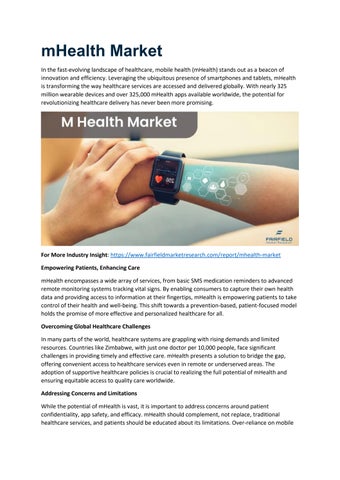
mHealth Market In the fast-evolving landscape of healthcare, mobile health (mHealth) stands out as a beacon of innovation and efficiency. Leveraging the ubiquitous presence of smartphones and tablets, mHealth is transforming the way healthcare services are accessed and delivered globally. With nearly 325 million wearable devices and over 325,000 mHealth apps available worldwide, the potential for revolutionizing healthcare delivery has never been more promising.
For More Industry Insight: https://www.fairfieldmarketresearch.com/report/mhealth-market Empowering Patients, Enhancing Care mHealth encompasses a wide array of services, from basic SMS medication reminders to advanced remote monitoring systems tracking vital signs. By enabling consumers to capture their own health data and providing access to information at their fingertips, mHealth is empowering patients to take control of their health and well-being. This shift towards a prevention-based, patient-focused model holds the promise of more effective and personalized healthcare for all. Overcoming Global Healthcare Challenges In many parts of the world, healthcare systems are grappling with rising demands and limited resources. Countries like Zimbabwe, with just one doctor per 10,000 people, face significant challenges in providing timely and effective care. mHealth presents a solution to bridge the gap, offering convenient access to healthcare services even in remote or underserved areas. The adoption of supportive healthcare policies is crucial to realizing the full potential of mHealth and ensuring equitable access to quality care worldwide. Addressing Concerns and Limitations While the potential of mHealth is vast, it is important to address concerns around patient confidentiality, app safety, and efficacy. mHealth should complement, not replace, traditional healthcare services, and patients should be educated about its limitations. Over-reliance on mobile