
Green Ammonia Market Introduction & Size Analysis:
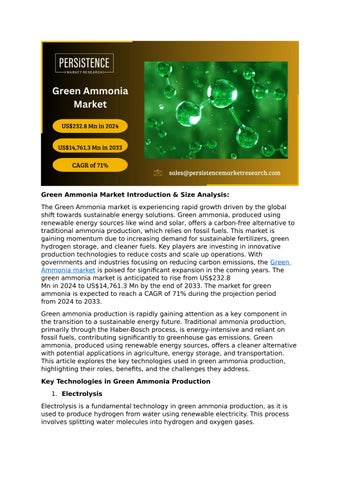
The Green Ammonia market is experiencing rapid growth driven by the global shift towards sustainable energy solutions. Green ammonia, produced using renewable energy sources like wind and solar, offers a carbon-free alternative to traditional ammonia production, which relies on fossil fuels. This market is gaining momentum due to increasing demand for sustainable fertilizers, green hydrogen storage, and cleaner fuels. Key players are investing in innovative production technologies to reduce costs and scale up operations. With governments and industries focusing on reducing carbon emissions, the Green Ammonia market is poised for significant expansion in the coming years. The green ammonia market is anticipated to rise from US$232.8 Mn in 2024 to US$14,761.3 Mn by the end of 2033. The market for green ammonia is expected to reach a CAGR of 71% during the projection period from 2024 to 2033.
Green ammonia production is rapidly gaining attention as a key component in the transition to a sustainable energy future. Traditional ammonia production, primarily through the Haber-Bosch process, is energy-intensive and reliant on fossil fuels, contributing significantly to greenhouse gas emissions. Green ammonia, produced using renewable energy sources, offers a cleaner alternative with potential applications in agriculture, energy storage, and transportation. This article explores the key technologies used in green ammonia production, highlighting their roles, benefits, and the challenges they address.
Key Technologies in Green Ammonia Production
1. Electrolysis
Electrolysis is a fundamental technology in green ammonia production, as it is used to produce hydrogen from water using renewable electricity. This process involves splitting water molecules into hydrogen and oxygen gases.
Proton Exchange Membrane (PEM) Electrolysis: PEM electrolysis uses a solid polymer electrolyte to conduct protons between the anode and cathode. This technology is known for its high efficiency, rapid response to fluctuations in power supply, and compact design. PEM electrolyzers are well-suited for integrating with intermittent renewable energy sources like wind and solar power.
Alkaline Electrolysis: This traditional electrolysis method uses an alkaline electrolyte, such as potassium hydroxide or sodium hydroxide, to facilitate the reaction. Alkaline electrolyzers are known for their long operational life and lower capital costs compared to PEM electrolyzers. However, they are less responsive to power fluctuations and have a larger footprint.
Solid Oxide Electrolysis: Solid oxide electrolysis uses a solid ceramic electrolyte to conduct oxygen ions. This technology operates at high temperatures, which allows it to achieve high efficiency and potentially lower energy costs. Solid oxide electrolysis is still in the development phase but shows promise for large-scale green ammonia production.
2. Renewable Energy Integration
Green ammonia production relies on renewable energy sources to power the electrolysis process. Key renewable energy technologies include:
Solar Photovoltaics (PV): Solar PV systems convert sunlight directly into electricity using semiconductor materials. Solar energy is abundant and scalable, making it a viable option for green ammonia production, especially in sunny regions.
Wind Power: Wind turbines harness the kinetic energy of wind to generate electricity. Wind power is a mature and widely used technology, with the potential to provide significant amounts of renewable electricity for green ammonia production, particularly in windy regions.
Hydropower: Hydropower utilizes the energy from flowing water to generate electricity. It provides a stable and reliable source of renewable energy, making it suitable for continuous green ammonia production operations.
Geothermal Energy: Geothermal energy comes from the heat stored beneath the Earth's surface. It can be used to generate electricity or directly supply heat for the ammonia synthesis process. Geothermal energy offers a consistent and reliable source of renewable power.
3. Hydrogen Storage and Handling
Efficient hydrogen storage and handling are crucial for green ammonia production, as hydrogen needs to be transported and stored before being used in the ammonia synthesis process.
Compressed Hydrogen Storage: Hydrogen can be stored as a compressed gas in high-pressure cylinders or tanks. This method is well-established and widely used, but it requires energy-intensive compression and poses safety challenges due to hydrogen's flammability.
Liquid Hydrogen Storage: Hydrogen can be stored as a liquid at extremely low temperatures (-253°C). Liquid hydrogen has a higher energy density compared to compressed hydrogen, but the liquefaction process is energy-intensive and requires specialized storage infrastructure.
Metal Hydrides: Metal hydrides are chemical compounds that can absorb and release hydrogen. They offer a compact and potentially safer storage solution compared to compressed or liquid hydrogen, but their use is still limited and requires further development.
Chemical Hydrides: Chemical hydrides, such as ammonia borane, can store hydrogen in a solid chemical form. They release hydrogen through chemical reactions and offer high storage density, but they involve complex handling and regeneration processes.
4. Ammonia Synthesis Technologies
The synthesis of ammonia from hydrogen and nitrogen is a critical step in green ammonia production. Several technologies are employed in this process:
Haber-Bosch Process: The Haber-Bosch process is the conventional method for ammonia synthesis, combining hydrogen and nitrogen under high pressure and temperature with a catalyst. While it is highly efficient and well-established, it is not inherently green. To produce green ammonia, the hydrogen used must come from renewable sources.
Electrochemical Ammonia Synthesis: This emerging technology involves synthesizing ammonia directly from hydrogen and nitrogen using an electrochemical cell. Electrochemical synthesis operates at lower temperatures and pressures compared to the Haber-Bosch process, potentially reducing energy consumption and costs.
Plasma-Assisted Ammonia Synthesis: Plasma-assisted ammonia synthesis uses high-energy plasma to activate nitrogen and hydrogen molecules, facilitating their reaction to form ammonia. This technology operates at lower temperatures and pressures than traditional methods and offers potential for improved efficiency.
Catalytic Ammonia Synthesis: Researchers are exploring advanced catalysts and reaction conditions to enhance the efficiency of ammonia synthesis. Innovations in catalyst materials and designs aim to reduce energy requirements and improve the overall sustainability of the process.
5. Carbon Capture and Storage (CCS)
Although green ammonia production aims to minimize carbon emissions, integrating carbon capture and storage (CCS) technologies can further enhance sustainability by capturing and storing any residual CO2 emissions from the production process.
Post-Combustion Capture: This method involves capturing CO2 from flue gases after the combustion of fossil fuels. It is widely used in industrial applications and can be adapted for use in green ammonia production facilities to capture any CO2 generated.
Pre-Combustion Capture: Pre-combustion capture involves removing CO2 from fossil fuels before combustion. This technology can be integrated into processes that use fossil fuels as part of the ammonia production process, ensuring that CO2 emissions are minimized.
Direct Air Capture: Direct air capture (DAC) technology captures CO2 directly from the atmosphere. While still relatively expensive, DAC offers the potential for offsetting emissions and enhancing the sustainability of green ammonia production.
6. Energy Management and Optimization
Effective energy management and optimization are essential for maximizing the efficiency and sustainability of green ammonia production. Technologies in this area include:
Energy Storage Systems: Energy storage systems, such as batteries and thermal storage, help manage the intermittency of renewable energy sources. They store excess energy during periods of high generation and release it when needed, ensuring a stable power supply for the electrolysis process.
Demand Response Technologies: Demand response technologies enable production facilities to adjust their energy consumption based on grid conditions and electricity prices. By optimizing energy use, these technologies help reduce costs and enhance the efficiency of green ammonia production.
Energy Management Systems (EMS): EMS solutions monitor and control energy use within production facilities. They provide real-time data and analytics, enabling operators to optimize energy consumption, reduce waste, and improve overall efficiency.
Challenges and Future Directions
While the technologies used in green ammonia production offer significant benefits, several challenges need to be addressed to achieve widespread adoption:
Cost: The initial capital costs for renewable energy systems, electrolysis equipment, and advanced ammonia synthesis technologies can be high. Reducing costs through technological advancements, economies of scale, and supportive policies will be crucial for making green ammonia competitive with conventional ammonia.
Infrastructure: Developing the necessary infrastructure for renewable energy integration, hydrogen storage, and ammonia distribution requires substantial investment and planning. Coordinated efforts between governments, industries, and stakeholders will be essential to build and scale the required infrastructure.
Efficiency and Scalability: Enhancing the efficiency and scalability of green ammonia production technologies is critical for meeting growing demand and achieving sustainability goals. Continued research and development efforts are needed to improve process efficiencies, reduce energy consumption, and optimize overall performance.
Regulatory and Policy Support: Supportive regulatory frameworks and policies are essential for driving the adoption of green ammonia technologies. Governments and policymakers need to provide incentives, establish standards, and create supportive environments to encourage investment and innovation in green ammonia production.
Conclusion
Green ammonia production represents a transformative shift towards sustainable and environmentally friendly chemical manufacturing. By leveraging key technologies such as electrolysis, renewable energy integration, hydrogen storage, ammonia synthesis, and carbon capture, the industry is advancing towards a cleaner future. Despite the challenges, ongoing innovations and supportive policies hold the promise of making green ammonia a cornerstone of a sustainable energy landscape. As technology continues to evolve and scale, green ammonia has the potential to revolutionize various sectors, offering a cleaner and more sustainable alternative to traditional ammonia production methods.
Follow Us: LinkedIn | Medium | Twitter