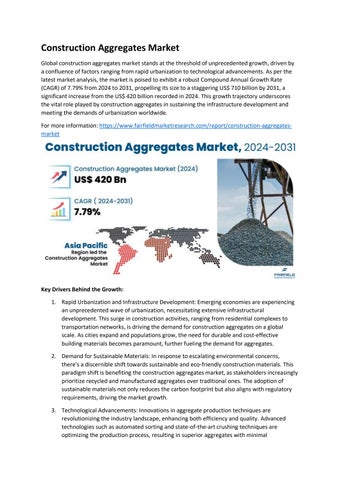
Construction Aggregates Market Global construction aggregates market stands at the threshold of unprecedented growth, driven by a confluence of factors ranging from rapid urbanization to technological advancements. As per the latest market analysis, the market is poised to exhibit a robust Compound Annual Growth Rate (CAGR) of 7.79% from 2024 to 2031, propelling its size to a staggering US$ 710 billion by 2031, a significant increase from the US$ 420 billion recorded in 2024. This growth trajectory underscores the vital role played by construction aggregates in sustaining the infrastructure development and meeting the demands of urbanization worldwide. For more information: https://www.fairfieldmarketresearch.com/report/construction-aggregatesmarket
Key Drivers Behind the Growth: 1. Rapid Urbanization and Infrastructure Development: Emerging economies are experiencing an unprecedented wave of urbanization, necessitating extensive infrastructural development. This surge in construction activities, ranging from residential complexes to transportation networks, is driving the demand for construction aggregates on a global scale. As cities expand and populations grow, the need for durable and cost-effective building materials becomes paramount, further fueling the demand for aggregates. 2. Demand for Sustainable Materials: In response to escalating environmental concerns, there's a discernible shift towards sustainable and eco-friendly construction materials. This paradigm shift is benefiting the construction aggregates market, as stakeholders increasingly prioritize recycled and manufactured aggregates over traditional ones. The adoption of sustainable materials not only reduces the carbon footprint but also aligns with regulatory requirements, driving the market growth. 3. Technological Advancements: Innovations in aggregate production techniques are revolutionizing the industry landscape, enhancing both efficiency and quality. Advanced technologies such as automated sorting and state-of-the-art crushing techniques are optimizing the production process, resulting in superior aggregates with minimal