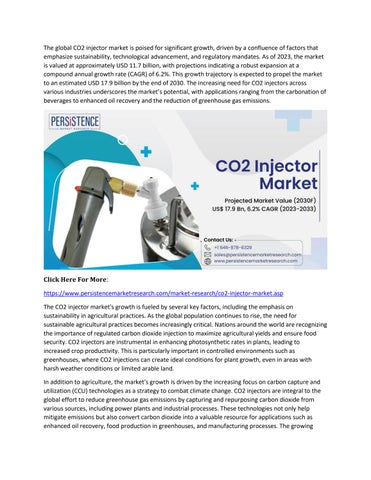
The global CO2 injector market is poised for significant growth, driven by a confluence of factors that emphasize sustainability, technological advancement, and regulatory mandates. As of 2023, the market is valued at approximately USD 11.7 billion, with projections indicating a robust expansion at a compound annual growth rate (CAGR) of 6.2%. This growth trajectory is expected to propel the market to an estimated USD 17.9 billion by the end of 2030. The increasing need for CO2 injectors across various industries underscores the market’s potential, with applications ranging from the carbonation of beverages to enhanced oil recovery and the reduction of greenhouse gas emissions.
𝐂𝐥𝐢𝐜𝐤 𝐇𝐞𝐫𝐞 𝐅𝐨𝐫 𝐌𝐨𝐫𝐞: https://www.persistencemarketresearch.com/market-research/co2-injector-market.asp The CO2 injector market's growth is fueled by several key factors, including the emphasis on sustainability in agricultural practices. As the global population continues to rise, the need for sustainable agricultural practices becomes increasingly critical. Nations around the world are recognizing the importance of regulated carbon dioxide injection to maximize agricultural yields and ensure food security. CO2 injectors are instrumental in enhancing photosynthetic rates in plants, leading to increased crop productivity. This is particularly important in controlled environments such as greenhouses, where CO2 injections can create ideal conditions for plant growth, even in areas with harsh weather conditions or limited arable land. In addition to agriculture, the market's growth is driven by the increasing focus on carbon capture and utilization (CCU) technologies as a strategy to combat climate change. CO2 injectors are integral to the global effort to reduce greenhouse gas emissions by capturing and repurposing carbon dioxide from various sources, including power plants and industrial processes. These technologies not only help mitigate emissions but also convert carbon dioxide into a valuable resource for applications such as enhanced oil recovery, food production in greenhouses, and manufacturing processes. The growing