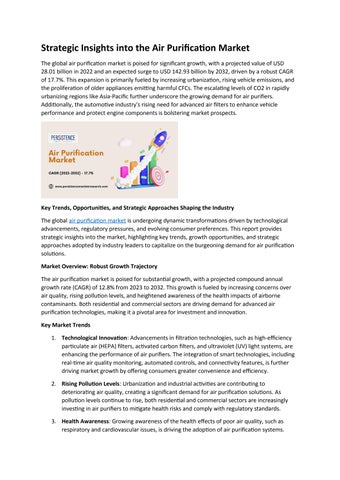
Strategic Insights into the Air Purification Market The global air purification market is poised for significant growth, with a projected value of USD 28.01 billion in 2022 and an expected surge to USD 142.93 billion by 2032, driven by a robust CAGR of 17.7%. This expansion is primarily fueled by increasing urbanization, rising vehicle emissions, and the proliferation of older appliances emitting harmful CFCs. The escalating levels of CO2 in rapidly urbanizing regions like Asia-Pacific further underscore the growing demand for air purifiers. Additionally, the automotive industry's rising need for advanced air filters to enhance vehicle performance and protect engine components is bolstering market prospects.
Key Trends, Opportunities, and Strategic Approaches Shaping the Industry The global air purification market is undergoing dynamic transformations driven by technological advancements, regulatory pressures, and evolving consumer preferences. This report provides strategic insights into the market, highlighting key trends, growth opportunities, and strategic approaches adopted by industry leaders to capitalize on the burgeoning demand for air purification solutions. Market Overview: Robust Growth Trajectory The air purification market is poised for substantial growth, with a projected compound annual growth rate (CAGR) of 12.8% from 2023 to 2032. This growth is fueled by increasing concerns over air quality, rising pollution levels, and heightened awareness of the health impacts of airborne contaminants. Both residential and commercial sectors are driving demand for advanced air purification technologies, making it a pivotal area for investment and innovation. Key Market Trends 1. Technological Innovation: Advancements in filtration technologies, such as high-efficiency particulate air (HEPA) filters, activated carbon filters, and ultraviolet (UV) light systems, are enhancing the performance of air purifiers. The integration of smart technologies, including real-time air quality monitoring, automated controls, and connectivity features, is further driving market growth by offering consumers greater convenience and efficiency. 2. Rising Pollution Levels: Urbanization and industrial activities are contributing to deteriorating air quality, creating a significant demand for air purification solutions. As pollution levels continue to rise, both residential and commercial sectors are increasingly investing in air purifiers to mitigate health risks and comply with regulatory standards. 3. Health Awareness: Growing awareness of the health effects of poor air quality, such as respiratory and cardiovascular issues, is driving the adoption of air purification systems.