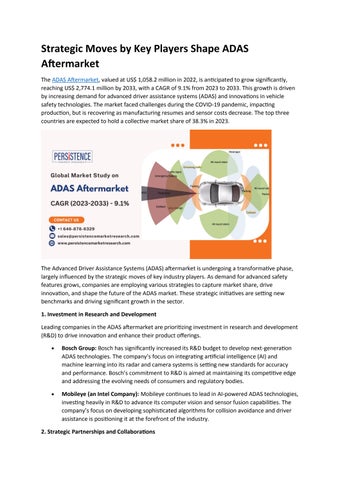
Strategic Moves by Key Players Shape ADAS Aftermarket The ADAS Aftermarket, valued at US$ 1,058.2 million in 2022, is anticipated to grow significantly, reaching US$ 2,774.1 million by 2033, with a CAGR of 9.1% from 2023 to 2033. This growth is driven by increasing demand for advanced driver assistance systems (ADAS) and innovations in vehicle safety technologies. The market faced challenges during the COVID-19 pandemic, impacting production, but is recovering as manufacturing resumes and sensor costs decrease. The top three countries are expected to hold a collective market share of 38.3% in 2023.
The Advanced Driver Assistance Systems (ADAS) aftermarket is undergoing a transformative phase, largely influenced by the strategic moves of key industry players. As demand for advanced safety features grows, companies are employing various strategies to capture market share, drive innovation, and shape the future of the ADAS market. These strategic initiatives are setting new benchmarks and driving significant growth in the sector. 1. Investment in Research and Development Leading companies in the ADAS aftermarket are prioritizing investment in research and development (R&D) to drive innovation and enhance their product offerings.
Bosch Group: Bosch has significantly increased its R&D budget to develop next-generation ADAS technologies. The company’s focus on integrating artificial intelligence (AI) and machine learning into its radar and camera systems is setting new standards for accuracy and performance. Bosch’s commitment to R&D is aimed at maintaining its competitive edge and addressing the evolving needs of consumers and regulatory bodies.
Mobileye (an Intel Company): Mobileye continues to lead in AI-powered ADAS technologies, investing heavily in R&D to advance its computer vision and sensor fusion capabilities. The company’s focus on developing sophisticated algorithms for collision avoidance and driver assistance is positioning it at the forefront of the industry.
2. Strategic Partnerships and Collaborations