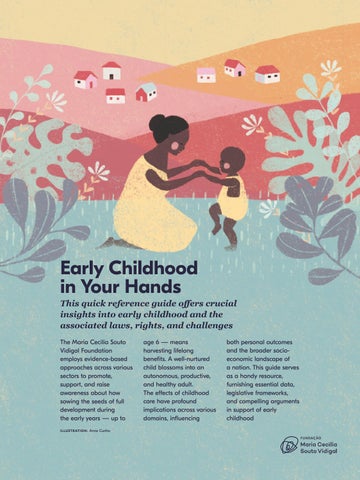
This quick reference guide offers crucial insights into early childhood and the associated laws, rights, and challenges
The Maria Cecilia Souto Vidigal Foundation employs evidence-based approaches across various sectors to promote, support, and raise awareness about how sowing the seeds of full development during the early years — up to
ILLUSTRATION: Anna Cunha
age 6 — means harvesting lifelong benefits. A well-nurtured child blossoms into an autonomous, productive, and healthy adult. The effects of childhood care have profound implications across various domains, influencing both personal outcomes and the broader socioeconomic landscape of a nation. This guide serves as a handy resource, furnishing essential data, legislative frameworks, and compelling arguments in support of early childhood
With 60 years of history, the Maria Cecilia Souto Vidigal Foundation has been committed since 2007 to ensuring that children in early childhood have the right to reach their full potential and are made a national priority
Mission
UN 2030 Agenda SDG 4.2
“By 2030, ensure that all girls and boys have access to quality early childhood development, care and pre-primary education so that they are ready for primary education”
Strategy
Advancing public policies and mobilizing society for early childhood
0.2% of Asian descent 1 ... who account for 8.9% of the entire population 18.1 million THIS REPRESENTS THE NUMBER OF CHILDREN aged 0 to 6 in Brazil...
ESSENTIAL, BUT UNKNOWN
Despite its enormous importance for the development of individuals and society, early childhood is still poorly understood in Brazil, as shown by ‘Panorama da Primeira Infância’ (‘Early Childhood Overview’), a public opinion survey commissioned by the Maria Cecilia Souto Vidigal Foundation and conducted by Datafolha. The survey revealed that: 2
42% of the Brazilian population DOES NOT KNOW WHAT THE TERM “EARLY CHILDHOOD” MEANS
Only 2% CORRECTLY ANSWER THAT EARLY CHILDHOOD IS FROM 0 TO 6 YEARS OLD, when asked about the age range of this phase
54% AFFIRM THAT CHILDREN HAVE RIGHTS guaranteed by law, which must be ensured by the family, society, and the federal government
However, 20% believe that only the family should decide what is best for children, WITHOUT INTERFERENCE FROM THE LAW
10 million children aged 0 to 6, or 55.4% of all registered children in this age group, LIVE IN LOW-INCOME FAMILIES, defined as having a monthly per capita income of up to half the minimum wage
73.8% OF FAMILIES WITH CHILDREN IN EARLY CHILDHOOD ARE SINGLEPARENT HOUSEHOLDS , predominantly led by Black individuals (74.3%) and those aged between 25 and 34 years (47.9%)*
8 out of 10 babies and children aged 0 to 6 living in lowincome families in Brazil HAVE THE BOLSA FAMÍLIA INCOME-TRANSFER PROGRAM AS THEIR MAIN SOURCE OF INCOME * 3
1 Demographic Census, Brazilian Institute of Geography and Statistics (IBGE), 2022 2 Panorama da Primeira Infância: O que o Brasil sabe, vive e pensa sobre os primeiros seis anos de vida, Fundação Maria Cecilia Souto Vidigal, 2025 3 Perfil Síntese da Primeira Infância e Famílias no Cadastro Único, Fundação Maria Cecilia Souto Vidigal e Ministério do Desenvolvimento, Assistência Social, Família e Combate à Fome, 2024 | * Excludes children who are part of Traditional and Specific Population Groups (GPTEs in it’s Portuguese acronym), including street children, Indigenous peoples, Quilombolas, and others
PROTECTION ON THE DECLINE
Vaccination coverage for crucial early childhood immunizations like BCG, pentavalent, MMR, and hepatitis B (percentage rates)
SOURCE: Brazilian Ministry of Health | Survey: Todos pela Educação, 2024
Among low-income families (those with a monthly per capita income of up to half the minimum wage) with children aged 0 to 6, 29% OF CAREGIVERS EITHER DO NOT ATTEND SCHOOL or have not completed elementary education, and 3.5% ARE ILLITERATE 4
in 3 babies and children
0 to 4 FACES
Nearly 400,000 children under the age of 5 ARE OVERWEIGHT 6
12.3% of babies born each year in Brazil are born to TEENAGE MOTHERS (up to 19 years old), with higher rates in the North (19.7%) and Northeast (14.9%) regions 7
9.5% of children ARE BORN UNDERWEIGHT (less than 2.5 kg) 8
4 Perfil Sistêmico da Primeira Infância e Famílias no Cadastro Único, Fundação Maria Cecilia Souto Vidigal and the Ministério do Desenvolvimento Social, Família e Combate à Fome, 2024
5 Pnad Continua Segurança Alimentar, IBGE, 2024 6 , 7 and 8 Ministério da Saúde | Survey: Fundação Abrinq, 2022
10.3% of all reported rape victims are UNDER 4 YEARS OLD
About 84% of cases involve a RELATIVE OR ACQUAINTANCE as the agressor
SOURCE: Anuário Brasileiro da Segurança Pública 2025, Fórum Brasileiro de Segurança Pública
THE CHALLENGE REMAINS SIGNIFICANT... Evolution of the infant mortality rate (per thousand live births up to 1 year)
24.9 2002
SOURCE: Sistema de Informações sobre Mortalidade – SIM/Ministério da Saúde
...THE MAJORITY ARE AMONG INDIGENOUS CHILDREN
SOURCE: Desigualdades em saúde de crianças indígenas, Comitê Científico do Núcleo Ciência Pela Infância, 2024
Child Development
Understanding how care and the environment influence brain development underscores the critical importance of the first few years of life
THE IMPACT OF STIMULI
A child’s full development is deeply influenced by their interactions with the world
talking, Playing, and reading to infants and toddlers singing,
provides them with the best stimuli for learning. Children who receive consistent attention from caregivers from an early age and interact in a secure environment tend to be emotionally healthier and develop advanced motor, cognitive, and socio-emotional skills
THE EMOTIONAL BOND THAT FORMS THROUGH CONSISTENT CAREGIVING is vital for a child’s emotional development 1
BRAIN DEVELOPMENT BEGINS EVEN BEFORE BIRTH. CARE DURING PREGNANCY IS CRUCIAL, as many vital structures are actively forming and maturing 2
LIVING IN ENVIRONMENTS CHARACTERIZED BY VIOLENCE, POVERTY, ABUSE, AND NEGLECT can lead to changes that adversely impact a child over their academic careers 3
1 and 3 Importância dos vínculos familiares na primeira infância, Núcleo Ciência Pela Infância, 2016 2 De Casper, A. J.; Fifer, W.P., Of human bonding: newborn prefer their mothers’ voices. Science, 1980
While
the brain retains the plasticity to learn throughout life, the speed of learning peaks during early childhood 4
IN THE FIRST FEW YEARS OF LIFE, brain connections form at a rate of 1 million per second, making this the most critical phase for neurological development 5
of a child’s brain connections have already formed by age 6
6
DESPITE THIS BODY OF EVIDENCE, THE BRAZILIAN POPULATION STILL DOES NOT ASSOCIATE EARLY CHILDHOOD WITH THE PERIOD OF GREATEST DEVELOPMENTAL POTENTIAL: 7
Only 15%
identify early childhood
as the stage marked by the most significant physical, emotional, and learning development
For the majority (84%), this peak of development is perceived as occurring later in life, particularly during adolescence (25%) or adulthood (41%)
4 Singer W., Development and plasticity of cortical processing architectures science, 1995 5 Center on the Developing Child at Harvard University, In brief: the science of early childhood development, 2007 6 United Nations Children’s Fund (Unicef), Annual Report of the United Nations Children’s Fund, Brazil, 2006 7 Panorama da Primeira Infância: O que o Brasil sabe, vive e pensa sobre os primeiros seis anos de vida, Fundação Maria Cecilia Souto Vidigal, 2025
ESSENTIAL NEEDS FOR EARLY CHILDHOOD:
GOOD HEALTH
Includes physical and emotional Monitoring, disease prevention, access to healthcare services, and promotion of wellness activities
PROPER NUTRITION
Balanced nutrition during pregnancy, exclusive breastfeeding for at least the first six months, and food security for the family
RESPONSIVE CAREGIVING
Focuses on guiding caregivers to foster strong bonds and provide proper care for children
SAFETY AND SECURITY
Protects against poverty and mistreatment and supports caregivers
EARLY CHILDHOOD EDUCATION
Ensures access to services and activities that promote development
These elements comprise Nurturing Care, which integrates five critical components to support holistic development in early childhood. This model also serves as a crucial framework for public policies targeting young children
SOURCE: World Health Organization (WHO), Unicef, and World Bank
Play is serious business
Early childhood is shaped by play and interaction with the world. Through play, children grow, activate their imagination, move their bodies, and learn to relate to others and their environment
Above all, play is a right
Just as life, equality, and safety are fundamental rights of all citizens, play is a right guaranteed to children by Brazil’s 1988 Federal Constitution and the 1990 ‘Estatuto da Criança e do Adolescente’ (‘Child and Adolescent Statute’ – ECA), which recognizes “play, sports, and recreation” as expressions of the right to freedom.
The 2016 Legal Framework on Early Childhood further establishes that the federal government must ensure adequate and safe public spaces for play. It also requires that children’s voices be heard and considered in the planning and maintenance of these spaces.
Brazil’s National Learning Standards (BNCC), which define the essential learning content for each stage of basic education, recognize play as one of the six learning and development rights to be guaranteed in early childhood education.
EVERY CHILD NEEDS:
To imagine Create stories and characters, exploring make-believe and creativity
Social interaction
Engage with other children and adults, learning to share and show respect
To move Run, jump, dance, and navigate their surroundings, developing motor skills
Safe spaces
Play in environments that foster freedom, free of hazards or restrictions
Curiosity
Experiment with materials, discovering textures, sounds, and colors
A lack of time and space to play can hinder a child’s development and compromise their social and emotional well-being
SOURCE: Brincar ajuda o desenvolvimento: O que fazer?, Fundação Maria Cecilia Souto Vidigal, 2015
Playing from the first months of life is essential.
Even in the absence of toys, babies can play by engaging with their caregivers’ gaze, voice, and touch 2
May 28
INTERNATIONAL DAY OF PLAY
Established in 1999 and recognized by the United Nations Children’s Fund (Unicef), this date marks the beginning of Play Week — an initiative celebrated in countries such as Brazil to raise awareness of play as an essential right
THE PRIMARY PURPOSE OF PLAY IS TO PROVIDE ENJOYMENT AND PLEASURE — NOT NECESSARILY LEARNING. HOWEVER, IT IS THROUGH PLAY THAT CHILDREN LEARN MORE EFFECTIVELY AND WITH GREATER DEPTH. IT IS BY PLAYING THAT THEY EXPLORE THE WORLD AROUND THEM AND CONNECT WITH THEMSELVES 1
ADULTS PLAY A VITAL ROLE IN CHILDREN’S PLAY. THEY PROVIDE AFFECTION AND HELP BUILD BONDS OF SECURITY AND LOVE. WHILE ADULT INVOLVEMENT IS IMPORTANT, IT IS EQUALLY ESSENTIAL THAT CHILDREN HAVE OPPORTUNITIES TO PLAY ALONE AND WITH PEERS 3
A Brazilian study assessed a home visitation program that encouraged low-income mothers with limited formal education, play and talk more with their babies, fostering attention and speech development. Compared with the control group, these mothers demonstrated a greater ability to interpret their babies’ communicative signals and were less intrusive, which led their children to vocalize more frequently during interactions 4
According to the Panorama da Primeira Infância survey, a significant portion of the population still does not associate free play with child development. Among a list of 13 activities, play ranked 10th, and was considered essential by only 63% of Brazilians 5
1 e 3 Nota 10 - Primeira Infância: Brincar é coisa séria, Fundação Maria Cecilia Souto Vidigal, 2012
2 Brincar ajuda o desenvolvimento: O que fazer?, Fundação Maria Cecilia Souto Vidigal, 2015
4 Alvarenga, Patrícia; Mães que recebem orientações em visitas domiciliares sobre como brincar e se comunicar com seus bebês fortalecem o desenvolvimento dos filhos, Núcleo Ciência Pela Infância (NCPI), 2023 5 Panorama da Primeira Infância: O que o Brasil sabe, vive e pensa sobre os primeiros seis anos de vida, Fundação Maria Cecilia Souto Vidigal, 2025
Why invest in Early Childhood
Studies and research from around the globe have proven the economic, social, and health benefits of investing in early childhood
SCIENTIFICALLY SUPPORTED
Enhancing the living conditions of vulnerable children from an early age — by ensuring access to
health, safety, nutrition, affection, and high-quality education
significantly boosts their prospects for a better present and future
NOBEL PRIZE-WINNING AMERICAN ECONOMIST
James Heckman asserts that every dollar invested in high-quality early childhood programs yields a return of seven dollars annually
SOURCE: heckmanequation.org
HIGHER SALARIES, ON AVERAGE, for children from disadvantaged backgrounds who attend high-quality daycare centers compared to those who do not have the same opportunities
SOURCE: Heckman, J.; Gertler, P. et al., Labor market returns to an early childhood stimulation intervention in Jamaica, 2014
HIGH-QUALITY EARLY CHILDHOOD EDUCATION
boosts socio-emotional skills and contributes to reducing emotional issues: 1
less likelihood of individuals committing violent crimes
less chance of incarceration less unemployment risk
Children in early childhood who receive holistic developmental support experience:
physical and mental health in adulthood learning conditions professional and income opportunities
tendencies towards smoking, alcoholism, crime, and violence chances of teenage pregnancy 2
BRAZIL FAILS TO FULLY DEVELOP 40% of its children’s potential. The national GDP could increase by 158% if all Brazilian children were enabled to develop their skills to their fullest potential 3
LASTING IMPACT OF INVESTMENTS
A longitudinal study tracking individuals from early childhood into middle age demonstrates the enduring benefits of holistic developmental support. At the age of 54, these children were healthier than 80% of the children in the other group and earned an average of $10,000 more per year 4
1 Sneha, E.; Hojman, A.; García, J.L. e Heckman, J., Early childhood education, 2016
2 O impacto do desenvolvimento na primeira infância sobre a aprendizagem, Comitê Científico do Núcleo Ciência Pela Infância, 2014 3 Banco Mundial, 2022 4 García, J.L; Heckman, J.; e Ronda, V., The Lasting Effects of Early Childhood Education on Promoting the Skills and Social Mobility of Disadvantaged African Americans, 2021
In
the
long term, children who receive fewer
developmental opportunities during early childhood are at a higher risk of becoming impoverished adults, perpetuating what is known as the intergenerational cycle of poverty
CREATING A SOCIETY with more equal opportunities requires that public policies emphasize integrated actions focused specifically on the first few years of life
Brazil’s Early Childhood Education Landscape
Fostering family awareness of early childhood education benefits, increasing availability, and enhancing quality remain key challenges
GOALS FOR CHILDCARE AND PRESCHOOL
ACCESS TO EARLY CHILDHOOD EDUCATION is recognized as a fundamental right for children and families, as guaranteed by the Federal Constitution of 1988
The National Education Plan (2014–2024) aimed for universal preschool enrollment for children aged 4 to 5 by 2016 and aimed to have 50% of children aged 0 to 3 in daycare by 2024. Despite progress, these targets (percentages) have not been fully met
DISPARITIES IN ACCESS IN THE LOWEST INCOME QUINTILE, only 30% of children attend daycare
SOURCE: CBrazil’s Federal Constitution of 1988 IN THE HIGHEST INCOME QUINTILE, 55% of the children attend daycare
SOURCE: Síntese de Indicadores Sociais, IBGE, 2024
CHILDREN ELIGIBLE FOR DAYCARE face access challenges due to insufficient facilities, limited availability, or age-related enrollment restrictions 2.2 million ARE NOT ENROLLED IN PRESCHOOL despite it being a mandatory educational stage 410,000
SOURCE: Pnad Educação, IBGE, 2024
INCLUSION IS A WIDESPREAD CHALLENGE
%
of all daycare and preschool classes in Brazil struggle with inclusion and accessibility for children with disabilities, due to issues such as inadequate infrastructure and a lack of specialized training for educators
SOURCE: Estudo Nacional sobre Qualidade da Educação Infantil, Fundação Maria Cecilia Souto Vidigal, 2023
INFRASTRUCTURE: INFRASTRUCTURE GAPS
Resources available in daycares and preschools across public and private (non-affiliated) school networks in 2024 (% of units with a)
REGULATORY FRAMEWORK FOR EARLY CHILDHOOD EDUCATION:
Article 208 of Brazil’s Federal Constitution stipulates the state’s duty to ensure daycare and preschool education for children up to 5 years old
The National Education Plan (2014–2024) outlines ten directives to steer Brazilian education from 2014 to 2024
‘Lei de Diretrizes e Bases da Educação Nacional’ (‘National Education Law’ – LDB) governs the structure of Brazilian education in accordance with constitutional principles
Brazil’s National Learning Standards (BNCC) serves as a compulsory reference for developing educational curricula and pedagogical practices for early childhood, elementary, and high school education
National Quality Parameters for Early Childhood Education provide standards for the organization, management, and operation of early childhood education institutions
SOURCE: School Census, Anísio Teixeira National Institute of Educational Studies and Research (INEP), 2024
The Value of Early Childhood Education
Early childhood education is not only a fundamental right of every child but also a critical stage for fostering physical, cognitive, and socio-emotional development that carries lifelong effects. This educational phase, encompassing daycare for children aged 0 to 3 and preschool for those aged 4 to 5, is crucial for addressing inequalities and disrupting intergenerational cycles of poverty
ENDURING BENEFITS OF EARLY LEARNING
One of the longest-running studies on early childhood education is the Perry Preschool Project in Michigan, USA, led by economist James Heckman. This research tracked 123 children from low-income families who started early education at ages 3 and 4 and compared their progress into adulthood with a control group who did not receive the same educational opportunities. The findings highlighted substantial long-term benefits up to the age of 55, even extending to the children of the original participants 1
Earning over $20,000 by age 40 (*) Measure that factors in performance and turning in homework, to name a few
DAILY STIMULATION
The Abecedarian Project, a landmark American study, engaged 111 children from low-income backgrounds born between 1972 and 1977 with daily developmental interventions. This project spanned from preschool through school age, providing families with essential guidance on nutrition, breastfeeding, health care, and developmental activities, with a strong emphasis on enhancing social, emotional, and language skills. The children were monitored until the age of 35, and the findings demonstrated significant long-term benefits compared to a control group that did not receive similar interventions: 2
• By Age 21: Participants exhibited fewer symptoms of DEPRESSION and led more
ACTIVE LIFESTYLES
• By Age 35: Participants had a lower incidence of CARDIOVASCULAR AND METABOLIC DISEASES
• 47% of project participants secured BETTER JOBS, versus 27% of those in the control group
• 26% of project participants experienced TEENAGE PREGNANCY, compared to 45% in the control group
Enhanced Academic Achievement
Attendance in preschool is associated with approximately A YEAR’S ADVANCE IN ACADEMIC PERFORMANCE by the time students reach grades 6 through 9 3
LITERACY BOOST
Children who attend preschool are five times more likely to acquire reading skills compared to their non-enrolled peers 4
1 Heckman, J.J. & Karapakula, G., Intergenerational and intragenerational externalities of the Perry Preschool Project, 2019 2 Campbell, Ramey, Pungello, Sparling, & Miller-Johnson., Adult Outcomes as a Function of an Early Childhood Educational Program: An Abecedarian Project Follow-Up, 2008 3 Santos, D, et al, Educação Infantil e o Desenvolvimento Individual, Journal of Development Studies, N° 53, 2016 4 Natal, J. F.; Santos, D, Análise Sobre a Relação Entre Saber Ler ou Não e Estar Matriculado ou Não no Ensino Infantil, Fapesp, 2013 5 Bartholo, T. L., Koslinski, M. C., Um Estudo Longitudinal Sobre a Trajetória de Aprendizagem de Crianças, UFRJ, 2019 6 Bartholo, T. L.; Koslinski, M. C.; Tymms, P.; Castro, D. L., Learning loss and learning inequality during the Covid-19 pandemic, 2022
PHYSICAL AND COGNITIVE DEVELOPMENT
There is a strong correlation between physical fitness and academic performance in preschoolers; those with higher levels of physical fitness tend to perform better in mathematics, underscoring the importance of holistic development in early childhood education 5
Attendance is Vital
Children who were in their second year of preschool in 2021 and who participated in only six months of face-to-face schooling due to the pandemic experienced a learning loss of 10 to 11 months in language and math, highlighting the critical role of preschool attendance in foundational skill development 6
Defining Quality in Early Childhood Education
Quality early childhood education, encompassing both daycare and preschool care, is not only a child’s right but also a potent tool for reducing inequalities. Research consistently shows that highquality early education yields significant benefits during childhood and well into adulthood, particularly for those in the most vulnerable situations. In the realm of early childhood education, “quality” encompasses several dimensions: a pedagogical framework, professional development, appropriate material and adequate facilities, and enriching and playful practices, where children are at the heart of the learning process
DEFINING QUALITY IN EARLY CHILDHOOD EDUCATION 1
Children and school
Child-centered educational activities
General
Initial and continuing training for teachers and other professionals
Adult-child and child-child stimulation and interaction
Playful learning and respect for individuality
Appropriate infrastructure that includes playgrounds, areas for physical activity, and natural settings, along with child-friendly amenities like toilets and drinking fountains to promote autonomy
Age-appropriate resources, such as books and toys designed specifically for early learning
Democratic governance that fosters strong connections between the school and families
Ongoing assessment of the quality of early childhood education
QUALITY MAKES A DIFFERENCE
Research involving 762 students from Brazilian public schools illustrates the significant impact of high-quality preschool education on literacy outcomes. This study used the Provinha Brasil test to measure literacy levels among children. Findings revealed that factors such as maternal education level, family income, and the Basic Education Development Index (IDEB) of their subsequent elementary schools also positively influence children’s performances 2
AT BOTH ENDS OF THE SPECTRUM
More profound impact for children from less-educated families
Quality early childhood education has a stronger positive impact on children raised by women with fewer years of schooling. These children are 20% more likely to achieve good grades in high school than peers from the same socioeconomic background who did not attend preschool. However, this difference is not statistically significant among children raised by adults with higher levels of formal education 3
Attending preschool is associated with a 16% increase in income in adulthood 4
Early childhood education potentially influences students’ academic motivation, helping reduce both falling behind in school and dropout rates. A study conducted by the Universidade Federal de Pelotas – UFPel in Rio Grande do Sul highlights that students who attended preschool are 88% more likely to complete elementary school and 73% more likely to finish basic education 5
1 Núcleo Ciência pela Infância, 28/04/2022, vídeo. Available at: https:// biblioteca.fmcsv.org.br/biblioteca/qualidade-educacao-infantil/ 2 A contribuição da educação infantil de qualidade e seus impactos no início do ensino fundamental, Fundação Carlos Chagas, 2010 3 Sylva, K. Melhuish1, E. Sammons, P. Siraj, I. Taggart, B., Effective Pre-school, Primary and Secondary Education (EPPSE 3-16), 2014 4 Menezes-filho, N. e Curi, N.Z., A Relação entre Educação Pré-Primária, Salários, Escolaridade e Proficiência Escolar no Brasil. Insper Instituto de Ensino e Pesquisa e FEA/USP, 2009 5 Santos, D., Impactos do Ensino Infantil Sobre o Aprendizado: Benefícios Positivos, mas Desiguais, 2015 6 Sylva, K., Melhuish, E., Sammons, P., Siraj, I., Taggart, B., Effective Preschool, Primary and Secondary Education (EPPSE 3-16), 2014
Conversely,
Studies show that lowquality daycare and preschool services do not contribute positively to future schooling outcomes and can even negatively affect a child’s learning process, compared to not attending any form of early childhood education at all 6
Inclusive Education
Science proves the beneficial impact of inclusive education on the mental, intellectual, emotional, and physical development of children with various disabilities. Evidence also points to its advantages for children without disabilities and for the overall school environment, including interactions with teachers and administration. Despite education being a universal right, numerous barriers continue to impede access for children with disabilities, affecting their ability to attend and excel in school
FIVE PRINCIPLES OF INCLUSIVE EDUCATION
Every child has the right to education 1.
All children are capable of learning 2.
Each child’s learning journey is distinct 3.
A diverse school environment enriches the educational experience for everyone 4.
Inclusive education is a collective concern 5.
Inclusive education should start in early childhood, from daycare through preschool. It offers significant benefits for children both with and without disabilities, fostering cognitive and socioemotional growth and creating a more diverse and equitable learning environment. However, implementing inclusive practices remains a substantial challenge in Brazil, where 98% of daycare and preschool classes struggle with inclusion and accessibility, due to issues such as inadequate infrastructure and a lack of specialized training for educators
SOURCE: Instituto Rodrigo Mendes e Diversa
SOURCE: Estudo Nacional sobre Qualidade da Educação Infantil, Fundação Maria Cecilia Souto Vidigal, 2023
ENROLLMENT IN EARLY CHILDHOOD EDUCATION
Over the past decade, there has been a notable increase in the enrollment of children with disabilities in mainstream early childhood education classes, yet there remains significant room for improvement 1
BENEFITS OF INCLUSIVE EDUCATION FOR CHILDREN WITH DISABILITIES 2
Enhanced reading and math skills development
Higher attendance rates
Reduced likelihood of behavioral issues
Improved graduation rates from high school
IMPACT OF REGULAR ATTENDANCE 3
A study contrasting children with disabilities who attended school between 25% to 50% of the time with those attending 75% to 100% revealed that more frequent attendees exhibited:
� Reduced likelihood of disciplinary actions -7.5%
� Increased likelihood of forming friendships +3.6%
� Better competitive edge in the job market +11.2%
� Higher chances of living independently +10%
1 School Census, Inep, 2023 2 Os benefícios da educação inclusiva para estudantes com e sem deficiência, Instituto Alana, 2016 3 Marder, C., Wagner, M., & Sumi, C., The social adjustment of youth with disabilities, 2003 4 What are the outcomes for nondisabled students?, Educational Leadership, 1995 | Os benefícios da educação inclusiva para estudantes com e sem deficiência, Instituto Alana, 2016 5 O que a população brasileira pensa sobre educação inclusiva, Instituto Alana e Datafolha, 2019 In Special Classes and Schools In Mainstream Classes
INCLUSION BENEFITS
ALL STUDENTS 4
Research indicates that integrating students with disabilities in mainstream classrooms offers academic and social advantages to their peers without disabilities, including:
� Decreased prejudice and reduced fear of differences
� Enhanced social cognition and increased acceptance of diversity
� Improvement in self-concept (self-esteem and feelings of belonging)
� Development of personal moral and ethical values
PUBLIC OPINION AGREES 5
86%
believe that schools are improved by including children with disabilities
76% are of the opinion that children with disabilities benefit academically and socially by learning alongside peers without disabilities
The Importance of Empowering Caregivers
Various initiatives have proven the efficacy of family support programs. Techniques like home visits and group meetings empower families to create nurturing, stimulating, safe, and affectionate environments. This foundational support positively impacts babies’ and children’s development and extends into adulthood
ANALYSES OF FAMILY SUPPORT PROGRAMS SHOW POSITIVE IMPACTS FOR BOTH CHILDREN AND CAREGIVERS 1
Child Development Improvements:
Enhanced physical skills
Boosted learning abilities
Progress in speech development
Improved self-control
Better regulation of emotions das emoções
THE REACH UP PROGRAM in Kingston, Jamaica, supports children from the city’s poorest families in situations of greater climate vulnerability through regular home visits. Remarkable outcomes — spanning a lifetime after only eight months in the program — have been observed: 2
Higher grades in math and language
Reduced levels of depression
Caregiver Benefits:
Increased sensitivity to the child’s needs
More active engagement with the child
Reduction in violence towards children
Enhanced quality of verbal interactions
25% higher earnings in adulthood
Increased educational attainment
Decreased participation in unlawful activities
Brazilian Parenting Initiatives
• AT THE FEDERAL LEVEL, Brazil boasts the Primeira Infância no Suas/Criança Feliz Program, which focuses on enhancing family care, strengthening parental bonds, and promoting child development. Moreover, the Serviço de Convivência e Fortalecimento de Vínculos (‘Service for Strengthening Family and Community Bonds’ – SCFV), provides group-based services for children up to 6 years old through the Centro de Referência de Assistência Social (Social Assistance Reference Center – Cras)
• State and municipal INITIATIVES
• Primeira Infância Melhor (‘Better Early Childhood’ – PIM), Rio Grande do Sul
• Programa de Apoio ao Desenvolvimento Infantil (‘Child Development Support Program’ – Padin), Ceará
• Mãe Coruja, Pernambuco
• Cresça com seu Filho (‘Grow with your Child’), Fortaleza (CE)
• São Paulo Carinhosa, São Paulo (SP)
• Família que Acolhe, Boa Vista (RR)
HOME VISITATION PROGRAMS SUPPORTED BY RIGOROUS EVALUATIONS HAVE IDENTIFIED KEY FACTORS FOR SUCCESS: 5
• CURRICULUM founded on scientific evidence
• Qualified, trained and supervised TEAMS
• A positive and engaging ENVIRONMENT that encourages interaction among parents and between parents and their babies
• Toys and materials for SHARED USE
• Constructive SUPERVISION
THE MOST COMPREHENSIVE ‘PRIMEIRA INFÂNCIA MELHOR’ (‘BETTER EARLY CHILDHOOD’ – PIM) EVALUATIONS SHOWED INCREASED FAMILY INTERACTION WITH CHILDREN AND A REDUCTION IN NEGATIVE DISCIPLINE PRACTICES: 3
• A 62.4% decrease in the likelihood of caregivers using physical punishment
• A 34.6% increase in the likelihood of having children’s books accessible at home
• Caregivers spent an average of over 4 hours more per day interacting with their children
SOURCE:
LATE 2018 e
ASSESSMENTS OF EARLY CHILDHOOD INITIATIVES UNDER BRAZILIAN SOCIAL ASSISTANCE SYSTEM (SUAS)/CRIANÇA FELIZ REVEAL POSITIVE IMPACTS FOR CHILDREN WHO RECEIVED HOME VISITS: 4
• Expanding vaccination coverage
• Children in visited groups had a development score on average 5.3 points higher than those in the control group
• Reduced use of spankings by caregivers: 27.4% among program participants, compared with 44.6% among non-participants
1 Visita domiciliar como estratégia de promoção do desenvolvimento infantil e da parentalidade na primeira infância, Núcleo Ciência Pela Infância, 2018 2 Walker, S. et al, Effects of early childhood psychosocial stimulation and nutritional supplementation on cognition and education in growth-stunted Jamaican children, Lancet, 2005; Walker, S. et al, Early childhood stimulation benefits adult competence and reduces violent behavior, Pediatrics, 2011; Gertler, P. et al, Labor Market returns to an early childhood stimulation intervention in Jamaica, Science, 2014 3 Pesquisa de avaliação de impacto do programa PIM, Secretaria Estadual de Saúde do Rio Grande do Sul, 2018 e 2021 4 Avaliação Primeira Infância no Suas/Criança Feliz, Ministério do Desenvolvimento e Assistência Social, Família e Combate à Fome e Universidade Federal de Pelotas, 2022 5 Fundação Bernard Van Leer e Bernal R, 2016
Secretaria Estadual de Saúde do Rio Grande do Sul. Pesquisa de avaliação de impacto do programa PIM - análise
2021
Epigenetics
Life experiences can alter the behavior of DNA. Our genetic code is not a fixed fate but a dynamic blueprint that evolves from gestation onward. Children raised in secure, nurturing environments are likely to thrive, while those who grow up amid poverty and neglect face increased risks of illness and behavioral issues throughout their lives 1
1. EPIGENETICS IS THE BRANCH OF SCIENCE that explores how life experiences influence gene behavior without altering the DNA sequence itself
2. DURING CHILD DEVELOPMENT, DNA ACQUIRES CHEMICAL MARKERS that determine how genes are expressed. Different experiences can rearrange these markers, Helping explain why twins with identical genetic codes may develop distinct behaviors, preferences, and abilities
3. THE GENETIC INFORMATION CHILDREN INHERIT from their parents shapes their development and many of their traits, such as height and eye color
4. EVERYDAY EXPERIENCES can modify the epigenome, the layer of chemical annotations that governs gene expression, impacting how genetic traits are manifested
5. THE EPIGENOME IS SENSITIVE TO both positive influences, like loving relationships and educational opportunities, and negative factors, such as exposure to pollution and violence, or other stressful conditions
Early-life stressors can have lasting effects that may even be passed down to future generations 2
SOCIOECONOMIC CONDITIONS
have a significantly greater influence on a child’s genomic expression than on that of an adult. Poverty is even more damaging for those in early childhood 5
Gender Differences in Stress Impact
PSYCHOSOCIAL SUPPORT PROTECTS MOTHERS AND BABIES
Research into epigenetics during pregnancy indicates that psychosocial interventions can shield the developing baby. Mothers facing stress and vulnerability during pregnancy show that those receiving psychosocial support have babies with notably better cognitive development outcomes compared to those who do not receive such interventions 4
Epigenetic studies support epidemiological data showing different birth outcomes between boys and girls due to maternal stress during pregnancy. Stress markers, such as cortisol and cytokines, accelerate epigenetic age at birth, indicating biological aging that outpaces chronological age. While exposure to inflammatory factors during pregnancy accelerates epigenetic aging in both boys and girls, cortisol has a greater impact on girls, suggesting an adaptive mechanism that enhances resilience 6
1 Epigenetics and Child Development: How Children’s Experiences Affect Their Genes, Center On the Developing Child, Harvard 2 Early Experiences Can Alter Gene Expression and Affect Long-Term Development, working paper 10, Center On Developing Child, Harvard 3 and 5 CJ Mulligan, Annual Review of Anthropology, 2016 4 Gestational age acceleration is associated with epigenetic biomarkers of prenatal physiologic stress exposure, 2022 6 Maternal distress, DNA methylation, and fetal programing of stress physiology in brazilian mother-infant pairs, 2023
Children and nature
Playing and learning in contact with the environment is a child’s right. However, ensuring this right requires commitment from families, society, and the federal government. In early childhood education, access to such experiences remains unequal
Outdoors, play becomes health, learning, and enchantment
Leisure and play — guaranteed to all children — become even more meaningful when they take place in contact with nature, in open spaces such as:
• patios
• streets
• flowerbeds
• gardens
• squares
• parks
• beaches
• ponds
• urban gardens
These experiences can be further enriched by the presence of natural elements, such as:
• rocks
• soil
• water
• plants and trees
• insects, birds, or other animals
• the sky, sun, moon and stars
CHILDREN’S FREQUENT CONTACT WITH NATURE: 1
Fosters physical well-being and emotional balance
Stimulates creativity, initiative, and self-confidence, while strengthening attention and cognition
Develops decision-making and problem-solving skills
Helps regulate vitamin D levels
Contributes to increased physical activity and motor development
Serves as an alternative to excessive screen time
Awakens empathy and connection, fostering a lifelong appreciation for and conservation of nature
1 Benefícios da Natureza no Desenvolvimento de Crianças e Adolescentes, Grupo de Trabalho Criança, Adolescente e Natureza da Sociedade Brasileira de Pediatria, 2024; Desemparedamento da infância: A escola como lugar de encontro com a natureza, Alana, 2018
The Brazilian Society of Pediatrics recommends that children and adolescents spend at least one hour per day engaged in play and interacting with nature.
• free play
• sensory experiences
• the presence of an adult as a companion (which also strengthens parenting) In early childhood, the focus should be on:
THE ROLE OF SCHOOL
The Brazilian Learning Standards (BNCC), which defines the essential content for each stage of basic education, establishes that children in early childhood education should explore “elements of nature, both in and out of school, expanding their knowledge”. However, data from the 2024 School Census show that this contact remains limited and unequal:
Inequality in access to green areas, combined with urban violence — particularly in suburban areas and large cities — deprives many children of contact with nature. Ensuring safe, high-quality squares, parks, and natural spaces is the responsibility of public authorities. INTERACTION WITH GREEN SPACES SHOULD NOT BE A PRIVILEGE, BUT A RIGHT OF EVERY CHILD CRIANÇA 2
SCHOOLS CAN ENCOURAGE OUTDOOR ACTIVITIES BY TAKING CHILDREN TO PLAY IN NEARBY PARKS AND SQUARES. The lack of vegetation within school grounds can be offset by the surrounding environment. A study conducted in the 26 state capitals and in Brasília found that 77.2% of early childhood education schools without green areas have squares or parks within 500 meters 3
2 Ciências da Natureza: práticas educativas na educação infantil, Fundação Maria Cecilia Souto Vidigal, 2022 3 O acesso ao verde e a resiliência climática nas escolas das capitais brasileiras, Alana, 2024
The impacts of the climate crisis
The climate crisis is profoundly reshaping how we live — Young children are the most vulnerable to these effects, which compromise their health and education, increase their exposure to violence, and hinder their full development
MULTIPLIED DISASTERS
Children born in 2020 are expected to face significantly more climate-related disasters than those born in 1960. Over their lifetime, they will be exposed, on average, to: 1 2x more forest fires
8 out of 10 BRAZILIANS SAY THEY ARE CONCERNED OR VERY CONCERNED ABOUT THE EFFECTS OF THE CLIMATE CRISIS ON BABIES AND CHILDREN IN EARLY CHILDHOOD. THE MAJORITY (71%) BELIEVE THESE CHILDREN WILL EXPERIENCE MORE HEALTH PROBLEMS 2
2.8x more river floods 6.8x more heat waves 2.8x more crop losses 2.6x more droughts
1.5 million children may be displaced in Brazil over the next 30 years due to flooding, storms, and other extreme weather events 3
A study projects that, by 2059, the HEATRELATED DEATH RATE PER 100,000 BABIES AND CHILDREN UNDER THE AGE OF FIVE is expected to increase significantly in Brazil. Under a moderate scenario, the increase could reach 50%. Under the most critical scenario — characterized by high CO2 emissions and a sharp rise in temperatures — the increase could reach 87%. 4
1 Climate crisis — children face life with far more heatwaves, floods, droughts and wildfires, Save the Children, 2021 2 Panorama da Primeira Infância: O que o Brasil sabe, vive e pensa sobre os primeiros seis anos de vida, Fundação Maria Cecilia Souto Vidigal, 2025 3 Children displaced in a changing climate, Unicef, 2023 4 London School of Hygiene & Tropical Medicine e Centro de Integração de Dados e Conhecimentos para Saúde (Cidacs), da Fiocruz (Fundação Oswaldo Cruz) Bahia, 2025
Babies and young children are more susceptible to heat waves because they sweat less, which reduces the body’s natural ability to regulate temperature. Recent studies show that exposure and young children to excessive heat CAN LEAD TO PREMATURE BIRTHS, LOW BIRTH WEIGHT, IMPAIRED CHILD DEVELOPMENT (motor and cognitive) and WEAKENED IMMUNE SYSTEMS 5
GLOBAL SYNDROME The climate crisis directly contributes to food insecurity in early childhood, leading to both malnutrition and childhood obesity. This stems from the lack of access to nutritious food and increased consumption of ultra-processed products. The intersection of climate change and food insecurity has already been characterized as a global syndrome — when multiple crises interact and compound one another, creating even more complex challenges 6
The climate emergency also disrupts children’s education. Extreme weather events damage school infrastructure, hinder access, and increase dropout rates — worsening risks such as child labor, exploitation, violence, and crime. Many schools are converted into shelters, delaying the resumption of classes. Refugee girls are especially vulnerable to forced marriage and sexual violence
Children exposed to above-average temperatures (one standard deviation higher) are projected to complete up to 1.5 fewer years of schooling compared to peers in average conditions 7 1.5 years less
BABIES AND CHILDREN BREATHE
50% MORE AIR per kilogram of body weight than adults. As a result, they also INHALE MORE POLLUTANTS, which tend to be more concentrated at their size 5
of children experience depression following extreme weather events, according to the American Psychological Association
ENVIRONMENTAL RACISM
The climate crisis does not affect all children equally — it magnifies existing inequalities.
BLACK AND INDIGENOUS CHILDREN are disproportionately impacted due to structural barriers that limit access to basic rights, constrain their ability to adapt, and increase their exposure to extreme climate events 8
5 O calor extremo afeta o desenvolvimento e a saúde na primeira infância – working paper n°1, Center on the Developing Child at Harvard University, 2023 6 Bortoletto, Ana Paula; Campello, Tereza; Jaime, Patrícia. Sindemia Global na Perspectiva Brasileira, Nexo Políticas Públicas, 2022 7 Randell, Heather; Gray, Clark. Climate change and educational attainment in the global tropics, 2019 8 Primeira Infância no Município – Promoção do antirracismo, Fundação Maria Cecilia Souto Vidigal, 2025
Toxic Stress
Extreme stress in early childhood can impair brain and body development and elevate the risk of both physical and mental illnesses over their academic careers. The presence and support of a nurturing adult are essential to mitigate these negative impacts
NOT ALL STRESS IS THE SAME
It can be differentiated into three distinct types: 1
CONSEQUENCE
Positive Normal and essential for healthy development
Tolerable More intense and prolonged stress, manageable with adult support
Minor increase in heart rate and mild elevation in stress hormone levels
CONSEQUENCE
Significant activation of stress responses, including elevated heart rate and hormone production
EXAMPLES
Receiving a vaccine, the first day at school, or staying with a new caregiver
EXAMPLES
Losing a loved one, surviving a natural disaster, or experiencing a serious injury
Toxic Occurs from intense, frequent, or prolonged exposure to adversity without adult support
CONSEQUENCE
Persistent activation of stress responses. It has the potential to disrupthealthy brain development and other organ systems, leading to increased risk of lifelong health issues like diabetes and heart disease
EXAMPLES
Persistent poverty, experiences of racism, physical and emotional abuse, chronic neglect, caregiver substance abuse or mental illness, exposure to violence, and the compounded stresses of family economic hardship
EXPOSURE TO TOXIC STRESS CAN SIGNIFICANTLY IMPAIR AN ADULT’S ABILITY TO PARENT EFFECTIVELY AND THEREBY AFFECT THE CHILD 2
RESEARCH INVOLVING 12-YEAR-OLDS
who were continuously exposed to abuse and neglect from early childhood revealed structural brain differences. Notably, there was a reduction in the size of the amygdala and hippocampus, critical areas for learning, memory, and emotional processing 3
INSIDE THE BRAIN
This illustration compares the brains of two 3-year-olds. The reduced size and increased dark spaces indicate developmental gaps due to neglect and lack of affection
SOURCE: Bruce D. Perry, M.D., Child Trauma Academy, 1997
1 and 2 Excessive stress disrupts the architecture of the developing brain, National Scientific Council on the Developing Child, 2005/2014 3 JL Hanson et al., Behavioral Problems After Early Life Stress: Contributions of the Hippocampus and Amygdala, Biol Psychiatry, 2014
INDIVIDUALS WHO EXPERIENCED TOXIC STRESS DURING EARLY CHILDHOOD HAVE AN INCREASED RISK IN ADULTHOOD OF DEVELOPING: hypertension diabetes lung diseases
ischemic heart disease
strokes autoimmune diseases
TOXIC STRESS CAN ALSO LEAD TO A HIGHER INCIDENCE OF NEUROPSYCHIATRIC, BEHAVIORAL, AND DEVELOPMENTAL DISORDERS, INCLUDING: depression anxiety disorder obsessive-compulsive disorder chemical dependency
autism spectrum disorder
hyperactivity disorder attention deficit
SOURCE: O papel do pediatra na prevenção do estresse tóxico na infância, Sociedade Brasileira de Pediatria, 2017
Child Poverty: A multifaceted threat
Child poverty is a violation of children’s rights and a threat to their overall development. It restricts access to sanitation, food, housing, information, and protection from child labor. In nations with low o medium per capita incomes, children from impoverished backgrounds are at an increased risk of infant mortality, malnutrition, delayed development and poor schooling, as well as being more frequent victims of violence and neglect. Investing in early childhood represents the most effective and sustainable approach to breaking the generational cycle of poverty and safeguarding the well-being of the children of today and the future
EARLY CHILDHOOD IN POVERTY 1
In Brazil, over half of the children up to age six live under financial strain. Out of the 18.1 million children in this age group, 10 million (55.4%) reside in families whose monthly per capita income does not exceed half the minimum wage
NO INCOME, NO BASICS
Although early childhood accounts for 8.9% of Brazil’s total population, this figure jumps to 15.9% within the low-income segment
The unemployment of caregivers profoundly impacts young children, obstructing their access to essential needs like food, education, and healthcare. This lack of resources compromises their physical, mental, and emotional development
43% of children in early childhood are from families without any income source, not counting social benefits
When such benefits are included, they represent the main source of incomefor 82.6% of families with children aged 0 to 6
NO WATER, SEWAGE SYSTEM, OR GARBAGE COLLECTION
The lack of basic infrastructure is a significant indicator of poverty, profoundly affecting children’s health and development. Among children in early childhood: 2
7.2 million (35%) do not have access to sewage systems
1.9 million (9%) lack garbage collection services
Childhood Hunger 3
618,000 (3%) live in homes without access to running water
THE DANGERS OF ULTRA-PROCESSED FOODS 4
Food insecurity disproportionately affects young children compared to other age groups. In Brazil, 4.1 million children aged 0 to 4, which is one in three, experience some degree of food insecurity:
MILD: 3 million children aged 0 to 4, when households are concerned about whether there will be enough food for the month
MODERATE: 657,000 children aged 0 to 4, when there is a reduction in the amount of food available to adults in the household
SEVERE: 418,000 children aged 0 to 4, when food availability is also reduced for children, potentially leading families to experience hunger
Across Brazil, 75.8% of households are food secure. IN HOUSEHOLDS WITH AT LEAST ONE CHILD IN EARLY CHILDHOOD, THIS SHARE FALLS TO 68.9%
1 Perfil Síntese da Primeira Infância e Famílias no Cadastro Único, Fundação Maria Cecilia Souto Vidigal and the Ministry of Social Development, Family, and the Fight Against Hunger, 2024 2 Pnad Contínua, IBGE, 2022 | Levantamento: Fundação Maria Cecilia Souto Vidigal, 2024 3 Pnad Continua Segurança Alimentar, IBGE, 2024 4 Rede Brasileira de Pesquisa em Soberania e Segurança Alimentar e Nutricional 5 Crianças, Alimentação e Nutrição – Crescendo Saudável em um Mundo em Transformação, Unicef, 2019
The rise in food insecurity is associated with increased consumption of ultraprocessed foods, which are typically cheaper, less perishable, and provide immediate satiety due to their high sodium and trans fat content, but offer low nutritional value. Excessive consumption contributes to childhood obesity, malnutrition, and a higher risk of mortality
ECONOMIC BENEFITS OF QUALITY CHILD NUTRITION 5
Proper nutrition is crucial for a child’s physical growth, cognitive development, academic performance, and future work productivity. It represents a vital investment in human capital. In countries most affected by hunger, every dollar invested in early childhood nutrition generates an estimated economic return of approximately $18
The impact of violence on children
The Detrimental Effects of Violence on Children Children exposed to violence, whether directly victimized or as witnesses, face significant risks that jeopardize their health, development, and in severe cases, their lives. The majority of such violence takes place within the home. Prolonged exposure leads to toxic stress, a physiological and psychological response to adverse experiences that disrupts a child’s normal functioning VIOLENCE
FORMS OF ABUSE
SEXUAL VIOLENCE PHYSICAL VIOLENCE
PSYCHOLOGICAL VIOLENCE
Includes sexual abuse, commercial sexual exploitation, and trafficking of children for such purposes
Involves the use of force against a child, including physical aggression and attacks that result in injuries such as bruises, burns, and hematomas
Encompasses discrimination, belittlement, and disrespect expressed through threats, embarrassment, humiliation, manipulation, isolation, verbal aggression, name-calling, ridicule, indifference, exploitation, or intimidation
NEGLECT
Covers failures in providing necessary physical, emotional, and educational support
SOURCE: Recommendations for the development of the Política Nacional Integrada para a Primeira Infância, Grupo de Trabalho Primeira Infância do Conselho de Desenvolvimento Econômico Social Sustentável, 2024
A WORRISOME ESCALATION
From 2012 to 2023, there was a noticeable increase in the main types of non-lethal violence against children aged 0 to 4 1
PSYCHOLOGICAL VIOLENCE
2013 – 200 2023 – 992
PHYSICAL VIOLENCE
2013 – 1,395 2023 – 4,126
SEXUAL VIOLENCE
2013 – 1,567 2023 – 7,575
NEGLECT
2013 – 6,313 2023 – 22,703
REDUCTION IN MURDERS
Homicide is one of the few indicators of violence that has declined among children aged 0 to 4
2013 – 253 2023 – 170
369 196 383 260 33
The Panorama da Primeira Infância survey found that most caregivers report using nonviolent discipline practices with babies and young children, such as explaining mistakes or helping them calm down. Even so, many still resort to aggressive methods, despite recognizing their limited effectiveness: 3
43% SAY THEY FIGHT OR YELL, but only 10% consider this effective
29% ADMIT TO SPANKING, but only 17% believe it works
When asked about the effects of these punishments, most caregivers (43%) acknowledge that physical violence makes children more aggressive
SCHOOL AS PROTECTION
As an environment children attend daily, schools play a critical role in identifying and reporting violations of children’s rights. They are spaces where children build trust with peers, teachers, and staff, and where they can find a safe and welcoming setting to seek help. School professionals, through their daily interactions, are well positioned to identify behavioral changes, visible injuries, and other signs of abuse, which may appear in drawings or spontaneous disclosures
1 and 2 Atlas da violência 2025, Instituto de Pesquisa Econômica Aplicada e Fórum Brasileiro de Segurança Pública 3 Panorama da Primeira Infância: O que o Brasil sabe, vive e pensa sobre os primeiros seis anos de vida, Fundação Maria Cecilia Souto Vidigal, 2025
Racism as a Root Cause of Inequalities
Structural racism infiltrates all aspects of society, culture, and economics, severely violating rights, particularly affecting babies and young children who are most susceptible to its impacts. It induces high levels of toxic stress that can hinder development, restrict access to public policies, and consequently perpetuate cycles of inequality and poverty. Combatting racial discrimination as a priority is crucial to safeguarding and affirming the rights of all children
Data indicates that Black children and their families are disproportionately affected by inadequate access to proper nutrition, higher poverty rates, and increased risk of violence
54%
71%
A PORTRAIT OF BLACK CHILDREN
Of the 18.1 million children aged 0 to 6, 9.8 million (54%) are Black 1
Among families with a monthly per capita income below R$200, this proportion increases to 71% 2
POSSIBLE EFFECTS OF RACISM ON CHILD DEVELOPMENT 3
Rejection of one’s own image and harm to self-esteem
Limitations on the realization of intellectual potential
Development of a devalued racial identity
Increased likelihood of chronic diseases in adulthood
Difficulties with socialization and behavioral inhibition
Toxic stress
Anxiety, phobias, and depression
Reduced self-confidence and trust in oneself
NO ACCESS TO BASICS
Infrastructure disparities are a clear sign of racial inequality 4
64% of children without access to sewage system services are Black 81% of children lacking access to running water are Black
72% of children without access to waste collection services are Black
THE COLOR OF HUNGER
70.4% of households suffering from severe food insecurity are headed by Black individuals. In households headed by White individuals, this rate is 28.5% 5
TEENAGE PREGNANCY
Teenage pregnancy, a critical factor in school dropout and continued poverty, disproportionately affects young Black women 6
Indigenous
White
race/color unknown 0.4% of Asian descent
73 .8% of families in the CadÚnico social welfare system are headed by single mothers –predominantly young Black women between 25 and 34
SOURCE: Perfil Síntese da Primeira Infância e Famílias no Cadastro Único, Fundação Maria Cecilia Souto Vidigal e Ministério do Desenvolvimento, Assistência Social, Família e Combate à Fome, 2024
Young Black children and babies face a 39 % higher risk of mortality before the age of five
SOURCE: Ethnoracial inequalities and child mortality in Brazil: a nationwide longitudinal study of 19 million newborn babies, Centro de Integração de Dados e Conhecimentos para a Saúde (Cidacs/ Fiocruz Bahia), 2022
Racism affects babies and children from a very early age: 7 16% of guardians say that the CHILDREN AGED 0 TO 6 UNDER THEIR CARE HAVE ALREADY SUFFERED DISCRIMINATION. MORE THAN HALF OF THESE CASES (54%) OCCUR IN DAYCARE CENTERS AND PRESCHOOLS Promoting anti-racist education from early childhood is essential to ensuring protection and a sense of belonging
1 Censo 2022, IBGE 2 and 4 Pnad Contínua, IBGE, 2022 | Survey: Fundação Maria Cecilia Souto Vidigal, 2024 3 Racismo, educação infantil e desenvolvimento na primeira infância, Comitê Científico do Núcleo Ciência Pela Infância, 2021 5 Pnad Continua Segurança Alimentar, IBGE, 2024 6 Datasus, Ministério da Saúde, 2023 7 Panorama da Primeira Infância: O que o Brasil sabe, vive e pensa sobre os primeiros seis anos de vida, Fundação Maria Cecilia Souto Vidigal, 2025
Screen Exposure and Early Childhood
Excessive technology use can negatively impact child development, especially during the first few years of life. Prolonged screen exposure may hinder language acquisition, creativity, and the development of motor and social-emotional skills
LIMITED AND SUPERVISED USE 1
Screens are a form of passive distraction that, when used excessively, can hinder child development. In the first few years of life, children learn through meaningful, real-life experiences, supported by stimuli and care that cannot be replaced by televisions, tablets, or smartphones. Accordingly, the Brazilian Society of Pediatrics recommends the following guidelines for screen use:
CHILDREN UNDER 2 YEARS OF AGE AVOID exposure as much as possible
BETWEEN 2 AND 5 YEARS
Limit to ONE HOUR per day, always with adult supervision
BETWEEN 6 AND 10 YEARS
Limit to TWO HOURS per day, always with adult supervision
EARLY CONNECTION 2
Brazilian children are accessing the internet and acquiring their first mobile phones at increasingly early ages:
A study of children aged 3 to 6
found that increased total screen time is associated with mental health problems, regardless of content. Two main factors help explain this association: 3
IMPACT ON DEVELOPMENT : Excessive screen time can impair cognitive processing and emotional regulation, and may lead children to become overstimulated
REPLACEMENT OF ESSENTIAL ACTIVITIES : Time spent on screens often replaces activities that are critical to healthy development and mental well-being, such as sleep and unstructured play
MORE SCREEN TIME = LESS CONVERSATION
An international study examined the impact of screen use on parent–child interaction. Among 3-year-olds, EACH ADDITIONAL MINUTE spent on digital devices was associated with 6.6 FEWER WORDS spoken by parents and 4.9 FEWER VOCALIZATIONS by children 4
NEGATIVE PERCEPTION 5
According to the Panorama da Primeira Infância survey, most caregivers recognize that excessive screen use is harmful to children aged 0 to 6. The main impacts cited include:
56 % say it affects health
42 % say it limits contact with other people and activities
42 % say it makes children agitated or aggressive
EVEN SO, SOME CAREGIVERS IDENTIFY POSITIVE ASPECTS:
18% say it keeps children occupied
17 % say it stimulates learning
12% say it alms them down
9% say it provides companionship
3 Types of On-Screen Content and Mental Health in Kindergarten Children, Jama Pediatrics, 2023 4 Screen Time and Parent-Child Talk When Children Are Aged 12 to 36 Months, Jama Pediatrics, 2024 5 Panorama da Primeira Infância: O que o Brasil sabe, vive e pensa sobre os primeiros seis anos de vida, Fundação Maria Cecilia Souto Vidigal, 2025
PRIVACY AND DIGITAL SAFETY
Lack of supervision during screen use can expose children to various risks, including:
Access to inappropriate content
Exposure to advertising, stimulating consumer desires
Disclosure of personal information
A widespread habit among caregivers and family members — EXCESSIVE SHARING OF CHILDREN’S PHOTOS AND VIDEOS ON SOCIAL MEDIA, KNOWN AS SHARENTING — poses additional risks, such as:
Violation of privacy
Misuse of images
Manipulation of photos and videos using artificial intelligence tools
Cyberbullying and online harassment
Corporate Responsibility
Research indicates that companies that implement family-friendly policies foster environments of trust, increase productivity, and reduce employee turnover
HOW IS IT DONE?
To be recognized as committed to supporting early childhood, companies should adopt the following minimum standards 1
WORKPLACE FACILITIES for NURSING MOTHERS 3
Extended Maternity Leave: At least 180 DAYS
DAYCARE ALLOWANCE
Beyond what is minimally required by union agreements
Extended Paternity Leave: At least 20 DAYS
EQUAL DAYCARE SUPPORT for FATHERS 5
All benefits should extend to adoptive parents and same-sex couples
EVERY BUSINESS CAN SUPPORT EARLY CHILDHOOD BY offering formal employment and decent working conditions for parents, which allow access to social security and fair wages that guarantee the well-being of the child and the family
Businesses committed to their environmental, social, and governance (ESG) impacts should:
� Create conditions that enable employees to balance professional responsibilities with the care of babies and young children
� Prevent, address, and eliminate child labor, sexual exploitation, and all forms of violence against infants and children within their operations and areas of influence
� Ensure that products and services are safe, inclusive, and supportive of the healthy development of infants and children
� Support actions by communities, civil society organizations, and governments to protect and uphold the rights of children in early childhood
Brazil mandates 120 days of maternity leave and 5 days of paternity leave
Under the federal government’s Empresa Cidadã program, companies can extend maternity leave by 60 days, to a total 180 days, and paternity leave by 15 days, totaling 20 days
Despite 160,000 companies being eligible, only 24,100 have participated 2
In 2022, 11.1 million Brazilian women were out of the workforce to care for their children at home, despite their desire to work 4
THE PROVISION OF CHILDCARE FACILITIES IS CRUCIAL FOR ENABLING WOMEN TO BALANCE MOTHERHOOD WITH PROFESSIONAL COMMITMENTS, THUS HELPING TO DIMINISH GENDER INEQUALITIES 5
Among men with children in early childhood, 9 out of 10 are employed
Among women, this rate drops to 5 out of 10
AVERAGE DURATION OF LEAVE WORLDWIDE 3
126 days
Paternity
Maternity 9 days
Research in 15 countries, including Brazil, shows that investing in employee health and well-being can boost productivity by up to 50%
6
1 Prêmio Melhores Empresas na Atenção à Primeira Infância - Great Place to Work Brasil, Fundação Maria Cecília Souto Vidigal e United Way Brasil 2 Pesquisa Licença Maternidade e Paternidade nas Empresas, 2021/2022 3 Organização Internacional do Trabalho, 2022 4 Custo da maternidade no Brasil: as múltiplas consequências do trabalho de cuidado não remunerado realizado por mulheres, Centro de Pesquisa em Macroeconomia das Desigualdades (Made/USP), 2024 5 Ser mãe é padecer no paraíso? Penalidades do trabalho de cuidados nas trajetórias laborais de mulheres com filhos na primeira infância, Ministério do Desenvolvimento e Assistência Social, Família e Combate à Fome, 2024 6 Right Management, 2022
What the Law Says About Early Childhood
Brazil’s approach to recognizing and upholding children’s rights, as well as promoting their health, safety, and holistic development, is grounded in three key legal documents: the Federal Constitution, the Child and Adolescent Statute (ECA), and the Legal Framework on Early Childhood
BRAZIL’S FEDERAL CONSTITUTION OF 1988 1
The cornerstone of Brazilian law, which guarantees the exercise of the social and individual rights of all Brazilians, states in Article 227 that:
The children are a “duty of the amily, society, and the federal government.” In other words, ensuring that they have the right to life, education, leisure, culture, freedom, and coexistence is the joint responsibility of everyone
The Constitution also establishes that children must be treated “with absolute priority.” This means that, in any circumstance involving a child, their rights and interests must be given precedence
CHILD AND ADOLESCENT STATUTE (1990) 2
Prior to the enactment of the ‘Estatuto da Criança e do Adolescente’ (‘Child and Adolescent Statute’ – ECA), the ‘Código de Menores’ (‘Minors Code’) was in force. Created in 1979 during the military dictatorship, this framework granted children limited autonomy and placed decision-making power primarily in the hands of the federal government and adults
Following the United Nations Convention on the Rights of the Child (1989), Brazil repealed the Minors Code and enacted the ECA in its place
With this new legal framework, which regulated constitutional principles, Brazil adopted the doctrine of comprehensive protection, formally recognizing children as rights holders with specific legal guarantees
LEGAL FRAMEWORK ON EARLY CHILDHOOD (2016) 3
Building on the advances of the Federal Constitution and the ECA, this law was created to address the specific characteristics of early childhood, defined as the period up to 6 years of age
The Legal Framework establishes guidelines for the development of public policies that support the full development of young children, incorporating scientific evidence and recognizing early childhood as the stage in which the foundations of physical, cognitive, and socio-emotional health are formed
The Legal Framework stipulates that governments must: 4
1.
2.
ENSURE THE RIGHT TO PLAY, by facilitating the creation of play spaces in both public and private spaces
Establish EQUAL RIGHTS AND RESPONSIBILITIES FOR MOTHERS, FATHERS, AND OTHER CAREGIVERS in the caring for and education of children
6.
Ensure that daycares and preschools are EQUIPPED WITH SUITABLE facilities, qualified professionals, and appropriate educational plans
9.
ESTABLISH INTERSECTORAL COMMITTEES to coordinate actions focused on early childhood
EXPAND THE AVAILABILITY OF PLACES in high-quality early childhood education
REDUCE INEQUALITIES IN ACCESS to goods and services that support early childhood 4.
5.
3. AID CAREGIVERS IN STRENGTHENING familial and community BONDS with the child
7.
REINFORCE HOME CARE SERVICES , particularly for families in vulnerable situations
8. EXTEND PATERNITY LEAVE from 5 to 20 days through participation in the citizen company program
INCLUDE CHILDREN up to the age of 6 in the formulation of public policies affecting them
11.
10. TRAIN PROFESSIONALS SPECIFICALLY on the needs of early childhood
12.
CONTINUOUSLY MONITOR AND EVALUATE services provided to children, and share the outcomes
1 Constituição Federal 2 Estatuto da Criança e do Adolescente 3 and 4 Marco Legal da Primeira Infância
Política Nacional Integrada da Primeira Infância
(‘Integrated National Policy on Early Childhood’)
For the first time, Brazil has a national policy that recognizes care for babies and children up to 6 years of age as a priority for social, economic, and human development
A POLICY TO COMBAT INEQUALITIES FROM AN EARLY AGE
On August 5, 2025, Brazil took a historic step with the launch of the Integrated National Policy on Early Childhood (PNIPI, in its Portuguese acronym). The policy represents a resolute initiative to address inequalities, combat poverty, and transform both the present and future of the country’s children across key areas, including
education health justice culture
human rights racial equity social assistance housing
Established under the Legal Framework on Early Childhood (2016), the PNIPI promotes the integration and strengthening of policies and services for babies and children up to 6 years of age. It brings together multiple sectors to operate in a coordinated manner across municipalities, states, and the federal government, with the goal of guaranteeing rights and improving the quality of care provided to children and their families — particularly those in vulnerable situations
Why is early childhood so important?
The PNIPI is grounded in scientific evidence showing that the first few years of life lay the foundation for all aspects of development. Children who receive adequate care:
• Have better physical and socio-emotional health
• Remain in school longer and achieve stronger academic outcomes
• Have greater employment opportunities and higher income in adulthood
Moreover, these positive effects extend to subsequent generations
Caring for early childhood is therefore an investment with proven returns — for children, their families, and the entire society
HOW WILL IT WORK?
Coordinated by the Ministry of Education, the PNIPI seeks to transform the way Brazil organizes early childhood care. The policy is structured around five pillars, as defined by Decree 12,574 of 2025, which formally established the national policy:
Living with rights Ensuring the protection and defense of children’s rights against abuse, racism, and all forms of discrimination and violence. Coordination: Brazilian Ministry of Human Rights and Citizenship
Living with education Ensuring access to and retention in high-quality early childhood education that promotes comprehensive learning and holistic development. Coordination: Brazilian Ministry of Education
Living healthy Ensuring comprehensive health care. Coordination: Brazilian Ministry of Health
Viver com dignidade Garantia ao cuidado, à proteção e à assistência social. Coordenação: Ministério do Desenvolvimento e Assistência Social, Família e Combate à Fome
Integration of information and communication with families
Creating conditions for the provision of integrated public services and effective communication between public authorities and families and legal guardians. Coordination: Ministry of Management and Innovation in Public Services
THE COORDINATING MINISTRIES FOR EACH PILLAR SHALL
Develop plans for the implementation of sectoral and intersectoral actions
Coordinate the execution of these actions
Establish protocols for integrated action
Provide technical support to states and municipalities to expand and improve public services
Continuously monitor results
ACTION PLAN
Defined by a joint ordinance issued by the coordinating ministries, the PNIPI Strategic Action Plan for 2025–2026 has the following objectives:
Promote integrated policies for child development
Expand and improve the provision of essential services
Integrate data and information related to early childhood
Provide technical support to states and municipalities
Strengthen coordination among social policies
The Maria Cecilia Souto Vidigal Foundation actively participated in the development of the Integrated National Policy on Early Childhood, both as a member of the federal council that proposed the policy and of the intersectoral committee responsible for drafting it. The Foundation will remain committed to its implementation so that every baby and child receives the necessary care and can develop to their full potential
International Regulations for Early Childhood
The protection of fundamental rights, the pursuit of quality early childhood education, and the importance of the holistic development of young children are established in international legal instruments
CONVENTION ON THE RIGHTS OF THE CHILD
In force since 1990, the United Nations Convention on the Rights of the Child is the most widely ratified international human rights treaty in history. Adopted by 196 countries, including Brazil, the Convention establishes that:
ARTICLE 2
Every child should have his or her rights respected without discrimination of any kind, irrespective of the child’s or his or her parent’s or legal guardian’s race, color, sex, language, religion, political or other opinion, national, ethnic or social origin, property, disability, birth or other status of the child, their parents, legal guardians, or family members
ARTICLE 3
In all actions concerning children, whether undertaken by public or private social welfare institutions, courts of law, administrative authorities or legislative bodies, the best interests of the child shall be a primary consideration
ARTICLES 28 AND 29
The state must make primary education compulsory and available free to all, with the aim of supporting the development of the child’s personality, talents and mental and physical abilities to their fullest potential
CONTEMPORARY CHALLENGES
The UN regularly issues General Comments to guide signatory countries of the Convention. Two of the most recent address emerging issues in early childhood
TECHNOLOGY AND THE INTERNET
General Comment 25 addresses the protection of children’s rights in the digital environment, emphasizing the need to prevent, monitor, investigate, and punish abusers. It warns of risks, including child labor exploitation, exposure to violence, and pervasive consumerism
ENVIRONMENT
General Comment 26 urges states to adopt immediate measures to ensure a clean, healthy, and sustainable environment for children. It emphasizes the need to address the repercussions of environmental degradation and climate change on children’s rights
SUSTAINABLE DEVELOPMENT GOALS
Established by the United Nations in 2015, the Sustainable Development Goals (SDGs) comprise 17 objectives aimed at transforming our world by 2030. Early childhood intersects directly with 11 of these goals. Key targets include:
1 GOAL
2GOAL
End poverty
Early in life, when the brain reach its maximum development capacity, children learn skills that will help them flourish to their full potential. Early childhood care offers the most cost-effective method to combat poverty
End hunger, achieve food security and improved nutrition Research indicates that combining nutritional support with developmental stimuli enhances the overall impact on a child’s growth, fostering healthier and more holistic development
3 GOAL
Ensure healthy lives and promote well-being for all at all ages Well-supported early childhood lays the foundation for a healthier and more active life course. Proper care d uring early childhood reduces the likelihood of chronic diseases such as cardiovascular conditions later in life
5GOAL
4
Quality education
Learning begins at birth. It has been proven that the experiences and stimulation children receive in early childhood are crucial for their ongoing educational success, academic attainment, and future productivity
Achieve gender equality
Investment in high-quality, accessible early childhood education is linked to better opportunities for women’s economic advancement
SOURCE: Pia Brito, Why early childhood development is the foundation for sustainable development, Unicef
10GOAL
Reduce inequality
Attention to early childhood serves as a significant equalizer, bridging disparities among children from varying socio-economic backgrounds
Make cities and human settlements inclusive, safe, resilient and sustainable A welcoming city for children in early childhood is a welcoming city for everyone. Children with opportunities to live in greener, safer and more sustainable spaces have a solid foundation for a healthier and fuller development
13
Take urgent action to combat climate change and its impacts The impacts of climate change disproportionately affect pregnant women and young children, particularly those in vulnerable circumstances. Mitigating the effects of this crisis is crucial for safeguarding the current and future well-being of our youngest generations
Glossary
B
BOND
The innate connection, or link between interdependent individuals.
BRAIN
Part of the nervous system, the brain controls all bodily processes. Protected within the skull, it regulates growth and development.
BRAIN PLASTICITY
The ability to constantly remodel not only the function, but also the structure of the brain, influenced by experiences and that continues over their academic careers.
CCHILDREN
Individuals up to 12 years of age, as defined by the ‘Estatuto da Criança e do Adolescente’ (‘Child and Adolescent Statute’ – ECA).
COGNITIVE DEVELOPMENT
Pertains to higher mental
functions such as memory, association, reasoning, and planning.
DDAYCARE
A facility providing educational and care services for children up to three years old.
DEVELOPMENT
The ongoing, dynamic acquisition and refinement of skills, enabling increasingly complex functions across various contexts, including growth and maturation.
E
EARLY CHILDHOOD
Encompasses the first 6 years or 72 months of a child’s life, as outlined in the Legal Framework on Early Childhood (Law 13257/2016).
EARLY CHILDHOOD EDUCATION
Educational programs for children up to six years old.
EPIGENETICS
The study of changes
in gene expression caused by mechanisms other than changes in the DNA sequence, influenced by factors like nutrition and environmental conditions.
‘ESTATUTO DA CRIANÇA E DO ADOLESCENTE’ (‘CHILD AND ADOLESCENT STATUTE’ – ECA)
Law 8069, enacted on July 13, 1990, provides a comprehensive legal framework for the protection of children and adolescents, safeguarding their human rights.
EXECUTIVE FUNCTION AND SELF-REGULATION SKILLS
Mental processes that enable an individual to plan, focus, remember, and juggle multiple tasks effectively.
FFULL DEVELOPMENT
Refers to the holistic progression of physical, emotional, social, and cognitive aspects.
LLEARNING
The process of constructing, acquiring, and internalizing knowledge.
PPARENTING
Refers to the activities performed by caregivers to ensure a child’s survival, full development, and gradual path to social integration and independence.
PRESCHOOL
Facility providing educational and care services for children aged 4 to 5 years.
RRIGHTS HOLDERS
Defined by Brazil’s 1988 Federal Constitution, recognizing children and adolescents as citizens and rights holders, declaring that family, society, and the federal government shall have the duty to guarantee those rights with absolute priority. This modern approach replaces the outdated term “minor” with “child and adolescent.”
SSTRUCTURAL RACISM
A societal and institutional system that perpetuates inequalities and disadvantages for marginalized groups. It manifests itself in laws, policies, social norms, and everyday practices, resulting in persistent inequalities that favor one race over others.
SUPPORT SYSTEM
A network of interpersonal relationships providing emotional support, material assistance, services, and information for individuals and families.
SYNAPSE
It’s the process that occurs whenever neurons receive a stimulus. It’s the point of contact between them. Synapses form pathways that facilitate connections between different brain areas.
TTOXIC STRESS
Stress experienced by a child over an extended period without supportive adult intervention. Toxic stress can disrupt the
healthy development of the brain and other body systems, increasing the risk of a range of illnesses. Sources of toxic stress include prolonged exposure to abuse, neglect, violence, or extreme poverty.
VVERY EARLY CHILDHOOD
The stage of life from birth up until the age of 3.
WWINDOW OF OPPORTUNITY
A critical period during which learning skills or developing aptitudes and competencies is particularly effective.