The Quarterly is published four times a year: winter, spring, summer, and fall.
Advertising Inquiries: editor@fly-nd.com
Advertising deadline is the first of the preceding month.
Tanner Overland – Chairman
Devin Cole – Vice Chairman
Mitch Lutze-Morris – Board Member
Ryan O’Rear – Board Member
Shae Helling – Board Member
Zoe Graham – Board Member
2025-2026
BOARD MEMBERS
Justin Weninger – Past Chairman
Renée Murrish - Manager
Kyle Wanner - NDAC Director
Mike McHugh - NDAC Aviation
Education Coordinator
From the Editor
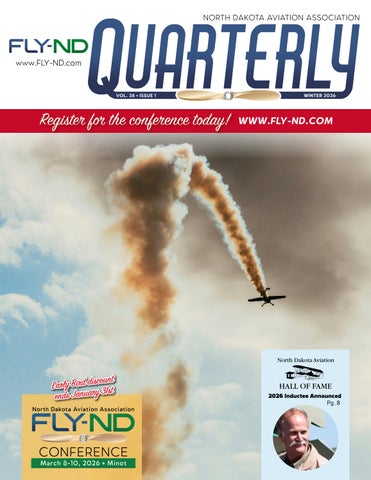
It’s time for our state’s great aviation get-together, the annual North Dakota Aviation Association’s Fly-ND Conference! This year’s event will be held in Minot, ND, from March 8-10, 2026.
You can find all the details for the upcoming conference on pages six and seven, including sponsorship information, as well as the newest North Dakota Aviation Hall of Fame inductee on page eight.
The conference is a wonderful opportunity to connect with old friends and make new ones in our local aviation community, as well as to challenge yourself by learning from aviation industry leaders and educational sessions. No matter what area of aviation you are a part of, there will be something at the conference for you!
Early bird tickets are available until January 31, 2026, so be sure to get yours today at www.fly-nd.com.
Wishing
you clear skies and unlimited visibility, Nicolette
Statements of fact and opinion are the responsibility of authors alone and do not imply an opinion on the part of officers and members of the NDAA or Fly-ND Quarterly staff. If you’ve received more than one copy of this newsletter, please share it with a friend. Email admin@fly-nd.com to update your address.
Tanner Overland, Chairman North Dakota Aviation Association chairman@fly-nd.com
A New Years’ Note
As the year winds down and the holiday season is upon us, it’s a natural time to pause, reflect, and give thanks. Aviation in North Dakota continues to thrive because of the people behind it- the professionals, volunteers, educators, students, airport leaders, operators, and supporters who show up day after day to keep our industry strong. Your dedication is what makes the North Dakota Aviation Association (NDAA) such a special organization and our aviation community such a tight-knit family.
This time of year also brings a renewed sense of optimism. While we celebrate the accomplishments of the past year, we’re already looking ahead to what’s next—and there’s a lot to be excited about.
We’re gearing up for the 2026 Fly-ND Conference, taking place March 8–10, 2026, at the Clarion Hotel in Minot, ND. This annual gathering remains one of the most valuable opportunities for North Dakota’s aviation community to come together, share ideas, learn from one another, and strengthen the connections that move our industry forward.
A highlight of the conference will be the North Dakota Aviation Hall of Fame Induction Banquet on March 10, where we will proudly induct Warren Pietsch as the 51st member of the North Dakota Aviation Hall of Fame. This special evening is always a meaningful celebration of leadership, service,
CHAIRMAN ’S COMMENTS
and lifelong dedication to aviation, and we look forward to honoring Warren’s lasting impact on our industry and our state.
There is also a great deal to look forward to throughout the conference itself. Attendees can expect engaging educational sessions, timely industry updates, valuable networking opportunities, and meaningful conversations with aviation professionals from across North Dakota and beyond. New this year, we’re especially excited to offer local tours highlighting Minot’s aviation and airport-related industries, providing a behind-the-scenes look at the facilities, businesses, and people that help keep aviation moving in the region.
As we begin a new year, I encourage you to reflect on the opportunities ahead and the role aviation continues to play in connecting our communities, supporting our economy, and inspiring the next generation. Thank you for your continued support of the North Dakota Aviation Association and for everything you do to advance aviation across North Dakota.
On behalf of the NDAA, I wish you a safe, successful, and rewarding year ahead. We look forward to seeing you in Minot this March as we come together once again to learn, connect, and celebrate aviation in North Dakota.
A New Year, A Shared Horizon
As we welcome the new year, aviation once again reminds us that every new beginning starts with preparation, purpose, and a shared commitment to move forward. The turning of the calendar is more than a milestone; it’s an opportunity to reflect on how far we’ve come and to set our sights on the horizons ahead.
Aviation is built on teamwork. From pilots and mechanics to airport managers, dispatchers, educators, and industry partners, every role matters. Each safe takeoff, smooth landing, and successful operation is the result of countless individuals working together with professionalism, dedication, and pride. Our North Dakota Aviation Association (NDAA) members are the heartbeat of this industry, and your passion for aviation continues to strengthen and elevate our community.
This past year demonstrated the resilience and adaptability that define aviation. Challenges were met with innovation, collaboration, and an unwavering commitment to safety and excellence. Because of your support, engagement, and willingness to lead, our aviation community continues to thrive and inspire the next generation.
As we look ahead, the new year brings fresh opportunities—new goals to pursue, new connections to build, and new ways to advance aviation together. Whether you are logging hours in the cockpit, maintaining aircraft behind the scenes, managing airport operations, or advocating for aviation’s future, your contributions make a lasting impact.
We extend our sincere appreciation to every member for your continued support, involvement, and belief in the power of aviation and in the North Dakota Aviation Association.
We are excited to announce that our new website is officially up and running. If you experience any issues, please don’t hesitate to reach out.
The NDAA team is actively planning an impactful 2026 FlyND Conference, taking place March 8-10, 2026, in Minot, ND. The conference schedule will be on our website soon and it promises to deliver an outstanding experience.
Here’s to a productive, successful, and rewarding year ahead. May it be filled with smooth flights, strong partnerships, and continued progress both on the ground and in the air. See you in March! Happy New Year.
Kyle Wanner, Director North Dakota Aeronautics Commission 701-328-9650 | kcwanner@nd.gov
DIRECTOR ’S Chair
Impacts of the 2025 Federal Shutdown on North Dakota’s Air Service
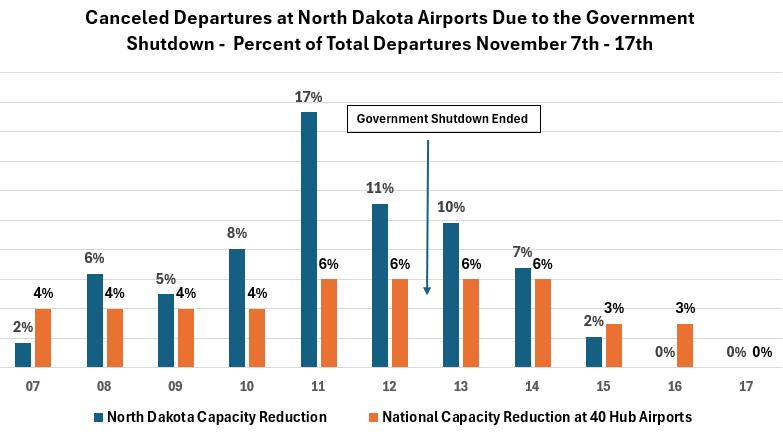
In the fall of 2025, North Dakota’s skies were stable during the early weeks of the longest federal government shutdown in U.S. history—43 days from October 1st to November 12th. October experienced minimal disruption, with nearly 1,800 airline departures across the state and only one airline cancellation occurring during the entire month. By November, however, the situation changed as disruptions began to affect travelers nationwide.
On November 7th, the FAA imposed nationwide capacity limits at 40 major hub airports due to air traffic controller staffing shortages. Hubs critical to North Dakota travelers, such as Minneapolis–St. Paul and Denver, faced restrictions that triggered cancellations and delays across the countryeffects that lingered even after federal funding was restored. To track North Dakota-specific impacts, the Aeronautics Commission surveyed all commercial service airports to document ongoing effects - data that would have been essential for communicating concerns with industry partners and congressional offices had the shutdown persisted. Although the shutdown ended five days later on November 12, the data is now able to demonstrate how quickly temporary airspace limitations can ripple through a rural, connection-dependent state like North Dakota.
During the month of November, a total of 54 airline departures were canceled statewide and approximately 70 percent (38 canceled flights) were directly linked to the federal government shutdown and associated FAA staffing constraints. Disruptions were most severe between the seven days of November 8th and 14th, when statewide cancellations exceeded national averages and reached as high as 17 percent. Fargo, Bismarck, Minot, Grand Forks, and Williston experienced the greatest impact, while smaller Essential Air Service airports in Dickinson, Jamestown, and
Devils Lake were largely unaffected. Over this time periodairports also reported declines in concession sales, parking revenues, and rental car activity - reminders that every flight delay or cancellation affects not just passengers, but local communities and businesses as well.
Passenger numbers were also affected by these disruptions. November boardings in North Dakota totaled approximately 101,000 people which was a 2% year-overyear decline that resulted in an end to eighteen consecutive months of record-breaking statewide growth. Based on historical trends and seasonal expectations, the state had anticipated roughly 105,000 -107,000 total boardings, indicating that suppressed demand, uncertainty, flight cancellations, and network ripple effects - all contributed to the 4,000 - 6,000 passenger shortfall for the month.
The impacts of 2025 federal government shutdown serves as a stark reminder of how national aviation constraints can ripple through communities, affecting travelers, local economies, and everyday routines. Throughout the shutdown, our aviation system remained safe and operational thanks to the dedication of aviation professionals - including Transportation Security Administration (TSA) personnel and air traffic controllers - who continued providing essential services. Looking ahead, strengthening staffing levels, enhancing airspace resilience, and advancing long-term solutions with industry leaders and policymakers will be critical to maintaining a safe, reliable, and resilient aviation system.
The full report on the impacts of the 2025 federal government shutdown, including detailed airport-by-airport data, is available in the news section of the North Dakota Aeronautics Commission’s website at aero.nd.gov.
Conference Highlights:
The conference is an opportunity to learn more about aviation in North Dakota and network with our aviation community. Throughout the conference, sessions will be held for pilots, mechanics, airport managers, and general aviation enthusiasts.
• Learn from Aviation Industry Leaders
• IA Renewal Credits
• Associations Annual Business Meetings
• Networking Opportunities
• Icebreaker Event
• Exhibitors Night
• Hall of Fame Banquet
• Educational Sessions
• Breakout Sessions for Pilots, Mechanics, UAS, Aerial Applicators, and Airport Operators
SPONSORSHIP OPPORTUNITIES
AIR TRAFFIC CONTROL - $10,000+
• Prominent logo placement and sponsor spotlight
• Meeting room sponsor of your choice
• Breakfast speaker sponsor
• 10 Conference and ND Aviation Hall of Fame banquet tickets
• Special recognition at the ND Aviation Hall of Fame banquet
• Triple booth exhibit space
• Logo on all marketing materials and emails
• Large logo displayed throughout the conference
• One marketing piece place in each welcome bag
BEYOND VISUAL LINE OF SIGHT - $7,500+
• 4 conference and ND Aviation Hall of Fame banquet tickets
• Special recognition at the ND Aviation Hall of Fame banquet
• Double booth exhibit space
• Sponsor spotlight
APPROACH CONTROL -
$5,000+
• 2 conference and ND Aviation Hall of Fame banquet tickets
• Special recognition at the ND Aviation Hall of Fame banquet
• Single booth exhibit space
• Sponsor spotlight
CONTROL TOWER -
$3,000+
• Recognition throughout the conference sessions
• Single booth exhibit space
• Sponsor spotlight and logo on all marketing materials
MAIN RUNWAY -
$1,000+
• Recognition throughout the conference sessions
• Sponsor spotlight and logo on all marketing materials
• Medium logo displayed throughout the conference
• One marketing piece place in each welcome bag
CROSSWIND RUNWAY - $500+
• Sponsor spotlight and logo on all marketing materials
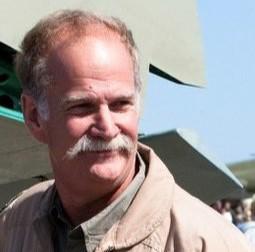
The North Dakota Aviation Hall of Fame will soon welcome one of the state’s most accomplished aviators and most respected stewards of aviation heritage. Warren Pietsch of Minot has been selected as the Hall of Fame’s 51st inductee in recognition of his lifelong commitment to aviation, his leadership in preserving historic aircraft, his service to the State of North Dakota, and his impact on pilots and aviation enthusiasts around the world.
Warren Pietsch to be inducted into North Dakota’s Aviation Hall of Fame
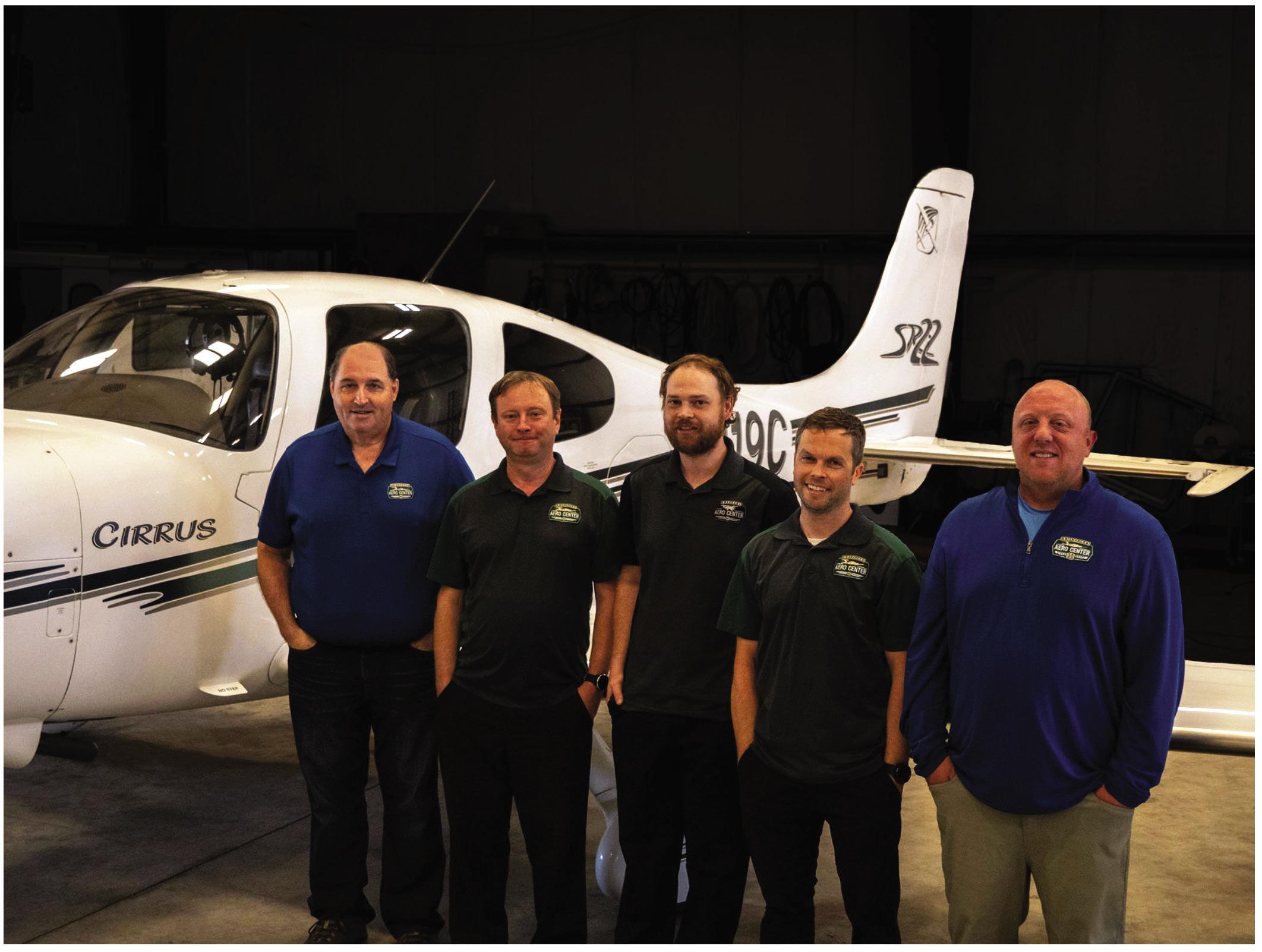
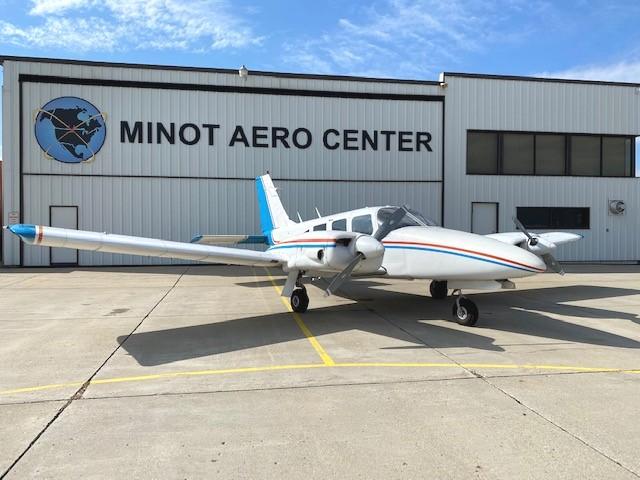
Warren’s story began under the wings of his family’s business, Pietsch Flying Service, where aviation was not simply a profession—it was a family tradition. By age ten he had painted a P-51 Mustang on his bedroom wall, and by sixteen he had completed his first solo flight. That early passion grew into a remarkable career that has helped shape North Dakota aviation for more than four decades. In the 1990s, Warren took ownership of the family business and guided its evolution into the Minot Aero Center, which today provides FBO services, aircraft maintenance, flight training, testing services, and pilot support. He also spent nearly two decades flying for ATA Airlines, serving as captain on the L-1011, Boeing 727, and Boeing 737.
As co-founder and Chief Pilot of the Dakota Territory Air Museum, Warren has played a central role in developing one of the world’s premier collections of airworthy World War II aircraft. Through Pietsch Aircraft Restoration & Repair—now the Minot Aero Center—he has returned countless vintage airplanes to flight, preserving not only their mechanical histories but also the legacies of the pilots who flew them. Among his most notable restorations is the celebrated P-51C Mustang Thunderbird, once owned by actor Jimmy Stewart and aviation icon Jackie Cochran. Pietsch recovered the aircraft from a crash site and brought it back to the airshow circuit, flying it at national venues including Oshkosh and Reno.
His logbook is a testament to extraordinary experience, including warbirds such as the Supermarine Spitfire, P-40 Warhawk, F4U Corsair, FM-2 Wildcat, Mitsubishi Zero, and multiple P-51 Mustangs. Yet beyond his flying skill, Warren
is admired for the humility, kindness, and authenticity he brings to every flight and every interaction.
Warren’s lifelong dedication to cultivating future aviators is evident across the state. He has mentored countless pilots, spoken in classrooms, supported school aviation curriculum, and welcomed students, visitors, and dignitaries into the hangars and restoration shops of Minot. For many from across the country and around the world, a stop in Minot to visit Warren—whether for guidance, conversation, or inspiration—has become an essential waypoint.
His service to the State of North Dakota includes over a decade of service as a Commissioner for the North Dakota Aeronautics Commission, including time as Commission Chair. During his tenure, the commission supported record airline passenger growth, advanced aviation education, secured critical infrastructure funding, and contributed to North Dakota becoming one of the nation’s congressionally authorized Unmanned Aircraft Systems test sites.
On the national and international stage, Pietsch has contributed extensively through the International Council of Air Shows (ICAS), serving on the Aerobatic Competency Evaluation (ACE) Committee and helping shape industrywide safety and training standards. His accomplishments have earned worldwide recognition, including the prestigious Bill Barber Showmanship Award in 2005. He has also participated in major national commemorations such as the Arsenal of Democracy flyovers over Washington, D.C. and holds the distinction of Honorary Royal Canadian Air Force Snowbird.
Beyond the aviation realm, Warren has served his community through St. Leo’s Catholic Church, Northern Neighbors Day, and decades of support for Minot Air Force Base personnel and families.
Warren is widely regarded as a guardian of aviation heritage—a pilot, mentor, restorer, teacher, and ambassador whose influence reaches far beyond North Dakota’s borders. Whether flying a P-40E War Hawk in formation over the nation’s capital or showing a young student how an aileron works, he approaches each moment with the humility and joy that first drew him to flight as a child.
The North Dakota Aeronautics Commission and the North Dakota Aviation Association’s Hall of Fame Committee congratulate Warren Pietsch on this well-deserved honor.
Induction Ceremony Details
Warren will be formally inducted during the annual Hall of Fame Banquet at the upcoming Fly-ND Conference on Tuesday, March 10, 2026, at the Clarion Hotel in Minot. The event will begin with a social at 6:00 p.m., followed by the banquet at 7:00 p.m. For more information about the state aviation conference or to purchase tickets for the Hall of Fame banquet, visit the conference registration page at fly-nd.com.
Tickets are $75 through February 23rd and will increase to $125 thereafter. Questions may be directed to the North Dakota Aeronautics Commission at 701-328-9650.
SOLUTIONS
Finding Joy in Checkrides — Even in the Cold
By Tajae Viaene | Director of Flight School Operations | Fargo Jet Center
As temperatures drop and winter layers make their annual return, one thing remains constant for me: how much I truly enjoy conducting checkrides. These final exams —often the last big hurdle for pilot applicants— are more than just evaluations. They’re meaningful moments in someone’s life, and I feel fortunate to play a small part in helping people reach goals they’ve often dreamed about for years.
Every checkride tells a unique story. It begins with that first communication, where excitement and nervousness usually blend together. From there, I get the chance to help applicants settle into what can understandably be a stressful testing environment. Watching someone relax, regain confidence, and show the skills they’ve worked so hard to build is genuinely rewarding.
And sometimes, despite everyone’s best efforts, a checkride ends in a disapproval. Even then, the process is fulfilling. Working through that disappointment and helping applicants prepare for a retest often brings out their resilience and determination. Seeing them return stronger, then eventually succeed, is one of the most gratifying parts of this work.
Cold weather or not, being part of these journeys keeps me energized. Each checkride is a reminder of why aviation is
such a passion-driven profession: it’s about growth, grit, and incredible personal milestones. I’m grateful to share in those moments, one applicant at a time.
And as for winter? Let’s just say I’ve learned to keep an impressive collection of leg warmers and hand warmers on standby—because nothing says “professional examiner” quite like being bundled up like a stylish, slightly frozen marshmallow.
Mike McHugh, Aviation Education Coordinator
North Dakota Aeronautics Commission
701-328-9650 | mmchugh@nd.gov
Growth Mindset
An educational trend of today is for students to become 21st century learners. While this has many components, one important element is continuing an educational journey outside of the classroom, to develop oneself into a lifelong learner. This important element of education can be accomplished in a number of ways such as formal training, but also through less formal methods.
I encourage all individuals, regardless of age, to continue their learning on a regular basis regardless of age, career field, etc. As you may ask a child, “What did you learn at school today?” Consider asking yourself, “What have I learned recently?”
Learning can take many forms: for a pilot, this may be experience in the cockpit. One example would be doing some landings in unique environments. Another may be spending an hour or two with a flight instructor or another pilot to practice some maneuvers that you may not have done in a while. For others, learning may be from reading articles on current trends in your field, or watching a video of someone demonstrating something in your field. Some less traditional learning methods may include social media. There is a lot to be learned from a network of peers on Linkedin or
even Facebook. You would be amazed at how much learning you could do without changing much in your day. A good place to start might be with your professional organization, such as the American Association of Airport Executives (AAAE,) the Aircraft Owners and Pilots Association (AOPA,) the Experimental Aircraft Association (EAA,) etc.
While online environments can provide a daily dose of learning, it is rare that face-to-face learning cannot provide a better platform. That said, I encourage you to attend professional conferences and seminars such as the Tri-State Aerial Applicator Conference, the local Fly-ND Conference, or other national conferences and events when able. Here the opportunity to ask questions to a presenter is sure to enrich your learning. In between sessions, networking from others in the field is almost certain to provide some learning opportunities at the event and into the future.
As the days get longer and warmer, I encourage you to ask yourself, “What have I learned recently?” and challenge yourself to take it one step further. I hope to see you at one of our upcoming conferences and look forward to hearing how you are growing your knowledge.
Eternal FLIGHT
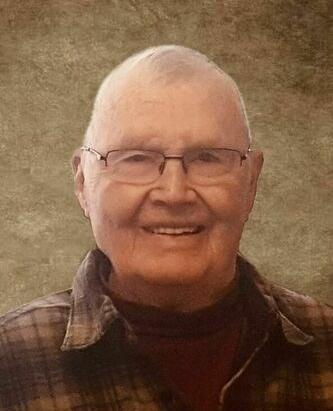
Carl Leland Johnson (Leland/ Lee) was born on June 14, 1921, on a ranch 12 miles south of Taylor in Stark County, ND. His parents were Carl A. P. Johnson and Henrietta Connie Larsen. Leland was the youngest of four children born to this union. His mother, Connie, passed away when Lee was 2 and a half years old. He and his sister Charlotte then went to live with their uncle and aunt, Samuel and Catherine Johnson Brand. Lee’s father remarried, and Florence (Johnnie) was born to this union.
Lee was raised on the Stone Hammer Ranch a few miles south of Taylor where he became an avid horseman and hunter. He graduated from Taylor High School and attended North Dakota Agricultural College (NDSU) in Fargo, majoring in agricultural engineering. He participated in ROTC and track, breaking the school record in the hurdles.
Lee’s love of flying started early in his life, and his expertise led to his becoming an instructor in a Navy flight school in Minot, N.D. That is where he met Gail Jewel Dasher. They were married on October 6, 1944, and moved to the Stone Hammer Ranch at the end of World War II. In addition to ranching and farming, Lee remained an active pilot doing acrobatics, crop spraying, and coyote hunting. He was active in the community of Taylor, playing baseball and supporting all of the activities in the Taylor schools.
He and Gail raised four daughters; Jo Carol, Lynn, Nancy, and Barbara (Dub.) A very difficult time in their lives was the 1968 death of Jo Carol in a commercial airline crash. Lee had a broad range of interests and enjoyed following the activities of his daughters, grandchildren, and great-grandchildren, whether they be music, athletic, or equestrian.
Lee’s passion was flying. He was a contract pilot for the federal government, primarily hunting coyotes. He was the first president of the North Dakota Flying Farmers organization, and he served as a commissioner of the North Dakota Aeronautics Commission. He was an inaugural inductee to the North Dakota Aviation Hall of Fame. Most memorable was his mercy flight that saved the life of a baby who was sick with pneumonia but whose family was snowed in and unable to get him to the hospital. Leland’s life summary as a pilot can be viewed on YouTube “North
Dakota Aviation Hall of Fame Leland Brand the Flying Farmer.”
At 104 years old, Lee outlived three of his siblings, Arthur Johnson, Paul Johnson and Charlotte Johnson Brand Bollyn. Also preceding him in death were his wife Gail, daughter Jo Carol, and son-in-law, Dennis Dohrmann. Continuing his legacy are his sister, Florence, daughters Lynn Tool, Nancy Kleingartner, Barbara Dohrmann, 11 grandchildren, 20 greatgrandchildren, and three great-great-grandchildren.
Lee lived his life to the fullest, never wanting to waste a minute. He was a voracious reader and life-long learner. Lee grew to admire Native American culture, and he spent years searching for arrowheads and other Indian artifacts. His favorite charities were those benefitting Native American youth. He especially appreciated the Crow belief that there is no end to life; there are no goodbyes, because we will see each other again. An Apsaalooke Tribal belief that Lee wanted shared at his funeral is, “Don’t weep too long, for I have returned to my Creator...I am in the minds and hearts of the many lives I have touched.”
NORTH DAKOTA PROFESSIONAL AVIATION MECHANICS ASSOCIATION
2026 MECHANIC OF THE YEAR APPLICATION
It’s time to apply for the NDPAMA Mechanic of the Year award! Email or mail application to Chad Symington by Monday, March 9, 2026 chad.symington@und.edu | Chad Symington 2798 Airport Drive Stop 9052 Grand Forks, ND 58202
QUALIFICATIONS: Each person submitted on the entry form must hold an FAA Airframe and/or Powerplant rating, or Repairman Certificate, and must be employed in the field of aviation maintenance in the state of North Dakota. Entries must be based upon a viable contribution to aviation safety. | JUDGING: The NDPAMA President will form a committee of at least three members, at least one being a representative of the FAA (when available) to judge the entries. | AWARD: An award of $1,000 will be presented to the selected mechanic of the year.
Application Checklist:
• Name
• Address
• Telephone No.
• FAA Certificate No.
• FCC License No.
• Employer
• Employer’s Address
• Year first designated a Maintenance Technician
• Total years of experience
• A brief, factual description of the applicant. Drawings, photographs or other presentations may be included to assist the judging committee. All entries become property of the Selection Committee and will not be returned.
If you submit the entry for someone other than yourself, please also include your:
• Name
• Address
• Employer (Name and Address)
• Position Held
• Date
• Signature of person submitting entry
MOSAIC 2025: A New Horizon for Recreational Aviation
By Mitch Lutze-Morris | Chief Inspector | Fargo Jet Center
In July 2025, the Federal Aviation Administration (FAA) unveiled the long-anticipated Modernization of Special Airworthiness Certification (MOSAIC) rule, marking one of the biggest regulatory overhauls in General Aviation in more than two decades. Designed to modernize outdated rules and open the skies to more pilots and aircraft, MOSAIC promises to expand recreational flying, simplify certification, and unleash innovation across the light aircraft sector.
MOSAIC changes how aircraft and pilots are regulated by replacing weight-based restrictions with performance-based standards. For decades, sport pilots and light-sport aircraft (LSA) were shackled to a narrow set of rules, established in 2004. Now a lot of those constraints are gone and with them, many of the limits that kept capable aircraft and eager pilots grounded.
The traditional 1,320-pound cap for LSAs has been removed, giving designers and builders the freedom to produce larger, safer, and more capable aircraft that still meet strict performance criteria. Instead of focusing on how much an aircraft weighs, the new regulations focus on how it performs in flight, most notably its stall speed, as a measure of safety and suitability.
Perhaps the most transformative change under MOSAIC is the dramatic expansion of what sport pilots can legally fly.
More aircraft types: Sport pilots can now operate aircraft with up to four seats (though still limited to one passenger), eliminating the old two-seat cap.
Performance-based eligibility: Instead of being barred by weight, pilots are now limited by stall speed making a wider range of airplanes usable under sport privileges.
Advanced features allowed with endorsements: Retractable landing gear, controllable-pitch propellers, and even night flying are now possible for sport pilots, once proper training and endorsements are completed.
These enhancements offer recreational pilots access to aircraft that were previously off-limits without a private pilot license, potentially cutting training costs and lowering barriers to entry. The changes are also expected to lower the cost and time required to bring new aircraft models to market while expanding the variety of machines available to pilots and flight schools.
Additionally, repairman and maintenance privileges for qualified individuals have been expanded to cover the newly defined LSA category, simplifying upkeep for owners and small operators. Under this change, light-sport repairman privileges are now expanded to allow a properly certified repairman to conduct condition inspections on amateur-built aircraft that are of the same category and class of aircraft for which the individual is rated for and revises requirements for performing repairs/alterations of light-sport category aircraft.
Other changes from a maintenance standpoint include: Sport pilots can perform preventative maintenance on lightsport category aircraft that they owned or operated.
Light-sport repairman certification course has been updated from three-week duration to a requirements-based curriculum.
Minor alterations and repairs may be performed on lightsport aircraft without manufacturer approval or a person acceptable to the FAA.
It is important to know, however, that MOSAIC did not change any maintenance standards for aircraft with standard airworthiness certificates. While the aircraft types approved for use by sport pilots have vastly increased, aircraft with a standard airworthiness certificate must be maintained according to Part 43 and 61 by certified mechanics.
MOSAIC’s rollout is structured in phases to help the aviation community adapt. Updates to sport pilot privileges and operational rules took effect on October 22, 2025, with the next phase of changes being planned for July 24, 2026. These changes will pertain to aircraft certification and the formal removal of the old “light-sport aircraft” definition become effective. This staggered schedule gives pilots, instructors, and manufacturers time to align training programs, certification pathways, and business models with the new landscape.
For those interested in the full details of the changes or have questions about the final rule signed into effect on July 18, 2025, refer to FAA Docket No. FAA-2023-1377.
Adam Dillin, Airport Planner
Make Some Room! NDAC Guidelines on Constructing Airport Hangars
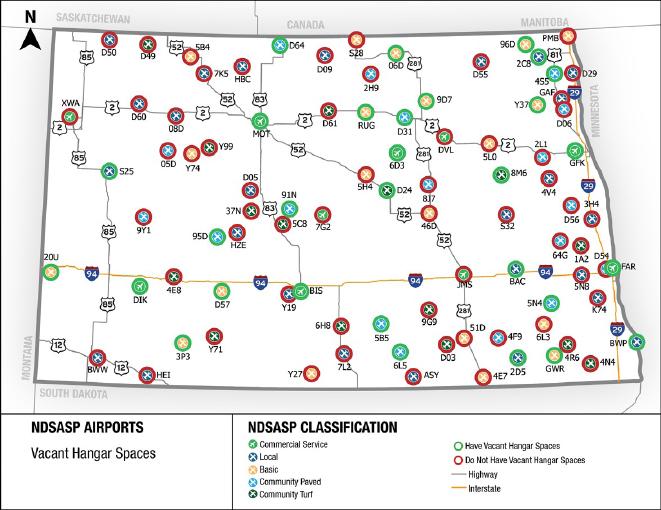
North Dakota continues to see growth all across our state. New technologies bring new business, which brings new jobs. Our population continues to grow. This growth rings true in the world of aviation, as well. According to our aircraft registration data – over 1,800 aircraft were based at our public airports in 2025, one of our largest years ever! But these aircraft need homes. With the weather we see, especially our famous North Dakota winters, those aircraft are looking for safe shelters to avoid the ice, blistering winds, and drifting snows. The need for space is real, but our airports are beginning to run out of room. Out of our 89 public airports statewide, only 30 currently report having available covered storage ready for new based tenants. This means the other 59 either do not have any covered storage or have hangars that are fully occupied.
This is a good problem to have; but still a problem, nonetheless. Our airports can develop a plan that includes applying for state grant assistance from the North Dakota Aeronautics Commission (NDAC) for public-owned hangar construction. When compared to other airport infrastructure needs, however, hangar projects rank low in priority. The NDAC assigns all airport projects a priority ranking with a range of 11 (lowest priority) to 57 (highest priority). Public hangar projects are assigned a priority of 12. The low priority, combined with increasing costs for vertical infrastructure, has made it extremely difficult for the NDAC to consider funding hangar projects for airports. This is why the NDAC created a set of hangar guidelines for airports to consider when applying for grant assistance.
The NDAC will only provide funding to hangars that will be publicly available and owned by the airport authority. In their grant application, airports also need to address why federal funds are not being utilized (if the airport is in the National Plan of Integrated Airport Systems (NPIAS) and is eligible to receive federal funds). The airport should also provide evidence of the demand for hangars; most airports will keep a waiting list of individuals with aircraft ready for hangar space. The NDAC also wants to ensure there are no conflicts with the construction; if fixed base operators (FBOs) are present on the airfield, we require a letter of support from the business to show adequate demand and ensure no competitive concerns are present.
These questions and guidelines should all be addressed and submitted to the NDAC, along with a concise business plan. This business plan should outline the airport’s plan for funding. The NDAC’s guidelines stipulate that before state grant assistance is considered, airports should consider any debt obligation options available. One of the most
attractive options available to our airports is a low-interest infrastructure loan program, available through the Bank of North Dakota’s Infrastructure Revolving Loan Fund. These loans are available to all public subdivisions, including cities and airport authorities. Airports must also propose reasonable and fair hangar rental rates. These rates may vary from airport to airport, and from building to building. For example, a metal sheet hangar with gravel flooring would reasonably offer a lower monthly rate than a concrete foundation building with insulation and heated storage. These guidelines help the NDAC assess the feasibility of a new hangar construction. If the needs are justified, and the price is reasonable, state grant assistance may not be needed. If the airport needs to acquire debt to fund the hangar and cannot meet a break-even point by charging a fair monthly rental rate, the NDAC may consider assistance to minimize the debt obligations that the airport will take on. The NDAC also offers a free budget calculator to airports to assist with planning out and calculating all monthly costs compared to possible rental fees.
The NDAC is committed to supporting airports as North Dakota’s aviation community continues to grow. At the same time, it is essential that hangar projects are structured for long-term success. Rising construction costs remain a significant obstacle, and these guidelines are intended to help airports realistically evaluate feasibility, minimize debt, and establish fair rental rates before seeking state assistance. The guideline document and budget calculator are both publicly available; you can find them on our website at https://aero.nd.gov/airports/airport-grant-funding/. Please reach out to the North Dakota Aeronautics Commission if you have any questions on these guidelines.
Good News from the 2025 Government Shutdown
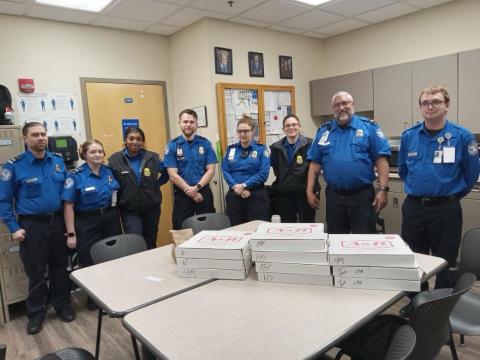
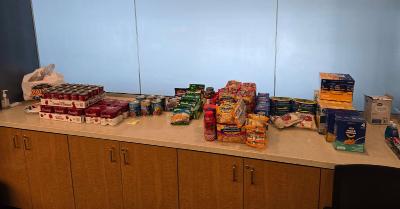
While the historic government shutdown seemed to consume most of the headlines during the month of November, airports around the country banded together to support their federal partners. Here are a few snippets as to what the local airports in North Dakota were able to do for their airport families:
Bismarck Municipal Airport (BIS)
“During the recent government shutdown, our community showed incredible appreciation for the federal employees who keep our airport running. An individual generously surprised our TSA team with Little Caesar’s pizza and later that same day, A&B arrived with even more to keep them going. Just before the shutdown ended, we received messages from individuals wanting to organize food drives or provide additional meals for both TSA and FAA Air Traffic Controllers; efforts that reflected a genuine desire from the Bismarck community to support those who continue working through uncertainty. We’re grateful for the kindness shown to our federal partners and the important work they do every day.”
Minot International Airport (MOT)
“During the record-breaking shutdown in 2025, the Minot International Airport facilitated a potluck and food drive to help ease some of the financial burden from our TSA partners. The Trestle Tap House restaurant offered free pizzas and everyone around the terminal remained available for assistance whenever needed.”
Grand Forks International Airport (GFK)
“The Grand Forks Regional Airport Authority purchased a lunch for both our FAA ATCT and TSA Screening personnel. We were happy to do so and it was very appreciated.”
Williston Basin International Airport (XWA)
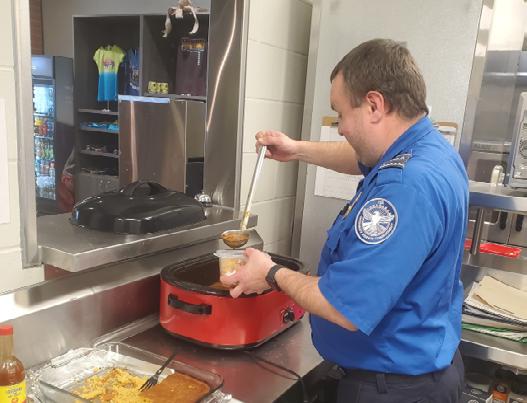
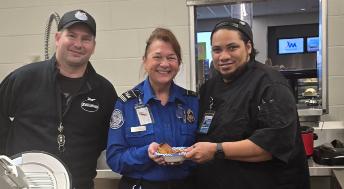
“The Refinery Kitchen staff at XWA stepped up and started a ‘pay what you can’ soup lunch for those affected by the government shutdown. Pictured: James and Richard from The Refinery Kitchen + Bar share a warm batch of homemade Gumbo with the crew.”
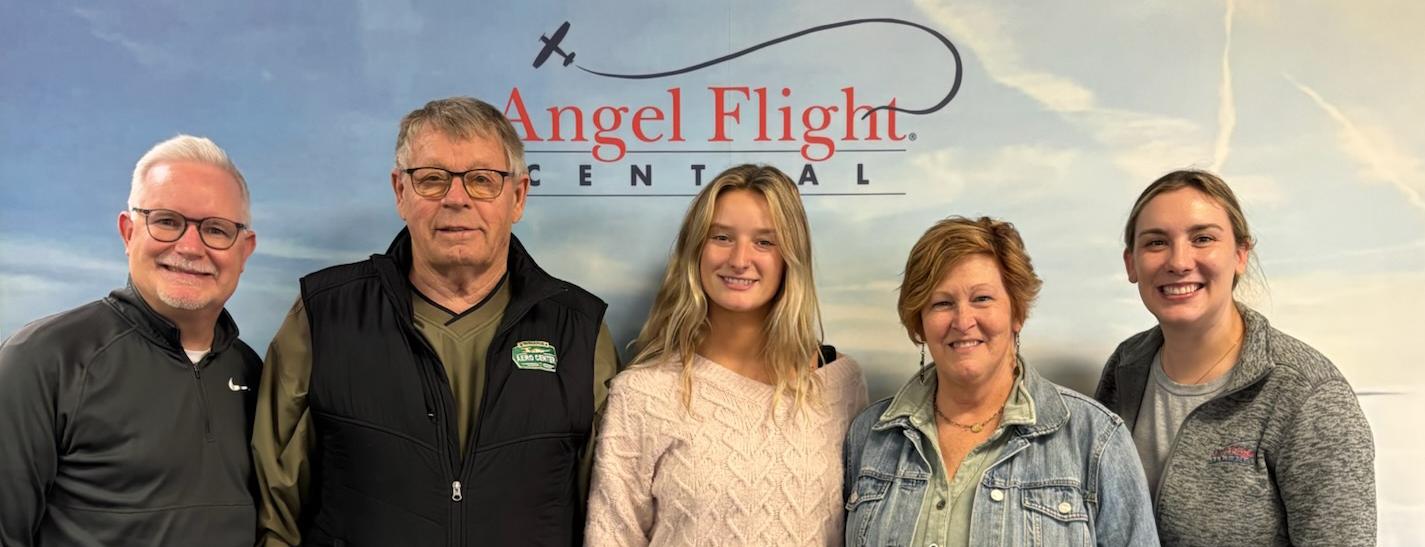
The Privilege of Giving Back - Angel Flight Central
By Bob Simmers
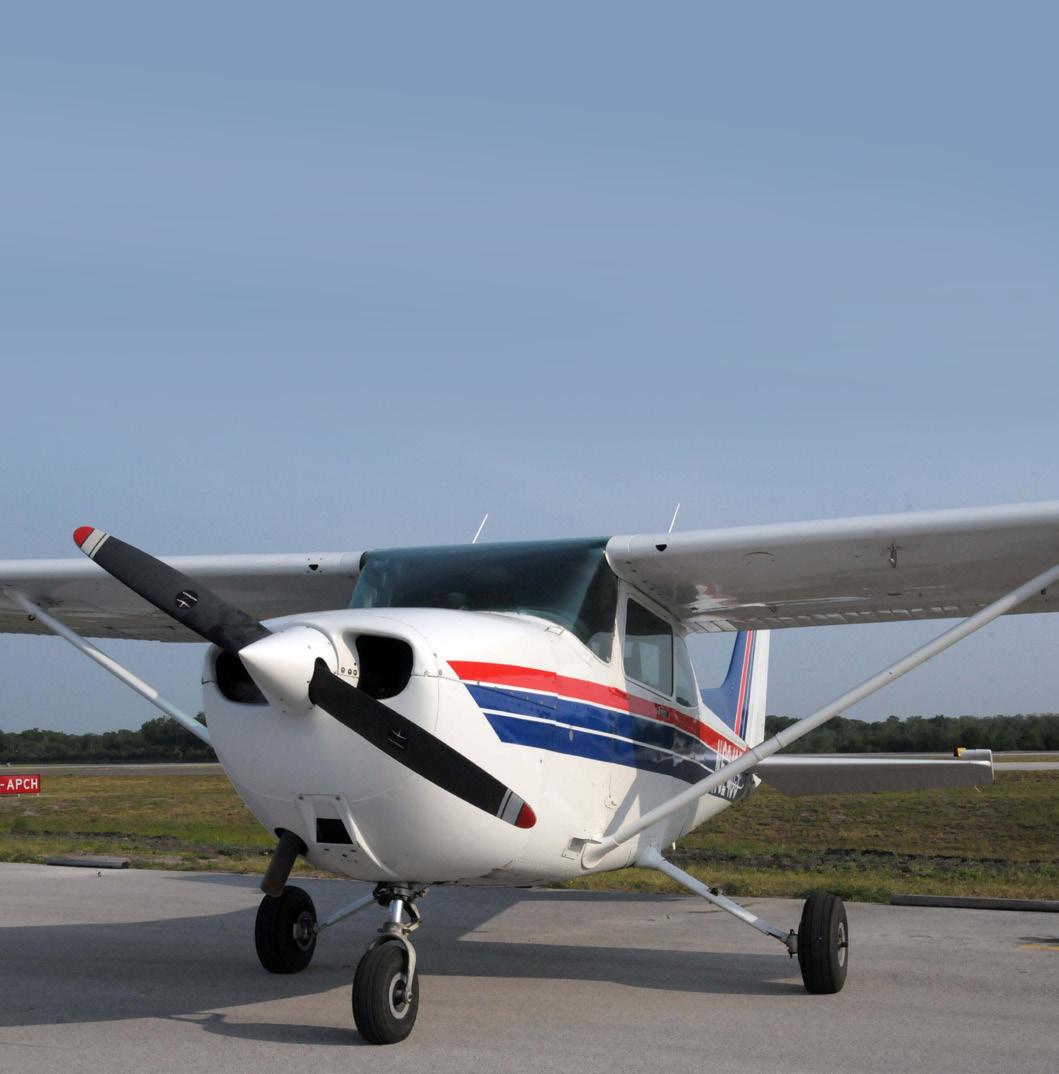
Being able to pay it forward is one of life’s great rewards. I have been fortunate to have been selected by Angel Flight Central as a mission pilot. Angel Flight Central is a nonprofit organization that matches up transportation needs and medical needs with their battalion of mission pilots. The patient must first be qualified by Angel Flight Central and once qualified, then the list of missions is emailed daily. The mission pilots can apply for the flights that are in their area. They also provide alternative transportation in the form of airline tickets, in the event that weather or other
circumstances arise. Most of the missions are planned not to exceed one and half hours of flight. Most patients require two flight legs, which requires coordination between the pilots.
The rewards are great. One memorable flight was for two young girls and their mother from Billings, MT, to their destination of Shriners Children’s Hospital in St. Paul MN. What made this trip so special was not only the fact that I was the pilot, but I’m also a Shriner. This transfer was divided into three mission legs. I picked them up in Billings and flew
them to Bismarck, where they were met by another mission pilot who flew them to Wahpeton, where a third pilot met them and delivered them to St. Paul. The real reward is knowing that we provided a service to a young family at no transportation cost to them. Being part of a team that delivered the girls to the Shriners Children’s Hospital, which provides all their services at no charge to the patient was a reward, plus finding out that both the girls are now leading healthy and productive lives.
My passengers range from 11-month-old babies to adults with cancer, burn victims to cardiac repair patients, all seeking the specialized services that are not available on the prairie.
Not all trips are just rewarding. In fact, the first trip I flew had me wondering if this was worth it. But since then, I have met a lot of wonderful people, made many new friends, and have been rewarded with smiles and thank yous, which is all I need.
Today, I have flown over 75 missions; my goal is 100 missions.
If this is something that you might be interested in, you can learn more about Angel Flight Central by checking out their website at www.angelflightcentral.org. Oh, by the way, did I say how great these people are to work with?
UND celebrates first graduate of Enhanced FAA Air Traffic Controller Program
Anthony Lake can move directly ‘from classroom to tower,’ thanks to his completion of UND’s FAA-approved enhanced program
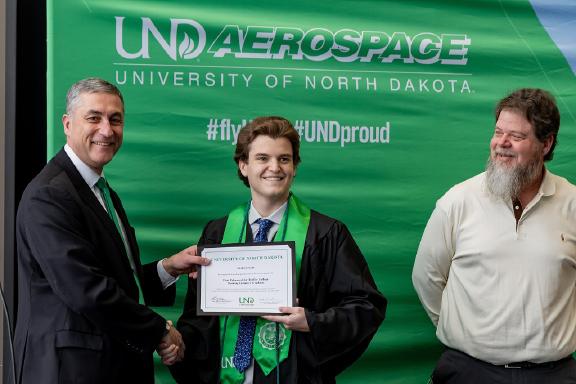
Robert Kraus (left), dean of the John D. Odegard School of Aerospace Sciences at UND, presents Anthony Lake (center) with a certificate while Craig Carlson, associate professor of aviation and assistant chair of UND’s Air Traffic Management program, looks on. The certificate honors Lake for being UND’s first graduate of the FAA’s Enhanced Air Traffic-Collegiate Training Initiative Program, and was awarded Dec. 19 at a pre-Winter Commencement reception on the UND campus.
Photo by Adam Kurtz/UND Today.
The University of North Dakota’s John D. Odegard School of Aerospace Sciences has reached a historic milestone with the graduation of Anthony “A.J.” Lake, UND’s first-ever graduate of the Enhanced Air Traffic–Collegiate Training Initiative (AT-CTI) program.
Lake was awarded his bachelor’s degree in Air Traffic Management at UND’s Winter Commencement ceremony on Dec. 19. But at the same time, Lake also graduated from the Federal Aviation Administration’s Enhanced AT-CTI pathway, and his achievement places UND among the earliest institutions in the country to successfully graduate a student from the FAA-approved enhanced pathway.
Robert Kraus, speaking at Winter Commencement reception in the Aerospace school’s Robin Hall, took the time to congratulate all UND Aerospace graduates, including the University’s first Enhanced AT-CTI grad.
“First, I want to say congratulations to all of our students
who are graduating today in a couple of hours, and thank you for coming out to this reception where we can get to share a few more minutes with you,” Kraus said. Then he added a unique recognition:
“Today we also recognize our first graduate of the FAA Enhanced AT-CTI Program at UND.”
Unlike traditional AT-CTI graduates, students in the enhanced program who meet rigorous performance benchmarks can bypass the FAA Academy in Oklahoma City, Okla., and proceed directly to air traffic control facilities for on-the-job training, Kraus noted.
Only nine schools nationwide have been approved for the FAA’s Enhanced AT-CTI pathway. The highly selective program was designed to help address the nationwide shortage of air traffic controllers by accelerating the controllers’ preparation and making full use of universitylevel training facilities, such UND’s 360-degree control tower simulator and 32-position radar lab.
“This is all our hard work coming realized,” said Craig Carlson, associate professor of aviation and assistant chair of UND’s Air Traffic Management program. “We built the Enhanced AT-CTI program, but we set a very high bar; and until a student successfully completed the program, we didn’t know for sure it could be done.
“So, A.J. passing the FAA’s Air Traffic Skills Assessment exam was a great accomplishment for him, and a huge weight lifted off our shoulders, too,” Carlson said. “It proved we did this right.”
A demanding program
Carlson emphasized that the enhanced program is intentionally demanding and requires exceptional commitment.
“This enhanced program is not for every student,” Carlson said. “It’s for highly motivated individuals who are willing to put in significant extra time in the labs. A.J. was the perfect student for this: he wanted to be the first, and he put in the work.”
To meet FAA standards, UND significantly remodeled its air traffic control curriculum, aligning upper-level tower courses directly with FAA Academy simulations and training requirements. The University is also expanding its simulation facilities and planning additional faculty hires in response to rapidly growing student interest in air traffic control.
Enrollment in UND’s Air Traffic Management program has increased since the FAA approved UND’s Enhanced AT-CTI Program in 2024.
Lake, a native of Faribault, Minn., said the chance to enter the workforce months earlier than the traditional route motivated him to pursue the enhanced program.
“I’m saving three or four months of time, for sure,” Lake said. “It feels like a real accomplishment. I came out of it smiling — and there was a round of applause from all the associates and professors who were in the room, so that was great.”
Lake will soon receive a list of FAA tower assignments that he can choose from. He hopes to begin his career in the Upper Midwest, potentially near the Twin Cities area.
With thanks to U.S. Sen. John Hoeven
Carlson expressed his personal gratitude to Sen. John Hoeven, R-N.D., for the top leadership role the senator has played in moving the Enhanced AT-CTI program forward.
Hoeven, for his part, expressed his own praise for Lake and the UND program. “Congratulations to Anthony Lake on becoming UND’s first-ever Enhanced AT-CTI graduate,” Hoeven said.
“We worked to secure UND’s role in this new AT-CTI program to help address the air traffic controller shortage, and it’s gratifying to see UND’s first graduate from the program. At a time when the nation faces a critical need for highly trained ATCs, Anthony’s willingness to lead the way sets a powerful example for prospective students and helps strengthen the future of the aviation industry.”
Lake’s success is just the beginning, Carlson noted. UND expects multiple additional Enhanced AT-CTI graduates in the coming semesters, with numbers projected to grow steadily in the years ahead.
“This is going to snowball,” Carlson said. “AJ helped prove what’s possible.”
Shawn Dobberstein Honored with Agrey Award
The Agrey Award is the Upper Great Plains Transportation Institute’s highest honor, recognizing individuals whose leadership in transportation has made a lasting impact on North Dakota. Named for John Agrey—a pioneer and tireless advocate for transportation in the state—the award celebrates visionary service and achievement.
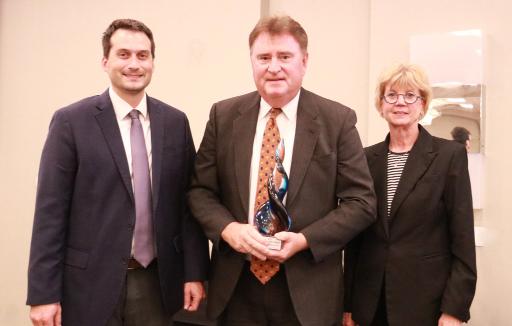
This year’s Agrey Award was presented to Shawn Dobberstein in recognition of his significant contributions to aviation in North Dakota as Executive Director of Hector International Airport in Fargo.
Shawn began his public service career with Fargo Public Works in 1985 and joined Hector International Airport in 1991. Appointed executive director in 1997, he has since guided the airport through a period of sustained growth and transformation.
Under his leadership, the airport completed major projects including reconstruction of the primary runway, terminal expansion, and development of a new cargo ramp that established Fargo as a regional hub for FedEx and UPS. In 2024, more than 5,500 cargo aircraft transported approximately 350 million pounds of freight through the airport.
Passenger boardings increased from approximately 400,000 in 1997 to 1.1 million in 2024, with 2025 on pace for another record year. To accommodate this growth, the airport has recently launched a $200 million capital program that
includes a five-gate terminal expansion and a 1,000-space parking garage.
Through defining challenges such as post-9/11 security changes and the COVID-19 pandemic, Shawn’s steady leadership has helped establish Hector International as North Dakota’s only small hub airport and a vital economic engine for the state. It’s great to see North Dakota’s aviation professionals recognized for their impact on the transportation industry—congratulations to Shawn on this well-deserved honor!
Whether you're looking to charter a flight, pursue your pilot's license, or rent an aircraft for your next adventure, Western Edge Aviation is your trusted FBO in the air and on the ramp.
The Agrey Award is presented to Shawn Dobberstein by Kyle Wanner, Executive Director of the North Dakota Aeronautics Commission and a member of the UGPTI Advisory Council, and Sheri Haugen-Hoffart, North Dakota Public Service Commissioner and chair of the UGPTI Advisory Council.