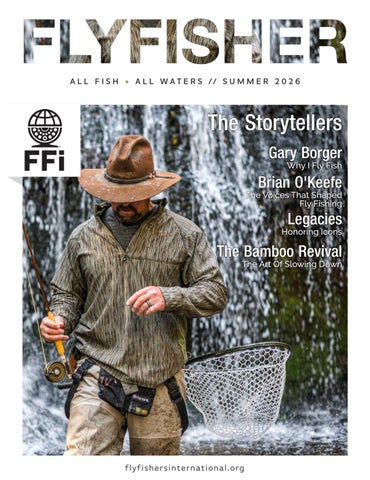
FlyFisher FlyFisher is published for FFI by Bird Marketing Group Inc. PO Box 227A Eastport, ID 83826
Board of Directors Tilda Evans Chair of the Board Rhonda Sellers (non-voting) Executive Director Bryant Dunn Vice Chair of the Board International Programs Committee Chair Sam Matalone Secretary Awards Committee Chair Jim Maus Treasurer Finance Committee Chair Dave Peterson Chairman Emeritus Conservation Committee Chair
Fly Fishers International 1201 US Highway 10 West, Suite D4 Livingston, MT 59047 (406) 222-9369 flyfishersinternational.org Executive Director Operations, Conservation/Education Coordinator & Webmaster Rhonda Sellers | rhonda@flyfishersinternational.org
Kastine Coleman Willy George Fly Casting Education Programs Chair Keith Groty Executive Committee Senior Advisor Todd Heggestad Council Presidents Committee Chair Patty Lueken Executive Committee Women Programs Chair Dale Ray Richard Ross Executive Committee George Sylvestre Education Committee Chair Robert Uselton Executive Committee Development Committee Chair Jeff Wagner Executive Committee Additional Committee Chairs (non-voting) Jack Gillis Fly Tying Programs Senior Advisors Tom Logan Chairman Emeritus Senior Advisor Conservation Kuni Masuda Senior Adviser International Programs Douglas Silver Senior Advisor Financial Sustainability Rick Williams Senior Advisor Casting & Conservation
Editor Chris Bird
Communications Director, Donor Programs Blake Parsons | blake@flyfishersinternational.org
Justin Bubenik Sandy Carpenter
Executive Publisher Jennifer Bird jbird@birdmarketinggroup.com
Membership Coordinator & Fly Tying Programs Kate Richardson | membership@flyfishersinternational.org Clubs & Councils Coordinator & Women Programs Jessica Atherton | clubs@flyfishersinternational.org
Group Art Direction Terry Paulhus
Office Administrator Kim Carruthers
Casting Coordinator & Merchandise Nikki Loy | casting@flyfishersinternational.org Membership & Donor Administrator Lindsey Webster | donations@flyfishersinternational.org Bookkeeper Sharon Cebulla | bookkeeper@flyfishersinternational.org
Flyfisher is the official publication of Fly Fishers International, published two times a year and distributed by mail and online free to members. Send membership inquiries, fees and change of address notices to the FFI Headquarters at the address listed above. Flyfisher is produced for FFI by Bird Marketing Group Inc. Editorial & Advertising Inquiries: Editorial queries are welcome and should be sent to Bird Marketing Group Inc at the address listed above attention to the Editor. Email queries can also be emailed to editor@flyfishersinternational.org. Visit flyfishersinternational.org for the full writer and photographer guidelines. Advertising inquiries can be directed to jbird@birdmarketinggroup.com. Visit flyfishersinternational.org for Ad rates and spec guidelines. Reprints & Permissions All facts, opinions and statements appearing within this publication are those of the writers and are in no way to be construed as statements, positions, or endorsements. No part of this publication may be reproduced in any manner without the written consent of the publisher. Copyright 2026 Fly Fishers International.
Department Contributors
Conservation Catch Cormier David Peterson
Casting Blake Parsons
Fly Tying Larry Olson
Feature Contributors Chris Bird Gary Borger George Daniel Jan Krieger Phil Monahan Brian O’Keefe Will Rice Jen Ripple
Letters to the Editor Send your comments about any aspect of Flyfisher to the Editor at editor@flyfishersinternational.org. We will endeavor to reply to each letter. We reserve the right to edit all submissions. Letters published in Flyfisher become the property of Fly Fishers International.
3
INTHIS ISSUE 6 Leadership Message Every fly fisher's journey begins with a story. Board Chair Tilda Evans and Executive Director Rhonda Sellers reflect on the mentors, memories and connections that build community and inspire the future of Fly Fishers International. 8
FFI Events Calendar
10 Why I Fish From fishing mud puddles at age four to landing his first trout on a hand-tied fly, Gary Borger traces the moments that made fly fishing a lifelong pursuit. 14 The Storytellers From Lefty Kreh to John Gierach, the voices that shaped fly fishing continue to inspire, educate and entertain generations of anglers. 22 Bamboo Off-Piste From a small Colorado workshop to the banks of the Colorado River, a handcrafted bamboo rod reveals a different way to experience fly fishing. 30 Legacies Celebrating four remarkable individuals whose passion, leadership and contributions continue to shape the future of fly fishing. 36 Fly Tying Storied Patterns: The materials may change, but the stories endure. 42 Casting How the Fly Casting Skills Development Program advances FFI's educational mission and grows its community. 53 FFI Guides, Outfitters And Business Listings The Guides & Outfitters Association helps fly fishing guides connect with people interested in fly fishing around the world. 46 Conservation Protecting the rivers and fish that shape our stories. 54 FFI Forum
4
FlyFisher Summer 2026
Photo credit: Will Rice On the cover: Dustin English
LEADERSHIP MESSAGE
T
his issue of Flyfisher celebrates the storytellers of fly fishing: the writers, teachers, mentors, conservationists, artists, elders, youth and everyday anglers whose stories shape identity, ethics and belonging within the sport. When we share our stories, we build community and preserve the legacy of those who taught us how to fish, cast and tie flies. We tell our stories in many ways. We teach. We make films. We fish with others. We attend meetings. We write books. We gather at events like FlyFest. What is your first memory of fly fishing? What is your favorite memory? Who do you share your stories with? I share mine with friends, family and anyone I meet who shows an interest in fly fishing. My favorite stories are often about unique fish and funny moments on the water. I learned to fly fish shortly after A River Runs Through It was released. At the time, my husband was looking for a lifelong hobby after my father passed away soon after retirement. His choices came down to golf or fly fishing. He chose fly fishing and quickly became obsessed with it. I realized that if I wanted to spend time with him, I probably needed to learn as well. For my birthday, I asked him to find a guide who could teach me to fly fish. He visited a local fly shop and asked whether someone could take us fishing and teach me. They said they did not offer that service. He then stopped at a larger sporting goods store with a fly fishing department and met a young Rob Crandall, who agreed to take us out. Rob was just beginning his guiding career
at the time. He took us to the Crooked River outside Prineville, Oregon, and taught us how to cast, choose a fly and read the water. He explained that fish in that area often held tight to the bank and warned me not to step into the river too quickly before fishing the water close to shore. I was fishing a nymph, possibly a pheasant tail. I cast upstream and let it drift past me, mending the line for a clean drift. Just 6 inches from the bank at my feet, I hooked my first fish on a fly: a beautiful 12-inch rainbow trout. The fish was not the only thing hooked that day. I was hooked for life. And, by the way, Rob went on to build a successful guiding career in Oregon. Since then, I have helped form a women’s fly fishing club, served as the first woman president of the Oregon Council, become a Fly Fishers International Board member and officer, and eventually serve as the organization’s first female board chair. Along the way, I have mentored many new fly fishers — men, women and children alike — and spent countless hours in nature’s cathedral casting for whatever species called those waters home. I have one more story to tell. I met my husband at the 2008 Conclave in Whitefish, Montana. We were both volunteering at the event. He was attending for the first time, while I was balancing board meetings and seminars. Our first date was the Saturday night barbecue. Afterward, we found a quiet place to talk and get to know each other better. My fly fishing friends were understandably curious about this potential new relationship.
The next day, we fished together before I boarded the train back to Oregon. Over the following year, we stayed in touch. I visited him in Colorado over Labor Day, at Christmas and again in April. He visited me in Oregon at Thanksgiving. We talked nearly every day. One year to the day after we met, entirely by accident, we were married. It seemed only fitting that we spent our honeymoon at the 2009 Conclave in Loveland, Colorado. This year marks 16 years of marriage. While not everyone will find love through FFI, it remains one of my favorite fly fishing stories. FFI continues its work on an updated strategic plan centered around five key areas: community, education, conservation, credentialing and financial stability. We strengthen community through shared experiences and connections. As the leading educational fly fishing organization, we help teach and inspire future anglers. Our conservation work protects the waters and fisheries that make these experiences possible. Credentialing programs develop exceptional instructors and guides who pass knowledge forward to others. And financial stability ensures that FFI can continue serving anglers for generations to come. One of the best places to experience this community is FlyFest in Redding, California, Sept. 24-26, 2026. Join us as we gather to learn from some of the most respected voices in fly fishing, discover new perspectives and share experiences with fellow anglers from across the country. And yes, the fishing will be exceptional too. Thank you for being part of the stories that continue to shape the future of fly fishing.
Tilda Evans A lifelong angler with a deep passion for conservation and education, Tilda Evans has been actively involved in FFI for over 15 years, serving on the Board of Directors and most recently as Board Secretary and a member of the Executive Committee. Her leadership has been pivotal in expanding fly fishing opportunities, promoting conservation initiatives, and educating new anglers. Recognized for her outstanding contributions, she has received multiple honors, including the FFI Distinction for Leadership and Service award, Fly Fisher of the Year, and the Women’s Community Development award. 6
FlyFisher Summer 2026
O
ne of the beautiful things about fly fishing is that no one arrives here alone. Every one of us can point to a person, a moment, or a story that drew us in and kept us coming back. Maybe it was a parent or grandparent teaching us to cast. Maybe it was a mentor at a local club meeting, a magazine article that sparked curiosity, or a conversation beside the water that changed how we saw the world. Fly fishing has always been built on stories shared generously from one person to another. That spirit is at the heart of Fly Fishers International. As I reflect on my time serving this organization, I find myself thinking less about milestones and more about people. Over the past 15 years, I have had the privilege of working alongside passionate volunteers, dedicated club leaders, generous partners, talented educators, and members who care deeply about preserving and growing the culture of fly fishing. Together, we have strengthened educational programming, expanded digital resources, supported conservation efforts, grown international relationships, modernized communications, elevated events, and continued building a community that welcomes new fly fishers into the sport. What has always impressed me most is the willingness of this community to share knowledge, time, and encouragement with
others. That generosity continues to shape the future of FFI. And the future is bright. This September, FlyFest 2026 in Redding, California will bring our community together in an exciting new way. More than just an event, FlyFest is being built as a gathering place for collaboration, education, inspiration, and
connection. Members from across North America and beyond will come together to exchange ideas, strengthen friendships, learn from one another, and celebrate everything that makes fly fishing meaningful. From presentations and workshops to demonstrations, exhibits, and informal conversations, FlyFest will
reflect the best of who we are as an organization. It will also mark the beginning of an important new chapter for Fly Fishers International. As the Board of Directors conducts its search for the next Executive Director, I am genuinely excited about the opportunity ahead for this organization. FFI is seeking a leader who understands both the traditions and the evolving future of fly fishing; someone capable of building community, strengthening partnerships, supporting volunteers, and guiding the organization into its next era of growth and relevance. I have tremendous confidence in the future of FFI because I have seen firsthand the s trength, passion, and dedication that exists throughout this organization. The next Executive Director will inherit not only a respected organization, but a community of people who care deeply about education, conservation, mentorship, and preserving the culture of fly fishing for future generations. Serving Fly Fishers International has been one of the greatest honors of my life. While I am ready to begin a new chapter personally, I will always remain one of FFI’s biggest supporters and advocates. I look forward to watching this organization continue to grow, evolve, and inspire from the sidelines. Thank you for allowing me to be part of the story.
Rhonda Sellers Rhonda Sellers is the Executive Director of Fly Fishers International (FFI). She has an integral part of FFI since 2011, managing operations and working to improve the organization’s responsiveness to members, groups, and industry. She is a trained professional in managing government and community relations having served on numerous non-profit boards during her career. Rhonda was awarded the FFI Award of Distinction for Leadership and Service in 2024. Leadership Message
7
EVENTS CALENDAR
JUNE Ladies Day @ Sunny Brook Trout Club Date: June 6, 2026 Location: Sandusky, Ohio Summary: Help honor and encourage other female anglers by spending a beautiful day fly fishing at Sunny Brook Trout Club. Hosted by FFI Women Connect and FFI Ohio Council. Ladies 101 and 201 Fly Fishing Clinic Date: June 6, 2026 Location: Bremen, Alabama Summary: An interactive women’s clinic including fly casting, fly tying, and guided wading instruction. Oregon Women Connect June Campout Date: June 12–15, 2026 Location: Camp Sherman, Oregon Summary: A popular women’s fly fishing campout on the Metolius River featuring fishing and community activities. Fly Casting Skills Development – Keystone Fly Fishers Date: June 20, 2026, July 18, August 15, September 19 Location: Seneca, Pennsylvania Summary: Continuing fly casting education workshop for anglers of varying skill levels.
8
FlyFisher Summer 2026
Fly Casting Skills Development-Great Lakes Council Date: June 27, 2026 Location: Mio, Michigan Summary: The 10th Anniversary Celebration for AuSable River Outfitters and the Great Lakes Council will be there with the Fly Casting Skills Development Program. Single handed fly casting instruction and fly tying introduction will also available. Ozarks Fly Fishing & Fly Tying Swap Meet Date: June 27, 2026 Location: Springfield, Missouri Summary: Buy, sell, trade, and connect with fellow anglers in a relaxed, community-focused gathering celebrating fly fishing fellowship and conservationminded outreach. Hosted by TriLakes Fly Fishers. Ladies Fly Tying Night Date: June 30, 2026 Location: Metairie, Louisiana Summary: Join other ladies for an evening of fly tying fun. Hosted by FFI Women Connect & No Wake Outfitters JULY White River Fly Fishers Expo Date: July 24–25, 2026 Location: Branson, Missouri Summary: Regional expo featuring fly tying, vendors, demonstrations, and educational opportunities.
1st Annual Central Virginia FCSD Workshop Date: July 25, 2026 Location: North Chesterfield, Virginia Summary: Fly Casting Skills Development workshop hosted by Chesapeake Council FFI. A Fly Fishers’ Tour of St. Croix Rod Company Date: July 31, 2026 Location: Park Falls, Wisconsin Summary: Fly rod tour of the St. Croix factory with group discussion about fly rod construction, new technologies in fly rod design and manufacturing with St. Croix officials. SEPTEMBER Tri Lakes Expo Date: September 11–12, 2026 Location: Clinton, Missouri Summary: Regional fly fishing expo featuring vendors, education, and community events. Suncoast Lady Fly Tournament Date: September 12, 2026 Location: Saint Petersburg, Florida Summary: A women-centered fly fishing tournament and community gathering.
Northeast Fly Fishers & Outdoors Festival Date: September 19-20, 2026 Location: Greenfield, Massachusetts Summary: A gathering for all outdoor enthusiasts! The festival includes on site camping, fly fishing & outdoor activities, seminars, sponsors and vendors, live music, and mingling with others. Hosted by the North Eastern Council of FFI.
Fly Fishing on Trinity River Date: September 20-23, 2026 Location: Indian Creek Lodge, Douglas City, California Summary: FFI Women Connect will be Fishing on the Trinity River. The river is legendary for its salmon, steelhead, and trophy brown trout. The river’s fishing is accessed from Indian Creek Lodge and anglers can begin casting at sunrise.
NOVEMBER Florida Council Fly Fishing EXPO Date: November 5–7, 2026 Location: Crystal River, Florida Summary: A major Florida-based fly fishing expo featuring education, demonstrations, vendors, and community engagement. MARCH
OCTOBER
Photo: The Fly Shop
FlyFest 2026 Date: September 24–26, 2026 Location: Redding, California Summary: FFI’s signature annual gathering featuring presentations, fly tying and casting demonstrations, educational seminars, conservation discussions, and a large consumer trade show.
Driftless Rendezvous: Iowa 2026 Date: October 12–18, 2026 Location: Highlandville, Iowa Summary: FFI Women Connect’s annual Driftless-area gathering focused on fly fishing, education, and community.
NW Fly Tyer & Fly Fishing Expo Date: March 12-13, 2027 Location: Albany, Oregon Summary: The NW Expo offers a comprehensive experience for anyone interested in fly fishing. This event provides a social, educational, and networking platform for families, youth, and individuals keen on learning about this distinctive sport.
For more information scan
Events Calendar
9
Why I Fly Fish From homemade flies to an unforgettable trout
All photos: George Daniel
Gary Borger
I
did not grow up in a fly-fishing family; I didn’t even grow up in a fishing family. So why fly fishing? Indeed, why fishing at all? Well, interestingly, it all began when I was about 3 years old. My mother told me that she and my dad had been sucker fishing the day before I was born, and somehow that resonated with me. Sucker fishing was a springtime ritual for many families in my parents’ home area. It was a matter of threading a large gob of worms on a hook and soaking it in a local stream in the hopes that a sucker would take it. Suckers were very bony, but tasty, and it was a spring rite to fish for them, regardless of one’s desire to fish or not. And my mother even described where they had been fishing, and that they had not caught anything. For some reason my young mind seized on that description of fishing, and it was something that I just had to do. I can remember fishing in the mud puddles in front of my parents’ home in northwestern Pennsylvania, at age 4. I obviously didn’t catch anything, but the fishing was exciting, nonetheless. And the idea remained: Fishing was just something that had to be done. My father had two green, metal bait-casting rods with accompanying reels that were wound with heavy black, braided nylon line, and he allowed my older brother, Val, and me to use them. Off we would go, fishing a local brook, with those miserable rods and reels. The line was much too thick, and we knew nothing about casting other than heaving. We became quite adept at untangling bird nests on the reel, and getting the line untangled from the bushes. We caught exactly nothing, but dreamed of catching chubs and other fish that we imagined would take our worms. We lived in a fishing dream world, highlighted by the minnows we often saw clustered around our baited hooks. School was an interruption to fishing, but it proved very good at teaching me to read, and I read everything I could find in the school library for young readers. Dr. Seuss was my favorite, and I rapidly read through all of his books. My parents were good and active readers, and they were thrilled that I was also excited about books and learning
Gary Borger from what I read. They had many magazine subscriptions, Gary Borger is one of the world’s foremost fly fishing educators. He holds a Ph.D. from the University of and I started to read from those. It was slow and painful for Wisconsin- Madison and is Professor Emeritus at the University of Wisconsin Campus in Wausau. free-lance meEditor at first, I knewMagazine, only grade-school words, and writer and photographer, Gary is also a Contributing for because Fly Fisherman and Editor at Large to discover the movie meanings of all new words I for the Virtual Fly Shop. Gary was also a consultanthad on Robert Redford’s “A River Runsthe Through It.” He is a founding board member of the River Alliance of Wisconsin, a founding member of the Board of encountered. Governors of FFI’s fly casting instructor certification program, a member of The Order of the Jungle Cock, Trout Unlimited, United Fly Tyers, FFI, and other conservation organizations. Why I Fly Fish
11
But time crept by and my reading and understanding got better, as did my fishing. I managed to catch some chubs but was told they weren’t as tasty as trout or catfish. In those days, people ate the plants they grew in the garden, and any animals they might hunt, catch or raise on the farm, and so I was encouraged to bring home what I caught in order to add it to our meals. My mother’s father had a farm, and on the farm was a beaver dam. The pond held catfish and my parents fished for them often, and permitted me to fish, also. I can still remember the warnings of my parents about catfish spines, and the pain caused by not obeying their cautions about not letting the spines “get you.” And still I got older, and more capable of reading. My father’s outdoor magazines, such as Outdoor Life, Field and Stream, True and others, were ones I loved to read; the photos were often of very large deer antlers, bears shot by hunters, and huge fish caught by anglers. For some reason, the articles on fly fishing especially caught my eye, and the photos accompanying them of huge trout, salmon and saltwater species, were quite exciting to a young kid whose “big” fish were chubs. Then too, the articles on fly tying were of great interest, as I read about how the authors tied them, or had used a particular imitation to catch an especially large trout, or why and how they chose a particular material for a fly, and why
12
FlyFisher Summer 2026
a particular fly had deadly effects on trout and other s tream fish. In the meantime, my father took pity on his fishing son, and purchased me a spinning rod with a side-bail, green Johnson spinning reel and 100 yards of 6-pound monofilament line. I became quite adept at catching stocked rainbow trout with the rig. We had plenty of rainbow trout meals. When I was 11 years old, I asked for and received a fly-tying kit for Christmas. I was instantly a fly tier and fly fisherman. The first few imitations were obviously designed by me to cause deathly laughter from the fish. After their death, I guess I was planning to wade out and simply gather them up. But the kit also contained Family Circle’s Guide to Trout Flies and How to Tie Them. Trouble was, the kit was lacking most of the materials listed for each of those imitations. The artificials, illustrated so beautifully in that little book, quickly became the examples of what I knew real flies should look like, and so I set out to copy them, as best my shallow talent and lack of materials would allow. I finally managed to work through tying a Leading Coachman. It was a huge problem, not just from lack of materials, but also from lack of information about what was meant by words like hackle, herl, set wings and so on. But somehow, desire and some basic instinct succeeded. When it came to
Why I Fly Fish
13
finishing the fly, the half hitch they suggested wouldn’t hold in silk thread so I came up with the double hitch, which I still use as the finishing knot. Although the body showed the end of the tinsel poking through, the wings were poorly set, and there was no hackle, I had a Leading Coachman (more or less, mostly less) (Figure 1). My own “creation,” and I imagined a huge brown trout rolling up off the bottom to inhale the little imitation (Figure 2). My chance came a couple of weeks later, about a month before my 12th birthday. My parents lived near a larger trout stream in Venango County, Pennsylvania, and trout season opened on April 15 in those years. It was a pleasant spring day, the weekend after the opener, and I was going to fly fish for the first time. I wore oversized hip waders and carried a long fly rod, the reel wound with a level “D” thick plastic fly line. The leader was a concoction of my own creating, and the fly was knotted on its end with a simple double overhand knot. Clumsy by today’s standards, but it worked for me in those days. I waded to a small island in the stream and began watching the narrow channel on the other side.
14
FlyFisher Summer 2026
My mind was filled with the details of all the stories I’d read over the winter regarding the way trout feed, and what their feeding activities looked like. Suddenly I saw a trout rise along the other shore. My casting was crude, to say the least; the loops (what loops?) were huge to nonexistent and the line crashed onto the surface about halfway to the fish. The fly flipped over the top of the loop and plopped down a couple of feet upstream of where I’d seen the “rise.” A small rainbow trout (Figure 3) seized it immediately, and I awkwardly set the hook. I was good at playing fish with my spinning rod, but I had read that fly fishers only stripped line in. What was stripping? Awkwardly I struggled with what I assumed was stripping, using my teeth to hold the line between strips. The stocked rainbow trout was only 8 to 10 inches long, so my clumsy retrieval method worked, and the trout was soon in my net. All I felt was relief. The father of a neighborhood friend had been watching, and called out, “Nice job.” That little rainbow trout and my neighbor’s compliment was all I needed to cement my future as a fly fisher.
LEADING THROUGH
INNOVATION.
SA Advisor Camille Egdorf McCormick
For over 80 years, we have been at the forefront of innovation. Sharpened by experience. Pushing the boundaries of material science to make our lines stronger and more durable. Then testing in the most demanding environments with the world’s best anglers. Those who demand the best choose Scientific Anglers.
The Storytellers Legends, Lies & Fish Tales Brian O'Keefe
16
FlyFisher Summer 2026
T
o me, a good-to-great storyteller has the ability to recall special moments in time that are snippets of history told or written in an entertaining and sometimes educational style. However, there are no storytellers without an audience. A willing audience. We all had the goofy uncle who told and retold stories from his high school football days. That was a pained, trapped audience at the Christmas dinner table. In our fly-fishing world, there are many fantastic storytellers and many enthusiastic listeners and/or readers. I have been lucky to have had a great many storytellers in my drift boat, truck or at a lodge or fly-fishing show dinner. Big names, who lived larger-than-life lives, and mostly by accident. It seems hard to imagine anyone dreaming of being a great storyteller in their youth, before life really happens. I had quite a few dinners with Lefty Kreh. As funny and entertaining as Lefty was, he was equally willing and able to talk about serious subjects. After all, his military career and exposure to anthrax was legendary. He knew more jokes than anyone I knew, and wove those into his stories. His smile put every listener at ease. That was his style.
The Storytellers
17
I spent a week with Thomas McGuane (Ninety-two in the Shade, The Longest Silence: A Life in Fishing, and many more excellent books) on a live-aboard boat in Cuba. How better to relate to such an interesting person like Thomas, than being in Cuba, with great fishing, rum and cigars. After dinner, the somewhat modest Mr. McGuane could be encouraged into recalling life in early Key West, Florida, with Jimmy Buffett and others. Plus, the evolution of fly fishing for bonefish and tarpon, and the skiffs, and characters. Great stuff. Such an honor. I live 15 minutes from Mike Lawson. As in Mike Lawson's Henry Fork Anglers, and books, articles, fly club presentations, etc. We try to fish once a week in the season. Stories and Mike Lawson are synonymous. They just happen. It takes one name or fly pattern or hatch and here they come. Some start in his driveway, hooking up the boat, and last all the way to the boat ramp. The bigger and longer the better.
18
FlyFisher Summer 2026
Many stories include luminaries of our sport like Rene Harrop, Ernie Schwiebert, Gary LaFontaine and many, many more. Mike has a certain style. It is very authentic and “everyday man.” He has stories about teaching shop class and driver's ed to high school kids. He's got stories that are set in New Zealand, with missed flights and lost luggage and big fish. My personal favorites are about drift boats coming off the trailer hitch. Classic!! Just over the Teton Mountains, is where Jack Dennis lives. We just spent three days together at the Wasatch Fly Fishing Expo near Salt Lake City. Do not ask Jack about a person, product or place, if you don't have a free hour. Jack is extremely generous with his time. And one thought blends seamlessly into another and in answering one question about a knot, be prepared to learn about Harrison Ford, Vice President Cheney, and a long list of other celebrities in our sport and in Hollywood and Washington, D.C.
The Storytellers
19
Jack is old enough to have known Lee Wulff, yet is still guiding, and doing fly-fishing shows, and with energy! Just ask longtime friend Jeff Currier. Written words and spoken stories are spellbinding, done right. They are ancient and present today. The late John Gierach brought his easygoing style to millions over the last couple decades. Storytelling is changing with technology, for good or bad, is an individual's own opinion. Social media is where a younger storyteller can find a younger audience. Done properly, they can reach an older demographic as well. I like to think that my good buddy Todd Moen is carrying on a newer version of storytelling through his fantastic fly-fishing videos and Catch Magazine. And the Mill House Podcast, where Andy and Nicky Mill chronicle and preserve authentic, spokenword stories from our sport's most interesting and influential anglers and guides. My first favorite storyteller was Roderick Haig-Brown. His books are timeless, important and very entertaining. Not all great storytellers are as famous as the people who I just mentioned. Guides, lodge owners and fly-tackle reps have lived a life full of amazing people and experiences. I hope that our stories continue to amaze, entertain and educate. Our storytellers are national treasures.
20
FlyFisher Summer 2026
The Storytellers
21
Bamboo Off-Piste
Photo: Dustin English
Will Rice
O
ff-piste — adjective, adverb — acting outside established boundaries, deviating from conventional methods or going off the beaten path. When I first talked to Paul “PJ” Dufour, I asked him about his approach to bamboo rod making. More specifically, I asked him about his approach to teaching people how to make bamboo rods. He answered my question with a question. “Well first off, why do you want to make a bamboo rod?” asked Dufour. I paused. He then pivoted and asked the question a little bit differently. He asked me about my spot. “If you were to make a bamboo rod ... close your eyes ... think about it ... and now tell me about where you would be fishing it. Tell me exactly. Specifically.” OK. This question was a little easier. There was a small creek not far from my house that I like to fish at certain parts of the year. It was “dry fly only water” and the fish weren’t massive by any means. But they weren’t small either. I typically used a 4-weight rod, beat-up fly reel with a well-worn floating fly line that probably deserved replacement. It didn’t take me long to reach this little creek that was an upper tributary to the Colorado River. I didn’t necessarily fish it for hours and hours, but it was a great little
place. And yes, I could imagine casting a bamboo fly rod in this very specific creek. “But get more specific,” challenged PJ. “Is there a specific riffle or bend that you can see? How do you want to fish it?” Well yes ... in fact there was. “But I lean toward faster rods,” I said. “I’m not really into those super slow-mo, wet noodles.” This time PJ paused. I could tell it was not the response he was looking for from a new potential student. At the time, I wasn’t sure that building a bamboo rod from the ground up was right for me. But on the other hand, maybe it was me who needed to slow down a bit. “Well if you’re looking for a 4-weight for that kind of creek that’s a little bit faster, I’m sure I can figure out a taper that’ll work,” PJ concluded. And that’s how it all began. Now, it’s been a few years since I spent six sweat-filled, back-to-back days in PJ’s rod-building shop located in Pagosa Springs, Colorado, to produce that faster-action bamboo rod we conjured. The taper and measurements were all PJ and I certainly had help from him and his staff throughout the construction process. I’ve fished it many times in that original spot where I had envisioned fishing it. And, it casts amazingly. But recently, I had the opportunity to fish a much larger tributary to the Colorado River for a much different caliber
Will Rice Will Rice is a freelance writer whose work has appeared in The Denver Post, The Drake Magazine, The Flyfish Journal, Fly Rod & Reel, Outside, Saltwater Fly Fishing, and Angling Trade, among others. Originally from upstate New York, Will spent many years in Colorado before relocating to Vancouver, British Columbia, where he lives with his wife, Sara, and their dog named Buzz. Bamboo Off-Piste
23
24
FlyFisher Summer 2026
fish. I wasn’t quite sure if bringing my “Little-Fast-4” (as it became nicknamed, somehow) on a raft and camping trip was the right call or not. But then I thought ... “f@ck it ... this bamboo rod is not going to fish on its own.” When I returned from the trip, I sent PJ a note and a few photos and let him know that I went a little bit off-piste with the rod he helped me build. Here are a few sound bites and excerpts from one of our earliest conversations over the years. Will Rice: So just tell us a little bit about who you are, how you came up with what you're doing now and where we are as well. Talk a little bit about this space we’re in. PJ Dufour: Who am I, man? I'm a mutt. I started off my whole world as an art background of, you know, from school to college to everything was all about art. And then went into building custom homes for decades and decades, which was really great because I got to with those homes. I ended up with some awesome clients that let me share my creativity there. And also a fly-fishing junkie, since I was brand new, could get into fishing. It just appealed to me. And as life went forward, those all kind of started coming together. And I personally believe the top of the food chain in the fly-fishing world is bamboo. It is where you get to. It's where it all ends. And I was reaching that point in my life, and I chose to use my skills that I acquired over years of building and my artistic background and built some rods. And I was blessed that people liked them, people found them beautiful, people loved fishing them. It just slowly, over the years, kept going until we are here, here in Pagosa Springs on Main Street, across from the San Juan River, and in a little space where we have our little retail spot out front and our class back here with four people at a time, and we build bamboo fly rods in the classes. WR: You're building custom bamboo rods for clients who have very specific design criteria that you talk about ahead of time? PJD: Oh, yeah, I mean, I want to know everything. Whether people are ordering rods online with us or they're calling me personally or they come in off the street and they know what I do. I've had quite a few people that have driven pretty great distances just to come here to take part in it. I want to present every option from all the different agate colors I can for our stripping guides to the silk color and how that ties through to. We build these custom wooden grips. I want to know, like, where is their “dream stream”? On that dream stream, what
is the species of fish, size of species of fish? What are the bugs that they're, you know, the entomology of that river? What are they targeting? I also want to know about literally their family, their life, their grandkids. I want to know where, what led them to want to start taking this on and going to that next level. And to me, that's how you bring it all together to something for them that's going to be an heirloom for the rest of their days. WR: Why do you think people want to build bamboo fly rods? PJD: There are a lot of reasons. It could just be their look, it could just be that their grandfather had one, their great-grandfather. They learned on one from their dad. There's a million reasons, but at the end of the day, the basics of it is bamboo in the fly-fishing world is a slow rod. The action is slow, you have to slow down. And a big part of that is if you're an angler and you go onto the river and you're a fly fisherman, you have to slow down. It makes you slow down. The action of fly fishing makes you slow down. Bamboo makes you slow down even more. And even though you don't know that you're doing it, you're slowing down when you are on the river. And you're going to choose that path up the river. You’re going to go the way with the least noise, with the least ruffling of the willows and all of that so that you're not going to spook that fish. You're slowing down. When you walk into that river and you're trying to get to that spot to make that presentation, you're watching the bottom, you're watching your footing so that you don't slap the water and you're not slipping and moving around, you're slowing down. You are looking around, you're seeing what bugs are hatching, what bugs are flying around, right? You're slowing down. And in this world that we live in right now of just fast-paced life, you know, every day it's racing for the job, to the kids, to get home, to got to do this, to got to do that. If you can slow down and get on the river I mean, and trout inherently live in the most beautiful places in the world. Why not slow down? And bamboo is going to make you do that even more and make that slow presentation to that one just beautiful. Drift down and that rise and that's it. You know, why not slow down? It's an amazing thing. WR: For those folks out there who haven't really keyed in on bamboo and the history, can you just walk people through like a quick 101 on bamboo and also talk a little bit about the materials, what makes it, what makes it so strong. And I was amazed at the transformation from what we started with on Day 1 and where we ended up here on Day 5 of 6.
Bamboo Off-Piste
25
PJD: Characteristics, you know, the characteristics is something amazing even to me. I know a lot of the sides to it, but it's the characteristics of bamboo that have had it still outlast the generations. You know, it seems like every year, this year we have graphite rods that are, you know, this new generation every year, the newest, latest and greatest. Well, Tonkin bamboo has been the top of the food chain for fly rods since 1861. OK. It. This generation hasn't changed much. Tapers vary a little this and that, from 5-weights to 4-weights to this and that, but it's still Tonkin bamboo. And Tonkin bamboo is special. Even in the world of bamboo, it's special. And it comes from one particular steep hillside on the Sui River in southern China, on the Bay of Tonkin, thus the name Tonkin bamboo. There were guys at the turn of the century that went out, searched out Tonkin bamboo, and with like, five basic criteria. Because bamboo is a grass, with it being a grass, it inherently is full of sugar. One of its criteria is looking at all these different bamboos around the world, which one, on average, met the best criteria, which one had the most? So Tonkin bamboo has some of the most sugar of any bamboo. Also, the nodes. Everybody has looked at bamboo. Everybody's seen the pictures of the bamboo. It's very flat on Tonkin bamboo, which is nice. Then inside of that on the bamboo, it's called the power fibers. The power fibers are really what's transporting the sugar, the lifeblood of that bamboo. And we want to have as big and as densely packed power fibers as possible. You take all those together. Tonkin bamboo on this, literally one hillside beats the rest. That's it. And that's where it comes from. That's what we're still using. And that's why we harden up that sugar in there, we temper that sugar, we work that sugar, we plane it down, and that's what gives it this action that still is just transcending time. WR: And I think a lot of people out there will think about bamboo fly rods and think about the Rocky Mountain, west stream environment, and it feels very trouty. But we also had a really great, cool conversation about bamboo expanding out into different fisheries, into different species. What's your, what's your thoughts on that and where, where things can go? PJD: I think the sky's the limit. Personally, I think it's such an amazing fiber and the more we learn and the more we do, I mean we, we're just touching what bamboo's capable of. It's not just with fly rods. You know, there's clothes, beautiful clothes, they feel like silk almost that have all these great properties that are being made and it's just, and it grows so fast. It's just
26
FlyFisher Summer 2026
in this day and age, it's just such a great resource. But to back to your question, I think we're just touching the surface. There's a few other bamboo rod companies that have been around for a long time that are really diving into the salt. They're hitting the ocean. Hemingway knew, Hemingway knew before all of us, all the way back when, that's what he was fishing. And whether it was his deep-sea rods or his fly rods, he was fishing bamboo. There's guys now that are white marlin are being landed on 11-weight bamboo fly rods. We've got guys who have built bamboo rods and caught rooster fish, arapaima in the Amazon, redfish on the flats, bonefish, and the thing about it, the bamboo is, is it's, it's never going to be the graphite. It's not made by a computer to suit the masses. It's a natural fiber and it demands your respect. You just don't get to have that instant gratification that we all seem to want so much. Right. That you're gonna get this rod and you have to earn it. It's gonna show you every bad habit you ever had. And but once you have it, oh man, it's there. And you will cast better on any rod you've ever fished from fiberglass to graphite to bamboo. And it's going to teach you, you're going to earn it. But once you have it, it's amazing. The presentations you will get can't be reproduced. And it's that just natural fiber. It's not that carbon, it's not that fiberglass, it's not that plastic in your hand. This is natural and it's completely different than anything else if you haven't experienced it. WR: OK, so we’ve just finished up day five out of day six. What do you think is one of the most difficult steps in the bamboo rod-making process? PJD: That’s a great place to start (laughs). Usually one of the biggest, hardest steps for people is ... writing your name on the rod. Having people write their names, the date, and what was meaningful to them. People have a hard time with that step. Because hopefully this rod is going to outlast you. Because bamboo gets handed down and its intrinsic beauty just goes longer than us. WR: Over your left shoulder. What’s that protruding from the workshop’s kegerator? PJD: In the shop here, we try and have an atmosphere that I like. You know, this is supposed to be fun. It's supposed to be adventure, supposed to be creative. And so, yeah, we have a kegerator right behind me. So, at the end of the day, you know, have a little camaraderie and share a beer. And not just a can of beer. We're going with tap beer. And yeah, the tap. I built the tap. It's one of my favorite things that is actually rod number two that I ever built. And it was a deal with a good
friend of mine, brought his nephew and we went fishing. It was kind of unexpected. He got rod number two. And anybody who's an angler and has ever waded in a river knows that some rivers are slimier than others, more slippery. And he was a kid and yeah, he ended up doing the Pete Rose, trying to save it. Jammed the rod into the bottom of the river. Broke it first time, still trying to save it. He then breaks it a second time, still trying to save it. I think he got broken four times before he ended up flat faced across the river bottom filling his waders, filling everything up. And that was one of the leftover pieces. So, yeah, it got turned into a tap handle for the keg. And it also has an original, Hardy Lightweight reel. Short answer: beer tap (more laughter). WR: The death of a bamboo rod. And then ... resurrection. PJD: There it is. There it is. They keep living on in one form or another. WR: So moving from different places, different species, and broken fly rod ... I want to get back to PJ and talk about, you know, your experience and you know, if you close your eyes and you say, hey, this is where I want to be fishing. And we talked a little bit about this during class. But, you know, talk about your ideal experience with bamboo. Where are you? What are you fishing for? And what are you feeling? PJD: Wow. What am I fishing for? My spot, you know, I like to get away. I like to get away. One of the big questions, like what you're asking, I'll add to that, is they want to know what's my trophies? You know, so to answer the. You know, to answer that, trophies has changed as I've gotten older. Trophies have changed as my perception of slowing down and where I want to be has been. And as everything has sped up, those have changed. You know, when I have five minutes between running between here and there, and I can drive by the river and see there's a hatch coming off to get. To go down, to sit down there, watch, and to see that one working fish, it doesn't matter what it is, and watching them rise and make that perfect presentation on a rod that I built with a fly that I tied to a bug that I saw flying. And to have that one, just big loop come down, and the last thing to come down and hit is that fly and have that rise, that's a trophy. That's a trophy. No matter where you're at, that's a trophy to slow down and take the time to experience it. Because these are where, you know, being on this western side of the Continental Divide, we have a lot of amazing water. So mine ... yeah ... it's from little, tiny high mountain creeks for little brookies to fishing the Colorado, the Gunnison, all of that. It's
28
FlyFisher Summer 2026
the moment, whatever it is, take, slow down and take in the whole moment where you're at. Look around, man. It's always a beautiful place. So that’s my spot. That's just me. That's where I'm at in life right now. Bamboo fly rods is functional art. And fly fishing is an art. And it all seems to kind of work its way together. So did that even answer your question? I don't know. I kind of got off on a tangent. You painted that picture and I just started imagining this river, you know, and the rise is happening. WR: Keep going. PJD: And I can't define one spot to you. I define a moment. Yeah, I can't. A lot of people have that dream stream. You knew yours. You knew the creek right by your house. You knew that spot. I don't have one right off the top of my head. I have that picture in my head. Like Ansel Adams just took a picture with the mountains and the trees and the water moving. And not just that, to feel the water up against your legs, you know, it's alive. I like live water. And to have that just working fish, you know, it's a whole thing. It could be high or it could be low. It could be big water, slow water, but it's that general moment that's me. That's my spot when I get it, you know? Because, man, I just want and need to slow down. Does that make sense? Sorry, I go off on tangents because I have a vision in my head. WR: I love the tangents. You nailed it. And if you had a spot, a specific spot, I wouldn't want you to share with everybody. PJD: No, I'm not telling you about my spot. When you take a bamboo rod that was built for smaller river and smaller fish to a larger, unfamiliar venue with larger fish it does in fact change the experience. And then when you show up to that larger piece of water and the bugs don’t show up as expected, it’s time to rethink things. My typical modus operandi in this situation would be to throw a streamer rig or nymph setup if the fish were not showing themselves. Next up would be a dry fly and dropper to coax a reaction or eat. But when you find yourself on the riverbank staring at the water and knowing that you have committed to a single dry fly and a stick you built by hand it does change the situation. You are forced to slow down a bit — to think things through and maybe search a bit more carefully, more methodically. And I think it’s that act of slowing down that makes something that feels so good on its own, feel that much better. When in fact ... you’re able to slow things down enough ... the fish sips your dry fly ... and the magic happens.
Legacies Examples that will inspire generations.
30
FlyFisher Summer 2026
I’ve Got An Idea Jan Krieger
F
anny Bienstock Krieger was a doer. She was a shining example for many in coming up with a plan and then following through with it to the end. She was inspirational and a champion for women in the fly-fishing world. She was a beloved mother, grandmother, great-grandmother, and friend who passed away peacefully at age 97, leaving behind a life defined by resilience, vision, and an extraordinary spirit. She had a fighting spirit to the very end. Born in Paris in 1929 and raised in Aix-les-Bains, France, Fanny’s early life was shaped by both love and unimaginable loss. During World War II, her parents and younger sister were taken from their home by the Nazis and never returned. She survived only because she was away that night. As a young teenager, she spent the remainder of the war in hiding, carrying with her the strength and courage that would define her life. At seventeen, alone and starting over, Fanny came to the United States. She built a life not defined by what she had lost, but by what she could create — through determination, creativity, and an unwavering sense of purpose. In the early 1960s, she and her husband, Mel, made their home in San Francisco with their two young children, Sharon and Jan. In 1964, Fanny founded Trans World Visa Service, running it from her apartment before growing it into a successful business serving clients across the country. Fly fishing became one of the great passions of her life—but true to her nature, she didn’t just participate, she transformed. In 1983, she co-founded the Golden West Women Flyfishers with her friend Susan Williams, helping create one of the first organized communities for women in the sport. She sent out twenty-one invitations, hoping a handful of women might respond. All twenty-one said yes—a moment that revealed both her vision and the deep need for connection she recognized in others. Fanny’s impact did not stop there. In 1996, she organized the first International Festival of Women Fly Fishers in San Francisco, bringing together women from around the world in the largest gathering of its kind. The following year, she helped inspire the creation of International Women Flyfishers, expanding that sense of community across continents.
No woman before her had organized women in fly fishing at this level. Her vision proved something lasting: when women are invited in, they show up—and they show up together. Fanny’s contributions were widely recognized, including her induction into the Northern California Council of the Federation of Fly Fishers Hall of Fame. She continued to mentor, teach, and inspire others throughout her life, always sharing her knowledge and enthusiasm. But beyond her many accomplishments, Fanny will be remembered most for who she was. She was gracious, generous, kind, and endlessly adventurous. She had an infectious energy, a creative spirit, and a “go for it” attitude that made people feel welcome and capable. She brought people together, built communities, and left every space better than she found it. Above all, she was devoted to her family. She was a loving mother, grandmother, and great-grandmother who took immense pride in the lives of those she nurtured and supported. Fanny lived a long and full life—one that transformed hardship into purpose, and passion into connection. Her influence continues to ripple outward in the communities she built and the lives she touched. She will be deeply missed and forever remembered with love. She didn’t wait for an invitation. She sent them.
Legacies
31
“Let’s Look to the Fall” Phil Monahan
I
was saddened to learn of the passing of my old friend, Dave Klausmeyer, who served as the editor of Fly Tyer magazine from 1994-2023. He died on November 24, after a long battle with a rare form of lymphoma. According to a Facebook post by his wife, Diane, Dave remained positive the entire time, which makes perfect sense to those of us who knew him. I first met Dave in the summer of 1998, when I arrived in Vermont to take the helm of American Angler, which was published by the same company as Fly Tyer. He was incredibly welcoming and took me on my first trip into the Green Mountains to catch wild, native brook trout. A great bear of a man—I used to refer to him as Dave “The Man-Mountain” Klausmeyer—he had a loud, infectious laugh and was always available to shoot the breeze about such diverse topics as blues guitarists, bamboo rods, and William Shakespeare. At the time, Dave was living in Steuben, in the remote Downeast region of Maine. He’d spend the work week in
32
FlyFisher Summer 2026
Bennington, and then drive 7 hours home for the weekend. One time, at a consumer show, Dave spent a long time talking to one of his many fans. As the man walked away, Dave turned to me laughing and said, “That guy lives in Portland, but thinks he’s from Maine.” Although I wouldn’t say that Dave had no ego, he did not care a jot for self-promotion. Between editing Fly Tyer for almost 30 years and writing more than a dozen books on the subject, he was clearly among the more influential figures in fly tying over that period. He taught so many people to become better tiers and anglers, and he did it without any airs or pretentiousness. That is a rare bird, indeed. We worked together for a decade and stayed in touch sporadically over the years since. Our last long text conversation was in February, where I suggested that we meet in the middle and fish somewhere, and he responded by saying, “Let’s look to the fall. We always had a great time together.” We sure did, Dave, and and I’m sorry we won’t get the chance to do it again. As published on midcurrent.com
"Hotter than Hell in Orlando" Jen Ripple
I
remember the moment I met Jim. It was at ICAST’s On the Water in 2013. It was a day much like every day at ICAST. It was Orlando in July and it was hotter than hell. I was there, first-edition of DUN in hand, to hear about the new Hardy offerings. Jim was there representing Hardy. I only knew “of” Jim and in that moment he was larger than life. Definitely intimidating. He carried himself like the person he was - someone who had seen a lot and did not need to prove anything to anyone. And he did not give me the time of day. That was my first Jim Murphy moment. To be honest, at the time, I thought he was kind of elitist. Hardy is a legacy brand. It was history and tradition, a pinnacle of the fly-fishing world, and Jim fit what I thought that brand was from a distance. Then I got to know him. The thing about Jim was he didn’t care if you were a man or a woman. He didn’t care if you were the loudest voice in the room. He cared if you loved the sport. You had to be passionate. He cared if you were there for the right reasons. And once you broke through that barrier, it was like finding a lost family member on the other side. Over the years, Jim and I became friends. I worked on the PR side of Hardy and Greys and Jim worked on the brand side. We spent hours in the Hardy booth at ICAST talking about gear, fishing, people, and life. And let me tell you, when Jim talked, I listened. He understood the why behind the gear. He knew where and how it had been tested, why it was made. He knew how to fish it, and who it was for. I learned so much from him standing in those booths. He had had his hands in so many brands that helped shape modern fly fishing, but that’s not what I think about first. I think about the man behind all of that knowledge. I think about his stories. So many stories. The kind where halfway through you think, there is no way that really happened. But with Jim, it did. And he was funny! He was quick-witted in a way that took you by surprise. But what surprised me the most was his poetry. I don’t even remember how the subject came up, but when he said he wrote poetry, nothing could have surprised me more. Then he showed me one of his poems, and I remember thinking, who is this man? His poems were remarkable.
They showed a side of him not everyone got to see. That is the Jim those who knew him saw. Not just the co-founder of Redington. Not just the Hardy executive. Not just the guy who knew everyone. He was a mentor and a sounding board. A father figure in fly fishing for so many of us. I knew Jim had been sick. Still, I will never forget the day I got the call that he had passed. Jim had become my friend. He had been my mentor. Fly fishing had lost someone no product catalog can measure. Jim was not a rod, a reel, or a logo. He was a person. And this sport is built by people, not products. If Jim were here now, I would tell him thank you. Thank you for the conversations. Thank you for the advice. Thank you for the poems. Thank you for the quick wit I did not see coming. Thank you for making me feel like I belonged in the room. And thank you for what you did for our sport. His legacy will forever live on in the brands and products he helped shape, but more than that, it will live on in the people who knew him, loved him, and called him their friend.
Legacies
33
On Candy Bars, Fly Fishing, and the People Who Shape Our Sport Chris Bird
T
he fly-fishing world is filled with incredible people who believe in the sport and what it does for the soul. Some are well known. Others work diligently behind the scenes. They are the people running CNC machines late at night, the engineers designing and building the gear, the marketing geniuses who create the memorable ads, videos and stories that bring it all to life. Ours is an industry teeming with talented people who believe as much in the spirit of fly fishing as the gear they create. Over the past few years, we’ve lost too many of them. We celebrated icons like Lefty Kreh, Flip Pallot and others, people who moved our sport forward and left a mark. We don’t often touch on the lives of those who played a significant role behind the scenes. People who may not have known that their work shaped fly-fishing culture. People like Joe Wolthuis. Joe was a beacon of compassion and kindness to many. He touched countless people through his creative genius, providing the inspiration to trade the magnetic noise of life for the silent solace of the water. He did this in his life and through the tools available to him in his role as the Marketing Manager of Scientific Anglers. If you’ve been on the water over the last decade, read a fly-fishing magazine, listened to a podcast, attended a film
34
FlyFisher Summer 2026
event, been to a show, or walked through the doors of your local fly shop, you’ve experienced his support and work. I’ve always been drawn to the people in the fly-fishing world. They are a salt-of-the-earth community with a shared passion for the pursuit of freedom that adventure provides, the beautiful places where fish live, and the need to conserve them. Joe embodied the spirit of the very best in our community. Without question, the single most treasured gift the Bird family has been blessed with over these last twenty years are the friendships. This community is an industry, but it is best defined as a family where friendships run deep. I recall a dinner where we were introduced to Joe. The conversation was an instant connection over bed bugs, nerdy marketing data, metrics and demographics. And there was always laughter. That first dinner turned into countless dinners, lunches, phone calls, zooms and text messages. Sometimes work-related, most times not. One of my favorites was a dinner where Joe told us about an out-of-this-world “candy bar” he encountered on a trip to Canada. There was a joyous hope in the way he described this chocolate nectar he had discovered. He went on to explain that this particular candy bar was not available in Michigan. A few months later, as any friend would, I arrived for a lunch with Joe with a dozen Mr. Big bars. This would be the start of a long tradition. Joy can be found in the little things. When word of Joe’s arrival as Marketing Manager was announced, I called a mutual friend who knew him well. Of Joe, he said, “You are going to really like him.” Indeed, we did. The fly-fishing family is deeply saddened by the loss of our cherished brother. There is a place where rivers flow freely, where they run gin clear, where the fish are always eager, where peace is ever present, and where there is no last cast. Joe is there. “Under the rocks are the words, and some of the words are theirs.” ~ Norman Maclean His voice will continue to move quietly through the fly-fishing community he cares so deeply about. We will miss him immensely.
FLY TYING
Innovative Materials, Enduring Stories Larry Olson
Larry Olson Larry Olson is a current member of the FFI Fly Tying Group Board of Governors. He is the Managing Editor of the Whip Finish Journal and the Lead Editor of the new book on fly tying, "Fly Tying for All Fish All Waters". He is the 2025 recipient of the Darwin Atkin Fly Tying Achievement Award. He has also conducted and developed courses and events for introducing youth to tying flies and leads the Fly Tying Group's grant program. 36
FlyFisher Summer 2026
T
hey were just too skinny and didn’t float like he wanted. The dry flies that Lee Wulff imagined were buggier and would stay atop longer on the heavy waters he fished. One hundred years ago most dry flies were slim and all feathers. Lee was an experimenter, had access to new materials and a whole new series of flies came about. The big Gray Drake hatch was a favorite and he finally settled on bucktail. He has his fly, the “Ausable Gray”, bucktail for the tail, angora wool for the body and bucktail with two saddle hackles for the wings. Lee was close friends with Dan Bailey and fished together often. Dan Bailey had one of the first fly shops out west and this new style of dry fly was perfect. Everything except the name. He told Lee the fly should be the “Gray Wulff”. This whole new series of bulkier, buggier dry flies became the Wulff Series. These first dry flies of animal hairs, not just feathers, became the White Wulff, Gray Wulff and the iconic Royal Wulff. Preston Jennings, author of “Book of Trout Flies”, couldn’t
believe they would be good trout flies, and they were not included in the book. Lee tied with simplicity and felt that fancy feathers do not catch fish, the sign of life (motion) does. Lee attended a 1999 FFF conclave of tiers and tied the Royal Wulff. There are many examples of fly patterns with great stories, and I asked three of my favorite tiers and story tellers to share more. Dutch Baughman The study of fly development is full of great stories describing the “how” and “why” fly innovation occurred. Many stories describe the passionate alignment of personal sentiment with the development of a fly pattern and the naming of a new fly, and some stories are just humorous. Perhaps the most intriguing story of a fly pattern was the story of the Sandy Mite fly pattern, which was a story never told. The Sandy Mite fly pattern was designed by Franz Pott, a German immigrant in the 1920’s and settled in the Bitterroot Valley of Missoula,
Montana where Pott was a wig maker and opened a barbershop. Using his skills as a wigmaker, Pott dressed the first woven hair trout flies that became the dominant patterns in the Rocky Mountains. George Grant, a Butte, Montana fly shop owner, stated “the Sandy Mite fly pattern was Montana’s most successful wet fly for 50 years and outsold its closest competitor by at least five to one”. At that time, the Stonefly was referred to as a Hellgrammite, so since the Sandy Mite was designed as a trout fly replicating a Stonefly, it was named as one of the fly patterns Pott created in his “Mite” series. The Sandy Mite sold for $.35 a piece, which was a premium price, or three flies for $1. The Sandy Mite was popular because it was so effective catching fish, but the fly pattern was extremely durable. Stories written during that time stated the three flies could last a whole season. The Sandy Mite was known for its durability but characterized by a tightly woven body with a brightly colored stripe woven in the underbody, and a
Sandy Mite RECIPE Hook: size 4 to 10, wet fly hook Body: Pott woven hair body, natural color, long strands, colored orange stripe in underbody Hackle: woven hair hackle, natural color
Fly Tying
37
woven hair hackle. Pott used Badger and Ox-ear hair to weave the hackle. Badger and Ox-ear are stiff and coarse, and harder to obtain, so today the woven body would be made from Moose Mane, Elk, Horse, Gemsbok, Tahr, or Aoudad. The woven hair hackle could be Moose mane, Elk, Tahr, and others. The Sandy Mite, and the Mite series fly patterns were extremely effective and popular, however, the wig-making weaving technique for the woven hair hackle was extremely proprietary. Pott did not share his woven-hair hackle weaving technique with anyone. The woven bodies were often tied by staff, but Pott kept the woven hair hackle technique a secret, and a story never told. Pott actually held patents for the process of making a woven hair hackle. Fortunately, George Grant, also a fly
tyer, was most diligent to study the construction of Pott’s woven hair hackle fly patterns and was able replicate the weaving feature for the trout fly. While Pott used a three-thread loom and a weaving technique aligned with wig making, Grant developed a two-thread loom and weaving method. The Sandy Mite and woven hair hackle fly patterns are still just as effective today, but the hair weaving and dressing technique is not commercially feasible. Kelly Galloup The Zoo Cougar came to be in an attempt to make a better sculpin silhouette from the fish’s view, looking up from under the fly. I also wanted a fly that wobbled a little side to side when the currents hit it, sculpin are not
great swimmers when dislodged from the bottom. Knowing that the sculpin is often very two toned, dark on the top to blend into the bottom and frequently very light yellowish on the belly. I built the overall silhouette with a broad hair head, then to keep the shape going to a point at the tail I added the pointy flank feather that keeps its shape perfectly. The yellow tails is for light yellow belly that I often saw in the natural. The name came from a response of one of Bob Linsenmans fishing buddies in Canada when Bob told him he was getting a little rounder than he used to be. His response was “ya, I used to be a svelte mountain cougar, now I’m just a fat Zoo Cougar” the Manistee Muddler was instantly renamed the Zoo Cougar.
Zoo Cougar RECIPE Head: Dyed Yellow deer body hair Collar: same dyed body hair Body: pearl mylar braided body wrap Underwing: white calf tail, should end at the end of body Wing: Wood duck colored dyed Mallard flank feather, should extend just past the tail Tail: Yellow marabou
38
FlyFisher Summer 2026
Eric Austin Dette’s Coffin Fly was developed in Roscoe, N.Y. by Walt Dette in June 1932. A Coffin Fly is the clever name given to the spinner stage of the Eastern Green Drake, Ephemera guttulata. Spinners return to the water, lay their eggs, and then die. Ted Townsend, the local game warden, came up with the name, having just attended a funeral. He was the first to try it and had great success. Walt and Winnie Dette were one of two “First Families” of Catskill tiers; the other couple was Harry and Elsie Darby. They started tying as one company but later went their separate ways. The Dette legacy lives on to this day, passed to Mary Dette Clark and ultimately to Mary’s grandson Joe Fox. Dette’s Fly Shop was a fixture in Roscoe for years until moving to the current location in
nearby Livingston Manor. Dette’s Coffin Fly appears to have fallen out of favor somewhat, but not with me. It’s a brilliant design, featuring a close-clipped dense hackle wound around the body. It floats like the proverbial cork, and I’ve found the fly to be useful as both a spinner and a dun. Late in a Green Drake hatch, I’ve noticed that the fish key on movement. Hundreds of duns can float by, and you won’t see a single fish move on a long glide. However, if one of the duns is struggling to get off the surface or splashing around in any way, its days are numbered. That fish, which you didn’t know was there, will attack it violently. This scenario is one where Dette’s Coffin Fly is indispensable. It floats like a dream due to the clipped body hackle and robust four-hackle collar and will
skate all day long. You can’t overdo the movement, however. Just an inch as the fly approaches a fish you’ve located will do the trick. Neither the Dette family nor the Darbys were known for their fly designs. They were too busy filling orders for local customers as well as for major sporting goods companies in New York City. Harry Darby created a well-known fly using just two hackles to create the body, tail, and hackle. He created the Rat Faced McDougal as well, however a similar fly, the Irresistible, became the popular one. But the legends of the two families don’t have much to do with fly-invention. Instead, they were known for producing thousands of superb flies used by fly fishermen throughout the East from the 1930s until today. Fly fishermen like me.
Dette’s Coffin Fly RECIPE Hook: Long shanked dry fly hook #12-14. Tail: Black and white peccary hairs. Body: White poly-yarn with a white saddle hackle with the barbs trimmed short, wrapped over the body. Rib: White thread, counter-wrapped over the trimmed hackle body. Wing: Divided teal flank, well-marked. Hackle: Golden Badger. Mary Dette used 4 separate hackles.
40
FlyFisher Summer 2026
PEAK PRV-G2 ROTARY FLY-TYING VISE
PEAK FISHING 112 MARSCHALL CREEK RD, FREDERICKSBURG, TX 78624
CASTING
Built to Teach How the Fly Casting Skills Development Program Advances FFI's Educational Mission and Grows Its Community Blake Parsons
F
ly Fishers International has long defined itself as an educational organization. Its mission includes a core belief that quality fly-fishing instruction is grounded in sound technique, delivered by knowledgeable educators, and made broadly accessible. This mission focus strengthens both the individual angler and the larger
community the sport depends on. The FFI Fly Casting Skills Development (FCSD) program is where that belief takes its most practical form. FCSD is a structured framework through which FFI translates its educational mission into direct activity, often at the local club and community level. By establishing a tiered progression of
casting skill levels, setting consistent standards for each, and creating the casting clinic and workshop infrastructure that carries those standards to participants around the world, FCSD combines the core FFI functions of providing quality fly-fishing education and supporting the global fly-fishing community. A Curriculum Built on Consistent Standards The FCSD program is organized around a tiered framework of casting skills that provides participants with a clear developmental pathway leading to improved on-the-water success. Each tier establishes specific skills, and advancement through the program requires demonstrating those skills against defined criteria. The result is a curriculum with real shape, that tells participants where they are, where they are going, and what progress looks like. That structure is not incidental to the program's success and value. Informal instruction, though well-intentioned, tends to produce uneven outcomes. The leaders of the FFI Fly Casting Education
Blake Parsons Blake Parsons is Communications Director at Fly Fishers International. He’s rarely far from a fly rod, having escaped a career in advertising to make the rounds as fly shop guy and guide. Blake lives in Nashville, Tennessee with his wife Ally, who out fishes him on a regular basis. 42
FlyFisher Summer 2026
Program understood that, and envisioned a shared framework that improves the quality of the learning experience. Seeing a need for this structure and an opportunity to extend FFI’s reach, the FCSD program was developed to provide this improved learning experience. FFI Fly Casting Education Program Chair Willy George sees this as a natural continuation of the organization’s long casting education history. "FFI’s long history of world-class fly casting education has always emphasized the importance of teaching beginners through advanced casters at their appropriate levels of vocabulary, knowledge of casting mechanics, skill drills." The tiered design also makes the program adaptable across a wide range of participant experience levels. FCEP Program Chair Willy George, “The FFI Fly Casting Skills Development Program, featuring real fishing casts, carries on that tradition with its framework of Foundation, Bronze, Silver, and Gold skill levels that is already seeing broad, global application ranging
from self-paced learning to a full-scale teaching curriculum.” Training the Instructors Who Carry the Program Forward The reach of the FCSD program is ultimately a function of the FFI Councils, Clubs, and Instructors who deliver it. Every casting clinic, workshop, and club event that runs within the FFI community depends on Certified Instructors and FCSD Facilitators who understand the program’s framework and can guide participants through it. That shared foundation is the mechanism through which FFI’s educational standards move from concept to practice. Executing the program well at local levels requires both technical casting competency and the ability to communicate clearly, diagnose needs accurately, and adapt to a group of learners with different starting points. Those are distinct skills, and the FCSD defined levels and criteria give instructors a common language and a clear framework to work from rather
than relying solely on personal habit or instinct. Scott Allen, FFI Certified Casting Instructor, has been actively involved in leading FCSD events in Northern Virginia, and for the Chesapeake Council of FFI. Allen believes the clear structure of the FCSD achievement levels is a benefit to both instructors and participants. “As a CI, FCSD gives me a method to provide a clear baseline of casting skill level and a framework participants can walk away with to continue to improve skills and progress through achievement levels.” Instructors working within the FCSD framework also become part of an international peer network through which resources, approaches, and best practices can be shared. That community is one of the less visible but most durable aspects of the FCSD program. Allen, “What I’ve learned in leading FCSD events has improved my own instructional abilities during my regular casting instruction lessons. The fundamentals based approach provides a
Casting
43
great playbook I can give my casting students who want to build skills, whether they’re experienced or beginners.” Structured Skill Development as a Gateway to Community It's clear when hearing from FCSD students and instructors that FCSD events are not simply delivering a curriculum. When FFI councils and clubs bring FCSD to local levels, they create organized events through which people who share an interest in fly fishing come together, work toward common goals, and encounter FFI and its mission in a direct, experiential way. That encounter is difficult to replicate through other outreach channels. Promotional materials and digital content can describe what FFI stands for. A well-run FCSD event demonstrates it. Participants leave having experienced the organization’s educational values firsthand, and that experience is consistently more compelling than any description of it. The skill-building event and the community introduction happen at the same time, through the same activity. Willy George highlights this community building as a key reason for
44
FlyFisher Summer 2026
the success of the FCSD program. “Two of FFI’s main priorities are building community and providing world-class education. The FFI Fly Casting Skills Development Program supports both of these goals by fostering a fun, social atmosphere for casters of all skill levels to improve their casting in a structured but low-key environment.” This dynamic makes FCSD events among the most effective outreach tools in FFI's programs. FCSD does not require a separate community engagement approach running parallel to its educational work. The educational events themselves are the outreach, and the quality of the instruction and curriculum is what makes them effective. From Participant to Member to Instructor The organizational implications of FCSD’s outreach function are measurable over time. Participants who encounter FFI through a clinic represent one of the organization’s most reliable membership pathways. These new members arrive having already engaged with FFI’s educational offerings, having met an instructor grounded in the FCSD framework, and having experienced the
kind of structured instruction that distinguishes an FFI-affiliated event from informal alternatives. That cumulative effect gives FCSD its organizational significance beyond any individual event. A single clinic reaches a room of participants. An international network of instructors running FCSD events consistently seems to do something larger by building a community and extending reach. FFI's Position in Fly Fishing Education Fly fishing instruction exists in many forms outside of FFI. Guides, fly shops, and a growing range of digital resources all provide a wide breadth of fly-fishing knowledge. However, that landscape is broad and largely uncoordinated. In this context, the FCSD program represents something distinctive, with a consistent framework maintained by a recognized organization, with defined skill levels and a community of instructors trained to deliver them. That distinction matters for participants, who can engage with an FCSD event knowing what to expect and with the confidence that the instructor running it has achieved a standard of certification. It also matters for FFI's standing in the broader fly-fishing and outdoor education communities, where the organization’s commitment to structured, informed instruction sets it apart from less formalized alternatives. The FCSD program is what FFI's identity as a leading educational organization in fly-fishing looks like in practice. A mission not just stated but demonstrated, in communities around the world, through programs that produce real outcomes for participants and lasting value for the sport itself.
WH E R E T H E R I V E RME E T S T H E S O U L P u r p o s e B u i l t , R u g g e d , a n dT r a v e l R e a d y F l yF i s h i n gC a s e sf o r L i f eo nt h eWa t e r
S e aR u nC a s e si sp r o u dt op a r t n e r wi t hF l yF i s h e r sI n t e r n a t i o n a l i ns u p p o r t o f t h e i r mi s s i o n t og r o wa n dp r o t e c t t h ea r t o f f l yf i s h i n gt h r o u g he d u c a t i o n .
1 0 %c o n t r i b u t i o nwi l l b eg i v e nb a c kt oF l yF i s h e r sI n t e r n a t i o n a l t of u n de d u c a t i o nf o r e v e r yc a s es o l dwi t ht h eF F I l o g o . E x p l o r eo u r s p e c i a l e d i t i o nF F I c a s e sa t s e a r u n c a s e s . c o m/l s e a r u n c a s e s P e r s o n a l f i t t i n gc o n s u l t a t i o n : 8 3 3 6 3 4 7 4 6 4
CONSERVATION
The Last Best Chance Protecting the Rivers That Shape Our Stories Dave Peterson “Michigan must act now to stop this sale and protect the rivers that define our natural heritage.” Five prominent Michigan conservation groups, including the Great Lakes Council of Fly Fishers International, are trying to stop a
scheme that could irreparably harm five of Michigan’s most important and storied rivers which provide outstanding fly fishing for trout, salmon and steelhead and smallmouth bass. The stakes are high — this may well be the last, best chance for eventually
decommissioning of the dams, allowing the rivers to flow freely again. Like many other states, Michigan is saddled with hundreds of aging dams that are warming the water, preventing connectivity that inhibits fish passage and
Dave Peterson Dave is Chairman Emeritus and Conservation Committee Chair for the Board of Fly Fishers International. He is a semi-retired school superintendent who fly fishes as often as he can. The Pere Marquette River in Michigan is his home water and he also fishes regularly in Montana, Maine, Florida and the Turks and Caicos Islands. He is a Life Member of FFI, the Conservation Vice President for the Great Lakes Council of FFI and a dedicated member of the West Michigan Hacklers, his local FFI charter club. 46
FlyFisher Summer/Fall 2025
migration, and degrading fish habitat. The science is clear; these dams harm both the rivers and the fish that live in them. Consumers Energy, Michigan’s largest electricity provider, operates thirteen hydropower dams on five rivers; the Au Sable, the Muskegon, the Manistee, the Grand and Kalamazoo. Consumers has proposed the sale of these aging dams for $1 apiece to Hull Street Energy and its subsidiary, Confluence Hydro, an out of state private equity firm. Consumers then plans to buy back the electricity produced by the dams at a higher rate, passing those costs along to their customers. By their own admission, these dams cost Consumers more to operate than the value of the energy they generate, operating at a net $152 million dollar loss. Consumers own Senior Vice President Srikanth Maddipati said of the proposed sale, “It allows Consumers Energy to transfer substantial future operational and environmental liabilities and risk to Confluence.” The Great Lakes Council of Fly Fishers International is a member of the Michigan Hydro Relicensing Coalition, along with Michigan Trout Unlimited, the Anglers of the Au Sable, and the Michigan Steelhead and Salmon Fishermen’s Association. The coalition strongly opposes the sale of these dams. Many others, including Michigan’s Department of Natural Resources and Natural Resources Commission also oppose the sale. Bob Stuber, who heads the Coalition, said that a private investment equity firm owning the dams “scares me.” “The bottom line for them will be profit,” Stuber said. “What about down the road when there are more expensive repairs and that starts cutting into their bottom line because they can’t pass those costs off to the Michigan Public Service Commission?” The highly regarded Environmental Law and Policy Center (ELPC) which represents
the groups opposing the dams says, “The thirteen dams in the proposed sale are in five rivers throughout Michigan, including the Au Sable, Manistee, Muskegon, Grand, and Kalamazoo Rivers. These rivers are highly valued among anglers. The Au Sable River is known for world-class trout fishing. It is the premier groundwater-fed cold-water stream in Michigan, drawing anglers from throughout the state and the Midwest. Additionally, the Manistee and Muskegon host the most visited migratory fisheries for steelhead and salmon in the state.” Howard Learner, CEO of the Environmental Law & Policy Center (ELPC) which is providing pro bono legal services to the coalition, and lead public interest attorney in the case, said: “The Environmental Law and Policy Center’s public interest attorneys are proud to represent the Great Lakes Council and four other leading Michigan conservation groups working to protect five iconic rivers that Michiganders use and enjoy for outdoor recreation. We are making the expert witness-supported policy, economic, business and environmental case why the Michigan Public Service Commission should deny approval of Consumers Energy’s misguided proposed sale of 13 hydropower dams to an unaccountable out-of-state
private equity firm. This proposed sale is contrary to the applicable Michigan legal standards because, if allowed, it would result in unfair rate increases to consumers, increase environmental and dam safety risks, and transfer 32,000 acres of current riverfront recreational and conservation lands to private equity ownership for development. Michigan public officials and stakeholders of goodwill should work together to achieve better solutions that better protect Michigan ratepayers, rivers and taxpayers.” “This is the precedential and vital case for determining Michigan’s essential policies to deal with the many old, mostly-in-need of-costly-repairs hydro dams that are not needed for electricity system reliability. This is the largest-ever proposed sale of dams in Michigan. It raises fundamental fairness, legal, environmental risks and financial concerns before the Michigan Public Service Commission.” Why the Sale Is a Bad Deal Lost restoration opportunities: Consumers own studies show that removing these dams is the most effective and economical way to restore healthy rivers, improve fishing, and protect communities from catastrophic
Conservation
47
failures—while supporting river recreation, fisheries, and wildlife recovery that matter deeply to anglers and conservationists. Increased risk: There are serious questions about the new owner’s willingness and financial capacity to maintain these outdated dams safely. Recent history shows the danger: the 2020 Sanford Lake dam failure on the Tittabawassee River and the bankruptcy at the Au Train hydropower project in the Upper Peninsula of Michigan left local communities with the human and financial costs of failure. Moreover, this past April, Michigan experienced record rainfall that brought the risk of failures on many of our aging dams. The flooding and near catastrophic failures further illustrate the need for greater dam safety oversight. Higher Costs: If the sale goes through, Consumers will buy electricity from the new owner at about double the current market rate, locking ratepayers into higher bills for the next 30 years. Reduced accountability: Private equity ownership raises concerns about shortterm profit motives, limited regulatory
oversight, and uncertain long-term stewardship. Questionable Track Record: Confluence Hydro, the company slated to buy these dams, has previously owned 49 dams and sold 32 of them in less than three years, raising concerns about any long‑term commitment and accountability. The final decision regarding the dams’ sale rests with the Michigan Public Service Commission which is made up of three gubernatorial appointees and governs all utilities in the state. The Federal Energy Regulatory Commission (FERC) must also approve the deal and transfer the hydropower licenses to Confluence Energy. A lot is at stake in the Commission’s decision. Mark Johnson, President of the Great Lakes Council, said, "Our involvement on the "Stop the Dam Sale" is critical to the protection of our river resources. It is very important we succeed in this effort for our Great Lakes Council members and the citizens of Michigan.” The Great Lakes Council is proud to be part of a unified, science-based case
Breaking News! A judge’s ruling is making a difference. Go to flyfishersinternational.org for details
48
FlyFisher Summer 2026
against the sale of these dams, protecting Michigan’s rivers, safeguarding communities, and keeping electric rates fair. It may also be our last chance to eventually decommission the dams, allowing these rivers to flow freely once again. Speaking of the potential for dam removal, Bryan Burroughs, Michigan Trout Unlimited Executive Director, said, “Removing the dams would ultimately save money for residential, industrial, and commercial electricity customers statewide” and….”would remove the grave, long-term threat of dam failures, massive floods, downstream deaths, and billions of dollars in property damage. Removing the dams could create one of the greatest networks of free-flowing natural rivers in the United States…” Dave Peterson, Conservation Chair of Great Lakes Council of Fly Fishers International, sums it up, “Michigan must act now to stop this sale and protect the rivers that define our natural heritage."
The Most Valuable Fish in the Sea The Battle for Menhaden Catch Cormier
M
enhaden as a major conservation concern was not on my 21st century Bingo Card. Yet here we are! This small filter-feeding species is the base of the food chain for every predatory species in the ocean, as well as birds, and ocean mammals. Once seemingly endless numbers are now threatened in some areas. The commercial menhaden (pogy) harvest in Louisiana is not only having direct negative impacts on the forage species in the state, but the bycatch is hindering recovery of redfish and seatrout stocks that just underwent regulatory changes two years ago. In November of 2025, the Louisiana Wildlife and Fisheries Commission (LWFC) voted to reduce the commercial harvest buffer zone from half-mile to quarter-mile. This decision took place just one year after regulations of a half-mile buffer were established in agreement with the commercial menhaden industry. At the Commission hearing, the president of LGL Group gave results of their year-long bycatch study. It showed that approximately 30,000 mature red drum, aka “bull reds”, are
killed annually from menhaden harvest bycatch. That’s in addition to a quarter million speckled trout, and millions of other popular game fish. The study also showed that moving the harvest out to half-mile in most nearshore waters had resulted in little reduction in the bycatch of redfish and speckled trout. This was the evidence the industry needed to warrant its request. At the end of the hearing - despite overwhelming opposition - the Commission voted with the industry in favor of reducing the buffer back to quarter-mile.
On to the Legislature Although the measure passed the Commission, it still had to be approved by a legislative committee. The committee decided that it was better to resolve this issue by law rather than regulation. This spring, several bills were filed in the Louisiana Legislature with regards to menhaden fishing. Three were significant to reducing both menhaden harvest and bycatch. While the LGL Group study showed little benefit in a half-mile buffer, it showed a significant bycatch reduction with net sets in
Conservation
49
water depths of 22 feet or more. Using this data, Representative Joseph Orgeron filed House Bill 855 (HB855), which established depth requirements for the commercial use of purse seines to no less than 22 feet. A coalition of conservation groups supporting HB855 requested citizens to contact their legislators in support of the bill. The groups included CCA Louisiana, Theodore Roosevelt Conservation Partnership (TRCP), Louisiana Wildlife Federation (LWF), American Saltwater Guides Association (ASGA), Bonefish and Tarpon Trust (BTT) and Fly Fishers International (FFI). While HB855 passed the House Natural Resources Committee, it failed by a slim margin on the House floor. The menhaden industry made the case to legislators that this bill would seriously hurt their ability to make a profit. This is a false narrative as Rick Owens, Advocacy Director for Louisiana Wildlife Federation points out. “The menhaden industry has repeatedly described itself as a more than $400 million economic engine that is critically important to Louisiana’s coastal economy. At the same time, however, the industry has argued that relatively modest management adjustments, particularly in limited nearshore areas where bycatch concerns are highest, would create devastating impacts. Those positions are difficult to reconcile”. Two other bills related to tracking of net boats easily passed both the House and Senate Committees and House Floor. While they don’t help reduce bycatch, they do establish a precedent for conservation, according to Chris Macaluso, Fisheries Director for TRCP. "Passing legislation that establishes accountability measures and provides the public with additional information about how many fish the menhaden industry catches in Louisiana waters is a significant step forward.”, says Macaluso.
50
FlyFisher Summer 2026
A Better Alternative? While the FFI Gulf Coast Council supported HB855, we also supported Senate Bill 186. Filed by Senator Mike Fesi, SB186 would establish - for the first time - a quota on commercial menhaden reduction catch within Louisiana territorial waters. The amount set by the bill would be 315 million pounds annually. Menhaden harvest has been taking place in Louisiana for nearly 80 years, but during the late 90s and early 2000s, it climbed from an average around 600 million pounds to more than a billion pounds. Coincidentally, during this time we've seen a precipitous decline in king mackerel, tarpon, and other species that depend primarily on pogies as forage. Knowing the impact this species has on the ecosystem, every other Gulf state has strict regulations, including quotas and even bans. So the long-term solution to both bycatch and ecosystem health in Louisiana waters might be a harvest quota. But its going to be a much tougher sell than an exclusion zone. As of this writing, SB186 has not been introduced to the Senate Natural Resources
Committee. Even if the bill were to pass a very difficult committee hearing, it is highly unlikely it will get through the legislative cycle before the session ends. The Path Forward The FFI Gulf Coast Council will continue to work with our conservation partners to ensure regulations that reduce bycatch and help preserve this valuable forage species. Our original position of a 1-mile buffer remains, and according to our allies in the Louisiana Wildlife Federation who share that stance, is one that makes the most sense. “Our position has remained consistent throughout the process.”, says Rick Owens with LWF. “We continue to support a 1-mile buffer framework because the LDWF economic impact study clearly shows that approximately 85% of the industry’s total harvest already occurs outside of a 1-mile protection zone. That data demonstrates there is room for reasonable compromise that allows the industry to remain productive while also providing additional protections for important recreational species such as redfish and speckled trout.”.
FFI GUIDES, OUTFITTERS AND BUSINESS LISTINGS
ALABAMA Tim Barr, Guide tbarr215@gmail.com
Frank Selby - His & Her Flyfishing Shop, Guide hisandherflyfishing.com
FLORIDA Ken Balboni kenbalboni@me.com
IOWA Ronda Long, Guide rondalong67@yahoo.com
Jonathan Craft, Guide craftjd@gmail.com
Kaz Wisniewski, Guide emeraldwatersguideservice.com
Rusty Chinnis, Guide rustychinnis.com
LOUISIANA Bradley Lowman, Guide gulfcoastflyfish.com
David Horky, Guide davidmatthewflyfishing.com
COLORADO Drifthook Fly Fishing drifthook.com
Arthur H Ferber III, Guide evergladesflyfishingcharters.com
Deep South Outfitters fishdso.com ALASKA Damond A Blankenship, Guide damond.a.blankenship@gmail. com Christopher Doremus, Guide cjdoremus@gmail.com Hunter Heafer, Guide kenairivertrouthunter.com Dave McKenna, Guide tidewaterflyfishing.com ARIZONA Jon Barrett, Guide jbflyfishing.com ARKANSAS Bill Willmert, Guide bwillmert@suddenlink.net CALIFORNIA Jay Clark, Guide jay@jayclarkflyfishing.com MoJoBella Fly Fishing, Guide mojobella.com John Dietsch, Guide Johndietsch@gmail.com Lance Gray, Guide lancegrayandcompany.com Clay Hash, Guide clayhash.fft@gmail.com Kathy Lester, Guide katlester@sbcglobal.net Dayle Mazzarella, Guide flyfishingwesternwyoming.com Mike Pease, Guide mikepeaseadventures@gmail.com
Greg Blessing, Guide troutblessing.com Justin Bryan, Guide justin.bryan98@gmail.com
Capt Michael Manis, Guide puntagordaflycharters.com Capt Richard Montgomery, Guide pensacolabeachflyfishing.com Chris Myers, Guide orlandoflycasting.com
Kyle Holt, Guide fish4bonz@gmail.com
Captain Daniel Snapp, Guide snappy252@gmail.com
IdentaFly identaFly.app
GEORGIA Peach - Fishing and Adventures peachfishingandadventures.com
Greysen Lincoln, Guide greysenlincoln97@gmail.com John MacMurray, Guide jgmacmurray@hotmail.com Rick Mikesell, Guide rick.mikesell@gmail.com Gerald Naico, Guide naicojj@gmail.com JP Fly Fishing Specialties jamespushchak@gmail.com Robert Redding, Guide robert@watermanadv.com Peter Rodriguez, Guide triathlete.im.44@gmail.com Frances Silva Blayney, Guide canopyflyfishing@gmail.com Zach Sudol, Guide zachsudol@gmail.com CONNECTICUT Derrick Kirkpatrick, Guide derrick@CTFishguides.com John Lynch, Guide john.lynch5589@gmail.com
MAINE New England Fly Company, Guide newenglandfly.com Rangeley Region Sport Shop rivertoridge@aol.com
Steve Henderson, Guide hendersonflyfishing.com
Kimberly LeTourneau, Guide kimberlylt80@gmail.com
Jeffrey Raines, Guide mrjeffraines@gmail.com
Brian Noyes, Guide bhnoyes@rmdavis.com MARYLAND John Barmby, Guide fishrockon.com John Barmby, Guide barmby@comcast.net
Richard Heneghan, Guide r.a.heneghan@gmail.com David Hulsey, Guide hulseyflyfishing.com
John Bilotta, Guide jbilotta@georgetownflyfishing. com
Ken Louko, Guide kenloukoflyfishing.com
Todd Bosley, Guide trustyourguideflyfishing.com
HAWAII Paul Christensen, Guide info@flyfishinghawaii.com
Steven Culver, Guide steveculver1965@gmail.com
Winston Welborn, Guide info@fanningislandoutfitters. com IDAHO Bryant Dunn, Guide dunnoutfitting.com Heath Gunns, Guide gunns4040@iCloud.com Gregory Hitchcock, Guide ghitch1@att.net The Idaho Angler idahoangler.com INDIANA Matthew Cox, Guide sicktroutdude@gmail.com
Brian Roberts, Guide brianrobertscpa@tfsllc.net Henry Scott, Guide oldbreedflyfishing@gmail.com Clifford Taylor, Guide cliff.taylor0@gmail.com Duber Winters, Guide duberfly@gmail.com MASSACHUSETTS Patrick Cassidy, Guide capecodonthefly.com Quinn Lumsden, Guide qxlumsden@gmail.com Juro Mukai, Guide capeflyfisher.com
FFI Guides, Outfitters and Businesses
FFI GUIDES, OUTFITTERS AND BUSINESS LISTINGS
Sean Murphy, Guide seanmurphy4269@gmail.com
Livingston Chamber of Commerce info@livingston-chamber.com
Chris Ryan, Guide cjryan93@yahoo.com
Sweetwater Fly Shop dan@sweetwaterflyshop.com
George Sylvestre, Guide sylvestreoutdoors.com
Chase Glowacki, Guide cglow33@gmail.com
MICHIGAN Feenstra Guide Service feenstraguideservice.com
Alexander Hepworth, Guide alexhepworth1031@gmail.com
John R Kluesing, Guide jtkluesing@gmail.com Ted Kraimer, Guide current-works.com William Mangan, Guide manganscastafly.com Jeff McGowan, Guide jmcgowan617@gmail.com Tom Quail, Guide ausableriverguideservice.com Rob Ramage, Guide ausableonthefly@gmail.com Scott Smith, Guide smithsc1@aol.com Matthew Supinski, Guide msupin2583@aol.com MINNESOTA Dan Brown Guide Association, Guide brownstroutadventures.weebly. com John LaGow, Guide theridgeflyfishing.com Micah Mohler, Guide 2riversflyfishing@gmail.com Twin Cities Flyfishing twincitiesflyfishing@gmail.com MISSOURI Jim Rogers, Guide bennettspring@aol.com MONTANA Patrick Alduenda, Guide palduenda@gmail.com
52
FlyFisher Summer 2026
Montana Casting Co. montanacastingco.com Jeff Kalwara, Guide kintlaguides@gmail.com McKinnie Fly Fishing Outfitters of Montana mckinnieflyfishingmontana@gma il.com Sean McLendon, Guide smclendontx@gmail.com Keenan Morrison, Guide keenanmorrison406@gmail.com Brant Oswald brantoswaldflyfishing.com Mark Peterson, Guide markpeterson1939@gmail.com Stephanie Witham, Guide @stephanie_of_the_406 Doug Young, Guide viyoung@yahoo.com NEBRASKA SEVENWT info@sevenwt.com
NEW MEXICO NETrekk netrekk.com
OKLAHOMA Gregory Dodds, Guide gregory@checkurfly.con
Ron Kless, Guide ronald.kless@gmail.com
OREGON Rob Crandall, Guide rob@watertimeoutfitters.com
NEW YORK Craig S Buckbee, Guide easterncaster@gmail.com
SnapHatch snaphatch.com
Richard Cosgrove, Guide rcosgrove50@gmail.com
David Roberts, Guide oretroutbum2@gmail.com
Tony Ertola, Guide tonyertola@gmail.com
Michael T Williams, Guide mtwilliams@nu-world.com
Gone Driftless Outdoors, Guide gonedriftless.com
PENNSYLVANIA Richard Brown riccbrown@comcast.net
River Bay Outfitters, Guide paul@riverbayoutfitters.com NORTH CAROLINA Anthony Allen, Guide anthonyjhallen@hotmail.com Baldheaded Bobby Guide Service, Guide baldheadedbobby.com Evenlight Eagles evenlighteagles@gmail.com Michael Foreman, Guide thespeckledtroutoutfitters.com Michael Mihalas, Guide mike@mihalas.com Paul Rose, Guide carolinabonefishing.com Troy Wallace, Guide marineone173@gmail.com
NEVADA Russell Vezzali, Guide russvezzaliflyfishing.com
Patrick Weaver, Guide weaverflyfishing.net
NEW HAMPSHIRE John McKernan, Guide grnleech@yahoo.com
OHIO Lapel Pins Unlimited LLC lapelpinsunlimited.com
NEW JERSEY David Blinken, Guide northflats.com
James Lingenfelter, Guide Wildohiooutdoorguide.com
Acute Angling acuteangling.com
Great Lakes Flyfishing LLC greatlakesflyfishing.com
Ariadne Capotis, Guide acapotis@gmail.com Steven Hancock, Guide stevenmhancock@netzero.net Kevin Moriarty, Guide topwatertrips.com Ronald Nimitz, Guide rlnsailor@comcast.net Janet Schmitt, Guide anglersrefuge.com RHODE ISLAND John Lemont, Guide johnlemont53@gmail.com SOUTH CAROLINA Steve deBlois, Guide brooksideguides.com Shannon O'Quinn, Guide shannonoquinn@hotmail.com Braden Powell, Guide bpowell@springisland.com TENNESSEE Chachi Avirett, Guide spotteddogoutfitters.com Steven W Nix, Guide sl.nix@comcast.net Rob Simpson, Guide tfcguideservice@outlook.com
The Guides & Outfitters Association helps fly fishing guides connect with people interested in fly fishing around the world. For more information about FFI Guides & Outfitters Association and Business member benefits visit flyfishersinternational.org
TEXAS David Cowden, Guide dcowden@live.com
WYOMING Rivfly Ventures llc rivfly.com
Total Gate Manufacturing Inc. Ontario joel@totalgate.ca
SLOVENIA Laurens Bubendorfer, Guide emeraldparadise.at
Capt Stacy Lynn, Guide wowflyfishing.com
Clark Smyth, Guide clark.smyth@gmail.com
Simon Beaudoin, Guide Quebec salmosim@gmail.com
Mark M Marmon, Guide metroanglers.com
AUSTRALIA Eamonn Donnellan, Guide New South Wales ed@abcsurveyors.com.au
SWITZERLAND Thomas Luescher, Guide Aargau flyfisheurope.ch/thomas-luescher
Peter Holder, Guide Quebec peter.holder@taoco.com
Justin Duggan, Guide New South Wales sydneyflyfishing.com.au
Pat Johnson, Guide Quebec devilsriverflywork.com
Joshua Mulders, Guide New South Wales flylifementor@gmail.com
COSTA RICA Martin Berrini, Guide Limon martin.berrini@gmail.com
Bryan McMurry, Guide drflyconsulting.com Richard Pinard, Guide richard.m.pinard@gmail.com Ron Ridgeway, Guide matagordaloops.com VERMONT Catamount Fishing Adventures, Guide catamountfishing.com
Glenn Watt, Guide Northern Territory gwillwatt@gmail.com
VIRGINIA Andre Kinney, Guide andrerkinney@gmail.com
Glenn Duncan, Guide Queensland glennsandy@bigpond.com
Owen Perry, Guide shenandoahflyfishing@gmail.com
Ray Curran, Guide Tasmania redtagtrout.com
WASHINGTON Lael Johnson, Guide flygyde.com Andy Lueck, Guide andylueck@gmail.com David McCoy, Guide emeraldwateranglers.com Frank Mueller, Guide flyfishinggermany.com WISCONSIN Trout Lines Travel Company troutlinestravel.com Mack Peters, Guide bruleriverguideservice@gmail. com Patrick & Donna P Smith, Guide pjguideservice.com Lisa Wilson, Guide lawtbls@gmail.com
David Becconsall, Guide Victoria davidbecconsall@gmail.com BHUTAN Singhey Gyamtsho, Guide divineflyfishing.com CANADA Dave Burns, Guide British Columbia goldengillie.com Clint Goyette, Guide British Columbia valleyfishing.com Kastine Coleman, Guide Newfoundland and Labrador tightloopstightlines.com Bonnie Cowan, Guide Ontario b.cowan@live.ca Marcos Hlace, Guide Ontario marcoshlace@gmail.com
Marco Flury, Guide Flury.marco@gmail.com UNITED KINGDOM Wesley Grant Parke, Guide Highland youfishscotland.com Rob Holmes, Guide Middlesbrough robholmes@hotmail.co.uk
FRANCE Francois Bietry, Guide info@francoisflyfishing.com
GERMANY Matthias Streichert, Guide matthias.streichert@web.de ITALY Battistella Mauro, Guide Pavia s.salar.mauro@gmail.com Alessandro Salvi, Guide Udine ale.thefisherman@gmail.com MALAYSIA Ping Anchorage, Guide Terengganu @flyfishingterengganu NEW ZEALAND Joel Hughes, Guide Southland joelhughes.co.nz Kristina Placko, Guide Southland placko.kristina@gmail.com Dr Rachel McNae, Guide Waikato rachelmcnae@gmail.com POLAND Piotr Talma, Guide Podkarpackie flyhouse.pl
For more information scan
FFI Guides, Outfitters and Businesses
53
Quietly Passing It On
Delaware Valley Fly Fishers Johnny K. Teaching a child to fly fish is a moment when nature and nurture meet. It’s a place where curiosity leads the way — turning over rocks to discover bugs, watching the water, and learning to fish while listening to the language of a stream. Youth programs such as the iFishiBelong Becca Sue Klein All Kids Fish bring together a community of anglers, where learning unfolds naturally as mentors guide, support and build kids’ confidence on the water. Launched in 2019 by Becca Sue Klein in partnership with the Chattahoochee
Riverkeeper, The Orvis Co. and United Women on the Fly, the All Kids Fish Program has grown into a national iFishiBelong initiative. Its goal is simple — help more kids discover fly fishing and feel welcome on the water. Youth ages 10 to 18 are paired with “river mentors” for a hands-on outdoor experience. In the morning, kids rotate through fun learning stations covering casting, knot tying, gear basics and stream ecology — yes, bugs too! — before heading to the water in the afternoon to put those skills into practice. Kids learn patience, observation and respect for nature, including how to carefully handle fish, why clean water matters and how
small details can make a big difference. But for me, serving as a river mentor for the inaugural PA All Kids Fish Program, it was the spark of discovery through a child’s eyes, the confidence that comes from trying something new, and the connection formed between generations on the water. And of course, the bugs! That kind of joy stays with a child and leaves a quiet sense that something meaningful has just been passed on. Carol Bigham serves as the PA volunteer coordinator for the All Kids Fish Program and is a volunteer for fishing programs in her community. She is a new member of Fly Fishers
International and is also a member of the Delaware Valley Fly Fishers and Delaware Valley Women’s Fly Fishing Association. PA All Kids Fish is holding its second annual event on Saturday, Sept. 26, 2026, in Norristown, Pennsylvania. Back on That Bank
Southern Council FFI Brian DeLoach I know that service is at the heart of what we do in FFI, and in my council, we do plenty of it. But the reason I keep teaching beginners is not entirely unselfish. When I was 15, I caught my
first fish on a fly rod. It was a tiny panfish on a 3-weight that I snagged quite by accident after slapping the water without luck for five hours. It was a defining moment I’ll never forget, and I remember thinking how no other feeling or experience I’d had up to that point came close. Now, 22 years and hundreds of students later, I get to relive that moment when I put my students on their first fish. I get to see the excitement, the complete mania, and that look in their eyes halfway between panic and joy, and I get caught up in it, too, and, for a brief moment, I’m back on that bank in 2004,
cradling that runt of a bluegill with a completely different vision of what I wanted to do with my life. It is a totally vicarious experience. I get to be present for a beginner angler's first fish on the fly; I get to be part of that first step that, for some, is the beginning of a much longer and more fulfilling journey. I also know that the minute I’m no longer utterly infected by the frenzy of that milestone, it’s time for me to move on and do something else. I hope that day never comes.
Council Presidents Chesapeake Lane Thurgood lthurgood68@gmail.com
North Eastern George Sylvestre george.sylvestre@sylvestreoutdoors.com
Southwest Leigh Ann Swanson president@swcffi.org
Eastern Rocky Mountain Dwyne Combs president.ermc.ffi@gmail.com
Northern California Ron Beltramo rjbeltramo@aol.com
Texas Russell Husted president@texascouncilffi.com
Eastern Waters Jerry Coviello jerrycoviello@gmail.com
Ohio Cari Vota carivota267@gmail.com
Upper Midwest Ray Morris raywmorris@gmail.com
Florida Rick Warfel rh_warfel@yahoo.com
Oregon David Frisendahl orcffi@gmail.com
Washington State Steve Jones president@wscffi.org
Great Lakes Mark Johnson mjohns1588@outlook.com
Southeastern Brian DeLoach casting@secffi.org
Western Rocky Mountain Dave Londeree dlonderee@roadrunner.com
Gulf Coast AJ Rosenbohm ajrosenbohm@gmail.com
Southern Chris Allen callenshooter@aol.com
FFI FORUM
The Feeling That Stayed
David Redd Suncoast Fly Fishers Growing up on the west coast of Florida, I had fished with my father ever since I could remember. But my father wasn’t a fly fisherman, yet I developed an interest in wanting to learn. In my mid-30s, I finally decided to give it a serious try. I was familiar with some areas in western North Carolina from previous family vacations. I found hatch reports online, bought a rod, reel, flies, waders and a pair of boots. I set out for a week of fishing in early December. The first day I went to the Davidson River near Brevard. I could see fish but I couldn’t get them to eat. It was frustrating. But it was my first day so I stayed positive. Back to the Davidson the next day, I was experiencing the same stingy fish. If you are familiar with the hatchery on the
56
Davidson, you know there are almost always a few anglers there. I started a conversation as I encountered them, each had such a willingness to share knowledge. Some gave me different flies to try, another gave me some lead shot and an indicator. That day I had two eats but lost both fish. I was so excited. I was making progress. The next day I met another angler and in our conversation he suggested that I try another river, the North Mills. He explained that the Davidson is heavily fished and the fish are wise, but at the North Mills the fish are stocked and less finicky. So I headed up to the North Mills for my last day of fishing before heading back to Florida. I tried to remember all the
advice I had received in the previous days. That day I ended up catching three rainbows, all about 10 to 11 inches, stocked fish but I didn’t care. I remember being on my knees in the river with that first fish in my net and giving thanks for such a wonderful experience that whole week had been. I made several trips to North Carolina and met wonderful people on all of them, but now I wanted to fly fish in Florida. So I searched for a fly-fishing club and found Suncoast Fly Fishers, and I jumped in with both feet. I haven’t stopped meeting wonderful people and learning from them. Moreover, I have found fulfillment in teaching and sharing with others that they might find the feeling I found those years ago on my knees in the river.
The Basscatch Project is an initiative of FFI designed to highlight the importance of species diversity in fisheries and the conservation of their unique habitats. By encouraging fly fishers to pursue multiple species within the genus Micropterus, the program promotes a deeper understanding of the distinct characteristics and habitat needs of each species.
The Cuttcatch Project is part of an effort by FFI to express the value of species diversity in fisheries. The project is designed to help flyfishers appreciate diversity of native species in general and, in this particular case, value the many subspecies of cutthroat trout. Presently, 12 subspecies exist in some portion of their historic native range. Learning to value these cutthroat in their native range is a critical first step for their recovery.
Ben Roussel, 9-12, ALL Baton Rouge, LA
Vic Kopnitsky, 5-8, 9-12, and ALL Canastota, NY
FlyFisher Summer 2026
Brian Roberts, 1-4, 5-8 Baton Rouge, LA
Russell Vezzali, 1-4 Carson City, NV
Glen Robert Blackwood
March 2, 1963 — December 29, 2025 Glen Blackwood, 62, passed away on Monday, December 29th, 2025 in Rockford, Michigan. He graduated from The Ohio State University in 1986 and was also a graduate of the Missouri School of Auctioneering. Throughout his life, he donated his time as an auctioneer to many conservation organizations. Glen owned the Great Lakes Fly Fishing Company in Rockford, MI, where he and his wife Kathleen began their family. Glen also traveled and filmed around the world for his television show, Fly Fishing with Glen Blackwood. As owner of the Great Lakes Fly Fishing Company, Glen taught many in West Michigan to fly fish and appreciate the sport. Glen was most at home by a stream or in a field bird hunting or training his field-bred English Springer and Cocker Spaniels. He especially looked forward to the start of fly fishing season in the spring and to the month of October, when he and his friends could devote themselves to their favorite outdoor pursuit of hunting grouse and woodcock. Glen was a devoted conservationist and dedicated a significant portion of his time to volunteering with organizations he cared deeply about, including Trout Unlimited, the Great Lakes Council of Fly Fishers International, the Ruffed Grouse Society, and the Pere Marquette Watershed Council, among others. Long time friend Dorothy Schramm shared the following, “Glen Blackwood was a generous man. His donations of time and talented auctioneering skills to raise funds for conservation organizations are unsurpassed. His sense of humor made competition in the fundraising auctions a painless way to part with monies for the beautiful waters
of Michigan. Next time you go to the river tie on a fly for Glen and give it a long gentle drift. When the fishing is over, maybe put that fly in your hat. Our gentle Glen will not be forgotten.” Jim Bos, President of the Pere Marquette Watershed Council said, “Glen Blackwood was a longtime friend and supporter of Pere Marquette Watershed Council as well as a Life Member. He was a tireless and passionate advocate for fly fishing and trout streams. Extremely generous, he was always willing to share his time and talents as an auctioneer for our benefit. He used his wit and charm to entice those in the audience to open their wallets to maximize our return.” Glen was a frequent advocate at the Michigan Natural Resources Commission, advocating for the trout and their rivers; most recently helping to limit wild steelhead harvest. His passing has left a void in the conservation community that
cannot be replaced.” Kevin Feenstra, long time friend and Michigan river guide said, “Glen had a large impact on the Michigan fishing community for many years. Glen created a fishing community. His fly shop was a hub for anglers, and I spent many hours there when I was a young guide. Many of the friends I met at the shop are friends to this day. Over the course of his career, Glen did a lot of work for conservation. Despite his …larger than life” personality, he seldom sought credit when he worked on conservation causes. He had a unique talent as an auctioneer, and many conservation groups sought his help with auctions.” Glen is survived by his wife, Kathleen (Meehan) Blackwood; his daughter Megan (Reed) Westcott; his son, Ian Blackwood; and his sister, Ruth (Mike) Lee, lifelong boyhood friend and brother at heart, Chris Campbell, and several nieces and nephews.
FFI Forum
57
THANK YOU TO OUR GENEROUS SUPPORTERS FLY FISHERS INTERNATIONAL DONORS We are proud to recognize donors who have donated $2500 or more. These funds help FFI continue our important work in conservation, education and as the voice of all fly fishers. These gifts may be dedicated by the donor to a cause they are passionate about.
PRESIDENT’S CLUB The President’s Club at Fly Fishers International represents the highest level of financial commitment to the organization. Over the course of FFI’s history, the President’s Club has been instrumental in our ability to ensure the legacy of fly fishing for all fish in all waters.
PLATINUM $25,000+
FFI 1,000 STEWARDS
Anna Atkin
Patagonia
Larry Gibbs
David and Nancy Peterson
Keith and Mary Groty
Ryan and Pearl Riney
Patty Lueken
Douglas Silver
Paul Moseley
Robert W. Uselton
Howe Foundation
YOT Full Circle Foundation
GOLD $15,000+ Bass Pro Shops & Cabela's Outdoor Fund Ron & Betty Cordes George Lane Charitable Trust
James Maus
You give back to the sport that has given so much to you when you become one of FFI’s 1000 Stewards. By donating $500 per year over 5 years, you join the ranks of supporters dedicated to the legacy and future of fly fishing, and can enjoy exclusive benefits and opportunities as a show of our gratitude. Reflect your passion for fisheries conservation, your commitment to providing learn- ing opportunities for all skills levels, and your support to inspire and engage the growing fly fishing community by becoming one of FFI’s 1000 Stewards.
Mark Twite Bruce Williams
SILVER $10,000+
Alpine Fly Fishers Club
Frank Koterba
Paul Beckmann
John R. Lewis
Ken Bowers
David Moore
David M. Boyer
John Page
Keith and Hillary Burkhart
David Perry
Anonymous
Richard Ross
Patrick Hugh Berry
Dorothy Schramm
Glenn Erikson
Scientific Anglers
Bobbi Phelps Chapman
Dennis Precourt
Thomas Gadacz
Craig Souser
John and Kaki Crews
Steve Schalla
Gary Grant
Edwin "Bill" Stroh
Thomas Alan Cunningham
Molly Semenik
FFI Great Lakes Council
George Sylvestre
Robert E. Davis II
Robert "Bob" Shirley
Tom and Patti Logan
Leonard Tavormina
Stewart Mitchell
Jonathan Walter
Alan Christy Davis
Phil Shook
Michael F. Nolan
M. V. Williams Foundation Inc.
Jeffrey Dean
Blayne Robert Smith
Richard Diamond
Del Lee Southall
David Drake
Joseph and Catherine Johnson Family Foundation
Kent G. Richardson
BRONZE $5,000+
FFI Eastern Waters Council
Robert Bencic
Dean and Margaret Lewis
Andrew Entwistle
Tim Boyce
Douglas Lovell
Eric Esswein
John Breslin
Roger Maler
Richard and Mary Brown
Roger and Sandra Miller
Bruce Brown
Sheryl Mustain
Mark A. Brown
Northern California Council of FFI
Leonard Gruenberg
Bryant Dunn
Ove W Jorgensen Foundation Inc
Todd Heggestad
Lew and Tilda Evans
Andy Payne
Charles Higman
Bud Frasca
Andrew Reichardt
Bruce Kline
Ronald Frerichs
Tom Sadler
Jack R. Gillis
Fred Schmitz
Philip and Linda Greenlee
Rhonda Sellers
David James
Michael Stewart
Steve and Nancy Jensen
Holdfast Collective
Tom and Debra Jindra
The Charles S. Lipke Trust
Carl & Maura Johnson
Kirei Usa
Dave and Alice Jones
Richard & Karen Warfel
Carole Anne Katz
Barry Webster
Herb Kettler
Ron R. Winn
Ron Knight
Len and Dawn Zickler
Overlake Fly Fishing Club James Goedhart
Wayne Knight
Rebecca Steiner Joan Swartz The Forrest Family Charitable Fund Upper Midwest Council of FFI FFI Washington State Council Estate of Bartlett D Whelton Michael Willis JoAnn Zuercher