











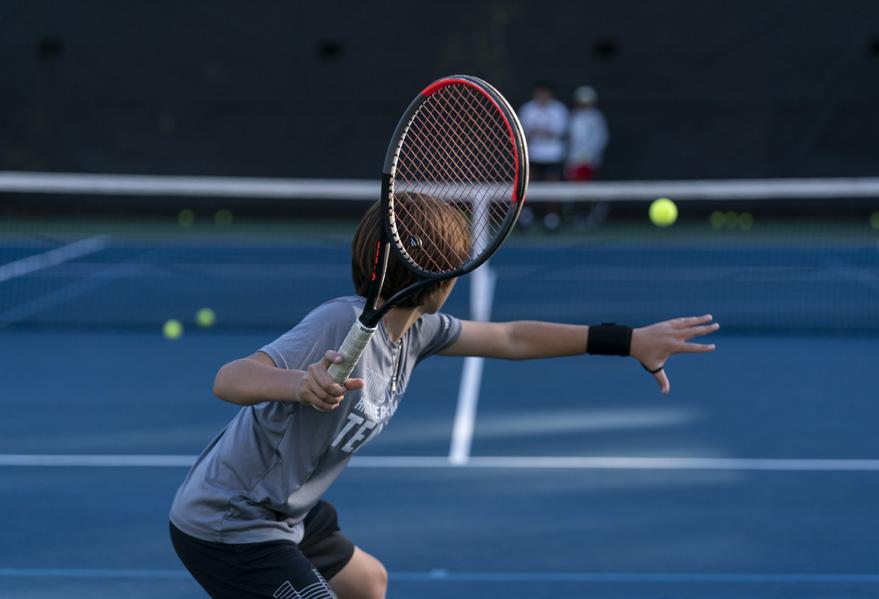
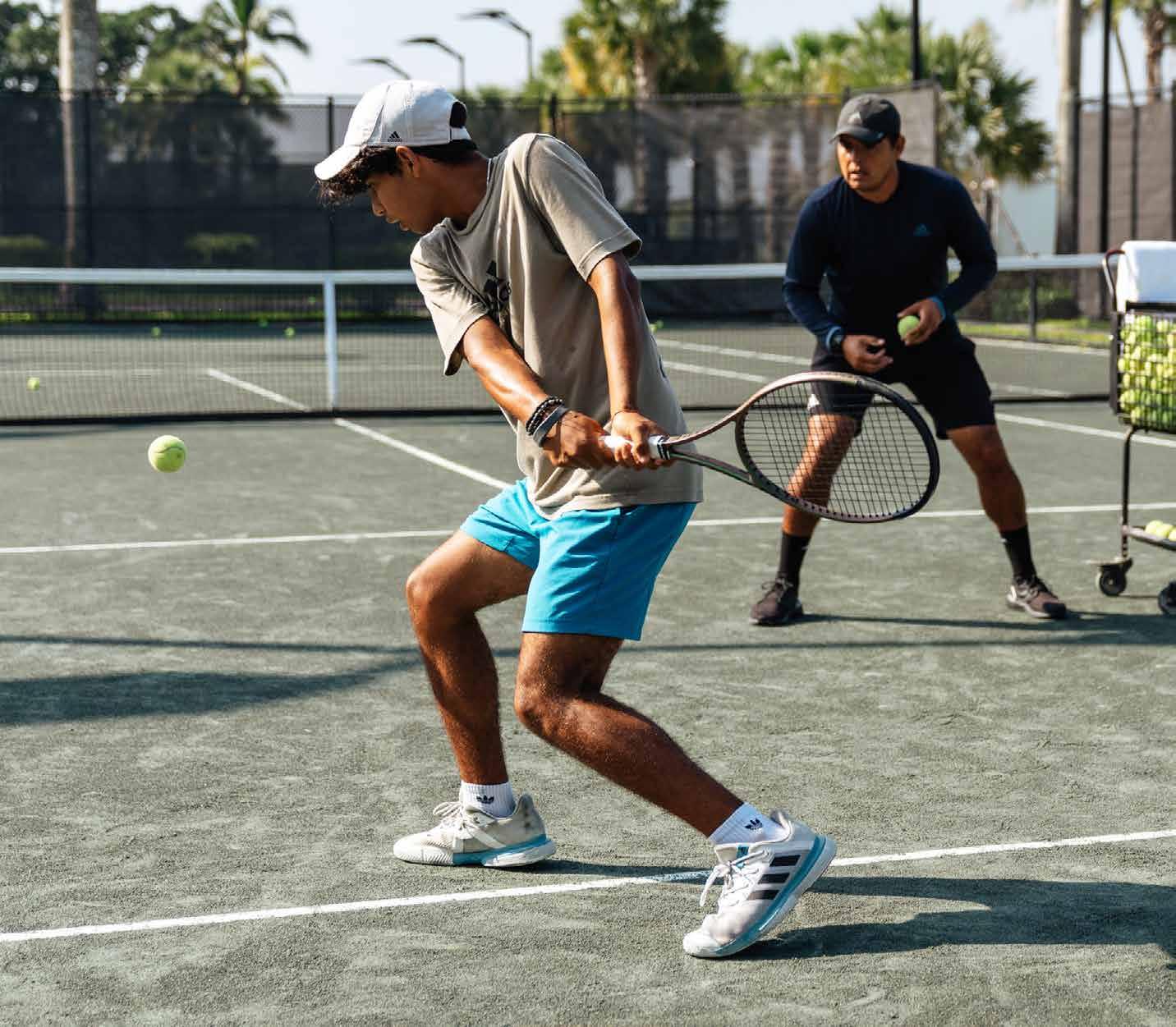
Coaches that help their students go onto play in D1, D2, and D3 college programs.
Recognized by the USTA as the pioneer in adapting to the developmental needs of young tennis players. College placement in partnership with the USP.
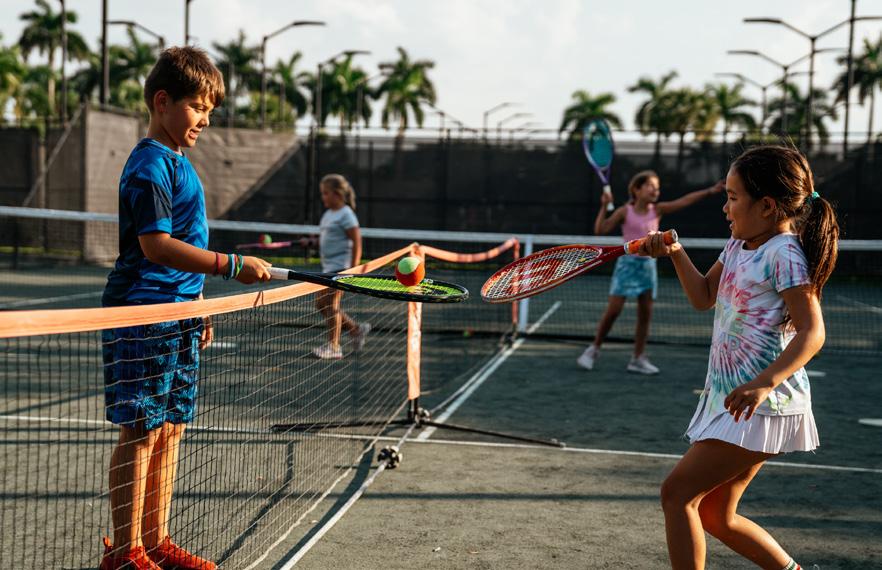
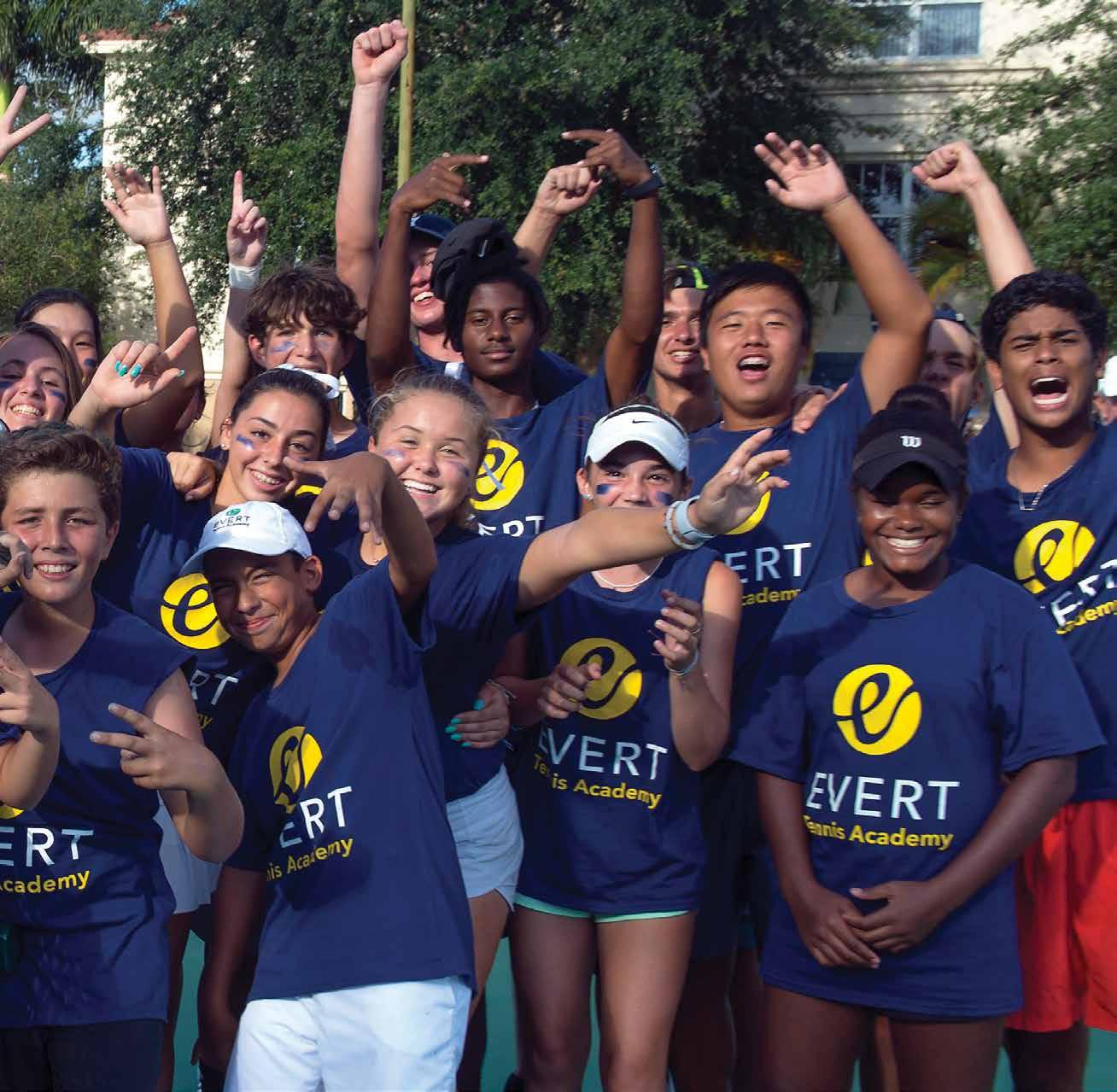
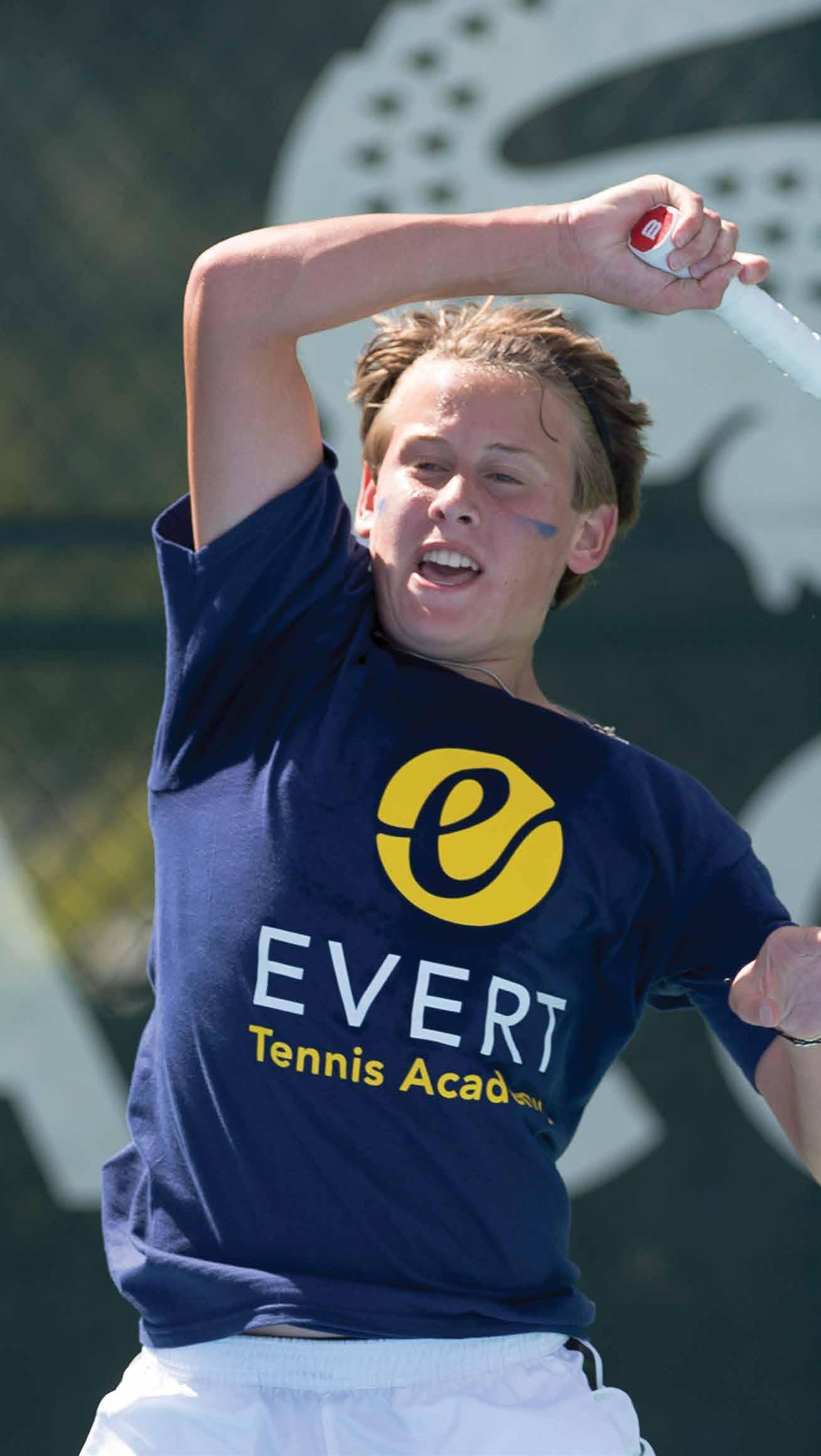
With year-round programs for all ages and skill levels, featuring a unique passion-centered coaching approach, your child can pick up a racquet for the first time and reach unlimited tennis potential all in one place. They’ll grow with the same dedicated coaches, amazing facilities, and friends they meet along the way. We don’t just create tennis players; we shape exceptional tennis individuals.

Scan to view our junior tennis programs.

Ready to unlock your potential?
At Lobster we understand the power of repetition and high-intensity, independent training. Try it for yourself!
Forehand & Backhand Consistency DAY
1
Heavy Spin & Defense DAY
2
Volley & Attack DAY
3
Cardio & Court Coverage DAY
4
Match
Simulation & Review DAY
5
Build Muscle Memory and “groove” your primary strokes with consistency and technique.
Learn to handle and return high-bouncing balls and practice generating your own heavy topspin with customizable training.
Medium speed, medium topspin. Use Horizontal Oscillation to hit alternately to the forehand and backhand baseline corner.
High speed, Maximum Topspin. Set feed rate to be slightly quicker than comfortable. Focus on aggressive footwork and racket speed.
Low speed, Low Feed Rate (for slow volleys). Then switch to a faster feed rate. Change Elevation for low net-skimming shots. Improve quick reactions, hand-eye coordination, and net-play finishing skills.
Improve your Footwork and Endurance by simulating intense match rallies.
High speed, Random Oscillation. Increase the feed rate to keep you constantly moving side-to-side and depth-to-depth.
Bring all elements together in a high-pressure, game-like scenario for independence and advanced training.
Utilize a Pre-Programmed Drill (if available) or set a completely Randomized sequence (speed, spin, location) to mimic an unpredictable opponent.


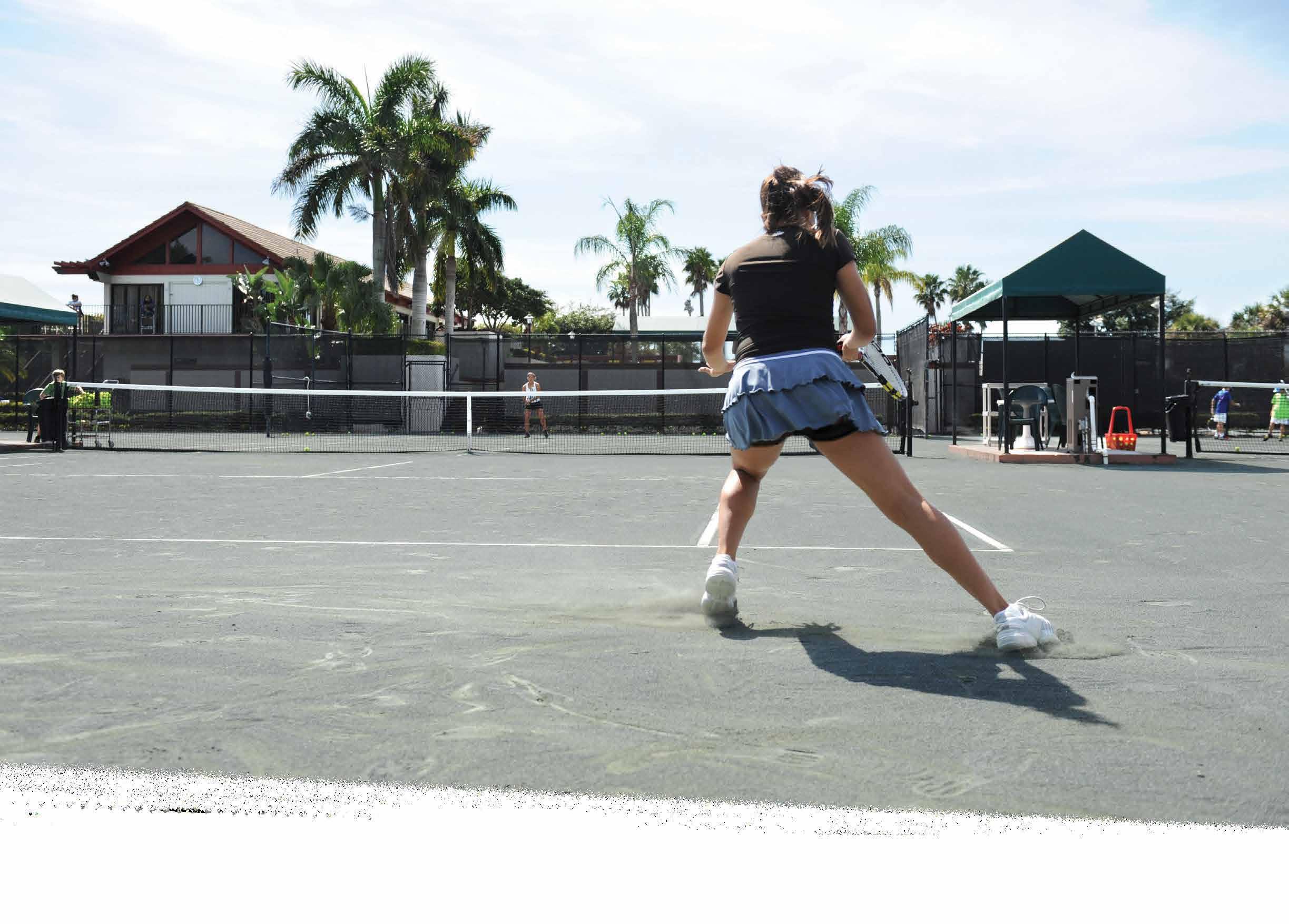
HAR-TRU is mined in the Blue Ridge Mountains of Virginia. It’s a natural green stone that is hard and angular. The particles lock together to create a stable, durable, and enjoyable playing surface.
HAR-TRU is known for being easier on the body and reducing the incidence of common tennis injuries. Players are seven times less likely to be injured on a HAR-TRU court than on a hard court.
Playing on clay — especially American green clay — develops a complete all-court game, essential footwork, shot construction, and balance techniques that other surfaces just don’t teach.
Get in touch for any last-minute equipment or accessories to get your courts open and ready for play! Shop online or contact one of our associates directly.

VOLUME 2. 2026
EDITOR AND PUBLISHER Matt Pressman
CREATIVE DIRECTOR Kevin Connaughton
HOST & ENTERTAINMENT DIRECTOR DJ Mad Linx
ASSOCIATE EDITOR Osvaldo Godoy
ASSISTANT EDITOR Alex Binstok
CONTRIBUTING WRITERS
Adam Ross, Dave Kozlowski, Cameron Mofid, Todd Pechter, Zach Shahan, Ian Pyka, Guillermo Morales-Rubert
CONTRIBUTING PHOTOGRAPHERS
Fred & Susan Mullane (CameraworksUSA), Christine Pechter
FLORIDA TENNIS PODCAST Host: Adam Ross
FLORIDA TENNIS APP Powered by ATR Tennis
Florida Racquet Sports LLC 4800 N. Federal Highway, Suite B200 Boca Raton, FL 33431
ADVERTISING info@floridatennis.com 754-222-1785
SUBSCRIPTIONS
1 Year (6 issues) $39.95, 2 Years (12 issues) $69.95 US subscribers only
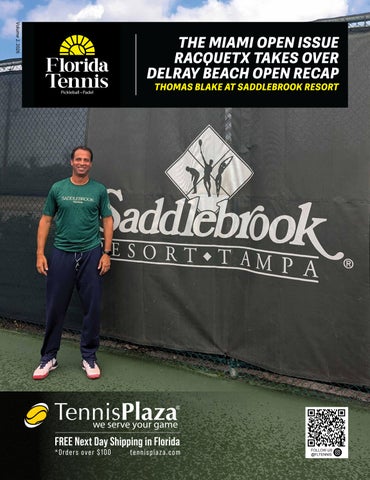
COVER PHOTO Saddlebrook Resort
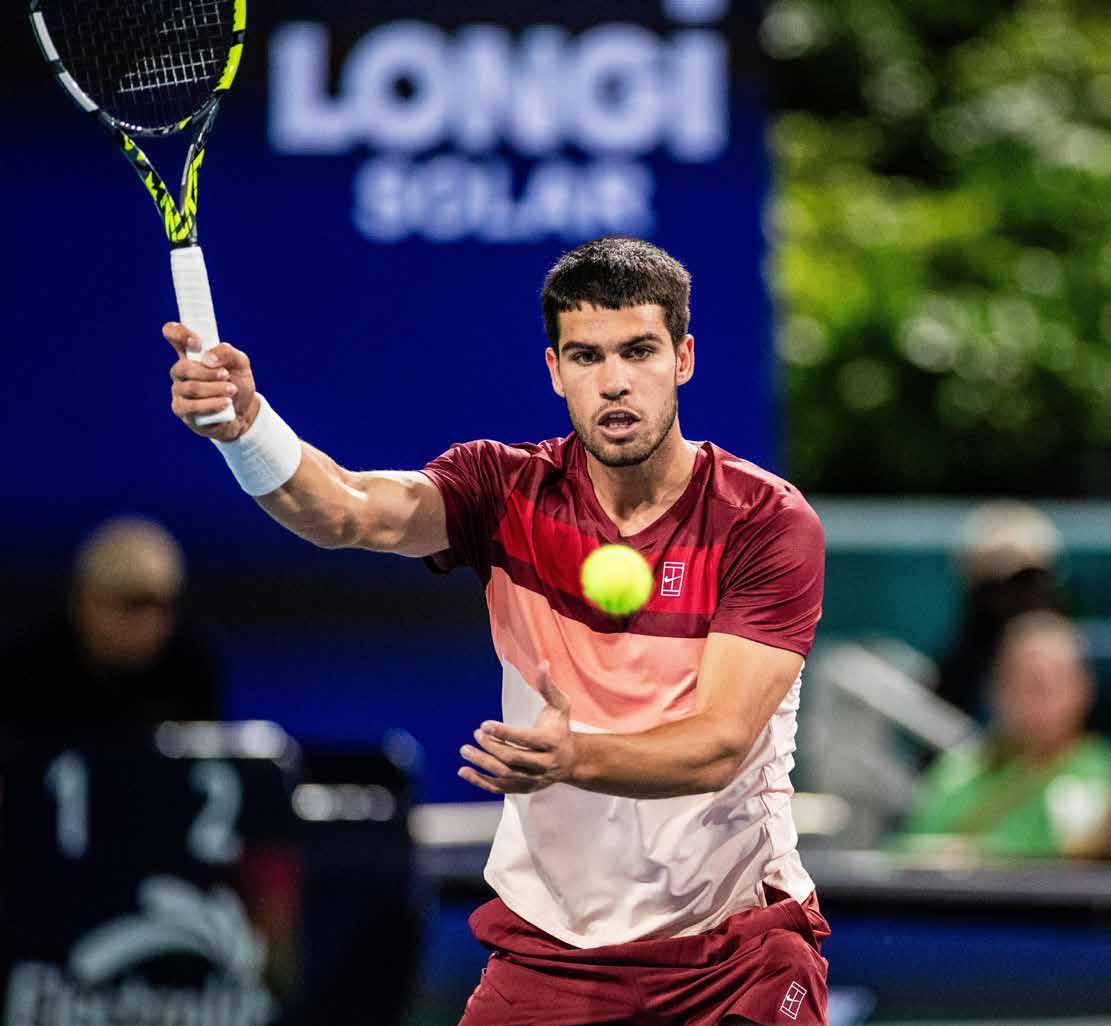
The Miami Open presented by Itaú has announced the singles entry lists for the March 15–29 tournament, set to take place at Hard Rock Stadium. This year’s field features past champions, Grand Slam winners, current Top 10 players, and rising stars from around the world.
The fields include eight past champions and players representing 34 countries. The entries also include 17 players who have won titles this season, 16 Major champions and seven players who have held the No. 1 ranking.
The top two players from both tours are among the former Miami Open champions in the field. ATP No. 1 Carlos Alcaraz won the 2022 title and No. 2 Jannik Sinner was the 2024 winner.
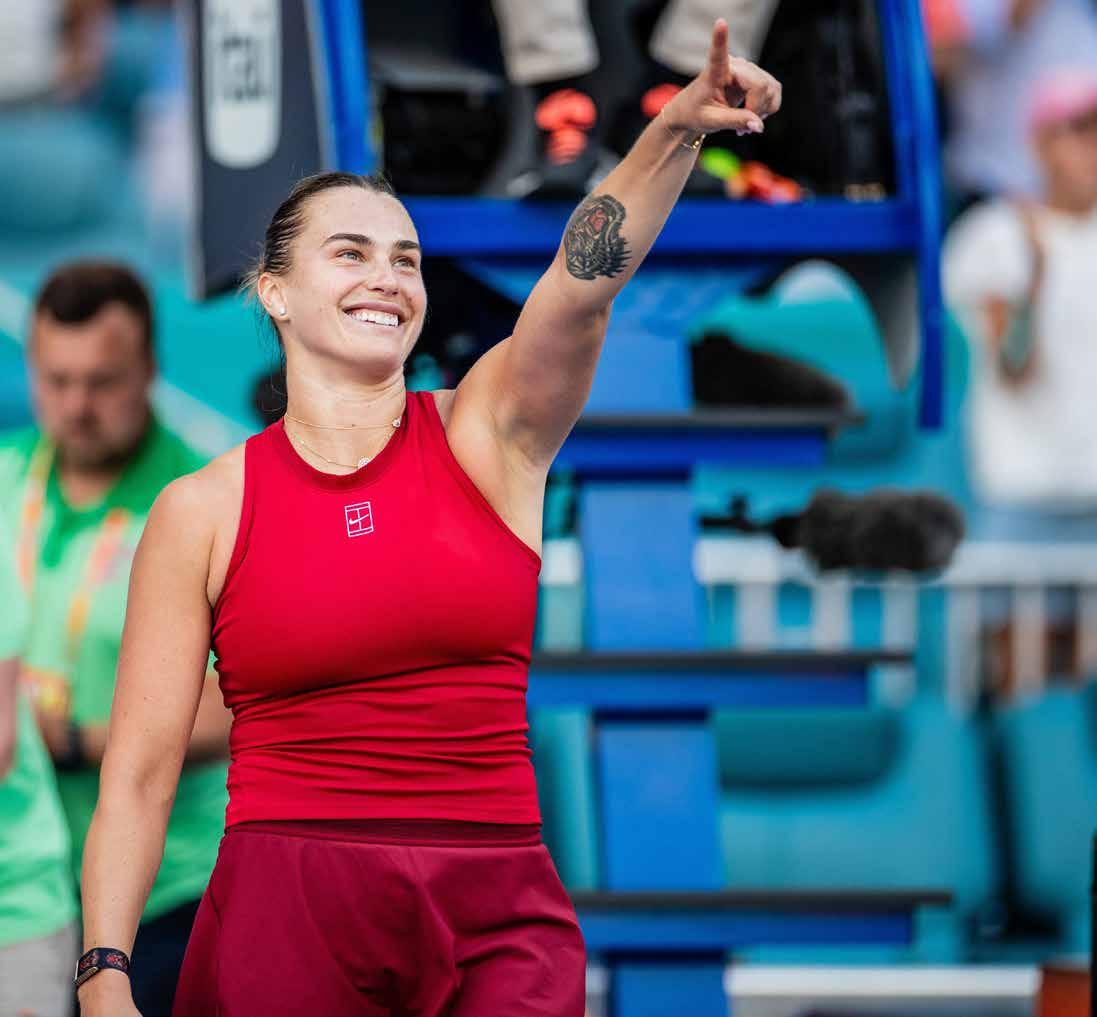
WTA No. 1 Aryna Sabalenka will return to defend her title while No. 2 Iga Swiatek was the 2022 champion.
Alcaraz was a tournament-record 18 years old when he claimed his title. The second-youngest men’s champion was crowned last year when 19-yearold Jakub Mensik won the title, defeating six-time Miami Open winner Novak Djokovic to lift the trophy.
At 38, Djokovic will be the oldest player in the men’s field, while 19-yearold Brazilian Joao Fonseca is the lone teen among the ATP entries.
A handful of teenagers are on the WTA entry list: 18-year-olds Mirra Andreeva, Iva Jovic and Tereza Valentova along with 19-year-olds Victoria Mboko and Maya Joint.
There are 27 Americans among the more than 150 initial entries, highlighted by five players ranked in the Top 10 of their respective tours: WTA No. 4 Coco Gauff, No. 5 Jessica Pegula and No. 6 Amanda Anisimova, along with ATP No. 8 Taylor Fritz and No. 9 Ben Shelton.
Tournament Schedule
Play begins with qualifying rounds Sunday through Tuesday (March 15–17). Main draw action will begin on Tuesday, March 17, which will feature a Stadium Court night session for the first time to close Women’s Empowerment Day at the Miami Open.
The tournament will conclude with the women’s singles championship on Saturday, March 28 followed by the men’s final on Sunday, March 29.
The Miami Open presented by Itaú is led by the support of its Presenting Sponsor, Itaú, and Platinum Sponsors — Public Investment Fund (PIF), Lacoste, Vanda Pharmaceuticals, Emirates, Cadillac, DoorDash, Stella Artois, Pirelli, Disney Cruise Line, CRM Bonus, La Roche-Posay and Betway.
Tickets are on sale now at miamiopen.com

By Alex Binstok
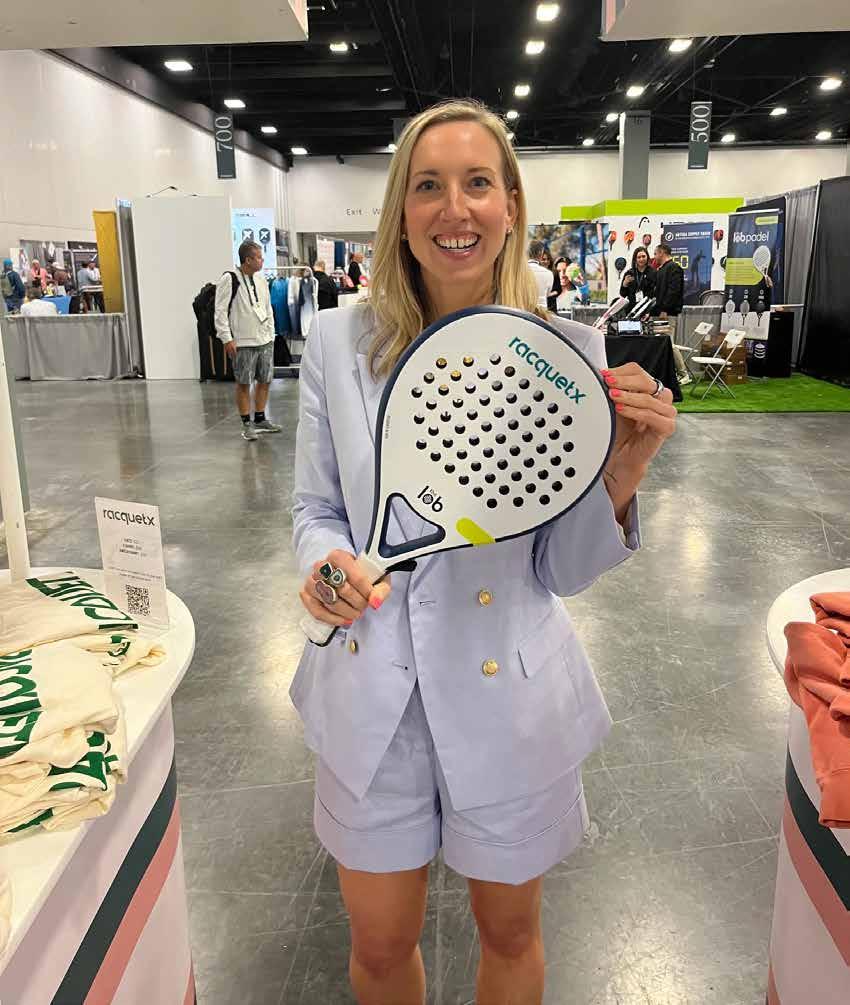
Florida Tennis spoke with Robyn Duda, co-founder and CEO of RacquetX, about the growth of racquet sports and how RacquetX keeps developing each year. The 2026 event will take place March 13–15 at the Broward County Convention Center in Fort Lauderdale. The dates line up with the start of the Miami Open, which helps place RacquetX right in the middle of Florida’s busy spring tennis season. As RacquetX enters its third year, Ross and Duda talked about its growth, industry involvement, and the overall goal of the event.
When asked to explain RacquetX to someone who has never been before, Duda kept it simple. “Oh, it's like Disneyland for racquet lovers.”
She then shared the main idea behind the event. “We are trying to be the home court for racquet sports.” With that, she made it clear that RacquetX is more than just a trade show. It’s a place where fans, brands, coaches, and players from all areas of racquet sports can come together.
When asking Duda on her passion for RacquetX she notes, “I'm a connector, events are my livelihood. I love seeing everyone come back together. And I feel like it's becoming a homecoming for a lot of folks.”
She also pointed to the crossover nature of today’s racquet sports participants. “A lot of people who have racquets in one hand tend to have a paddle of some other type in their other hand.” That observation reflects the relationship between enthusiasts of tennis, pickleball, padel, squash, and emerging racquet disciplines.
That business case took shape when industry leaders recognized a structural gap. “They didn't really see that there was anything out there across all racquet sports.” The absence of a unified B2B and consumer-facing platform across racquet sports created the opening RacquetX would later fill.
Launching a new event carried inherent uncertainty. “You build these things, you have no idea if people are going to come or not.”
Early turnout and reception shifted that uncertainty. “That's what was really amazing.” As RacquetX scales, Duda emphasized the importance of maintaining authenticity. “We're trying to maintain an authentic, personal brand that still feels like home.”
Ross then steered the discussion toward the broader growth across racquet sports. Participation trends, facility development, and brand investment have accelerated over recent years.
“Things started growing during covid when you were able to be contactless outside playing.” The pandemic reshaped recreational habits, driving renewed interest in accessible, outdoor-friendly activities.
Pickleball’s expansion became a defining example. “That's when every household became pickleball fanatics.” Tennis participation experienced renewed engagement as well. “People reengaged with tennis lessons, cause you were able to be outside.”
Padel’s global surge added another layer. “Padel is the fastest growing sport outside of the USA, and that's starting to come here.”
RacquetX mirrors that inclusivity by design. “It's a festival model.” Rather than relying solely on traditional conference structures, RacquetX integrates education and participation.
Duda described the layout philosophy. “It's building courts and programming those courts as though they're conference rooms.” The design recognizes that learning within sport often occurs through experience and observation.
“Your learning happens not just in a classroom, it happens when you're playing as well.”
That structure resonated with brands across the industry. “The brands were just like, we're going to do this.” Emerging companies recognized opportunity for exposure and direct engagement.
“We would love to get in front of everyday players.”
Unity across racquet sports remains another defining principle. “Rising tides lift all ships.” Duda expanded on the concept. “There's enough room for everyone to be successful here.”
“Supporting each other... makes a lot more sense.”
One of RacquetX’s strongest growth components has been the Club Summit. “We launched the club summit, and we had almost two hundred clubs come.” Demand for deeper engagement led to expansion beyond the flagship event.
“Let's take this baby on the road.”
The RacquetX City Series introduced smaller gatherings designed to strengthen regional relationships. “There's no better way to build the big event, than being in the field.”
By the close of Ross’s conversation with Duda, the themes were consistent: accessibility, connection, collaboration, and sustained industry momentum. RacquetX positions itself as a shared platform for the racquet sports world — one designed to reflect how the industry is expanding and where it continues to head. Fort Lauderdale will host the next chapter.



By Will Turvey
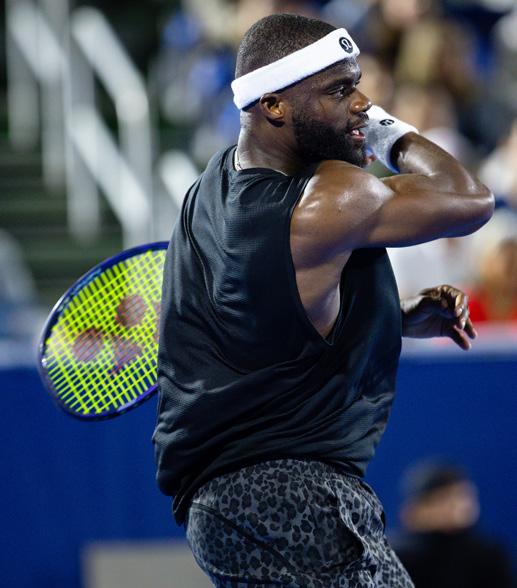
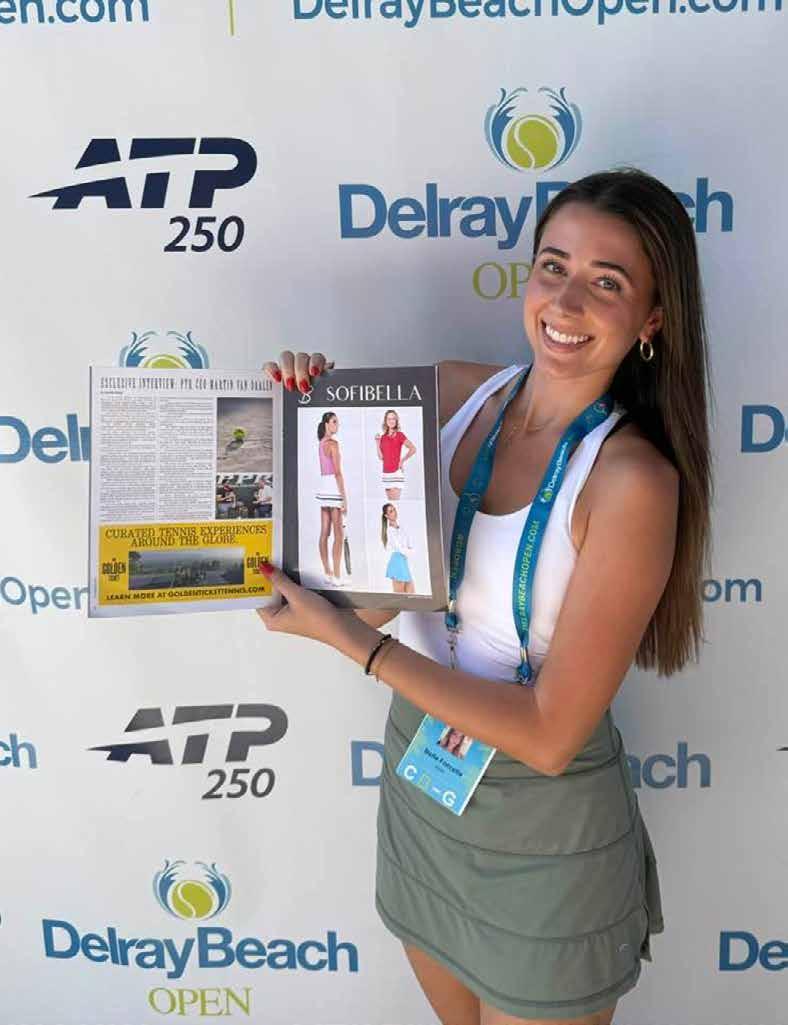
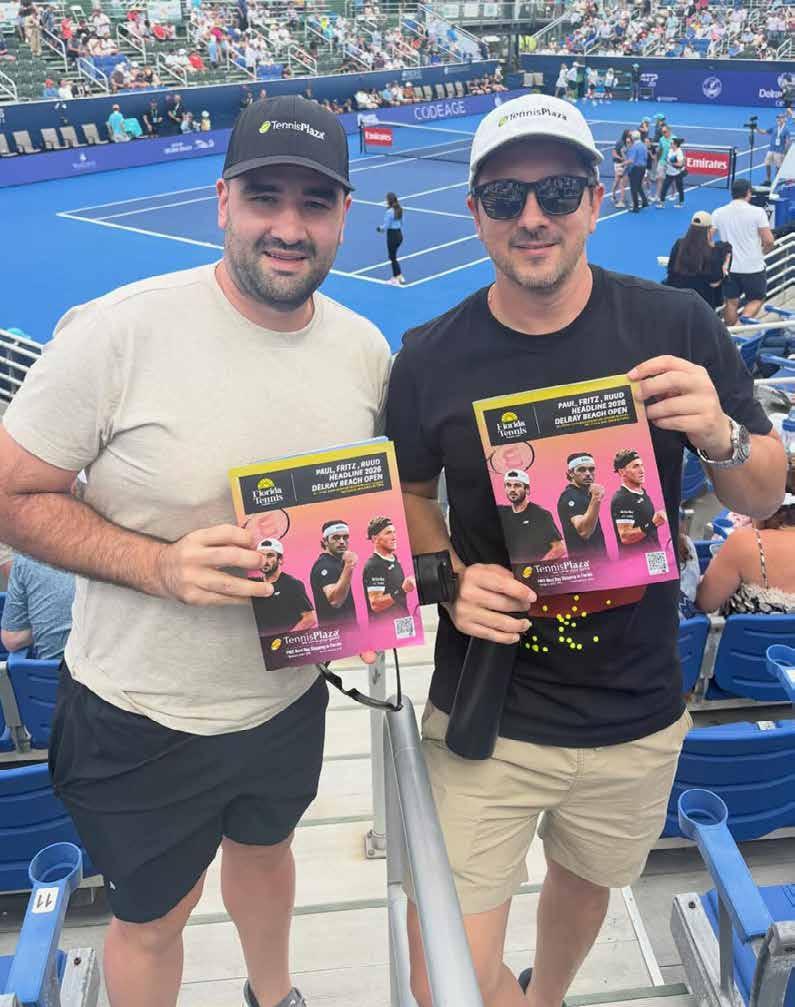
This year, the Delray Beach Open truly exceeded expectations on every level, and a big part of this was not just the food and party but the players involved: the 2026 edition boasted the most packed draw ever with eight top thirty players including world No. 8 Taylor Fritz. Out of the field of exceptional level, an unlikely contender and eventual champion emerged who truly raised the bar against the big names. Let’s boil down all the action.
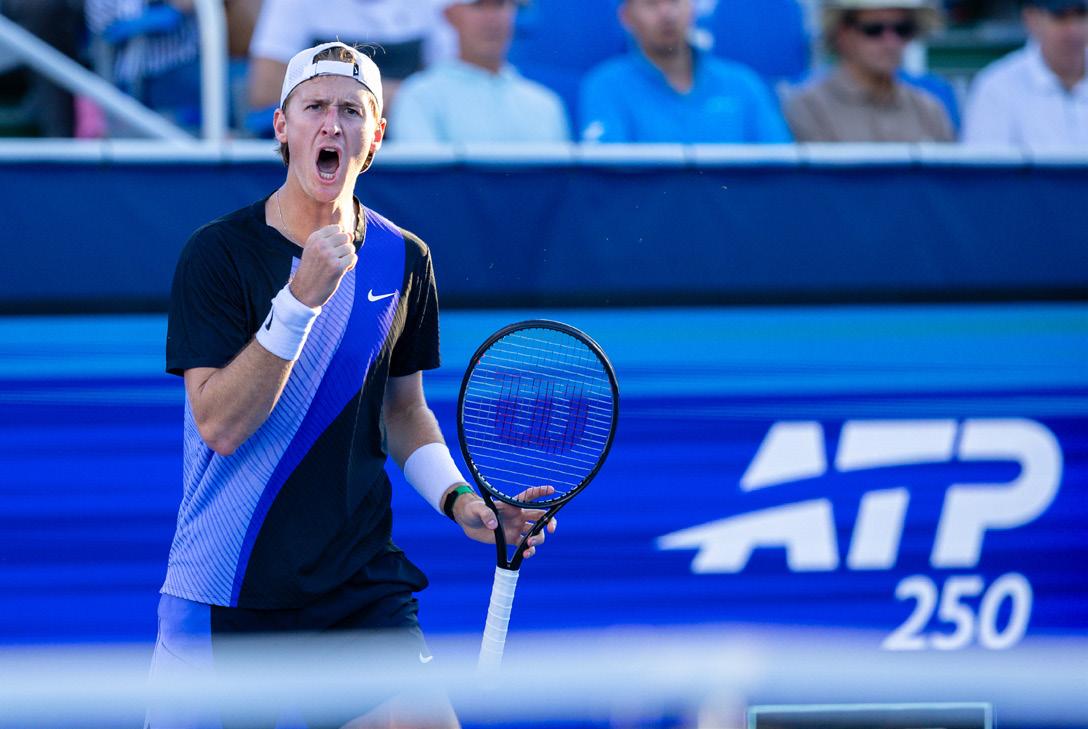
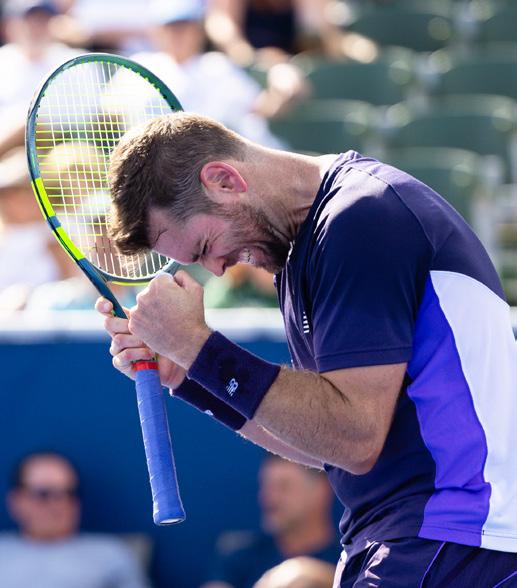
As an up-and-coming 20-year-old on the ATP Tour all the way back in 2021, Sebastian Korda reached his first final right here in Delray Beach but bowed out to Hubert Hurkacz in a bland two-set affair. Five years later, Korda found himself back in the championship showdown with 5th seed and fellow former finalist Tommy Paul. Both came into the match wanting to take their progress at the event just one more golden step forward, but it was Bradenton boy Korda who answered the call and lifted the trophy on a shadowy day at the beach.
Unseeded and with five matches ahead of him, Sebastian Korda entered the event as a solid contender but not a predictable champion, but that all shifted as, with each match, his tennis got better and better and the big wins started to rack up. He kicked things off with a convincing two setter against Mackenzie McDonald in which he barreled down fourteen aces. He backed that up by picking apart a dangerous Alex Michelsen, but the action truly got going in the quarterfinals against 2nd seed Casper Ruud.
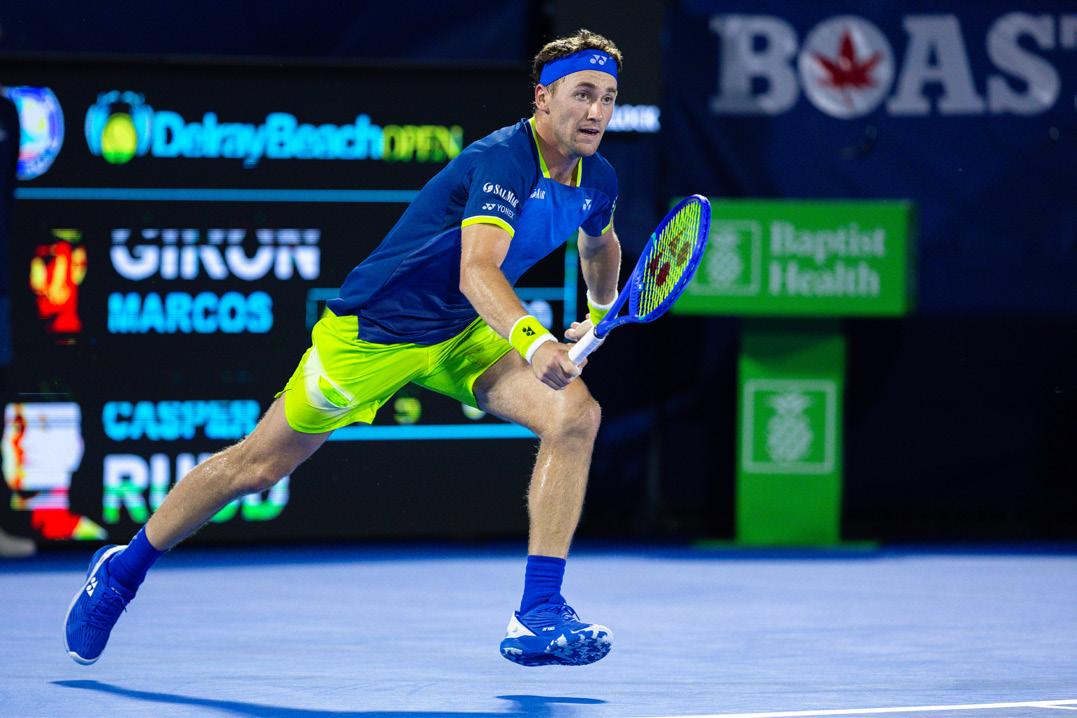
The top-ranked Norwegian and 3-time major finalist got things going by taking the first set 6-4, and it seemed as though everything was on track for a standard victory. But a relentless Korda refused to give up and brought his best tennis in the second set, securing a final date with a commanding 6-2 performance. It was evident right from the start of the third that the American was vibing in his home state with the late night crowd, and was able to spring ahead and book the semifinals with another 6-2 shutout.
Next up was 3rd seed Flavio Cobolli, another player with plenty of experience on these cool blue courts. Despite this, the intense heat seemed to get to the Italian who struggled to accel past Korda in the first and keep up with him in the second. After the two held even and pushed each other into a tiebreak, Korda took advantage of some early errors and confidently soared to a 7-1 victory in points. The confidence carried over into the second, and Korda pushed onwards with a brilliant score of 6-1 to seal a place in the final. It was time for redemption.
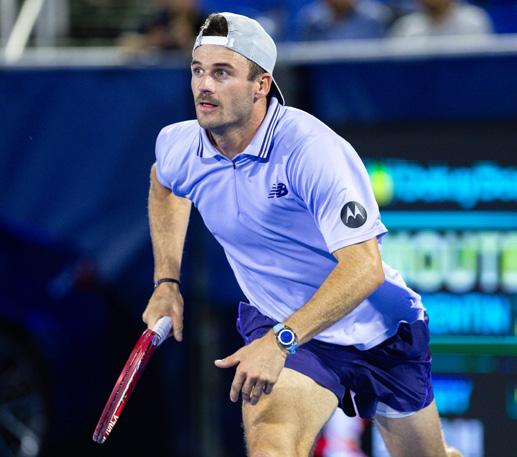

Tommy Paul was fresh off wins against 4th seed Learner Tien and 1st seed Taylor Fritz in the previous rounds, respectively, and on paper the clear favorite to claim the silverware on championship Sunday. On top of that, he was armed with a whole pack of passionate fans known as the “founding fathers”----teens who had dressed up in revolutionary style and made themselves known as a vocal presence at the 28-year-old’s previous matches. But with grey skies and cooler conditions, Korda’s shots slid perfectly through the court and he was able to outplay Paul with a dominating performance in his own serve and a few key breaks to get the job done.
While they both clocked in 67% made on their first serve, it was Korda who made up for it with an 83% win on first while Paul matched his in percentage with another 67%. And things just deteriorated for Paul on the second serve at 41% points won, as a hungry Korda passionately took advantage of this and did his part to break at the perfect time in the first and second sets, winning the match 6-3, 6-4. It was a long time coming for Sebi Korda in Delray Beach, and after suffering tremendous adversity in the form of persistent injuries, he seems to have set himself back on the right track with a new coach, and now a new title to add to the cabinet.

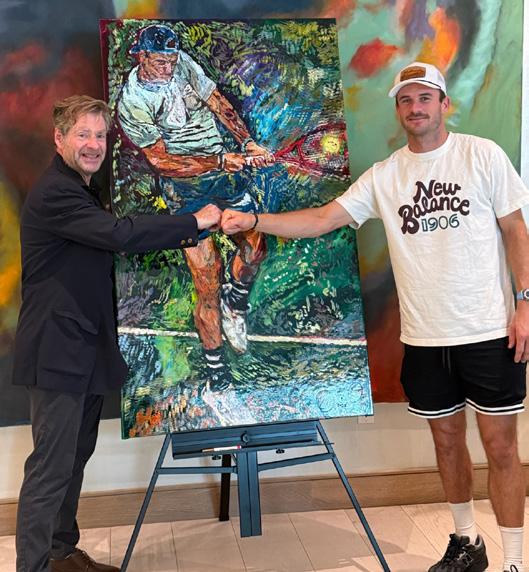
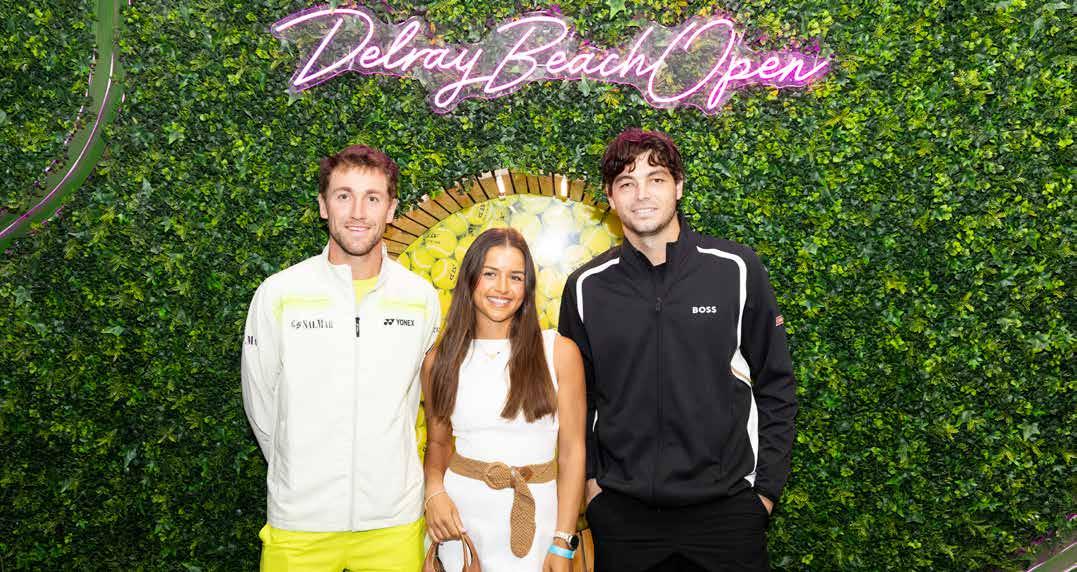
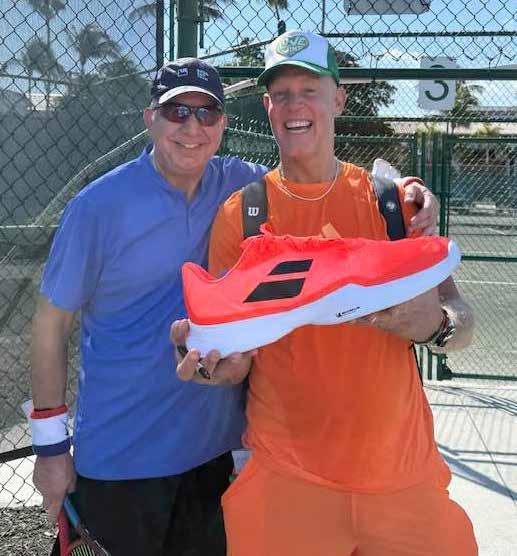








By Alex Binstok
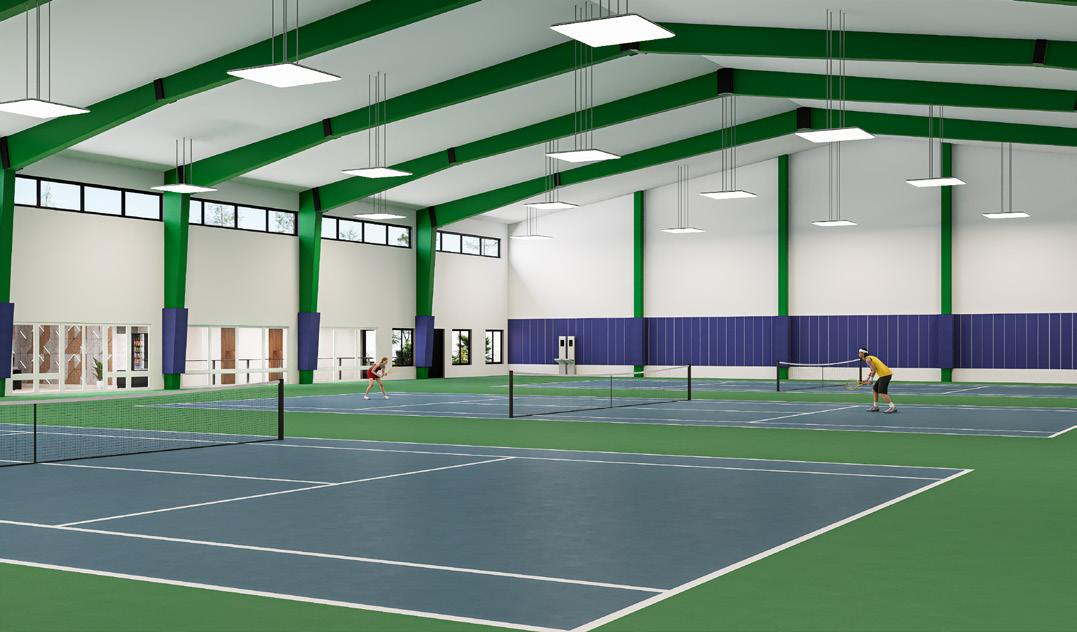
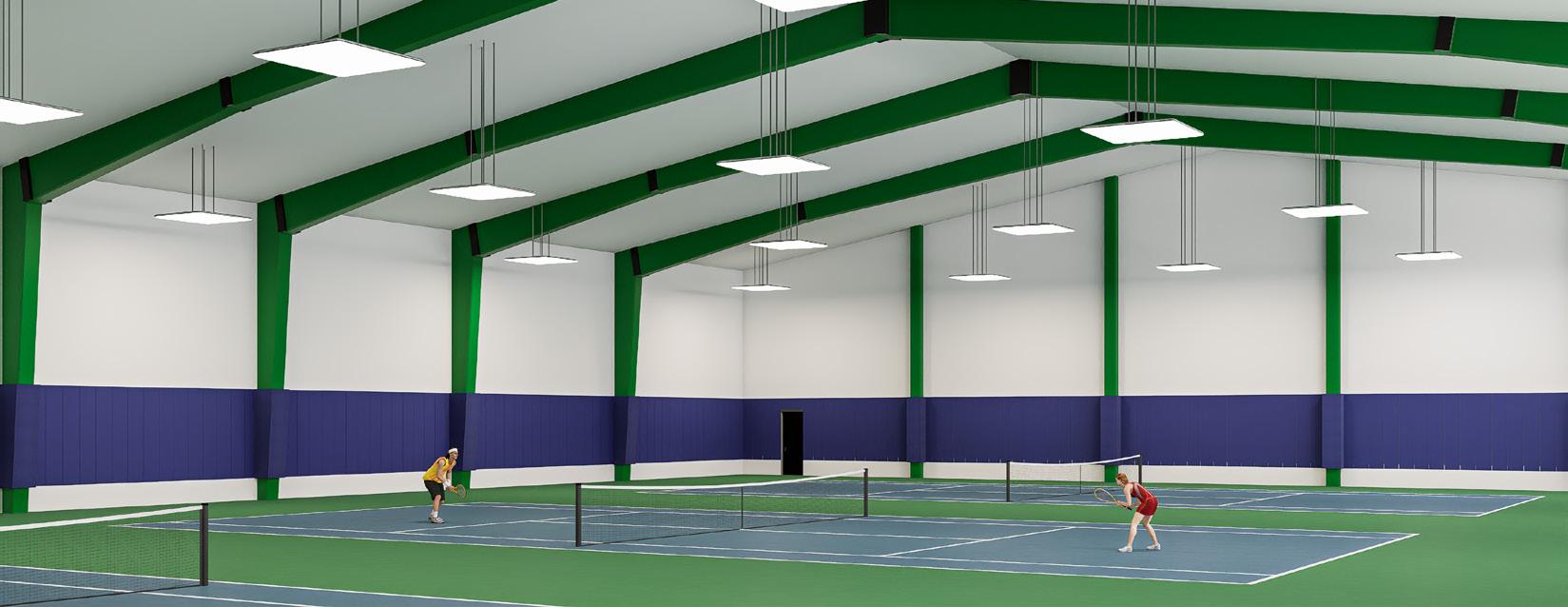
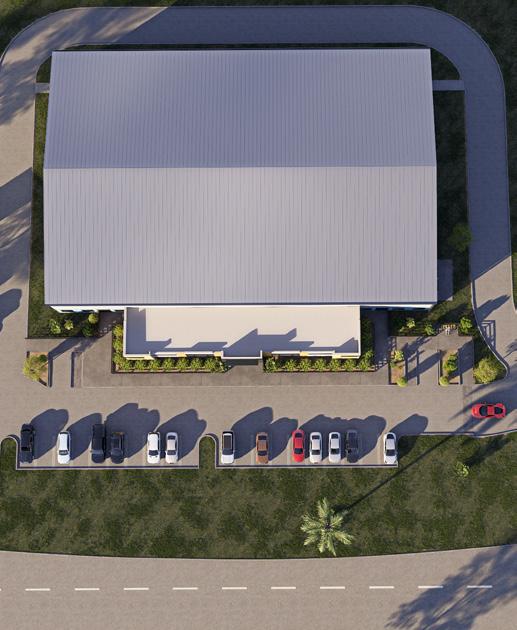
Florida is known for its sunshine, but even in the Sunshine State, serious players understand the value of high-quality indoor courts. That’s exactly the gap Neal Feinberg, President and General Manager of Florida Indoor Tennis Club, is looking to fill.
Speaking with Matt Pressman, Editor and Publisher of Florida Tennis Magazine, Feinberg outlined his vision for what he believes will become a game-changing facility for players across the region.
“We want to create a true indoor tennis experience,” Feinberg explained. “This isn’t just about putting a roof over courts. It’s about building a complete tennis environment where players can train, compete, and improve year-round without worrying about weather interruptions.”
While Florida boasts thousands of outdoor courts, dedicated indoor tennis facilities remain relatively rare compared to other major tennis states. Feinberg sees that as both a challenge and an opportunity.
“In many parts of the country, indoor tennis is essential,” he said. “Here in Florida, people don’t always think about it because of the climate. But between summer storms, extreme heat, and humidity, there’s absolutely a need for reliable indoor court time.”
Florida Indoor Tennis Club aims to provide climate-controlled courts designed for comfort, consistency, and performance. The goal is to create an environment where junior players, high-performance athletes, league competitors, and recreational players can all benefit.
“We want players walking into our facility knowing they’re going to get consistent playing conditions every single time,” Feinberg added.
According to Feinberg, the club won’t be limited to one segment of the tennis population.
“This is not just a high-performance academy, and it’s not just recreational play,” he said. “We’re building something that serves the entire tennis community.”
Plans include structured junior programming, adult clinics, leagues, private lessons, and competitive events. The facility is also expected to host tournaments and special events, giving players additional competitive opportunities in a controlled indoor setting.
Pressman noted during the interview that indoor tennis can also create a different kind of energy and focus. “There’s something about being indoors — it brings a certain intensity,” Pressman said.
Feinberg agreed. “Absolutely. Players can concentrate. There’s no wind. No rain delays. It becomes about pure tennis.”


One of the key advantages of indoor facilities is predictability — something Feinberg believes is critical for player development.
“For juniors especially, consistency matters,” he said. “If you’re training seriously and preparing for tournaments, you can’t afford to lose sessions to weather. Indoor courts allow us to keep development on track.”
The club is also expected to incorporate modern training tools and programming aimed at maximizing player improvement.
“We’re thinking long-term,” Feinberg emphasized. “This is about building a place where players can grow — technically, physically, and mentally.”
Florida’s tennis participation continues to expand, with clubs, academies, and community programs seeing increased engagement. Feinberg believes Florida Indoor Tennis Club arrives at the right moment.
“The sport is growing,” he said. “People are playing more. Families are investing in lessons and development. There’s a real demand for quality court time.”
By offering indoor access, the club hopes to complement — not compete with — Florida’s rich outdoor tennis culture.“There will always be outdoor tennis in Florida. That’s part of the beauty of the state,” Feinberg said. “We’re simply adding another option — one that enhances what’s already here.”
As Florida Indoor Tennis Club prepares to open its doors, Feinberg’s vision is clear: create a reliable, high-level tennis environment that supports players 12 months a year.
“We want this to become a home base for players,” he said. “A place where they know they can train, compete, and be part of a tennis community.”
For Florida’s passionate tennis population, the arrival of a dedicated indoor facility could mark an important new chapter — one that blends the state’s vibrant tennis culture with the consistency and performance benefits of year-round indoor play.
More details on programming and opening timelines are expected to be announced soon.
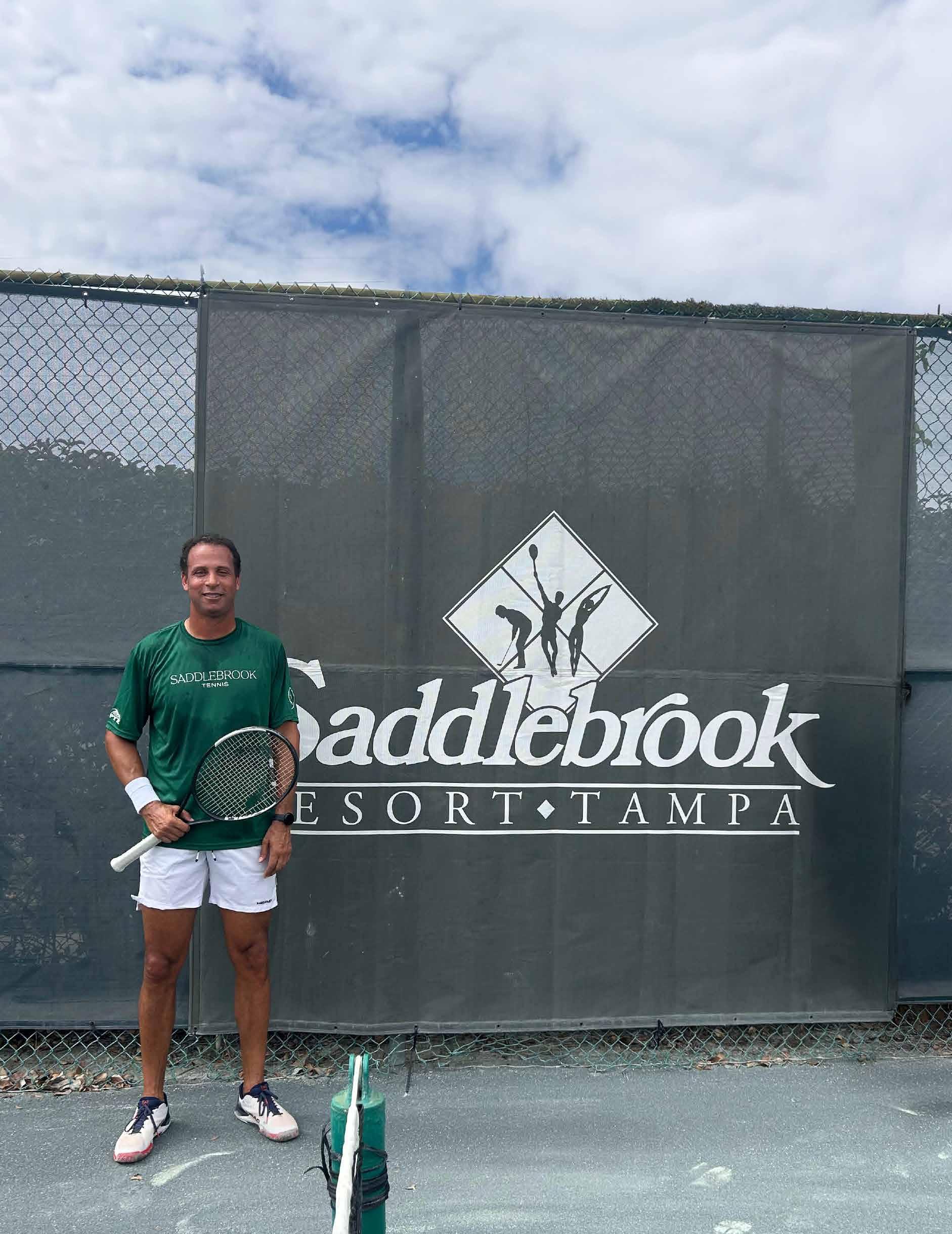
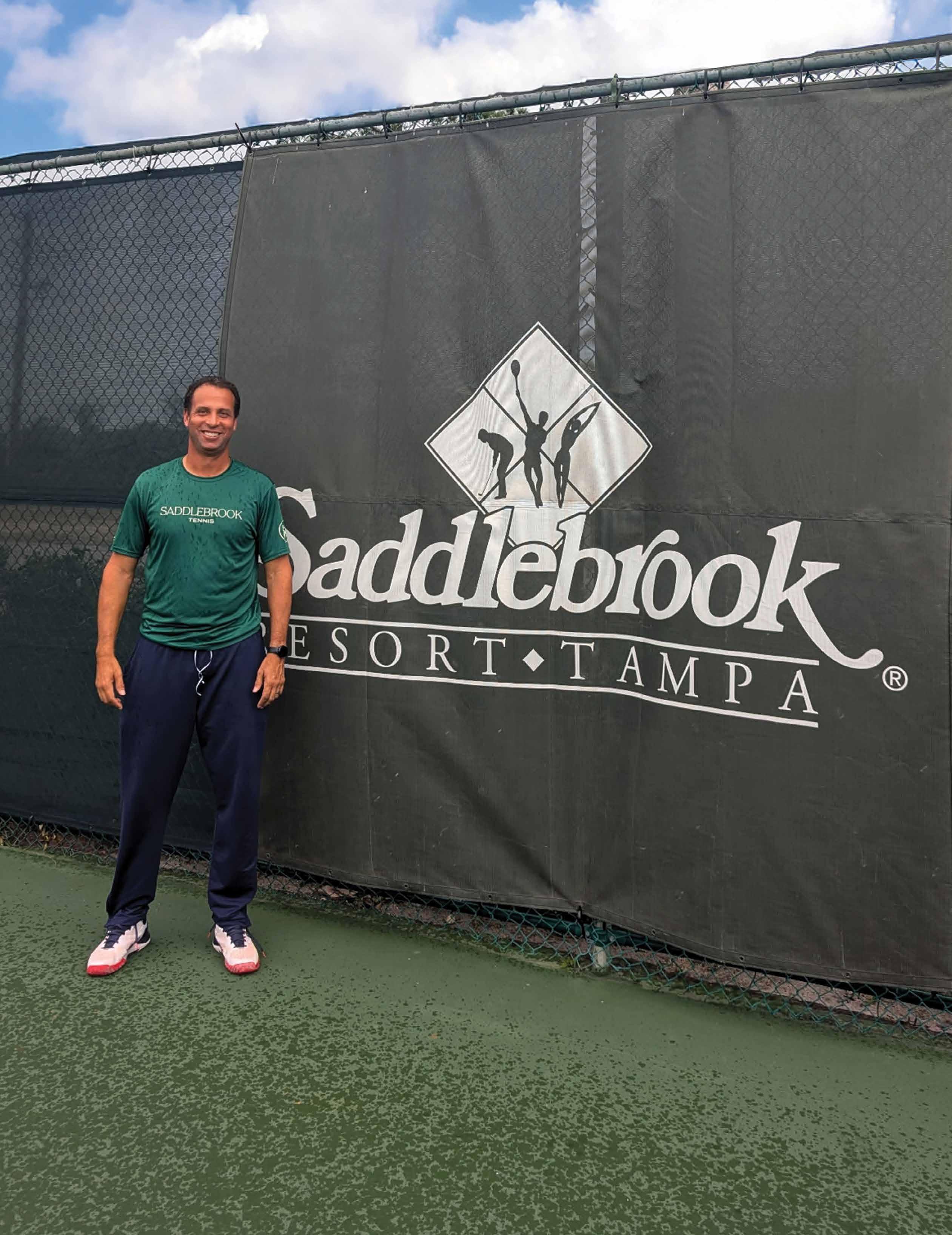
Saddlebrook Resort, the Florida destination known for its world-class athletic training, legendary tennis and golf, diverse leisure offerings, and a variety of group experiences, today announced Thomas Blake, Association of Tennis Professionals (ATP) veteran, as director of performance tennis. Blake joins Saddlebrook as the iconic resort – home to Saddlebrook Preparatory – enters its next era, following a $92 million reimagination that debuted in November 2025.
Blake takes the helm of Saddlebrook’s legendary tennis program, a worldclass training ground that has developed generations of champions, including Jim Courier, Pete Sampras, Martina Hingis, Andy Roddick, John Isner, current top player Alexander Zverev, and his own brother, James Blake. It’s here, too, where Blake honed his own skills throughout his professional career.
Bringing decades of tour-level expertise and a performance-driven philosophy, Blake will build on this legacy by advancing the training and on-court development for elite junior, collegiate, and Saddlebrook Preparatory players, as well as professional athletes training at the academy. In his role, he will oversee all high-performance tennis operations, help define the program’s technical and tactical approach, lead and mentor a team of high-performance and touring coaches, and drive further advancements in the program.
“Joining Saddlebrook as director of performance tennis is a full-circle moment for me," said Blake. "I had the opportunity to train at this incredible program throughout my professional tennis career, learning from the best coaches in the world. Seeing the resort re-emerge with such intention, and in a way that truly honors its legacy, is one of the many reasons I am thrilled to be back. I am proud to step into a role that allows me to mentor the sport’s rising stars, share my passion for tennis, and lead an exceptionally talented team of coaches and staff.”
“Thomas is widely respected for his professional playing career and his ability to develop elite talent on the global stage,” said Jeff Mayers, Managing Director of Saddlebrook Resort. “His return to our Saddlebrook community reinforces the legacy and impactful experience we provide for our students, guests, and members. We’re thrilled to have him as part of our team.”
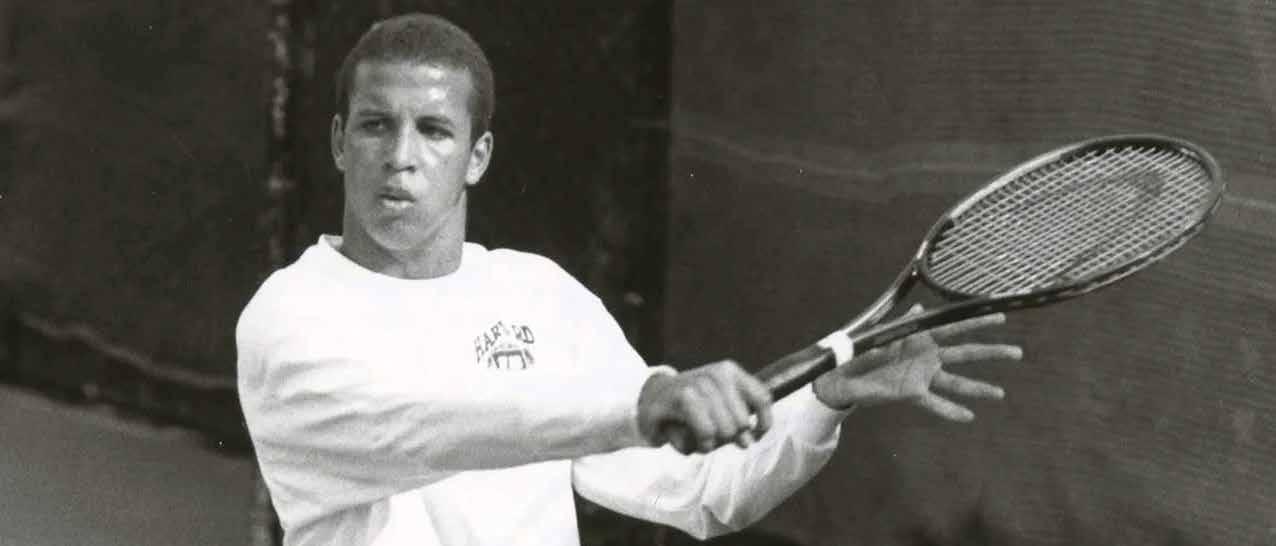
Blake brings a wealth of experience as he returns to Saddlebrook, with a background in collegiate tennis at Harvard University and an international professional career, highlighted by a doubles appearance at the U.S. Open alongside his brother. Following his playing career, Blake remained deeply embedded in high-performance tennis, coaching and training elite athletes and
serving as a hitting partner for top ATP and WTA players like Maria Kirilenko, Jill Craybas, and, most recently, Eliot Spizzirri. He has also competed in and coached World Team Tennis. Today, he remains actively involved in the sport through leadership and advisory roles at premier events, including The Miami Open, and serves on the boards of the James Blake Foundation and the Avila Charity Tennis Tournament.
"Thomas’s vision for tennis perfectly aligns with our philosophy of combining world-class sports programming with a premier resort experience," said Michael Kazma, President of Amzak Capital Management, the investment firm that owns Saddlebrook Resort in partnership with Mast Capital. "From the outset, our mission has been to honor Saddlebrook’s rich history while thoughtfully evolving the resort to today’s standards, and Thomas is a key piece of that. His leadership will strengthen our legacy and expand our bespoke fitness and sports offerings – creating an experience that can only be found here.”
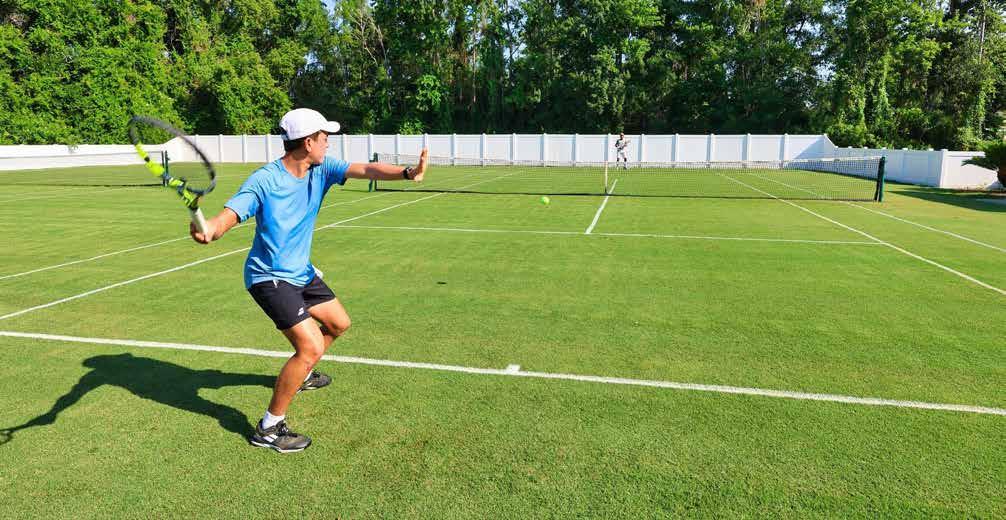
When Saddlebrook debuted its extensive transformation in late 2025, the resort introduced 451 newly redesigned guest rooms and suites, a reimagined lobby, four distinct culinary concepts, championship golf courses designed by renowned architect Rees Jones, renovated meeting and event spaces, and more. The resort boasts expansive sports offerings, including 41 tennis courts representing all four Grand Slam surfaces, eight pickleball courts, a state-ofthe-art fitness center, and a planned multi-court padel complex. In 2024, Saddlebrook welcomed the international headquarters of the Professional Tennis Registry and Professional Pickleball Registry, further cementing its status as a global hub for racquet sports. Saddlebrook Resort is also home to the Saddlebrook Golf Academy, where K.J. Choi, Karl Vilips, and Aline Krauter, among many others, have trained.
Saddlebrook also expanded its private membership program as part of the revitalization. For the first time, the resort opened its membership to individuals and families beyond its neighboring residential community, welcoming new members to experience its premium amenities and vibrant resort lifestyle. Members can access everything Saddlebrook has to offer through the program’s multiple tiers – from premier golf, tennis, and pickleball and prolevel coaching to celebration-worthy dining, leisurely pool days, and exclusive programming.
For more information please about Saddlebrook Resort, visit saddlebrook.com. For membership information, visit saddlebrook.com/membership-overview.

By Osvaldo Godoy
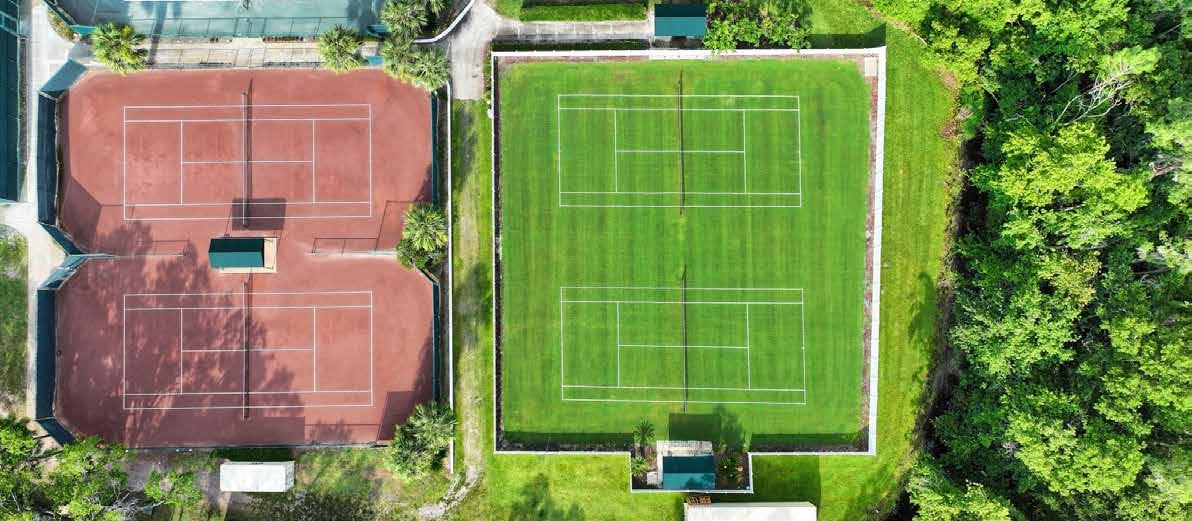
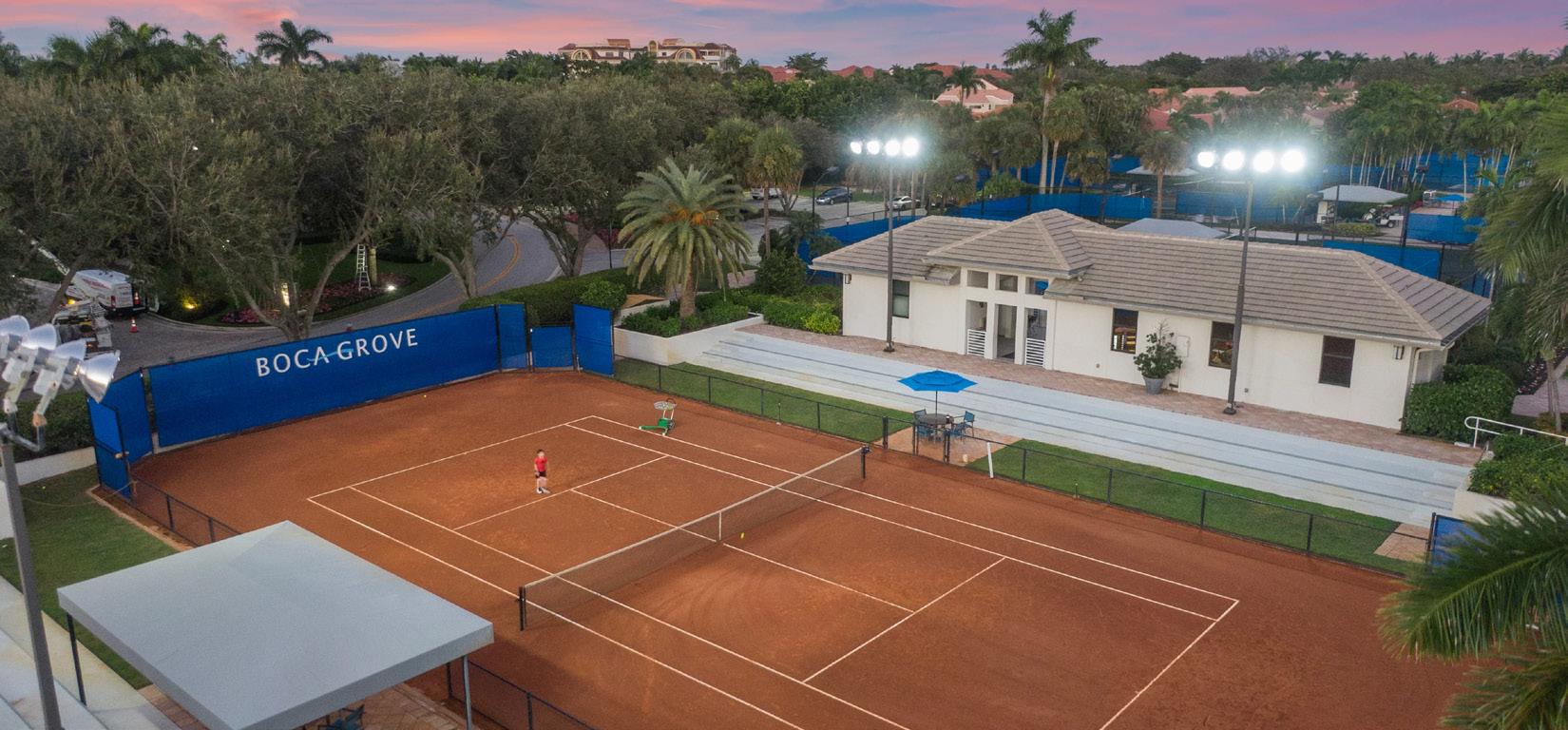
Sitting courtside on the red clay stadium court at Boca Grove Golf & Tennis Club, it’s easy to forget you’re in South Florida. The surface, the vibe, and the atmosphere evoke a European sophistication making Boca Grove one of the most distinctive racquet sports destinations in the region.
Florida Tennis Magazine Editor Matt Pressman recently sat down on court with Dalibor “Nick” Nikolin, Director of Racquet Sports at Boca Grove, to talk about what sets the club apart—and where its program is headed.
“This is our unique red clay court,” Nikolin explained. “In the past, we've had a lot of pros coming here prepping for the French Open... this is imported Italian clay, and we are really proud of it.”
Because of that authenticity, Boca Grove has quietly become a training base for elite players preparing for the clay-court swing. Nikolin confirmed that several top professionals have spent extended time at the club.
“We had Taylor Fritz, Coco Gauff, Bianca Andreescu recently, and Tommy Paul was here as well,” he said. “Everybody loved it. They spent over a week, two weeks here at our club.”
Nikolin’s own journey to Boca Grove mirrors the club’s international flavor. Originally from Serbia, he played junior tennis before beginning his professional career in Europe.
“My first bigger role was in Sweden,” Nikolin said. “I was running a club in Gothenburg. Then I came here to Boca Raton.” Now settled in South Florida, Nikolin appreciates the year-round tennis culture.
“In this state, 365 days per year we play outdoor,” he said. “That’s just amazing coming from different climates and different parts of the world.”
While the red clay court may steal the spotlight, Boca Grove’s racquet sports program is built around participation, variety, and community. “We are big on social programming,” Nikolin explained. “We have a lot of clinics, a lot of round robins.”
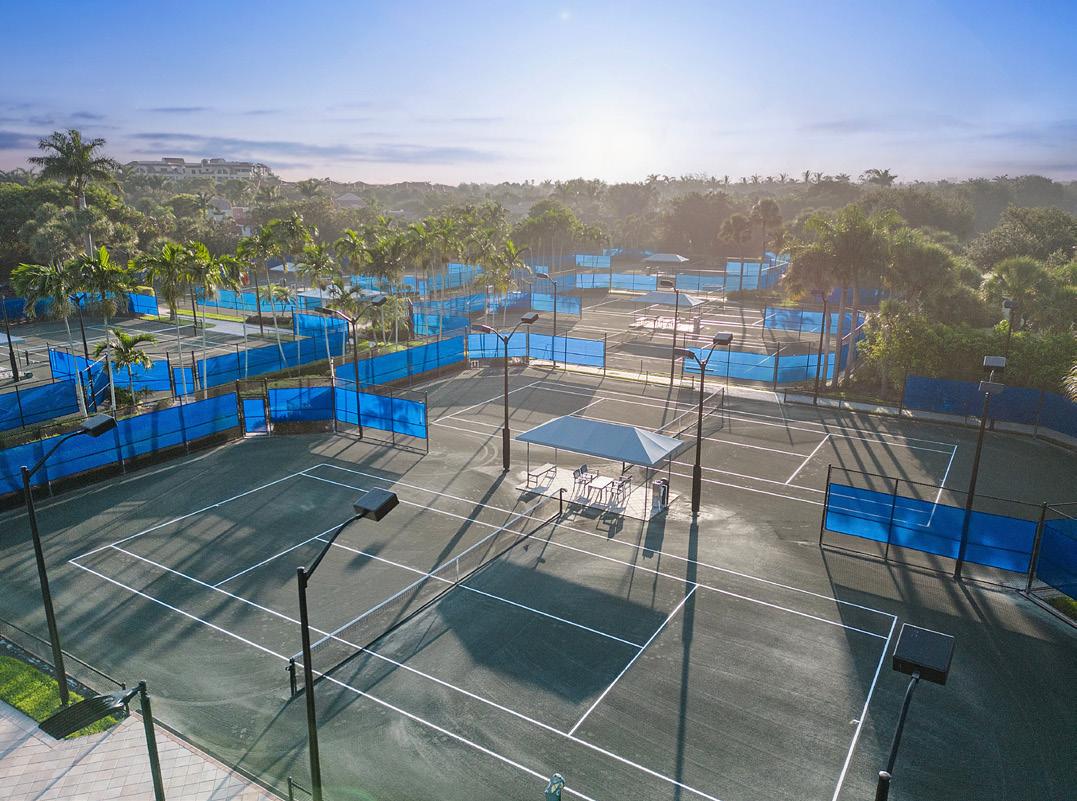
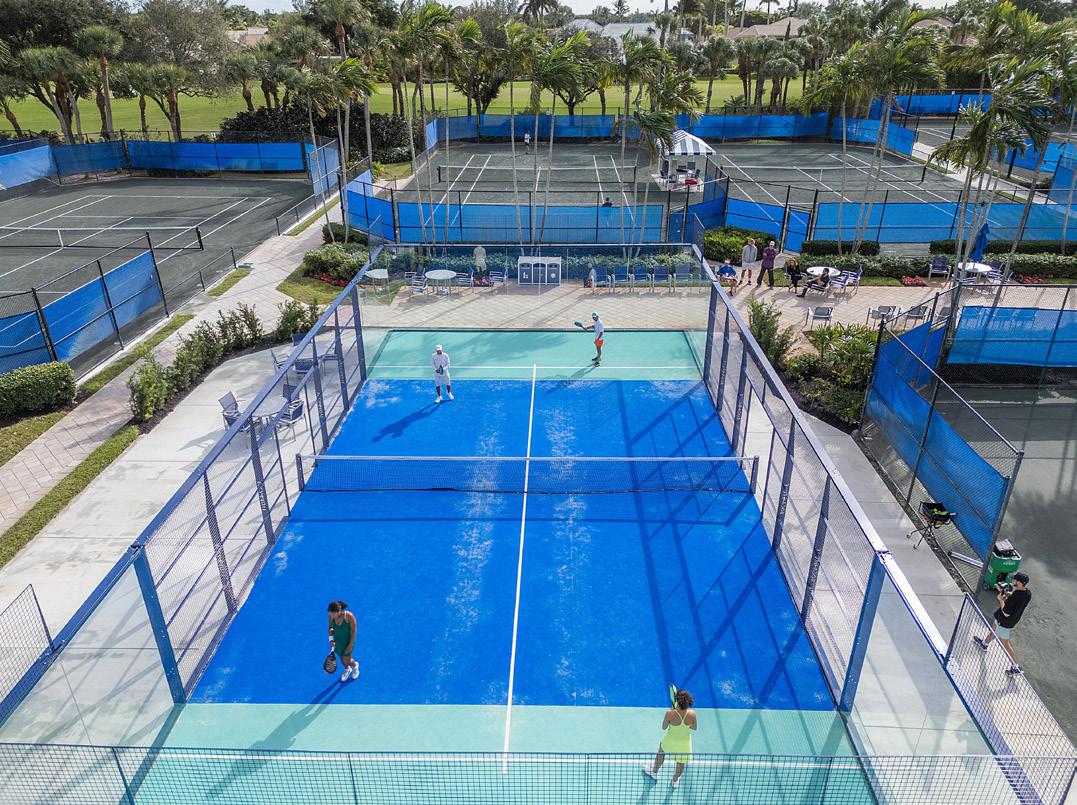
Boca Grove has also positioned itself as a leader in multi-sport racquet offerings. The club was the first in Boca Raton to introduce padel. “We are actually one of the first full racquets facilities offering all three sports,” Nikolin said. “We started with pickleball in 2020 and padel in 2022. Members love it.”
Boca Grove currently features nine Har-Tru tennis courts—including the red clay stadium court—five pickleball courts, and two padel courts. Nikolin added, “We replaced all the parts for the [tennis] courts too — new lines, everything is brand new. We’re ready to go.
With a full-time staff of four pros plus himself—each cross-trained and certified across all three sports—Nikolin sees continued growth ahead.
“We’re trying to get bigger with tennis teams,” he said. “We’re starting night leagues, and for padel, we’re looking to build two more courts.”
If you’re into tennis, padel, or pickleball, this is a must-see (and play) destination in South Florida. Boca Grove isn’t just keeping pace with the evolving racquet sports landscape—it’s helping shape it.
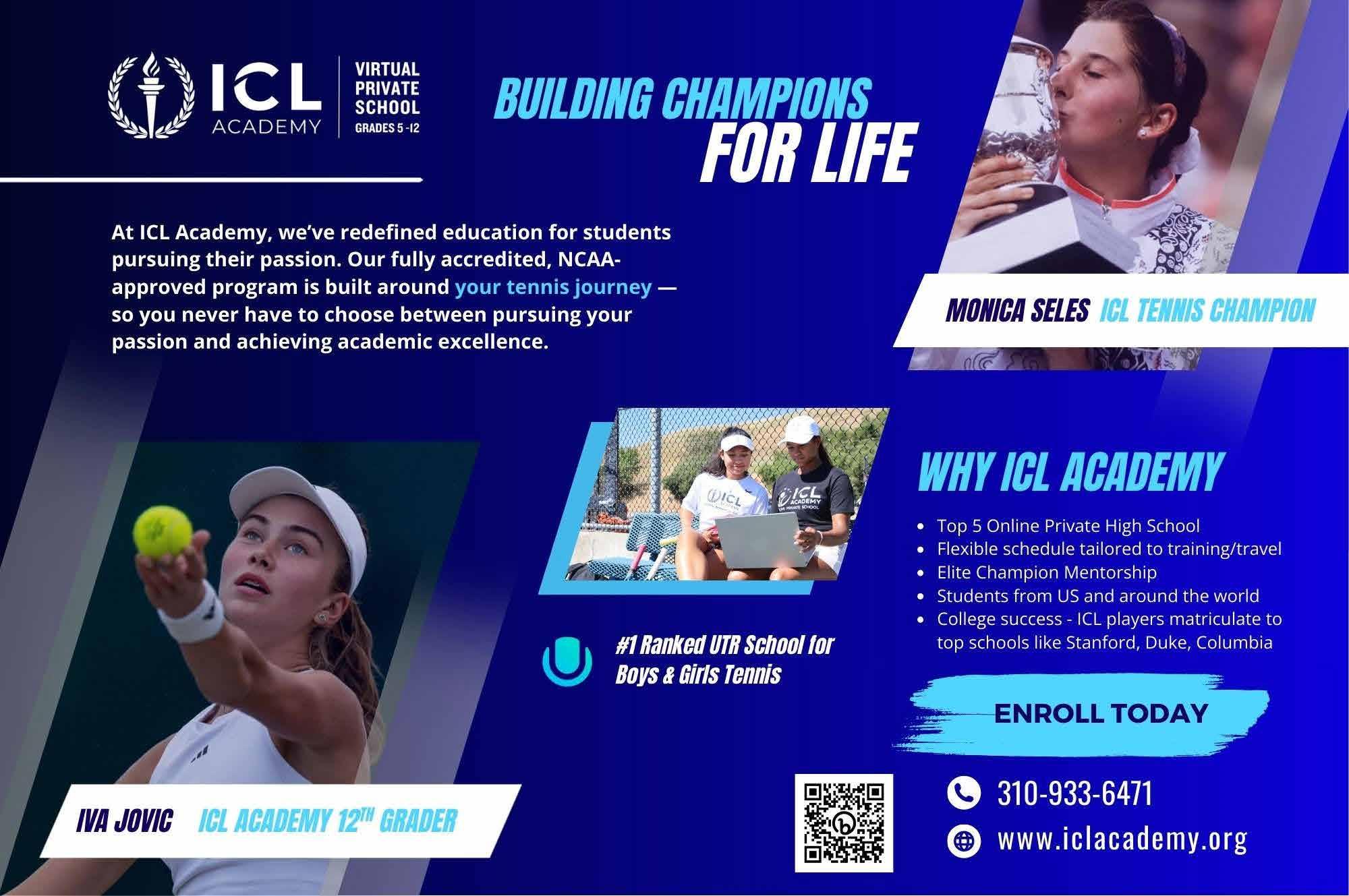
While most high school seniors are worrying about college applications and prom dates, Iva Jovic just became one of the top 20 tennis players in the world.
The 18-year-old American sensation has captured the hearts of tennis fans worldwide with her Australian Open quarterfinal run, climbing seven spots to a career-high ranking of No. 20—an extraordinary achievement made even more remarkable by the fact that she's still taking classes and completing assignments as a senior at ICL Academy, the world's #1 ranked tennis school.
Jovic has officially arrived as tennis's newest darling, and she's doing it while juggling homework and Grand Slam tennis.
"ICL has definitely done so much on the academic side, being able to get a great education and have amazing teachers and peers. I love ICL and its a great platform for me," Jovic said earlier in the tournament.
On Tuesday, her fairytale run at Melbourne Park came to an end when world No. 1 Aryna Sabalenka defeated her 6-3, 6-0 in sweltering conditions at Rod Laver Arena. But the loss doesn't diminish what Jovic accomplished: she reached the quarterfinals without dropping a single set, became the youngest player to do so at the Australian Open since Venus Williams in 1998, and vaulted into the sport's elite Top 20—all before receiving her high school diploma.
What makes Jovic's achievement even more extraordinary is the balancing act she's performing. While competing at the highest level of professional tennis, she's simultaneously completing her senior year of high school at ICL Academy—a feat that seems almost impossible in the modern era of specialized, year-round professional sports.
ICL Academy's innovative model has made this dual pursuit possible. The online school integrates rigorous academics with elite tennis training, providing flexibility that traditional schools cannot match. Teachers schedule testing and coursework around students' training, travel, and tournament schedules—crucial for someone now ranked among the world's Top 20 players.
For years, Jovic's path seemed straightforward: secure admission to a prestigious university, excel academically, and have a successful college tennis career. Her parents, Bojan and Jelena—both trained pharmacists who emigrated from Serbia and Croatia respectively—instilled in their daughter the importance of education alongside athletic pursuit.
"For a long time, it was getting into a great school and having a good college career, getting a good education," Jovic reflected during the tournament. "That was the plan, and then things just kind of took a little bit of a turn."
That turn has been meteoric. While her older sister Mia chose the collegiate route, currently playing tennis at UCLA while studying Business Economics, Iva opted to chase her professional dreams while maintaining her commitment to education. The decision has paid dividends beyond anyone's wildest imagination—she's now a Top 20 player in the world before even graduating high school.
The academy boasts an unparalleled roster of tennis champion mentors whose expertise is woven into the curriculum, including all-time men's major champion Novak Djokovic, tennis legends Monica Seles and Tommy Haas, rising stars JJ Wolf and Michael Mmoh, doubles legends Mike and Bob Bryan, ATP tour veteran Grigor Dimitrov, and many other tennis luminaries.
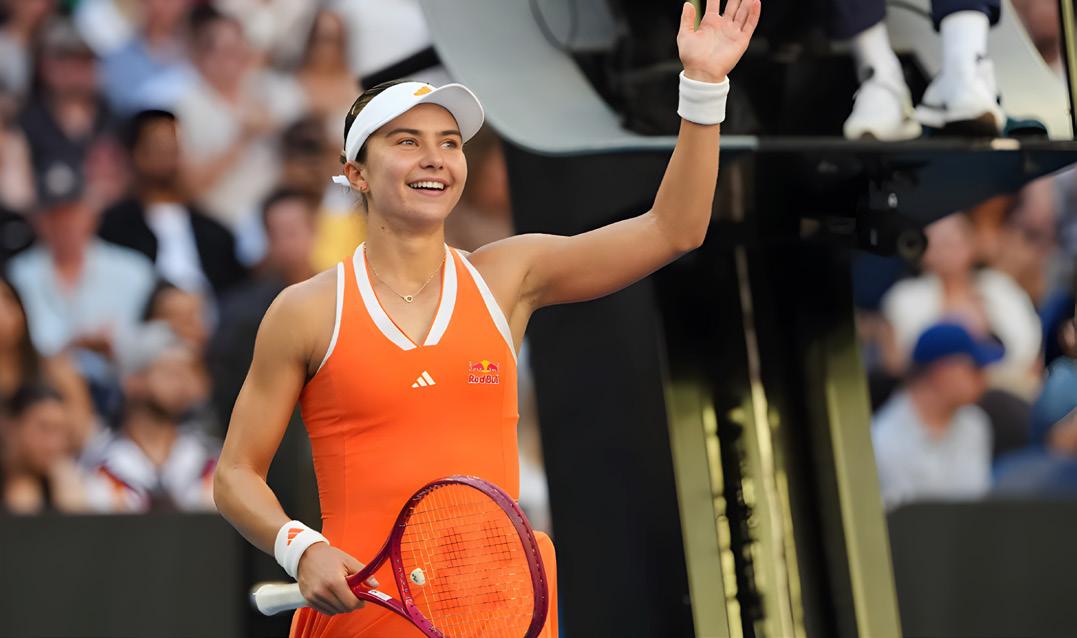
"We couldn't be more proud of Iva," said Kirk Spahn, ICL Academy Founder. "She exemplifies the complete student-athlete – someone who refuses to compromise on academic excellence while pursuing tennis greatness."
And tennis greatness she has found. At 18 years old, still months away from her high school graduation, Iva Jovic is ranked No. 20 in the world.
The ICL champion Novak connection
Jovic's rapid improvement hasn't gone unnoticed by tennis royalty. Novak Djokovic, the 24-time Grand Slam champion and ICL Champion who shares Serbian heritage with Jovic through her father, has taken a personal interest in mentoring the teenager throughout the tournament.
"She definitely has all the tools to be a future champion and a future number one," Djokovic said. The 38-year-old legend didn't just offer advice at the start of the tournament—he stayed in touch throughout Jovic's run, providing ongoing support and tactical tips.
"Yes, he did text me with some more tips throughout the rounds. I don't even know what day it is anymore!" Jovic said with a laugh. "So we've been in communication, and I feel like we've built a little bit of a relationship now, which is amazing, and I wish him all the best for the rest of the tournament."
Jovic referenced advice she attributed to Andre Agassi about Djokovic's playing style, comparing him to "a boxer and the way that he's going in for punches and then faking them out a little bit. I think the way (Djokovic) approaches the match is very impressive."
"Hopefully throughout the year I can keep having more moments with him because it's been amazing," Jovic added.
Jovic's performance at the 2026 Australian Open has made her tennis's newest darling—a teenage sensation who combines power, poise, and the perspective that comes from balancing life as a student and a world-class athlete. Tennis experts and former pros are comparing her trajectory to past prodigies who became Grand Slam champions.
Annabel Croft, former British tennis star, captured the excitement surrounding Jovic's run: "She's almost suffocating opponents when she's out there, and there must be a fear factor because no-one wants to lose to an 18-year-old. She's really taking the bull by the horns."
The tennis world has fallen in love with Jovic's story: the high school senior who cracked the Top 20, the daughter of immigrant pharmacists who believed in education and excellence, the young American who plays fearless tennis on the sport's biggest stages while still attending online classes between matches.
This combination—the A's and the aces, the brains and the brawn, the maturity and the fearlessness, the textbooks and the Top 20—is what makes Iva Jovic the sport's most compelling new star. Her quarterfinal run at the Australian Open, achieved while completing homework assignments and preparing for final exams, represents something rare in modern professional sports: an athlete who refuses to choose between academic and athletic excellence.
Many more tournaments await. Many more victories do too. And when Iva Jovic walks across the stage to receive her high school diploma later this year, she'll do so as one of the top tennis players on the planet.
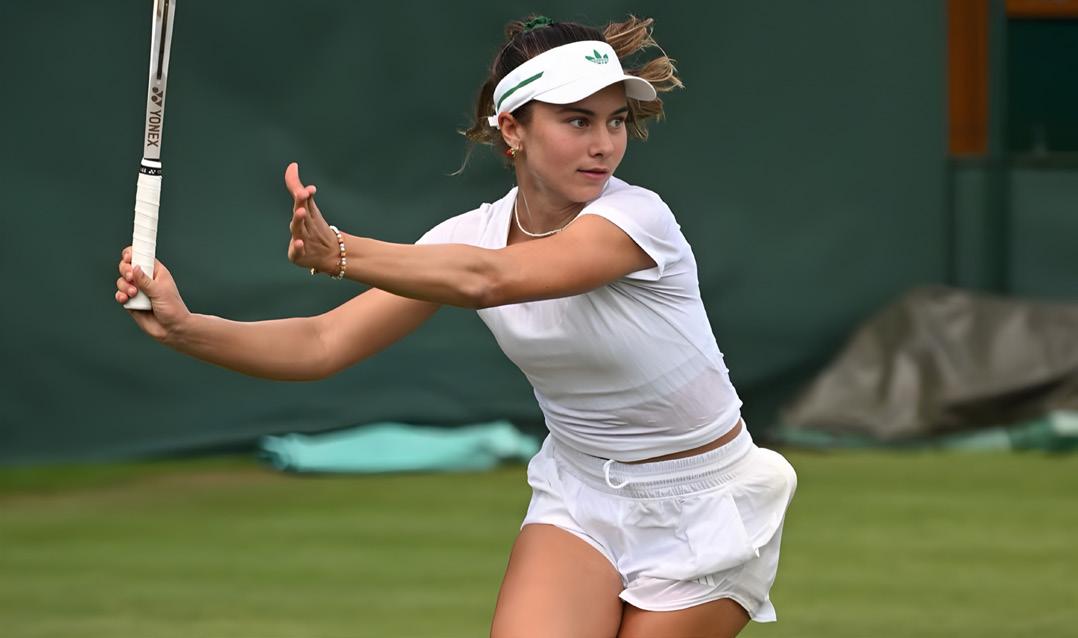

By Alex Binstok
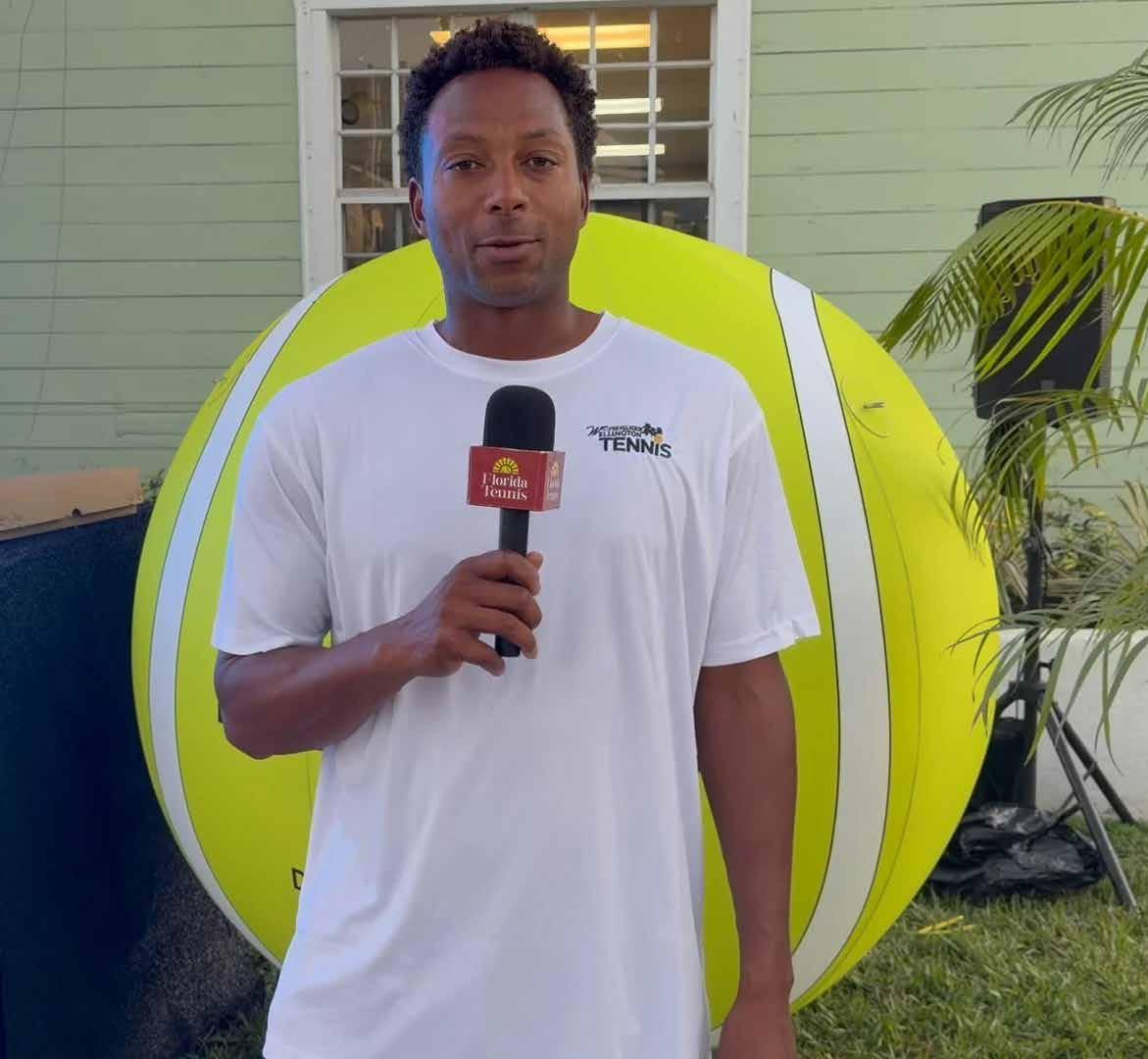
On a lively afternoon in South Florida, former ATP professional and Academy Director of Wellington Tennis Center, Scoville Jenkins stepped back into competition mode during the Legends Event at the Delray Beach Open. The setting connecting with fans, and reflecting on the incredible legends and their careers. Between matches, Jenkins shared insights on why he embraces Delray Beach, how his academy philosophy took shape, and what he believes truly drives player development. The conversation moved naturally from the day’s action to coaching, confidence, and the evolving facilities that now define his training environment.
Jenkins first gave his take on the Legends Event at the Delray Beach Open. For Jenkins, the experience still carries genuine excitement. “I think it’s incredible, this is going on the third straight year that i’ve done this and i’ve had just the best time ever doing this.”“It’s really fun to actually prepare for this little bit. I don’t wanna embarrass myself, so I hit a little bit before so, I get a little practice.” The event allows for past players to get back on court in front of crowds, and the legends feel at home. “Everyone’s just so nice and it’s actually really good to get back on that court again too.” The joy of competition, even briefly, can be seen as the Scoville resonated on his career on tour.
The conversation soon shifted toward how Jenkins found his current home base. “That’s a great question. It really was Chuck Gill, the Tennis Director of the Wellington Tennis Center?” The relationship traced back years. “He was the director of the Club at Ibis where i worked previously and we developed a good relationship and i was really looking to build my own academy and kind of my own thing.” The opportunity aligned naturally. “And it really worked out with Wellington and Chuck. I’ve been really excited about what the future holds to.” Scoville representing his love for Wellington. Jenkins described what players can expect inside his program with direct clarity. “Well, what number one is you get a lot of one on one attention.” That individual focus is central to his structure. “I want the best for you and i’m not just like a regular coach where we just go out and play.” Accountability plays a defining role. “I hold you accountable to everything.” The daily process reflects intensity and intention. “With me, it’s a lot of one on one and it’s just nonstop hard and smart work.”
When asked about the qualities he prioritizes as a coach, Jenkins didn’t
hesitate. “Confidence. The biggest thing is confidence.” He views belief as something earned through experience. “Which you have to basically earn by playing, but always feel when you’re a confident player, you’ll make the right decisions.” That principle shapes his interactions with students. “So i really instill confidence in you all the time so you can play the way you want to play.” His conclusion was firm and uncomplicated. “Without confidence is really hard to play this game.” For Jenkins, development begins with the confidence to improve.
“No matter what i’m going to push you to your very limit to where you don’t think you can do it, but I will never ever, ever make you do something you can’t do.” The philosophy reflects lessons from his own career. “My coach took me to places physically, mentally and emotionally that I couldn’t take myself.” This is one major guideline he wants to pass down to his students.
Jenkins also highlighted the infrastructure supporting that philosophy at Wellington Tennis Center. “I don’t know any better courts, really in south Florida area, there’s twenty six clay courts right now.” Expansion is already underway. “They’re in pristine condition. They’re building three more right now. There'll be three hard courts that will be done in march and then seven padel courts later this year.” Scoville continued to emphasize the other amenities Wellington has to offer. “We have Swingvision technology as well, so actually watch the practice and watch the match, which I do.” Review and analysis remain integral. “I really believe that’s a big development, a big part of developing your game is a coach watching your match with you.”
Ultimately, Jenkins returned to the core mission driving his work. “Yes, the number one thing is I want all of the students to reach their ultimate goals.” Expectations are intentionally high. “The number one goal is to overachieve and I really push you to the max.” He acknowledged that intensity can sometimes feel demanding. “Sometimes i, sometimes i could push you a little too hard.” Yet his reasoning remains rooted in player welfare. “But I want people to always know it’s for your own good. I’m not doing this to help myself. It’s to always help you and be the player that you think you can be.” In the end, the day’s exhibitions, reflections, and philosophy echoed a consistent theme: purposeful work in pursuit of progress.
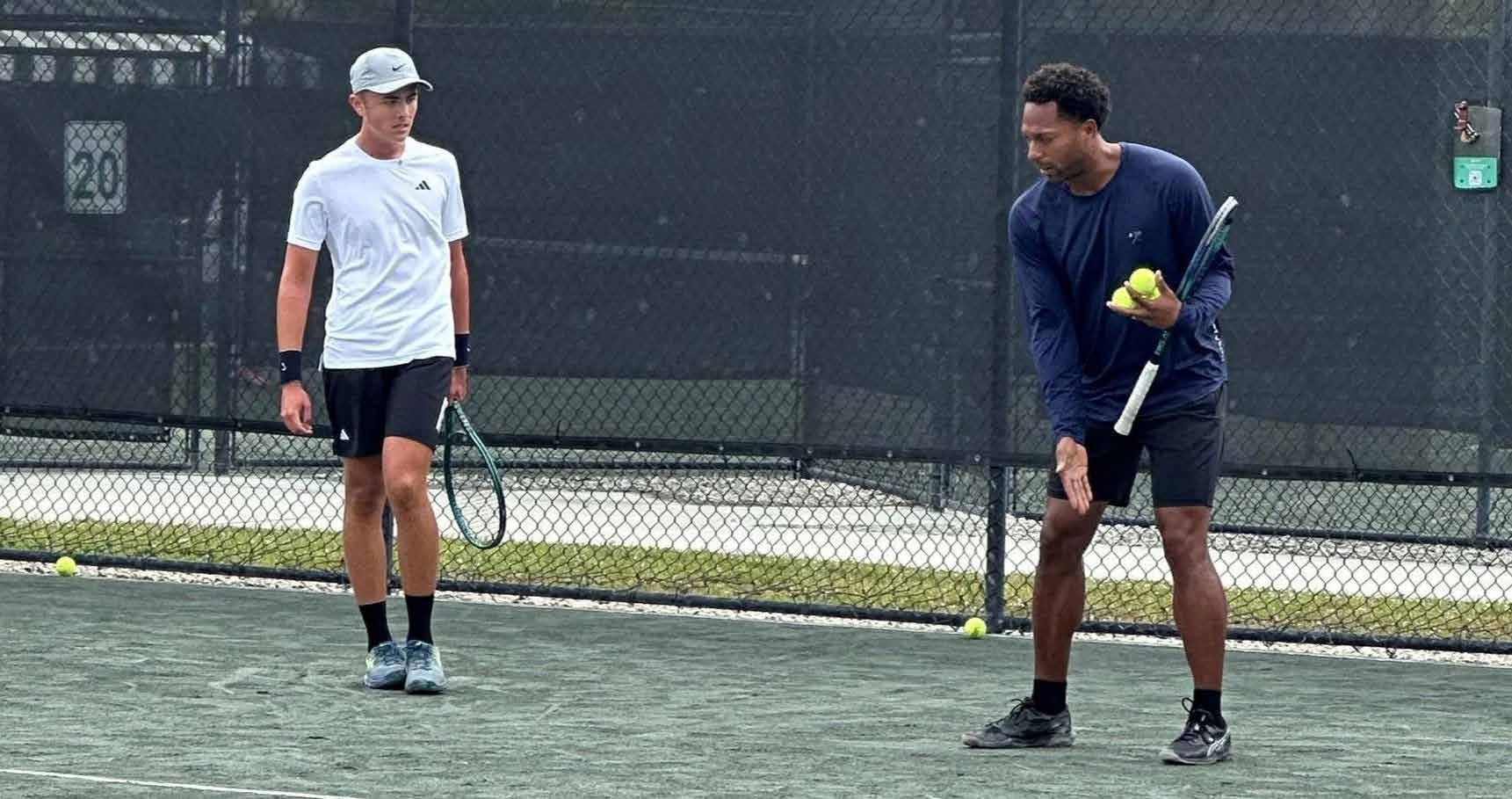



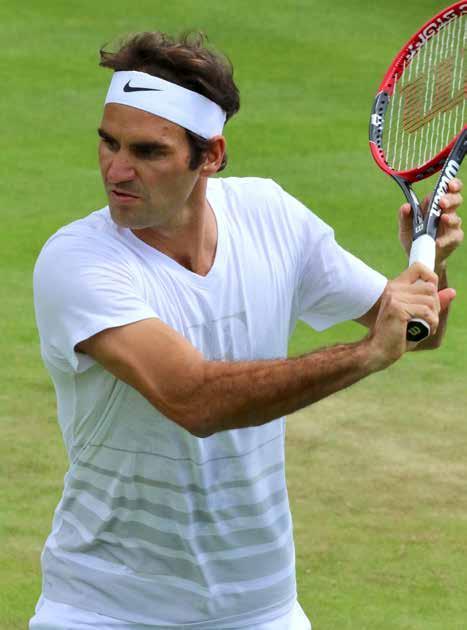
Standing courtside at South County Regional Park, Matt Pressman, Editor and Publisher of Florida Tennis Magazine, spent time on court with Casey Curtis, Director of Curtis Tennis Academy, breaking down one of the game’s most misunderstood strokes: the slice.
“The slice is a stroke that has changed a lot since I was trained as a junior player,” Pressman opened. “What we really wanted to cover is the difference between the classic slice—where you hit straight through the ball—and the kind of cut you’re seeing much more in today’s game.”
Curtis was clear from the start: modern players need both.
“I believe in using both,” Curtis said. “You’ll see a lot of players now hitting what I call the side slice, whether they’re going crosscourt or down the line. But I still want a player to be able to hit that straight slice—the classic slice—as well.”
According to Curtis, the straight slice travels on a more linear path and is often used to drive the ball deeper through the court.
“That straight slice is basically a straight line. The racket stays on that line, the ball stays lower, and it usually goes deeper,” he explained.
But depth alone isn’t enough in today’s game.
“In today’s game, if you float a slice at all, you’re in trouble,” Curtis said bluntly. “Everybody’s forehand is so big now. If you put it up high, they’re just going to hammer it.”
Whether players choose a straight slice or a side slice, Curtis emphasized one universal rule.
“In today’s game, if you’re hitting a slice—any slice—you need to keep the ball low. We call it ‘sticking’ the ball. You don’t want it floating.”
That principle applies both to defensive slices and offensive ones.
“If you’re going deep, you still want to stick it—pace, depth, and low over the net. And if you’re hitting the short slice, that one has to stay low too.”
Curtis pointed to Roger Federer as one of the best examples of how the short slice can be weaponized.
“Federer used that short slice into the outside corner extremely well. It was incredibly effective. Other guys started catching on, so he didn’t use it as much later, but it’s still a great shot—especially in the women’s game.”
Curtis explained that the evolution of the forehand has made the short, low slice even more dangerous.
“A lot of players now use very western grips, and they close the racket face. That makes low balls—especially short ones—much harder to handle.”
He added that many modern forehands rely on the “pet the dog” position seen across the men’s game.
“If you watch Sinner or Alcaraz, they drop the racket head down and then come up. That’s the modern forehand. It’s great for pace, but it’s not ideal against low, skidding balls.”
That’s why Curtis believes the short side slice can be a tactical nightmare.
“When you cut that ball short and low, you’re pulling the opponent eight to ten feet inside the court, and often out wide. That’s not a great position. They almost have to hit a winner because so much of the court is now open.”
Pressman noted that players were traditionally taught to keep slices deep and crosscourt, especially during the serve-and-volley era.
Curtis agreed—and explained why the advice has changed.
“Back when you and I were playing, guys were coming to the net all the time. You didn’t want to bring them in. That’s where they were most comfortable.”
Today, it’s different.
“Now, bringing a player in on purpose can be very effective. It’s not the same as them attacking a short ball. When they know you’re bringing them in intentionally, it creates doubt.”
The mechanics of the slice itself have evolved as well.
“The North American slice we were taught had a more open racket face,” Curtis said. “You could get under the ball more easily, but that also made it easier to float.”
The modern, more European-influenced technique reduces that risk.
“With the European style, the racket face starts more vertical, the wrist is set, and the strings stay more square. That makes it less likely you’re going to float the ball.”
Curtis pushed back against the idea that the slice is purely a defensive shot.
“There’s a lot of myths around the slice,” he said. “It can be defensive, neutral, or offensive—it depends on the intention.”
Using the slice to draw an opponent forward? That’s offense.
“If you’re slicing short on purpose to bring someone in, that’s not defensive at all.”
But even when players are stretched wide, the modern slice still needs intent.
“You’ll see players reach with a slice, but it’s usually hit with pace. They’re not floating it down the middle. The game is faster and more offensive now.”
Slice returns, especially off the one-handed backhand, are becoming rarer.
“Federer did it a lot,” Curtis noted. “But you’re seeing less of that now because it’s so hard to hit that shot offensively on the return.”
Curtis was particularly strong on this point.
“I think women should be using more slice—and more drop shots,” he said. “Any young girl training at a high level who isn’t working on her drop shot is missing out.”
“When you shorten the court and keep the ball low, that’s when things get tough. Even if they get a good shot off, they’re exposed.”
As the session wrapped up, Curtis summarized the key lessons.
“You should absolutely be able to hit both the deep slice and the short slice,” he said. “If you always go short, your opponent will start charging.”
Variety is the real weapon.
“Sometimes you show slice and go deep. Sometimes you bring them in. That uncertainty is what makes the slice effective.”
One last warning:
“The floater can neutralize a point in certain situations—but in general, you want the ball low and purposeful. Low and deep, or low and short. Not floating.”
As Pressman concluded, the slice is no longer a survival tool—it’s a strategic weapon. And in the modern game, those who learn to use it with intent gain a serious edge.
To learn more, schedule a visit, or watch instructional videos, visit curtistennis.com or follow @CurtisTennis on Instagram.


By Dave Kozlowski
When Don Lang began playing tennis in 1959, he did not feel that tennis was popular sport. Some of his friends teased him that he was not in a manly sport. He hid the fact that he were playing tennis. He did not even know that USTA junior tennis tournaments even existed and only played interclub matches. As a kid, Lang’s big tennis thrill was going to Orange Lawn Tennis Club in New Jersey. On the grass courts was where he saw Aurthur Ashe, Gene Scott, and Charlie Passarell.
Lang got back to tennis where he enrolled at The University of Miami. The team had Eddie Dibbs (world career high-five men’s singles), Pat Kramer (world career high number 95), Raz Reid (round of 32 at 1972 US Open), Luis Garcia (Mexico Davis Cupper, reached round of 32 at 1999-67 US Open. Lang was not the varsity. He played tennis for his dorm team. He groomed the varsity clay courts and spent highly coveted time talking to Dale Lewis (University of Miami tennis coach / International Tennis Association Collegiate Tennis Hall of Famer).
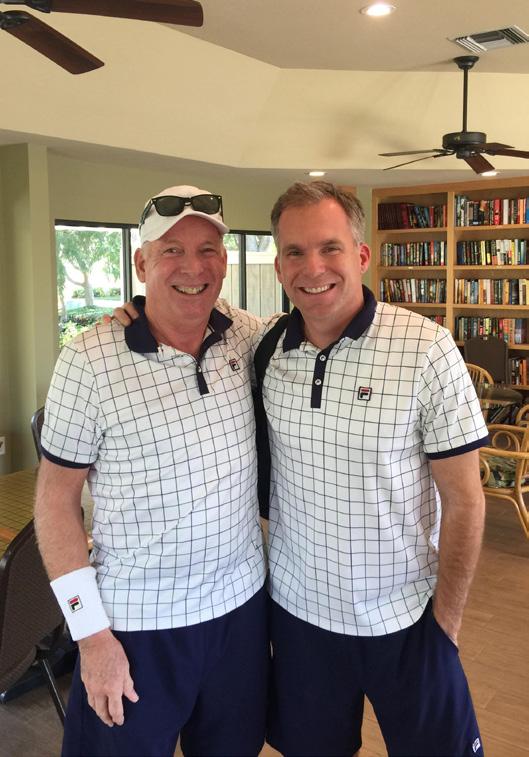
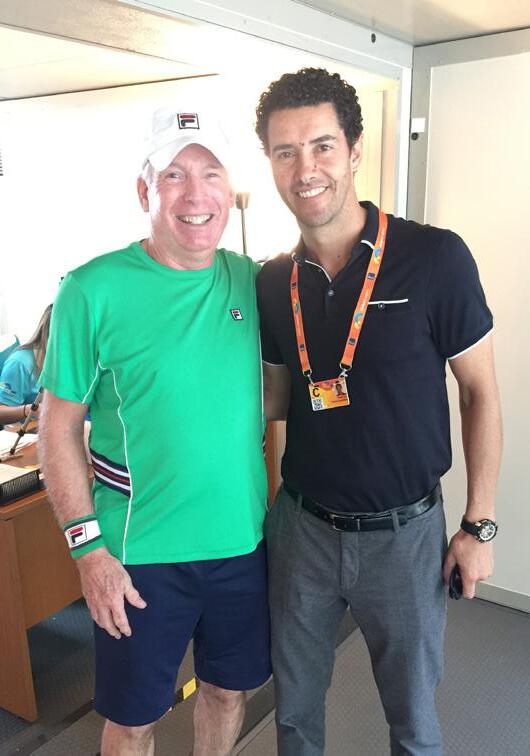
Nothing made Don Lang more ecstatic than being in the tennis industry. He took his father’s advice about being enthusiastic, seizing his energy for a highly successful 20 years at ProKennex and 16 years as Florida Rep for Fila. In total he has spent a half century in business. Lang also was part of the IMG staff with Nick Bollettieri. He was General Manager of the Billy Jean KingWorld Team Tennis for the SARASOTA TWIST. Keynote players: Jimmy Arias and Nicole Arendt. Lang also provided tennis events with his World Class Tennis Promotions, LLC. Lang is impressive within the tennis industry. He knows the product, apparel, and strings. He has saved many tennis elbows by suggesting lower tension and softer strings.
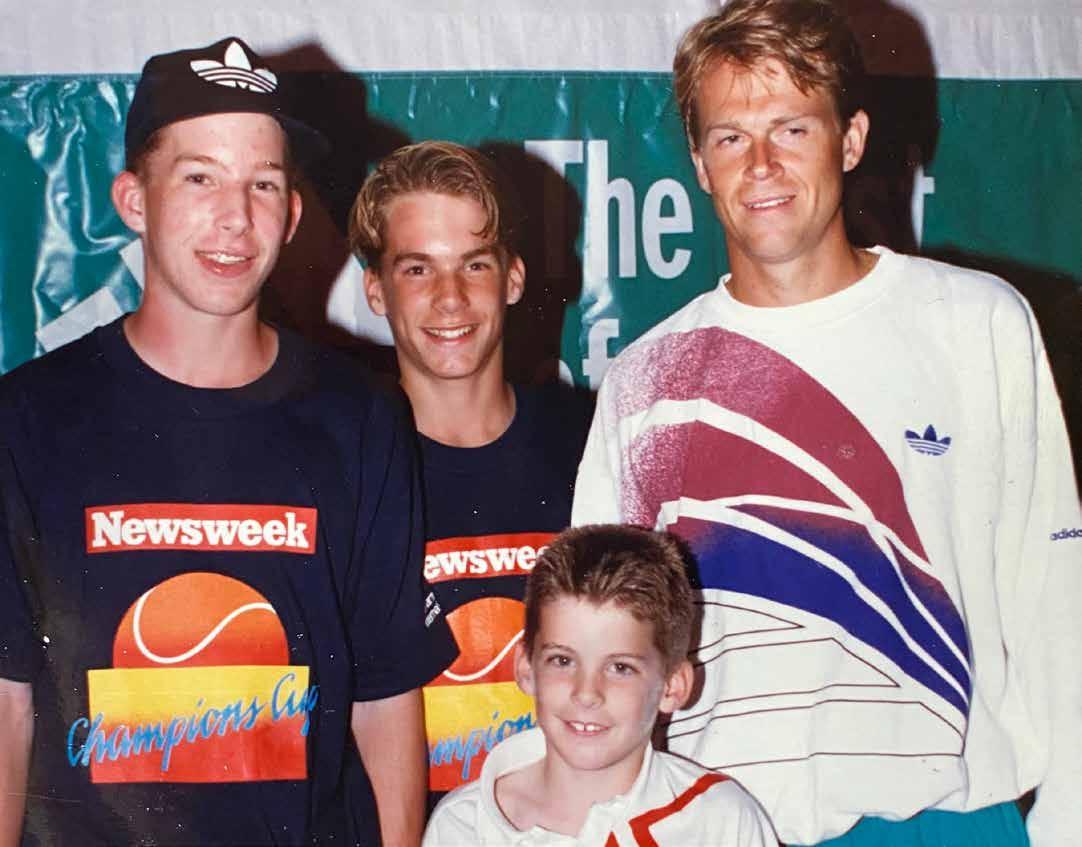

The Summit, New Jersey kid made sure that his kids were going to experience a strong start to the game. When asked who his kids’ models were, he answered Pete Sampras, Bjorn Borg, and Stefan Edberg. Don Lang had Jimmy Connors as his role model.
Charlie Oliver, the coach of Lisa Raymond, former WTA number one ranked doubles and number 15 singles, was influential. Oliver told the leaders at the Philadelphia Tennis Patrons Gold Cup that Micheal Lang at age 5 ? -years-old deserved to be in the program and he was correct. Michael went on to be the number one player in the United States 16 and under. He was a member of Georgia NCAA Championship team and Big East Player of the Year while at the University of Miami in 2001. He also had taste of the pro-tour. Don’s two other sons Ryan and Tucker had impressive college tennis performances. Tucker at NAIA Top 5 Flager College. Ryan tennis and football at Jacksonville University, wow!
The Lang family and the Koz family have been friends since the 1980s. The Langs came to Sea Colony, a beach and tennis resort in Bethany Beach, DE. I was the Director of Tennis there. Don and I first played and the kids met. We then spent 11 years together at Laurel Oak C.C. in Sarasota where the kids became the best of friends playing junior tennis circuit. We are seeing much more of Lang as he has joined The Florida Tennis Magazine as a marketing agent. Don shared with us that Jim Martz did a terrific article about Lang family journey of tennis. Lang also disclosed his admiration for Matt Pressman for offering both Florida Tennis magazine and digital.



Boca Cryo is a wellness company which offers healing and recovery through state of the art technologies, all non-invasive and drug-free. We offer 7 different therapies in our center.
Our flagship service is WHOLE BODY CRYOTHERAPY, which treats inflammation, pain, stiffness, sleep disorders and helps performance improvement. Three minutes of sub-zero temperatures (-160 F) using safe, cold air in a “true” whole body chamber, leaves you with a rush of endorphins and other pain modulators. This short stay in the cold also boosts your metabolism while strengthening your immune system! Our specialized chamber is equipped with speakers which play your favorite tunes while moving freely about. Unlike our competitors, we DO NOT use liquid nitrogen.
We also offer LOCALIZED CRYOTHERAPY for those specific areas of pain and inflammation. This can be administered a La Carte or in conjunction with WBC.
BOCA CRYO FACIAL is another popular therapy. If you are looking for less wrinkles and puffiness, and want tight skin and a younger look, this is for you! This 10 minute therapy, in conjunction with WBC, is shown to increase collagen production. As one of the most abundant proteins in the body, collagen helps make the skin look younger and fuller without injections and expensive creams.
MAGNETHERAPY is yet another treatment offered, using a state-of-the-art device called the Magnesphere. This is a low level magnetic resonance device which helps relax the body by balancing your Heart Rate Variability or HRV. Our Autonomic Nervous System is divided into Sympathetic (fight or flight) and Parasympathetic (rest and digest) systems. By bringing these two systems into balance, the body begins to heal itself! All of our clients, who have used this device, relax so much that they fall asleep during the session.
Our COMPRESSION THERAPY focuses on the lower body. This pneumatic system, developed by a physician for circulation-challenged patients, inflates sleeves covering your legs. Systematically, the compression helps eliminate the by-products of exercise and aids in venous return to the heart. Athletes and weekend warriors, as well as people with circulatory insufficiencies, can benefit from this therapy.
Our SALT THERAPY is a form of therapy which entails relaxing in a room infused with medical-grade salt crystals that are inhaled and help with respiratory issues ranging from asthma, COPD and sinusitis, to mention a few. Salt therapy is a tremendous therapy and healer for skin disorders such as acne and psoriasis.
Our newest technology from Prague, Czech Republic, is called EMSCULPT. It is the first FDA approved device to increase muscle by 16% and decrease fat by 19% on average. In the world of aesthetics, this is rapidly becoming very popular in our center.



190 Glades Rd, Suite C, Boca Raton, FL 33432 www.bocacryo.com ~ 561-717-4402 ~ Email: ian@bocacryo.com

Ian Pyka received his Bachelor’s degree in Kinesiological Sciences at the University of Maryland and completed his Master’s degree in Exercise Physiology at the University of Tennessee. His first job was at the University of Massachusetts, as their first Head Strength and Conditioning Coach. Four years later, he accepted the same position at Tulane University. He later accepted the position of Head Strength and Conditioning Coach for the New England Patriots. In 1994, he managed a preventive medicine center in Scottsdale, Arizona, working with a retired population, establishing diet and exercise regimes to improve quality of life and longevity. Then in 1998, he was hired by the Florida Panthers to be their Head Strength and Conditioning Coach. In 2002, he started Power Play Fitness, a company which focuses on the sports specific and comprehensive training of athletes as well as any motivated individuals interested in improving their overall fitness and health. He presently teaches Kinesiology, Biomechanics and Advanced Strength and Conditioning Methods, in the Exercise Science Department at Florida Atlantic University in Boca Raton. He is certified as a strength and conditioning specialist with the National Strength and Conditioning Association.
Ian was also a three time All-American (Track &Field) while at Maryland and earned an alternate spot on the 1980 US Olympic Track and Field Team.


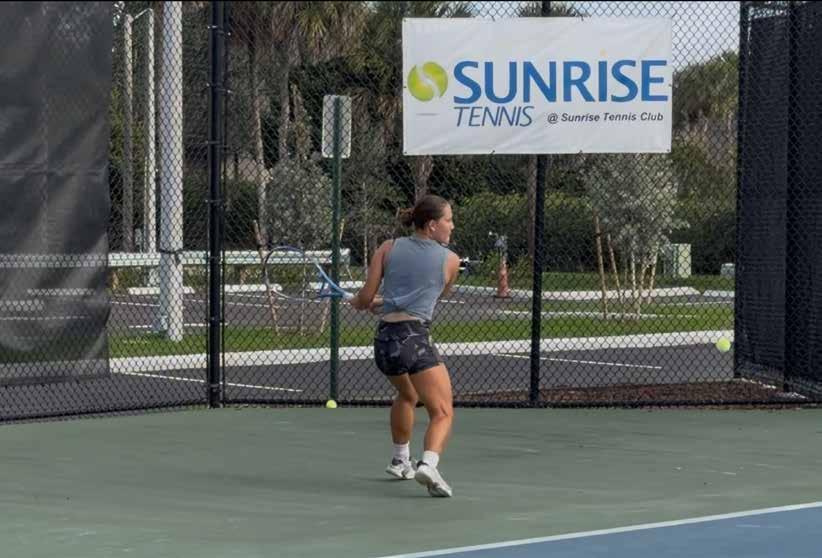
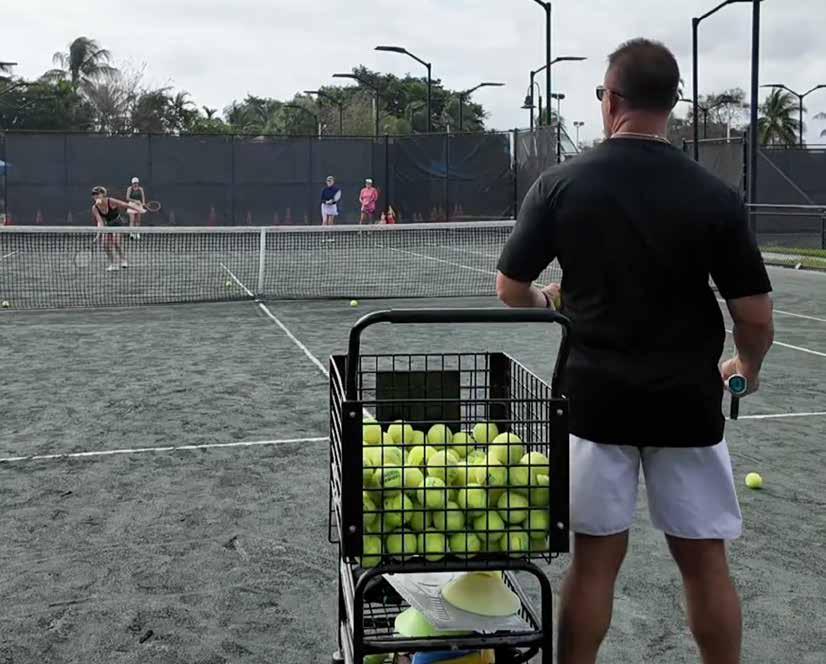
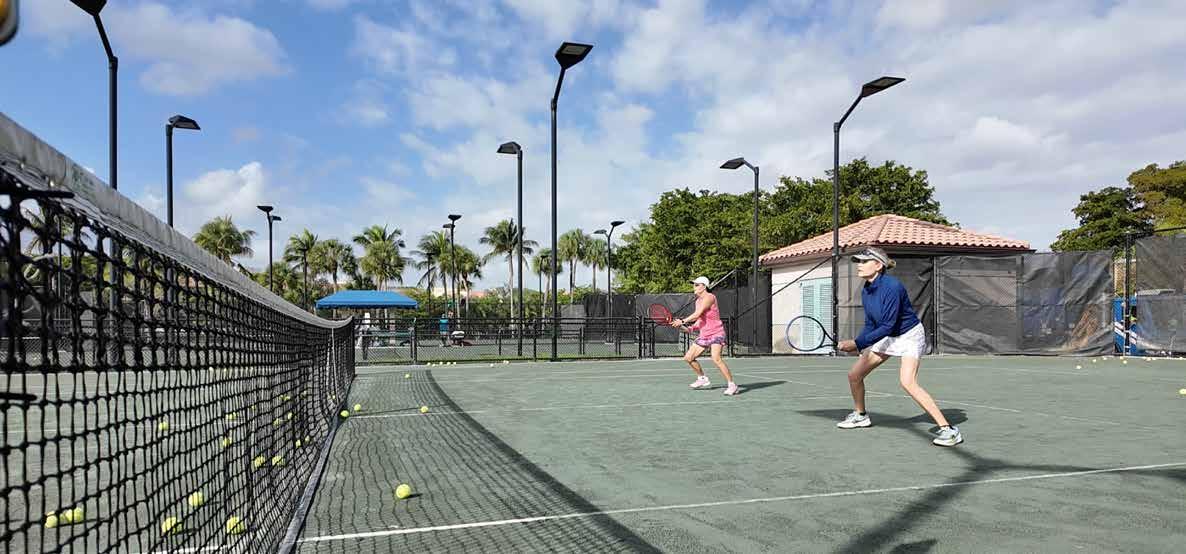
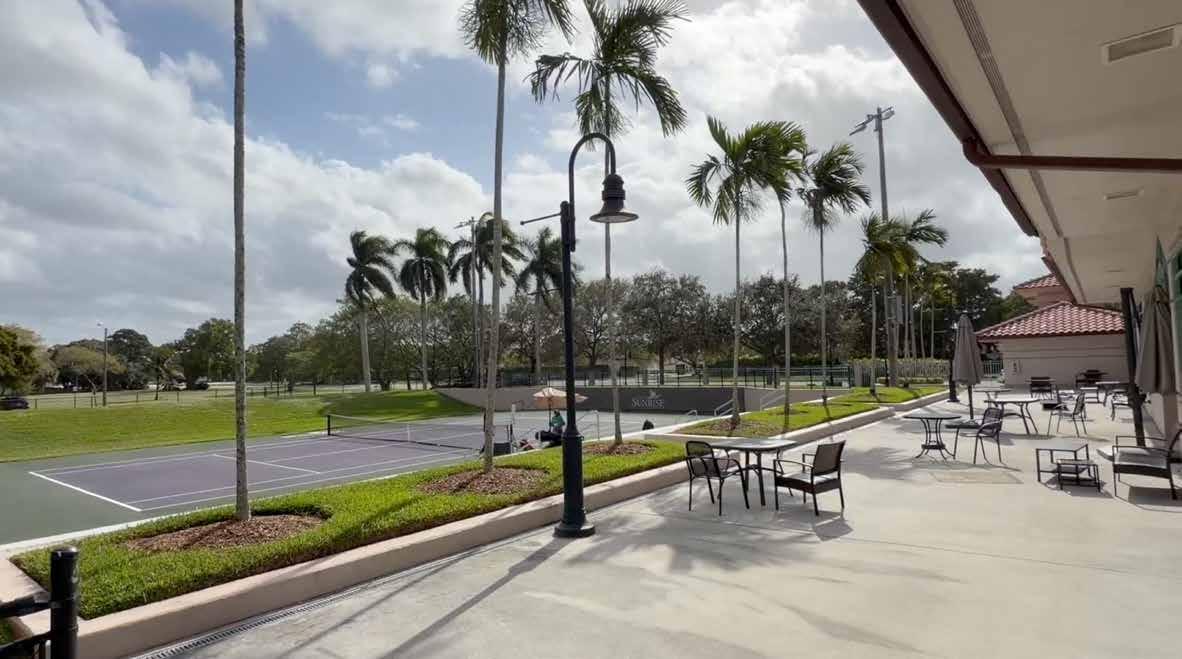
Hall of Fame tennis player Michael Chang was only 17 years old when he shocked #1 ranked Ivan Lendl in the semifinals of the 1989 French Open despite suffering severe body cramps in the fifth set. Chang thought about retiring from the match but fought through the pain to beat Lendl, even employing an unforgettable underhand serve on his way to the victory. The win was both a physical and mental masterpiece from the young American, who went on to beat Stefan Edberg in the final to win the French Open crown.
Thirty-seven years later, during the 2026 Delray Beach Open, I spoke with Chang after he finished playing tennis with his young son, Micah. It was fascinating to watch him quietly and patiently dole out tennis tips throughout the practice. Chang is currently the coach of the rising young American tennis star Learner Tien. Tien was seeded fourth at the tournament and, at only 20 years old, has rapidly risen to a current world ranking of #23 under the tutelage of Coach Chang.
What is it that makes certain high-achieving former tennis players into excellent coaches? “I think it depends on how people think about the game. To think their way through strategically is something that was a part of my game and the way that I play,” said Coach Chang. He added, “For me, I felt like it was pretty natural to be able to share that as a coach with Learner.”
And what does Coach Chang highlight as the key to Tien’s success? “He’s an incredible fighter, very thoughtful in the way that he plays, very smart.” He added, “In certain aspects, I’m trying to help him approach some things a little bit differently, trying to improve his serve a little bit, and he’s making good progress and gaining confidence along the way.”
And what were Learner Tien’s thoughts about having Coach Chang in his corner during tight matches, including his big comeback win over Frances Tiafoe in the Round of 16 at the 2026 Delray Beach Open? “It’s really good during these matches. He’s always really calm. He can always give me just the advice I’m looking for. So it’s been really good.”
Finally, what is it about tennis that keeps Coach Michael Chang inspired to stay in the game? “In so many aspects, tennis has given me so much. I learned so much from the sport. It’s taken me all over the world. I’ve enjoyed it since the day I picked up a racquet and started hitting tennis balls.” With a smile, Coach Chang concluded, “Here I am, almost 54, and I enjoy it just as much. To be able to teach my son and my daughter, and to teach Learner some of the things that I’ve learned through experience, brings a lot of joy to me.”
Adam Ross is a contributing writer and podcast host for Florida Tennis. He won the Miami Open’s Jim Martz Media Award in 2024. He volunteers for the USTA Florida and the Tennis Collectors of America/TCA.
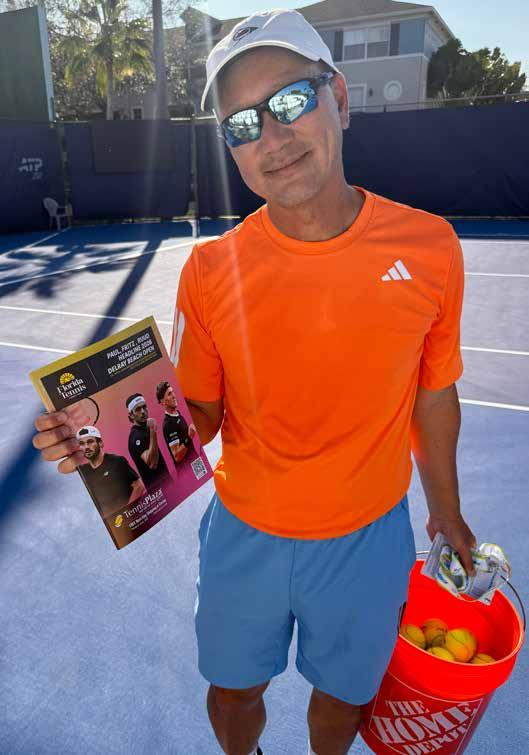
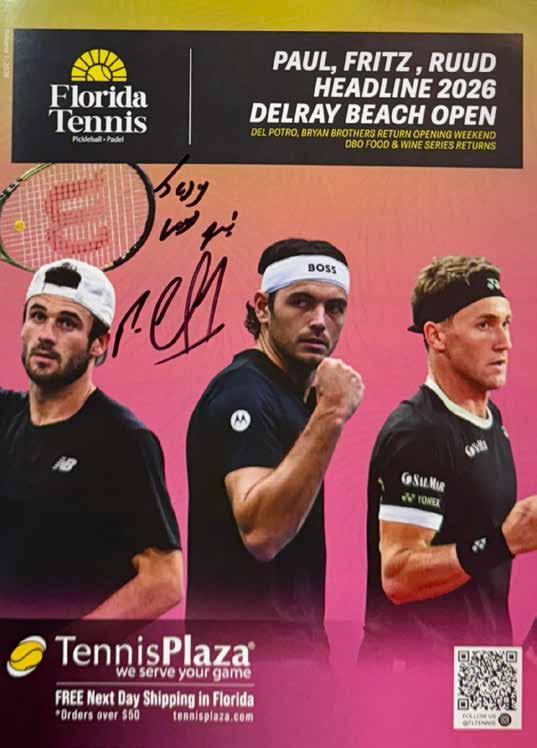
By Osvaldo Godoy
Abrie Du Plooy has built a coaching career shaped by international experience, collegiate tennis, and academy leadership. Now based in Bradenton, he is leading the tennis program at Inspiration Academy, a setting he describes as intentionally small and development-focused.
Originally from South Africa, Du Plooy arrived in Florida after working in New Orleans, where he coached a mix of domestic and international players. He said the transition to Bradenton aligned with his long-term goal. “I work more with international players and the local kids from Florida, and that’s what I’ve wanted to do all my life, to work with top players,” he said.
Du Plooy also brings a collegiate background, having played at the University of Tennessee under coach Mike DePalmer. He noted the historical significance of the Bradenton area, referencing its long connection to elite tennis development. “In our school, it used to be called Bradenton Academy, and Andre Agassi went to the school,” he said. “One of my teammates at Tennessee went there as well.”
While located near large-scale academies, Du Plooy emphasized that Inspiration Academy follows a different model. “This is more intimate. It’s more of a boutique academy,” he explained. “We have way less people here, so we can take the kids to tournaments and really help them out because we don’t have big numbers.”
That approach, he said, has generated increased interest from families seeking alternatives to larger programs. “We’re getting a lot of calls nowadays because of that,” Du Plooy noted.
In addition to daily training, Inspiration Academy is heavily involved in competition hosting. Du Plooy outlined an active tournament schedule, including professional and junior events. “I’m doing a pro circuit event in January, January 12 through the 18th. It’s a $35,000 women’s tournament,” he said. “Then every weekend we do prize money UTR events or USTA Level 7s, 6s, and 5s.”
Balancing tournament organization with academy operations requires constant involvement. “You have to be everywhere,” Du Plooy said. “We run the academy too, and we run a tight ship. I have to get sponsors and manage everything, but that’s what I signed up for.”
Du Plooy’s connection to Inspiration Academy began through personal relationships and familiarity with the program. “My son went here, and I’ve known Teo Davidov and his dad,” he said. He noted that Davidov is one of the top juniors training at the facility. When coaching changes created an opening, Du Plooy took the opportunity. “I came here to do consulting work, and a month later I was here full time.”
For families evaluating academy options, Du Plooy pointed to several distinguishing factors. “Because of the small numbers, and we have a school link, which a lot of academies don’t,” he said. “The kids’ SAT scores are very high, and we’re close to the beach, close to an international airport, with good coaches and good players.”
As Inspiration Academy continues to expand its competitive calendar and training structure, Du Plooy remains focused on maintaining a personalized environment. His goal, he said, is to build a program where players receive consistent attention on and off the court while preparing for the next level of competition.
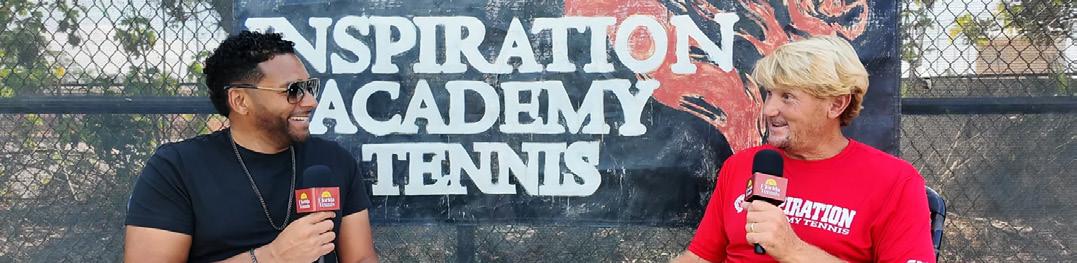
Learn more about Inspiration Tennis Academy, its programs, and upcoming tournaments by visiting inspirationtennisacademy.com.

By: Jaret Kappelman
At the inaugural USTA Florida Tennis Summit last November, the organization unveiled its three Big Bold Moves designed to shape the future of tennis in the Sunshine State. One of those bold moves, Business Insights, is all about leveraging local data to make smarter decisions, demonstrate progress, and identify what drives growth. USTA Florida has a unique advantage in utilizing Florida-specific data that goes beyond national metrics, and today we are putting that data to work.
Are there enough public courts to meet the needs of the communities that rely on them? “ “
Using the latest data from USTA Florida’s Facilities Dashboard, here is a look at the current state of tennis infrastructure across the state and why the numbers point to a growing need for more public park support.
Florida is home to 5,614 tennis facilities with a combined 17,845 tennis courts spread across 65 counties and 714 cities. That is an impressive footprint, but when you dig deeper into the data, a critical gap emerges. Of those 5,614 facilities, 81% are privately owned and just 19% are public. That means only 1,057 facilities are public compared to 4,557 that are private. With demand for tennis at record highs across the state, the question becomes clear. Are there enough public courts to meet the needs of the communities that rely on them?
The data also reveals where Florida’s tennis infrastructure is concentrated. Palm Beach County leads the state with 657 facilities and 2,489 total courts, followed by Broward County with 506 facilities and 1,581 courts, and Miami-Dade County with 429 facilities and 1,479 courts. While South Florida is well-represented, other regions of the state have significantly fewer options, creating gaps in access for players who depend on public facilities.
When it comes to court types, outdoor hard courts are the most common surface statewide, making up 61.5% of all courts with 10,957 total. Outdoor clay courts account for another 6,787 courts, while indoor courts remain rare with just 41 across the entire state. The overwhelming majority of Florida’s tennis is played outdoors, which makes the condition and availability of public
outdoor courts even more important.
Public parks are the front door to tennis for most Floridians. They are where beginners pick up a racquet for the first time, where families play together on weekends, and where community programs introduce the sport to underserved populations. With only 19% of facilities being public, the need for investment in public tennis infrastructure has never been greater.
This is exactly the kind of insight that USTA Florida’s Business Insights initiative was designed to surface. By asking the right questions and using data to guide the conversation, USTA Florida can advocate more effectively for public park support, help communities identify where new courts are needed, and ensure that resources are allocated to the areas that will have the greatest impact.
Data like this is only valuable if it leads to action. That is where you come in. USTA Florida’s Advocacy program is built on the belief that anyone who cares about the sport can make a difference in their community. Whether it is working with local parks and recreation departments to improve existing courts, making the case for new facilities, or simply sharing the story of what tennis means to your neighborhood, local advocates are the key to keeping tennis thriving across the state.
If you are passionate about growing tennis in your community, sign up to become a local advocate at ustaflorida.com/tennis-advocacy. After you sign up, a member of the USTA Florida staff will reach out to learn more about your interests and connect you with advocacy projects in your area. Together, we can turn insights into action and ensure that every Floridian has access to a place to play.
*The courts and properties featured in this article represent a large and thoroughly verified sample of tennis inventory across Florida,andourdatacollectioneffortscontinuetogrow.AsUSTA andUSTAFloridacontinuetocollectinformationfromtennisproviders statewide, additional properties are expected to be identified. This data reflects our ongoing priority to build the most complete picture of tennis in Florida possible.
If you have any questions about the content from USTA Florida in this magazine, please contact the Marketing & Communications Coordinator, Jaret Kappelman (kappelman@ustaflorida.com). To view the rest of the USTA Florida staff and find out who to reach out to regarding any programming questions, visit, ustaflorida.com/staff.
By: Jaret Kappelman
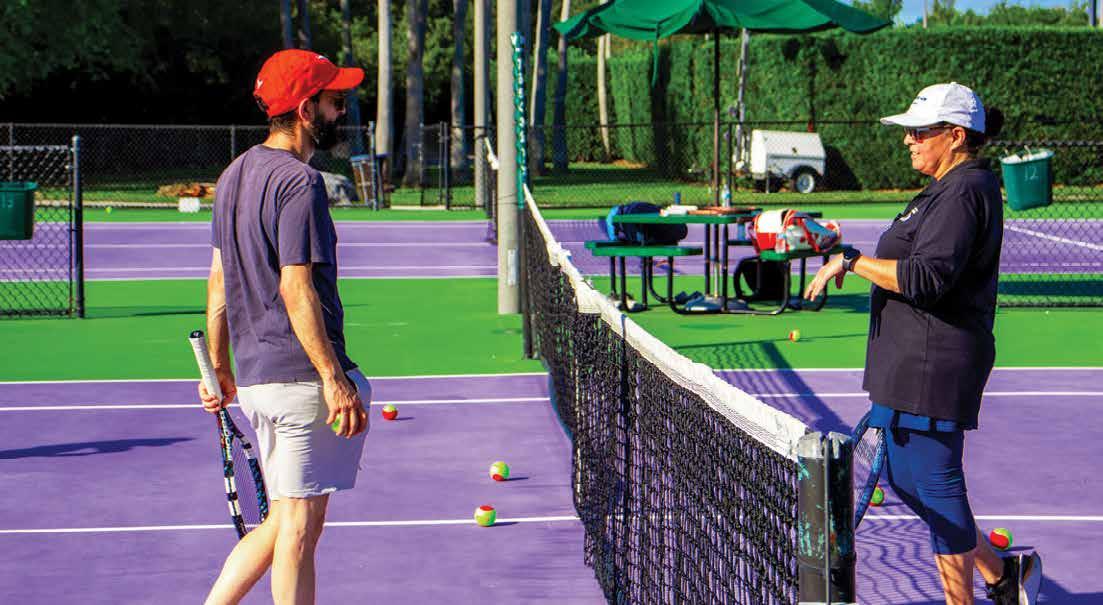
For years, Crandon Park stood as one of Florida’s most celebrated tennis destinations; a place where champions trained, families gathered, and the love of the sport flourished. On January 16, USTA Florida officially began operations at Crandon Park, restoring full operating hours. expanding support for daily play, and marking an exciting new chapter for one of Florida’s most iconic tennis venues.
Opening week was a success, with players, families, and longtime supporters returning to the courts and taking advantage of the increased hours, as well as newcomers feeling the renewed energy throughout the facility. From the moment the courts opened, there was a noticeable sense of excitement in the air. Many players shared how refreshing it felt to have restored hours and on-site support, experiencing both familiar surroundings and positive changes. USTA Florida is committed to keeping the community informed as operations continue to grow, and the message is clear: community tennis at Crandon Park will be even stronger.
A dedicated player at the facility, James Hawkins, is thrilled that Crandon Park has fully restored hours after being extremely loyal to the facility for years. “I’ve been playing here for 30 years and organizing a tennis group here since 2015,” he said. “I’ve always loved the facility, and I’m really looking forward to what USTA Florida will do here.”
With operating hours fully restored, the spotlight was on community play. Demand was high, with all 22 playable courts booked evenings and on both Saturday and Sunday. This past weekend, local youth came out for a small birthday-party tournament with music, pizza and tennis.
Local high schools filled the courts during the afternoons with tryouts for the upcoming season. Coaches from Mast Academy and Ransom High School were clamoring for additional courts to accommodate the large number of students vying for spots on the teams. Adult Leagues also came out to compete in the evenings and held weekend practices.
“It’s been phenomenal to see how much local play is happening here,” said Laura Bowen, executive director of USTA Florida. “The response from the community has been incredible. We could easily fill more courts.”
USTA Florida is offering junior classes, adult clinics and lessons throughout the week. Early sessions have been filled with energy and smiles as players take their first steps on the court— or continue building on skills they’ve been honing for years.
New players have also found a warm welcome on the courts with the low-cost Love To Learn program. It is designed for beginners looking to gain confidence and learn the fundamentals.
With new coaches coming on staff in early February, additional programs and lessons will be offered every day. USTA Florida is eager to hear feedback on current programming and welcomes input on what players would like to see in the coming months. Reach out to us by visiting crandonparktennis.com .
By: Jaret Kappelman
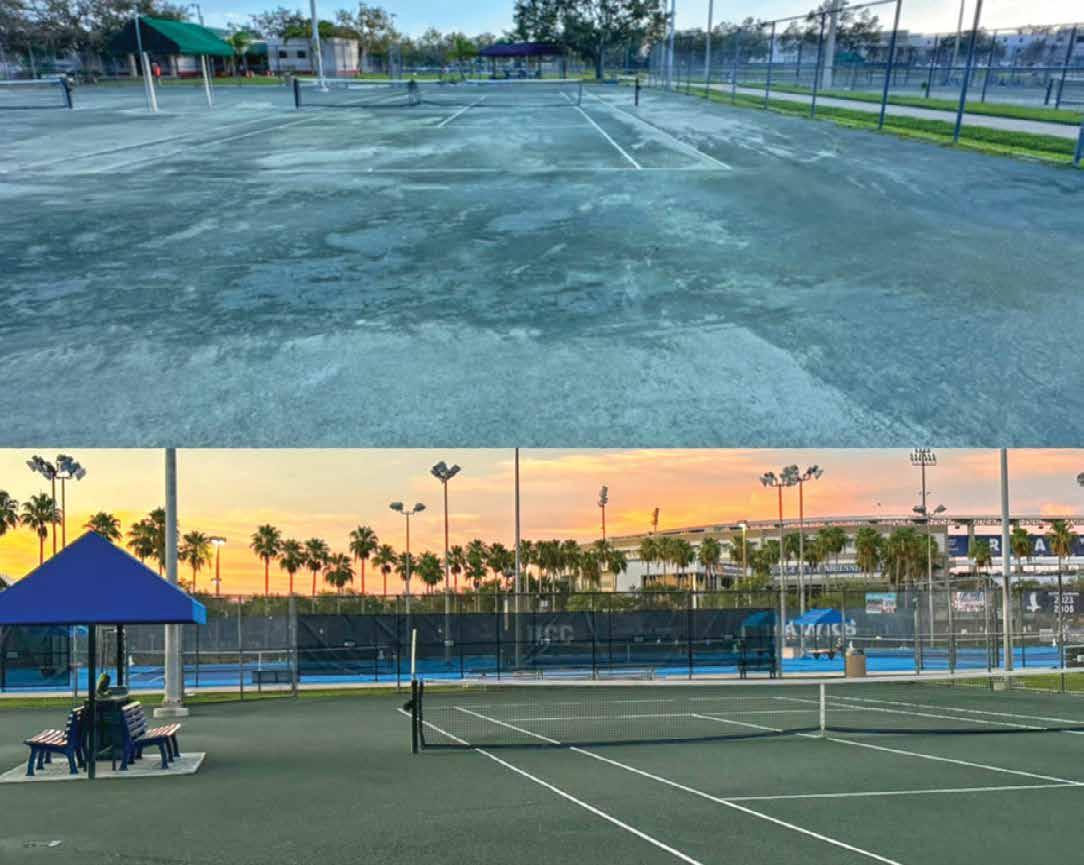
Last April, the USTA Florida Foundation awarded more than $829,000 in Hurricane Relief Grants to five tennis facilities in the Tampa-Clearwater area that were devastated during the 2024 hurricane season. It was the largest collective hurricane relief effort in the Foundation’s history. Today, those facilities are not only rebuilt but thriving, with courts full of players and new programming on the horizon.
“The Hurricane Relief Grant is designed to help rebuild tennis facilities throughout the state of Florida that were ravaged by recent hurricanes,” Elizabeth DeConti, USTA Florida Foundation
Treasure Bay has completed all hurricane-related fencing and court repairs, bringing the facility back to full operation. With reconstruction complete, the focus is now shifting forward. Future lighting projects may be in the works to enhance play opportunities, and new programming is being planned with the addition of community coach instructors. Phil, who has been mentoring these new coaches, is helping to build a pipeline of leadership at the facility that will serve the local tennis community for years to come. It is a great example of how hurricane relief is not just about restoring what was lost but building something even stronger.
The St. Petersburg Tennis Center has also completed all hurricane repairs and is back to full operations. Like Treasure Bay, future lighting projects may also be on the way. The center is wasting no time getting back to hosting events, with a Larry Turville Super Senior Grand Prix tournament on the schedule soon. Beyond competitive play, the St. Petersburg Tennis Center continues to be a hub for community programming.
The facility offers a popular summer program for kids and hosts impactful initiatives like Racquets in Recovery, which uses tennis as a tool to support individuals in their recovery journeys. It is programming like this that shows just how much a tennis facility means to its community and why investing in their recovery matters.
In addition to Treasure Bay and St. Petersburg, the HCC Tennis Center, McMullen Tennis Complex, and Apollo Beach Racquet & Fitness Club have all undergone repairs and are back to offering tennis at normal operations. These facilities, which collectively serve thousands of players across Hillsborough and Pinellas counties, are once again providing the courts and programs that their communities depend on.
The recovery of these five facilities is a testament to the power of the tennis community coming together. USTA Florida donated $525,676 to the Hurricane Relief Fund, USTA National contributed $250,000, and donors from across the state stepped up to fill the gap. Since 2019, the USTA Florida Foundation has provided more than $1.3 million in hurricane relief grants, helping repair and rebuild over 10 tennis facilities throughout the state.
To learn more about the USTA Florida Foundation’s mission or to contribute to future relief efforts, visit ustafloridafoundation.com.
President said. “The donations we received were used to rebuild courts, fix lighting, repave courts, nets, and fences in the Tampa and Clearwater area.”
The grants, made possible through the generous contributions of donors along with significant support from USTA and USTA Florida, were awarded to Treasure Bay Golf & Tennis Facility, HCC Tennis Center, St. Petersburg Tennis Center, McMullen Tennis Complex, and Apollo Beach Racquet & Fitness Club. Across all five locations, more than 20,000 players were impacted while courts remained unplayable in the aftermath of the storms.
By: Jaret Kappelman
The 2026 Florida High School Athletic Association Tennis season is officially underway, with over 1,000 boys’ and girls’ teams across the state competing for the ultimate prize, a State Championship. From powerhouse programs looking to defend their titles to hungry contenders ready to make their mark, this season promises intense competition and no shortage of exciting storylines.
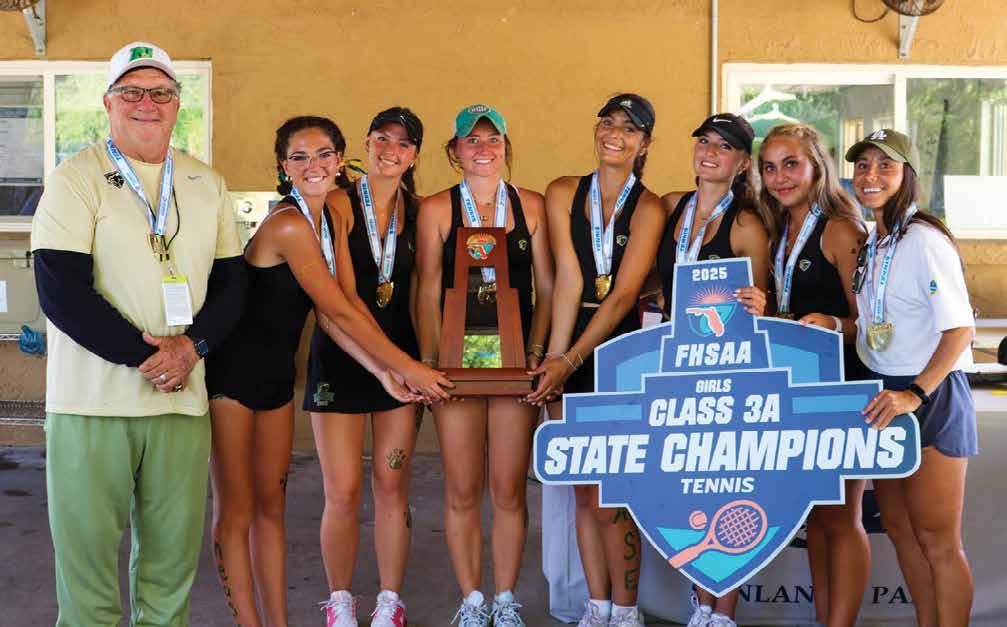
Florida high school tennis continues to be among the most competitive in the country. Teams compete in four classifications (1A-4A) based on school population, not skill level. 1A schools have the smallest student populations, while 4A schools represent the largest. Each classification will crown a team champion, while the state’s best individual players will battle for the Overall Singles and Doubles Championships.
District Tournaments kick off on April 13, followed by Regional Tournaments on April 21 and 23. The FHSAA State Championships will run from April 27 to May 1 at Sanlando Park, Red Bug Lake Park, and Sylvan Lake Park in Seminole County, returning to the same Central Florida venues that have hosted thrilling championship action in recent years.
True North Academy made history last season, sweeping both the Boys’ and Girls’ team titles. The program has quickly become one of the most dominant forces in 1A and will enter 2026 with a target on its back.
Saint Andrew’s will be the top challenger on the boys’ side. The Scots were 1A runners-up last year and return Rafael Bote, who captured the singles state title as a sophomore. Bote and Saint Andrew’s will be hungry to reclaim the crown the program held for five consecutive years. Episcopal School of Jacksonville, Community School of Naples, and Holy Trinity Episcopal Academy are also ones to watch. For the girls, True North looks to keep its dynasty rolling, while Grandview Prep, Benjamin, and Saint Andrew’s could challenge after strong postseason runs a year ago.
The American Heritage brand remains synonymous with 2A success. American Heritage Delray captured the Boys’ title for the third straight year in 2025, while American Heritage Plantation took home the Girls’ crown. On the boys’ side, Heritage Delray enters as the team to beat once again, but Bolles, Gulliver Prep, and Aubrey Rogers all showed potential at last year’s State Championships and will look to close the gap. For the girls, American Heritage Plantation will defend their title against a classification full of competitive squads ready to make a push.
Class 3A delivered some of the most memorable matches at last year’s State Championships. Osceola’s boys captured the title behind standout players Alessandro De Bernardo and Alexander Rangelov, who were a force in both singles and doubles. If key contributors return, Osceola will be the team to beat, with Chiles, St. Thomas Aquinas, Nease, and Ponte Vedra all capable of making deep runs.
Nease’s girls’ championship was one of the best stories of 2025. The Panthers captured their first state title since 1997, powered by Kylie Kochis, who dominated the tournament en route to the overall individual singles crown. With Kochis having graduated, the question is whether Nease’s young core can keep the momentum going. Jensen Beach, St. Thomas Aquinas, and Niceville will all be in the hunt again.
Class 4A is set to be the most unpredictable classification once again. Lake Nona’s boys broke through last season, capturing the title in dramatic fashion — winning a 10-point tiebreaker on the top line to edge Doral Academy in the finals. The Lions will look to defend, but Doral Academy, Cypress Bay, Spanish River, West Boca Raton, Steinbrenner, and Winter Park all have the talent to make serious title runs.
For the girls, Miami Palmetto reclaimed the 4A crown last season with Catherin Cardona-Carballosa clinching the championship in a third-set tiebreaker. It was the program’s second title in three years. Lake Nona, Wellington, Cypress Bay, and Winter Park are among the programs that could challenge, with Wellington returning a talented roster after reaching the state semifinals.
• 1A Girls: True North Academy | 1A Boys: True North Academy
• 2A Girls: American Heritage Plantation | 2A Boys: American Heritage Delray
• 3A Girls: Nease | 3A Boys: Osceola
• 4A Girls: Miami Palmetto | 4A Boys: Lake Nona
With new champions crowned across multiple classifications last year, the 2026 season promises even more shakeups as young talent rises and established programs reload. Whether it’s a dynasty extending its reign or a new contender breaking through, the 2026 FHSAA Tennis Season is shaping up to be one for the books.
For more coverage of Florida high school tennis, follow USTA Florida on Instagram and visit the News page.
By: Osvaldo Godoy
Junior tennis in Florida continues to grow at an impressive pace. From local state championships to internationally known events, the state offers young players a wide range of competitive opportunities. Thanks to year-round weather and a full tournament calendar, Florida remains one of the most important regions for junior development in the United States.
At the center of this system are several key tournaments that help players gain experience and move up the competitive ladder.
The Bobby Curtis Junior State Championships are widely considered the top in-state junior event in Florida. Each year, the tournament brings together many of the best players in the state across multiple age divisions, typically from the 12s through the 18s.
Held at the USTA National Campus in Orlando, the event gives players a chance to compete against strong in-state competition in a structured and high-level environment. For many juniors, the Bobby Curtis is very important in their development and often serves as a stepping stone toward national tournaments.
The event also includes Green Ball and doubles divisions, helping younger players enter the competitive pathway early. Its broad structure makes it one of the most important parts of Florida’s junior tennis calendar.
The Orange Bowl International Tennis Championships, played each December in South Florida, is one of the most respected junior tournaments in the world. Founded in 1947, it is classified as an ITF Grade A event, placing it among the highest levels of junior competition.
The tournament consistently attracts top under-18 and under-16 players from around the globe. Many former participants have gone on to successful professional careers, which has helped build the event’s long-standing reputation.
For Florida players, the Orange Bowl offers a rare opportunity
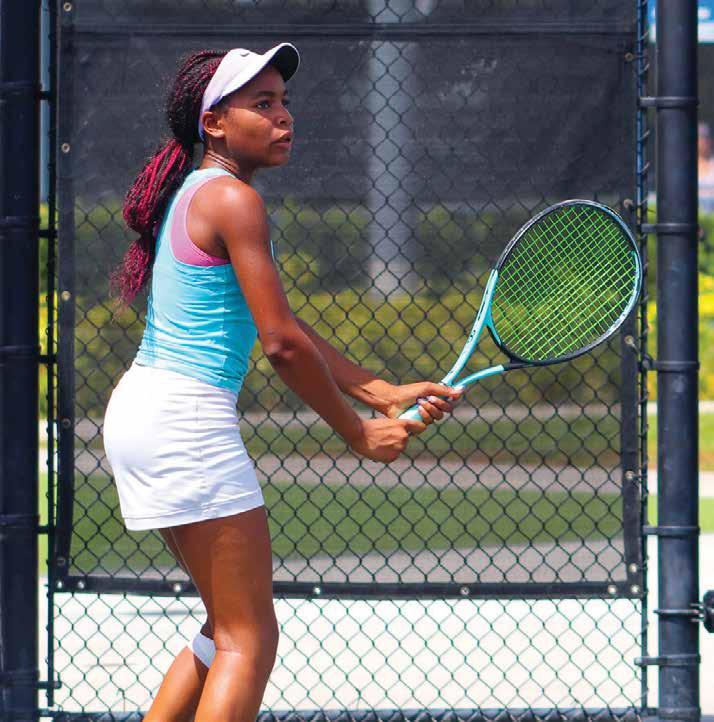
to compete against elite international opponents without leaving the state.
The Junior Orange Bowl International Tennis Championships focuses on the 12-and-under and 14-and-under age groups. With more than 60 years of history, the event welcomes young players from dozens of countries each year.
The tournament plays an important role in early player development. Many well-known professionals competed in the Junior Orange Bowl during their early years, making it a meaningful stop for ambitious juniors.
For Florida families, it provides early exposure to high-level international competition.
Another major event on the Florida calendar is the Eddie Herr International Junior Championships in Bradenton. First played in 1987 and hosted at IMG Academy, the tournament has become one of the most competitive junior events in the United States.
Eddie Herr typically takes place shortly before the Orange Bowl, and many top players compete in both events. The tournament is known for strong international fields and high-quality matches across multiple age divisions.
Together, Eddie Herr and the Orange Bowl form one of the most important junior stretches of the year in Florida.
Several factors continue to support the growth of junior tennis in Florida. The state’s year-round playing conditions allow young athletes to compete and train consistently throughout the calendar. In addition, the large number of academies and training centers provides players with access to high-level coaching and development opportunities.
Florida also benefits from a steady schedule of tournaments and strong support from USTA Florida programs. Tournaments like the ones mentioned help ensure that Florida players build a solid competitive base before moving on to national and international levels.
By: Jaret Kappelman
USTA Florida’s All-Girls Tennis Camps are back and stronger than ever in 2026. The initiative, which is part of USTA Florida’s Women in Tennis and AMPLIFY efforts, is designed to empower girls of all ages and abilities by creating a space where they can develop their tennis skills, build confidence, and see themselves reflected in the women who coach and mentor them. With the first camp of the year already in the books and several more on the calendar, USTA Florida is continuing to expand the reach and impact of this powerful program.
The 2026 All-Girls Tennis Camp series kicked off this past Saturday at Edward Waters University in Jacksonville, and it was a fantastic start to the year. The camp featured a unique element that made it especially meaningful. Members of the EWU Women’s Tennis Team served as coaches for the day, leading the young participants through drills, activities, and on-court instruction.
The experience was empowering for everyone involved. For the young girls, it was an opportunity to learn from college athletes who look like them and who are living proof that tennis can take you places. For the college players, it was a chance to give back, lead by example, and see the impact they can have as role models. The connection between the two groups was something special to witness, and it is a model USTA Florida hopes to bring to more college campuses throughout the year.
The camps are open to girls ages 5 to 18 of all skill levels and abilities. Each camp features tennis instruction delivered by an all-woman coaching team, along with lunch, a women’s panel, and giveaways including t-shirts and swag. The goal is to create an environment where girls feel supported, inspired, and confident that they belong in every aspect of tennis and sports.
“Women’s empowerment is essential to providing equitable opportunities for girls and women in sports, a traditionally male-dominated field,” said Katie Bivolan, USTA Florida High School and Youth Team Play Coordinator. “It demonstrates that barriers can be overcome and that real opportunities exist to create meaningful change.”
USTA Florida has a full lineup of All-Girls Tennis Camps planned for the rest of 2026, with events being organized at locations across the state. The City of Fort Walton Beach All-Girls Camp is confirmed for September 19, and additional camps are being planned at the University of North Florida, Cocoa Beach, and Riverside Racquet Complex in Vero Beach. USTA Florida is also looking to expand its college-based camp model after the success of the EWU event, with the goal of partnering with more university women’s tennis programs to create that same powerful connection between college players and young campers.
These camps are part of a larger movement within USTA Florida to grow girls’ and women’s participation in tennis. Since launching the All-Girls Camp initiative, the organization has partnered with universities, community organizations, and programs like Black Girls Tennis Club and Love Serving Autism to reach more than 100 girls across multiple camps in recent years. The momentum continues to build, and 2026 is shaping up to be the biggest year yet.
To learn more about upcoming All-Girls Tennis Camps or to get involved, visit ustaflorida.com/women-in-tennis
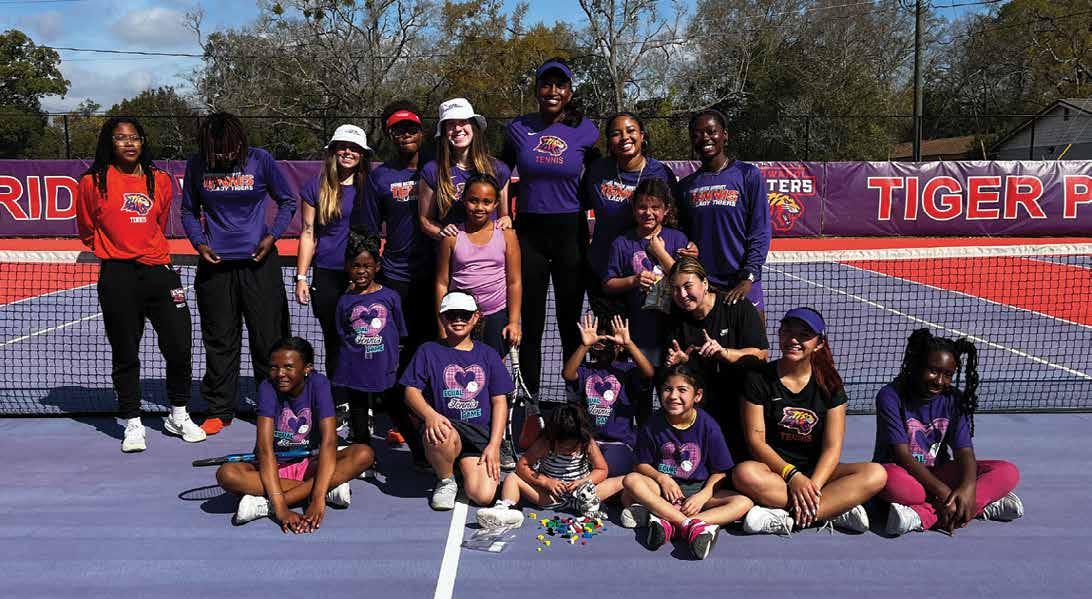
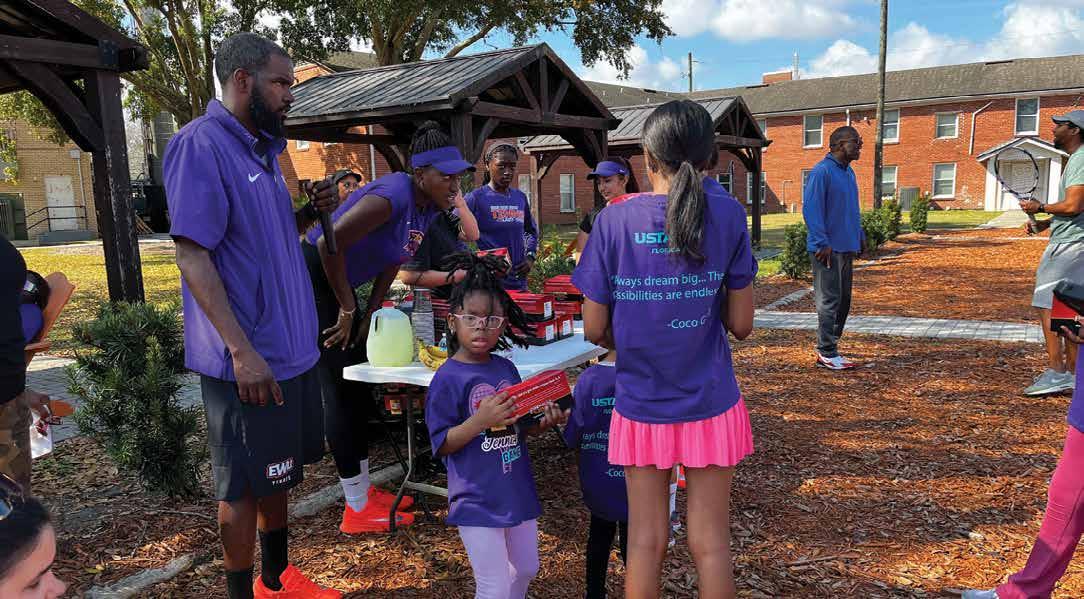
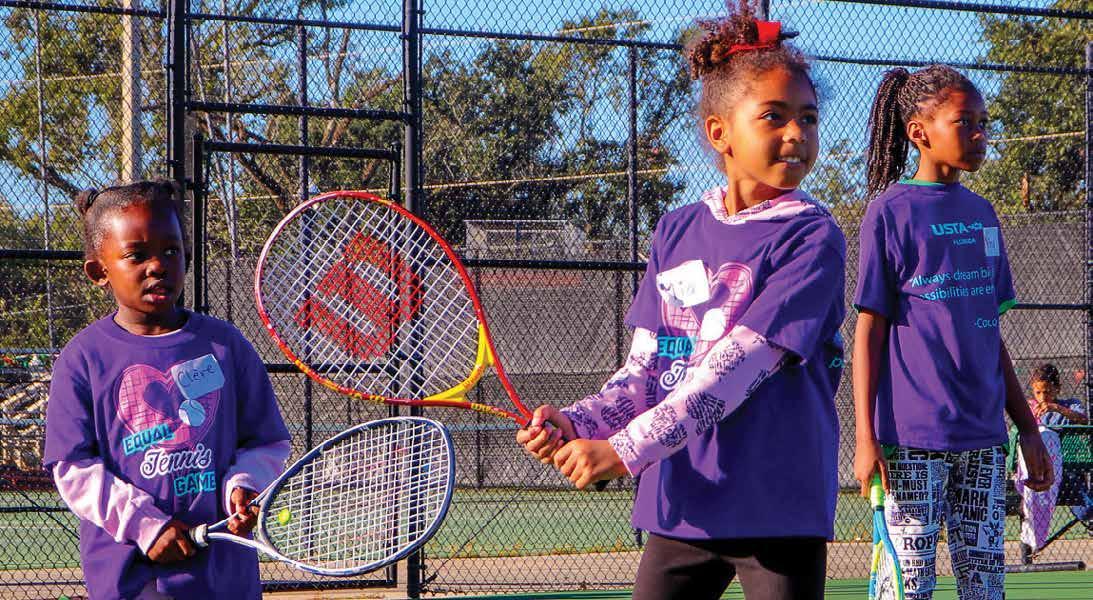
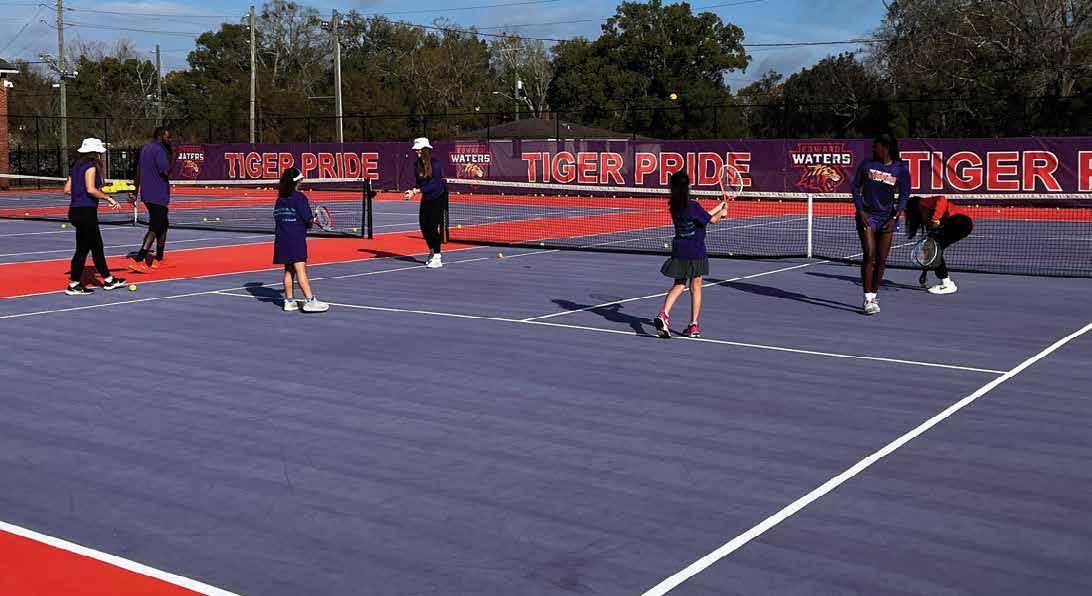
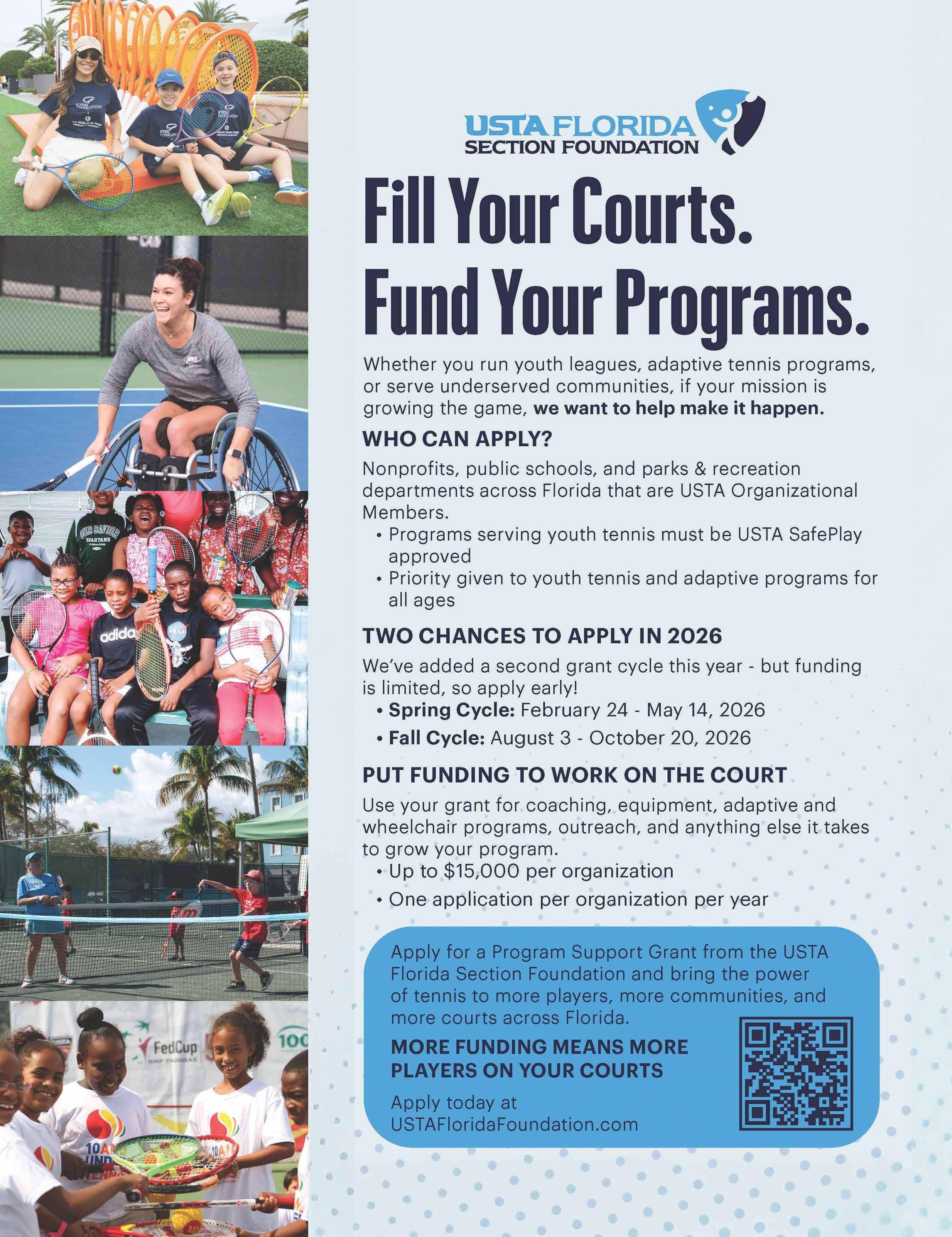
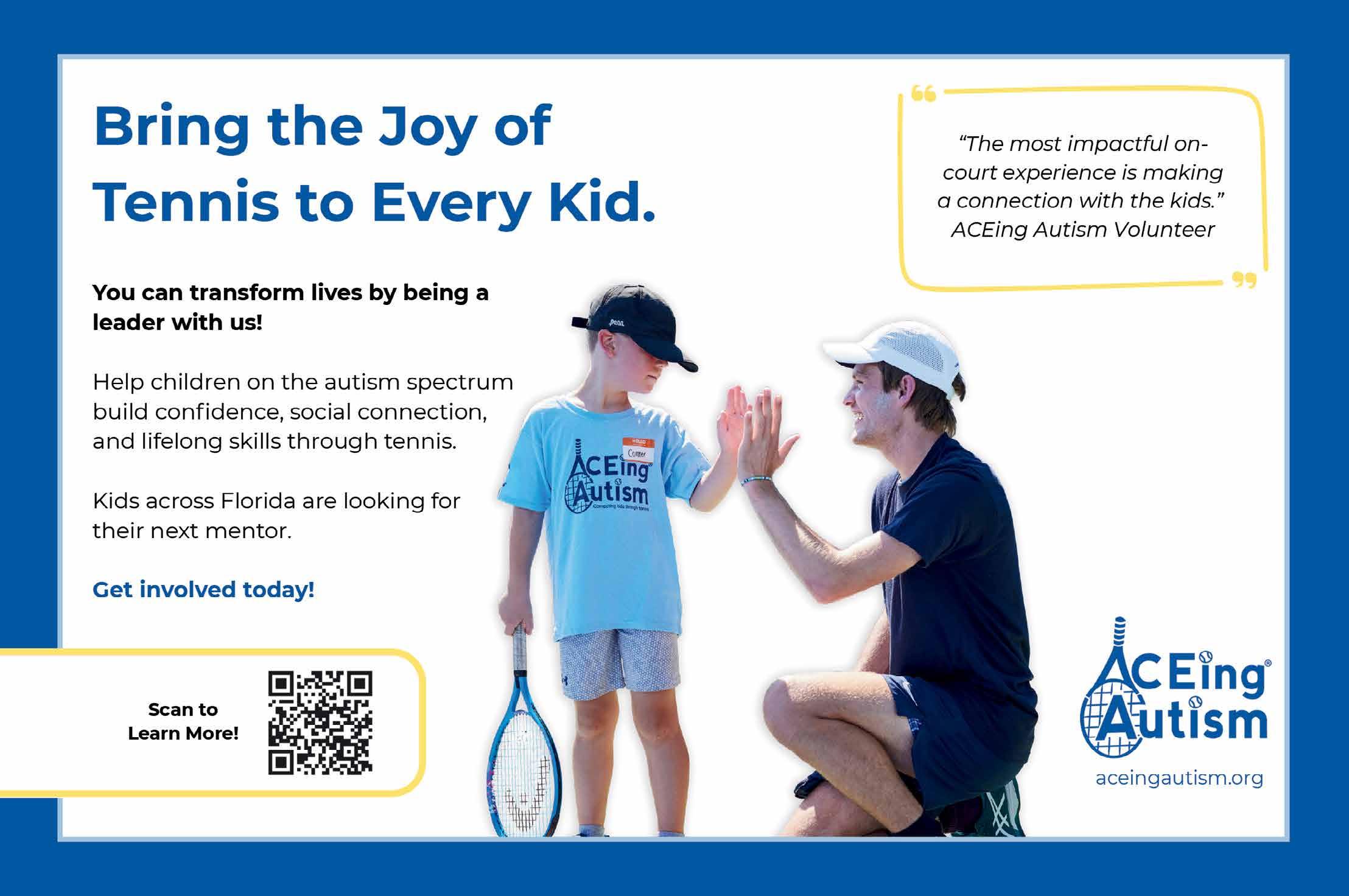






Qualify for Nationals! The top four yellow ball players (semifinalists) in each age division from each “Little Mo” Regionals will advance to the prestigious “Little Mo” Nationals in Austin, Texas from September 2528, 2026. These players will form a 16-size draw in each age division at the Nationals. The top 160 players who reach the Nationals are the youngest and brightest future stars in American tennis!
Palm Beach Gardens Tennis Center Palm Beach Gardens, Florida April 25-27
Girls and Boys (ages 8-12)
Green Dot: 8,9,10
Yellow Ball: 8,9,10,11,12
(Yellow Ball results count for UTR Ratings)
(Green Dot results count for CBR Ratings)



Nominations/Applications now being accepted for the following:
John Van Ryn Awards
Kelley Awards Special Projects
Jack Blair Awards
Please visit our website for details: YTF-FL.ORG
The Youth Tennis Foundation of Florida, Inc. Serving Florida Tennis since 1962 A 501[c][3] organization
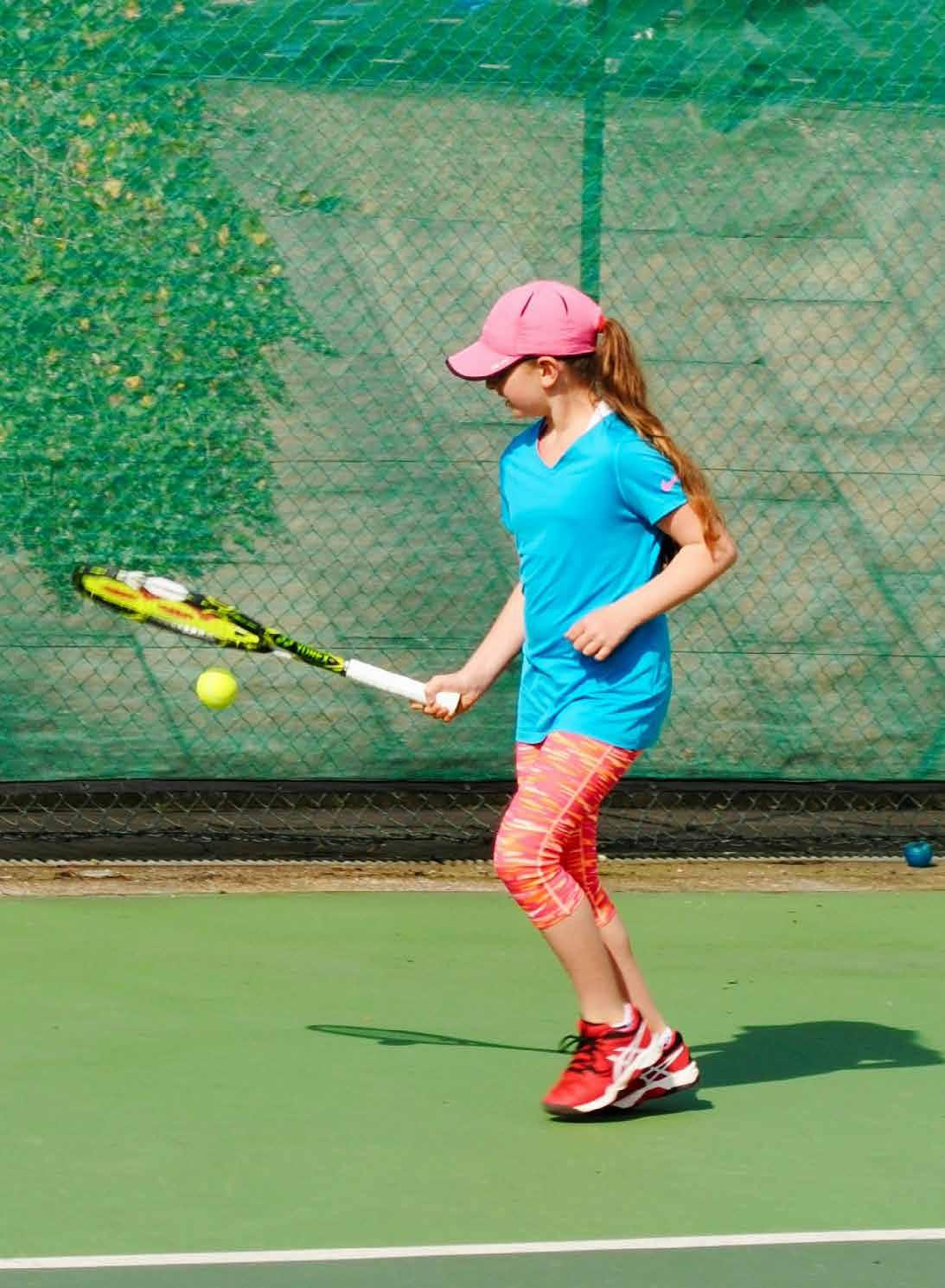
"THE MOST UNDERUSED WEAPON IN TENNIS? THE UNDERHAND SERVE."
GINO FAVA
WATCH MY YOUTUBE VIDEO FOR AN EXCLUSIVE LESSON ON HOW TO IMPROVE YOUR GAME
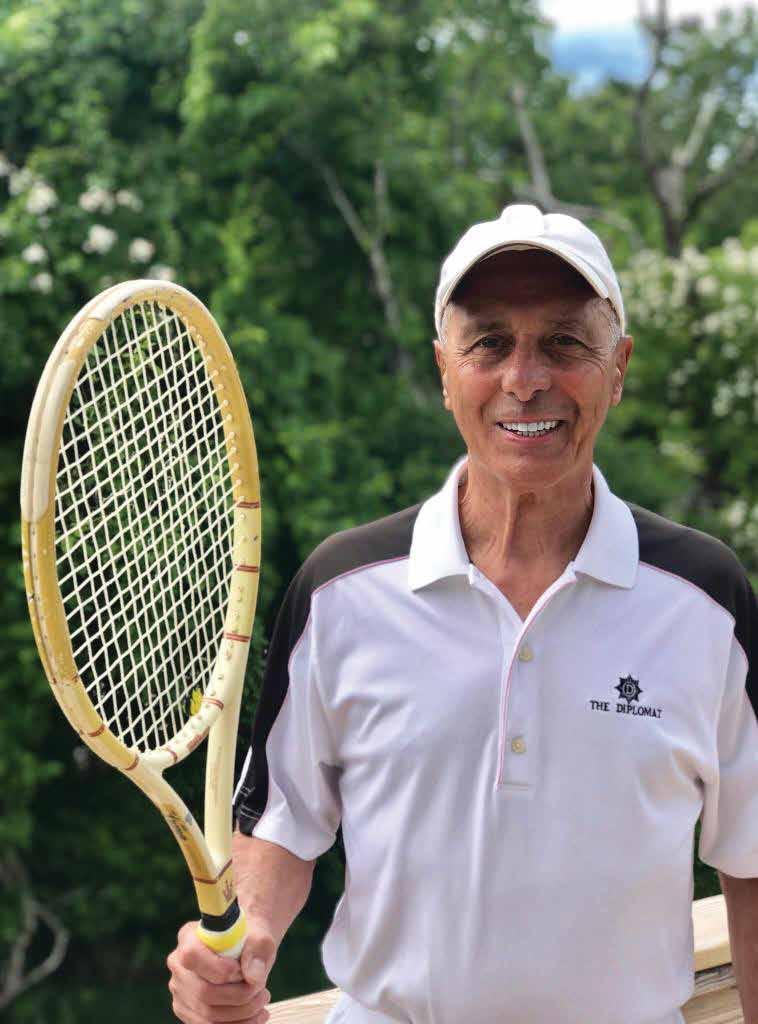
By Ian Pyka

Elite tennis demands speed, power, endurance, and resilience across long matches and congested tournament schedules. For female athletes, one often overlooked tool for optimizing performance and recovery is the menstrual cycle. By using cycle phases as a guide for training intensity and volume, coaches and athletes can better align physiological readiness with performance demands.
The menstrual cycle is made up of four distinct phases. The Menstrual Phase (Days 1-5), the Follicular Phase (Days 6-14), the Ovulatory Phase (Mid-cycle) and the Luteal Phase (Days 15–28). Hormonal fluctuations throughout this cycle influence energy levels, neuromuscular coordination, recovery capacity, and perceived exertion. While individual responses vary, many athletes notice predictable patterns that can help guide training decisions.
During the Menstrual Phase, energy and motivation may be lower due to hormonal drops. Training should focus on lighter, technical work including mobility and light to moderate intensity for strength training. Flexibility and recovery modalities such as Cryotherapy, Red Light Therapy and Compression Therapy should be prioritized. Volume should be kept to a minimum as well.
The Follicular Phase sees estrogen rising, often improving strength, power output, and coordination. This is an ideal time to push performance gains. Training focus during this phase should focus on high-intensity strength training and power development using Olympic lifting movements. Emphasis here should include higher volume court work along with tennis-specific speed and agility drills.
The Ovulatory Phase is produces peak estrogen levels which may enhance neuromuscular efficiency and reaction time. Training targets here should consist of maximum power and speed exercises. This is a great opportunity to introduce high-intensity match play and tactical drills, while empha-
sizing proper mechanics.
During the Luteal Phase, progesterone rises, body temperature increases, and fatigue may accumulate. Some athletes experience decreased tolerance for high volume. Keeping this in mind, strength training should be focused on maintenance rather than overload, volume and intensity should both be ramped down, while endurance and tactical work are prioritized. This is a great opportunity to treat recovery as a priority and spend time on proper hydration and dietary needs.
Tennis requires repeated bursts of acceleration, deceleration, and rotational power. Aligning strength sessions, sprint work, and match simulations with higher-energy phases can enhance adaptation, while tapering volume during lower-energy phases supports recovery and injury prevention.
Although men and women may train similarly for tennis, women have to deal with the physiological changes of menstruation. Not all female athletes experience the same symptoms or performance patterns. Tracking mood, energy, sleep, and performance metricsv alongside cycle phases allows coaches to tailor training precisely. Open communication between athlete, coach, and medical professionals fosters trust and long-term success.
Integrating menstrual cycle awareness into strength and conditioning isn’t about limiting training—it’s about optimizing it. By respecting physiology and training in harmony with hormonal rhythms, female tennis players can enhance performance, reduce injury risk, and sustain peak performance throughout the season.
Understanding the body is the ultimate performance advantage. At Boca Cryo TM, we understand the female athlete’s needs and supply the proper recovery modality, at the proper time, to offer the athlete the best opportunity for success.

Ace your tennis bets on Florida’s sportsbook app. And you can bet any serve, set, and match with boosted odds for each major this year. Place your bets with a tap and turn up the payout.

Offered by the Seminole Tribe of Florida. Must be 21+ and physically present in Florida to wager. Terms and Conditions Apply. If you or someone you know has a gambling problem, please call 1-833-PLAYWISE