Volume 5. 2026 Volume 5. 2026
DELRAY BEACH OPEN PREVIEW 10-YEAR-OLD STUNS D1 COLLEGE PLAYERS FLORIDA TENNIS EVENT RECAPS
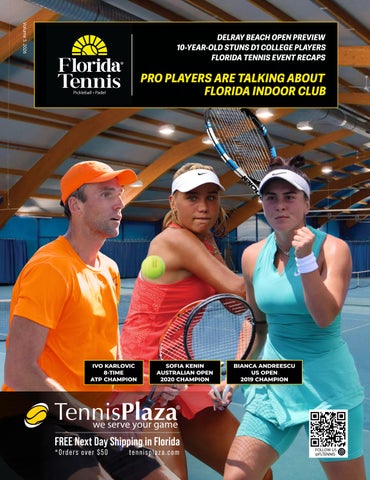
PRO PLAYERS ARE TALKING ABOUT FLORIDA INDOOR CLUB
FLORIDA INDOOR CLUB COVER
IVO KARLOVIC 8-TIME ATP CHAMPION
SOFIA KENIN AUSTRALIAN OPEN 2020 CHAMPION
FREE Next Day Shipping in Florida *Ord ers over $ 50
tenn i s p l az a .c om
BIANCA ANDREESCU US OPEN 2019 CHAMPION
FOLLOW US @FLTENNIS
®
Pickleball • Padel
VOLUME 5. 2026 EDITOR AND PUBLISHER Matt Pressman HOST & ENTERTAINMENT DIRECTOR DJ Mad Linx ASSOCIATE EDITOR Osvaldo Godoy ASSISTANT EDITOR Alex Binstok GRAPHIC DESIGNER Nathalia Suarez Arbelaez CONTRIBUTING WRITERS Adam Ross, Dave Kozlowski, Cameron Mofid, Todd Pechter, Zach Shahan, Ian Pyka, Guillermo Morales-Rubert, Will Turvey CONTRIBUTING PHOTOGRAPHERS Fred & Susan Mullane (CameraworksUSA), Christine Pechter FLORIDA TENNIS PODCAST Host: Adam Ross LIFESTYLE CORRESPONDENT Cymber Larkin FLORIDA TENNIS APP Powered by ATR Tennis OFFICE Florida Racquet Sports LLC 4800 N. Federal Highway, Suite B200 Boca Raton, FL 33431 ADVERTISING info@floridatennis.com 754-222-1785 SUBSCRIPTIONS 1 Year (6 issues) $39.95, 2 Years (12 issues) $69.95 US subscribers only COVER PHOTO Karlovic Photo: si.robi, CC BY-SA 2.0, via Wikimedia Commons Kenin Photo: robbiesaurus from Smithtown, NY, USA, CC BY-SA 2.0, via Wikimedia Commons Andreescu Photo: Hameltion, CC BY-SA 4.0, via Wikimedia Commons Background photo courtesy of Florida Indoor Club
In Loving Memory of Florida Tennis Founder Jim Martz
floridatennis.com
@floridatennismagazine
floridatennismagazine
@fltennis
Florida Tennis is published bi-monthly by Florida Racquet Sports, LLC. Florida Tennis is proudly printed in Florida. Florida Tennis® is a registered trademark of Florida Racquet Sports LLC. All rights reserved. All images, text, and other content appearing in this magazine are protected under U.S. copyright law and may not be reproduced in any way without prior written consent from Florida Racquet Sports LLC. While every care was taken during the production of this magazine, Florida Racquet Sports LLC cannot be held responsible for the accuracy of the information and/or any consequences arising from it. Florida Racquet Sports LLC accepts no responsibility for the return of unsolicited manuscripts and/or photographs and reserves the right to edit, rewrite, or refuse material and is not responsible for products. Florida Racquet Sports LLC gives no warranties, guarantees, or assurances and makes no representations regarding any products or services advertised in this issue.
Delray Beach Open
Celebrates 35 Years
14
floridatennis.com
Every February, the world’s best men’s tennis players descend on Delray Beach for one of the ATP Tour’s most beloved stops. In 2027, the event will reach a milestone: The tournament is celebrating its 35th anniversary at a coastal beach town that has become synonymous with phenomenal tennis. Founded in 1993 in Coral Springs as a clay-court event, the first-ever champion was American Todd Martin, who would reach No. 4 in the rankings. The tournament then moved to Delray Beach in 1999, where it remains today. Set at the Delray Beach Stadium & Tennis Center next to the bustle of Atlantic Avenue, the tournament draws more than 50,000 fans each year and reaches a global television audience in over 180 countries. Over the years, legends like Andre Agassi, Jim Courier, Patrick Rafter, and Andy Roddick have all played in Delray Beach. Former champions include Grand Slam winners Marin Cilic, Juan Martin del Potro, and Lleyton Hewitt, along with Grand Slam finalists Taylor Fritz, Kei Nishikori, and Kevin Anderson. Next taking place Feb. 12-21, 2027, the Delray Beach Open is the ATP Tour’s first North American hard-court stop of the outdoor season. Last year’s final was an all-American showdown between Sebastian Korda and Tommy Paul, with Korda winning his third career ATP Tour title. He became the ninth American champion in tournament history, joining the likes of Fritz, Reilly Opelka, Frances Tiafoe, and Sam Querrey. The Delray Beach Open is unique for its idyllic beach setting, its many special events, and its Legends Event, which brings tennis greats back to the court for a round-robin competition. Last year’s Legends Event showcased the likes of Juan Martin del Potro, Tommy Haas, as well as Bob and Mike Bryan, who won the doubles title a record six times. The 2027 edition kicks off with its Legends Event from Feb. 12-14, fol-
lowed by qualifying matches on Feb. 13-14 and main draw singles and doubles action running from Feb. 15 - 21. Off the court, the tournament's popular Food & Wine Series returns for its eighth year, bringing dozens of South Florida's top restaurants, food vendors, and spirit partners to the grounds throughout the event. The Delray Beach Open Food & Wine Series features a different event every day and evening from Feb. 15 - 21. Individual tickets for the 2027 tournament are on sale now, and fans have more ways than ever to save. Series tickets grant access to every session of the tournament and include parking passes for the week, with box seat holders also enjoying Clubhouse Lounge access. Fans purchasing three or more sessions can take advantage of the Flex 3 offer, saving 20% on Reserved seats or 10% on Box seats. Groups of 15 or more qualify for discounted Reserved and Box seating, along with complimentary tickets and added perks that grow with group size for specific sessions. Seniors 55 and older can enjoy Buy 1, Get 1 Free pricing on select sessions, and families will find plenty of value too: kids 14 and younger receive a free Reserved seat with an adult ticket for early sessions, while kids 3-12 will receive 50% off Stadium Court Reserved seats with an adult ticket purchase, excluding Final Sunday (Feb. 21). Whether you're a longtime fan or planning your first visit, now is the time to lock in tickets before the best sessions sell out at this can't-miss stop on the South Florida calendar. Tickets and full event details are available now at DelrayBeachOpen.com or by calling 561-330-6000.
Photo credits: Delray Beach Open
BILLIE JEAN
KING CUP Returns to Delray Beach for USA vs. Hungary
16
four weeks before the competition. Saturday will begin at 1:30 p.m. ET with two singles matches featuring each country’s top two nominated players. Sunday’s action, also beginning at 1:30 p.m., is scheduled to open with doubles followed by two additional singles matches if needed. The first country to win three matches takes the tie. Tennis Channel will carry the competition in the United States. The event is another significant international tennis showcase in Delray Beach. Last September’s Davis Cup competition between the United States and Czechia generated more than $2 million for the local economy, according to the USTA. “The Billie Jean King Cup is one of the most prestigious events in global tennis, and we are honored to welcome the World Cup of Tennis back to The Palm Beaches,” said George Linley, Executive Director of the Palm Beach County Sports Commission. Two-day ticket packages go on sale to the general public August 21 at 10 a.m. through Ticketmaster, with packages starting at $50. For Delray Beach, it’s another chance to welcome Team USA back to a venue where the American women have never lost.
Photo credit: Todd Pechter
floridatennis.com
The Billie Jean King Cup is coming back to Delray Beach — and the United States will once again have home court in South Florida. The U.S. Billie Jean King Cup Team will face Hungary at the Delray Beach Tennis Center on November 21–22 in a pivotal playoff at the 2026 Billie Jean King Cup by Gainbridge, bringing one of international tennis’ signature team competitions back to Palm Beach County. There is plenty at stake. The winner of the best-of-five-match tie moves back into the qualifying pool with an opportunity to compete for the Billie Jean King Cup championship in 2027. For the Americans, Delray Beach has been very friendly territory. The U.S. Billie Jean King Cup Team is 4-0 all-time at the Delray Beach Tennis Center. Its most recent appearance came in 2023, when South Florida stars Coco Gauff and Jessica Pegula helped the United States sweep Austria in front of near sell-out crowds. This year’s U.S. team will be captained by International Tennis Hall of Famer Lindsay Davenport, who guided the Americans to the Billie Jean King Cup final in 2025. The actual lineup remains part of the intrigue. The United States and Hungary can each name as many as five players, with rosters due no later than
Florida Indoor Tennis Club
A New Era of Indoor Tennis Has Arrived
18
floridatennis.com
By Alex Binstok
Florida’s reputation as the Sunshine State has made it one of the world’s premier destinations for outdoor tennis. From public parks and country clubs to elite academies, players enjoy nearly year-round access to the game. Yet even in a state blessed with warm weather, one challenge remains constant: the unpredictable combination of intense heat, high humidity, and frequent rainstorms. Florida Indoor Tennis Club, a new state-of-the-art facility coming to Pompano Beach, aims to solve that problem while introducing a new era of indoor tennis to the state. Neal Feinberg, President of Florida Indoor Tennis Club, is helping to provide players with a reliable, climate-controlled environment where tennis can be played every day of the year, regardless of the weather outside. More than simply an indoor facility, Feinberg envisions the club as a complete tennis destination serving players of every age and ability. "We want to create a true indoor tennis experience," Feinberg explained. "This isn't just about putting a roof over courts. It's about building a complete tennis environment where players can train, compete, and improve year-round without worrying about weather interruptions." While indoor tennis facilities are common throughout the Northeast and Midwest, they remain surprisingly rare in Florida. Feinberg believes that gap represents one of the biggest opportunities for the state's rapidly growing tennis community. "In many parts of the country, indoor tennis is essential," he said. "Here in Florida, people don't always think about it because of the climate. But between summer storms, extreme heat, and humidity, there's absolutely a need for reliable indoor court time." The timing couldn't be better. Tennis participation continues to grow across Florida as more families invest in lessons, junior development, league play, and recreational competition. With additional court demand comes the need for dependable playing conditions—something outdoor facilities simply can't guarantee every day. "The sport is growing," Feinberg said. "People are playing more. Families are investing in lessons and development. There's a real demand for quality court time." Located at 3100 West Atlantic Boulevard in Pompano Beach, Florida Indoor Tennis Club will feature climate-controlled indoor courts built with cushioned Laykold surfaces—the same court technology used at both the US Open and the Miami Open. Beyond the premium playing surface, the facility is designed to create consistency for every player who walks through its doors. "We want players walking into our facility knowing they're going to get consistent playing conditions every single time," Feinberg added. That consistency is particularly valuable for junior athletes working toward tournament competition. Training schedules often fall victim to Florida's unpredictable weather, forcing players to miss valuable court time during critical development periods.
"For juniors especially, consistency matters," Feinberg explained. "If you're training seriously and preparing for tournaments, you can't afford to lose sessions to weather. Indoor courts allow us to keep development on track." The club's programming reflects a commitment to serving the entire tennis community rather than focusing on a single demographic. Junior development, adult clinics, private lessons, social leagues, cardio tennis, competitive events, and tournaments are all expected to become part of the club's yearround offerings. "This is not just a high-performance academy, and it's not just recreational play," Feinberg said. "We're building something that serves the entire tennis community." The excitement surrounding Florida Indoor Tennis Club extends well beyond its founders. World-class players have already voiced their support for the project, including Wimbledon and French Open finalist Amanda Anisimova. Amanda recently said "I'm so excited to play there—especially on days when it's super hot, as it normally is in Florida during the summer, or when it's raining and we have nowhere to hit." Former Australian Open champion Sofia Kenin has also expressed her enthusiasm, saying she's excited to train at the facility and thrilled that Florida will finally have a premier indoor tennis destination. Former US Open champion Bianca Andreescu has also caught wind of the new facility and shared her thoughts on what it will bring to South Florida tennis. “When it’s raining outside, you’ll finally have a place to play indoors,” Andreescu said. Even former World No. 14 Ivo Karlović highlighted the need in memorable fashion. In a video with rain falling behind him after being forced off the court, Karlović joked about Florida's daily weather interruptions before praising the arrival of the air-conditioned indoor tennis club where players can continue uninterrupted. Rather than replacing Florida's iconic outdoor tennis culture, Feinberg sees the new facility as enhancing it. "There will always be outdoor tennis in Florida. That's part of the beauty of the state," he said. "We're simply adding another option—one that enhances what's already here." Ultimately, Feinberg hopes Florida Indoor Tennis Club becomes more than a place to reserve a court. "We want this to become a home base for players," he said. "A place where they know they can train, compete, and be part of a tennis community." By combining world-class indoor courts, year-round reliability, comprehensive programming, and the support of some of the sport's biggest names, Florida Indoor Club is poised to become a valuable new home for players seeking to elevate their game, no matter what the Florida forecast has in store.
Photos courtesy of Florida Indoor Tennis Club
“I’m so excited to play there, especially on days when it’s going to be super hot”
— Amanda Anisimova
“When it’s raining outside, you’ll finally have a place to play indoors” — Bianca Andreescu
“I’m so excited there will finally be an indoor court here in Florida” — Sofia Kenin
“There’s finally an air-conditioned indoor tennis club” — Ivo Karlovic
20
A 10-year-old just won a prize money tennis tournament against players connected to NCAA Division I programs. That sentence almost doesn’t sound real. But in South Florida, Vlada Hranchar made it happen. Hranchar, the young Ukrainian-born tennis phenom who trains daily with legendary coach Rick Macci, captured the women’s singles title at the Battle of Boca, earning the $1,500 winner’s prize in one of Florida’s toughest tennis tournaments. Not a junior title. Not an age-division event. The Battle of Boca is a weekly UTR prize-money tournament where juniors, college players, adults and pros all compete in the same ecosystem. Tournament director Jason Zafiros said the event runs 52 weeks a year and has drawn an impressive list of collegiate and professional tennis players. The level is real. Zafiros said past Battle of Boca players include Ben Shelton, Martin Damm, Emilio Nava and Juncheng Shang. Just weeks ago, top-100 WTA player Renata Zarazua played and won the tournament before continuing a strong stretch on tour. “No place on earth can that happen but the Battle of Boca,” Zafiros said. “You basically have to be a Futures player or a top ITF player to get to play some of these people. But you can do this right here on Court 12 in a public park.” That is the stage Hranchar stepped onto — and won. Her path made the accomplishment even more startling. In the round of 16, Hranchar defeated No. 1 seed Autumn Rabjohns 6-7(1), 6-0, 12-10. Rabjohns is a Northwestern women’s tennis player — meaning Hranchar beat a Big Ten player before she has even reached middle school. In the semifinals, Hranchar defeated Anastasiia Kochelaevskaia 1-6, 6-2, 10-4. Kochelaevskaia plays for the University of Wyoming and has earned AllMountain West singles honors. In the final, Hranchar faced Lyla Messler, an incoming University of Illinois player. Hranchar dropped the first set 6-1, won the second set 6-4, and earned the title after Messler retired before the deciding match tiebreak. Three opponents tied to Division I college tennis. Multiple comebacks. Prize money on the line. And the champion was 10. “You can’t make this up,” Macci said. “Obviously, 10 years old, 4-foot-7, 78 pounds, but a human stick of dynamite. I’m so proud of her.” Macci, whose coaching résumé includes work with five former No. 1 players including Venus Williams, Serena Williams, Maria Sharapova, Jennifer Capriati and Andy Roddick, has been outspoken about Hranchar’s potential. But he framed this win as part of a larger journey to improve. “We play the Battle of Boca for experience,” Macci said. “The more that you can see different styles, it’s epic — because this is junior development, not junior final destination.” Zafiros said the Battle of Boca is built to expose players to pressure. He said Hranchar’s ability, at just 10 years old, to fight back repeatedly is what really surprised him. “Absolutely unheard of,” Zafiros said. “You have to be a fighter. And that’s why my motto here is never give up.” Macci said Hranchar is clearly not winning because of her power or size. At this stage, he sees something different: courage, toughness and an unusual ability to stay present in the smallest moments. “She’s fearless,” Macci said. “If you have courage, that’s the difference between great and good, especially in the big moments.” Her work ethic has also become part of the story. Macci said Hranchar is on court every day and often begins before sunrise. Zafiros said he sees it himself while arriving early to prepare the tournament. “I thought I was here early at 5 in the morning,” Zafiros said. “This girl’s out here at 4:30, 4 in the morning with Rick Macci.” It is far too early to declare what Hranchar’s tennis future will become. She is still a child, and Macci has repeatedly emphasized that he is building her game for the long term. “The future’s bright,” Macci said. “You never know what’s going to happen. All I’m trying to do is build a game for the future.” Still, a 10-year-old winning a $1,500 open prize-money title is remarkable. Doing it in a tournament recently won by a top-100 WTA player — after beating opponents tied to Division I programs at Northwestern, Wyoming and
Illinois — makes it one of the most eye-opening tennis results anywhere this year. For Hranchar, it is a milestone in a long development process. For serious tennis fans, it is the kind of result that will be remembered. Could it be a watershed moment? Hard to say. But for anyone watching the next wave of women’s tennis talent, it is an early signpost that demands attention.
Photo credit: Rick Macci / Battle of Boca
floridatennis.com
10-Year-Old Tennis Phenom Vlada Hranchar Downs Division I College Players to Win $1,500 Prize Money Title
Cincinnati and the US Open Two Tournaments, Two Different Objectives By Gabe Jaramillo Not every tournament carries the same importance within a player’s competitive plan. Some tournaments are the final destination; others, regardless of their prestige, are part of the preparation for a greater objective. Cincinnati and the US Open are perfect examples. Cincinnati is one of the most important tournaments on the ATP and WTA calendars, but for many players, it also serves as the final competitive preparation before the US Open. In 2026, Cincinnati ends on August 23, while the US Open main draw begins on August 30. That leaves very little time to recover, make adjustments, and prepare for the physical and mental demands of a Grand Slam. The player should arrive in Cincinnati physically prepared and competitively sharp, but not necessarily at their absolute peak. The tournament provides an opportunity to adapt to the hard courts, regain match rhythm, test tactical patterns, and identify the final details that need attention. The result matters, but it should not compromise the primary objective. After Cincinnati, the training plan must depend on how far the player advanced. A player who loses early may need a few controlled training sessions to maintain rhythm. A player who reaches the semifinals or final will need considerably more recovery. The mistake would be giving both players the same program. During the days before the US Open, training volume should decrease while intensity remains high. Sessions should be shorter, purposeful, and focused on serving, returning, movement, and the tactical patterns the player will need in competition. Sleep, nutrition, hydration, physiotherapy, and mental recovery become just as important as time on the court. The objective is not to peak twice. It is to use Cincinnati as part of the process that allows the player to reach their highest level at the US Open. A wellplanned preparation respects both tournaments but clearly identifies where the athlete must be at their absolute best. Great preparation is not simply about working harder. It is about understanding when to build, when to compete, and—most importantly—when to recover so the athlete can perform at their highest level when it matters most.
under the pressure of competition, and every athlete hopes to perform at the peak of their abilities. Yet one of the most common mistakes is arriving with residual fatigue. In the days leading up to a tournament, players who do not feel confident about their game often believe they must train longer and harder. I have even seen players return to the practice court after an exhausting match because they were unhappy with their performance. This is completely counterproductive. If a player has had sufficient time to prepare physically, technically, and psychologically, they will not dramatically raise their level during the final week before competition. Trying to do so usually has the opposite effect. Those players arrive physically depleted. They may perform well for one or two matches, but eventually, the accumulated fatigue catches up with them. Tapering is therefore a vital part of the periodization and planning of every high-performance athlete. The objective is to gradually reduce training volume while maintaining intensity. The exact formula depends on the individual player. Some athletes need three days of reduced workload, while others may need seven or more. To understand each player’s needs, coaches must maintain detailed records of training loads, recovery, physical condition, and competitive performance. Over time, this information reveals the tapering strategy that allows the athlete to arrive at competition feeling sharp, strong, confident, and mentally fresh. Tapering is the final fine-tuning of the athlete. The work has already been done; this is not the moment to build more—it is the moment to allow the body and mind to absorb the preparation. When tapering is managed correctly, fatigue disappears without sacrificing intensity, and the player arrives ready to access the higher level of performance that competition demands. Ultimately, championships are not won by the athlete who trains the most during the final week. They are won by the athlete who arrives most prepared to perform when it matters. Tapering does not reduce preparation—it completes it.
TAPERING: ARRIVING READY TO PERFORM Everyone understands the importance of work ethic and the relationship between training hours, sacrifice, and results. In fact, many people mistakenly believe that the athlete who trains the longest will improve the most. But this is not necessarily true. Progress depends on how well each player absorbs and responds to training. Pete Sampras trained in two-hour blocks, while Andre Agassi preferred 90-minute sessions. Both became great champions. Manipulating training volume and intensity is highly individual; what works for one player may not work for another. Every coach and athlete knows that the goal is to arrive at a competition in the best possible condition. Months of preparation will ultimately be tested
(Above) Photo credit: Mauricio Paiz (Left) Photo credit: © Rolex/Jon Buckle
Johan Kriek - Autograph Corner won 14 singles titles and reached at least the quarterfinals at all 4 Majors. He was a semifinalist at the 1980 U.S. Open and the 1986 French Open. He battled and beat some of the greatest players in tennis history. He recorded wins over HOF’ers John McEnroe, Jimmy Connors, Bjorn Borg, Guillermo Vilas and Andre Agassi. Kriek’s win over Agassi was particularly memorable. Agassi was a very promising junior on the cusp of greatness and Kriek was asked by HOF Coach Nick Bollettieri to play an exhibition match against the flamboyant youngster. Kriek went into the match with tremendous confidence and ended up in a battle royale until he ultimately prevailed. “There was no way I was losing to a freaking junior,” Kriek told Florida Tennis. In hindsight, if Kriek had lost, that result would have aged pretty well. His 1982 victory over John McEnroe at the U.S. Indoor Championships was also particularly memorable. McEnroe was famous for his
fiery personality and Kriek was not intimidated. He beat Johnny Mac on the fast indoor court and that match was a microcosm of Kriek’s competitive fire that he demonstrated throughout his career. Kriek’s tight loss to Borg at the 1980 U.S. Open was another indication of his willingness to battle. Kriek reached the semifinals that year and pushed the legendary Swede before Borg ultimately prevailed. After his storied ATP career, Kriek played in Legends Tennis Events including the Delray Beach Open. He currently oversees the elite Johan Kriek Tennis Academy in Jupiter, Florida. He also coaches annually at the John Newcombe Legends Tennis Fantasy Camp. Photos courtesy of Adam Ross
Tennis Legend Johan Kriek is the answer to a great tennis trivia question. Which player won the same singles Major title twice on the same surface in the same year and defeated the same player? Kriek won the Australian Open twice in 1982 over Steve Denton. How is that possible? Because of an anomaly in the always complex tennis calendar, Kriek officially clinched the 1981 Australian Open over Denton on January 3rd, 1982. He returned to Australia and defeated Dent again in December of 1982 to win the Australian Open for the second time in the same calendar year. Two Major wins in the same Grand Slam over the same player on the same surface in the same year. Kriek told Florida Tennis that he believed this record would never be broken! Beyond that interesting trivia Kriek possesses some very impressive career statistics. Kriek who was born in South Africa and became an American citizen in 1982, reached a career-high ranking of No. 7 in the world in 1984. He
Adam Ross is a contributing writer and podcast host for Florida Tennis. He won the Miami Open’s Jim Martz Media Award in 2024. He volunteers for the USTA Florida and the Tennis Collectors of America/TCA.
BOASTUSA.COM @BOAST B OA S T AT H L E T E J J W O L F W E A R I N G THE VOLITION AMERICA X BOAST
24
floridatennis.com
QUARTER ZIP AND BOAST PEAK SHORT
SHOP NOW
EXPERIENCE THE NEW SADDLEBROOK THIS FALL Legendary instruction with new accommodations and resort-wide upgrades. Tennis and Pickleball enthusiasts of all ability levels come to Saddlebrook to experience our intense and demanding adult program.
Available year-round, our adult tennis camps, daily clinics, and professional analysis include a series of imaginative drills designed by the legendary Harry Hopman and taught by our pros.
They’ll help you develop the stamina, speed, agility, and endurance you need to play at your very best, while incorporating your natural style of play.
All Tennis
&
Pickleball
Bookings Must Be
.
Prearranged
*To learn more or book, please call: 813-907-4200 or ema l hopman@saddlebrook.com
-Seen at-
26
Photo credits: Florida Tennis Partners
floridatennis.com
Midtown Athletic Club
Florida Tennis joined forces with Florida Tennis Partners to create our first “Tennis x Refresh” event. Over 100 players attended the event at Midtown Athletic Club and got a chance to demo the Tenniix AI ball machine. The event was hosted by Florida Tennis Entertainment Director DJ Mad Linx who also supplied the music and provided on-court tennis tips to the massive crowd. Big thanks to our friends at Hydracourt for helping to keep guests hydrated on-site.
Dr. Brian Hainline on Tennis, Health and the Future of the Sport By Guillermo Morales-Rubert Few figures in American tennis have worked as extensively at the intersection of medicine, athlete health and sports leadership as Dr. Brian Hainline, a pioneer in the development of the Chief Medical Officer role across major sports organizations. A longtime sports neurologist and tennis leader, Hainline served for 16 years as Chief Medical Officer (CMO) of the US Open and later as CMO of the USTA before becoming the NCAA’s first CMO in 2013. He went on to serve as USTA Chairman of the Board and President from 2023 through 2024. Hainline recently spoke with Florida Tennis about his path through sports medicine, tennis as a public good, the research connecting the sport with longevity, and the importance of making tennis accessible to players of all abilities.
28
floridatennis.com
In Conversation with Dr. Brian Hainline Guillermo Morales-Rubert: How did you become the first NCAA Chief Medical Officer? Dr. Brian Hainline: I believe it was paved in a significant way by my being the part-time Chief Medical Officer of the USTA. I had served as the CMO of the US Open for 16 years and then was CMO of the USTA from 2008 to 2012. The NCAA job came up, and I had already done a lot of work in sports, not just tennis. I was a ringside physician in boxing and had written a book on doping and sport, Drugs and the Athlete. I think that boxing experience, combined with operating at such a high level within the US Open and USTA, was instrumental. Someone called me and said, “Brian, there’s this job you should really consider applying for.” I applied, and I just reached for the stars. I said, “I think the NCAA has an opportunity to become the example of what it means to have health and safety and governance all for the studentathlete and to be a model governing body.” That pitch worked well. They gave me an incredible amount of flexibility, and it was almost like a blank slate. Morales-Rubert: You were a pioneer. Hainline: Yes, the USTA and NCAA really paved the way, and I happened to be fortunate to be there at the right time and place. Morales-Rubert: How do we advance our personal health through sport and advance the understanding of sport as a public good? Hainline: Sport really is a phenomenal opportunity, not just for physical health, but for mental health and even for academics and productivity. We have so much evidence that people who are active in sport and develop what we call physical literacy benefit in many, many ways. Youth sport is becoming increasingly specialized, and it’s also becoming increasingly professionalized. Those are danger points. We really have to have a comprehensive approach from the top down, and I’m talking about the very top, even the President of the United States and Congress. Ideally, we would have some central oversight of sport and say we must make sport accessible for everyone — every person, every ability and every background. That’s not only going to be good for the individual, but it’s going to be good for our society. Sport teaches you so many lessons, and the evidence is unequivocal that sport is good for you physically, mentally and cognitively. Morales-Rubert: So a minister of sport could be a Cabinet position, you would say? Hainline: Ideally, yes. Morales-Rubert: You served as USTA President from 2023 to 2024. What accomplishment are you most proud of? Hainline: The thing I’m most proud of is that we really rallied around a new mission statement. The mission of the USTA for decades had been to “promote and develop the growth of tennis,”
which is fine. But it doesn’t really have a broader purpose. So we changed the mission to “Growing tennis to inspire healthier people and communities everywhere.” We said, look, tennis should become the model sport. If we grow tennis, it’s not just that we’re growing tennis and the numbers look good, but that we’re actually inspiring individuals and communities toward healthier ways of living. And it’s not just physical health. It’s health in every way, even communal health. The thing I’m most proud of really is the messaging around not just tennis, but how sport is so vital to our country and to society. Morales-Rubert: You’ve also spoken about studies suggesting that people who play tennis live longer. Please expand on that. Hainline: There were a couple of studies that were very interesting. One study looked at more than 80,000 people over many years, and another looked at more than 8,000. Both found significant health benefits associated with racquet sports. One in particular compared tennis with a number of other sports and activities. This study found — and it was a pretty well-done study — that you live more than nine years longer if you play tennis than if you don’t. Some other sports increased longevity by seven years or six years, but tennis was definitely at the top. We took an in-depth look at that data, and it could be criticized. One could say, “Well, maybe it’s because tennis players have more access to healthcare, and they tend to be wealthier and more affluent.” My reply is: if that’s the case, then let’s make certain that we make tennis accessible to everyone. Therefore, we need to improve the infrastructure across our country and make tennis available to people of all abilities and backgrounds. Morales-Rubert: At my club, I have several players over 90 whose goal is to surpass 100 and keep playing tennis. I can see how instrumental tennis is for longevity. Hainline: Yes. I hope to keep going into the 75s, 80s, 85s, 90s and 95s. And yes, it would be great one day to reach the 100s. Morales-Rubert: Can you talk about wheelchair tennis and its importance to you? Hainline: Wheelchair tennis is really near and dear to me. Many years ago, I chaired the summit that wrote the rules of eligibility for wheelchair tennis. Therefore, it’s always been an important part of my life. The goal now is not just for wheelchair tennis to be at a very high level from a player-development point of view, but to continue looking at ways to make the sport more accessible. And it’s not just wheelchair tennis. It’s really about individuals who have different types of disabilities. The larger goal is making tennis accessible to as many people as possible. Continuing His Impact Hainline continues to play an influential role in tennis and sports medicine. He currently serves as Immediate Past President of the USTA and is in his sixth term on the USTA Board of Directors. Internationally, he serves on the World Tennis Board of Directors as a Vice President. He is also Clinical Professor of Neurology at NYU Grossman School of Medicine. Hainline is also the author, co-author or editor of numerous medical and sports publications, including Back Pain Understood: A Cutting-Edge Approach to Healing Your Back, Concussion: What Do I Do Now?, Sports Neurology, Positioning Youth Tennis for Success, Drugs and the Athlete and Neurological Complications of Pregnancy.
aceingautism.org
Bring the Joy of Tennis to Every Kid. Kids across Florida are looking for their next mentor. Help them build confidence, social connection, and lifelong skills through tennis.
Scan to learn more about ACEing Autism and get involved!
Pioneering adaptive tennis in Florida and nationwide for nearly twenty years.
Nick Saviano on Coaching Philosophy, Mindset & Building Elite Tennis Players By Osvaldo Godoy
30
many of the challenges that you would face in competition.” Photo courtesy of Saviano High Performance Tennis When discussing player development, Saviano made a clear distinction between style and fundamental technique. He believes coaches should allow players to develop their own identity, but not at the expense of sound mechanics. “When you look at fundamental principles of technique, that’s not style,” Saviano said. “There’s a range of acceptability, and that acceptability is to avoid limitations.” For Saviano, leaving a player with a major technical weakness is unfair to their long-term growth. “I don’t like to leave players with weaknesses,” he said. “It’s a flawed approach to do that and it is not fair.” He also emphasized the importance of building a clear long-term vision once a player is old enough to show their on-court personality and physical attributes. “You want to build the game around those things so that they love the way they play and they highlight the physical attributes they have,” Saviano said. When it comes to tactics, Saviano wants players to understand both general principles and personalized patterns that fit their own strengths. His ideal style of play is not passive consistency, but controlled aggression. “High percentage aggressive is the name of the game,” Saviano said. “Most of the time, the person who plays high percentage aggressive is going to beat the person who is playing high percentage passive.” As the conversation turned to competition, Saviano stressed that pressure is often about perception. Players must learn to embrace challenges while focusing on what they can control. “It’s okay to be nervous. It’s never okay to be scared out on a court,” Saviano said. “The idea is to ultimately make the competition a relentless pursuit from the inside out to be your best.” Winning, he added, should not be dismissed. Instead, it should be understood within the larger process of growth. “Winning’s important. It’s great. That’s one of the things we want to accomplish out there,” Saviano said. “But understanding that you’re not going to guarantee it.” At the heart of Saviano High Performance Tennis is a belief in continuous improvement, not only for players, but for coaches and the academy itself. “It’s about relentless growth,” Saviano said. “I’m not here to say I’ve arrived. I’m not here to say that Saviano’s is perfect.” For Saviano, the mission remains clear: to help each athlete grow as both a tennis player and a person. “Each one of these little ones is important,” he said. “We are all striving here to help them reach their full potential, not only in tennis, but in life.”
Photos courtesy of Saviano High Performance Tennis
floridatennis.com
Florida Tennis Magazine sat down with Nick Saviano, founder and worldclass coach at Saviano High Performance Tennis, for a wide-ranging conversation about coaching, player development and the life principles behind highlevel performance. For Saviano, coaching begins far beyond technique, tactics or tournament results. It starts with a clear philosophy. “That’s at the core of my coaching,” Saviano said. “When you put together a coaching philosophy, which every coach should have, or anybody who is a mentor, a teacher, and even parents have their own philosophy which they’re trying to instill in their children, you’ve got to be clear on that stuff. And that’s kind of your north star.” Saviano described his approach as being built around what he calls “fundamental principles of life success,” values that guide the way he works with young athletes every day. “The core of my fundamental principles in dealing with young people is that working with young people is a sacred trust,” Saviano said. “Coaching, mentoring, teaching, and as we all know, being a parent is a sacred trust.” That responsibility, he explained, extends not only to the player, but also to the family. “It’s a sacred trust not only to that young person, but to the parents as well because they are entrusting you with this precious child,” Saviano said. Nick Saviano, invited guest of Jim Courier during Courier’s 2015 Hall of Fame induction. Photo courtesy of Saviano High Performance Tennis A major part of that trust is helping players understand what they can and cannot control. Saviano emphasized that outcomes matter, but they can never be guaranteed. “You don’t guarantee outcomes. Forget about it. You can’t now. You never will. No one ever has,” Saviano said. “Where greatness lies is in the acceptance that we cannot control outcomes. We can influence them.” That mindset, he believes, is essential for players trying to reach their full potential. “The goal is to give yourself the best chance to get the outcome,” Saviano said. “Your goal is to perform as well as you can and give everything you have to be able to perform at your highest level.” Saviano also spoke about the importance of a growth mindset, pointing to the value of purposeful training and constant improvement. He said that real development does not come from simply hitting more balls, but from training with clarity and intention. “When you are actually executing, having the appropriate level of focus and purpose in whatever drill you are doing, we're not looking for mediocrity,” Saviano said. That standard applies to every part of a player’s game, from movement and technique to decision-making and competition. “Don’t just be slapping balls mindlessly,” Saviano said. “The drills very often should be consistent with the way you would execute, so they simulate
Seen North Seen at Seenat at North North
Miami Miami Beach MiamiBeach Beach
floridatennis.com
Tennis Tennis Center TennisCenter Center
Florida Tennis joined forces with Nodir “Ned” Azimov (@simplifiedtennis) at the North Miami Beach Tennis Center to give attendees an opportunity to demo the PongBot Pace S Pro. The event was hosted by Florida Tennis Entertainment Director DJ Mad Linx who also supplied the beats and tennis tips to a group that included our friends at Florida Tennis Partners and players from the North Beach Tennis Academy. Big thanks to our friends at Celsius for providing beverages to our guests.
32
Photo credits: Florida Tennis Partners
Silver 2026 Award
The Story Behind Florida Tennis Partners What started as one player’s search for reliable hitting partners has grown into a thriving tennis community across South Florida. Florida Tennis Partners began as a simple Facebook group in Fort Lauderdale and has since expanded into a growing network of players, meetups and opportunities designed to make tennis more accessible, organized and connected across the state. Florida Tennis sat down with Florida Tennis Partners founder Laura Herrera to learn more. Herrera has a strong tennis background: she won a Florida high school state championship and went on to play college tennis at Notre Dame College, where she was named Second Team All-MEC after spending much of the season in the team’s top singles slot. She opened up about her experience launching a tennis community in the Sunshine State. Q: What inspired you to create Florida Tennis Partners? A: I simply wanted reliable people to play tennis with. At first, there was no intention of building a tennis community — I just wanted to create a group so I could play more often. I loved the sport and wanted to keep it part of my lifestyle, while many former players had moved on to pickleball, padel, or stopped playing after college. As more people started joining from outside my local area, I realized I wasn't the only one looking for a better way to stay connected through tennis.
ies across Florida. As demand continues to grow, so does our commitment to creating more opportunities for people to play. Q: What makes Florida Tennis Partners unique? A: What sets Florida Tennis Partners apart is our consistency, the quality of our community, our intentional organization of groups by skill level, regularly meeting at public parks, and our vision of building a connected tennis community across the entire state of Florida. Organizing players by skill level takes significantly more work, but it's essential to helping people find the right hitting partners and level of competition. That combination is surprisingly rare. Q: What is the mission behind Florida Tennis Partners? A: Our mission is to make tennis more accessible by creating consistent opportunities for players to connect while bringing together players, coaches, and clubs to strengthen Florida's tennis community. We want everyone to have a reliable place to play, improve their game and build lasting relationships through tennis. Q: What is your vision for the future of Florida Tennis Partners? A: I hope Florida Tennis Partners continues expanding throughout Florida so that no matter where someone lives, they have a welcoming tennis community they can count on. At the end of the day, my vision is simple: everyone should have someone they can rely on when they want to play tennis.
Q: How did Florida Tennis Partners begin? A: In 2023, I created the Fort Lauderdale Tennis Partners Facebook group to help local players connect. I didn't pay much attention to it for about a year, but by December 2024, it had grown to around 400 members and people were actively posting, introducing themselves and looking for hitting partners. Instead of everyone searching individually, I thought, "Why not bring everyone together at once?" I started organizing monthly meetups at a local park, which eventually became weekly. What began as a simple idea quickly grew into something much bigger and showed me we were filling a need that wasn't being met in the tennis community. Q: When did you realize there was a bigger need for this type of community? A: I first realized there was a bigger need when our weekly sessions started drawing around 15 players, including people driving from cities like Boynton Beach and Doral. They weren't just coming for tennis — they were coming because they knew they'd find quality players and an organized group. More recently, I posted about an open play in an Orlando tennis Facebook group and received more than 100 comments from people wanting to join. That confirmed the demand extends well beyond South Florida. Q: What was that first meetup like? A: The first meetup was small — only one person showed up. But I kept organizing the sessions because I believed there were more people looking for an easier way to play. The next meetup brought four players, then six, and eventually dozens. That consistency is what helped build the community.
34
A: The most rewarding part has been watching people connect. Players arrive not knowing anyone and leave with new friends, regular hitting partners, and a reason to keep coming back. Florida Tennis Partners has become about more than just tennis — it's become a community where people feel welcome, included and connected through a shared love of the sport. Q: How has Florida Tennis Partners grown since those early days? A: From January 2025 to July 2026, Florida Tennis Partners grew from around 400 members to more than 1,400. What started in Fort Lauderdale has expanded into Hollywood and Miami, with plans to continue growing into other cit-
Photo credit: Florida Tennis Partners
floridatennis.com
Q: What has been the most rewarding part of growing this community?
Which Lobster Tennis Ball Machine
is Right for You?
Elite Simple to use Beginner to intermediate players Excellent for families Adjust ball speed, spin, feed rate and elevation Multiple battery or electric power options Triple oscillation (elite two and three)
Elite Grand
Phenom
All-digital with LCD screen
Ideal for teams, clubs, and home courts
Best for competitive players
Same advanced digital options of the grand machines but holds 100 more balls
All the features of the elite line plus pre-loaded drills, customizable drills, and expanded 2-line options Fully random mode that throws balls throughout the entire court
Higher ball launch point simulates a standard ground stroke Electric-powered
Battery-powered
Play More. Win More. Shop online to compare Lobster Tennis Ball Machines LOBSTERSPORTS.COM
Photo by Wilson Stratton on Unsplash
THE ONLY OFFICIAL WILD CARD PLAY OFF SERIES
JUNIOR ORANGE BOWL
QUALIFIER
#1
SEPTEMBER 26-27, 2026
QUALIFIER
#2
OCTOBER 3-4, 2026
QUALIFIER
#3
OCTOBER 10-11, 2026
QUALIFIER
#4
OCTOBER 17-18, 2026
MASTERS CHAMPIONSHIP OCTOBER 24-25, 2026 ONE WINNER - ONE WILD CARD Locations:
Finalist - one wild card for JOB qualifier
Continental Tennis Center: 10001 SW 82nd ave, 33156 Miccosukee Golf & Country Club: 6401 Kendale Lakes Dr, 33183
is the
Florida 2026 “Little Mo” Internationals Palm Beach Gardens Tennis Center Palm Beach Gardens, Florida
Disney World
December 4-9, 2026
Registration is open! The Breakers
To register: www.mcbtennis.org (214) 754-7065 carol@mcbtennis.org
Open to players worldwide (Girls and Boys ages 8-14) “Little Mo” Divisions: ages 8-12 (Green Dot: ages 8, 9, 10) (Yellow Ball: ages 8-12)
Epcot
Acceptance list based on verified UTR ratings Singles / Doubles / Mixed Doubles Sea World
Players play their own birth year Opening Ceremony with Player Parade of Nations Player Clinic and Player Party Yellow Ball and Green Dot Ball results count for UTR Ratings
__________________
Florida Beaches
Join us for a fun family vacation and competitive matches!
USTA FLORIDA LAUNCHES
Redesigned Website to Better Serve the Florida Tennis Community VOLUME 5, 2026
By: Jaret Kappelman USTA Florida has officially launched a completely redesigned website at ustaflorida.com, built from the ground up to make it easier than ever for Floridians to connect with the sport of tennis. The new site is more than a visual refresh. Every element was rebuilt around one guiding question, “How do we make it easier for people across the state to find their way into tennis?” Guided by real data on how visitors actually use the site, the redesign puts the Florida tennis community first at every turn. Whether someone is a brand-new player searching for a court down the street, a parent looking for a junior program, a league player checking schedules, or a volunteer seeking resources, the new ustaflorida.com is designed to help them find what they need faster and with fewer clicks.
WHAT’S NEW The redesigned site features a cleaner, more modern look that works seamlessly across desktop and mobile devices. Navigation has been simplified so visitors can get where they need to go in fewer clicks, and a refreshed news section and brand-new resources hub make it easier to stay informed and find the tools that matter most. One of the biggest additions is a dedicated page for every one of Florida’s 67 counties. Each county page features local events, programs, courts, coaches and more, giving players and fans a localized gateway into everything tennis has to offer in their area. The site also features more than 5,000 places to play across the state, now easy to search and explore. Frequently asked questions are built into nearly every page, providing quick, reliable answers to common questions without the need to search or call. And in a major step toward accessibility and inclusion, the entire site is now available in Spanish, helping USTA Florida welcome even more Floridians into the game.
BUILT FOR THE COMMUNITY The new ustaflorida.com reflects USTA Florida’s ongoing commitment to making tennis accessible, welcoming and easy to find for everyone across the state. By meeting people where they are, whether online or on the court, USTA Florida is opening the door to new players, new fans and new opportunities for the sport to grow.
The launch of the redesigned site is just the beginning. USTA Florida is committed to providing the best possible digital experience and will continue to enhance and upgrade the site to ensure visitors always have the tools and information they need at their fingertips. Visit the new site at ustaflorida.com and explore everything Florida tennis has to offer.
If you have any questions about the content from USTA Florida in this magazine, please contact the Manager of Public Relations & Communications, Jaret Kappelman (kappelman@ustaflorida.com). To view the rest of the USTA Florida staff and find out who to reach out to regarding any programming questions, visit, ustaflorida.com/staff.
SCAN TO VIEW STAFF PAGE
USTA FLORIDA HOSTS ADVOCACY WORKSHOP TO EMPOWER
Tennis Leaders in the Greater Volusia-Flagler Area By: Jaret Kappelman USTA Florida brought its Advocacy Workshop series to the Greater Volusia-Flagler area on August 8, convening tennis leaders, facility operators and community advocates at Embry-Riddle Aeronautical University for a full day of education, collaboration and strategic planning to grow the sport in the region. The workshop, led by USTA Florida President Chuck Gill, USTA Florida Board Member Trishna Patel and USTA Florida Board Member Tracy Almeda-Singian, was the second installment in the organization’s expanding Advocacy Workshop series in 2026, following a successful event in Tampa earlier this year. The day opened with a welcome and introduction from Gill, who set the tone with a discussion on the importance of working together to grow the game. An icebreaker and synergy exercise led by Almeda-Singian helped attendees connect and identify shared goals across their local tennis communities. “Advocacy does not come from a national or regional office,” Gill said. “Advocacy is the relationship that each of you builds and makes with the people in your community. Advocacy happens locally.” Brad West, USTA Florida Business Intelligence Manager, followed with a presentation on Greater Volusia-Flagler Tennis Data Insights, with a focus on the underutilization of tennis facilities in the region. The data provided attendees with a clear picture of the opportunity to grow participation and maximize the use of existing courts. The morning’s centerpiece was a panel discussion talking about growing the game together and tackling tennis’ biggest challenges, moderated by USTA Florida Executive Director Laura Bowen. Dana Andrews, former USTA Florida President and advocate, and Chris Wollette, Bethune-Cookman University Women’s Tennis Head Coach, shared perspectives on the obstacles facing public tennis and strategies for overcoming them at the local level.
Later on, Jaret Kappelman, Manager of Public Relations & Communications, sat down with Wendy Tatum, Tennis & Pickleball Director at Palm Beach Gardens Tennis & Pickleball Center, for an exclusive one-on-one interview. The conversation focused on creating thriving public tennis centers in today’s environment, offering practical insight into what it takes to build and sustain successful facilities at the community level. Trishna Patel then moderated the afternoon’s second panel discussion focused on connecting campuses and communities through tennis, which explored how colleges, universities and local communities can partner to expand access to the sport and create opportunities that benefit both students and residents. Trish Riddell, Head Coach of Women’s Tennis at Florida Southern College; Chris Nyholm, Director of Tennis at Hillsborough Community College; George Henry, Former Head Coach at Bethune-Cookman College; and Chad Berryhill, Women’s Head Coach at Embry Riddle Aeronautical University, talked about their experiences and how things can be improved moving forward. The day wrapped up with an activation exercise and community connections session. Attendees left with practical tools and renewed motivation to champion tennis across the Greater Volusia-Flagler area. The workshop reinforced USTA Florida’s Big Bold Moves, the strategic framework driving tennis growth across the state: Best in Class Facilities and Providers, Business Insights and Analytics, and Volunteer System and Structure. With the second workshop this year, the Volusia-Flagler workshop is another step in USTA Florida’s continued mission to strengthen public tennis through education, collaboration and strategic advocacy, with plans to bring the program to more communities across the state. To learn more about USTA Florida’s advocacy efforts or to get involved, visit ustaflorida.com/tennis-advocacy.
CELEBRATING 50 YEARS:
Wheelchair Tennis By: Jaret Kappelman
More than 40 players came together at the USTA National Campus in late July, to celebrate one of the most significant milestones in the sport’s history, the 50th anniversary of wheelchair tennis. The free, family-friendly event brought wheelchair and able-bodied players together for on-court activities including drills, coaching tips and open play. Guests also had the opportunity to try wheelchair tennis firsthand, with sport-specific wheelchairs available for anyone in experiencing the game. Off the court, attendees enjoyed music, food, drinks and giveaways from the USTA Wheelchair Tennis team and partners. The celebration was a fitting tribute to a sport that has grown from a simple idea on a California tennis court into a global movement played in more than 80 countries.
50 YEARS OF PUSHING LIMITS Wheelchair tennis came into existence in 1976 when Brad Parks, a young skiing prodigy, was paralyzed after a freestyle skiing accident. While rehabbing, Parks asked a simple question that would change the sport forever, wondering if you can play tennis in a wheelchair. Parks and fellow rehabilitation patient Jeff Minnebraker decided to give tennis in a wheelchair a try on local courts near their hospital, and together they worked to develop a sport that would grow beyond anything they could have imagined. The key adaptation was allowing two bounces of the ball instead of one, making the game both accessible and fiercely competitive. By 1977, the Los Angeles Parks and Recreation Department held the first wheelchair tennis tournament, which Parks won. The sport grew rapidly through the 1980s, with governance provided by the National Foundation of Wheelchair Tennis and the launch of the World Team Cup in 1985. In 1988, wheelchair tennis was featured as an exhibition event at the Paralympic Games in Seoul, Korea. Four years later, at the 1992 Barcelona Paralympic Games, wheelchair tennis achieved full medal status. In 1998, the USTA made history by absorbing the National Foundation of Wheelchair Tennis, becoming the first national governing body worldwide to take on governance of a Paralympic sport.
The inclusion of wheelchair tennis in Grand Slam events began in 2002 with the Australian Open, with the US Open and Wimbledon following in 2005 and the French Open in 2007. Parks was the first wheelchair athlete inducted into the International Tennis Hall of Fame in 2010.
WHEELCHAIR TENNIS IN FLORIDA Florida has been at the heart of wheelchair tennis growth in the United States. The USTA National Campus in Lake Nona has hosted premier wheelchair tennis events including the NEC Wheelchair Tennis Masters and the ITA National Wheelchair Championships, bringing the world’s top wheelchair athletes to Orlando. USTA Florida is dedicated to providing top-flight programming and developmental opportunities to wheelchair athletes of all ages and backgrounds, with the goal of helping athletes learn the sport and have fun. The state is home to wheelchair tennis programs in Orlando, Fort Myers, Palm Beach Gardens, Boca Raton, Kissimmee, Plantation and Tampa, among others. In Jacksonville, USTA Florida helped launch the city’s first youth wheelchair tennis program, training coaches and providing equipment to get the program off the ground. USTA Florida also partners with organizations including Special Olympics, ACEing Autism, Love Serving Autism and others to promote tennis for all. Earlier this year, longtime USTA Florida volunteer Jim Tierney was honored with the Brad Parks Award at the 2026 USTA Annual Meeting & Conference, recognizing his outstanding contributions to the growth of wheelchair tennis in Florida.
LOOKING AHEAD The celebration at the National Campus was a powerful reminder that wheelchair tennis is more than a sport, it is a community built on inclusion, resilience and a shared love of the game. As the sport enters its next 50 years, events like these ensure that the spirit of accessibility and competition that Brad Parks ignited in 1976 continues to thrive. To learn more about wheelchair tennis opportunities in Florida, visit ustaflorida.com/wheelchair-tennis.
USTA FLORIDA TRAINS HUNDREDS OF PE TEACHERS ACROSS
The State Ahead of the New School Year By: Jaret Kappelman USTA Florida’s mission starts with a simple goal: get racquets in hands. Few pathways deliver on that goal at the scale of school PE programs, and as students across Florida headed back to class, USTA Florida spent the summer on the road training hundreds of physical education teachers to bring tennis into their gyms and onto their courts for the 2026-2027 school year. The pathway is straightforward and it costs schools nothing. When a PE teacher registers their program, they receive a large kit of free tennis equipment along with free curriculum, giving them everything they need to put a racquet in every student’s hand from day one. For many of the kids these teachers reach, PE class will be their very first experience with the sport. What makes this year different is the connection to the new USTA Coaching platform. Beyond the free curriculum and equipment, teachers now have access to a full library of coaching education should they wish to expand their skills, whether that means running a stronger PE unit, coaching a school team or pursuing certification. The trainings are no longer just a one-day introduction. They are the entry point to an ongoing pathway for educators who want to grow as coaches. These sessions have been a cornerstone initiative of USTA Florida for nearly a decade, and this year’s slate covered nine counties from the Panhandle to South Florida, including three districts that hosted a PE teacher tennis training for the very first time.
A STATEWIDE EFFORT The largest turnout of the summer came in Duval County, where more than 165 K-12 PE teachers representing 145 schools came out to learn how to teach tennis at their schools. With the help of USTA National, they hosted a high-energy session that gave teachers across one of the state’s biggest districts a clear path to bringing the sport into their programs. Pasco County hosted its first-ever PE Teacher Curriculum Training, and the response was strong enough to require two days. With Day 2 drawing a larger-than-expected turnout of 120 K-12 teachers. The team organized the group into rotations through a variety of tennis drills and activities so every teacher had a chance to get on court and participate. Marion County in Ocala also ran two training sessions. More than 40 elementary school PE teachers attended the first session, walking through the process of registering their PE programs with
USTA Coaching to receive free tennis lesson plans and free tennis equipment for their schools. A second training followed for 27 middle school PE teachers. Hernando County held its first-ever PE training as well, with 36 teachers spending a morning outdoors despite the Florida heat. The group came away energized about adding tennis to their PE classes. Hillsborough County kicked off the training season in Tampa, providing support for these PE Teachers. In Leon County, training in Tallahassee had teachers highly engaged, setting up a strong group of educators ready to introduce kids to tennis in the upcoming school year. The Indian River School District joined the list of first-time hosts, holding its inaugural PE Teacher Tennis Training on August 4 at Vero Beach High School. Sixteen energetic PE teachers spent the day learning how to teach tennis in PE class. USTA Florida also connected with educators at Orange County Public Schools’ Back to School PE Planning Day, sharing what the organization offers in the PE space with many new faces, and got an early start on Polk County’s PE Contact Day.
WHY IT MATTERS Research shows that tennis is the healthiest sport, offering cardiovascular benefits from just three hours of play a week, along with improved coordination, stress relief, social connection and nearly 10 additional years of life expectancy. It is a sport for all ages and abilities, which makes it an ideal fit for PE curriculums looking to build lifelong healthy habits. By training the teachers who see students every week, USTA Florida is able to multiply its reach far beyond what any single clinic or event could accomplish. One trained PE teacher can introduce tennis to hundreds of students over the course of a school year, and those students carry the sport with them long after the bell rings. These school partnerships are part of a larger vision to make tennis accessible, sustainable and impactful across Florida, and this summer’s trainings laid the groundwork for another year of growth. To learn about play opportunities in your area, visit ustaflorida. com/places-to-play. PE teachers interested in bringing tennis to their school can learn more at ustaflorida.com/school-tennis.
FLORIDA TENNIS ATHLETES BRING HOME
Six Medals From 2026 Special Olympics USA Games By: Jaret Kappelman Four Florida tennis athletes returned home with six medals from the 2026 Special Olympics USA Games, including two gold and four silver, after a week of competition at the Baseline Tennis Center at the University of Minnesota. Kiera Phoebus (Orlando) and Lizanne Viplav of (Lake City) both struck gold in singles play, while Garrett Lanier (St. Cloud) and Alexander Polodna (Oviedo) rounded out the medal haul with silver performances across singles and doubles. Phoebus delivered the most decorated week for Team Florida, winning gold in Level 6 Singles and pairing with Lanier to take silver in Level 6 Open Doubles. Viplav matched her with a gold of her own in Level 4 Singles, sweeping both medal-round matches without dropping a set. Polodna earned silver in Level 5 Singles, and Lanier added silver in Level 5 Singles to go with his doubles silver. The four athletes were part of a 73-player tennis field representing delegations from across the country. Florida was one of more than 25 states with athletes competing at Baseline Tennis Center from June 21-26. Held every four years, the Special Olympics USA Games are the largest national multi-sport event of their kind, uniting thousands of athletes with intellectual disabilities from all 50 states for a week of competition that showcases skill, courage, and dedication at the highest level. The 2026 Games in Minneapolis spanned more than a dozen sports across traditional and Unified formats, building on the legacy of the 2022 Games hosted in Orlando. Tennis competition followed Special Olympics’ divisioning model, where athletes are grouped by skill after King of the Court play earlier in the week to ensure balanced and meaningful matches in the medal round. Phoebus and Lanier were placed from Level 5 to Level 6 in doubles after a dominant opening round, then earned silver against the strongest field in their bracket. Overall, it was an unforgettable week for Team Florida, as all four tennis athletes earned their place on the podium and represented their state, their communities, and the sport of tennis with pride.
FLORIDA TENNIS SINGLES RESULTS • Gold Medal: Kiera Phoebus (Orlando), Level 6 Singles • Gold Medal: Lizanne Viplav (Lake City), Level 4 Singles • Silver Medal: Alexander Polodna (Oviedo), Level 5 Singles • Silver Medal: Garrett Lanier (St. Cloud), Level 5 Singles
FLORIDA TENNIS DOUBLES RESULTS • Silver Medal: Garrett Lanier (St. Cloud) and Kiera Phoebus (Orlando), Level 6 Open Doubles • Fourth Place: Alexander Polodna (Oviedo) and Lizanne Viplav (Lake City), Level 5 Open Doubles
RAY HILARIO AND THE SOUTH FLORIDA TENNIS CLUB:
Building Community Through Tennis By: Osvaldo Godoy
ceremony and catered food, adding another social element to the competition. The club also holds team tennis twice a year, where players from different skill levels can compete together. “It can be an A player playing with a B player and a C player, and that’s your team,” Hilario said. “You get to meet different levels of play, and then you get to compete in that also.” Most importantly, participation is not limited to members of the LGBTQ+ community. “You don’t need to be in the LGBT community to join,” Hilario said. “We embrace literally everybody and all levels of players, too.” Hilario experienced that sense of community himself after moving to Florida from Texas. He began playing tennis in high school, initially thinking it would be an easy sport before quickly discovering its challenges and falling in love with the game. After high school, he continued competing before eventually relocating to South Florida. “When I moved over here to Florida, I was looking for teams and I found the South Florida Tennis Club,” Hilario said. “I’ve been playing with them ever since, and it’s been the best thing ever.” The relationships he has developed through the sport have become an important part of his life. “A lot of my best friends come from tennis,” he said. “To me, tennis is a big part of my life.” Looking beyond SFTC, Hilario hopes to see greater LGBTQ+ visibility at the professional level. He believes seeing openly LGBTQ+ athletes competing on the sport’s biggest stages could help others feel more comfortable and represented. “I feel like having more visibility just gives everybody that feeling of, ‘Hey, if they can do it, I can do it too,’” Hilario said. That sense of belonging reflects what SFTC has worked to create since 1987: a place where players can compete seriously, develop friendships, and feel welcome regardless of their background or playing level. “Check us out, give it a try, and you never know,” Hilario said. “You’re probably going to love it and want to keep going every Sunday.”
Photo Credit: Harley Garza
For nearly four decades, the South Florida Tennis Club (SFTC) has brought players together through tennis, creating a space centered on competition, friendship, and inclusivity. Founded in 1987, SFTC is a nonprofit organization that develops and coordinates tennis activities for the LGBTQ+ community and its friends throughout South Florida. The club welcomes players of all backgrounds and skill levels while offering competitive and social tennis opportunities. The organization also contributes to local charities each year, extending its impact beyond the tennis court. For Ray Hilario, SFTC’s business developer, maintaining that welcoming atmosphere while continuing to grow the club is one of his priorities. “What makes our club unique is we’re very LGBTQ friendly, and then we also, of course, embrace everybody else,” Hilario said. “We have such a warm and embracing nature.” That atmosphere can be seen every Sunday during the club’s popular round robin. Hilario has experimented with different ways to mix players and skill levels, including using a random generator to create matchups. The idea is to encourage members to play with people they might not normally meet while keeping each Sunday different and enjoyable. “We try and make it as fun as possible,” Hilario said. “Sometimes we even play music. We’ll have snacks. So, it’s not just tennis. You meet a lot of really great people and you make some friends there, too.” But the social atmosphere doesn’t take away from the competition. Hilario believes that can sometimes be a misconception surrounding LGBTQ+ sports organizations. “We’re also really competitive,” Hilario said. “A lot of us have the most competitive matches, and we’re there screaming like, ‘Come on!’ and ‘Let’s go!’ Aside from us being so inclusive and embracing, we also bring a lot of competitiveness into it.” SFTC offers much more than its Sunday round robin. The club organizes competitive singles and doubles ladders during the spring and fall, giving players across different levels the opportunity to compete over several months before playoffs. At the conclusion of the ladders, members come together for a
INTERNATIONAL TENNIS BRAND CHAMPIONSHIP GUIDELINES December 12–19, 2026 Revised 4.28.2020
Celebrate the 65th edition of this world-class event, featuring over 600 of the top-ranked junior players in the 12 & Under and 14 & Under divisions, representing more than 76 countries. Come watch tomorrow’s tennis champions in action— FREE admission at Biltmore Tennis Center, Salvadore Park, and Crandon Park Don’t miss tomorrow’s champions in action—today!. Thank you to our sponsors!
SPORTS
TA L E N T
E N T E R TA I N M E N T
juniororangebowl.org/tennis
Two Forehands, One Big Future
Meet Tennis Phenom Teo Davidov By Dave “Koz” Kozlowski
48
“We are very proud to have Teo as one of the ‘Little Mo Champions.’ He already brings a strong reputation to our program, with his character and sportsmanship,” said Carol Weyman, Executive Vice President of the Maureen Connolly Brinker Tennis Foundation. Abrie Duplooy, Director of Tennis at The Inspiration Academy, said, “Teo is such a role model. He hits with the other kids here. He gives them all high-fives. He jokes around and has fun with kids and adults. He is a role model and an inspiration. The Davidov family is a great addition out here at the academy. His father is a solid and excellent coach. We are so pleased to have the family here.” There is humility in the Davidov family. Coach Kalin is uncomfortable when someone tries to give him credit for inventing the use of two forehands. His feeling is: Let’s wait and see what happens as we continue working with the two forehands. Teo’s parents are both licensed physical therapists. His mother, Elina, gives Teo a daily massage. Teo follows a vegetarian diet of home-cooked, organic foods. He also has a daily yoga session. Tennis Channel has taken a look at Teo as well. Renowned tennis coach Paul Annacone, during a broadcast, noticed that Teo was out in the snow—yes, in the snow—hitting a one-handed, open-face backhand. Annacone acknowledged, “I guess that Teo could hit a one-handed, open-face backhand if needed.” Teo and I had a good laugh at that one. We had another good laugh when I reminded him that he was not old enough to drive a car but already had an ATP ranking. He quickly responded that he was getting his license at the end of August.
Photo credit: Inspiration Tennis Academy.
floridatennis.com
Let’s start with the “off-court” demeanor. Within 10 minutes, I could feel that this guy had a healthy dose of “under-control self-esteem.” His eyes were comfortable looking into another person’s eyes. Currently, at age 15, 145 lbs. and 5 feet, 7 inches tall, this gifted athlete has a genuine feel for a “gentleman’s handshake.” The question is: Are we going to see a new look, a new style, a new mentality from the baseline of tennis? Teo Davidov was born on August 26, 2010, in Sofia, Bulgaria. The Davidov family then moved to the United States. Teo was one and a half years old when he placed his baby sneakers on the capital of American tennis turf: the state of Florida. At two and a half years old, he started swinging a racquet at a ball dangling from the ceiling. His father, Kalin Davidov, started coaching his son on a part-time basis when young Davidov was four and a half years old. He soon made this part of his twice-a-day routine. Teo began competing in tournaments at age five. He had the drive to take his early training to the next level by testing himself against other young aspiring tennis champions. His first recognized major tournament was the Little Mo Internationals in the 8-and-under draw. “Little Mo,” the nickname of American Maureen Catherine Connolly, was the first woman to win the Calendar Year Grand Slam. The tournament bearing her nickname has helped launch some of the biggest names in tennis. Distinguished winners have included Andy Roddick, Coco Gauff, Taylor Townsend, Leylah Fernandez, Dominic Thiem, Madison Keys, Donald Young, Sonya Kenin, and more.
Boca Cryo is a wellness company which offers healing and recovery through state of the art technologies, all non-invasive and drug-free. We offer 7 different therapies in our center. Our flagship service is WHOLE BODY CRYOTHERAPY, which treats inflammation, pain, stiffness, sleep disorders and helps performance improvement. Three minutes of sub-zero temperatures (-160 F) using safe, cold air in a “true” whole body chamber, leaves you with a rush of endorphins and other pain modulators. This short stay in the cold also boosts your metabolism while strengthening your immune system! Our specialized chamber is equipped with speakers which play your favorite tunes while moving freely about. Unlike our competitors, we DO NOT use liquid nitrogen. We also offer LOCALIZED CRYOTHERAPY for those specific areas of pain and inflammation. This can be administered a La Carte or in conjunction with WBC.
WHOLE BODY CRYOTHERAPY
BOCA CRYO FACIAL is another popular therapy. If you are looking for less wrinkles and puffiness, and want tight skin and a younger look, this is for you! This 10 minute therapy, in conjunction with WBC, is shown to increase collagen production. As one of the most abundant proteins in the body, collagen helps make the skin look younger and fuller without injections and expensive creams. MAGNETHERAPY is yet another treatment offered, using a state-of-the-art device called the Magnesphere. This is a low level magnetic resonance device which helps relax the body by balancing your Heart Rate Variability or HRV. Our Autonomic Nervous System is divided into Sympathetic (fight or flight) and Parasympathetic (rest and digest) systems. By bringing these two systems into balance, the body begins to heal itself! All of our clients, who have used this device, relax so much that they fall asleep during the session.
COMPRESSION THERAPY
Our COMPRESSION THERAPY focuses on the lower body. This pneumatic system, developed by a physician for circulation-challenged patients, inflates sleeves covering your legs. Systematically, the compression helps eliminate the by-products of exercise and aids in venous return to the heart. Athletes and weekend warriors, as well as people with circulatory insufficiencies, can benefit from this therapy. Our SALT THERAPY is a form of therapy which entails relaxing in a room infused with medical-grade salt crystals that are inhaled and help with respiratory issues ranging from asthma, COPD and sinusitis, to mention a few. Salt therapy is a tremendous therapy and healer for skin disorders such as acne and psoriasis.
EMSCULPT
Our newest technology from Prague, Czech Republic, is called EMSCULPT. It is the first FDA approved device to increase muscle by 16% and decrease fat by 19% on average. In the world of aesthetics, this is rapidly becoming very popular in our center.
190 Glades Rd, Suite C, Boca Raton, FL 33432 www.bocacryo.com ~ 561-717-4402 ~ Email: ian@bocacryo.com Ian Pyka received his Bachelor’s degree in Kinesiological Sciences at the University of Maryland and completed his Master’s degree in Exercise Physiology at the University of Tennessee. His first job was at the University of Massachusetts, as their first Head Strength and Conditioning Coach. Four years later, he accepted the same position at Tulane University. He later accepted the position of Head Strength and Conditioning Coach for the New England Patriots. In 1994, he managed a preventive medicine center in Scottsdale, Arizona, working with a retired population, establishing diet and exercise regimes to improve quality of life and longevity. Then in 1998, he was hired by the Florida Panthers to be their Head Strength and Conditioning Coach. In 2002, he started Power Play Fitness, a company which focuses on the sports specific and comprehensive training of athletes as well as any motivated individuals interested in improving their overall fitness and health. He presently teaches Kinesiology, Biomechanics and Advanced Strength and Conditioning Methods, in the Exercise Science Department at Florida Atlantic University in Boca Raton. He is certified as a strength and conditioning specialist with the National Strength and Conditioning Association. Ian was also a three time All-American (Track &Field) while at Maryland and earned an alternate spot on the 1980 US Olympic Track and Field Team.
HORMESIS AND TENNIS TRAINING
How the Right Amount of Stress Builds a Stronger Player By Ian Pyka
54
Controlled cold exposure, including cold showers, cold-water immersion, or Whole Body Cryotherapy, may also be used to support recovery, perceived soreness, and readiness during demanding training or tournament periods. Stress alone does not make an athlete better. The productive cycle is training stress, temporary fatigue, recovery, adaptation, and improved capacity. If another intense stressor is introduced before adequate recovery occurs, fatigue can accumulate faster than the body can adapt. Consistent, high-quality sleep, adequate calories and protein, proper hydration and electrolyte intake, active recovery, and appropriate use of recovery technologies can all play a role in that process. Modalities such as Whole Body Cryotherapy, Red Light Therapy, Infrared Sauna, Compression Therapy, PEMF, and massage may support a comprehensive recovery plan. However, no technology can compensate for consistently poor sleep, inadequate nutrition, or excessive training. The best coaches do not simply ask, “How hard can we train today?” They ask, “What is the smallest effective dose of stress that will produce the adaptation we want?” At Boca Cryo™, recreational and competitive tennis players can develop personalized recovery strategies using Whole Body Cryotherapy, Red Light Therapy, Infrared Sauna, Compression Therapy, PEMF, EWOT, and other performance-focused technologies. The goal is to apply the principle of hormesis intelligently by matching the right modality, dose, and timing to each player’s training demands and competitive schedule. Stimulate, recover, adapt, perform. This article is intended for general educational purposes and is not a substitute for medical advice. Individuals with medical conditions should consult an appropriate healthcare professional before beginning a new training, heat, cold, or recovery program.
Photo credit: Mauricio Paiz
floridatennis.com
Tennis is a sport of repeated stress. Every practice, sprint, change of direction, serve, and long rally challenges the body. When that stress is applied in the correct amount—and followed by adequate recovery—the body adapts by becoming stronger, faster, and more resilient. This process reflects an important concept known as hormesis. Hormesis is often summarized by the phrase, “The dose makes the difference.” A small or moderate physiological challenge can activate the body’s protective systems. In response, the body works to repair itself and prepare for similar stress in the future. Exercise itself is one of the most familiar forms of hormesis. A training session temporarily disrupts the body’s normal balance. During recovery, the body attempts to rebuild beyond its previous level. This is the foundation of physical adaptation. Tennis is particularly demanding because a player may perform hundreds of accelerations, decelerations, lateral movements, rotational actions, and overhead strokes during a match. The player must also maintain concentration, make rapid decisions, control emotions, and execute precise skills while becoming increasingly fatigued. Hormesis does not mean that more stress is always better. Too little stress produces little adaptation. Too much stress can interfere with recovery and eventually reduce performance. The objective is to identify the athlete’s optimal training dose. Coaches must remember that the body responds to total stress, not simply training stress. Academic pressure, travel, poor sleep, inadequate nutrition, emotional concerns, and frequent tournament play all contribute to the athlete’s overall load. Strength training is one example of controlled physical stress. Resistance challenges muscle fibers, connective tissue, and the nervous system. When the athlete recovers adequately, the body adapts by increasing strength and structural resilience.
A Summer of
CHAMPIONS AND FUN Congratulations to our partners on another fantastic hardcourt season. We’re honored to be part of these ATP and WTA tournaments, and to help make these championship events a reality. Har-Tru is the court surface partner of: • The Mubadala DC Open • The National Bank Open & Tennis Canada • The Cincinnati Open
Thank you for your commitment
to the sport, the players and the fans. Cheers to a phenomenal season in 2027!
hartru.com
1-877-4-HAR-TRU (1-877-442-7878)