Gainesville Police Department hasn’t signed 287(g) agreement with ICE
CITY DEPARTMENT DIFFERS FROM ALACHUA COUNTY SHERIFF’S OFFICE AND UNIVERSITY POLICE DEPARTMENT
By Angelique Rodriguez Alligator Staff Writer
Gainesville is the second-largest city in Florida whose police department has not signed an agreement with U.S. Immigration and Customs Enforcement.
A 287(g) agreement is an ICE program that allows state and local law enforcement officers to act as deputized federal immigration agents. Under the program, trained officers can serve warrants for immigration violations, question individuals about their immigration status and detain people for potential deportation proceedings.
The Alachua County Sheriff’s Office and the University Police Department have both signed the agreement, as have police departments in large cities like Miami and Tampa.
Gov. Ron DeSantis directed state law enforcement — including the Florida State Guard and Florida Highway Patrol — to enter into agreements with ICE in early 2025. All of Florida’s 67 counties have now signed agreements, and their law enforcement officers are able to act as ICE agents.
The law, however, did not specify whether cities have to sign agreements, leading to disputes between the state government and cities that have resisted signing.
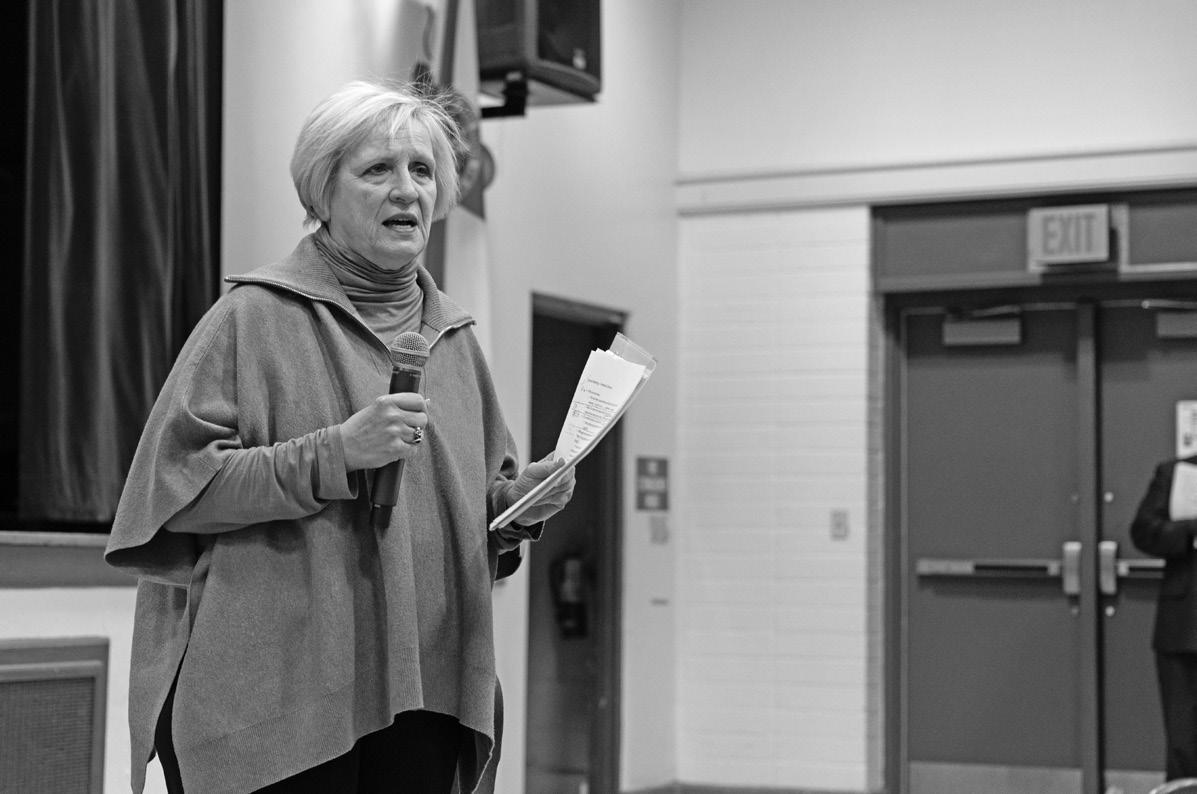
In a town hall meeting in October 2025, Gainesville Chief of Police Nelson Moya said he wouldn’t sign one yet.
“It does make me nervous, because everybody around GPD and the city has, for reasons that I can appreciate, signed that agreement,” Moya said. “Because I don’t have a clearer picture, I’ve been foregoing a signature.”
However, he said he felt pressure to sign into agreements was building, and he thought it was a “matter of time before that
SEE 287G, PAGE 4
MEN'S BASKETBALL
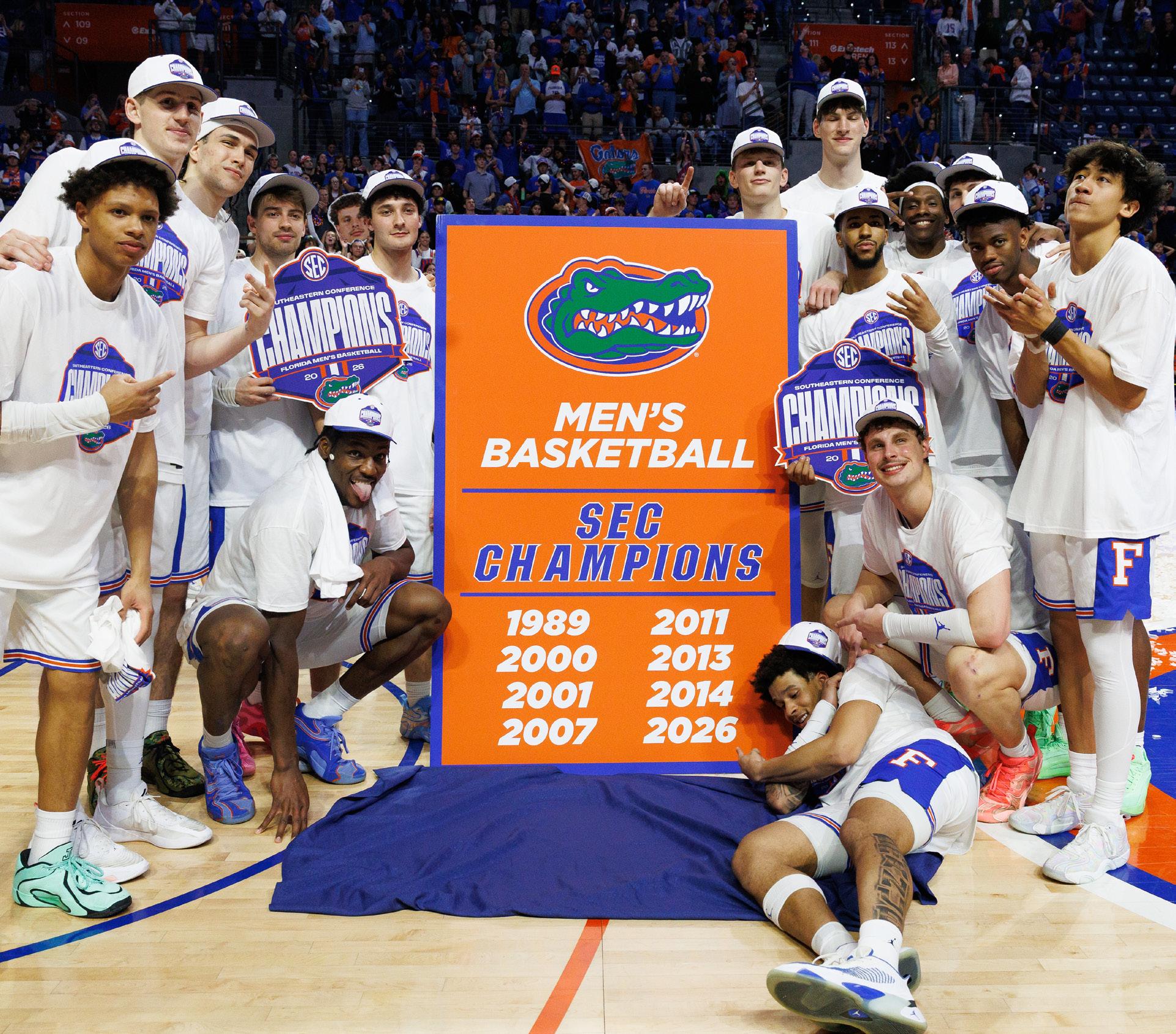
The Florida men’s basketball team poses with the SEC Championship sign after defeating Arkansas
in an NCAA basketball game Saturday, Feb. 28, 2026, in Gainesville, Fla. Read more in Sportson pg. 12.
UF adds Western canon-focused courses to general education
20 Hamilton School classes were added after hundreds of social sciences courses got cut last year
By Cameron Countryman Alligator Staff Writer
One year after purging its general education curriculum of hundreds of humanities and social sciences courses, UF is slowly rebuilding its offerings by adding courses from the Hamilton School for Classical and Civic Education.
Last year, faculty across Florida reviewed general education catalogs to ensure courses fell in line with a new law targeting perceived left-wing bias in higher education. The law required general education courses not distort historical events or teach “identity politics.” Additionally, humanities courses must include selections from the Western canon. The review resulted in over 900 courses
Florida bill proposes 5% enrollment cap for out-of-state and international students at top universities. Read more on pg. 2.
being cut from UF’s general education offerings by the time the final list came before the Florida Board of Governors for final approval in Spring 2025. This was part of an annual general education review, in which the state board must approve general education catalogs across all universities before the start of each academic year.
This year’s review was less dramatic, with just five UF courses removed and 26 added. The changes were approved at the board meeting Jan. 29.
Of the 26 general education courses added, 20 came from the Hamilton School — the university’s state-mandated civic center, founded in 2022, which teaches students “how to think, not what to think,” according to its website.
Jason Mastrogiovanni, the school’s interim associate provost for student success, said the majority of the Hamilton School’s courses are Quest courses, which are required undergraduate courses that “engage students in interdisciplinary inquiry, civic responsibility, critical thinking, and real-world engagement.”
Angela Lindner, the interim vice provost for undergraduate affairs, approached the Hamilton School while she was guiding the Quest program, Mastrogiovanni said. Lindner asked the school when it started if it wanted to provide Quest courses, many of which already satisfy humanities general education requirements.
“They were meant to be small seminars taught by faculty,” Mastrogiovanni said. “We were in the process of trying to
obviously be established and start teaching courses. And when they came to us asking, it was really a good fit right away, so we went all in on it.”
Every faculty member at the Hamilton School is encouraged to write and submit his or her own Quest course, Mastrogiovanni said. There are around 45 faculty members, and at some point in their course load, each must teach a Quest course, which he said is why the school has many new general education courses this year.
Mastrogiovanni said the requirement for Western canon in general education humanities aligns with what the Hamilton School teaches.
Victoria Backherms, a 19-year-old UF American government, history, literature and law sophomore, is taking the Hamilton School’s Classics of American Thought I: English Settlement to the Civil War course.
SEE GEN ED, PAGE 4
Caroline Walsh // Alligator Staff
111-77
Today’s Weather
Florida bill would cap out-of-state enrollment at top public universities
PROPOSAL TIES STATE FUNDING TO IN-STATE ADMISSION TARGETS
By Alexa Ryan Alligator Staff Writer
When Kevin Kendrick’s nephew didn’t get accepted to UF, he decided to attend Santa Fe College instead, with the goal of eventually transferring. What his family didn’t do, Kendrick said, was “b---- and complain.”
But parent complaints are exactly what Kendrick thinks are driving an ongoing legislative push to increase the share of seats at Florida public universities reserved for instate students.
A bill, which passed its final Florida House committee Feb. 26, would require at least 95% of new full-time, first-time college students enrolled at each of Florida’s four preeminent state research schools — including UF — to be Florida residents starting in 2030, based on an average across three years. The bill’s next step is a full floor vote in the House.
A similar but not identical Senate version of the bill, filed by Sen. Erin Grall, R-Vero Beach, has yet to be heard in any committees. Identical versions must pass both the House and Senate in order to proceed to the governor.
Kendrick, who has two kids attending UF as in-state students, said universities should maintain flexibility. He doesn’t think in-state students are being rejected because of out-of-state applicants. Instead, he said, admissions decisions reflect competitiveness and limited space.
“The University of Florida should have the ability to attract the best students from across the country and from across the world,” he said, “and not have limitations on how many students actually come from inside the state of Florida.”
UF, Florida State University, the University of South Florida and Florida International University would all be affected by the change due to their “preeminent” status. The University of Central Florida also recently met the academic benchmarks for the designation and will
join the group if the Florida Board of Governors grants final approval in June.
Currently, state law caps nonresident enrollment at 10% across Florida’s 12 public universities, not at each individual campus. Because the cap is calculated statewide, individual universities may enroll more or fewer than 10% nonresident undergraduates, as long as the systemwide total remains under the limit.
Over one in five UF and FSU students come from outside Florida as of Fall 2024, for example, while other public universities enroll fewer out-of-state students to balance the umbrella limit.
Under this bill, if a preeminent university fails to meet the 95% requirement, it would lose eligibility for certain state funding, which totaled $25 million per school for the 2024-25 fiscal year.
The bill’s introduction ignited heated debate on social media among UF parents and students. The debate intensified after early action decisions were released — reserved for in-state applicants — with many opening rejection letters instead of acceptances.
Rep. Jennifer Kincart Jonsson, R-Lakeland, sponsored the legislation. Her goal in doing so, she said, was to open up as many seats for in-state students as possible.
“This is something that I think has been needing to be addressed for a long time, but I'm the legislator here that's willing to address it,” she said.
In Kincart Jonsson’s opinion, many of the “best and the brightest” Florida students who are being rejected from the state’s top universities are just as qualified as the nonresident students being accepted, she said.
The UF records department said it didn’t collect data on acceptance rates or admissions statistics of outof-state applicants versus in-state applicants for the Class of 2029.
However, over 43% of the entire Fall 2024 freshmen class, including PaCE and online students, were out-of-state students, according to enrollment data.
The percentage of out-of-state students enrolled has increased steadily for each freshman class
at UF over the past 10 years, with around 14% of freshmen in Fall 2014 hailing from outside of Florida.
What’s the cost?
The move follows ongoing debates over in- and out-of-state tuition rates. All four preeminent universities raised their out-of-state tuition rates by 10% beginning in Fall 2025, marking the first increase in over a decade.
Florida has long prided itself on affordable education. Its in-state tuition was the lowest among all U.S. states and Washington as of 202223, according to the National Center for Education Statistics. Its out-ofstate tuition was the fifth-lowest.
The gap between in- and outof-state tuition in Florida is also relatively small compared to other states. Average tuition and fees for 2022-23 were about $13,300 higher for out-of-state students than Floridians. That’s smaller than the national average difference of $18,550 between residents and nonresidents for each state.
In January, USF approved an additional 15% increase in out-of-state tuition fees to be implemented starting in Fall 2026, pending approval by the Florida Board of Governors.
Some legislators opposing the bill argued it would cause universities to lose money from people paying out-of-state tuition rates.
Although lower than the national average, out-of-state tuition per credit hour at UF remains over four times the price of in-state tuition. The average out-of-state student at UF pays over $120,000 in tuition for a four-year degree, while the average in-state student, without the Bright Futures scholarship, pays around $25,000.
During discussion of the bill in the Careers and Workforce Subcommittee Jan. 26, Rep. Allison Tant, D-Tallahassee, asked how schools would deal with the loss of out-ofstate tuition to their budgets, saying that money sometimes makes up for the relatively low in-state tuition rates.
In response, Kincart Johnson suggested “taking care of our Florida students first and making it work.”
Two other legislators asked why residency is being used to determine preeminence status during the Jan. 28 meeting.
“If the goal is excellence, then why is residency, rather than achievement or research output, the trigger for preeminent eligibility?” said Rep. Leonard Spencer, D-Gotha.
Parent perspectives
Jodi Furman, a college admissions counselor and a UF parent, said she’s glad to see that legislators are making sure Florida students are getting a “fair shake” in the admissions process.
The Alligator strives to be accurate and clear in its news reports and editorials. If you find
at 352-376-4458 or email editor@alligator.org 352-376-4458
Eva Lu // Alligator Staff
A Florida education bill proposes
Inside SwampCon’s drag show cancellation
By Christopher Rodriguez Alligator Staff Writer
Since 2014, crowds of hundreds have filled the Reitz Union each Spring to watch a cosplay drag show, the headline event of the free multiday, multigenre SwampCon.
But this year, SwampCon the Club, the UF student organization that hosts the event, canceled the beloved show. The event will go on without drag performances, the organization wrote in a social media post Feb. 18.
The organization cited a 2023 Florida law as the primary cause for the cancellation. The law restricts university spending of state funds on programs or campus activities that “advocate for diversity, equity, and inclusion, or promote or engage in political or social activism.”
The announcement, made through an Instagram post, was met with disappointment and discourse. The post received over 1,200 likes and over 150 comments, most of which expressed frustration with the change.
SwampCon is a multiday convention dedicated to “[celebrating] Japanese arts and fashion, gaming, pop culture, cosplay, and performance arts across fandoms,” as described on its website. The event hosts all kinds of artists and vendors, from anime figure resellers to fan artists selling their works.
Andrea Rendon, a fifth-year University of Central Florida aerospace engineering major who previously attended UF, said SwampCon served as one of her first experiences interacting with queer art. Growing up in a small town
in Central Florida, she never experienced drag shows until college, she said.
“I love seeing queer joy as someone of the community myself,” Rendon said. “I found it was a way for a lot of queer people to come together and enjoy someone’s art.”
Even though she no longer lives in Gainesville, the 23-year-old has made attending SwampCon a yearly tradition. She traveled to the event last year, and she plans to make the journey again, despite the drag show’s cancellation, in order to support the artists who will still be present.
Ongoing diversity funding cuts
The Florida law cited by SwampCon previously resulted in the elimination of the UF Office of the Chief Diversity Officer in 2023. In August 2025, the university declined renewal of Signature Event designations to groups including the Hispanic-Latine Student Assembly and Pride Student Union welcome assembly — leaving them scrambling to find alternative funding.
Signature Event status provides student-led events with funding and event space that exceeds what is possible with a typical Student Government-provided budget.
Last Fall, after the PSU assembly lost its Signature Event status, it had to host its Fall welcome event using SG funds, rather than using the university funding it typically relies on.
PSU president Steph Deleon called the change “nerve-wracking” but pushed on to host the annual welcome event, recognizing the importance it holds to building a queer community
on campus. Despite the lack of traditional funding, the welcome assembly was one of the PSU’s best yet, according to Deleon, and even featured two drag performers. “We had one of the largest turnout, almost 500 people,” Deleon said. “We have our executive board working very hard to provide spaces for queer students.”
But SwampCon remains a Signature Event, which it has been since 2022. This allows the group to “maintain funding and support,” according to its social media post.
“SwampCon staff were unable to find a way to include the Drag Show in a way that complied with the policy outlined in Florida Senate Bill 266,” the post said.
UF law professor Lyrissa Barnett Lidsky said she isn’t convinced that the law applies to drag shows, or even SwampCon as a whole. The term “diversity, equity and inclusion” is overly broad, she said, which can have a “chilling effect” on free expression on campus.
A chilling effect occurs when an overbroad law causes groups to self-censor out of fear of persecution, Lidsky said. In this case, SwampCon has been “chilled” by the law, she said, fearing that hosting the drag show would be lumped under the “diversity, equity and inclusion” umbrella and lead to the cancellation of the entire event.
“It’s not obvious to me what a drag show has to do with diversity. I don’t see a drag show as being diversity; I see it as an entertainment performance,” Lidsky said. “If a student organization can hire a singer to sing popular show
tunes, then why can’t they have this performance?”
The rule also impedes on the right to due process, as there isn’t a clear notice of what exactly could violate it, Lidsky said.
It’s unclear whether SwampCon made the decision to cancel due to direct university messaging or out of an abundance of caution. When contacted by The Alligator, the organization declined an interview, saying it was “unable to provide further additional comment regarding the situation that is outside the statement we’ve posted.”
Drag queens weigh in Nicki Mirage, one of the drag queens set to host the drag show, has been with SwampCon since the beginning. Participating in the first SwampCon as a student volunteer before joining the full-time staff, she founded the SwampCon drag show in the event’s third year, titled “SwampCon: Rising.”
The event was Mirage’s first major drag performance, and it’s taken place every year since with her at the helm, growing to become one of the largest events of its kind in north central Florida.
Bayden Armstrong // Alligator Staff
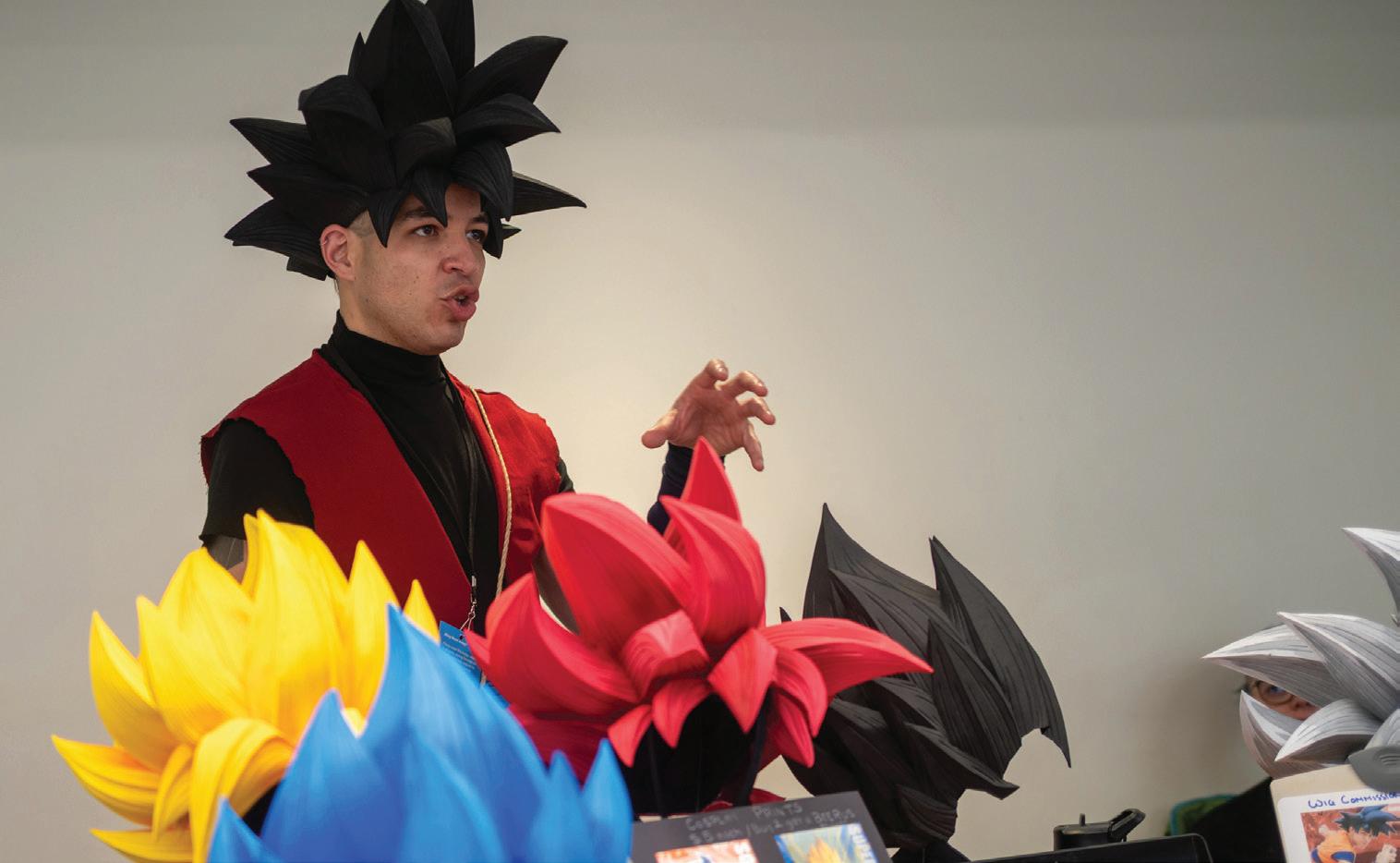
Vendors at SwampCon
Gainesville police refrain from ICE contract
an inclusive environment.
“I think it’s because we elect strong public officials,” Osorio said.
born, making up 12% of the population.
agreement is absolutely invoked.”
Four months later, GPD is still holding out.
“Currently, we have not entered into a 287(g) agreement,” wrote Art Forgery, GPD’s public information officer, in an email to The Alligator Feb. 13. “We are carefully evaluating all available courses of action within our command structure and will make decisions consistent with our policies, legal obligations, and the best interests of our community.”
Gainesville Mayor Harvey Ward said the community needs its officers to remain focused on “the things that Gainesville Police Department does,” like improving public safety and lowering crime.
As an elected official, Ward emphasized he doesn’t direct police administrative work. But to his knowledge, no one has demanded GPD sign an agreement with ICE, nor is one in the works, he said.
“They're focused on public safety,” he said of GPD officers. “And they want to make sure that our neighbors, people in our community, are as safe as possible, and that people don't get hurt. That's where our focus has been.”
The city of Gainesville doesn’t operate a jail, Ward pointed out, which makes its police department less practically valuable to ICE. The federal agency uses local jails as its primary network for identifying, detaining and transferring immigrants.
A slow stream of ICE detainees has moved through the Alachua County Jail since last year, with the most recent ICE transit appearing in booking logs Feb. 25.
Capt. Chris Sims with Alachua County Sheriff’s Office said Gainesville, as a city, has a right to not sign the agreement.
Making assumptions about the department’s reasons for not doing so would be improper, he said, and he has not heard of any future GPD
plan to sign the agreement.
“The city’s decision is that of their own. We are not part of that process,” he said.
Tim Marden, the chairman of Alachua County Republicans and mayor of Newberry, said he thinks GPD hasn’t signed the agreement because Gainesville is “a welcoming city.” Newberry does not have a city police department, and its law enforcement services are provided by the Alachua County Sheriff’s Office.
Gainesville promotes immigration, Marden said, and political dynamics prevent them from signing the agreement.
Marden said he’d “guarantee”
leaders of GPD don’t agree with the workings of ICE. After living in Alachua County for more than three decades, he believes the city is politically left-leaning, pursuing green policies and social programs, he added.
“It’s a shame that they can’t see beyond their political bias as to what is good and is not good for a community,” Marden said.
Juan Osorio, the president of UF College Democrats, said he thinks GPD hasn’t signed a 287(g) agreement because its leaders are prioritizing residents’ concerns about how an agreement with ICE affects public safety, as well as upholding
“Our current leadership is doing the right thing, listening to constituents’ concerns.”
In Gainesville, the city manager, rather than the elected commissioners and mayor, oversees GPD. That structure differs from cities like Jacksonville, where the mayor can appoint and remove the police chief.
Osorio said Gainesville is home to a mix of people from all over the world, and GPD makes it welcoming for everyone who resides here. Not signing the agreement is protecting a city shared by a diverse population, he said.
As of 2023, more than 17,000 Gainesville residents are foreign-
Osorio said he appreciates Gainesville leaders who have not pushed for the agreement to be signed.
“To be here in a city that I know values our communities and works to protect them to the best of their ability, using every legal lever they have — I really appreciate that,” he said.
Zoey Thomas contributed to this report.
Lee la versión en español en línea. @angeliquesrod arodriguez@alligator.org
General education changes emphasize Western canon
from pg. 1 GEN ED, from pg. 1
Classics of American Thought I and II are being added as general education courses at UF for next school year.
Backherms, who plans to go to law school, said she’s taking the class because it’s a foundational course for her major.
So far, the course has covered the foundations of the American system going back to Thomas Jefferson, Alexander Hamilton and James Madison, she said, and has also discussed the U.S. Constitution, Bill of Rights, Federalist Papers and other related documents.
“I think that more people our age should be required to take classes related to civics education and understanding the basis for the Bill of Rights and the amendments and all the rights that we observe and get to enjoy,” Backherms said.
Backherms said she supports the Hamilton School’s emphasis on Western canon in general education because she thinks too many students lack civic education and understanding, which she said are fundamental to being a productive
member of society.
Some faculty outside the Hamilton School, meanwhile, are grappling with how to attract students now that general education designations have been removed from many of their courses.
Anna Peterson, a UF religion professor who teaches Environmental Values and Practice along with ethics and Latin American religion and politics courses, said students have little room in their schedules for religion courses.
When there were more religion courses that fulfilled the requirements to be a general education humanities course, students had more motivation to take those courses because they satisfied the requirement.
“So many people, students, have told me, ‘I'm going to be a better doctor because of this class,’” Peterson said.
“‘Because I never thought about religion before in terms of how it affects how I treat my patients, and what I need to know about my patients, and how my patients are thinking about their treatment and their health.’”
Three international credit hours are required in UF’s general education curriculum. The international requirement must be earned simultaneously with a course classified in another general education category. So, general education international courses also fulfill either a social science or humanities requirement, according to UF’s general education catalog.
If a humanities course does not include Western canon, it can lose its humanities designation, Peterson said. Because the international requirement is fulfilled alongside a humanities requirement, a course that does not engage Western canon and loses its humanities designation would also lose its international designation.
Peterson said there’s now fear due to declining enrollment in religion courses. But the lower enrollment numbers may not be entirely caused by the curriculum changes.
Mario Poceski, a professor and chair of UF’s Department of Religion, said enrollment numbers tend to fluctuate from
year to year, and numbers are lower in the Department of Religion this semester than in the past.
“Some of the worries that faculty have might be, in some instances, be a little bit overblown,” Poceski said.
Poceski and others in his department had to adjust their courses to meet the Western canon requirement, he said. He also adjusted the syllabus for his introduction to Buddhism course to emphasize the interactions between Buddhism and the West to keep its general education status.
German-Swiss author Hermann Hesse’s novel “Siddhartha” is one example of how Poceski uses Western works to teach about a religion mainly practiced in Asia.
Poceski said because the decision was made by the state, faculty members have to come to terms with that and try to implement the requirements the best they can while also keeping their students’ best interests in mind.
“The most important thing is to try to serve our students and give them a wellrounded education to the best of our abilities,” Poceski said.
Matthew Quesada // Alligator Staff
The Gainesville Police Department building at 545 NW 8th Ave. in Gainesville, Fla., Monday, Feb. 16, 2026.
Alachua County School Board requests redrawn elementary, high school maps
NEW MAPS WILL EXHIBIT NEIGHBORHOOD BOUNDARY SHIFTS AND SELECTED SCHOOL CLOSURES
By Grace Larson Alligator Staff Writer
The Alachua County School Board requested new rezoning maps for local elementary and high school levels at a workshop Feb. 26.
In a meeting lasting over four hours, the board selected its favorite of the maps and requested modifications before a March 3 meeting.
Elementary school maps
Across all maps at the elementary school level, five school closures were proposed — Alachua, Williams, Foster and Rawlings elementary schools and Duval Early Learning Academy, a pre-K through kindergarten school.
Board member Leanetta McNealy expressed concern with the closure of schools. She disapproved of all of the elementary school maps and requested no closures be made.
“I cannot sleep at night thinking about what can happen with five closures of schools,” McNealy said.
The district held meetings at each of the schools proposed for closure Feb. 24 and 25. At the meetings, parents expressed concerns with transportation, teacher relocation and the disproportionality of closures.
Of the five schools proposed for closure, three — Rawlings, Williams and Duval — are in East Gainesville, which is home to sev-
Caroline Walsh // Alligator Staff
Alachua County Superintendent Kamela Patton speaks at a community rezoning feedback meeting at Stephen Foster Elementary School, Wednesday, Feb. 25, 2026, in Gainesville, Fla. The school is being considered for closure in all three rezoning map drafts.
eral historically Black neighborhoods. Foster Elementary School is located on Northwest Sixth Street, which some consider a part of greater East Gainesville.
Despite McNealy’s desire to keep the elementary school boundaries the same, other board members expressed the necessity of closing schools to reduce district spending.
School rezonings have been pushed off for years, board member Tina Certain said.
“Not doing anything is not an option at this point,” Certain said.
“We have to face the realities of what’s happened in our community.”
Although the city and county commissions have approved multiple investments into East Gainesville in recent months, those initiatives won’t cause more
students to live on that side of town, she said.
In January, the city commission approved a $2 million project to revitalize the Duval neighborhood in East Gainesville. In December 2025, the county commission approved the Eastwood Preserve project to bring more housing to the east side of Alachua County.
During the discussion, the board agreed to the recently proposed Map D, which keeps Rawlings Elementary School open. However, the board also requested changes.
The board asked for Duval Early Learning Academy to remain open. Vacant portions of the building could be rented out to the city.
The board supported the closure of Foster Elementary School but requested the school’s STEM
magnet program be moved to Metcalf or Rawlings Elementary School, rather than Norton Elementary School, to bring opportunity to East Gainesville.
Board members also asked that students currently attending Foster Elementary be zoned for two different schools, rather than dividing the community into five separate zones.
The board supported the closure of Alachua Elementary School; however, it suggested Irby Elementary School also be closed. The closure of both schools would prevent the Alachua community from being divided into two schools at the elementary school level. Instead, the board proposed one consolidated pre-K through eighth grade school.
Both Alachua and Irby elementary schools are operating under capacity, according to a presentation provided by John Gilreath, the director of business development at JBPro. JBPro is the engineering company hired by Alachua County Public Schools to design the rezoning maps.
To create a central pre-K through eighth grade school, new buildings would be added to Mebane Middle School to accommodate an influx of students. While the conversion of Mebane to a K-8 was projected for the 2027-28 school year, it is unclear when the board’s newly suggested project would be completed.
To reduce transportation times for families, the board requested the Longleaf community, located in southwest Gainesville, be zoned for Wiles Elementary School and the Fletcher’s Mill community, located in northwest Gainesville, be zoned for Terwilliger.
Board member Sarah Rockwell recognized the difficulty of the decisions on community members.
“This is emotional,” Rockwell said. “Even if we have to make tough decisions that upset some people, at least we need to hear you and recognize that [emotion], and I haven’t seen that happen.”
Middle school maps
At the middle school level, there was no debate. The board agreed on Map C without any requests for modifications.
Map C focuses primarily on rightsizing, ensuring each school is operating at a reasonable capacity. The proposed rezoning lessens enrollment at Fort Clarke, Hawthorne, Kanapaha and Oak View Middle Schools, according to the JBPro presentation. It increases enrollment for Bishop, Lincoln and Westwood Middle Schools.
High school maps
When considering the high school maps, the board agreed on Map D with limited modifications. The board requested the entire Haile community be zoned for Buchholz High School rather than being split between two schools. Another request was for the Buchholz walk zone to be fixed, as the map currently zones students within a 2-mile walking distance from the school for elsewhere. These modified maps will be shared with the board at a meeting March 3. The board won’t vote on the maps until a special meeting March 12.
@graceellarson glarson@alligator.org
Remembering Gainesville civil rights legend Rosa B. Williams
WILLIAMS DIED FEB. 12 AT THE AGE OF 92
By Kaitlyn McCormack Alligator Staff Writer
Gainesville civil rights activist Rosa B. Williams, known affectionately as “Miss Rosa,” died Feb. 12 at age 92. She was a local pioneer for the Black community, and those who knew her remember her as a catalyst for change who touched countless lives in Gainesville.
Born in 1933, Williams’ civil rights activism was not a choice, but a necessity.
“Black women have had to be fierce women from day one,” said Vivian Filer, the 88-year-old founder and chair of the Cotton Club Museum and Cultural Center.
Filer recalled her experience working with Williams in the 1960s during the Civil Rights Movement. Williams spoke up to the Alachua County government any chance she could about the inequalities the Black community faced, Filer said, even when it was difficult.
“Miss Rosa was a spokesperson who had the ear to a lot of people who were elected officials, and she wasn’t afraid to speak up,” Filer said.
Williams fought for desegregation, voting rights and equal opportunities in Alachua County, Filer said, and she was an advocate for young people.
In the 1950s, Williams was the first Black person in Gainesville to obtain a library card. Williams recalled in an interview from 1992 that she had to go through multiple background checks and provide references to even be considered.
During her lifetime, Williams joined countless community boards and foundations. She was the chair of the Gainesville Black on Black Crime Task Force, Concerned Citizens for Juvenile Justice
and the United Gainesville Community Development Corporation.
The Black on Black Crime Task Force, established in 1988, is still active. The force meets monthly to discuss educational and crime-reduction youth outreach programs, programs for preparing inmates after release and updates from GPD on crime trends.
Williams also served on boards for Shands Hospital, the Gainesville/Alachua County Regional Airport Authority and the Gainesville Housing Authority. She was the first vice president of Gainesville’s chapter of the NAACP.
Williams worked with local agencies to improve the lives of her peers, Filer said, and she cared deeply about keeping people safe and encouraging change by building community.
“I share the sentiment of all of the rest of us that her work is a legacy that we will all benefit from,” Filer said.
Williams went on to co-found Gainesville’s flagship program for at-risk youth, the Reichert House Youth Academy, in 1987. Though it closed in 2023 due to a lack of funding, the program served 2,200 students while active.
The program was managed by the Gainesville Police Department and provided educational tutoring, mentorship, behavioral support, life skills training and meals for at-risk young Black men.
James Nixon, a 32-year-old Bunnell, Florida, resident, went to the Reichert House for help from 2006 to 2007.
“They gave me that structure that I needed to survive in life and not become a statistic as a young Black male in this world,” Nixon said. “That program is kind of the reason why I succeeded in life to this day.”
Nixon recalled his fond memories of Williams. Her guidance helped him change his perspective on life, he said.
“She taught me that being good wasn’t a bad thing,” Nixon said. “Being a person that helped others was a way of life … versus being that troublemaker child that was constantly in and out of jail
and court systems.”
Nixon said he’ll always remember her generosity. Williams never let anyone leave the Reichert House without eating a hot meal, he added.
“She will give you the clothes off her back,” Nixon said. “She will give you her last dollar.”
Nixon wishes there were more people like Williams in the world, and he said he’s just one of the many people from Gainesville who will miss her dearly.
“If I could personally make Miss Rosa known worldwide, I would,” he said. “That lady had the greatest soul ever, and she loved everybody, just like you were her own kids.”
Williams’ niece, Terri Bailey, a 59-year-old Gainesville resident, also shared fond memories of her aunt. She said Williams introduced important values in her from a young age.
When Bailey was about 5 or 6 years old, she recalled, her aunt brought her to her first NAACP meeting. Bailey said she was instructed to “take notes,” but at the end of the meeting the adults were surprised when she actually had.
“She instilled in us a sense of giving without expectation of return,” Bailey said, “and that we have to unify and be together in order to affect change.”
Many people who knew Williams emphasized how her outlook on life is something current society is lacking. Williams was a prime example of how change can be enacted through true passion and care, Bailey said.
“Right now we live in such an individualistic society, and my auntie embodied community, doing for others, looking out for others, knowing your neighbors,” Bailey said.
@kaitmccormack20 kmccormack@alligator.org
MONDAY, MARCH 2, 2026
www.alligator.org/section/the-avenue
FOOD & DRINK
Asian fusion food truck (egg) rolls into Gainesville
THE SOUTH FLORIDA-BASED WORLD FAMOUS EGGROLLS SPENT THREE DAYS SERVING DEEP-FRIED FARE
By Zoey Thomas & Corey Fiske Avenue Staff Writers
Barbecue pulled pork. Steak taco. Burger beast.
When stuffed into an egg roll, these make rather interesting culinary creations. With the classic crunchy shell on the outside, the fried morsels are stuffed with seemingly endless possibilities.
World Famous, a South Florida-based Asian fusion egg roll business, serves up inventive, sometimes decadent twists on the classic dish. It has four brick-and-mortar storefronts — in Fort Lauderdale, Boynton Beach, Miami Gardens and Hollywood — but also travels across the state in seven food trucks, drawing crowds wherever it parks.
From Feb. 27 to March 1, the egg roll empire set up shop in Gainesville. Plastered with images of savory slabs of meat and thick wedges of cheesecake, the gargantuan truck parked outside a Walmart in northwest Gainesville off of Northwest 34th Boulevard.
World Famous visits Gainesville every six to eight weeks, said Latanya Grant, a 20-yearold cashier who’s worked for the business for
MUSIC
about two years.
She leaned out the window, calling out numbers as she slid stacks of steaming plastic boxes across the counter to eager customers. Behind her, a full wall of screens displayed livestreams from the truck’s locations across the state.
Every location is different, the Fort Lauderdale resident said, but she enjoys the laid-back energy and weather in Gainesville. Grant’s favorite part of her job, she said, is constantly being on the move.
“You meet a lot of cool people; you’re always in a cool town,” she said, handing a lemonade cup roughly the size of her head to a family of three.
One key to the egg roll empire’s success lies in its marketing. Its unique social media approach involves posting its schedule and location four or five times every day, accompanied by ultrazoomed photos of egg rolls dripping with cheese or perched aside handfuls of crispy fries.
Its fleet is rigged with 4K cameras, Ring doorbells and livestream setups, broadcasting live in a kind of egg roll surveillance state as employees flip and fry up roll after roll.
Instagram and TikTok videos first lured Jason Aguiar, a 22-year-old UF biology senior, to the siren song of sizzling soy sauce and shrimp. Aguiar has ordered a new item each time he’s visited the truck. Most recently, he opted
for the baked mac and cheese roll: cheddar jack cheese, baked in cavatappi pasta and crammed into the truck’s signature crispy egg roll.
He described the concoction’s taste as “revolutionary.”
“And, I don’t want to be basic, but delicious,” he added.
Aguiar was one of about two dozen people to line up for a taste of the self-described “world famous” cuisine. Parents holding the hands of small children, employees from the nearby Walmart and UF students dressed in Gator garb all squinted at the overwhelming menu before selecting their rolls of choice.
First-timer Toni Gibbs heard about the truck from work. The 40-year-old customer service supervisor drove in from Bronson to try the hibachi and Southern soul food egg rolls — and plans to also get a car wash.
“I went for the one that sounded the best, but there are several that I like,” she said of her selections.
The hibachi roll comes with hibachi steak, chicken and shrimp fried rice, while the Southern soul food roll comes stuffed with slowcooked barbecue chicken, kettle-cooked collard greens and baked mac and cheese.
World Famous rolled out of Gainesville March 1, but the business dutifully alerts customers to its next tour stops on social media.
Vané Light learns to ask for help on new single ‘Ultraviolet’
THE UF STUDENT INDIE ARTIST EMBRACES COLLABORATION ON HER FOURTH RELEASED TRACK
By Isabel Kraby Avenue Staff Writer
Making it on your own as a musician once seemed to be the only plausible path to singer-songwriter Vanessa Garcia.
Garcia, a 20-year-old UF media production, management and technology and economics sophomore — whose artist name is Vané Light — took to YouTube University her freshman year of high school and started learning to produce music on her own. She released her first three songs last year, all written and recorded individually. She wasn’t accustomed to teamwork.
Sports
Growing up in a Cuban immigrant household, independence was a core value instilled in her, so asking for help has never been in Garcia’s nature. That is, until “Ultraviolet.”
The alternative indie pop artist’s newest song, released Feb. 27, marks the first time Garcia has collaborated with her band to record a track. The five-piece formed last spring, but until now, Garcia has put together her tracks all on her own.
She said “Ultraviolet” is a big stride in her own self-development and is the next level in terms of her music’s quality.
“That song is kind of the epitome of my growth as of the last couple months,” she said. “I always felt like if I didn’t do everything on my own, there was no way I was going to be able to succeed.”
Garcia, whose love for music is innate and whose songwriting jour-
Gator men’s basketball takes home SEC regular season title. Read more on page 12.
ney began in middle school, grew up faced with the societal stigma that pursuing a career in the arts was unsustainable. For a long time, she felt ashamed of her passion.
But last year, she decided it was now or never.
“Now in college, I was like, this is my last chance, and I’m taking it the most seriously I’ve ever taken it in my entire life, and it’s made me the most happy I’ve ever been,” she said. “I feel like when you’re fulfilling who you are, you are the most happy.”
Toward the beginning of the project, Garcia wasn’t entirely comfortable with her material, and she even doubted whether her bandmates wanted to show up to practice. But since last spring, Garcia’s keyboardist Gabe Collante said her confidence has grown.
Collante, a 21-year-old UF music business and entrepreneurship soph-
omore, said Garcia’s not the only one who’s used the band as a point of growth. The project has also gotten him out of his own comfort zone.
“Her music actually gave me kind of a unique challenge, because a lot of what I was working on before was classical, jazz and stuff like that,” he said.
Carlos Tovar, now the frontman of indie group Dumpster, has also witnessed Garcia’s growth, even within the short time he played guitar for Vané Light. He was excited to be asked to play on “Ultraviolet,” his favorite track of the band’s to rehearse.
Tovar, a 22-year-old UF music business and entrepreneurship sophomore, admires how Garcia’s stage presence has developed. Whether it be a show at University Club or a set at the AM/FM Festival, the frontwoman always hops off the stage, becoming a part of the crowd and
spurring them to “get hype.” Garcia also inspires Tovar with her dedication and organization. He recalled the singer had a Google Drive with demos and chords for each track to keep the band in the know while practicing.
As an up-and-coming musician in the Gainesville scene himself, Tovar is grateful to have Garcia and her band as a support system and knows if there’s ever an empty space to fill at one of her gigs, she’ll give him a call.
“It’s really nice, because these new waves of bands that are coming up, I’m friends with all of them, and it really feels like a little family,” he said.
Read the rest online at alligator. org/section/the-avenue. @isabelgkraby ikraby@alligator.org
Corey Fiske // Alligator Staff
The World Famous Eggroll Truck sits at 5700 NW 23rd St., Sunday, March 1, 2026, in Gainesville, Fla.
El Caimán
LUNES, 2 DE MARZO DE 2026
www.alligator.org/section/spanish
Informe anual de la UF sobre negocios en América Latina regresa después de 3 años
EL INFORME LABER FUE CREADO EN EL 2000 Y SE HA CONVERTIDO EN UN PUNTO DE REFERENCIA PARA LOS ESTUDIOS LATINOAMERICANOS
Por Ariana Badra
Escritora de El Caiman
El informe sobre el Entorno Empresarial de América Latina de la UF, conocido como el LABER, publicó su edición número 24 el 1 de noviembre de 2025, tras una pausa provocada por la pandemia de COVID-19.
El regreso del LABER ofrece una visión de cómo los gobiernos y los mercados se están adaptando en respuesta a la inestabilidad política e incertidumbre económica de América Latina.
Profesores de la UF introdujeron el informe en el 2000 para analizar los cambios rápidos que se producen en la región. Desde entonces, el reporte se ha convertido en un punto de referencia sobre los riesgos y oportunidades empresariales en América Latina.
Pilar Useche, coautora del informe 2025-26 y economista aplicada afiliada al Departamento de Economía de Alimentos y Recursos y al Centro de Estudios Latinoamericanos de UF, calificó el reporte como un “bien público”.
“Se ofrece sin costo alguno y ayuda a que la UF sea más visible a nivel global”, dijo.
El LABER ofrece un análisis más amplio de América Latina en comparación con otros informes, añadió Useche.
“La mayoría de los documentos y personas que analizan oportunidades de inversión suelen enfocarse en los países más grandes de América Latina”, dijo. “Nosotros cubrimos todos los países… así que ofrece una excelente perspectiva comparativa.
El análisis del LABER abarca 20 países de Centro y Sudamérica, desde México hasta Brasil y Panamá.
La edición 2025-26 la produjo un equipo liderado por Useche, junto con investigadores de las facultades de derecho y negocios de la UF y un colaborador de Ecuador.
El informe también se basa en el trabajo de 160 especialistas regionales.
Esta es la primera edición publicada tras la discontinuación del informe en 2022, que ocurrió por falta de recursos derivada de la pandemia, según Useche. Fue retomado por su valor y singularidad, dijo.
Useche señala que los hallazgos del informe no son exclusivos de la comunidad académica; también pueden servir como recurso para el sector empresarial, instituciones en América Latina y universidades en EE.UU.
Muchas personas creen erróneamente que América Latina no tiene espacio para la prosperidad, dijo Useche.
En realidad, el informe muestra una disminución del
desempleo y la pobreza. También destaca el crecimiento de “startups” llamadas “unicornios”, que se estiman a convertirse extremadamente rentables en el futuro. Colombia, por ejemplo, obtuvo altas calificaciones por generar empresas unicornio. Dado que EE.UU. impuso tarifas en Europa, los países europeos están buscando alianzas en otros lugares, lo que hace que el informe sea aún más relevante hoy en día, agregó Useche. China también ha intentado expandirse en América Latina, impulsando la competencia económica en la región. De los 20 países analizados, México es el único proyectado a experimentar una desaceleración económica directamente en parte por la incertidumbre asociada al comercio con EE.UU., dijo.
Usar el informe como herramienta de enseñanza también brinda a los estudiantes habilidades para analizar el cambiante panorama empresarial latinoamericano. Por ejemplo, la clase de Entorno Empresarial Latinoamericano integra el LABER en su currículum.
“[El LABER] está uniendo componentes de enseñanza, investigación y extensión que son tan centrales para los estudios latinoamericanos”, dijo Useche.
Lea el resto en línea enalligator.org/section/spanish.
@arianavbm arianabadra@ufl.edu
Evento para contar historias en español fortalece la comunidad en Gainesville
LATINA WOMEN’S LEAGUE COLABORÓ
CON SELF NARRATE PARA PRESENTAR, POR PRIMERA VEZ, UN EVENTO CON RELATOS EN ESPAÑOL
Por Ornella Moreno
Escritora de El Caiman
Aproximadamente 40 personas se reunieron el jueves por la noche en The Bull para el primer evento de Self Narrate que incluyó historias contadas en español.
El encuentro se centró en relatos personales sobre cómo las personas han encontrado comunidad a lo largo de su vida. Self Narrate, una organización local sin fines de lucro fundada en 2013, busca enseñar habilidades de narración y crear espacios seguros para la autoexpresión. Durante sus eventos en The Bull, las personas se reúnen para compartir historias sobre temas que varían cada sesión.
Durante esta ocasión, Self Narrate colaboró con Latina Women’s League para presentar, por primera vez, historias en español, con el fin de llegar a más miembros de la comunidad inmigrante en Gainesville.
Veronik Rodrigues, coordinadora de participación comunitaria de Latina Women’s League, ayudó a desarrollar la idea del evento. Hace aproximadamente dos años, Rodrigues asistió con su esposo a un encuentro de Self Narrate y escuchó a varias personas compartir sus historias solo en inglés.
Ahora, en su nuevo rol, pensó que la liga debía organizar un evento de narración junto a Self Narrate para que personas de la comunidad latina en Gainesville pudieran compartir sus propias experiencias de vida.
Rodrigues contactó a Self Narrate y dijo que el grupo recibió la propuesta con entusiasmo
y disposición para colaborar. También se aseguró de que el evento coincidiera con el evento de UF Gator Salsa para darle mayor visibilidad al club.
“Cada historia que compartes es un paso más para crear conexión, para crear comunidad, para conocer la vida de alguien más, para entender su pasado, y eso cambia la vida de las personas”, dijo Rodrigues.
El jueves, Rodrigues también compartió su propia historia sobre cómo se mudó de Brasil a Nueva York cuando tenía 18 años, luego a Florida y finalmente a Gainesville en 2020. También expresó su deseo de que en el futuro se organicen eventos multilingües, donde
personas de diversas culturas y orígenes puedan contar sus propias historias en el idioma en el que se sientan más cómodas.
Karolina Banda, integrante de Latina Women’s League originaria de Cartagena, Colombia, emigró a Estados Unidos hace 20 años. De manera espontánea, Banda se puso de pie y compartió su historia sobre inmigración y comunidad con el público en The Bull.
Lea el resto en línea en alligator.org/section/spanish.
@ornellamorenom omoreno@alligator.org
Opinions
Reflecting on U.S. hockey win: “Women can play the sport that they love, but they very often aren’t allowed to celebrate.” Read more on pg. 8.
Síganos para actualizaciones
Para obtener actualizaciones de El Caimán, síganos en línea en www.alligator.org/section/spanish.
www.alligator.org/section/opinions
They can play, but they can’t celebrate
Hockey, since I was 9 years old, was the center of my universe. The sport pushed me past a decade-long fight against obesity, created lifelong friendships (shoutout Luke, Felix and Plano Senior Hockey) and gave me purpose during times when I wasn’t invested in academics.
One thing is for certain: For many kids in this country, regardless of gender, this sport can be a much-needed escape from the real world.
So why does a brutishly sexist joke made by President Donald Trump and the men’s hockey team after the Olympics matter? Because it points out the truth that most male hockey fans, parents, players and even coaches don’t usually consider.
Women can play the sport that they love, but they very often aren’t allowed to celebrate.
On Feb. 26, the U.S. men’s Olympic hockey team took home the gold medal for the first time in over four decades. Directly after the win, the team spoke with Trump on the phone, and the president facetiously claimed he would be forced to invite the women’s team to celebrate alongside the men. If he didn’t, Trump said, they would “impeach him.”
The joke, caught on a widely shared video, was followed by hollering laughter.
What Donald Trump remarked and what the U.S. men’s team — filled with many of this sport’s biggest role models — had found hilarious cuts deep because it’s true. “Having to invite” the women’s team to the White House is a simple continuation of male domi-
nance in a sport so near and dear to many of our hearts.
Through videos from that locker room, Americans got to bear witness to what I would consider a typical hockey celebration.
Back on my mostly male hockey team, even winning high school hockey tournaments would send our team into a state of absolute chaos. We may not have been pouring champagne, but filling up trophies with water and drinking out of them was still par for the course. We would throw our gear everywhere, blast obnoxious music from our one massive speaker and take countless photos.
But these celebrations were never equal. There were always one or two girls on our team who weren’t allowed to change in our locker room. Women change in the “Women’s Locker,” which at my home rink meant a key-locked, dingy room at the other end of the rink.
Athletes, especially men, cannot avoid talking about politics while still demanding media coverage and million-dollar wages. When male hockey players demand political silence, people view female players as complaintive and whiny by comparison. This “political privacy” dismisses the role athletes play in shaping the world they live in, silencing needed conversations on gender equality.
The male-dominated narrative in my sport consistently denies political privacy for women. As our governments try to define a “female athlete” and our business leaders justify lower wages, women in sports can’t look away from politics.
When U.S. ice hockey player Jack Hughes wants to hide from public backlash because he laughed at a sexist joke, he hides in a space designed only for male athletes.
On my high school team, the girls sometimes received scholarships to play college hockey and often played second- or thirdline minutes on ice. But locker room regulations forced them to celebrate as if they had been cut the night before.
This is why the push for women’s solidarity in hockey has been so massive. In a physical sport where girls and women usually become disadvantaged due to disparities in size, weight and speed by the age of 10, not being able to have a women-only hockey community means they struggle for play time. And the few that get the opportunity won’t get the rewards.
The U.S. women’s Olympic hockey team, which also won gold this year, declined Trump’s invitation to the State of the Union address. I’m not surprised. Why would women fight to enter the men’s locker room instead of fighting to have their own space?
This nation is slowly becoming a hockey locker room. As the men’s team chanted “USA, USA, USA” during the State of the Union address, that comparison became poignant. It’s a locker room similar to the one I knew, where if you weren’t physically “fit,” and a man, you had no place to celebrate.
Defenses such as “politics and sports don’t always belong together” are masqueraded versions of “I don’t care that women, LGBTQ+ and disabled athletes don’t get to celebrate, because I also agree that men sim-
ply deserve more celebration.”
Sasha Morel opinions@alligator.org
If we fail to recognize that the normative culture of our country spreads into youth and adult sports at every level, we fail to protect those who use sports as an escape from the real world, a world that so often pushes us down for reasons we can’t control.
As we celebrate victories exiting Milan, the conversation needs to shift toward not simply celebrating gold medals but toward the struggle it took for many female athletes to call themselves athletes in the first place. So it’s time we celebrate a massively ephemeral win for both women and for our country, because the struggle won’t disappear after the champagne stops flowing (Kash Patel will not be invited to this locker room).
Financially supporting the development of women’s hockey ensures they have equal resources. It also provides a first step towards closing other gender disparities in sports, like the pay gap.
Donations to organizations such as the Brianna Decker Endowment Fund or the Grindstone Foundation have expanded access for decades. As they’ve grown, so has respect for women in hockey. Donations can be made at www.usahockeyfoundation. com/donatenow and grindstoneaward.com/ donate/.
@BySashaMorel smorel@alligator.org
Ayear ago, a coach asked me, “What do you play tennis for?”
On Feb. 22, Jack Hughes scored the overtime goal, and the U.S. men’s ice hockey team won gold at the Milan Winter Olympics. Sticks flew into the air and gloves scattered across the ice as his teammates piled atop him in a whirlwind of joy, disbelief and triumph.
It was a moment to be etched into the history books forever. Just days earlier, his brother, Quinn Hughes, delivered an overtime goal of his own to keep the Americans’ dream alive against Sweden.
Interviewed afterward, Jack Hughes didn’t talk much about himself.
“This is all about our country,” he said. “I love the USA. I love my teammates. The USA hockey brotherhood is so strong. … I’m so proud to be American today.” Brotherhood. Country. Teammates.
In Gainesville, roughly 5,000 miles from Milan, my teammates and I watched Hughes and the Americans make history. We listened to the national anthem play as they raised the American flag, and the team soaked in the glory of what they just accomplished. Ironically, just a few hours later, we took to the court and listened to the national anthem for the second time that day, played before our match.
On a Florida afternoon Feb. 22 at the Alfred A. Ring Tennis Complex, orange and blue fans packed the stands for our women’s tennis dual matchup.
Different stages. Same song. Same motivation.
Because when a college tennis dual match comes down to 3-3, every point feels like there might as well be a gold medal on the line. Every groundstroke echoes louder. Every overhead hangs in the air longer, and
views expressed
every second serve gets more tense.
At a certain point, it stops being about forehands and backhands. Instead, it becomes about who you’re playing for.
It had been 46 years since the Americans won gold in men’s hockey at the Olympics. In the film “Miracle,” coach Herb Brooks asked his players a question that had nothing to do with body checks and everything to do with the letters stitched across their chests: “Who do you play for?”
The U.S. hockey team bleeds red, white and blue.
Florida Gators bleed orange and blue. So who do I play for? What pushes me to dig deep in the third set, when I’m down 2-5 and my legs are cramping up? What gets me through the last interval on the AssaultBike?
I play for my teammates — my seven sisters who compete their hearts out alongside me — who show up every day, leave it all
on the court and won’t ever back down.
I play for my coaches, who believe in me even in moments when I don’t always believe in myself, and who push me to be the best player I can be. For my trainers who tirelessly tape my ankles every day, and who take me through rehab sessions to get me back stronger from injury.
For the fans who cheer “Go Indi!” from the bleachers despite the score.
I play for my family in California and for my new family in The Swamp. I play for the Florida Gators. And there’s no one else I’d rather play for.
@indiahoughton16 ihoughton@alligator.org
Los Angeles Times Daily Crossword Puzzle
Edited by Patti Varol
How to Place a Classified Ad:
APARTMENT FOR RENT - Furnished 1BR/ 2nd floor, heat/air not central. 10 Minutes to campus 409 SE 14th Pl. Asking $925. Grad students preferred. No drinking, drugs, smoking, pets. 55 & Older. 352-213-5942 3-9-26-3-1
You need the money to do what you will Rich at Best Jewelry and Loan has the
5 Real Estate
NEW CONDOS-WALK TO UF For Info on ALL Condos for Sale, Visit www.UFCONDOS.COM or Matt Price, University Realty, 352-281-3551 4-20-26-14-5
We Buy Houses for Cash AS-IS! No repairs. No fuss. Any condition. Easy process: Call, get cash offer and get paid. Call today for your fair cash offer: 1-321-603-3026
3-2-16-5
When the heat is on and it's bucks that you need, Best Jewelry and Loan your requests we will heed. 523 NW 3rd Ave 352-371-4367 4-20-14-5
The surf's up at "Pawn Beach". We're all making the scene. If you're in need go see Rich, Best Jewelry and Loan's got the "green" 523 NW 3rd Ave 352-371-4367 4-20-14-5
● UF Surplus On-Line Auctions ● are underway...bikes, computers, furniture, vehicles & more. All individuals interested in bidding go to: SURPLUS.UFL.EDU 392-0370 4-20-26-14-10
Donate your vehicle to help find missing kids and keep kids safe. Fast free pickup, running or not, 24 hr. response. No emission test required, maximum tax deduction. Support Find the Children Call – Call 1-833-546-7050 3-2-42-12
CASH PAID FOR HIGH-END MEN'S SPORT WATCHES. Rolex, Breitling, Omega, Patek Philippe, Heuer, Daytona, GMT, Submariner and Speedmaster. These brands only! Call for a quote: 1-833-641-0211 3-2-37-13
We Buy Vintage Guitar's! Looking for 19201980 Gibson, Martin, Fender, Gretsch, Epiphone, Guild, Mosrite, Rickenbacker, Prairie State, D'Angelico, Stromberg. And Gibson Mandolins / Banjos. These brands only! Call for a quote: 1-833-641-6789 3-2-37-13
SALESPERSON WANTED FOR UNIQUE CLOTHING SHOP - World Equestrian Center in Ocala. Pleasant environment, flexible hours, good pay. Minimum 12 hrs/wk. Call 617-413-7989 3-23-26-3-14
● ● SEW AT HOME ● ●
Work at your own pace sewing dog coats. Relaxed environment that allows you to stay as busy as you like. Call 617-413-7989 3-23-26-3-14
Submit your ad today! www.alligator.org/classifieds EYES UP. PHONE DOWN. DON'T TEXT & DRIVE.
15 Services
When you're stuck out in Oz and you need cash to get home, click your heels three times and think of Best Jewelry and Loan. 523 NW 3rd Ave 352-371-4367 4-20-14-15
● ● ● PLAY PAINTBALL ● ● ● Wayne’s World of Paintball 4841 S. Pine (Hwy. 441) Ocala, FL 352-401-1801 www.waynes-world.com 4-20-26-14-21
BATH & SHOWER UPDATES in as little as ONE DAY! Affordable prices - No payments for 18 months! Lifetime warranty & professional installs. Senior & Military Discounts available. Call: 1-833-754-2465 3-2-91-15 Submit your ad today! www.alligator.org/classifieds
Need CPR
Training?
(352) 727-4733 www.GatorCPR.com CNA Prep Classes from GatorCNA.com 4-20-86-14-16
Alachua County Health Dept. Call 334-7960 for app’t (optional $20 fee) ATTENTION OXYGEN THERAPY USERS! Discover Oxygen Therapy That Moves with You with Inogen Portable Oxygen Concentrators. FREE information
TESTING
OPERATION CATNIP
Spaying/Neutering
District 2 – North Florida Al-Anon Family Groups
Help for the family and friends of alcoholics Find a local Al-Anon Meeting at our website: alanonfla2.org 12-1-15-16
Attention: VIAGRA and CIALIS USERS! A cheaper alternative to high drugstore prices! 50 Pill Special - Only $99! 100% guaranteed. CALL NOW: 1-877-349-1243 3-2-20-16
STOP OVERPAYING FOR HEALTH INSURANCE! Reduce premiums and out-ofpocket costs while getting the coverage you need! Call now for a competitive free quote. 1-877-351-3442. Plus... Income based government subsidies are available for those that qualify! 3-2-20-16
the code to
1. U.S. STATES: Which state is home to the Acadia National Park?
2. U.S. PRESIDENTS: Which president was an avid dog breeder who gave his hunting hounds funny names like "Sweet Lips" and "Madam Moose"?
3. MOVIES: Who is the antagonist of "Shrek" in the first animated movie?
4. LITERATURE: What is the pseudonym of the 20th-century author who was born Adeline Virginia Stephen?
5. TELEVISION: What's the family's last name in the TV sitcom "The Middle"?
6. HISTORY: Which famous nurse was known as the Lady with the Lamp?
7. GEOGRAPHY: Ringgit is the common currency in which Southeast Asian country?
8. ANATOMY: Which human organ stores bile?
9. LANGUAGE: What does the Latin phrase "Cogito, ergo sum" mean in English?
10. MATH: What is the next prime number after 7?
Trivia Test Sports Quiz
2. What women's professional indoor volleyball league had its inaugural season in 2025, with the team from Austin, Texas, winning the first championship?
3. In the 1990-1991 season, which NBA team finished with a historically bad 1-40 road-game record?
4. Which Philadelphia college's athletic teams are nicknamed the Dragons?
5. Brothers Vince, Joe and Dom DiMaggio all played baseball in the minors for what Pacific Coast League team?
6. Rock climber Adam Ondra, winner of both the lead climbing and bouldering titles at the 2014 Climbing World Championships, hails from what country?
7. What team selected Eric Lindros with the first pick of the 1991 NHL entry draft but was forced to trade him to the Philadelphia Flyers a year later because he refused to play?
U.S. Olympic Hockey Team -- Mike Eruzione, Jack O'Callahan, Jim Craig and Dave Silk -- played hockey for what college team?
MONDAY, MARCH 2, 2026
www.alligator.org/section/sports
TENNIS
Brooke Black continues family tennis legacy, creates identity at Florida
THE FRESHMAN CARRIES A FIVEGAME WINNING STREAK AND A FAMILY LEGACY IN TENNIS
By Sofia Alamo Sports Writer
Tennis runs in Brooke Black’s blood. With a generational legacy in the sport, the Gator is stepping into her own place in her family history.
Black’s parents first introduced her to the training formula of professional tennis. Her dad, Wayne Black, and mom, Irina Selyutina, are former Grand Slam champions who competed for the world’s No. 1 spot several times.
“They’ve been my coaches my whole life,” Brooke said. “Obviously, we have clashes, like parents do. But I trust them the most, with my technique, with everything.”
Trained in a household where winning was the standard, the London native grew up carrying a lot of pressure from herself.
“Sometimes it's a bit of pressure, because I always compare myself to them,” she said. “They’ve never put that pressure on me. ... I always do it to myself.”
WOMEN’S BASKETBALL
But Brooke doesn't let the pressure affect her performance. She was named SEC Freshman of the Week after a strong showing early in the season. She carries six wins and only two losses in singles. On the doubles side, alongside partner Valery Gynina, the duo has delivered dominant wins over nearly every single opponent.
Just five months in, Brooke feels at home in Florida, saying it “just felt right.” But this wasn’t the path she originally imagined for herself.
“I didn't actually know I wanted to go to university until about August of last year,” she said. “My dad came in one day and he was like, ‘You're going to university.’ And I was like, ‘What?’”
Her father, Wayne, on the other hand, was confident in his daughter’s decision. The Zimbabwe native said the team at Florida helped seal the deal, and his confidence grew after a phone call with associate head coach Axel Damiens.
“Let’s not even bother going to look at other schools,” Wayne recalls saying. “You’re going to Florida.”
After much back and forth, Brooke agreed to visit The Swamp and discovered her father was right — Florida was the place
for her.
The freshman instantly clicked with her teammates, whom she calls the best support group she could’ve asked for. Having them by her side also changed Brooke’s relationship with the sport itself.
Now, she said, she truly loves stepping on the court and playing for not just herself, but her whole team. Playing as part of a group marks a drastic change for Brooke. She recalls often feeling lonely growing up in an individual sport.
The support of one particular teammate has been especially meaningful: her doubles partner, Russia native Gynina. Brooke grew up speaking Russian, a result of her mom’s Kazakhstani heritage, so the pair signals to each other in the language between points. The shared language fosters a deeper connection on the court.
“I’ve improved so much just playing with her,” Brooke said. “I can never just go for it, and Vals is the complete opposite. When I’m feeling sketchy, she’s like, ‘Brooke, just go.’”
Their unique communication and chemistry have propelled them as a pair. With a 5-3 record together, Brooke and Gynina are the strongest doubles team of the Gator
Alexia Dizeko’s last act in Orange and Blue
THE GRADUATE GUARD TAKES HER FINAL BOW IN GAINESVILLE AFTER THREE SEASONS
By Isis Snow Sports Writer
Alexia Dizeko didn’t make her final regular-season home game about herself. After the final buzzer, there were no dramatic speeches or lingering goodbyes, just gratitude.
“It’s emotional,” she said simply. “Because it’s my home here.”
Home is a word that carries weight for Dizeko.
Born in Switzerland with Angolan roots, Florida graduate guard Alexia Dizeko grew up speaking multiple languages and eventually represented Angola on the international stage. Her journey to Gainesville stretched across continents and included a dominant junior college career before she ever stepped onto a Southeastern Conference floor.
She approached her final season as a graduate with the same steady, team-first mindset that's defined her career — remaining focused on growth, being grateful for the mo-
women’s team.
“I don’t think coming in, she would have said she was a doubles player,” said head coach Per Nilsson. After working closely to train Brooke for conference play, Nilsson said her potential is huge.
The freshman isn't new to success. She notched top-20 wins while playing in the junior stages at the Australian Open a year ago.
Brooke said she wasn’t expecting to even qualify for the tournament, so getting through to the second round was a massive achievement.
Her parents say the tournament marked a turning point in her career, while Brooke says this is her proudest moment yet. But she's hungry for more.
With conference play rolling out, the Gator carries momentum with a five-game winning streak in singles. Brooke admits she's still learning and becoming more disciplined with every match.
“Don’t compare yourself to others,” she said. “Everyone goes at their own pace.”
@alamosofiaa salamo@alligator.org
ment and willing to do whatever the team needs.
Dizeko’s impact can’t be measured by one stat line, but the numbers still tell a story.
Her most complete offensive performance came on Jan. 18 against Missouri, where she poured in a season-high 16 points, shooting 7-of12 from the field and knocking down two 3-pointers.
Ten days earlier against Texas A&M, she filled the stat sheet with five assists and four free throws, showing an all-around performance that reflected her maturity.
Still, ask Dizeko about scoring, and she’ll shift the focus elsewhere.
“It helped the team to win,” she said after a career-high performance earlier this year. “I would do everything for the team.”
That mentality has defined her final season, especially on the other side of the ball. Defense is where Dizeko takes pride.
“Defense is one of my favorite things,” she said. “I tell myself, ‘She’s not going to score on me.’”
Her footwork, balance, quickness and instincts are not just built in practice, but in the dance studio.
“I like to dance … hip-hop,” she said with a smile. “I dance, I play
volleyball — I will do every sport that’s going to help me.”
The rhythm she develops off the court shows up in how she slides defensively, recovers and stays disciplined through physical matchups. Even when she fouls out, her mindset doesn’t waver.
“It’s part of the game,” she said after fouling out in the Missouri game. “Maybe I will just be better next game.”
That steady, accountable presence makes Dizeko a great teammate. It’s also why her growth this year has extended beyond the box score.
“I think Lex is one of the best teammates I've ever had,” said teammate junior guard Laila Reynolds. “She's selfless.”
Sophomore guard Liv McGill shared a similar sentiment.
“She's going to have your back,” McGill said. “She's going to do the little things that nobody wants to do. … It's not on the stat sheet, but we all know what she does for this team.”
This season, Dizeko made a conscious effort to expand her leadership.
“I try to grow my leadership,” she said. “More talk and teach the
younger teammates and speak up when I have to speak up.”
She’s been willing to adjust roles, come off the bench, start when needed, defend the opponent’s top option and celebrate teammates’ success just as loudly as her own.
Off the court, she’s equally intentional — spending time dancing with teammates, connecting with family across time zones and embracing the community that embraced her.
When she talks about going back to Switzerland, she doesn’t mention sightseeing or rest. She talks about her niece and nephews.
“My first nephew is 15,” she said. “We play video games together. My niece … I just ask her, ‘What do you want to do?’ And I try my best to do it with her.”
Across time zones, she makes sure to FaceTime them when she can.
“It’s like my little sister,” she said about her niece. “I love her so much.”
Florida head coach Kelly Rae Finley sees her impact firsthand.
“Selfless, joyful, committed, determined and extremely loyal,” Finley said. “She's a champion in everything that she does in her life.”
After the final regular-season home game, she reflected on Dizeko as a player and a person.
“I truly enjoyed coaching Lex, and I'm really proud of who she is, not only as a basketball player, but as a growing young woman,” she said.
And Dizeko has always described herself as independent. It’s etched permanently on her arm by a tattoo featuring butterflies, birds and one word: freedom.
“It’s something I really like about my personality,” she said. “I love to do whatever I want. I don’t mind what people think about me. I just do something that I like.”
After three seasons at Florida, Dizeko’s time in Gainesville is coming to a close.
She finishes her career as a veteran guard who embraced multiple roles, developed into a vocal leader and built her impact on defense and versatility. Whether starting or coming off the bench, she provided steady minutes, on-ball pressure and a team-first approach that coaches and teammates consistently praised.
Her next step, professionally or internationally, is yet to come. But her final season made clear the identity she leaves with: a defender, a leader and a player willing to do the work that others don’t.
@isis_snoww isnow@alligator.org
www.alligator.org/section/sports.
‘We’re
playing as good as anybody’: Florida looks ahead after SEC regular-season title
THE GATORS ANNIHILATED ARKANSAS 111-77 SATURDAY
By Max Bernstein Sports Writer
With a chance to capture their eighth SEC regular-season championship title in program history and the program’s first since 2014, the Florida Gators were firing on all cylinders Feb. 28.
Seven players scored in doublefigures en route to a 111-77 demolition of No. 20 Arkansas. It marked the ninth consecutive victory for the No. 7 Gators, who have won all but one of their last 15 games.
The win marked a dramatic turnaround for Florida. After starting the season 5-4, the defending national champions have stormed to a 23-6 record, including a 14-2 mark in SEC play.
"It took us a little bit to get comfortable and to find our way,” Florida head coach Todd Golden said. “And the credit that this team deserves more than anything is staying together, believing in each other when guys weren't playing at their best, not pointing fingers. … I think we're playing as good at basketball as anybody in America right now."
And the Gators have a right to say that.
Since Jan. 1, Florida is 14-2 and
ranks No. 2 in Bart Torvik’s T-Rank, which measures a team’s quality based on offensive and defensive efficiency. During that timespan, the Gators also have the nation’s No. 7 offense and No. 2 defense.
The only team ranked ahead of UF is Duke, which defeated Florida 67-66 on Dec. 2, 2025, at Cameron Indoor Stadium in Durham, North Carolina. Since then, the Blue Devils have only lost two games by a combined total of four points, establishing themselves as the No. 1 team in the country.
Two of the three other 1-seed spots in the NCAA tournament are seemingly locked up by No. 2 Arizona and No. 3 Michigan. That fourth 1-seed is currently occupied by No. 4 Connecticut, according to ESPN’s Joe Lunardi. Meanwhile, Florida is Lunardi’s No. 5 team, making the Gators his top 2-seed.
Despite the Huskies’ 77-73 victory over the Gators Dec. 9, 2025, in Madison Square Garden, Golden remained confident Florida had a path to the final No. 1 seed, especially after UF’s flawless 8-0 February.
“I told the guys, we're playing to become the best seed possible,” Golden said. “If we take care of business and play really well, there's not a seed out there that is unattainable for us. Obviously, there's other teams competing for it, but we have a lot that's under our control down the stretch here."
the first half of an NCAA college basketball game, Saturday, Feb. 28, 2026, in Gainesville, Fla.
The advanced analytics agree with Golden’s sentiment. Across the season, Florida ranks No. 4 in TRank. The Huskies, meanwhile, rank No. 8. The Gators also rank No. 4 in Ken Pomeroy’s Net Ranking, while UConn comes in at No. 10.
The NCAA Evaluation Tool ranking, which is the primary metric used to measure teams in terms of seeding, has Florida No. 4 and UConn No. 9.
Golden isn’t the only Gator focused on potential seeding implica-
tions. Junior forward Alex Condon, who has averaged 21 points and six rebounds over the past four games, looked ahead post-game.
“On to the next thing, SEC tournament and closing out the season the right way,” Condon said. “We really want that 1 seed.”
Including Condon, six players are averaging 20-plus minutes and 10-plus points per game this season, with junior forward Thomas Haugh pacing the team in both categories (33.2 minutes per game, 17.1 points per game).
Haugh posted his 12th 20-plus point outing of the season Feb. 28 en route to finishing as Florida’s leading scorer with 22 points.
His consistent play all season has been key for the Gators to rebound from their rough start.
“We knew who we were as a team from the beginning,” Haugh said. “We just stuck to it.”
With two more regular-season games until the SEC Tournament begins, Florida just needs one more win or an Alabama loss to clinch sole possession of the SEC regular-season crown.
The Gators have a chance to do so in their final home bout of the season against Mississippi State, which tips off in the O’Connell Center March 2 at 8 p.m.
@maxbernstein23 mbernstein@alligator.org
the Swamp for Autism!
Caroline Walsh // Alligator Staff
Florida forward Alex Condon (21) drives against Arkansas forward Trevon Brazile (7) during