
Environmental scientists weigh in on proposed development near Paynes Prairie
Single-family housing may harm Florida’s only wild bison population
By Logan McBride Alligator Staff Writer
Florida’s only wild bison roam the savanna of Paynes Prairie State Park, but a proposed housing development has environmental scientists concerned for the future of the park’s endangered species.
American bison, which are native to Florida, were once a staple in the United States. Commercial hunting and habitat loss brought the species to extinction in Florida by 1830. To restore the population, 10 Nebraska bison were brought to Paynes Prairie State Park in 1975.
Around 50 to 70 genetically pure bison reside in the park following a statewide effort led by the Florida Park Service to restore the state’s natural landscapes and wildlife. The bison roam over 22,000 acres of parkland with little to no human contact.
UF child abuse pediatrician resigns after investigation into workplace conduct
IN WISCONSIN AND ALASKA OVER SIMILAR COMPLAINTS
By Avery Parker Alligator Staff Writer
A human resources investigation into UF Jacksonville Health child abuse pediatrician Barbara Knox substantiated accusations she created a hostile work environment while leading the University of Florida’s Child Protection Team, a child pediatric clinic handling cases of suspected child abuse and neglect. In January, an investigation into
Knox uncovered complaints that she bullied employees and created a hostile work environment at First Coast CPT in Jacksonville, which specializes in pediatric forensics.
Knox held forensic pediatric roles in Wisconsin and Alaska, where she faced scrutiny over her workplace professionalism and medical accuracy. She eventually resigned from both positions under intense pressure. A Wisconsin court even overturned a ruling that relied on Knox’s testimony alleging parents had abused their child.
Some raised concerns about Knox’s hiring at UF as early as February 2024. The criticism reached new heights when First

Coast CPT employees accused Knox of pressuring workers who wanted her to quit, exhibiting racism toward coworkers and families of color and neglecting medical responsibilities.
The accusations led UF to launch a human resources investigation into Knox, led by investigator Noah Deutsch, which was completed March 31.
According to the report, the investigation began in October 2024, when UF Jacksonville College of Medicine Dean Linda Edwards requested UF Human Resources look into claims Knox created a toxic work environment following a letter
Maronda Homes LLC, a residential construction company, requested a zoning change to subdivide 73 acres of land to build 134 single-family homes. About 24 of the 73 proposed acres would be developed, leaving the remaining acres open.
Micah Hébert, a 39-year-old environmental science teacher at Palm Beach Central High School, said he was concerned about the potential development’s impact of light pollution on Paynes Prairie’s wildlife, especially its bison.
“They won’t be able to sleep,” Hébert said. “It’s going to affect their breeding patterns, their migration patterns. There’s a whole cascade of effects. If anybody questions that, just try to sleep with your lights on and tell me that doesn’t make a difference.”
Animals typically follow the brightest light source in the night sky for navigation, especially
during migration. Artificial lights used by residential areas can disorient animals, he said.
Development would likely impact the prairie’s ecosystem because light pollution will bleed “well beyond” the development’s square footprint, he said.
The prairie’s bison also attract tourists, and developments harming the bison could “sell out” public benefit, he said.
“That’s a heritage that is priceless,” Hébert said. “They almost went extinct, and we were able to save them. I’m not going to let them take out the bison twice.”
Florida’s bison aren’t the only species that could be harmed by light pollution.
Anna Mavrodieva, a 23-yearold Gainesville resident and environmental scientist, works with Alachua Audubon and Alachua Conservation Trust and is an outreach educator at the Florida Museum of Natural History.
Mavrodieva said she was concerned about other endangered species in the prairie, including the snail kite, a small bird that experienced population declines in the early 2000s.
Habitat fragmentation, a loss of groundwater recharge areas and an increase in polluted runoff can harm the prairie’s ecosystems, she said. Agricultural and urban runoff are major nonpoint sources of nutrients and contaminants in Florida waters.
The impact of light pollution could also draw a host of insects toward neighborhood light sources at night, in turn attracting frogs, snakes and other nocturnal animals that eat insects.
For example, drivers often hit frogs, snakes and opossums because they follow car headlights, she said.
“Even if they build the most
SEE PAYNES PRAIRIE, PAGE 3 SEE KNOX, PAGE 4

BARBARA KNOX LEFT POSITIONS
Jordan Klucharich // Alligator Staff
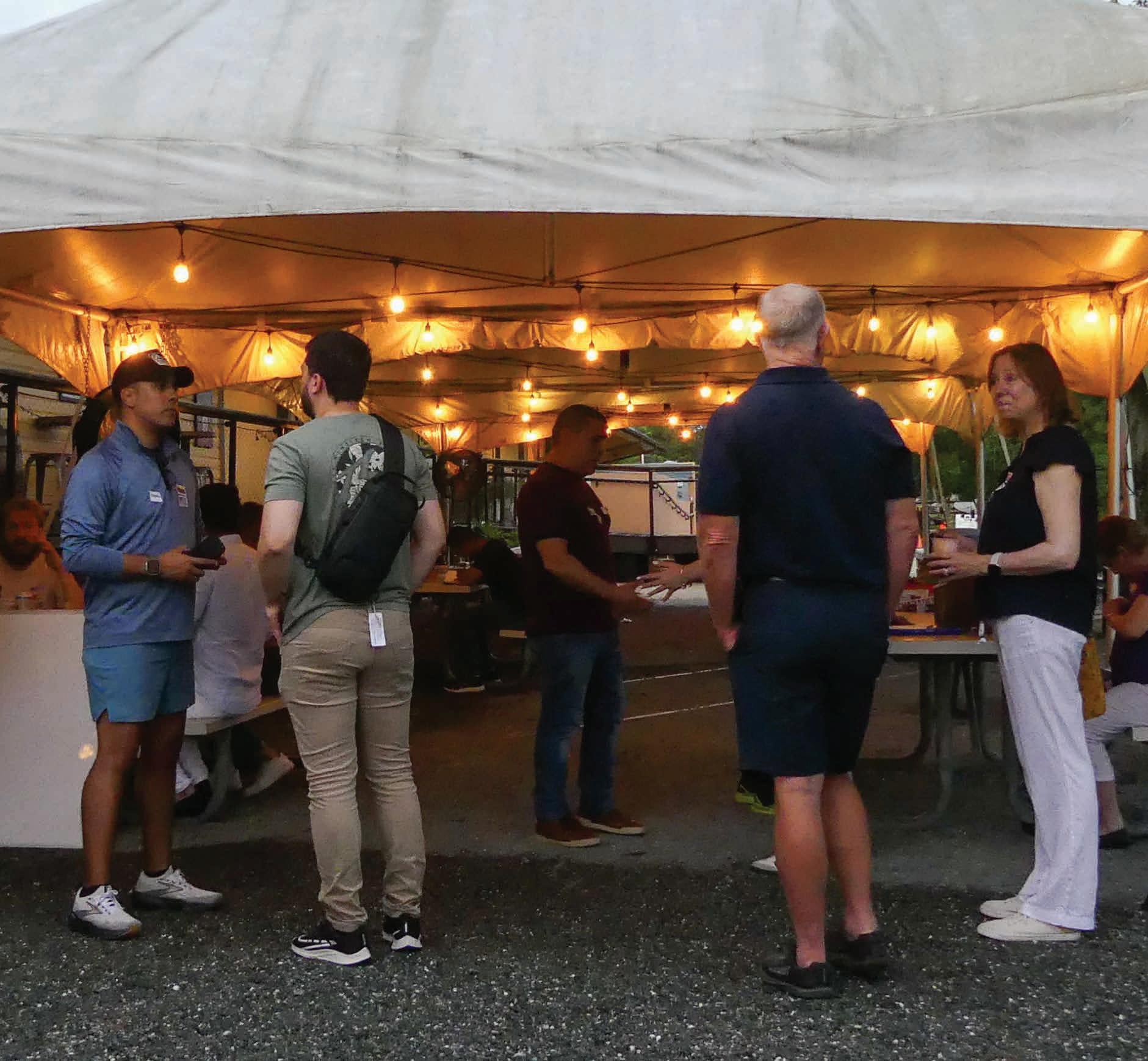
The Language Party gathers outside Boxcar Beer & Wine Garden at Depot Park on July 3, 2025. Read more on pg. 4.
Today’s Weather
International students weigh in on proposed
UF tuition increase
Proposed fee increases raise concerns for international students
By Swasthi Maharaj Alligator Staff Writer
A proposed 10% tuition increase for non-resident students at UF raised concerns among out-of-state and international students. Students are left questioning the fairness of the proposal and considering its financial implications.
The proposed increase would raise the per-credit-hour cost by approximately $90, adding nearly $1,000 per semester for fulltime students. While the Board of Trustees hasn’t yet voted on the proposal, international and out-of-state students are already concerned.
Salma Hage, a 17-yearold incoming UF biomedical engineering freshman from the Dominican Republic, learned about the proposed increase just days after being accepted into UF.
“As international students, we’ve already sacrificed so much,” Hage said. “I’m not the one paying for my own fees. [My parents] worked so hard to get me to where I am now.”
Cost played a central role in her college decision. She was accepted into her first-choice school, Tufts University, but ultimately chose to attend UF due to its lower cost of attendance.
International and out-of-state students currently pay more than twice what in-state students pay
per credit hour. The proposed increase would further widen the gap in a move some students view as inequitable.
Hage said she understands the necessity of tuition increases, but she questioned why in-state tuition will remain untouched by the change.
“[As] international students, we already pay so much,” she said. “I don’t understand why instate tuition is staying the same.”
Astrie Ting, a 20-year-old UF neurology junior, grew up in Taiwan but qualifies for Florida residency. She understands the significance of the tuition increases, she said.
Even with in-state costs, Ting’s tuition is still more expensive than her siblings’ in Taiwan.
“My parents are waiting for me to graduate to retire,” Ting said.
While she understands the gradual rise of tuition costs, she said the university should honor the cost students agreed to upon enrollment, protecting them from mid-degree changes.
“If people get in, and that’s the maximum they can pay outof-pocket, and now you raise it, what do you want them to do?” she said. “Drop out?”

Have an event planned? Add it to the alligator’s online calendar: alligator.org/calendar
Chetan Shinde, a 28-year-old UF computer science graduate student from India, said the mid-program increase could significantly affect students who rely on loans from their home countries.
“As an international student, [we] take out loans to come to the US and study,” Shinde said.
Loans are sanctioned for a specific period of time, usually two or four years, he said. If tuition costs increase, it’s difficult to find extra funding, he added.
A $5,000 tuition increase is sometimes the equivalent of an average year’s salary in his home country, he said.
Shinde emailed UF’s Board of Trustees to share his concerns and offered what he believes would be a fairer decision: apply the tuition increase only to incoming students.
“If we start rolling out this increasing fee for new students, they might [be able to] plan out their education and their expenses accordingly,” Shinde said.
He questioned why in-state tuition remained untouched in the proposal. Shinde called for transparency and fairness, suggesting increases in operational costs should be shared across the student body.
“UF belongs to all of us,” he said. “If there are financial constraints like increasing cost of operation, I think that should be barred by everyone.”
@s_maharaj1611 smaharaj@alligator.org


officially associated with the University of Florida Published by Campus Communications Inc., of Gainesville, Florida
NEWSROOM:
Editor-In-Chief
Engagement Managing Editor
Digital Managing Editor
352-376-4458
Delia Rose Sauer, drosesauer@alligator.org
Bailey Diem, bdiem@alligator.org
Zan Valere, zvalere@alligator.org
Sara-James Ranta, sranta@alligator.org
Avery Parker, aparker@alligator.org
Opinions Editor
Metro Editor University Editor El Caimán Editor
Kairi Lowery, klowery@alligator.org
Noor Sukkar, nsukkar@alligator.org
Avery Parker, aparker@alligator.org
Sports Editor
Assistant Sports Editor
Multimedia Editor
Assistant Multimedia Editor the Avenue Editor
Max Bernstein, mbernstein@alligator.org
Luke Adragna, ladragna@alligator.org
Sydney Johnson, sjohnson@alligator.org
Kade Sowers, ksowers@alligator.org
Copy Desk Chief Jin-Hee Lee, jin-heelee@alligator.org
Editorial Board
DISPLAY ADVERTISING
Advertising Office Manager
Delia Rose Sauer, Bailey Diem, Zan Valere, Kairi Lowery
352-376-4482
Sales Representatives Cheryl del Rosario, cdelrosario@alligator.org
Sales Interns
CLASSIFIED ADVERTISING
Paige Montero, Sydney Sesaldo, Simone Simpson, JP Fournier, Jasmine Chavez, Faith Shimick, Yaxel Valladares
Nethumi Ratnayake, Sofia Korostyshesky, Rachel Al Baissari
352-373-3463
Classified Advertising Manager Ellen Light, elight@alligator.org
352-376-4446 BUSINESS
Comptroller Delia Kradolfer, dkradolfer@alligator.org
Bookkeeper Cheryl del Rosario, cdelrosario@alligator.org
Administrative Assistant Ellen Light, elight@alligator.org
ADMINISTRATION
352-376-4446
General Manager Shaun O'Connor, soconnor@alligator.org
President Emeritus C.E. Barber, cebarber@alligator.org
SYSTEMS
IT System Engineer Kevin Hart
PRODUCTION
Production Manager
Namari Lock, nlock@alligator.org
Publication Manager Deion McLeod, dmcleod@alligator.org

Got something going on? Want to see it on this page? Send an email with “What’s Happening” in the subject line to engagement@alligator.org. To request publication in the next day’s newspaper, please submit entries before 5 p.m. Please model your submissions after the above events and keep them to 150 words or fewer. Improperly formatted “What’s Happening” submissions may not appear in the paper. Press releases will not appear in the paper.
The Independent Florida Alligator is a student newspaper serving the University of Florida, published by a nonprofit 501 (c)(3) educational organization, Campus Communications Inc., P.O. Box 14257, Gainesville, Florida, 32604-2257. The Alligator is published Monday mornings, except during holidays and exam periods. The Alligator is a member of the Newspaper Association of America, National Newspaper Association, Florida Press Association and Southern University Newspapers.
No portion of The Alligator may be reproduced in any means without the written consent of an officer of Campus Communications Inc.
The Alligator strives to be accurate and clear in its news reports and editorials. If you find an error, please call our newsroom at 352-376-4458 or email editor@alligator.org
Juleidi Machuca // Alligator Staff University of Florida’s international students share how a potential tuition increase could affect them.
Proposed development rouses environmental concerns
PAYNES PRAIRIE,
from pg. 1
ecologically sound subdivision, there will still be more issues than if it was just undeveloped,” Mavrodieva said.
She took issue with Maronda Homes being primarily based outside of Gainesville because it isn’t familiar with the natural area, she said.
Since 1940, one of the largest threats to biodiversity is housing development.
Mavrodieva made an Instagram post about the proposed development to express her dissent. The post has over 2,300 shares as of July 6.
“It’s a testament for how much people care about this issue,” she said. “It just took off among people who live in Gainesville who really care about the prairie and who just want to make sure our commissioners continue to prioritize our green spaces.”
Alachua County Communications Director Mark Sexton said the county is aware of Maronda Homes’ rezoning application.
“We have received the rezoning application,” Sexton said. “Staff will review and prepare a recommendation for the Planning Commission and for the Board of County Commissioners.”
It is unknown when the recommendation will be completed and reviewed. The next commission meeting is scheduled for July 8.
@LoganDMcBride lmcbride@alligator.org


Julieidi Machuca // Alligator Staff
A proposed change could allow residential development across from the environmental landmark. Community members and officials are reviewing its potential impact.
Investigation results support HR complaints
she received detailing the doctor’s behavior.
Knox wasn’t the investigation’s sole subject. It also examined Jennifer Koerner, First Coast CPT’s finance manager and division director, whom CPT employees claimed collaborated with Knox to bully and intimidate employees.
UF HR interviewed 21 witnesses, including First Coast CPT employees, former employees and UF Health Jacksonville officials.
After conducting the interviews, the investigation concluded Knox had violated UF regulations against disruptive behavior by creating a hostile work environment. The investigation did not substantiate accusations against Koerner.
Deutsch’s report concluded “CPT has been obstructed in its mission and its reputation in the community has been damaged” due to the work environment Knox cultivated.
Once Knox learned she was being investigated, she attempted to obtain the identities of and collect “dirt” on employees who had complained against her, according to the report.
“Knox all but admitted that she wanted to find out who had been complaining about her,” Deutsch wrote.
He described Knox had been “compromised” in her judgment, and she “intended to do professional harm to subordinates,” he wrote.
The investigation supported additional claims employees made against Knox, including reports she made racist comments to CPT employees and demanded “employees do personal tasks for her,” such as transporting her children, reviewing her child’s college application essay and doing maintenance work at her house.
Knox said she didn’t make employees do tasks for her. The investigation said her claims that subordinates volunteered seemed disingenuous.
CPT employees claimed Mark Hudak, the chair of UF Health Jacksonville’s pediatric department, stood behind Knox and allowed her to terrorize them and run CPT at her whim. UF substantiated the claims in its investigation.
According to Deutsch’s report, Hudak, knowing Knox would face criticism for her work history in prior states, tried to shut down potential dissent.
“Hudak delivered two clear messages,” Deutsch wrote. “Knox was free to micromanage, and employees who discussed Knox’s past would face consequences.”
As a result, Deutsch wrote there was an open revolt among CPT employees.
Witness interviews with current and former CPT employees detailed significant emotional and professional turmoil for Knox’s targets.
Jacqueline Sandefer-Gonsen, the team coordinator for CPT’s Tallahassee office, said Knox yelled at her on several occasions and placed a hand over her face while telling her to “shut up” during a meeting.
Sandefer-Gonsen felt as if she had no choice but to resign, she said, and ultimately did so. She received a resignation acceptance letter stating she didn’t leave in good standing, a note future employers may look at.
Jenna Peace, a First Coast CPT case coordinator, said she and other coordinators loved helping children but feared having their jobs made “a living hell” because of Knox’s behavior, in addition to the stress of handling child abuse cases.
Melissa Scites, the director of health care administration for the Department of Pediatrics, said she didn’t witness any form of bullying in Knox’s conduct, but she didn’t work in the First Coast CPT office. However, Knox’s communication and leadership could have been better, she added.
She rebuffed the claim Hudak had threatened to fire anyone who discussed Knox’s previous roles in Wisconsin and Alaska. Instead, he assured prior claims against her were unfounded and anyone who discussed them might be addressed, she said.
Jacob Barnes, a medical student who did rotations at First Coast CPT, said Knox spoke harshly about employees behind closed doors. He said she often prefaced such discussions with, “Don’t tell anyone this, but.”
In his interview with UF HR, Hudak fiercely defended Knox, describing her efforts leading
The Language Exchange Party Bonanza: A

the CPT as heroic. He said employees set out to “create chaos” because they were unhappy with Knox’s firm but necessary leadership style.
Knox said in her interview that employees discussing her professional record amounted to hazing. She denied the allegations against her. She said employees had offered to review her daughter’s college essay, which the report described as “plainly disingenuous.”
Knox said she felt retaliated against for making helpful changes to CPT’s operations.
Knox did not respond to a request for comment.
Alyssa Phipps-Poe, First Coast CPT’s former case manager, originally provided her account of Knox’s behavior under anonymity in January. She said the investigation failed to thoroughly examine Knox’s behavior.
party to
“[Deutsch] did not meet with all CPT employees, only those who proactively came forward,” Phipps-Poe said. “The experiences of many who witnessed or were subjected to Dr. Knox’s behavior are going to really remain unheard.”
The report’s understated analysis reflects how “[Knox’s] behavior went unchecked for over a year,” she said.
UF spokesperson Cynthia Roldan wrote, “Dr. Knox signed an agreement on June 24 that constitutes a notice of resignation from UF Health effective August 15, 2025.”
It marks Knox’s third resignation from a lead forensic pediatrics position since 2019.
@AveryParke98398 aparker@alligator.org
practice languages
and make friends
People from different cities come together to practice languages and share cultures
By Candy Fontana-Verde Alligator Staff Writer
On July 3, around 15 people gathered at The Boxcar Wine & Beer Garden to practice languages, laugh at common mistakes and celebrate different cultures during the Language Exchange Party Bonanza, a free and open meetup for anyone, regardless of language or fluency level.
Since 2020, the event has grown steadily thanks to León Icaza, 48, a language instructor and one of its main organizers.
“People who are truly passionate about a language work really hard to learn it,” Icaza said.
His enthusiasm for connecting cultures led him to start the initiative during uncertain times, with the idea of offering
something “positive for the community” in contrast to so much negative news, he said.
Each person receives flag stickers representing the languages they speak and want to practice, from more common ones like English and Spanish to others like Danish, Arabic, or Russian.
“What I love most is that it doesn’t matter if you’re rich or poor,” Icaza said. “What matters is the effort you put in.”
The atmosphere is relaxed, people can stay for the full three hours or just stop by for 30 minutes. Sometimes games are organized, but the focus is always conversation.
“Many of our members have learned here and later traveled to another country,” he said. “Their trip was much better because they could speak the language.”
He recalled his own trip to Martinique, where speaking French allowed him to connect with a local host who took him to explore mountains he wouldn’t have discovered otherwise.
André Pérez, 46, a Jacksonville resident, drove to Gainesville for the event. He has attended similar meetups for several years and says they’ve helped him tremendously.
“It’s great to be able to practice the language, sure, but it also gives you the opportunity to meet people from all over the world and build relationships in places where you normally wouldn’t,” Pérez said.
In addition to the Gainesville meetups on the first and third Fridays of each month, there are Japanese conversation sessions called “Nihongo Kaiwa” twice a month. They also host French
events titled “French, Anyone!?” semimonthly in Jacksonville and virtual gatherings every Saturday called “Heading into Language Land,” where participants practice through online card games.
Julio Muñoz, a 58-yearold web developer for UF and Gainesville resident, attended for the second time. What he enjoys most is meeting new people and practicing languages he might otherwise forget.
“It’s really great because it’s not just about languages, it’s also about socializing and learning from other cultures,” Muñoz said.
Events like this not only improve fluency, he said, but also create spaces where participants can use the language in real and spontaneous situations outside the structured environment of a classroom.
As noted by the specialized site EFLCafe, “Cultural exchange programs significantly improve language skills by providing students with opportunities to interact in real-life situations.”
This kind of exposure is key for developing language practically because it forces people to use it in authentic, natural settings.
Thomas Glenn, a 60-year-old retired Navy pilot, also values that aspect of the community.
“You can have lots of apps and learn vocabulary, but if you don’t talk to someone, it’s not very useful,” Glenn said. “Not everyone is extroverted, but people enjoy chatting a little and sharing.”
@CandyFontanaV cfontanaverde@alligator.org
Alligator Archives
Dr. Barbara Knox, who faced allegations of creating a hostile work environment, has resigned in light of an investigation into her behavior.
Books-for-Prisoners project bridges volunteers and prisoners
DESPITE
RISING COSTS, ORGANIZATIONS CONTINUE TO SEND BOOKS TO INCARCERATED PEOPLE
By Alanna Robbert Alligator Staff Writer
Jojo Sacks scanned brightly colored book spines inside a makeshift library, searching for what books best fulfilled an order.
When nothing fit under Westerns, she moved to a shelf on the other side of the room. There, she found a book more fitting: a biography about Martin Luther King Jr. She wrapped the book in a pre-cut paper bag.
The package, labeled for postage, will be sent to a Florida prison.
Gainesville Books to Prisoners mails books to incarcerated individuals in prisons and jails across the state. Located inside the Civic Media Center, a small library is reserved for the project. Every other Tuesday, volunteers do their best to find books to fit inmates’ requests.
Sacks, one of the project’s organizers, said its main goal is to promote media literacy.
“Free availability to read and learn, what we want to learn, is something people often leave incarcerated people out of the conversation,” Sacks said.
While book censorship in prisons is often justified due to safety or security concerns, U.S. prisons employ a variety of reasons why books are censored.
Independent nonprofits across Florida push for access to reading materials, which foster education, entertainment and personal growth during prison time.
History of book access
Florida holds some of the highest rates of K-12 book banning. It’s also one of the top states for prison book bans. More than 20,000 titles are banned in Florida prisons, according to the Marshall Project. Many restricted books are deemed too sexual or violent.
For an insight into K-12 content restriction, Sacks said people should first look to prisons.
“There’s been censorship happening in prisons and jails and detention centers and other places of incarceration for a really long time,” she said.
The Marshall Project found more than 50,000 titles are prohibited in U.S. prisons, according to a 2023 report.
States that don’t maintain a banned book list evaluate them on a case-by-case basis, often with inconsistent rules and little oversight. Many book reviews happen at the hands of mailroom staff.
The Florida Department of Corrections lists specific rules for restricted books, noting material must lack descriptions of violence or sexual content or encourage escape.
The process for inmates to request books begins with a letter written on a loose-leaf sheet of notebook paper. They can request specific genres, such as fantasy, science fiction and Western.
The organization sends three softcover copies per package with little to no stains or marks per to minimize the chance of a book getting rejected. Books can’t have hard covers, metal binding or notes in their margins. Rules specify appearances to prevent substances or unapproved messages from reaching an inmate.
If a book is rejected, it’s returned to the sender. Sacks said the organization often receives books back without explanation.
Specific genres are in higher demand than others, she said, especially stories with high-speed pacing, including thrillers and adventure books. Reference books, including almanacs and dictionaries, and empty puzzle books like Sudoku and crosswords are also heavily requested.
Gainesville volunteers
Ashten Mays, a 35-year-old Gainesville resident, is another organizer for the project. The organiza-
tion has evolved over many years, with the current version active since 2021, she said.
The organization began sending letters to prisoners before it started receiving book requests, she said.
“You get this huge stack of mail,” Mays said. “There’s a real need, a real desire [for the books].”
The organization wants the community to know that incarcerated people are also a part of Gainesville, she said.
“They’re just as much part of our community as anybody else, even though you can’t see them every day,” she said. “It’s [the project] is a very easy way to bring people into this kind of work and highlight the importance of those people, even though they’re not here with us.”
The donation-based project has been struggling to fulfill “hundreds of requests a month” due to increasing postage prices. Postage rose from $5 to $7 per package after the United States Postal Service announced increased shipping rates effective July 2025, Mays said.
“We’ve been trying to get creative because funding has constantly been a problem for postage,” she said.
The organization primarily uses social media to attract donations but also applies for grants. It collaborates with local businesses, such as SquareHouse Pizza, which donates through its Round
Up For Charity program.
Sam Edelweiss, a 29-year-old Gainesville resident, has volunteered for the project for two years. Sending books shows the project’s solidarity with incarcerated people, they said.
Prison libraries are often in poor condition or closed, Edelweiss said, so it’s essential to send books. Inmates need books to learn about new topics or passions, they said.
“I’ve had people very dear to me affected by the police and prison system,” Edelweiss said.
Val Donaldson, a 25-year-old Gainesville resident, said the project is a way for her to “restore” prisoners’ humanity, believing prisoners are “systemically getting that stripped from [them in] their day-today life.”
Depression rates among incarcerated people are higher due to loss of personal freedom and privacy, prison violence and social isolation. Just over 11% of inmates in 2024 had depression compared to about 7% of the general population.
Sending books is a “tangible and important” way to show inmates people outside prison care about them, Donaldson said.
Read the rest online at alligator.org. @alannafitzr arobbert@alligator.org
NOAA budget cuts threaten hurricane response as Florida enters peak season
DECREASED FEDERAL FUNDING FOR CLIMATE RESEARCH WILL IMPACT COMMUNITIES NATIONWIDE
By Koushin Unber & Avery Parker Alligator Staff Writers
In 2024, Sean Farrell’s family put up rain shutters, locked windows and doors, packed up their dogs and cat and drove to the Panhandle to ride out Hurricanes Helene and Milton. When they returned, they found no damage, save a couple of trees knocked down in the surrounding area.
Farrell, a 21-year-old UF statistics senior, said his family home in Sarasota, Florida, was directly in the hurricanes’ path of destruction.
He attributes his family’s safety to early warnings that told them to evacuate, he said.
He doesn’t know if he could say the same about this year because funding cuts on weather prediction programs can chip away at families’ preparation.
The Trump administration’s “skinny budget,” released by the White House May 2, proposed a 24% reduction in funding for the National Oceanic and Atmospheric Administration, the federal organization responsible for monitoring and forecasting weather events like hurricanes.
Predicting the risk of a hurricane begins with gathering data. Experts at NOAA’s National Hurricane Center examine satellite images, observe weather patterns and create computer models to forecast and warn emergency officials, media and the public about approaching hurricanes, tropical storms and tropical depressions.
With about 800 employees terminated since Feb. 28, NOAA faces understaffing, presenting the agency with critical challenges in finding staff necessary for accurately forecasting hurricanes, tornadoes and other extreme weather events.
Stephen Mulkey, a UF biology professor
and environmental scientist, said storms are intensifying and making landfall farther north. He attributed it to extremely high sea surface temperatures.
“The temperature of the Gulf of Mexico over the last hurricane season in July and August was absolutely terrifying,” Mulkey said. “It was unbelievable.”
In 2024, the Gulf of Mexico had an ocean heat content of 89 kJ/cm², compared to an average of 74 kJ/cm² from 2013 through 2024. The estimate for 2025 is even higher, Mulkey said.
Ignoring, silencing and defunding climate monitoring and response only serves to worsen the situation, Mulkey said.
“The funding cuts will be devastating to the basic climate change program,” he said. “Urgent systemic changes are needed to avoid civilization-threatening consequences.”
Climate censorship worsens the situation, he added.
Mulkey said the National Science Foundation reprimanded him on three occasions for using the terms “climate change” or “sustainability” in grant abstracts and titles in 2017. He was encouraged to avoid them because the terms might have drawn negative attention from a Republican Congress, he said.
“The goal of this censorship is to continue to keep the public in the darkness as to how grave our situation is,” he said.
Melanie Schepmans, a Gainesville lead organizer of GenCLEO, the youth branch of the climate activist organization CLEO Institute, said heavy hurricane activity means Floridians need strong hurricane resources.
“NOAA data shows us that the past nine consecutive hurricane seasons had above-average activity,” Schepmans said. “These cuts affect the lives of all Americans, but especially Floridians, whose lives depend on that fast, reliable and accurate hurricane forecasting that’s only possible through the resources that a government agency such as NOAA has.”
The CLEO Institute relies on weather-relat-
ed emergency broadcasting and federal agencies like NOAA to help provide aid to hurricane victims, she said. The organization forwards awareness campaigns to remind residents of evacuation routes and shelters.
Gainesville Interim Emergency Manager Alvin Jones said federal cuts have directly impacted the city’s hurricane services.
“We lost funding that we relied on heavily for our specialty teams,” Jones wrote in an email.
The city is working to fill gaps with support from Gainesville Fire Rescue and a collaboration with Alachua County Emergency Management, he added.
The city released its 2025 Gainesville Hurricane Season Brochure, which includes emergency response numbers, hurricane shelter locations and preparation advice. The brochure advises residents to rely on NOAA organizations like the National Weather Service and the National Hurricane Center to stay informed before, during and after a storm. Such organizations are facing budget cuts and have had access to key monitoring satellites revoked.
David Peaton, Alachua County’s assistant director of emergency preparedness, said the county’s hurricane response will remain consistent regardless of federal changes.
“No matter what happens, we still have the same responsibility, and that’s to keep our community safe and get people’s lives back to normal as quickly as possible [after a storm],” Peaton said. “Nothing is changing the way we are going to respond to our community.”
Alachua County frequently uses the National Weather Service in Jacksonville to help with hurricane response, and despite looming uncertainty, Peaton said the organization still provides the county a “top-notch service.”
He hopes the county can continue to rely on the NWS for critical storm information for hurricanes and other extreme weather events, he said.
Kirsten Chaney, a meteorologist for the NWS Jacksonville location, said residents need
to take hurricane preparation seriously, especially as North Florida faces an above-average hurricane season.
“We are in what’s called an endzone neutral year, and that is going to allow storms to form without any disruption,” Chaney said. Because of reduced wind shear, which can prevent hurricane formation, “if [storms] start going, they can keep going.”
Still, she said, high activity doesn’t guarantee landfall will occur.
Chaney said the NWS Jacksonville branch will remain in close contact with its local partners in Florida and Georgia.
“We work very closely with our emergency managers, fire, police and essentially everyone that’s making decisions for public safety,” she said. “If there is a potential storm out there, we will be providing weather briefings to what we call our core partners – the emergency manager community and [local] decision-makers.”
She feels confident the NWS will continue to provide critical support throughout the 2025 hurricane season, she said.
“We are provided with a bunch of tools that we are confident going into this hurricane season [with],” she said. “We will always provide service that helps to protect lives and property in our forecast area.”
NOAA communications specialist Marissa Anderson said the NWS “continues to meet its core missions amid recent reorganization efforts” in a written statement.
The NWS is assigning temporary duties to remaining employees to fill critical positions at field offices, she wrote. NOAA will open “a targeted number of permanent, mission-critical field positions” exempted from hiring freezes in the Department of Commerce, Anderson said.
@KUnber27
@AveryParke98398 kunber@alligator.org aparker@alligator.org
MONDAY, JULY 7, 2025
www.alligator.org/section/the_avenue
The price of prestige: UF’s low-income students work to stay afloat during the summer
UNIVERSITY OF FLORIDA
STUDENTS JUGGLE WORK AND CLASSES OVER THE SUMMER TO MAKE ENDS MEET
By Isis Snow Avenue Staff Writer
Mallory Lewis clocks in, clocks out and clocks back in again. Her summer is a cycle of work, interning with little room for rest, all just to stay afloat.
“I just needed money,” Lewis said. Lewis, a 21-year-old University of Florida student double-majoring in political science and criminology with a minor in public relations, is going into her senior year working close to 30 hours a week.
This summer, her time is split between three roles: supervising at RecSports, running
FOOD & DRINK
social media for New Scooters 4 Less and interning unpaid at the Eighth Judicial Circuit Court. The income she earns goes toward essentials like groceries, gas, utilities and car payments.
The heavy summer workload is shared by many low-income students at UF, who take on multiple jobs just to stay afloat while managing their academics. As UF markets itself as a top ten public university, the cost of attending is anything but low.
According to UF’s Office of Student Financial Aid and Scholarships, the cost of attendance for the 2024-25 academic year for in-state undergraduates living off-campus was $23,530.
At UF, about one in five undergraduates receive Pell Grants, a common benchmark for identifying low-income students. About one in three undergraduates in four-year public universities across the state received Pell Grants
in the 2022-23 school year, according to data from the U.S. Department of Education’s National Center for Education Statistics (NCES).
The UF Board of Trustees recently announced it would consider a proposal to raise out-of-state student fees by 10% at a special meeting on July 23. If approved, the increase would take effect in Fall 2025.
While the proposal wouldn’t affect in-state tuition or fees, it can have ripple effects on the campus community, especially for students already struggling to afford the university as is.
“I feel like I don’t ever have money to do fun things for myself unless they’re free,” Lewis said. “It just kind of sucks being a college student, and you can’t afford to do all the things that you see everyone else doing.”
It’s important to find a job that allows her to get the full college experience while enabling her to support herself, she said.
“While I do need money, I would rather
have experiences that I only get at this age, like being able to go home and spend a month for Christmas with my family,” Lewis said. “I’m not going to have that once I graduate.”
While some parents help with rent and other expenses, some students work to pay for personal expenses.
Anna Lu, a 21-year-old biology senior, works 20 hours a week at the Reitz Union Arts & Crafts Center over the summer while balancing four classes.
“I spent so long trying to get a job on campus because I was struggling so hard to manage my money without having a job previously,” Lu said.
Read the rest online at alligator.org/ section/the_avenue. @snow_isisUF isnow@alligator.org
A taste of home: Gainesville’s ethnic markets offer comforting meals, friendly faces
TWO STANDOUT MARKETS BRING CULTURE AND COMMUNITY TO IMMIGRANTS IN GAINESVILLE
By Allison Bonnemaison Avenue Staff Writer
Homesickness is a familiar feeling. Whether you’re craving a meal your mom used to make, a snack from childhood or a friendly face, these two Gainesville ethnic markets can cure your longing or open the door to a new culture.
From African spices to Eastern European sweets, these markets offer more than food; they share identity and belonging.
African Unique — International Marketplace
Representing West African countries like Cameroon, Nigeria and Ghana, African Unique offers staples like gari, palm oil and fufu, along with clothing, jewelry and cosmetics.
“It’s like a miniature African consulate,” said Victor Okorochukwu, the market’s 68-year-old Nigerian owner.
Okorochukwu supplies products from regions all over Africa, but most are from West Africa.
He caters to student clientele, creating a sense of family for young people away from home, he said.
“I always like to tell them, ‘I’m your uncle now,’” he said. Influenced by his African culture, everyone is family to Oko-

Keep up with the Avenue on Twitter.
Tweet us
@TheFloridaAve.


rochukwu. Taking care of others, like a homesick student, is not just part of the job but a part of his life, he said.
He gets many American customers curious about African food. He recalled an American customer who lived in Kenya, looking for the dishes they were accustomed to.
The store carries products made in Africa, such as hair care and skin care infused with shea butter, and women’s dresses and accessories like jewelry and wigs. Its African menswear is perfect for the hot weather, Okorochukwu said.
Every product stocked on his shelves is tied to custom. His handmade bags line the walls. One holds cultural significance to him, a handbag from Cameroon used to hold kola nuts.
In African culture, the eldest male in a household will welcome his guests with kola nuts.
“He who brings kola, brings life,” is a well-known African saying, Okorochukwu said.
The custom consists of praying over the fruit and breaking the kola between the host and the visitors, he said. The prayer includes everyone connected to the household or community, even if they aren’t physically present.
Marie Stewart, an Alachua County resident, has been a regular at Okorochukwu’s store for about six years. She came to buy attieke, a couscous-like dish made from cassava and a popular food in Côte d’Ivoire, her homeland.
“We’ll find everything here from our country,” Stewart said. She felt welcomed by the owner, she said, noting that if you are looking for something specific, Okorochukwu will order it
for you.
She used to buy from Okorochukwu when she ran her African restaurant, and she and her family still shop there, she said.
Euro Food Basket & International Market
Euro Food Basket & International Market transports visitors to Ukraine with its candies and Russian tea. Apart from food, the market features knickknacks like Russian nesting dolls and Polish ceramics.
Ukrainian owner Tatiana Gromova sees her store as an opportunity for nostalgia. People come in looking for food they grew up eating, she said. She witnesses them reconnect with their childhood memories at the market.
Her own memories fill the shelves. Running the market was a fantasy of hers from a young age, often pretending she owned a food market. She remembers asking her mom to make pelmeni, a Russian dumpling she keeps stocked in her store.
“They have bonded to the taste, the food, the experience,” Gromova said.
Read the rest online at alligator.org/section/the_avenue. @allisonrbonn abonnemaison@alligator.org








El Caimán
Lugareños reúnen para practicar diferentes idiomas y celebrar culturas. Leer más en la página 11.




Open until 9 pm every Thursday!
Thursday, July 10, 6 – 9 pm
Multimedia Mix Up
Explore the experimental history of multimedia art. Through creativity, curiosity and innovation, we invite guests to immerse themselves in multimedia firsthand with a photobooth, Art Blast Tours, live music and short film screenings.
Wine Down
Thursday, July 31, 6 – 9 pm harn.ufl.edu/artafterdark

Wine down with a jazz performance by Jose Piñeiro Trio. Free lite bites and desserts by Chef Bert Gill will be served, along with wine and beer.
image: El Anatsui, Old Man’s Cloth, 2003, Museum purchase with funds from friends of the Harn Museum
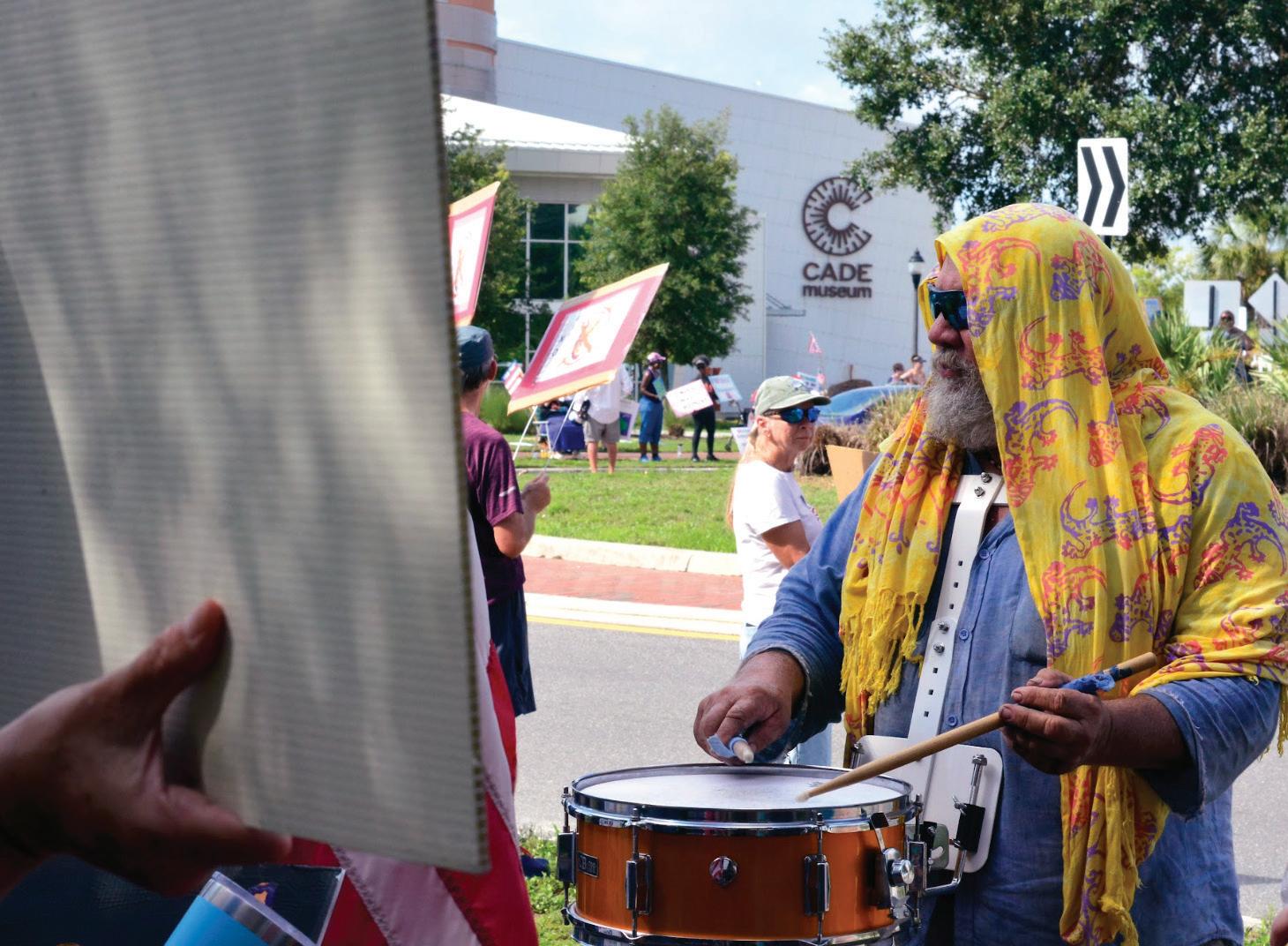
In the shade, protesters protect themselves from the heat at Depot Park on Friday, July 4, 2025.
Different posters are left out on the grass for protesters to borrow at Depot Park on Friday, July 4, 2025.
Photos by Delia Rose Sauer // Alligator Staff
A protester carries a sign as the crowd chants at Depot Park on Friday, July 4, 2025.
Chris Deutsch and her daughter Tamara Deutsch chant at the corner of Depot Park on Friday, July 4, 2025.
www.alligator.org/section/opinions
Trump’s ‘One Big Beautiful Bill’: Why we must protect Medicaid now
In hospitals, “code blue” is a well-known emergency code that describes the critical status of a patient, and one that usually sends doctors running down the hall. The U.S. is now experiencing a “code blue” of its own in the form of President Donald Trump’s domestic “One Big Beautiful Bill.”
The bill, passed by Congress July 3 and signed by Trump July 4, calls for reduced federal spending and stricter work requirements for public assistance. It adds a Medicaid requirement for those who are able and childless to work at least 80 hours a month to receive benefits.
While Trump said the bill won’t impact people on Medicaid, the effects will be farreaching and deeply harmful to millions of Americans on Medicaid who can’t work 80plus hours a month. Thus, a code blue.
Medicaid isn’t a budget line; it’s a lifeline for millions of Americans. It’s a federal and state program that provides essential health insurance coverage to low-income individuals, including children, seniors and those with disabilities.
Over 71 million Americans were enrolled in Medicaid as of January, according to the Centers for Medicare & Medicaid Services. In Florida, the program supports working families who would otherwise lack coverage.
In Alachua County, 44,110 residents —14.8% of the population — were enrolled in Medicaid in 2024, according to the Florida Department of Health.
These numbers aren’t mere statistics; they represent our neighbors, classmates and patients who rely on Medicaid for their wellbeing.
Despite this, congressional leaders push detrimental changes to Medicaid, deceptively presenting them as efforts to reduce “waste” or foster employment through new work requirements. In reality, these policies are designed to reduce enrollment, not enhance care.
We’ve already witnessed the adverse effects in Florida.
Following the expiration of pandemicera protections, the state resumed Medicaid eligibility reviews in April 2023. During the “unwinding” period, more than 1.3 million Floridians lost their Medicaid coverage, including approximately 420,000 children, according to the Florida Policy Institute.
Shockingly, 64% of these disenrollments were due to procedural reasons, such as not returning paperwork, rather than being deemed ineligible. This means hundreds of thousands may have lost care, not because they no longer qualify but due to avoidable bureaucratic errors.
Let’s be clear: Work requirements don’t promote work; they penalize poverty. Many Floridians on Medicaid already work full-time in essential roles, including grocery clerks, nursing aides, restaurant staff, childcare workers and caregivers. Withdrawing their healthcare will only exacerbate their challenges in maintaining health, productivity and housing.
As a neuroscience student at the University of Florida and a volunteer at the Norman Fixel Institute for Neurological Diseases, I witness the profound significance of Medicaid. I encounter patients who rely on it for life-saving treatments and long-term care. The cuts are not theoretical; they are deeply personal.
Medicaid plays a crucial role in sustaining local clinics and rural hospitals. It supports community care and enables public health initiatives. Slashing funding won’t save lives. It will cost them.
Florida lawmakers, backed by Gov. Ron DeSantis, have repeatedly refused to expand Medicaid under the Affordable Care Act as recently as 2023, according to the Center on Budget and Policy Priorities.
As a result, more than 400,000 uninsured Floridians fall into the Medicaid coverage gap where they earn too much to qualify for Medicaid but too little to afford private insurance — a failure that leaves many without access to basic care.
We can’t afford further harm.
Despite the bill’s recent passage, I strongly urge Florida’s U.S. Senators to reject this idea and administration and stand with our communities, not billionaires. We must protect our healthcare system and preserve our dignity.
This is a code blue, and in Gainesville, we’re answering the call.
The hidden hazards on your plate: Uncovering the dangers of processed foods
If you’re anything like me, diet culture can make the simple task of weekly grocery shopping seem like the most daunting task on your to-do list.
It can be frustrating to constantly be fed contradicting diet fads. One minute, I’m told I don’t “get enough protein,” and the next, I’m convinced gluten is the secret villain behind all my problems — cut out gluten, lose weight, clear your skin and, in turn, live a happy, carefree life.
People are exhausted by the needless confusion surrounding diet culture. It’s become too overwhelming to concern ourselves with. We’re tempted to take the road that seems the most straightforward.
Unfortunately, modern medicine only worsens this temptation.
When we experience frustrating health issues, we long for a pill, supplement or operation to be the “fix.” It’s largely because of how we’ve been conditioned to approach our health. When it comes to sustaining long-term health, there may not be such a simple way out.
In recent years, the concept of functional medicine found its place among diet fads, but it shouldn’t be confused with one. You’ve probably heard the phrase “the root cause of ___” thrown around your Instagram reels the past year. Anything from digestive, hormonal or skin issues can be inserted into the blank, but the videos all have the same answer: a diet that prioritizes whole food consumption while reducing processed food consumption.
But why? What makes this “diet” any better than other diet trends?
Eating a well-rounded diet means cutting processed foods, or foods that damage our body’s cells due to an excess of refined ingredients and sugars. However, eating highly processed foods has become the norm.
Eating real food shouldn’t be considered a diet.
It’s not a coincidence that rates of chronic illnesses are rapidly increasing in our society. We’re feeding our
The views expressed here are not necessarily those of The Alligator.
body things that aren’t real and calling it normal.
Even food items labeled “natural” or “healthy” aren’t exempt. The next time you’re at the grocery store, look at the ingredients of the protein bar you’re about to buy, the granola for your vanilla yogurt or the bottled smoothies boasting high amounts of protein.
Foods generally considered “healthy” are full of ingredients we weren’t made to ingest: unnecessary amounts of added sugar, refined ingredients and harmful sugar substitutes, which are all linked to an increased risk of numerous health issues, according to a Harvard Medical School study.
While the modern food industry is happy to encourage the narrative that processed foods aren’t harmful, those who specialize in functional medicine strive to discover the root cause, which is often connected to what you consume.
Our flawed healthcare, pharmaceutical and food industries run on people getting sick and staying sick. It shouldn’t be a surprise those who profit from the system disregard the negative impacts of highly addictive, processed foods.
If you’re feeling extremely discouraged at this point, you’re not alone. It’s nearly impossible to avoid these foods, and despite the risks, I don’t believe we should torture ourselves trying to do so.
The best way we can advocate for ourselves and our loved ones is to learn as much as possible and try our best to properly nourish our bodies before it’s too late.
Kendall O’Connor is a UF English junior.
The Alligator encourages comments from readers. Letters to the editor should not exceed 600 words (about one letter-sized page). They must be typed, double-spaced and must include the author’s name, classification and phone number. Names will be withheld if the writer shows just cause. We reserve the right to edit for length, grammar, style and libel. Send letters to opinions@alligator.org, bring them to 2700 SW 13th St., or send them to P.O. Box 14257, Gainesville, FL 32604-2257.Columns of about 450 words about original topics and editorial cartoons are also welcome. Questions? Call 352-376-4458.

Fatima Shahid is a UF neuroscience junior.
Fatima Shahid opinions@alligator.org
Kendall O’Connor opinions@alligator.org
How to Place a Classified Ad:
● UF Surplus On-Line Auctions ● are underway...bikes, computers, furniture, vehicles & more. All individuals interested in bidding go to: SURPLUS.UFL.EDU 392-0370 8-14-25-13-10
Donate your vehicle to help find missing kids and keep kids safe. Fast free pickup, running or not, 24 hr. response. No emission test required, maximum tax deduction. Support Find the Children Call – Call 1-833-546-7050 7-7-14-12
and
Los Angeles Times Daily Crossword Puzzle
2
The surf's up at "Pawn Beach".
CASH PAID FOR HIGH-END MEN'S SPORT WATCHES. Rolex, Breitling, Omega, Patek Philippe, Heuer, Daytona, GMT, Submariner and Speedmaster. These brands only! Call for a quote: 1-833-641-0211 7-7-10-13
We Buy Vintage Guitar's! Looking for 19201980 Gibson, Martin, Fender, Gretsch, Epiphone, Guild, Mosrite, Rickenbacker, Prairie State, D'Angelico, Stromberg. And Gibson Mandolins / Banjos. These brands only! Call for a quote: 1-833-641-6789 7-7-24-13
● ● CASH FOR YOUR STUFF ● ● GAINESVILLE COLLECTIBLES IS BUYING Gold/Silver Coins ● Paper Money ● Stamps Watches ● Jewelry ● Silver Flatware Comic Books ● Sports Items Near Campus ● Call 352-776-6591 7-28-25-21-13 You need the money to do


BATH & SHOWER UPDATES in as little as ONE DAY! Affordable prices - No payments for 18 months! Lifetime warranty & professional installs. Senior & Military Discounts available. Call: 1-833-754-2465 7-7-63-15
Don't Pay For Covered Home Repairs Again! Our home warranty covers ALL MAJOR SYSTEMS AND APPLIANCES. We stand by our service and if we can't fix it, we'll replace it! Pick the plan that fits your budget! Call: 1-833-650-5419 7-7-67-15
1. ANIMAL KINGDOM: What is a female goat called?
2. TELEVISION: What is the name of the town in "Gilmore Girls"?
1. MEASUREMENTS: How many inches are in a mile?
3. GEOGRAPHY: How many states does the Appalachian Trail cross?
4. MOVIES: Which actress voices the character Jessie in "Toy Story 2"?
2. ASTRONOMY: What does the acronym SETI mean to the scientific community?
PROTECT YOUR HOME from pests safely and affordably. Roaches, Bed Bugs, Rodent, Termite, Spiders and other pests. Locally owned and affordable. Call for a quote or inspection today 1-833-542-1732 Have zip code of property ready when calling! 7-7-70-15
When you're stuck out in Oz and you need cash to get home, click your heels three times and think of Best Jewelry and Loan. 523 NW 3rd Ave 352-371-4367 8-14-9-15
AGING ROOF? NEW HOMEOWNER? STORM DAMAGE? You need a local expert provider that proudly stands behind their work. Fast, free estimate. Financing available. Call 1-833-889-1805 Have zip code of property ready when calling! 7-7-21-15
● Affordable RV Camping Near Campus! ● Convenient location just minutes from UF. Safe, quiet, perfect for game day weekends. Water, electric, and Wi-Fi. Reserve your spot today! 352-372-1026 katesfishcamp.com Book Early - Limited Spoits! 8-14-25-13-15
DRUG PROBLEM? WE CAN HELP! 24 HOURS 7 DAYS CALL NARCOTICS ANONYMOUS 352-376-8008 www.uncoastna.org pr@uncoastna.org Need CPR Training? (352) 727-4733 www.GatorCPR.com CNA Prep Classes from GatorCNA.com 8-14-25-13-16
TESTING
Alachua County Health Dept. Call 334-7960 for app’t (optional $20 fee) ATTENTION OXYGEN THERAPY USERS! Discover Oxygen Therapy That Moves with You with Inogen Portable Oxygen Concentrators. FREE information kit. Call 1-833-661-3729 7-7-93-16
Might be the Bible Answers you've been
Clear, Respectful......ahhhh......... but a little Different ... 7-7-25-8-20 WATER DAMAGE CLEANUP & RESTORATION: A small amount of water can lead to major damage in your home. Our trusted professionals do complete repairs to protect your family and your home's value! Call 24/7: 1-833-714-3745. Have zip code of service location ready when you call! 7-7-70-15
5. U.S. PRESIDENTS: What is believed to have caused President Zachary Taylor's death?
3. LANGUAGE: What does the Latin prefix “sub-” mean in English?
6. ANATOMY: What is the most abundant protein in the human body?
7. GEOMETRY: How many sides does a hexagon have?
4. U.S. PRESIDENTS: Who was the only president to serve two nonconsecutive terms?
8. LITERATURE: Serial killer Hannibal Lecter first appears in which novel?
9. ASTRONOMY: What are planets outside our solar system called?
10. MUSIC: Who was the first women inducted into the Rock & Roll Hall of Fame?
5. LITERATURE: Which 20th-century movie star penned the autobiography “Me: Stories of My Life”?
2025 King Features Synd., Inc.
6. HISTORY: What was the first National Monument proclaimed in the United States?
7. GEOGRAPHY: Where is the island of Luzon located?
8. MOVIES: Which sci-fi movie has the tagline, “Reality is a thing of the past”?
9. GENERAL KNOWLEDGE: What was the name of the United States’ first nuclear-powered submarine?
1. Name the running back from South Carolina who rushed for 5,785 yards in his NFL career with the Philadelphia Eagles (1997-2003) and Pittsburgh Steelers (2004-2006).
2. In January 1975, what member of the Boston Bruins was prosecuted for aggravated assault after striking the Minnesota North Stars' Henry Boucha in the head with a hockey stick?
10. GAMES: What are the four railroad properties in Monopoly?
3. Name the brothers who were heirs to the Revlon cosmetics company and were both killed in separate auto-racing crashes in 1967 and 1974.
4. What jockey rode Real Quiet (1998), Fusaichi Pegasus (2000) and Big Brown (2008) to Kentucky Derby wins?
1. 63,360 inches
5. What three players were dubbed the "Triple-Edged Sword" of the U.S. Women's National Soccer team that won the 1991 FIFA Women's World Cup?
2. Search for extraterrestrial intelligence
7. What racecar driver from Colombia started the 1992 Indianapolis 500 from the pole position, then spun out and crashed on the parade lap before the race even began? 1.
6. According to World Athletics rules, track and field athletes cannot achieve records in certain events if the tailwind ("wind assistance") exceeds what speed?
3. Below or insufficient 4. Grover Cleveland 5. Katharine Hepburn
ScrabbleGrams solution
Duce Staley.
Dave Forbes.
Doug and Peter Revson.
Kent Desormeaux.
Michelle Akers, Carin Jennings and April Heinrichs. 6. 2 meters per second.
Roberto Guerrero.
A doe or nanny.
Stars Hollow.
Joan Cusack.
Acute gastroenteritis.
Collagen.
Six.
"Red Dragon" by Thomas Harris.
Exoplanets.
Aretha Franklin.
Sudoku solution
El Caimán
LUNES, 7 DE JULIO DE 2025
www.alligator.org/section/elcaiman
The Language Exchange Party Bonanza: Una fiesta para practicar idiomas y hacer amigos
PERSONAS DE DISTINTAS CIUDADES SE REÚNEN PARA PRACTICAR IDIOMAS Y COMPARTIR CULTURAS
Por Candy Fontana-Verde Escritora de El Caimán
El 3 de julio, alrededor de 15 personas se reunieron en The Boxcar Wine & Beer Garden para practicar idiomas, reírse de errores comunes y celebrar diferentes culturas para el Language Exchange Party Bonanza, un encuentro gratuito y abierto para todos sin importar idioma o nivel de fluidez.
Desde 2020, el evento ha crecido con fuerza gracias a León Icaza, de 48 años, instructor de idiomas y uno de sus principales organizadores.
“La gente que está verdaderamente apasionada con el idioma se esfuerza mucho por aprender”, dijo Icaza.
Su entusiasmo por conectar culturas lo llevó a fundar la iniciativa en medio de tiempos
inciertos, con la idea de ofrecer algo “positivo para la comunidad” frente a tantas noticias negativas, dijo.
Cada persona recibe calcomanías con banderas de los idiomas que habla y quiere practicar, desde los más comunes como inglés y español, hasta otros como danés, árabe o ruso.
“Lo que más me gusta es que puede ser la persona más pobre o más rica. Lo que importa es el esfuerzo que pones”, dijo Icaza.
El ambiente es relajado, se puede participar durante las tres horas completas o simplemente pasar a saludar por media hora. A veces se organizan juegos, pero lo central siempre es la conversación.
“Muchos de nuestros miembros han aprendido aquí y después han viajado a otro país. Su viaje ha sido mucho mejor porque pueden hablar el idioma”, dijo.
Recuerda su propio viaje a Martinica, donde hablando francés le permitió conectar con un anfitrión local que lo llevó a explorar montañas que de otra forma no habría descubierto.
André Pérez, de 46 años, residente de Jacksonville, condujo hasta Gainesville para
asistir al evento. Ha participado en encuentros similares por varios años y asegura que le han ayudado tremendamente, dijo.
“Es bonito poder practicar el idioma, claro, pero también te da la oportunidad de conocer personas de todo el mundo y construir relaciones en lugares donde normalmente no lo harías”, dijo Pérez.
Además de las reuniones en Gainesville el primer y tercer viernes del mes, hay sesiones de conversación en japonés llamadas “Nihongo Kaiwa” en la ciudad dos veces al mes. También tienen eventos de francés titulados “French, Anyone!?” en Jacksonville dos veces al mes, y encuentros virtuales los sábados conocidos como “Heading into Language Land”, donde se practica mediante juegos de cartas en línea.
Julio Munoz, desarrollador web para UF, de 58 años, residente de Gainesville, asistió por segunda vez. Lo que más disfruta es conocer personas distintas y practicar idiomas que de otro modo podría olvidar, dijo.
“Es muy bueno porque no solamente es sobre los idiomas, también se trata de socializar y aprender de otras culturas”, dijo Muñoz.
Este tipo de eventos no solo mejoran la
fluidez, dijo, sino que crean espacios donde los participantes pueden usar el idioma en contextos reales y espontáneos fuera del entorno estructurado del aula.
Como señala el sitio especializado EFLCafe, “Los programas de intercambio cultural mejoran significativamente las habilidades lingüísticas al brindar a los estudiantes oportunidades para interactuar en situaciones reales”.
Este tipo de exposición es clave para desarrollar el idioma de manera práctica porque obliga a utilizarlo en contextos auténticos y con naturalidad.
Thomas Glenn, piloto retirado de la marina, de 60 años, también valora ese aspecto de la comunidad.
“Puedes tener muchas aplicaciones y aprender vocabulario, pero si no hablas con alguien, no sirve de mucho”, dijo Glen. “No todos son extrovertidos, pero la gente disfruta hablar un poco y compartir”.
@CandyFontanaV cfontanaverde@alligator.org
Los recortes presupuestarios de NOAA amenazan la respuesta ante huracanes
LA DISMINUCIÓN DE FONDOS FEDERALES PARA INVESTIGACIÓN CLIMÁTICA AFECTARÁ A COMUNIDADES EN TODO EL PAÍS
Por Koushin Unber y Avery Parker Escritor de El Caimán
Traducido por Sofia Bravo Escritora de El Caimán
En 2024, la familia de Sean Farrell colocó protectores contra la lluvia, cerró puertas y ventanas, empacó a sus perros y condujo hacia la región del Panhandle para esperar el paso de los huracanes Helene y Milton. Cuando regresaron, no encontraron daños, salvo algunos árboles caídos en los alrededores. Farrell, estudiante de último año de estadística en la Universidad de Florida, de 21 años, dijo que la casa de su familia en Sarasota, Florida, estaba directamente en la trayectoria de destrucción de los huracanes.
Atribuye la seguridad de su familia a las advertencias tempranas que les indicaron evacuar.
Dijo que no está seguro de poder decir lo mismo este año, ya que los recortes a programas de predicción meteorológica podrían afectar la preparación de muchas familias.
El “propuesto flaco” de la administración Trump, presentado por la Casa Blanca el 2 de mayo, propone una reducción del 24% en el financiamiento de la Administración Nacional Oceánica y Atmosférica, la agencia federal encargada de monitorear y predecir fenómenos meteorológicos como huracanes.
Predecir el riesgo de un huracán comienza con la recopilación de datos. Los expertos del Centro Nacional de Huracanes de NOAA analizan imágenes satelitales, observan patrones climáticos y crean modelos computarizados para alertar a las autoridades de emergencia, medios de comunicación y al público sobre tormentas y huracanes en camino.
Con aproximadamente 800 empleados despedidos desde el 28 de febrero, NOAA enfrenta una grave escasez de personal, lo que representa un gran desafío para prever con precisión huracanes, tornados y otros fenómenos meteorológicos extremos.

Mantente al día con El Caimán en Twitter. Envíanos un tweet @ElCaimanGNV.
Stephen Mulkey, profesor de biología y científico ambiental en UF, dijo que las tormentas se están intensificando y tocando tierra más al norte, lo cual atribuye a las altísimas temperaturas del mar.
“La temperatura del Golfo de México durante la última temporada de huracanes, en julio y agosto, fue absolutamente aterradora”, dijo Mulkey. “Fue increíble”.
En 2024, el contenido de calor oceánico en el Golfo de México fue de 89 kJ/cm², en comparación con un promedio de 74 kJ/cm² entre 2013 y 2024. La estimación para 2025 es un mayor, según Mulkey.
Ignorar, censurar y recortar los fondos destinados al monitoreo y respuesta climática solo empeora la situación, añadió.
“Los recortes presupuestarios serán devastadores para el programa básico de cambio climático”, dijo. “Se necesitan cambios sistémicos urgentes para evitar consecuencias que amenacen a la civilización”.
La censura climática, dijo, también empeora el panorama.
Mulkey contó que la Fundación Nacional de Ciencias lo reprendió en tres ocasiones por usar términos como “cambio climático” o “sostenibilidad” en resúmenes de proyectos y títulos de subvenciones en 2017. Se le sugirió evitar esas expresiones porque podrían atraer atención negativa del Congreso republicano.
“El objetivo de esta censura es mantener al público en la oscuridad sobre la gravedad de nuestra situación”, dijo.
Melanie Schepmans, organizadora principal en Gainesville de GenCLEO, la rama juvenil de la organización activista climática Instituto CLEO, dijo que la alta actividad ciclónica exige recursos sólidos para huracanes en Florida.
“Los datos de NOAA muestran que las últimas nueve temporadas de huracanes han tenido una actividad por encima del promedio”, dijo Schepmans. “Estos recortes afectan a todos los estadounidenses, pero especialmente a los floridanos, cuyas vidas dependen de pronósticos rápidos, confiables y precisos que solo una agencia como NOAA puede proporcionar”.
El Instituto de CLEO depende de transmisiones de emergencia relacionadas con el clima y de agencias federales como NOAA para ayudar a las víctimas de huracanes, comentó. La organización promueve campañas de concienciación para recordar a los residentes sobre rutas de evacuación y refugios.
Alvin Jones, gerente de emergencias interino de Gainesville, dijo que los recortes federales han impactado directamente los servicios de huracanes de la ciudad.
“Perdimos fondos que eran fundamentales para nuestros equipos especializados”, escribió Jones en un correo electrónico.
La ciudad está trabajando para cubrir esas carencias con el apoyo de Gainesville Fire Rescue y en la colaboración con el Departamento de Manejo de Emergencias del Condado de Alachua, añadió.
La ciudad publicó su Folleto de la Temporada de Huracanes de Gainesville 2025, que incluye números de emergencia, ubicaciones de refugios y consejos de preparación. El folleto recomienda que los residentes confíen en organizaciones como el Servicio Meteorológico Nacional y el Centro Nacional de Huracanes, ambas bajo NOAA, para mantenerse informados antes, durante y después de una tormenta. Estas agencias están enfrentando recortes presupuestarios y la pérdida de acceso a satélites clave de monitoreo.
David Peaton, subdirector de preparación para emergencias del condado de Alachua, dijo que la respuesta ante huracanes del condado se mantendrá constante pese a los cambios federales.
“No importa lo que ocurra, seguimos teniendo la misma responsabilidad: mantener a nuestra comunidad segura y restablecer la normalidad lo más rápido posible después de una tormenta”, dijo Peaton. “Nada cambiará en la forma en que responderemos a nuestra comunidad”.
El condado de Alachua utiliza con frecuencia el Servicio Meteorológico Nacional de Jacksonville para ayudar en la respuesta ante huracanes. A pesar de la incertidumbre, Peatón dijo que el NWS sigue prestando un “servicio de primera categoría".
Lea el resto en línea en alligator.org/section/elcaiman.
@KUnber27 kunber@alligator.org
@AveryParke98398 aparker@alligator.org
Síganos para actualizaciones Para obtener actualizaciones de El Caimán, síganos en línea en www.alligator.org/section/elcaiman.
MONDAY, JULY 7, 2025
www.alligator.org/section/sports
FOOTBALL
High hopes: Florida football trending upward heading into 2025 season
UF FINISHED 2024 ON A FOUR-GAME WINNING STREAK
By Max Bernstein Sports Writer
Billy Napier’s third year was set to be a crucial one. Following two consecutive losing seasons, the honeymoon phase for the former Louisiana head coach was over, and the pressure was on for the Gators to return to their winning ways.
At the start, it didn’t look like that would be the case. A slow start left the Gators with a 3-3 record.
"I'm not a fool," Napier said early in the 2024 season. "Part of leadership is you've got to have some self-awareness, and you have to make tough decisions. This is all just part of the story."
With former graduate student quarterback Graham Mertz suffering a season-ending knee injury against Tennessee on Oct. 12, thenfreshman DJ Lagway sprang into action. It wasn’t a seamless transition as Florida dropped two of its next three games. Then, the tides turned.
The Gators dominated the season’s final stretch, winning four straight games, including two ranked home victories.
With a hot end to the 2024 campaign, Napier earned goodwill from the Florida faithful, and the program’s momentum continued into the offseason. The Gators landed the No. 7 recruiting class in the country, according to the 247Sports composite.
Headlining the recruiting class was a pair of wide receivers, Vernell Brown III and Dallas Wilson. Both made early impressions on UF staff upon their arrival on campus. Napier
MEN'S TENNIS

supplemented the deep roster with six additions in the transfer portal, headlined by graduate student wide receiver J. Michael Sturdivant, who previously played at UCLA.
“This is by far the deepest receiver group we’ve had since we’ve been here,” Napier said following the 2025 Orange and Blue Game. “There’s a bunch of speed out there, so that’s got a chance to be a strength for us.”
Florida also returned a large majority of its eight-win team from 2024. College football expert Phil Steele ranked UF the sixth-most experienced team in the country.
Florida was one of two teams in the nation featured in all eight of Steele’s top 25 position group rankings, with the other team being Penn State, his preseason No. 1 team.
The combination of established talent and incoming firepower has experts high on the Gators heading into 2025. Steele ranked Florida No. 17 in his preseason poll. Athlon Sports placed the Gators at No. 11.
A majority of the excitement for the 2025 season revolves around Lagway, who showcased his dynamic ability in his freshman season. The Willis, Texas, native completed nearly 60% of his passes while throwing for 12 touchdowns in 2024.
"He's on a different planet,” Napier said about Lagway in 2024. “He's got to put the puzzle pieces together — our concept, their concept, the more reps, the better anticipation that he can continue to move quicker and make better decisions. So he'll get better every day."
The Gators' strengths lie in the trenches on both sides of the ball. Four of five starters return to the offensive line from last season’s unit, which greatly improved as the season went on. The line’s anchor is senior Jake Slaughter, a consensus preseason All-American pick. Steele ranked the line the fifth-best group in the nation.
Running behind the line is sophomore running back Jadan Baugh, who is set to shine alongside senior Ja’Kobi Jackson, who recorded 198 rushing yards and three touchdowns in the Spring 2025 Orange and Blue Game. The backfield firepower, combined with the bolstered receiver group, which returns junior Eugene Wilson III, should give the Gators one of the nation’s top offenses.
UF features a unit of highly touted prospects along its defensive line, which Steele ranks the No. 10 unit in the nation. Leading the way are seniors Tyreak Sapp and George Gumbs Jr., who combined for 13 sacks last season. Senior Caleb Banks, who logged 4.5 sacks in 2024, can boost his draft stock with a strong 2025 season. Despite losing veteran Shemar James, Florida’s linebacker room returns plenty of experience. This includes sophomore Myles Graham, who ESPN’s Harry Lyles Jr. named his breakout player to watch for the Gators in 2025.
“We saw what Graham was capable of as a freshman for the Gators with 30 tackles,” Lyles wrote. “With a line that should only be stronger in front of him, [Graham] has the potential to take another step in 2025.”
Read the rest online at alligator.org/ section/sports.
@maxbernstein23 mbernstein@alligator.org
The Gators find their guy: Ganesan takes the reins as Florida’s court one competitor
GANESAN EARNED A TOP-50 SINGLES RANKING EN ROUTE TO A 13-8 2025 CAMPAIGN
By Curan Ahern Sports Writer
Sweat pelted the pavement on court one of the Louisiana State University Tennis Complex as the Louisiana heat collided with hours of grueling tennis. Florida men’s tennis sophomore Adhithya Ganesan found himself trailing early after dropping the first set 6-1 to Louisiana State. As a bead of sweat hung from his brow, Ganesan realized he needed to dig deep to power across the finish line.
“Every point I won, I was getting loud, just fighting,” Ganesan said. “The guy was playing ridiculous in the first set.”

After edging out a deuce-filled second set 6-3, Ganesan pushed onward to a 6-2 victory in set three, giving Florida a much-needed advantage in its fourth straight conference road win.
“I was down 6-1, started the second set, a lot of deuce points, barely got through it,” he said. “I wasn’t playing my best, but I still was able to find a way to win.”
Before coming to Gainesville, Ganesan found his love for the game in Clarksburg, Maryland. The soon-to-be blue chip prospect began playing on the courts near his home at 4 years old and took a liking to the game’s dual-natured balance of mentality and physicality.
“I like it because you have to problem-solve on-court,” he said.
“It’s just yourself. You have to find a way, even if you’re not playing well.”
Ganesan began playing tournaments by the age of 12. As he
alligatorSports has a podcast! The alligatorSports Podcast releases episodes every Wednesday and can be streamed on Spotify, Apple Podcasts or your other preferred streaming platform.
improved, he opted to try his hand at international tennis tournaments when he was 15. It quickly became apparent Ganesan was skilled after collecting 10 ITF Juniors Titles and reaching an ITF Junior Ranking of No. 24.
“When I was 11 years old, I was playing a lot of national matches: 12-and-unders, 14-and-unders,” he said. “I think a lot of those guys are playing college or pro now, so I think at that time, I knew that I had the level to play college tennis.”
Before UF, Ganesan captured the J100 Sobota in June 2023. He also picked up title wins in the J200 Nagoya, J100 Hong Kong, J200 Hong Kong and J200 Kuala Lumpur over a monthlong span.
The Maryland native is no slouch in doubles either, snagging doubles titles in the J300 College Park, J500 Osaka and J200 Kuala Lumpur in 2023.
Follow our newsletter Love alligatorSports? Stay up to date on our content by following our newsletter. Scan the QR Code to sign up.
Less than three weeks after his dominant stretch in Kuala Lumpur, Malaysia, Florida announced its acquisition of the incoming freshman. After proving himself in international play and solidifying himself as a top Juniors player, Ganesan decided to forgo his commitment to Cornell University and sign with Florida, citing the program’s fair weather, athletic facilities and decorated history as factors in his decision.
“Campus is beautiful, the facilities were really good, so it’s kind of what made me choose Florida,” he said. “I knew some of the guys on the team before I committed, so I talked to them and the coaches.”
Ganesan entered his first year at UF in the spring semester, missing months of fall practice and competition before the 2023-24 season. The new recruit was barely fazed by the rigor of collegiate tennis and kicked off the season

by capturing five straight singles wins, all in straight sets. Ganesan dominated in doubles alongside thensophomore Tanapatt Nirundorn, capturing seven wins in their first nine doubles matches.
However, the freshman couldn’t maintain momentum, failing to win a singles match in February and losing four of his next five contests after his blistering start to the season.
An abdominal injury limited his ability on the court for the remainder of the season. When his freshman year came to an end, Ganesan tallied an 8-8 singles record, which came primarily on the No. 3 court, and a 9-5 record in doubles.
Read the rest online at alligator.org/section/sports.
@CuranAhern cahern@alligator.com
Follow us for updates For updates on UF athletics, follow us on Twitter at @alligatorSports or online at www.alligator.org/section/sports.
Alligator Archives
UF Football Coach Billy Napier looks on as Quarterback DJ Lagway passes the ball during a spring practice session.