This rare bird hasn’t been seen in Alachua County since 1999 — until now
Daniela Peñafiel // Alligator Staff
The lesser nighthawk’s unexpected appearance draws crowds to Sweetwater Wetlands Park
By Juliana DeFilippo Alligator Staff Writer
After he caught word of the lesser nighthawk sighting in Alachua County, Tim Hardin went to see it for himself. It took him three days to finally catch a glimpse of the speckled bird, with its small pointed beak and sharp eyes, against the backdrop of Sweetwater Wetlands Park Dec. 19.
Until last month, the bird hadn’t been seen in Alachua County since 1999, when a park ranger found a dead lesser nighthawk at Paynes Prairie Preserve State Park. The bird’s return was first reported by Luis Gles and Mariah Hryniewich on eBird, a popular platform for birders to record sightings.
“Rare. Second Alachua Co. record according to eBird, & 1st record alive!!!” Hryniewich wrote Dec. 16, citing her location as Sweetwater Wetlands Park.
Three days later, Hardin and
When ChatGPT becomes a crisis helpline
UF experts assess the benefits, dangers and future of AI in mental health support
By Swasthi Maharaj Alligator Staff Writer
UF experts say the use of AI for making life decisions and dealing with mental health struggles has increased since the pandemic, with a decrease in the amount of people showing up to therapy and counseling sessions in-person.
Last year, Adam Raine, a 16-year-old boy from Santa Margarita, California, spent months questioning the bot about life advice. ChatGPT responded to his prompts about self-harm and suicide with detailed explanations of how to carry them out. Shortly afterwards, the boy died by suicide.
The aftermath of Raine’s death prompted legal action against OpenAI and amplified conversations about AI’s role in
mental health support.
At the same time, researchers at Sentio University examined how frequently people use AI for mental health guidance.
In a July 2025 study of 499 participants, 64% reported using LLMs for mental health support for more than four months. Nearly half said AI had improved their mental health in some way.
At UF, students, psychologists and researchers say they are striving to understand why people turn to AI, what it offers, where it falls short and how institutions can and should respond.
Perceived benefits and accessibility
Christopher You, a UF doctoral candidate studying human-centered computing, has published multiple research papers on AI’s role in mental health. His work focuses on
how people choose to engage with large language models, like ChatGPT, when it comes to navigating health and well-being.
“Over the last 20, 30, 40 years, we’ve been seeing a trend where our visits with doctors are not the only way we improve our health,” You said. “Now it’s more of a self-journey.”
With the expansion of online health information, You said, people face a growing “cognitive burden” when trying to determine what advice is reliable — a gap AI has increasingly filled.
In 2022, You ran a qualitative study interviewing people about their concerns over AI. The main concerns, he said, were AI taking employment opportunities from doctors and psychologists and the validity of its advice. Still, many were open to AI serving as a supplement to professional care, he said.
around 75 others walked through the park after hours, guided by staff, searching for the bird.
“Honestly, I feel a lot happier that a lot of other people were able to see [the bird],” he said. “I've seen some phenomenal birds here that not very many people have been able to see, and I have an appreciation of the joy and the camaraderie and having those shared experiences of seeing the bird.”
On Jan. 5, Sweetwater Wetlands Park hosted a second after-hours event to spot the nocturnal bird as it starts hunting. The event drew around 145 people eager to see the lesser nighthawk, including nonbirders, which Hardin referred to as “breaking containment.”
Over 80 photos of the Alachua County lesser nighthawk have been uploaded to eBird as of Jan. 20.
Many birders keep “lifelists,” where they keep track of all the
One major benefit of AI, You said, is its ability to synthesize information from multiple sources and tailor it to individuals. For students, that can include identifying relevant mental health resources on campus.
Though bots are now becoming more and more humanlike, You said he believes genuine human touch remains important.
“I think the more AI we get, the more human we need to be,” You said.
Ivanna Revoredo, a 21-year-old UF business administration senior, said she has used ChatGPT for mental health and life advice.
During periods of personal crisis, Revoredo said, she turned to the chatbot for guidance on situations she felt uncomfortable discussing with people in her life.
“It just made me feel like I wasn’t crazy,” she said.
While she said friends may have offered similar advice, she preferred what felt like
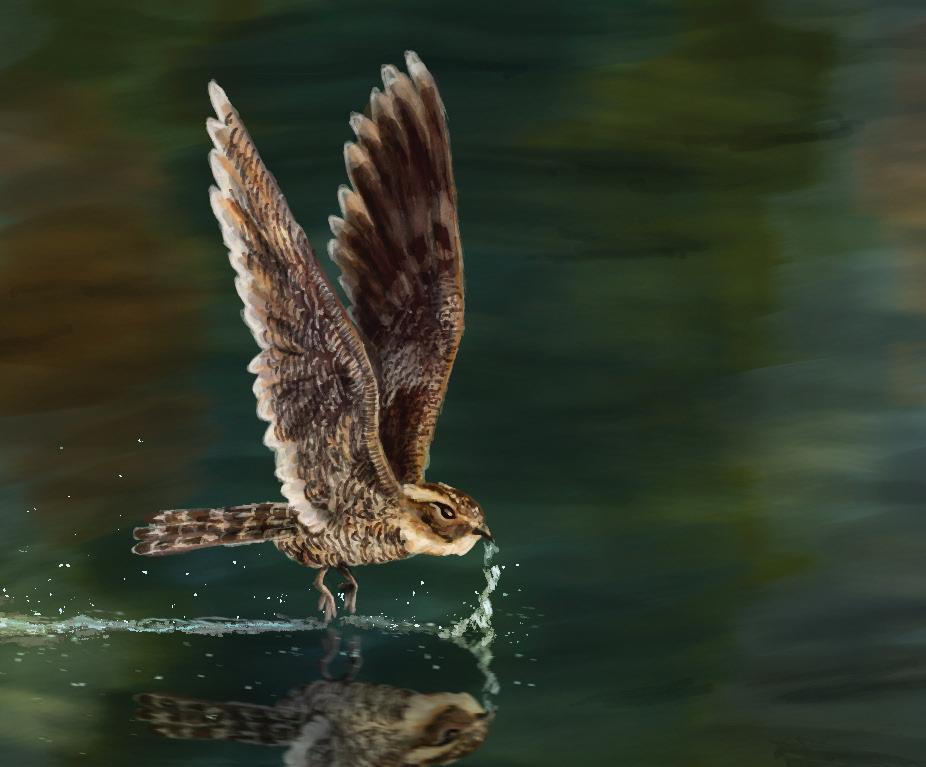
An illustration depicts the lesser nighthawk, which was spotted in Alachua County for the first time since 1999, bringing crowds to its temporary location in Sweetwater Wetlands Park.
Today’s Weather
UF Ukraine Rebuilding Initiative implements new wastewater pump station in Nizhyn
NIZHYN CITIZENS NOW HAVE A MORE RELIABLE WASTEWATER SYSTEM
By Alabama Weninegar Alligator Staff Writer
Thanks to efforts from a group of UF students, a city in Ukraine now has a more reliable and energy-efficient wastewater pump.
The Ukraine Rebuilding Initiative received word Dec. 9, 2025, that the new pump station it sent to Nizhyn, Ukraine, was successfully installed.
URI began in August 2023 under the leadership of cofounder Mikhail Mikhaylov, a 24-year-old UF international studies and political science alumnus. Mikhaylov’s mission was to connect Russian and Ukrainian students at UF to help rebuild communities targeted by war.
Mikhaylov spent a year building a relationship with Gainesville Mayor Harvey Ward to establish Nizhyn as Gainesville's sister city in October 2024.
URI worked with a Ukrainian engineering firm and the Nizhyn City Council. Together, they designed a replacement for their previously aging and unreliable wastewater pump station to ensure the city could avoid a wastewater crisis during the war.
Mikhaylov said the members of URI gained skills that went beyond just engineering while working on the project. They also took on the roles of economists, government officials and diplomats.
“It's not just one element. It's
not just one skill,” Mikhaylov said. “It's different ones that go beyond the sphere of just one student's focus and their area.”
Rylee Jarmolych, a 22-yearold UF civil engineering senior, is the group's engineering team lead. An unreliable wastewater pump, Jarmolych said, poses a big health concern and threatens a contamination disaster, which could impact Nizhyn’s water sources and agriculture.
After the problem was identified, URI received the $10,000 Projects for Peace grant from UF’s Brown Center for Leadership last March. The group allocated the money toward all five divisions of the club: prosthetics, cultural affairs, agriculture, public health and engineering.
With the grant secured, Jarmolych and her team spent nine months coordinating through language barriers, making careful calculations and executing every detail accurately. Jarmolych said this was a time full of challenges but was ultimately rewarding.
As a second-generation Ukrainian American with family in Ukraine, Jarmolych added the experience resonated with her on a deeper level.
“This opportunity to be able to help them has just been something I'm so beyond honored to have had,” she said. “I never really realized I’d be able to impact a city so far from me.”
The new pump will require 43% less energy than the previous system, Jarmolych said — an accomplishment that exceeded the city’s expectations for the project.
Markella Stavrinakis, a 22-year-old UF environmental engineering senior and URI’s environmental engineering lead, worked closely with Jarmolych.
The energy-efficient pump allows the wastewater system as a whole to become more reliable, Stavrinakis said. This prevents future failures during a time when Nizhyn’s energy infrastructure is at risk of being targeted.
Stavrinakis said this project put into perspective how much of an effect she can have as an engineering student.
“Being able to work on a project where you know that it will have a tangible effect is really rewarding,” she said.
Nizhyn Mayor Oleksandr Kodola said the city has seen immediate improvements in Nizhyn with the installation of the system.
The mayor wrote in an email to The Alligator that the system now runs more reliably, reducing the need for emergency responses. He added that these are direct benefits to the city’s public health and environment.
“This support means far more than technical assistance. It represents human connection, trust and shared values,” he wrote. “Knowing that the University of Florida community stands with Nizhyn reminds us that we are not alone.”
URI is continuing its efforts in helping Nizhyn through fundraising in hopes to replace the quality of the city’s water testing equipment.
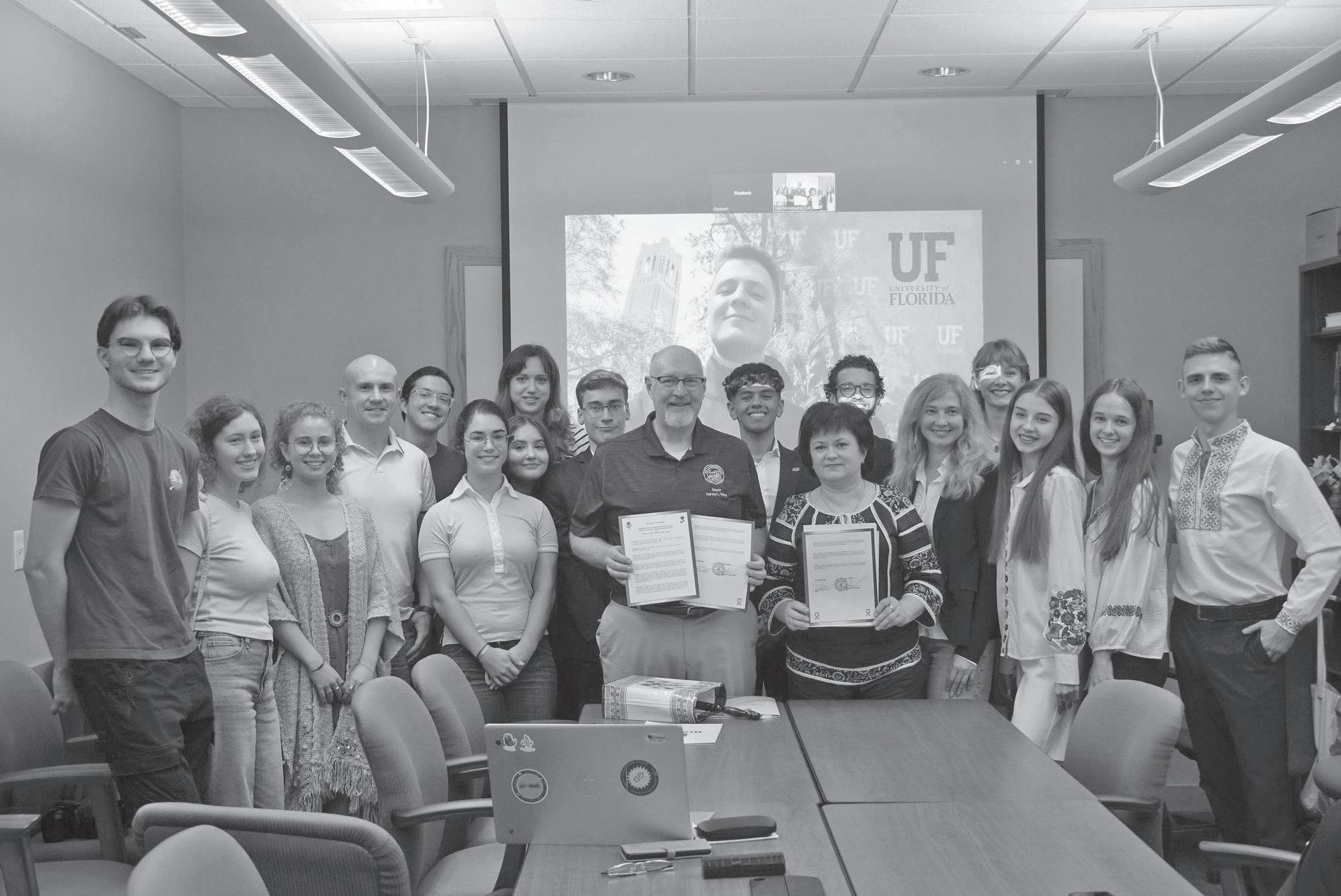
UF Ukraine Rebuilding Initiative members stand with Gainesville Mayor Harvey Ward to mark a sister-city partnership, Thursday, Oct. 31, 2024.
Millhopper Family Dentistry, UF to host free dental clinics in February
THE EVENTS HONOR NATIONAL CHILDREN’S DENTAL HEALTH MONTH
By Lily Hartzema Alligator Staff Writer
Last month, Tashenia Torres went to the dentist after experiencing sharp, excruciating pain in her jaw — a result of the growth of her wisdom teeth. Still, without insurance to afford dental care, she said the clinic wasn’t much help in scheduling an extraction.
“I told them, ‘I don’t have the money, I don’t even have health insurance, so how can I take it out?’” Torres said. “They said, ‘You need to get the money in order to get it taken out,’ and I thought that was just unfair.”
Torres, a 31-year-old Gainesville resident, isn’t the only local who finds dental care inaccessible. An estimated 6 million Floridians struggle or face barriers accessing dental care, according to the Floridians for Dental Access.
Financial barriers leave many unsure how to access the care they need.
“That’s the question: How do you go about it if they don’t provide the necessary things that you need?” Torres said.
In February, Millhopper Family Dentistry and the UF College of Dentistry are hosting free dental clinics to celebrate National Children’s Dental Health Month.
These events provide the Gainesville community access to essential dental care at no cost, targeting those who might face barriers to treatment. By making dental care accessible, both Millhopper Family Dentistry and UF aim to promote long-term oral health, according to the two clinics.
Millhopper Family Dentistry will host its free dental clinic, Care to Share, Feb. 28 beginning at 8 a.m. for the first 100 people on a firstcome, first-served basis. Free dental services include fillings, extractions and cleanings, according to the Care to Share flyer.
The UF College of Dentistry will host its 11th annual Super Sealant Saturday event at the College of Dentistry Feb. 7 from 8:30 a.m. to 1 p.m. The event will offer free dental exams, sealants and fluoride varnishes to children ages 1 to 17, along with educational activities designed to
promote oral health.
Though walk-ins are welcome, it’s highly recommended to sign up for an appointment, according to the College of Dentistry.
Care to Share
After seeing the Care to Share event on Facebook, Torres said she plans to attend to get two teeth extracted — half of the teeth she needs gone. She’ll wait for next year’s event to get the other side extracted, she added.
Torres plans to arrive as early as 1 a.m. on the day of the event to secure a spot. Still, she said she was shocked to hear some prospective patients will camp out the day before.
The free care doesn’t entirely resolve Torres’ worries. She said she’s concerned about what type of medicine she will be given, whether she will need to bring someone with her and how long she will be out of work.
“I’m a bit anxious because I was told that I will have to be out of work for the next couple of days, and that is scary,” Torres said. “I live with people — we need to put food on the table.”
Jessica McMillan, a 42-year-old office administrator at Millhopper Family Dentistry, said the free clinic initiative began in 2010 in response to patients who couldn’t afford routine dental care.
“We wanted to be able to do something to give back,” McMillan said.
McMillan has worked at Millhopper Family Dentistry since 2002 and said she notices the difference in the types of services requested along the years. Early on, she said, many patients requested extraction services. But over the years, more have begun requesting fillings and cleanings.
“To us, it says we’re helping and what we’re doing — that people are needing less extractions, where the tooth is not restorable, and they’re moving to where they just need some fillings or even just cleaning,” McMillan said. “We have noticed that, and we think that that is awesome.”
To make the event possible, McMillan said Millhopper Family Dentistry receives sponsorships and partners with former employees. About 75 volunteers, former and current staff participate to accommodate the high number of patients, she said.
People line up the day before the event to secure a spot, she added,
and volunteers will pass out numbers to the first 100 people until they’re gone.
Alecia McDonald, the 46-year-old owner of Millhopper Family Dentistry, said the initiative began for those who may have sought dental care but were unable to receive it due to qualification restrictions, like not having health insurance.
“We have a large office here in town, and we thought, ‘What better way to give back than to utilize our office?’” McDonald said. “It was a fun way for us to get together with specialists in town and provide work for people with no real qualifications — just kind of, ‘Hey, we’re here. If you’re willing to wait, we’re willing to take good care of you.’”
One of the most rewarding aspects, she added, has been collaborating with other dental specialists and general practice offices.
“It’s been really neat to be a leader in volunteerism,” McDonald said. “Seeing people fired up about helping the community and giving up their day — it’s just a fun camaraderie thing.”
Her experiences hosting the an-
nual event are equally meaningful on a personal level, she added.
“It’s just a good feeling to be able to use your training and your knowledge and work together with your staff to provide a good service for the Gainesville community,” she said.
Super Sealant Saturday
Olga Ensz, a 36-year-old UF clinical associate professor and director of community-based outreach at the College of Dentistry, said dental students started up the initiative.
Ensz teaches a course for dental students in the College of Dentistry that involves community-based public health rotations. Students are able to provide schools and community centers with preventative dental services under faculty supervision.
“There was a dental student, after attending that event, that was really inspired and said, ‘I want to do more for kids in our community and something on a Saturday,’” Ensz said.
The initiative was co-founded by dental students Stephen Obeng and Patrick Fitzgerald in 2015, according to the College of Dentistry.
Close to 200 volunteers helped
the college host the event, Ensz said. Since the initiative began, the event has served over 1,100 children, she added.
The primary goal of the event is to provide accessible dental care and promote awareness through a familyfriendly manner by adding a carnival component, she said. Last year’s theme was “Frozen”; this year’s will be “Toy Story,” she added.
Approximately 40% of the population experiences fear or anxiety of the dentist, according to The Harvard Gazette.
“It’s to help make preventative dental services more accessible for kids,” Ensz said. “It’s also to make it a really positive experience, which is why we always have a fun theme.”
The event allows dental students to gain hands-on experiences while addressing local needs, she said. By hosting it on Saturdays, it’s more accessible for parents who work full time or have busy schedules, she added.
@lilyhartzema lhartzema@alligator.org
Daniela Peñafiel // Alligator Staff
The Millhopper Family Dentistry and UF host free dental clinics in February for the Gainesville community.
Students turn to ChatGPT for medical advice
an unbiased perspective.
Still, she said she wouldn't encourage others to use AI for mental health support. Although she personally has used the tool, she said she wouldn’t encourage it to others.
“I wouldn’t say it’s bad,” she said. “But it’s better if you hear it from a professional psychologist.”
If faced with another situation she didn’t feel comfortable discussing with anyone, she said she’d resort to seeking advice from the chatbot again.
Risks, limitations and safety concerns
Ernesto Escoto, executive director of UF’s Counseling and Wellness Center and a clinical psychologist, said the increasing use of AI for mental health support among students has become apparent within the past year and a half. More students have come into counseling and admitted to having spoken to AI about their issues before seeking professional help.
Escoto acknowledged AI’s appeal: It’s accessible, immediate and offers some degree of confidentiality, he said. Still, he cautioned against equating access with quality care.
“The system starts to reorganize itself around what’s efficient and what’s scalable, and they may not necessarily be looking after what people actually need,” Escoto said.
He said society’s emphasis on efficiency can spill into human relationships, potentially creating distancing or controlling dynamics.
When discussing AI’s risks, Escoto emphasized the stakes involved.
“One death is too many deaths,” he said.
As companies introduce safeguards, Escoto said, AI may be better positioned to serve as a bridge — directing people in crisis to human resources rather than replacing therapists.
Since the COVID-19 pandemic, Escoto said, clinics nationwide have seen fewer in-person visits. His “educated guess,” he said, is that telehealth and AI use have
contributed to the shift.
At UF’s Counseling and Wellness Center, a team is drafting recommendations for clinicians on how AI can be used responsibly, Escoto said, as more students report relying on it. He warned that while AI can simulate connection, it may also deepen loneliness if it replaces real relationships.
Escoto said he believes AI is here to stay.
“My hope is that as they grow in their reach and utilization by the public, is that
we also have a much better understanding of the real benefits of AI, but also the risk associated with AI,” he said.
Looking ahead
Andreas Keil, a UF psychology professor, said AI presents both promise and danger in mental health contexts.
While he has seen research underscore the easy accessibility and other benefits of AI, he has also seen many research papers highlighting that chatbots are not ideal for any kind of psychotherapy.
Keil said he has also read about cases of young people in extreme times of crisis, such as having suicidal thoughts or relationship issues, who receive advice from a chatbot that may not be the advice a psychotherapist would provide.
“I’m sure what will change, though, is we will have available increasingly well-designed, validated software that is dedicated and made by experts to support people’s mental health,” Keil said.
@s_maharaj1611 smaharaj@alligator.org
As large language models increasingly become a part of everyday life, more people have started using chatbots in lieu of human therapists.
Birdwatchers flock to Sweetwater for nighthawk sighting
NIGHTHAWK, from pg. 1
species they have seen in their lifetimes. The bird was a “lifer” for Hardin, or his first time seeing the species in person, although he has seen many common nighthawks. He differentiates between the two by the white bar on their wings — a common nighthawk’s is toward the center of its wing, while the lesser nighthawk’s is closer to the tip.
Last seen in the park Jan. 13, the bird is native to the desert and commonly found in the southwestern U.S., which is why it’s surprising the lesser nighthawk has stayed in Sweetwater Wetlands Park, said Darby Guyn, recreation leader for the City of Gainesville.
Rare bird appearances can happen for a variety of reasons, Guyn said.
Sometimes, extreme weather events or irregular wind patterns drive birds to unfamiliar areas.
Other times, a bird’s internal compass is thrown off, which is what she thinks happened to a second rare bird that was seen at Sweetwater, the groove-billed ani. Another non-native bird, the groove-billed ani was spotted around the same time as the lesser nighthawk. But unlike the nighthawk, it didn’t stick around long.
“It hasn't left,” Guyn said of the lesser nighthawk. “Clearly, it is getting what it needs in this area. Now, when it comes time for
breeding season, I don't know if it's just going to fly or if it's going to stick around. We really have no way of knowing how long this bird is going to be here.”
Guyn and other park staff aren’t sure why the lesser nighthawk arrived in Alachua County in the first place or why it is staying, but it’s not an endangered species and not causing harm to other local wildlife. Guyn is open to planning more after-hours events with the Alachua Audubon Society, in addition to their regular Wednesday Bird Walks collaboration. Climate change is driving many trends in bird populations and migration patterns. eBird tracks the populations of several
species and reports changes in their numbers and locations. Data on the lesser nighthawk’s range indicates that during its nonbreeding season from December to March, it is rarely seen in the U.S. other than in South Florida.
“I’ve seen a number of models that they [eBird] do when they compare their data from 1980 to today, and you can see the change in migration routes,” Guyn said. “You can see that it's happening earlier or later, or it's more widespread or more narrow. So it's definitely happening within bird species. We are seeing some unusual changes.”
Casual observers like Taylor Spangler needed help spotting the lesser nighthawk.
She and her husband visited the park with their relatives, hoping to introduce them to Gainesville’s nature. The bird was an added bonus for her father-in-law, a wildlife photographer.
She was grateful for both the birders and guides who pointed out the hawk.
“They pointed out as it was moving,” Spangler said. “OK, can you see this now?’ ‘Look up,’ or ‘It's flying over to the left or to the right.’ And without that, we would have had a nice evening at the park, but we would not have seen this bird.”
@JulianaDeF58101 jdefillipo@alligator.org
Henry A. Moore // Alligator Staff
Gainesville’s Sunshine State Festival draws crowd to support Florida’s writers
MORE THAN 100 FLORIDA AUTHORS GATHERED IN GAINESVILLE FOR THE SEVENTH ANNUAL EVENT
By Olivia Lofaso Alligator Staff Writer
Pirates, puppets and local writers filled Santa Fe College’s Jackson N. Sasser Fine Arts Hall Jan. 24 for the seventh annual Sunshine State Book Festival, bringing over 150 readers and writers together to celebrate 250 years of literature in Florida.
This year’s theme was “Celebrating Florida’s Literary History: Pirates to Present Day,” inspired by one of the state’s first authors, Sir Francis Drake. The children’s reading space came alive with piratethemed props and children’s book writers from across Florida.
The festival included an awards ceremony for the Sunshine State Teen Lit Awards, organized by the Writers Alliance of Gainesville. The contest challenges middle and high school students across Florida to write an original story about the festival’s theme for cash prizes up to $500.
Jenny Dearinger, the secretary of WAG and creator of the Teen Lit Awards scholarship, said more than 200 applicants participated statewide. She first shared the idea in 2022 with Don Fitzpatrick, an Alachua County Public Schools curriculum specialist.
“He told me when I first started this contest four years ago, he said, ‘You won’t get very many people [students participating] the first couple of years,’” Dearinger said. “It’s amazing how we’ve taken off.”
The festival spotlighted over 100 writers from across Florida. Each author showcased their books, bookmarks and stickers, as well as QR codes visitors could scan to purchase digital books.
Michael Angee // Alligator Staff
Author Debbie Miller sits at her booth during the Sunshine State Book Fair at Santa Fe College in Gainesville, Fla., Saturday, Jan. 24, 2026.
Lana McAra, an author and the president of the Jacksonville chapter of Sisters in Crime, first attended the festival as a visitor before tabling as an author and guest speaker in 2025. She shared her table with a fellow author and friend whom she met at the festival last year.
“You’re not just selling a book today, but you want to make connections with people,” McAra said.
Aspiring author Desiree Camacho, 24, attended with her sister, who also writes books. They learned more about the publishing process while meeting other writers, illustrating the festival’s hope of
supporting the next generation of Florida authors.
“I think it’s good to meet people who have [published their work] and get tips and check out series that are popular,” Camacho said. “It’s great to have for the community.”
While this year marked the festival’s biggest turnout, it did not always begin on such a large scale. Wendy Thortan, the founder of WAG and an organizer of the festival, said the idea began out of necessity. She and a friend had complained about the extensive travel they did for book festivals and writers meetings.
“We’re driving all over the state to hear things about writers,” Thortan said, “so we started the Writers Alliance.”
Marie Q Rogers, the chairperson of the festival, said organizers try to find larger event spaces to accommodate the increase in attendance each year. Their first meeting to plan next year’s festival is already coming up next week.
“It takes a year of planning,” Rogers said. “We have to find the place, the speakers, organize the authors.”
This year’s program included Pamela D. Marshall’s one-woman play about prolific Florida author Zora Neale Hurston and a keynote address by David Morton, an adjunct lecturer in film and history at the University of Central Florida.
The festival held drawings for free books every half hour. Visitors received a sheet from event volunteers upon entering. After visiting 10 author tables, visitors could return their sheet for a chance to win a free book.
For many of the event’s visitors, the festival is more than just browsing books. It’s an opportunity to become inspired and connect with local creatives to celebrate the craft of storytelling.
Richard Alvarez, the 37-year-old owner of small family farm Little Wild Homestead, found the event by chance while en route to a hiking trail in Gainesville. Alvarez said he enjoyed meeting local authors with his family and discovering new reading opportunities.
“We’ve only been here [Gainesville] for five years, and we don’t really know anybody. We live in the woods, so getting to meet people is important. It’s fun,” Alvarez said.
Olivia Lofaso is a contributing writer for The Alligator.
Parents upset after Alachua County Public Schools installs new fence near school
The fence surrounds a Glen Springs Elementary School field used by nearby residents
By Grace Larson Alligator Staff Writer
Each morning, Amaira Caballero walks four children along a busy, four-lane road to school.
While the conditions are unfavorable, the 20-minute walk is the only option she has.
Caballero, a 30-year-old stay-at-home mom, lives in Hidden Oaks, a neighborhood that borders a field sitting on the outskirts of Glen Springs Elementary School. Like other families in the area, she and her kids used to walk through the field to get to school.
On Jan. 5, the Glen Springs Elementary School principal emailed parents about a new fence that would be installed around the field, according to Caballero.
Parents were told the gate would be installed by the end of the week. It was completed the afternoon of Jan. 6, students’ first day back from winter break, Caballero said. Her children, second and third graders, have been diagnosed with autism, ADHD and anxiety. They didn’t walk home from school on their own until the end of last year.
“For me, to let them do things on their own has been kind of hard, more on me than them,” she said.
With their route to school now blocked, the family has faced some challenges. They only have one car, which Caballero’s husband takes to work every day, she said.
Caballero’s previous seven-minute walk to the school now takes 20. She is accompanied not only by her schoolage kids, but also her younger child and another child she babysits.
“My kids know basic sidewalk safety,” Caballero said. “But going down 39[th Avenue] — even if it’s those five minutes that
we have to walk through there — is kind of nerve-wracking.”
Sidewalks less than 4 feet from the road running parallel are considered hazardous student walking conditions under state statute. In the event of a hazardous path, the statute requires the school board to provide transportation for students while the condition is corrected “within a reasonable period of time.”
Caballero has contacted the school about correcting its “safety walk protocol” but hasn’t heard back yet, she said.
Other parents have faced similar challenges following the installation of the new fence.
Paul Cingolani, 64, moved to the Hidden Oaks neighborhood with his wife and two kids over winter break. They were drawn to the area because of the field, which provided the kids with a quick path to school.
They were shocked to find the area closed on their first day of school, he said.
“That’s why I moved here — because that little field in the back … was going to be our own little private entry to school, super safe for our kids,” he said.
The family paid more for the house, excited to have easy access to the school — but now, Cingolani said, they just feel stuck.
To him, the solution is simple: The school board should add a gate that allows students to enter the campus through the field, he added.
Another portion of the newly installed fence, which borders a separate neighborhood, has a gate that can be used to enter and leave the school.
According to Alachua County Public Schools spokesperson Jackie Johnson, the solution isn’t as simple as Cingolani suggests.
“It may be an inconvenience,” she said, “but it’s an in-
convenience that is outweighed by the additional safety that’s provided for the students, staff and visitors at the school.”
The new fencing, which represents a district-wide focus on school safety initiatives, corresponds with recommendations from local law enforcement and security requirements at the state level, Johnson said.
The new enclosed perimeter complies with a Florida bill passed in May 2024, which requires that all access points to the school property remain closed and locked throughout the day.
The district plans to add gates to the field, but they won’t be readily accessible as a route to school — instead offered only as emergency exits.
“There will be two gates that have panic hardware,” Johnson said, “which is basically a push bar so that people can leave the campus in an emergency.”
For 45-year-old Hidden Oaks resident Kenny Silver, the fence represents a problem with school board “overreach.” Silver received no notice for the fence’s installation, he said, finding the gate newly installed upon his return from holiday vacation.
“I get it,” Silver said. “It’s not my property, but I also think there’s tremendous value in offering some green space, and there’s not a lot around.”
Neighborhood kids would go to the field to play, he said. Now, the space sits unused.
He hopes the school will change its decision and add a gate that grants residents access to the field, he said.
@graceellarson glarson@alligator.org
MONDAY, JANUARY 26, 2026
www.alligator.org/section/the-avenue
Meet Georgie the cat, the ‘ambassador’ of Hawthorne Trail
THE ORANGE TABBY GUARDS
THE GAINESVILLE-HAWTHORNE STATE TRAIL FROM HER CUSTOM-BUILT CABIN
By Teia Williams Avenue Staff Writer
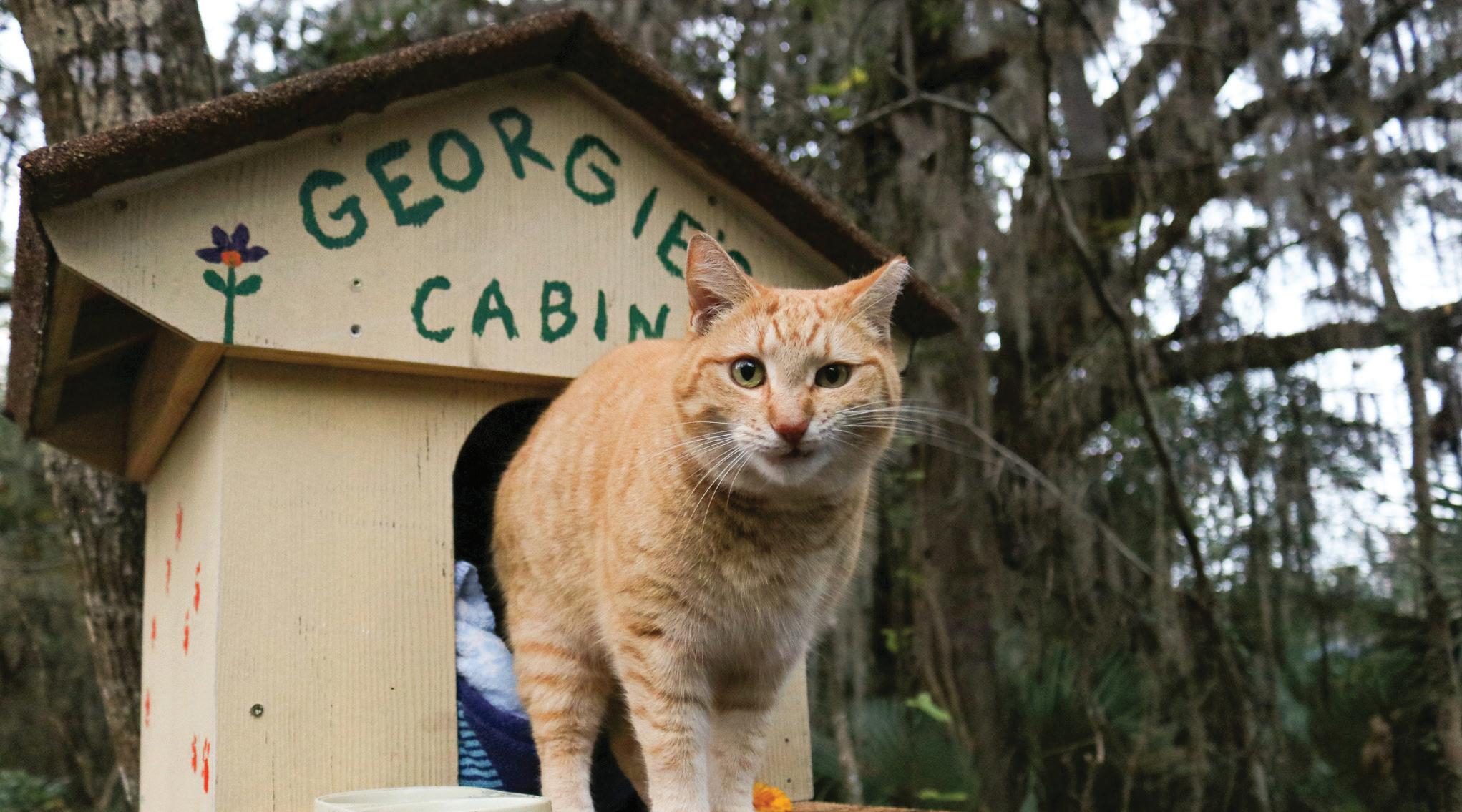
Like many cats, Georgie has a place to sleep, daily meals and a frequently filled water bowl. The difference between Georgie and other cats: She lives in her own cabin off of the Gainesville-Hawthorne State Trail.
The chunky orange cat loves attention but only for a short period of time. She approaches people so they can pet her, but she won’t stay right by them for long. Sometimes, she sits right next to the trail, anticipating her next visitors.
“She’s the ambassador for the Gainesville-Hawthorne Trail,” caretaker Kathy McGlone said.
A few months ago, an anonymous person built a cabin for Georgie, where she’s lived ever since when not roaming the trail.
Her cabin is next to the Robinson Heights neighborhood. About five households take care of the cats in the area and always make sure they are fed.
Before becoming a trail cat, Georgie lived in a house in the neighborhood, McGlone said. In 2023, she migrated to become more of an outdoor kitten, going to different houses in the area for food.
That year, a colony of 14 cats, including Georgie, was spayed and neutered through Operation Catnip, McGlone said. Some of the cats were taken in, and others that wanted to stay outdoors were taken care of from a distance.
MUSIC
Georgie was a special cat from the start — only about one in five orange tabby cats are female. But she also stood out as the cat that never wanted to be around her peers. She liked to be alone, and she didn’t get along with the other cats the same way they did with each other, McGlone said.
Two college students tried to adopt Georgie once, but the cat didn’t enjoy apartment life. Georgie was taken back to the neighborhood, and McGlone put a sign at her spot on the trail. The sign explains Georgie is happy with her life on the trail and tells readers not to adopt her.
Georgie continued to get help from the neighbors after her return to the trail. One of the residents made a heated box for her to keep warm during the winter.
Georgie’s cabin walls are built from wood, and her roof is made of asphalt shingles. In big green letters, “Georgie’s Cabin” is written on the front, in between the painted purple and pink flowers.
Painted paw prints decorate the sides of the cabin. Georgie also has a front porch containing her food bowl. People from the trail this week have added to the cabin. On her porch now sits a yellow flower and a pinecone, left as gifts for Georgie.
Inside her cabin, there are blankets for her to lie on, gifted from someone in the area for Georgie to be cozy.
She was known on the trail before the cabin, but her celebrity status has grown in recent months. Gainesville-Hawthorne State Trail is known for attracting runners, bikers and walkers. Passersby often greet, pet and snap photos of Georgie.
Helping Georgie thrive is a neighborhood effort. The households that look over her all walk on the trail regularly and check in on her frequently.
The coyotes on the trail present a threat to the cats in the area. Eight cats have died as a result of coyote attacks on the trail. To protect Georgie, the residents of the neighborhood ensure Georgie’s food is put away at nighttime. Once, the caretakers tried to get all of the cats inside at night to protect them from the coyotes, but Georgie had other plans, said caretaker Rhonda Felheim. She broke through the screen porch where her caretakers placed her. Georgie’s mother, Torti, another trail cat, also likes to be independent and roam the neighborhood free, Felheim said.
“She is just like her mother,” Felheim said. Devon Richardson, a 25-year-old UF animal science senior, has walked her dog, Jagger, on the trail for a few years and noticed Georgie. She said Georgie is reliable because she is always there.
“[Georgie] is like a great improvement to my mental health. It’s something I looked forward to every day,” Richardson said. “I’m sure it would help other people who’ve been stuck inside studying for exams.”
@teia_williams twilliams@alligator.org
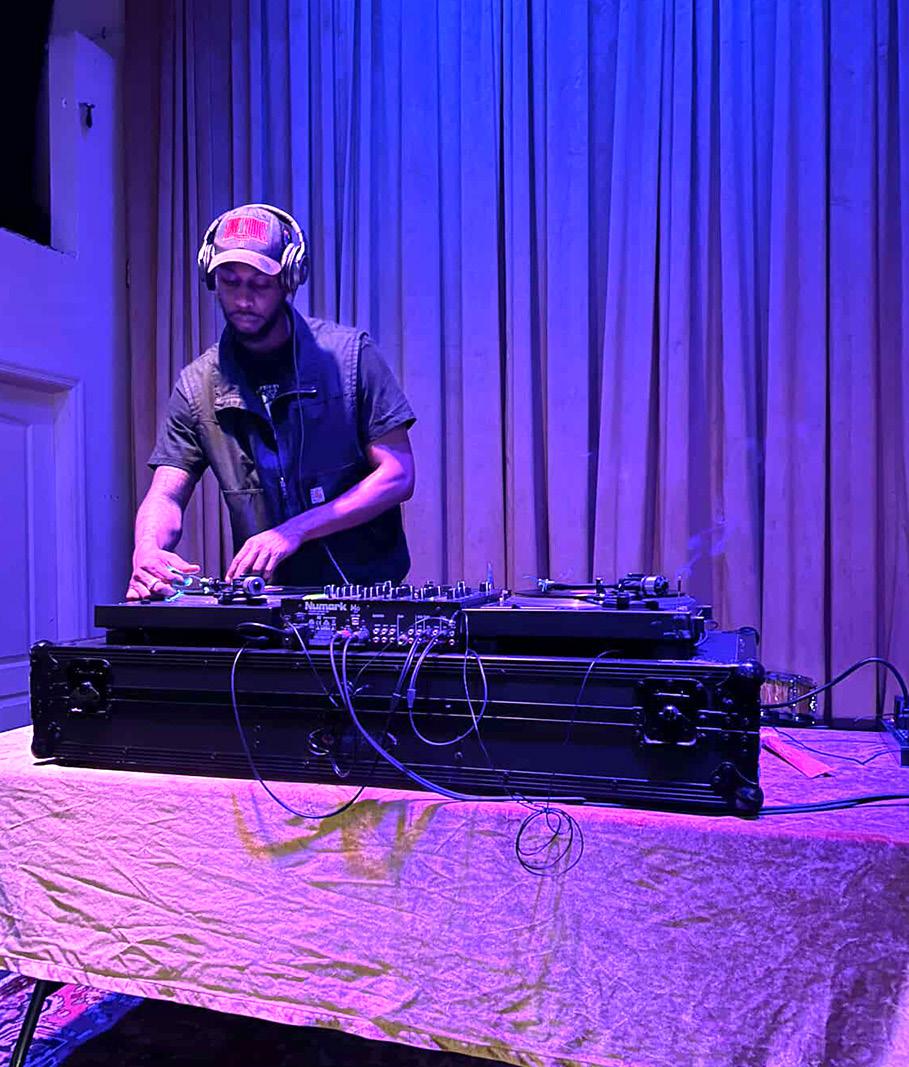
Gainesville DJs ‘blend’ generations of electronic music enthusiasts
LOCAL DISC JOCKEYS OF ALL AGES STRIVE TO MOVE AUDIENCES WITH THEIR MUSIC
By Isabel Kraby & Christopher Rodriguez Avenue Staff Writers
What do a 25-year-old college student, a 37-year-old senior digital designer, a 46-year-old record press operator and a 51-year-old resource coordinator all have in common?
A love of DJing.
To these passionate disc jockeys, their craft is much more than
beatmatching and smooth transitions; it’s fostering connections with crowds and bridging the gap between generations.
Emilio Román
Among the younger demographic of local DJs is Emilio Román, a 25-year-old UF food and resource economics senior. He said Gainesville has the perfect atmosphere to pursue DJing, and many college students seem eager to join the community.
From a Gasparilla rooftop gig to a fraternity house tailgate party, the venues Román performs at don’t matter much to him. What he loves most about DJing is his audiences — getting the crowd to
move through his carefully curated playlists.
“Everyone can learn how to mix, but what really differentiates you between other DJs is your song selection, how you can really test the waters and see the energy of the crowd,” he said.
Román said while there are opportunities for Gainesville residents to launch their DJing pursuits, local DJs aren’t paid adequately. Making a living off the craft in Gainesville, he added, is hardly possible.
Though his sets feature popular house music, Román sticks to his Latino roots and draws a following of Latino listeners. Some of the venues he has played at include
Cantina Añejo, The Range and Downtown Fats.
Still, he and his friends hope to branch out of Midtown and downtown and begin frequenting spaces like cafes and flower shops.
DJ Wax Atom
With over 20 years on Román, 46-year-old Bobby Harper has pursued DJing locally since he was 18. Known as DJ Wax Atom, he enjoys sharing new music through his sets. As his day job, he works as the lead record press operator at Audiodrome in Alachua. He often discovers new tracks digging through hip-hop samples and trudging through bins at local record shops like Sunshine Re-
cords. Focusing on the music of his youth — soul, funk and hip-hop — Harper blends the sounds of the past with the sounds of today.
“I feel like there’s a way that you can bridge the gap between new music and old music that people may not know as well, but there’s a way that you can play them together and have people appreciate both,” he said.
Read the rest online at alligator.org/section/the-avenue.
Caroline Walsh // Alligator Staff Georgie eats food at a cabin built for her on the Gainesville-Hawthorne State Park Trail in Gainesville, Fla., Wednesday, Jan. 14, 2026.
New Santa Fe College basketball coach makes his mark.
more on page 11.
El Caimán
LUNES, 26 DE ENERO DE 2026
www.alligator.org/section/spanish
3 restaurantes venezolanos que no te puedes perder en Gainesville
DESDE AREPAS HASTA CREPES, ESTOS AUTÉNTICOS LOCALES OFRECEN DESAYUNO, ALMUERZO Y CENA
Por Ornella Moreno
Escritora de El Caiman
Los restaurantes venezolanos juegan un papel importante en Gainesville, juntando a las personas a través de la comida tradicional. En los últimos años, más espacios en la ciudad han adoptado formatos accesibles como food trucks y conceptos enfocados en la comunidad. Aquí hay tres restaurantes venezolanos que definitivamente tienes que probar si aún no lo has hecho.
1. Tinker Latin Restaurant
El restaurante, propiedad de Tinker Quevedo y Antonella D’Errico, abrió originalmente como food truck en 2019. Actualmente está ubicado en South Main Street y se destaca por su amplio espacio, ideal para reuniones familiares y encuentros sociales. El restaurante también funciona como sede para eventos grandes como fiestas, watch parties y celebraciones. En 2024, el negocio abrió una segunda sede en Tioga.
Aunque el menú se basa principalmente en la cocina venezolana, también incluye platos de otros países latinoamericanos, como la bandeja paisa, un plato típico de Colombia.
Entre los platos más populares se encuentran distintos tipos de arepas y empanadas, así como opciones más elaboradas como hallacas, chicharrón, breakfast arepas y bistec a caballo. El restaurante ofrece opciones de desayuno, almuerzo y cena.
Roberto Carrero, 22, estudiante de último año de ciencias de la computación de la UF, dijo que Tinker es su restaurante favorito en Gainesville.
“Me gusta la comida, me gusta el ambiente, el local es muy bonito”, dijo Carrero.
También mencionó que aprecia tener comida venezolana en la ciudad, a pesar de que no hay muchos restaurantes venezolanos. Es un buen lugar para venir con amigos, dijo.
2. Stop Venezuela
Stop Venezuela es un foodtruck especializado en perros calientes venezolanos, ubicado en NW Eighth Avenue, que opera todos los días de 6:45 p.m. a 11 p.m.
Objetos culturales venezolanos se exhiben en La
Gainesville, Florida, 23 de enero de 2026.
Stop Venezuela es popular por su “martes promo”, que ofrece un combo de dos perros calientes y una bebida por $9.99.
Pedro González, un cliente frecuente de 35 años, dijo que en Venezuela, su país natal, se pueden encontrar puestos de perros calientes como este.
“Uno llega y comparte con los
muchachos que no conoce pero en ese momento se hacen conocidos”, dijo González.
Su pedido favorito, dijo, es un perro caliente con tocineta y una malta.
3. La Maracucha Restaurant & Creperie
La Maracucha se enfoca en la cocina tradicional de Maracaibo, Venezuela, aunque con el tiempo se ha adaptado para ofrecer platos de distintas regiones del país.
El menú incluye opciones como la arepa de agüita e’ sapo—una arepa tradicional de estilo maracucho— mandocas, empanadas, tequeños, pastelitos y cachapas.
La Maracucha también ofrece una amplia selección de postres, entre ellos crepes, helados, sorbetes, malteadas y smoothies.
El restaurante es propiedad de María Alejandra Puentes y Eros Puentes, ambos de Maracaibo. El proyecto comenzó en 2017 como un food truck en Miami y ahora tienen una sede permanente en W University Ave. Kush Miryala, 22, estudiante de tercer año de ciencias de la computación y economía en UF, visitó el restaurante por primera vez después de ver una promoción que ofrecía 50% de descuento en entradas y postres.
“La ubicación es buena, el ambiente es bueno”, dijo Miryala, y agregó que parece un lugar agradable y que regresaría para probar más de la comida venezolana que ofrecen.
@ornellamorenom omoreno@alligator.org
3 Venezuelan restaurants you can’t miss in Gainesville
EFROM
AREPAS TO CREPES, THESE AUTHENTIC SPACES COVER BREAKFAST, LUNCH AND DINNER
By Ornella Moreno Alligator Staff Writer
Venezuelan restaurants play an important role in Gainesville, bringing people together through traditional food. More spaces in the city are embracing accessible formats like food trucks and community-focused concepts in recent years. Here are three Venezuelan restaurants you definitely have to try if you haven’t already.
1. Tinker Latin Restaurant
The restaurant, owned by Tinker Quevedo and Antonella D’Errico, originally opened as a food truck in 2019. It is currently located on South Main Street and stands out for its large space, ideal for family gatherings and social
Opinions
meetups. The restaurant also functions as a venue for large events such as parties, watch parties and celebrations.
In 2024, the business opened a second location in Tioga.
Although the menu is primarily based on Venezuelan cuisine, it also includes dishes from other Latin American countries, such as bandeja paisa from Colombia.
Among its most popular items are various types of arepas and empanadas, as well as more elaborate dishes like hallacas, chicharron, breakfast arepas and bistec a caballo. The restaurant has options for breakfast, lunch and dinner.
Roberto Carrero, a 22-year-old UF computer science senior, said Tinker is his favorite restaurant in Gainesville.
“I like the food, I like the atmosphere, the place is very nice,” Carrero said.
He also mentioned that he appreciates having Venezuelan food in the city, despite there not being many Venezuelan restaurants. It’s a good place to come with friends, he said.
Problems with the Hamilton School, from a student’s perspective. Read more on pg. 8.
2. Stop Venezuela
Stop Venezuela is a food truck specializing in Venezuelan hot dogs, located on Northwest Eighth Avenue, which operates daily from 6:45 to 11 p.m.
Stop Venezuela is popular for its Tuesday promotions, which offer a combo of two hot dogs and one drink for $9.99.
Pedro González, a 35-year-old frequent customer, said many hot dog stands like this can be found throughout Venezuela, where he is from.
“You arrive and share with people you don’t know, but in that moment, you kind of become familiar with everyone,” González said.
His favorite order, he said, is a hot dog with bacon and a malt beverage.
3. La Maracucha Restaurant & Creperie
La Maracucha focuses on the traditional cuisine of Maracaibo, Venezuela, though over time it has adapted to offer dishes from different regions of the country.
The menu includes items such as the arepa de aguita e’sapo — a traditional Maracaibostyle arepa — mandocas, empanadas, tequenos, pastelitos and cachapas.
La Maracucha also offers a wide selection of desserts, including crepes, ice cream, sorbets, milkshakes and smoothies.
The restaurant is owned by María Alejandra Puentes and Eros Puentes, both from Maracaibo. The project began in 2017 as a food truck in Miami and now operates a permanent location on West University Avenue.
Kush Miryala, a 22-year-old UF computer science and economics junior, visited the restaurant for the first time after seeing a promotion offering half off appetizers and desserts.
“The location is good; the atmosphere is good,” Miryala said, adding that it seems like a pleasant place and that he would return to try more of the Venezuelan food they offer.
@ornellamorenom omoreno@alligator.org
Síganos para actualizaciones Para obtener actualizaciones de El Caimán, síganos en línea en www.alligator.org/section/spanish.
Matthew Quesada // Alligator Staff
Maracucha, en
MONDAY, JANUARY 26, 2026
www.alligator.org/section/opinions
UF students are missing the elections that matter most
As midterm elections approach, with the state primary Aug. 18 and the general election Nov. 3, UF students are consumed by national debates over immigration, ICE and cultural flashpoints at the federal level. But while attention is fixed on Washington, the elections most directly shaping students’ lives are largely overlooked. Unlike federal officials, state policymakers operate with far less visibility and funding, even as their decisions directly govern public universities.
In Florida, power and influence are concentrated in the governor’s office. Who becomes governor has a direct and measurable impact on UF students’ experiences inside and outside the classroom.
The governor appoints 14 members of Florida’s Board of Governors, the body overseeing every public university in the state. This board sets system-wide policy, controls
tuition caps, determines performance funding and decides which academic programs are prioritized or cut. UF answers to this board, and the governor shapes it.
The governor’s influence reaches directly into UF’s top decision-making bodies. Six of UF’s 13 Board of Trustees members are appointed by the governor, with five more appointed by the Board of Governors. Only two seats are held by internal university leadership: the student body president and the chair of the UF Faculty Senate. This means the board responsible for hiring and firing UF’s president, approving budget priorities and guiding campus direction is primarily shaped by the governor and his appointees.
This isn’t abstract power. It shapes tuition, academic offerings and campus priorities in real time.
Students often gravitate toward federal politics because they feel morally urgent and
emotionally charged. But many of the issues dominating national debate are deeply entrenched problems that won’t be solved by one election cycle.
If students want to see tangible changes during their time at UF, they need to start paying closer attention to state and local races that directly affect campus life.
Beyond the governor’s race, Florida’s 2026 ballot includes multiple elections receiving little student attention, despite significantly affecting UF. All 120 seats in the Florida House of Representatives and 20 seats in the Florida Senate are up for election, giving voters influence over the lawmakers who write UF’s budget, set tuition policy and pass higher education laws.
Voters will also decide statewide cabinet offices, including chief financial officer and commissioner of agriculture, which play roles in state budgeting and land-use decisions tied
to university expansion and development.
Alannah Peters opinions@alligator.org
Paying attention to these races is not a rejection of federal politics; it is an acknowledgment of where power actually sits. Students can debate national issues endlessly, but state elections determine the officials who control tuition, funding, governance and policy at UF. If students want their political engagement to produce tangible outcomes during their time here, they need to treat state races as seriously as the national ones.
@alannahpeters777 apeters@alligator.org
The Hamilton School’s blind spots, from the perspective of one of its students
On the fourth floor of the Computer Science and Engineering building is the Hamilton School, a circle of classrooms, offices and old lab spaces reminiscent of a typical college campus building. The Hamilton School, rather than focusing on many of the school’s popular liberal arts pursuits, prioritizes the study of classic literature, timeless political ideologies and the foundations of philosophy.
The Hamilton School aims to emulate a model of education seen in “elite” institutions like Oxford, Harvard and Cambridge. The school hires top-of-the-line professors, like Wall Street Journal columnist and former Yale professor Walter Russell Mead and Jeffrey Collins, the 2021 winner of the Morris Forkosch Prize. The school combines these worldrenowned professors with a teaching style that prioritizes discussion and the creation of thought.
As a student at the Hamilton School, I am blessed with the opportunity to work under some of the brightest minds in political, philosophical, economic and legal theory. For UF students who wish to become experts in those topics or — as Walter Mead put it at the beginning of my first class with him — to win arguments with their parents, this is a great place on campus to do so.
But I’ve noticed an unfortunate trend as my time spent at the Hamilton School increases: The school’s funding mechanisms, professors and a majority of students beget and prioritize conservative American thought. I realize this claim may seem like I’m “jumping the shark” per se; however, I believe it to be instrumental to understanding why and how the newest college at UF conducts itself.
Here are what I would call the “blind spots” of the Ham-
ilton School.
First, the Hamilton School’s conception was not initiated by the university or the students; it was conceived and primarily funded by former UF president and Republican U.S. Senator Ben Sasse, Republican megadonor Ken Griffin, Florida Gov. Ron DeSantis and the Florida GOP. With UF’s recent pledge to political neutrality, how can the Hamilton School rely on funding from politically biased avenues?
Conservatism isn’t inherently a political term. It only defines a desire to preserve tradition and reject certain progressions in thought. Yet it’s become the primary philosophy of the GOP and the American political right. Until the Hamilton School rids itself of its politically backed funding, we can’t be certain our education is legitimized by anything beyond conservative politics.
Second, these dissonances become even louder considering classes such as “Special Topics PPEL (Conservatism)” are paired alongside “The Crisis of Liberalism (Quest 1).” As a supporter of open thought and persistent education, I have no issues with these classes being taught. My issue comes in when two opposing ideologies are pitted against each other dialectically by a college that tells us to form our own thoughts, and these are the only two classes discussing such topics.
How can conservatism merit a “special topic” status, but liberalism, an ideology commonly found on our campus, only merits being talked about as in a “crisis state”? If the Hamilton School is actually keen on replicating the traditional Oxford model, it must treat all ideologies as opposite but equal.
Third, and finally, there is a disconcerting lack of diversity within the college’s faculty. Virtually all of the scholars who teach at the Hamilton School, except for two, are of either American or European descent. Throughout the time I have spent taking courses, I’ve noticed analysis essentially forgets to consider the narratives of systemically excluded people. “Classical” education will certainly include philosophy and literature from the political elites and higher classes. But the truth is, I wasn’t assigned to read a single non-white scholar in any of my introductory courses last semester.
As the professors posit methods on how to read and analyze history and thought, you should consider supplementing their readings with alternate perspectives. A history that fails to remind itself of the suppression of others may allow for the same arguments to be reused today. This is a fate that the politically active reader may not just fear; it’s a fate they may recognize in their day-to-day lives.
I highly recommend taking courses at the Hamilton School. However, if you are interested in exploring one of the coolest academic opportunities on campus, be conscious of the structural and systemic blind spots it presents, and don’t fall victim.
@BySashaMorel smorel@alligator.org
The views expressed here are not necessarily those of The Alligator.
The Alligator encourages comments from readers. Letters to the editor should not exceed 600 words (about one letter-sized page). They must be typed, double-spaced and must include the author’s name, classification and phone number. Names will be withheld if the writer shows just cause. We reserve the right to edit for length, grammar, style and libel. Send letters to opinions@alligator.org, bring them to 2700 SW 13th St., or send them to
FL 32604-2257.Columns of about 450 words about original topics and editorial cartoons are also welcome. Questions? Call 352-376-4458.
How to Place a Classified Ad:
APARTMENT FOR RENT - Furnished 1BR/ 2nd floor, heat/air not central. 10 Minutes to campus 409 SE 14th Pl. Asking $925. Grad students preferred. No drinking, drugs, smoking, pets. 55 & Older. 352-213-5942 1-26-26-2-1
We Buy Vintage Guitar's! Looking for 19201980 Gibson, Martin, Fender, Gretsch, Epiphone, Guild, Mosrite, Rickenbacker, Prairie State, D'Angelico, Stromberg. And Gibson Mandolins / Banjos. These brands only! Call for a quote: 1-833-641-6789 1-26-47-13
● UF Surplus On-Line Auctions ● are underway...bikes, computers, furniture, vehicles & more. All individuals interested in bidding go to: SURPLUS.UFL.EDU 392-0370 12-1-25-15-10
Times Daily Crossword Puzzle
TO UF For Info on ALL Condos for Sale, Visit www.UFCONDOS.COM or Matt Price, University Realty, 352-281-3551 4-20-26-14-5
Los Angeles Times Daily Crossword Puzzle
We Buy Houses for Cash AS-IS! No repairs. No fuss. Any condition. Easy process: Call, get cash offer and get paid. Call today for your fair cash offer: 1-321-603-3026 1-26-11-5
Donate your vehicle to help find missing kids and keep kids safe. Fast free pickup, running or not, 24 hr. response. No emission test required, maximum tax deduction. Support Find the Children Call – Call 1-833-546-7050 1-26-37-12 ¿hablas español? lee el periódico universitario independiente mas grande de estados unidos. You need the money to do what you will Rich at Best Jewelry and Loan has the cash for those bills
1-26-26-3-13
CASH PAID FOR HIGH-END MEN'S SPORT WATCHES. Rolex, Breitling, Omega, Patek Philippe, Heuer, Daytona, GMT, Submariner and Speedmaster. These brands only! Call for a quote: 1-833-641-0211 1-26-33-13
? Submit your ad today! www.alligator.org/classifieds
NEEDED HOUSE-SITTER FOR FAMILY DOGS McIntosh, FL. Needed March 30th - April 15th. Spend the nights at the house and be comfortable with multiple dogs. $1200. Call 352-207-2717 or heronwesleyd@yahoo.com 2-23-26-7-14
SOUTHEAST CAR AGENCY is looking for full/part-time car washers. Must have good driving record. Please come fill out an application in person 310 NE 39th Ave Gainesville, FL 32609 2-23-26-7-14
15 Services
YOUR HOME from pests safely and affordably. Roaches, Bed Bugs, Rodent, Termite, Spiders and other pests. Locally owned and affordable. Call for a
of
or
1-833-542-1732 Have
when calling! 1-26-93-15 When you're stuck out in Oz and you need cash to get home, click your heels three times and think of Best Jewelry and Loan. 523 NW 3rd Ave 352-371-4367 4-20-14-15
● Affordable RV Camping Near Campus! ● Convenient location just minutes from UF. Safe, quiet, perfect for game day weekends. Water, electric, and Wi-Fi. Reserve your spot today! 352-372-1026 katesfishcamp.com Book Early - Limited Spots! 12-1-25-15-15
● ● ● PLAY PAINTBALL ● ● ● Wayne’s World of Paintball 4841 S. Pine (Hwy. 441) Ocala, FL 352-401-1801 www.waynes-world.com 4-20-26-14-21
OPERATION CATNIP
DRUG PROBLEM? WE CAN HELP!
24 HOURS 7 DAYS CALL NARCOTICS ANONYMOUS 352-376-8008 www.uncoastna.org pr@uncoastna.org
Need CPR Training?
(352) 727-4733 www.GatorCPR.com CNA Prep Classes from GatorCNA.com 4-20-86-14-16
ATTENTION OXYGEN THERAPY USERS! Discover Oxygen Therapy That Moves with You with Inogen Portable Oxygen Concentrators. FREE information kit. Call 1-833-661-3729 1-26-115-16
HIV ANTIBODY TESTING
Alachua County Health Dept. Call 334-7960 for app’t (optional $20 fee)
BATH & SHOWER UPDATES in as little as ONE DAY! Affordable prices - No payments for 18 months! Lifetime warranty & professional installs. Senior & Military Discounts available. Call: 1-833-754-2465 1-26-86-15 Submit your ad today! www.alligator.org/classifieds
the code to
4.
SUBMIT YOUR AD TO ONE OF THE FOLLOWING CATEGORIES TODAY!
5.
6.
7.
1. HISTORY: When did the Easter Rising insurrection take place in Ireland?
2. GEOGRAPHY: What is the capital of India?
3. MEDICAL TERMS: What is a common name for lateral epicondylitis?
4. MOVIES: The "Back to the Future II" characters travel forward in time to which year?
5. LITERATURE: What color is the badge of courage in Stephen Crane's novel about the Civil War?
6. GAMES: How many points is the center red bullseye on a dartboard worth?
7. ANIMAL KINGDOM: What is a group of floating otters called?
8. AD SLOGANS: Which car company used the slogan "Drive your dreams"?
9. TELEVISION: What is husband Darrin's profession in the "Bewitched" sitcom?
10. SCIENCE: What part of the brain controls hunger?
Trivia Test Sports Quiz
2. The
3. Which U.S. state's legislature passed Act 130, commonly called the 1936
Attention: VIAGRA and CIALIS USERS! A cheaper alternative to high drugstore prices! 50 Pill Special - Only $99! 100% guaranteed. CALL NOW: 1-877-349-1243 1-26-15-16
STOP OVERPAYING FOR HEALTH
INSURANCE! Reduce premiums and out-ofpocket costs while getting the coverage you need! Call now for a competitive free quote. 1-877-351-3442. Plus... Income based government subsidies are available for those that qualify! 1-26-15-16
Planning an event? Let people know today! www.alligator.org/classifieds District 2 – North Florida Al-Anon Family Groups Help for the family and friends of alcoholics Find a local Al-Anon Meeting at our website: alanonfla2.org 12-1-15-16
MONDAY, JANUARY 26, 2026
www.alligator.org/section/sports
WOMEN'S BASKETBALL
Florida’s ‘big 3’ lead the way after first SEC win
MCGILL, REYNOLDS AND O’NEAL COMBINE SCORING, LEADERSHIP AND CHEMISTRY
By Isis Snow Sports Writer
The muffled uproar of fans inside Exactech Arena stood in contrast to the atmosphere in the Gators’ locker room following their first Southeastern Conference win of the season. While the result was welcomed, the response was measured rather than celebratory.
“We’re proud of ourselves for the fight, from the end to the beginning, but it’s expected,” junior guard Laila Reynolds said This victory strengthened a foundation the Gators are still constructing as they work toward their long-term goals. Rather than a defining moment, it represented another step in a longer process for the young roster establishing its identity in conference play.
Against Missouri, the Gators (13-8, 1-5 SEC) found a breakthrough. The team earned its first conference win of the season against the Tigers (13-9, 1-6 SEC) Jan. 16 in the Exactech Arena. At the center of Florida’s progress is a trio — Reynolds, Liv McGill and Me’Arah O’Neal — that has become increasingly influential as conference play has unfolded.
Reynolds brings experience and stability, often stepping in when Florida needs a timely basket.
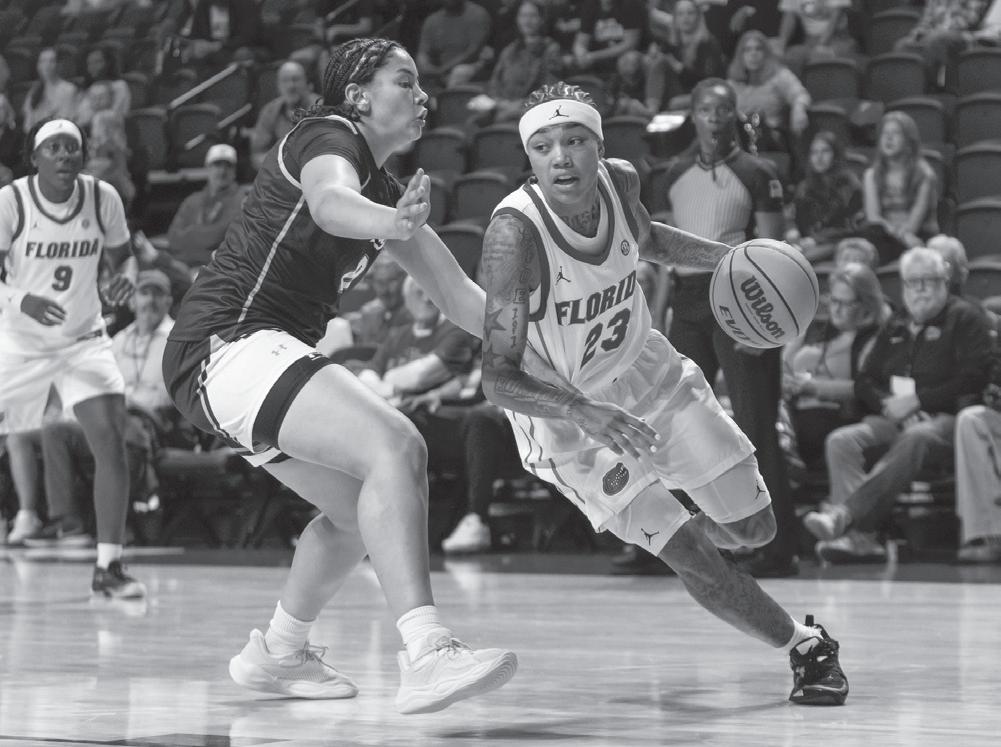
Sophomore guard McGill leads the group as Florida’s top scorer, setting the pace on both ends of the floor.
And sophomore forward O’Neal provides a presence in the paint while also stretching defenses with her ability to shoot from beyond the arc.
Their impact goes beyond individual production. The trio has developed a connection that allows them to play off of one another, particularly in late-game situations where communication and trust are critical.
“When people think about Florida, they think of us,” McGill said.
MEN'S BASKETBALL
Nov. 3, 2025, in Gainesville, Fla.
That chemistry has been essential in conference play, where Florida has faced the physicality and pace that define the SEC.
“I think the whole world knows that the SEC is the best conference,” McGill said. “Everybody’s strong, everybody’s fast.”
So far, Florida has been at the forefront of playing powerful opponents. Three of the Gators’ last six opponents were ranked. UF’s first two games that opened conference play were against then-No. 23 Tennessee (13-3, 5-0 SEC) and then-No. 3 South Carolina (19-2, 5-1 SEC).
In both of those contests, Florida remained on the heels of its challengers into the final 10 minutes, underscoring a pattern that has followed the team through the early portion of SEC play.
“We’re right there in all those games,” Reynolds said.
“We’ve been working on just fighting those last little bits, those last little minutes.”
But due to slow starts and inconsistency, the Gators continued to fall short. Despite the results, each member of Florida’s core has embraced a defined role as conference play has progressed.
Reynolds has embraced that responsibility, using her aggressiveness to create offense when possessions tighten late. Her ability to attack the basket has become an important element for a Florida team learning how to close against elite competition. In conference play, she averages 1.2 points and 3.8 rebounds per game.
McGill’s role extends beyond scoring. As Florida’s leading scorer, she has also assumed leadership responsibilities on the defensive end, where consistency and effort are demanded on every possession. She’s averaging 21.3 points, 5.7 rebounds and 5.3 assists in SEC play.
She said she’s focused on “taking every possession at a time like it’s the game winner.”
O’Neal’s focus has been on communication and maintaining a forward-looking mindset as she adjusts to the SEC's physicality and pace. Over the last six games, she is averaging 13.3 points and five rebounds.
She chose Florida over LSU, her father’s alma mater, citing a stronger connection with the coaching staff as a key factor in her decision. That bond has only deepened on the court, contributing to the close relationship she shares with McGill and Reynolds.
“Just to play with two talented people, it’s a wonderful experience,” O’Neal said. “You’re constantly learning.”
Florida continues to prepare for its next challenge against LSU on Monday at 8 p.m. in the Pete Maravich Assembly Center. The upcoming matchup represents another test against one of the conference’s established programs and an opportunity to measure the Gators' growth.
@isis_snoww isnow@alligator.org
In his second season at Santa Fe College, coach Ritzdorf has found his rhythm
THE NEW MEN’S BASKETBALL COACH IS OFF TO A WINNING START TO THE 2025-26 SEASON
By Lilianne Fernandez Sports Writer
Following the retirement of Santa Fe College basketball head coach Chris Mowry, coach John Ritzdorf was hired in the 2024-25 season to continue Mowry’s 21-year legacy.
Named head basketball coach on May 10, 2024, Ritzdorf came from Central Community College in Columbus, Nebraska, where he was a three-time Region 9 Coach of the Year.
During his first season at Santa Fe, Ritzdorf led the team to an 11-20 record, recruited top local prospects and brought the team just one game shy of a playoff spot.
Now, the Saints stand at an impressive 14-5 record midway through the 2025-26 season as of Jan. 25. Last season, they averaged 72.8 points per game, and as of Jan. 20 of this sea-
son, they are scoring 88.2 points per game on average.
“This year, he has really gotten to put his feet down, and he has just been able to help us more,” freshman guard Palmer Walton said.
Walton said last season was difficult because it was a new school for Ritzdorf. But now, he said, the coach has found his groove.
Ritzdorf agreed the team made progress as the 2024-25 season went on. After a difficult start to the season, which included injuries and adjusting to a new coach, the players still managed to improve.
“The fact that we really improved throughout the season and ended up being that close to making the postseason was a moment where I really felt like we had the program going in the right direction,” Ritzdorf said.
While the team may have had a rough start during Ritzdorf’s first season, coaches and players worked hard to finish the season off right.
At the end of the 2024-25 season, the Saints had an All-Florida College System Activities
Association First Team selection. Five players signed to play at four-year schools, and four became FCSAA Division I Men's Basketball Player of the Week athletes, an award given to players with outstanding performances.
Ritzdorf said he sees the job as a rewarding experience. He appreciates seeing his players graduate, advance to four-year schools and fit into their new environments, he said.
Between walk-ons and recruits, 12 new players joined the team this season.
Going into his second season, Ritzdorf no longer has to endure the off-court demands that come with being a new addition.
Last season, the Saints lost to Florida Gateway College twice, once at home. This year’s team beat Florida Gateway 84-71.
“Looking back 12 months ago, we were getting blasted by this team,” Ritzdorf said. “So that was kind of a moment where it's like, hey, we have come a long way, and we can be proud of the things that we've accomplished.”
Ritzdorf said he hopes to continue to watch the team flourish.
Alex Pierre-Louis, an 18-year-old business major and freshman guard, said he bonded with Ritzdorf because they were both new to Santa Fe.
“Since it is new to him, and it is also new to me, it makes me feel as though we're both new to this, and it just makes me feel more comfortable,” Pierre-Louis said.
Moses Horne, a 20-year-old business major and sophomore guard, said he appreciates how Ritzdorf works with the team to constantly do better.
Horne said Ritzdorf always ensures he corrects what went wrong after a game loss. The players have specifically worked on keeping their momentum in the second half.
Horne said he likes Ritzdorf’s winning attitude.
“He cares to win,” Horne said. “That's big for me, honestly — just caring to win.”
@ltfernandez8 lfernandez@alligator.org
us for updates For updates on UF athletics, follow us on Twitter at @alligatorSports or online at www.alligator.org/section/sports.
Ryan Friedenberg // Alligator Staff
Florida guard Liv McGill (23) drives to the basket during a NCAA college basketball game against North Florida, Monday,
Rueben Chinyelu etches career-best season amid Florida’s tough slate
THE JUNIOR CENTER ADDED OSCAR ROBERTSON NATIONAL PLAYER OF THE WEEK TO HIS LIST OF RECENT ACCOLADES
By Ava DiCecca Sports Writer
One percent.
While that’s the benchmark Florida center Rueben Chinyelu said he’s excited to improve in each aspect of his game, his growth has been far greater.
“I'm proud of everything,” he said. “Just getting better 1% in each aspect is a beautiful thing. I'm just enjoying it.”
Chinyelu exited last basketball season as a national champion and a full-time starter, but he ceded the spotlight to the main faces of the nation’s best squad. Behind Florida’s renowned veteran backcourt and then-sophomore forwards Alex Condon and Thomas Haugh, Chinyelu had a quieter but significant impact.
The Enugwu-Agidi, Nigeria, native averaged 6 points and 6.6 rebounds in his sophomore campaign and amassed four double-doubles across the season. He was one of only five players in Gator history to start 40 games in a season and was second on the team in boards.
“One of the greatest moments of my life has been winning a champi-
onship with my brothers,” he posted on social media. “That’s a memory I’ll cherish forever and an experience I’ll always hold close to my heart.”
As a transfer from Washington State who averaged 4.7 points and five rebounds across 35 games played in his freshman season, his commitment to growth was evident.
After a solid sophomore year, Chinyelu decided to declare for the NBA draft April 17, 2025, to take his career to the next level.
Despite testing out the waters of professional basketball for about a month, he announced his decision to return to Florida via social media May 19. With the return of Condon and Haugh as major players in the national championship as well, the trio quickly established themselves as one of the most dominant frontcourts in the nation.
With 6-foot-10 Chinyelu at the forefront, the Gators rank No. 1 in the nation in rebound margin and offensive rebounds per game, largely due to their size advantage.
While Florida’s combined frontcourt has been touted, Chinyelu’s individual accomplishments this season have not gone unnoticed, both in Gainesville and across the nation.
"He's playing so well,” sophomore guard Boogie Fland said Jan. 14. “Just look at the production, look at the level he's playing."
Beyond the recognition close to home, Chinyelu has been recognized twice nationally since his standout performances against Oklahoma and
Florida center Rueben Chinyelu (9) forces a turnover by Auburn guard Elyjah Freeman (6) during the second half of an NCAA college basketball game against Florida, Saturday, Jan. 24, 2026, in Gainesville, Fla.
Vanderbilt.
Chinyelu logged 20 points and 10 rebounds in the win at then-No. 10 Vanderbilt on Saturday, recording a 16-point second half. The performance followed his 19-point, 12-rebound outing at Oklahoma Jan. 13.
The Monday following the win, Chinyelu earned his first-ever conference accolade, SEC Player of the Week. He was the second Gator to receive the distinction this season after Haugh in November. Just two days later, he was named the Oscar
a piece of the documentation of his success in the Gators program. Following his 15-point, 21-rebound showing in Florida’s 79-61 win over LSU, he became the first Gator since Chip Williams in 1975 and the sixth in program history to have multiple career 20-rebound games.
He is also well on track to be the first Gator in 50 years to average a double-double. So far this season, he’s averaged 11.9 points and 11 rebounds per game. He recently logged four straight double-doubles, a streak that was just broken after a slight dip in production in Saturday’s loss to Auburn.
Recently, he’s found success beyond his dominance on the glass, drawing fouls and getting to the line. In the Gators’ three games before facing Auburn, he took 21 free throws, including 15-straight makes, his career best.
Across the season, he’s logged 11 double-doubles, almost tripling his total from last year.
Robertson National Player of the Week, further showing his impact.
The accolades, though, are just a small part of the focus.
“The most important thing is make sure that I'm enjoying the game with my teammates,” he said. “Whatever it takes, I'm just going to go out there and do it, so it's a beautiful thing to see that I'm shedding light towards that part, and something that you got to be proud of the moment and enjoy it.”
The national splash has been just
“He’s just really come into his own,” head coach Todd Golden said after the win against LSU. “He just impacts the game so well defensively and on the glass that he’s become a real stalwart for us in the front court.”
Chinyelu and the Gators travel to Columbia to take on South Carolina (11-9, 2-5 SEC) next on Wednesday at 9 p.m. EST.
@avadicecca24
adicecca@alligator.org
Wine Down
Thursday, January 29, 6 – 9 pm
Wine down with a performance by DJ Zion. Free lite bites and desserts, along with wine and beer.
Museum Nights
Thursday, February 12, 6 – 9 pm
Celebrating Africa!
Experience the Harn’s annual celebration of arts in Africa and beyond. Join us for dance performances led by Professor Rujeko Dumbutshena and live music from drum ensemble, Pangea; hands-on art activities based on African traditions; light bites and refreshments