www.alligator.org
We Inform. You Decide.
MONDAY, JANUARY 12, 2026
VOLUME 120 - ISSUE 16 Not officially associated with the University of Florida
Published by Campus Communications, Inc. of Gainesville, Florida
Some UF Venezuelan students have new hopes of returning home. Others aren’t so sure. MANY WEIGH FAMILY TIES, STABILITY AND THE OPPORTUNITIES EACH COUNTRY OFFERS
By Dulce Rodriguez-Escamilla Alligator Staff Writer
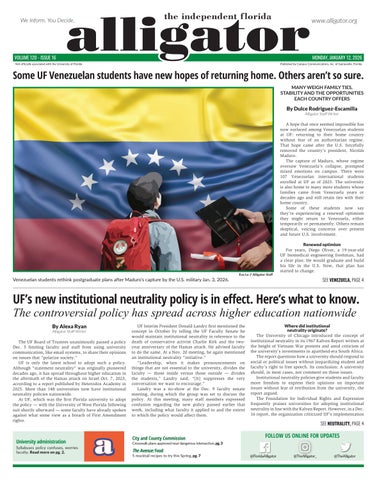
A hope that once seemed impossible has now surfaced among Venezuelan students at UF: returning to their home country without fear of an authoritarian regime. That hope came after the U.S. forcefully removed the country’s president, Nicolás Maduro. The capture of Maduro, whose regime oversaw Venezuela’s collapse, prompted mixed emotions on campus. There were 107 Venezuelan international students enrolled at UF as of 2025. The university is also home to many more students whose families came from Venezuela years or decades ago and still retain ties with their home country. Some of these students now say they’re experiencing a renewed optimism they might return to Venezuela, either temporarily or permanently. Others remain skeptical, voicing concerns over present and future U.S. involvement.
Venezuelan students rethink postgraduate plans after Maduro’s capture by the U.S. military Jan. 3, 2026.
Eva Lu // Alligator Staff
Renewed optimism For years, Diego Oliver, a 19-year-old UF biomedical engineering freshman, had a clear plan: He would graduate and build his life in the U.S. Now, that plan has started to change.
SEE VENEZUELA, PAGE 4
UF’s new institutional neutrality policy is in effect. Here’s what to know. The controversial policy has spread across higher education nationwide By Alexa Ryan Alligator Staff Writer
The UF Board of Trustees unanimously passed a policy Dec. 5 limiting faculty and staff from using university communication, like email systems, to share their opinions on issues that “polarize society.” UF is only the latest school to adopt such a policy. Although “statement neutrality” was originally pioneered decades ago, it has spread throughout higher education in the aftermath of the Hamas attack on Israel Oct. 7, 2023, according to a report published by Heterodox Academy in 2025. More than 148 universities now have institutional neutrality policies nationwide. At UF, which was the first Florida university to adopt the policy — with the University of West Florida following suit shortly afterward — some faculty have already spoken against what some view as a breach of First Amendment rights.
SPORTS/SPECIAL/CUTOUT
University administration Story description finish with comma,
Syllabuses policy confuses, worries pg# faculty. Read more on pg. 2.
UF Interim President Donald Landry first mentioned the concept in October by telling the UF Faculty Senate he would maintain institutional neutrality in reference to the death of conservative activist Charlie Kirk and the twoyear anniversary of the Hamas attack. He advised faculty to do the same. At a Nov. 20 meeting, he again mentioned an institutional neutrality “initiative.” “Leadership, when it makes pronouncements on things that are not essential to the university, divides the faculty — those inside versus those outside — divides the students,” Landry said. “[It] suppresses the very conversation we want to encourage.” Landry was a no-show at the Dec. 9 faculty senate meeting, during which the group was set to discuss the policy. At this meeting, many staff members expressed confusion regarding the new policy passed earlier that week, including what faculty it applied to and the extent to which the policy would affect them.
Where did institutional neutrality originate? The University of Chicago introduced the concept of institutional neutrality in its 1967 Kalven Report written at the height of Vietnam War protests and amid criticism of the university’s investments in apartheid-era South Africa. The report questions how a university should respond to social or political issues without jeopardizing student and faculty’s right to free speech. Its conclusion: A university should, in most cases, not comment on those issues. Institutional neutrality policies give students and faculty more freedom to express their opinions on important issues without fear of retribution from the university, the report argued. The Foundation for Individual Rights and Expression frequently praises universities for adopting institutional neutrality in line with the Kalven Report. However, in a Dec. 16 report, the organization criticized UF’s implementation
SEE NEUTRALITY, PAGE 4 City and County Commission
FOLLOW US ONLINE FOR UPDATES
Crosswalk plans approved near dangerous intersection, pg. 3
The Avenue: Food
5 mocktail recipes to try this Spring, pg. 7
@FloridaAlligator
@TheAlligator_
@TheAlligator
2 ALLIGATOR MONDAY, JANUARY 12, 2026
FloridaToday’s schoolsWeather won’t enforce controversial syllabuses rule until Summer, state says The new rule requires faculty to publicly post syllabuses 45 days before classes begin By Alabama Weninegar Alligator Staff Writer
Faculty members across Florida public universities and state colleges are preparing to comply with a new regulation requiring them to publicly post their syllabuses and class materials 45 days before the semester begins. But confusion remains over when and how the rule will be enforced. Although the law was approved two months ago and initially set to take effect during the Spring ‘26 semester, the 45-day requirement won’t be enforced until Summer 2026, the Florida Board of Governors wrote in an email to The Alligator Jan. 8. The board passed the policy in November 2025. It obligates all faculty within Florida universities and colleges to post their syllabuses 45 days before the semester starts and keep them publicly accessible for at least five years. The purpose of the regulation, the board wrote, is to allow students greater transparency so they can properly evaluate their courses before registering. But critics say the rule is designed to chill academic freedom, allowing the public to police classroom content. The regulation requires syllabuses and textbooks to be searchable by the general education status of their course. Syllabuses must include the course curriculum, required and recommended textbooks and materials, student expectations and performance evaluation methods. State colleges are also affected by the change — though, like the university system, details of its implementation remain unclear. The Department of Education, which governs state colleges across Florida, did not respond to a request for comment on when dates of implementation are expected after multiple emails and phone calls. Regardless, Santa Fe College plans to comply by the Fall
semester, wrote Shawn Jenkins, the college’s communications manager, in a Jan. 6 email to The Alligator. As faculty navigate the inconsistent timeline, with universities giving mixed guidance on when syllabuses must be finalized and posted, many faculty are still raising concerns about the content of the policy itself. Some say they’re unsure how much leeway they’ll have once enforcement begins. Anna Peterson, a 62-year-old UF religion professor, was initially confused by the policy. She believes the necessary information is already accessible to students. One of the most problematic aspects of the policy, Peterson said, is not knowing if she’ll be restricted from modifying class content to represent current events that carry relevance to her class. She cited a past class in which she rearranged content after the Paris bombings so students could apply what they had learned in class to current events, a change she said was valuable. “One of the things we’re told is that what we’re teaching should be relevant and should help students prepare for professions and in graduate school, etc., so that requires some flexibility,” Peterson said. Robert Cassanello, the state president of higher education union United Faculty of Florida and an associate professor at the University of Central Florida, doesn’t think the legislation is about transparency, he said. “Lawmakers are not trying to create a standard of open access; they’re doing this because they understand very well that professors will feel targeted,” Cassanello said. “Professors will feel intimidated, and they will be more circumspect as a result of this.” He has no issue with putting his class materials online, he said, but he believes it will interfere with the teacher-student relationship.
Correction A staff writer for The Independent Florida Alligator committed an act of apparent journalistic fabrication in a story about eating disorder resources that appeared in print Dec. 1, 2025. Managing editors addressed the issue in an editorial published on our website Dec. 17, which you can find on Alligator.org. The Alligator deeply regrets the errors published in the story, which did not meet our journalistic standards. As an independent, student-run newsroom, we pride ourselves on providing trustworthy information to the UF, greater Gainesville and Alachua County communities. We apologize to our readers for breaking that trust, and we look forward to rebuilding it.
Conversations about course content should remain between the student and the professor, he said, and the information shouldn’t be publicly shared online. In November, UFF and the Florida Education Association challenged the policy through a petition to determine its invalidity, arguing it represents an unjustified use of legislative authority. The FEA is now scheduling depositions, meaning it is awaiting the opportunity to move forward once its hearing takes place. Andrew Spar, the president of the FEA, views this policy as a way to censor trained professors within higher education. “We think this is a major overreach, and logistically, it doesn't even make sense,” he said. Spar added the FEA believes the Board of Governors is exceeding its authority by implementing the policy. Only the state legislature, not the board, would have the power to pass a law of this scope, he said. Graduate students are also expressing concern. Cassandra Urbenz, a 25-yearold UF design and visual communications graduate student, works as co-president of UF Graduate Assistants United. Urbenz said she has already noticed fear within the graduate assistant community due to the policy. Syllabuses typically contain the names of the student assistants teaching the course, as well as faculty members. Urbenz said she believes passing laws like this raises the possibility of student assistants receiving public backlash after syllabus information is posted online. “We have some students who are extremely concerned and erring on the side of caution,” she said. While some faculty say the lack of clarity has caused anxiety and fear, others argue the policy, despite its unclear timeline, will benefit students without threatening academic freedom. Stan Kaye, a 68-year-old professor emeritus and former member of UF’s chapter of the UFF union, taught and ran the graduate theater program in design until retiring last year. Kaye said he doesn’t believe the policy infringes on what a teacher can and can’t teach. He also believes this rule directly benefits students by increasing transparency within course content. Allowing students the ability to compare the interests of faculty members and the distinction of courses this far in advance is only one of the advantages to the new policy, he said. “I don't think it harms — I think it's great,” he said. “Transparency.” @AlabamaW40513 aweninegar@alligator.org
VOLUME 120 - ISSUE 15
ISSN 0889-2423
Not officially associated with the University of Florida Published by Campus Communications Inc., of Gainesville, Florida
NEWSROOM:
Editor-In-Chief
352-376-4458 Zoey Thomas, zthomas@alligator.org
Engagement Managing Editor
Megan Howard, mhoward@alligator.org
Digital Managing Editor
Sara-James Ranta, sranta@alligator.org
Senior News Director Enterprise Editor Metro Editor
Pristine Thai, pthai@alligator.org Vera Lucia Pappaterra, vpappaterra@alligator.org
Bailey Diem, bdiem@alligator.org
University Editor
Sofia Meyers, smeyers@alligator.org
Opinions Editor
Sofia Bravo, sbravo@alligator.org
the Avenue Editor
Corey Fiske, cfiske@alligator.org
El Caimán Editor
Avery Parker, aparker@alligator.org
Sports Editor Assistant Sports Editor Multimedia Editor Assistant Multimedia Editor Copy Desk Chief Editorial Board
DISPLAY ADVERTISING
Ava DiCecca, adicecca@alligator.org Max Bernstein, mbernstein@alligator.org Noah Lantor, nlantor@alligator.org Bayden Armstrong, barmstrong@alligator.org
Pristine Thai, pthai@alligator.org Zoey Thomas, Sara-James Ranta, Megan Howard, Pristine Thai 352-376-4482
Advertising Office Manager
Cheryl del Rosario, cdelrosario@alligator.org
Sales Representatives
Paige Montero, Simone Simpson, Jasmine Chavez, Andrew Han, Makenna Paul, Sofia Korostyshevsky, Lilly Schneider, Ashley Demir, Daniel Sanchez
Sales Interns
Angelina Rota-Ono, Juliana Arbelaiz, Sofia Morales-Guzman, Mixtli Huerta, Lara Baran, Alessandra Puccini
CLASSIFIED ADVERTISING
Classified Advertising Manager
BUSINESS
Comptroller Bookkeeper Administrative Assistant
ADMINISTRATION General Manager President Emeritus
352-373-3463 Ellen Light, elight@alligator.org 352-376-4446 Delia Kradolfer, dkradolfer@alligator.org Cheryl del Rosario, cdelrosario@alligator.org Ellen Light, elight@alligator.org 352-376-4446 Shaun O'Connor, soconnor@alligator.org C.E. Barber, cebarber@alligator.org
SYSTEMS IT System Engineer
Kevin Hart
PRODUCTION Production Manager
Namari Lock, nlock@alligator.org
Publication Manager
Deion McLeod, dmcleod@alligator.org
The Independent Florida Alligator is a student newspaper serving the University of Florida, published by a nonprofit 501 (c)(3) educational organization, Campus Communications Inc., P.O. Box 14257, Gainesville, Florida, 32604-2257. The Alligator is published Monday mornings, except during holidays and exam periods. The Alligator is a member of the Newspaper Association of America, National Newspaper Association, Florida Press Association and Southern University Newspapers.
The Alligator offices are located at 2700 SW 13th St. © Copyright 2020. All rights reserved. No portion of The Alligator may be reproduced in any means without the written consent of an officer of Campus Communications Inc.
Subscription Rate:
Full Year (All Semesters) $75
The Alligator strives to be accurate and clear in its news reports and editorials. If you find an error, please call our newsroom at 352-376-4458 or email editor@alligator.org
MONDAY, JANUARY 12, 2026 ALLIGATOR 3
Gainesville, Alachua County approve plans for two new crosswalks near University Avenue The crosswalks are estimated to cost $3 million By Kaitlyn McCormack Alligator Staff Writer
Located on the outskirts of UF and situated between apartment buildings and restaurants, the intersection at University Avenue and Southwest 13th Street sees 3,000 pedestrians every day during its busiest hours, according to a City of Gainesville study. It’s no surprise one of the most bustling intersections in the city is also one of the most dangerous, with 175 crashes occurring in the past five years. To combat this, on Jan. 5, the Metropolitan Transportation Planning Organization approved plans for two new crosswalks: a raised crosswalk in front of the Publix at University Village Market on Northwest Third Avenue and a regular crosswalk farther down the street by Northwest Fourth Place. The MTPO is a joint organization between Alachua County and the City of Gainesville that receives federal and state funds for transportation projects. The Southwest 13th Street project was a submission from the City of Gainesville and was the MTPO’s only proposal for the Florida Department of Transportation’s “Transportation Alternatives” grant program. The program is used to fund small-scale transportation projects emphasizing non-motorized travel choices, like cycling and walking. The MTPO does not yet have an estimate for when the grant will be approved. Alison Moss, the Deputy Executive Director of the MTPO, predicts the city will hear back Fall 2026 at the earliest. According to the project proposal and study, Gainesville identified the intersection of University Avenue and Southwest 13th Street as within the city’s high-risk network area, with 86% of collisions involving a pedestrian or bicyclist resulting in injury or fatality. The project is estimated to cost $3 million,
but if the grant is awarded, the Florida Department of Transportation will reimburse the City of Gainesville throughout the construction process. However, the initial funds will come from Gainesville’s transportation budget. The city’s 2026 budget allocated $37.7 million to transportation. While the project still needs grant approval before construction, Moss said the design plans are almost finished. “I’m under the impression that it’s developed about 90%, which is effectively fully designed for an engineering project,” she said. During the Jan. 5 MTPO meeting, airport representative Adrian Hayes-Santos and Alachua County Commissioner Mary Alford suggested changes to design plans, including reducing or eliminating medians to reduce speeding. There’s still time to make adjustments to reflect the interests of the members, Moss added. Moss said she thinks the crosswalks address pedestrians’ needs in a community-focused way. “It’s a real break from this old mentality where we would design streets and roads basically according to convenience for automobiles,” she said. The new crosswalks align with the most convenient paths of desire for pedestrians, she added. “If we want to eliminate severe and fatal crashes, we have to look at what people actually do, not what they should do,” Moss said. The new crosswalks are also a part of Gainesville’s Vision Zero initiative. The City Commission adopted a Vision Zero Policy in 2018 to conduct studies in areas of Gainesville that are most dangerous for pedestrians and cyclists. Gainesville’s Vision Zero Action Plan uses a variety of data collection and community input to determine how and where the city can make improvements. “University and 13th have really been the central area that we have been trying to improve pedestrian accessibility,” said City
Caroline Walsh // Alligator Staff
Pedestrians crossing at University Avenue and Northwest 13th Street, Saturday, Jan. 10, 2025. Commissioner Bryan Eastman. According to the city’s website, the Vision Zero program has identified and improved over 20 areas around Gainesville so far, including an upgraded bus shelter at Grace Marketplace and buffered bike lanes on Northeast 15th Street. “If we design our roads better and we make sure that it’s better for all users, we can pretty severely, pretty intensely, reduce overall fatalities,” Eastman said. Recognizing the 13th and University crossing as one of the busiest intersections in the city, some community members support the new crosswalks as a safety improvement — but also predict unintended consequences. Traffic at that intersection has been a longlasting issue. The intersection’s 2021 corridor study conducted by the City of Gainesville
reported that vehicle capacity is both constrained by inconvenient infrastructure while still dominating the intersection and creating challenges for both pedestrians and other vehicles. Angela Casteel, a 49-year-old Gainesville resident, mostly supports the crosswalks. However, she doesn’t think Southwest 13th Street can handle the traffic congestion they might create. “The raised crosswalks are good but bad at the same time,” she said. “Do I see it being a little safer? Yes. However, it’s going to create more congestion, and the way that the city is laid out just doesn’t accommodate for allowing that.” @kaitmccormack20 kmccormack@alligator.org
Kendra Frorup
ST. JOHNS CULTURAL COUNCIL
ST. AUGUSTINE | PONTE VEDRA | FLORIDA’S HISTORIC COAST
®
4 ALLIGATOR MONDAY, JANUARY 12, 2026
UF leaders discouraged from sharing opinions NEUTRALITY, from pg. 1
of the principle. “A University of Florida ‘Institutional Neutrality’ policy threatens to put leaders’ thumbs on the scales of debate and chill faculty and student voices,” the report said. The criticism refers to a section of the policy that bans UF leaders from speaking on issues not directly related to the university’s “mission, governance, or operations” while conducting university business. It applies to members of “institutional or unit leadership teams,” though it’s still unclear which faculty fall into those categories. The policy said only the president, in consultation with the board chair, has the power to make these statements. UF Interim President Landry clarified this aspect of the policy in a Dec. 9 email to faculty, writing that such statements should only be issued “if the issue [is] of importance to the core mission of the university.” The email also emphasized the rights of faculty to free speech. “To be clear, you as university employees still retain the right to express your own opinions, provided you don’t use UF communication resources to do so or state or imply the university’s endorsements of those opinions,” the email said. What are faculty and experts saying? One complaint from faculty was the policy’s vagueness.
Jane Bambauer, a UF professor of journalism and law, said she supports institutional neutrality in theory, but she believes the specifics of UF’s policy raise First Amendment concerns. “Employees who might be worried about discipline might worry that they don’t know what the university will construe as bonafide academic discussion,” she said. “So, they might get nervous even about commenting on things within their expertise.” UF Spokesperson Steve Orlando said the university is working on a webpage to address questions faculty and staff may have about the policy. Steve McGuire, the head of the American Council of Trustees and Alumni’s Campus Freedom Initiative, which grades universities on their commitment to freedom of expression, said UF’s policy is “very detailed as a sort of uniquely crafted policy on institutional neutrality.” Some schools choose to directly adopt the Kalven Report, but UF chose a different route and created its own policy, he said. “Overall, it looks quite good to me,” McGuire said. However, he also expressed concern over possible overreach, particularly restrictions preventing faculty from sharing opinions through university email systems even when those views are not publicly disseminated. @AlexaRyan_ aryan@alligator.org
Henry A. Moore // Alligator Staff
Critics say UF’s policy of institutional neutrality threatens to strip nuanced discussion of social issues in the classroom.
Venezuelan students question their futures post-Maduro VENEZUELA, from pg. 1
Maduro’s capture took Oliver by surprise in the early hours of Jan. 3. It marked a moment of reflection on what the future holds, he said. “I’ve thought about it,” Oliver said. “I would finish my university studies here, but in the future I would like to work and live, even if only for a short time, in Venezuela.” Oliver moved to the U.S. in June 2016 with his brother and his mother, he said, while his father remained in Venezuela for work. What was initially a temporary move became permanent by December of that year, as his parents believed life would be safer and the family would have better opportunities in the U.S. Still, leaving the country was a difficult decision for Oliver’s family. “My parents would have loved to remain in Venezuela if the situation in Venezuela had been better,” he said. In his desire to return, Oliver said he hopes he might be “able to experience
what I couldn't fully experience during my childhood.” While Oliver did briefly return to the country to visit his grandparents during the COVID-19 pandemic, the distance has been difficult for him. “I’ve been away from my country for so long,” he said. “I miss my family, and for me, being able to return someday is what matters most.” Other students echoed Oliver’s optimism following Maduro’s removal. David Gomes, a 20-year-old UF biochemistry sophomore, said his family began to celebrate as soon as they heard the news. “In my family group chats, everyone was celebrating,” he said. “They finally captured him.” For Gomes and his family, the news opened the idea of a possible return to Venezuela, especially for his mother, who he said always wanted to return to her home country. Gomes knows the future is still uncertain for the country. Venezuela needs to reach a certain level of political security and public safety before he can
“even consider” returning, he said. But he remains optimistic. “It’s not like we’re going back tomorrow, but it’s one more step,” he said. In the meantime, Gomes plans to continue a medical career in the U.S. If Venezuela improves its political and economic status in the future, he said he would learn medical practices there, gaining unique experience in his country of origin. Lingering doubts Other Venezuelans have expressed more skepticism about what Maduro’s removal means for their future. Andres Eloy, a 18-year-old UF chemical engineering freshman from Venezuela, said he was more worried than excited when he heard about Maduro’s capture. Immediately, he worried family members living in Caracas would be in danger due to military strikes carried out in coordination with Maduro’s capture. In the aftermath, Eloy said he doesn’t feel as much happiness as other Venezuelans.
He believes U.S. intervention will not bring prosperity to Venezuela, politically or economically. “I am more worried that the mismanagement of our natural resources will keep the Venezuelan population in poverty in the long term,” he said. In a press conference following the strikes, President Donald Trump announced the U.S. would “run” Venezuela to control its oil reserves, the largest in the world. Eloy said he worries a regime change will benefit wealthy politicians and foreign interests more than ordinary Venezuelans, with the poorest no better than before and many immigrants still stranded abroad. He also worries about family separation and basic living conditions, including access to education and daily essentials. The country is still poor and “in turmoil,” he said, making it difficult even to find food. “We are not considering returning,” he said. “The situation remains difficult.” drodriguez@alligator.org
MONDAY, JANUARY 12, 2026 ALLIGATOR 5
‘A window to the outside’: 3 death row pen pals reflect on their relationships with inmates Letters offer prisoners a link to life beyond cells By Alexa Ryan Alligator Staff Writer
Florida’s death row inmates spend 23 hours a day in their 6-by-9 foot cells, passing time by watching TV on prison-issued devices, reading books or magazines, studying their case files or writing letters. For some, those letters become a lifeline. There are 265 people on Florida’s death row, according to the Death Penalty Information Center — 264 men and one woman. In 2025, Florida executed 19 inmates, more than any other state that year and a record for the state. The previous record for executions in Florida in any single year was eight. Across the country, dozens of organizations connect people on the outside with death row inmates through pen pal programs. Sometimes the correspondence ends after a few letters. Other times, it lasts decades. Some pen pals choose to keep a strict emotional distance and not disclose their personal lives; others form deep, lasting bonds. ‘I love you’ Ines Aubert, who lives in Switzerland, was present when her pen pal was executed eight years ago. He was 38 when he died, but Aubert began writing to him when he arrived on Texas’ death row at age 22. Hours before the execution, he was granted a final phone call. His loved ones gathered in a room, passing the landline receiver from person to person.
When the phone reached Aubert, she said, “I love you. I love you. I love you. Thank you.” “We just wrote more often at the end; I wrote him everyday,” she said. “Everything else was not important anymore, just the gratefulness and the love, which is actually beautiful in a situation where you wouldn’t expect any beauty.” Aubert, a special education teacher born and raised in Switzerland, shared her day-to-day life with pen pals on death row in the U.S. for 24 years. During the past two decades, she has corresponded with multiple other death row inmates, including three in Florida and one in Texas. Two have since been executed: Mark Geralds in Florida on Dec. 9, 2025, and her longtime pen pal in Texas eight years ago. “It’s a window to the world,” Aubert said. “I show them the outside of the cell, and I talk about my everyday life.” She said writing to people in prison benefits both sides. “It enriches our lives and broadens our horizons,” she said. “We learn about the life of someone else and about a life that we will never have, and that is very interesting.” Aubert said she believes the experience has made her more grateful for everything she has and for her freedom. After hearing the stories of her pen pals and realizing the benefits of writing to them, she founded Connect Death Row, an organization that connects students to pen pals and publishes essays written by death row inmates.
‘Ten years since my toes touched the grass’ Sigrid Wade shares similar reasons for writing. She started writing to death row inmates over 20 years ago while living in France, where she was born and raised. Her fascination with the death penalty started when she was 14 and found out the United States still practiced capital punishment, something she said she couldn’t believe. Wade moved to Florida nine years ago and has spent every Sunday since visiting her pen pal on Florida’s death row. Something written in one of this pen pal’s first letters put her life into perspective. “It’s been 10 years since my toes touched the grass,” he wrote, according to Wade. She said reading it made her feel more grateful for “all the things we don’t think about,” like seeing the stars or the moon at night. When Wade turned 18, an antideath penalty organization recommended she write to a death row inmate as a way to get involved with the movement. “The worst thing that can happen to someone [is] being sentenced to death,” she said. “This is all I can do. I’m just going to support someone who is facing, to me, my worst fear.” She sent her first letter to a man in California to whom she still writes today. She continued to write to him even after she found out the details of his crime, which she said gave her nightmares. Wade has corresponded with three others, but now she always
The sun sets over Florida State Prison in Raiford, Fla., Thursday, Nov. 13, 2025.
looks up inmates’ crimes early so she isn’t surprised later on. In 2019, she started her own organization, Wire of Hope, to connect prison inmates with pen pals to foster rehabilitation. Wade decided not to take on more pen pals after the execution of one of her long-time pen friends last February in Texas, at least for now. After that experience, which she described as one of the hardest things she’s gone through, her “heart is not ready” to take up another correspondence with someone eligible for execution, she said. She said he called her an hour before he was executed. “The last thing I want[ed] him to hear is that I do love him,” she said. ‘I want to be a part of this somehow’ Debbie Vomero, a volunteer for the prison ministry at the Diocese of St. Augustine and a Gainesville resident, tends to keep her pen pals at arm’s length. She doesn’t look up any of her pen pals’ crimes after doing so for her first pen pal. “It’s not about what he did. That’s not why I write,” she said. Her first pen pal, Darryl Barwick, was executed in May 2023, as she stood outside Florida State Prison in protest. She has attended several protests outside the prison in the two years since. Vomero’s journey started in 2017, she said, when she got the opportunity to tour a gang rehabilitation program in Los Angeles. “I couldn’t believe what I was seeing, you know, listening to the stories of where these people had been
in their lives and what I was seeing now,” she said. “I want to be a part of this somehow.” Vomero became involved with the prison ministry at the Diocese of St. Augustine in 2020. She was given a list of inmates from which to choose as a pen pal. “I deliberately chose a man on death row,” she said. “I felt like, of all the people in prison, these are the people who would feel most isolated, most forgotten.” In their letters, he talked about how he played basketball in the yard, and she told him about how COVID-19 was affecting the world. The content of the letters changed when his execution date was set. In the first letter after the date was set, Barwick wrote, “I have good news, and I have bad news,” Vomero recounted. In the month between the death warrant and the day of the execution, they wrote several letters to each other. He assured her he had come to terms with it. In one of the last letters Vomero received from him, he told her not to worry about him because he would be closer to God. “I found great comfort in that,” Vomero said. However, as she stood outside the prison on May 3, 2023, and the man leading the vigil outside the prison said the injection had been administered, it was hard for her to take, Vomero said. Vomero now enters the prison regularly with the prison ministry after attempting to write to another death row inmate without receiving a response. @AlexaRyan_ aryan@alligator.org
Bayden Armstrong // Alligator Staff
El Caimán
LUNES, 12 DE ENERO DE 2026 www.alligator.org/section/spanish
‘Espero que alivie sus preocupaciones': Jazz Life se presenta dos veces al mes en Muñecas Downtown CADA SEGUNDO Y CUARTO VIERNES, EL RESTAURANTE MEXICANO COLABORA CON MÚSICOS LOCALES Por Ornella Moreno Escritora de El Caiman
Cada segundo y cuarto viernes del mes, el restaurante mexicano Muñecas Downtown transforma su ambiente habitual en un espacio animado lleno de jazz. Lo que comenzó como un evento ocasional se ha convertido en una noche recurrente favorita para los clientes que buscan buena comida, un ambiente cómodo y música en vivo a cargo del dúo local “Jazz Life,” junto con una lista cambiante de artistas invitados. El restaurante se llena durante el evento,
que normalmente se lleva a cabo de 7 a 9 p. m. Para muchos clientes, la música en vivo es un atractivo clave que los motiva a regresar. La presentación de esta semana, que contó con la asistencia del guitarrista Spencer Hofert, no fue la excepción. Theresa Martin, una jubilada y clienta del restaurante, decidió salir por primera vez en un tiempo para disfrutar de la noche de jazz, dijo. “El joven que toca la guitarra, Spencer, es súper dotado y talentoso, así que esa es otra razón que me trajo hasta aquí, y la música es excelente”, dijo Martin. Para ella, el jazz cambia por completo el ambiente al cenar. El evento tuvo lugar dentro del restaurante, cerca del bar, donde el espacio se llenó de personas comiendo platos típicos mexicanos o tomando bebidas mientras escuchaban la música. El viernes, algunos clientes asentían al
ritmo de la música desde sus mesas, y cada set cerraba con aplausos. El repertorio mantuvo un equilibrio entre jazz relajado y jazz más animado, creando un ambiente en el que la música realzaba la experiencia sin imponerse sobre la conversación. Martin agregó que más restaurantes deberían invertir en música en vivo, y dijo que este tipo de eventos hacen especial a Muñecas. “Estamos apoyando las artes y a los músicos, es entretenimiento”, dijo. “Cuando tienes buena comida y buena música, no hay mucho más que pedir”. Desde la cocina, el impacto también es claro. Vincent Cretella, gerente nocturno de cocina de 35 años, explicó que este evento con jazz en vivo solía realizarse con menos frecuencia, pero eso cambió después de que la administración notara la respuesta positiva
del público. “Simplemente aceleramos el ritmo porque nos dimos cuenta de que a nuestros clientes realmente les gusta salir y escuchar música en vivo”, dijo. Cretella señaló que el objetivo es crear “un ambiente más cómodo” que motive a las personas a salir, y enfatizó la importancia de apoyar a músicos locales. El grupo Jazz Life está conformado por el tecladista Howard Wapner y el bajista Rafael Abdalla, un músico brasileño y ganador de dos premios estudiantiles de la revista DownBeat por su álbum “Alafia.” Lea el resto en línea en alligator.org/ section/spanish. @ornellamorenom omoreno@alligator.org
‘I hope it eases their troubles': Jazz Life plays bimonthly shows at Muñecas Downtown EVERY SECOND AND FOURTH FRIDAY, THE MEXICAN RESTAURANT COLLABORATES WITH LOCAL MUSICIANS By Ornella Moreno Alligator Staff Writer
Every second and fourth Friday of the month, the Mexican joint Muñecas Downtown transforms from its usual restaurant setting into a lively space filled with jazz. What began as an occasional event has become a recurring favorite night for customers who seek good food, a comfortable atmosphere and live music by the two-person local group “Jazz Life,” alongside a changing slate of special guests. The restaurant fills up for the event, which normally takes place from 7 to 9 p.m. For many customers, the live
Opinions
music is a key attraction that motivates them to return. The Jan. 9 performance, which featured special guest guitarist Spencer Hofert, was no exception. Theresa Martin, a retiree and restaurant customer, decided to go out for the first time in a while on Jan. 9 so she could enjoy the jazz night. “The young man playing the guitar, Spencer, is super gifted and talented, so that's another reason that got me out here, and the music is great,” Martin said. For her, jazz transforms the dining atmosphere. The event took place inside the restaurant near the bar, where the space filled with people eating Mexican dishes or having drinks while listening to the music. On Jan. 9, some nodded along from their tables, and applause followed at the end of each set. The performance shifted between relaxed and more upbeat jazz, creating an environment where guests could enjoy the music without it overpowering conversation.
Gainesville mayor, UF interim journalism chair welcome students back. Read more on pg. 8.
More restaurants should invest in live music, Martin added, saying these kinds of events make Muñecas special. “We are supporting the arts and musicians, and it’s entertainment,” she said. “When you have good food and good music, it doesn't get much better than that.” The impact is also clear from the kitchen. Vincent Cretella, the 35-year-old night kitchen manager, said Jazz Night used to occur less frequently, but that changed after management noticed the increased public response. “We just picked up the pace because we realized that our customers really enjoy coming out and seeing the live music,” he said.
Síganos para actualizaciones
Read the rest online at alligator.org.
Para obtener actualizaciones de El Caimán, síganos en línea en www.alligator.org/section/spanish.
@ornellamorenom omoreno@alligator.org
MONDAY, JANUARY 12, 2026 www.alligator.org/section/the-avenue
FOOD & DRINK
Romanticize Dry January with 5 vibrant mocktail recipes ENJOY HEALTHIER DRINKS PACKED WITH VITAMINS AND FIBER By Summer Johnston Avenue Staff Writer
The new year has come around again, and your favorite influencers are talking about ditching alcohol for January. I’m here to help you start off 2026 with spirit — just not the alcoholic kind. As someone who drinks Poppi sodas and coconut water consistently, I’ve been known to mix concoctions of juices and fruits together. There’s something magical about being a mocktail mixologist. Drinking in ages 18 to 34 has dropped by 9 percentage points since 2023, according to a Gallup poll. More non-alcoholic bars are popping up around the country. The health benefits of sobering up and saving money are persuasive. All of these ingredients can be
Summer Johnston // Alligator Staff
Sunkissed bliss drink prepared by Summer Johnston, Wednesday, Jan. 7, 2026.
found at any grocery store. If you’re looking for something with the taste of alcohol, you can replace the club soda with non-alcoholic sparkling wine. One of my tips for finding non-alcoholic drinks is to search the aisles of HomeGoods.
Sunkissed Bliss I have always loved mangos. But after visiting Guatemala and tasting them straight off of the tree, I have been obsessed. Their juicy, tropical taste transports me to sandy beaches and losing track of time. For this creation, I wanted something unique and combined
the cool touch of mint with the warmth of golden mangos.
2.
Prep time: 10 minutes Ingredients: • 1 ripe mango (peeled and cubed; about one cup fresh mango puree) — or one cup frozen mango for a slushier version • 5 to 8 fresh mint leaves • 1 to 2 tablespoons honey (adjust to mango sweetness) • ½ to ¾ cup chilled club soda or sparkling water — start with ½ cup and add more for desired fizz • Ice cubes (crushed for best texture)
3.
For the rim: • Coarse sugar and sliced starfruit Garnish: • Lime wheel or mint sprig Directions: 1. Run a lime wedge around the rim of a glass, then dip in coarse sugar.
4.
5.
6. 7.
Slice starfruit for garnish if desired, and wedge on the rim of the glass. In a sturdy glass or cocktail shaker, add the mint leaves and ¼ cup lime juice. Gently muddle the mint (just bruise to release oils — don’t shred it) for 10 to 15 seconds. Add the mango cubes (or puree) and sweetener. Muddle again until the mango is mostly mashed and combined. (Blend together if the mango isn’t combined.) Fill the glass with ice (or shake with ice if using a shaker, then strain into an ice-filled glass). Top with ½ to ¾ cup chilled club soda and gently stir to mix. Garnish with a lime wheel and fresh mint sprig.
Read the rest online at alligator.org/section/the-avenue. @summerajohnston sjohnston@alligator.org
FILM
‘Primate’ is a blood-soaked lesson in monkey business A DOMESTICATED CHIMP GOES FERAL, CAUSING INVENTIVE KILLS, POOR JUDGMENT AND LITTLE SUBTLETY By Aaliyah Evertz Avenue Staff Writer
Growing up, I used to find the idea of a pet monkey fun. After seeing “Primate,” my fantasy has been unapologetically crushed. Directed by Johannes Roberts and co-written with Ernest Riera, the film centers on chimpanzee Ben, domesticated by a well-meaning family. The movie charts his violent descent after contracting rabies. What begins as an uneasy coexistence spirals into a graphic, relentless creature-feature horror.
Roberts wastes little time establishing Ben as both companion and potential threat. The chimp, portrayed through prosthetics and puppetry by movement specialist Miguel Torres Umba, is introduced as intelligent, socially attuned and deeply integrated into family life. His bond with Lucy (Johnny Sequoyah) and her younger sister Erin (Gia Hunter), alongside their deaf father Adam (Oscar winner Troy Kotsur), gives the early scenes a grounded, almost affectionate tone. That balance collapses when Ben is bitten by a wild mongoose in his cage and begins showing symptoms of rabies. As the virus progresses, his behavior shifts from unpredictable to murderous (downright apes--tcrazy, pun intended), transforming him from pet to apex threat with frightening efficiency. Once Ben fully turns, “Primate” becomes
ruthlessly efficient. The kill sequences are frequent, graphic and staged with clarity — emphasizing the chimp’s unnerving agility and strength. Roberts keeps the camera focused and the geography clear, allowing the violence to feel sudden without becoming incoherent. These scenes are the film’s strongest asset, delivering the kind of visceral, crowd-reactive moments that creature-feature fans often crave (I am not one of these fans, and I was terrified the whole time). One of my favorite moments was one of dark irony. In the scene, shown in the trailer, a frat guy finds Ben sitting on top of him while he’s in bed. The former reduces the animal threat to a joke, pounding his chest and making exaggerated monkey noises (in true frat boy fashion).
Within seconds, that same bravado is violently dismantled when Ben pins him down to attack. The scene lands not as camp, but as grimly satisfying symmetry. Unironically, it’s one of the film’s sharpest moments, distilling its view of human arrogance into a single, savage payoff. Outside of the kills, however, “Primate” struggles to maintain momentum. The story follows a familiar, overdone arc — disbelief, denial, containment failure and survival — without adding meaningful variation or insight. Read the rest online at alligator.org/section/the-avenue. @aaliyahevertz1 aevertz@alligator.org
Basketball
How does this season’s team compare to last season’s champions? Read more on page 12.
SAVE WITH THE NEW RESTAURANT DISCOUNT CARD!
1
2
Spring is coming in hot, so I wanted to incorporate some seasonal fruits into this collection. You can find strawberries, lemons, limes, oranges, mangoes and kiwis cheaper in-season. As I wistfully dream of the flowers starting to bloom and spring break adventures, I crafted these bright mocktails to reflect the renewal and vitality the season represents. Elevate them with edible glitter, candied garnishes, sugar rims or edible flowers. All of the recipes can be adjusted to create a frozen slushie version in a blender.
&
Academy of Music and Art Gainesville Guitar Academy 1128 NW 13 th Street, Gainesville, FL 32601 (352) 372-8004
AcademyOfMusicAndArtGainesville.com
New restaurant discount card saves you big on all the restaurants listed. Most savings are buy one, get one free or 50% off meals. Card never expires, you can use it year-round. You can also become a dealer and make $10.00 for every card you sell. For information and order form, send 2 stamps to:
Wallace Rankins 5639 Wells Circle Stone Mountain, GA 30087 Taco Bell, Burger King, Subway, Dennys, Arbys, Applebees, Golden Coral, IHOP & Little Caesars.
CHEAP CLASS STANDARD GARAGE PARKING NEXTOPEN! TO UF! BY UF NOW
Affordable hourly, monthly & yearly rates!
Go to Parkonthefly.com & Reserve While Supplies Last!
Monday to Wednesday: 10 a.m. - 4 p.m. 523 NW 3rd Ave.
352-371-4367
bestjewelryandloan.com
MONDAY, JANUARY 12, 2026 www.alligator.org/section/opinions
Mayor Ward welcomes you back
Column
W
elcome (back) to the Spring semester in Gainesville! The most important thing I hope you’ll take away from this column is that I’m glad you’re here. No matter who you are, no matter where you come from, no matter the hue of your skin or the accent of your voice, no matter whose hand you hold or the clothes you wear, no matter how (or if) you vote, I’m glad you’ve chosen to be a part of Florida’s cultural capital. Of the more than 400 cities in Florida, Gainesville is the 13th largest, with more than 151,000 residents, but our community is so much larger than that. Neighbors from a dozen or more surrounding counties work, play and shop here, and families from all over Florida – and the world — send their loved ones to learn at UF and Santa Fe
College or to be healed at our hospitals. We’re proud to host some of the greatest higher education and healthcare the world has to offer, but Gainesville is more than that. We are music, and we are springs, and we are parks, and we are libraries, and we are restaurants, and we are sports and we are so many more things that are yours to embrace and enjoy. I hope you will do exactly that. As the world around us moves faster in unfamiliar, often frightening directions, I want you to know that your local government in Gainesville continues to deliver for you. When Congress threatens to (or actually does) shut down the federal government from time to time, Gainesville’s City Hall remains open and is here for you.
Is everything perfect in our city? Of course not. But the Gainesville City Commission and I (and everyone who works for our city government) are focused on building a cleaner, safer and more affordable city every day. We closed out the calendar year a few days ago, so I can report to you that crime continues to drop significantly every year in Gainesville, and we have become one of the safest cities to be a pedestrian or a cyclist anywhere in Florida. Regarding affordability, our city government is working with partners to build — or has already built — nearly 800 affordable homes over the past three years. We’re renovating and investing in historic buildings across the city. We’re building and rebuilding parks and public safety buildings
and neighborhood streets in every corner of our community. Just this past week, we announced a $2 million grant program for homeowners and businesses in the Duval neighborhood in East Gainesville. Near the UF campus, through partnerships with the University, the Florida Department of Transportation and the City of Gainesville, we’ve made and are making physical changes to University Avenue and 13th Street that make them far safer for pedestrians, cyclists and drivers as well. Speaking of UF, we’re developing a better relationship between city government and UF leadership than I’ve seen in many years. And the city’s relationship with Santa Fe gets better every year as their Downtown/Blount Center campus continues to build out and grow.
My Harvey Ward point in opinions@alligator.org all of this? Regardless of what is happening in the outside world, this is an exciting and a good time to be a neighbor in Gainesville. This is your city, and I hope you’ll be active in it. Come visit us at City Hall. Ask questions. Get involved. Whether you’ve been here in Gainesville for a few days or a few decades, whether you are looking for exits or putting down roots, whether you are a casual bystander or hip-deep in local culture, you are a part of Gainesville’s story, and Gainesville is a part of your story. And once again, I’m glad you’re here. Harvey Ward is the mayor of Gainesville.
Column
UF journalism department welcomes you back A nd so it begins. The beginning of the Spring semester is my favorite time of year. The air is crisp. The humidity and blanket of pollen have yet to arrive. Gainesville awakens with a buzz of activity from its winter break slumber. January symbolizes a fresh start on the calendar. You may or may not indulge in New Year’s resolutions. Regardless, you have a clean slate. Remember that. Cherish that. You are the chief architect of your student experience — and life. Resolve to live life on your terms. That is not permission to sleep through classes or party too hard. It is a hat tip to personal responsibility and self-determination. Create your own adventure. Not passionate about your major? Change it. In a toxic relationship? Dump them. Feel isolated and alone? Join clubs, talk to classmates, visit office hours. I do not mean to oversimplify challenges. Twenty-some years ago, I was in your shoes roaming campus as an undergraduate
and bogged down in challenging course work, unequal friendships and the daily drama. I wish someone would have reminded me that I had the power to change things I didn’t like, but instead I was choosing to enable them. I teach journalism courses on campus, which means tens of thousands of students will never take a class with me. I want to share a nugget I usually save for the classroom. The best and brightest young people in the world matriculate at UF. Perfection has been ingrained in your heads since birth. High grades, high test scores, president of everything. It is how you were socialized. Guess what? The pursuit of perfection is a red herring in the book of life. The truth is, “perfection” is a mirage in the distance, fleeting, and it moves as you get close enough. You can spend your life chasing it, but at what expense? To the detriment of everything else in your life? In journalism (and life), there is no such thing as perfection. It’s subjective. This is why I challenge my students to get better every
single day. The growth mindset will propel you toward greatness in a more sustainable fashion. Every opportunity is an opportunity to grow. Reflect on your performance, product or interaction to better understand what went right, what went wrong and what can be done better next time. That reflection is a blueprint toward improvement, and it is rooted in reps and practice. Nothing is easy, or everyone would do it. I will leave you with a few personal goals of mine for this upcoming semester as a means of inspiration and challenge. Choose happiness amongst a sea of negativity. Learn something new each day. Read, talk, engage. Build friendships with people who have differing perspectives. These conversations and friendships teach us to amicably disagree, negotiate and challenge our own beliefs. Relationships must be additive only. You don’t know what you don’t know. Be vulnerable and admit what you don’t know
or ask for help when needed. Travel to experience different cultures, landscapes, history. This could mean 30 minutes outside Gainesville Harrison Hove or 3,000 miles away. opinions@alligator.org Push yourself outside of your comfort zone. This could mean starting a conversation with a stranger, joining a new club or attending a community event. Be your best advocate. Embrace imperfections in yourself and others. Choose to be great at something, and pour time and energy into the pursuit. Welcome back. You got this. Harrison Hove is the interim chair of UF’s journalism department.
The views expressed here are not necessarily those of The Alligator. The Alligator encourages comments from readers. Letters to the editor should not exceed 600 words (about one letter-sized page). They must be typed, double-spaced and must include the author’s name, classification and phone number. Names will be withheld if the writer shows just cause. We reserve the right to edit for length, grammar, style and libel. Send letters to opinions@alligator.org, bring them to 2700 SW 13th St., or send them to P.O. Box 14257, Gainesville, FL 32604-2257.Columns of about 450 words about original topics and editorial cartoons are also welcome. Questions? Call 352-376-4458.
How to Place a Classified Ad: Online: w/ major credit card at www.alligator.org/classifieds
BUY IT. SELL IT. FIND IT. 373-FIND MONDAY, JANUARY 12, 2026
Corrections and Cancellations:
ByPerson: In E-mail: classified@alligator.org Cash, Check, MC, Discover, AMEX or Visa @The Alligator Office: By Fax: (352)2700 376-4556 SW 13th St. M-F, 8am - 4pm By E-mail: Mail: P.O. classified@alligator.org Box 14257 G-ville 32604 Call 352-373-FIND for information. By Fax: (352) 376-4556 Sorry, no cash by mail. By Mail: P.O. Box 14257 G-ville 32604 Credit cards or checks only.
Cancellations: Call 373-FIND M-F, 8am - 4pm. No refunds or credits can be given. Alligator errors: Check your ad the FIRST day it runs. Call 373-FIND with any corrections before noon. THE ALLIGATOR IS ONLY RESPONSIBLE FOR THE FIRST DAY THE AD RUNS INCORRECTLY. Corrected ads will be extended one day. No refunds or credits can be given after placing the ad. Corrections called in after the first day will not be further compensated. Customer error or changes: Changes must be made BEFORE NOON for the next day’s paper. There will be a $2.00 charge for minor changes.
www.alligator.org/classifieds
See alligator.org for more information
For Rent
1
6
furnished
NOTE: This newspaper assumes no responsibility for injury
The surf's up at "Pawn Beach". We're all making the scene. If you're in need go see Rich, Best Jewelry and Loan's got the "green" 523 NW 3rd Ave 352-371-4367 4-20-14-5
or loss arising from contacts made through advertising. We suggest that any reader who responds to advertising use caution and investigate the sincerity of the advertiser before giving out personal information or arranging meetings or investing money.
SS & VA ARE WELCOME!
are underway...bikes, computers, furniture, vehicles & more. All individuals interested in bidding go to: SURPLUS.UFL.EDU 392-0370 12-1-25-15-10
unfurnished
12-1-15-2
Donate your vehicle to help find missing kids and keep kids safe. Fast free pickup, running or not, 24 hr. response. No emission test required, maximum tax deduction. Support Find the Children Call – Call 1-833-546-7050 1-12-35-12
Real Estate
5
NEW CONDOS-WALK TO UF
answer on page 10 Release Date: Monday, January 12, 2026 Release Date: Tuesday, December 2, 2025
Los Daily Puzzle Los Angeles Angeles Times Times Daily Crossword Crossword Puzzle Edited by Patti Varol Edited by Patti Varol
ACROSS 3 British cartoon 37 Octagon at an 48 Blacksmiths’ Itty-bitty 46 Lower than 3character Word before ACROSS 1 Awards such as whocan 34 intersection workplaces or Man 1Best StickUpset (out) and 36 Prepayments Splotches 47 Calvino loves muddy 39 in 49 Writer Mil. truant 4puddles “Buona __”: 4Best RawGame fish dish 37 some Luggage48 Extra zip big book 53 Desert watering Enjoya recess in a 4 “Oof, Italianthat’s “Good checking org. 49 __ masala: not 6 9Have spoonful, deals hole schoolyard evening” 38 Put money away say good” 40 Ravioli filling, 55 spiced AirPlaychickpea and Darthkin Vader’s Different 55Quick andfrom 1113“Tsk!” for the future dish sometimes AirDrop tablet childhood 6nimble Retail outlet 14 Fleece source 42 Highbrow Covered in goo 53 56 “Frozen” Challenging 41 nicknameEllen “Steppenwolf” 15 Astronaut 67Monopoly token 43 Benelux Statistical tool snowman 43 chem course 14who “Come novelistby Hermann wason thein!” first sported the 58 Wood-cutting Phoenix suburb continent for checking a 55 tool 15Latina Tylenol alternative 8 Fury director game’s mascot 45 Got smart with 61 Dog Pettypark peeve hypothesis 56 sound 16ofWhatever the Tartan patterns 79Crossword dir. the Johnson 46 for“Breaking some 62 Regret Actress de 44 Sites Anna’s 57 outcome Space Center 8 Shook cold 10 Slowly,with in music rites Armas gossip Bad” role 58 Celebrity Fan frenzy 9 Novelist Morrison 1618Activist Yoko 11 Arthur Miller’s “__ 47 Chewy candy 63 site Yea’s opposite 45 Two pints Hibernation 17191980s Atari spots 10 Breaks bread From the Bridge” game 11 “My(for) ANSWER 20racing Covering that 12Miyazaki’s Be homesick PREVIOUS PUZZLE: PUZZLE: ANSWER TO TO PREVIOUS 19 Air passenger keeps a pant leg 15Neighbor Rare and__” screening org. 12 Open, as a dry expensive Italian 2021Future onesie Copied violin maj. 13 andon warm 24counselor’s “Please lower 17Nice Getting in 21 Hallucinations 18 Emotional wound your voice” years 2326Salt Lake state 22 19-Across Edit 20 Circumference 2528Black dialect, for Purple garden 21request Ann __, Michigan short 23 side flower 22Spy-fi Pink garden 2729“Doggone it!” 24 See 26-Down Idaho’s capital flower 26 2830Tree goo Penny 23With Party24-Down, notice sent 2932Minimally outmoded “The Raven” poet with a clickmedia invasive surgical format Edgar Allan __ 25 Problematic 29 Mixture of metals 35procedure “It’s not all bad engine sounds 32 Mop target 30 Nail salon brand news ...,” and 27__ “Get it?”Iowa 34 Old photo hue 31 City, what the circled 30 Move on all fours 35 Amuses, with 33 Terse text sent letters inas this 31while __ al-Fitr: end anecdotes taxiing to of puzzle literally Ramadan 38 Elementary the terminal are? 32 Cockpit figure shoebox 36 Large ruminant in 39school Pastrami bread 33the Scents 12/02/25 Rockies 12/1/2025 01/12/26 40project Young blokes 4241Actor Nick Mani-pedi place 44 Calf’s suckling 42spot Stash away Fully 4544Hall of enjoys Fame 45pitcher Fabricwho piece for a threw sewing circle for four no-hitters 50the Site with Dodgers handmade goods 50 Industrial tank 5151__Loosens, vera gelas shoelaces 52 Front of a ship “Such a tease!” 5352Like some high54fiber Amybreakfast of “Enchanted” and bars “Disenchanted” 54 Snug apartments Cameo role, 5755Times New __e.g. Rented 5959Give in toagain gravity 60 Snorer’s affliction, 60 Cylinder in the maybe snack aisle Piña colada 6461Notable time liquor Walked (on) 6562Texas A&M 63athlete Fisherman’s __: waterfrontcity district 66 Cathedral in in San Francisco Tuscany Brimlesshrs. hat with 6764Summer 68 Frowned-upon a tassel acts 69 Analyze, as ore DOWN 1 Mandible DOWNto 2 College, By Norman M. Aaronson 12/02/25 1 Start to sneeze? By PattiTribune Varol Content Agency, LLC Aussies ©2025 01/12/26 2 Moo __ pork ©2026 Tribune Content Agency, LLC
For Info on ALL Condos for Sale, Visit www.UFCONDOS.COM or Matt Price, University Realty, 352-281-3551 4-20-26-14-5
● ● CASH FOR YOUR STUFF ● ● GAINESVILLE COLLECTIBLES IS BUYING Gold/Silver Coins ● Paper Money ● Stamps Watches ● Jewelry ● Silver Flatware Comic Books ● Sports Items Near Campus ● Call 352-776-6591 1-26-26-3-13
We Buy Houses for Cash AS-IS! No repairs. No fuss. Any condition. Easy process: Call, get cash offer and get paid. Call today for your fair cash offer: 1-321-603-3026 1-12-9-5 When the heat is on and it's bucks that you need, Best Jewelry and Loan your requests we will heed. 523 NW 3rd Ave 352-371-4367
CASH PAID FOR HIGH-END MEN'S SPORT WATCHES. Rolex, Breitling, Omega, Patek Philippe, Heuer, Daytona, GMT, Submariner and Speedmaster. These brands only! Call for a quote: 1-833-641-0211 1-21-31-13
4-20-14-5
Submit your ad today!
www.alligator.org/classifieds
Need help? Submit your ad today!
We Buy Vintage Guitar's! Looking for 19201980 Gibson, Martin, Fender, Gretsch, Epiphone, Guild, Mosrite, Rickenbacker, Prairie State, D'Angelico, Stromberg. And Gibson Mandolins / Banjos. These brands only! Call for a quote: 1-833-641-6789 1-12-45-13
www.alligator.org/classifieds
Submit your ad today!
www.alligator.org/classifieds
J UMB L E by David L. Hoyt 1
2
Wanted
13
The American Cancer Society Road to Recovery Volunteers Needed!
VOLUNTEER DRIVERS NEEDED to transport cancer patients to treatment. Flexible schedule. Training and liability insurance provided. Please call
14
Help Wanted
Planning to liquidate stereos, TV's, instruments and tools? See Rich at Best He'll give cash for your jewels 523 NW 3rd Ave 352-371-4367 4-20-14-14 NEEDED HOUSE-SITTER FOR FAMILY DOGS McIntosh, FL. Needed March 30th - April 15th. Spend the nights at the house and be comfortable with multiple dogs. $1200. Call 352-207-2717 or heronwesleyd@yahoo.com 2-23-26-7-14 SOUTHEAST CAR AGENCY is looking for full/part-time car washers. Must have good driving record. Please come fill out an application in person 310 NE 39th Ave Gainesville, FL 32609 2-23-26-7-14
Need to hire someone? www.alligator.org/classifieds
¿hablas español? lee el periódico universitario independiente mas grande de estados unidos. EYES UP. PHONE DOWN.
DON'T TEXT & DRIVE.
TM
R
1-12-26
3
4 5
6
7
ACROSS CLUE 1. Thrifty 5. Ballroom activity 6. Radioactive gas 7. Seller DOWN CLUE
RUAFLG NCAED DNAOR EVRDON
1. Squirm 2. Rattle 3. Revised 4. Room angle
EFDITG URENENV ENDEAMD NEORRC
ANSWER
ANSWER
CLUE: The ____ ____ was originally bred to hunt wild boar.
BONUS Complete the crossword puzzle by looking at the clues and
How to play uunnssccrraammbblliengthteheciarncslewdelrest. tWerhsentothseolpvueztzhlee iBs OcoNmUpSle. te, ANSWERS: 1A-Frugal 5A-Dance 6A-Radon 7A-Vendor 1D-Fidget 2D-Unnerve 3D-Amended 4D-Corner B-Great Dane
©2026 King Features Synd., Inc.
Autos
12
Wanted
800-227-2345 if interested.
● UF Surplus On-Line Auctions ●
For Rent
You need the money to do what you will Rich at Best Jewelry and Loan has the cash for those bills 523 NW 3rd Ave 352-371-4367
For Sale
10
$700/BedRoom ● No Deposit! ● Furnished Cable ● Internet ● Utilities “Call or Text” 352-246-3418 4-20-14-1
2
13
Furnishings
2026 Tribune Content Agency, LLC
& Hoyt Designs. All Rights Reserved.
Send comments to DLHoyt@HoytInteractiveMedia.com
solution on page 10
10 ALLIGATOR MONDAY, JANUARY 12, 2026
OPERATION CATNIP
Spaying/Neutering Free-Roaming Cats Borrow a Trap / Make a Clinic Reservation Make a Donation / Volunteer New Expanded Hours
Lots of NEW info at
CALL NARCOTICS ANONYMOUS 352-376-8008 www.uncoastna.org pr@uncoastna.org
Need CPR Training?
(352) 727-4733 www.GatorCPR.com CNA Prep Classes from GatorCNA.com
4-20-86-14-16
ATTENTION OXYGEN THERAPY USERS! Discover Oxygen Therapy That Moves with You with Inogen Portable Oxygen Concentrators. FREE information kit. Call 1-833-661-3729 1-12-113-16
© 2026 King Features Synd., Inc.
Sports Quiz 1. Which Hockey Hall of Famer and four-time Stanley Cup champion may be best known for the Canadian donut shop chain he cofounded in 1964?
GET THE ALLIGATOR IN YOUR INBOX!
scan the code to
SUBSCRIBE to our
5. What university is known as "Sportscaster U." for its many alumni -- including Marv Albert, Mike Tirico, Dick Stockton, Sean McDonough and Ian Eagle -- with distinguished careers in sports media?
¿hablas español? lee el periódico universitario independiente mas grande de estados unidos.
20
Events/Notices
When cash is low and the bills seem out of reach, Best Jewelry and Loan is the surfer's "Pawn Beach". 523 NW 3rd Ave 352-371-4367 4-20-14-20
Submit your ad today!
www.alligator.org/classifieds
Sports Quiz answers
CryptoQuote solution
WORDS ARE OFTEN SEEN HUNTING FOR AN IDEA, BUT IDEAS ARE NEVER SEEN HUNTING FOR WORDS. - JOSH BILLINGS
STOP OVERPAYING FOR HEALTH INSURANCE! Reduce premiums and out-ofpocket costs while getting the coverage you need! Call now for a competitive free quote. 1-877-351-3442. Plus... Income based government subsidies are available for those that qualify! 1-12-13-16
Sudoku solution
Trivia Test answers
5. Syracuse University. Michigan State Spartans.
Attention: VIAGRA and CIALIS USERS! A cheaper alternative to high drugstore prices! 50 Pill Special - Only $99! 100% guaranteed. CALL NOW: 1-877-349-1243 1-12-13-16
7. Chauncey Billups.
12-1-15-16
© 2026 King Features Synd., Inc.
answers below
12: AUTOS 13: WANTED 14: HELP WANTED 15: SERVICES 16: HEALTH SERVICES 17: TYPING 18: PERSONALS 19: CONNECTIONS 20: EVENTS/NOTICES 21: ENTERTAINMENT 22: TICKETS 23: RIDES 24: PETS 25: LOST & FOUND
6. The Indiana Hoosiers and
alanonfla2.org
SUBMIT YOUR AD TO ONE OF THE FOLLOWING CATEGORIES TODAY!
8. 2.
Al-Anon Family Groups
Help for the family and friends of alcoholics Find a local Al-Anon Meeting at our website:
7. Name the Basketball Hall of Famer and Portland Trail Blazers head coach who was arrested in October 2025 as part of an investigation into rigged sports gambling and poker games.
5. Neptune, California.
District 2 – North Florida
6. What two college football teams play for the Old Brass Spittoon rivalry trophy?
2. Q and Z.
The end of the term and the end of your rope. Best Jewelry and Loan is the needy Gator's home! 523 NW 3rd Ave 352-371-4367 4-20-14-16
3. What horse racing facility in Hallandale Beach, Florida, hosted the Breeders' Cup in 1989, 1992 and 1999? 4. What international agreement, signed in 1981, requires all member countries to protect the International Olympic Committee's five interlocking rings logo from unauthorized commercial use?
NEWSLETTER!
1: FOR RENT (FURNISHED) 2: FOR RENT (UNFURNISHED) 3: SUBLEASE 4: ROOMMATES 5: REAL ESTATE 6: FURNISHINGS 7: COMPUTERS 8: ELECTRONICS 9: BICYCLES 10: FOR SALE 11: MOTORCYCLES/ MOPEDS
solution below
2. Which NFL head coach compiled a 34-46 regularseason record with the Dallas Cowboys (1998-99) and Buffalo Bills (2010-12)?
6. "A Raisin in the Sun," by 9. Maine. Lorraine Hansberry, 1959. 10. Asgard.
24-hour hotline #352-372-8091 www.aagainesville.org No dues or fees
8. MATH: What is the smallest prime number?
3. Mr. Bigglesworth.
Alcoholics Anonymous
7. LANGUAGE: What is the official language of Austria?
7. German.
Alachua County Health Dept. Call
6. THEATER: What is the first play written by an African American woman to be produced on Broadway?
answers below
HIV ANTIBODY TESTING 334-7960 for app’t (optional $20 fee)
5. TELEVISION: What is the name of the town where "Veronica Mars" is set?
10. MYTHOLOGY: What is the home of the Norse gods?
16 Health Services WE CAN HELP! 24 HOURS 7 DAYS
4. MEDICAL TERMS: What is the common name for somnambulating?
9. GEOGRAPHY: What is the only U.S. state with a one-syllable name?
http://ocgainesville.org/
1-12-26-1-15
DRUG PROBLEM?
3. MOVIES: What is the name of Dr. Evil's cat in "Austin Powers in Goldmember"?
1. Tim Horton.
House Cleaning Service Tidy House Cleaners Ariel Lutz 864 Don Wilson Ave Apopka Fl 32712 352-272-1226
Pets
24
2. GAMES: Which letters in the English version of Scrabble are worth 10 points each?
4. The Nairobi Treaty on the Protection of the Olympic Symbol.
BATH & SHOWER UPDATES in as little as ONE DAY! Affordable prices - No payments for 18 months! Lifetime warranty & professional installs. Senior & Military Discounts available. Call: 1-833-754-2465 1-12-84-15
● ● ● PLAY PAINTBALL ● ● ● Wayne’s World of Paintball 4841 S. Pine (Hwy. 441) Ocala, FL 352-401-1801 www.waynes-world.com 4-20-26-14-21
1. HISTORY: What is the Code of Hammurabi?
2. Chan Gailey.
● Affordable RV Camping Near Campus! ● Convenient location just minutes from UF. Safe, quiet, perfect for game day weekends. Water, electric, and Wi-Fi. Reserve your spot today! 352-372-1026 katesfishcamp.com Book Early - Limited Spots! 12-1-25-15-15
Surf on down to "Pawn Beach" when the tide seems too high. We're your summer cash friends so your blues will be all sky! 523 NW 3rd Ave 352-371-4367 4-20-14-21
Trivia Test
3. Gulfstream Park.
When you're stuck out in Oz and you need cash to get home, click your heels three times and think of Best Jewelry and Loan. 523 NW 3rd Ave 352-371-4367 4-20-14-15
Entertainment
4. Sleepwalking.
PROTECT YOUR HOME from pests safely and affordably. Roaches, Bed Bugs, Rodent, Termite, Spiders and other pests. Locally owned and affordable. Call for a quote or inspection today 1-833-542-1732 Have zip code of property ready when calling! 1-12-91-15
21
1. One of the earliest and most complete written legal codes established by the Babylonian King Hammurabi.
Services
15
ScrabbleGrams solution
MONDAY, JANUARY 12, 2026 www.alligator.org/section/sports
FOOTBALL
Jon Sumrall’s first win at UF was retaining last season’s ‘fab five’ players JADAN BAUGH, MYLES GRAHAM AMONG KEY RE-SIGNINGS FOR THE GATORS IN 2026
purpose yards, good for fifth among true freshmen. The Freshman All-SEC recipient announced his return to the program Dec. 26. “It’s everything. I wore the jersey growing up, always aspiring to play for the Florida Gators, so to be able to accomplish that dream and become a contributor in my first year, it was amazing,” Brown said to Florida Victorious. “Obviously, I was able to accomplish my goal of Freshman All-SEC, but there’s still a lot left on the table, and I’m coming for it all next year.”
By Max Bernstein Sports Writer
No college football coach around the nation had a busier end to 2025 and start to 2026 than Jon Sumrall. The 43-year-old was announced as Florida’s 31st head football coach on Nov. 30. He quickly began rehauling the Gators’ coaching staff while securing highly touted commits in both the high school and transfer portal recruiting cycles. At the same time, Sumrall served as Tulane’s head coach as it captured the American Conference Championship and made its first ever College Football Playoff appearance. With plenty on his plate, Sumrall faced a crucial roadblock: the pressure to retain UF’s elite talent. He singled out the task as a priority during his introductory press conference. "Retention in these days of the college football world is the most important thing to build a team,” Sumrall said Dec. 1. “We need those guys to stay, and that's the first recruiting effort I have." Despite interest from programs all over the nation, five of Florida’s most important players — Jadan Baugh, Vernell Brown III, Dallas Wilson, Jayden Woods and Myles Graham — all re-signed with Name, Image and Likeness Collective Florida Victorious for the 2026 season, marking landmark victories for the future of Gators football in the Sumrall era. All five players cited their positive impression of Sumrall as a leader and a strategist as a key reason for staying, as well as their desire to help turn around a Gator program that has struggled over the past half-decade.
3. Dallas Wilson
Meanwhile, Wilson broke onto the scene in his debut, grabbing six passes for 111 yards and two touchdowns in UF’s upset win over Texas Oct. 4. He ultimately tied for the team lead in receiving touchdowns (three) despite only playing four games. Wilson later announced his intention to remain at Florida Dec. 30, citing Sumrall’s “electric” nature as a key component to his decision to remain in Gainesville. “I’ll say this: It’s a revenge season,” Wilson told Florida Victorious. “I’m coming back for everything. Everybody that doubted us or talked about us … we’re coming back. Just know that.” 4. Jayden Woods
While the returns of Florida’s true freshman receivers came without many speed bumps, the same cannot be said about UF’s dynamic edge rusher. After emerging as one of the top freshman edge rushers in the nation and recording a joint team-high 3.5 sacks, Woods originally opted to enter the transfer portal Dec. 31. The Shawnee, Kansas, native went on a visit to Texas, but he remained in constant contact with Sumrall and his staff, including new defensive coordinator Brad White and outside linebackers coach Bam Hardmon. After virtual and in-person meetings between the two sides, an agreement was reached, and the Freshman AllSEC selection announced his intention to withdraw from the portal and return to the program Jan. 7. “I wanted to make an informed decision,” Woods said to Florida Victorious. “I had lost my head coach, defensive coordinator and position coach, so I needed to be sure that if I came back to Florida — which I always wanted to do — it was the best decision for me and my family.”
1. Jadan Baugh
All five players — two rising juniors and three rising sophomores — were standouts in 2025 despite Florida’s lackluster 4-8 campaign. No one shined brighter than Baugh, as he became the first Gator back to hit the 1,000-yard rushing mark since 2015. After ending his season on a high note with a staggering 38-carry, 266-yard, two-touchdown performance against Florida State Nov. 29, the Atlanta native was non-committal on his future in the Orange and Blue. “I ain't too much thought about it,” Baugh said. “I'm never focused on future things. I'm always focused on the moment. Life is short. Focusing on the moment, just enjoying everything that's in front of me, I feel like that's the way to go.” Even more doubt regarding Baugh’s status developed as Texas hired former Florida running backs coach Jabbar Juluke, someone Baugh called “one of the best running backs coaches in America” in that same press conference. By the time the portal opened Jan. 2, there was no update on Baugh’s status. However, that changed just a few days later. Baugh officially re-signed with the Gators and Florida Victorious on Jan. 6, days after meeting with Sumrall and new UF running backs coach Chris Foster. “When I first met Coach Sumrall, it was during his first team meeting,” Baugh told Florida Victorious. “He meant business, but you could also tell he genuinely cared about the team and about making the right decisions for everyone. That really stood out to me.” 2. Vernell Brown III
While Florida’s offense leaned on Baugh for much of the
Follow our newsletter
5. Myles Graham
Bayden Armstrong // Alligator Staff
Florida wide receiver Dallas Wilson celebrates after scoring a touchdown against Texas at Ben Hill Griffin Stadium in Gainesville, Fla., Saturday, Oct. 4, 2025. season, Vernell Brown III and Dallas Wilson both showed glimpses of superstardom in their true freshman campaigns, despite being limited to 14 combined games. A third-generation Gator, Brown led the team in catches (40) and receiving yards (512). He also served as UF’s primary return specialist and finished the year with 773 all-
Love alligatorSports? Stay up to date on our content by following our newsletter. Scan the QR Code to sign up.
The final member of the “Fab Five” was never in doubt. Gainesville native, Buchholz High School alum and secondgeneration Gator Myles Graham was the first to announce his re-signing during Sumrall’s tenure, doing so Dec. 16. “Being a legacy here is everything,” Graham said before the 2025 season. “I get to put on the 5, the same number my dad wore at Florida. I have Graham on my back.” Graham shined in the heart of Florida’s defense in 2025, racking up 76 total tackles, two sacks and four pass deflections. He will remain a centerpiece of the Gator front seven under White, whose defensive scheme Graham said he “loves.” But a crucial factor in Graham’s decision, like the rest of the core group, was their faith in Sumrall as the next great Gator coach. “We loved him, man. He was intense. He told us straight up that he wasn't going to back down," Graham told Florida Victorious. "He was ready for the challenge, and we loved him. I feel like a lot of guys bought into that." @maxbernstein23 mbernstein@alligator.org
Follow us for updates
For updates on UF athletics, follow us on Twitter at @alligatorSports or online at www.alligator.org/section/sports.
12 ALLIGATOR MONDAY, JANUARY 12, 2026
MEN'S BASKETBALL
Halfway to March: How the 10-5 Gators compare to last year's championship squad THE STRENGTHS AND WEAKNESSES OF THE GATORS SO FAR
logging 36% shooting, including 26.5% from 3-point range. The Toronto native has shown glimpses of his potential recently, with a season-high 24 points against George Washington on Dec. 13. “I just think I’m a little more comfortable out there,” Lee said after the game. “I feel like I'm connecting better with my teammates and we’re all playing with a little more chemistry.” Fland and Lee’s inconsistencies have also played a significant role in Florida’s struggles from 3-point range. Last season, the Gators shot an overall 35.5% from deep, placing them No. 6 in the Southeastern Conference. This season, Florida is shooting 27.9% from 3, putting them last in the SEC. “We’d like that number to go up a little bit, obviously," Lee said. “We all know we can shoot … I’m confident that we got a lot of guys who make shots on the team, and it’s going to start going in.”
By Jeffrey Serber Sports Writer
Coming into the 2025-26 season as the defending national champions, Florida men’s basketball has been tested early. The Gators (11-5) have already passed their loss total from last season (4) with 15 games left in the regular season. Florida's record should not come as a surprise, considering it took on one of its toughest nonconference schedules since the 201718 season. The Gators faced eight KenPom Top-100 opponents — measured by adjusted offensive and defensive efficiency — headlined by matchups against three of the top six teams in the latest AP Poll: Arizona, Duke and UConn. “This team is capable of getting to where we were last year,” said junior forward Thomas Haugh. “We played some of the best teams in the nation and sticking right there, so we know we’re able to, and we just gotta put some things together.” Through 16 games, Florida’s frontcourt emerged as one of the best in the nation, while the inconsistent guard play and shooting combined with a lack of production from the bench has held the Gators back.
Limited bench production
Dominant frontcourt
Florida saw four of its frontcourt players return, meaning its frontcourt now leads the team in seniority — a contrast from last season. While last year's backcourt senior trio of Walter Clayton Jr., Will Richard and Alijah Martin were at the helm, this year’s team is reliant on frontcourt pieces Alex Condon, Rueben Chinyelu, Micah Handlogten and Haugh. Building off last year’s experience, these four created one of the strongest frontcourts in the nation this season, ranking No. 1 in rebound margin, offensive boards per game and rebounds per game. “It’s how we’re built,” said head coach Todd Golden. “The more that we accept that and take pride in kind of being the ugly, gritty, physical team, I think we will continue to see good results.” At the forefront of Florida’s dominance on the glass is Chinyelu. After starting all 40 of Florida's games last season, the junior center returned to Florida after testing the NBA predraft process for a brief period. So far this season, he leads the team with 10.6 rebounds per game, tying him at the No. 15 spot nationally. His 21 rebounds against Merrimack on Nov. 21 were the most recorded by a Gator in the shot-clock era. The 6-foot-10 center is on track to be the first Gator in 50 years to finish the season averaging double-digit rebounds. Florida’s frontcourt has also found success because of Golden’s decision to move Haugh from power forward to small forward heading into this season. As a result, instead of having Haugh (6 feet, 9 inches) and Condon (6 feet, 11 inches) compete for time on the court, the two get to play with each other, adding to the Gators’ height advantage. With this move, Haugh’s productivity has improved drastically. The Pennsylvania native went from Florida’s first option off the bench to its leading scorer with 17.2 points per game, a 7.4 points per outing increase from last season. He is averaging 20.6 points per game
Noah Lantor // Alligator Staff
Florida forward Thomas Haugh (10) drives during the second half of an NCAA college basketball game against Saint Francis in Gainesville, Fla., Wednesday, Dec. 17, 2025. against ranked opponents. In Florida’s victory over No. 18 Georgia on Tuesday, Haugh recorded a 21-point, 12-rebound doubledouble. “He’s turned himself into one of the better players in America,” Golden said. “It’s a testament to his work, his belief, his coachability. He’s incredibly coachable. … He’s an incredible leader by example, and he is what a Gator is.” Condon came into the season as Florida’s first AP preseason All-American since Joakim Noah received the honor ahead of the 2006-07 campaign. So far, the Aussie has shown both highs and lows. During Florida's loss to Arizona, he reached the foul limit and had six turnovers. However, in Florida’s victory against Georgia, he logged 21 points and eight rebounds. Overall, he’s averaging 14.5 points, 8.5 rebounds and a team-high 3.5 assists per outing. Off the bench, Handlogten contributes to Florida’s dominance on the glass, with 6.6 rebounds a game. At 7 feet, 1 inch, his size has brought depth to Florida’s frontcourt. As the season goes on, Florida will continue to look at its frontcourt to lead the way.
Inconsistent guard play and shooting
lorida had one of the most elite backF courts in the nation last season. With three star players getting drafted to the NBA, the Gators filled the void through the transfer portal, bringing in sophomore Boogie Fland from Arkansas and senior Xaivian Lee from Princeton. Fland, a former McDonald’s All-American, came into the program after a year filled with injuries for the Razorbacks. Still, he finished the campaign with 13.5 points and 5.1 assists per game. This season, he’s struggled to provide the same offensive threat. His 3-point percentage has fallen from 34% to 22%, and he is averaging 11.6 points a game. However, the Bronx native is coming off his best performance with Florida, recording 23 points on 9-of-13 shooting against No. 21 Tennessee on Saturday. Lee came to Florida after earning back-toback unanimous First-Team All-Ivy League honors at Princeton. During the 2024-25 campaign, he averaged 16.9 points per game on 43.9% shooting from the field and 36.6% from beyond the arc. This season, his numbers have dropped to 11.6 points per outing,
ast season, Florida’s bench was filled L with depth and offensive talent. The two main substitutes were Denzel Aberdeen and Haugh. Aberdeen, who transferred to Kentucky after last season, provided 7.7 points per game on 41.8% shooting during his 39 appearances throughout the 2024-25 campaign. Haugh led the bench in minutes (24.5) and points (9.8) per game last season. He came to life in Florida’s run in March Madness. He logged 20 points and 11 rebounds against Texas Tech in the Elite Eight. His back-to-back 3-pointers ignited Florida to come back from down nine with 3:14 left. Overall, Florida’s bench had five players who averaged about 10 minutes a game last season. This year, the Gators have three players who can say the same. Urban Klavzar leads UF’s bench with 9.2 points per game on 36% shooting from beyond the arc. He recorded a season-high 20 points, going 4-for-7 from 3-point range against TCU. However, in Florida’s games against No. 4 Duke and No. 5 UConn, the junior guard had a combined 9 points on 3-of12 shooting in 44 minutes of action. While Handlogten brings a lift off the bench for rebounding, he’s struggled offensively. After starting the season with backto-back doubles-doubles against Arizona and North Florida, the senior center’s productivity has decreased, reaching double-digit points only once following his early-season success. Isaiah Brown is Golden’s last man in the rotation, with 4.1 points per game. He has yet to hit double figures in scoring this season and has a 22.2% 3-point percentage. However, the sophomore guard brings energy to the team through his defense. “Being a consistent defender has been my main priority right now,” Brown said. “Being a versatile defender is kind of what I’m embarking my role on right now.” While Golden has yet to expand his rotation, the options are limited for a team averaging 20.5 points off the bench, ranking them No. 265 of 361 NCAA Division I men’s basketball teams. The Gators will need more production from their bench, especially if starters come down with injuries throughout conference play. @JeffreySerber Jserber@alligator.org