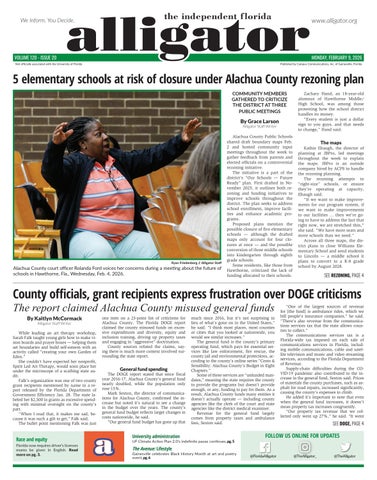
5 elementary schools at risk of closure under Alachua County rezoning plan
COMMUNITY MEMBERS GATHERED TO CRITICIZE THE DISTRICT AT THREE PUBLIC MEETINGS
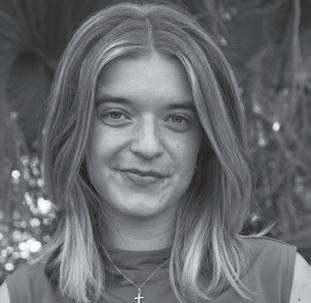
By Grace Larson Alligator Staff Writer
Alachua County Public Schools
shared draft boundary maps Feb. 2 and hosted community input meetings throughout the week to gather feedback from parents and elected officials on a controversial rezoning initiative.
The initiative is a part of the district’s “Our Schools — Future Ready” plan. First drafted in November 2025, it outlines both rezoning and funding initiatives to improve schools throughout the district. The plan seeks to address school enrollment, improve facilities and enhance academic programs.
Proposed plans mention the possible closure of five elementary schools — although the drafted maps only account for four closures at once — and the possible conversion of three middle schools into kindergarten through eighth grade schools.
Some residents, like those from Hawthorne, criticized the lack of funding allocated to their schools.
Zachary Hand, an 18-year-old alumnus of Hawthorne Middle/ High School, was among those protesting how the school district handles its money.
“Every student is just a dollar sign to you guys, and that needs to change,” Hand said.
The maps
Kathie Ebaugh, the director of planning at JBPro, led meetings throughout the week to explain the maps. JBPro is an outside company hired by ACPS to handle the rezoning planning.
The rezoning attempts to “right-size” schools, or ensure they’re operating at capacity, Ebaugh said.
“If we want to make improvements for our program system, if we want to make improvements to our facilities … then we're going to have to address the fact that right now, we are stretched thin,” she said. “We have more seats and more schools than we need.”
Across all three maps, the district plans to close Williams Elementary School and send students to Lincoln — a middle school it plans to convert to a K-8 grade school by August 2028.
County officials, grant recipients express frustration over DOGE criticisms
The report claimed Alachua County misused general funds
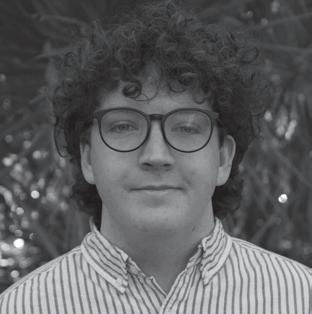
By Kaitlyn McCormack Alligator Staff Writer
While leading an art therapy workshop, Sarah Falk taught young girls how to make vision boards and prayer boxes — helping them set boundaries and build self-esteem with an activity called “creating your own Garden of Eden.”
She couldn’t have expected her nonprofit, Spirit Led Art Therapy, would soon place her under the microscope of a scathing state audit.
Falk’s organization was one of two county grant recipients mentioned by name in a report released by the Florida Department of Government Efficiency Jan. 28. The state labeled her $2,500 in grants as excessive spending with minimal oversight on the county’s part.
“When I read that, it makes me sad, because it was such a gift to get,” Falk said. The bullet point mentioning Falk was just
one item on a 23-point list of criticisms for Alachua County. The Florida DOGE report claimed the county misused funds on excessive expenditures and diversity, equity and inclusion training, driving up property taxes and engaging in “aggressive” doctrination.
County sources refuted the claims, saying there is much more context involved surrounding the state report.
General fund spending
The DOGE report stated that since fiscal year 2016-17, Alachua County’s general fund nearly doubled, while the population only rose 15%.
Mark Sexton, the director of communications for Alachua County, confirmed the increase but noted it’s natural to see a change in the budget over the years. The county’s general fund budget reflects larger changes in costs nationwide, he said.
“Our general fund budget has gone up that
much since 2016, but it's not surprising in lieu of what's gone on in the United States,” he said. “I think most places, most counties or cities that you looked at nationwide, you would see similar increases.”
The general fund is the county’s primary operating fund, which pays for essential services like law enforcement, fire rescue, the county jail and environmental protections, according to the county’s online series “Cents & Sensibility: Alachua County’s Budget in Eight Chapters.”
Some of these services are “unfunded mandates,” meaning the state requires the county to provide the programs but doesn’t provide enough, or any, funding to pay for them. As a result, Alachua County funds many entities it doesn’t actually operate — including county agencies like the clerk of the court and state agencies like the district medical examiner.
Revenue for the general fund largely comes from property taxes and ambulance fees, Sexton said.
“One of the largest sources of revenue for [the fund] is ambulance rides, which we bill people's insurance companies,” he said. “There's also revenue from the communications services tax that the state allows counties to collect.”
The communications services tax is a Florida-wide tax imposed on each sale of communications services in Florida, including mobile communications, cable and satellite television and music and video streaming services, according to the Florida Department of Revenue.
Supply-chain difficulties during the COVID-19 pandemic also contributed to the increase in the general fund, Sexton said. Prices of materials the county purchases, such as asphalt for road repairs, increased significantly, causing the county’s expenses to climb.
He added it’s important to note that even when the general fund increases, it doesn’t mean property tax increases congruently.
“Our property tax revenue that we collected only went up 27%,” he said. “It went
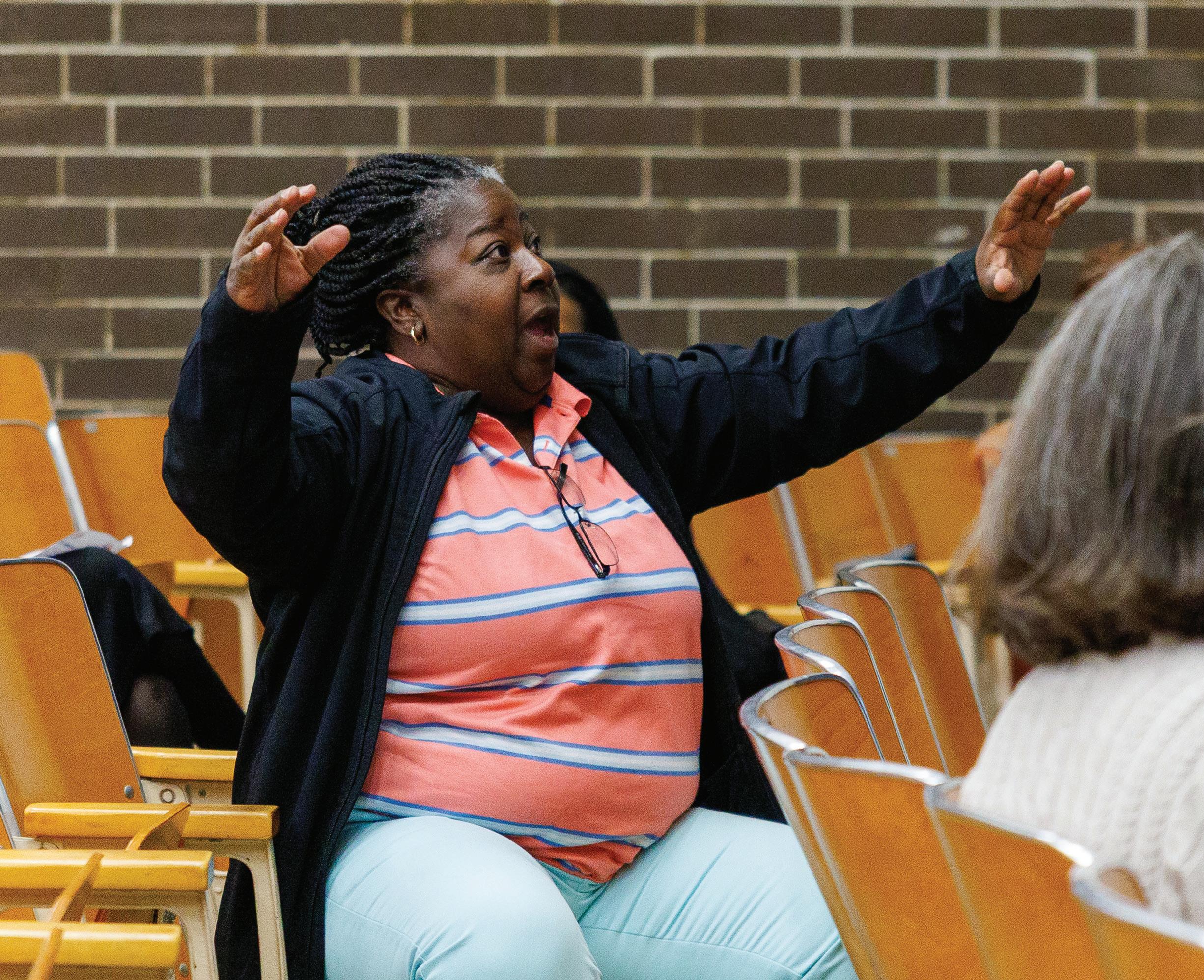
Ryan Friedenberg // Alligator Staff
Alachua County court officer Rolanda Ford voices her concerns during a meeting about the future of schools in Hawthorne, Fla., Wednesday, Feb. 4, 2026.
Today’s Weather
Alachua County Democratic Party alleges city’s precinct closure suppresses voters
ALACHUA CITY COMMISSION VOTED TO CLOSE POLLING LOCATION IN PREDOMINANTLY BLACK NEIGHBORHOOD
By Alexa Ryan Alligator Staff Writer
During a Jan. 26 meeting, the Alachua City Commission unanimously voted to close Precinct 53 at the Cleather Hathcock Community Center ahead of the April 14 municipal election.
The commission cited planned construction at the community center during the election as the reason behind the closure, though a start date for the project has not been released. The city of Alachua didn’t respond to phone calls requesting details on the project.
The decision has drawn criticism from the Alachua County Democratic Party and from residents, who are now accusing the commission of creating a barrier to voting for a targeted group of people. According to demographic data from the Alachua County supervisor of elections, the precinct serves a majority non-white population.
In last year’s April election,
only about one-third of the people who voted at the Hathcock Center were white. By comparison, at the city’s other two polling locations, voters were 74% and 88% white. The Hathcock location also serves a smaller population — welcoming about 280 total voters, a little over half the amount of the other two precincts.
Faith Collins, a Precinct 53 voter, found out about the closure while watching the city commission meeting.
“It suppresses voting access, and it seems unnecessary at this time,” she said. “There’s been no opportunity for public, real conversation about it.”
Several local political organizations and residents said the closure will make voting more difficult for some residents.
Precinct 53 voters must now vote at the Legacy Park Multipurpose Center in Precinct 3. The new location is about 2.3 miles from the Hathcock Center, a roughly 37-minute walk, according to Google Maps. The other city polling site, Turkey Creek, is located inside a gated community.
There are no bus routes between the Hathcock Center and Legacy Park areas.
On Jan. 27, the Alachua County Democratic Party issued a press re-
lease accusing the commission of “shutter[ing] a vital precinct in a Black neighborhood.”
The statement listed three demands for the city: a suitable replacement voting location for the Hathcock Center, an explanation for why voting could not continue at the community center and funding to notify voters of the change.
One commissioner is already backtracking his support of the closure. The day after City Commissioner Jacob Fletcher voted to close the precinct, he wrote in a Facebook post that he was wrong to do so.
He wrote he voted yes under the belief he had a legal obligation to ensure the election went through. But he later realized there was no deadline for the decision to be made.
“The ‘urgency’ to close the Cleather Hathcock Center (Precinct 53) without public discussion was manufactured, not mandated,” he wrote. “I now realize I was rushed into a decision that did not need to be made in the dark.”
Read the rest online at alligator.org.
@AlexaRyan_ aryan@alligator.org
UF committee delays decision on project that could remove nearly 1,000 trees
PROPOSED STORMWATER IMPROVEMENTS IN GRAHAM WOODS WOULD AFFECT DOZENS OF HERITAGE TREES
By Juliana DeFilippo Alligator Staff Writer
The UF Lakes, Vegetation and Landscaping Committee voted Feb. 5 to delay action on the Graham Stormwater Improvement Project, citing concerns about the scale of tree removal.
The project would remove an estimated 947 trees, including 67 designated as heritage trees. The designation applies to trees of notable size, shape or importance.
In the Feb. 5 meeting, committee member Adam Dale, a UF entomology associate professor, called it “one of, if not the biggest tree removal projects that has come to our committee.”
The project is intended to address persistent drainage problems caused by an aging stormwater system, according to a Lake Alice Watershed Study presented in 2024.
Fifteen drainage pipes currently run through the 7.5acre Graham Woods area, located between Flavet Field and Gale Lemerand Drive. The pipes contribute to erosion and steep drop-offs that have forced the university to close portions of the site to pedestrians.
The Graham Stormwater Improvement Project would replace damaged pipes and add manholes to help drain runoff. It would create two connected stormwater ponds to slow water flow and improve its quality as it flows downstream toward Lake Alice.
The proposal also includes recreational and educational trails, project manager Kate Farmer said.
“It would be good for our professors and students to have some additional learning opportunities, and ecological classes could be held out there or in helping students understand our stormwater management, which is a big problem that we have on campus,” Farmer said. “So we are trying to improve that with this project.”
But committee members worried about one major as-
pect of the project: tree removal.
Farmer and her team estimate construction would require removing almost 1,000 trees, including 67 heritage trees. The list of heritage trees slated for removal includes 12 maple trees, 12 hickories and 10 southern magnolias, as well as several others.
Trees around the site’s perimeter would be preserved, and the proposal includes plans for replanting and increasing biodiversity.
The mitigation fee, which landscapers must pay to account for any tree removals, is $455,500.
Kristin Rubin, representing the Sierra Club SuwanneeSt. John’s group, said the scale of the tree removal for the project would offset attempts to resolve stormwater issues.
“We may be removing the very living infrastructure that already does much of that work,” she said. “These heritage trees are not landscaping. They are stormwater assets.”
Tree removal is common in campus construction projects, and the committee reviewed several smaller proposals earlier in the meeting.
Those included the removal of a 30-inch nagi podocarpus for the new Hamilton School for Classical and Civic Education campus and two 23-inch live oaks for the Microbiology and Cell Science building expansion.
But for many, the scale of this removal is unprecedented.
Last year, the committee approved a project that removed 30 trees. An online petition in favor of stopping the project garnered 157 signatures.
The committee decided to table the Graham Woods project until its next meeting March 5 in order to allow members to review additional information.
Lisa Strange, an IFAS extension agent, made the motion to hold off on a decision.
“This is overwhelming,” she said. “It's such a massive project.”
The Alligator strives to be accurate and clear in its news reports and editorials. If you find an error, please call our newsroom at 352-376-4458 or email editor@alligator.org
UF windows have caused hundreds of bird deaths. A
campus group seeks a solution.
THE BIRD WINDOW COLLISION PROJECT SEEKS BIRD-FRIENDLY WAYS TO BUILD BASED ON STRIKE DATA
By Juliana DeFilippo Alligator Staff Writer
Theresa Sumrall works at the UF College of Medicine, where she does clinical data management and sits outside to enjoy the weather in her free time. She also finds a lot of dead birds.
“I’ll hear an impact,” she said. “I’ll see the body fall.”
In spring and fall, which is the migration season for many bird species, there were weeks Sumrall would find over a dozen birds that had collided with the Health Professions, Nursing and Pharmacy building. The five-story structure has a window stretching across its facade, reflecting the Bartram-Carr Woods Conservation Area.
When Sumrall finds the bodies, she photographs them and uploads her pictures to iNaturalist, a citizen science platform where users can post wildlife photos for identification. Since 2021, she has recorded 90 observations on the platform of 44
unique species. Sumrall posts most of her observations to the UF Bird Window Collision Project’s page, which collects data on bird window strikes around campus.
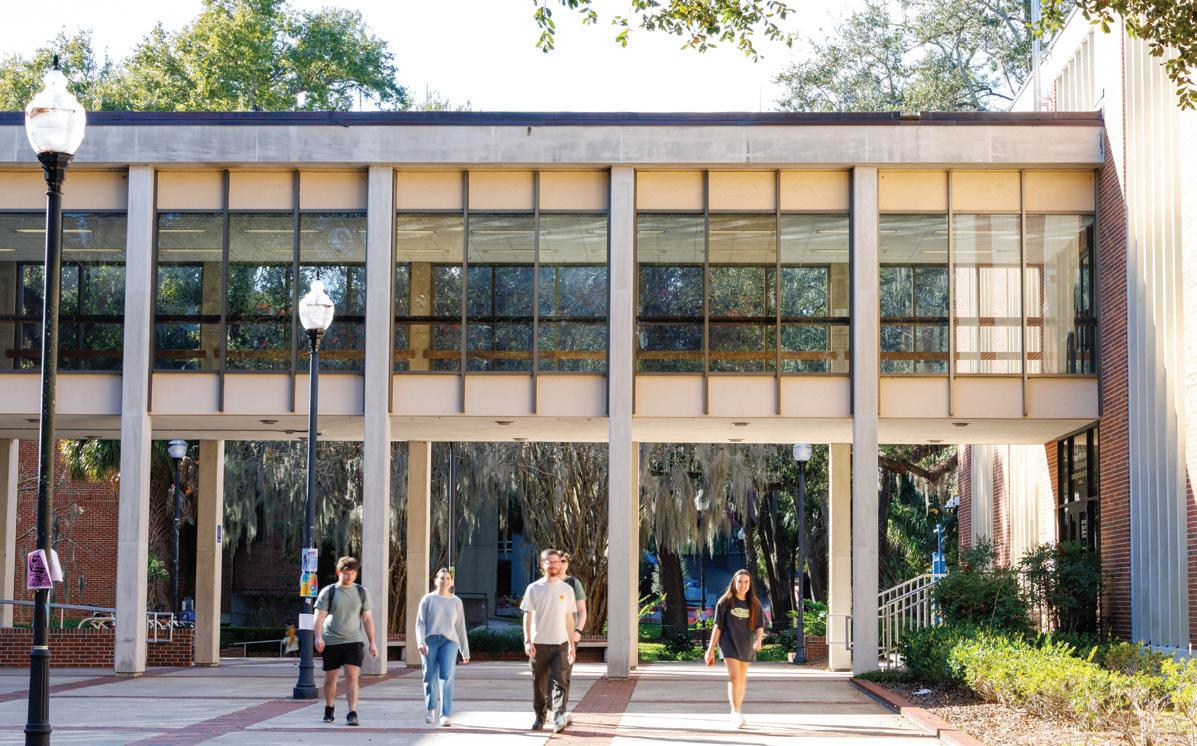
The Bird Window Collision Project advocates for bird-friendly building techniques, especially when it comes to windows like that of the HPNP building, which is just one of many potentially harmful areas on campus. The Fine Arts buildings, connected by a glass walkway, also draw many reports of bird collisions on iNaturalist.
“It was humans who decided on that architectural design and signed off on it and built it,” Sumrall said. “Not the cats or the raccoons or the possums. They’re just doing their best to live in a world that we’ve crafted, and every problem that animals face is a result of something we’ve done.”
Mark Hostetler was always aware of bird window strikes, but the Bird Window Collision Project came about after his students referred him to a hotspot at Jennings Hall. There, he found around 40 songbirds of the red-eyed vireo species, seemingly killed in one mass collision.
He and his students decided to start the iNaturalist project to gather data and discern which buildings
Friday, Jan. 23, 2026.
were dangerous. From there, fueled by “a couple of pizzas and very little money,” they created a solution: a special type of wind curtain to be mounted on dangerous windows, which they dubbed the Acopian BirdSavers.
The BirdSavers are made from paracord, which is hung vertically above windows to create visible columns in the panes, in the hopes of breaking up the reflection for incoming birds.
These Acopian BirdSavers now guard the windows at NewinsZiegler Hall. While this solution only costs $2 to $3 per window, making it cost-effective, it is often only a temporary solution. More permanent options, like tapes and decals that act as wallpapers and break up window reflections with patterns or designs, are often more expensive.
In 2021, UF started requiring all new buildings to implement a birdfriendly strategy in its design. For
‘Absurd’: Gainesville reacts to ban on non-English driver’s license testing
Florida is requiring all exams to be taken in English, without an interpreter, beginning Feb. 6
By Dulce Rodriguez-Escamilla Alligator Staff Writer
Leaenespañolenlapágina7
As of Feb. 6, the driver’s license exam and its instructions will be administered exclusively in English, following a new directive from Florida Department of Highway Safety and Motor Vehicles.
Previously, the exams and instructions for obtaining a driver’s license or a permit were available in multiple languages, including Spanish, Chinese, Haitian Creole, Portuguese, French and Russian.
The change poses a disruption for Florida’s large non-English-speaking communities. In
2023, over one in five Florida households reported speaking primarily Spanish at home. Haitian Creole was the second-most-common non-English language, at a little over 2% of households.
In Gainesville, community members have reservations about the change.
UF Spanish and Portuguese professor María Laura Mecías said she was able to take a license exam in Spanish in 2021, before the directive went into effect. She said having the exam interpreted in her native language gave her a sense of security and comfort, and she wishes others had the same opportunity.
“I felt more safe knowing that I would not have to worry about not knowing a word,” Mecías said. “I was more calm in understanding what I was doing, and at no moment did I
have any complication.”
Still, she said, people who need a driver’s license will adapt by studying for the exam regardless of the language in which the test is offered.
The change comes after Harjinder Singh, an undocumented U.S. immigrant from India, attempted to make an illegal U-turn on Florida’s turnpike, killing three people in August 2025. When Singh failed an English proficiency test, some Florida politicians began to call for a ban on people who don’t read English getting driver’s licenses.
Lawmakers, including Gov. Ron DeSantis, argued the change will make Florida’s roads safer. The governor posted about the policy on X on Jan. 31.
“Good reform by FHSMV to require driv-
newer buildings, the policy recommends reducing the reflectiveness of windows by using fritted or etched glass, or films and decals that break up the reflections. Malachowsky Hall, which opened in 2023, was built with fritted glass, which uses dots to break up the reflection of the windows. While protecting birds, this glazing also reduces heat gain in the building, according to a written statement from the UF Office of Planning, Design and Construction.
“As with all aspects of construction, PDC continuously evaluates how to balance the unique needs of campus facilities in a cost-effective manner,” it said.
Elle Henson, a 21-year-old UF wildlife ecology and conservation junior who works with the Bird Window Collision Project, sees the policy for new buildings as a positive step.
“Building it into the building is way more sustainable than building and then having to go back and retrofit all the windows,” she said. “Which is kind of what we’re having to do now with some of the older buildings.”
Read the rest online at alligator.org.
@JulianaDeF58101
jdefillipo@alligator.org
er exams be conducted only in English,” he wrote. “Need to be able to read the road signs!”
Evidence that people who take driving exams in a foreign language pose a higher risk on the road remains limited. A PolitiFact analysis reported that experts from the National Safety Council and the Insurance Institute for Highway Safety were unaware of any research indicating as much.
Guidelines for foreign-language exams from the American Association of Motor Vehicle Administrators indicate a person’s inability to read or speak English “is not necessarily a barrier to proper motor vehicle operation” as long as the driver can interpret signs, signals and markings.
Read the rest online at alligator.org.
@DulceRodrigueze drodriguez@alligator.org
Ryan Friedenberg // Alligator Staff
Students walk between the fine arts buildings on UF’s campus,
Divided opinions on ACPS rezonings
a K-8 school by August 2027.
Built in 1938, Williams Elementary School is the oldest school in the district. Its enrollment is 200 students under capacity. Because Williams Elementary School is located next to Lincoln, it’s easier to merge students together, Ebaugh said.
The district also proposed the closure of Foster Elementary School, the second-oldest in the district. The school, built in 1952, is a popular school of choice. Its science, technology, engineering and math magnet program will move to Norton Elementary School next school year.
The relocation of Foster Elementary School students varies by map. The first has students attending Norton and Parker Elementary Schools. The second divides the zone into Norton, Rawlings and Metcalfe Elementary Schools. The third proposes they attend Norton and Metcalfe Elementary Schools.
For Julia Gatson, a science teacher at Foster Elementary School, the school’s closure is frustrating and disrupts an already difficult transportation process for students.
“How are my students — most of them walk to school because their families don't have reliable transportation — how are they supposed to get to Norton or Metcalfe or Williams or wherever they're being sent to?” she asked.
The question of transportation is one apparent throughout the district, as recommended closures are not unique to Williams and Foster Elementary Schools.
In addition to the closures of these schools, the first map proposes Rawlings Elementary School also close. Rawlings students would attend Norton and Metcalfe Elementary Schools.
The second map retains Rawlings Elementary School and instead proposes the closure of Alachua Elementary School, a third through fifth grade school. Alachua currently shares a zone with Irby Elementary School, which teaches students from kindergarten to second grade. The map suggests the zone split in two, with Irby Elementary transforming into a pre-K-5 school and other students attending Mebane, a middle school that will be transformed into
The third map proposes a total of four school closures: Williams, Foster, Rawlings and Alachua Elementary Schools.
Additional conversions of middle schools to K-8 schools include Oak View Middle School, which is located in Newberry. The school will expand to a K-8 school by August 2026 to provide a space for elementary school students following Newberry Elementary School’s conversion to a charter.
Changes at the high school level feature no conversions or closures, focusing instead on evening out attendance and enrollment at the schools.
Community input meetings
Over 100 Hawthorne residents gathered in Hawthorne Middle/High School’s auditorium Feb. 4 to listen to a presentation of the maps, which quickly went off track.
When residents voiced concerns about inaccessible QR codes, an overuse of surveying techniques and the prevention of public discussion, Superintendent Kamela Patton gave in to community requests for a public discussion.
Patton initiated conversation by assuring residents Shell Elementary School and Hawthorne Middle/High School, the city’s two schools, would stay open indefinitely. The concern over school closures stemmed from a rumor that brought residents to a school board meeting Jan. 20.
In a discussion lasting over an hour, community members criticized the lack of funding offered to their schools.
Heather Surrency, a Hawthorne parent, said the district needs to focus on “the grounds, the discipline and accountability” of Hawthorne schools.
Her complaints stem from the schools’ broken facilities and unkempt gardens, the lack of discipline for misbehaving students and educators unwilling to teach, she said.
City officials meeting
Elected officials throughout Alachua County met at the ACPS District Office Board Room Feb. 6 to discuss the school district’s rezoning initiatives following the first week of community input meetings.
with community members about the future of schools in
Fla., Wednesday, Feb. 4, 2026.
Representatives from Archer, Alachua, Hawthorne, Gainesville, Micanopy and the county attended the meeting. Each provided feedback for ACPS’ tentative plan.
Within the meeting, both JBPro and the school district emphasized the flexibility of the drafts.
The plan is to create a new draft of maps following the end of the community input sessions Feb. 18. The school board will then meet to discuss the new maps and tweak them during a workshop before they are approved at a board meeting March 12.
City officials were among those providing input this week. Alachua County Commissioner Marihelen Wheeler emphasized the importance of keeping students within the county.
Alachua County responds to Florida DOGE report
from pg. 1 REZONING, from pg. 1
up less than the rate of property values.”
Of the $321.6 million in the fiscal 2025 general fund, a little over half came from the property tax for services provided countywide, according to the county’s budget series. The county ranked 41st among Florida’s 67 counties for its millage rate, or amount of tax payable per $1,000 of a property’s value, in the same fiscal year.
Art Tag Grant Program
The DOGE report stated Alachua County misused funds by providing “numerous small grants to which the county provides minimal oversight.” The Art Tag Grant program was specifically mentioned in the report.
The program aims to increase accessibility of arts experiences to underserved communities, according to a press release. The grant
includes a list of what the money can be used for, which includes art supplies, music supplies and costumes. Activities of the grantee will be monitored as needed throughout the project, the release notes, and the grantee must provide a final detailed report of funds.
Two recipients of the grant were also mentioned in the DOGE report: the Florida Coalition for Peace and Justice and Falk’s Spirit Led Art Therapy.
The Florida Coalition for Peace and Justice was awarded $2,500 in 2024 for Gainesville’s Flying Pig Parade. Community arts organizations collaborated for the event, making costumes and large puppets to accompany theatrical performances in a downtown Gainesville parade.
Eduardo Arenas, the president of the Florida Coalition for Peace and Justice, said the event fit the criteria of the Art Tag Grant.
“This was a legitimate, transparent and fully appropriate use of the
grant funding for a well-established, family-friendly cultural event that brings together artists, performers, musicians and residents from all walks of life, reflecting the vibrant diversity that makes Gainesville such a special place to live,” he wrote in a statement to The Alligator.
Spirit Led Art Therapy’s $2,500 award went toward numerous free art therapy workshops for women and children, according to Falk, a High Springs resident. Funds sponsored three workshops centered on faith-based art therapy, she said.
“I'm so grateful for that grant, and I'm so grateful for all the good that came out of it,” she said.
In addition to her Spiritual Growth Workshop for Girls, Falk also led a Unique Expressions Workshop. This event allowed neurodivergent children at Canvas Church to express their emotions through art, she said, while art therapy groups at Anew were aimed at
“I feel like we need to be very careful in terms of redistricting now, that we don't push more out,” Wheeler said. “We want to make it so we grab those kids back.”
With the rise of private and charter schools, the school district has lost students, she said.
She hopes the rezoning initiative will show parents that public schools offer great opportunities for education.
Community members interested in providing feedback on the maps can fill out an online survey. The next community input meeting will be held at 5:30 p.m. on Feb. 9 at Buchholz High School.
@graceellarson glarson@alligator.org
helping women who have been affected by sex trafficking.
To prove the money was being used wisely, Falk said, she had to return all of her receipts to the county. She also had to compile a final report of expenses.
“I was able to purchase supplies for these events and set myself up to start my own business,” Falk said. “Without this opportunity, I would not be where I am right now.”
Without the grant, she said, she wouldn’t have been able to serve her community. She was disappointed when the state framed her organization in a bad light in the Jan. 28 report, she added.
Diversity, equity and inclusion
The DOGE report stated Alachua County’s diversity, equity and inclusion initiatives and training for staff were “indoctrination” and an overall waste of resources. DOGE cited multiple examples, including the DEI training for Alachua County firefighters.
“Alachua County Fire Rescue’s
firefighters were diverted from their mission to study ‘racial statistics in Alachua County,’ discuss so-called ‘systemic sexism, racism, discrimination, and inequality,’” the report stated.
County communications director Mark Sexton addressed claims, saying DEI is an “unfair advantage.”
“There’s been these vague assertions that somehow that is about hiring people who are not qualified,” he said. “We always hire the best applicant for our jobs.”
Alachua County will continue to uphold its community values, he added, even though they may not align with the state.
“We see diversity as beautiful and as a real strength of the organization,” he said. “We understand that the majority in Tallahassee doesn't value diversity, equity and inclusion programs, but some local governments do, and it's our decision unless we hear otherwise from legislation.”
@kaitmccormack20 kmccormack@alligator.org
Ryan Friedenberg // Alligator Staff
Alachua County Public Schools Superintendent Kamela Patton engages in discussion
Hawthorne,
UF’s new Climate Action Plan in limbo as indefinite pause continues
FOLLOWING THE OFFICE OF SUSTAINABILITY’S CLOSURE, IT’S UNCLEAR WHETHER THE PLAN WILL RESUME
By Alabama Weninegar Alligator Staff Writer
UF’s Climate Action Plan 2.0 is on an indefinite pause. Following the Office of Sustainability’s closure in August 2025, it’s unclear who — if anyone — will pick it back up.
UF initially started working toward climate action in 2006 under former UF President Bernie Machen. A group of staff and faculty, called the Energy and Climate Change Task Force, published the first Climate Action Plan in 2009. The CAP focused on infrastructure energy efficiency, as well as monitoring and reducing greenhouse gases.
UF met the requirements of the first CAP in reducing emissions by 18% in 2020, according to previous reporting by The Alligator. CAP 2.0, a draft that started in 2021, continued UF’s original goal to be carbon neutral for all tracked campus greenhouse gas emissions starting in 2025.
But since its drafting, climate action plans have stalled.
UF halted its adoption of the CAP 2.0 in 2023 before former UF President Ben Sasse transitioned into leadership to allow him to evaluate institutional priorities, spokesperson Cynthia Roldán said in an email statement to The Alligator. Last year, the university closed its Office of Sustainability, the entity responsible for implementing the plan, after 20 years of service.
Roldán said while the plan has still not received approval, UF still works on its commitment to sustainability.
The previous link to the new plan on the university’s website is no longer available — nor is the link to the 2009 original.
Cory Rinesmith, a 22-year-old UF political science senior with a minor in sustainability, said privatizing this information “clouds” the university’s image. A climate action plan can create public engagement and educate others about the importance of climate change, she said.
“I think the most important thing about sustainability is getting everyone on board with it,” Rinesmith said. “For a prestigious institution to come out with information
Under the now-closed Office of Sustainability, UF launched a Climate Action Plan 2.0. However, the plan is now on pause, according to the university.
about climate change and the environment is very important.”
Rinesmith also said without a climate action plan, students are becoming discouraged from finding jobs within the sustainability field — questioning why they should pursue sustainability studies when their university doesn’t treat the topic as a priority.
UF did not receive a nod on this year’s review of Green Colleges from The Princeton Review, an honor it received last year and still has pinned on its social media as of Feb. 6. Several other state universities, including Florida State University and the University of Central Florida, all earned recognition from the review, which previously praised UF for employing a sustainability officer and offering a public greenhouse gas inventory plan.
Many students haven’t given up on encouraging sustainability. The UF Student Senate proposed its own Green New Deal resolution in 2024, becoming the first student government at a public university to do so. The resolution endorsed UF’s adoption of CAP 2.0.
Maegan Lamey, a 21-year-old sustainability junior and co-author of the Green New Deal resolution, said a climate action plan is necessary for UF, and its adoption of the plan would combat climate change.
According to previous reporting by The Alligator, the proposed CAP 2.0 was structured around five key focus areas: energy and buildings, transportation, education and research, resilience, and offsets and finance. These areas targeted reducing campus energy use, promoting low-carbon transportation options and establishing sustainable building standards.
CAP 2.0 also outlined a proposed $15 million fund to support and finance these sustainability initiatives.
“I think it’s a good thing for any large corporation or organization to have a laid out vision of goals,” Lamey said, “something that holds them somewhat accountable.”
Now, the lack of transparency regarding the climate action plan’s implementation is something that concerns Lamey, she said.
Peer universities across the state, from UCF in Orlando to New College of Florida in
Sarasota, all have publicly available climate action plans that pledge to significantly reduce emissions in the next few decades.
Glen Billesbach, a 34-year-old UF postdoctoral associate in the sustainability studies program, said there’s a lot of great sustainability work being done at UF, but he has noticed a “vacuum” at the institutional level after the Office of Sustainability’s closure.
Billesbach said he hasn’t seen UF’s climate action plan implemented to its fullest potential since he started working at UF in 2018. A climate action plan could pay off economically, socially and environmentally, saving UF money in the long run, he said.
“I think it could pay off in terms of the social benefits and to having a more green campus,” Billesbach said.
He also said a climate action plan would show support to the students pursuing an education in sustainability.
There were 92 UF undergraduate students pursuing sustainability-related bachelor’s degrees as of Spring 2024, the latest available data. That number has trended slowly downward since its peak of 127 enrolled students two years ago.
Still, the continuing efforts of students and faculty members fighting sustainability issues in Gainesville is one of the things Billesbach said keeps him in high spirits. Clubs like the UF Sustainability Studies Student Association are working to build community among students and have noticed the absence of UF’s CAP 2.0.
Ava Vellines, UFSSSA’s outreach director and a 22-year-old UF sustainability and economics senior, said a climate action plan gives students opportunities to collaborate on solutions to tackle climate challenges. Vellines said that collaboration is something she’d like to see UF take a more proactive approach toward.
By not prioritizing its climate action plan, UF also directly affects students pursuing sustainability-related degrees in the classroom, she said.
“When you go into class, you’re really faced with these dark and complicated issues,” she said. “It’s hard to walk out of that classroom into a community and onto a campus that doesn’t really seem to care much.”
@AlabamaW40513 aweninegar@alligator.org
Many Haitian Creole textbooks are outdated. So, this UF professor co-wrote his own.
‘Kreyól pale’ fills a learning resource gap for Florida’s third-most-common language
By Dulce Rodriguez-Escamilla Alligator Staff Writer
Haitian Creole is the third-most-spoken language in Florida, but the resources for learning it are scarce, outdated and often lack lessons on day-to-day conversation. Among those who speak the language, there are also many who cannot read or write in it.
To address these issues, a UF researcher co-published a Haitian Creole textbook designed to improve learning at the university and beyond.
The book, “Kreyól pale,” was co-written by UF professor Benjamin Hebblethwaite and University of Alabama assistant professor David Tezil over nine years and published in print August 2025.
Hebblethwaite, a professor in UF’s Department of Languages, Literatures and Cultures, said he saw how underdeveloped Haitian Creole resources were as an instructor of the language.
“The textbook we were using until this particular book came out was quite outdated in terms of its content, its methodology,” Hebblethwaite said.
Aside from outdated content, Hebblethwaite said older textbooks also presented Haitian Creole through a narrow lens.
They didn’t represent the country in a respectful way, he said; instead, they emphasized “poverty and vulnerability.”
The modern textbook focuses on bridging the gap between formal and outdated Haitian Creole and the language used by modern Haitians, addressing topics like how to order food, dating and job hunting.
“We wanted to bring some more balance where we showed the culture in a more well-rounded, a more representative way,” Hebblethwaite said. “Rather than focus on a narrow aspect of the country, as well as a sort of a smaller group of users.”
The book consists of 29 chapters with over 60 exercises and open-ended activities to encourage conversations and critical thinking, meant to ensure readers receive diverse experiences in vocabulary, grammar and culture.
Haitian American students at UF say they see the book as important in supporting Haitian language and culture.
Georffrey Pierre, a 19-year-old first-generation UF English sophomore from a Haitian family, said Haitian Creole defines his everyday life and is part of who he is. The language is a form of connection and communication with his family and roots, especially as many of his family members are not fluent in English, he said.
He said learning Creole is a way to preserve his connection
to his roots and foster a community where Haitians support and share family values.
“I do think it is a vital resource, especially having a Haitian textbook, because learning [Haitian] Creole is not really accessible,” Pierre said. “Even in Google Translate, there’s no speaker option to hear anything spoken back to you, so I feel like it could help if it were more widespread and well known.”
Duchnah Richard, a 19-year-old first-generation UF educational sciences sophomore from a Haitian family, said she is excited to see Haitian Creole represented in language learning academics.
Though a Haitian Creole speaker, Richard said she cannot write in the language. Her main exposure to reading in Haitian Creole is through the Bible, which causes her to miss out on many modern aspects of the language, she said.
“I think having a resource for people who do struggle with the language or struggle between switching through languages is a good idea and a sick support system for people,” she said. “Especially if they feel kind of ashamed about asking for help.”
“Kreyól pale” is available online in a no-cost, PDF format through UF Digital Collections.
@DulceRodrigueze drodriguez@alligator.org
Dylan Speicher // Alligator Staff
MONDAY, FEBRUARY 9, 2026
www.alligator.org/section/the-avenue
Ditch the supermarket flowers and hit these 6 local shops for Valentine’s Day
OPTIONS FOR GIFTS AND FLORAL ARRANGEMENTS FROM CLASSIC TO CHIC
By Aaliyah Evertz Avenue Staff Writer
Valentine’s Day is just around the corner, which means it’s officially time to start thinking about flowers.
Whether you’re planning a romantic gesture, a low-key “thinking of you” or something a little more creative than the standard dozen roses, Gainesville has no shortage of local florists ready to help you get it right.
The Plant Shoppe Florist
If your valentine loves plants as much as — or more than — cut flowers, The Plant Shoppe Florist is a no-brainer. Its arrangements feel organic and thoughtfully composed, often mixing fresh blooms with textured greenery for bouquets that look effortlessly cool rather than overly formal. You can go for traditional roses here, but the real magic is in its seasonal mixes and plant-forward designs.
Located just outside downtown Gainesville at 303 NW Eighth Ave., it’s an easy stop if you’re already planning a dinner date, coffee meetup or stroll nearby. Bonus points for grabbing something living and long-lasting — a subtle “this isn’t just for one day” kind of gesture.
The Flower Shop
If you’re looking for classic Valentine’s Day energy — red roses, soft pinks, timeless arrangements — The Flower Shop delivers exactly that. Its bouquets lean traditional in the best way, making them a solid choice when you want romance to be instantly recognizable and beautifully executed.
Situated at 720 W. University Ave., it’s a convenient option whether you’re headed toward UF campus, midtown or just trying to knock out errands efficiently. Reliable, romantic and
BLACK HISTORY MONTH
something beautiful without venturing far. The arrangements here feel friendly and expressive, ideal for newer relationships or low-pressure but heartfelt gestures.
Agapanthus
Not a florist, but absolutely worth including in any Valentine’s game plan. Agapanthus is where you go for the “extra something” — chic candles, jewelry and beautifully curated gifts that feel intentional rather than last minute. It’s perfect for elevating a bouquet into a full Valentine’s moment.
Set in Butler Town Center at 2917 SW 35th Drive, it’s an ideal pairing shop if you’re already out shopping or grabbing dinner nearby. Think flowers from one spot and finishing touches from there — a move that reads thoughtful without trying too hard.
Prange’s Plantscapes & Florist
Prange’s is known for lush, well-balanced arrangements that feel polished without being stuffy. Its Valentine’s bouquets are full and generous — the kind that immediately make an impression and feel worth lingering over.
At 2505 NW Sixth St., it’s an easy stop whether you’re going downtown or Midtown. If you want something timeless, elegant and reliably gorgeous, Prange’s is a strong choice.
Crevasse’s Florist
straight to the point.
Floral Expressions Florist
Floral Expressions strikes a nice balance between classic and cheerful. You’ll find roses there, but also colorful mixed bouquets that feel warm, lively and full of personality — great if your valentine prefers something bright and joyful over deep, moody reds.
Located at 4414 NW 23rd Ave., it’s a particularly good pick if you’re shopping from the northwest side of town and want
Crevasse’s Florist has that old-school, local charm that makes Valentine’s Day flowers feel especially sincere. Its arrangements lean romantic and expressive, perfect with a handwritten card and a well-planned evening.
At 2441 NW 43rd St., it’s a great option if you value personal service and a neighborhood feel. Simple, heartfelt and very much about letting the flowers do the talking.
@aaliyahevertz1 aevertz@alligator.org
Gainesville artists and poets celebrate a night of Black love, art and poetry
THE EVENT MARKED ITS SIXTH ANNUAL CELEBRATION KICKING OFF BLACK HISTORY MONTH
By Laura Manzor Alligator Contributing Writer
Gainesville artists, poets and community members came together for a free event Feb. 7 at the Oakview Community Center to celebrate Black History Month with art exhibits and spoken word performances.
The sixth annual Celebration of Black Love, Art and Poetry drew about 20 guests. Attendees excitedly walked into a room filled with paintings and artist booths showing their crafts.
One of the artists, Theresa
Sports
Adams, has been creating Black Raggedy Ann dolls for 30 years after struggling to find one for her daughter. In her presentation, Adams explained the background of her dolls in a historical context.
“The slaves knew the importance of having a doll that looked like you,” she said.
After guests walked around and enjoyed food and drinks, Terri Bailey, the founder of the nonprofit Bailey Learning and Arts Collective, welcomed the attendees and motioned for everyone to take their seats.
Bailey started the open-mic portion of the night by presenting a poem about her roots living in Pleasant Street, one of Gainesville’s historically African American neighborhoods.
“In Pleasant Street, God reigned supreme,” she said. “I thank God I’m a Pleasantnite.”
Previewing the Gator baseball roster before this week’s season opener. Read more on page 12.
The Bailey Learning and Arts Collective hosted the event along with the A. Quinn Jones Museum & Cultural Center and the city of Gainesville.
Bailey, a seasoned poet, noted the rich collection of artists, poets and musicians in the city. She looks forward to seeing what people have to offer in the event every year, she said.
“I love Black history, I love my community, and I love poetry and visual art,” Bailey said.
The event has changed throughout its six years, including moving from different locations and featuring new types of art.
“This is the first year we’re actually having an art or printmaking activity,” Bailey said, referring to a stamping printing workshop artist Turbado Marabou taught to attendees. “We have [had] younger poets in the past. Everybody’s been a lit-
tle older [this year].”
Attendee Rafael Sierra was invited by a friend. He said he appreciated the opportunity to support both the Gainesville community and the artists involved in the event, especially as a former dancer.
“It’s very important to keep the community together,” Sierra said. “I really like to come to this type of event to support the community and support the artists.”
Throughout the event, seasoned and amateur artists alike came up and presented their poems in a spoken-word style, including Cynthia Portalátin, known as Cynthia Rose, who shared a poem titled “Love Must Win.”
“We’re in such a time of division right now. We need more events that are art-focused to bring the community together,” Portalátin said. “The poem I chose … is what
I feel needs to happen in order for communities to come together, and this is a perfect example.”
Portalátin and other poets received support from the crowd, with shouts of “mhm” and “rewind!”, telling speakers to highlight a phrase that stood out. Many poets spoke about topics such as identity and freedom.
Two decades ago, Portalátin lived in Gainesville for four years before moving away to Tallahassee. She recently moved back and said the city is a hub for celebrating Black art and culture.
“I love Gainesville. I feel like it’s a very inclusive community with lots of wonderful art events,” she said. “I’ve only been back for three years, and I’m just amazed about how much creativity exists.”
Laura Manzor is a contributing writer for The Alligator.
Caroline Walsh // Alligator Staff
A flower bouquet is put together at The Flower Shop, Monday, Feb. 2, 2026, in Gainesville, Fla.
El Caimán
Gainesville
LUNES, 9 DE FEBRERO DE 2026
www.alligator.org/section/spanish
reacciona a la prohibición de exámenes de licencia de conducir en idiomas distintos
FLORIDA EXIGIRÁ QUE TODOS
LOS EXÁMENES SE TOMEN EN INGLÉS, SIN INTÉRPRETE, A PARTIR DEL 6 DE FEBRERO
Por Dulce Rodriguez-Escamilla & Angelique Rodriguez Escritoras de El Caiman
A partir del 6 de febrero, el examen para obtener la licencia de conducir y sus instrucciones se administrarán exclusivamente en inglés, tras una directiva del Departamento de Seguridad Vial y Vehículos Motorizados de Florida.
Anteriormente, los exámenes y las instrucciones para obtener una licencia de conducir o un permiso estaban disponibles en varios idiomas, incluyendo, español, chino, criollo haitiano, portugués, francés y ruso.
El cambio representa una interrupción para las grandes comunidades no angloparlantes de Florida. En 2023, más de uno de cada cinco hogares en Florida reportó hablar principalmente español en casa. El criollo haitiano fue el segundo idioma no inglés más común, con poco más del 2% de
Opinions
hogares.
En Gainesville, miembros de la comunidad tienen reservas sobre el cambio.
La profesora de español y portugués de la UF, María Laura Mecías, dijo, pude tomar el examen de licencia en español en 2021, antes de que la directiva entrara en efecto.
Ella dijo que al tener el examen interpretado en su lengua materna le dio una sensación de seguridad y comodidad, y desearía que otras personas tuvieran la misma oportunidad.
“Me sentí más segura sabiendo que no tendría que preocuparme por no conocer una palabra”, dijo Mecías. “Estaba más tranquila al entender lo que estaba haciendo, y en ningún momento tuve alguna complicación”.
Aun así, dijo que las personas que necesitan una licencia de conducir se adaptarán estudiando para el examen independientemente del idioma en el que se ofrezca.
El cambio se produce después de que Harjinder Singh, un inmigrante indocumentado de la India, intentara hacer un giro en U ilegal en la autopista de peaje de Florida, causando la muerte de tres personas en agosto de 2025. Cuando Singh no aprobó una prueba de dominio del inglés, algunos políticos de Florida comenzaron a pedir una
Can someone be pro-life and support the death penalty? Read more on pg. 8.
prohibición para que personas que no leen inglés no obtengan licencias de conducir.
Los legisladores, incluyendo el gobernador Ron DeSantis, argumentaron que el cambio hará que las carreteras de Florida sean más seguras. El gobernador publicó sobre la política en X el 31 de enero.
“Buena reforma por parte de FHSMV para exigir que los exámenes de manejo se realicen solo en inglés”, escribió. “¡Hay que poder leer las señales de tránsito!”
La evidencia de que las personas que toman exámenes de manejo en un idioma extranjero representen un mayor riesgo en las carreteras. Un análisis de PolitiFact informó que expertos del Consejo Nacional de Seguridad y del Instituto de Seguros para la Seguridad en las Carreteras no conocían ninguna investigación que lo indicara.
Las directrices sobre exámenes en idiomas extranjeros de la Asociación Americana de Administradores de Vehículos Motorizados indican que la incapacidad de una persona para leer o hablar inglés “no es necesariamente una barrera para la correcta operación de un vehículo motorizado”, siempre que el conductor pueda interpretar señales, semáforos y marcas viales.
Ericka Ghersi, presidenta de la junta directiva de la Liga de Mujeres Latinas de
Síganos para actualizaciones
al inglés
Gainesville, dijo que la nueva directiva es desalentadora para la comunidad latina.
Ghersi dijo que miembros de la Liga de Mujeres Latinas han hablado con ella, preocupados por la directiva. Muchos de ellos están en proceso de aprender inglés, pero no tienen un nivel lo suficientemente avanzado como para tomar el examen. Aunque la organización está considerando soluciones, como ofrecer una clase para sus miembros, Ghersi dijo que no cuenta con los fondos necesarios para contratar educadores y comprar herramientas de enseñanza. El ambiente actual en torno a la comunidad latina e internacional ya es tenso, y la nueva directiva estatal no ayudará a mejorar la situación, dijo.
“Creo que todos sabemos lo difícil que se está volviendo navegar en este nuevo clima”, afirmó. “Esto no va a ser bueno para nadie; no estamos mejorando nada con esto”.
Lea el resto en línea enalligator.org/ section/spanish.
Para obtener actualizaciones de El Caimán, síganos en línea en www.alligator.org/section/spanish.
www.alligator.org/section/opinions
How pro-life and pro-death can coexist among conservatives
One of the most common accusations directed at conservatives is that you cannot be both pro-life and supportive of the death penalty. If life is sacred, as anti-death penalty voters argue, it must be protected in all circumstances — from the womb to the prison cell.
But pro-death penalty conservatives believe that argument collapses a valuable moral distinction in this debate: the difference between innocent lives and chosen violence.
Within pro-life conservative thought, opposing abortion is about protecting an innocent life that has done nothing, chosen nothing and harmed no one. Children in the womb have not forfeited their humanity or right to exist. Ending their lives is not justice. Abortion is the deliberate destruction of someone defenseless.
The death penalty, by contrast, is not about innocence. It’s about accountability for irreversible harm. Murder is not a private failing or a mistake able to be undone; it’s a willful act of permanently destroying another human being. As pro-life conservatives argue, treating the death penalty as morally equivalent to abortion ignores the reality of one life being taken without cause, while the other is taken in response to their criminal actions.
Many conservative objections to the death penalty lean heavily on grace. Grace is central to Christian teaching. But grace does not mean there’s no punishment. Christianity does not teach that forgiveness cancels out consequences. It teaches that both can exist simultaneously.
Pro-death penalty conservatives believe
Scripture draws a clear line between personal mercy and public justice. Christians are called to forgive, but governments are given the authority to punish evil to preserve order and affirm the value of life.
This authority is not treated as cruelty or moral failure but as a necessary responsibility. Without consequences for the most severe crimes, justice becomes hollow, and violence is left unanswered.
Conservative influencer Allie Beth Stuckey has framed the issue this way: Support for the death penalty flows from the same belief that drives opposition to abortion — a commitment to preserving innocent life. The argument is not for all life to be treated identically but that innocence matters. Ending the life of a child in the womb and punishing someone who has deliberately taken a life
are morally distinct acts, even if they both involve death.
Peters opinions@alligator.org
Pro-death penalty conservatives believe the purpose of capital punishment is not solely about mercy but about acknowledging that some acts substantially disrupt moral order. When murder is treated as something that can always be absorbed without final consequence, the seriousness of taking a life is debased rather than affirmed.
@alannahjp777 apeters@alligator.org
Conservatives can’t be both pro-life and for the death penalty
The pro-life ideology is misleading. A deceiving misnomer. It claims human life has value and no state or person should take life away. This logic, however, only pertains to fetuses. Once you are out of the womb, your life is expendable.
If you die at the hands of a school shooter, then all you get is “thoughts and prayers.” If it’s part of an ethnic cleansing, then it’s your fault for being a “demon that lives on earth.” And if you’re on death row, then you have lost the right to life.
Defenders of the death penalty claim that maintaining the life of a prisoner is too costly for the state. The claims of this argument are inaccurate, and its logic applies equally to abortion.
In much the same way, the birth and raising of a child can be costly for the mother. Is the taking of her child’s life suddenly valid? If the economic costs for the death penalty — whether imagined or real — justify ending a
life, this same logic must also apply to any low-income mothers.
Yet why stop there? If the U.S., one of the richest countries in the world, cannot afford to keep a prisoner alive, then any mother — no matter how rich or poor — can also have an abortion.
The economic arguments for abortion are regularly rejected by pro-lifers. If a mother cannot have an abortion on economic grounds, then the state cannot justify the death penalty on economic grounds.
Either pro-life supporters must accept abortion has an economic defense, or they must find another reason to support the death penalty.
The other reason they support the death penalty is that those who receive the death penalty have given up their right to life.
This idea that you can lose your right to life — a common defense for the death penalty — is contradictory to the pro-life foun-
dation of every human life having intrinsic value. This value for human life is often rooted in a religious or philosophical belief. This value of life is not dependent on innocence. According to the very document that birthed our nation, life is an inalienable right, not a privilege.
Privileges can be given up. Rights cannot. They should never be taken away by any person or government. The value of life is not contingent on its works. Rather, human life possesses value merely for being a human life. When a human being has committed such a grave crime, they should lose privileges: holding public office, having a driver’s license and owning a gun. They should not, however, lose rights, such as freedom of religion, a fair trial or life.
Human life is not conditional on behavior or correctness; it is valuable because it exists. If every human has the possibility to lose their life because of wrongs they have
The views expressed here are not necessarily those of The Alligator.
committed, then is not the life of every human in danger? After all, we have all committed grave errors.
To be truly prolife, you must protect life in all manners. You must be so radically in support of life that you oppose not only abortion but also any instance where human life is at risk.
You can’t have it both ways. Either you can claim that life is valuable no matter what, and you stop supporting the death penalty, or you accept that the same defenses for the death penalty apply to abortion.
@timothydilleh tdillehay@alligator.org
32604-2257.Columns of about 450 words about original topics and editorial cartoons are also welcome. Questions? Call 352-376-4458.
Timothy Dillehay
Alannah
Los Angeles Times Daily Crossword Puzzle
How to Place a Classified Ad:
You need the money to do what you will Rich at Best Jewelry and Loan has the cash for those bills 523 NW 3rd Ave 352-371-4367 12-1-15-2
The surf's up at "Pawn Beach". We're all making the scene. If you're in need go see Rich, Best Jewelry and Loan's got the
● UF Surplus On-Line Auctions ● are underway...bikes, computers, furniture, vehicles & more. All individuals interested in bidding go to: SURPLUS.UFL.EDU 392-0370 12-1-25-15-10
Donate your vehicle to help find missing kids and keep kids safe. Fast free pickup, running or not, 24 hr. response. No emission test required, maximum tax deduction. Support Find the Children Call – Call 1-833-546-7050 2-9-39-12
Planning to
and
NEEDED HOUSE-SITTER FOR FAMILY DOGS McIntosh, FL. Needed March 30th - April 15th. Spend the nights at the house and be comfortable with multiple dogs. $1200. Call 352-207-2717 or heronwesleyd@yahoo.com 2-23-26-7-14
SOUTHEAST CAR AGENCY is looking for full/part-time car washers. Must have good driving record. Please come fill out an application in person 310 NE 39th Ave Gainesville, FL 32609 2-23-26-7-14
When the heat is on and it's bucks that you need, Best Jewelry and Loan your requests we will heed. 523 NW 3rd Ave 352-371-4367 4-20-14-5
We Buy Houses for Cash AS-IS! No repairs. No fuss. Any condition. Easy process: Call, get cash offer and get paid. Call today for your fair cash offer: 1-321-603-3026 2-9-13-5 Submit your ad today! www.alligator.org/classifieds
¿hablas español? lee
el periódico universitario independiente mas grande de estados unidos.
CASH PAID FOR HIGH-END MEN'S SPORT WATCHES. Rolex, Breitling, Omega, Patek Philippe, Heuer, Daytona, GMT, Submariner and Speedmaster. These brands only! Call for a quote: 1-833-641-0211 2-9-35-13
We Buy Vintage Guitar's! Looking for 19201980 Gibson, Martin, Fender, Gretsch, Epiphone, Guild, Mosrite, Rickenbacker, Prairie State, D'Angelico, Stromberg. And Gibson Mandolins / Banjos. These brands only! Call for a quote: 1-833-641-6789 2-9-49-13
Help wanted Fashion forward individual to assist adult woman assemble and photograph outfits currently in her closet. Also need assistance in purchasing items needed to complete a capsule wardrobe. I live about 5 minutes south of campus and willing to pay $25/hr. with a minimum of 4 hours employment. Please send email detailing your qualifications - send to: tcremo@gmail.com 2-9-26-2-14
15 Services
to get home, click your heels three times and think of Best Jewelry and Loan. 523 NW 3rd Ave 352-371-4367 4-20-14-15
● ● ● PLAY PAINTBALL ● ● ● Wayne’s World of Paintball 4841 S. Pine (Hwy. 441) Ocala, FL 352-401-1801 www.waynes-world.com 4-20-26-14-21
BATH & SHOWER UPDATES in as little as ONE DAY! Affordable prices - No payments for 18 months! Lifetime warranty & professional installs. Senior & Military Discounts available. Call: 1-833-754-2465 2-9-88-15 Submit your ad today! www.alligator.org/classifieds
OPERATION CATNIP
WE CAN HELP! 24 HOURS 7 DAYS CALL NARCOTICS ANONYMOUS 352-376-8008 www.uncoastna.org pr@uncoastna.org
ATTENTION OXYGEN THERAPY USERS! Discover Oxygen Therapy That Moves with You with Inogen Portable Oxygen Concentrators. FREE information kit. Call 1-833-661-3729 2-9-117-16 DRUG PROBLEM?
HIV ANTIBODY TESTING
Alachua County Health Dept. Call 334-7960 for app’t (optional $20 fee)
District 2 – North Florida Al-Anon Family Groups
Help for the family and friends of alcoholics Find a local Al-Anon Meeting at our website: alanonfla2.org 12-1-15-16
Attention: VIAGRA and CIALIS USERS! A cheaper alternative to high drugstore prices! 50 Pill Special - Only $99! 100% guaranteed. CALL NOW: 1-877-349-1243 2-9-17-16
STOP OVERPAYING FOR HEALTH INSURANCE! Reduce premiums and out-ofpocket costs while getting the coverage you need! Call now for a competitive free quote. 1-877-351-3442. Plus... Income based government subsidies are available for those that qualify! 2-9-17-16
the code to
1. GEOGRAPHY: What is the capital of Honduras?
2. FOOD & DRINK: What is the name of the Pillsbury Doughboy?
3. TELEVISION: In which state is the sitcom "Roseanne" set?
4. PSYCHOLOGY: What is the fear represented in the condition called arachibutyrophobia?
5. MUSIC: Which 1992 Radiohead song has the lyric "I wish I was special"?
6. MOVIES: Who is Indiana Jones' nemesis in "Raiders of the Lost Ark"?
7. U.S. PRESIDENTS: Which president is known for giving the longest inauguration speech to date?
8. LITERATURE: "Cry, the Beloved Country" is a novel set in which country?
9. HISTORY: Which organization was awarded the Nobel Peace Prize in 1917?
10. ANATOMY: Which element is a primary component of bones?
Trivia Test Sports Quiz
The
2. American publishing conglomerate Doubleday & Company purchased which Major League Baseball team in 1980?
3. Which retired NASCAR driver was among seven people killed in a December 2025 plane crash in North Carolina?
4. What female long-distance runner from Germany won the Boston Marathon three straight times from 1994 to 1996?
5. French soccer great Thierry Henry was named manager of what Major League Soccer club in November 2019?
6. Name the heavyweight boxer who was injured in a 1964 police shooting incident, recovered to fight Muhammad Ali in 1966, and died at age 66 after being struck by a
7. Motorsports legend Craig Breedlove set five world land speed records from 1963 to 1965 driving turbojetpowered vehicles, all known by what name? (Hint: The Beach Boys recorded a song about it.)
2025 King Features
MONDAY, FEBRUARY 9, 2026
www.alligator.org/section/sports
FOOTBALL
Florida football’s top incoming recruits in 2026
UF HAS 20 RECRUITS SET TO JOIN THE FOOTBALL PROGRAM IN JON SUMRALL’S FIRST SEASON AS GATORS HEAD COACH
By Curan Ahern Sports Writer
When former Florida head coach Billy Napier walked out of UF’s Heavener Football Training Center for the final time Oct. 19, many believed the Gators’ hopes of adding key 2026 freshmen recruits walked out right along with him.
But now, under newly hired head coach Jon Sumrall, UF has 20 incoming recruits in the class of 2026 to complement a productive transfer portal cycle. With multiple high-production freshmen entering the scene in 2026, here are three of Florida’s top recruits on each side of the ball.
Offense
Wide receiver Davian Groce Davian Groce committed to the Gators in August 2025 and officially signed with the program in December. Ranked this year’s No. 8 receiver by 247Sports and the No. 2 athlete by ESPN, Groce boasts a four-star rating and a reported 4.39-second 40-yard dash time. Only two players ran a sub-4.3 in the 2025 NFL Combine.
He played both running back and receiver through four years at Lone Star High School in Frisco, Texas, totaling 2,429 yards on 290 carries and adding 166 receptions for 3,313 yards, per MaxPreps. He also compiled 20-plus touchdown seasons in his sophomore and senior years.
As multiple Florida receivers hit the transfer portal ahead of 2026, Groce is expected to bring speed and quick-twitch ability to a Gators receiving unit that saw only a single receiver, Vernell Brown III, average over 45 yards per game in 2025.
Wide receiver Justin Williams
A four-star receiver and Gainesville hometown hero, Justin Williams is ranked by 247Sports as the No. 9 athlete in his recruiting class. Like Groce, he also played running back in high school. Williams played two seasons of varsity football at Buchholz High School, totaling 4,160 all-purpose yards and 50 touchdowns split evenly between rushing and receiving.
As a Gainesville native, Williams grew up around the Florida football scene and even played alongside fellow UF receiver Vernell Brown III with the Gainesville Panthers at a young age. Now, he will look to make an impact in his first season as a versatile route runner who can make catches in traffic.
Quarterback Will Griffin
Griffin is a four-star incoming freshman quarterback who signed with Florida in December 2025. He attended Tampa Jesuit High
School, where he threw for 12,299 yards and 143 touchdowns, becoming the No. 16 quarterback in the 2026 class, according to 247Sports’ rankings.
He was selected as a 2025 Gatorade Player of the Year, and his 143 touchdowns are the second-most thrown by a high school quarterback in Florida history, only behind Tucker Israel’s 162-touchdown season in 2014.
With the departure of sophomore quarterback DJ Lagway, Florida is looking to find its guy under center. Though Griffin offers a stacked resume and exciting potential, don’t be surprised if Sumrall sides with experience when it comes time to deem a starter in the fall.
Defense
Cornerback CJ Bronaugh
A four-star defensive back from Winter Garden, Florida, CJ Bronaugh committed to UF in 2025. Even after visiting Ohio State in Novem-
ber, he signed with the Gators in December. As a three-time state champion track sprinter, the incoming freshman will bring speed and an acrobatic playmaking ability to UF’s roster. Ranked the No. 10 cornerback in his class by 247Sports, Bronaugh has presented elite zone coverage, good reaction time and valuable closing speed the Gators can utilize this fall and beyond.
Defensive lineman JaReylan McCoy
JaRaylan McCoy is a 6-foot-6, 245-pound defensive lineman from Mississippi. ESPN ranked him as a five-star recruit and as the No. 3 defensive end in his class. He logged 24.5 sacks and 111 solo tackles, nearly half of which were for loss, throughout his high school career. McCoy committed to Florida at the end of his junior season, in June of 2025. Though UF’s defensive line is chock-full of talent, the departures of Michai Boireau and Brien Taylor Jr. into the transfer portal may leave some opportunity for McCoy. Regard-
less, he represents a high-ceiling lineman who can hold his own in the trenches and make a splash in the Southeastern Conference.
Edge Kevin Ford Jr. Kevin Ford is a four-star edge consistently ranked around the top 20 edge rushers in his class. Across three years of varsity football in Duncanville, Texas, Ford tallied 141 total tackles and 18 sacks.
Ford has the potential to make a name for himself in Gainesville and is expected to bring depth to a Florida defense that allowed 154 rushing yards per game on average last season. Additionally, under the mentorship of fellow UF edge Jayden Woods and Gators returning defensive line coach Gerald Chatman, Ford has the opportunity to become an effective bull rusher and major run-stuffing threat in the years ahead.
@CuranAhern cahern@alligator.org
Noah Lantor // Alligator Staff
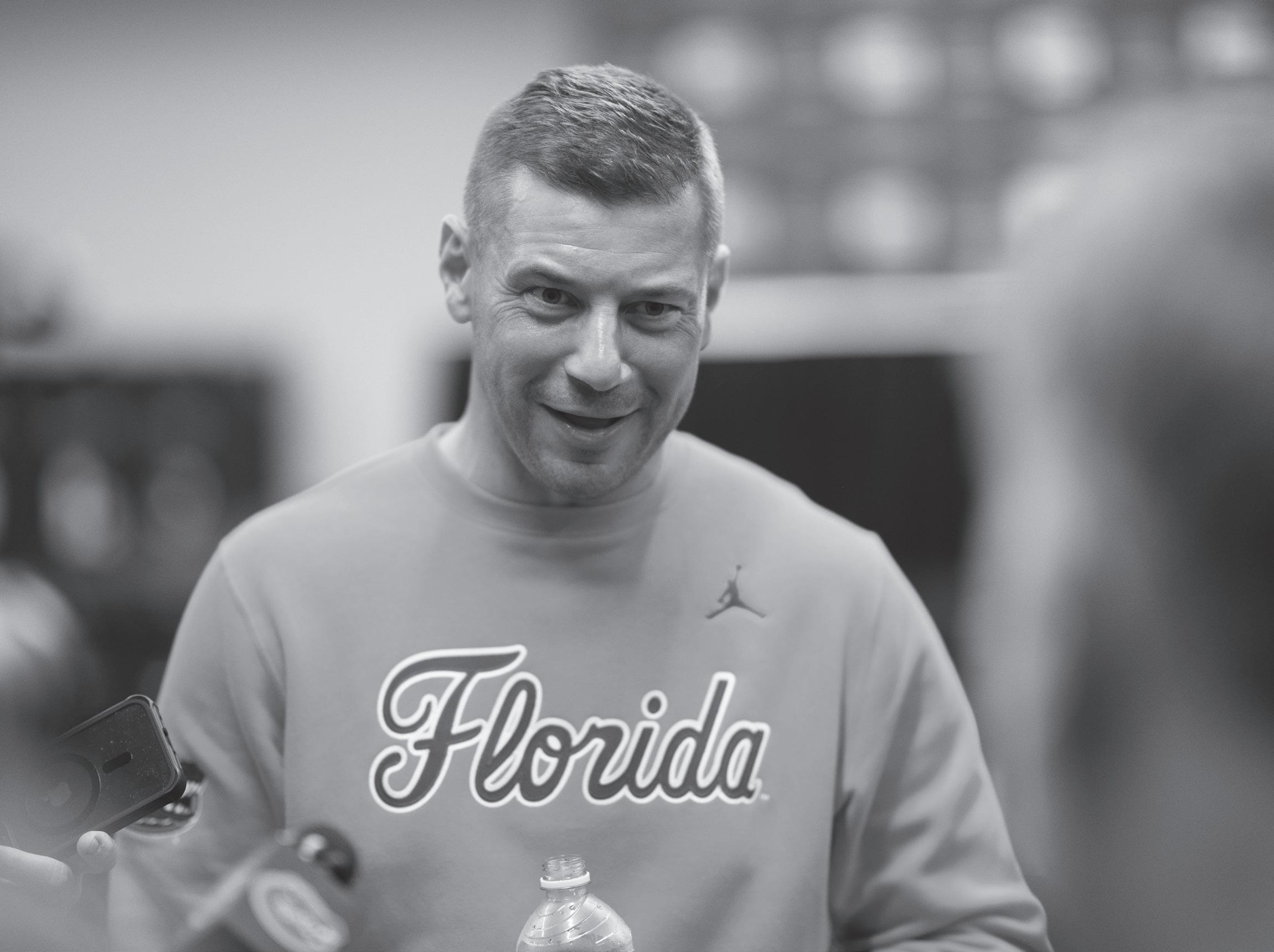
Florida head coach Jon Sumrall holds a press conference in the media room of the O'Connell Center during halftime of an NCAA men's basketball game between Florida and Auburn, Saturday, Jan. 24, 2026.
BASEBALL
‘Let’s have a
good one’: Gators baseball season days away
FLORIDA OPENS THE SPRING SEASON FEB. 13 AGAINST UAB
By Adrian Carmona Sports Writer
Condron Family Ballpark will see its first action of the year on Feb. 13 as Gators baseball begins its spring season, looking to leave a tumultuous 2025 in the rear view.
Florida comes off of a rollercoaster season that saw it start 1-11 in Southeastern Conference play. However, the year will be remembered by the comeback, as Florida won its last six series matchups, including a victory over No. 1 Texas in May to finish 39-22.
But its postseason run was short-lived after coming up short in the Conway Regional against East Carolina. This year, the Gators will look to make it back to Omaha, Nebraska, for the first time since 2024.
“Obviously, it didn't end the way we wanted it to,” said Florida head coach Kevin O’Sullivan. “But in the grand scheme of things … no one in the history of the SEC in baseball, since ‘91 … has ever started out at 1-11 and turned it around. So hopefully, that momentum, we can build off of that.”
The program saw the departure of several key players to the 2025 MLB Draft. The losses included shortstop Colby Shelton, right-handed pitcher Jake Clemente, left-handed pitcher Pierce Coppola, third baseman Bobby Boser and catchers Luke Heyman and Brody Donay. But Florida responded by adding nine transfers that look to be key contributors right away.
New pitchers join returning leaders
Among the additions, three D1 transfers came to help the pitching staff, including Ricky Reeth (Notre Dame), Russell Sandefer (UCF) and Cooper Walls (Hawaii). They also added Division II transfer Ernesto Lugo-Canchola (Northwest Nazarene), who was named a fourth-teamer in the NCBWA’s Preseason AllAmerican list.
The Gators will see the return of some familiar faces. Pitchers Liam Peterson, Aidan King and Luke McNeillie, as Florida’s big three, will lead the staff on the mound.
“I think overall, as a staff, we got significantly better in almost every department now,” Peterson said. “I’d set the ceiling pretty high.”
All three pitchers were named Preseason All-SEC. Peterson and McNeillie were selected to the first team, while King was awarded a spot on the second team.
Peterson and King, who will open as the Gators’ weekend starters for the second straight season, were also named Preseason All-Americans.
“I think we have a really good group of guys here,” King said. “Pitching this year is going to be a game changer.”
However, the third weekend starter spot is still up for grabs. McNeillie is in the mix, O’Sullivan said, but the coach is waiting to see how his pitchers will perform once gameplay begins.
“Everybody's in the running for Sunday’s spot,” O’Sullivan said. “I don't have all the answers quite yet, but once we play and how they perform when the lights go on, they'll answer the questions for us.”
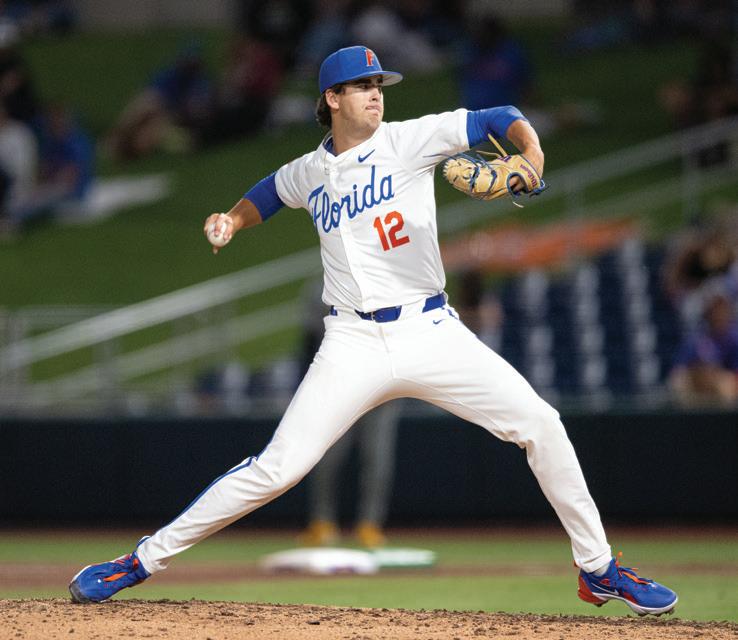
Noah Lantor // Alligator Staff Florida pitcher Liam Peterson throws a pitch during an NCAA baseball game against Missouri, Thursday, April 10, 2025, in Gainesville, Fla.
Versatile infield, deep outfield
As for the infield, the team added infielder Ethan Surowiec (Ole Miss), shortstop Sam Miller (Columbia) and catchers AJ Malzone (Wabash Valley College), Karson Bowen (Texas Christian) and Cole Stanford (Lenoir-Rhyne).
Meanwhile, returning infielder Brendan Lawson looks to make a second-year jump and lead Florida’s defense. Lawson was a 2025 First Team Freshman All-American last season, and he starts off 2026 on the SEC Preseason Second Team.
“I think the biggest surprise for me when I got back was the shape that Brendan Lawson was in,” O’Sullivan said. “We got a lot of versa-
tility in the infield.”
Florida also added former Jacksonville outfielder Jaden Bastian. But a compound fracture in his right leg during fall training will sideline Bastian for the season.
Despite losing a projected starter, O’Sullivan said he remains confident in the team’s depth. Florida will look to returners Kyle Jones, Hayden Yost and Blake Cyr to step up to fill the void.
“Yeah, that was a shame,” O’Sullivan said. “What a great kid, great family. Fortunately enough for us … we do have some depth.”
The Gators open the season No. 13 in D1 Baseball’s preseason rankings. The SEC leads all conferences with nearly half the teams inside the top 25. Florida’s tough slate will include six of those teams: No. 2 LSU, No. 7 Arkansas, No. 9 Auburn, No. 15 Georgia, No. 18 Kentucky and No. 25 Texas A&M.
In addition, the Gators will face No. 16 Florida State and No. 22 Miami during the team’s non-conference run.
The Gators will start off the 2026 season against the University of Alabama-Birmingham on Feb. 13 at 6:30 p.m. for the first weekend series.
O’Sullivan will not be a part of the first weekend action as he serves a three-game suspension after a heated exchange with NCAA officials during 2025’s regional.
Nonetheless, O’Sullivan said he’s eager to get the campaign underway.
“I’m excited about the season getting started,” he said. “Let’s have a good one.”
@abcarmona04 acarmona@alligator.org
UNTIL 9 PM
Museum Nights
Thursday, February 12, 6 – 9 pm
Celebrating Africa!
Experience the Harn’s annual celebration of arts in Africa and beyond. Join us for dance performances led by Professor Rujeko Dumbutshena and live music from drum ensemble, Pangea Band; hands-on art activities based on African traditions; light bites and refreshments
Wine Down
Thursday, February 26, 6 – 9 pm
Wine down with a performance by Jazz Life. Free lite bites and desserts, along with wine and beer.