‘Is there any way I can feel safe?’: Social 28 tenants
file worker conduct complaints
RESIDENTS ALSO CONCERNED BY LACK OF NATURAL LIGHT, APARTMENT DAMAGE AMID ONGOING
CONSTRUCTION
By Caroline Walsh Alligator Contributing Writer
Like clockwork, Social 28 tenants awake to their daily alarm — hammering, drilling and shouting. While the tenants’ clocks read 7:30 a.m., their rooms still appear as if it were midnight.
March marked the tenth straight month of construction on Social 28, an off-campus student apartment complex built in 2015, located directly across the street from UF’s College of the Arts.
The ongoing construction, done by multiple licensed third-party contractors and Centex Construction as the general contractor, involves renovations to amenities such as the gym, pool and study rooms, and exterior improvements like window and balcony replacements.
Tenants said they were not informed of the planned construction when they signed their leases. However, their leases included a clause that allows Social 28 to do construction without informing residents beforehand.
Some tenants said they have not been given a clear answer on the projected end of construction and are fed up with the lack of clear communication by management.
Nishra Kothari, a 19-year-old UF finance sophomore, moved into a four-bedroom unit at Social 28 in August 2025. She said construction ramped up on her side of the building after returning from winter break. The windows of every bedroom in her unit have been boarded up with plywood by the construction workers since the second week of the Spring semester, she said.
In an email sent to The Alligator on March 3, Social 28 regional manager Angelina Mercurio said after B.HOM Student Living acquired
SPORTS/SPECIAL/CUTOUT
The Avenue
the complex, the ownership made plans for a multimillion-dollar investment to replace the entire exterior of both buildings. This involved boarding up residents’ windows for temporary protective measures. Mercurio added the boards were removed as soon as each portion of work was completed.
Renovations are expected to be completed within the next couple of weeks for the South building, while the North building will be under construction until at least mid-May, she said.
Throughout the renovations, Mercurio said, Social 28 has provided weekly communication about construction through multiple means like emails, on-site signage and direct outreach by management. She said there is on-site management to answer residents’ questions about construction, and the company is focused on remaining transparent while providing consistent updates.
Social 28 did not respond to further emails asking for comment on specific incidents reported by residents, such as alleged harassment by construction workers and debris left in bedrooms.
Interactions with construction workers
Some tenants said they felt uncomfortable with construction workers constantly outside of their windows. Alaina Campagna, an 18-yearold UF microbiology and cell science freshman, said her roommate lodged a harassment complaint about their behavior.
In the complaint, which was shared with The Alligator, the tenant wrote a construction worker scraped a smiley face into the paint that construction covered her window with. She then saw the worker look into her room around 10:30 a.m. Campagna said her roommate immediately called her father and went to the leasing office to report the incident.
In a second complaint filed six days later, which was also shared with The Alligator, the tenant wrote that she found four total smiley faces scraped into her window after returning
Gainesville could see population boom as climate change progresses
AS SOUTHERN FLORIDIANS
ARE
PRICED OUT OF THEIR HOMES, MANY ARE LOOKING TO NORTH CENTRAL COUNTIES
By Juliana DeFilippo Alligator Staff Writer
When Bob Tancig thinks about climate change in Gainesville, he thinks about azaleas. The small pink flowers traditionally bloom from February to April, when temperatures start to increase after chilly North Florida winters. But Tancig has started spotting them as early
as December.
He’s heard some people call the changes that come with temperature shifts “climate chaos.” Chair of the Gainesville chapter of the Climate Reality Project, Tancig has lived in Gainesville since the 1980s, and he sees the impact of climate change in more than just the azaleas.
“Alachua County is expected to see an increase of people who are moving here because of the climate threats in South Florida,” he said.
As more South Florida residents
description finish with comma, pg#
Meet the UF alumnus who took home an Oscar on March 15. Read more on pg. 6.
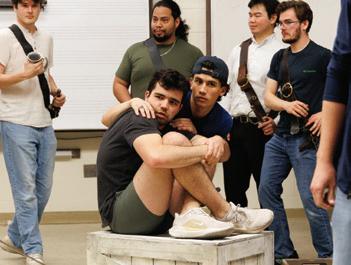

Caroline Walsh // Alligator Contributing Staff
Jenna Horner, founder of Mindful Messages, stands in front of a mural she is painting at Eastside High School, Wednesday, March 11, 2026, in Gainesville, Fla. Read more on pg. 3.
Today’s Weather
A look into UF’s multibillion-dollar construction plans
THE UNIVERSITY WILL SPEND OVER $2.4 BILLION ON 76 PROJECTS FROM LATE 2025-2030
By Alabama Weninegar Alligator Staff Writer
As of December 2025, UF has a total of 76 ongoing construction projects. Some are in the design process, others are being planned and some are already undergoing construction.
UF is allocating over $2.4 billion into the endeavor. About $2.2 billion will go toward 28 “major” capital construction projects, while the remainder will go to 48 “minor” ones.
Major projects include facility and infrastructure upgrades and new buildings. They could also refer to additions and renovations to current buildings. Activities like roof replacements, single floor renovations and classroom and lab additions are considered “minor.”
Anticipated completion dates vary, with the latest being 2030. Twenty-two of the projects don’t have confirmed completion dates as of December 2025.
Here’s a look into some UF’s major advancements in housing and academic facilities.
Construction of new undergraduate dorms
Earlier this year, the Florida Board of Governors unanimously approved a loan that would allow UF to borrow up to $245 million for new UF dorms.
The project, expected to cost around $214.7 million, is the first of a decade-long plan to strengthen the UF housing system, according to the resolution proposed by the board. Two eight- to nine-story buildings, including around 1,100 beds, will house on-campus UF undergraduate students, the resolution says.
The project will replace the 622 beds lost in the demolition of Trusler, Simpson and Graham halls in June 2025. The board said the project will expand undergraduate housing by 5.11%, with a total of over 9,700 beds for all undergraduate dorms.
The buildings will be located at the intersection of Museum Road and Gale Lemerand Drive, where Trusler, Simpson and Graham halls previously stood.
The per-bed cost is the highest to date for UF student housing projects and the second-highest among all projects in the State University System, costing $195,000 per bed.
UF attributed the high cost to inflation induced by the COVID-19 pandemic. The university plans to increase rent over multiple years in the housing system to align with the building cost increases, according to the resolution.
Kevin Pichard, assistant vice chancellor on the board, explained how this project will cater to waitlisted freshmen for on-campus housing at the meeting where the project was approved.
“UF’s got a waiting list,” Pichard said, “a perpetual waiting list every year that could fill this project on its own.”
The project is planned to be completed by July 2028 to accommodate incoming freshmen for Fall 2028.
UF’s ongoing housing projects
Five residence halls on UF’s main campus are set for renovation over the next 10 years: Beaty Towers will get a refresh, as well as Mallory, Yulee and Reid halls. These housing demolitions, renovations and new construction projects on UF’s campus are also part of the 10-year campus master plan, estimated to cost $1.1 billion.
The dorms, which are catered to incoming freshmen according to the project summary, will mostly be twobedroom, one-bathroom semi-suite rooms with study and lounge spaces as well as grab-and-go dining areas.
Monthly rent for students will be a little over $1,100, which is higher than the average UF dorm rent of $900 across all residences.
The project summary also said one of the buildings will partially allocate two stories to the Disability Resource Center.
These rooms will allow UF to address the high demand for oncampus housing, which has a recordhigh occupancy rate of 98% to 99%, along with yearly waiting lists.
Though not directly involved in this project, Ryland Wagner, the 47-year-old managing member at Joyner Construction Partners, has done several jobs on campus. From a management perspective, he said, the long-term construction of a project this size can affect nearby areas. Wagner says the project will likely bring road closures, debris and noise.
One of the main challenges that comes with on-campus projects is ensuring all workers have access to parking, he added.
“I've done a bunch of projects on campus or near campus. There's no parking anywhere,” Wagner said. “Everybody's got a truck.”
Another issue is the timeliness of the project, Wagner said. If the project takes longer than expected, students with those housing placements will likely have to be temporarily placed into hotels.
Honors Village, an undergraduate residential project, was completed in 2024, costing $150 million. Additionally, the demolition of both undergraduate and graduate halls took place last year, estimating a total cost of $18.5 million.
Graduate students question priorities
While the new dorms will cater toward waitlisted undergraduate students, after the recent demolition of graduate residence halls Maguire Village and University Village South last year, graduate students are also advocating for more on-campus housing options.
The on-campus graduate housing capacity in 2029 is roughly 950 students. By comparison, undergraduate student housing for 2029 is estimated at around 9,400 students.
Based on the total number of undergraduate students in UF’s 20242025 term, 25.8% would be able to live on campus in 2029. Using this same data for graduate students, only 4.8% would be able to live on campus.
Saad Alghamdi, a 30-year-old UF mechanical engineering doctoral student, has lived in Diamond Village for four months. Alghamdi has enjoyed his time in Diamond, but he said he was on a waitlist for on-cam-
pus housing for two years straight. Alghamdi said living off-campus was difficult because of higher rent and a longer commute to campus.
“We need more buildings for the graduate students,” he said. “I have so many friends that are waiting for the waiting list.”
Wonjung Kim, a 27-year-old UF political science doctoral student who also lives in Diamond Village, appreciates the convenience of oncampus locations for graduate housing, but he agreed waiting lists can be tricky.
“I know the process can be quite complicated in terms of waiting lists,” he said. “But I think they [UF] are trying their best.”
Izaya Miles, a 25-year-old UF law student, lives at The Continuum, a graduate housing complex partnered with UF. He said finding housing was easy for him when he moved to Gainesville.
Miles said he's enjoyed his time at The Continuum and appreciates the management. From his personal experience, he said UF’s provided graduate housing is in a good place.
“You know, everyone's got to live somewhere,” Miles said.
UF Planning, Construction & Design was not immediately available for comment.
UF College of Dentistry reconstruction — what to expect
The UF College of Dentistry has entered the fourth and final year of funding for its $210 million, multiphase reconstruction project — a total redesign to expand student capacity, modernize clinical training and increase access to affordable dental care.
Additions should be completed by July 2028, and renovations should also end by July 2030, according to the construction plan. Additions include a new main entrance and expanded space for practice clinics, teaching labs, classrooms, offices and research facilities.
Dr. Isabel Garcia, dean of UF College of Dentistry, said the project will bring new opportunities for faculty and students.
“The project — it’s really three projects — will create what is going to be an amazing new space,” she said.
Plans also call for replacement of the college's parking lot, with closer, covered parking to improve accessibility for patients and visitors.
The reconstruction would not have been possible without what she described as historic support from the Florida Legislature, Garcia said.
The first phase, known as the “building envelope project,” began Fall 2025 and focuses on removing the building’s original brick exterior, a process she said is expected to take about a year. The brick demolition will be followed by an installation of a waterproof insulation system.
The second phase will add about 100,000 square feet of modernized clinical and educational space. Construction is expected to begin in August and last about two years.
Read the rest online at alligator.org.
aweninegar@alligator.org

Editor-In-Chief
Engagement Managing Editor
Digital Managing Editor
Senior News Director
Enterprise Editor
Metro Editor
University Editor
Opinions Editor
Zoey Thomas, zthomas@alligator.org
Megan Howard, mhoward@alligator.org
Sara-James Ranta, sranta@alligator.org
Pristine Thai, pthai@alligator.org
Vera Lucia Pappaterra, vpappaterra@alligator.org
Bailey Diem, bdiem@alligator.org
Sofia Meyers, smeyers@alligator.org
Sofia Bravo, sbravo@alligator.org
Corey Fiske, cfiske@alligator.org
El Caimán Editor
Avery Parker, aparker@alligator.org
Ava DiCecca, adicecca@alligator.org
Assistant Sports Editor
Assistant Multimedia Editor the Avenue Editor
Max Bernstein, mbernstein@alligator.org
Multimedia Editor
Noah Lantor, nlantor@alligator.org
Sports Editor Editorial Board
DISPLAY ADVERTISING
Advertising Office Manager
Sales Representatives
Sales Interns
CLASSIFIED ADVERTISING
Bayden Armstrong, barmstrong@alligator.org
Copy Desk Chief Pristine Thai, pthai@alligator.org
Zoey Thomas, Sara-James Ranta, Megan Howard, Pristine Thai
352-376-4482
Cheryl del Rosario, cdelrosario@alligator.org
Paige Montero, Simone Simpson, Makenna Paul, Sofia Korostyshevsky, Daniel Sanchez
Sofia Morales-Guzman, Alessandra Puccini, Olivia Fussner
352-373-3463
Classified Advertising Manager Ellen Light, elight@alligator.org
BUSINESS
352-376-4446
Comptroller Delia Kradolfer, dkradolfer@alligator.org
Bookkeeper Cheryl del Rosario, cdelrosario@alligator.org
Administrative Assistant Ellen Light, elight@alligator.org
ADMINISTRATION
352-376-4446
General Manager Shaun O'Connor, soconnor@alligator.org
President Emeritus C.E. Barber, cebarber@alligator.org
SYSTEMS
IT System Engineer Kevin Hart
PRODUCTION
Production Manager
Namari Lock, nlock@alligator.org
Publication Manager Deion McLeod, dmcleod@alligator.org

and exam periods. The Alligator is a member of the Newspaper Association of America, National Newspaper Association, Florida Press Association and Southern University Newspapers.
The Alligator strives to be accurate and clear in its news reports and editorials. If you find an error, please call our newsroom at 352-376-4458 or email editor@alligator.org 352-376-4458 NEWSROOM:
Eastside High School hosts unveiling to celebrate new mural
The mural celebrates the school’s
past and honors the present
By Grace Larson Alligator Staff Writer
Roughly 25 students, teachers and community members gathered at Eastside High School March 31 for the unveiling of its new mural.
The mural is the latest painted by Jenna Horner as a part of Mindful Messages: A Mural Movement, a nonprofit
organization dedicated to painting murals with uplifting messages in Alachua County schools.
The 200-foot mural highlights the school’s diversity, acknowledging its history of integration. Eastside opened in 1970 to facilitate the integration of Alachua County Public Schools following a U.S. Supreme Court order requiring the school system to desegregate.
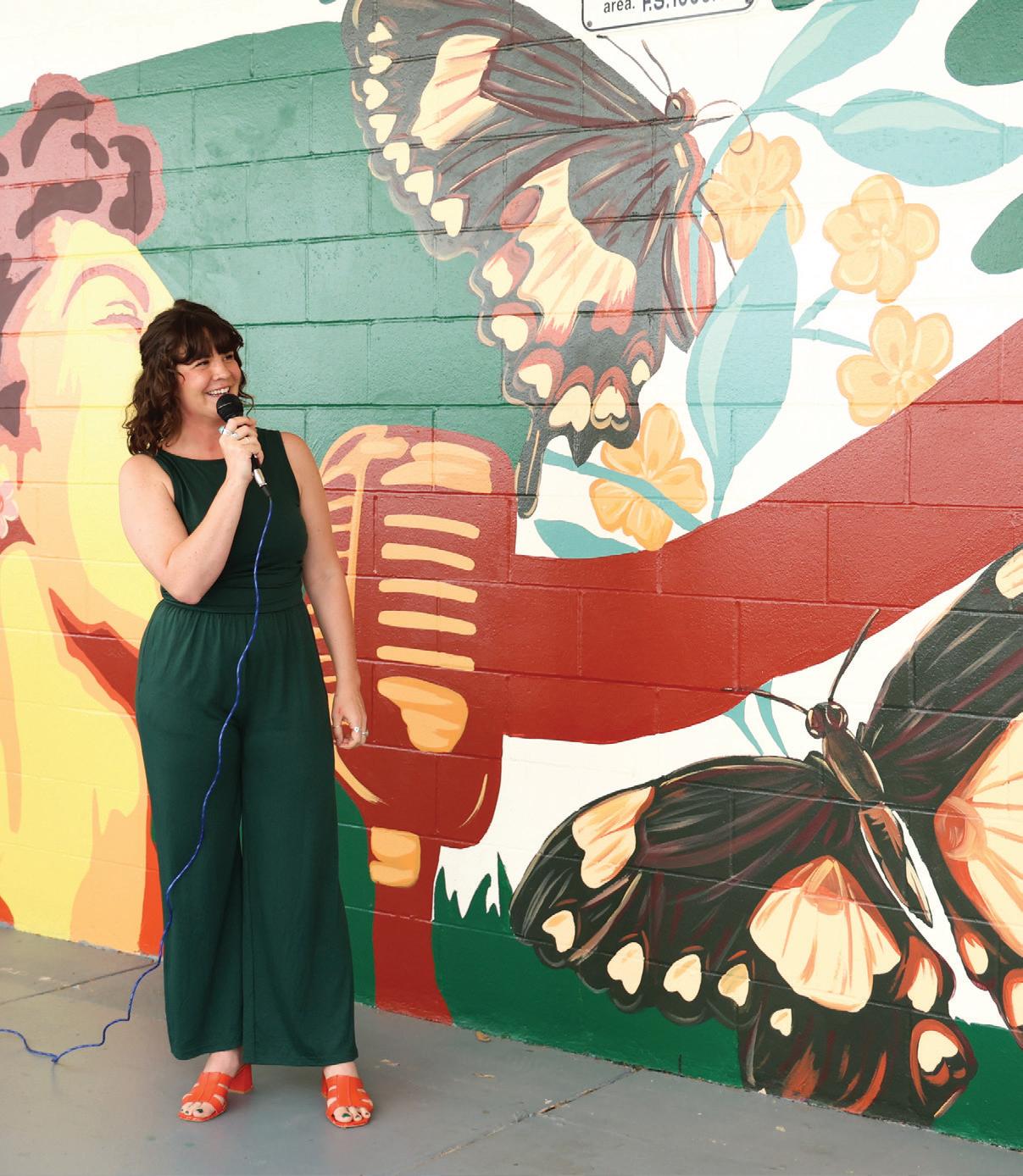
butterflies throughout the mural at Eastside High School, Tuesday, March 31, 2026, in Gainesville, Fla.
The new mural is full of motifs that highlight local nature and the diverse extracurricular activities offered at Eastside. It depicts two timelines: the transformation of caterpillars into butterflies and the school’s history.
The mural begins with paintings of students from the ‘70s dancing on a football field. Across the field are images of modern-day football and basketball players, band students and cheerleaders. At the end of the mural is a portrait of a student with a headdress. “Be yourself” is written, along with other smaller messages, around her head.
The mural is modeled after current students, like 16-year-old Kaleb Gordon, who is depicted holding a football.
For Gordon, the mural is more than just art — it’s an experience.
“This experience has really opened my eyes to new opportunities and ways of expression,” Gordon said.
Throughout the week of the project, Gordon had the opportunity to paint an image of himself. Once the mural was finished, students wrote their own inscription around the “Be yourself” message. Gordon wrote “Express yourself,” a message he said he learned being a student at Eastside.
To celebrate the school’s diverse extracurriculars, the Eastside band played an array of songs, including the school’s alma mater. Audience members bobbed their heads and tapped their feet to the dance breaks and chants.
For artist Horner, the performance was a perfect introduction to the mural’s message about the importance of creativity.
“I’m a deep believer that

creativity is something that’s inherent in all of us,” Horner said. “And [I] wanted to give them an example of somebody going from being a student to actually in action, whatever their creative field is.”
Whether it be the mural’s depiction of sports or music, she said the message remains the same: Be yourself in your own creative field.
Not only does Horner hope to promote a message of creativity in the mural, she also hoped to do so in its production.
“The most impactful part for me was getting to talk with these students and have their expression literally go onto the
wall,” she said, “after being a part of the whole collaborative experience of what it is to be one piece to a much bigger picture.”
For Principal Leroy Williams, the mural is representative of what it means to be an Eastside Ram.
The mural captures Eastside’s energy, honor, integrity and history, he said. Through the mural, the message is maintained forever.
“You all took this moment, and you’re a part of history forever,” Williams said. “That is what it’s all about, is being passed along.”
@graceellarson glarson@alligator.org
Florida panthers made a comeback in the ‘90s — where do they stand now?
AS PANTHERS ENTER THEIR REPRODUCTIVE SEASON, HUMANS CONTINUE TO POSE THREATS TO THE SPECIES
By Juliana DeFilippo Alligator Staff Writer
In 1992, the Florida panther had an estimated 40 years left before extinction. The population had dwindled to roughly 30, and inbreeding had caused genetic deficiencies and health issues.
However, Florida scientists weren’t ready to give up on the animals.
Today, about 200 Florida panthers remain. But they face new threats.
Cars are now the leading danger to panthers, accounting for 466 deaths since 1978, according to data from the Florida Fish and Wildlife Conservation Commission. As car travel increases during the spring and summer, Florida panthers simultaneously enter their most active breeding season, meaning the risk of vehicle strikes is higher.
While panthers breed year-round, members of the Florida subspecies typically reproduce from March to July, making them especially vulnerable to human-caused risks. Carol Rizkalla, coordinator of the FWC Panther Management Program, said male panthers disperse widely — sometimes traveling up to 42 miles — which makes them prone to car strikes.
“They have large home ranges, and they move around that home range every day, so they are actively crossing roads,” she said. “It’s unavoidable.”
Of the 29 panthers killed by cars in 2024, 19 were male. Because of their wide dispersal, they are found more frequently outside the species’ typical South Florida domain. It’s rare to see breeding panthers north of the Caloosahatchee River in Fort Myers, but a male was spotted in Georgia in 2008 before being killed. More recently, in 2017, two breeding female panthers were seen north of the river.
Assistant professor Hance Ellington works at UF’s Range Cattle Research and Education Center in Ona, an unincorporated community about 50 miles east of Sarasota. There, he monitors local trail cameras, which have
captured two male Florida panthers over the years, including one sighting earlier this year.
“The panther population continues to grow,” Ellington said. “It’s not growing super fast, but it is growing, and safely crossing the Caloosahatchee means the population is also expanding its distribution.”
With the species’ expansion north comes greater risk for accidents. The roads panthers cross rarely have lights because they are largely based in rural areas, said Marie Filipek, animal care supervisor at ZooTampa.
“If you can, use your high beams,” Filipek said. “For vehicle safety and human safety and animal safety, just don’t be a distracted driver.”
But Florida panthers face human-created risks beyond cars. Habitat loss also threatens the panther population, as development and road building in South Florida reduce available land.
Organizations like the Florida Wildlife Corridor Foundation aim to create safe passageways for wildlife like the Florida panther. Filipek and her team at ZooTampa tell visitors about the group, which conserves lands from the Everglades to the Georgia border to create
a connected 18 million-acre stretch for wildlife to travel across.
The Florida panther is considered an umbrella species, which means their conservation helps protect several other species in their ecosystem. As apex predators, panthers protect against environmental issues by limiting invasive populations that, if left unchecked, could cause damage to other species populations.
It’s why scientists worked to rebuild the Florida panther population in the 1990s, and why organizations continue to encourage state legislators to protect the species.
As Florida’s population continues to grow, prompting more development, Filipek worries about losing sight of the species she works to protect.
“More people are moving here all the time, but making sure that we’re preserving what we have left of our natural habitats is really important,” she said.
@JulianaDeF58101 jdefillipo@alligator.org
Caroline Walsh // Alligator Staff
Jenna Horner, founder of Mindful Messages, paints a mural at Eastside High School, Wednesday, March 11, 2026, in Gainesville, Fla.
Riley Beiswenger // Alligator Staff
Jenna Horner presents her art and explains the symbolism of the
Gainesville apartment construction sparks resident pushback
from a three-day trip. The tenant also said a construction worker shined a flashlight through her window and looked around her room shortly before 8 a.m.
In both complaints, she asked management, “Is there any way I can feel safe in my own room?”
The tenant said she never received a response to her emails but spoke to Social 28 management in person, who referred her to the management of the construction company. When she spoke with them, she said they apologized and said they would speak with the workers. She said no incident has occurred since.
Campagna said the incidents scared all of her roommates at first. Now, when construction workers are outside her window, she said she closes her blinds and puts in earbuds.
“It got to the point where I got used to it,” Campagna said. “Which is not a good thing.… It should be scary.”
She said construction covered her window with paint from August to late November last year, blocking out any natural light. To know if it was raining, she said she had to go outside the apartment building.
“It felt like I was living in a cave for most of my first semester, and it made me just not want to live here or not want to be here,” Campagna said.
Abigail Cowling, a 20-year-old UF business administration sophomore, said she and her roommate had issues with the construction workers’ conduct as well. The first week after Fall move-in, she said her roommate told her a construction worker entered both of their bedrooms through their windows.
Cowling’s roommate had been sleeping in her bedroom when the worker climbed in through her window. Cowling was in class when the entry occurred, but said she found wood and paint chips all over her clothes and bags. Neither Cowling nor her roommate had advance notice the construction workers would be entering their unit. After the two
reported the incident, Cowling said management started sending emails with a timeframe of when construction workers would need access to tenants’ apartments.
However, Cowling said miscommunications over construction timelines still occur.
“It seems like nobody actually knows what’s going on,” Cowling said.
Construction also extended to the complex’s parking garage, according to a letter Social 28 sent to tenants shared with The Alligator. The letter informed residents they could not park in their assigned space from Feb. 23-27 because of renovations and should instead park in guest spots on a first-come, first-served basis. Social 28 said it would offer reimbursements for reasonable expenses related to alternative parking arrangements.
Isabella Mastrson, a 20-year-old UF applied physiology and kinesiology sophomore, said she pays $250 per month for a secure parking spot, but the garage’s system has been broken since November 2025. She said she is frustrated by the way Social 28 is handling the situation.
“I don't want to have to now find another parking spot,” Mastrson said. “It's just another inconvenience to throw onto everything.”
Noise and flooding:
‘It really stresses me out bad’
Another frustrating aspect for Mastrson was the constant construction noise on her side of the building during October and November 2025. She said she wore soundproof Beats headphones, blasting music or white noise at full volume, to block out the construction noise when sleeping. Still, she said she was woken up daily around 7 a.m. by construction noise and her room vibrating.
“I would wake up, and there's just dust all around me, like on my bed,” Mastrson said. “They're banging so hard, the paint on the walls is falling into my face.”
Another tenant, Sydney Parsons, a 21-year-old UF civil engineering junior, said she went to UF Student
Legal Services when she experienced flooding in her apartment after the construction workers improperly taped up her window.
The first incident occurred Sept. 27, 2025, as she and her roommate were getting ready to go out and rain started leaking into their apartment. After setting out pots and pans to collect water, she said she tried calling maintenance but kept getting a Verizon message saying the line did not exist. After trying several management numbers multiple times, she said she finally got a hold of someone.
“I started panicking, and I am a little bit evil,” Parsons said. “I was blowing up their stuff.”
After the first instance, she said she got a lawyer through Student Legal Services. Eight days later, the flooding occurred again with rustcolored rainwater pooling into their living room, she said.
She said she settled her case with Social 28 and now pays 75% of her original rent price. While she said she was happy with the outcome of the case, she said dealing with the situation greatly affected her.
“I felt obligated to be home and
cancel plans,” Parsons said. “It really stressed me out bad.” Parsons also finds the construction noise disruptive to her trying to get any schoolwork done. She said she would wake up at 7:30 a.m. to the sound of hammering and her walls vibrating, which caused items to fall off of her shelf and break. The hammering would persist until construction ended for the day around 6 p.m.
“It was absolutely impossible, in my opinion, to focus here,” Parsons said.
Caroline Walsh is a contributing writer for The Alligator.

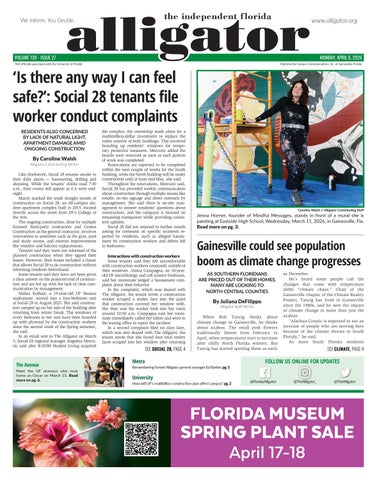
Construction workers on scaffolding outside the south building
Monday, Feb. 23, 2026, in Gainesville, Fla.
Rising temperatures push out South Florida residents
are priced out of the area and climate threats loom, Central and North Florida are changing to accommodate emerging migration patterns. An FAU survey found over one in three Floridians considered moving because of climate change in 2025. Climate change threatens coastlines, raising sea levels by increasing amounts each year. In South Florida, where Tancig is from, sea levels are expected to rise by 10-17 inches by 2040. By 2100, sea level rise will result in increased coastal flooding, which is expected to impact almost 500,000 people in Florida.
In Tancig’s view, cities have to decide between paying to mitigate problems like sea level rise or paying to increase resilience to those problems. And they’re running out of time.
“A lot of the money that we could or should be spending on reinforcing our
infrastructure and transitioning the clean energy sources, that money is now instead being directed to recover from the disasters that have occurred, because we haven't been spending our money in those areas,” he said.
Rising insurance and housing costs in coastal areas have contributed to inland migration. Florida has the third-highest average annual premium, meaning the cost of an insurance plan, at $5,838, is more than $3,000 higher than the national average. South Florida counties like Monroe have annual premiums up to $7,000. By contrast, Alachua’s average in 2023 was $1,877.
Projections from Nature Climate Change show that by 2100, Miami could lose more than 2.5 million residents, with Orlando seeing over 250,000 migrants. A study from UF’s Bureau of Economic and Business Research projected Alachua County will see 23,000 new residents by 2100 due to sea level rise.
Rising insurance costs in vulnerable areas of Florida create a financial incentive to relocate, said Esther Mullens, assistant professor of geography at UF. She raised concerns about a person’s emotional attachment to the place they live, which could lead them to remain in a place when it becomes too dangerous.
Cities and governments will have to factor in extreme weather when it comes time to work on relocation plans.
“How do you do that in a sustainable way that's respecting the fact that people have a strong connection to a place?” she said. “It's going to be very emotionally difficult to know what to do about that.”
Mullens points to record-breaking heat during Florida summers and the hurricane patterns of 2024 when addressing how these shifts will necessitate change. More housing development companies are offering net-zero options, as well as spray foam insulation to reduce heat inside
homes.
In her classes, UF assistant professor of architecture Patricia Kio challenges her students to generate possible solutions to the problems posed by climate change. They focus on making structures more resilient to things like raised temperatures and flooding.
Gainesville has implemented resilient features on many homes and structures, with emphasis on reducing the impact of extreme heat. The city's Climate Resiliency Plan prioritizes planting more trees in urban areas and transitioning away from fossil fuels and toward solar energy.
As Kio explains, resilience won’t come down to one decision, but a new system of thinking and problem-solving.
“Thinking responsibly, thinking sustainably, using the minimum things that you require,” she said. “Always thinking about the future generations when we make our decisions.”
Caroline Walsh // Alligator Contributing Staff
of the Social 28 apartment complex,
Remembering ‘Uncle Ed’: Former Alligator general manager Ed Barber dies at 86
Co-workers, family members reflect on Barber’s 50 years of support to student journalism
By Leona Masangkay, Sofia Meyers & Zoey Thomas Alligator Staff Writers
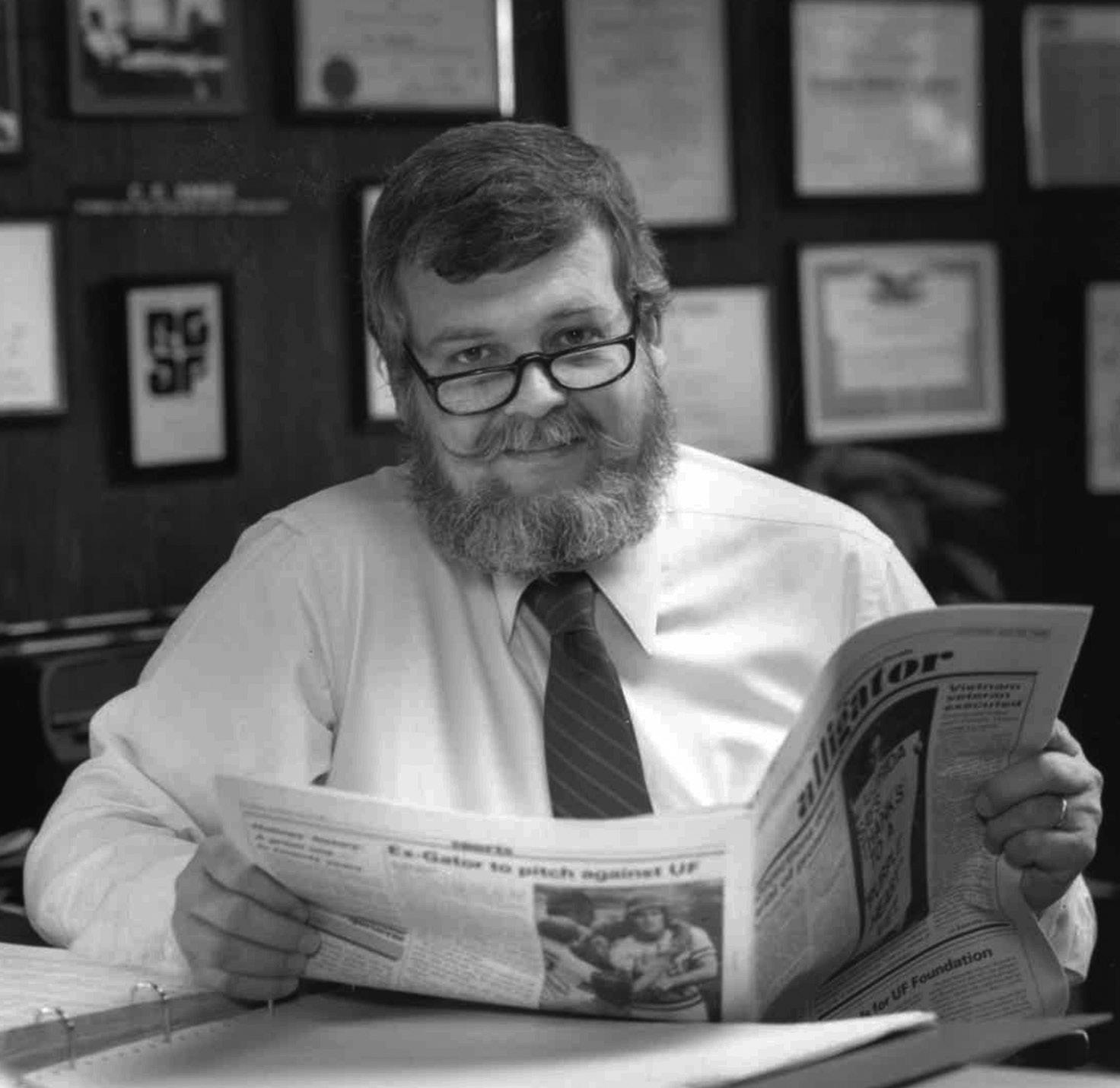
Charles Edward “Ed” Barber, also known as “Mr. Alligator” or “Uncle Ed,” died March 29 at 86 years old.
Barber’s legacy in UF’s journalism community and at The Alligator stretches over 50 years. Alumni and former colleagues remember him as a mustachioed mentor, chili connoisseur and steadfast supporter of independent student journalism.
The South Florida native first became involved with The Alligator as a student reporter a year after enrolling at UF in 1962. After a brief career at the university, Barber became The Alligator’s general manager, president and treasurer in 1976. He resigned in 2007 after holding the position for over three decades.
Ron Sachs, a friend of Barber’s for 57 years and former Alligator editor-in-chief, described Barber as someone who “not-so-quietly” supported the paper’s student journalists.
“He’s the real hero and the story of The Independent Florida Alligator,” Sachs said.
Sachs credits Barber for keeping The Alligator afloat in the early years of its independence. The paper parted ways with the university in 1973, two years after its staff, under Sachs’ leadership, challenged a state law restricting publication of abortion information.
Barber stepped up to defend The Alligator behind the scenes, Sachs said, by coaching its student journalists. He also helped make The Alligator financially viable, monetizing the paper so students could be paid.
“The tradition lives on because of the example that Ed Barber set as a big brother, mentor, coach, who had never done anything in his own life except support college journalists,” Sachs said.
Matt Adams, who was on The Alligator’s staff from 1990 to 1993, said Barber backed up the paper in times of conflict and controversy — never wavering in his dedication to keep The Alligator strictly studentled.
“I would wish for anybody, in their whole lives, to love something as much as Ed loved The Alligator,” he said.
Family and early life
Born Oct. 30, 1939, Barber began working in journalism far earlier than other kids. At just 9 years old, he started a community newsletter in his Miami neighborhood. He’d go on to serve as editor of his Hialeah High School newspaper, The Record, during his senior year.
“Ed grew up dirt poor. … I mean, no shoes and one pair of coveralls,” said David Carlson, a friend of Barber’s for over three decades. “In the boondocks, out in the swamps, basically — they had an outhouse.”
After graduating high school, Barber joined the U.S. Coast Guard Reserve and went on active duty for six months. He also served in active reserves for another seven and
a half years upon his return. Barber moved to Gainesville with his wife and high school sweetheart, Judith Tuck, in 1962 to pursue a UF degree.
Enrolling as a married military veteran, Barber studied journalism with a minor in history. He also held several positions at The Alligator — then known as simply The Florida Alligator — ending as executive editor before graduating in 1966.
In 1971, Barber began leading the Office of Student Publications at UF, where he oversaw The Florida Alligator, the student yearbook and literary magazine. He then moved to the University Press, the scholarly book publishing arm of the university. Barber held that role for three years before beginning his 30-year career at The Alligator.
In addition to being a dedicated journalist, Barber is also remembered by friends for his kindness.
Aside from his smile, which Carlson described as “sneaky,” Carlson will miss the fact he could talk to Barber about anything the most, he said.
Carlson, a retired professor in the UF College of Journalism and Communications, first arrived at UF in 1993. During the first week Carlson was in Gainesville, Barber paid him a call and invited him out to eat.
“I found him a kindred soul from pretty much the moment I got in his car to go out to lunch,” Carlson said.
Even after Barber moved to Tallahassee, they made sure to pay each other visits, he said.
“I remember him once bringing my wife and me dinner right after we had bought a house,” Carlson said. “It was the fall, and he had a lot of trouble with pollen in the fall … so he showed up wearing a mask, or maybe even two masks.”
Magdalena Davila, Barber’s wife, described him as compassionate and caring. The two married in 2009 after Tuck, his wife of 44 years, died in 2004.
Davila recalled times at restaurants when Barber would gather the finished dishes at the end of the table to make cleaning up easier for their waiters. He would also leave notes at restaurants thanking waiters for their service.
“He always thought about other people, was always grateful, always thankful for everything,” she said.
“That was the kind of man he was.”
Apart from The Alligator, Barber served as president and publisher of The High Springs Herald, which was owned by The Alligator’s parent company, beginning in 1990. The community weekly paper was sold in 2007 and has since shut down.
In 2006, Barber became the president and managing director of the Alligator Alumni Association. He held the position until his death.
Memories from Alligator alumni
Tom Julin, an Alligator alumnus who first met Barber in 1975 as The Alligator’s layout editor, called him a “wonderful person.” Barber was the single most important influence on the paper’s continued survival, he said.
“Without Ed Barber, there prob-
ably would be no Independent Florida Alligator,” Julin said.
Barber had the vision for The Alligator to be completely student-run, he said, recognizing that high-quality student journalism requires the “adults” to step back.
Lynda Mitsakos worked at The Alligator with Barber in the ‘70s, while the paper was going through all the growing pains of becoming independent. Barber united The Alligator when it went through rough patches, Mitsakos said.
“He just built the paper back up,” she said.
Barber made an impact on everyone, Mitsakos said, and he kept in touch with Alligator alumni even when he moved to Tallahassee.
To some of those alumni, Barber was also known for handling mistakes among the staff with care.
Beth Kassab worked at The Alligator with Barber from 1996 to 2000. She said Barber was always present to help students learn and ensure The Alligator’s continued existence.
Kassab recalled when she was an editor and there was an error in a story. She said Barber handled the mistake in a remarkable way, providing support while still letting the students navigate the situation.
“He tended to know people’s names in the newsroom, but not on a level where he would walk through and try to flout his position there,” she said.
Eric Estrin, a news editor for The Alligator in 1974, remembered when he was assigned a story on panhandlers in Gainesville. His editor wanted him to pose as a panhandler and write about his experience.
Estrin panhandled outside of McDonald’s, he said, because he read people are more inclined to give away money when they are full. He cracked a joke in the article about McDonald’s and its customers that didn’t land well.
McDonald’s, offended by the piece, canceled a large advertising
breathed it, and he passed that onto many, many, many students.”
Memories from university connections
His colleagues also remember the diplomacy Barber maintained between the university and The Alligator, even when the two came into disputes over the paper’s content.
Steve Orlando, interim vice president for communications and marketing at UF, worked with Barber in two very different ways. As a student journalist in the ‘80s, Orlando remembers Barber’s “absolutely larger than life” presence in The Alligator’s office.
Like many former staffers, Orlando recalled Barber’s long-running chili cook-off tradition, when staff members brought their own recipes for their co-workers to sample and vote on. Barber also kept the staff fed with the occasional pizza.
When Orlando later took a communications role at UF, he began serving as a liaison between the paper and the university. His respect for Barber never wavered — even when the two entities had what Orlando called “our differences.”
contract with The Alligator. Despite this, Estrin said, Barber didn’t chastise him about the mistake.
“Ed was so cool about it,” he said. “I just really appreciated that it was just a place for students to learn and grow and to do it at their own pace without pressure from him.”
Barber practiced extreme discipline to allow students to run the publication, said Dennis Kneale, a news editor for The Alligator in fall of 1978 and winter of 1979.
“He sat there through generation after generation of editors of the paper who made mistakes,” Kneale said. “If they wanted his advice, he gave it, and if they didn’t ask it, usually he kept it to himself.”
Kneale recalled Barber advocated for The Alligator through many controversies. At one point, a campus group organized the theft of thousands of newspaper copies after The Alligator promoted a Student Government party not endorsed by the group in the paper.
Once independent from UF, The Alligator became “a thorn in the administration’s side,” Kneale said, and the university likely “wanted The Alligator to die.” However, Barber kept the publication afloat.
“Ed always was able to revive the thing,” Kneale said. “He leaves that behind as a legacy.”
Apart from his role at The Alligator, Barber was known for his white handlebar mustache. Later in his life, he grew a long white beard to dress up as Santa Claus for children’s entertainment, Kneale said.
After Barber retired from The Alligator in 2007 for health reasons, Trish Carey picked up the role of general manager. She previously worked under Barber as an advertising director and assistant general manager.
Filling Barber’s shoes wasn’t possible, Carey said. Putting into words what exactly journalism meant to Barber is an equally difficult task.
“He’s a journalist, 100% journalism,” she said. “And he lived it,
“At the end of the day, we always had tremendous respect for The Alligator and especially for Mr. Barber, because he always did the right thing,” he said.
What would be the best way for student journalists to honor Barber’s legacy, according to Orlando?
“Meeting their deadlines,” he said.
When asked if The Alligator would exist today without Barber, former Alligator board member and retired UF journalism professor Jean Chance took a five-second pause before responding.
“Gosh, I think it’s questionable,” she said.
Chance worked on The Alligator’s staff in the late 1950s, “before there was an Ed Barber there,” and she watched the paper grow into its newfound independence under his leadership.
Through confrontations with leaders at Tigert Hall, Barber served as a “good diplomat,” maintaining relations with UF while fiercely protecting the journalistic ethics he valued.
She recalled a time when university leaders wanted to remove The Alligator’s orange distribution boxes from campus due to complaints they were “ugly.” Over the course of several meetings, the paper and university found a compromise to get some of their boxes back on campus and into students’ hands.
“Ed was just a good, honest person who represented everything about what being a good journalist is and what the student newspaper should reflect,” Chance said.
Barber’s memorial service took place Saturday, April 4 from 3 to 5 p.m. at the Forest Meadows Funeral Home in Gainesville. His final resting place will be at the Jonesville Cemetery. Any donations will be sent to the American Civil Liberties Union.
lmasangkay@alligator.org smeyers@alligator.org zthomas@alligator.org
Courtesy to The Alligator
Former Alligator general manager Ed Barber died Sunday, March 29, 2026, at 86 years old.
www.alligator.org/section/the-avenue
UF Opera Theatre to stage student-led ‘The Pirates of Penzance’ at Phillips Center
STUDENT PERFORMERS
LEAD IN-HOUSE
PRODUCTION WITH SCHOOL OUTREACH AND REGIONAL TOUR
By Aaliyah Evertz Avenue Staff Writer
The UF Opera Theatre will present “The Pirates of Penzance” this April at the Phillips Center for the Performing Arts, featuring an all-student cast and a free outreach performance for Alachua County schoolchildren.
Director Tony Offerle, a professor of voice and opera at UF, selected the production based on the strengths of current students in the School of Music and the School of Theatre + Dance.
“[It] gives them the chance to be on stage and further their careers
FILM
and feature not only a great production for the community, but also an educational experience for our students,” he said.
The operetta, written by W.S. Gilbert and Arthur Sullivan, premiered in 1879 and follows Frederic, a young man mistakenly apprenticed to pirates instead of ship pilots due to a misunderstanding. After reaching adulthood, Frederic attempts to leave piracy behind, but a contract tied to his leap-year birthday forces him back into service.
The production features no guest artists. Principal roles use double casting to provide additional performance opportunities.
The show marks the first fully in-house collaboration between UF Opera Theatre and UF Performing Arts, bringing together students from the School of Music and the School of Theatre + Dance.
Instead of renting scenery, the production team designed and con-
structed its own set, including a large pirate ship built in Gainesville.
“It’s ours,” Offerle said. “We did it ourselves.”
The production includes more than 40 student performers and a full orchestra, with the UF Symphony Orchestra performing the complete score under the direction of conductor Tiffany Lu.
As an operetta, “The Pirates of Penzance” combines elements of opera and musical theater, incorporating spoken dialogue alongside sung music.
Ethan Garrepy, a 22-year-old UF musical theatre senior who plays Frederic, performed in an independent production of “Hedwig and the Angry Inch” in February while preparing for this role.
Garrepy rehearsed for “The Pirates of Penzance” alongside “Hedwig,” balancing separate rehearsal processes and performance demands.
“This has been one of the most difficult roles I’ve ever done,” he said. “I normally perform as a musical theater rock singer, so doing something really classical has been very challenging — but also very rewarding.”
The production includes graduate voice students trained in classical opera.
Lily Mancini, a 24-year-old UF graduate student in vocal performance, plays Mabel, the lead soprano and Frederic’s love interest. Mancini said the operetta’s format allows performers to combine elements of opera and musical theater.
The show, performed in English with a comedic tone, differs from many traditional operas that rely on foreign languages and tragic storylines.
“There really is a lot of theatrical elements in opera that I think play really well from what I learned doing theater,” she said.
UF alumnus reflects on Oscar win for best documentary
DIRECTOR DAVID BORENSTEIN TALKS
STUDENT LIFE, FILMING PROCESS AND STANDING UP TO OPPRESSIVE GOVERNMENTS
By Christopher Rodriguez Avenue Staff Writer
On March 15, a Gator graced the Oscars stage to take home the award for best documentary feature film.
David Borenstein, a UF 2009 alumnus, directed the film “Mr Nobody Against Putin” with Russian videographer Pavel “Pasha” Ta-
Opinions
lankin, who doubles as the film’s main character.
The 90-minute documentary focuses on indoctrination within Russia during its war with Ukraine. In it, a classroom is transformed from a place of learning into a recording studio for pro-war propaganda.
As he stood atop the Oscars stage, Borenstein delivered a compelling speech urging all the “Mr. Nobodies” of the world to not be complicit with tyrannical governments.
“Institutions are something that you need to treat like a garden,” he later told The Alligator. “They need water, they need sunshine, they
Ever wondered why tennis players grunt? Alligator sports columnist breaks it down. Read more on page 8.

In addition to its public performances, UF Opera Theatre will present a free educational performance for Alachua County students on April 9 at 10:30 a.m. at the Phillips Center.
The outreach program includes classroom materials such as lesson plans, activities and a comic book competition designed to introduce students to opera and live performance.
Public performances of “The Pirates of Penzance” will take place April 10 and 11 at 7:30 p.m. at the Phillips Center. Alternating casts will perform across both nights. Following the Gainesville run, the cast will travel to Ocala for an additional performance in partnership with the Ocala Symphony Orchestra at the Reilly Arts Center.
@aaliyahevertz1 aevertz@alligator.org
need love and care. If we don’t protect them, then bad actors in society will transform them into tools that help them accomplish their own missions.”
Reflecting on his days at UF, he tied the themes of his speech back to his earlier days as a student activist, urging the university to divest from the Iraq War. Borenstein encouraged students to stand at the frontlines when an institution is acting objectionably.
The winning film is shot largely from Talankin’s point of view. The Russian government ordered Talankin, a primary school teacher, to record and submit videos of pro-war lessons
to verify their existence. Disgusted, Talankin found Borenstein through a casting call for individuals whose jobs had been affected by the war, and the duo began working on the film. The film was originally projected to be a geopolitical thriller, according to Borenstein. But Talankin’s footage brought the documentary a distinct tone. It was no longer a film just about war, but about the community that holds a war-torn town together.
Read the rest online at alligator.org/ section/the-avenue
@ChrisRodri29386 crodriguez@alligator.org




Friends of the Library
LUNES, 6 DE ABRIL DE 2026
www.alligator.org/section/spanish

La beca Gators Unidos cubre la vació dejado por la cancelación de las becas públicas para estudiantes de la UF


Solicito la Beca Gators Unidos durante su tercer año de la universidad tras verla anunciada en línea por una antigua beneficiaria.
beca.
Friends
Trabajó durante toda su carrera universitaria en la UF, y la beca la eximió de los gastos de alojamiento y libros, que de otro modo habría tenido que pagar ella misma,
“Siento que con el tiempo, sigo obteniendo más y más de esto”, dijo. “Una comunidad que me apoya constantemente”.
Friends of the Library
Friends
Maria Aliaga, becaria de la Beca Gators Unidos 2025 y estudiante de último año de finanzas en la UF de 21 años, nació en Lima, Perú, antes de mudarse a Weston, Florida, a los 9 años para acceder a mejores
Cuando supo que la conectarán con una exalumna hispana en su campo, Aliaga esperaba obtener oportunidades laborales y mentoría profesional — había cambiado su especialización a finanzas al final de su segundo año y buscaba orientación. Su mentora, analista bancaria, la ha ayudado a desarrollar su currículum, cartas de presentación y presentaciones breves para ferias de empleo, y hablan mensualmente sobre una carrera en finanzas.
April 26 – 30, 2025
“Ella me preparo para todo, y estoy muy agradecida por el programa de becas porque ella pasó exactamente lo mismo que estoy pasando yo ahora”, dijo Aliaga.

Desea usar su pasión por las finanzas y la resolución de problemas como analista para ayudar a los demás. Este verano, trabajará como analista de gestión financiera en prácticas en Bank of America, una oportunidad que obtuvo en parte gracias a la
Lea el resto en línea enalligator.org/ section/spanish.
Friends of the Library
April 26 – 30, 2025
@angeliquesrod arodriguez@alligator.org
430 N. Main St. gainesville, fl
At a time when many publicly funded scholarships for Latino students have been cut following crackdowns on diversity initiatives at the state and federal level, private scholarships like Gators Unidos signify a remaining avenue of
“I wouldn’t be where I am today if I wouldn’t have received a lot of this funding just to be able to go to school … especially if you don’t have that … support from your parents, not because they don’t want to, but because they financially can’t,” she

Last year, the Florida Board of Governors cut the Latin American and Caribbean Scholarship, which offered in-state tuition rates for international UF students from 50 countries. The state’s education budget also decreased by 1.3%, which impacted higher education funding throughout Florida.


Cobblah was born in Cuba to a Cuban mother and Ghanaian
father. She was raised in Cape Verde before moving to Miami when she was 10. She applied for the Gators Unidos Scholarship her junior year after seeing it advertised by a former recipient online.
500,000 items books, comics art, cd s , dvd vinyl records collector’s corner & more! 1/2 price OCTOBER 25 - 29, 2025

Friends of the Library

Friends of the Library 500,000 items books, comics
She worked throughout her undergraduate years at UF, and the scholarship relieved her of costs associated with housing and books for classes, which she otherwise would’ve paid for herself, she said.
Friends of the Library
April 26 – 30, 2025
Síganos para actualizaciones
Para obtener actualizaciones de El Caimán, síganos en l www.alligator.org/section/spanish.
BOOK SALE


“I feel like over time, I just keep getting more and more from it,” she said. “A community that continuously supports me.”






April 26 – 30, 2025 430 N. Main St. gainesville, fl pay with Cash, Checks, credit cards, Google Pay, or Apple Pay Bring Bags or Boxes
500,000 items books, comics vinyl records collector’s corner & more! BOOK SALE

April 26 – 30, 2025 430 N. Main St. gainesville, fl
26 – 30, 2025 430 N. Main St. gainesville, fl
500,000 items books, comics art, cd s , dvd vinyl records collector’s
April 26 – 30, 2025
April 26 – 30,
430 N. Main St.

500,000 items books, comics art, cd s , dvd s
500,000 items books, comics art, cd s , dvd s vinyl records collector’s corner BOOK SALE

430 N. Main St. gainesville, fl

Friends of the Library 500,000 items books, comics art, cd BOOK SALE
430 N. Main St. gainesville, fl pay with Cash, Checks, credit cards, Google Pay, or Apple Pay Bring Bags or Boxes
500,000 items books, comics
Friends of the Library 500,000 items books, comics art, cd s
www.alligator.org/section/opinions
‘The Match Point’: Why do tennis players make so much noise when they play?
You could be an avid tennis fan who streams tour matches on a random Tuesday in March. Or, you could be someone who doesn’t know who Roger Federer is. But one thing becomes obvious the moment you watch a tennis match: Tennis players are loud.
If you’ve ever watched a match and wondered why on earth players make such strange, dramatic noises when they hit the ball, you’re not alone.
And if you’ve somehow never experienced the thrill and noise of a competitive tennis match, consider yourself officially forewarned.
A tennis grunt comes in many varieties — kind of like different dog barks. There are the deep “WAAA-eys” (usually courtesy of clay-court grinders). High-pitched squeals. Yogi-like exhales. And occasionally, screeches that make you glance at the remote to make sure you didn’t accidentally switch from Tennis Channel to Animal Planet (a phenomenon best understood by watching highlights from Belarusian pro Victoria Azarenka).
No other sport quite matches the soundtrack of tennis. Weightlifters let out noise during a maximum-effort deadlift. Soccer players might grunt while making a decisive shot on goal. But you don’t hear a baseball batter screeching through a home run swing, or a golfer audibly exhaling midputt. The very thought feels absurd.
Tennis players, meanwhile, do it on nearly every shot.
For a sport wrapped in country-club tradition — pristine whites at Wimbledon, quiet spectators, polite applause between points — the contrast feels all the more striking.
Is it exaggerated? Sometimes.
Necessary? Arguably.
Strategic? At times (again, just ask Azarenka).
Tennis grunting is the butt of many jokes, especially from people who aren’t spending their afternoons practicing their groundstrokes or watching Novak Djokovic highlights like thrillers (yes, I absolutely do that). It’s prime meme material.
But here’s the part that often gets lost in the jokes: Grunting actually helps you play better.
Just ask Florida women’s tennis associate head coach Axel Damiens, who emphasizes its importance for both performance and stress release.
“I think it’s very important,” Damiens said. “The exit velocity of the ball of a player grunting compared to a player not grunting is faster. It’s a way of breathing out, instead of keeping it inside and getting a little more stressed and tighter. It’s a way of exerting air and creating power and force. So yeah, I’m big on it.”
Amid the high-pressure environment of college tennis, where matches can swing on a single point, finding ways to stay loose and execute in tight moments is essential.
Sports science research backs up Damiens’ perspective. Multiple studies show grunting can enhance hitting performance. Collegiate tennis players were found to hit with significantly increased groundstrokes and serve velocity when they grunted.
Andy Murray, former world No. 1 tennis player, has explained why he grunted while playing.
“I think one of the worst things you can do when you play
tennis is holding your breath,” he said. “That’s why some coaches encourage grunting or breathing when you are hitting the ball, to help with looseness and less tension.”
India Houghton opinions@alligator.org
From personal experience, I notice an immediate difference in my game and mindset when I’m grunting compared with when I’m not. My shots feel freer. My breath stays steadier during long rallies. My body feels more grounded and synced to each swing instead of tense and rushed. It’s less about making noise and more about releasing it. And honestly? It’s more fun to watch, too. The sound adds personality to the match. You can hear the effort and the split-second release of tension as players go for bigger shots in major moments.
Of course, some players take it to extremes. But most players aren’t trying to intentionally distract their opponent. When levels of play are so close and matches hinge on only a handful of shots, every advantage matters.
Sometimes, you just need to turn up the volume.
@indiahoughton16 ihoughton@alligator.org
Congress isn’t solving the DHS shutdown — it’s managing optics
For weeks, the most visible consequence of the Department of Homeland Security shutdown has played out in airport security lines. Travelers have waited for hours, and TSA agents have worked without pay. The disruption has been immediate, public and impossible to ignore — especially as spring breakers travel.
Now, Congress claims to have a solution. Lawmakers are advancing a plan to fund most of DHS, including TSA, while delaying funding for immigration enforcement agencies like ICE and Border Patrol. At face value, this looks like progress. In reality, it’s a split solution addressing the most visible problems while postponing the most difficult ones.
DHS is a single department with interconnected responsibilities. Breaking it apart for
political convenience does not resolve the underlying disagreement over how it should function. It divides the crisis into slightly more manageable pieces.
TSA will be funded, airport lines should shorten and the most visible sources of public frustration will ease. But the central conflict, how to fund and oversee immigration enforcement, remains unresolved.
This approach is not accidental. It reflects a prioritization of optics over substance.
This distinction matters because it reshapes how the shutdown is understood. What was once disrupting daily life is now eased just enough to quiet public frustration, even though the severity of the problem has not changed, only its visibility.
Funding for ICE and Border Patrol is not being resolved through compromise but de-
ferred to a separate process, where it can be handled along partisan lines. Resolving the shutdown would require agreement on immigration enforcement policy, a divide so deep that lawmakers are choosing to delay the fight rather than confront it.
Congress should be negotiating a comprehensive funding agreement that reflects clear priorities, defines oversight and has a shared understanding of how immigration enforcement should be carried out. That means engaging directly with disagreements over authority, accountability and policy — not postponing them into a separate legislative track designed to bypass opposition.
I’m exhausted. Americans are not asking for perfect agreement; they are asking for a government that does its job. Instead, lawmakers are offering partial fixes that ease
The views expressed here are not necessarily those of The Alligator.
32604-2257.Columns
immediate frustration while leaving the core problem untouched. It is not enough to manage the fallout of a shutdown.
Alannah Peters opinions@alligator.org
Disagreement has defined American politics for more than two centuries, but it has not excused an inability to perform basic governance functions. Delaying decisions and calling it progress is not governance. It’s avoidance, and it’s not what the public is owed.
@alannahjp777 apeters@alligator.org

Los Angeles Times Daily Crossword Puzzle
How to Place a Classified Ad:
Furnished Rooms
Rooms with internet, TV, fridge, desk, and utilities. Shared bath, kitchen, LR, DR and W/D. Drive by 2220 SE 44th Terr, call/text 386-623-9228 for info. 4-20-26-3-1
● UF Surplus On-Line Auctions ● are underway...bikes, computers, furniture, vehicles & more. All individuals interested in bidding go to: SURPLUS.UFL.EDU 392-0370 4-20-26-14-10
Donate your vehicle to help find missing kids and keep kids safe. Fast free pickup, running or not, 24 hr. response. No emission test required, maximum tax deduction. Support Find the Children Call – Call 1-833-546-7050 4-6-46-12
Estate
TO UF For Info on ALL Condos for Sale, Visit www.UFCONDOS.COM or Matt Price, University Realty, 352-281-3551 4-20-26-14-5
CASH PAID FOR HIGH-END MEN'S SPORT WATCHES. Rolex, Breitling, Omega, Patek Philippe, Heuer, Daytona, GMT, Submariner and Speedmaster. These brands only! Call for a quote: 1-833-641-0211 4-6-41-13
We Buy Vintage Guitar's! Looking for 19201980 Gibson, Martin, Fender, Gretsch, Epiphone, Guild, Mosrite, Rickenbacker, Prairie State, D'Angelico, Stromberg. And Gibson Mandolins / Banjos. These brands only! Call for a quote: 1-833-641-6789 4-6-41-13

el periódico universitario independiente mas grande de estados unidos.


15
get home, click your heels three times and think of Best Jewelry and Loan. 523 NW 3rd Ave 352-371-4367 4-20-14-15
BATH & SHOWER UPDATES in as little as ONE DAY! Affordable prices - No payments for 18 months! Lifetime warranty & professional installs. Senior & Military Discounts available. Call: 1-833-754-2465 4-6-95-15
Wayne’s World of Paintball 4841 S. Pine (Hwy. 441) Ocala, FL 352-401-1801 www.waynes-world.com 4-20-26-14-21
Programs Include: TNR / Working Cat / Kitten Shelter Diversion Find More Information at http://ocgainesville.org/
CPR Training? (352) 727-4733 www.GatorCPR.com CNA Prep Classes from GatorCNA.com 4-20-86-14-16

HIV ANTIBODY TESTING
(optional
hotline #352-372-8091
District 2 – North Florida Al-Anon Family Groups
Help for the family and friends of alcoholics Find a local Al-Anon Meeting at our website: alanonfla2.org 12-1-15-16
Attention: VIAGRA and CIALIS USERS! A cheaper alternative to high drugstore prices! 50 Pill Special - Only $99! 100% guaranteed. CALL NOW: 1-877-349-1243 4-6-24-16 STOP OVERPAYING FOR HEALTH INSURANCE! Reduce premiums and out-ofpocket costs while getting the coverage you need! Call now for a competitive free quote. 1-877-351-3442. Plus... Income based government subsidies are available for those that qualify! 4-6-24-16



1. GEOGRAPHY: The famous Hanging Gardens of Babylon, one of the Seven Wonders of the World, are believed to have been in what modern-day country?
2. GENERAL KNOWLEDGE: What is the name of the six-point blue star on emergency medical vehicles?
3. MOVIES: What is the nickname of the "vicious" dog in "The Sandlot"?
4. HISTORY: What was the name of the United States' first space shuttle?
5. LITERATURE: In what language was "The Odyssey" originally written?
6. TELEVISION: Where is the 1990s sitcom "Northern Exposure" set?
7. ANIMAL KINGDOM: What is a group of kangaroos called?
8. SCIENCE: What is the process called when a lizard loses and regenerates a tail?
9. U.S. STATES: Which state borders two oceans?
10. MUSIC: What was Taylor Swift's first song to make Billboard's Hot 100?
Trivia Test Sports Quiz
1. Introduced in 1990, the
the
is named in honor of what golf great?
2. The Balmy Beach Beachers, winners of Grey Cup championships in 1927 and 1930, were a Canadian rugby football team located in what city?
3. In the original Trivial Pursuit board game, what color was used to represent the Sports & Leisure category of questions?
4. The phrase "get through to tea" - meaning persevere until the afternoon break - originated in what sport?
5. What Ohio stadium was home to the University of Akron Zips football team from 1940 to 2008?
6. Who scored the gold medal-winning goal for the U.S. Men's Hockey Team in their 2-1 overtime victory over Canada at the 2026 Milan Cortina Winter Olympics?
7. What member of the Los Angeles Lakers, nicknamed "Swaggy P," had his look of bewilderment inspire an internet meme in 2014?
Alaska: Pacific and Arctic Oceans
"Tim McGraw."
PGA Tour Player of
Year award trophy
MONDAY, APRIL 6, 2026
www.alligator.org/section/sports
SOFTBALL
Gabi Comia: The spark plug of the Florida lineup
AS
OF APRIL 2, COMIA RANKS
THIRD IN BATTING AVERAGE FOR THE GATORS
By Zach Moore Sports Writer
To know your role on a 16-person roster is a must, and no one has found theirs this softball season quite like Gabi Comia.
A second leadoff refers to the nine-hole hitter who often provides the “spark plug” for the top of the order behind her. The St. John, Indiana, native has done just that, capitalizing on her coach’s trust in her and seeing her own confidence soar.
“I know that regardless of the situation, they have trust in me, and I can't accomplish all these numbers and all these stats and everything that comes along without them behind me,” Comia said.
The second baseman has embraced that trust and excelled at the plate. After tallying 20 hits as a freshman, she has more than doubled that total, recording 45 hits as of April 2.
Long before she stepped on the diamond, Comia’s love for the sport started in the stands. Growing up, she watched her older brother Jared play like any younger sibling would.
“I was always just that little sibling that kind of ran around at their games, chasing the foul balls, thinking, ‘Maybe I should try this,’” Comia said. “And then I started realizing that I was a little bit better than the competition around.”
Watching her brother play inspired her to try it out herself. She began playing rec ball and never looked back.
Her brother continued his academic and athletic career at the University of Illinois, along with her cousin Branden Comia.
Once Comia realized she had outgrown the local rec ball competition, she set her sights on travel softball. But the transition came with sacrifices, requiring her to travel more than an hour from her hometown just to attend practices.
Travel ball led Comia to join the Beverly Bandits, a Chicagobased travel organization. She began playing for the Bandits at just 8 years old and remained with the program through her
TENNIS

graduation from Hanover Central High School.
Jared became a major influence on her development, as they would constantly hit in the cages with their father. Often, Jared helped his younger sister with swing adjustments, and that led Comia to take after her older brother.
“I was always really looking up to him and trying to almost
mimic him," Comia said. “He's a baseball player, but he was so good growing up, and he was someone that I really looked up to.”
That knowledge led her to become the No. 3-ranked player in 2024, according to MaxPreps. At Hanover Central, she held a .627 career batting average while tallying 72 RBIs, 10 home runs and 27 doubles. But what stood out the most from Comia was her positive attitude.
Comia’s energy and attitude served as a catalyst for the player she has become. After starting 21 games in her freshman year, she became an everyday starter in 2026 at second base.
Head coach Tim Walton complimented the way the second baseman acts even when she is struggling. For example, Comia was hitless in the series victory over Tennessee, but that didn’t affect her style of play, he said.
“I mean, everybody's heard the only two things you can control are your attitude and your effort. And Gabi has that attitude and aura about her,” Walton said. “She did a really good job of finding a way to turn the page. You really wouldn't have known that she didn't get a ton of on-base opportunities this weekend.”
Her defensive success has not gone unnoticed. After the Tennessee series victory, the second baseman, along with her counterpart, shortstop Kenleigh Cahalan, was awarded the Defenders of the Week by Softball America. The duo combined for 13 assists and a pair of double plays.
Comia’s teammates have picked up on her positive energy as well. First baseman Madison Walker is always right beside her in the field, giving her a firsthand look at it all.
The “freakishly athletic” second baseman is always trying to get better, Walker said, and she deserves all the success the year has brought her. Just this week, she saw Comia practicing hard behind-the-back flips, she added.
“I was like, I don't know who can do this, but Gabi Comia can,” Walker said.
@zach_moore27 zmoore@alligator.org
Leading their last ride: Gator tennis seniors reflect on team culture, bold play style
TANAPATT NIRUNDORN AND PABLO PEREZ RAMOS LEAVE A LASTING IMPACT IN THEIR FINAL SEASON
By Curan Ahern Sports Writer
Tanapatt Nirundorn and Pablo Perez Ramos have had two very different college careers. But both seniors are leading the Florida men’s tennis team in their final seasons as brothers, mentors and highly ranked tennis players.
Tanapatt Nirundorn: ‘I had to step up big time’ Nirundorn, coming out of Bangkok and Hilton Head, South Carolina, is a Gator through and through.

He started his freshman season at Florida in 2022 with a 32-20 overall record and persevered when a new coaching staff took over at the start of his sophomore year.
“I was kind of on edge. I didn’t know how it would affect the program or affect me,” Nirundorn said.
“I just felt with my instincts that I should tough it out, and what I’ve learned is that change is good.”
As the Gator great father-and-son duo of Bryan and Ben Shelton left UF to pursue their careers on the Association of Tennis Professionals Tour, coach Adam Steinberg and the supporting staff filled the void they left behind.
But it wasn’t just the new coaching system that stepped up; Nirundorn also took on a leadership role early into his collegiate career to help the talented incoming freshman class.
He felt a personal responsibility for helping the freshman adjust, he said.
“I feel like I had to step up big time,” Nirundorn said.
The senior did, as the team went 11-1 at home in the 2023-24 season, and he would go on to post an overall doubles record of 74-49 as of April 4.
Throughout his final season, Nirundorn provided veteran leadership and lineup stability, helping the team secure rankings all while guiding a young roster. The Gators currently sit at No. 21 nationally, while Nirundorn and junior teammate Henry Jefferson are ranked No. 8 in doubles.
That impact has translated into results on the court. The team has had some notable wins this season, knocking off top contenders in Intercollegiate Tennis Association and
SEC play. Nirundorn and his teammates attribute their success to the current Florida coaching staff.
“They know me very well as a player,” Nirundorn said. “All three coaches are really positive, and I think that's what I need. I don’t need someone always berating me.”
The Gators use this support, both on and off the court, to shape their play style and their personality. Like most sports, tennis is a mental battle. Players can fall off early in a game and lose the set, but what matters most is maintaining the right mindset and responding.
Steinberg, associate head coach Anthony Rossi and assistant coach Max Koller remind the team of these lessons when they go to the towel or the bench to recollect themselves.
“I think as a player, I have more identity for my game,” Nirundorn said. “I know exactly what I'm doing

every point now, and the coaches have always encouraged me to play aggressive and play the right way.”
Pablo Perez Ramos: ‘We push together’ Florida’s other senior star, Pablo Perez Ramos, also emulates that aggressive play style.
Ramos, like Nirundorn, brings life and leadership to his team. But his path to Florida was much different. After growing up in the Canary Islands, the Spaniard decided to travel nearly 3,400 miles to the New Jersey Institute of Technology to chase his tennis dreams.
Read the rest online at alligator.org/section/sports. @thefeinline efeinberg@alligator.org
Ryan Friedenberg // Alligator Staff Florida Gators infielder Gabi Comia throws to first base during an NCAA softball game against Mississippi State, Sunday, April 5, 2026, in Gainesville, Fla.
The leap to the national championship: How Gator gym landed in Fort Worth
THE GATORS FINISHED WITH A 198.050 APRIL 4 TO ADVANCE
By Ava DiCecca & Max Bernstein Sports Writers
The Gators were given a total of 11 days to revel in their SEC Championship title before competition called again.
No. 3 Florida headed to Arizona to compete in the NCAA Division I Gymnastics Tournaments’ Tempe Regional on April 2 and 4, looking to advance to the finals. It’ll be the team’s fifth national championship appearance in six years.
And after two rounds of competition, the Gators are advancing to the semifinal round of the NCAA Tournament. Now, Florida will gear up for what Fort Worth, Texas, has in store.
Here’s an event-by-event deep dive into how the Gators performed in Tempe, Arizona.
Vault
In both dual meets in Tempe, the Gators kicked off the proceedings on the vault. Coming into the NCAA Tournament, the vault was Florida’s lowest-ranked event of the season, as the Gators ranked No. 9 nationally in vault National Qualifying Score. NQS is how individual gymnasts and teams are seeded and ranked in both specific events and overall play.
But Florida broke through the vault performance ceiling, especially on April 2, when the Gators posted their season-best 49.600 on the event. The mark also tied the fifth-best vault score nationally this season.
At the forefront of the vault success was UF’s anchor, senior Selena Harris-Miranda,
who stuck her routine for a 9.975 score, her highest score on the event this season.
However, Harris-Miranda wasn’t the only standout at the event in the second round. Junior Kayla DiCello matched her collegiate best with a 9.950, while juniors Skylar Draser and Anya Pilgrim notched 9.900 scores.
While not matching their score April 4, the Gators still posted a solid 49.375, led by HarrisMiranda and DiCello’s 9.900 marks.
If the Gators continue their strong starts on the vault, it will continue to help push Florida toward its fifth national title.
Uneven bars
One of two events in which Florida ranks No. 1 nationally, as well as an event where UF boasts four of the top 10 bar performers nationally, the Gators continued their overall excellence on the uneven bars in Tempe.
No one shined brighter than sophomore Skye Blakely, who scored the team’s lone 10.000 of the Tempe Regional with a pictureperfect bar routine April 2.
Blakely’s flawless score was nearly matched by Harris-Miranda, who scored a 9.975 on the event. Uneven bars specialist senior Riley McCusker was also her dominant self, earning a 9.925 score on her event. Overall, the Gators racked up a 49.625 on the event April 2.
While UF fell just short of that total at the quarterfinals with a 49.575, it was Blakely who again led the charge with a 9.950 tally.
Behind her, McCusker and Pilgrim both scored 9.925, while the ever-dependable Harris-Miranda earned a 9.900 mark.
If Florida is destined to win another national title, the squad’s success on the uneven bars would be a major factor in that accomplishment.

the floor during an NCAA gymnastics meet against Oklahoma, Friday, Feb. 13, 2026, in Gainesville, Fla.
Balance beam
Beam has been by far Florida’s most consistent event all season. The Gators are the No. 1 beam team in the country with a 49.536 NQS. They also hold the highest beam score of the season in the country with a 49.800. And while they didn’t quite meet that mark in Tempe, they still shined on their stronghold event.
On its first day of competition, Florida posted a 49.450 on beam. Despite not being its strongest performance of the season, many Gators still raised the bar.
UF’s ace Harris-Miranda logged an impressive meet-high 9.950. Behind her, DiCello and junior Alyssa Arana put up 9.900s, while the rest of the lineup dropped into the 9.800 range.
However, on April 4, the Gators elevated even further, scoring a 49.550 on the event. The successful night on beam was headlined by Harris-Miranda and DiCello with 9.925s. Meanwhile, Draser, Blakely and eMjae Frazier all posted 9.900s, giving UF the highest score
on beam of any team by 0.300. For Florida to continue its success, it will need to uphold the standard of excellence on one of its premier events.
Floor exercise
In terms of steady improvement seasonwide, the floor exercise has been the exemplifier. And in Tempe, the Florida squad showed out, earning shares of the team crown on both nights.
The Gators posted a 49.450 in the second round, with Harris-Miranda once again leading the way with a 9.925 total. Meanwhile, Blakely and freshman Amelia Disidore posted 9.900 totals.
But Florida turned it up another notch for the quarterfinals with Harris-Miranda at the helm of the success.
In the anchor position, Harris-Miranda, who is still one 10.000 on the floor away from the heralded gym slam, came up just short of the feat with a 9.975 total.
Blakely also improved on her second round total with a 9.950 score in the quarterfinal, while Frazier tallied a 9.925.
Florida, the No. 6 floor team nationally, will look to continue its upward trajectory at the event in Fort Worth.
The Gators face No. 2 Louisiana State, No. 6 Georgia and No. 7 Stanford in the national semifinal on April 16. The top two qualifiers from that meet will advance to the national championship, where the top four teams will face off for the ultimate crown.
@avadicecca24 adicecca@alligator.org @maxbernstein23 mbernstein@alligator.org

Bayden Armstrong // Alligator Staff Florida gymnast Selena Harris-Miranda performs on