Normalizing danger: UF students, health workers on college alcohol misuse
MENTAL HEALTH CONCERNS, ALCOHOL POISONING AND SEXUAL ASSAULT AMONG RISKS
By Zoey Thomas Alligator Staff Writer
Grabbing a handle of Tito’s vodka, one-third full, and chugging it straight at The Range bar. That’s the last thing Bennett remembers before waking up in the hospital with a wristband reading “rescue peanut.”
The UF student, whose last name is omitted due to regulations from his Alcoholics Anonymous chapter, had just started his second semester of college. He spent much of the first getting “way too messed up” on alcohol and marijuana, skipping class and getting into fights.
After a friend picked Bennett up from the hospital, he used their phone to call his dad.
“He was like, ‘OK, you’re done,’” Bennett said. “And that was the point where there was nothing left.”
Bennett’s father picked him up the next day to take him to a Connecticut treatment center.
Almost 70% of UF students reported drinking in the last three months in a health survey conducted in 2022, the latest data available. That’s about 6% higher than the nationwide reference group. Although it’s normalized as part of the college experience, drinking also comes with mental and physical risks.
Bennett, now a 20-year-old UF industrial systems sophomore, said his own substance misuse began in high school when he smoked marijuana daily. After he added alcohol in college, his parents grew concerned. But he was too “deep in the barrels” to see himself as an addict.
“In my head, throwing up and having to go to the hospital and making my parents pay, that’s OK,” Bennett said. “Watching my mom
look at me when I literally can’t move, can’t walk, because I’m just throwing up.”
Today, Bennett has been sober for about a year and a half and helps direct communications for his AA chapter. He still sometimes visits bars with friends.
“I think what I was really afraid of, going into rehab, was that I would change as a person,” he said.
“I thought I was going to turn into a rock. But at the end of the day, I’m still me. I have different priorities now, but I’m still a funny kid, I’m still outgoing.”
Mental and physical risks
Emily Westerholm, a Gainesville Community Counseling mental health clinician, specializes in substance misuse disorders. Binge drinking is normalized among college students, even though their age makes them more susceptible to harmful effects, she said.
For a typical adult, binge drinking means consuming five or more drinks for males or four for females in two hours, according to the National Institute on Alcohol Abuse and Alcoholism.
Young adults can get overwhelmed with academic and social stress, Westerholm said. Many don’t know alcohol can worsen anxiety and depression.
“If you find yourself creating these new patterns where you’re only using depressants, and you don’t really know what you’re doing because you haven’t had that exposure before, it’s really overwhelming for your body,” she said. “Physically, psychologically.”
Even casual alcohol users can be affected. Mina Edwards, a 21-yearold UF sociology senior, drank about once every two weeks from age 18 to 20. Edwards became sober for health reasons about eight months ago and “just feels better” since giving it up,
UF SG started a Gender and Sexuality Protection agency. What’s next?
While some students praise its creation, others question its true intentions
By Avery Parker Alligator Staff Writer
UF Student Government’s new Gender and Sexuality Protection agency announced its foundational goal of making “our campus a more inclusive environment for all of our students” in its first Instagram post July 31.
The Gender and Sexuality Protection agency, or GASP, describes its goal as protecting and advancing
equality for all genders and sexualities on campus. The self-proclaimed DEI agency is funded through the Student Senate. Meanwhile, some students have met the agency’s creation with skepticism.
GASP agency head Riley Towbin, a 20-year-old UF history and women’s studies junior and member of the LGBTQ+ community, said it serves to help students feel safe and welcome on campus.
“I just want to make sure that
everyone knows that no matter how they look and no matter how they present themselves,” Towbin said. “They have a space for themselves in the queer community, even in spaces that aren’t necessarily considered queer.”
While Towbin acknowledged that other SG organizations dedicated to providing inclusion and education, such as the Pride Student Union, do exist, she wants the
Ryan Friedenberg // Alligator Staff
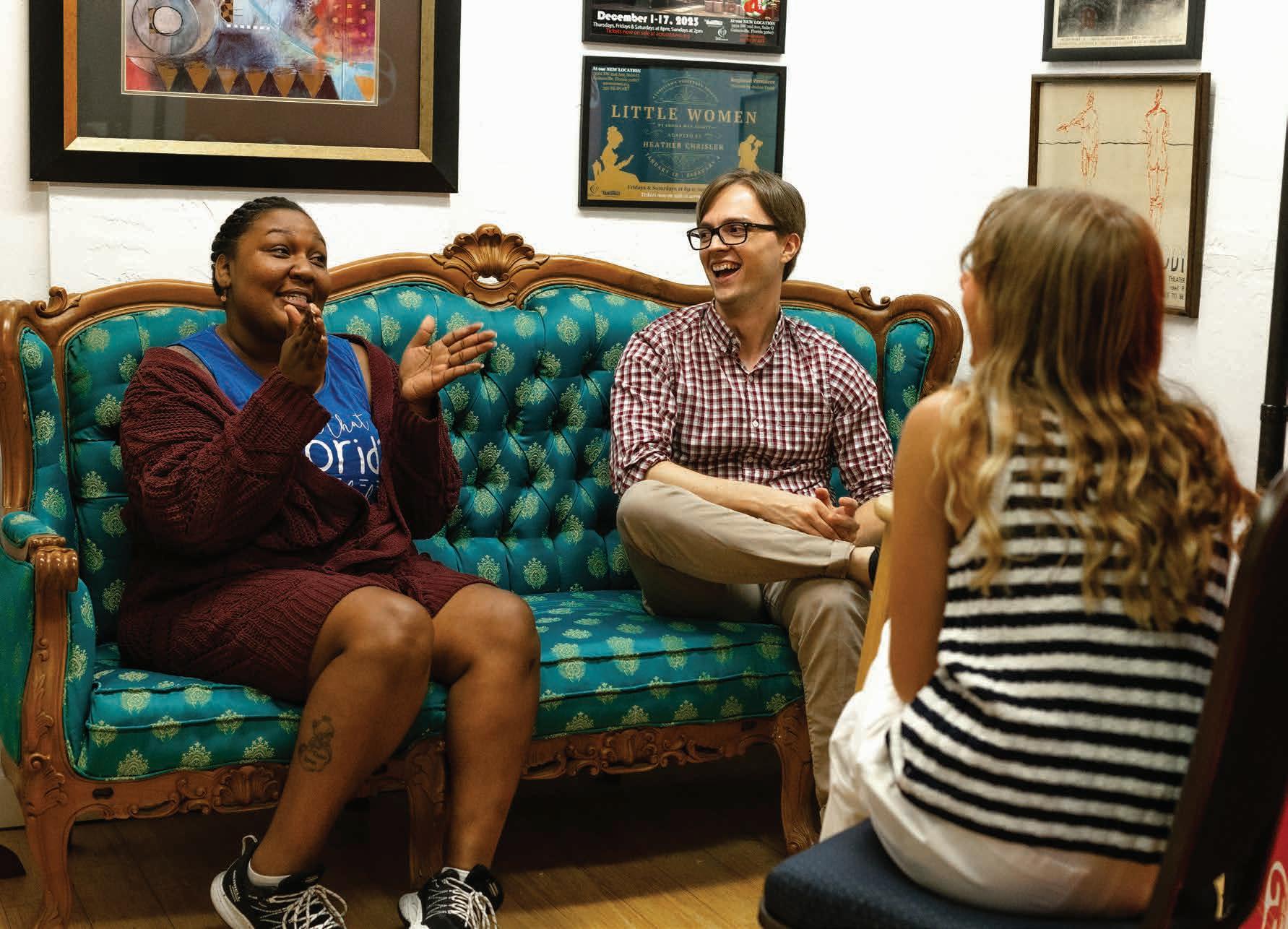
Actors being interviewed at the Acrosstown Repertory Theatre on Aug. 28, 2024. Read more in The Avenue on pg. 8.
Today’s Weather
A majority of Ben Sasse’s inner circle at UF was not rehired
Only two of his closest allies remain employed, while Sasse’s salary exceeds Fuchs’
By Sophia Bailly & Annie Wang
Alligator Staff Writers
A majority of Ben Sasse’s inner circle received letters of nonreappointment after the former UF president resigned in July.
Among 12 of Sasse’s staff original hires, five of whom live out-of-state, only two remain on the UF President cabinet website. James Wegmann and Dan Dillon currently serve as the vice president for communications, the vice president for marketing, and the senior advisor, respectively.
Dillon’s compensation package upon hire included a base salary of $570,000. He was also eligible for a performance bonus of $75,000 for completing goals set by his supervisor. After his 12-month review, his base salary would increase to $598,000, and he would be eligible for a $100,000 performance bonus the following year. A UF spokesperson declined to comment on Dillon and Wegmann’s behalf.
Sasse is receiving an annual $1.4 million until 2028. He is transitioning to become a professor at UF’s Hamilton Center, but he is not teaching as of Aug. 29. UF interim president Kent Fuchs will receive $1 million in his temporary role, which will end by July 31, 2025, unless a presidential pick is determined before then.
Despite serving as president for eight years compared to Sasse’s 17 months, Fuchs’ salary
is $40,000 less than the former president’s. Fuchs declined to comment.
In Fuch’s employment letter, additional terms included a semiannual review of all presidential expenses to be conducted by the Office of the Chief Audit Executive and a report presented to the Audit and Compliance Committee of the Board of Trustees.
Sasse’s allies dwindling Alice Burns, the former director of presidential relations & major events, received her official notice of non-renewal on July 31, and her employment ended Aug. 1. She was placed on a paid vacation Aug. 1 with a lump sum of three months’ pay. Burns was a former scheduler for Sen. Lindsey Graham (R-SC) from 2009 to 2023. Graham publicly endorsed Sasse's 2020 reelection campaign.
Liam Carlson, David Koeper and Nina Hunt, the former presidential fellows, received notice that their probationary appointments would be discontinued Aug. 1. They were instructed to work on a completely remote basis until their employment ended on Sept. 1. The letters indicated they would be eligible for rehire after their last day of employment.
While Carlson and Koeper have Alachua County addresses, Hunt worked remotely from Dallas. Before working under Sasse’s administration, Hunt spent three years with McKinsey & Company,
Have an event planned? Add it to the alligator’s online calendar: alligator.org/calendar
a consulting firm Sasse signed a $4.7 million contract with.
Kelicia Rice and Kari Riddler, who had temporary appointments as advisers to the president, learned Aug. 1 that their position would end Nov. 1. They were told to work remotely until the end of their term. Rice lives in Virginia, and Riddler lives in Nebraska. Both worked remotely for the entire duration of their appointments.
Raymond Sass, the former vice president of innovation and partnership, received his former notice of non-reappointment Aug. 2. His employment ended that very same day. His letter assigned him three months’ pay.
Penny Schwinn, the former vice president of the PK-12 & prebachelors program, was issued a non-reappointment letter July 26 and departed from her position July 31—the same day Sasse left office and 13 days after the former president publicly announced his resignation. She was placed on a paid vacation from July 29-31, and she received three months’ pay afterward. She lives in Nashville, Tennessee.
Another out-of-state hire, Raven Shirley, who was an executive assistant in the president’s office, received a notice of non-reappointment July 31 and left office Aug. 1. She was placed on paid vacation and received a lump sum of three months’ pay. She lives in Alexandria, Virginia.
Taylor Sliva, the former assistant vice president of presidential communications strategic communications & marketing, was tasked with handling communications between Sasse and the media. Sliva was notified of his nonreappointment through a handdelivered letter on Aug. 6. His final day was Aug. 5, and he was assigned three months’ pay.
Melissa Curry, UF vice president for human resources, sent all of the non-reappointment letters. After serving in an interim role, she received the position permanently under Sasse.
Got something going on? Want to see it on this page? Send an email with “What’s Happening” in the subject line to engagement@alligator.org. To request publication in the next day’s newspaper, please submit entries before 5 p.m. Please model your submissions after the above events and keep them to 150 words or fewer. Improperly formatted “What’s Happening” submissions may not appear in the paper. Press releases will not appear in the paper.
The Independent Florida Alligator is a student newspaper serving the University of Florida, published by a nonprofit 501 (c)(3) educational organization, Campus Communications Inc., P.O. Box 14257, Gainesville, Florida, 32604-2257. The Alligator is published Monday mornings, except during holidays and exam periods. The Alligator is a member of the Newspaper Association of America, National Newspaper Association, Florida Press Association and Southern University Newspapers.
The Alligator strives to be accurate and clear in its news reports and editorials. If you find an error, please call our newsroom at 352-376-4458 or email editor@alligator.org
Jea Nace
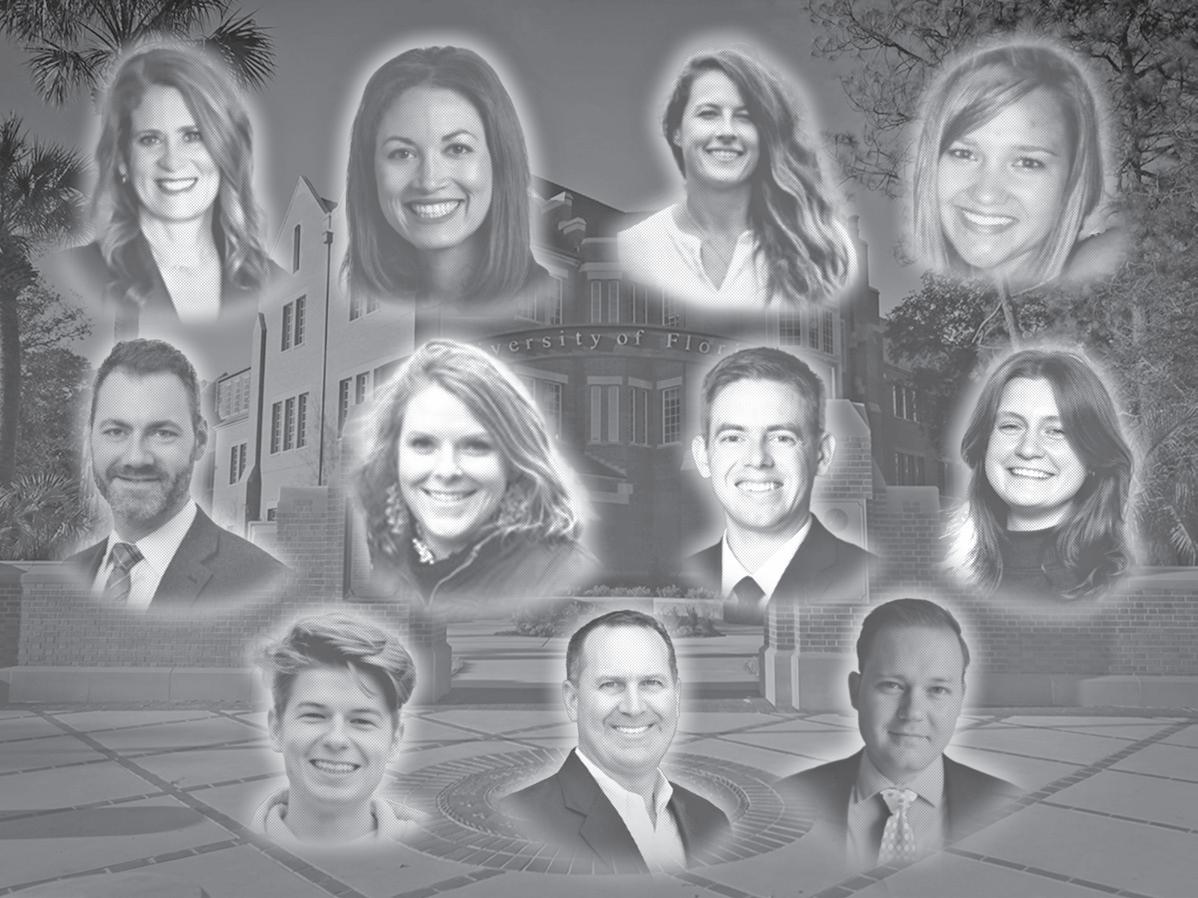
First row, from left to right: Kari Ridder, Penny Schwinn, Kelicia Rice and Raven Shirley. Second row: Raymond Sass, Alice Burns, David Koerper and Nina Hunt. Third row: Liam Carlson, Dan Dillon and James Wegmann.
Murray, Carolena Selva
UF courses related to antisemitism under review
STATE-MANDATED EVALUATION PROMPTS CONCERNS OVER ACADEMIC FREEDOM
By Vera Lucia Pappaterra Alligator Staff Writer
UF courses discussing antisemitism and the history of Israel are under state-mandated review after a Florida International University test question was interpreted as antisemitic.
Florida’s 12 public universities will each form a faculty committee this Fall to examine their syllabi, curricula and any content in courses that mention topics or words including Israel, Israeli, Palestine, Palestinian, the Middle East, Zionism, Zionist, Judaism, Jewish or Jews.
“What prompted this was a question that said Jews invented
terrorism,” Ray Rodrigues, the State University System of Florida chancellor, told the Miami Herald.
The committees are looking for content that contains “antisemitic material” or “anti-Israeli bias.”
The review reflects an increasing state focus on how universities teach sensitive issues. Last year’s House Bill 999, for instance, made headlines for initially seeking to eliminate women’s studies majors and minors. It was later revised to retain those programs, but the appropriate nature of related course content continued to be discussed.
Armin Langer, a visiting assistant professor at UF’s Center for European Studies, who teaches a course titled "Antisemitism and Islamophobia in Europe," voiced his apprehensions about the review. He sees the initiative as part of a larger trend of politicizing academic work, particularly concerning Israel and Gaza.
“Academics are being depicted as left-wing radicals for indoctrinating students,” Langer said. “And as part of that narrative, academics are being accused of being one-sided when it comes to Israel, and that one-sidedness is often portrayed as antisemitism.”
Proponents of the review, like Florida Rep. Randy Fine, R-Palm Bay, argue it ensures that universities provide accurate and comprehensive information about Jewish history and modern issues, particularly after the situation at FIU.
On the social media platform X, Fine said, “There is no room for #MuslimTerror at Florida’s state universities.”
But Langer worries the review could have a chilling effect on academic freedom at UF, particularly for professors and programs that focus on Palestinian rights and related issues.
The rising trend of antisemi-
Students face alcoholism issues
ALCOHOLISM,
from pg. 1
she said.
“I feel like I just have more mental clarity and better focus,” Edwards said. “I deal with a good bit of anxiety and depression and stuff, and I just noticed all of that was reduced a little bit when I stopped drinking.”
Additionally, drinking poses physical risks. Trevor Henderson, a UF Police Department lieutenant, said his biggest concern for students is alcohol poisoning — a life-threatening condition where there is so much alcohol in a person’s bloodstream their breathing and heart rate begin to shut down.
UF police responded to 130 on-campus alcohol-related incidents in 2023, 60% of which resulted in the sick person being transported via emergency medical services, according to figures the department provided to The Alligator.
The 130 alcohol cases in 2023 marked a jump from 75 reported the year prior and 89 the year before that. Henderson said the increase could reflect more incidents getting reported, which he sees as a positive trend.
In the past four years, UF police have not made any disorderly alcohol arrests. Rather, students get referred to the dean’s office or Student Conduct & Conflict Resolution.
“It’s not about punishment,” Henderson said. “It’s about getting them educated, getting them safety, any help before things could progress to worse.”
Alcohol, gender and sexual assault
Alcohol use is also considered a risk factor for sexual assault, said Liana Hone, a UF health education assistant professor. The inability to give consent while intoxicated sometimes furthered by drink-spiking drugs like Rohypnol or “roofies,” can endanger students, especially women.
Hone, who studies the link between alcohol and the desire for sexual partners, found an association between male sex with new partners, which has been linked with sexual aggression, and drinking in studies on more than 1,000 first-year students.
“In this age group, when mate choice and competition is kind of peaking, drinking is also peaking,” Hone said. “I don’t think that’s a coincidence.”
Hone said college students, especially women, can take protective steps while drinking to stay safe. Those include location sharing, setting intentions before starting to drink and downloading a ridesharing app.
The idea that men drink more than women, especially on college campuses, doesn’t hold up today, for college women have outpaced men in alcohol consumption every year since 2013 in the National College Health Survey. At UF, more men reported drinking in 2020, but the roles flipped by 2022.
Hone said reasons for the closing gender gap need further investigation but could relate to anxiety and depression among women, who were more than twice as likely to report be-
tism on college campuses across the United States is said to have set this review in motion. According to Hillel International, since the Oct. 7 Hamas attack, there have been a total of 1,896 reported antisemitic incidents on college campuses. At UF, antisemitic vandalism in recent years has scared Jewish students.
“The review itself is not a problem, but the political instrumentalization of it can be harmful,” Langer said. “It can definitely create a sense of insecurity, both among faculty and the student body.”
Students at UF have also expressed mixed feelings about the review. Ben Roberts, a UF political science senior, has taken courses that discuss Judaism, antisemitism and Middle Eastern conflict. Roberts acknowledged the inherent controversy in these topics but felt his professors handled the material objectively.
In his experience, Roberts added, he has never felt offended in a classroom or faced commentary
ing diagnosed with both conditions in the UF survey.
Shaylyn Lyons, an 18-year-old UF graphic design freshman and self-described “mom friend” of her group, said her gender identity plays a big part in her insistence on safe drinking habits.
“I was talking to one of my friends about going to the University Club, and she was going to go by herself, and I was like, ‘What are you doing?’” Lyons said. “‘Make sure you’re watching your drink, even if it’s not alcoholic, all of that.’”
David Fields, the executive director of the UF Health Florida Recovery Center, said men, especially white men, tend to be overrepresented in substance use treatment. However, he said he’s seen demographics grow to reflect greater racial and ethnic diversity, and he predicts gender may soon follow.
“Not that anybody sees it this way, but coming to treatment is a privilege,” Fields said. “You get a chance to take time out of your life to really delve into deep parts of who you are as a person, to become a healthier version of yourself. That's a real luxury.”
Outside the rehabilitation center Fields oversees, which treats some UF students but also draws adults from across the country, the university offers resources through its Counseling and Wellness Center to support students in substance use recovery.
Fields said he’s seen the university take some steps toward becoming more recoveryfriendly in the last couple of years, such as hosting “sober tailgates” before each home football game in front of the UF Reitz Union. However, Fields would like to see more re-
that seemed overly inflammatory.
“I think the topic is inherently controversial,” he said. “Even if a teacher gives a fair synopsis of the Israeli perspective or the Palestinian perspective, I think there are ways for someone to get offended somehow.”
Julianne Do, a 21-year-old UF biological sciences junior, took courses that discussed philosophy, political science and human rights in Asia. Do said her experiences with these class concepts at UF had been respectful, but recognized the possible motivations behind the review.
“I feel like UF does a pretty good job of being objective,” she said. “I don't think UF picks sides whatsoever. You know how to stick to our primary sources and to disseminate the information without galvanizing students for any agenda.”
The curriculum review will begin this Fall.
@veralupap vpappaterra@alligator.org
sources from the university, like a sober dorm option.
The Alcohol and Other Drugs Department of the UF Counseling and Wellness Center hosts the sober tailgates and weekly counseling groups. Coordinator Stefanie Jasper Romie encouraged students to seek support if drinking is impacting their health, academics or relationships.
“The best advice I would give is that you are not alone,” Romie said.
UF students concerned about alcohol use can reach out to the following on- and off-campus resources:
North Central Florida Alcoholics Anonymous
• Contact: gainesville.intergroup@gmail. com
• Website: https://aagainesville.org/
• 24-hour hotline: 352-372-8091
UF Counseling and Wellness Center Alcohol and Other Drugs Services
Repair stations across campus are either missing or inoperable
By Delia Rose Sauer Alligator Staff Writer
Noah Adelson uses a hand-medown bike on campus. It’s a Giant Rincon Mountain Bike from the 1990s. It’s not an extravagant bike, but it’s a safe one.
A former Team Florida Club Cycling president gifted the bike to the 19-year-old UF data science sophomore at the end of Adelson’s last year. Adelson, the current president of the nearly 40-year-old club, now spends his Friday mornings cycling with other members to get pastries and coffee.
Riding a bicycle is advertised as a convenient and sustainable way to navigate the UF campus. Bike repair stations are located across campus to help students and faculty do minor repairs. However, many of the 28 stations have disappeared or are in disrepair.
About a year ago, Adelson had to put air in his tires and found one of the Fix-It bike repair stations near Yulee Pit. The station was functional, and he was able to fix his bike.
According to the UF Bikes website, 28 Fix-It stations across campus provide tools like an air pump, wrenches, screwdrivers and tire levers. The stations are free to use and are meant to help students make sure their bikes are safe.
However, not every repair station is operable. Many across campus are missing pumps or the tools necessary to do minor repairs on a bike. Additionally, some repair stations do not exist where they are said to be located based on the UF Bikes map.
When Adelson lived in Infinity Hall during his first year, he had no space to work on his bike; he discovered a repair station near his dorm but learned the pump did not work. Instead, he used it as a stand to make the adjustments on his bike himself.
“You have to have a reliable bike, and part of it is being able to maintain that bike,” Adelson said.
Adelson also warned that if resources are not accessible so students can fix their bikes, it can lead to crashes or injuries.
“Road rash is not fun, especially when it's not your fault or it's preventable,” he said. “You want to not feel like you're going to die riding your bike.”
Adelson’s bike is one of the 6,000 bikes on campus on an average day, according to an email from Amy Armstrong, a UF spokesperson. She estimates that 5% to 10% of students and faculty ride a bike at least twice a week.
The bike repair stations were first introduced in 2013 to help provide resources to the high volume of cyclists on campus. It was originally a program under the Housing and Residence Life created by Inter-Residence Hall Association students.
Some students who originally introduced the stations joined Student Government and “expanded the stations on campus as an SG project,” Armstrong said.
“The repair stations have strengths and weaknesses,” she wrote.
The pumps can be damaged by regular use, and since their introduction, parts to repair them have become more expensive. She explained that multiple organizations on campus were responsible for different stations, but the specific organizations that own those stations were not defined in her email.
Over the summer, those organizations made plans to get all stations fully operating again, Armstrong said. However, getting the parts shipped takes a while. As of right now, there aren’t any funds or plans for expansion. The goal is to fix the existing stations.
Student Body President John Brinkman wrote in an email response that SG created the bike repair stations to ensure that students can get around campus.
According to Brinkman, SG has “ordered all the parts to fix the bike repair stations that SG owns.” Brinkman did not state the number of stations SG owns.
“We are in a partnership with TAPS [UF Transportation and Parking Services] to get them repaired by the end of September,” he wrote. “We also have a plan going forward for continued maintenance with TAPS.”
While the repair stations are a necessary resource for students who use bikes, when repaired, they could
help encourage sustainability on campus.
Leslie Thiele, a political science professor and director of sustainability studies, rides his bike to campus every day — a routine he has maintained for 33 years. Cycling allows him to limit his carbon footprint.
While Thiele has the tools to do most of his bike repairs at home, he believes the repair stations should “exist in abundance” if they will be used by students and faculty, he said.
Thiele once visited a repair station that didn’t have a pump when he had a flat tire, he said. “It was a frustrating experience. They should fix the ones that exist to a level of at least providing pumps and the information about where they are.”
Whether SG provides more operational bike repair stations depends on the frequency at which students and faculty use them.
With more operational bike repair stations, students and faculty could make better use of their bikes and promote sustainable habits, Thiele said. He appreciates how the Office of Sustainability works to make UF’s campus more bike-conscious and hopes students take advantage of SG’s bike repair in the Reitz.
However, Thiele believes encouraging students and faculty to be sustainable is still an ongoing task.
“We have to not only sustain the planet,” he said. “We have to sustain our lives.”
@_delia_rose_ drosesauer@alligator.org
New LGBTQ+ organization has mixed reviews
from pg. 1
agency to connect with students who might not typically engage with advocacy, especially Greek life.
The five-member agency is looking to give presentations related to gender and sexuality to clubs, like sororities and fraternities, which would embrace inclusive language and intersectionality, Towbin added.
GASP will hand out popsicles in the Plaza of the Americas from 11 a.m. to 2 p.m. Sept. 5 to introduce students to the agency. The agency hopes to hold other events this semester, Towbin said, including an allyship event to promote support for the LGBTQ+ community.
Towbin proposed another event, called “Take Back the Night,” that would promote safety and empowerment for women and other commonly targeted students when they are walking home at night.
“When you hear ‘gender and sexuality,’ you think LGBTQ+ only,” Towbin said. “But we also really want to harp on the fact that gender is something that’s really important to us and along with gender comes the idea of sexual violence awareness and sexual vio-
lence prevention.”
However, not all students are convinced by GASP’s messaging. Syd Engstrom, a 20-yearold UF sociology junior who is part of the LGBTQ+ community, said they were concerned with what GASP has not said.
“They call themselves a protection agency, but have made no explicit reference to what we as queer people are being protected from,” Engstrom said. “There was a vague allusion to combating gender inequality, but inequality is perpetuated by the individuals, usually the state government or the Board of Trustees at UF, and there’s been no mention of that.”
GASP has also made no mention of recent campus developments, like the removal of Lavender LLC, or state legislation, like a law that went into effect last summer that requires people to use bathrooms that align with their gender assigned at birth.
Another topic GASP has not mentioned is the university’s decision to fire 13 fulltime DEI officers, among other positions, last March. When asked about GASP’s role in light of DEI cuts at UF, Towbin said questions of that nature should be directed to Student Body President John Brinkman.
Engstrom also said the agency’s social media posts do not explicitly mention certain
queer groups. GASP’s Instagram has no direct mention of the dangers that homophobia and transphobia pose to the queer community.
To protect students, Engstrom added, the agency should first acknowledge the issues and obstacles that the LGBTQ+ community faces across campus. But Engstrom said she doesn’t expect that from SG’s leading powers.
“I don’t think they exist to benefit students,” Engstrom said,. “So I’ve stopped expecting them to.”
Erin Huguenin, a 20-year-old UF history senior, shared similar concerns. Huguenin also felt uncomfortable with one of GASP’s posts’ phrasing, which referred to a person’s sense of being either male, female, or “something else entirely.” To her, the phrasing came off as condescending and out-of-touch, she said.
Huguenin questioned whether GASP can provide services to UF’s queer community that other organizations don’t already provide.
“There’s already a lot of organizations on campus for women [and] for queer students,” she said. “This just seems like they’re not coming at it from a perspective of actually furthering the cause and more so it just seems like a resume builder.”
Huguenin said if GASP wants to make a positive change, it should challenge state laws
pertaining to higher education or stand up for queer students through actions like protests.
She views GASP as an internal effort of SG to appear more inclusive and accepting without “having to do anything subversive.”
“What we need to be protected from, frankly, is the people that these organizers are friends with,” she said.
Robin Anstett, a 20-year-old UF computer science junior, on the other hand, said they were happy to see GASP’s creation. Anstett is the queer cultivation program director for the Pride Student Union. They find GASP to be essential for SG to equally represent gender and sexual diversity on campus.
Anstett said they wanted to see GASP produce “programming that reflects the wants and needs of queer students, especially as some of our safe spaces have been altered or taken away.”
While Anstett said they understood why students might feel frustrated at GASP’s lack of political discussion, they understand the difficulty of managing an agency through SG and abiding by university requirements.
“I think that, regardless of party lines, there’s a lot of good that can be done in Student Government,” Anstett said.
@AveryParke98398 aparker@alligator.org
Madilyn Gemme // Alligator Staff
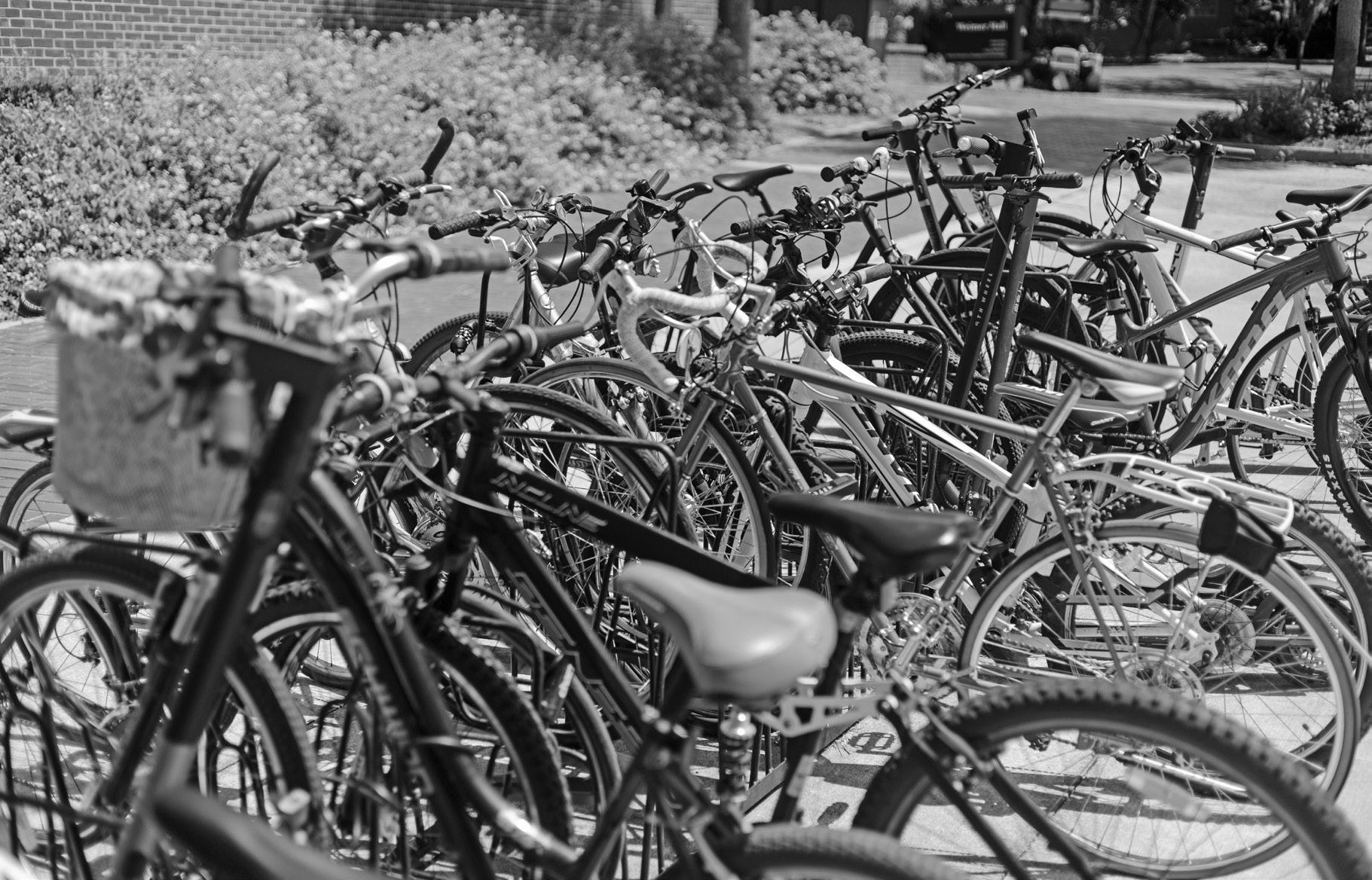
A University of Florida bike rack fills up outside of Weimer Hall.
Alachua
County, City of
VOTERS EXPRESSED CONCERN FOR LONG-TERM RESILIENCE AND SUSTAINABLE DEVELOPMENT
By Rylan DiGiacomo-Rapp Alligator Staff Writer
Alongside environmental activists in Alachua County, Gainesville resident Bob Tancig hopes for a better future through local politics in the face of global climate change.
“It’s about the kids alive today, the future generations,” Tancig said.
Following the Aug. 20 primary, local candidates headed to the November general election campaign with a focus on environmental policy as the City of Gainesville and Alachua County collaboratively develop climate action strategies. The recently completed county Climate Vulnerability Assessment will serve as a blueprint for climate-focused goals as voters form a stance on solutions tailored to local needs.
Completed in July, the assessment analyzed global warming from a local perspective, detailing threats of heat waves, heavy rainfall and sea level rise. It found that extreme weather and lower water quality, paired with a strained food supply and declining economy, could impact the county.
Vine Sourdough Bakery pasta-maker Tancig is seeking an answer to the climate crisis that suits city needs.
The implementation of adaptive climate strategies will be a swaying point in his general election voting decisions as the threat of global warming grows more pressing. While national and international policy provides a path to global collaboration, he said most action takes place locally.
The city and county aim to gather public in-
Gainesville prioritize climate action policy ahead of election season
put on their climate action policies by the end of 2024, a process advised by the Joint Water and Climate Policy Board and Citizen Climate Advisory Committee.
‘County resilience’ during election season
Days after the general election, the county will host a summit Nov. 16 to seek community opinion on a climate action draft, an effort advised by local candidates up for re-election.
Alachua County Commissioner Anna Prizzia will advance to the November general election for her District 3 seat with a campaign rooted in ensuring water quality and land protections, which she plans to carry out as a current Joint Water and Climate Policy Board member.
The board, composed of three county commissioners, three city commissioners and one member from an outlying municipality, advises local government on intersectional city and county environmental priorities.
Regardless of election season, Prizzia said the development of a climate action plan through community and scientific input has remained at the forefront of county priorities.
“The climate issue is here to stay, and it’s a priority of our county to make sure that we are providing good mitigation and adaptation strategies … regardless of who is in office,” she said. “Politics has really stayed out of it.”
Alachua County Commissioner and board member Mary Alford felt similarly. In her pursuit of re-election representing District 1, Alford said her campaign will maintain carbon neutrality through tree planting and sustainable infrastructure.
As discussions of climate action plans begin to reach the public this fall, Alford emphasized the necessity of “county resilience” in the face of climate change’s unpredictable impacts.
“Economic and equity needs in our county
are something that we take very seriously, and all of those things fit into resilience,” she said.
Alford said her priorities include addressing the possible increase of climate migration into North Central Florida as citizens flee sea level rise on the coast. Alachua County’s population could grow by 8% by the end of the century due to climate migrants alone, exacerbating housing and food supply concerns, according to the county’s Climate Vulnerability Assessment.
Prizzia and Alford’s Republican challengers Jenn Garrett and Lizabeth Doebler, respectively, did not respond in time for publication.
City mitigation and adaptation
Gainesville Chief Climate Officer Dan Zhu said the city’s plan will prioritize the mitigation of existing climate-related challenges and adaptation to future risks.
The strategy is framed by a July $24.6 million grant awarded by the Federal Transit Administration dedicated to sustainable infrastructure development, including the replacement of diesel-fueled Regional Transit System buses with hybrid electric buses.
The city will also continue to pursue its established goals of “Zero Waste by 2040” and net-zero greenhouse gas emissions by 2045, which Zhu said would be folded into the city’s future climate action policies.
“While the plan includes some initiatives already underway, all actions will be evaluated both in the short and long term following the plan’s adoption to ensure their effectiveness and adaptability,” Zhu wrote through a city spokesperson.
‘Urban jungle’ voters weigh in Equipped with a newspaper classified ad and an interest in local environmental policy,
Gainesville resident and scientist James Fulton launched his involvement in the Citizen Climate Advisory Committee in 2020.
Appointed by the Joint Water and Climate Policy Board, committee members provide community guidance on city and county environmental policy, including the development of climate action plans.
Before the Aug. 30 conclusion of his threeyear term on the committee, Fulton offered counsel on pressing city and county issues, which included energy, recycling, water usage and climate change. However, he said conscious infrastructure development should be a priority item for local candidates during election season.
“One of the reasons why I enjoy Gainesville so much is that we’re known as an urban jungle,” he said. “We want to make sure that development is smart and that as we’re expanding the city, we’re doing it in ways that make the city more efficient.”
As for Tancig, he balances his pasta-making duties with another responsibility: serving as campaign chair for the Climate Reality Project Gainesville chapter, a global non-profit founded by former Vice President Al Gore.
The organization focuses on several “impact areas,” which Tancig said include expanding renewable energy, zero-carbon transportation, green communities, environmental justice and public health.
“Our role is to promote awareness in the community … about what are the impacts of climate change,” Tancig said. “Our challenge is to go out and create the political will to drive either individual action or public policy.”
@rylan_digirapp rdigiacomo-rapp@alligator.org
Alachua County divested from Israel. Is Gainesville next?
Last month, Alachua County struck all corporations from its investment portfolio amid public outcry. Gainesville retains corporate holdings despite mounting pressure from activists
By Natalie Kaufman Alligator Staff Writer
Nearly a year has passed since the escalation of the Israel-Hamas conflict became the subject of a fierce culture war in the U.S. As grassroots advocacy continues sweeping college campuses nationwide, students and administrations have become further embattled.
Last Spring, protestors across UF and the surrounding community coalesced around the boycott, divestment and sanctions movement, which plunged Alachua County and Gainesville into hot water.
Public demonstrations denouncing Israel’s retaliation to Hamas’ attacks on Oct. 7, 2023, have populated UF’s campus. A growing sector of Jewish Gators is defecting from staunch support of Israel as the war continues; this includes pushing the city and the county to divest from weapons companies like Lockheed Martin.
In November 2023, the anti-Zionist organization Jewish Voice for Peace paired with UF Students for Justice in Palestine to pressure the Gainesville City Commission to pass a ceasefire resolution and divest from munitions manufacturers. When the city commission made it clear it was unwilling to comply, activists redirected their attention to that of Alachua County.
Abigail Fletcher, an organizer with Gainesville’s chapter of Jewish Voice for Peace, said it took months of reso-
lute campaigning for the county to pay attention to their cause. In May, County Commissioner Ken Cornell motioned to direct the county to pursue corporate divestment. On July 9, county commissioners unanimously voted in favor of an amended investment policy, with Commissioner Chuck Chestnut absent.
County spokesperson Mark Sexton outlined the revised investment strategy. He said the county didn’t just cross Israel-supporting corporations off its investment list; it extracted capital from all corporate holdings.
“Instead of playing the stock market, [we now] invest in investment tools that are designed to preserve capital, like treasury bills,” he said. “We are just divesting of corporate investments and going into capital preservation.”
Sexton emphasized that the decision was in the county’s best financial interest, divorced from ideological considerations.
“There was nothing in the motion on July 9 that finalized this, that described any motivation other than preserving capital,” he said.
Still, the Florida Youth Action Fund is celebrating the county commission’s decision, said Cameron Driggers, its 19-year-old executive director. The YAF connects young people with resources to lead progressive issues-based campaigns in their communities.
“I’m so proud of the amazing student organizers and community organizers that have been working towards this issue for several weeks
and months now,” Driggers said.
Driggers, a UF sophomore studying business administration, added of the county’s divestment, “I think it’s nothing short of a historic moment.”
NKwanda Jah, the 70-year-old executive director of the local nonprofit Cultural Arts Coalition, also sees the county’s decision as a step in the right direction.
Jah was a vocal participant in the 1980s movement to boycott corporations supportive of South African Apartheid. She characterized Alachua County’s move to proceed with corporate divestment as a watershed moment.
“Even though this does not go far enough, it does cause the manufacturers to take note that we no longer want to be complicit in what they’re doing,” Jah said.
Others disapprove of the motion to cut financial ties with Israel. Rabbi Berl Goldman of UF Chabad said Alachua County should stay out of international affairs.
“For national affairs [and] foreign affairs, we have elected officials in Congress,” Goldman said. “We vote for Alachua County Commissioners to deal with county business.”
Still, Goldman believes everyone should voice their concerns about the ongoing conflict.
“We are all speaking out against the war, against Hamas, [and] the moment Hamas surrenders and returns the hostages…not one more innocent life will be lost,” he said.
Rabbi Jonah Zinn, executive director of UF Hillel, believes Alachua
County residents shouldn’t be seeking divestment from Israel of their government officials. Doing so would compound prejudice against Jewish people, he wrote in an email.
“BDS campaigns are not about shaping government policy—they are about normalizing antisemitism,” Zinn said. “Accusing Israel of ‘genocide’ is not only false; it is also a modern-day iteration of the age-old antisemitic blood libel.”
Groups supporting the Palestinian cause remain unsatisfied, denouncing the City of Gainesville for failing to follow Alachua County’s lead.
Representatives from some of these organizations protested outside City Hall during an August commission meeting. Others made their case inside the building, urging Mayor Harvey Ward to withdraw tax dollars from corporate investments in Lockheed Martin, Hewlett Packard, Caterpillar, Chevron, Nvidia and Textron, which supply military materials — including missiles and fighter jets — to Israel.
The city holds more than $33 million in cash and nearly $2 million in investments.
Ward cited a 2023 Florida HB3 as an impediment to the city’s ability to make corporate divestments. The mandate states that environmental, social and governance factors must not influence local financial decisions.
Still, nearly 70 local pro-Palestinian organizations have signed an electronic petition calling upon the City of Gainesville to follow Alachua Coun-
ty’s example. The list includes UF’s United Faculty of Florida chapter, a union representing faculty members and graduate assistants statewide.
Marilyn Wende, a 31-year-old UFUFF council member, thinks the city can do more to support her organization’s cause, she said.
“Harvey Ward is being overzealous in his interpretation of [HB3],” she said. “I would even posit that he is actually making his decision to not divest from corporations for a political reason, and it’s that he doesn’t agree with our understanding of the war on Gaza.”
Tess Tumarkin, a 32-year-old member of Alachua County Health Care Workers for Gaza, agreed with Wende, saying Gainesville should follow in the county’s footsteps.
“Well, if the county can do it, I think the city can as well,” Tumarkin said, “And I think if nothing [else], there is a reasonable conversation to be had.”
Ward encouraged those seeking city-level divestment to present their concerns to the Florida legislature. District 3 City Commissioner Casey Willits agreed, saying Gainesville is unwilling to defy state law to pursue corporate divestiture.
“Even if we want to say that we don’t want to invest in people who make a profit off of war,” Willits said at an Aug. 15 city commission meeting, “I don’t know that we can.”
@Nat_Kauf nkaufman@alligator.org
Alachua County, UF in negotiations over new animal shelter on university property
MIXED COMMUNITY RESPONSE OVER THE NEW FACILITY
By Julia Levi Alligator Staff Writer
Alachua County is negotiating with UF to build a new animal shelter on a 12.6-acre section of campus. The $3 million ground lease would allow Alachua County to occupy a section of the swine unit, situated two miles southwest of UF’s main campus.
The subleased property would be near the intersection of Archer Road and Southwest 23rd Terrace.
Pamela Blasetti, a Gainesville resident and former volunteer for Alachua County Animal Resource Services, said there could be a need for an expanded facility to keep up with community demand for animal resources and care.
The current lease states “[the facility may] include offices, animal shelter structures, clinical space, outdoor space and parking,” as well as all necessary utility infrastructure.
However, Blasetti believes moving the shelter’s location onto UF property may not be the best scenario, she said.
“In my opinion, our established location works very well for most people,” she said. “It is rather centralized, and we do have an additional 13 acres on our present property that we could expand into.”
The new lease specifies the facility will be “dedicated to support for stray and unwanted animals awaiting adoption and for veterinary education, along with other related uses necessary.”
Blasetti thinks it would be better to work on expanding the existing property, rather than “causing more stress for the taxpayers’ dollars” by building the new shelter, she said.
On the other hand, Gainesville
resident Dotty Faibisy said building the shelter on UF property would mean having a positive association with UF’s veterinary program.
“Hopefully we will have UF students volunteering along with citizen volunteers,” she said.
“The UF vet school, that is a pretty nationally recognized school.”
At an Aug. 13 Alachua County Commission meeting, the commission approved the architecture and engineering services firm, plus the construction manager, for the new animal shelter.
Borrelli & Partners, the archi-
tecture firm, proposed a 78-week timeline for designing the shelter.
“They said our next step in this process would be community engagement because some community members feel they have not been listened to,” Faibisy said. “But that is next. We will have a chance to give our opinions soon.”
UF spokesperson Steve Orlando said subleased property for the new animal shelter could be used to advance the mission of the university through interactions with the university’s College of Veterinary Medicine.
The collaboration could offer opportunities for “educational instructional activities” for UF faculty, staff and students, according to the lease.
If the county and the university can reach an agreement, the sublease will need approval from the Alachua County Commission, the UF Board of Trustees and the State of Florida.
However, the consideration of community input remains unsettled. Orlando said the county can build and design the new shelter with whatever input it deems appropriate.
The Alachua County Animal Welfare Advisory Committee meets quarterly and is an ideal way for concerned citizens to become involved and aware of proceedings and issues within the county, Faibisy said.
“I would really recommend that concerned folks and citizens attend these advisory board meetings,” she said, “because then you find out firsthand what is being discussed and what is happening.”
@julialevi55 jlevi@alligator.org
Gabriella Aulisio // Alligator Staff
23rd Terrace on Aug. 24, 2024.
www.alligator.org/section/opinions
Kamala Harris will save the world
The Democratic and Republican National Conventions offered Americans two wildly different visions for the future of our great nation.
Most Americans know the most prominent differences between the policies of the two parties: Democrats protect women’s inalienable freedom to make their own healthcare choices. Republicans want the government to control individual healthcare decisions. Democrats want to build an economy that ensures the prosperity of all Americans, no matter their background. Republicans want to exploit the levers of power to benefit their billionaire corporate backers, such as Peter Thiel and Elon Musk, in ways that have recklessly led to America’s only two recessions in the past 17 years.
These are the kitchen-table issues that Americans know and vote on. It is what motivates volunteers to go out in droves to knock on doors, pass out campaign literature and make phone calls in support of their candidates.
But Americans are not the only ones with a close eye on the presidential race: the entire world is watching our election. Every political leader around the globe knows that when America wobbles, the world shakes. Across the world, the lives of tens of millions, if not hundreds of millions or even billions of people, depend on the decisions made in the Oval Office.
Voters in swing states are not just choosing the future of our own great country, but also essentially determining the fates of nations on the other side of the world.
The world is at a crossroads. For nearly two decades, civil liberties and democratic governance around the world have been in decline. News from Ukraine and the Middle East dominate our headlines, but these two conflicts are just the most prominent manifestations of a titanic struggle between an
alliance of autocracies, led by the Russian Federation and People’s Republic of China, and an alliance of democracies, led by the United States.
Connor Effrain opinions@alligator.org
I also want to bring attention to the conflicts around the world that do not dominate our headlines, yet have seen thousands of casualties. Russian mercenaries for years have been rampaging throughout Africa, assisting in the overthrow of multiple governments in West Africa, seizing gold mines to fund Russia’s invasion of Ukraine, and backing groups such as the Rapid Support Forces in Sudan, an organization that is responsible for massacring tens of thousands of civilians. While Russian mercenaries were on the move massacring civilians in the Central African Republic, former President Donald Trump ordered U.S. troops to withdraw from Somalia, directly leading to a surge in power for the terrorist group al-Shabaab, which is affiliated with al-Qaeda.
Let me be clear: the alliance of democracies is far from perfect. Both the U.S. and our partners have made colossal errors in judgment in the past few years that have needlessly led to unfathomable human suf fering. In the U.S., we the people can make our voices heard and vote to change the ac tions of our government. The people of Rus sia and China cannot do that. There are no checks on the depravities that Putin and Xi Jinping can unleash in the lands they rule.
Read the rest online at alligator.org/section/ opinions.
Connor Effrain is a UF history junior and the president of UF College Democrats.
RNC, DNC disappoint constituents
Once every four years, the two biggest teams in America put on the biggest shows in the country. Each flexing their accomplishments and wins of the previous years to sell a vision to Americans for their future. These events of showmanship are the Republican National Convention and the Democratic National Convention. From porn stars to presidents, the conventions brought big names in front of the country and gave their best shot at putting their candidate in the most powerful office in the world.
The first and most interesting was the RNC, and as always, the Republicans never fail to make headlines. The biggest question facing the future of the Republicans is how to handle an ideological split between new MAGA Republicans and old establishment Republicans. With each group fighting it out with accusations of warmongering, betrayal against the GOP or worst of all, working with Democrats in Congress. We saw it play out last year when Donald Trump disciple congressman Matt Gaetz ousted former Speaker of the House Kevin McCarthy and replaced him with MAGA Republican Mike Johnson. This ideological split has played out since Trump won the nomination in 2016, entering a new age of the Republican party. The split between the old and new was on full display at the RNC. No former Republican presidents, or even former Vice President Mike Pence,
sure what is.
Sprung opinions@alligator.org
The next biggest issue for Republicans in this conference is a two letter name: J.D. While J.D. Vance may be an up-andcoming name for the Republicans with his work in the Senate and his successful “Hillbilly Elegy” book, does anyone truly believe that this was the best pick to win? Sure, he may have similar policies to Trump and have the traits on paper of a vice president. But in practice, Vance has a weakness that no political consultant could’ve predicted. Awkwardness. Watching Vance campaign is like watching your weird uncle socialize at Thanksgiving. Nobody cares, nobody is interested and nobody wants him there. Videos of Vance at campaign stops having socially awkward conversations with voters and polling in negative numbers in swing states will create an issue for Republicans this fall. The Republicans also have an identity crisis within their base. Having Amber Rose, who is currently a rapper and porn star, as a speaker at the convention was one of the biggest messaging failures of the RNC. Republicans are losing a grip on the rustbelt states. A rapper with face tattoos and an OnlyFans account will not shift or solidify any swing state voters. Rose is the
The views expressed here are not necessarily those of The Alligator.
The Alligator encourages comments from readers. Letters to the editor should not exceed 600 words (about one letter-sized page). They must be typed, double-spaced and must include the author’s name, classification and phone number. Names will be withheld if the writer shows just cause. We reserve the right to edit for length, grammar, style and libel. Send letters to opinions@alligator.org, bring them to 32604-2257.Columns of about 450 words about original topics and editorial cartoons are also welcome. Questions? Call 352-376-4458.
Lucas
TUESDAY, SEPTEMBER 3, 2024
www.alligator.org/section/the_avenue
THEATRE
Gainesville volunteer theater champions diversity with bold productions
THE ACROSSTOWN REPERTORY THEATRE OPENS DIFFICULT CONVERSATIONS WITH ITS UPCOMING PRODUCTION
By Tanya Fedak Avenue Staff Writer
The room contains 50 seats arranged around the sides of a small-scale stage. With an overall capacity of 70 people, there’s little room for cast and crew.
With this little space, putting on a full-scale production could be a faraway fantasy — an aspiration, not an actuality. But for more than 40 years, Gainesville’s volunteer-run theater organization Acrosstown Repertory Theatre has used this disadvantage to create an intimate experience and open conversations for performers and audience members alike.
Acrosstown Repertory Theatre, located just west of the university on Southwest Second Avenue, is rehearsing for its production of “Bee-Luther-Hatchee,” written by Philadelphia playwright Thomas Gibbons. The play follows African-American editor Shelita Burns as she publishes an autobiography written by a 72-year-old Black woman named Libby Price. Touched by the novel, Shelita sets out to meet Price, but she’s not who she claims to be.
Cristina Palacia, the show’s director and a retired attorney who is making her ART directorial debut, said she was initially drawn to the show’s strong female lead. Since the casting was finalized, Palacia has been working with ART’s creative team to carefully craft the play and its message.
“What I’d hope for is that the audience sees it and thinks about these issues as they leave,” she said. “Maybe it raises some interesting con-
FOOD
versations about when is it appropriation… and how human beings just touch each other, no matter what their background is.”
Kandyce Williams, the 39-year-old who plays Shelita Burns, said analyzing these themes and questions during auditions helped her connect with her character.
“It does feel like there is a big culture of appropriation,” she said, “and it can feel very frustrating and angering coming from a Black woman’s perspective when, if I’m bringing it to the present, a lot of things that may have been looked at negatively are now being accepted because more white people were accepting them.”
Jamie Blackband, who plays Sean Leanord, said getting to know and understand his character was a similarly emotional process.
“Both of these characters are coming from a perspective that, no matter who’s in the audience, they’re probably going to sympathize with in some way,” the 29-year-old clinical researcher said.
By working to create relatable characters, the show discusses uncomfortable topics, Williams said. ART aims to face this discomfort head-on, and it has not deterred cast members from delivering their best performances.
In fact, it excites some of the performers, including Blackband.
“It’s definitely going to make people fidget in their seats, which might not be the ticket-selling line, but it’s what makes this show special and unique and really stand out,” he said.
This is not the first time Acrosstown Repertory Theatre has put on a “risky” production.
Andrea Young, the 39-year-old ART president, said these shows have always been a part of the organization’s history.
“The founder really wanted it to be a place where it was like an actor’s theater,” she said. “We want to do things that are challenging —
that’s our mission. We want to challenge the community. We want to challenge the actors and designers that are involved.”
While the organization seeks to provide challenges, it also faces its own. As an entirely volunteer-run organization, ART struggles to find volunteers who can commit to evening rehearsals, Young said.
The theater’s biggest challenge is finding the money to bring its productions to life. The organization originally relied on a grant, but the grant was cut this year after Gov. DeSantis vetoed it from the budget.
Young said the theater group has had to rely on ticket sales, causing them to raise ticket prices by $5.
“We’ll have to scrape and beg and ask people to give a little bit here and there,” she said.
Although relying on ticket sales may not seem like a consistent way to earn a sufficient profit, every Acrosstown musical has sold out. ART’s next step is getting its plays to reach the same level of popularity.
“It’s getting there,” Young said. “I think people are just now realizing that we’re here, even though the theater’s been in existence for 40-plus years. It’s nice that people know we’re here now.”
Before relocating to Second Avenue in 2023, ART previously rehearsed in the Baird Hardware Company Warehouse on Main Street. The organization moved locations because it was “not given the opportunity” to renew its lease when revitalization began in the area, Young said.
In 2022, Acrosstown Repertory Theatre became a nomadic troupe, rehearsing and performing in local parks for crowds of more than 100 people. However, Young said members quickly realized they needed another rehearsal space.
“We made it work, but it was a struggle,” she said.
The theater’s doors remain open for everyone who wishes to step inside, regardless of their age, race, gender, abilities or beliefs. Young said diversity has remained a priority for the organization since it was founded as a grassroots community theater in 1980 by Ajamu Mutima.
Although the organization has traditionally seen diversity in the cast and crew, Young said one of her “bucket list” goals is to create even more diversity this year. Not only can it do better at finding people who have different perspectives, she said, but it would like to bring in more individuals who haven’t done theater before.
One way Young hopes to accomplish these goals is by hosting more classes for beginners or people who want to polish their skills.
“[We] want to do more classes in the future,” she said, “because it’s scary. Just to get up there and speak in front of people is terrifying for a lot of people. So, those people that have never done it before, let’s give it a go.”
Until these classes begin, ART will be busy preparing for its 10 performances of “Bee-Luther-Hatchee,” which opens Sept. 13 and runs until Sept. 29. Tickets are $25 for adults and $20 for students and senior citizens, but ART will be hosting a preview of its final dress rehearsal for $10.
As ART gears up for its opening night, Cristina Palacia, the show’s director, has one goal that rises above all others: to entertain.
“The main point isn’t for me to make people necessarily think deep thoughts,” she said. “I hope they do, but I want to entertain them with a good story, and this is a good story.”
@ttanyafedak tfedak@alligator.org
City Food Hall celebrates grand opening for first location in Ga inesville
The eatery and entertainment hub offers a selection of 10 cuisines
By Noor Sukkar & Rachel Mish Avenue Staff Writers
As football season kicked off, so did City Food Hall Gainesville.
Residents, investors, city officials and staff came together Aug. 29 to celebrate City Food Hall’s grand opening and ribbon-cutting ceremony. Located underneath The Standard at Gainesville, the new hall serves as a public eatery, offering visitors unique cuisine from 10 local restaurants and small businesses.
While there are other City Food Hall locations in Orlando, Destin, West Palm Beach and Georgia, the eatery’s vendors are all locally sourced.
Peter Rounce, the founder and chief execu-
Keep up with the Avenue on Twitter.
Tweet us
@TheFloridaAve.
tive officer of City Food Hall, said the new location has a duty to deliver its promise to vendors and the people of Gainesville.
“It’s the people who have passion for the craft that I want to be here,” he said. “Every vendor wakes up every morning, coming here to achieve their dream. I’m just humbled and pushing to be the platform to help them do that.”
Rounce’s promise is nothing short of supplying variety, offering students a game-day hangout while supporting small businesses.
The hall’s restaurants include Luke’s New York Bagels, GoNoodle, Gringo Taco, SmashCity, Nori, Peace of Pie, Miranda Gelato, Hummus & Flame, Wings & Co. and the Teacher’s Ade.
The grand opening gave visitors a taste of upcoming weekly entertainment plans, such
Caiman
as karaoke, quiz nights, bingo and open mic. The hall promises a curated selection of live entertainment and special events, with details to be determined.
The Teacher’s Ade was one of the first booths to accumulate a line. The restaurant, which was originally made for teachers, drew customers in with its colorful menu, offering handcrafted lemonades and hearty breakfast options.
Stephanie Hersey, a UF staff member who used to work with The Teacher’s Ade owner’s wife, visited the lemonade spot on her lunch break and decided to grab a strawberry mint lemonade.
Hersey said the drink was “very refreshing,” and she plans to frequent the place on her lunch breaks.
Filled with Gator decor, flat-screen televi-
Estudiantes hispanos discuten preocupaciones sobre diversidad, equidad e inclusión. Lea más en la página 11.
sions, board games and a TouchTunes jukebox, the hall creates a welcoming atmosphere for people of all ages.
Alexa Katz, a 21-year-old health education and behavior senior who grew up in Gainesville, is living at The Standard for a second year. Katz and her roommate said they had anticipated the food hall’s opening for months.
“I think I would have loved this when I was a kid in Gainesville,” Katz said. “I think this is good because it gives local places a time to shine instead of bringing in other places from chains.”
Read the rest online at alligator.org/ section/the_avenue
2021 Scooters-4-Less Wolf Slander Scooter, 1100 mi. $999. Will deliver. Call 352-440-4657 8-2624-1-11
5 Real Estate
NEW CONDOS-WALK TO UF For Info on ALL Condos for Sale, Visit www.UFCONDOS.COM or Matt Price, University Realty, 352-281-3551 8-14-24-13-5
Land for sale
Quarter acre building lot for sale. Two lots available. 35 minutes from UF. 40 minutes from the Atlantic Ocean beach. In the cute small town of Interlochen Florida. Very low property taxes, mobile homes or site built homes OK. $4000 per lot or buy both lots for $7500. Call 352 337 0967 9-3-24-2-5
10 For Sale
Los Angeles Times Daily Crossword Puzzle
by Patti Varol
Edited by Patti Varol
for busy Dermatology
in
M-F 8:00 – 5:00. Duties include scheduling appointments, checking patients in and out, verifying insurance, collecting payments, answering phones and other duties. Looking for a professional individual with good math and computer skills. Experience in a medical office is a plus. Part Time OR Full Time with benefits including 401K, health insurance, paid time off. Willing to train motivated individual. Opportunity for advancement Send cover letter and resume to daopportunity@aol.com 9-3-24-3-14
Part-time Sales Associate needed for ILENES GATOR STORE. Cheerful outgoing personality, loves fashion. Minimum 14 hrs. /week. Salary to start $14.00 per hour. Text Ilene at 352-317-3413 with contact info. 9-23-24-5-14
windows may be the answer! Call for a consultation & FREE quote today. 1-888-993-3693. You will be asked for the zip code of the property when connecting. 9-3-29-15
BATH & SHOWER UPDATES
DAMAGE? You need a local expert provider that proudly stands behind their work. Fast, free estimate. Financing available. Call 1-888-967-1158. Have zip code of property ready when calling! 9-3-35-15
WATER DAMAGE CLEANUP & RESTORATION: A small amount of water can lead to major damage and mold growth in your home. Our trusted professionals do complete repairs to protect your family and your home's value! Call 24/7: 1-866782-4060. Have zip code of service location ready when you call 9-3-36-15 Don't Pay For Covered Home Repairs Again! Our home warranty covers ALL MAJOR SYSTEMS AND APPLIANCES. We stand by our service and if we can't fix it, we'll replace it! Pick the plan that fits your budget! Call: 1-888-521-2793 9-3-33-15
PROTECT YOUR HOME from pests
DRUG PROBLEM?
WE CAN HELP! 24 HOURS 7 DAYS CALL NARCOTICS ANONYMOUS 352-376-8008 www.uncoastna.org pr@uncoastna.org
Need CPR Training?
(352) 727-4733 www.GatorCPR.com CNA Prep Classes from GatorCNA.com 12-2-24-15-16
ATTENTION OXYGEN THERAPY USERS! Inogen One G4 is capable of full 24/7 oxygen delivery. Only 2.8 pounds. FREE information kit. Call 844-958-2473. 9-3-59-16
TESTING Alachua County Health Dept. Call 334-7960 for app’t (optional $20 fee)
Events/Notices
The Metropolitan Transportation Planning Organization for the Gainesville Urbanized Area announces a public meeting to which all interested persons are invited.
DATE & TIME: September 16, 2024 at 3:00 p.m.
PLACE: John R. “Jack” Durrance Auditorium, County Administration Building, Gainesville, Florida
PURPOSE: Regular Business Meeting of the Metropolitan Transportation Planning Organization
A copy of the agenda may be obtained by visiting our website at www.ncfrpc.org (click Metropolitan Transportation Planning) or may be seen posted at 2009 NW 67th Place, Gainesville, Florida one week prior to the meeting.
Public participation is solicited without regard to race, color, national origin, sex, age, disability, familial status, religious status, marital status, sexual orientation, or gender identity. Persons who require special accommodations under the Americans with Disabilities Act or persons who require translation services (free of charge) should contact Michael Escalante at 352.955.2200, extension 114, at least 48 hours prior to the public meeting. 9-3-1-20
1. GEOGRAPHY: How many lakes are in the Great Lakes Basin?
2. MOVIES: What is the little girl's last name in the film "Matilda"?
1. MEASUREMENTS: How many inches are in a mile?
2. ASTRONOMY: What does the acronym SETI mean to the scientific community?
3. TELEVISION: What is the name of the teacher on the animated kids' series "The Magic School Bus"?
4. LITERATURE: In which historic period is Jack London's novel "Call of the Wild" set?
5. U.S. CITIES: Which city's nickname is "City by the Bay"?
3. LANGUAGE: What does the Latin prefix “sub-” mean in English?
6. ANATOMY: How much of the human body is made up of water?
7. SCIENCE: What is heliology?
8. HISTORY: Which world leader's birth name is Jorge Mario Bergoglio?
4. U.S. PRESIDENTS: Who was the only president to serve two nonconsecutive terms?
9. ASTRONOMY: In what year did a U.S. astronaut land on the moon?
10. ENTERTAINERS: Which famous actor who starred in "The Notebook" was once a member of "The Mickey Mouse Club"?
5. LITERATURE: Which 20th-century movie star penned the autobiography “Me: Stories of My Life”?
6. HISTORY: What was the first National Monument proclaimed in the United States?
7. GEOGRAPHY: Where is the island of Luzon located?
8. MOVIES: Which sci-fi movie has the tagline, “Reality is a thing of the past”?
1. What cyclist representing Great Britain won the Tour de France in 2013 and three straight times from 2015-17?
2. Comedian, actor and entertainer Bill Cosby was awarded a track and field scholarship to what university in 1961?
9. GENERAL KNOWLEDGE: What was the name of the United States’ first nuclear-powered submarine?
3. What member of the 1996 Stanley Cup champion Colorado Avalanche is the all-time leader for goals, assists, points and games played by a Latvian in the NHL?
10. GAMES: What are the four railroad properties in Monopoly?
4. Name the tight end for the Los Angeles Raiders who led the NFL in receptions twice with 92 in 1983 and 95 in 1986.
Answers
5. A fictional TV network called ESPN8: "The Ocho" was introduced in what 2004 sports comedy film starring Ben Stiller and Vince Vaughn?
1. 63,360 inches
6. Daniel Wiffen, gold medalist in the men's 800-meter freestyle swim at the 2024 Paris Olympics, competed for what country?
2. Search for extraterrestrial intelligence
7. Name the Anaheim Angels third baseman who was named MVP of the 2002 World Series?
3. Below or insufficient
4. Grover Cleveland 5. Katharine Hepburn 6. Devils Tower, 1906 7. The Philippines 8. “The Matrix” 9. The USS Nautilus 10. Pennsylvania, Short Line, Reading and B&O
El Caimán
www.alligator.org/section/elcaiman
Las organizaciones de estudiantes hispanos y latinos de la UF mantienen la esperanza a pesar de los cambios en la DEI
Desde el control presupuestario hasta la recaudación de fondos, las organizaciones estudiantiles hispanas y latinas encuentran formas de superar los obstáculos
Por Isabela Reinoso Escritora de El Caimán
La eliminación en Florida de los programas de diversidad, equidad e inclusión en la educación superior ha generado incertidumbre en el campus de la UF. Tras el Proyecto de Ley 266 del Senado de 2023, todos los programas de DEI financiados por el estado fueron eliminados en marzo, dejando a los extracurriculares étnicos de la UF con preguntas.
Pero a pesar de las preocupaciones, el ánimo y la esperanza entre el grupo de estudiantes hispanos sigue floreciendo, dicen los líderes estudiantiles. La Asociación de Estudiantes Hispanos organizó su Asamblea Anual de Estudiantes Hispanos-Latinos el 28 de agosto en el Reitz Union, donde docenas de estudiantes hispanos y latinos promovieron sus organizaciones entre los estudiantes.
Los estudiantes que asistieron al evento afirmaron que la asamblea ofrecía un espacio para garantizar la resiliencia más allá de cualquier reto o cambio. Pero los estudiantes siguen discutiendo sobre las incertidumbres del futuro de las iniciativas de DEI en la universidad. Estefania Rodriguez, de 21 años, estudiante de último año de informática de la UF y
UF’s
presidenta de la Asociación de Estudiantes Venezolanos de la UF, dice que ha notado un cambio en la financiación.
La organización también tiene capítulos en la Florida State University y en la University of Central Florida. Rodriguez dijo que el club puede contar con los fondos recaudados en anteriores eventos de recaudación de fondos.
Alexandra Crespin, presidenta de la Asociación de Estudiantes Latinos de Medicina de la UF, dijo que también había notado un cambio en la cantidad de fondos que el club solía recibir. Con los recortes presupuestarios, Crespin dijo que el club está adoptando ahora un enfoque más cauteloso hacia la asignación de fondos.
“Tenemos que ser muy conscientes de adónde va nuestro dinero”, dijo.
Crespin dijo que es más que probable que la organización se involucre en otras oportunidades para recaudar dinero, como la recaudación de fondos externos para sus eventos.
Algunos miembros de organizaciones dijeron que no han visto ninguna alteración que afecte directamente a su organización, pero sí les preocupa que vaya a haber un cambio.
La tesorera del equipo de baile Sabor Latino, Andrea Engativa, dijo que si se produjera una disminución de la financiación, la experiencia
de baile del club ya no sería tan inmersiva.
“Quizá tengamos que restringir el número de bailarines que se nos permite tener en nuestro equipo”, dijo Engativa.
“Esa podría ser la mejor manera de poder permitirnos suministrar todo el material que necesitamos para estas actuaciones”.
Ante los cambios presupuestarios, los miembros de la organización han encontrado otras formas de recaudar dinero y seguir difundiendo su nombre por el campus.
Maria Esparza Mancilla, de 21 años de edad, estudiante de último año de fisiología aplicada y kinesiología de la UF, ha estado organizando rifas para el capítulo de la UF de Por Colombia desde antes de los cambios del DEI. Dijo que el dinero que la organización recibía antes de los conflictos con el DEI no era suficiente.
“Nunca hemos tenido como muchos fondos", afirma Esparza, actual presidenta de la organización.
Y ahora que se están produciendo nuevos cambios, afirma que las rifas siguen pareciéndole una solución aún más prometedora.
Otros estudiantes confían en que el dinero no será un obstáculo para seguir difundiendo su nombre en el campus.
Arturo Zarrate, de 19 años de edad, estudiante de segundo año de bioquímica y
filosofía de la UF, coordinador financiero de la Asamblea de Estudiantes Hispano-Latinos, dijo que reconoce los desafíos, como la pérdida del Instituto de Culturas Hispano-Latinas, La Salita. Pero mantiene una actitud positiva respecto al futuro de la mayoría de estas organizaciones.
“A pesar de las pérdidas que hemos sufrido -sobre todo con La Salita-, creo que aún podemos seguir floreciendo aquí en el campus”, afirmó. “Nuestra comunidad se ha visto, por supuesto, debilitada”.
Valentina Brown, presidenta de la Organización Latina Centroamericana de la UF, dijo que ha decidido mantener una actitud positiva con respecto al futuro de su club.
“Sólo tenemos que perseverar para hacer frente a cualquier cambio presupuestario”, dijo Brown.
Los miembros de estas organizaciones seguirán explorando otros métodos de recaudación de fondos para mantener la calidad de las experiencias que ofrecen a los estudiantes del campus.
“Como buen colombiano nos lo rebuscamos”, Esparza dijo. “Que nos tiren crema de afeitar en la cara”.
@isareinosod ireinoso@alligator.org
Hispanic and Latine student organizations stay hopeful despite
DEI changes
From budget control to fundraising, Hispanic and Latine student organizations find ways to tackle obstacles
By Isabela Reinoso Alligator Staff Writer
Florida’s elimination of diversity, equity and inclusion programs within higher education has bred uncertainty on UF campus. Following 2023 Senate Bill 266, all state-funded DEI programs were eliminated in March, leaving UF’s ethnic extracurriculars with questions.
Despite concerns, encouragement and hope thrives among the Hispanic student body, student leaders say. The Hispanic Student Association hosted its annual Hispanic-Latine Student Assembly Aug. 28 at the Reitz Union, where dozens of Hispanic and Latine students promoted their organizations to students.
Students at the event said the assembly offered a space to ensure there is resilience beyond any challenges and changes. But students are still discussing the uncertainties of the future for DEI initiatives at the university.
Estefania Rodriguez, a 21-yearold computer science senior and president of the UF Venezuelan Student Association, said she’s noticed a funding change.
The organization also has chapters at Florida State University and the University of Central
Florida. Rodriguez said the club can rely on funds it’s collected from past fundraisers.
Alexandra Crespin, president of the UF Latino Medical Student Association, said she also noticed a change in the amount of funding the club used to get. With budget cuts, Crespin said the club is now adopting a more cautious approach towards allocating funds.
Mantente al día con El Caimán en Twitter. Envíanos un tweet @ElCaimanGNV.
“We do have to be very cognizant about where our money is going,” she said.
Crespin said it’s more than likely the organization will engage itself in other opportunities to raise money, like outside fundraising for its events.
Some organization members said they have not seen any alterations directly impacting their organization
but do worry there is going to be a change.
The treasurer of the Sabor Latino Dance Team, Andrea Engativa, said if a decrease in funding were to happen, the club’s dance experience would no longer be as immersive.
“We might have to restrict the amount of dancers we are allowed on our team,” Engativa said.
“That might be the best way for us to be able to afford supplying all the materials that we need for these performances.”
In the face of budget changes, organization members have found other ways to raise money and keep spreading their name around campus.
Maria Esparza Mancilla, a 21-year-old UF applied physiology and kinesiology senior, has been organizing raffles for the UF chapter of Por Colombia since before the DEI changes. She said the money the organization received prior to DEI conflicts wasn't enough.
“We have never had as many funds,” Esparza said, who is the current president of the organization.
And now with new changes developing, she said raffles continue to feel like an even more promising solution.
Other students are confident money will not be an obstacle for them to keep spreading their name on campus.
Arturo Zarrate, a 19-year-old biochemistry and philosophy sophomore and the financial coordinator of the HispanicLatine Student Assembly, said he acknowledges the challenges, like losing the Institute of HispanicLatino Cultures, La Salita. But he maintains a positive attitude regarding the future of most of these organizations.
“In spite of the losses that we suffered — with especially La Salita — I think that we can still continue to flourish here on campus,” he said. “Our community has been, of course, weakened.”
Valentina Brown, president of the Central American Latin Organization at UF, said she’s decided to keep a positive attitude regarding the future of her club.
“We just have to persevere with dealing with any budget changes,” Brown said.
Members of these organizations will continue exploring other methods to raise money to maintain the quality of experiences they provide to students on campus.
“As a good Colombian, we have to look at different ways,” Esparza said. “Let them throw shaving cream in our face.”
Síganos para actualizaciones Para obtener actualizaciones de El Caimán, síganos en línea en www.alligator.org/section/elcaiman.
@isareinosod ireinoso@alligator.org
Matthew Lewis // Alligator Staff
A University of Florida sophomore student, Lucia Garcia, tables at the Rion Ballroom in the Reitz on Aug. 29, 2024. She is the vice president of Latin American Women in Business.
TUESDAY, SEPTEMBER 3, 2024
www.alligator.org/section/sports
UF Golf’s Ian Gilligan practices patience, mental breaks to win championships
GILLIGAN TRANSFERRED FROM LONG BEACH STATE IN 2023
By Aiden Wacksman Sports Writer
The Florida men’s golf team trailed in four out of its five matches at the 2023 SEC Championship match play quarterfinals. Facing Vanderbilt, the Gators were competing against one of the top teams in the nation at the time.
Florida made an incredible comeback on the back nine, tying Vanderbilt 2-2 with one match remaining. However, UF fell just short of qualifying for the semifinals despite showing an immense amount of fight and resilience in its late push.
It wasn’t the result the Gators were looking for, but Florida senior men’s golfer Ian Gilligan recalls the SEC Championship being a memorable experience. He had some of the most fun he’s ever had on a golf course, he said.
“All of a sudden, we went from having zero chance to a really good chance [of winning],” Gilligan said. “The amount of excitement that was in the air… was something I’ll never forget.”
Great golfing requires precise technique and physical prowess. But for Gilligan, staying mentally focused on the course is even more important.
Gilligan, one of Florida’s top golfers last season, keeps his composure by playing one hole at a time, taking mental breaks during competi-
FOOTBALL
tion and remaining in a patient state of mind.
One of the most valuable lessons Gilligan has taken away from his collegiate golf career is to avoid heavily emphasizing his results. Drowning your thoughts in the end result of a tournament can lead to a mental collapse on the course that generates a downward spiral, Gilligan said.
“Sometimes you just have to remind yourself [that] this is just golf,” Gilligan said. “Who cares if this is The Masters or if you’re playing with your buddies? You [have to] treat every shot the same.”
Gilligan focuses his mental energy on one hole at a time, he said. When he finishes playing one hole, he immediately moves on to the next without overthinking his prior performance. His mental fortitude allowed him to take his game to new levels throughout matches, regardless of how he may perform on an individual hole.
Staying composed on the course can be especially challenging when a match or tournament lasts several hours. Gilligan maintains his focus by diverting his thoughts away from the game of golf in between holes.
“Some people say you want to be fully focused for the entire round, but that’s unrealistic,” he said. “[In between shots] I’ll think about what I’m having for dinner or… what homework I have [to do].”
Gilligan utilized these mental tactics at the Western Amateur tournament this summer, one of the most competitive amateur golf tournaments in the world. The tournament opens
with four cutoff rounds before beginning match play quarterfinals, which consists of 16 golfers.
Mental fatigue can take a toll on even the best professionals. Gilligan said he especially felt its effects during the semifinal and championship matches of the Western Amateur, which took place on the same day.
He played against some familiar faces in his final two matches: fellow Florida teammates Parker Bell and Jack Turner.
“[Turner and I] played 19 holes in the morning and we were out there for 12 hours,” Gilligan said. “It was nonstop golf, so it [was] pretty exhausting.”
In the championship match against Turner, who is also Gilligan’s roommate, he experienced firsthand how mental fatigue can affect his game. Gilligan had opportunities to win the match but was unable to close the way he had hoped.
The pair battled to the 29th hole, where Gilligan finally secured the championship.
“I had to remind myself that [I] can’t just focus on the outcome [because I’ll become] nervous over shots,” he said.
Gilligan takes inspiration from the game’s all-time greats: Tiger Woods and Phil Mickelson. The senior hopes to emulate and balance their qualities within himself.
“[Woods] is the best golfer that’s ever played,” Gilligan said. “The focus that he had… was second to none. Mickelson, too. He seemed to always have a good time on the golf course.”
He had the opportunity to play alongside teammates throughout his first season at UF
who have faced similar mental hurdles they’ve had to overcome.
Former Gator John DuBois was a key member of Florida’s 2023 national championship team. But his rise to success didn’t come without inconsistent play and mental challenges.
“I just had to take a step back and realize that it’s going to be OK,” DuBois said. “It’s not the end of the world and just [try to] smile a little more.”
Florida men’s golf head coach J.C. Deacon believes Gilligan’s presence is vital to team success. Gilligan provides a strong work ethic and possesses a constant desire to learn and improve, he said.
“He’s been the most perfect fit we could have ever imagined,” Deacon said. “He brings the scores, gets his work done in the classroom and brings it in the gym.”
Deacon also appreciates Gilligan’s sense of humor and relaxed attitude on the course.
“I really enjoy his personality,” Deacon said. “A lot of kids play with a burden, but [for him] it's kind of the opposite.”
Gilligan’s main goal heading into his 202425 campaign is to avoid placing too much focus on his results. He’s aware that said results can directly affect his PGA Tour University ranking.
Read the rest online at alligator.org/ section/sports. @aidenwacksman awacksman@alligator.org
Florida seeking to bounce back from lackluster season opener
THE GATORS ARE COMING OFF A 41-17 LOSS TO MIAMI SATURDAY
By Jack Meyer Sports Writer
In the weeks leading up to Florida’s season opener against Miami, there was an overwhelming sense of optimism around the Gators’ football facility. Players, coaches and fans shared a belief that the program was ready to turn around for the better.
Following a far-from-perfect 2023 season, Florida head coach Billy Napier could have silenced any remaining doubts that the team could compete in an already competitive pool of SEC squads this season.
All it took was four hours of football for that positive outlook to be flushed away.
After a 41-17 loss to Miami to open 2024, questions and criticisms regarding Florida’s future have already returned to the forefront of the program.
“You’ve got to be a man and
you've got to take responsibility for the things that you can do better,” Napier said after the game. “If you really care about the team, you'll work at it.”
Most of the blame has been put on Napier, who many analysts believe could be on the hot seat should the Gators continue to underperform this season.
Napier, however, has remained adamant that the team’s performance on Saturday was far from its best and that the loss will serve as a stepping stone for the Gators to continue their development.
“The sun is going to come up tomorrow, and we're going to go back to work,” he said. “Ultimately, I think there's not much for us to talk about right now. We've got to go play better. That's where we're going to spend our time.”
In his post-game remarks following Florida’s loss to Miami, Napier acknowledged his squad was “outcoached… and outplayed”.
From a lack of time and space created from the offensive line to a lack of discipline resulting in several costly miscues from the defense, the
alligatorSports has a podcast! The alligatorSports Podcast releases episodes every Wednesday and can be streamed on Spotify, Apple Podcasts or your other preferred streaming platform.
UF head coach called it an “embarrassing” performance.
“I don’t have a ton of excuses,” Napier said. “We struggled to produce any running game outside of one explosive [play]… Obviously, we had a couple of key penalties, and defensively, outside of the third down, we didn’t do too much.”
For Florida fans, these acknowledgments are perhaps beginning to lose credibility as the team seemingly continues to go backward in its rebu ild.
The Gators are coming off their first stretch of three consecutive losing seasons since 1949, and Saturday’s performance did little to reassure anyone that UF’s dog days are over.
While the clock continues to tick on Napier and his prospective rebuild of Florida’s football program, his players have made it clear they are standing by his side no matter what this year may bring.
Senior wide receiver Chimere Dike, who transferred from Wisconsin to join the Gators in the Spring, said the team is already putting their week one loss behind them while
Follow our newsletter Love alligatorSports? Stay up to date on our content by following our newsletter. Scan the QR Code to sign up.
turning its attention to the remainder of the season.
“You prepare all camp and then come out and make mistakes, it doesn’t feel good,” Dike said. “But I think that the only thing you can do is grow from here. We have a lot of games left, and I think that’s kind of the mentality that we’re taking.”
For now, the sentiment in Florida’s locker room remains clear: Saturday's performance was a far cry from what this team expects — and believes — it’s capable of. Redshirt junior edge rusher Justus Boone, who Napier previously cited as a leader for Florida’s defensive platoon, echoed this viewpoint when addressing the media following UF’s loss to the Hurricanes.
Boone limited his credit towards Miami’s offensive line largely because of the Gators’ inability to create any pressure on UM senior quarterback Cam Ward. Instead, he took responsibility for both his teammates and himself for what he saw as an overall lackluster outing.
“No disrespect, I’m not saying that their offensive line is not good or anything like that, but I’m an ac-
countable guy,” Boone said. “I’m not fitting to give nobody credit [for] saying they did something to me… It’s nothing they did special. I feel like we beat ourselves today.”
Napier will need to make a massive statement next week, and it could come at a perfect time as one of Florida’s easier opponents of 2024 is set to come to town.
Florida will remain home for its week two matchup against Samford Saturday at Ben Hill Griffin Stadium at 7 p.m. In the last meeting between the two, the Gators came away with what many saw as a hollow victory in a 7052 shootout in Dan Mullen’s final season as Florida’s head coach in 2021.
“If you play this game, you’re going to experience ups and downs, and it challenges all the intangibles that you work on building with your team,” Napier said. “We have a group that I think will stand up, go back to work and try to improve and do their job. But we have to go prove it on the grass.”
@jackmeyerUF
jmeyer@alligator.org
Follow us for updates
For updates on UF athletics, follow us on Twitter at @alligatorSports or online at www.alligator.org/section/sports.