
Flinders University - Impact of giving 2026

Page 1


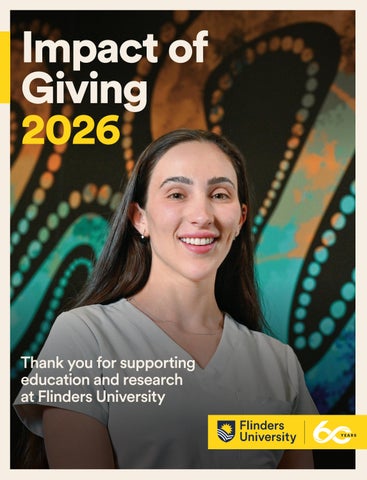
Impact of Giving 2026

Thank you for supporting education and research at Flinders University

60 Years of Impact with Purpose

This year, as Flinders marks its 60th anniversary, I am energised by what lies ahead – for our University, and for the communities we are proud to serve.

We recently launched an ambitious new strategic plan that charts our goals for the next decade – including our vision to change 10 million lives for the better by 2035.

I have every confidence that, together with your support, we will achieve this vision as we continue rising to the challenge of changing lives and changing the world.

Thank you for your support for education, which is changing the lives of our students and, in doing so, building a more equitable society.

For example, Eugenia Matthews has drawn on her professional expertise and lived experience to establish a scholarships for students living with disability (see page 12).

We are now Australia’s fastest-growing research university. Our researchers are delivering extraordinary impact, empowered by your philanthropic support.

At a time when democratic systems across the world are under incredible pressure, researchers at our Jeff Bleich Centre for Democracy and Disruptive Technologies are taking the lead in understanding and mitigating digital influences on democracy, thanks to a generous donation (see page 4).

We are deeply grateful for Gary Curtis’ bequest, which will accelerate discovery, nurture excellence and foster leaders in leukaemia research (see page 16).

As we celebrate 60 years, I reflect on the purpose that has shaped Flinders from the beginning: a determination to challenge convention, widen access to education, and make a meaningful difference in the community.

With thanks to your generosity, together we continue to fulfil this fearless purpose.

What you supported in 2025*

Health & Medical Research

Health & Medical Scholarships

Sustainability Research

Financial Need Scholarships

Rural Scholarships

Culture & Creativity

Indigenous Scholarships

Autism Research

STEM Research

STEM Scholarships

Political Research

Disability Scholarships

Other

*Based on donation amounts.

Contact Us (08) 8201 3721 giving@flinders.edu.au Flinders.edu.au/giving

The 2026 Impact of Giving report is published by Advancement, Flinders University.

Editor: Lynda Allen

Writers: Lynda Allen & David Sly

Design: Flux Visual Communication

Photography: Brenton Edwards

Photos supplied: pages 10, 14, 16 & 17

Cover image: Kayla Vitale

Acknowledgement of Country

Thank you! Matthew Flinders Scholarship

“You have made me a better doctor – thank you.”

Achieving her medical degree and now working as a doctor is especially meaningful for Helen.

A single mother of three and a cancer survivor, Helen completed her four-year, full-time medical degree last year – thanks to her extraordinary courage and donor support for scholarships.

Helen credits the financial relief provided by the Matthew Flinders Scholarship and the Dr Lesley Shorne Memorial Scholarship as being pivotal to her success.

“The scholarships played a critical role in helping me achieve my degree and become a doctor,” says Helen.

“With your generous support, I could focus more on my studies instead of having to work so much to make ends meet.”

Now embracing her hospital-based role, Helen is also grateful for the education she received at Flinders University, which has prepared her well to serve the community with confidence and compassion.

“Being a doctor is an absolute privilege. I hope to practice at my best for many years to come and to provide excellent care to my patients.”

Thank you for providing life-changing support for students in financial need through the Matthew Flinders Scholarship.

Flinders.edu.au/support

Flinders University acknowledges the Traditional Owners and Custodians of the lands on which its campuses are located. These are the Traditional Lands of the Arrernte, Dagoman, First Nations of the South East, First Peoples of the River Murray and Mallee region, Jawoyn, Kaurna, Larrakia, Ngadjuri, Ngarrindjeri, Ramindjeri, Warumungu, Wardaman and Yolngu people. We honour their Elders past, present and emerging.

Strengthening democracy in the digital age

Jeff Bleich Centre for Democracy and Disruptive Technologies

With the support of a generous donation, Flinders University is contributing vital research to strengthen democratic security, governance and policy in the digital age.

In a democratic society, power rests with the people. Citizens actively participate through voting, debate and free expression, fostering an inclusive environment with diverse views. It ensures everyone, including the government, is accountable and rights are protected through free speech and fair elections.

However, recent global events have shown that democratic rule cannot be taken for granted – especially liberal democracies that safeguard fair and transparent elections. The growing interference of disruptive technologies, the increasing spread of misinformation and the rise of extremist movements all pose increasing threats to democratic societies the world.

“Democracies are more fragile than people may think,” says Professor Rodrigo Praino, Director of the Jeff Bleich Centre for Democracy and Disruptive Technologies (JBC) at Flinders University.

“There are only 29 liberal democracies in the world, which means that almost three out of four people globally are living under a nondemocratic regime.”

Inspired and supported by Jeffrey Bleich, former United States Ambassador to Australia, the Jeff Bleich Centre was established at Flinders University in 2019 to strengthen democratic systems through independent research, community engagement and collaboration with government and industry.

Among existing challenges to democracy, Professor Praino believes digital technologies such as Artificial Intelligence (AI) pose both significant opportunities and serious threats to democracy, democratic ideals and democratic institutions.

“The rise of disinformation and misinformation, increasing polarisation, declining civic engagement, and disengagement among younger generations are all part of this complex equation impacting democracy,” he explains.

“Now, yet another emerging technology – generative Artificial Intelligence – is disrupting the status quo in unpredictable ways. As a result, there is much more analytical work ahead of us.”

Professor Praino has identified the need to respond to the impacts with independent research on AI and disruptive technologies, space and security, civic engagement and human rights, youth views on democracy, and the influence of both disinformation and misinformation.

The Centre’s work is already making a measurable difference across community, industry, and government sectors.

Professor Rodrigo Praino

“At the community level, our programs, events and public research empower individuals to better understand the forces influencing their lives, and to be equipped with tools to navigate information responsibly to safeguard their democracy.

“At the policy level, our independent, world-leading research informs national democratic strategies, while our close collaboration with industry and government ensures our work delivers real impact.

“Ultimately, our goal is to strengthen the foundations of a healthy democracy.”

The Centre’s research is supported by competitive grants, contracted research and philanthropic donations, and thanks to a $1.5 million donation in 2024, the Centre has been able to significantly expand its work to strengthen democracy.

“Philanthropic donations provide the flexibility that allows JBC to pursue high-impact research that might otherwise be impossible through traditional grants,” says Professor Praino.

The donation has funded the Visiting Scholar Fellowship, bringing leading global experts to Adelaide to enrich JBC’s research, international collaborations and community engagement through public presentations.

Visiting Scholars include Professor Erik S. Herron from West Virginia University (USA), and Dr Jean-Nicolas Bordeleau from the University of Ottawa (Canada) – who has since relocated to Adelaide to be a JBC Research Fellow.

Alongside this program, public events such as the inaugural JBC Distinguished Lecture delivered by former Australian Prime Minister, the Hon Malcolm Turnbull AC, allow the Centre to host high-profile discussions with leaders, policymakers and the wider community.

“Public initiatives ensure our research findings are shared widely and meaningfully. They are building Flinders University’s reputation as a trusted thought leader,” says Professor Praino.

“The Jeff Bleich Centre has become the leading expert voice on democracy in South Australia and one the most prominent voices nationally.”

The donation is also enabling the scale and focus needed to make national and international impact, generating new knowledge, evidence-based solutions and practical policy recommendations that will shape the future of democratic societies worldwide.

“This level of support ensures our work remains responsive, relevant, and aligned with real-world democratic challenges,” says Professor Praino.

“Our world-class research has built our reputation internationally as we collaborate globally with governments and industries committed to protecting democratic systems.

“The research is also strengthening communities by making them more informed, more secure, and more resilient.”

Professor Praino believes now is the time for the community to understand what is at stake and what they can do as individuals to safeguard democracy — for this generation and for generations to come.

“Democracy underpins everything we do as a society. If left unprotected, our democracy will quickly look very different from what it is today.

“There has never been a more pivotal time to act.”

Flinders.edu.au/JBC Help strengthen our democracy

Explore research, events and tools that support democratic resilience in the digital age.

Support for a healthier future

Through personal loss, financial pressures and the demands of parenting, Kayla Vitale’s determination to Become a doctor has been supported by lifechanging scholarships – thanks to the generosity of donors.

A proud Ngarkat woman, mother of three and third-year Doctor of Medicine student at Flinders University, Kayla is driven by a deep commitment to improving health outcomes for Aboriginal and Torres Strait Islander people.

Kayla grew up in Copeville, a tiny town of just 34 residents in South Australia’s Murray Mallee. Living in a close-knit rural community, she learnt about the challenges regional and remote communities face in accessing healthcare.

These early experiences, combined with her professional background as a registered nurse working across rural clinics and the APY Lands, helped shape her ambition to become a doctor and her vision for improved outcomes for cancer patients.

“I really want to reduce disparities in cancer treatment and care,” says Kayla.

“This can be achieved by developing culturally safe cancer care models that prioritise early detection, prevention and patient-centred care delivered on Country.”

Behind this clarity of purpose, however, lies profound personal hardship.

Kayla’s first year of medical school coincided with the devastating loss of her father – her biggest supporter – to Stage 4 lymphoma. His illness involved years of treatment, followed by six months in intensive care and a prolonged medically-induced coma.

Kayla was at the hospital daily, balancing the demands of her studies with caring for her young children. During this time, she gave birth to her third child in the same hospital where her father lay unconscious.

Kayla Vitale

Navigating grief, motherhood and the intensity of a medical degree felt overwhelming, but Kayla says it was the support of her community, Flinders University and scholarships, that got her through.

“My family and mob were incredible, and Flinders lecturers, students and staff offered genuine care, flexibility and practical help,” she says.

“Financial support through scholarships was also critical. It allowed me to reduce paid work, spend time with my children, and access essential study resources.”

During her first year of study, Kayla received the Mavis Brown Scholarship, Indigenous Medical Study Resources, and the Professor Ross Kalucy Indigenous Wellbeing Scholarship.

“The financial support meant I could work less, be present with my children and focus on my studies without constantly worrying about whether we’d have enough money to get through the week.”

But receiving the Professor Michael Kidd AO Scholarship in her second year marked a turning point for her focus, after such a difficult year.

“Thanks to this scholarship support, I can give my degree everything I’ve got,” says Kayla.

“I can focus on becoming the doctor I know my community needs, without carrying that constant weight of financial stress.”

Passionate about doing what he can to make the world a better place, Australia’s Chief Medical Officer Professor Michael Kidd AO FAHMS created the scholarship with his husband Professor Alastair McEwin AM.

“In 2010, when I was Executive Dean of Medicine, Nursing and Health Sciences at Flinders University, it became clear that one of the most effective ways to improve the health and wellbeing of Aboriginal and Torres Strait Islander people was to support Aboriginal and Torres Strait Islander people to become health professionals,” says Professor Kidd.

“The scholarship supports the retention and successful graduation of Indigenous students studying medicine, nursing and allied health professions at Flinders University –which can lead to improvements in the health and wellbeing of all Aboriginal and Torres Strait Islander people.”

For Kayla, the impact of the scholarship was immediate and profound. It allowed her to fully commit to her studies and focus on her future – without the daily anxiety of whether she could pay her bills.

“To everyone who donates to scholarships – thank you! Your donation creates breathing room to balance study with life. It allows people like me to show up fully – as students, as parents, and as future doctors,” says Kayla.

“Without the scholarships, I wouldn’t be still studying, still dreaming, still moving toward a future where my children and my community have a healthier future.”

More than financial assistance, the scholarships have sent Kayla a powerful message – that she is valued, her ambitions matter, and her future impact is believed in.

This is a sentiment Professor Kidd wholeheartedly shares.

“Indigenous students training to become health professionals have the capacity to be clinicians, role models, and community leaders,” he says. “Kayla embodies all three.”

Help pave the way for a healthier future

Donate today to the Professor Michael Kidd AO Scholarship to improve health and wellbeing outcomes for Aboriginal and Torres Strait Islander communities.

Scan to donate

Professor Michael Kidd AO

Donors

Brian & Jennifer

Abbey AM

Larry Abel

Frances Adamson AC

Trevor Ainsworth

Veronica Aldrete

Lynda Allen

Bonnie Allmond

Gunther Andersson

Peter Anglberger

Catherine Antonio

Sukhvinder Badwal

Chris Baggoley AO

Barbara Baird AM

Greg Barritt

Neil Batty

Margy Burn AM

Alan Burns

Denis Byrne

Bronwyn & Phillip Carson

Joyce Carter

Robert Castelow

Claire Catt

John Chalmers AC

Allan Chan

Ian Chesterman AM

John Clancy

Jennifer Clark

Michele Cochrane

Nayia Cominos

Tiffany Conroy

Katherine Cooke

Celia Cookson

Elizabeth Ford

Mike Fungalei

Gareth Furber

Florence Furechi

Maureen Gallagher

Ann Gardiner

Douglas Gautier AM

Scott Germann

Veronica Ghee

Terry Giesecke

Ellen Giles

Puneet Gill

John Glenn

Mark Goldsmith

Solveig Grenfell

Gina Gustafson

Jan Haaren

Peter Hussin

Reuben Jacob

Kylie Jarrett

Ricardo L Johnson

Erica Jolly CUniv

Mark Jones

David Kaczmarek

Krishan Kant

Angela & Mark Keam

Barry Keldoulis

Claire Kelly

Aravind Kesavan

Mehrnaz Keyhanfar

Theodore Klick Jr

Bianca Koch

Elizabeth & Michael Kompo

Michael Kooymans

Denise Martin

Annette Masters

Paul Mazourek

Doug McEvoy AM

Bill McKee

Ross McKinnon

Vincent Megaw AM

Kelly Meier

Jacqui Michalski

Fij Miller

Peter Monteath

Betty Moore

Alec Morley

Elizabeth Morris

Russell Mountford

Mahmoud Moussa

Peter Mulraney

Thank you

Jo Baulderstone

Baulderstone Family

Cheryl Bennetts

John Bishop AO

Trevor Blackburn

Jeffrey Bleich

Claire Bockner

Linnea Boileau

Mike Bowen

Chris Bowman

Nicholas Brealey

Chris Brebner

Esther & Bill Breed

Max Brennan AO

Freddie Brincat OAM

Annelie Brixius

Rosemary Brooks OAM

Jane & Bob Brummitt

Bruce Buchan

Joy Bullitis

David Bunce

Lawrence Burk

Emma Burke

Milly & Andrew Costi

David Craig

Jonathan Craig

Rubi Cury

Jennifer Cuthbertson

Eleonora Dal Grande

Bill Damachis

Kevin Davis AM FAIBF

Jenny & John Dawes

Joseph Demura

Gorakh Deshmukh

Bozo Djuric

Marie-Louise Dreux

Suzanne Dunn

Alan Easton

John Eckermann

Danny Eckert

Ruth Eckhard

Theo Ellenbroek

Ross Ermidis

Rebecca Esteve

John Finlay-Jones

Jayne & Chris Flaherty

Jane Habner & Rianna Lopez

Lee-Anne Hall

Ruth Hall

Peter Hallsworth

Keith Hancock AO

Peter Hanlon

Michelle Harris

Helen Harrison

Wayne Harrison AM

Michael Harry

Helen Heithersay

Dianne Hill

David Hilliard OAM

Carol Hillman

Gloria Hinks

Naomi Hodgens

Joe Hortovanyi

Teresa Hudson-Green

Alex Huisman

Jenny Humphrey

Roger Hunt

Damian Hussey

Barbara Kupke

Jennifer Kuyper

Tony Kyriacou

Angela Lacey

Romy Lawson

Mason Lee

Melinda Lee

Meredith Legg

Peter Leverenz

Warren Lewis

Karen Lower

Kadar & Anton Lucas

Arthur Lucas AO

Emma Mackenzie

Carole Mackintosh

Peak Mann Mah

Reetta Makinen

Abraham Makuei

Deirdre Malouf

Seya Manawamma

Sinclair Mann

Christine Marsden

Janis & Simon Marsh

Murchland Family

Kim Murphy

Janet Murray

Yumi Naito

Michael Nance

Ada Nataren

Jennifer Nicholls

Linda Notley

Chris O'Grady

Josephine O'Grady

Suzanne Parker

Tahlia Parrish

Robert Paterson

G.Keith Payne

Lerryn Pennell

Colleen Penny

Liz Perry AM

Lea Petrovic

Albert Phillips

Melinda Pike

Melissa Pitman

Katrina Pobke

Wee Ching Pok

Santosh Poonnoose

Greg Powell

Kim Pryor

Kyra Quilliam

Katrina Ramsay

Leonie Randall

Julie Rayner

Chris Reid

Alistair Rendell

Robert Rice ^

Ian Roberts

Joan Robins

Courtney Roe

Bev Rogers

John Rogers

Dorothy Rowell

Andrew Rowland

Kym Stockman

Kuma Subedi

Charles Such

Michael Sullivan

Prashant Sumeet

Matthew Sykes & Peter Allred

Anna Szorenyi

Katherine Taalman

Acram Taji AM

Elaine Tan

Joan & Anthony

Thomas AC

Jacqui Thorburn

Marika Tiggemann

Anna Treloar

Alan Tucker

Anton van Bavel

Yan Yang

Jeanne Young

Bruno Yvanovich

Pamela Zorn

Organisations

Adelaide Primary Health Network

Adelaide Theatre & More

Social Club Inc

AGL South Australia Pty Ltd AMK Law

Australian Rotary Health

Bennelong Foundation

Community Bridging

Services Inc

Day Family Foundation

Dylan Alcott Foundation

Rotary Club of Barossa

Valley Foundation Inc

Rural & Remote Health, CMPH, Flinders University

SA Health

SABRENet

Save Granite Island Penguins

Seeley International

Sophia Ecumenical

Feminist Spirituality Inc

The Dr Sarah Barlow Bowel Cancer Foundation

The Weise Foundation Inc.

University of the Third Age – Flinders Branch

Victor Chang Cardiac Research Institute

Gifts-inMemoriam

In memory of

Michael & Jack Alpers

Deborah Lehmann

In memory of

Margaret Barlow

Bryan Barlow

In memory of Phillip Beddall

Cathi Tucker

In memory of Jenny Calvert

Dean Calvert

In memory of Marcello Costa

Margaret & David Wattchow DUniv

... to our many donors who partnered with us in 2025 * to change lives.

Stephanie Rowland & Family

Andrew Rutter

Bryce Saint OAM

Geoffrey Sauer

Frank Scali

Helen Schinckel

Elnora Schmocker

Anthea Schubert

Lea Thin Seow

Roger Sexton AM CUniv

Geoff Shacklock

Michael Shanahan

Mary Sired

Joel Smith

Lesley Smith

Alison Smyth

Margaret Smythe

Antimo Spagnuolo

Megan Spiliopoulos

Heather Spratt

Carol-Ann Stanborough

Colin Stirling

Joe Van Dalen

Ann Verbeek

Janet Vermeeren

Alison Vink

Lucas Wagner

Margaret Wall

Rick Walsh

John Warne

Heidi Warren

Richard Weate

Garry Weatherill

Catherine Wegener

Deborah West

Irena & Gerry White

Heather Whitford

Emma Widdison-Duke

Adrienne Williams

Heather Williams

Trish Williams

Brenda Wilson AM

Ronald Wright

Lily Xiao

Guang Xing

E&L Consultancy Pty Ltd

Eco Logical Australia

Fleurieu Philanthropy Foundation

Gaganis Bros Imported

Food Wholesalers Pty Ltd

Helpmann Academy

Hong Kong Arts

Development Council

Humanitix

(Andy Adams-Murphy)

Integrated Heritage Services

Leahurst Nurses' Foundation Incorporated

Little Heroes Foundation

Matthews Lawyers

Montebello Foundation

Nature Foundation Ltd

Neale Draper and Associates

Noarlunga Trees For Life

Queensland Eye Institute Foundation

Radiology SA

Wattle Range Council

WAX Design

Yitpi Foundation

Bequests

Estates of the late

Gary Curtis

Midge Dunn

Mavis Haydon

W Gordon Heaslip

Ivy May Naylon

Frank Van Straten

Gifts-in-Kind

Max Altman

Susan & Michael Armitage

Andrew Baker

Bin Bai

Christopher Hodges

Dianne Longley

Christine McCormack

Gus Worby

In memory of Vivienne Crisp

Helen Petros

In memory of Midge Dunn

Penny Kilby

In memory of Norman Feather

Mark Feather

In memory of Gwyneth & Maurice Keogh

Samantha Cribb

In memory of G. Creagh Miller

Alfred Martin

In memory of James Moore

Paul Coddington

Cheryl & Carey Fear

Nathan Fear

Fay & Barry Williams

In memory of Christopher Scanlon

Vivi Scanlon

*The Donor Honour Roll recognises those who donated to Flinders University between 1 January & 31 December 2025. ^Donor has since passed away.

Building foundational literacy skills

Early Career Research Seed Funding

Community support for an early career researcher at Flinders University is driving greater accountability for mobile apps that claim to assist children’s foundational literacy skills.

More than 9,000 apps across the Apple and Google Play stores are currently promoted as tools to develop early reading skills, including phonics. Yet little evidence exists to help parents and educators determine which of these apps genuinely support children’s learning.

“In today’s world, with increasing use of mobile devices, parents often turn to mobile apps to support their child’s reading development,” says Dr Lisa Furlong, a practicing speech pathologist and researcher in the College of Nursing and Health Sciences at Flinders.

“We need to ensure that what’s available will actually benefit children’s learning.”

With the support of a community-funded Early Career Research Seed Funding grant, Dr Furlong led a first-of-itskind study to appraise 309 mobile apps that claim to support the development of phonics and phonological awareness –foundational skills critical to early reading development. The findings were concerning.

“Almost one in five apps were rated as poor quality, with expert reviewers recommending only 27 per cent of the apps for their potential to support the development of foundational reading skills,” says Dr Furlong.

“While many apps are aesthetically pleasing and entertaining, our research found the majority lack the educational rigour required to teach phonics and phonological awareness effectively.”

The study, published in the Early Childhood Education Journal, also found no significant correlation between consumer star ratings and the expert evaluations.

“Apps that scored highly with consumers tended to be those with high engagement, aesthetics or functionality –rather than those with real potential to support children’s reading development,” Dr Furlong explains.

The research highlights a major gap between consumer perceptions and educational quality.

“Parents and educators often rely on star ratings and user reviews when selecting apps – but our findings show these metrics are not reliable indicators of educational value.”

In fact, the research showed that the majority of apps failed to provide explicit instruction, lacked a structured and sequenced approach to teaching letter-sound associations, and did not provide corrective feedback.

Many included incorrect modelling of the target skills, mispronunciations of letter sounds and inappropriate word choices for reading tasks – issues that could actively hinder children’s learning.

With app stores remaining largely unregulated, these findings raise serious concerns for children, parents and educators who rely on digital tools to support literacy development.

“There is a great need for stronger regulation and more robust certification processes.”

“Clearer labelling and disclosures are essential to ensure that children are engaging with tools that genuinely support their learning,” says Dr Furlong.

She also points to issues at the development stage. Despite increased advocacy around the science of reading, many app developers are not responding with tools that reflect best practice.

“We urgently need more investment in highquality, evidence-informed educational apps.”

Without an established track record of grant funding, Dr Furlong says it can be difficult for early career researchers to deliver this kind of real-world impact.

Top 5 best performing apps

1. Hairy Letters

2. Initial Code

3. Chimp Fu Syllables

4. PocketPhonics Stories

5. PLD 2P Read 1d

She is grateful for the community’s support for Flinders Early Career Research Seed Funding grants, which made this important research possible.

“Thanks to the Seed Funding support, I gained expertise in the quality appraisal of mobile apps, strengthened my project and people management skills, and raised my national profile through extensive media coverage on the study results.”

Dr Furlong says that investing in emerging researchers provides real benefits for the community by driving innovation and sustaining the future of scientific discovery.

“Thank you to the donors who supported this project. Their contribution provided a critical step in my research and my career, and I am deeply appreciative of their recognition of the research’s value and importance.”

Dr Furlong continues to evaluate and provide advice to parents and educators on the effectiveness of mobile apps in supporting early reading development. She now has plans to explore the development of her own evidencebased app designed to deliver real impact.

Transform lives & improve our community

Support our emerging researchers to deliver real world impact through Early Career Research Seed Funding. Flinders.edu.au/Donate

Dr Lisa Furlong

Achieving goals

Matthews Lawyers Disability Law Scholarship

The generosity of a Flinders University graduate is creating opportunities and building confidence for students living with disability to achieve their goals.

In 2025, there were 2,092 students living with a disability at Flinders University – 7.68 per cent of the total student cohort.

With far-reaching difficulties faced by these students, many could benefit from additional support to achieve their academic goals.

To respond to this need, Flinders University graduate and Adelaide Hills lawyer Eugenia Matthews established the $5,000 Matthews Lawyers Disability Law Scholarship at the University in 2024.

“While studying at Flinders, I saw capable students who had difficulty with academic writing and other challenges related to disability,” says Eugenia.

“With the help of Professor Tania Leiman, Dean of Law at Flinders University, the Matthews Lawyers Disability Law Scholarship was created to address those barriers.”

The scholarship is already making a meaningful difference to its first recipient, second-year Law student Louis Umlauf, who manages significant challenges with Attention-Deficit/ Hyperactivity Disorder (ADHD), while also working to support himself during his studies.

“I was only diagnosed with ADHD in late 2024,” says Louis. “Keeping up with everything can feel overwhelming, but I’ve been learning to put better systems in place and to be realistic about what I can manage.”

One tangible improvement to support his studies has been purchasing his own laptop computer, thanks to the Matthews Lawyers Disability Law Scholarship.

“Before that, I was relying on my late grandfather’s desktop at home, a tablet in class, and computers at university,” he explains.

“I was constantly logging in, reopening things and working around the tablet’s limitations, which made studying really inefficient.

“Having my own laptop has completely changed how I study. I can work wherever I need to, with far less frustration and more focus on learning.”

The scholarship has also enabled Louis to access ADHD coaching, which has significantly improved his study methods and efficiency.

“The scholarship has made a massive difference to my confidence and wellbeing,” says Louis.

“It’s shown me that I’m not doing this on my own – there are people who believe in students like me and want us to succeed.”

Eugenia understands Louis’ challenges firsthand. When she began her studies at Flinders University in 1985, she struggled academically due to undiagnosed learning difficulties.

Through the care and support of lecturers – particularly the late Professor Don De Bats and Dr Greg Tobin – she completed a Bachelor of Arts, which opened pathways to further study, including Law.

Today, Eugenia is the principal of leading Adelaide Hills law firm Matthews Lawyers. She is keen to support the community through her work.

“I am passionate about service to the community and being able to help someone with a legal problem.”

“Being able to make a positive contribution to students at Flinders through financial support, mentorship and advice is rewarding,” says Eugenia.

Inspired by Flinders University’s Chair in Forensic DNA Technology, Professor Adrian Linacre, Eugenia has now announced a second scholarship: the $5,000 Matthews Lawyers Disability Forensic Science Scholarship, designed to support Forensic Science students living with a disability.

“Good forensic science is critical to the criminal justice system – without it, outcomes could be flawed,” says Eugenia.

“Because of my learning difficulties, particularly with STEM subjects, I never thought I could ever contribute to science. But with the right support, I would have had more academic options – and that’s what these scholarships are about.”

Eugenia believes supporting students living with disability is vital and she is proud of the impact these scholarships will have on enabling students to achieve their goals.

“These two scholarships will open learning opportunities for students who, through no fault of their own, have difficulty demonstrating their academic capability,” she says.

“Everyone deserves the opportunity to shine. Students with learning disabilities just need a little support to show their brilliance.”

For Louis, the scholarship is helping to turn a long-held ambition into reality.

“I chose to study Law because I’ve seen people up against oppressive systems,” he says.

“I want to understand how those systems work - where they help people and where they fail – and to use this knowledge to make a real difference through legal practice or policy work.”

Establish a scholarship to support students. Contact us: (08) 8201 3743 giving@flinders.edu.au

Eugenia Matthews and Louis Umlauf

Cleaning up our oceans

Australian Geographic Society

Support from the Australian Geographic Society has enabled a Flinders University investigation into microplastics – a critical step toward cleaning up our oceans.

Our plastic consumption has quadrupled over the past 30 years – generating 353 million tonnes of waste since the year 2000.

Nearly two-thirds of plastic waste now comes from shortlived products used for less than five years, including 40% from packaging, 12% from consumer goods and 11% from clothing and textiles.

And it’s waste that is not going away.

Microplastics are tiny fragments of plastic – mostly not visible to the naked eye – that have broken down from larger plastic items but have not decomposed completely.

Global warnings about microplastic contamination in our environment have been issued by researchers for many years. Now, with growing evidence of causing health problems, their escalating contamination of land, air, food and waterways, community demand to find a solution has been heightened.

A crucial first step is to measure the size of the problem.

Flinders University has been at the forefront of global research to identify and understand the types of microplastics in local rivers and oceans, measure the current quantities of microplastics in waterways, and to trace the sources.

Dr Anastasiia Snigirova

“There has been a glaring lack of data,” says Flinders University researcher, Dr Anastasiia Snigirova.

“We need to understand what we are dealing with first, before government can create effective mitigation strategies.”

In 2023, Dr Snigirova led a microplastics study funded by the Australian Geographic Society, in collaboration with Professor Sophie Leterme from Flinders University’s Nano & Microplastics Research Consortium.

The study also benefited from research support from the University and from state government environmental authorities, the Environmental Protection Authority (EPA) and South Australian Research and Development Institute (SARDI).

The Australian Geographic Society is a not-for-profit organisation dedicated to conservation, research and exploration. Since 1987 it has supported thousands of projects that have restored ecosystems, protected endangered species, elevated Indigenous knowledge and driven bold discovery.

Through philanthropic support, the Society ensures this vital work delivers real-world impact while also inspiring the wider public.

“We seek to empower individuals and organisations to tackle environmental challenges and find innovative solutions to the many threats faced by our natural world,” says Chrissie Goldrick, Chair of the Australian Geographic Society.

With the foundation’s support Dr Snigirova was able to carry out a study into microplastics pollution in the Gulf Saint Vincent – the waterway between South Australia’s Yorke and Fleurieu Peninsulas.

The research looked specifically at minute microplastics particles – ranging in size from 20 microns (about 0.02 millimetre) to two millimetres in length, and their distribution in the water column.

“The investigation indicated high variations of microplastics throughout the gulf, but with 8 particles per litre on average,” says Dr Snigirova.

“As a baseline study on microplastic contaminants it’s impossible to compare these results. But any level of microplastics in our waterways is not good news.”

The results also showed no difference in the concentration of microplastics at different ocean depths.

“We collected water samples near the surface and also deep parts of the gulf, and found no difference in the concentration, because those particles are being mixed in a very dynamic environment, constantly affected by tides, winds and currents.”

The data from the research study will now be used by government bodies, such as the Environmental Protection Authority, to develop strategies to mitigate the issue.

“Thanks to the Australian Geographic Society, this research will form baseline data and contribute to a long-term database of this developing and devastating situation,” says Dr Snigirova.

“It’s now important to continue ongoing sample collection, to build accurate measurements on microplastics accumulation in our rivers and oceans.

“From this data, I’m confident we can find many answers to this significant issue.”

Dr Snigirova believes the next crucial step in microplastics research will be to measure how bad the effects are on the health of the community – research that is now being led by Associate Professor Melanie MacGregor at Flinders Nano & Microplastics Research Consortium.

“There is so much more data we must collect to obtain an absolutely clear picture of how dire the situation is and before we can truly clean up our oceans – but this is a good start.”

Help clean up our oceans

Donate today to support critical microplastics research at Flinders University.

A bequest for hope

Gary Curtis Leukaemia Research Scholarship

A remarkable and enduring legacy of hope in the fight against blood cancer has been created through a generous bequest from Gary Curtis.

Each year, around 5,000 Australians are diagnosed with leukaemia – a type of blood cancer that begins in the bone marrow, where blood cells are produced.

The disease is characterised by the uncontrolled growth of abnormal blood-forming cells, which crowd out healthy red and white blood cells and platelets.

Despite advances in treatment and care, outcomes remain poor, with around one-third of patients dying within five years of diagnosis.

After battling leukaemia for several years, Gary Curtis was one of those patients, sadly passing away in 2024 at the age of 77.

Gary was an only child who grew up in Adelaide’s western suburbs. For much of his adult life he lived in a cottage in North Adelaide, working in a men’s clothing store in the city. He had a deep appreciation for music, art, theatre and reading.

In the 1970s and 80s Gary lived in London, where he worked at the luxury department store Liberty. Here he met lifelong friend Sheila Cohen, with whom he travelled throughout the United Kingdom and Europe.

During his treatment for leukemia, Gary was deeply impressed by the expertise and care provided by his medical team at Flinders Medical Centre, led by Associate Professor David Ross, and was grateful for the guidance of Flinders University researcher, Professor Bryone Kuss

Gary Curtis at work

– an experience that strengthened his confidence in the University’s research capability.

While fighting the disease, Gary benefited from recently approved medication developed from a research study. He understood the impact research could have on improving medical treatments and actively contributed to this work by participating in a clinical trial.

Recognising both the urgent need and potential impact of research, Gary made the decision to continue the fight against leukaemia beyond his lifetime by leaving the sale of his estate as a donation in his Will to support leukaemia research at Flinders University.

Today, Gary’s extraordinary $1.36 million bequest to Flinders University supports emerging researchers and clinicians through the Gary Curtis Leukaemia Research Scholarship.

The scholarship funds PhD candidates whose work addresses the complex pre-leukaemic conditions that significantly increase the risk of the aggressive disease, including Chronic Myelomonocytic Leukaemia, Myelodysplastic syndromes, and Myeloproliferative diseases.

“Developing new knowledge around leukaemia and identifying the early mechanisms of the disease is vital to improving patient outcomes and ultimately shifting the trajectory from treatment to prevention and cure,” says Professor Kuss.

“Creating opportunities for exceptional early career researchers and clinicians, Gary’s bequest will strengthen the pipeline of expertise needed to tackle one of the world’s most devastating diseases.”

Through close collaboration with clinicians and medicinal chemists, the leukemia research team at Flinders University is designing next-generation treatments and innovative approaches that selectively attack cancer cells, while sparing healthy immune cells.

Importantly, people with lived experience of cancer are active partners in this work, ensuring research remains focused on delivering meaningful benefits for patients and their families.

Demonstrating the depth of his generosity, Gary also left a portion of his estate to South Australia’s Women’s and Children’s Hospital to provide immediate support to children suffering from leukaemia.

Flinders University is grateful for Gary’s extraordinary bequest, which will accelerate discovery, nurture excellence and foster future leaders in the field of leukaemia research – creating a legacy of hope and the promise of better outcomes for patients and their families.

Create a lasting impact

Include a bequest in your Will to support students or research at Flinders University.

Contact: (08) 8201 3743 giving@flinders.edu.au Flinders.edu.au/bequest

Scan to learn more

Gary Curtis with lifelong friend Sheila Cohen

Enriching lives through art

Emeritus Professor Keith Hancock AO is one of Flinders University’s most influential foundation figures – an economist of international repute, a transformative Vice-Chancellor, and a generous supporter of the Flinders University Museum of Art.

Joining Flinders in 1964 as its inaugural Professor of Economics, Professor Hancock arrived at the new institution at just 28 years of age.

As a founding staff member, Professor Hancock played an important role in shaping the University’s early identity and was instrumental in developing Economics as a strong and respected discipline.

Ten years on, Professor Hancock became Pro ViceChancellor (1974–79), before his appointment as ViceChancellor in 1980. Over the next seven years he guided the University through a period of growth and consolidation, earning admiration for his clarity of thought and fairness.

In recognition of his contributions, Flinders awarded Professor Hancock an Honorary Doctor of Letters in 1987. In the same year he was appointed an Officer of the Order of Australia for service to learning.

During this time, Professor Hancock developed an important connection with the Flinders University Museum of Art (FUMA).

“I supported the aspirations of the Professor of Visual Arts at the time, Emeritus Professor Vincent Megaw AM, who was dedicated to building one of Australia’s most significant university-based Indigenous art collections,” says Professor Hancock.

Thanks to this shared vision and community support, including generous donations from Professor Hancock, FUMA is now custodian to around 8,000 Australian and international works – one of the largest public collections of art in South Australia.

“I made FUMA the main recipient of my donations to the University, believing they might make a meaningful difference.”

This modest but strategic philanthropy reflects Professor Hancock’s conviction that the arts are vital to enriching lives.

“Professor Hancock’s generous support has played an essential role in FUMA’s trajectory as a nationally significant museum – especially the collections of Aboriginal and Torres Strait Islander art,” says FUMA Director, Fiona Salmon.

These works are now driving cultural learning and opening conversations that advance reconciliation.

“Art has the power to change lives, and through his contributions, Professor Hancock is making a real difference in the education of our students and the community.”

Change lives through art

Donate today to shape FUMA’s cultural collections that support cultural learning and conversations that advance reconciliation. Flinders.edu.au/FUMA/Donate

Emeritus Professor Keith Hancock AO

Impact

of Giving Donor Afternoon Tea

Midge Dunn Living Strong Indigenous Bursary Launch

Celebrating 60 years of impact with purpose

For 60 years, Flinders University has worked to change lives through education, research and partnership – made possible by the trust and generosity of our community. That trust carries a responsibility to create meaningful impact that benefits students, society and future generations.

As we build on this foundation, we’re setting our sights on what comes next.

Our new strategy, Agenda 2035: Impact. With Purpose. sets a bold ambition to change 10 million lives for the better over the next decade. This vision reflects what Flinders does best: opening opportunity, solving real-world problems and translating knowledge into outcomes that strengthens communities.

Our generous supporters are central to this mission. Please continue this work with us and help bring this vision to life.

Together, we will work fearlessly to change 10 million lives for the better by 2035 – and every one matters.

Scan to learn about Agenda 2035

Turn static files into dynamic content formats.
Create a flipbook
Flinders University - Impact of giving 2026 by Flinders University, Marketing and Communications Office - Issuu