Northern Indo-European pre-Christian religions
A critical humanities perspective on Celtic, Germanic, and Baltic traditions
Jan Reichstäter
Masaryk University
Monographs
Vol.8
Northern Indo-European pre-Christian religions
A
critical humanities perspective on Celtic, Germanic, and Baltic traditions
Jan Reichstäter
Department for the Study of Religions
Faculty of Arts, Masaryk University
Masaryk University Press Brno 2025
This book will be made open access within three years of publication thanks to Path to Open, a program developed in partnership between JSTOR, the American Council of Learned Societies (ACLS), the University of Michigan Press, and the University of North Carolina Press to bring about equitable access and impact for the entire scholarly community, including authors, researchers, libraries, and university presses around the world. Learn more at https:// about.jstor.org/path-to-open/.
The book was supported by the “Scientia est potentia” Masaryk University fund.
Reviewed by
Václav Blažek (Masaryk University)
Rudolf Havelka (Palacký University Olomouc, Jaroměř Town Museum)
Translated by Mark Newkirk in co-operation with Jan Reichstäter
© 2025 Masaryk University
© 2025 Text by Jan Reichstäter
© 2025 Translated by Mark Newkirk
ISBN 978-80-280-0602-0
ISBN 978-80-280-0601-3 (hardback)
https://doi.org/10.5817/CZ.MUNI.M280-0602-2025
2.1
Chapter
2.2.1
Chapter 1
Prologue
This book sets out to offer critical insights into the problem of studying the preChristian religions of the northern Indo-Europeans, specifically the Celts, Germans and Balts. The use of the adjective “northern” to cover the ethnic groups in question is not based on the word’s linguistic connotations. Despite their long-term neighbourhood and mutual interactions of varying intensity, over varying periods of time, and in different geographical contact zones,1 the Celtic, Germanic, and Baltic languages do not form a common linguistic branch within the Indo-European ecumene, nor do they belong to the same group within the basic classification of Indo-European languages according to the satem-centum dichotomy.2 The speakers of these languages are categorised together here mainly for reasons of geography because they constitute the northernmost Indo-European branches in terms of ethnogenesis (see Map No. 1) and for reasons of cultural history closely related to the factor of geography. The ethnogenetic and cultural development of these Indo-European groups was taking place to the north of the Alpine-Carpathian mountain chain in part of the area traditionally designated in ancient sources of Greek and Italian provenience as barbaricum (Greek barbarikon > Latin barbaricum). In a certain respect, this pejorative term reflects the cultural conservatism of the northern Indo-Europeans, whose traditions evidently developed less turbulently during antiquity than the traditions of their linguistic relatives in the Mediterranean region, which were subjected to
1 From the perspective of a cultural history, during the period between the Iron Age and the high Middle Ages, one can detect particularly adstrate influences of (1) the Rhine-Danubian and Insular Celts on the western part of continental and Scandinavian Germania, (2) the central European Celts on the West Balts (especially in the vicinity of the “Amber Road”, a transportation road connecting the Alpine-Hercynian and Baltic regions), (3) the Scandinavian Germans on the West Balts (especially the coastal tribes of the Prussians and Curonians). It should be added that evidence of these contacts is based mainly on the comparative study of archaeological and linguistic documentation because of the lack of contemporaneous ethnographic information about this from written sources. From the perspective of religious studies dealing with a specific part of spiritual culture, traces of mutual interaction between these non-literate ethnic groups in the pre-Christian period are all the more difficult to study, and conclusions of any kind are usually merely hypothetical.
2 Satem features predominate in the phonological system of the Baltic languages, while the Celtic languages clearly belong to the centum type, and the Germanic languages basically represent the transition between the two macro-areas, although with a strong predominance of centum features; see e.g. Anthony, The Horse, the Wheel, and Language, 345–346.
inspirational influences of local civilisations whose representatives belonged to AfroAsiatic ethnic groups (especially the Semitic peoples) or to other old ethnic groups of the northern Mediterranean (such as the Hattians, Hurrians, Minoans, Etruscans, or Iberians) that later underwent Indo-Europeanisation.3 After all, literary sources from antiquity and from the Middle Ages record numerous common, archaic-looking features4 in their descriptions of the pagan cultures of the Celtic, Germanic, and Baltic peoples. They are connected to practically all important aspects of cultural expression:
• manner of urbanisation (a system of village settlements and isolated homesteads, sometimes with hillforts with various functions, all usually based on wooden architecture);
• economic fundamentals (combination of agriculture and livestock raising, the tradition of legitimacy of plundering raids beyond a group’s political territory);
• political arrangements (tribal organisation with strong family ties and an established social hierarchy);
• gender relations (a rigid patriarchal order with traditions of patrilineality and patrilocality);
• “heroic” ethics (bravery, generosity, faithful keeping of oaths, and unwavering acceptance of one’s fate as basic aspects of personal honour and positive social reputation, through which exceptional individuals achieve a kind of “immortality”);
3 In terms of this cultural dichotomy between the “northern” and “southern” Indo-Europeans, it would be possible to include to the former group not only the three ethnic groups being studied here, but also undoubtedly the Slavs, and possibly even the Indo-Europeans from the inland area of the Balkan Peninsula (the Pannonians and the Dacians) or from the steppes of Eurasia (the Scythians and the Sarmatians). However, in comparison with our knowledge of Celtic, Germanic, and Baltic religious traditions, about the traditions of these other “barbarians” we know far less (Slavs, Scythians) or nothing at all (Pannonians, Dacians, Sarmatians). Concerning the close interdependence of the dimensions of language, culture, and geography in the histories of the individual branches of the Indo-Europeans, see e.g. Puhvel, Srovnávací mytologie, 47–57. On the question of the influence of ethnic substrata on mutual cultural differences of individual Indo-European groups, see e.g. Lincoln, Death, War, and Sacrifice, 1–5.
4 Reconstructions of the cultural prehistory of the Indo-Europeans, including the characteristic features of their religions, are generally based on comparisons and syntheses of archaeological and written sources. Here, as in the questions of the chronology and geography of the spread of the Indo-European languages, the theses of the Lithuanian-American archaeologist Marija Gimbutas basically remain valid. According to her, the main Proto-Indo-European epicentrum was located in the steppes between the lower reaches of the Volga and the Dnieper, and the spread of the subgroups occurred from the end of the Neolithic period in various directions, mostly through militant means; see especially Gimbutas, The Kurgan Culture and the IndoEuropeanization of Europe. For criticism of these theses and an alternative model, see Renfrew, Archaeology and language. For a revision of Gimbutas’s model and criticism of Renfrew’s model, see e.g. Anthony, The Horse, the Wheel, and Language. For current results of genetic studies based on ca. 70 samples of European DNA from the period between the Mesolithic and the Bronze Age that seem (at least for now) to confirm Gimbutas’ “steppe” model, see Haak et al., “Massive Migration from the Steppe was a Source for Indo-European Languages in Europe”, 207–211.
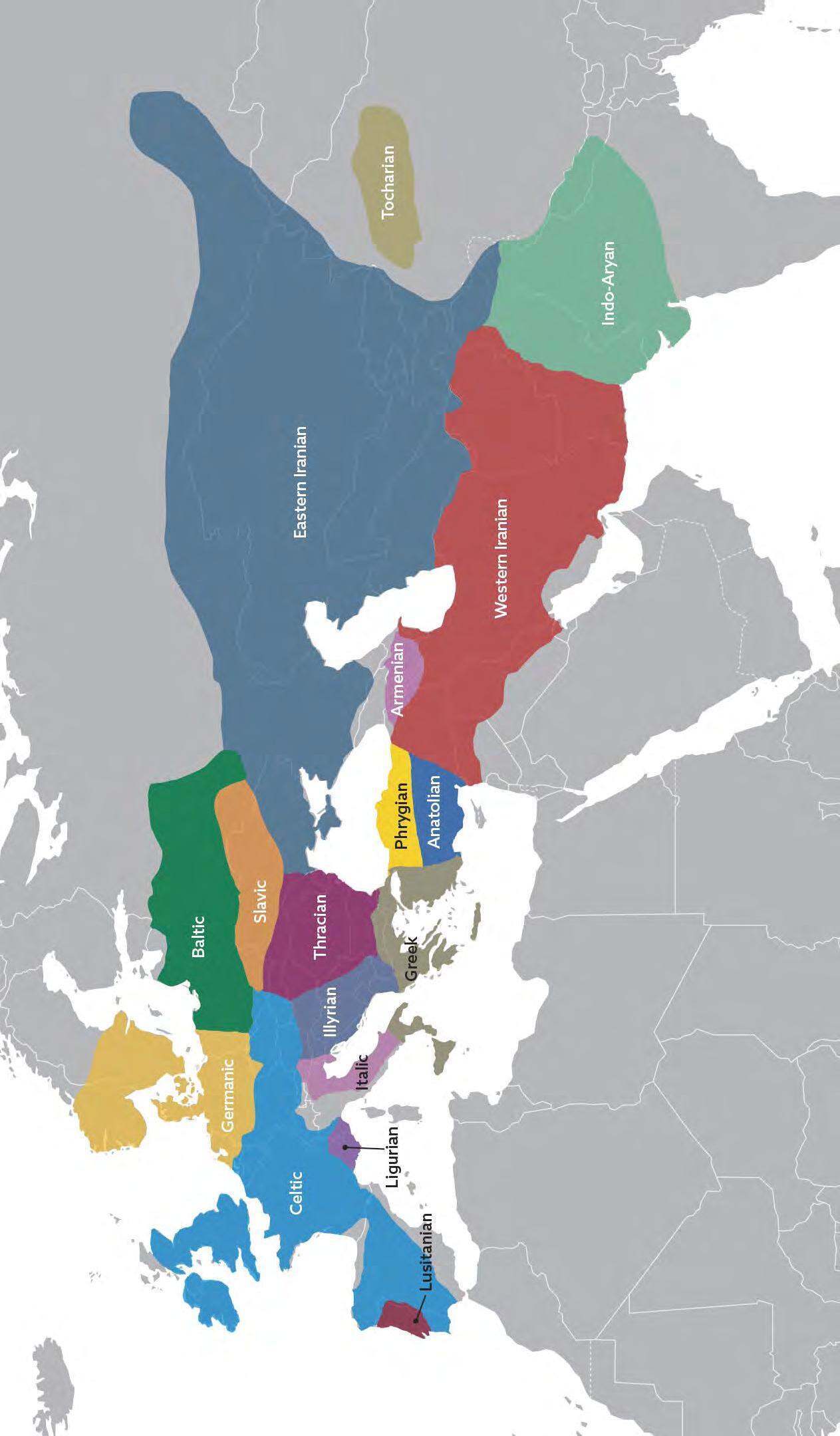
Map No. 1: Approximate distribution of Indo-European languages at the time of the first ethnographic reports about their northern groups (ca. 500 BCE)
• importance of alcoholic beverages (as traditional means of reaching extasy) in the spheres of the profane and the sacred;
• absence of literature (or tenacious oral transmission of socially important narratives despite knowledge or availability of writing);
• religious importance of the horse (in the spheres of ritual, mythology, and the arts);
• practice of human sacrifice (usually of convicts or captives, carried out as part of certain rituals connected with the cults of gods or with divination);
• religious particularism (or a spatially and temporally variable system of local, tribal, and transregional cults of gods, spirits, and ancestors);
• popularity of triadic concepts (as matrices of classification or organisation in the spheres of the sacred and the secular).5
Despite the conservatism discussed above, it is clear from historical documents, supplemented by linguistic and archaeological analyses, that cultural developments of similar complexity to those in the Mediterranean were also taking place during antiquity north of the Alps and the Carpathians. Local non-Indo-European substrata or adstrata, of which only the Basques, the Sami, and the Baltic Finns have survived down to the present (in terms of their languages), undoubtedly played an important role in the cultural genesis of northern Indo-European groups. However, reconstructing these processes of assimilation – as well as the spiritual cultures of the local ethnic groups before Christianisation – is an extremely difficult task, primarily because we have relatively little reliable information about the history and everyday life in this large geographical area.
Literary sources referencing areas populated by pagan Celtic, Germanic, and Baltic peoples rather rarely contain more comprehensive passages dealing with ethnography both because of the genre orientation of the sources and because of frequent lack of interest, the language barrier, ideological prejudices, or the cultural alienation of the authors. For scholars interested in the traditions of the northern Indo-Europeans, these sources are undoubtedly valuable because they offer an exclusive “live” look
5 An enumeration of mutual differences between the northern Indo-European groups and of their specific features would undoubtedly be just as extensive. Some of the features in question can also be documented for southern Indo-Europeans (between the Apennine Peninsula and the Indian subcontinent) or outside of the Indo-European ecumene (e.g. in Semitic, North Caucasian, Altaic, or Finno-Ugric milieus). However, these facts do not by any means reduce the value of information about the discussed set of features common to the cultures of the northern Indo-Europeans, because the set of features in question is not apparently found elsewhere in such a complete form (and if so, in exceptional cases, then usually as a result of intensive influences from this cultural milieu). It should be added that this set of features may surely be broader and more detailed, but as a basic sample of shared cultural features in the area in question, it may be regarded as sufficient. Concerning documentation from late antiquity and the Middle Ages of parallels between the pagan cultures of the northern Indo-Europeans, see e.g. Modzelewski, Barbarská Evropa. Concerning archaic features of the religions of the Indo-Europeans, see especially Lincoln, Death, War, and Sacrifice; Gimbutas, The Kurgan Culture and the Indo-Europeanization of Europe
at local paganism, and they may also make reference to cultural contrasts and to mutual relations between these ethnic groups and their neighbours. At the same time, however, these sources are usually insufficient for a more detailed reconstruction of a religion. Moreover, the sources are usually tied only to a particular location or region, so the information covers only a small part of the ethnic area in question.6
6 Reflections on the Celts in written sources date back to before 500 BCE in the now lost writings of Hecataeus of Miletus, and they are continued by Herodotus and by the classical philosophers Plato and Aristotle. The most extensive mentions of the culture and religion of the Celts were written during the period from 100 BCE to 100 CE by Posidonius of Apameia, Caesar, Diodorus Siculus, Strabo, Pliny the Elder, and Tacitus. These writings mainly focus on the southern territories of Gaul and Britain, while they almost completely overlook areas where a wealth of archaeological material is found (the Rhine and the Danube valleys) as well as territories with mythological literature produced later during the Middle Ages (Ireland and Wales). For an overview of ethnographic sources on the old Celts, see Cunliffe, The Ancient Celts, 288. The beginnings of historical references to the ancient Germanic peoples are connected to the now lost work of Posidonius of Apameia from the end of the second century BCE, probably dating from the time of the attacks of the Cimbri and the Teutons on Italy’s northern border. Ethnographic information from Caesar and Tacitus that is of greater wealth (and is frequently cited) primarily concerns the territories of the westernmost Germanic groups along the Rhine, although the latter also refers briefly to areas farther to the northeast, including Scandinavia. More extensive references to the practice of religion of the North Germanic peoples do not appear until during the Viking Age, with reports by Rimbert, Ahmad ibn Fadlan, and Adam of Bremen (9th–11th centuries) that date from just before the period of Christianisation of the Nordic region. The most detailed description of Norse polytheism was presented by Snorri Sturluson (13th century), an Icelandic Christian deeply interested in his country’s archaic traditions. By his day, however, the public practice of paganism had already been banned for over two centuries, and there is no evidence that it continued to be maintained in private. Moreover, the degree to which the Icelandic polytheism he described corresponds to pre-Christian traditions elsewhere in Scandinavia is unclear. For an overview of sources on the religiosity of pagan Germanic peoples, see Ström – Biezais, Germanische und Baltische Religion, 282–286. At the end of the first century CE, Tacitus already reports on the cultural customs of the Baltic peoples living to the east of their Germanic neighbours. Then, however, come eight “dark” centuries until the reports of the Anglo-Saxon sailor Wulfstan and of the German church chroniclers Adam of Bremen and Helmold of Bosau (9th–12th centuries). These sources, however, concern almost exclusively the territory of the Old Prussians, which also applies to later chronicles by Peter of Duisburg, Simon Grunau, and Marcin Murinius (14th–16th centuries), which present the most detailed information about the characteristic features of Baltic paganism. A 13th century chronicle by Henry of Latvia reports on the cultural customs of the old Latgalians (the eponymous ancestors of the Latvians), but much more information there is devoted to the Finno-Ugric Livonians and Estonians living farther to the west, whose religious customs apparently did not differ fundamentally from those of the Baltic peoples. More extensive and detailed information on the original religious practices of the Latvians does not appear until in the writings of authors of the modern era, most of whom were Christian priests of non-Baltic origin like Joannis Stribingius or Paul Einhorn (17th century), who reflect upon the persisting birituality of natives of the area. More concrete information about the cults of the old Lithuanians is found in the Russian-language Galician–Volhynian Chronicle (13th century) and later in works written in Latin by historians of the late Middle Ages such as Jan Długosz or Enea Silvio Piccolomini (15th century), who record the process of the depaganisation of Lithuania after the conversion of the local elites to Christianity. The persistence of birituality in the rural interior of Lithuania (as well as neighbouring Prussia) for many generations after official