Photography: Jarlath Sweeney, Sean Murtagh, Paul White, Michael Martin Photography
Administration: Orla Sweeney
Advertising: Mary Morrissey
Design: Crackerjack Design House
Printed in Ireland
Contents Spring 2026
74 ROAD SHOW
Coach Tourism & Transport Council (CTTC) AGM, Wexford CTTC Coach & Bus Show 2026, RDS, Dublin with Campion Insurance
62 NEW DELIVERIES
Recent deliveries from Volvo, Higer, Noones and EVM
64 ON TEST
Neoplan Tourliner – From the MAN Truck & Bus stable Kia PV5 Passenger – Award winning pedigree
70 LAUNCH PAD
In a new Class of its own - New VLE from Mercedes-Benz
72 IN PROFILE
Bernard Kavanagh & Sons, Urlingford, County Kilkenny
Harris Bus & Coach launches Higer V-Series around the country
76 OPEN DAY
EVM opens doors to factory facility in Kilbeggan, County Westmeath
78 ADVICE
Some useful advice & Information about GSR2 Regulations from EVM
80 PREVIEW
Preview to the FIAA Bus & Coach Show in Madrid
82 CONDUCTORS’ STAND
Looking into the year ahead in the PSV industry
Disclaimer: Fleet Bus & Coach Magazine management can accept no responsibility for the accuracy of contributed articles or statements appearing in this magazine and any views or opinions expressed are not necessarily those of Fleet Bus & Coach management, save where otherwise indicated. No responsibility for loss or distress occasioned to any person acting or refraining from acting as a result of the material in this publication can be accepted by the authors, contributors, Editors or publishers. The Editor reserves the right to make publishing decisions on any advertisements or editorial article submitted to the magazine and to refuse publication or to edit any editorial material as seems appropriate to him. Professional legal advice should always be sought in relation to any specific matter.
EVM Classic (Accessible) makes travel inclusive and comfortable for everyone. With flexible seating for up 19-22 passengers or 6 wheelchairs users - it is the perfect choice for mobility transport.
The CTTC (Coach Tourism & Transport Council) held its Annual General Meeting (AGM) in Wexford at the end of February. Starting with a tour of the Rosslare Europort facility, delegates moved to Johnstown Castle for some industry presentations and the AGM.
CTTC Vice-Chairman Brendan Crowley who acted as organiser and host for the event said he was proud to welcome everybody to Wexford, his hometown. He opened the meeting by thanking everyone for making the trip to the South-east and introduced Chairman, David Conway to the stage, who outlined the year’s activities.
He mentioned that executive delegates had recently met with the two Ministers in the Department of Transport, Darragh O’Brien and Sean Canney to discuss various issues in the industry, and had had the opportunity to appear before the Oireachtas transport committee. A comprehensive Budget submission was then presented.
During the year there were some good wins for the CTTC. Some progress has been made in discussions with Bus Éireann around the tendering process and the age limit for school bus drivers. Confirmation from Defence Minister Jim O’Callaghan that Garda Vetting will be able to transfer in some circum-
stances is a welcome development. Discussions around the use of HVO as an alternative fuel to diesel and the need for a successful transition to a more carbon friendly fuel will require consultation between the Government and the industry. This is something the industry is committed to confirmed by David Conway.
For 2026, the CTTC has a busy agenda. The campaign to allow U-9s to travel free will continue, as is the urgent need to address parking issues in Dublin. The sudden closure of the existing parking site has caused some annoyance with operators and is a priority to resolve.
Accountancy firm BDO has been commissioned to prepare an updated economic assessment of the sector, and establish further policy strategies. In conclusion, David said he hoped to increase the membership and apply to have the CTTC become a nominating body for the Seanad, He congratulated the incoming executive and said he was looking forward to working with them in the coming year.
P RESENTERS & P RESENTATIONS AT THE CTTC AGM
Ben Radford, Rosslare Europort
On the morning of the AGM, members were given a presentation by Ben Radford, commercial manager at Rosslare Europort. The Wexford port facility Rosslare has gone through extensive expansion in the past two years, and the extra services are all being fully utilised. Plans for the future are impressive. Ben outlined the challenges facing the port and how the Irish Rail
CTTC hosts AGM in Wexford
jointly owned company planned to deal with them. For example, the extension of the M11 motorway directly into the port will reduce journey times and may even make them more competitive than Dublin Port for the roll-on/roll-off tourist business. Long term the port aims to utilise the railway line for container traffic.
Eoghan O’Meara Walsh, Irish Tourism Industry Confederation (ITIC)
The ITIC is an umbrella group for the various sectors of the tourism industry, of which the CTTC is a member. In Ireland, 13% of the total workforce in Ireland are employed in the tourism industry. Another fact maybe not well known is that 29 cents of every euro spent by tourists goes back to the Exchequer. While aware that the future is a little uncertain Eoghan stated that the creation of a new tourism policy as part of the program for Government, the lifting of the cap at Dublin Airport and the VAT reduction for restaurants coming later this year will all be help to the sector.
Tom Enright, Ryder Cup 2027 Project Director
Scheduled to happen in September 2027, the Ryder Cup is one of the biggest events ever to be hosted in Ireland. Planning for the America versus Europe golf tournament is at an advanced stage in terms of transport. There will be four or five Park & Rides in the region and some use of the newly constructed railway line between Limerick and Foynes Port will be utilised. Music to the ears of those present was the news that hundreds of buses and coaches will be required, some on a 24-hour basis to bring spectators from the various parking areas to the course. No decision has been made as to whether coaches arriving from long distance will drop at the stop-off facility or go directly to the course. Certainly, operators were left with food for thought after the presentation, no doubt this opportunity will bring challenges.
Friday 27th and Saturday 28th November are the confirmed dates for the biennial Coach & Bus Show to be held once again at the RDS
Simmonscourt Pavilion. Forward stand bookings are ahead of those from previous years, and extra floor space has been procured. A new website has
been set-up to allow bookings and provide information about exhibitors to members – www.coachshow.ie
Long term event supporters Campion Insurance has once again come on board as title sponsors for the CTTC Coach & Bus Show 2026.
New Noone’s DAF Turas & MercedesBenz Coach and Bus sales
Martin Gallagher of Patrick Gallagher Travel (Donegal) has taken delivery of the company’s new DAF Turas 900 S. This high specification Turas 900 S comes with 37 upgraded passenger seats plus courier, USB connections, large rear boot, LED lighting, dash fridge, veneer finishes and much more! Check out www.patrickgallaghertravel.com
O’Shea’s of Kerry has purchased two new DAF Turas 800 S coaches, the first of a four vehicle order to be delivered and these two initial units have 33 luxury passenger seats plus courier, LED lighting, large rear boot, veneer finishes, dash fridge, USB connections and finished in a stunning metallic grey -www.osheasofkerry.com
Aidan Furey of Fureys of Sligo has headed back west to the Yeats County
with their new Mercedes-Benz Sprinter Low Floor Connect. The low entry minibus has 21 seats plus driver, wheelchair and standee places, fold out ramp, USB connections, deep rear boot, LED lighting, wood effect floor covering, 10 inch dash display and much more - www.fureysofsligo.com
Martin Slevin of Slevins Coaches (Westmeath) has bought this new DAF Turas 800 S, featuring 33 luxury upgraded passenger seats plus courier, USB connections, LED lighting, large rear boot, dash fridge and finished in a stunning metallic silver - www.slevinscoaches.com
A high-spec new DAF Turas 900 S has arrived at Siney Bus Hire (Laois), which comes with 37 luxury passenger seats plus courier, LED lighting, USB connection, veneer finishes, large rear boot, upgraded decency screens and finished in a stunning metallic grey!
First batch of new Higer V10 Coaches recorded by Harris Bus & Coach
Daithi Feehily - Feehily’s Sligo Travel Centre Feehily’s Sligo Travel Centre is a well-established operator based in the northwest, providing private hire, tours and scheduled services. The addition of the Higer V10 strengthens their fleet with a modern, fuel-efficient coach suited to both local and long-distance operations, enhancing passenger comfort and operational reliability.
Paul Nash - Travel Trips & Tours (Galway) Travel Trips & Tours specialise in group travel and bespoke coach hire services. The new Higer V10 offers a compact yet spacious solution, delivering strong performance, comfort and efficiency for a wide range of charter and touring requirements.
Sean Keaveney - Keaveney Travel (Galway) Keaveney Travel operates across private hire and tour services. The Higer V10 provides a versatile and dependable addition to their fleet, combining manoeuvrability with premium passenger comfort, ideal for both regional and extended journeys.
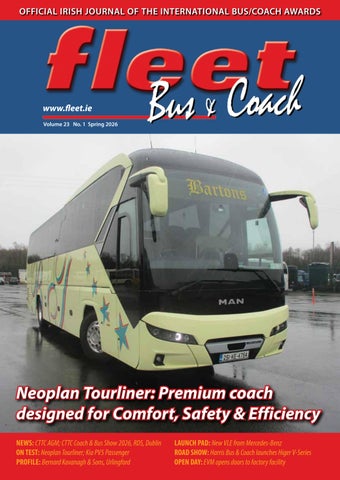
Bartons of Maynooth have been passenger transport operators and bus and coach dealers for over sixty years. The family has had a business relationship with MAN for decades, originally purchasing chassis to build coaches on. These days Bartons are buying complete, fully integral MAN Truck & Bus Neoplan coaches both for use within their own operations as well as selling to customers.
At the helm of Bartons of Maynooth is Pat Barton, someone who is well aware of the qualities of the Neoplan range, having opted both to build coach bodies on the MAN chassis as well as buy their integral coaches. While Pat explained that the company historically regularly reviewed which approach was best for them it was Covid that was to change things dramatically.
Barton’s preferred coach-builder at that time was Beulas, but with supply chains suffering major disruption, the Spanish manufacturer was unable to confirm production delivery dates or even prices for delivered units. So, it seemed timely for Bartons to look again at the importation of Neoplan coaches, the Tourliner in particular. When the first batch of twenty units arrived early in 2025, five were allocated for Bartons’ own fleet. Eighteen Tourliners have already been delivered this year, with some of these also joining the Maynooth fleet.
Neoplan Tourliner:
Ready for the long road ahead
It’s been Barton’s policy to sell off some of their own vehicles at the end of the season and replace them with new vehicles. Most of the purchasers of these coaches come as repeat customers. As Pat explained: “These people know us and the quality of our used equipment. We give a one-year warranty also and take the coach back at the end of the first year for a full service. They maintain their own vehicles after that. None of the Neoplans have filtered down that far yet, but I’d expect we will have no difficulty selling them.”
With regards to the Neoplans, Bartons order a standard Touring type specification as standard. Operators ordering a standard coach can expect a delivery time of about four months. All coaches can have a toilet fitted although it impacts on the seating configuration. Neoplan can also supply a coach with a wheelchair lift and Public Service Vehicles Accessibility Regulations (PSVAR) compliant. Some of the coaches ordered by Bartons have the bodywork prepared for the retro fitting of a wheelchair lift. It will future proof the coach if there are any changes in future regulation around wheelchair access. One of the features of the Neoplan wheelchair access design is that it does not encroach on the luggage space of the coach.
All the coaches imported so far are fitted with the traditional type mirrors, but digital mirror cams are available and will likely be fitted on future orders. All Neoplan coaches are fitted with three-point belts as standard, and are available in two lengths of 12.1m and 13.1m.
Launched in the early 2000s, almost 5,000 Tourliners have been produced to date. One of the fortes of the Tourliner is its timeless look, with each new version introducing subtle changes that freshen it up while ensuring previous models don’t look dated. Tourliners are powered by MAN’s D2676 engine that produces 440hp or 480hp and are fitted with a six-speed auto-box.
Drivers report impressive power and the software between the engine and the gearbox is well matched with none of the delay and shunt that’s associated with some coaches. Taking an example for a test drive along the M4, I can wholeheartedly confirm that this coach is solid on the road with no wandering or weaving from the rear-end. With light rain falling during our drive, we found that the large windscreen is easily cleaned by the big sweep of the wipers. Effective demisters and easily controlled air-con create a comfortable working environment for the driver and those on board. The driver’s area is compact but not too small, as everything can be reached easily, and it is not difficult to monitor the cluster. Notable also is that while some coach builders seem to compromise on the space for the tour guide, those travelling in the front of these Tourliners will be quite happy with their surroundings.
For the passengers the interior is spacious and bright. A new LED lighting concept adds a softness to the interior illumination. The entrance area is wide and there are a number of grab handles for passengers that may like some assistance in this regard. Tourliner has a feature that most drivers will like, and that is the large overhead lockers. With up to 12 cubic metres of space and little intrusion from the interior fittings, they may not be not large enough to accommodate a typical airline cabin case, but will comfortably take most ruck-sacks. The centre aisle is wide enough to allow easy access from those passing through to the rear. Around the centre door there is ample width and the entrance to the toilet area (where fitted) is wide and not difficult to access.
Bartons expect the numbers of Tourliners on the road to increase in the next few years. With full sales and service facilities available on site at the firm’s headquarters in Maynooth and further back up services available through the MAN Truck & Bus European and Irish network, operators can be reassured that the Neoplan brand is here for the long road ahead.
N EOPLAN TOURLINER
While on a factory visit in Hwaseong, South Korea, almost a year ago, right from the first drive of the new Kia PV5 light commercial, a lasting impression was felt. Although it was a near production prototype, there was enough to take in what this new arrival in the van and passenger transport sector was all about. Subsequent and longer drives at the European launch in Marbella, Spain further enhanced the experience. Now the PV5 isit’s here in Ireland and available to us on a long term test programme.
The all-electric PV5 Cargo and Passenger models are Kia’s first Commercial Vehicles to launch under the company’s Platform Beyond Vehicle (PBV) strategy, and are now on sale through Kia’s nine dedicated PBV dealers nationwide.
New PV5 is based on the brands Electric-Global Modular Platform for Service (E-GMP.S) with L2/H1 Passenger and Cargo versions available from launch, with additional variants to follow such as the CrewCab and possibly the WAV (Wheelchair Accessible Version).
‘Last November at Solutrans 2025, in Lyon, the PV5 Cargo was crowned International Van of the Year for 2026 - It was subsequently awarded a maximum 5-star Euro NCAP rating’
All versions feature a 71.2 kWh battery and 120 kW Electric motor as standard. From that comes an electric range of up to 416 kilometres and ultra-fast (up to 150 kW DC) charging capabilities, reaching 80 per cent in just 30 minutes. AC charging for home installations is also available. Peace of mind is guaranteed through a 7 year general warranty plus 8 years on the fifth
New Kia PV5 Passenger version: Talking heads
generation battery pack. Thanks to the heat pump fitted, the battery pack heats up quicker and also saves vital and valuable energy. Vehicle to Load power from the unit is an option also. Smoothness in the drive, vast spaciousness inside, high levels of visibility and ease of entry and egress are main attributes of the initial experience on board this 5-seat passenger version. Although compact in overall dimensions, the 5.5m long PV5 sits in between the C (3m2) and D (4m2) segments, therefore
creating a niche. Built on a totally new platform that’s designed and dedicated to electric mobility it allows for low floor access for both passenger transport and cargo handling, at 399 m, in fact.
It’s broad visibility is mainly due to the large glazed area, made possible by a low belt-line, reducing blind spots in an instant.
Twin side-opening doors provide super practicality and enable safe and easy access for passengers, especially children. The 60/40 dividable rear seats both recline and fold forward for extra travel comfort or load space. To keep the driver informed on vehicle performance, there’s a 7.5” digital screen behind the multi adjustable steering wheel, with the main multimedia screen, 12.9” in size covering all vehicle data and entertainment. There are three driving modes, two of which are most used from the Eco, Normal and Snow options available.
Areas for storage are plentiful, placed all around the cabin and even under the seats.
Among the generous specification included on the PV5 includes LED headlights, a digital key (accessible for up to seven
mobile phones), air conditioning, heated seats and steering wheel, front and rear parking sensors, Highway Driving Assist (HDA), Lane Keep Assist System (LKAS), 360° Surround View Monitor (SVM), Blind-spot View Monitors (BVM), electric folding mirrors and Blind-spot Collision Avoidance Assist. The PV5 Passenger is available exclusively in the K4 trim which features all these aforementioned elements including full vegan leather seats, electric tailgate and heated rear seats for a retail price of €42,550, inclusive of the SEAI grant.
Driver satisfaction is gained by the smoothness of the travel. As well as the aforementioned driving modes, battery energy regeneration is achieved through two hand toggles on the steering wheel, three levels up and three levels down with the highest number the strongest restrainer, enabling the driver to operate a one pedal system, thereby saving on brake wear. Large rear view mirrors add to the great visibility all round. As for the load area, it’s huge, sufficient to install another layer of seats, to make it an 8-seater, now there’s a thought! (Actually, there are 5/6/7 seat configurations available on the options list).
From its 2,995 mm wheelbase, it’s tight turning circle will surprise, better than others, even those in the D-segment. Indeed, PV5 has a presence on the road, eye-catching and curiosity creating. A welcome newcomer to the motoring scene, particularly the young family sector that seeks environmentally friendliness with safer, roominess and comfort all in one.
Kia will operate its PBV business from nine existing Kia dealerships that will now operate as dedicated PBV centres. These include:
n Joe Duffy North Road in Dublin 11
n Johnson & Perrott Douglas Road, County Cork
n Nyhan Motors Bandon, County Cork
n Hinchys, Garryspillane & Ennis Road, Limerick
n Edward Conway Motors, Castlebar, County Mayo
n Sheridan Waterford Ltd., County Waterford
n Newgate Motor Group in Navan, County Meath
n McElligotts Tralee Ltd., County Kerry.
Kia Ireland is continuing its upward trajectory and gaining popularity among the mainstream marketplace customer, especially with its wide electric offerings. It began the new year with sales up 5%, fifth in the brand league table, and third in the electric rankings. With sales of 261 light commercials increasing by 22% and eLCVs up 167%, all augers well for the Kia PV5 in both passenger and cargo forms.
PV5 is just the beginning of the Kia commercial vehicle journey, as later this year we will see the larger PV7, with the PV9 and PV3 to follow.
Volvo B8R MCV eVoTor – Popular choice by PSV operators
First time Volvo Bus customers Edwyn and Emily Siney from Siney Coaches (Laois) collected a new Volvo B8R MCV eVoTor 57 seater coach from Irish Commercials (Naas). The vehicle was sold through Diarmaid Thompson, Regional Account Manager in Ireland, who supports the customer as its fleet expands with a stylish, fuelefficient coach built for comfort, reliability and performance.
Another new Volvo B8R MCV eVoTor to was handed over to Kelly Travel (Limerick), which now benefits from a full-size coach offering 57 comfortable passenger seats, excellent fuel efficiency, and proven reliability. Pictured is Diarmaid Thompson and Jonathan Kelly.
Pictured is Daniel Gallagher, from Patrick Gallagher Coaches, (Donegal) the proud owner of a new B8R MCV eVoTor 53 seat executive coach, receiving the key from Diarmaid Thompson. This coach is factory painted and is the second B8R MCV eVoTor to join the business’ fleet in two years.
The first of three Volvo B8R – MCV eVoTors were recently handed over to Nolan Coaches (Dublin). This addition features 53 seats and a centre toilet. Launched in 2024, the 12.6m Volvo B8R MCV eVoTor is an affordable full-size coach, combining excellent fuel efficiency and reliability with a package offering great passenger comfort. Pictured left to right are Diarmaid Thompson, Regional Account Manager for Ireland; Adam Nolan and Garrett O’Toole, Nolan Coaches.
New EVM minibuses heading East & West
Lydon’s of Galway collected a new EVM X-Clusive Luxury Minibus. The 16 seater luxury EVM will provide bespoke, luxury tours of Ireland with Lydon’s. With saloon tables, saloon air conditioning, panoramic windows and more, this vehicle is perfectly placed to support all the touring needs.
Hill Top Treks (Dublin) has put into operation two new EVM Elegance 19 seater minibuses, shining in Arctic White. Hill Top Treks , in business for over 15 years, showcases the very best of what Ireland has to offer. This minibus provides customer comfort, safety and service as priority, with EVM Comfort Plus seating, driver benefits like Intelligent Speed Assistant, Hill Start Assist and Reversing Camera and grab handles throughout.
Wolfhound Tours (Dublin) has invested in a new 16 seater EVM minibus with saloon air conditioning, panoramic windows, large drop boot, drivers mic and much more, finished in high-tech silver.
Four new minibuses have been purchased by Vagabond Tours Ltd, (Wicklow) made up of two 4×4 Elegance minibuses and two Mercedes-Benz minibuses. These luxury units join Vagabond’s fleet, ready to provide outstanding touring services. Their unique 4x4 capabilities and exterior finishings plus high-end, interior detailing make them a stand out choice.
The V-Class is dead. Long live the VLE, to paraphrase a famous quote, with the announcement from Mercedes-Benz of the arrival of an all new people carrier, cum multi-purpose all-electric VLE that promises to mark the beginning of a new era at Mercedes-Benz Vans. The all-new electric VLE will be the first Mercedes-Benz model based on the newly developed, modular, and scalable Van Architecture.
VLE – Setting new Standards and Class for Mercedes-Benz
‘Bringing the best of two worlds together, the all-electric VLE combines limousine-like driving behaviour with MPV-like versatility’
From five to up to eight seats, the VLE portfolio will range from flexible vehicles for families and leisure active customers, to exclusive VIP shuttles. To come is the flagship VLS model line.
When at the press launch in Stuttgart, we teased what the nomenclature may stand for, the V meaning versatility (or even an homage to the outstanding V-Class), with the L, nodding to the Limousine affect and features with the E, meaning electric traction.
As added value for customers is key for Mercedes-Benz, the future VLE will suit perfectly customers’ needs and demands, in terms of design, functions and usability.
‘Van Architecture allows for a clear differentiation between privately positioned Grand Limousines – the MercedesBenz VLE and the Mercedes-Benz VLS – and commercial transporters, such as the new Vito van’
Whatever way or angle it’s viewed, the overall design is proportionately 100% in terms of its shape and size, yet deceivingly spacious inside. Dimension wise, it stands at 5,309mm tall, 1,999mm wide and 1,943 in height. It boasts low drag coefficient credentials, which at 0.25 Cd are probably the lowest ever seen in a vehicle of this size. Initially the 300 (front wheel drive) model will be marketed with a 115 and 200 kW power pack, with the 400, with 800 volt technology offering 305 kW and 4Motion all-wheel drive traction. High speed charging is a forte here. A lower powered 300 with an 80 kW battery will be added to the range next year. Mentioning range of a different nature, the range distance between each drivetrain stretches from 350 to 700 km.
Upon opening the automatic sliding doors, the rays from the panoramic roof shines through and the low sill makes for easy entry and exit. The rear tailgate has a split function with the glazed area opening separately, which is handy.
In a word the interior area is breathtaking, from the three part full length digital dash, to the luxurious seat fittings, not to mention the hi-tech infotainment offering. Dash details include
a 10.25” driver display; 14” central and passenger touch screens. Passengers will be enthralled by drop down large 31” multimedia screen in the passenger area that can accommodate the showing of movies, social media etc., as well as hosting zoom meetings at the same time, thanks to the split screen function.
A further enhancement is the 22 speaker Dolby surround sound system and that the glazed areas are automatically shaded for perfect and undisturbed viewing.
Several types of seats (slidable) can be specified from the full armchair with built in massage, along with the storage box that cools and heats food or drinks as required. Further flexibility is offered in the back in that seats from the second and third rows can be taken out to make room for bikes, surf boards, golf club sets and the like. The VLE has two separate air con systems on board for front and rear mounted passengers. Wireless charging pods are to be found all round as are storage areas and drinks bottle holders.
The front grille design differs depending on the specification and trim level, with the star emblem on the front of the bonnet replaced by the Mercedes-Benz badge with the large Star logo illuminated on the grille. Trim levels start at Standard, with two AMG types plus the Exclusive with a whole host of options.
The VLE comes as standard with extensive safety and assistance systems as well as air suspension for the ultimate driving experience, while, if required it has a towing capacity of 2.5 tonnes.
With the VLE, Mercedes-Benz will have a unique offering for passenger transport operators in the tourism sectors, especially the high end market.
In Ireland there is a growing trend for bespoke and exclusive holiday experiences with smaller groups. Some are family oriented with many overseas visitors checking out their Irish roots, while others wish to spend their leisure time on golf courses or on fishing or shooting trips.
This is where the Mercedes-Benz star shines like no other, and the new VLE fits the bill - even more so when the new VLS is launched. Although the new VLE is totally electric, there is no compromise on internal passenger or luggage space, thanks to the totally new platform.
What impressed most along with the smooth driveability was the efficiency in manoeuvring mainly thanks to the rear-axle steering and the associated more direct steering ratio on the front axle. This system seen on the Mercedes-Benz S-Class, has a steering angle on the rear axle at 7°. This reduces the curbto-curb turning circle to a tight 10.9 metres, giving the VLE a turning circle comparable with the new Mercedes-Benz CLA. In addition, thanks to the more direct steering ratio, the driver needs fewer turns of the steering wheel to make a full turn. We also had the opportunity to try out the automatic parking technology which works with amazingly cool, calculated efficiency.
Discussing the overall aerodynamic effect of the new body shell design, the issue of digital mirrors came up and the decision was made not to offer these for a few reasons. In general, digital mirrors would not be much sleeker than conventional mirrors unlike a truck or bus, and also, they would need to be constantly energised to work affectively, thereby using up some vital battery capacity of the vehicle.
Text & Photos: Jarlath Sweeney – editor@fleet.ie
For over 80 years, Bernard Kavanagh & Sons has provided public and private passenger transport from its hometown of Urlingford in County Kilkenny. Urlingford has a population of slightly over 1,000 people, but it has three substantial bus and coach operator companies, including Bernard Kavanagh & Sons, which probably makes it the town in Europe, if not the world, with the most buses per head of population. Today Bernard Kavanagh & Sons is in the hands of the second and third generations of the family, being run by Tommy Kavanagh and his sons, Bernard, Thomas and Emmett.
Bernard Kavanagh & Sons – Urlingford Co Kilkenny
*Three generations of passenger transport service excellence
The story begins in 1945, when Bernard and Johanna (affectionately known as Joanie) Kavanagh ran a small drapery shop in the town. It was just after World War II (or the Emergency as we called it in Ireland). Expanding from that retail outlet the Kavanaghs bought a bus and started a service from Urlingford to Roscrea twice a day going via Templemore and Templetuohy, one which continues to this day and is still operated from Urlingford.
Their first bus was a Bedford petrol engined 25 seater. Economically times were difficult, with the State having very little money and people less. In the early days there was little or no private hire business, and school transport did not exist.
Tommy and his two older brothers were involved in the business from an early age, taking over from their parents in 1975. However, despite handing over to the younger generation,
Bernie and Johanna remained in the background. While Bernard died in 1987, Johanna remained involved until 2015 when she passed away at the age of 97. A formidable woman, she was always available for advice and help and was well fit to spot the difference between time wasters and hard workers. Tommy tells a good story about how she dealt with an officious Revenue inspector, giving him a polite, but firm lesson in customer care.
As the business developed, the lads started to expand and develop. Matt set up his own successful business in Tipperary town and was a member of the Eirebus group. Paddy moved to Wexford, acquiring Enniscorthy Coach Company, which he ran for ten years
before returning to Urlingford. He took the lead on the development of the UK division and the expansion of Eirebus. Kavanaghs established a foothold in the UK market by founding Landtourer Coaches in Farnham and later acquiring Sunderland Coaches. These are now collectively known as Edinburgh Coach Lines, a business which is still trading. Kavanaghs also took a leading role in the formation and running of the coach operator’s cooperative, “Eirebus”. Over
Tommy Kavanagh, Matt Kavanagh and Paddy Kavanagh
time Kavanaghs bought out the shareholding of the other operators involved and established it as their Dublin Base.
In 1972, Tommy married Kate Dollard, and had three sons, Bernard, Thomas and Emmett, and a daughter Joanne. By 1980, Kavanaghs were well established, and while this was a period of reasonable prosperity in Ireland, Tommy says it was not without its challenges.
“We traded through the Gulf Wars, later Foot & Mouth disease, the financial crisis of 2009, Brexit and more recently the Covid pandemic. While we got a few bruisings over the years, we are still here. During the mid-2000s another major change saw Paddy and Tommy decide to split the company. Paddy took over Eirebus and the UK arm, with Tommy looking after the Urlingford and Cork sides of the business.
Over the years, Kavanaghs have run numerous makes and models of buses and coaches, including products from Bedford, Ford, Volvo, Scania and Mercedes-Benz. While never over critical of any brand, Tommy said there were good and not so good experiences, noting that as coaches improved and the quality of chassis improved, Kavanaghs moved with the times.
Hanging amidst many of the photographs on display in the main office at Urlingford is a plaque presented to Kavanaghs in 1995 to mark their 50th year in business. Another celebrates the delivery of their 100th Scania purchased. In the 1960s and early 70s, new coaches were out of reach for most operators, with most relying on second hand coaches for England. Having built up strong contacts with operators in the UK over time, Kavanaghs used these relationships to acquire most of their
fleet. They also were supplying other Irish operators in Ireland. For a time, the search for suitable vehicles went further afield to the old Yugoslavia and Hungary, Tommy describing some of these deals as “a learning curve”.
Today Kavanaghs operate a variety of buses and coaches, with differing specifications, sizes and configurations. Bernard noted that the market is constantly changing and evolving and operators must be ready for that. “In Dublin, we operate 30 coaches on the airport service. As part of the tender for this job all these coaches are run on HVO, to reduce emissions. On most of the Local Link services we are required to use low floor buses to improve wheelchair and general accessibility.”
Operating from four depots, Swords (Dublin), Cork, Mullingar and the main depot in Urlingford. Youngest son Emmett explained that the firm is running a substantial fleet of vehicles on various type routes and services. While each depot generally runs independently, Urlingford is the nerve centre, the place where “the bigger problems generally turn up here,” as he jokingly noted.
In Urlingford there is ample parking and a four-bay garage workshop with 10 mechanics and 4 body technicians employed. A full-time compliance manager is responsible to make sure all legal and regulatory requirements are met and a team of dedicated office staff keep the wheels in motion daily. In Urlingford the operations are run from a boardroom. Its remarkably calm and efficient, and no raised voices, remarkable for an office that handles complex queries and dynamic events.
people around Ireland, the UK and on to continental Europe. Emmett Kavanagh looks after this operation, and said that you have to listen to existing customers to try and work out where they would like to travel to next, as traveling trends change over the years.
Contract hire, rail replacement, inbound tourism, school services, town and city services are all part of the business portfolio these days.
From the Cork depot (Bernard Kavanagh & Sons Ltd acquired Barrys Coaches Ltd based in Cork in 1999), which is run by Thomas Kavanagh, three local routes are operated in the city, starting with route 200, Cobh to Cork city centre which commenced in 2018. These routes have all reached high percentage load factors.
Since 2011, the Cork operation has run the Cork – Dublin direct service which is now known as Citylink. Over the years, Kavanaghs have been involved in international transportation, providing buses for the various Euro Lines services. But Bernard stressed that sending buses far away is not as glamorous as it might seem: “In spite of being well prepared, we’ve learned some hard lessons out there.”
Over the years the profile of work the company has been engaged in has changed. Tommy reminded us that his mother was a dynamic woman and had a nose for what people wanted.
As the Irish economy started to lift in the 1960s, people could afford to travel and move out of their own operating areas a little. This was the foundation for Kavanagh Travel which operates today. In the early days they took people to Knock Shrine and events like the Dublin Spring Show in the RDS. Now the journeys are a little more adventurous, taking
When Tommy looks back over a lifetime in business, he reflected that there has been a lot of change. “For years, we were looking for more regulation and enforcement, maybe we have too much, but it puts every operator on a level playing field,” he said. “A political system that understands our business is very important; but it’s not always the case,” he said, highlighting one Transport Minister - John Wilson TD., who he described as “outstanding”.
Concluding Tommy said: “Two groups of people are key to our success, our customers and staff. We always respect both, any company that loses that focus is on borrowed time.”
Text: Sean Murtagh – sean@fleet.ie
Pictured left to right are Tommy Kavanagh’s three sonsEmmet, Thomas and Bernard
Harris Bus & CoachHIGER V-Series launch and Roadshows
Harris Bus & Coach has reinforced its ambitions for 2026 with the debut in Ireland of the new V-Series coach range developed in partnership with HIGER, the China-based manufacturer. The distributor has launched the new vehicle with a product launch combined with an extensive, customer-focused roadshow programme. Attended by Fleet Bus & Coach’s Sean Murtagh and Jarlath Sweeney
In other major news, Harris Bus & Coach is rolling-out a significant dealer network expansion in Ireland and the UK, to deliver nationwide coverage over the coming months.
Unveiled at a dedicated two-day event at the company’s Naas Road headquarters in December, the V10 and V12 low-emission diesel coaches represent a clear step forward in specification, design and market focus.
For Managing Director Willie Daniels, the timing was deliberate: “We’ve listened closely to what operators in Ireland have told us,” he said.
“They want modern, efficient coaches that meet the latest emissions and accessibility standards, but they also want proven drivelines, strong residual prospects and dependable aftersales support. The V10 and V12 bring all of that together in a package that is practical, competitively priced and ready to go straight to work.”
The 10-metre V10 seats 43 plus courier and driver, ideal for shuttle, school and mixed urban-rural work, while the 12-metre V12 offers 55 seats plus courier and driver for touring and inter-city duties. Both are paired with Cummins engines and ZF gearboxes to align the V-Series with established European drivelines and components, while both come with a wheelchair option. Updates over the previous range include a tighter turning circle, improving manoeuvrability, ride comfort and driving dynamics. A new 14-metre V14 tri-axle touring coach will join the line-up shortly, slated for launch at the CV Show in April.
Inside the focus is on a move upmarket, with two-tone diamond-stitched seats featuring lateral adjustment, fold-down tables and footrests for a business-class feel. Generous overhead storage, LED lighting and large windows enhance the cabin, while drivers get a redesigned cockpit with a digital dashboard, integrated command screen and on-board CCTV.
In the New Year, Harris Bus & Coach took the V-Series directly to operators nationwide. Two Roadshow events across January and February, stopping at nine strategic locations, brought the coaches to venues throughout Ireland, allowing customers to see the product up-close and engage with the Harris team.
“We didn’t want this to be a one-off launch,” Daniels added. “Our customers depend on their fleets every day. By bringing the V-Series to their doorstep, we’re demonstrating not just the product, but the commitment behind it. The early response, confirmed orders and strong enquiry levels give us real confidence for the year ahead.”
At the end of February, EVM invited operators to visit its assembly facility in Kilbeggan, County Westmeath where the company prepares its mini-bus models. The workshop is impressive and is the only site of its type for the adaption of passenger transport vehicles in Ireland. What stood out was the craftmanship, the automation and attention to detail involved.
Over 100 visitors came to Kilbeggan, the midland town most famous for its Distillery, to visit the EVM facility at the end of February. A significant amount of people on the guest list
were operators from all over Ireland. While most were returning customers, attendees also included some potential new customers. Those present were able to get an extensive guided tour of the assembly line, followed by a welcome Irish Breakfast and a chance to ask some questions.
On average EVM turns out 300 buses here per annum, although there have been years where this number was exceeded. All around the display area were the various models from the broad EVM portfolio.
Danny McGee, EVM’s Managing Director was pleased with the good turnout and interest from customers. Welcoming the attendees, he said: “Our very first Open Day at EVM in Ireland will be remembered as a truly special milestone — and a great
EVM host successful Open Day at Kilbeggan HQ
success. What started as a simple idea quickly gained momentum, growing into a major event complete with facility tours and hospitality for all our visitors. With over 70 registrations and more than 100 attendees on the day, we were delighted to welcome both long-standing and new customers.”
“There was also significant interest in our home-grown EVM product range, with a further four vehicle orders confirmed since the event. It was a fantastic opportunity to spend meaningful time with our customers and provide a behind-the-scenes look at how our buses are built. Feedback on the factory tours — delivered four times throughout the day by Ivor Jones, MD., EVM Vehicle Conversions — was overwhelmingly positive. We’re already looking forward to doing it again — and, as always with EVM, the next event will be even bigger and better.”
Knowing Danny, there is no doubt that will be both true and soon!
Text: Sean Murtagh – sean@fleet.ie
Darren Kealy of Kealy Coaches attended the Open Day at EVM and took delivery of a brand new AOS Visigo. Aidan is pictured with Area Sales Manager Aiden Heavin.
Cosimo Facecchia, Head of Operations at EVM UK & Ireland, explains some of the requirements and consequences of the General Safety Regulation II (GSR2), in force now and that of additional legislation to come later this year. Operators should be aware of them.
“GSR2 has fundamentally changed what ‘standard specification’ means. Operators buying new commercial vehicles today are getting technology that actively helps prevent accidents, particularly in busy urban environments where buses and minibuses operate every day.
The key is understanding what is fitted and ensuring vehicles are compliant not just for today, but for 2026 and beyond.”
From a commercial perspective, GSR2-compliant vehicles also bring:
n Lower accident risk
n Better protection for drivers and passengers
n Reduced insurance exposure
n Improved residual values as older, non-compliant vehicles age out of fleets
GSR2: What Irish bus and coach operators need to know
While much of the industry’s focus is on electrification and emissions, one of the most important regulatory changes affecting Irish fleets is already in force — and many operators are only now starting to feel its impact.
The EU’s General Safety Regulation II (GSR2) has applied to all newly registered buses, coaches, minibuses and commercial vehicles in Ireland since July 2024. Any vehicle entering service since then must meet a significantly higher safety standard than those built just a few years ago.
Some useful advice & Information about GSR2 Regulations from EVM
For fleet operators, understanding what GSR2 is — and how it affects vehicle purchasing — is now essential. What is GSR2?
GSR2 is the European Union’s framework for making vehicles more capable of preventing accidents, not just protecting occupants when one occurs. It applies to M1, M2 and M3 category vehicles, covering everything from eight-seat minibuses to full-size coaches and city buses.
The regulation requires manufacturers to fit advanced driver assistance and monitoring technology as standard on all new vehicles registered in Ireland. The aim is to reduce collisions involving vehicles, pedestrians and cyclists — particularly in the urban and mixed-traffic environments where buses and minibuses spend most of their time.
The European Commission estimates that these measures will save more than 25,000 lives and prevent over 140,000 serious injuries by 2038.
What safety systems are now standard?
Since July 2024, all new buses, coaches and minibuses registered in Ireland must include the following:
n Blind Spot Information System (BSIS)
- Warns the driver when cyclists, pedestrians or vehicles are in blind spots alongside the vehicle.
n Moving Off Information System (MOIS) - Detects people directly in front of the vehicle when pulling away from a stop — one of the highest-risk moments for urban buses.
n Intelligent Speed Assistance (ISA) –Helps the driver stay within the legal speed limit by recognising road signs and providing alerts.
n Emergency Stop Signal (ESS)Automatically activates hazard lights during heavy braking to warn traffic behind.
n Reversing Motion Detection - Detects obstacles and people behind the vehicle during reversing manoeuvres.
n Cybersecurity protection - Ensures that modern connected vehicle systems are protected against hacking and unauthorised access.
These are no longer optional extras. They are part of the base specification of any new vehicle entering an Irish fleet.
More changes are on the horizon
GSR2 is being phased in over several years. From July 2026, further systems will become mandatory for new vehicle type approvals, including:
n Driver drowsiness and attention monitoring
n Emergency lane keeping
n Alcohol interlock preparation
n Event data recorder (vehicle “black box”)
Many vehicles already offer some of these features, but from 2026 they will be a regulatory requirement — which means today’s buying decisions affect tomorrow’s compliance.
What this means for Irish operators
For fleet managers, GSR2 changes how new vehicles should be evaluated. Safety specification is no longer something that varies widely between brands or models — it is now a regulatory baseline.
What to check when buying vehicles
Although all vehicles registered from July 2024 must be GSR2-compliant, some stock vehicles built to older specifications may still be available in the market.
Operators should therefore always:
n Confirm GSR2 compliance before purchase
n Ask which safety systems are fitted as standard
n Check whether the vehicle is prepared for the 2026 phase of the regulation
This is particularly important for fleets planning long replacement cycles or operating in high-risk urban environments.
As Ireland’s transport sector continues to professionalise and decarbonise, GSR2 ensures that safety evolves alongside it — quietly, but decisively, making every journey safer.
Leading Bus & Coach brands exhibit at FIAA 2026, Madrid
The FIAA Organising Committee continues to make progress as it prepares for the forthcoming edition of the International Bus & Coach Fair, organised by IFEMA MADRID, which will be held from 22 to 24 September 2026, with the participation of some of the sector’s leading brands already confirmed.
IRIZAR, DAIMLER (Mercedes-Benz & Setra), IVECO, HIGER - MOBILITY BUS, YUTONG, INDCAR, KARSAN, TEMSA, SOLARIS, ANADOLU ISUZU, MARCOPOLO, STYLEBUS, SERVICAR, ZEROID and FORD are just some of the companies that will be participating in the next edition of FIAA, representing the entire value chain of the bus and coach sector.
FIAA is also adding more than 30 new exhibitors which will participate in the event for the first time, reinforcing the renewal and dynamism of the offer presented, and cementing confidence in this essential platform for the bus and coach in the Iberian Peninsula. The
international element of the fair has also grown, with 50% more overseas companies, confirming FIAA’s growing role as a major global platform for business, innovation and networking.
At the Organising Committee’s last meeting, the president of CONFEBÚS, Rafael Barbadillo, said: “The bus is consolidating its position as the great silent leader of sustainable mobility: it is the mode of transport that moves the most passengers in Europe and a cornerstone of territorial cohesion. This year we have also seen the boost of the new Sustainable Mobility Law, which, together with policies to promote public transport, further strengthen the role of collective transport. I invite everyone to participate in this edition, which will be particularly significant for the future of the sector.”
FIAA 2026 is cementing its position as a leading multi-sector event where the entire bus and coach industry chain will be represented, with vehicle and bus chassis manufacturers; after-sales, repair and maintenance; technology and software suppliers; mobility services and solutions; associations and the media; as well as alternative energies and sustainability, transport infrastructures and safety and accident prevention.
It is this diversity that makes it possible to generate commercial synergies, expand business opportunities and turn the fair into a real hub attracting an ever-increasing number of more qualified professionals, both from Spain and abroad.
And of course, the next edition of FIAA will host the 5th edition of the Minibus of the Year awards, bringing together the 23 members of the International Bus & Coach jury from 22 countries, consolidating the Fair as a key stage for the sector’s major milestones.
“FIAA is evolving to respond to the real needs of the sector and to consolidate its position as a strategic event for the sector at a time of transformation,” explained David Moneo, director of the Fair.
“FIAA acts as a neutral space that facilitates dialogue, knowledge sharing and access to different technological solutions so that each operator can make informed decisions. What’s more, the growing international expansion of FIAA brings new opportunities for companies in the sector and boosts their competitiveness.”
Text: Rob van Dieten – rob@fleet.ie
Speaking to passenger transport manufacturers and dealers as well as bus and coach operators over the last month or so, I get a sense of a little uncertainty, nervousness and occasionally some cautious optimism. Will confidence grow as the year goes on or will those with doubts lead to planned and cautious trading?
At one of the breaks during the Coach Tourism & Transport Council’s (CTTC) Annual General Meeting (AGM) in Wexford, news broke of the American and Israeli attack on Iran. It gave some certainty to earlier discussions that had been taking place during the meeting around fuel costs and the threat of political uncertainty in the world, and what impact it might have on the Irish economy and inbound tourism. It appeared that that the caveats mentioned in earlier discussions could now be certainties.
British politician, Austen Chamberlain in a speech made in 1936, quoting a Chinese proverb, said: “May you live in interesting times”. It was said in the context of Europe becoming increasingly unstable. We are facing some elements of a lack of stability now, but hopefully we are not facing what came after 1936. Nonetheless the last ten years have seen changes that no one expected or wanted. The impact from Brexit was slow to take hold but it’s certainly starting to take effect now as the British economy weakens and slows down. While visitor numbers may not show an adverse change yet, there are ominous signs. Fast on the heels of Brexit was Covid. People
What’s in store for 2026?
have mixed views on how they characterise that time. While many felt it allowed them to reconnect with their families and their friends, there have been some long-term negative effects. From our industry’s perspective private hire did not fully recover; inbound tourism has been slow to turnaround, and there are definite signs that the future here is a little uncertain.
While there are many events that are outside our control, others are in our brief, at least in the control of our administration. According to Eoghan O’Mara Walsh, CEO of the Irish Tourism Confederation (ITIC), the only certainty is uncertainty in the tourism sector. While he reported that most of the inbound tourism markets show a reduction of activity, his members and membership groups felt that the industry was not as negative as reported. He said his group would continue to lobby for State support and pointed out that out of every euro spent by tourists; twenty-nine cents went back into the Exchequer. Speaking to members of the CTTC at the AGM in Wexford, he pointed to the positives but cautioned about complacency. One speaker told those present that their American business for 2026 would be down on 2025.
While the sale of new coaches seems buoyant, there is a view that because of limited buying in the Covid years and limited availability in the years following, some of the purchases last year and in 2026 was and is a natural correction as operators are being forced to replace vehicles, with older buses and coaches having reached the bottom of the cycle making them redundant as school buses. One dealer told me that in spite of the fact that they had strong order books, he had a slight concern that forward orders would not materialise as sales.
He continued that for the past few years because of supply chain challenges, order lead times had gone to over twelve months in some cases and that when it came to taking delivery, some orders could be cancelled. There is a change in buying patterns in the marketplace also. As Turkish and Chinese models become more available with improved build quality, strong dealer back-up and shorter lead times in terms of delivery, some competition in pricing is likely to be seen.
Cost impacts operators in many ways. For those in the tourist sector, hotel and attraction charges are having an effect. Continental visitors have been saying this as they leave Ireland after a very enjoyable, but more expensive holiday than they expected. Costs for operators in terms of labour, parts, fuel and new vehicles have all increased in double digits. It is unlikely that these costs will ever come down, so it is necessary for some fresh thinking to try and reduce costs. Cutting and eliminating red tape is always a good suggestion but generally doesn’t happen.
It would be a brave move for the industry to try and allow operators to use school buses for up to thirty years in service and continue to keep the campaign in place to increase the age limit for school bus drivers to at least 75. There is a strong argument to support such change.
As the year progresses, we will see how the industry will fare out. My experience is that things generally do work out and often the events worried about never materialise, at least not as bad as might have been expected. Coach operators are a resilient group, and if challenges are on their way, they will survive them.
Text: Sean Murtagh – sean@fleet.ie
FUNDING SOLUTIONS
With extensive experience and knowledge across the transport industry, our team of specialists are committed to finding the right funding strategy for your business.