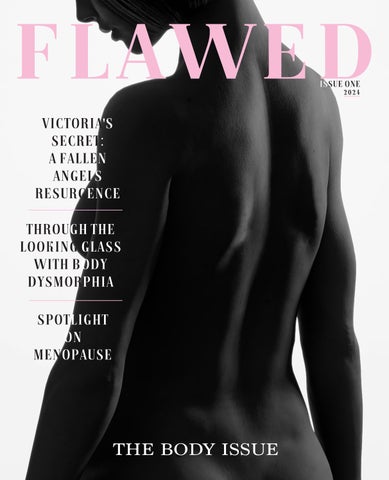
FLAWED
Victoria's secret: A fallen Angels Resurgence
Through the looking glass with Body
Dysmorphia
spotlight on menopause
![]()
Dysmorphia
Growing up in the 2000s meant that only one body type – slim – was desirable and considered pretty. Our depiction of our own reflections became distorted. So, we wanted to create a female–dominated magazine which is unfiltered. Flawed celebrates natural beauty, every body type, size and race. We hope that our readers will be able to find themselves in the magazine; and understand that the things which are considered ‘flaws’ are beautiful. They’re what unite us.
All our love,
1.On the cover
Welcome to Flawed, a magazine where all women can feel confident in their skin, lets start with ‘The Body Issue.’
2-3. From Flawed
Meet the women behind Flawed, who are here to represent all of us, no matter our shape, size or ‘flaws’.
4-5. Contents
You are reading the contents page! We’ve packed a lot into our first issue so please keep reading on, you won’t regret it.
18-21. Does this offend you?
Why do we feel offended by natural aspects of our body?
From armpit hair to cellulite, these aren’t flaws to us.
22-27. Spotlight on menopause
Menopause: Manisha Morgan, tells all: from symptoms of menopause to how young women can prepare.
28-30. Understanding my body
PCOS: Here’s what to know about your fertility and those irregular periods you may have been experiencing.
Flawed’s faves: Our pick of the best makeup, skincare and bare essentials. We hope you love them as much as we do.
10-13. Angels resurgence
Former Ann Summers model, Jordanna Vyse struts through the turbulent evolution of the lingerie industry.
15-17. Through the looking glass
Your reflection does not define you. Body image therapist, Lucie Valléé, speaks her mind on the topic.
31-33. Thyroidism: It’s not just hormones
Thyroids: We all have them but how much do we actually know about that hormone box that controls EVERYTHING?
33-35. How can I learn to love my body?
It’s hard to love your body at any age but despite self criticism, uniting is what makes women strong.
36 Mothers’ meeting podcast
Listen to the unfiltered girly chats hosted by the Flawed editors themselves.
Coming soon! #slay
As many women will know, we are constantly being shown new skincare, makeup and ‘essential’ products both online and in person. The temptation to splash our cash on the latest trends can be overwhelming. Here at Flawed, we’re no different to you and after splurging on some products, we’ve compiled a list of a few firm favourites we’re sure you’ll love just as much as we do. Find each of our ‘must haves’ right here.
Yours truly,
The Flawed girlies xx
1
MAC face and body foundation £35, L’Oréal Paris Infallible More Than Concealer £9.99, L’Oréal Paris True Match Powder Foundation £6.99, Charlotte Tilbury Airbrush Bronzer £45, Too Faced Natural Blush Pallette £40, Plouise brow balm £15, Maybeline lash sensational £9.99, Individual Lashes £9.99, Charlotte Tilbury lipstick £27.
Clinique Cleansing balm £34, Neutrogena Acne Wash
3
1460 Pascal Max Leather Platform Boots £220, PLT Jeans £31, Oliver Bonas earrings £40, Tampons £3.40,
Too Faced Natural Face Palette-
ARE YOU FOLLOWING FLAWED?
FLAWED WANTS YOU TO FOLLOW
ACCEPT DECLINE
Stage lights set. Bodies bronzed. The angels start to line up. A sea of models flood the catwalk, all perfectly toned and tall. Everyone wanted to be them, and some still do.
A resurgence of the Victoria’s Secret fashion show was in high demand since the iconic event ended in 2019. The long-awaited return was met with disappointment from longterm fans of the company. With inclusivity on the rise, should Victoria’s Secret be left in the 2000s?
From 1995 to 2019, the Victoria’s Secret fashion show was a runway held by the most popular lingerie brand of Y2K. Kendall Jenner and Bella Hadid were amongst the arsenal of models who promoted ‘VS’ lingerie on the main stage. Musicians such as Taylor Swift and Harry Styles, were a few of the accompanying artists for the live events.
We spoke to former lingerie model, Jordanna Vyse, about her experience in the ever-evolving underwear industry. The 26-yearold was modelling for seven years from the age of sixteen, and described her newfound empowerment as a fresh face in the modelling world. “It made me feel more confident.”
always had good music playing, and sets made you feel confident, they would never make you do anything you felt uncomfortable with.”
Things weren’t always glamourous for the young model; Vyse was happy to reveal her realistic work routine. “It’s not always as a fun as it seems… you’ll go all the way down to London for 10 minutes and you walk into a room full of people who look just like you.” Although Vyse chose to model alongside her fulltime career, she highlights the instability of income. “Whilst the pay can be very good, they can take up to 90 days to pay… I always worked full time anyway, but a lot of girls weren’t sure how they were going to pay rent that month.”
“you walk into a room full of people who look just like you.”
The anticipated revival of the fashion show came to fruition on the big screen. Victoria’s Secret: The Tour 23, was a documentary style project to showcase creatives around the world on behalf of Victoria’s Secret. Fans were met with disappointment when they realised it wasn’t the production they remember.
Vyse, ‘sang the praises’ of Ann Summers for the prominence of women she worked with. “Ann Summers especially are quite a female-led team, so apart from a male photographer, generally it would be just a massive group of women.” After signing with her agency at ninteen, Vyse said that the environment whilst on set, was always uplifting and safe. “We
The Victoria’s Secret brand undoubtedly set an unrealistic standard for women in the early 2000s. With the promotion of tall, slim models with near symmetrical dimensions, it was almost impossible to obtain this ‘look’ for the women watching. Vyse spoke about the expectations she was met with when trying to broaden her experience in the industry.
When the young model travelled to Manchester for a casting with an Italian agency, she encountered the impact of beauty standards.
“I knew instantly this wasn’t going to go well, I won’t be thin enough for them, and I was about a size 8… When I was being measured up, I got asked if my hips were always like this and I was informed, they were too big.” This isn’t the only criticism Vyse had faced during her time as a model, she elaborated on some of the comments she had noticed on the official Ann Summers Instagram. “I always used to get a lot of comments like, ‘she needs to eat a burger’, ‘does she ever even eat.’” Being a model requires you to be prepared for constant judgement of your physique, which isn’t unusual for all women.
As the lingerie world was changing, so were the models that were being hired. “I could see it was changing a lot, the modelling work was going to a more petite girls.” The prevalence of inclusivity began to mould the models that were being chosen for campaigns. “I don’t know if it was that my agency changed, but I would definitely say they started off wanting tall, slim kind of girls and then it went to a lot more petite, very curvy girls. It’s great that there was such a huge range of different models, in terms of ability, genders, ages, etc.
It then went to a lot of like filler, and boob jobs and you know that’s not what I look like. It just isn’t me.”
“It’s a funny old world, modelling is.” Vyse acknowledged the positive change in demand for inclusivity in the industry. “People expect to see different ranges now. They don’t want to see everyone else looking the exact same. If I look at who’s on my agency now, it’s so diverse which is incredible and as someone now who organises campaigns, that’s exactly what I want to see. I want to see clothing on different girls.”
The Victoria’s Secret resurgence was a clear display of the shift the lingerie world has seen. It might not have been the Y2K extravaganza everyone remembers, with inclusivity on the rise it was necessary for the brand to update its wardrobe. “You can never please everyone can you?”
About 1 in 7 women are diagnosed with Breast Cancer during their lifetime.
Touch- feel for a lump or other changes Look- for changes in shape and texture Check- with your GP if you find any changes
Written & Designed by Ella Gardner
Bodies. We all have them, so why do we spend all of our time obsessing over the way they look? “Don’t waste your life’s purpose worrying about your body, it’s your vessel, it’s your home there’s no point in judging it,” says British actor, Emma Thompson. Yet here we are still experimenting with crazy diets, spending our free evenings in the gym, and fixating over the size of our jeans in an attempt to change our appearance.
It’s time to break the cycle. Lucie Valléé, a 30-year-old Body Image Therapist has been on a healing journey from the age of seventeen.
A recent study from the Body Dysmorphic Foundation revealed that 2% of the population suffer with the disorder. So, what is this body dysmorphia? Lucie says: “It’s a mental health condition in which a person spends a lot of time worrying about their flaws, and those flaws are often unnoticeable for other people. “It can affect their life in many aspects: work, social life, and relationships. Symptoms include comparing yourself a lot to other people and spending time thinking about your appearance, to an extent where it interferes with your ability to live normally”. Compared to the average human being, an individual with signs of body dysmorphia often has extreme fluctuations with their body image.
If you need advice on body dysmorphia, please visit:
- www.beateatingdisorders.org.uk
- bddfoundation.org/support/online-support-groups
“One day you see yourself as just worthless,
“Your worth as a human being is always attached to what you see in the mirror. I would argue that it affects more than 2% of the population. I think not everyone gets a diagnosis because you have to go to a doctor to talk about it and put yourself through a process that in your mind, you find hard to justify,” she says.
Whether you or someone you know is experiencing this mentality (or you’re just discovering it) body dysmorphia is still on the rise. “The average woman is dissatisfied with their body, and that’s how the media portray the ‘ideal female body’,” says Lucie. “If you look at movies or TV shows, you always see a little joke about a woman who’s like, ‘Oh I can’t have that dessert now because I’m looking at my weight.’ So, it’s very normalised.”
The effects of social media and body dysmorphia:
So, where is this negativity about our bodies coming from? Lucies’ guess: social media. “Social media typically shows only one ‘ideal’ shape and colour of a man and woman’s body, and then the steps for how to achieve that look in order to feel good about ourselves.
“After consuming this false information, people internalise the idea, and this can happen at a very young age. There have been studies showing sixyear-olds beginning diets in order to live up to these unrealistic expectations.” It comes as no surprise that this toxic media consumption starts at the beginning of our lives.
“The first cartoons I watched were The Little Mermaid and all those Disney classics. What I got from it was that Ariel is very thin, very white, and she has beautiful skin. So, if I want to get a Prince, I should look the same - this is still happening right now.
have this very strict schedule for exercising, I believe it’s solely down to the influence of social media.”
Despite the healthy inspiration pouring out of the media, the pressure to look strong, toned or to attain noticeable attributes is damaging a lot of young people’s perceptions on accepting their natural body frame.
"In reality no one is perfect, everyone has flaws and insecurities."
“What we look at on Instagram, TikTok, Snapchat, Twitter, Facebook, where you see pretty girls that are with their boyfriends who are talking about whatever ‘inspirational’ thing, is just the modern version of The Little Mermaid. It’s the same narrative over and over”. Even within the ‘healthy’ social media trends, body dysmorphia is still more apparent than ever.
“I see this gym culture more and more and I see that more men are being diagnosed with body dysmorphia or eating disorders. Today I see so many women and men who will count their calories, eat protein, you know, be mindful of their intakes. They
Lucie’s advice provides a new glimpse of hope for those who are currently struggling: “I would say, learn the difference between social media’s beauty standards and the real world. In reality no one is perfect, and everyone has their own flaws and insecurities which is only recognised by themselves – not the rest of the world.
“I believe practising ‘body work’ is very important to feeling that your body is great because it can provide you with the ability to laugh and interact with others –it’s pleasurable to just move around and feel alive.”
Perhaps it’s time to cut out the social media crap and take Lucie’s advice. “We need to erase the stigma around going to therapy and make it something that people see as an opportunity to heal from the effects of social media surrounding body image. It doesn’t mean that you’re crazy, it means you need some time to work on yourself.”
Delve into the reality of womanhood through raw and honest photography. We live in a digitally-dominated world, where photoshop is the norm. These images are beautifully flawed: they’re what unites us
Menopause expert, Manisha Morgan, tells all: from symptoms of menopause to how young women can prepare for ‘the change’
written & designed by
Lily-May Broadheads women, we will all experience the menopause at some point in our life – preparation is key. Manisha Morgan, 53, is a personal trainer, nutritionist, and mother to twins, with a large following on social media. She covers topics such as nutritional health, fitness, and menopause, hoping to educate younger and older women on how to deal with ‘the change’. Some women describe menopause as feeling like ‘death has knocked on their door’, but not Manisha. Here, she gives a realistic but optimistic outlook on menopause from her professional and personal experience.
“The menopause is when your reproductive cycle comes to an end. It’s when a woman runs out of eggs and that could happen at any age. It could also be brought on by surgical procedures as well, which is why younger women can go through menopause as early as their 20s or 30s. For most women it will be when their eggs run out. This typically happens around their 40s.”
There are three stages of the menopause: Perimenopause, Menopause and Post-menopause.
Perimenopause occurs before menopause. Menopause is defined as 12 consecutive months of having no period. Post menopause is the time after menopause. “During perimenopause you can still have periods, but they may become more irregular, and the flow can become irregular – both of those happened to me. I have endometriosis, so my periods were very light and always on time. One of the first changes that I experienced was that I started getting very heavy periods and I couldn’t walk for ten minutes without having to go and change my tampon or pad.”
lack of information on menopausal symptoms and gives young readers clear advice, “I’d say to any young girl reading this, take care of your teeth.”
Another uncommon symptom of perimenopause is dry eyes, when a person’s tear duct becomes blocked causing water to develop. “Every time I went outside, and it was cold weather, my eyes started watering.
The most common symptoms of perimenopause/menopause are:
- Hot flashes
- Anxiety
- Depression
- Change of period cycle
She describes her experience being perimenopausal optimistically and explores the uncommon (but very existent) symptoms. “I had a few sleepless nights but nothing which impacted me majorly – I kind of breezed through perimenopause, but everybody is different. However, I did have bleeding gums.” Manisha was on the verge of having gum disease due to
- Palpitations
- Weight gain
- Infection
- Itchy ears
“The issue with the professionals is that not everybody acknowledges that certain problems women seek help for, are linked to being a symptom of menopause. One of the first things that a professional should ask a woman of a typical age is, if they are experiencing perimenopause.”
She goes on to explain that if it wasn’t for her masseur being a qualified physiotherapist, the pain she was feeling would have gone undiagnosed. “I had back pain which moved from my back down to my bum. My masseur said ‘You have Gluteal Tendinopthy’.” Due to Manisha being a personal trainer, her back pain caused her to take time away from the gym. “I must have gone back to lifting heavy weights a little bit earlier than I should have done, which then aggravated my tendons, which is what Gluteal Tendinopathy is.”
Even though Manisha eats well and exercises because of her profession, she still experiences symptoms. “Since becoming postmenopausal I eat and exercise much better now, yet I still experience some symptoms. When you start entering your 40s, you need to start to really be in tune with the types of symptoms you are experiencing and with what’s going on in your body. Last year was a bit of a tough year for me really.”
As a nutritionist, Manisha is aware of foods which can be beneficial to your body’s health when experiencing menopause. “There are three food groups which are protein, carbohydrates, and healthy fats, and all three are important. We have been brought up with a lot of mixed messages about what we should be doing.”
She explains that women’s mindsets on certain foods have become distorted. “When you become older, it’s hard to change your mindset around certain things – I still have to tell ladies that they need to eat carbohydrates. But there’s a difference between eating rice and eating a bar of chocolate.”
However, she is aware that when you enter menopause, our eating habits need to adapt. “Let’s face it, we would rather have a bag of chips or something like that, but we do need to change our eating habits. Fibre, which is part of carbohydrates are essential and then all your healthy fats like olive oil, avocado seeds and nuts are very important.”
In her opinion she says that proteins are “absolutely essential” and that “everybody needs it, especially as you get older, you need more protein.” This is due to a long-term effect menopause can cause - Sarcopenia.
“Sarcopenia is when you begin to lose muscle mass. This does happen to everybody as you get older, however, it gradually declines at a much faster rate when you hit menopause.” She jokes and makes a correlation between eating well and the importance of utilising the gym. “If you want to wipe your own bum when you’re older you need to start eating well and doing exercises. Otherwise, someone else will have to wipe it for you.”
Manisha makes no apologies for advocating strength training. “Osteoporosis is when your bones become brittle and weak. It is extremely important. Two ways that you can minimize that is through strength training at least three times a week and eating more protein.”
Once a woman enters menopause, they are six times more likely to die of a heart attack in comparison to a man. This is due to a woman’s oestrogen levels dropping (the hormone which is responsible for lowering your cholesterol levels) when she enters menopause. Manisha says that, “If the levels aren’t controlled, it can rise and potentially lead to blockages of arteries - a balanced diet is compulsory.”
As a vegetarian, Manisha gives some insight into how she receives certain vitamins which are found only in animal products. “Oily fish basically contains something called DHA EPA. You can only get that from all your fish, so even if you are a meat eater, you might not eat oily fish two to three times a week; If you are vegetarian or vegan then you will need to have a supplement of Omega-3, but you will need quite a high dose. That is not the same as cod liver oil, krill oil, fish oil, chia seeds or flax seeds.” Omega 3 is high in EPA, DHA and magnesium, and are all beneficial to take because most women won’t receive enough through their diet. Manisha explains that by taking these it can “help women with sleep and relaxing their muslces.”
Her social media pages have gained a high volume of following, therefore promotional videos are inevitable. However, she says her opinion on promoting supplements for menopausal symptoms. “As a nutritionist, trust me, every day I must get at least one email asking me to promote a menopause supplement, and I don’t support any of them because most of the time they don’t have enough of the dosage. A lot of these multivitamins, for menopause, don’t have enough of the ingredients
that you need and everything else is neither here nor there. You can get that just from eating the right foods.”
“Food always comes first. If you’ve got a vitamin C tablet versus an orange, an orange is always better. It’s going to keep you full and you’re going to get lots more out of that orange than you are from Just the vitamin C tablet.”
“When I was thirty, I used to work for a pharmaceutical company and the first drug I sold was HRT - I didn’t remember anything about it because the awareness wasn’t there. When you’re young, you can’t see that far ahead. We didn’t see our mums go through it because they weren’t aware of what they were experiencing.” She gives younger women advice on menopause. “Please don’t ignore it. Your generation have access to all of this information - don’t ignore it. Don’t do it for your twenty-yearold self, do it for yourself when you’re sixty because I need people to know that just because you eat well, just because you exercise, just because you do everything, you’re not immune. You are not immune from anything that can happen to you.”
She gives a hopeful outlook on ‘the change’, aiming to shine postivity on the matter. “So many women say ‘death is at its door. What’s the point of carrying on? Life is over.’
But I also show people the other side of menopause. I qualified as a nutritionist, I qualified as a personal trainer at 51 and I set up my own business when I was 50. These are the positive things that can happen, but only you can make that change. It can be shit, but you have the power and the control to change that. It’s the best years of your life. I am genuinely living my best life. Life does not need to end for me just because my reproductive system stopped. Life definitely began at menopause. It is the second phase of your life.”
"Life does not need to end for me just because my reproductive system stopped.”
Idon’t understand my body. I have Polycystic Ovarian Syndrome. Navigating a diagnosis can be intimidating to understand, Polycystic Ovarian Syndrome, also known as PCOS, is a leading cause of infertility in women. So why do I know nothing about it?
Polycystic Ovarian Syndrome is a hormonal condition and it’s related to abnormal hormone levels in the body. The World Health Organisation released statistics that found 70% of women effected will remain undiagnosed.
There is a selection of defining moments as a teenage girl diagnosed with PCOS, that I can clearly recall. I decided to go to the doctors because of the irregularity of my periods. I wasn’t sexually active at the time, so I knew I wasn’t going to be blessed with a pleasant surprise - but I did know something wasn’t right.
The beginning
I was in bed one morning in anticipation of my mundane retail job, when a wave of nausea started to drown me - as someone with emetophobia, this was unpleasant and unusual. I felt severe discomfort in my stomach. The same evening, I had a visit from my period
which had been kind enough to stop by after 3 months. That particular period was the catalyst of my PCOS journey. I booked an appointment with the doctor’s, after a consultation and a physical examination, they began further investigations. I had blood tests, internal and external ultrasounds. None of these were particularly unpleasant (except for the desperation to use the bathroom after drinking 2 litres of water in preparation). I was prescribed Mefenamic Acid and Mebeverine for the pain whilst investigations continued. The result of this testing arrived shortly after, and I was anticipating the conclusion of these investigations.
vividly speaking to my doctor, who informed me that I have Polycystic Ovarian Syndrome. As a 16-year-old girl this didn’t mean a lot to me. It was only when she delved into the importance of the regularity of my periods and the potential need to place me on the pill if I wanted children, that any of this resonated. I was sat silently in the car park before relaying this to my mum and then having to rush to work. That was it.
There was owhere to find help or navigate my diagnosis. The thought of not being able to carry a child had never crossed my mind - if anything, my aim at sixteen was the opposite.
“I’m not sure I have ever truly acknowledged my diagnosis”
I’m not sure I have ever truly acknowledged my diagnosis; I don’t actively avoid content related to it, but I lack a drive to understand my body better because of the education accessible to me. The severity of PCOS wasn’t highlighted to me, which I think is reflected in my avoidant behaviour when it comes to handling the reality of my diagnosis. I don’t fit the typical list of physical symptoms, which makes having PCOS easier to ignore.
On my arrival to work, I hurriedly answered my phone without time to regard who was ringing me. I remember
Symptoms that present physically in someone with PCOS can range from, excessive hair growth - also known as hirsutism.
Other symptoms include: significant weight gain, acne, and hair loss. There is a prevalent stigma around individuals with PCOS because of the accompanying symptoms.
Not all symptoms are visible. PCOS can lead to irregular or no periods at all which coincides with the difficulty of getting pregnant due to irregular or no ovulation.
There is no cure for PCOS, however there is a way to manage your symptoms. The information available on the
previously mentioned.
Polycystic Ovarian Syndrome is a health problem that affects one in ten women who are of childbearing age. As a now 20-year-old woman who has been aware of my PCOS for four years, I found this statistic surprising. There is such a loud silence when PCOS is the topic of conversation. I think higher rates of diagnosis and a reduced stigma could benefit educational resources for women with PCOS.
I would be lying if I said the thought of not being able to have children didn’t scare or upset me. That’s not the way I choose to think, maybe I am delusional in a lot of aspects of my life but seeing success stories, like Mettisse Campbell - an influencer who has shared her pregnancy journey as a woman with PCOS - validates my positivity. Her content is honest but a joy to witness.
I’m not sure I will every fully understand Polycystic Ovarian Syndrome. But I’m trying to understand my body.
”PCOS affects 1 in 10 women who are of child bearing age”
A glance into the world of the female thyroid, from Helen Bragg, a woman who’s embraced the hormone hell
Written & designed by Ella Gardner
“When I went to the doctor after I had my first child they said, ‘You’ve just had a baby, it always takes a long time to lose the weight after having a baby, there’s nothing wrong with you. Just stop breastfeeding and go on a diet.’” This was the first piece of medical advice Helen Bragg, 52, received since recognising her symptoms might be linked to Hypothyroidism. Nestled in the intricate web of our hormonal system, the thyroid gland plays a pivotal role in regulating metabolism, energy levels, and overall bodily functions. However, if the balance is interrupted, then all hell can break loose and lead to detrimental health effects.
Often mistaken for depression or stress, hypothyroidism (known as underactive thyroid) can be seen to have contrasting effects.Symptoms can range from: weight gain, sensitivity to the cold, tiredness, depression, loss of libido, dry and scaly hair, brittle nails, irregular periods and even slow thoughts and movements. Having battled
”They told me to stop breastfeeding and go on a diet.”
with the temperamental symptoms from her mid-twenties through to the birth of her first child at the age of thirty two, Helen booked herself a blood test. “The results came back with chronic hypothyroidism; my levels were off the scale, and they treated it as an emergency situation. They had to give me the highest dose of drugs they could give me, for six months, to try and kickstart my thyroid.”
Testing for thyroid requires you to know your TSH, T3 and T4 levels to determine whether your thyroid is ‘normal’ or not. Despite the NHS offering blood tests on TSH levels, they do not usually test for T3 or T4 due to lack of finance. T3 represents the hormone triiodothyronine, whilst T4 represents the hormone Thyroxine – both are vital for a women’s thyroid to work efficiently and maintain a regulated hormonal balance and bodily function.
Thyroid disease has two primary types: Hyperthyroidism (also known as overactive thyroid), where one’s metabolism is too fast resulting in too higher energy levels, sensitivity to heat, difficulty sleeping, heart palpitations, and increased nervousness anxiety.
Low levels of thyroid-producing hormones such as T3 and T4, can change the way the body processes fat, which explains why weight gain is a primary symptom in an underactive thyroid and weight loss in an overactive thyroid. “If you have an underactive thyroid, you take something called thyroxine, which is a synthetic hormone which
replaces what your body is not producing – I take 150 micro grams a day which is quite high, and it changes every six months when I have a blood test”.
One in 20 people in the UK have a thyroid problem, with women six times more likely to suffer from the condition more than men. If an underactive thyroid isn’t treated, then symptoms can lead to a low pitched and hoarse voice, thinned or partly missing eyebrows, a puffy looking face, a slow heart rate, hearing loss and even anaemia.
Nevertheless, there is plenty of information available at our fingertips as Helen explains: “There’s the British Thyroid Association, they have a good website. So, the information is definitely out there and if you present with the usual symptoms, your doctor should suggest that you get tested”.
The British Thyroid Association offers support for those who have recently been diagnosed and for those who need support with their thyroid condition. The website gives advice on how to live with your thyroid, drugs/medicine updates and support groups.
With active research still being recorded I asked Helen whether she believes if birth control can affect one’s thyroid. “I don’t know how much research has been done between contraception and whether that has an effect on your thyroid.
I had a coil fitted after my second child, when my son was born, and my body didn’t like it.
If you need professional advice please visit:
www.British-Thyroid Association.org
www.btf-thyroid.org
British Thyroid Foundation
“I think that was because the coil was giving me progesterone – it was a marina coil so that included hormones and I realised I couldn’t have additional progesterone in my system as it didn’t agree with me.” It’s known that long-term use of hormonal birth control (ten years plus) can increase your chances of acquiring hypothyroidism according to VeryWell Health, an online health website.
“Even though I still have some bad days with my hypothyroidism, I’m living my best life. I’m based in Devon with my two dogs, I have a very supportive partner, a stable job, and I’m enjoying feeling good in my own skin,” says Helen. Speaking to Helen about her journey, it’s clear that with the right treatment and lifestyle adjustments, both men and women can reclaim vitality and wellbeing. Through the right education and support, this condition becomes not a barrier, but a manageable aspect of a wholesome and fulfilling life whilst adopting resilience and a fresh sense of optimism.
I don't think loving your body can be described as something you can learn to love. I think self love comes with a lot of compromises, and I don’t think anyone truly loves everything about their body. Social media makes it almost impossible to feel comfortable in your own skin because of the constant comparing and feeling like you need to look like others you see online. I think self love, is mostly just fake confidence. I think the only way to love your body is to accept you for you and therefore embrace yourself everyday. Dancing in the mirror also helps.
Your body is only one part of you and probably in some ways you will have no control over it. look at your positives and be grateful. More importantly look at yourself as a whole and be kind, considerate,,respectful to everyone- especially yourself and all your beauty will shine xx
It can be hard to love your body in this age of scrunity and social media. We asked women of different ages to answer the question: How can I learn to love my body?
For me, it’s learning that it will change and however it changes, you have to accept it and that’s the hardest part; especially when you have children, your body changes massively, but it’s about accepting it. wheatever shape or size you are, theres no specific thing that can be defined as perfect, being different than the social norm is beautiful.