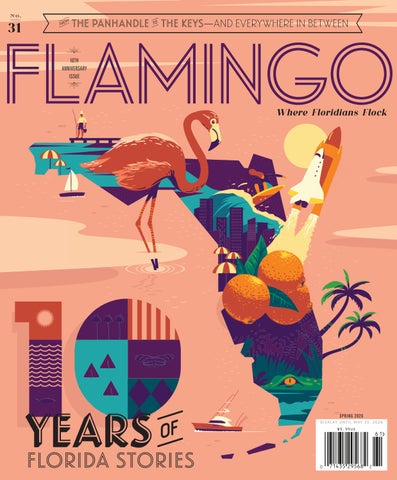
Spring 2026 10th Anniversary Issue

Page 1


Glide into a side of The Florida Keys few ever see. A seaplane tour lifts you above turquoise shallows and secret sandbars. Then it’s barefoot beach strolls, reef dives, mangrove paddles and moonlit dinners. In The Florida Keys, the days blur in all the best ways until you’re not just on vacation. You’re somewhere that stays with you.

VisitFloridaKeys.com 1.800.Fla-Keys

There’s no greater escape.

ELEVATE YOUR ADVENTURE IN THE Florida Keys & Key West

Singular regional experiences define the allure of island life.

The Art of the Catch >

Fishing in The Florida Keys spans open water, quiet flats and generations of maritime tradition. With access to the Atlantic, the Gulf and the backcountry, anglers can cast for everything from bonefish to sailfish. Trips balance exhilaration with stillness, earning the island chain a reputation as one of the world’s most iconic and premier fishing destinations.

Below the Surface >

< Dining by the Tide

Diving in The Florida Keys welcomes travelers into a luminous underwater world shaped by coral gardens, historic shipwrecks and spectacular turquoise waters. Home to the only living coral barrier reef in the continental U.S., the region offers warm temperatures year-round, clear visibility and an inviting experience for both new and seasoned divers.

For more travel inspiration, go to visitfloridakeys.com.

Keys is a journey that encourages connection, exploration and relaxation. Days unfold with boat rides, bike paths, beach sunsets and more. With tranquil waters, abundant wildlife and an emphasis on outdoor adventure, The Keys inspire shared discovery, where treasured moments form naturally, framed by limitless skies and sunshine.

Food and beverage in The Florida Keys deliver elevated island dining rooted in freshness. Seafood takes center stage at refined, chef-driven restaurants that balance simplicity with sophistication, paired perfectly with Caribbean- and Latin-inspired flavors, sunset views and a vibrant yet unhurried pace.

A plant palette like no other

Where tropical beauty is always in bloom

The Garden bursts into color with ChromaFlora, January 24 – May 25. See all that’s in store at SUPPORTED BY

Spring Blooms Brighter

The spring lineup at Naples Botanical Garden brings vivid exhibitions, one of Florida’s biggest flower shows and a beer garden under the stars.

Springtime in Southwest Florida means vibrant blooms, sunny skies and idyllic temperatures made for lingering outdoors. There’s no better place to soak in this time of year than at Naples Botanical Garden, a 170-acre tropical oasis celebrating its most colorful season yet. From immersive exhibitions to hands-on explorations of nature’s palette—and even the science behind the plants that end up in your pint glass—there’s something to inspire every visitor. Whether you’re here to learn, wander or simply bask in the botanics, you’ll leave feeling energized and reconnected to the living world around you.

ChromaFlora

Ever wonder why a hibiscus blooms red or a palm frond looks so deeply green? “ChromaFlora” answers that question by turning the Garden into a living painter’s palette, Jan. 24–May 25. Designed by the Garden’s own horticulturists and education specialists, this exhibition organizes plants by color to reveal the science behind natural hues, like how flavonoids produce blues and violets. Grab your smartphone for a self-guided

tour with video explanations as you stroll. The exhibition looks completely different depending on when you visit, too. Explore the grounds during extended evening hours on Wednesdays and Fridays (February through April) to see how golden hour transforms the Garden.

Naples Flower Show & Garden Market

Mark your calendar for Southwest Florida’s premier juried flower show. On March 13–14, Kapnick Hall comes alive with dramatic floral arrangements, styled table settings and botanical photography. This year’s theme, “Under the Big Top,” brings a playful circus-inspired twist to designs from dozens of exhibitors, many from the show’s partner, Naples Garden Club. Shop orchid purveyors, succulent stands, jewelry artisans and home decor boutiques at the

garden market. Friday night’s extended hours until 8 p.m. mean you can shop, stroll and catch live music as the sun sets over the Garden.

Blooms & Brews

Raise a glass to the hops and botanicals that make your favorite brews possible. The annual beer-tasting celebration on April 11 brings in regional microbreweries for an evening of imbibing, which includes beer samples, live music and watching the sky shift from sunset to starlight. Pro tip: pace yourself and come hungry. Fogg Café, with its famous Fogg burger, will be joined by local food trucks on-site, offering plenty of tasty bites for purchase to round out the evening. Just remember your ID— this one’s 21 and older only. Tickets go on sale in March, but book ahead to beat the sellout.

From top: A ground orchid, Spathoglottis kimballiana, blooms at Naples Botanical Garden; visitors wander through Blooms & Brews.

Features Contents

58 Behind the Stories: A Decade of Our Best Flamingo has been publishing Florida’s greatest stories since 2016. From cowboys and boy bands to oystermen and python hunters, we’ve rounded up the features that have helped define us over the last 10 years.

68

The MagLab Did It Again

Can Tallahassee’s acclaimed MagLab control the weather? We find out the answer to that question and what some of the nation’s leading scientists are really up to at the largest magnet lab in the world.

78

Tending the Fires

Come with us to tend the fire, roll the dough and stir the stew as we explore Native American cooking techniques. We head south and dive into the culinary culture on Florida’s reservations and beyond.

88

The Culture Keepers of Florida

Soar into space, hit epic guitar riffs, dance alongside Beyoncé and fight for the wild side with these 10 people protecting the cultural fabric and precious ecosystems for generations of future Floridians.

Departments

18 / FLOCKTAILS

This Florida-made libation isn’t your papa’s paw-paw.

23 / GOOD SPORT

Bait and wait for the bass to bite at these captain-approved fishing spots.

25 / NATIVE

This clever orchid was once stolen from swamps en mass. Now, it’s almost gone.

27 / MY FLORIDA

A photographer captures what it means to grow up as a wild child in the Sunshine State.

33 / MADE IN FLA

Gatorade was a lightning-strike moment in the world of sports hydration.

38 / PLUME

Lauren Groff takes us to Florida’s most notorious mental hospital.

40 / STUDIO

Miami-based textile artist Kandy G Lopez is a dream weaver.

47 / SOUNDCHECK

Southern rock is in good hands with Devon Allman and Duane Betts.

50 / JUST HATCHED

Haberdasheries, honky-tonks, handroll sushi bars and other new openings

101 / GROVE STAND

Meet the father-daughter duo bringing elevated Middle Eastern to Jacksonville.

106 / STONE’S THROW

Board the world’s biggest cruise ship and forget everything you thought you knew.

112 / BIRD’S-EYE VIEW

Our St. Augustine travel guide cuts the kitsch and serves up the Old City’s best.

115 / TIDE

A season of to-dos in the sea, on the shore and 60 feet deep in the springs

120 / FLORIDIANA

The story of Tupperware took off from the comforts of one woman’s living room.

Columns

55 / CAPITAL DAME

By Diane Roberts

Sex, drugs and some rockin’ reporting were staples at this formative college paper.

98 / PANHANDLING

By Prissy Elrod

While on an anniversary retreat, this writer gets a massage she wasn’t expecting.

24 / FLORIDA WILD

By Carlton Ward Jr.

This wildlife photographer has a whale of a good time with the largest shark in the world.

Cover illustration by KIKO RODRÍGUEZ

On the cover: An homage to the places and pastimes that make Florida the great state that we love

This page: Two white ibises perched on top of a chickee on the Miccosukee reservation

Photography by: Sonya Revell

Ten years have passed since we ran a story titled “Where Have All the Oysters Gone?” in Flamingo’s first issue. The piece laid out the dynamics of the “water war” between Florida and Georgia, warned of unstable salinity in Apalachicola Bay and chronicled the imminent threat to its natural oysters—a once-abundant delicacy harvested for two centuries. To this day, it remains one of my favorite Flamingo stories, not only for its beautiful reporting and writing, but also for the stunning portraits of the oystermen.

That story marked the beginning of a decade of covering the Forgotten Coast and its bivalves. We’ve followed the collapse of commercial harvesting in Apalachicola Bay, the rise of innovative oyster farmers, the regeneration of natural reefs and the reopening of a short harvest season in January 2026. It’s been a hardfought chapter in the life of a Florida icon— one that at times felt defeated, only to rise again a decade later.

To me, the Apalachicola oyster is the perfect Flamingo story. It’s a combination

10 Years

of roots, ruin and redemption that cracks open a niche Florida culture, emblematic and overlooked, and transports readers to a corner of the state they might never have gone without us to take them there.

Like the bay, Flamingo has waded through its own briny waters to arrive here stronger. There were moments of uncertainty, a pandemic that nearly shuttered us and lessons learned. But the work always pulled us forward. Good times and a steadfast focus on our mission to unify the state and create the destination for Florida’s greatest stories kept us determined.

At the heart of it all is an extraordinary community of designers, editors, writers, photographers, illustrators, advertising partners and readers who believe excellent storytelling matters and that Florida is worth honoring. This milestone is shaped by countless creative hands and curious minds who have built Flamingo into what it is today: Florida’s Magazine of the Year.

For those new to the flock—and for our day-one loyalists—inside this issue, we’ve assembled a collection of our favorite features from the past decade, offering a behind-the-scenes look at how these stories came to life through the perspectives of the Flamingo contributors and staff who created them. From there, we head south down Alligator Alley to the Miccosukee reservation, where we meet a woman preserving Native American cooking traditions and examine the history of Native foods. We geek out on physics at the MagLab, putting a long-standing hurricane myth to the test. We introduce 10

figures helping preserve Florida’s cultural fabric and ecosystems, from astronauts and activists to folk artists and fishing guides. We sit down with Southern rock royalty Devon Allman and Duane Betts, break bread with a father-daughter duo elevating Jacksonville’s dining scene and revisit iconic Florida inventions, from Gatorade to Tupperware. It’s a best-of lineup—celebrated names alongside littleknown warriors—each shaping the state.

You may also notice that things feel a bit different inside. In honor of our 10th anniversary, Vol. 31 is arriving with a refreshed look, starting with our first-ever illustrated cover. The refresh leans into our signature Art Deco aesthetic while embracing a more modern design that lets the stories shine. Two new departments join the mix: Native, spotlighting indigenous plants and animals, and Good Sport, offering a window into Florida’s water and adventure sports. Plume, our Florida author series, returns from the vault, and Florida Wild, our long-standing photo column by Carlton Ward Jr., appears in this issue as a special pull-out poster—our thank-you to you.

Ten years in and the purpose behind what we do remains the same: Florida is complex, resilient and an endless well of stories. Thank you for reading, believing and traveling the backwaters and byways with us. We’re still just getting started.

let us know what you think. Email me at jamie@flamingomag.com.

To Believe or Not to Believe

Skydiving Capital of the World

A great place to go and watch people jump out of perfectly good airplanes.

—Richard G.

Always loved the vibe at the DeLand drop zone. It felt like the skydiving version of Hawaii’s North Shore surf spot to me. —Yatin P.

We used to love to go to that burger joint by the airport and watch it “rain people.”

—Janet W.

Going to IHOP in DeLand in the 1980s was truly an international scene with large groups of Germans, Swedes, Brits and Aussies visiting Skydive DeLand. Wonderful article! —Mary Collins P.

I remember delivering for Papa Johns Pizza back in the late ’90s. Every time we had deliveries in DeLand, it was said to “watch out for falling bodies.” Skydivers frequently landed in the road and in the woods—it was great. I never saw anyone get seriously hurt. I remember taking a large order to a hotel room and they yelled, “Come in!”

in an accent. I opened the door, and there were half a dozen guys with casts on their arms and legs. I simply asked, “Skydivers, eh?” and they yelled, “Yeeees!” It was a German skydiving team.

—Mike W.

The Skunk Ape

Sorry, I enjoy walking barefoot with a size 11 extra wide, no arch, full flat foot. My footprints look just like the Skunk Ape’s. Now what?

—Brian V.

When I was a kid in the late ’70s—when Skunk Ape frenzy was at its height—my dad took my brother, a friend and me out to one of his favorite childhood haunts in Big Cypress. He said that if the Skunk Ape existed, we’d find it there. We were creeping down an old road in our Land Cruiser, scanning the swamp for any sign, when our friend shouted that he saw it moving through the dense cypress stand. My dad backed up and we jumped out to look. But ... nothing. Whatever was there, if it was ever there, was gone.

—Steve R.

Well done, Flamingo. The Shealys are dear friends of

mine. Dave is an icon, but I still remember the first time I met Jack, the visionary. He walked into my office, full of passion and purpose, sharing his plans to offer pole boat tours and his desire to honor the Gladesmen culture ... So much has changed over the years, yet my bond with the western Everglades and with the Shealys has only grown. Once this place and these people get into your heart, they stay there forever.

Serpent Sensation

Loved going here on field trips in elementary school. Bill Haast was a local legend. I saw Bill do the cobra exhibition multiple times.

—Anthony C.

I grew up in Punta Gorda, where he moved to, and got to meet Bill Haast as a kid several times in the late ’80s.

—Christopher Z.

Bill Haast giving hardcore herpetology!! Wait—also the serpentarium employee outfits were kind of a sssslay. ����— Sarah K.

As a young child growing up nearby, this was the place to be. �� —@jaxwildliferemoval

Where Floridians Flock • FOUNDED

EDITORIAL

Editor in Chief and Founder JAMIE RICH jamie@flamingomag.com

Deputy Editor Emilee Garber emilee@flamingomag.com

Creative Director Holly Keeperman art@flamingomag.com

Contributing Designer Ed Melnitsky edit@flamingomag.com

Art Production Manager Kerri Rak

Editorial & Marketing Assistant Helen Bradshaw helen@flamingomag.com

Contributing Editors

Eric Barton, Steve Dollar

Contributing Writers

Eric Barton, Moni Basu, Evan S. Benn, Cavin Brothers, Christina Cush, CD Davidson-Hiers, Steve Dollar, Prissy Elrod, Olivia Evans, Jessica Giles, Debbie Hanson, Mary Beth Koeth, Josh Letchworth, Alyssa Morlacci, Craig Pittman, Melissa Puppo, Diane Roberts, Maddy Zollo Rusbosin, Stefanie Schwalb, Dave Seminara, Katie Hendrick Vincent,Carlton Ward Jr., Cynthia S. Zimmermann

Contributing Photographers & Illustrators

Carly Berry, Thais Bolton, Cavin Brothers, Leslie Chalfont, Nicholas Conzone, Beth Gilbert, Kim Heise, Cole LoCurto, Alicia Osborne, Jules Ozaeta, Kristen Penoyer, Sonya Revell, Kiko Rodríguez, Carlton Ward Jr.

Copy Editors & Fact-Checkers

Patty Carroll, Stacy Cortigiano, Olivia Evans, Nick Song

Editorial Interns Amia King, Lily Mitchell, McKenna Oakley SALES & MarkETING

Publisher JAMIE RICH jamie@flamingomag.com

Advertising Sales Director Janis Kern janis@flamingomag.com

Advertising Sales Executive Jenn Kirby jenn@flamingomag.com

Advertising Sales Executive Megan Zebouni megan@flamingomag.com

Newsstand Distribution Tom Ferruggia tferruggia@msn.com

Contact Us JSR Media LLC 13000 Sawgrass Village Circle Bldg. 3, Suite 12 Ponte Vedra Beach, FL 32082

P: (904) 395-3272 // E: info@flamingomag.com

Spacing

Cavin Brothers

Photographer

Sarasota

IF YOU COULD PICK THE STATE BIRD?

The scrub jay. They are only found in Florida. You can’t find them anywhere else on the planet. Swallowtail kites are also very Florida. They’re a close runner-up and probably my favorite bird. We have a pair of swallowtails that nest right outside the front door of my house every year after they migrate from South America.

TOWN YOU LOVE?

Osprey or Nokomis. Those are my stomping grounds. They’ve changed a lot over the years.

p. 27

Kim Heise

Illustrator

Parkland

FAVORITE FLORIDA ICON?

The Florida panther. I used to think it was too basic, but after volunteering with the South Florida Wildlands Association, I gained a new appreciation for the animal. I learned that the panther is an “umbrella species,” which means by helping the Florida panther, the other plants and animals in its range are helped too.

IF YOU COULD PICK THE STATE BIRD?

I’m team Florida scrub jay! I think the state might change the bird to the flamingo and the songbird to the scrub jay, which I like. As long as the scrub jay gets to be an official bird in some capacity, I’ll be happy! Flamingos are a natural choice, but scrub jays are endemic to Florida. It’s also extremely threatened, so if it’s recognized as an official state bird, it will help others learn and lead to greater protection.

p. 25

Debbie Hanson

Writer and fishing captain Estero

FAVORITE FLORIDA ICON?

Everglades photographer Clyde Butcher. I have such a deep respect for our Everglades ecosystems. Butcher’s stunning blackand-white images capture the striking details, depth and beauty of the River of Grass.

TOWN YOU LOVE?

Sebring is definitely at the top of my list. I love the freshwater fishing opportunities near Lake Wales Ridge, the smalltown vibes and Highlands Hammock State Park.

p. 23

Nicholas Conzone

Photographer

Silver Springs

FAVORITE FLORIDA ICON

The gopher tortoise has always held a special place in my heart. It digs underground burrow systems that create habitats for more than 350 different Florida species. With its grumpy facial expressions and shovel-like, fossorial forelegs, it’s hard not to stop and appreciate the sighting of one in the wild.

IF YOU COULD PICK THE STATE BIRD

Often called pirates of the sky for their prey-thieving nature, frigatebirds are truly awesome. Watching them along the Gulf Coast with their aggressive aerial maneuvers, distinctive V-shaped tails and Jurassiclike calls creates a very pterodactyl-esque aura. A bold bird would be a great choice for a bold state.

p. 23

Fairchild Tropical Botanic Garden

Cultivating a Comeback

The Million Orchid Project is bringing South Florida’s lost blooms and urban biodiversity back to life.

In the early 1900s, orchids were once found in nearly every tree in South Florida. In fact, early travelers even described the landscape as dripping in the delicate blooms. That abundance didn’t last. Poaching, habit destruction and development eventually erased orchids from much of the region altogether. Today, those vanished orchids are quietly returning, thanks to Fairchild Tropical Botanic Garden and its ambitious efforts with the Million Orchid Project.

Launched in 2012, the program reintroduces rare, native orchids into South Florida’s urban and public landscapes. Unlike traditional conservation efforts that operate away from public view, the Million Orchid Project thrives on community participation. Students, volunteers and local partners help propagate orchids in Fairchild’s laboratories before planting them throughout Miami-Dade County, rooting them in the very places people live, learn, work and play.

“Thinking about biodiversity, sustainability and resilience inside urban areas is really important right now,” says Dr. Jason Downing,

Thinking about

biodiversity,

sustainability and resilience inside urban areas is really important right now.
—Dr. Jason Downing

director of research at Fairchild Tropical Botanic Garden. “The Million Orchid Project is a charismatic way to get people involved in real conservation that matters.”

Central to the project’s mission? Education. At this point, thousands of students in every major municipality have taken part in handson research through classroom propagation programs, collecting real data that contributes

to peer-reviewed scientific studies. Some high school students even graduate with published research already under their belts. Beyond their beauty and educational benefits, orchids also play a critical ecological role.

Sometimes considered “canaries in the coal mine” of plants, orchids are highly sensitive to environmental change. Their unexpected resilience in dense, heat-intensive urban areas offers valuable insights into how plants and ecosystems can adapt to climate pressures.

“Once we know these orchids can survive and reproduce in these environments, we know trees and shrubs can,” Downing explains. “Once we put in the plants, that’s when we get the birds and the pollinators back, and other parts of the ecosystem will slowly start to colonize these areas.”

To date, 700,000 orchids have been placed across the region, making it the largest urban orchid restoration initiative of its kind in the world. Schools, hospitals, city streets, neighborhoods and public parks now host orchids that haven’t been seen there in more than a century.

For more information, visit fairchildgarden.org.

This page from right: The South Florida climate is great for orchid growing; epiphytic orchids grow on trees.

The Slice

ALYS BEACH • APALACHICOLA

ATLANTIC BEACH • BRIGHTON

CAPE CANAVERAL • CLEARWATER

EVERGLADES CITY • FORT LAUDERDALE

FORT WHITE • GAINESVILLE • HOLLYWOOD

JACKSONVILLE • KEY WEST • KISSIMMEE

LAKELAND • MIAMI • NAPLES • OCHOPEE

ORLANDO • PALM BEACH • PLANT CITY

SARASOTA • SEASIDE • ST. AUGUSTINE

ST. PETERSBURG • TALLAHASSEE • TAMPA

VENICE • WEST PALM BEACH

Fun Facts & Figs A DECADE OF BY THE NUMBERS

331 Florida cities and towns covered

620K magazines printed

1,316 stories published

217 contributors from across the state

Remembering an Icon

RON JON

In the 1960s, while tourists flocked to Disney World, a wave of surfers discovered a little-known surf shack in Cocoa Beach, marking the beginning of Ron Jon’s success story that would include seven stores and splashy billboards dotting the state. Last fall, after more than 50 years in Florida, the store’s founder, Ron DiMenna, passed away. Read about his life and legacy at flamingomag.com/ronjon

EXTRA, EXTRA!

Get the latest Flamingo stories delivered straight to your inbox in our weekly Fresh Squeezed newsletter. For the bookworm, cinephile or Florida foodie, check out our monthly dispatches: Well-Read, Dollar Matinee and Key Lime, respectively.

Join the flamboyance by signing up for our weekly Fresh Squeezed newsletter or send an email to info@ flamingomag.com

International and out-ofstate applications to Florida’s largest public colleges, the University of Florida and Florida State University, have surged, and the state’s high school seniors who thought they were a shoo-in are facing a new reality: being denied.

flamingomag.com/admissions

Online Reads

Food & Drink

WHISKEY NEAT

Ask any Floridian to name the state bird, and they might (incorrectly) say exactly what Islamorada-based Representative Jim Mooney is lobbying for: the flamingo. For the past century, Florida’s avian ambassador has been the mockingbird, but Mooney is campaigning for the flamingo to replace it as the colorful species returns to our shores. flamingomag.com/statebird

RESTORING THE RIVER OF GRASS

President Bill Clinton authorized the Comprehensive Everglades Restoration Plan (CERP) 25 years ago. It was—and is—the largest ecosystem restoration ever undertaken. The plan came after decades of disruption to the flow of water in the Everglades from development projects—an area home to more than 2,000 plant and animal species, including dozens that are endangered. Now, engineering projects are working to repair damage caused by road construction, canal systems that redirected water and the widespread draining of the Everglades for development. Slowly but surely, CERP projects are getting the green light and creating change to restore the balance of water. In this piece, we take a look at a quarter century of conservation and the hope on the horizon. flamingomag.com/cerp

Jacksonville-born musician Derek Trucks, of Tedeschi Trucks Band, has found a new calling in the form of an American classic: bourbon. His aptly named venture, Ass Pocket Whiskey, is bottled in a 200ml flask and fits neatly in a back pocket. “Being from the Deep South, there’s a conflicted history,” he says. “There’s not a lot of stuff you can just truly be 100% proud of. But ... you can be way into the Allman Brothers and bourbon.” With four releases under his belt, Trucks’s whiskey obsession (and the drink’s fanbase) is on the rise.

flamingomag.com/asspocket

The Paw-Paw of Palm Beach

How this papaya libation went from healing potion to happy hour

Aman, an island and a magic elixir—the legend of Munyon’s Paw-Paw runs deep into the soil of Palm Beach, where a Northern entrepreneur launched a wellness empire at the dawn of the 20th century. Dr. James M. Munyon was a larger-than-life character who bought and named his own island in the Lake Worth Lagoon estuary, where he opened the Hotel Hygeia in 1904, a winter resort for moneyed snowbirds and a would-be fountain of youth. The area flowed with a “homeopathic remedy” he bottled by fermenting the isle’s abundant papayas—among other ingredients. The potion took its name from the pink-orange fruit, known as “paw-paw” in local Florida parlance— not to be confused with the actual pawpaw, the continent’s largest native edible fruit.

This page: The Palm Beach Spritz combines the flavors of papaya from Munyon’s Paw-Paw and grapefruit for a bright, bubbly beverage.

Golden Hour

CHARLES COURTNEY CURRAN AND THE ROMANCE OF AMERICAN IMPRESSIONISM

SPRING EXHIBITION

| FEBRUARY 10 - MAY 24

The Spring Exhibition traces the celebrated American painter’s journey from his Ohio roots to New York, Paris, and the mountaintop artists’ colony of Cragsmoor, New York, where he spent four decades capturing sunlit gardens, breezy mountaintops, and moments of quiet grace. Blending the elegance of the Gilded Age with the airy brushwork of American Impressionism, Curran’s paintings, filled with women in flowing white dresses, playful children, and lush floral landscapes, offer a luminous vision of summer at its most poetic. The exhibition includes rarely seen works, early portraits, and period fashions that bring his idyllic worlds to life.

Underwritten by:

561.655.2833

&

Flagler Museum Music Series

THE FINEST CHAMBER MUSIC SETTING IN SOUTH FLORIDA

Audience members experience chamber music as it was intended, in a gracious and intimate setting. Each evening includes a pre-concert reception in the Grand Hall at 6:30 pm.

Poulenc Trio | March 3, 7:30 pm

Trio Gaia | March 10, 7:30 pm

Guitarist Paul Galbraith | March 24, 7:30 pm

Underwritten by: Roe Green | MBS Family Foundation | Drs. Jason & Vanessa Cuéllar

Flagler Museum Lecture Series

PRESENTED IN WHITEHALL’S GRAND BALLROOM

David Owen, The Legacy of the 1893 World’s Columbian Exposition | March 8, 3:00 pm

Bryan Huffman & Thomas Lloyd, Bunny Mellon’s Philanthropy | March 11, 5:30 pm reception

Meg Caldwell, E.F. Caldwell and Co. | March 22, 3:00 pm

Underwritten by: Mr. David Sarama & Mr. Daniel Drennen

Bluegrass in The Pavilion

SATURDAY, APRIL 11, 3:00 PM

This season, the Museum welcomes two world-renowned, award-winning performers: Doyle Lawson and Quicksilver with Carson Peters and Iron Mountain.

Charles Courtney Curran (American, 1861 - 1942). Girl in Window Seat, 1892, detail. Berg Family Collection. Image Courtesy of Eric Baumgartner.
Carson Peters and Iron Mountain.

“They say at the turn of the century, he was more famous than the president of the United States,” says Paul Massey, who, with his partner Joe Colucci, revived Munyon’s Paw-Paw in 2022 and turned it into the premium liqueur it is today. “Unlike all the other medicine — aka snake oil—salesmen from that era, he was front and center in every one of his ads, with his famous salutation, his finger pointed in the air, saying, ‘There is hope!’”

The two Florida liquor industry veterans had spent decades working for major brands and wanted to launch their own. Inspiration for the venture came after Colucci found a historical Munyon display inside the visitor center at John D. MacArthur Beach State Park, which includes Munyon Island and the site of the hotel, which burned down in 1917.

“I called Paul, and we were off to the races,” Colucci says. “We went down a rabbit hole from there.”

As part of their quest to reinvent the brand, Massey and Colucci became

Munyon scholars, which led them to the foremost expert on the man: Ned D. Heindel, the late Pennsylvania research chemist whose 2021 biography “Medicine, Music and ‘Money’ Munyon” captured the life and times of a character he called “America’s most colorful medical huckster.” They had Heindel analyze a sample from one of three original unopened bottles they owned, hoping to uncover the good doctor’s secret sauce. And, indeed, they did. “Munyon was prescribing this to anyone that was five or older,” Massey says. “We knew there was papaya, but to the surprise of all of us, Ned called up after he ran all the tests on it and goes, ‘There was THC in this product as well.’”

It marries with pretty much any spirit out there.
—PAUL MASSEY

Today’s customers need not expect any undisclosed mood-altering substances. There’s 20% alcohol in each bottle, and the complete ingredient list for the current version of the “all-natural aperitif” appears online. The list of 14 ingredients includes papaya, of course, as well as pink grapefruit, Florida orange, cane sugar, anise, elderflower and hibiscus. “You can enjoy it neat or on the rocks, but it marries with pretty much any spirit out there,” Massey says. Margaritas. Old Fashioneds. Spritzes. The aperitif comes in a 750ml bottle suitable for old-timey medicinal purposes, but it’s crafted at Miami’s Big Cypress Distillery.

The flavor is gentle on the tongue, neither too bitter nor too sweet, with a tropical panache that appeals to American palates. Says Colucci, “It’s like if Grand Marnier and Aperol had a baby.”

Palm Beach Spritz

serves 1

2 ounces Munyon’s Paw-Paw

2 ounces prosecco

2 ounces premium grapefruit soda

Orange slice, for garnish

PREPARATION: Fill a wine glass with ice. Add Munyon’s Paw-Paw and prosecco, then top with grapefruit soda. Stir. Garnish with orange slice.

Florida Smoke Show

serves 1

2 ounces mezcal

1 ounce Munyon’s Paw-Paw

1 ounce fresh lime juice

1 ounce agave syrup

Lime wheel, for garnish

PREPARATION: Add all ingredients to a shaker filled with ice. Shake vigorously, then strain over crushed ice in a rocks glass. Garnish with a lime wheel.

Above: A bottle of Munyon’s Paw-Paw Right: A Florida Smoke Show cocktail
Palmetto Bluff

Where the Bass Are Biting

AN Angler Muses on Bass fishing’s prime time.

Spring arrives in a subtle fashion here in Florida. There’s no dramatic thaw, no seemingly sudden burst of green. Instead, it shows up in small, but unmistakable ways—warmer breezes blowing in from the south, a few more hours of sun and the keen observation that our freshwater lakes and canals are becoming more active again. As a captain and fishing guide, I define spring not by a date on a calendar, but by the routes I take to pursue my passion for bass fishing.

I begin to celebrate this much-revered time of year by spending time in the Everglades Water Conservation Area (WCA) canals of South Florida. These thin ribbons of water, bordered by rugged limestone ledges and towering cypress trees, come alive when water levels in the surrounding sawgrass marshes drop during Florida’s dry season from late winter to early spring.

My pace when fishing these narrow canals is slower and much more deliberate than it would be when targeting bass on a large lake or out in open water. I take mental notes of where I see herons and egrets wading along vegetation edges. I use my polarized sunglasses to spot bass patrolling beneath the spatterdock leaves and stay

I define spring not by a calendar, but by the routes I take.
—DEBBIE HANSON

mindful of the many alligators that fancy sunning themselves along the canals. As South Florida water temperatures start to warm back into the high 60 to low 70-degree range following our winter cold fronts, the WCA canals provide exceptional bass fishing opportunities. On calm days, I love rigging up a weightless Senko fishing lure in either a junebug or watermelon color and casting it around the edges of the bulrushes and lily pads using a medium-light rod. It doesn’t matter that I’ve been fishing for over four decades: When I feel the thump of a 5 to 6-pound bass striking a Senko as it flutters down through the water column, there’s always an emphatic “Yes!” or “Yahoo!” echoing across the Everglades.

Once April arrives, I make my way north from the Everglades to Lake Istokpoga in Highlands County. The variety of aquatic vegetation is a reason the Florida Fish and Wildlife Conservation Commission

ranks it among the top lakes in the state for trophy bass fishing. The hydrilla, eelgrass, bulrushes and Kissimmee grass provide plenty of hiding places for big bass that come to shallow water to spawn. The heavy cover also means switching to medium-heavy rods rigged with 30-pound braided line and stocking up on soft-plastic creature baits like lizards or craws.

I caught my first Florida trophy bass in 2015—weighing just over 10 pounds—on Lake Istokpoga, while learning about the fishery from local guide Don Hatcher. That morning and the slow, foggy drive up to Sebring on US-27 North will remain ingrained in my memory for years to come.

What connects these places isn’t the spring fishing patterns alone—it’s the way they anchor me to the season. I find myself returning to these waters not out of habit, but out of gratitude for the ways they continually challenge me and provide muchneeded space to reset.

Above: A bass peers out from the underwater vegetation in a Central Florida lake.

Up in Smoke

inside the cigar orchid’s rebound in southern swamps

Tucked away in Miami’s Fairchild Tropical Botanic Garden, there’s a group of plants that aren’t supposed to be there. No record shows any gardener planted them, but among the curated blooms and leaves of the sanctuary, this rare plant has naturally claimed its rightful home—and it stands out. When the cigar orchids bloom every year, there’s no question that their masses of yellow and maroon flowers are right where they belong.

“It can send out hundreds of flowers at once,” says Hong Liu, an ecologist at Fairchild, who has spent her career studying cigar orchids, a plant named for its swollen stems and paperlike skin resembling cigars. “Just imagine what that’s like. That’s spectacular.”

Cigar orchids are giants of South Florida’s swamps—their native habitat— where they grow on the trunks of cypress and buttonwoods scattered throughout the Everglades, Big Cypress National Preserve and the Fakahatchee Strand Preserve State Park. The species, which can measure up to 5 feet wide, is rarely seen in Florida outside of Collier and Dade counties, where its roots revel in the humidity of the protected wildlands.

In early spring, during its blooming season, the species can produce upward of 500 flowers. Also known as the bee-swarm orchid, the plant emits a perfume from the chambers of its flowers, attracting two local pollinator species. In Collier County, carpenter bees flock to the petals. In Dade County, a highly specialized oil-collecting bee—limited in range to the state’s southernmost regions—buzzes toward the

flower, hoping to find a prize inside. But the cigar orchid has other plans.

“They’re cheaters,” Liu says. It’s a scheme millennia in the making: The cigar orchid has evolved to produce flowers that look like one of the bees’ favorite plants. But by the time the bees arrive and find nothing inside, the orchid has completed its mission of getting pollen onto its unsuspecting hosts, a cunning strategy that saves the orchid from having to produce nectar or oil for the bees. It’s no risk, all reward for the flowers.

The fraudulent flowers are prevalent from the Caribbean to South America,

but only a few hundred cigar orchids are known to remain in Florida, where plant poachers stole them by the truckload in the early 1900s.

Efforts from research centers like Fairchild Tropical Botanic Garden are helping to increase numbers in the wild, but as climate change pushes sea levels higher into the orchid’s habitat, they could drown or their host trees could suffer.

“I want to say that we’re okay for the next decade. For how many decades, I really don’t know,” Liu says.

Liu is lucky if she spots one cigar orchid per day when her research team is searching in the wild. But no matter how much swamp they have to wade through, seeing a cigar orchid is worth it. “(When we see one,) we just yell ‘Touchdown!’” she says. “You’ve been looking for so long, and you know all the effort is worthwhile at that moment … It’s just like you found treasure.”

Above: A Centris errans oil-collecting bee
Right: The cigar orchid, Cyrtopodium punctatum
It

is not just the textures and details of the river, but also knowing that it was once deeply polluted and seeing it now nearly restored.

—CARLTON

FLORIDA WILD PHOTOGRAPHS & FIELD NOTES

This page : Scientists place a springmounted, temporary satellite tag on the dorsal fin of a whale shark swimming off the coast of Tampa Bay.

As above, so below

Where the Florida Wildlife Corridor meets the Gulf of Mexico

my favorite place on Earth is Florida’s Gulf Coast. I can list a lot of reasons why, but the biggest is that it’s home. Unseen, overlooked and forgotten. These three words describe the stories that have been the focus of my career since 2005, when I began pointing my camera at Florida’s ranchlands. My work evolved to bears, panthers, the Florida Wildlife Corridor and many of the people and wildlife who share that landscape. Across two decades my focus has expanded, and these words have remained a mantra beneath my quest for people to see and remember the places, species and cultures we still have a chance to save.

I grew up in Clearwater, with one foot in the Gulf and one foot on my family’s ranch near the Peace River. You could say I’ve been trying to connect those two worlds ever since. In recent work, l’m drawn to an area I call the Wilderness Coast—200 miles of undeveloped shoreline between Tampa and Tallahassee where the Florida Wildlife Corridor and the Gulf of Mexico meet.

The first photograph shows the Fenholloway River fanning out into the Gulf. Last July, I set out in Wildpath’s expedition houseboat to show the landscapes under pressure of development. Underwater, I pointed my camera at the diversity of life thriving in the seagrasses. Above the surface, I flew my drone to capture the scale of the wild coastline. I documented several rivers, and this image of the Fenholloway River is one of my favorites. It is not just the textures and details of the river, but also knowing that it was once deeply polluted by a paper mill and seeing it now nearly restored.

The health of the water flowing from the land has a cascading influence through estuaries, seagrasses and beyond. Over the years, as I focused on the Florida panther to illustrate the importance of the Florida Wildlife Corridor, my team and I followed movements of animals in the Gulf to bring attention to marine wildlife corridors. That’s where the quest for the second photo began.

Whale sharks, which are the largest fish species, reaching lengths over 40 feet, are well-documented near Mexico’s Yucatán Peninsula. Over the past two years in May, boaters have reported seeing whale sharks within 20 miles of the mouth of Tampa Bay. Together local anglers, FWC and a team of NOAA scientists located and tagged whale sharks there. I joined them in 2025 when they placed spring-mounted, temporary satellite tags on the dorsal fins of 13 whale sharks—which is what’s happening in this photo.

As scientists continue to map wildlife corridors for marine species, the data will show the most conflict with shipping lanes and other industrial activity and where we need new marine protected areas. The stories of these animals help inspire us to act to protect their pathways so that they can continue to make the planet habitable for us.

works to restore and protect America’s Everglades through science, advocacy and education.

This unique ecosystem is home to more than 2,000 species of animals and plants. It is also the source of drinking water for millions of residents and countless tourists.

Mac Stone Photography

Photography and words by Cavin

Wild Child

Nokomis local and photographer Cavin Brothers captures the untamable spirit of a Floridian childhood in this photo essay.

Igrew up fishing, surfing and running around Sarasota. Now, my wife Jackie and I have four kids between the ages of 2 and 10, and we split our time between the beach and a semirural zone in the Myakka River valley. They are just 10 minutes apart from each other, on opposite ends of the bulging—yet once small—town of Nokomis, which has become victim to its own charm and beauty. I’m lucky that I found a passion that I could make a living with early in life.

Commercial and editorial photography, as well as directing and shooting short films and commercials, is my profession. But it goes far beyond a job—it’s an unwavering urge to create. I create still images of subjects that I’m curious about, and oftentimes these are images of the people, places and things I’m around daily, like my family. The following photographs reflect the fleetingness of childhood alongside a rapidly changing environment. In a lot of ways, they reflect my childhood, too.

NOKOMIS BEACH 2022

Surfing came from my dad who, at 72, is still a dogged surfer, never missing any of our puny Gulf Coast swells. My brother and I picked up surfing young and were quickly obsessed. As we got older, our pursuit for better waves took us to far-off places. Many of those surf trips were with our family and I’m thankful. In a way, surfing and traveling started my career in photography. I still surf, often with my dad, so it’s naturally been introduced to my kids. This photo shows my son Cyrus lying on his board during a summer rain shower. Spending so much of my childhood surfing here, it’s one of those photos that I can smell and feel. It reminds me of when I was a kid.

My friends and I had little boats that we’d run everywhere.
—CAVIN BROTHERS

MYAKKA RIVER 2020

Cyrus with a fishing rod in a jon boat. Cy, who was about 5 years old in this photo, is our oldest boy and a certified fishing addict. I remember getting my boater’s license from the local Coast Guard Auxiliary station when I was 10 years old. My friends and I had little boats that we’d run everywhere—to the back of every bay, up the creeks and into the rivers. We fished and surfed the wake behind them by day and used them as mini barges to haul our camping gear and friends out to the mangrove islands by night. It made sitting around and playing video games a hard sell. Jackie and I not only hope that our kids have the desire, but we also gently push them to get out and explore by exposing them to the outdoors right away. So far, so good.

VENICE 2021

Our Great Pyrenees, Ghost, mid-haircut. I’m not sure why our daughter Abby has her hands on her face and is seemingly upset. Perhaps my relentless pursuit to document these moments with my camera has something to do with it. We have freerange chickens, and the only way to protect these vulnerable morsels from bobcats and coyotes is the mighty guardian Ghost, who is hardwired to eliminate any possible threat to his flock 24/7. And that he does. We keep his coat trimmed because, well, this is Florida.

NOKOMIS BEACH 2024

Mya and the ice cream boat. This boat goes up and down Nokomis Beach and the Intracoastal playing that same ice cream truck tune that we all remember from our childhoods. Nostalgia is a hell of a thing, and not always good. But damn, I wouldn’t mind going back and taking a break from my sandcastle or skim board to grab a screwball from the ice cream boat. I love seeing the kids lose their minds when this boat pulls up. Enjoy it for as long as you can.

MYAKKA RIVER 2023

As a family, we split our time on the beach and the river. This is one of those spots where the black water and mangled tree roots give way to a scant white sand beach, an inevitable hangout spot made worthier by an overhanging limb for a rope swing. The river has become a beloved area for us. In a town that has seen unprecedented growth in recent years, getting out on the river is like hitting a reset button. It’s actually comforting when I see more alligators than people in a day—when I see people, it usually means a few minutes of conversation. It still seems extraordinary that a habitat can exist that is so visually and culturally different from that of the beach in such close proximity to each other.

VENICE 2017

We also have a black Labrador retriever named Gus, pictured above with Cyrus. This dog has been there for every important moment of our lives, and he’s helped raise our four kids. He’s 13 years old now, but by land or sea, he still keeps up. I know everyone says their dog is the best, but how could a finer dog than this exist? A favorite photographer of mine, Sally Mann, wrote in one of her books, “Goddamn dogs. Heartbreak, every time.” That line alone is easily taken out of context, but I suppose it’s true. Gus will break our hearts someday, but right now he’s still playing with the kids and begging us for food—or, as I write this, lying in the sun with a watchful eye on his people.

VENICE 2020

An eastern diamondback rattlesnake skin in the barn. This snake was hit by a car in front of our house, and I thought it would embellish the wall of our home better than the asphalt of our street. Skinning and tanning the skin was also an exceptional science experiment for the kids. Snakes can maintain their bite reflexes and fully functioning venom glands after death, so I can’t really endorse that everyone should do this at home. However, this opportunity gave the kids an up-close view of a dangerous beauty that they won’t forget.

VENICE 2019

Cyrus feeding our bull in the backyard. This little bull was really more of a giant puppy dog. He’d walk up to you and try to lean on you the way a dog does to show affection. I say “little bull,” which is true by cattle standards, but he was huge. We sold him to our neighbor, and he lives down the street now, but we still see him every day when we drive in and out. There was just too much baby-making happening around here, and he was one of the leading offenders. Now we have steers, and the kids feed those too. What makes a steer is its inability to make babies. As farm life dwindles as a less common way of life around our town, we value the small exposure to it that we are able to give our kids. I didn’t grow up on a farm, and I certainly didn’t have cows to feed. Now our kids are helping to care for and grow the food that they eat, which is something that I didn’t pay much attention to until I was an adult.

CENTRAL FLORIDA 2025

This was at one of Central Florida’s many springs. I had helped my friend (and longtime Flamingo contributor) Josh Letchworth with a photo shoot at this location the week prior and was blown away. I vowed to bring the family back, and here we are the following week. This particular oasis is different than most of the springs near Sarasota and looks more like a movie set of an exotic land that belongs in Disney World. It is just another example of Florida’s natural allure: an underground stream of impeccably clear water that penetrates the limestone and flows through dense woods into bigger rivers that eventually find the ocean. As the sun hammered the limestone, the kids were paralyzed in the warmth for just long enough for me to get this photo. I like to shoot with an old large-format film camera from the 1940s. Speed is not one of the camera’s attributes, and for me, capturing all four of our restless kids in this shot was a miracle.

Capturing all four of our restless kids in this shot was a miracle.
—CAVIN BROTHERS

Game Changer

How Gatorade went from solving a small problem for a Florida football team to becoming a billion-dollar business synonymous with sports hydration

Aquestion can change the world. In 1965, during punishing football practices at the University of Florida, the coaching staff noticed that players weren’t stopping for bathroom breaks. Over coffee, assistant football coach Dewayne Douglas asked UF nephrologist James Robert Cade why that might be. The question stuck in Cade’s mind. Little did either man anticipate the question would lead to a lab experiment, a lemon-infused solution and the accidental invention of Gatorade, the hydrating drink that helped launch

modern sports nutrition.

Now arguably one of the most recognizable brands worldwide, owned by PepsiCo and valued at more than $6 billion, the beverage celebrated its 60th anniversary in October. But in 1965, the drink was not an overnight success.

“Really, (Gatorade) is the story of resilience and curiosity. So many things could’ve gone wrong along the way,” says Bradley Gamble, CEO of the Cade Museum for Creativity & Invention in Gainesville, taking a sip of water from a Gatorade-branded reusable bottle. The

almost 26,000-square-foot museum named after Cade opened in 2018.

Despite the drink’s billion-dollar success over the past six decades, Gamble says Cade was not an entrepreneur and did not set out to change the world. The doctor considered himself a creator who delighted in solving problems.

“He was a scientist, musician, poet,” Gamble says. “He bred roses.”

Florida’s infamous heat was sucking the energy out of players, dehydrating them during practice and making them lose important minerals. Cade and his

This page: Fruit punch was the third flavor of Gatorade, released in 1983.

For more than 450 years, explorers and dreamers have found inspiration along this extraordinary 42-mile Atlantic coastline. Discover artistry in centuries-old architecture, ocean-fresh cuisine, live music, and historic brick-paved streets. Enjoy championship golf, rejuvenating spas, and unforgettable accommodations that will stay with you forever. & T H E

ST. AUGUSTINE ART ASSOCIATION

Experience 100+ events over five days in America’s Most Photogenic City®. Florida’s Historic Coast presents a standout year of birding and outdoor photography with expert instruction at multiple venues.

April 22-26, 2026

5205 A1A S. floridasbirdingandphotofest.com

The St. Augustine Art Association showcases monthly exhibitions, education programs, and outreach. Located in the historic district, the gallery welcomes visitors with free admission six days a week.

22 Marine Street staaa.org 904- 824-2310

ST. AUGUSTINE’S FOOD + WINE FESTIVAL

Named one of Florida’s Top 10 Food & Wine Festivals by USA Today, this May 6-10, 2026 event features local and celebrity chefs, tastings, live music, and cooking demos.

395 St. Marks Pond Boulevard staugustinefoodandwinefestival.com 904-385-9121

The Villa

Museum, built in 1883 by Franklin

showcases Moorish Revival design and preserves remarkable history, art, and antiques that offer a rare view into the Gilded Age.

83 King Street villazorayda.com 904-829-9887

FloridasH istoric c oast com
THE
VILLA ZORAYDA MUSEUM
Zorayda
W. Smith,
FLORIDA’S PHOTO FEST

team of medical doctors, which included Dana Shires, Jim Free and Alejandro de Quesada, figured the issue stemmed from an electrolyte imbalance. Then-UF head football coach Ray Graves would not let Cade and his team experiment on the varsity squad that included soon-to-be Heisman Trophy-winner Steve Spurrier. Graves did, however, let them run various tests on the freshmen. The researchers took temperatures and sweat and blood samples before and after practices from 10 freshman players. The tests confirmed the men were losing vital minerals such as sodium and potassium, which help maintain blood pressure and keep the body hydrated.

So, the researchers set out to create a concoction to refuel the footballers while on the field, consisting of ingredients such as sodium, potassium and—like for hummingbirds who rely on nectar to sustain their metabolism—sugar.

The medical team presented the drink to the freshman players. The footballers took a sip—and promptly spit it out.

“It tasted like sweat,” Gamble says. It was Cade’s wife, Mary, who solved this major hurdle in the drink’s invention. An excellent cook, she suggested he add lemon for flavoring. The freshmen not only kept the mixture down this time, but the younger team beat the varsity B team during an annual scrimmage.

Then, Coach Graves insisted the entire football team drink the beverage that would eventually be called Gatorade, named after the school’s alligator mascot, before the next game.

“So then the doctors are squeezing lemons in the lab,” Gamble says. The Gators beat the higher-ranked Louisiana State University Tigers the next weekend and went on to win more games. Cade pinched extra glucose supplies from nearby labs to meet the rising demand for the drink.

Two years later, when higher-ranked Georgia Tech lost to Florida in the Orange Bowl, Coach Bobby Dodd told reporters, “We didn’t have Gatorade.”

Global success out of The Swamp

In six decades, Gatorade rocketed skyward to become one of the most successful sports drink brands in the world. But progress was still step-by-step.

This page, clockwise: Stokley-Van Camp bought the rights to produce and sell Gatorade in 1967; Cade in the lab; Coach Urban Meyer getting a Gatorade shower from players after winning the 2009 FedEx BCS National Championship

MADE IN FLA

In 1967, food packaging company Stokely-Van Camp bought the rights to produce and sell Gatorade in the U.S. But the metal cans used to package the drink were rusting from the sodium content, so the distributor switched to a historic glass bottle. Over the next 15 years, Gatorade rolled out its orange flavor, branded itself with a lightning bolt and entered international markets. Quaker Oats bought Stokely-Van Camp in 1983 and introduced fruit punch as the brand’s third flavor. In 1991, basketballer Michael Jordan became a Gatorade spokesperson with the iconic “Be Like Mike” campaign, followed by soccer player Mia Hamm in the same decade.

Since PepsiCo bought Quaker Oats in 2001, the Gatorade brand has continued to expand. In 2024, Gatorade generated $7.3 billion in annual sales and accounts for more than 60% of the U.S. sports drink market.

“Gatorade was born in The Swamp 60 years ago to solve real athlete problems and we’re still doing exactly that today. From the orange bolt on the sidelines to the Gatorade Dunk, everything we do is

Gatorade was born in The Swamp 60 years ago.
—JEFF KEARNEY

rooted in what athletes need to perform at their best,” says Jeff Kearney, Global Head of Sports Marketing at Gatorade.

“We’ve fueled legends like Michael Jordan and Serena Williams, and now we’re fueling the next generation— Caitlin Clark, Justin Jefferson and countless others at every level of sport,” Kearney says.

Yet Cade’s proudest accomplishment was not unlocking athletes’ endurance with Gatorade in its early years. Instead, it was an altered version of the drink that was given to dehydrated infants in the UF Health Shands Hospital’s NICU, and more recently, zoologists studying insects who have used Gatorade to rehydrate endangered Miami blue butterflies.

For Gamble, the real legacy of Gatorade is not the commercial success of the brand or the football team if first helped, but the chain reaction started by a casual conversation that led to a universal change. The coffee with Dewayne Douglas. A scientist asking, Why? A home cook’s intuition to add lemons. “So many things had to go right,” Gamble says. The lesson is simple: Big ideas don’t always arrive fully formed. Sometimes they start as a small curiosity—drawn out by the Florida heat.

This page, from top : Cade supplies the UF football team with Gatorade; Cade poses with Gatorade’s first flavor, lemon-lime, and its second flavor, orange, which was released in 1969.

By

The Fierceness of Florida

Gainesville-based author Lauren Groff talks about the untamed state of Florida and her latest collection of short stories, “Brawler.”

An unprepared woman riding out a Category 5 hurricane. Two abandoned children befriending nature on a sun-bleached island. A mother, her two sons and a writer’s ghost wandering the French coast. New York Times bestselling author Lauren Groff is known for creating characters in states of peril—both literal and internal— throughout her books that include “Florida” and “Matrix.” Her latest anthology, “Brawler,” spans across decades, state lines and lives. In one story, Groff pays a visit to a Sunland facility based on the real chain of state-run psychiatric hospitals that once operated in Florida. Her new book explores outgrown relationships, pockets of historical vulnerability and unexpected wildness.

“Oh, Florida gave me my literary life,” Groff said in an interview with Flamingo while reflecting on her latest book, her love for the Sunshine State and why she opened her Gainesville bookstore, The Lynx. The following are excerpts from that conversation.

This page from left: Lauren Groff; “Brawler,” Groff’s latest collection of short stories

How do you create cohesion across such a diverse set of characters and settings in “Brawler”?

Lauren Groff: Because story collections take so long to write (the earliest story in this one is from 2016), and I only write stories that feel urgent to me, what happens is that I end up with between 15-20 stories that I could put in a collection. I have to go through and do some weeding and ordering so that the collection feels as though it’s making a larger statement or argument. I knew as soon as I wrote them that “The Wind” would be my first story and “Annunciation” would be the last, but the slow build from story to story between the two was the work of care and love and time.

Looking back at “Florida” how does the relationship between character and place evolve in “Brawler”?

LG: “Brawler” is a bit more diffuse, geographically: We have Florida, of course, but also New York, California, Italy, Nantucket, New Hampshire, Boston and on and on. But I’m a firm believer that all characters are, in the end, only human, which means that they’re sophisticated animals. And as with all animals, they are profoundly changed by minute environmental cues. The same characters in the same situations would react differently if they were put in different environments. The same married couple with the same set of grievances would react radically differently if their breakup scene was shivering on Mount Everest, or if they’re half-naked at a Caribbean beach resort.

Our emotional landscapes are inherently tied to our physical landscapes. I have to establish place in extreme specificity before I understand how my characters will engage with each other.

How does living in Florida influence your perspective in writing?

LG: Oh, Florida gave me my literary life. I came here in 2006, shortly after graduating with a Master of Fine Arts. I knew nobody, which was excellent for the life of solitude that I needed to finish my first few books. I belatedly began to love Florida for its own wackadoodle, stunningly gorgeous, heartbreaking sake, and was taught this love by other Florida writers. I think it’s good to never feel fully integrated into one’s daily life as a creative person. You can’t really write from the center, you have to always write a little bit from the side. I love that no matter how long I live here, there will be a part of Florida that makes me feel like a bewildered alien.

What elements of the state’s landscape, culture or people are in the themes of your books?

LG: I think all of my Florida characters feel ambivalence toward the state, not because they don’t love it, but because ambivalence means tremendously strong feelings in both directions: passionate love mixed with fear and anger and confusion. I write literary fiction, which means that there is no such thing as a single story—I’m trying to find multiple levels of meaning in all stories. Florida has

given me deep insights into layered thinking and feeling.

What drew you to open your bookstore, The Lynx?

LG: In the spring of 2023, I had a fellowship at the American Academy in Berlin, when (Gov. Ron) DeSantis decided to make it easy for basically anyone to challenge books in public schools. Note that none of this applied to private schools. Republicans are deliberately trying to starve our children in public schools of critical thinking skills so that parents with means will pull children out of our great American wealth of public education and put their children into private schools. Germans told me that book bans are the point of the spear of authoritarianism—all modern genocides have begun with book bans or burns to make enemies of the people whose work, thoughts and representations are being censured. They told me I had to do something about it. When my husband and I returned at the end of the summer, we looked for a location, got the keys in January 2024, and were open by the end of April 2024.

What do you hope readers gain from your latest book?

LG: A story collection is meant to meet you where you are, and to shine light into the places that have been dark to you for a while. I hope this collection shows my readers parts of themselves they haven’t examined. I hope all of my books become good companions, friends of my readers.

Above: Groff is a New York Times bestselling author and three-time National Book Award finalist.

The Fiber of Her Being

Even though she’s one of Miami’s preeminent fiber artists, Kandy G Lopez doesn’t know how to embroider, needlepoint, crochet or knit, and she likes it that way. Her lack of technical skills helped her “to experiment,” she says. “There weren’t any rules or guidelines.”

“For me, they’re still paintings,” she

says. “I’m just using yarn to paint. I’m viewing it in a way that a painter would view it.” Her palette: an assortment of craft store yarn; her canvas: hooking mesh; her brushstrokes: a self-taught, dynamic weaving method.

It’s a technique the Dominican American artist created by accident when a piece of string fell on one of her

collages of a streetscape, serendipitously landing on an image of a power line. Lopez, 38, was intrigued not only by the string’s appearance on the artwork, but by what fiber could imbue on the piece.

In the wake of Trayvon Martin’s killing, she was inspired to make a political piece—a rug portrait of her then-boyfriend and now-husband, who,

Miami-based artist KANDY G LOPEZ weaves stories through yarn.
Above: Kandy G Lopez’s 2025 work “City Girls,” 102 x 168 in., yarn, acrylic and spray paint on hook mesh canvas

SHOP ICONIC DESIGNERS, SAVOR AWARD-WINNING CUISINE, EXPLORE VIBRANT ART SCENES, AND UNWIND ON SUN-DRENCHED SHORES.

like Martin, was a Black male living in Florida. “Then nobody wanted to step on it,” she says. “That’s something in itself, right? There’s a lot of things that happen inside of the mind for you to understand that you don’t touch art or step on art, or that it’s valuable in comparison to people in general.”

Lopez’s use of yarn expanded beyond power lines, but she continued to depict Floridians in her work who have been historically underrepresented in American galleries. Lopez’s work adorns museums and gallery spaces across the country—from New York and California to South Carolina and her home state of Florida. They’re often of Afro-Caribbean Floridians like herself, whose forms emerge on canvas from hundreds of overlapping strings. Experiencing her work is like looking at a ’90s Magic Eye, where the threads reveal themselves from the image as you train your eyes to focus.

Creating these portraits is a timeintensive process that begins with finding a model. Sometimes it’s someone she knows, or sometimes a Miami pedestrian catches her eye. This was the case with LoriAnn, a woman clad in a vibrant bandana-patterned ensemble that Lopez spotted at Art Basel.

“There was this lady, and she was wearing this outfit. She had this huge ‘fro and her shoes were cool, and the outfit was cool,” Lopez says. “I asked for her permission to create a piece, and she said, ‘Do whatever it is you need to do.’”

So Lopez took a photo of her and hit the studio. Using her typical approach, Lopez began by mapping out LoriAnn’s shape with an Expo marker onto a mesh canvas. She then punctured the canvas with black thread to create the iris before adding color, beginning a 35-hour weaving marathon.

The resulting piece, “LoriAnn,” stands at 8 feet tall, confronting the viewer in her arresting outfit—what Lopez calls armor. “A lot of my paintings also deal

For me, they’re still paintings. I’m just using yarn to paint.
—KANDY G LOPEZ

with the clothing that we wear and how we present ourselves in different spaces … it’s a defense mechanism so that people don’t mess with you, especially in the city. There’s this really hard stare and glare that you have to put on, especially as women, inside of these spaces.”

But nearly as important as the woven parts of her pieces are the spaces she leaves empty in her works, like LoriAnn’s hair. “They’re still growing, so the negative space still reads as an incomplete person,” she says. “When it comes to hair, I want the emphasis to be on what’s not there, because it starts these conversations. Hair is such an important

This page, clockwise: Miami artist Kandy G Lopez; details of “LoriAnn”; the Orlando Museum of Art’s 2025 Florida Prize in Contemporary Art installation, showcasing Lopez’s work

PRESENTED BY PUBLIX

IN PARTNERSHIP WITH SOUTHERN LIVING

part in Caribbean culture, Black culture and this idea of good versus bad. It’s important for me to get people to start thinking about why.”

Lopez has excelled in many styles over the years—stained glass, collage and, now fiber. But ultimately, no matter the subject or style, her favorite artistic medium is experimentation. It’s a skill born from her time growing up in art schools in Miami. “I think that was ingrained with us in middle school, because we didn’t have much, so we had to figure out how to share and paint on cardboard and do cyanotypes to get us technically understanding what was happening within the pieces.”

Even now—although she loves fiber paintings—she’ll never close herself off

to the ebbs and flows of experimentation. “When I get tired of doing this, I’ll do stained glass, and when I get tired of doing stained glass, I’ll make a ceramic piece,” she says. “I like to just play a lot with a lot of different things.”

No matter the artistic medium, she won’t stop representing the people she loves in her art—from pieces that make the viewer reflect on systemic injustice to those that invite a gallery-goer to a celebration of Florida’s Afro-Caribbean community. “I just want people to see themselves and to feel comfortable being in that space,” she says. “I hope they can see a friend, themselves, an uncle, a sister, a cousin. I just want it to feel warm—like family is in the room and that they’re invited to the space.”

This page, clockwise : Lopez’s 2024 piece “Hispaniola III - Mia and Kenya,” is part of a larger series of Haitian and Dominican women; in “R2 - Roscoe and Reggie,” Lopez intentionally omits details of the clothing; “LoriAnn” is modeled off someone who caught Lopez’s eye because of her bold style.

Sons of the Songbook

Devon Allman and Duane Betts forge a new musical life while paying homage to their famous fathers’ legacies.

On a snowy winter night in Pennsylvania, Devon Allman and Duane Betts are settling into their pre-show rituals, which, these days, involve a little “meditative prayer to ask for the power to let everybody shut the world off for a couple hours” and maybe a couple of Diet Cokes. Three nights into a coast-to-coast run, the longtime collaborators—and sons of Allman Brothers Band founders Gregg Allman and Dickey Betts—have just kicked off the annual Allman Betts Family Revival

tour, where the set list shifts nightly and the two sons of rock royalty pay homage to a family legacy. When they’re not celebrating their fathers’ songbook, the pair channel that same chemistry into their own project, The Allman Betts Band. Together, they’ve produced two albums of original music for the band and stoked the fires of their solo careers. The two rockers sat down with Flamingo during their Revival tour to talk about honoring the past, Floridian inspiration and who’s shaping the future sound of Southern rock.

WHAT WAS YOUR FIRST MEETING LIKE?

Devon Allman: It was 1989. The reunion tour for the box set that they had put out. I got into the tour, and my dad said, “Hey, go throw your stuff on the bus. Dickey’s son’s on the bus.” We met, and Duane had headphones on. I asked him what he was listening to, and he said, “Testament,” which is a pretty hardcore thrash band. I think I was 17. He was 11 or something. And then I asked him if it was the “Practice What You Preach” record. And he kind of, perked up, like, “Maybe this guy’s alright.”

This Page: Allman Betts Band members Devon Allman, left, and Duane Betts, right

Duane Betts: Some of the other kids were out (on tour), Berry Oakley Jr. and Seth Trucks, Melody Trucks, Vaylor (Trucks) would be around, sometimes Brittany Oakley. You know, it was a family thing. But we all knew that we were tied together by something that was greater than us. You know that our fathers had started well before we were an apple in their eye.

THE ALLMAN BROTHERS BAND CARRIES A LEGACY. HOW MUCH DOES THAT WEIGH ON YOU?

DB: The nagging anchor! If you can imagine, like the heaviest weight ever dragging you down—that’s what it’s like! OK, honestly, that’s not true. I’m just joking. It can be a weight, but it’s a weight you’re happy to carry. You’re like, yeah, I’m gonna carry this weight. I can do it.

DA: You realize, too, that the songs are the boss, right? As rock and roll has aged through the years, bands have lost members, or you have some bands out that don’t even have any original members. Folks out there that love the music want to hear those songs … if I can just play the song in its correct spirit, then it kind of takes the weight of the other down, but it also kind of makes it even heavier, because you really want to do the song justice.

WHY DOES THE REVIVAL TOUR MATTER SO MUCH?

DB: For these three weeks a year, we focus solely on this catalog and celebrate the songbook. Every year, I look forward to this tour, and there’s nobody I would rather be on stage with doing it than Devon.

WHAT ARE YOU HOPING THE FANS TAKE AWAY FROM YOUR PERFORMANCE?

DA: You know, hopefully these songs will take them back. It’s neat to see folks in their 60s and 70s feeling like they’re in their 20s again. It’s heavy because there’s times I’m singing “Melissa,” and I really wish I was sitting in the chairs off the side of the stage watching my dad sing “Melissa,” you know, but also I’m proud to sing it for him, because he can’t be here. It’s bittersweet.

You realize, too, the songs are the boss.
—DEVON ALLMAN

WHEN YOU GUYS ARE TOGETHER OUT ON THE ROAD, FOR THE REVIVAL TOUR OR YOUR OWN ALLMAN BETTS TOUR, ARE YOU WORKING ON NEW MUSIC?

DA: The question that comes up is the Allman Betts next record. And it’s been five years now since we did that. And I think we’re both at a point where I think that will come when it’s just an open, natural thing. We’ve got other projects that we do. We got solo records we’re concentrating on. There’s going to be a day, and it could be next week or next year, where Duane writes one and goes, “Well, man, this is an Allman Betts song,” or where I write one and go, “Hey, man, listen to this.” When those days come, it’s great.

HOW DO YOU WRITE A SONG LIKE “AIRBOATS & COCAINE,” WHICH SEEMS UNDENIABLY INSPIRED BY FLORIDA?

DB: It’s a great song. I’ve been on airboats—and I’m sober nine years—but I did a lot of cocaine. I never did cocaine on an airboat. But, um, no—in all seriousness, I grew up in Sarasota. I’m a fourth-generation Floridian. I used

to go down to Islamorada every year and go fishing. And my dad, we’d drive through the Everglades, and we’d go to Lake Okeechobee and go out on airboats. I have all the Florida stuff. I’ve got it in spades.

WHAT NEW MUSICIANS ARE PICKING UP THE SOUTHERN ROCK MANTEL?

DA: I think we have a great influx of newer, younger artists. (Christone) “Kingfish” (Ingram)—good friend of ours. Marcus King—good friend of ours. I mean, these folks are already well established. But they’re younger, and they’re killing the genre of blues, blues-rock, Southern rock, Americana—you know, organic rock and roll, right. Sierra Ferrell—we love her, she’s fantastic.

DB: The Red Clay Strays. They’re old friends of mine. I played a couple gigs with them, just sat in with them when they were playing beach bars in Gulf Shores, Ala.

DA: The future of Southern rock—or however you want to term it—it’s already here, and it’s in great hands.

WHAT DOES 2026 LOOK LIKE FOR YOU?

DA: Japan and Hawaii. We’re going to do some solo work, and then obviously, we’ll have Revival at the end of the year. The last couple years, we’ve done a June Allman Betts run.

DB: We have plenty on our table. I have a record that’ll be coming out. Devon’s working on a new one.

Above: Allman and Betts first met on the road when their fathers were on tour in 1989.
Below: The Allman Betts Band’s 2020 album, “Bless Your Heart,” and 2019 album, “Down to the River”

ADVENTURE READY NATURE EXPLORING MEMORY MAKING PLAY ALL DAY FAMILY FUN

Discover a Southwest Florida getaway the whole family will love. Spend your days exploring over 70 parks, paddling along calm Blueway trails, and creating memories on peaceful, uncrowded beaches. When it’s time to dine, indulge in fresh Gulf-to-table favorites like grilled grouper or try a variety of global flavors, all with stunning harbor views. From outdoor adventures to relaxed evenings, unwind, reconnect, and cherish every moment together.

NORTH

FLA

/// SEASIDE /// Headley Hat Co.

Head’s up—that’s always the case at this popular milliner, which started in Seaside’s Pop-Up District, where Tyler and Kala Headley first imported their hat business from Springfield, Mo. The signature wide-brim straw hats are custom-made for sun-drenched beach escapes. Last April, they expanded into a larger storefront in Four Corners, complete with two custom hat bars, Western boots and home goods. As ever, the trucker hats are big on humorous slogans and time-tested homilies. “Work hard and be nice,” one reads, a credo that has served the Headleys well.

headleyhat.com

/// TALLAHASSEE /// Midtown Reader

When beloved tiki bar Waterworks shut down in 2024, it was the end of an era. But then Midtown Reader, the Capital City’s leading independent bookstore, inaugurated a new one. The shop expanded onto the property, nearly doubling its retail space to 16,000 volumes total and expanding seating for its author events to 100. “Books matter, and stories matter. Tallahassee is a community of readers,” says owner Sally Bradshaw. “We’ve tried to provide a space that welcomes a diverse group of readers and celebrates the ability to learn and grow together.” midtownreader.com

/// ATLANTIC BEACH /// Hearth & Soul

The all-in-one boutique, with shops in Tallahassee and St. Louis, launched a third store in November in Atlantic Beach. The space, organized into departments offering clothing, home goods, fine art and books, is laid out like a well-appointed home, creating a welcoming ambience for communityoriented events, including partnerships with nonprofit groups and artists. “A lot of times artists don’t have a gallery opportunity,” says founder Susie Busch Transou. “We benefit from it as well because we have their beautiful work in our homelike setting.” hearthandsoul.com

/// ST. AUGUSTINE /// 36 Granada

Enjoy two restaurants under one roof at this multicuisine hub. The concept is the brainchild of John Valentino, Janice Hudgins and her husband, Johnny Hudgins, whose enterprise combines the best of several worlds: Little Miss Ha serves up soulful and satisfying homemade Vietnamese dishes, while in the same building, The French Pantry offers temptations you’d find along a Parisian boulevard. But there’s more here than just dining. La Petite Kitchen is a spot for cooking classes, and Cache-Cache, a secluded “speakeasy,” is a seductive post-dinner destination with specialty cocktails and groovy DJ sets. 36granada.com

Above: With roll-away bookshelves, Midtown Reader’s expansion is ready to welcome bigger crowds for events.
Above: Seaside’s Headley Hat Co.’s custom hat bar

CENTRAL FLA

/// LAKELAND ///

Notta Gallery

Florida artists Tony Agnello, Danielle Klonecki, Katie Webb and Andy Webb have each built careers across a range of styles. Now, joining forces, they’ve created something beyond a canvas: a downtown hub where art, learning and community converge. In a nod to its name (pronounced “not a gallery”), the studio breaks norms of a traditional white cube gallery. Here, art—by mostly local artists—adorns brick walls and metal displays. The space, which opened in September, is designed for both shopping and workshopping, plus room for events like weddings. nottagallery.com

/// ST. PETERSBURG /// Arms of Persephone x The Roaming Petal

St. Pete’s first drive-thru flower shop wouldn’t exist if Regan Smith and Erica Holland hadn’t burned out in their media careers and started separate floral shops around 2020. In the fall, they came together under one roof. “We want it to be a community space where you aren’t just picking something up and leaving,” Holland says. If time is tight, the drive-thru offers bouquets. While inside, experimenting in workshops and trying out the seed vending machine is greatly encouraged. @armsofpersephonefloral

/// SARASOTA ///

Crepetopia

This shop is known for serving up sweet crepes, with combos from strawberry Nutella to Cinnamon Toast Crunch, but since opening in September, an off-menu offering has stolen the show: fruit-shaped desserts, made famous on TikTok. Their sculpted exteriors look convincingly like real oranges, mangoes or raspberries, and the inside surprises with a mousse filling. The mini masterpieces go quickly. Luckily, there are plenty more items to tempt, like waffles, banana splits and a selection of Dubai-inspired offerings that pay homage to owner Darin Abdel’s Middle Eastern roots. crepetopiaofficial.com

/// ORLANDO /// June

At this Mexico City-inspired restaurant, authentic flavors arrive in unexpected forms, guided by what Chef Nick Grecco calls a focus on “clean, honest cooking”— no seed oils, minimal refined sugars and quality proteins and vegetables. His recommendation is the serves-two duck, cured for 24 hours, slow-cooked confitstyle, then finished over a wood fire and served with tortillas and salsas for a buildyour-own taco experience. Opened in July, the eatery is wrapped in natural materials and moody lighting, evoking the feeling of stumbling into a spot in one of Mexico City’s most vibrant enclaves. juneorlando.com

Above: Flower shops Arms of Persephone and The Roaming Petal have united in a bright St. Pete space.
Above: June’s pineapple-topped chicken is meant to be shared.

SOUTH FLA

/// MIAMI /// Pari Pari Handroll Bar

If you haven’t experienced the pleasure of a fresh hand roll, Wynwood’s Pari Pari is where you’ll want your first bite. Friends and restaurant founders Hugo Dayan, Edouard Benitah and Benjamin Chemouny were regulars at Chef Yasu Tanaka’s Michelinrecognized sushi counter, where inspiration struck. “I made them a hand roll just for fun. That moment sparked the entire concept,” says Tanaka, a Pari Pari collaborator. His pro tip? Start with the hamachi jalapeño, then the hamachi chimichurri and finish with the uni wagyu. “Those dishes really capture the range of what we do,” he says. pariparimiami.com

/// WEST PALM BEACH /// West Palm Cowboy Club

Florida-raised DJ Diplo (Thomas Wesley Pentz) is bringing his cowboy era home as musical director at West Palm Cowboy Club, a barbecue, live music and sports venue in the heart of downtown. Inside, cowhide, gator and denim textures make a design ethos inspired by honky-tonks with a Florida edge. “I grew up and cut my teeth in South Florida, and it inspired so much of who I am,” Pentz said in a press release. “I’m really proud to bring this energy home.” Kick back at the club, where the glowing marquee makes it an instant landmark. westpalmcowboyclub.com

/// NAPLES /// Naples Beach Club, A Four Seasons Resort

Just opened in the fall, this luxury beach club spans 1,000 feet of white-sand beach with 220 well-appointed guest rooms and five dining options, including two-time James Beard Award-winning chef Gavin Kaysen’s The Merchant Room. Spend your morning at the 30,000-square-foot Sanctuary Spa—complete with a Finnish sauna and a rooftop lap pool—then catch golden hour at Sunset Bar with Latin-inspired bites. Book the resort’s 34-foot boat for a trip to an island for a seashell safari or a sunset sail. fourseasons.com

/// CORAL GABLES /// Buccan

Chef Clay Conley is bringing his seven-time James Beard semifinalist magic to Miami’s Miracle Mile this spring, and he’s not stopping at one concept. Three side-by-side spots—Buccan, Japaneseinspired Imoto and Buccan Sandwich Shop—will mirror the beloved trio up north in a new Coral Gables location. “Much of the menu will be the same, but we will introduce dishes inspired by Miami,” Conley says. The chef is also excited about plant-based offerings, like the butter “chikin” and grilled carrot salad. “I love the simplicity of pure ingredients,” he says. buccancoralgables.com

Above: Naples Beach Club, A Four Seasons Resort, overlooks the sparkling Gulf of Mexico.
Above: Grab a smoky libation at West Palm Cowboy Club.

Powerful PENs & Yesterday’s Paper

Diane Roberts reflects on her time in a college newsroom.

Ididn’t intend to become a journalist. I wanted to be a “writer”—not that I quite knew what that meant—and an English professor, a job in which you apparently got paid to read books and talk about them to 20-year-olds. As an undergraduate at Florida State University (FSU) I learned to research, craft long footnotes and wield literary criticism like a (rather dull) sword. Jerry Stern, my favorite teacher, gave me A’s while gently deploring my academic stodginess. After I presented him with a particularly arcane essay on Henry James’s “The Portrait of a Lady,”

characterized by sentences that seemed to never end (what with all the subordinate clauses, parentheses, digressions and qualifications), he sighed, saying, “Maybe you could learn to write for humans.”

He sent me off to the Florida Flambeau, a pugnacious little newspaper operating out of a ratty, smoke-stinking cottage on the edge of campus. I crept in and asked for Steve Dollar, the arts editor. That would be the Steve Dollar who later became a movie critic for The Washington Post and The Wall Street Journal, as well as a regular contributor to this very magazine. The

boys in the newsroom (it was mostly boys in 1980) looked at me as though I were a bow-headed Pekingese who’d wandered into the dodgy end of the dog pound. I was wearing sorority pins. And pearls. But Dollar was kind and handed me a record to review. I stuck around all afternoon, sitting at a corner desk in front of a manual typewriter the size of a Bradley Fighting

This page: Diane Roberts, center, and the Flambeau staff read a November 1985 issue; front page news from

CAPITAL DAME

Vehicle, eavesdropping on conversations about who was cheating on whom and with whom, how the United States undermines Latin American democracy, whether the P-Funkster Bootsy Collins or the Family Stone’s Larry Graham was the greatest of all bass players and where to get good uppers in Tallahassee.

Back in the castle-like fastness of the English Department, Professor Stern asked how it went. “Well,” I said, “the toilet has no seat, they take drugs, they’re all sleeping with each other and they hate Ronald Reagan.”

“Did you like it?” he asked.

“I loved it,” I said.

I still love it. The Flambeau was my college of journalism, my graduate degree in political science, my education in American history (most of the signers of the Declaration of Independence owned slaves? Seriously?) and eventually my soapbox. I started writing columns satirizing Florida government, which operated—then and now—like a cross between the House of Borgia and kindergartners hopped up on sugar. The column was called “Das Kapital,” largely because the reference to Karl Marx irritated certain people. They read the columns, though. I got lots of hate mail. Dark secret: Journalists love hate mail.

The students who founded the Flambeau in 1915, back when Florida State University was the Florida State College for

Social justice was always the beating heart of the paper.
—DIANE ROBERTS

Women, may have been nicely brought-up young ladies, but they were still deeply engaged in the world around them. Sure, they reported on campus teas, but they also cast a cold eye on the powerful. In the 1920s, the content in the paper started advocating for female suffrage, and in the decades that followed, it advocated for the right to wear trousers and leave campus without an escort.

It wasn’t all feminine wiles: The paper covered sports—especially after the college became officially coed in 1947 and instantly cobbled together a football team—as well as out-of-the-mainstream movies, books and bands. Until the counterculture became the culture at FSU, the Flambeau even had a “Greek editor” whose job it was to report on fraternities and sororities. Carter White House speech writer, politician and environmental activist Robert Rackleff held the proud title of “Greek editor” in the early 1960s. Florida State’s small journalism program was abolished in 1959. Undeterred, the Flambeau’s editors and staff taught each other to report, write and put out a newspaper examining issues such as AIDS, abortion, campus rape and the exploitation of immigrant farm workers.

Social justice was always the beating heart of the paper. It supported Tallahassee’s lunch counter sit-ins and civil rights marches. In 1960, editor Virginia Delavan got arrested at a demonstration. She planned to put a big story about students’ anti-Jim Crow activism on page one. FSU administrators said no. She ran a blank cover in protest.

But as Bugs Bunny liked to say, “Of course, you realize this means war.” The more the legislature and the people running FSU disapproved of the paper’s embrace of racial equality and loud opposition to the Vietnam War, the more the paper fought back. It embraced activists such as “Radical Jack” Lieberman, who got expelled for teaching a class called “How to Make a Revolution in the United States” at FSU’s Center for Participant Education. On March 4, 1969, when Students for a Democratic Society (SDS) held a nonviolent event on campus, FSU called in riot police carrying M1 rifles. The paper called it the “Night of Bayonets.”

College brass and lawmakers wanted to silence the Flambeau and the University of Florida’s paper, The Florida Alligator. That was never going to work: The newspapers had a right to free speech. In 1972, FSU President J. Stanley Marshall responded by cutting the Flambeau’s funding and kicking it off campus.

This was the best thing that ever happened to the Flambeau; it was throwing Brer Rabbit into the briar patch. The paper loved a good briar patch, the stickier the better. Freed from the administration’s censorious ways, the paper began to generate ad revenue while continuing to lob journalistic stink bombs at what was then called The Establishment. Rick Johnson, who had been a leading member of SDS, became general manager. In 1973, Tommy Warren, former quarterback for

Above: A staff member cuts and pastes columns to the layout board for the Flambeau in the 1960s.

the Seminoles, Flambeau sports editor and now a renowned civil rights lawyer, helped the paper break a national story about how FSU coach Larry Jones tried to “toughen up” his players by forcing them to perform brutal and illicit “drills” in chicken wire cages. The following year, the paper scandalized the community with a photo of three buck-naked young gents cavorting outside Tully Gym. A witness observed, “That’s an awful unusual way to go about getting a tan on your heinie.” It was a legit news story: The streaking phenomenon had begun at FSU, and the paper reported it with a (mostly) straight face.

By the late 1990s, the world had turned: Many FSU students were more interested in high-earning careers than dissent. Advertising money dried up, and the paper shut down. A rival paper, the FSView, bought the name and began publishing as the FSView & Florida Flambeau.

The Flambeau wasn’t just a great extracurricular college activity. It trained us all to question authority, tell a good story and try to make a difference in the world. Some Flam alums are lawyers, judges, mayors, teachers, community organizers,

It trained us all to question authority ... and make a difference.
—DIANE ROBERTS

tech gurus and entrepreneurs. Many went on to stellar careers at the Associated Press, The New York Times, Politico, The Washington Post, The Atlanta JournalConstitution, Tampa Bay Times, NPR and the BBC. Martin Dyckman, legendary St. Petersburg Times newsman, learned his craft at the Flambeau and continued speaking truth to power as a Sun Sentinel columnist. Former Flambeau editor Michael Moline runs the Florida Phoenix, part of the national States Newsroom network. The first editor I worked for, a red-headed boy named Sid Bedingfield, became vice president and senior executive producer at CNN; Doug Marlette, whose Flambeau cartoons satirized officialdom, won a Pulitzer Prize; Carol Marbin Miller of the Miami Herald holds extensive state and national awards for investigative

reporting; Moni Basu, another writer whose elegant prose appears in this magazine, is an awarded Iraq War reporter and the head of the University of Georgia’s graduate Narrative Nonfiction program.

The Flambeau taught me to think about words: how they shape the world, how they can expose wrongs and help right them, how they can make people see what they’d rather not see. Every time I am lucky enough to get my writing in The Washington Post or The Atlantic or Flamingo, I know it’s because years ago, I—like all those people I just mentioned— walked into a scruffy newsroom full of clever misfits who believed first and foremost in journalism’s Great Commandment: comfort the afflicted and afflict the comfortable.

Diane Roberts is an eighth-generation Floridian, educated at Florida State University and Oxford University. Her work has appeared in The New York Times, The Guardian and the Tampa Bay Times. She has also authored four books, including “Dream State,” a historical memoir of Florida.
Above: During the Flambeau’s early days, the paper was delivered in a red wagon called the Flambeau Flier; FSU students grab the latest issue, c. 1960

Behind the Stories:

A DECADE OUR BEST

The Beauty of the Bay

Telling the generational story of Apalachicola oystermen

I was living with my grandfather when I got the assignment. He was a quiet man, but I knew he was excited because the morning after I told him, he forwarded me an email chain he’d already had with his friends—whose family once owned an Apalachicola newspaper—to see if they still had contacts in the area. Soon, his friends’ friends had me in touch with Tommy and T.J. Ward, fourth- and fifth-generation oystermen, and I had a trip planned to the Panhandle.

In the meantime, I reached out to Southern food expert John T. Edge, with whom I’d emailed when I was an intern at another magazine. He appreciated that Flamingo wanted to spotlight the plight of this iconic industry and seconded that I needed to talk to the Wards. In addition, he recommended I interview Lynn Martina, a third-generation oyster dealer turned restaurateur. These sources, in turn, connected me with others. I was blessed that so many people

I knew I wanted to capture the beauty of the bay ... and the peace of Florida’s Forgotten Coast.

Unpack the backstories behind 10 years of Florida’s best features—told from the perspectives of the writers, photographers and editors who brought them to life.

believed in this story from the get-go and made sure I had the voices needed to bring it to life.

After an afternoon exploring Apalachicola’s waterfront, I spent two full days talking to oyster dealers, touring empty packing houses and patronizing local restaurants like Boss Oyster, which sadly was destroyed by Hurricane Michael in 2018. I left with a notebook full of information and a stomach full of bivalves.

When I write, I rarely begin with the intro. This time was an exception. I knew I wanted to capture the beauty of the bay—indeed, shimmering like sequins—and the peace of Florida’s Forgotten Coast.

On my way home, I spent a night at my dad’s cousin’s home in Sopchoppy. I debriefed her on my story, and she mentioned her friend who started farming oysters. I interviewed him a few days later and had my kicker. I was relieved to find something optimistic to end on.

“Where Have All the Oysters Gone?” won best feature story from the Florida Magazine Association in 2016. Accolade or not, this story was my proudest professional achievement.

2017

The Design Madam of Palm Beach

where to find the best vintage Lilly threads in the Sunshine State and borrowed several pieces from two sources in South Florida: Nancy Noonan and Elinor Stephens.

On the hunt for vintage Lilly Pulitzer

Let’s take a Technicolor time warp and uncover the making of “Long Lost Lilly.” Before I lived in Florida, my many years of magazine feature assigning and editing in New York City had well equipped me to tackle the logistics around this colorfully complicated 12-page feature story in my role as Flamingo’s executive editor.

First, we did our own research to get an understanding of what was uniquely Flamingo about Lilly Pulitzer’s designer tale. Turns out, it was the way she connected dots across the state, just like we aimed to do at the magazine.

Writer Nancy Klingener, a former NPR correspondent based in the Florida Keys, shared that Lilly bridged Palm Beach country clubbers with a cadre of artists and small business owners in Key West. After squaring away the story angle and writer, we dug into how and

To bring Lilly into the present tense, we hired a fresh-faced model, Eve Gay, who conveniently lived near our Flamingo headquarters in Ponte Vedra Beach and made herself available for a massive fitting. We also visited Emly Benham and Penelope T boutiques in Jacksonville Beach, obtaining accessories to keep Eve looking current and chic. Knowing we were going to make this story a combination feature and fashion piece, we had to get the location right. A scouting trip to Flagler University in St. Augustine, the surrounding streets and nearby Lightner Museum revealed that one Florida icon, Lilly Pulitzer, deserved to be photographed with another, Henry Flagler.

The day of the shoot, photographer Mary Beth Koeth arrived from Miami with her calm and positive demeanor. The weather and lighting were perfect. One of my favorite memories of that day was being on shoe patrol, making sure the bottoms of the borrowed Jimmy Choos that Gay was wearing didn’t get scratched by covering them with yellow sticky notes. This story went back in time, yet it was also precocious, evoking the Palm Beach cool that is currently reflected in Apple TV’s campy hit show “Palm Royale.”

2018

Bivalves and Bygones

Reminiscing along the oyster route of U.S. 98

My reflections on indelible memories from a familial past became a snapshot of a coastal culture forever at the mercy of shifting tides.

Steve Dollar

As a Panhandle kid growing up in the 1960s, it was easy to take everything for granted—all the beach trips and meals at seafood houses, the unspoiled shoreline of St. George Island, the perfect gem-like miracle of the Apalachicola oyster, the hint of coconut scent from the Coppertone sunscreen mixed with the salt breeze from the Gulf. You think it will all be there perfectly preserved forever, but time takes its course, and with it, hurricanes, ecological disasters, gentrification, politics and the rest erode the idealized picture frame of memory and leave the present reality.

My feature story was an ode to the oyster shacks of Highway 98, a yet-Edenic stretch of road that wraps along what locals still like to think of as the Forgotten Coast. It was inspired by a need to lock down feelings that lingered from those childhood experiences—back even when I pointedly refused to eat any kind of

fish at all (I was always the kid who ordered a cheeseburger) and hid from the sun under my own improvised beach tent (otherwise I would fry like bacon). At the time I was reporting the story, which mainly involved eating a lot of raw oysters and drinking cold beer—God, I love journalism—my father had just died, so emotions were raw and memories vivid. Maybe it’s a cliche, but writing really was therapy and gave me a necessary way to ground to something elemental. At the time, I wouldn’t know that a pandemic and a pair of highly destructive hurricanes would bring more trouble to the delicate ecosystem that supported my cherished oyster dives, and that destinations fixed in my personal mythology—like Spring Creek Restaurant— would cease to exist. My reflections on indelible memories from a familial past became a snapshot of a coastal culture forever at the mercy of the shifting tides.

Leveling the Lineup

Making waves to ensure equal pay in local surfing competitions

In the fall of 2019, our family’s weekends revolved around surf competitions. One Saturday, my daughters—then 8 and 12—surfed in the Void Pro/Am at the Jacksonville Beach Pier. At the time, Void was a popular local surf and skate magazine, and the contest drew amateurs and pros. Our girls surfed as amateurs, but several of their coaches and mentors—including Kayla Durden—competed as professionals.

After the finals, everyone headed to Surfer The Bar, a nearby restaurant and bar, for tacos and to hear the results of the pro divisions. While we ate, the emcee kicked things off by announcing that Durden had won the women’s pro shortboard division. She stepped onstage amid a storm of hoots and hollers and was handed an oversized check for $250. All was good.

Next came the reveal for the men’s pro shortboard division. Local favorite Cody Thompson had won and was presented with his oversized check for $1,250. The crowd went wild. I nearly choked on my taco.

A $1,000 difference? For the same event? What really made me upset was that the organizers themselves had young daughters competing alongside ours, and Durden was a hero to them all. Our family of four left that night hotly debating how this could still happen in 2019.

Later that night, a social media post went up advertising the upcoming Wavemasters, an even bigger pro/am competition. The men’s purse was $10,000, while the women’s was only $5,000. My head was spinning.

Flamingo wasn’t a player in the surf sponsorship world. But we were in the business of telling stories—and helping to create positive change when we could. We put up the $5,000 to equalize the women’s pro purse. People were elated, and women from as far away as California came to compete. We rooted for Durden, of course, but another rising Floridian, a then 14-year-old Zoe Benedetto, took home the top prize. Benedetto— and the right to equal pay in women’s surfing— became Flamingo’s Winter 2019 cover story.

I’m proud to report that our sponsorship made a lasting mark. Every professional surf contest held in Jacksonville since then has paid male and female competitors equally. At home, it was a chance to show our girls that when you see something that’s not right, it’s OK to make waves because it just may lead to a change in the tide.

2019

But we were in the business of telling stories— and helping to create positive change when we could.

2020

Snake Hunting With the Lady Killers

Riding shotgun for a night with female python hunters of the Everglades

In June 2020, I was asked to photograph Florida’s leading female python hunters. I spent the evening with Anne Gorden-Vega, a then 61-year-old Floridian who had captured more Burmese pythons than the 37 other hunters working for the Florida Fish and Wildlife Conservation Commission combined that year. Her background is in art education. Her resume does not include hand-to-hand combat with invasive species, but perhaps it should.

I met Anne at 6 p.m., just as the sun dropped low over the Everglades, and stayed with her until 10:30 that night. She typically hunts until 2 in the morning, which quickly clarified the difference between professional endurance and my own. We drove slowly along dirt roads, massive lights mounted on her truck flooding the swamp with artificial daylight. Hunters are trained to look for iridescence and a pattern— subtle visual cues signaling a python hidden in dense vegetation. Anne scanned with ease. I squinted with optimism.

Her resume does not include handto-hand combat with invasive species , but perhaps it should.

Mary Beth Koeth

Throughout the night, we encountered several other female hunters. Many reminded me of my childhood schoolteachers—kind, composed women who look like they might gently remind you to sharpen your pencil, not wrestle a 7-foot python after sunset. They spoke calmly, joked easily and hunted with quiet authority. There was no bravado, no theatrics— just hours of looking, waiting and driving at roughly 6 mph.

The work is not especially lucrative. Some nights yield no snakes at all, effectively making this a minimum-wage job with unusually high stakes. Anne spoke less about money than she did about the absence of wildlife—the raccoons, foxes, birds and small mammals the pythons have erased. The urgency, she explained, leaves little room for hesitation.

At 10:30 p.m., I headed back to Miami Beach, genuinely disappointed to leave. I told Anne I wished I could stay until 2 a.m. She nodded, as if that were reasonable, and kept scanning the swampy terrain.

If photography ever stops working out, I will not become a python hunter. But I would make an excellent truck companion—cheerleader, moral supporter and snack provider. Some roles are about knowing your strengths. I’ve always been great at snacks.

Keeping Florida’s Frontier

On the ranch with the real rawhide cowpokes

Driving out to Myakka City that morning in 2021 felt like a journey back in time. I left behind the roar of Interstate 75 as I rolled further into Florida’s rural past, finally ending up rumbling over the shells that covered Coker Gully Road in Manatee County.

I was heading for Blackbeard’s Ranch to spend some time with Jim Strickland, a rancher who had grown up in Florida’s cattle industry. The acclaimed photographer Carlton Ward Jr. had recommended him, so I expected Strickland to look and act like one of the rugged characters from Carlton’s photo book “Florida Cowboys: Keepers of the Last Frontier.”

I tried to control my excitement. When I was a kid, I was obsessed with cowboys. I wore cowboy boots and a straw cowboy hat every chance I got. I was glued to the TV whenever it was time for “The Lone Ranger” or “Rawhide.” Now, I was about to meet a real one!

But Strickland was not what I expected. He wore a cowboy hat and jeans, of course, but also a vented fishing shirt that made him look like he’d just stepped off a boat. And, instead

2021

of boots, he wore a beat-up pair of sneakers. Strickland had a New Age approach to ranching. He tried to gently herd the cows so they wouldn’t lose any weight through anxiety. He was concerned about the environment. He had a keen sense of the history of his industry, in part because he’d lived through it.

Helping Strickland were some freelance cowboys he’d hired for the day. Usually, there would be a ranch foreman running the show, but he’d come down with COVID-19.

So along with the freelancers, Strickland was getting help from a couple of volunteers. One was a lean 71-year-old neighbor who was spattered with mud from head to toe. The other was the 11-year-old son of one of the ranch hands who’d wanted to accompany his dad to work. He was the only one I saw wearing cowboy boots.

Here were my “Rawhide” cowpokes. While Strickland was laid-back as could be, these two were clearly having the time of their lives— working cattle, being outdoors on a nice day, big smiles on their faces. Of course, I had to work them into the story.

When I was a kid, I was obsessed with cowboys. I wore cowboy boots and a straw cowboy hat every chance I got ... Now, I was about to meet a real one! —

Craig Pittman

2022

An Ode to Boy-Band Mania

Still beaming over Orlando’s pop icons

The ex-teenybopper side wanted an excuse to interview the guys who used to plaster my bedroom walls.

Zollo Rusbosin

Everyone was in white. And glitter. So much body glitter. That was the first thing that struck me as I stepped foot into the atrium of the Sphere this past August in Las Vegas. Then it was the music: all Backstreet Boys, of course, but not the “I Want It That Way” level singles. Those were for later. Instead, it was a curated playlist of tracks that never made the radio waves. Naturally, I still remembered every word. Even though the fans around me had also made the pilgrimage to Vegas, I was still surprised almost everyone knew every single word as well.

If you remember my 2022 feature story, this evening wasn’t the first time I had seen the Backstreet Boys (it was the eighth, I think?), nor was it the first time I had seen them in Sin City. I had been to a previous residency years ago, but the energy this go-round felt wholly different. More alive. And as I listened to the near-constant screaming as the Backstreet Boys got beamed onto stage from their spaceship that was zooming around on the surrounding screen, it was hard not to smile. Boy-band mania was most definitely back, and it was a day I wasn’t sure I’d see again.

Having grown up in Orlando, the home of the Backstreet Boys, I had always been intrigued by the evolution of these groups. Plus, these teen idols shared my Central Florida roots, so it felt appropriate to write a story on them. The journalist side of me wanted to explore exactly how the boy-band sausage was made, while the exteenybopper side wanted an excuse to interview the guys who used to plaster my bedroom walls. Luckily, I was able to do both of those things. Cue 13-year-old Maddy shrieking in excitement. While reporting the article, nearly everyone I talked to noted there was something special about that moment in pop music, a phenomenon that hadn’t happened since. After watching the set in Las Vegas this past summer, I noticed another phenomenon at hand: Boy bands are officially cool again. In fact, the Backstreet Boys’ “Into the Millennium” stint has been one of the Sphere’s most successful acts to date. While the stream of boy bands coming out of Orlando has dried up, we still have Kevin, Nick, AJ, Brian and Howie gyrating onstage like it’s Y2K, and maybe that’s all we need.

A Quest for Tupelo Honey

A trip to Wewa reveals the plight and peril of North Florida’s liquid gold. By

There’s not much I can thank my ex-boyfriend for, but this story is one of them. We took a trip one weekend to stay with his best friend, who told me all about his hometown of Wewahitchka. After he spent about 10 minutes teaching me how to pronounce it (WEE-wah-HITCH-kuh), I learned the Panhandle town’s claim to fame was tupelo honey. He assured me he’d bring me back a bottle the next time he visited his parents. Little did he know I’d beat him back to his hometown. This conversation sparked my curiosity about tupelo honey and the people whose entire livelihoods depend on this finicky nectar. So our photographer Mary Beth Koeth, editor in chief Jamie Rich and I piled into the car and pointed our wheels west. I’d chatted over the phone with beekeeper Ben Lanier of L.L. Lanier and Son’s Tupelo Honey, but his personality was larger in person. Before I even got my first question out, he

began rattling off my past work experience, as though he’d memorized my resume. “See, I did my research too,” he said.

Later, the Laniers took us to visit some of their hives. Before we got out of the car, Ben’s wife casually handed me a beekeeping veil. I accepted it with gratitude, but silently wondered where the rest of it was. Didn’t beekeepers wear full-body suits? What about gloves? Not wanting to seem like a wuss, I pulled on the veil and stepped outside with faux confidence. I had expected the professionals to handle the buzzing insects, but before I had a chance to protest, Ben thrust one of the hives into my hand. This is the part where I would have screamed had my boss not been present. It dawned on me, as the honeybees crawled all over the hive dangling from my bare, pinched fingers, that I actually had no idea if I was allergic to bees. I had never been stung.

It dawned on me, as the honeybees crawled all over the screen ... that I actually had no idea if I was allergic to bees. I had never been stung. —

Jessica Giles

As the primates called to one another through the canopy, it felt like eavesdropping on a language older than all of us.

2024

A Night in Old Florida With the Great Apes

Sleeping in a cabin among the orangutans and chimpanzees of Wauchula

I walked out onto the screened-in porch before putting the coffee on, and I heard it. A hoot, somewhere deep in the trees. Then came an answering whoop. Suddenly, the whole forest seemed to speak in its own language.

From the porch of a little clapboard cabin, situated on the property of the Center for Great Apes, I watched the sky turn pastel over the live oaks. Nearby, primates and their human handlers started their days. Doors slid open in the night houses. Metal clanged. Voices—some human, some not—called to each other, like friendly neighbors passing each other on the way to work.

I’d arrived the morning before to the small city of Wauchula, three hours northwest of Miami. Founder Patti Ragan drove me around the 150-acre sanctuary in a golf cart, pointing out family trees of apes, noting the aggression of the young one who had just arrived and the sweetness of a chimp who stuck his muscular

arms through the bars to request a hug. Every enclosure came with a backstory: a former roadside-attraction chimp, an orangutan who once worked in movies and Cahaya, the surprise baby who became the center’s “radiant light.”

Because it would’ve been a long round trip, the staff offered me a cabin that usually houses an intern. Out on the porch the night before my tour, I shut off the lights and listened. Croaking frogs and buzzing insects filled the darkness with sounds wild and unknown to me. And occasionally a distant rustle reminded me I was sleeping near dozens of apes.

In the morning, as the primates called to one another through the canopy, it felt like eavesdropping on a language older than all of us. If Patti’s plan works, someday there won’t be any need for this sanctuary, with apes living only in freedom. This patch of Old Florida, then, won’t have the voices of primates every morning—just the ancient, magnificent sounds of the forest.

Eric Barton

Getting Chest-Deep in the Everglades

Wading through the swamp with Gladesmen

photographer

Something within me always shifts when I drive south into the Everglades. The landscape demands your attention. Leading up to my trip, I had spoken to both Dave and Jack Shealy, owners of the Skunk Ape Headquarters and two of the last remaining Gladesmen.

“OK, Monday sounds good, but call me on Sunday to remind me. We have the Alligator Festival all weekend,” Dave said.

Shortly after 1 p.m., I pulled up to the Skunk Ape Headquarters, a green, low-slung building with a Bigfoot-like statue standing in front. I noticed a man in a camouflage top, snake boots and dark sunglasses sitting at ease, finishing an ice cream sandwich. He put out his free hand. “You must be Josh.” I knew right then I was in for a wonderfully unique time.

Dave took me through the gates of the property, which backs onto a vast expanse of the Everglades, bordering Big Cypress Reservation. In addition to Skunk Ape HQ, the Shealeys’ property includes campsites, chickees, ponds, swamp buggies, their homes and a warehouse full of

relics like airboats, gator skulls and even one of Totch Brown’s very own pole boats.

Later, I met Jack. His vibe was more familiar to me—closer in age and shared similar interests like fishing, traveling, the outdoors and our taste in music. We spent the afternoon pushing through swamp in wooden pole boats. At one point in our tour, I jumped into the water up to my chest, fully clothed in jeans, a rain jacket and muck boots to get the shot I wanted. I love this kind of stuff. The land of no fences, no signs and no guardrails.

My favorite part of what I do as a photographer is going on the equivalent of blind dates with peculiar kinds of folks. And on that short date, I get to listen, observe and take notice of what makes them so unique, and translate that into a photograph. It’s quite a rush.

I’m grateful for having this opportunity to help bring light to the unique facets of this great state and the people in it that have embraced all that she has to offer. It’s right where my heart resides.

I jumped into the water up to my chest, fully clothed in jeans, a rain jacket and muck boots, to get the shot I wanted I love this kind of stuff.

2025

Did it Again

Floridians have a lot to argue about—the insurance crisis, culture wars, college football rivalries—but theres one thing almost all of them probably agree on: the mysterious superpowers of the MagLab. The National High Magnetic Field Laboratory, as it’s officially known, enjoys a popular reputation as the state’s ace hurricane-buster, a perception based solely on an imagined clash over elemental forces and a belief that the infinite promise of scientific innovation can thwart the reckless and destructive power of nature.

Most entertain the fantasy: Every hurricane season, when the Big Bend stares down the eye of a roiling monster storm that wobbles east or west at the last minute—sparing the capital the worst of its winds—people exult in relief and shout to the glory of the mighty MagLab and its giant magnets, once again coming to the rescue and knocking certain doom off its course.

And if it’s meme-able, there must be something to it. An account on X named @The_TLH_Magnet flaunts weather maps of heavy gusters with captions like “I ate a mesocyclone for breakfast. It tasted like victory.”

Easy as pushing a button.

“It’s a good urban legend,” concedes Tim Murphy, one of the lab’s deputy directors, who greets me in his office on my

first visit to the site. The 300,000-square-foot campus is a hightech cluster of buildings tucked away in a leafy industrial park in southwest Tallahassee along a road named after Paul Dirac, the Nobel Prize-winning physicist who was one of the founders of the quantum mechanics field and a Florida State University (FSU) professor from 1972 until his death in 1984.

Since 1999, the lab has been home to the world’s strongest magnet when it comes to continuous magnetic field. MagLab’s signature hybrid magnet clocks in at 45 tesla (the unit measuring magnetic field strength). Standing at 22 feet high and weighing 35 tons, the magnet combines two types of magnets by wrapping a superconducting magnet rated at 11.5 tesla around a resistive magnet rated at 33.5 tesla. Girded by pipes of varying circumference, meters, metal tanks, wires and scaffolding, the lab space holding the magnet looks like the one from “Breaking Bad” on steroids.

To use the magnet, the MagLab researchers first run 740 gallons of liquid helium through the superconducting magnet to cool it down to -456 degrees Fahrenheit—80 degrees frostier than the coldest day on Uranus. The complementary magnet sucks down 4,000 gallons of coolant a minute to keep temps down. At peak operation, it uses 33 megawatts of power— enough juice to light up a small town, which feels appropriate, since the magnet uses four miles of superconducting wire.

This page:
The 900MHz 105mm ultra wide bore magnet is the strongest MRI in the world used for smallanimal imaging.
Opposite: Physicist Yawen Fang studies electrons in superconductors.

Price tag: $14.4 million. Take one of the monthly public tours and you can’t miss it. There’s a sky blue sign on the wall with an arrow and the words “World’s Strongest Magnet.”

MagLab owes its existence to Jack Crow, a physicist who, in 1990, became the director of the Center for Materials Research at FSU. Under Crow’s leadership, FSU submitted a proposal to the National Science Foundation (NSF) for a new national laboratory dedicated to magnetic research. Crow, whose life-sized bust graces the facility’s lobby, made a compelling proposal to his former employers, the NSF. FSU’s proposal won, beating out the Massachusetts Institute of Technology, where the NSF

had hosted a magnetic lab since 1960. The foundation awarded funding to FSU, as well as the University of Florida and Los Alamos National Laboratory—both of which host their own smaller magnetic lab outposts. Vice President Al Gore gave the keynote at the October 1994 dedication, while Florida political legends Gov. Lawton Chiles and U.S. Senator Bob Graham sat behind him. “It’s the story,” Gore said, “of the triumph of vision and faith over cynicism.”

It’s an inspiring backdrop for what the MagLab has expanded into over its three-decade history: a nucleus for global innovation where rigorous scientific endeavor pushes toward

Above: The 45 Tesla hybrid magnet takes up two stories and is the world's strongest continuous-field magnet.
We’re living in a world that we donʼt really understand all the rules of, so itʼs important to figure that out.
—TIM MURPHY

MAGIC OF QUANTUM MECHANICS

The place is remarkably quiet for all the heavy machinery. Most of the audible excitement comes from a group of local school kids responding to an educational demonstration of magnetic properties that cause a small puck to levitate and fly in a circle.

Nonetheless, my brain is still awhirl with the fantastical and extremely fictional visions of movies like Christopher Nolan’s black hole-hopping “Interstellar,” in which humanity’s very existence hinges on Matthew McConaughey bending time and space to get access to the fifth dimension.

At the very least, I wondered, is there anyone racing to save the world?

“Well, we all are in a way—or at least we think we are,” Murphy says. “We’re trying to understand how things work.”

That means about 1,500–2,000 researchers from around the world visit the MagLab every year. Most will spend a week, employing the lab’s array of magnets for research and technological advancement in the fields of health, the environment and energy—all to aid in what Murphy describes as “solving the mysteries of the universe.”

Let’s try to unpack that last part.

“So the world that we live in, the Newtonian world, is based (on) quantum mechanics, and we don’t understand a great deal about quantum mechanics,” Murphy says. The theory, which has evolved since Max Planck introduced its founding concepts some 125 years ago, is best described as an

revolutionary advances in everything from the development of more powerful MRI machines in the health care field to energy and the environment with the creation of more heat-efficient materials for use in AI data centers.

Like a lot of newbies on their first visit, I had to bring up the weather. Entertaining as it is, the presumption of the lab’s hurricane-busting powers obscures its actual accomplishments. “There are some folks who will actually take that seriously,” Murphy says. “The energy scales are wrong. We can’t.”

But what they actually do at MagLab is at least as head spinning, although it doesn’t easily break down into everyday shorthand.

seemingly infinite backbone of the universe. “We don’t have those good stories to snag people’s interest, which has been a long-term failing for condensed matter physics.”

It might be why so many people embraced the hurricane idea. All those magnets, they must be up to something.

And they are. Some of the potential breakthroughs promise world-altering impacts on everyday life but don’t sound quite so dramatic. The copious accomplishments documented online include recent projects analyzing the positive effect of whale poop on ocean ecology, the discovery of a new DNA structure and the impact made by wildfires on soil composition.

We donʼt have those good stories to snag peopleʼs interest.
—TIM MURPHY

“One of the big things that’s happening now is with data centers,” Murphy says, referring to the massive computing centers that are driving the AI boom as they burn up astonishing amounts of power. Projections from the International Monetary Fund expect worldwide electricity consumption for AI and data centers to triple by 2030. But research into what are known as topological materials would lead to reductions in consumption by lowering the current resistance of materials conducting electricity. “Something simple like this has tremendous benefits for technology.”

As public funding for scientific endeavors faces severe DOGE-era cutbacks, there is more urgency for researchbin-

stitutions to make clear, as Murphy frames the question, “why should we be spending hundreds of thousands or millions of dollars doing this?” His answer is at everyone’s fingertips: the phones in our pockets. “All the technology in that smartphone, from a physics perspective, is old,” he says. “All those materials (are from the) 1950s, 1960s, 1970s … that came about from work that was done in the ’20s, ’30s, ’40s and ’50s. What we’re doing now, if it’s going to be in a consumer product, you’re looking at five, 10, 15 years down the road. As we keep going, that time gets shorter, but being able to forecast that is pretty difficult.”

TOMORROWLAND, TALLAHASSEE

My visits evoke a good bit of wonder and also take me back to the 1960s when, as a child, I would hang out with my father, a technician at FSU’s nuclear physics lab, home to the EN Tandem Van de Graaff accelerator—one of only two in the United States at the time. The lab had all the bells and whistles out of a 1950s sci-fi movie, from the blinking, wall-sized control banks to the massive, room-filling cylinder of the accelerator itself. My dad’s pals were engineers who designed nuclear generators for third-world countries and invented things like the air-bearing turntable. The Space Race was on, and I even scored the autograph of an FSU chemistry professor named Anthony Llewellyn, who had been taught to dive by none other than Jacques Cousteau and trained at NASA for future Apollo missions. The missions never ended up happening, and Llewellyn dropped out of the program after a year. While none of this impelled me toward a career in the sciences—I barely

Left: W-band HiPER spectrometer
Above: Over 500 in-house researchers study at MagLab.

made it out of 12th-grade physics with a C—my proximity to this world showed me that my hometown played a crucial role in exploring the New Frontier. All these decades later, it’s reassuring to see that Tallahassee has maintained its scientific edge.

On an afternoon in early December, I joined physicist Ali Bangura, a director in the lab’s DC (direct current) Field Facility, to observe some visiting scientists at work. The DC Field Facility is the largest of MagLab’s four user facilities located at FSU. The facility houses 14 magnets and 15,000 square feet of cooling technology, enabling scientists to make cutting-edge discoveries. At the moment, the researchers using the facility are from Sandia National Laboratories, which is part of the National Nuclear Security Administration. While Sandia’s origins lie in the Manhattan Project, America’s top-secret endeavor to invent the atomic bomb, the laboratory’s mission today is wide-ranging.

“They’re here to measure two-dimensional electron gas,” explains Bangura, who goes on to outline their research, which involves a material known as graphene—a honeycomb structure of carbon atoms and the thinnest two-dimensional material that exists. Used in everything from touchscreens to water purification, graphene is prized for its conductivity and strength, which exceeds that of copper and steel. The material was first isolated in 2004 by a pair of scientists who later won the Nobel Prize for their discovery, but graphene’s potential as a miracle material has only just begun to be realized.

Cool graphene down, and it behaves a certain way; apply a magnetic field, and graphene acts completely different. “There’s nothing predictive of what you end up with,” Bangura says. Its unique characteristics and ability to transform potentially give graphene limitless applications—from electronics and energy storage to drug and cancer treatments. Much of the work on graphene attempts to better understand and control its structure to best utilize it. “The aim is ulti-

Above from left:
A scientist works on the custom-built 9.4 Tesla FT-ICR MS; a researcher tests a probe, which is used to place samples inside magnetic fields.

mately to model how this comes about and from that be able to design materials,” he says.

As Bangura is outlining all this, and a lot more, the Sandia scientists are busy on the second-level platform lab where we’re standing. The space has a warehouse vibe with bright overhead lighting, metal grates in the walls, fans, desktops cluttered with notepads, water bottles and gear. There’s the custom whiteboard with diagrams drawn in colored marker and a large metal rack stacked with electronic devices and cables sprouting everywhere, like the nerve system of a techno club.

As my eyes wander around, I notice a sign on the wall. “DANGER,” it shouts in bold red letters, and then in white: “OXYGEN DEFICIENCY HAZARD. Leave The Area Immediately If Blue Light Is Flashing.” Not to worry: Bangura assures it’s only an emergency if there’s a “major quench”—a rapid release of heat from the superconducting magnet that causes the space to fill with helium that’s expanded by a factor of 700. “The blue light would be on,” says Bangura, reassuringly. “We calculate to make sure that we don’t get stuck in here.”

with experiments. “Everything is very clean electrically,” Bangura says.

The facility feels unexpectedly transparent. It’s seemingly laid out for the public tours that happen once a month and the frequent sessions with Big Bend-area students. The site’s annual February open house draws up to 10,000 guests.

“I always like to say to people, ‘This is your MagLab,’” says Kathleen Amm, MagLab’s director, who began in May 2024 after having previously worked for GE Global Research and running the Magnet Division at Brookhaven National Laboratory in New York. “Your tax dollars are paying for it.”

Amm explains that a big part of MagLab’s mission to educate and to clarify public perceptions of their work. “I just finished watching the fifth season of ‘Stranger Things’ … (and) national labs are always mysterious things with these weird people that work there, and God knows what they’re doing.” She promises there are no Demogorgons lurking, “and we don’t have a black hole that we’re holding with magnets on top of the roof.”

Amm remembers the first time she saw the lab. It was 1993, on homecoming weekend, and she had driven south from Illinois while considering transferring to the FSU physics department as a graduate student. “It was under construction,” she says. “It was a very exciting time.” Jack Crow became her academic co-adviser. “He was really positive and full of energy. He just had a very bold vision that he made happen, and brought the team together to deliver the vision, too.”

As complex as the technological details can be, that vision remains fundamentally human. “I really do like the Star Trek universe,” Amm says. “I believe that science can help everybody. That’s what we’re about.”

I believe that science can help everybody.
—KATHLEEN AMM

In fact, we are standing inside what’s known as a Faraday cage. Inside, the windows are wrapped in copper mesh that blocks external energy, such as radio waves, from interfering

High on the list of quantum leaps is the lab’s work on high-temperature superconducting magnets, developing new techniques essential to the fusion industry like one called torque magnetometry, which pushes toward the commercialization and promise of unending clean energy by the middle of the next decade. When that happens, the phrase “The MagLab did it again” is sure to resonate, as it has amid countless advancements over the past 30 years. All except one, as Amm reiterates with a note of regret. “We do not control the weather,” she says. “I really wish we could. But I just want to say to the poor people of Perry, we would never have directed hurricanes over you twice. We would have sent them out away from all the boats and away from everybody.”

fires TENDING THE

on the Brighton, Big Cypress and Miccosukee reservations, Native people Keep Florida’s oldest Culinary traditions burning bright—one batch at a time.

By Eric Barton • Photography by Sonya Revell
Right A woman prepares grilled turtle at the 1987 Folk Festival in White Springs
Above: The entrance to the Miccosukee Indian Village on the edge of the Florida Everglades

fires

postcard printed in 1954 depicts a Seminole woman and two young children cooking at a campfire, with a pot bubbling at their feet. A pile of scrap wood lies behind them. It’s Susie Billie in that photo, and nowadays some name her the grand matriarch of the Panther Clan.

The woman wears an ankle-length dress that’s striped and patterned in the traditional Seminole patchwork style. A blue cape covers her shoulders. The children also wear splendidly colored clothing. The boy, Bobby, stirs the pot with a long spoon to keep his fingers out of the raging fire. His mouth is open, almost as if he’s midsentence, asking if the food is ready. The girl, Martha, is looking on, because she’s probably already learned this lesson.

It’s hard to tell what’s in the pot Billie is stirring, but there’s a good chance it’s sofkee, a dish that, more than any other, tells the story about Native Americans in Florida. Sofkee resembles grits and is often flavored with salt and maybe tomatoes to make something savory. Guava can be added to make it sweet, while corn starch can make the dish more sustaining. Sofkee can be made like a stew for dinner or thin like gruel in the morning, or it can be sipped all day

by somebody busy at work. It is food eaten on the run by the hunted, by the survivors.

In my lifetime, I’ve seen once-foreign foods spread to even small American towns: Thai, Vietnamese, Colombian, Bosnian. However, it’s unlikely you’ll see sofkee on a restaurant menu. Few restaurants in North America serve traditional Indigenous foods. The only Native American restaurant I have visited is a fry bread place in Phoenix.

So I set out to find the original foods of Florida. What I found isn’t a simple answer. It’s not some menu you could just re-create at home tonight. Some Indigenous chefs define Florida’s Native foods as the ingredients that existed before Western colonization—the meats and vegetables in

the Americas prior to 1492. And some see it as what it has become since: a fusion of tradition and what’s available— Florida’s only Native food.

THE FOOD BORN OF SURVIVAL

“Kind of harsh” is how Moleana Hall describes growing up on the Big Cypress Reservation in the ’70s. They’d eat sofkee most days, maybe fry bread too. The government delivered boxes of deer meat, wild boar and canned bread to the reservation every month or so. These childhood experiences hardened her in a way that makes her deeply proud now at 50 years old.

“It taught me how to not rely on anything. What we have,

the telephones and internet, I can do without,” she says. “It brought me up to be a tougher person. To be a strong woman and go out and achieve.”

As a kid, Hall took the long school bus ride to Clewiston every morning. Her grandmother raised her before she passed away, and then it was on to Aunt Lydia, then a few couches of other family members. Hall got pregnant at 15 with the first of her seven kids—eight if you count the nephew she raised. She got married and divorced and married again.

It brought me up to be a tougher person. To be a strong woman and go out and achieve.
—Moleana Hall

The constant was sofkee and fry bread and sometimes gopher tortoise soup, the way her grandfather would make it in the shell. It wasn’t just that these were the recipes of her ancestors, but they were eaten as an antidote to hard times. During the Seminole Wars in the 1800s, the U.S. Army descended on the peninsula, aiming to eliminate the Natives, managing only to chase them into the swamps.

The corn stew eaten by Native people for a millennium soon got thickened with corn starch and became sofkee.

European flour became fry bread. The Seminole Tribe of Florida proudly say they’re an unconquered people, and whether you believe their food helped that happen

This spread, clockwise: Sally Osceola cooking fry bread and beef stew over the fire at her family’s chickee on the Miccosukee reservation; a vintage postcard depicting Susie Billie of the Seminole Tribe with two children cooking over a fire; Richard Clark kneading fry bread at the Florida Folk Festival in White Springs

American cookbook; Sherman’s turkey and mushroom stew, served over corn mush

or was a necessity of difficult times, sofkee and fry bread represent their resolve.

Just like there aren’t many Native American restaurants, it’s not easy to find an expert on Native foods. But there is Sean Sherman, a member of the Oglala Lakota Tribe. Sherman grew up on his grandparents’ ranch on the Pine Ridge reservation in South Dakota. He went on to become a chef in Minneapolis before getting burned out on the industry and heading to Mexico in 2007. There was a community of Native people there, Huichol mostly, in the small town of San Pancho, and he had an epiphany. “It just got me thinking. I saw the connection to Indigenous people down there and Indigenous people up here.”

What connected them more than anything was food.

When he came home, he hosted pop-up dinners with a simple idea: cooking modern dishes with only ingredients that existed “before colonizers arrived.” Not the exact dishes of 1491, but a modern version of what his ancestors ate.

Turkey and Mushroom Stew

Serves 4 to 6

By Sean Sherman, “Turtle Island: Foods and Traditions of the Indigenous Peoples of North America”

2 fresh sassafras roots from saplings, cleaned, or 1 teaspoon dried sassafras bark

1 tablespoon coarsely chopped Virginia pine needles or white pine needles

1 ounce dried mixed wild mushrooms

3 cups boiling water

3 tablespoons sunflower oil

1 large whole turkey leg (leg and thigh) or 2 turkey thighs or 3 turkey drumsticks

1 large yellow onion, chopped

3 large garlic cloves, thinly sliced

1 large carrot, scrubbed well and chopped

1 cup fresh wild mushrooms, such as oyster or hen of the woods, very thinly sliced

1 heaping teaspoon filé powder

1/4 cup tender wild greens (such as chickweed, lamb’s quarters, plantain, dandelion, or wood sorrel), coarsely chopped, for garnish

Sea salt

Corn mush (optional), for serving

PREPARATION: Combine sassafras and pine needles in a tea bag or tied cheesecloth. Place tea bag in large bowl with dried mushrooms and boiling water, and let steep. Set aside. In large Dutch oven, heat 2 tablespoons of oil over medium-high heat until shimmering. Season turkey with salt and sear for 8 to 12 minutes on one side, until browned. Flip and repeat on second side. Transfer turkey to a plate. Reduce heat to medium and spoon off all but 2 tablespoons of fat. Add onion, garlic and carrot to pot. Cook for 5 minutes or until onion is translucent. Remove tea bag from steeping liquid and squeeze out liquid. Pour rehydrated mushrooms and infused liquid into the pot, avoiding any grit settled at bottom of bowl. Return turkey leg to pot and add water as needed so turkey is threequarters submerged. Bring to a boil, then reduce heat to medium-low, cover and simmer 1.5 to 2 hours, until meat pulls away from bone. Then, in a skillet, heat 1 tablespoon of oil over medium-high heat until shimmering. Add fresh mushrooms and cook about 8 minutes, stirring until brown. After turkey simmers, transfer leg to a bowl to cool. Increase heat under pot to high and cook until liquid thickens and reduces to 1.5 cups. Meanwhile, pull turkey meat from bones and add to pot (discarding bones). Add the cooked mushrooms and filé powder and cook, stirring, until liquid thickens. Plate with corn mush and wild greens, if desired, and serve.

Right: Sean Sherman is a member of the Oglala Lakota Tribe in South Dakota and authored the 2025 cookbook
“Turtle Island: Foods and Traditions of the Indigenous Peoples of North America”
Below: Sherman's Native
We’re just trying to dismantle what colonization did to our lifestyle.
—Sean Sherman
Clockwise: Sally Osceola makes fry bread from scratch at her family’s chickee on the Miccosukee reservation in the Everglades.

Fry Bread Serves 5 to 6

2 cups self-rising flour

3/4 cup warm water

Vegetable oil

1 can of pumpkin puree (optional)

Powdered sugar (optional)

PREPARATION: Slowly combine flour and water in a bowl, mixing until a soft dough forms. Turn the dough onto a floured surface and gently knead until it becomes smooth. Set aside for 10 minutes to relax dough. Pinch off small handfuls of dough and shape into round, flat patties (about 5 to 6 inches wide) or use cookie cutters to make shapes. Recipe should yield around 10 patties. Heat 1 to 2 inches of vegetable oil in a cast-iron skillet on medium-high heat. The oil should be hot but not smoking. Carefully add dough patties to oil, and fry for a few minutes, until golden brown on each side. Once done, remove patties from oil and let the excess oil drip back into the pan. Let patties rest on paper towels to cool and soak up excess oil. To make pumpkin-flavored fry bread, substitute water for 1 can of pumpkin puree. Dust with powdered sugar for a sweet treat or serve with savory meals like ground-beef stew.

Note: Osceola cooks over an open fire and by feel, not precise measurements, so this recipe has been edited to use cups. Feel free to adjust as needed.

He has a restaurant now in Minneapolis, called Owamni, built on that premise. He won three James Beard Awards: one for his cookbook “The Sioux Chef’s Indigenous Kitchen” in 2018, one for leadership in 2019 and one for his restaurant in 2022. Recently, Sherman published his second book on the foods of Indigenous peoples, “Turtle Island: Foods and Traditions of the Indigenous Peoples of North America.” The book includes a recipe that uses ingredients found in Florida prior to European colonization. An ethnobotanist helped Sherman discover what ingredients were available to Indigenous people living in the Sunshine State: seafood, shellfish, alligators, birds, venison, bears, cattails, nettles, seagrapes, hearts of palm, sunflowers and hickory nuts. The Seminole Wars turned all of that into flour, corn starch and canned meat. Sherman says, “When we’re being hunted, things change pretty quickly.” Sherman also runs a nonprofit aimed at highlighting the ingredients considered traditional to Indigenous cultures and histories.“We’re just trying to dismantle what colonization did to our lifestyle.” Just catching their breath is how

Sherman describes tribes today, scars of genocide still raw. Sally Osceola has a different way to think about where she came from. Osceola grew up on the Miccosukee and Hollywood reservations, back when a kid could make the Everglades a playground—biking and canoeing and fishing for dinner. She’d watch her grandfather turn gopher tortoises into soup and learned early on how to stir a pot of sofkee. “Thinking back on it now, life then was really nice,” she says. “It was easier, simpler to how it is now.”

She met her husband, Aaron Bartlett, at the old Hollywood Hard Rock before ownership built the 450-foot glass guitar hotel. Even though Bartlett is not affiliated with any tribes, both he and Osceola shared similar experiences. Bartlett is from Chokoloskee, an island in the swamps south

My kids are picky eaters, but one thing they’ll always eat is sofkee.
—Sally Osceola
Above: Sally Osceola at her family’s home on the edge of the Everglades

of Naples. His family has been there for two centuries now. He grew up with the Seminole Tribe of Florida, who also call that wild place home. Bartlett played in the Everglades and even stirred the occasional pot of sofkee himself. People there tell stories about the Calusa tribe, who once lived on the island. “They were the gatekeepers,” he says.

Now, Osceola and Bartlett tell those stories to their kids. While we don’t have many restaurants dedicated to serving Native dishes in Florida, we do have people working very hard to make sure the recipes and traditions don’t go away.

THE NEXT GENERATION OF NATIVE COOKS

On a recent day at the elder center on the Brighton Reservation west of Lake Okeechobee, one of the chefs asked Charlotte Gopher for her pumpkin fry bread recipe. She makes it in big batches, and if her family and friends and neighbors don’t eat it all, she’ll post on her Facebook page that she’s got extra. I asked her for the recipe.

“Oh, um, I’ll have to think about it. Hold on. One, two, three ... OK,” she says, before working it out: three cups

of self-rising flour, a small can of pumpkin puree, a cup of sugar, a cup of warm water. Work it into a consistency of regular bread dough, let it sit for an hour, pinch off little balls, roll flat and fry in vegetable oil.

Gopher is one of many mothers, grandmothers, fathers, grandfathers, aunts and uncles on Florida reservations who have not been hired by anyone to teach Native foods but are doing it anyway. The dishes are mostly taught by doing, showing their kids and their neighbors’ kids, telling them stories as they go along.

Eight years ago, Gopher retired from her career as a compliance officer at the Seminole Indian Casino. Last May, she returned to work in a different capacity by becoming the site manager for Brighton’s elder center, where she oversees 17 employees. Gopher looks after the older members of Brighton by ensuring their utilities and phone services are taken care of and remaining bills are paid. One thing she does that’s not in the job description: teaching the center’s cooks how to make fry bread.

But Gopher grew up there on the reservation, so she feels

Above: The Osceola family chickee, where they cook and gather for celebrations and events
Right: At the entrance to the Miccosukee Indian Village sits a larger-than-life statue of a man wrangling an alligator, a centuries-old MIccosukee practice.

like she has an obligation to do it. People know her for her work in establishing the Pull-Out Program, which partners with local schools to teach children with Seminole heritage the language and traditions. After her mother passed away, Gopher also took over running the Brighton Field Day Festival held every February. “Tradition is not Monday to Friday, 8 to 5,” she says. “It’s every day, 365.”

There was a time where everything didn't come from a grocery store .
—Moleana hall

On the Big Cypress Reservation, Hall shares Gopher’s view of tradition, which eventually translated into a small business. It started five years ago when the casino asked Hall to start selling some of the food she was always giving away to her neighbors on location. She sketched up a menu of the dishes people often asked her to make, and soon that one event turned into a food truck called Aunt Mo’s Kitchen. One dish is what her uncle called a Walking Taco: fry bread served sandwich style with pulled pork, brisket, pork chops, or a hot dog. When I asked about the line she’ll see at the truck when she shows up to an event, she said, “I’m supposing that the food is good.”

The menu isn’t what the Native people of Florida ate centuries ago, but Hall says frying bread still reminds her of watching her grandparents do it. There’s a photo of her grandmother shearing bark off a tree with a machete to harvest swamp cabbage. Recently, she taught her grandkids how to harvest saw palmetto berries—colloquially known as bolitas—being careful not to cut themselves on the leaves as sharp as her grandmother’s knife. Hall also warned them to look out for the rattlesnakes and water moccasins that may hide in the sandy soil.

“There was a time when everything didn’t come from a grocery store,” she recounts to her grandchildren. “We would go out in the fields so that we could have something to eat.”

Osceola now lives in Everglades City with her Chokoloskee-born husband. They run a business together called 3 Birds Tribal Treats, which makes and serves Italian ice and kettle corn at festivals. But at home, she makes sofkee from a recipe using baking powder, flour, salt and water. The meal resembles a dumpling soup and can be eaten at any time of

the day. It’s for get-togethers, birthday parties or anytime somebody has a cough.

“My kids are picky eaters, but one thing they’ll always eat is sofkee,” Osceola says. It’s not that she thinks hers is that special; she’s partial to the one her grandmother would make.

Gopher tells stories, too, when she’s making Indian Burgers—fry bread stuffed with ground beef. She’ll reminisce with whoever’s helping about how her family used to roast freshwater yellow-belly turtles or gopher tortoises directly on the fire, still in their shells. That was special occasion food. “Just out of the blue,” Gopher says, “someone would say, ‘Hey Mom, can you cook gopher soup?’ And she’d say, ‘When I have it.’”

Often, Gopher wakes up early before anyone else to fry bread, stuffing it with eggs and griddled bologna. She’s lucky: “They’re probably one of the few kids their age who will eat the traditional foods. Nowadays most kids, they’re like, ‘Let’s go to McDonald’s.’”

Gopher learned many of the recipes she uses now from her aunts and other family members. There’s comfort, she says, in knowing these dishes have been passed down that same way all this time. “To this day, my aunt will still tell me, ‘You should’ve done it this way.’ I’m like, ‘OK, sure.’ I’m 57 years old and I’m still learning from my elders.”

She never makes a small pot of anything. She’ll do a big batch of corn starch sofkee some mornings and then post on Facebook: “This is what I have tonight.” Bring your cups, she’ll write, but if you don’t have one, she’ll give you that too.

THE CULTURE KEEPERS FLORIDA

Meet 10 influential figures Protecting our State’s Natural Resources and Cultural Identity.

KATE DICAMILLOJESSICA NAMATH

• Illustration by Jules Ozaeta

BENNY BLANCO BILLY CORBENWINSTON SCOTT MARY PROCTORMICHELLE BERNSTEIN DEREK TRUCKS JULIE WRAITHMELLAMARI MARSHALL

BENNY BLANCO //////////////////////

Hooked on Clean Water

The fishing guide and conservationist says that quality of life begins and ends with water.

The quality of water in the state of Florida is the culture of the state of Florida,” says Benny Blanco, 49, a professional fishing guide based in South Florida and the father of three college-age daughters. “Our water is under attack, and it’s the foundation of all that’s beautiful in the state.”

For decades, Florida’s water policy has been heavily influenced by Big Sugar, the powerful and well-funded sugar industry lobby. Critics say the industry has polluted waterways with phosphorus, obstructed the natural flow of water south from Lake Okeechobee and contributed to air pollution through cane burning, among other impacts. Blanco, who lives in Palmetto Bay, says he and other conservationists affiliated with the nonprofit Captains for Clean Water are now waging— and winning—a sustained fight against Big Sugar to restore the flow of clean water south into Everglades National Park.

When Blanco became a fishing guide in 1998, he had no aspirations of becoming a lobbyist or activist. Out of a duty to the environment and his career, he became

involved in 2015 when a drought combined with persistent south winds and a lack of freshwater releases from Lake Okeechobee triggered a hypersaline event in Florida Bay. The result was catastrophic: 40,000 acres of seagrass were wiped out, threatening fragile habitats and Blanco’s livelihood. In response, he and other fishing guides mobilized, transforming themselves into part-time advocates who have since secured significant legislative victories.

Among them was the passage of Senate Bill 10 in 2017, which authorized construction of a massive reservoir south of Lake Okeechobee—widely regarded as the crown jewel of Everglades restoration.

Blanco says Florida’s waters are in far better condition now than they were just a few years ago, and he believes they will continue to improve. When he first began traveling to Tallahassee to lobby lawmakers on water issues a decade ago, he was told repeatedly that he was wasting his time. Eventually, he learned how to command attention by clearly articulating the economic importance of clean water to tourism and fishing.

Even more encouraging, he says, is the growing movement behind the cause. Fishermen and outdoorsmen who once merely complained when the fishing was poor are now actively engaged in the fight for water quality.

“That’s what gives me the most hope,” Blanco says. “A fairly uneducated fishing guide in the Everglades can make a huge change just by speaking up.”

Below: Benny Blanco poling a skiff on Biscayne Bay

KATE DICAMILLO //////////////////

creator of a classic

The “Because of Winn Dixie” author explains how Florida shaped her work.

For Kate DiCamillo, Florida wasn’t just a backdrop—it was the spark that ignited a lifetime of storytelling.

“I spent so much of my childhood on my bare feet,” laughs DiCamillo, who grew up running through citrus groves in the small town of Clermont. “I’ll horrify people when I say I was in the library (with) bare feet.”

The New York Times bestselling author spent her days roaming wild with other neighborhood kids in 1970s Central Florida: walking through the giant crocodilian jaws at Gatorland, watching mermaids swirl through crystal waters at Weeki Wachee Springs State Park and wading into the shallows of Pine Island to see pods of dolphins play. It’s clear from her writing that the magic and resilience in her children’s books are rooted in those formative years.

DiCamillo’s debut novel, “Because of Winn-Dixie,” about a young girl and her canine best friend finding friendship in a new town, won the John Newbery Medal and has become a Florida classic and required reading for many elementary students in the state. Set in a fictional town resembling Clermont, the story delves into grief, forgiveness and the many forms a family can take—lessons that shaped DiCamillo’s own upbringing.

Originally published in 2000, the beloved story was recently reprinted in celebration of its 25th anniversary. Since the Sunshine State is ever-changing, both environmentally and socially, DiCamillo feels it is her duty to share the Florida of her childhood. She says that stories are windows into other people’s lives and sometimes mirrors to our own.

When DiCamillo, 61, talks to children about writing, she often draws on her memories of looking out from the top of Clermont’s Florida Citrus Tower, a 226-foot tall structure built in 1956 with once sweeping views of orange groves.

“Being up there on a clear day, you could see the Gulf of Mexico on one side and the Atlantic Ocean on the other,” she says. “When I was a kid, there were nothing but orange groves in between. You could see there was a pattern to things. That had an impact on me.”

DiCamillo says she taps into her “incredible childhood” in many of her titles, including “The Tiger Rising,” “Flora & Ulysses” and “The Tale of Despereaux.”

“That is the great gift Florida gave to me,” she says.

And although urban development has forever changed the landscape of Clermont, DiCamillo appreciates that “you can still wade out from Pine Island and see dolphins.”

WINSTON SCOTT ////////////////// Rocket Man

The astronaut is making sure space science stays in the Sunshine State’s orbit.

Winston Scott saw his home from a vantage few ever will: hundreds of miles above Earth, Florida glowing beneath him, as he orbited the planet.

“You can see the entire state of Florida outlined in city lights,” he recalls. “It was a totally different perspective seeing your home state from up there. It sets in how far you have come from being a little kid in segregated Miami up to flying in space in America’s space shuttle. It symbolizes not just how far I had come, but how far our entire country had come.”

Winston Scott was just a grade school student in Jim Crow-era Miami when Alan Shepard launched from Cape Canaveral to become the first American astronaut to enter space in 1961.

“There were no astronauts, period, in my early elementary years,” he says. “Certainly not minority astronauts. It wasn’t a reality to me. It was something that didn’t occur until many, many, many years later. And even then, it was far-fetched.”

But even the most far-fetched dreams have a way of coming into focus. NASA selected Scott to become an astronaut in 1992 after he served as a pilot in the U.S. Navy. Four years later, he boarded the space shuttle Endeavour and watched his home peninsula shrink into the curvature of

Above: Over the course of two missions, Winston Scott orbited Florida 394 times.

Earth. Over the course of two missions, he orbited Florida 394 times.

Scott has since spent his career sharing space with all who are interested. As the current director of operational excellence at the Kennedy Space Center Visitor Complex, he now helps ensure there’s always an astronaut on-site each day the center is open (which is 363 days of the year) to answer questions from the public and inspire the next generation of space explorers.

Now at 75, Scott’s impact continues to shape Florida’s space boom—from being one of the first Black astronauts to orbit Earth to helping educate more than 1.5 million annual visitors at the Kennedy Space Center. The Sunshine State and the space industry are a natural fit in his eyes. Scott believes Florida has evolved into a place that embraces different cultural touchstones—from food and music and, over the last six decades, space exploration.

“What we do in space really belongs to everybody,” Scott says. “Those of us who had the privilege to fly, it was just that. It was a privilege, and we feel a responsibility to share our experiences with others, especially the younger generation, to inspire them to not only pursue science, but to do well at whatever they decide to do. The future is so bright to them. Youngsters don’t know anything about obstacles or limitations.”

MARY PROCTOR

Artist From the Ashes

The folk artist, whose work has appeared in the Smithsonian, turns pain into joy through painting.

The door to Tallahassee artist Mary Proctor’s prolific creative life opened through fire—a catastrophic fire that burned the mobile home her aunt, uncle and grandmother shared to ashes. All three perished.

Proctor’s grandmother had been her world, the woman who raised her because Proctor’s mother was a teen when she gave birth to her. Hollowed by grief, Proctor fasted for 30 days. Then she had a vision. The spirit told her to paint. She pulled abandoned doors from a scrap pile and painted portraits of the loved ones she lost, along with straighttalking words that conveyed the values her grandmother had taught her: Blessed are the hands that smile a little. To love is dance, to dance is love. A woman got to love herself. If she won’t who will? Proctor’s pieces read like both prayer and sermon, testimony and invitation. She felt guided, she says, by the words of Jesus in the Gospel of John: “I am the door; if anyone enters by me, he will be saved.”

“I painted things grandma said,” says Proctor, 65. “About forgiving. About power. Women. Grandma was powerful and strong, and she trusted in the Lord.”

She found emotional release in her art; soon she had filled her yard with the painted doors. A gallerist from New York saw them propped up against a chain link fence and instantly offered her $5,000.

Her face “lit up like she’d found a gold mine,” Proctor says. “I thought there was something wrong with her mentally.”

It was the mid-1990s when work produced by untrained artists like Proctor had become the rage in the art world. Proctor had no idea what folk art even was. But her paintings soon graced the walls of some of the nation’s most prestigious museums, including the Smithsonian and the American Visionary Art Museum, where a solo exhibition opened last summer. And yet Proctor’s mission remains unchanged. She never painted for gallery walls; she painted to bring joy to people.

Below: Acclaimed artist Mary Proctor in front of her Tallahassee studio

Her paintings, always rooted in her faith, are vibrant and childlike in their honesty. When she first started painting, she ran a salvage yard filled with objects cast aside by others—beads, buttons, old toys and trinkets—that found a second life in Proctor’s art. She likes to pick up junk, she says, and turn it into something good.

Proctor painted as though she were answering a call and began signing her name as Missionary Mary. She painted to get through her own struggles. She painted as though her survival depended on it. In 2011, her son Christopher died in a car accident. Proctor created a piece with toy cars and a message that riffed on Florida’s traffic safety slogan: “Drive to arrive alive so you can be all you suppose to be.”

She keeps a studio in Tallahassee’s Railroad Square, where angels encrusted with old buttons and sparkly costume jewelry adorn the walls. “Look and see the angel is you.”

She feels compelled to make people see goodness in a time of divisiveness in America.

“I want people to see good in this world. That is my mission,” she says. “You put my art in any place, those who look at it, they lighten up. They feel joy.”

DEREK TRUCKS ////////////////////////

Southern strings

The guitarist along with his wife, Susan Tedeschi, take up the mantle of Florida’s music scene.

Torchbearers for American blues and rock in all its hybrid promiscuity and testifying glory, Derek Trucks, 46, and Susan Tedeschi, 55, along with their fellow travelers in the dozen-strong band that bears their names, have staked it all on honoring the generations of great artists that have preceded them. Not least in that pantheon is the Allman Brothers Band, the founding fathers of Southern Rock and, like Trucks, favorite sons of Jacksonville, where the band formed in 1969. The guitarist is also connected to that legacy by blood—through his uncle Butch Trucks, one of the group’s two drummers and a founding member—and as a latter-day brother of the road himself, joining up in 1999 at age 20, and playing guitar until the ABB’s final gig in 2014. (Both Butch Trucks and Gregg Allman, whose gravelly baritone was the band’s emotive voice, died three years later.)

Trucks and Tedeschi, married since 2001 and touring as the Tedeschi Trucks Band since 2010, aren’t only about paying homage, although their intense and sprawling live performances are beloved for inspired cover versions of canonical rock, R&B, soul and gospel tunes. Their discography includes full-on revivals of classic rock landmarks “Layla” and “Mad Dogs & Englishmen.” Over 15 years of

recording since their 2011 debut “Revelator,” these onetime acolytes have fused a uniquely American musical vocabulary with their own expansive and exploratory vision. Witness the four-part concept album “I Am the Moon,” which turns ancient Arabic folklore into an improvisational epic— or, even better, catch one of the band’s concerts, in which Tedeschi channels gospel fire and sultry blues power while Trucks soars for the heavens on the keening slide guitar he’s so famous for, an equal inheritor of John Coltrane and the likewise gone-too-soon original brother, Duane Allman.

“When I think about those great Allman Brothers records, what they had over all the bands of that era—at least the bands that were improvising—(was that) Gregg could sing his ass off. Not many bands of that era had a

Above: Derek Trucks has honed an instantly recognizable slide guitar style.

guy who could sing like that. Then you had a band that could play anybody under the table. That’s a pretty deadly combination. In a totally different way, that’s what we’ve been able to capture with this band,” Trucks says. Bringing it all back home, the couple also presents the annual Sun, Sand and Soul Festival in Miramar Beach, a stirring showcase for all the thriving tangents of American roots music that amps up emerging talents alongside such legendary live acts as Jason Isbell and Taj Mahal.

MICHELLE BERNSTEIN ///////

The bernstein effect

A celebrated chef’s culinary art, combining flavors from home and afar, helped define Florida cuisine.

Michy’s, Michelle Bernstein’s long-gone but groundbreaking Miami restaurant, earned national acclaim for cooking that felt comforting, personal and distinctively Floridian. Her serrano and blue cheese croquetas, served with a fig marmalade just sweet enough to mellow out the blue’s funk, were like American cheese sticks going out on a date with Spanish tapas. Sweetbreads “Milanesa,” a nod to a popular dish from her late mother’s native Argentina, expertly paired

fried sweetbreads with black-eyed peas, bacon and a cider gastrique.

On Wednesdays during the summer, Michy’s would host an all-you-can-eat Southern-style fried chicken feast—sides included her watermelon-tomato-feta salad, fluffy biscuits, tangy cole slaw and creamy mashed potatoes and gravy— for no reason other than that Bernstein loves crispy chicken (she’s a dark-meat fan).

That sense of culinary storytelling has defined Bernstein’s career, and it shows why, in a state with no shortage of food-world stars, she stands apart as a true Florida culinary culture keeper.

Born and raised in Miami in a Jewish and Latino household, Bernstein, 57, grew up at tables that married Ashkenazi comfort foods with bold Latin flavors and ingredients, all meant to be shared. It’s why her food has always seemed more autobiographical than just fusion for fusion’s sake.

Several high-end South Florida kitchens helped shape her early career, but it was Michy’s, which she opened with her husband and business partner, David Martinez, in 2006 that cemented Bernstein’s place on Florida’s culinary map. The restaurant’s influence extended far beyond Miami, earning Bernstein the James Beard Foundation Award for Best Chef: South in 2008.

Since Michy’s, which closed in 2014, the powerhouse chef’s current culinary endeavors include Cafe La Trova in

Above: James Beard Award-winning chef Michelle Bernstein with her husband and business partner, David Martinez, at their restaurant Sra. Martinez

Little Havana, Sweet Liberty in Miami Beach, several locations of La Cañita, a revival of her beloved Sra. Martinez in Coral Gables and a full-service catering company.

Instead of leaning on trends to dictate her menus, Bernstein has always cooked from familiarity—foods rooted in memory and shaped by Florida’s interwoven cultures. Take, for example, her surprisingly light fettuccine carbonara “My Way,” a former Michy’s standout, with crispy pancetta, English peas and SaintAndré triple-cream cheese, or her rich oxtail paella, a current hit at Sra. Martinez, with buttery bone marrow. The beloved recipes tell stories of Bernstein’s heritage, travels and memories through classic techniques and local ingredients. That philosophy carries throughout her establishments, including Cafe La Trova, where food, live music and cocktails converge in what feels like an immersion in old-school Havana nightlife. At the award-winning Sweet Liberty, Bernstein channels playful high-low Americana through a Miami lens with bar bites like caviar onion dip, aguachile oysters and grilled Mexican street corn. And Sra. Martinez, which reopened in 2024 after a 12-year hiatus, reconnects diners with a Spanish-forward chapter of Bernstein’s story that locals never stopped missing.

JESSICA NAMATH ////////////////// protector

of public Lands

The activist spearheaded a statewide campaign to stop overdeveloping state parks.

Jessica Namath stood confidently behind the lectern at a Tequesta City Council meeting, boasting the same bravado her father, Joe Namath, had once shown on the football field. Let’s ban smoking in public parks and beaches, she argued. She figured: How could anybody disagree? At the end of her speech, one of the council members asked, “Anyone else here with you?”

Namath turned around. Nobody. She was alone. Which is exactly why her idea failed. That was a little under a decade ago, and it was an unglamorous beginning for Namath’s time as an environmental advocate. Since then, Namath, 40, has helped gather crowds of people to protest the infamous Alligator Alcatraz detention facility for immigrants. She’s at the forefront of the opposition against a data center that would be built on wetlands in Wellington. And it was Namath who helped mobilize the protests that got Gov. Ron DeSantis to drop plans to hand wide swaths of state parks to developers.

Her passion for the environment came about because her famous father, who was retired from football by the time she was born, raised her on the Loxahatchee River, where the sandbars were her playground, the running bait-fish her pets, the tides and the changing current her constant.

“If you paddle up the river far enough, it’s like going back in time,” Namath says. “It’s one of those areas where you feel like you can still protect and preserve it.”

The mother of four served on a Tequesta environmental advisory committee and ran unsuccessfully for the council. But it was her fight against the state’s effort to turn parks into golf courses that earned her recognition. She started a Facebook group page, now called Floridians for Public Lands, which quickly gained tens of thousands of followers and today has just shy of 50,000 members. That page is a big reason throngs of protesters rallied, which led to a bill passed in March 2025 that will protect Florida’s state parks from outside development.

During the height of the frenzy, Namath was asked if the stress of it all weighed on her. Reflecting on the many times she stood at a lectern solo, she’d say, “Oh this is a blast. I’ve lost so many battles over the years, and this was a pleasure.”

Even with that win, Namath doesn’t have plans to slow down. Just like the river currents she could count on as a kid, she knows there’s another threat to the water and the parks and all that she holds dear, just around the corner. She says of the river, “It’s really a battle against time to protect it.”

Below: Jessica Namath at a rally to save Florida’s state parks

AMARI MARSHALL

mover

and shaker

The professional choreographer has traveled the globe, spotlighting Florida’s many styles of dance.

It’s hard to look away when Amari Marshall is on a stage— which is an impressive feat considering she’s often dancing next to Beyoncé.

But long before she became dance captain for the musician with the most Grammy Awards of all time, Marshall found her footing in the Bold New City of the South. In her hometown of Jacksonville, she took her passion for dance to the next level through her church.

“There was a traditional West African dance team there, and me and my sister joined,” Marshall, 32, says. “My parents love music, but (for me and my siblings) dance was the one that was really screaming loud,” she says. So her parents listened—they formed Systematic Dance Crew, a dance troupe in Jacksonville where their children and their friends could perform.

And when the team had the opportunity to perform at

BET’s Wild-Out Wednesday competition in 2009, they did their hometown proud. “It felt like David and Goliath,” Marshall recalls. “You have this team from Jacksonville, Florida, going up against someone from New York and ... we actually won the championship.”

The Wild-Out Wednesday win gave Marshall the confidence to pursue a career in the dance industry. In subsequent years, she danced professionally with Janet Jackson and Lady Gaga, modeled for Nike campaigns and choreographed on multiple tours for Beyoncé.

Most recently, Marshall brought a Sunshine State spin to the stage on Beyoncé’s Cowboy Carter Tour—the highest-grossing country tour of all time, according to Rolling Stone.

“For Beyoncé, Southern country experience is through the Black Texas lens, versus (mine is) from the Black Floridian lens mixed with all these different cultures too. Because you have a huge Filipino community, a huge Indian community, a huge Caribbean community, all these different people that I grew up with.”

After 12 years away from her hometown, Duval County has called Marshall and her global talent back. While she continues to showcase her own art in A-list shows across the country, she’s also investing in Jacksonville by offering free community classes for budding performers.

Marshall never lost her fluency in Floridian dance, a culture that spans the entire state, from the jazz and funk-centric rhythms of South Florida to the swaggy shoulders of Duval County. No matter where she performs, Marshall recognizes these calling cards of movement onstage as subtle signals of shared roots. Now, she gets to explore them every day by teaching the future generation of performers—whether it’s with the woo, crumping, line dancing or another style woven into Florida’s cultural fabric.

“Anytime you go to a function by any type of Floridian, you’re always going to see dance,” she says. “Dance is a medium and a language that we all share.”

BILLY CORBEN

Caught on Film

The fearless filmmaker exposes and documents some of Florida’s most scandalous secrets.

Miami documentary director Billy Corben and his Rakontur partners Alfred Spellman and David Cypkin could have been archaeologists. They’re that adept at digging up dirt.

The Rakontur auteurs use their films to tell the stories behind some of Florida’s wildest scandals, touching on everything from politics and religion to drugs and sports. They’re one of the keepers of Florida culture—the scandalous division.

Their hits include “Cocaine Cowboys,” on the real-life smug-

Above: Amari Marshall, right, onstage with Beyoncé during the 2023 Renaissance tour

gling stories that inspired the “Miami Vice” TV show; “God Forbid” on the Miami pool-boy sex scandal that felled Liberty University’s Jerry Falwell Jr.; and “Screwball,” about the Miami steroid peddler who supplied baseball superstar Alex Rodriguez and others. All feature scenes of unhinged behavior, often accompanied by sprightly salsa music.

“Florida is our muse,” says Corben, a former child star who began writing scripts and directing when he was in middle school. “Miami is our inspiration.”

The level of corruption just keeps growing, he said, resulting in even wilder stories for them to tell. Spellman jokes that whenever someone finishes a prison sentence in South Florida, “your first call is to your mama, and your second one is to us.”

Corben, 47, says he and his partners are now working on a new system for delivering their filmed output directly to their fans. Some of them would be their hits, of course, but some would be content produced exclusively for their customers. The way he talks about it, it sounds like a cross between the Criterion Channel and Jimmy Buffett’s Coconut Telegraph. The dedicated YouTube channel is supported by ads and sponsors, Corben explains. That way, they won’t have to wait for an outlet to give them a green light for a film. They can just create whatever they want.

One of the projects they’re working on for their new delivery system, Corben said, is called “City of Progress,” about a huge scandal that blew up in Hialeah involving a corrupt cop who was cleared by the state attorney’s office and even promoted before he was exposed by the Miami Herald and prosecuted by the feds. At this rate, Rakontur should go on forever because they will never run out of Florida stories to tell.

JULIE WRAITHMELL

guardian of the flock

The lifelong avian enthusiast ushers in a new era of the Audubon Society.

There was a reason Julie Wraithmell loved a Seminole County Little League game when she was a kid, and it wasn’t tee-ball. “I remember being relegated to the outfield because I just wasn’t that great to begin with. But I was fine with it because in the winter, the flocks of American tree swallows sweep through,” she says. “It’s like being in the middle of a tornado. I would stand out in the blustery outfield with metallic blue and white flashing jet fighters zooming all around me. Of course, I missed the ball. Because who cares about a ball when you’re in the middle of that?”

Now, serving as the executive director of Audubon Florida, she still looks at Florida’s birds with the same wonder. To her, a Mississippi kite is a “summer thunderstorm,” and a flamingo is a “feathered Floridian comeback story.” She treats every bird—all members of an avian community to which she’s dedicated her career—with the same reverence.

The history of the Audubon Society is a history of Florida, founded out of a fight to end the plume trade. It spans from the founding women of the Audubon Society lobbying to protect birds before they could even vote to the hiring of the state’s first wildlife wardens, who were murdered by poachers while protecting wading birds. Wraithmell, 50, is the most recent guardian in a 125-year-long line of fierce Floridian bird stewards. Throughout her career, Wraithmell has ushered in major milestones, like leading the creation of the Great Florida Birding & Wildlife Trail. And she’s also seen heartbreaking setbacks, like the Deepwater Horizon oil spill that swamped the Panhandle coastline. But it’s the everyday work to connect the government, scientists and passionate citizens that most defines her legacy.

“It is a rapidly growing state, and a lot of the landscapes that make us special require intentionality to make sure that we don’t lose the very thing that makes Florida special,” she says. “Science in a vacuum without the ability to influence the policies that govern is powerless.”

Wraithmell goes on to note, “Folks like to think of Florida as a place of sinkholes and hurricanes and pythons and hanging chads and internet memes. But we’re also a place of cowboys and astronauts and the site of the country’s first National Wildlife Refuge and the world’s largest ecosystem restoration. And we’re the crucible in which Audubon was founded. I think that’s the foundation of the country’s entire wildlife ethic.”

Below: To Julie Wraithmell, a Mississippi kite is a “summer thunderstorm.”
Eric Barton, Moni Basu, Evan S. Benn, Helen Bradshaw, Steve Dollar, Emilee Garber, Craig Pittman, Dave Seminara

The Art of Anniversaries

Prissy Elrod celebrates both magazine and marital milestones .

Anniversaries arrive whether we’re ready or not, tapping us on the shoulder. We mark them in countless ways—flowers delivered, rings and necklaces engraved. They can celebrate joy: marriages, births and professional milestones. Others carry sorrow, honoring loss and the people who shaped us. Either way, anniversaries ask us to pause. To remember. To consider not just what happened on a particular day, but

what unfolded in the years that followed. This year marks the 10th anniversary of the award-winning Flamingo, a publication that didn’t simply prove itself on newsstands—it carved out a distinctive voice in Florida storytelling. Rooted in place, beauty, culture and perspective, Flamingo arrived with intention and stayed with purpose. For me, it also marks the beginning of an entirely unexpected second chapter in my writing life.

Before I imagined myself as a columnist, I was a reader and author—a Floridian who recognized her own sensibilities reflected in Flamingo’s pages. I had already published my first book, “Far Outside the Ordinary,” but I was not searching for a magazine in which to share my writing. I couldn’t have known then that one day my words would live inside Flamingo, issue after issue. Like so many meaningful things in life, it all began as an accident.

Christina Cush, an editor for Flamingo at the time, was on vacation doing what one often does near the ocean—wandering into a bookstore in search of a beach read. She chose “Far Outside the Ordinary,” loved it, and when she returned home, shared it with the magazine’s owner and editor in chief, Jamie Rich.

Shortly afterward, I received a call I never saw coming. Would I consider writing an essay for the magazine? It could be anything I chose about Florida. Yes!

An issue or two later, they asked for another piece.

Then came the question that shifted everything: “How would you feel about your own column?” they asked.

The question marked the birth of Panhandling—a column named as a tongue-in-cheek play on geography. I live in Tallahassee in Florida’s Panhandle. It felt fitting: a series grounded in a part of the state that can feel overlooked, with a point of view shaped by my lived experiences. It was a space for storytelling—observational, personal, reflective and humorous. Humor being my favorite noun and verb.

Over time, my relationship with Jamie grew richer. Though she is younger than I am, age never factored into our connection. We are both mothers to daughters. We share an understanding of ambition tempered by family, of creativity balanced with responsibility, of the push and pull between professional life and personal devotion. The rhythms of our lives aligned in ways neither of us could have predicted. What started as deadlines and edits became conversation, which grew into trust. And eventually, that trust turned into an endearing friendship—one built on shared values and mutual respect. We became two women cheering each other on—one magazine at a time, one story at a time, one season of life at a time.

Anniversaries, I’ve learned, don’t just measure time. They reveal relationships.

Over the years, Panhandling evolved into an ongoing communication—not just

between me and the magazine’s editors, but also its readers. Issue after issue, I returned to the page with stories shaped by family, travel, humor and quiet observations that often say the most. There is something liberating about the magazine’s quarterly schedule too. Life has time to happen. Children grow. Grief softens. Life surprises you. By the time the next issue arrives, I’m no longer the same person who wrote the last column—which, I’ve learned, is exactly the point.

Anniversaries, I’ve learned, don’t just measure time. They reveal relationships.
—PRISSY ELROD

Honeymoons and Hammams

Long before I celebrated a magazine anniversary, I had learned the weight marital anniversaries can carry. It happened at The Cloister hotel in Sea Island, Ga.

The Cloister has welcomed honeymooners since 1928—more than 40,000 couples beginning their married lives beneath its shaded corridors. For years, The Cloister has kept a honeymoon registry, a series of bound books with newlyweds’ names and photographs carefully inscribed and preserved. The volumes were once housed in a large case near the lobby, quietly holding thousands of love stories.

It was there that my first husband, Boone, and I began ours. I was 22. He was 26. Young, hopeful, blissfully unaware of how quickly life moves. Like so many couples before us, we believed we were standing at the very start of everything.

Twenty-five years later, we returned. We walked back through The Cloister, as seasoned partners—parents shaped by responsibility, softened and strengthened by time.

We found the registry and our names. There we were: Our photograph captured a couple I almost didn’t recognize—fresh faces, easy smiles, the innocence of two people who still believed they had forever. We stood there quietly, taking it in. Our beginning preserved in leather and ink. It was meant to be a celebration. Our silver anniversary. A return to where our journey had begun. What we did not know then was that it would also mark the beginning of an end. Boone died only months later from a brain tumor.

That milestone changed forever in my memory. It taught me that anniversaries are not just markers of time passed—they are reminders of love lived, of moments that mattered and how beginnings and endings often sit closer together than we realize.

But, life, thankfully, insists on chapters we don’t see coming.

Love found me again in a way I never could have predicted. After 30 years, my college boyfriend Dale reentered my life. We hadn’t stayed in touch. He had never married. What we found together wasn’t nostalgia, but something far stronger: a love seasoned by time, steadied by patience and shaped in a deep knowing that felt familiar and miraculous. Loving him felt less like starting over and more like coming home to a version of life that awaited me, quietly and faithfully, at just the right moment.

Dale is so kind, insanely generous and always listens fully. He delights in surprise. For one of our recent anniversaries, he decided extravagance was in order and surprised me with a week-long trip to Grand Cayman. He included a bow-tied gift certificate with unlimited spa services at the Palm Heights hotel. It was a dangerous gift for a woman who has logged more spa hours than frequent flyer miles.

When I entered, the menu alone was overwhelming. I told the young woman at the desk that I wanted something “out of the ordinary,” a phrase I have since learned can lead to the unexpected.

What followed was something called a hammam, a traditional Turkish bath, which

I mistakenly assumed involved soaking quietly in warm water. I was wrong.

The experience took place outdoors, under God’s blue Caribbean sky, in an open-walled garden of golden travertine. At the center stood a massive, heated washing stone that looked like an altar. When the gorgeous, muscular Turkish man motioned for me to discard my oversized Turkish robe, I silently thanked every prayer I’ve ever said that I was wearing a bikini and not naked.

What followed was ceremonial, at least for him. For me, it was panic in stillness. First came the Kessa scrub with black soap, then an exfoliation so thorough it almost removed my appendectomy scar. He then thrashed me with wet aromatic branches, applied a full-body mask and covered my

eyes so I had no idea where he was or what was coming next.

It was soapy foam. A cloud of bubbles engulfed me as he washed my hair, my scalp and, apparently, everything else. His hand was wrapped in an enormous loofah, moving in directions I couldn’t track. I lay there on the heated stone, steaming and covered in bubbles, like a spa-approved sacrificial offering.

When my eyes were finally uncovered, I stared up at the sky and questioned all my life choices, and said, “I wish I had a picture of this!”

Without missing a beat, the Turkish bath master straddled above me and pulled out his phone, took photos with it, and sent them to me.

It is still the most unforgettable anniversary of my life, and proof that

Art is the Destination

The oldest contemporary art museum in the South is more than a place to view works by the most influential artists shaping our culture today.

MOCA Jacksonville is a destination to discover new understandings of our world to inspire you to make your mark.

life holds both grief and grace. More importantly, that laughter and life’s surprises can return if we stay open to them. As I now reflect on anniversaries both personal and professional, I see how each one marks not just survival but evolution. They invite us to look back with honesty and forward with hope. Some bring tears. Others bring laughter. All of them, if we pay attention, offer perspective.

Anniversaries don’t simply mark time. They tell us what mattered and why.

the Ordinary” and “Chasing Ordinary,” the sequel. She was born and raised in Lake

and now

Prissy Elrod is a professional speaker, artist and humorist, and the author of two nonfiction books: “Far Outside
City
lives in Tallahassee with her husband, Dale.

Eastern Exposure

At Jacksonville’S OTHELLO , a father and daughter have created a restaurant rooted in memory, hospitality and place.

This page:
In Jacksonville’s Springfield neighborhood, Othello serves family-style dishes.

The housemade bread that starts almost every dinner at Othello is more than just bread—it’s a taste of the hospitality and flavors you’re about to experience in full. Hot from the oven and topped with za’atar, harissa or sea salt and olive oil, the riff on Lebanese man’oushe conveys the attention to detail and muscle-memory cooking that have drawn diners to the cozy restaurant since it opened a year and a half ago in Jacksonville’s historic Springfield neighborhood.

“Our fresh-baked bread sets the tone for the meal and reflects how we think about everything: rooted in tradition, cooked with care and meant to be shared,” says Jeriees

“Jerry” Ewais, who preps the bread daily for the restaurant, situated at the southeast corner of Pearl and Sixth streets, which he runs with his daughter, Vanesa Ewais.

Othello is the product of a proud family partnership: Jerry, 63, is a veteran restaurateur who operated Zodiac Bar & Grill in downtown Jacksonville for 21 years until it closed during the COVID-19 pandemic; Vanesa, 35, is a Jacksonville native—born just a few blocks from Othello—who earned advanced degrees in business and architecture and managed top New York restaurants before coming home.

Together, they’ve created something that exudes personality without arrogance. Othello is a neighborhood restaurant that doesn’t announce itself with flash or bravado, instead letting its softly lit, warmly textured space and Mediterranean-leaning dishes speak for themselves. The sense of ease is intentional, and it envelops even firsttime visitors with a feeling of familiarity in the 60-seat dining room and patio.

“We want people to feel relaxed, seen and comfortable lingering, whether they’re here for a celebration or a casual weeknight dinner,” Vanesa says.

Her dad traces that feeling directly to his childhood in the Middle East.

“Growing up in Jordan, food was never just food,” he says. “It was hospitality,

tradition, family. A meal was how you brought people together.”

That philosophy stayed with him when he came to the United States and began building a career in restaurants. Over more than two decades as a self-taught chef and owner, he allowed those early lessons to guide him—not through rigid tradition, but through instinct.

“Othello reflects those experiences,” Jerry says. “In many ways, it’s a continuation of the American Dream for me: taking what I was given, working hard and creating something meaningful that I can now build alongside my daughter.”

Othello’s food has roots in the Mediterranean—from southern Spain through North Africa and the Middle East—but, Vanesa says, “it’s less about strict geography and more about memory, warmth and generosity.”

Besides baking the daily bread, Jerry’s personal touches on the menu include a supremely creamy hummus, a flaky baklava and a smoky baba ghanoush. Those were all Zodiac favorites that he reworked for Othello alongside executive chef Sebastian Velez, who puts his fine-dining experience

Above from left: Vanesa Ewais; Othello has a 60-seat dining room and patio located in the Springfield neighborhood; Jeriees “Jerry” Ewais
Below: Othello’s seared octopus with cannelini beans

to work on rotating seasonal dishes, like a dukkah-spiced scallop crudo with red kuri squash and roasted gooseberry vinegar.

Vanesa and Velez had creative input on mains like braised lamb shank and roasted half chicken, which Velez elevated with cheffy touches like herbed yogurt for the lamb and saffron jus for the chicken. Many options are gluten-free and can satisfy vegetarian or vegan diners, including a “chorizo” Napa cabbage with ras el hanout tofu mayo. Everything from appetizers to mains is intended to be shared.

Vanesa sees her role as both steward and interpreter.“Many of the Arabic flavors and techniques on our menu come from my dad’s experiences and the culture he grew up in,” Vanesa says. “He’s our North Star in making sure we’re honoring what has come before us. But they’re interpreted through everything I’ve learned in kitchens across America’s best culinary cities.”

Before returning to Jacksonville, she worked in management positions at Danny Meyer’s Union Square Hospitality Group and historic Brooklyn oyster and chop house Gage & Tollner. She says those experiences shaped how she thinks about a restaurant’s flow, pacing and ambiance—“all the things that determine how hospitality actually feels to a guest.”

When the space that would be Othello became available, Vanesa’s vision came together. It reminded her of the local watering holes she visited when traveling in Spain—places where friends catch up after work over tapas and drinks.

The neighborhood has embraced Othello since its opening in September 2024, and the restaurant returns the love.

“I always thought Springfield was magical,” Vanesa says. “It’s a neighborhood that values history, character and community, and those values align deeply with Othello. People here appreciate places with soul—spots that feel intentional and locally rooted.”

This page: Othello’s fattoush salad is topped with tomatoes, red onion, lemonsumac vinaigrette and pita crisps.

The same intentionality and mutual respect define the working relationship of Othello’s father-daughter owners. They say their dynamic works because it is built on trust and a willingness to listen to one another (like when Jerry wanted Othello to be a pizza-and-beer joint and Vanesa persuaded him otherwise).

Jerry’s decades of experience and instinct, coupled with Vanesa’s perspective shaped by design and modern hospitality, give diners a complete package of food and service each night. Jerry and Vanesa are quick to point out, however, that Othello’s success isn’t theirs alone. The kitchen crew, led by Velez—whose background includes Michelin-starred restaurants—and a passionate front-of-house team bring the restaurant’s values to life every night.

“None of this works without them,” Vanesa says.

Looking ahead, both father and daughter speak less about expansion and more about refinement.“I’m excited to keep improving,” Jerry says. “Othello is still in its infancy compared to Zodiac. I look forward to watching Othello grow in whatever way is best.”

For Vanesa, the future is about evolution.

“We’ll continue to refresh the bar program, our natural wine selection, the guest experience,” she says. “I want Othello to feel alive—a place that grows with its community while staying true to its heart.”

As for opening more locations?

“People often ask if I want to open other locations or franchise Othello,” she says. “I believe Othello is of its place, and it wouldn’t make sense to grow in that way. We have a lot up our sleeves for future concepts and are excited to bring more culinary experiences to the Jacksonville area.”

Hummus

Serves 2 to 4

16 ounces dry chickpeas

1/4 teaspoon baking soda

1 teaspoon salt

2 tablespoons lemon juice

3 1/3 tablespoons tahini

1 teaspoon fresh garlic, minced

2-3 tablespoons of extra virgin olive oil for garnish

PREPARATION: Before starting, set aside a few chickpeas for garnish. Soak remaining chickpeas in a bowl filled with water and baking soda. Let them sit overnight. After, drain and rinse chickpeas, then boil until tender, continuously skimming impurities. Blend cooked chickpeas, salt, lemon juice, tahini and garlic in a food processor until smooth and creamy. Rinse and dry other chickpeas, then bake at 450 degrees for 10 to 12 minutes. Place hummus in bowl or on a plate, garnish with a drizzle of olive oil and baked chickpeas. Serve with pita chips or bread.

OTHELLO
Below: Othello’s hummus, sea salt and olive oil bread, za’atar bread and baba ghanoush

STONE’S THROW DESTINATIONS NEAR AND DEAR

Seas the Day!

Record bookings, futuristic ships and reimagined ports: Discover why Florida cruising is having its biggest moment yet.

This page: View from a private balcony in one of Disney Destiny’s one-story suites

The room erupted inside Star Princess’ indoor Arena theater as we watched a glass bottle shatter against the ship’s bow, captured on-screen from outside during the naming ceremony. The ship’s godparents, Matthew McConaughey and his wife, Camila, stood steps away, smiling onstage as we witnessed the centuries-old christening ritual unfold. Tradition calls for Champagne, but this time it was a bottle of the couple’s new Pantalones tequila that did the honors—a playful first for the industry.

Princess Cruises isn’t interested in doing things the old way, and neither are the rest of the cruise lines. At 177, 800 tons,

carrying more than 4,300 guests, Star Princess is one of the largest and most ambitious ships the company has ever built, complete with soaring glass atriums, a speakeasy venue and more than 30 dining and bar concepts. But scale is just the start for these ships. What happens once you step onboard is what has changed the standard of luxury.

Cruises have a stigma of all-you-can-eat buffet lines, overcrowded ports of call and silver-haired guests. Now, they’re floating resorts packed with Broadway-caliber productions, water parks with recordbreaking slides and dreamy private island getaways that have been transformed into immersive, resort-style destinations

rather than quick port stops.

Over-the-top experiences are just part of the reason why cruising is booming. An estimated 21.7 million Americans are expected to sail this year, according to the American Automobile Association (AAA), with Florida at the center of it all.

With eight ports, year-round warm weather and unmatched access to the Caribbean, the Sunshine State has become the launchpad for a new generation of ships that feels less like a means of transportation and more like a vacation that rivals anything on land. The question isn’t whether to cruise— it’s when to book and where to go.

onboard

Walk through any of Florida’s major ports today and look up. The ships tower above like vertical cities. You can’t help but wonder how something so massive floats on water, let alone holds roller coasters.

That sense of scale is most obvious in the Magic City, where cruising’s biggest ideas now live side by side at PortMiami. It’s home to massive ships and every type of sailing. Royal Caribbean’s Icon of the Seas—the world’s largest cruise ship—dominates the skyline at nearly 250 feet. Onboard, the ship is a floating city, organized into distinct “neighborhoods” with their own pools, bars and entertainment zones. Thrill Island, the ship’s adrenaline-pumping neighborhood, is home to Category 6, the biggest water park at sea; Central Park, an airy neighborhood flanked by restaurants and a jazz club—inspired by New York City’s famous green space— lives at the heart of the ship.

MSC Cruises’ MSC World America leans into spectacle in its own way, pairing F1 racing simulators with the Cliffhanger,

an over-the-water swing that sends riders soaring above the ocean. The awardwinning adults-only Virgin Voyages takes a more stripped-down approach, trading traditional cruise formalities for latenight musical sets, a tattoo studio and a spa featuring the first quartz bed at sea. During a special sail to the Caribbean, Virgin hosted Latin music star Nicky Jam to entertain guests for the eight-day trip. “Travelers are craving vacations that feel elevated but effortless,” says Stephen Hopkins, vice president of growth at Virgin Voyages. “They want freedom, not a formula—and that’s exactly the space we play in.”

In Fort Lauderdale, Port Everglades quietly welcomed a trio of headlinemaking arrivals late last year, including Disney Cruise Line’s first ship outside of Port Canaveral: Disney Destiny. It embraces a heroes and villains theme, featuring characters from Disney, Pixar, Marvel and Star Wars. Guests will ooh and ahh over everything from the Wakandan Grand Hall to De Vil’s, a one-of-a-kind, adult-exclusive piano lounge dripping in high style and an avant-garde selection of designer drinks. Try the Perfectly Wretched, complete with interactive “makeup,” including a Chambord jelly lipstick, edible glitter “face powder” and a spritz of Taittinger Champagne “perfume.”

One of the most unexpectedly moving moments onboard is watching “Hercules,” a Broadway-style, gospelinfused adaptation of the animated film.

Port Canaveral has long been the family cruise capital, thanks to its proximity to Orlando. Don’t miss the design-forward Celebrity Apex, complete with the Magic

This page, clockwise: The world’s largest cruise ship, Icon of the Seas; an MSC cruise ship docks at a private island in the Bahamas; Matthew McConaughey and his wife Camila Alves celebrate aboard the Star Princess.

Dig into unexpected delights, from original restaurants serving up local fl avor to amazing barbecue here in the BBQ Capital of Florida. Our culinary scene, extraordinary attractions & more are an oasis that’s off the beaten path, yet still close to it all. Plan your stay at VisitCentralFlorida.com

PEEBLES BAR-B-Q :: AUBURNDALE, FL

Carpet—a cantilevered platform that glides up and down the ship’s exterior and transforms into a floating bar or dining space suspended above the ocean.

Smaller ports in Tampa, Jacksonville, Palm Beach, Key West and, as of March 2026, Pensacola also host ships that signal a larger shift underway. Cruisers aren’t chasing checklists anymore but rather choosing voyages based on how the experience feels once they step onboard.

allowing more quality time there.

In fact, one-third of today’s cruisers are first-timers, with millennials and Gen Z accounting for roughly 36% of passengers, according to the Cruise Lines International Association (CLIA). Younger guests are drawn to the modern, hassle-free way to see the world. And cruise lines are betting big on keeping that momentum going.

On Trend

As ships evolve into destinations, cruise lines are reshaping everything around them, including how guests dine and spend a day ashore. They are pouring money into exclusive destinations that feel less like port stops and more like curated escapes, where guests are whisked away for customized itineraries,

MSC is developing a luxe, natureconnected escape, fondly dubbed Little Cay, near its Ocean Cay Marine Reserve, just 20 miles south of Bimini, Bahamas. Its turquoise waters and beachfront massages beckon, and in the evening, guests can catch a lighthouse LED show set to lively music.

“Cruise guests love the unique experience private islands offer and, in our case, many of them are choosing itineraries specifically because of a call at Ocean Cay,” says Suzanne Salas, executive vice president of marketing, e-commerce and sales at MSC Cruises USA.

Perfect Day at CocoCay is Royal Caribbean’s highest-rated private destination, beloved for its 14 waterslides, a 135-foot-high plunge, Hideaway Beach, an adultsonly enclave with DJ-heavy beats and a freshwater pool—the largest in the Caribbean. The

Above: Virgin Voyages pool deck; inside MSC’s World America ship

Below: MSC’s overwater swing ride, Cliffhanger; dining at Virgin Voyage’s Test Kitchen

Opposite: Celebrity Cruises Xcel debuted late last year.

brand also plans to roll out its Royal Beach collection of private islands, starting with Paradise Island in Nassau, Bahamas, then expanding into Mexico, with all-inclusive amenities such as overwater cabanas and dedicated neighborhoods—Family Beach, Chill Beach and Party Cove— featuring the world’s largest swim-up bar. Another reason cruising has caught fire is the level of immersive dining experiences and entertainment. Royal Caribbean pioneered this movement with The Royal Railway, a Wild Westthemed dining adventure that unfolds on a simulated train onboard Utopia of the Seas.

Celebrity Xcel, which debuted in Port Everglades late last year, leans into this with The Bazaar, a destinationinspired hub where Caribbean festivals—tied to ports on each itinerary—bring local

food, live music and cultural experiences onboard. Disney Destiny took the concept further with Pride Lands: Feast of the Lion King. The rotational dining experience blends African-inspired cuisine with live musical performances and environmental storytelling that mirrors Simba’s world.

Back at the Star Princess christening, the night was far from over. Guests made their way to deck 17 on top of the ship to feast on a lavish culinary showcase featuring cooking stations from dining venues onboard, like Alfredo’s Pizzeria and the Butcher’s Block by Dario. Sheryl Crow belted out her hits “Soak Up the Sun” and “All I Wanna Do” on the open-air pool deck, followed by a drone show that lit up the night in a choreographed tribute to Alaska, where

the liner will set sail in summer 2026.

As drones stitched the Northern Lights across the Fort Lauderdale sky and a Pantalones tequila-cocktail swirled in my glass, I found myself dancing

shoulder to shoulder with strangers that felt more like new friends. No longer a bad tourism cliche, cruising feels surprisingly current. And Sunshine State cruises are here to prove it.

BIRD’S-EYE VIEW CURATED CITY GUIDES

old city outing

Cozy cafes, lighthouses and historic hotels in St. Augustine

1. Castillo de San Marcos

Tour the oldest masonry fort in the continental United States, built in 1695. Cannons fire from the gundeck most weekends, and reenactors perform historic weapon demos and pose for pictures.

1 S. Castillo Drive

2. The Collector Luxury Inn & Gardens

This adults-only retreat is a welcome respite at day’s end—and a quick walk downtown at night’s beginning. Cozy up in The Well, a century-old bar on-site.

149 Cordova St.

3. The Conch House Marina Resort

It’s always island time at the Conch, as locals call it. Climb into a Jamaican-style grass hut overlooking Salt Run channel and munch on fresh Caribbean fare, then walk the plank down to their famous tiki bar and marina for live music and libations.

57 Comares Ave.

4. Blackfly The Restaurant

A neighborhood favorite since 2012, this eatery boasts a cool vibe with fly-fishing artwork created by the owner. Martinis flow alongside wood-fired pizzas and colorful fish tales spun at happy hour.

108 Anastasia Blvd.

5. The Shops at San Marco Avenue

Discover finds from around the world at 360 Boutique, shop for hand-designed gifts at Declaration & Co. or meander through the Secret Garden Market at Jenna Alexander Studio.

San Marco Ave.

6. St. Augustine Amphitheater

The Amp’s colorful history dates back to 1965, but a star was born when its doors reopened in 2006 after renovations. Worldfamous musicians hit the stage in this open-air pavilion. On Saturday mornings, a farmers market sells crafts and eats.

1340C A1A South

7. Ximenez-Fatio House Museum

Owned and operated by women since the 1800s, this boarding-house-turned-historic institution offers self-guided, docent-led and ASL tours demonstrating life from the Spanish Era through Reconstruction.

20 Aviles St.

8. Anastasia State Park

This 1,600-acre park is a rich ecosystem of tidal marshes and maritime hammocks. Rent a bike or kayak, pitch your tent and bring your binoculars to spot the 195 identified bird species living here.

300 Anastasia Park Rd.

9. Llama

Peruvian-born chef and owner Marcel Vizcarra excels in translating his country’s history through food, and every forkful of mar y tierra or ceviche lima has a story to tell. It’s an immersive culinary experience often booked out weeks in advance.

415 Anastasia Blvd.

10. Casa Monica Resort & Spa

Dating back to 1888, this hotel has opulent fountains, gilded frescoes and a grand ballroom. Explore the Grand Bohemian art gallery and cap off your evening at the Cordova Coastal Chophouse and piano bar.

95 Cordova St.

11. Saint

Housed in an 18th-century building, this Italian eatery refines rooftop dining in the Old City, with dishes like osso buco and homemade pastas on the special-occasion menu of palate-pleasers.

44 Avenida Menendez

12. Flagler College

Founded in 1968 on the site of Henry Flagler’s former Hotel Ponce de Leon, this liberal arts college stands in the heart of the historic district, noteworthy for both its striking Spanish Renaissance architecture and national academic ranking.

74 King St.

13. Bea’s Fine Foods + All Day Café

This laidback gathering spot is the little sister to highly acclaimed The Floridian. Fill up on brisket biscuits and savory meat pots, or opt for fare like datil-sumac tuna. If you know, you know.

9 Anastasia Blvd.

14. Collage

Looking for a cozy dinner for two? This downtown spot is a respite for romance, setting the mood with candles and the tables with dishes like lambchop lollipops and fresh catches of black grouper.

60 Hypolita St.

15. The Lightner Museum

Located in the former Hotel Alcazar, Gilded Age collections run the gamut from Tiffany stained-glass to shrunken heads. The Café Alcazar is open for lunch and sits right over what was once the world’s largest swimming pool.

75 King St.

16. St. Augustine Lighthouse & Maritime Museum

Explore the city’s storied maritime past in this working lighthouse built in 1874. Climb the 165-foot tower for spectacular views—it’s only 219 steps to the top.

100 Red Cox Drive

17. The Blue Hen Café

This locally owned cafe hits the spot when good ole Southern-style comfort food is calling your name. Mile-high biscuits with tangy homemade peach butter satisfy the soul, and their new location offers plenty of parking.

223 W. King St.

18. Lotus Noodle Bar

Chef Barry Honan considers himself a culinary perfectionist, and elevated ramen dishes such as miso kinoko and garlic noodle mazeman attest to his unwavering dedication to detail. Tables are reservationonly to ensure a personalized experience.

56 Grove Ave.

This spread from left: St. Augustine Lighthouse & Maritime Museum, St. Augustine Amphitheater, XimenezFatio House Museum, Declaration & Co., Flagler College, Castillo de San Marcos

/// TALLAHASSEE ///

Word of South Festival

April 24–26

Read, rock, repeat at this literaturemeets-music festival at Cascades Park, where book and boogie lovers alike can stop by nine stages hosting a mix of readings, conversations and live performances. Headliner Earth, Wind & Fire sets the tone, and the weekend continues on with the festival’s signature “mu-aushups,” which pair musicians with authors onstage for one-of-a-kind collaborations. Writers read excerpts, unpack inspiration and let the music respond in real time—an approach that has previously seen author Joe Hill (Stephen King’s son) blend horror readings with upbeat folk for an eerie, unforgettable effect. The Flamingo stage features singer Madison Hughes, Washington Post classical music critic Michael Andor Brodeur and a panel hosted by Florida Book Award winners in fiction and nonfiction. Arrive Friday for the legendary disco band, then stay all weekend to meet writers, hear new artists and leave with a fresh TBR list. wordofsouthfestival.com

/// ALYS BEACH ///

Digital Graffiti

May 15–16

At this Alys Beach art festival, pieces aren’t hung—they’re projected. Since its inception in 2008, Digital Graffiti has grown to feature more than 70 digital works from global artists, each carefully mapped onto the community’s iconic white buildings with the direction of Australian curator John Colette. Past installations include a live projection of a sand artist delicately creating intricate designs atop glass, an interactive display where participants change the images using a DJ board and an experience in which attendees try on the art by stepping into the light show and becoming a part of the display. Friday night offers a cuisine and cocktail experience for the 21 and over crowd, while the rest of the event welcomes art-appreciators of all ages. digitalgraffiti.com

/// FORT WHITE /// Deep End Weekend

March 5–8

Discover new depths of appreciation for Florida’s natural springs by descending far below the surface and into the silent, crystal-clear underwater ecosystem—no scuba tank allowed—at the nation’s largest free diving festival. Newlyweds and Deep End Weekend founders Kenzie and Tanner Pedersen invite you to fall in love with free diving, a sport where a single breath sustains divers as they go down 60 feet toward the Floridian aquifer. The weekend unfolds camp-style at the Ichetucknee Springs Campground, with live music and nightly bonfires. Past events have included a lesson on underwater photography, aquatic dance classes, chats with seasoned pros—world champion free diver Alexey Molchanov has made an appearance before—and, of course, free diving. Bring a tent if you’re feeling adventurous or glamp out with an RV. deependweekend.com

Above: Free divers enjoying Blue Hole Spring during Deep End Weekend

CENTRAL FLA

Sarasota International Dragon Boat Festival

April 18

Paddling to the beat of their own drums, 22-person crews aim to move in near-perfect synchronization across Nathan Benderson Park’s 400-acre lake at this high-energy dragon boat competition. Elite teams in the Sport Division paddle in 200-meter, 500-meter and 2,000-meter races, while the Community Division invites beginners to take part in three recreational heats. Flying solo? Join the Train and Race program, where five weeks of coaching prepares racers to compete and places them in a boat on the big day. Or, for instant gratification, sign up for the Race Ready experience, a one-hour introduction practice before the race begins, and compete shortly after. Spectators can cheer from the shore, grab a bite from the Food Truck Bazaar and browse the Health & Wellness Village, featuring brands like Pure Lotus Organics and The Monkey Brand. gwndragonboat.com

Above: The Sarasota International Dragon Boat Festival

CENTRAL FLA

/// PLANT CITY /// Florida Strawberry Festival

Feb. 26–March 8

Berry good times are ahead at this annual fair, which blends classic midway fun with fresh-picked Florida produce and big-name musicical acts. An estimated 650,000 visitors are expected to pass through the gates again this year. Stroll the grounds with a locally made strawberry shortcake in hand, take a spin on the Tilt-A-Whirl or grab a seat at Wish Farms Soundstage for performances by headliners such as Alabama, Ginuwine, Joan Jett & The Blackhearts or Lonestar. Be sure

to bring your appetite and sign up for an eating contest to test just how many Amish donuts or corn dogs is too many. Rides, livestock contests and a scholarship pageant round out the 11-day celebration marking the peak of strawberry season. flstrawberryfestival.com

/// CLEARWATER BEACH /// Pier 60 Sugar Sand Festival

March 27–April 12

This isn’t your average sandcastle competition. During this 17-day festival, Clearwater’s fine-grained sugar sand is transformed into larger-than-life

sculptures, drawing more than 118,000 visitors to wander through nearly 1,000 tons of intricately shaped sand. The centerpiece is the 24,000-squarefoot Sugar Sand Walk Exhibit, where 18 professional sand sculptors from around the world transform this year’s theme—United in Sand: Celebrating Sports & Spirit—into temporary works of art created in honor of the 250th anniversary of the Declaration of Independence. Admission is required to see the impressive creations, but the surrounding beach hosts free programming, including sand sculpting demonstrations, live music, artisan vendors, beach yoga and fireworks. sugarsandfestival.com

There’s nothing like our springs in the Spring.

Spring is a wonderful time to dive into West Volusia. From enjoying the pristine waters of Blue Spring State Park, the murals along the Wings of the West Trail to the shops, restaurants, and events in Downtown DeLand’s historic district, there is something to love around every corner. Book your stay now; good times are always on our calendar.

3/28

Wildflower & Garden Festival. 3/28 & 3/29

DeLand Outdoor Art Festival.

21st Annual Spring Frolic at the Barberville Pioneer Settlement.

There’s nothing like our springs in the Spring.

Conveniently located between Orlando and Daytona Beach VisitWestVolusia.com

SOUTH FLA

/// FORT LAUDERDALE /// Bonnet House International Orchid & Garden Festival

April 11–12

Floral fragrance perfumes the air at this 17th annual celebration of orchids, where colorful Catasetum, hybrids, tropical plants, herbs and fruit trees— many available for purchase at the festival—lure visitors to get lost in 35 acres of flora. To make the day as festive as it is botanic, enjoy good libations and even better vibrations with live music from artists such as DJ Richie Rich. Daily interactive talks and demonstrations cover topics on everything from creating a butterfly garden to growing orchids on a balcony or terrace. Admission includes self-guided tours of the historic house and grounds, situated just minutes from the beach. From flowers to food trucks and fine art for sale, the festival offers two full days of horticultural inspiration for avid floral fans. bonnethouse.org

/// KEY WEST ///

Key West Songwriters Festival

April 29–May 3

The Conch Republic reverberates with song this spring as music spills into the streets, sunset cruises and iconic haunts like Sloppy Joe’s during the annual Key West Songwriters Festival. This five-day celebration pairs live performances with behind-the-scenes storytelling, giving regional and national talent a platform to showcase new music to fans and industry insiders. The groovy gathering has helped launch early careers of performers like Florida Georgia Line, Kacey Musgraves and Maren Morris. Intimate sets from artists take place on stages across the island, showcasing genres spanning country, pop, rock and blues. Most shows are free, making it easy to wander from one set to the next and discover a new favorite along the way. keywestsongwritersfestival.com

/// MIAMI ///

Bacardi Cup Invitational Regatta

March 1–7

Bright sails harness 20-knot winds and carve sleek silhouettes across Biscayne Bay during this storied regatta, where a, world champions and weekend sailors alike vie for glory in the fiercely contested Star Class. Hundreds of competitors from around the globe compete over multiple fleets, including J/70s, Melges 24s and Snipe classes, creating a week of highperformance action on the water. Racegoers can watch the thrills from waterfront venues like Coral Reef Yacht Club, Biscayne Bay Yacht Club and Shake-A-Leg Miami, then continue the celebration ashore with post-race happy hours, live music and Bacardi cocktails that keep the party rolling. Founded by the Bacardi family to honor Tito Bacardi’s legacy as a patron of the sport, the regatta blends serious competition with sun-soaked fun, making it a weekend no sailing fan—or partygoer—should miss. bacardiinvitational.com

Above: Sailors from around the world compete in the Bacardi Cup Invitational Regatta.

FLORIDIANA ALL THINGS VINTAGE

Sealing the Business

The woman behind tupperware’s rise to household stardom

Created by Earl Tupper in 1946, the original Tupperware container was an innovation in the world of food storage. While not the first line of plastic containers, it was the first of its kind with a lid that had an airtight seal. The company is known for its “burping” bowls, a reference to the sound the lids make when they are correctly closed. Today, the name Tupperware is synonymous with food storage. None of this would have been possible without the help of Brownie Wise, one of the company’s most successful saleswomen.

Wise began selling Tupperware in 1950s Fort Lauderdale. At that time, the product was mainly sold in department stores, while a small network of salespeople started to come together. Wise quickly became the top-selling rep, making more money than the department stores. She used the home party method, revolutionizing how the company sold the containers across the country. Tupperware parties quickly became a nationwide sensation.

In 1954, Tupper promoted Wise to vice president of marketing and opened the Tupperware World Headquarters in Kissimmee on the Orange Blossom Trail, a well-traveled stretch of U.S. Route 441. The company pulled out of department stores and devoted all of its energy to the home-party business model. Under Wise’s direction, the company began holding annual Tupperware Jubilees to reward sellers and distributors. Wise became one of the first female executives in the country and the first woman to appear on the cover of Business Week magazine.

Despite the rapid success, Tupper looked to sell the business in 1958. And while he

had no qualms with women in business, Wise and Tupper butted heads often. Tupper, believing that no one would be interested in purchasing the brand if the strong-willed Wise was at the helm, fired her that same year.

Tupperware began to decline in the 1980s when its patents started to expire. In 2013, its sales revenue peaked at

$2.67 billion but started to drop due to competition and a failure to adapt to the modern retail scene. Tupperware officially filed for bankruptcy in late 2024, and its Central Florida headquarters shuttered. Today, the iconic Florida company, albeit much smaller, still operates, selling products online and in places like Target and Walmart.

Above: A retro advertisement for Tupperware, a nationwide food storage brand that rose to prominence in the 1950s

WHERE LUXURY NEVER GOES OUT OF STYLE

Built on a dream in 1926, the grandeur and storied legacy of this National Historic Landmark has been a favorite of world leaders and celebrities for over a century. We invite you to create memorable moments and immerse yourself in our rich history through decadent dining, world-class golf, spa days or simply relaxing at our iconic pool. It is a privilege to celebrate this extraordinary milestone as we honor a century of hospitality, and style that is etched into every arch, tile and column.

Turn static files into dynamic content formats.

Create a flipbook