45 WAYS
No.
33
TEST YOUR TASTE
FOOD, ART, MUSIC, FILM & MORE THE TASTE ISSUE
Where Floridians Flock PLUS
JAMES BEARD DARLING JAX
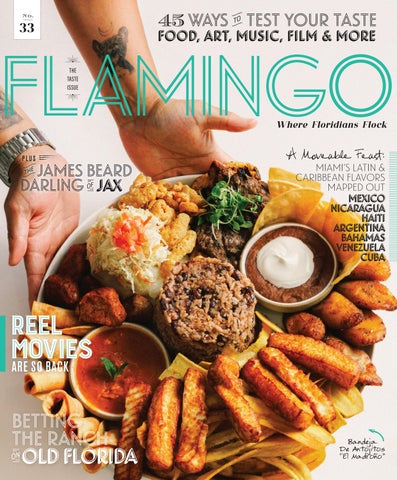
A Moveable Feast: MIAMI’S LATIN & CARIBBEAN FLAVORS MAPPED OUT Mexico Nicaragua Haiti Argentina Bahamas Venezuela Cuba
REEL MOVIES ARE SO BACK BETTING THE RANCH OLD FLORIDA
Bandeja De Antojitos “El Madroño”
Load up on apps and some real face time.
In The Florida Keys, it’s less about what’s on the itinerary and more about who’s around the table. Fresh seafood. Big laughs. And a view that makes everyone put their phones down without being asked. VisitFloridaKeys.com 1.800.FLA.KEYS
ADVERTORIAL
Finding Flavor
in the Florida Keys and Key West How a trio of culinary and conservation crusaders are elevating the food and drink scene in the Florida Keys
T
o truly appreciate the Florida Keys, you have to taste and savor its storied past. Long hidden behind the Conch Republic’s laid-back lifestyle and waterside adventures, the region’s food and beverage scene is now getting its long-deserved spotlight, with restaurants Moondog Cafe & Bakery and Blue Heaven receiving recent Michelin recognition. Here, three of the area’s culinary innovators share what it’s like to source from the region’s abundant waterways to master the art of casual dining.
Paul Menta
FLORIDA KE YS & KE Y WEST, CONOR DOHERT Y
CHEF AND OWNER OF KEY WEST FIRST LEGAL RUM DISTILLERY
From top: Paul Menta; Jeremy Ford; Rachel Bowman
Daredevil chef and rum distiller Paul Menta became a vocal supporter of the Keys’ gastronomy when he arrived here three decades ago. When he opened Key West First Legal Rum Distillery, Menta applied his culinary acumen to crafting each batch of rum because, as he puts it, “food and beverage collide heavily down here.” The same way he turned to the ocean to source his food ingredients, Menta emulated the process with his distillery, known for its small-batch, allnatural production. While traditional rum-making includes filling barrels with fresh water, Menta fills his own with salt water scooped straight from the ocean. He brings the barrels back to the distillery where he empties them and lets them dry, which, after around five days, leaves a layer of salt brine on the inside. The result is a rum selection that evokes the essence of the Keys, including a tropical line of green coconut and glazed pineapple flavors and silver rum that prefers a Florida Demerara sugar instead of molasses. “I make the best rum in Key West because it’s a flavor of Key West,” Menta says. “And there’s a pride that comes out of it.”
Jeremy Ford
CHEF AND PARTNER OF SALT + ASH After receiving a Michelin star in 2022 for his Miami Beach restaurant, Stubborn Seed, Jeremy Ford was ready for a new challenge. His next feat? Opening elevated farm-to-table, fresh-from-the-sea restaurant Salt + Ash. Strategically situated inside Hawks Cay Resort, a 60-acre tropical retreat in the Middle Keys, Salt + Ash brings Ford's passion for foraging and farming to a stunning seaside locale. Much of the restaurant’s ingredients are harvested from his own farm in the Redlands, located an hour and a half north of Salt + Ash, and local fishermen bring in just-caught seafood like swordfish and snapper. “It’s special here,” Ford says of the Keys. “And we get to serve fresh fish with tomatoes that we grew with our bare hands. It doesn’t get any better.”
Rachel Bowman
LIONFISH HUNTRESS When Rachel Bowman dives into the ocean, she enters the aquatic terrain for one purpose: to hunt lionfish. The first confirmed sighting of this invasive species in the Florida Keys was in 2009. The rapidly rising lionfish population has threatened local wildlife and coral reefs, changing the area's pristine natural ecosystem ever since. Armed with her spear, Bowman’s hunts have turned this invasive species into a food source. High in omega-3 fatty acids, lionfish have a delicate flavor that Bowman describes as mild, slightly sweet and similar to hogfish. She enjoys it baked with bell peppers, sliced onions and a dash of salt and pepper. Her hauls are sold at Whole Foods Markets and at local establishments like Chef Michael’s in Islamorada, making Bowman not only a hunter but also a provider.
For more culinary inspiration, go to visitfloridakeys.com.
ISLAND LUXURY ME E TS
CULINARY MASTERY A landmark culinary partnership with acclaimed Chef Curtis Duffy and Executive Chef Rodrigo Albornoz
L I T T L E PA L M I S L A N D . C O M
|
855.815.2620
Paradise
PERFECTED
OCEANKEY.COM 844.330.3852 | KEY WEST, FL
FLAMINGO FALL 2026 / VOL. 33
Contents Features
50
Eat Your Latin Caribbean Heart Out, Miami By Lyssa Goldberg
Every neighborhood tells a different migration story. From Little Havana to Homestead, follow the flavors and family traditions that have transformed Miami into one of America’s most exciting Latin Caribbean food cities.
60
Reel Revival
By Steve Dollar From Pensacola to Miami, Florida’s arthouse theaters are proving there’s still magic in the movies, pairing first-run films with cult classics, filmmaker Q&As and community experiences that are drawing people back to the cinema.
68
Saving Old Florida, One Ranch at a Time By Dave Seminara
Behind every cattle ranch is a story of perseverance and preservation. Meet the Florida ranchers balancing tradition with innovation to keep working lands in the hands of the family and Florida grass-fed beef on the table.
Cover Photography by JAMES JACKMAN
On the cover: Bandeja de antojitos, a massive sampler platter of traditional Nicaraguan food, at Madroño in Sweetwater, near Miami
Photography by
JOSH LETCHWORTH This spread: Ripe strawberry guavas hang from trees in one of Rebel Farms’ food forests.
4
FLAMINGOMAG.COM • FA L L 2 0 2 6
@theflamingomag
Departments 18 / F LOCKTAILS
Persimmon Hollow Brewing Company keeps the spirits of the past alive in DeLand.
20 / G OOD SPORT
Nothing beats the anticipation of a good hurricane surf swell in the Atlantic.
22 / N ATIVE
The Florida stone crab can regenerate a lost claw, but it’s not so simple.
24 / P LUME
Madeline Martin transports readers across oceans and centuries in her latest novel, “A Time of Witches.”
27 / MY FLORIDA
Five families are growing their food—and building their village—in a New Smyrna Beach neighborhood.
33 / M ADE IN FLA
Get a taste of the datil pepper’s storied history—if you can handle the heat.
36 / STUDIO
For artist Jiha Moon, whimsy comes in every color, each one carrying a deeper meaning.
41 / S OUNDCHECK
Sister Hazel guitarist Drew Copeland talks about the bonds of friendship that have kept the band together all these years.
45 / J UST HATCHED
Read about a new state park, a historic hotel and 10 other noteworthy openings.
80 / G ROVE STAND
87 / C ULTURE
Miami’s Lengua food symposium gathers restaurateurs, chefs and industry leaders to explore more than what’s in the dish.
90 / STONE’S THROW
Wilmington, N.C., may not be clamoring for the spotlight, but a charmer like this can’t stay a secret forever.
97 / D ESIGN DISTRICT
This 102-year-old Jacksonville building is coming back to life with fanfare and flourish. Come meet The June.
102 / B IRD’S-EYE VIEW
Slip away your day in sweet Sarasota.
107 / T IDE
Catch right whales calving, songwriters singing, vintage engines revving and Dwyane Wade training this fall.
112 / F LORIDIANA
If walls could talk, would the Caribbean Club in Key Largo tell the truth?
Columns
78 / PANHANDLING
By Prissy Elrod A good deed goes sideways, and the writer does too.
104 / F LORIDA WILD
By Carlton Ward Jr. A quest to photograph the endangered Florida panther yields both frustration and unexpected delight.
Meet the couple behind Jacksonville’s Chancho King and learn why their pork sandwich can make a grown man cry.
@theflamingomag
FA L L 2 0 2 6 • FLAMINGOMAG.COM
5
EDITOR’S NOTE
y husband, Brian, and I are
and the 30th anniversary of their hit “All
both fans of live music,
for You.” I’ve had the song on repeat ever
but we tend to disagree
since our chat. After all these years, I’m
on what constitutes good
still a Hazelnut.
music. This summer, my
More recently, I’ve become a fan
daughter Audrey and I drove to Gainesville
of Jacksonville’s Chancho King, an
to see Morgan Wallen’s sold-out stadium
Ecuadorian diner getting a lot of attention
show at The Swamp. We loved every
from the James Beard Foundation and
minute of belting out “Whiskey Glasses”
the subject of our chef profile in this issue.
surrounded by 80,000 glowing wristbands
I had been wanting to try it for a while.
pulsing to the music and pyrotechnics
So, for my birthday in July, Brian and our
exploding. Brian stayed home. He prefers to
older daughter, Elle, took me to celebrate.
see a decidedly nonmainstream musician
On the way across town, we hit a nasty
like Sturgill Simpson performing in a small
thunderstorm. Lightning knocked the
living-room-sized venue. But is one bad
train signal out of order, backing up traffic
taste and the other good? (Brian certainly
going into the Murray Hill neighborhood.
has his opinion.) To me, it’s all about the
As we slowly rolled through flooded
feels. If listening to an artist, wearing a
intersections, I worried our car might float
designer, buying a painting or consuming a
away. Elle had major reservations. “It’s not
meal brings you joy, then the taste can only be good, right?
worth it!” she shouted from the back. rarity on menus, but a select few restaurants
When it comes to music, art and food,
“It’ll be OK,” I said, as Brian turned down
and even some professional sports teams
the volume on a Morgan Wallen song
finding consensus is difficult. There are,
are prioritizing homegrown meat. To
playing on the radio.
however, a few things in this issue I think
understand more, writer Dave Seminara
Finally, the three of us settled into a
most Floridians can agree on. The first is
meets the Florida ranchers who are just as
cozy corner table and tucked into Shark
that Miami’s Latin Caribbean food scene
passionate about feeding customers the
Bite oysters sourced from New Smyrna
is one of the most exciting in the country.
highest quality grass-fed beef as they are
Beach, a seafood stew chock-full of
In our cover story, writer Lyssa Goldberg
about staving off developers and protecting
local fish and the signature pulled-pork
maps out the city’s immigrant food
the land they have worked for generations.
sandwich. We toasted our oyster shells
corridors, starting with a Cuban frita (think
Along with plenty to eat and drink
hamburger) on Calle Ocho and eating her
inside this issue, we bring you music and
way through Nicaraguan fritangas, Haitian
film. Cinephile Steve Dollar pulls back the
kitchens, Bahamian food fests and Mexican
curtain on a collection of arthouse theaters
knowing where to eat. And sometimes
taquerias from Homestead to North Miami.
reviving the magic of going to the movies.
it means knowing that you’re willing to
With every bite, she discovers that the soul
Screenings of cult classics and new features
drive through a flood with your husband
of a neighborhood lies at the table of a
are giving moviegoers a reason to get off
complaining about your music choices to
family-run restaurant. They’re the kind of
the couch and return to actual theaters.
get there. Here’s to good taste—and to
places the Michelin Guide might miss, so
Rediscovering something from the
deciding for yourself what that means.
save this story for future reference. We also have our own long-standing
to my birthday (the last in my 40s) and surviving the storm. Sometimes having good taste means
past that you once loved is exactly what happened to me when I sat down with Sister
food traditions rooted right here in the
Hazel co-founder Drew Copeland, who
Sunshine State. Florida-raised beef is a
opens up about the band’s staying power
Founder & Editor in Chief
let us know what you think. Email me at jamie@flamingomag.com.
6
FLAMINGOMAG.COm • FA L L 2 0 2 6
@theflamingomag
KRISTEN PENOYER
M
The TAste Test
A MONTAGE WELCOME SHAPED BY THE LOWCOUNTRY,
where the rhythm of the tides and the salt-kissed breeze set the tone for your stay.
BIG SKY
|
L AG U N A B E AC H
D E E R VA L L E Y |
Future Destinations: B A H A M A S
|
LOS CABOS | |
H E A L DSB U RG PA L M E T T O B L U F F
P U N TA M I TA
|
VA L L E D E G U A DA L U P E
mon tage.com | (866) 976- 6 413 On Location at Montage Palmetto Bluff
FLAMBOYANCE THOUGHTS FROM THE FLOCK
Reveling in the Wild and Unruly Readers hail Florida’s native plants, a monster truck family and an Old-Florida escape.
Revving Monster Truck Royalty Monster truck royalty indeed!! From Jester to King! Bow to the Pags! —Marrek P. And these guys love their fans, such an appreciative family right here. So happy for them to have conquered the mountain, together!! —Diggers Diecast Detailing
This Landscape Architecture Firm Is Bringing Back Wild to South Florida Yes! South Florida needs this so much! Brava! Transforming my once mostly grass yard into a biodiverse wildlife sanctuary is one of the best things I’ve done. —Susan H. We planted nine trees in our Palmetto Bay backyard. The couple that bought it pulled everything out. Heartbreaking. —Caroline D. This is such a beautiful and thoughtful approach to outdoor living. Bringing natural wild energy back into South Florida backyards is honestly so refreshing to see! —Laud Luxury Group I wish more of the people that move here would accept this, instead of cutting down and clearing everything native out. —Amy S.
People want unique architecture and natural landscapes! Florida is beautiful—that is why people like it! St. Petersburg just keeps building all of these ugly condos and apartments when there are a ton of vacant ones! Destroying all of the character and the charm of the city! —Esmeralda D.
It’s surrounded by over 800,000 acres of national and state forests. It would be difficult to develop like many parts of Florida—and that’s a good thing. —Howard R. Don’t come here. It’s too hot, has yellow flies and mosquitoes, and there is nothing to do but read. —Russel F.
FLAMINGOMAG.COm • FA L L 2 0 2 6
— FA L L 20 26 —
EDITORIAL Ed i to r i n C h i e f a n d Fo u n d e r JAMIE RICH jamie@flamingomag.com C re a ti v e D i re c to r Holly Keeperman art@flamingomag.com C o n tri b u ti n g D e s i g n e r Ed Melnitsky edit@flamingomag.com Ed i to ri a l a n d M a r ke ti n g As s i s ta n t Olivia Evans olivia@flamingomag.com Art Pro d u c ti o n M a n a g e r Kerri Rak C o n tri b u ti n g Ed i to r s Eric Barton, Steve Dollar C o n tri b u ti n g Wri te r s Eric Barton, Evan S. Benn, Helen Bradshaw, Steve Dollar, Prissy Elrod, Lyssa Goldberg, Josh Letchworth, Eric Michael, Melissa Puppo, Allison Ramirez, Maddy Zollo Rusbosin, Dave Seminara, Nila Do Simon, Sandra Simonds, Jarrett Van Meter, Carlton Ward Jr., Cynthia S. Zimmermann C o n tri b u ti n g Ph o to g ra p h e rs & I l l u s tra to rs Carly Berry, Leslie Chalfont, Beth Gilbert, Kim Heise, James Jackman, Josh Letchworth, Stephen Lomazzo, Jules Ozaeta, Kristen Penoyer, Carlton Ward Jr. C o p y Ed i to r s & Fa c t- C h e c ke rs Patty Carroll, Stacy Cortigiano, Jenn Kirby, Alyssa Ramos, Nick Song Ed i to ri a l I n te rn s Molly Seghi, Kailey Zagst
SALES & MARKETING Pu b l i s h e r
JAMIE RICH jamie@flamingomag.com Janis Kern janis@flamingomag.com
Ad v e rti s i n g S a l e s Exe c u ti v e
Jenn Kirby jenn@flamingomag.com
Ad v e rti s i n g S a l e s Exe c u ti v e
Megan Zebouni megan@flamingomag.com N e w s s ta n d D i s tri b u ti o n
If only they could do that to vacant lots leftover from demolished buildings. —Tommy P. More trees, less palms, more natives, more habitats for wildlife! —The Lamb and Flag
• FOUNDED IN 2016 •
Ad v e rti s i n g S a l e s D i re c to r
Fantastic … cultivating a (mostly) Florida native yard ourselves. It’s a great learning experience. —Hibiscus Island Home
SCAN THE QR CODE
8
The Panhandle’s Forgotten Coast
33
Where Floridians Flock
Tom Ferruggia tferruggia@msn.com C o n ta c t U s
Abov e : Shrimp boats on the
Forgotten Coast
S U B S C R I B E TO R E C E I V E 4 P R I NT I S S U E S A YE A R
JSR Media LLC 13000 Sawgrass Village Circle Bldg. 3, Suite 12 Ponte Vedra Beach, FL 32082 P: (904) 395-3272 // E: info@flamingomag.com All content in this publication, including but not limited to text, photos and graphics, is the sole property of and copyrighted by JSR Media and Flamingo. Reproduction without permission from the publisher is prohibited. We take no responsibility for images or content provided by our advertisers.
JSR MEDIA
@theflamingomag
L AYLLE DIGITAL MEDIA , LE AN TIMMS , AR AR AT_ ART VECTORSTOCK
Above: Cadence reimagines Florida backyards.
IS SUE
Where the land ends, vacation begins.
What will you find along 23 miles of The World’s Most Famous Beach? Warm sands. Gentle waves. Spacious accommodations. Delicious food. And, incredible memories that will live with you, always. Plan your trip at DaytonaBeach.com. Scan Now For Fall And Winter Hotel Deals.
CONTRIBUTORS Spacing
Lyssa Goldberg
James Jackman
Miami
Miami
Dave Seminara
Writer: Cattle Feature
St. Petersburg
WHAT DOES HAVING GOOD TASTE MEAN? In my world, you have great taste if you love St. Pete, tennis, skiing, the Buffalo Bills and Sabres, international travel, Paul Theroux books, German shorthaired pointers, all-day breakfast, real Italianstyle gelato, pecan pie and anything with hazelnuts.
FAVORITE FLORIDA RESTAURANT? Bern’s Steak House! The offmenu $20 steak sandwich is likely the best deal in Florida. Every year, I fail to set an alert 90 days before my wedding anniversary and thus have to settle for a 9 p.m. reservation.
p. 68
10
WHICH FLORIDA DISHES, RESTAURANTS AND CHEFS ARE YOU LOVING? I gravitate toward restaurants and chefs evolving on their traditional heritage cuisines with modern twists that incorporate Florida ingredients like a refreshing ceviche with local seafood and perfectly ripe diced mango.
WHAT’S OUR BIGGEST CULTURAL ASSET? Our people! Having such diverse communities from Latin America, the Caribbean, Europe and even families who’ve lived in our state for generations has been the biggest influence on our cultural scene.
p. 50
FLAMINGOMAG.COm • FA L L 2 0 2 6
Photography: Cover Story
Sandra Simonds Writer: Studio
Tallahassee
HOW WOULD YOU DESCRIBE YOUR TASTE IN MUSIC, FILM AND BOOKS? I like things that are a little offkilter, art that shows us parts of the human psyche that we don’t necessarily see very often. I want to see or read or hear something that makes me feel and think deeply and that helps me reimagine what I thought I knew about the world.
WHEN YOU THINK OF THE FLAVORS OF FLORIDA, WHAT COMES TO MIND? The smell of the plants and air and trees after a summer thunderstorm in Tallahassee. Is that a flavor?
p. 36
WHAT ARE THE FLAVORS OF FLORIDA? I think of a proper whole fried or grilled snapper with lime; Carrie mangoes from a friend’s front yard (a variety named after the grafter’s mother); Old Bay on peel-and-eat shrimp; Apalachicola oysters with a drip of Tabasco and a squirt of lemon; the kwai muk fruit from a tree off Swinton Avenue that was cut down to build yet another development; a Pub sub at the beach with a bit of saltiness from my oceanpruned hands.
WHAT DOES HAVING GOOD TASTE MEAN? Choosing to indulge in the local or traditional foodways as much as possible.
p. 50
@theflamingomag
DAVE SEMINAR A , LYSSA GOLDBERG , SANDR A SIMONDS , JAMES JACKMAN
Writer: Cover Story
ADVERTORIAL
Naples Botanical Garden
A Southwest Florida-Style
Holiday Season
Monserrat Reg 8.75/12 376 wds
Ditch the snow and see palm trees glow at Johnsonville Night Lights in the Garden.
T
NAPLES BOTANICAL GARDEN
he holidays bloom a bit differently in Southwest Florida. At Naples Botanical Garden, pines are traded for palms and frost for foliage, ushering in the holiday season in true tropical style.
The annual Johnsonville Night Lights in the Garden is a Naples tradition that has become a staple for both locals and holiday travelers seeking a taste of the North Pole—only with the perks of more pleasurable winter weather. When the sun sets, the garden begins to glow, as its 170 acres of lush grounds are washed in vibrant hues and laced with twinkling light displays, reflecting in the Water Garden. Guests can sip on spiked apple cider and enjoy holiday treats and grilled fare like Johnsonville brats and hot dogs as they meander through the brightly illuminated pathways. But the magic of the night doesn’t end with what you can see—it’s found in what you can smell. Flowers known as angel’s trumpets release their unique fragrance after sundown, filling the garden with a sweet perfume. At the center of it all sits a 15-foot-tall tree, made of native bromeliads and accented with tillandsia rather than tinsel, making a convincing case for swapping evergreens with a native alternative. Bask in its glow while carolers harmonize to nostalgic tunes.
This page: The Scott Florida Garden; festive attendees; bromeliad Christmas tree
Even Santa Claus gets a Southwest Florida makeover. His changes in latitude sure have an effect on his attitude—and his attire. At Johnsonville Night Lights in the Garden, visitors get to share their holiday wishes with a laid-back Santa on select nights before posing for a Christmas-cardworthy photo. Stroll the garden’s grounds to discover all the carefully curated photo spots sure to inspire a little envy from friends and family in colder climes.
For more information, visit naplesgarden.org.
The Slice Travel
•
• ••
•
MIAMI UNDERCOVER
• • •• •
• •
• • • ••
• • • •
MUSIC, FOOD AND FILM, BY THE NUMBERS
•
26
• Panhandle to The Keys
WHERE WE’VE BEEN IN THIS ISSUE
•
•
• • •
• •••
•
AT L A N T I C B E A C H • C O C O A B E A C H • C O R A L G A B L E S D AY T O N A • D E F U N I A K S P R I N G S • D E L A N D FERNANDINA BEACH • FORT LAUDERDALE FORT MYERS • GAINESVILLE • HOMESTEAD IMMOKALEE • INLET BEACH • JACKSONVILLE KEY LARGO • KEY WEST • MAITLAND • MIAMI MIAMI BEACH • NAPLES • NEW SMYRNA BEACH ORL ANDO • PANAMA CIT Y • PENS AC OL A
Michelin-star restaurants in Florida
1927
Jacksonville’s Riverside Theatre premiered the first feature-length “talkie” in Florida
196M
streams of Sister Hazel’s “All for You”
99%
of the U.S. stone crab harvest comes from Florida
S A R A S O T A • S E A S I D E • S T. A U G U S T I N E S T. P E T E R S B U R G • T A L L A H A S S E E • T A M P A TRILBY • WE ST PALM BE ACH
12
FLAMINGOMAG.COm • FA L L 2 0 2 6
Situated in Miami’s North Beach, Maison Felix is a restored 1948 hotel with 29 modern boho-inspired guest rooms and a lush courtyard pool, capturing the easy sophistication of old-school Miami steps from the sand. maisonfelix.miami
Join the flock! Sign up for our weekly newsletter or email us at: info@flamingomag.com.
Culture
TOAST OF THE TOWN
Dine, drink and discover on the waterfront at the Jupiter Inlet Lighthouse & Museum during its annual Rendezvous at the Light. The evening brings together more than 20 of Jupiter’s favorite restaurants, including Michael Jordan’s 1000 North, for a fete celebrating 166 years of the iconic red-brick lighthouse. Secure your spot at jupiterlighthouse.org.
@theflamingomag
J UPITER INLET LIGHTHOUSE & MUSEUM , MAISON FELIX HOTEL, LEWEN DESIGN , SENT YA IRMA AND NUR SYIFAH FAUZIAH FROM THE NOUN PROJECT
PROMOTIONS, PRODUCTS AND PARTIES
Swept away by soft light and
the luxury of letting go.
Wake up to the gentle rhythm of Amelia Island, the timeless Northeast Florida getaway where each day feels unhurried and entirely your own. Find your unwind at AmeliaIsland.com
PROMOTIONS, PRODUCTS AND PARTIES
The Slice POSTCARDS, DELIVERED
This summer, we traveled across the state through the eyes of readers who submitted their best shots to our travel photo contest. Meet the Readers’ Choice and Editors’ Choice winners. PHO CON TO W TEST
INNE R MER 2 0
• SUM
26 •
EDITORS’ CHOICE
St. Petersburg Pier by Emily Will
TELL US ABOUT THE MOMENT YOU TOOK THIS PHOTO. I took this photo on my iPhone while lying in my hammock on the first day of the year. I was alone reading a book, enjoying the peaceful weather and just taking in the moment.
WHAT DOES THIS SPOT MEAN TO YOU? This spot at Northshore Park means a lot to me. I learned how to ride my bike here, and my parents also got engaged here, so it holds a lot of special memories for me.
READERS’ CHOICE
Green Springs Park, Enterprise, by R.J. Adler
WHAT DOES GREEN SPRINGS PARK MEAN TO YOU?
TELL ME ABOUT THE MOMENT YOU TOOK THIS PHOTO.
It is one of many gateways to Old Florida, or the real Florida. It is a slice of untouched natural beauty that captures the true spirit of this land that we call home. As we see developments everywhere, it is so precious to see what truly makes Florida the Sunshine State ... To me, it is heaven on Earth.
This park had been on my radar for a while, so I decided to spend some time there. It was so tranquil. I could hear the buzzing and tweeting of nature all around me. When I made it to the springs, I was entranced by the hypnotic colors dazzling in the sunlight. I had to capture this moment.
14
FLAMINGOMAG.COm • FA L L 2 0 2 6
@theflamingomag
RJ. ADLER , EMILY WILL
YOUR PHOTO ON THE COVER
Flamingo is proud to introduce The Coquinas, our inaugural conservation photography contest. Show us the landscapes, wildlife, people and wild places that make Florida worth protecting. Our panel of conservation leaders and Flamingo editors will choose the winning image, which will land on the cover of our Winter 2026 Conservation Issue. The photographer will also be featured in a story inside. Now get outside and show us what you’ve got. Learn more at flamingomag.com.
Tucked away along Northwest Florida, Mexico Beach has five miles of quiet, white sand shoreline and crystal-clear emerald waters. It’s the place where vacations get back to basics with warm sun, gentle waves, and wide-open spaces to unwind. It’s the serene escape you’ve been searching for, where the only thing on your to-do list is packing a beach bag.
Discover Your Escape at MexicoBeach.com
DIGITAL DISPATCHES @ FLAMINGOMAG.COM
Online Reads Travel
GAINESVILLE, ALL GROWN UP
From the Archive
A DIFFERENT KIND OF COOKBOOK If you know what a can of Ro-Tel will do when mixed with a can of black-eyed peas, then you might need a copy of Ernest “Ernie” Mickler’s “White Trash Cooking” on your kitchen shelf. In the 1986 Southerncooking classic, Mickler paints a portrait of growing up gay and in the kitchen with the women of his family in North Florida. Recipes, photos and personal asides weave a tale as unique as a bite of oven-baked possum. flamingomag.com/whitetrash
Books & Film
‘A LAND REMEMBERED’ MADE FOR TV Tampa native Todd Wiseman Jr. just wrapped up 43 days of
Above: Kin Cocktail Bar & Lounge in Gainesville
filming across Florida’s unspoiled backwoods and private ranches, retelling this epic novel from behind the camera lens. The $25 million production features Sundance-winning leads and cinematography that includes driving 600 cattle across Sunshine State prairies. “It’s telling us the story of Florida that is undertold, the interior of Florida, the cattle history, the cowboys,” Wiseman says. flamingomag.com/alandremembered
16
FLAMINGOMAG.COM • FA L L 2 0 2 6
NEVER MISS A STORY! Find more of Florida’s greatest stories from the Panhandle to The Keys and everywhere in between online at flamingomag.com.
@theflamingomag
KIN COCK TAIL BAR & LOUNGE, CARLTON WARD JR ., TAMARIND FREE JONES , LIBBY VOLGYES
Most folks are familiar with the college coeds and football fanatics who shift Gainesville’s gears in the fall, but what goes on in this North Florida enclave beyond the boundaries of Gator Nation? Take a tour to explore some of G-ville’s hidden gems, from eats and drinks to bat houses and breweries to trails that wind through history with our day-trip agenda. flamingomag.com/gville
TWO GREAT HOTELS, ONE INCREDIBLE STAY! • Private Balconies with Ocean Views • Resort Style Pool • On-Site Restaurants and more • ~6,000 sq ft of event space • Close proximity to the beach and downtown
SCAN TO LEARN MORE ABOUT OUR PROPERTIES!
FOR MORE INFORMATION, PLEASE CONTACT:
MONIKA POPEK | DIRECTOR OF SALES 904.206.5604 | monika.popek@marriott.com
FLOCKTAILS FLORIDA-FRESH BEVS By Molly Seghi • Photography by Kristen Penoyer
Pop Tops
& Persimmons
with every pour, Persimmon Hollow Brewing Company is honoring deland’s lost harvest.
T
he cream-and-emerald brick facade of Persimmon Hollow Brewing Company, situated along West Georgia Avenue in DeLand, is stitched into historic downtown with strings of white lights crisscrossed over the narrow brick street. Sunlight cuts through tall factory windows where the building’s former life as a midcentury Western Auto shop lingers, its floor still marked in faint yellow paint. Like the space it occupies, the company’s name is an ode to the past. Long before citrus groves defined Central Florida, persimmon trees, with leaves seasonally matching their fruits’ burnt-orange color, blanketed the town once known as Persimmon Hollow. The Florida-native fruit, harvested in autumn, vanished from prominence once settlers arrived in present-day DeLand in 1876 in pursuit of orange gold. “[The brewery] does help to tell part of that story and advocate for more discovery of our heritage,” says Sarah Finch, the executive director of the West Volusia Historical Society. This page: Persimmon
Hollow Brewing Company’s Beach Hippie IPA makes a mean beermosa.
18
FLAMINGOMAG.COM • FA L L 2 0 2 6
@theflamingomag
FLOCKTAILS
It’s an appeal to that romantic kind of beachy bum fantasy that we’ve all had.
brew with a malt backbone, just balanced enough to satisfy both connoisseurs and newbies alike. Dirty Blonde, its golden, crushable companion, is sweeter on the tongue and lighter on the stomach. “It’s a beer I’m going to crack four or five open during the day,” Brooks says. —Mike Brooks Perhaps the brewery honors the Old That ethos of marrying preservation Florida town most by shaping its next and creation is brewed directly into its chapter. Since its founding in 2014, it products. Two of its four heavy-lifting has helped usher in the city’s downtown beers—Beach Hippie IPA and Daytona revival, holding court with other trendy Dirty Blonde Ale—were inspired revamps in town over the last decade. On by a mother-daughter duo any given afternoon, laughter from West Volusia who were from families celebrating PERSIMMON friends of the brewery. The milestones or friends playing HOLLOW Beach Hippie is even adorned bingo echoes beneath the BREWING CO. with a rendering of a vintage exposed wooden rafters — LOCATION — blue-and-white Volkswagen that once sheltered cars, 111 W. GEORGIA AVE., DELAND van the mother lived in during layering new memories into — TIP — the ’70s and ’80s. “It’s an the history already held by CHECK SOCIALS TO CATCH THE appeal to that romantic kind its walls. “We’re a part of the NEXT TRIVIA OR BINGO NIGHT. of beachy bum fantasy that community, and we want the @persimmonhollow we’ve all had,” says Mike community to be a part of us,” Brooks, the brewery’s director Brooks says. of sales and marketing. Beach Hippie, the most requested drink at the bar, accounts for more than 60% of Persimmon Hollow’s total m a k e s 1 Co c k ta i l revenue and is commonly referred to as “the beer that built the brewery.” The 1 ounce fresh persimmon puree East Coast-style IPA with 7.1% alcohol 1/2 ounce fresh lemon juice by volume (ABV) is a fruit-forward
The Daytona Dirty Cobbler m a k e s 1 CO C K TA I L 1 ounce bourbon 1/4
ounce honey syrup
2 dashes Angostura bitters 8 ounces chilled Persimmon Hollow Daytona Dirty Blonde Ale 1 dried persimmon wheel, for garnish 1 rosemary sprig, for garnish Cubed ice PREPARATION: Combine the bourbon, honey syrup and Angostura bitters in a rocks glass filled with cubed ice. Top with the chilled Daytona Dirty Blonde Ale. Stir gently. Garnish with the dried persimmon wheel and rosemary sprig. TIP: Clap the rosemary sprig between your palms before garnishing to release its aroma.
The Harvest Hippie Spritz
8 ounces chilled Persimmon Hollow Beach Hippie IPA This page from left: Two of the brewery’s
most popular pours; a blonde ale cocktail
2 ounces sparkling water (optional) Orange peel ribbon, for garnish Cubed ice PREPARATION: Add the persimmon puree and lemon juice to a cocktail shaker filled with ice and shake until chilled. Strain the mixture into a large wine glass filled with ice. Pour the chilled Beach Hippie IPA on top. Add sparkling water, if desired, and stir gently. Garnish the drink with an orange peel ribbon. TIP: Be sure to pour and stir gently as not to flatten the carbonation.
@theflamingomag
FA L L 2 0 2 6 • FLAMINGOMAG.COM
19
GOOD SPORT SEASONAL OUTDOOR PURSUITS By Eric Michael • Photography by Frankie Tuzcu
A Welcome Wrath
A Florida surfer reckons with mixed emotions during hurricane season.
S
ummer is torture for Florida surfers. While our neighbors revel in sunny skies, soft breezes and warm water, we lament a flat, lifeless Atlantic. Four decades in boardshorts, I experience this reversed seasonal affective disorder annually. The gentle, lapping ripples at my home breaks in Cocoa Beach make me sullen and withdrawn—until hurricane season heats up in late summer, early fall. The storm I fantasize about tracks north of the Bahamas, makes a slow right turn and shadows the Gulf Stream into the North Atlantic, sending wind-driven groundswell rolling toward Florida. This path of swirling low pressure draws air eastward across the peninsula, creating offshore wind that grooms the ocean’s raw energy into towering cylinders straight out of my dreams. It’s a potent, recurring reel in my mind this time of year. Nothing compares to the rush of a storm swell. I can feel the surf resonating before even cresting the dune for a first look at the waves. Corduroy lines stacked to the horizon detonate on sandbars far offshore. A cloud of mist refracts the sun through a veil of prisms. I breathe deep and rub wet sand on my board to rough up the wax, building nerve to tackle the shore break bubbling with thick foam. The only reasonable path to the takeoff zone is through a chaos of whitewater. Pushing under one avalanche after another, I focus on the self-assuring mantra “Just keep paddling.” Eventually, the ocean shows a crack in her defense, and I sneak through to calm water where other surfers bob and wait, wearing tense smiles. Before I catch my breath, someone in the lineup yells, “Outside!”
20
FLAMINGOMAG.COm • FA L L 2 0 2 6
Above: Storm season ushers in surf-worthy swells at the Cocoa Beach pier.
Committing to ride a menacing wall of water is a gut check like none other. The wind blinds me with spray as I paddle my arms madly to match the speed of the wave. In an instant, its energy pushes the board beneath me, and I jump to my feet, gripping the wax with my toes to hang on. After months of riding knee-high peelers, I’m not prepared for the speed and power of a big wave. Thankfully, muscle memory is deep, and instinct takes over as I scream down the line, pumping through heaving sections for a path to safety. The ride is worth the wait. A short list of storm seasons is burned into memory: Felix, Marilyn and Luis in 1995, Floyd in 1999, Sandy in 2012, Matthew in 2016 and Dorian in 2019 —but none is more fabled than the Halloween swell from Grace in
1991. Florida surfers may argue about its place at the top of the pyramid. But I surfed this swell at Satellite Beach and no one who made it out will ever forget the size and quality of that epic event. Looking back on a lifetime of hurricane surf is a trip through ecstasy and agony. In middle age, my perspective is different—kids and a mortgage will do that. I used to get a sacrificial haircut on June 1, the first day of hurricane season, to ensure a plentiful harvest. Then in 2004, Charley, Frances, Ivan and Jeanne devastated my neighborhood and changed my perspective. Living through the statewide aftermath tempered my seek-and-destroy mentality with heavy doses of fear and loathing. Today, wishing for a busy season seems depraved—but deep down, I’m still rooting for that perfect track.
@theflamingomag
FLORIDA’S MOST UNEXPECTED FOOD CITY. Jacksonville Neighborhoods Serve Up More Than Expected Some cities are known for one dish. Jacksonville isn’t one of them. Sure, you’ll find fresh-caught Mayport shrimp, dockside seafood and Southern staples. But the food scene doesn’t end there. Across the city, Cuban cafes, taco spots, bakeries, rooftop bars, chef-driven restaurants and hidden neighborhood gems prove that there’s a table for every craving.
Start planning your next bite at VisitJacksonville.com
GET SOCIAL WITH US: @visitjacksonville
Visit Jacksonville
@visit_jax
@Visit_Jax
@Visit_Jax
#onlyinjax
Visit Jacksonville
NATIVE SUNSHINE STATE SPECIES By Helen Bradshaw • Illustration by Kim Heise
Handle With Care Florida stone-crab claws come at a cost.
M
any Floridians know all about the sweet pleasure of dipping a hunk of succulent claw meat into warm melted butter or a tangy mustard sauce, but few connoisseurs stop to think about the life and times of that crustacean they just cracked. Florida stone crabs are the jocks of the sea—so beefy that they can’t even reach their claws to their backs. “They have these incredibly strong ratcheting claws, so perhaps what they lack in flexibility they make up for in brute strength,” says Kate Rose, a Florida Sea Grant agent. The thick-shelled bottom dwellers scuttle along the ocean floor, using their claws to crush and pinch prey. “They’re like little tanks,” Rose says. Each fall, a network of crab pots NATIVE descends into Florida RANGE waters, waiting for unsuspecting crustaceans to walk in. Crabbers hoist up the pots, sort the crabs and, with a swift pull, break off a claw. “The trick to help the crab is actually to twist it in a way that makes the crab sever its own arm,” Rose says. “It reduces the amount of injury that the crab suffers.” Conceptually, it seems like the perfect Floridian food source: Crabs lose a claw, but they’re tossed back into the ocean and get to work growing a new one—no harm, no foul. In practice, it’s not so simple. The process of regeneration can take nearly three years. “Herein lies the challenge with the mortality,” Rose says. “They have a lifespan of about six to eight years.”
22
FLAMINGOMAG.COm
During apoptosis, crabs under stress can lose and regrow a claw, which is a helpful trick to evade predators, but not one without its costs. “They’re losing the ability to feed themselves, and that’s why there are these reproductive impacts, because you know their body is trying to compensate for it, and they effectively say we don’t have the energy for eggs this season,” Rose explains. When a fisher doesn’t properly remove the crab’s claw, the crustacean’s life is at stake. Up to 59% of stone crabs die after having one claw removed, and around 13% die just from handling alone. For now, the Florida stone-crab fishery isn’t in immediate danger, Rose says. But in a state that has seen a once-abundant species pushed to the brink of extinction, regulators aren’t taking any chances. Officials are keeping a close eye on the industry and employing restrictions to safeguard its future. Although stone crabs have recently been documented as far north as Virginia, roughly 99% of the U.S. harvest comes from Florida, with the bulk of them pulled from The Florida Keys. That makes protecting one of the Sunshine State’s most coveted seafood traditions primarily Florida’s responsibility. “Everybody is engaged and focused on keeping the fishery healthy,” Rose says. “It’s the epitome of a local Florida industry and delicacy.”
•
@theflamingomag
A NEW chapter of coastal luxury. Experience the transformation of Omni Amelia Island Resort & Spa, from refreshed guest rooms and reimagined dining to restored golf and elevated spa experiences. OMNIHOTELS.COM/AMELIAISLAND
SCAN TO LEARN MORE
PLUME AUTHORS AND READS By Olivia Evans
Spellbound
st. Augustine author Madeline Martin talks about researching England’s notorious witch trials, her latest novel and finding magic in the past.
E
24
FLAMINGOMAG.COm • FA L L 2 0 2 6
What brought you to Florida? Madeline Martin: St. Augustine is the oldest city in America, and I am a history nerd. So that’s how I ended up coming here. It’s funny because when I was in high school, I really couldn’t afford to go and do all the historic fun things. Then I had kids, and I didn’t have the time to go and do all those kinds of things. So now that my kids are older, my husband and I, once a year, have a little weekend getaway 20 minutes from our house in downtown St. Augustine. We play tourists with the little trolley stickers and everything.
Tell me about the beginning of your career as a novelist. MM: Hugely pregnant with my
cozy bookshop in Georgia. As Lilith begins to dream about Sybil and consult a local fortune teller, she uncovers details about the 17th-century stranger, and their lives unexpectedly intertwine. “Both women are fighting for their independence, and the world is pushing back on that significantly,” Martin says. Flamingo recently sat down with Martin ahead of the release of “A Time of Witches” to chat about researching witch trials in England, her passion for historical fiction and the magical powers of self-love. The following responses are edited for length and clarity.
second daughter, I went to my very first writing group meeting. That was really interesting for me because it was the first time that people asked me about me. Rather than me being somebody’s wife or mother, I was myself again. It was like I’d almost kind of lost myself without realizing that that had even happened, and writing kind of helped me get that back.
How did that writers’ group shape you? MM: There was a woman there, and we did a critique of one another’s work. She was very kind, but I realized I had no idea what on earth I was doing. I really was not a very good author, and so I spent the next five years basically learning everything that I could about writing, and after those five years, that’s when I wrote my first historical romance, “Deception of a Highlander.” I submitted it to three nationwide contests, and I finaled in all three, and then I won first place in all three.
@theflamingomag
TORI STAUFFER PHOTOGR APHY
ven as a young Texas high school graduate, Madeline Martin was drawn to ancient times and places. At 18 years old, she left behind an “Army brat” life that had taken her overseas and back for a future in St. Augustine. A self-described history nerd, Martin found exactly what she was looking for among the city’s centuries-old streets, and she never left. More than 25 years later, the author has built a career anchored in stories of the past. From her St. Augustine home, where the walls are lined with history textbooks, she has written more than 40 books, many while juggling a career in business analysis. That balancing act ended in 2020 when Martin lost her job—a shift that allowed her to focus full time on writing and led to her first New York Times bestselling book, “The Last Bookshop in London.” In her latest novel, “A Time of Witches,” Martin, 46, transports readers between 17th-century Above: England and Madeline Martin present-day Savannah, Ga., where two women are tethered across time and distance to each other. The book’s perspective switches between Sybil, who lives in a time where witch hunters patrol cobblestone streets on horseback, and Lilith, who works in a
PLUME
When did you know that writing would be a full-time thing for you? MM: I was writing six to eight books a year, working a full-time job and my daughters were everything. The writing was on the wall at work, and I told my husband, “If I get laid off, I think I just want to try writing full time. I’m tired.” So I got laid off, and I thought, “This is going to be so amazing. I’m going to have the entire house to myself, and it’s going to be quiet, and I can focus.” This was February 2020. The pandemic happened three weeks later, and I was robbed (of that). But it gave me the opportunity to really put the focus that I needed to do the research for my first historical fiction, which was “The Last Bookshop in London.” A year later, that book came out, and it hit No. 8 on the New York Times (bestseller list).
What did that moment feel like? MM: I had written over 35 books. I had been writing for over 15 years. I never thought that was going to happen to me, and so I went home and I celebrated with a glass of wine while I was doing the laundry. Mom life doesn’t stop.
In your latest book, “A Time of Witches,” how did you collect the vivid details of life in 17th-century England? MM: I traveled on-site to Bury St. Edmunds. I went there for over a week, and it’s funny because I took so many tours that the tour company actually put an article in a newspaper about me. They’re like, “author takes record
number of tours,” and it was hilarious. I got to meet with a woman who specializes in historical herbs while I was there and just got to walk around and get the feel of the place.
How did researching the witch trials in Bury St. Edmunds inform the story? MM: An interesting aspect of the research, for me, is that when you read about the witch trials in other places of the world, there is so much violent torture. It was thumbscrews and the Iron Maiden, the rack and all of these other things. So because they weren’t implementing those specific devices (in Bury St. Edmunds), they didn’t think of what they were doing as torture. They’re like: “Yeah, well, we’re just making them stay up. Oh, well, we’re just not getting them any food. Oh, we’re just making them walk back and forth. It’s not that big a deal.” They didn’t see what they were doing as torture.
Did this information alter your approach to writing the novel? MM: After hearing about how they had been treated by these men, I wanted the men to pay. What you give to others, you’ll get that threefold.
What makes your story about witch trials different from others? MM: When I’ve read books about witch trials in the past, I’ve always been disappointed that you don’t get to see inside the cell. Maybe that’s a little bit morbid of me. It’s like the witch trial essentially happens in the courtroom, and I usually find that to be a bit boring. So I really wanted to see what the process looks like from when they actually get arrested.
What modern parallels did you explore? MM : I really wanted to showcase an independent woman in both particular time periods. As far as Lilith goes, she’s having to essentially fight for her independence as well—her decision to not get married and not have a child. She’s having to fight for that in a world
@theflamingomag
where we are supposed to be so much more free to do what we want, but there’s so much societal pressure still.
How did you approach writing Lilith’s journey of embracing a part of herself she had suppressed? MM: I wanted to approach it very slowly. I wanted it to be a gradual thing. I think a lot of women suffer from low self-esteem. I absolutely did. You don’t just wake up one day and think, “Actually, you know what, I’m amazing.” It takes a lot of work and self-reflection to get to the point that you can appreciate the amazing person that you really are.
What did you learn about yourself through this process? MM: The nature of magic and the appreciation of magic. So much of it really was going outside and paying attention to what’s around you. Thinking about how flowers know to bloom during certain seasons and how you know seeds will fall down that can make new trees. Just the cycle of life and going out and appreciating that. Feeling empowered by the sun, feeling emboldened by the moon and also really realizing that inside of you there is this power that is wonderful, and that it is pure, and that it is raw, and that it really is so much about self-love, and how empowering that can be.
What is it about historical fiction that keeps you writing? MM: It’s the Tootsie Pop of the book world. It’s brain candy wrapped around a nugget of knowledge, and you walk away feeling entertained and educated.
What Florida stories do you want to write but haven’t? MM: There is one that I thought would be really interesting that has to do with hotel staff during Henry Flagler’s time. It’s sort of the idea of kind of like a “Downton Abbey,” with all the things that happen under the surface. But I mean, it’s so hard to see when I would have a chance to do that. I have so many books in my head. I have more books in my head than I think I have life in my body.
FA L L 2 0 2 6 • FLAMINGOMAG.COM
25
ALRE A DY
W H E R E E V E R YO N E C A N S AT I S F Y T H E I R C R AV I N G S A F T E R A F U N F I L L E D D AY
Third Wave Cafe & Wine Bar
Beyond 17 miles of sun-soaked beaches and inviting places to stay, New Smyrna Beach is a food lover’s paradise. Be here when the area’s top restaurants come together again to showcase the freshest local seafood and coastal cuisine, celebrating Coastal Catch Restaurant Month during the month of October. The celebration continues with Taste of the Arts, presented by The Hub on Canal, on November 5, followed by Tide to Table on November 7th at the Marine Discovery Center—two unique events celebrating the region’s culinary talent and coastal heritage. Plan your relaxing fall getaway around an exciting, fun-filled foodie event.
VisitNSBFL.com
MY FLORIDA PERSONAL STORIES Photography and words by Josh Letchworth
Rebels With a Cause
Equal parts urban-farming business and suburban agrihood, the families of REBEL FARMS are cultivating food forests together while helping others grow their own.
H
undreds of fruit trees and bushes blanket less than an acre in the middle of a decades-old New Smyrna Beach neighborhood. What has grown here isn’t just a food forest—it’s a village. I met Maggie Drayton about nine years ago at a personal-growth workshop. Our friendship has deepened over the years, and I’ve watched her and her husband, Tyson Cowles, turn their ideas about growing food and building community into a reality. Rebel Farms is all at once a community, a business, a small urban farm and an experiment in permaculture and urban
homesteading. Five families, each with two children under the age of 5, live in neighboring homes about three miles from downtown New Smyrna Beach. Each family grows different crops in a maze of interconnected fruit-tree orchards and vegetable gardens. They share the burden of raising these crops—and their children—in an environment that is altogether wild and productive. I’m always impressed by people whose determination to succeed outweighs the obstacles in their way. With Rebel Farms, Maggie and Tyson are literally putting in the sweat for equity. Through hurricanes and freezes, maintaining the farm hasn’t
come easy, but they’ve created something that draws people in. They design and install gardens and food forests specializing in Florida native and food-producing plants, and they teach others to create “rebel gardens” of their own. More than 20 now dot New Smyrna Beach. At its heart, Rebel Farms offers a way to use and rewild land that has already been lost to development. My camera often speaks louder than my voice. It’s my way of transcribing what I see into a picture. In the following pages, I’m grateful to share photographs of my friends that capture what they’re creating and just how far they’ve come. rebelfarms.org
This page: Surf check. Rebel Farms cofounder Tyson Cowles, a New Smyrna Beach native, takes the farm truck—a 1993 Dodge Ram 250 Cummins turbo diesel—to get a quick look at the waves before heading to a nearby home to install fruit trees.
@theflamingomag
FA L L 2 0 2 6 • FLAMINGOMAG.COM
27
MY FLORIDA
▼ Agrihood co-founder Courtney picks crops with her daughter Winnie, 9 months. A force of nature, Courtney exudes positivity, humor and resilience while managing full-time work, child-rearing and farming.
▲ Tyson picks figs from trees planted in one of the sprawling food forests within the Rebel Farms agrihood. Over the last several years, Tyson and Maggie have planted more than 400 fruit trees and bushes on their 1/3 acre of suburban land, practicing a form of high-density permaculture.
▼
28
FLAMINGOMAG.COM • FA L L 2 0 2 6
wo-year-old Paisley is the T agrihood chicken whisperer.
@theflamingomag
MY FLORIDA
▲R ebel Farms founders Tyson and Maggie with their daughter, Etta-Louise, 4 months old, and their son, Quincy, age 3, in front of the A-frame guest house they built to accommodate visitors to the agrihood.
▲ Tyson opens a fresh-picked fig, one of more than 30 different fig cultivars grown at Rebel Farms, before devouring it.
@theflamingomag
▲T he newest agrihood members, Li and Willow, with their son Akoa. Willow is a gifted artist and experienced farmer, while Li is a talented musician and one of two martial arts teachers within the village.
FA L L 2 0 2 6 • FLAMINGOMAG.COM
29
▼
MY FLORIDA
A grihood members Cameron, Tyson and Li, along with volunteer Patrick, move logs to build new hugelkultur garden beds, burying wood beneath mounds of soil. The wood slowly breaks down to improve fertility and moisture retention in Florida’s sandy soil. The agrihood families frequently tackle large projects together while the kids play nearby.
▲ The propagation station is where Maggie and Tyson clone new crops and native plants. The pair have spent half a decade experimenting with new crops well-suited for Florida’s avenging climate. ▲D irt—an integral part of the magic at Rebel Farms. Maggie and Tyson’s son, Quincy, playing on a pile in the front yard.
30
FLAMINGOMAG.COM • FA L L 2 0 2 6
@theflamingomag
MY FLORIDA
▼ A fresh rack of bananas forms in a food forest installed by Rebel Farms at a beachside home. This cultivar, called the Dwarf Orinoco, thrives in Central Florida’s beachside climates.
@theflamingomag
▼
▲A grihood member Aura shows off her perfectly imperfect carrots. Since many seeds are sown by toddlers with little technique, crops often grow in nontraditional shapes and sizes.
yson loads the farm truck with T compost to prepare for the next day’s food-forest installation.
FA L L 2 0 2 6 • FLAMINGOMAG.COM
31
®
OcalaMarion.com
a v l o F r n r e h t u o S r Sip & Savo
PLAN NOW!
MADE IN FLA HOMEGROWN MAKERS By Cynthia S. Zimmermann • Photography by Kristen Penoyer
Pepper Pride
Sweet, fiery and famously finicky, the datil pepper has inspired generations of culinary lore in America’s oldest city.
I
f Peter Piper picked a peck of datil peppers, where would he go to pick? Legend has it that he’d have to hightail it over to St. Augustine, where the exact combination of sandy soil and salty air grows datils strong and spicy. Around here, pepper people love to brag, showing off the bright green and orange chilis in
closely guarded family recipes handed down over a century and smiling at outsiders when they take their first bite. As all good food folklore goes, the origin of the datil (Capsicum chinense) in Florida isn’t clear. A popular theory—especially loved by the locals—is that Menorcans imported them in the late 1700s, sewing the
coveted seeds into their clothing for safe transport first on their journey to Florida from Menorca, an island off the coast of Spain, and later on their 67-mile walk to St. Augustine from New Smyrna, where the immigrants had suffered horrible abuse working at an indigo plantation. Another story claims that a Cuban jelly maker named
This page: Datil K AILE Y Z AGST
pepper sauces add a little St. Augustine spice to any dish.
@theflamingomag
FA L L 2 0 2 6 • FLAMINGOMAG.COM
33
MADE IN FLA
Devilishly Deviled Datil Eggs S e rv e s 3 to 6
By D eanna Park 6 large eggs 1/4
cup mayonnaise
1 tablespoon whipped cream cheese 2 teaspoons Dijon mustard 2 tablespoons dill pickle relish 1-2 teaspoons datil pepper sauce Salt and freshly cracked black pepper, to taste 1-2 datil peppers, for garnish Datil dust (recipe below) or paprika, for garnish PREPARATION: Bring a large pot of water to a boil. Lower eggs into
Datil Dust
Y i e l ds a b o u t 1 o u n c e
By Josh Silcox 12 datil peppers
34
FLAMINGOMAG.COm • FA L L 2 0 2 6
the water. Cover, reduce the heat to medium low and cook for 12 minutes. Transfer the eggs to an ice bath for one minute, then drain. Rinse under cold water and peel. Halve the eggs lengthwise and scoop the yolks into a food processor. Add the mayonnaise, cream cheese, mustard, relish and datil sauce. Blend until smooth. Add salt and pepper to taste. Arrange the egg white halves on a platter. Transfer the yolk mixture to a piping bag fitted with a star tip and pipe into the egg whites. Garnish with datil dust, paprika or a thin slice of datil pepper. Serve eggs chilled.
PREPARATION: Wearing gloves, pat the datil peppers dry and arrange them in a single layer in a dehydrator set to 140 degrees. Dehydrate until completely dry and brittle (about six hours). Use a pepper mill to crush into a fine powder, avoiding direct inhalation of the pepper dust. Store at room temperature.
Esteban Valls brought the pepper to town around 1880, and yet another tale says no, the fiery fruit really came from Africa via the slave trade. Origin theories abound, but one thing is certain: Datils are a cultural, culinary icon in America’s oldest city— there’s even a festival dedicated to it—and most folks outside of the area have never heard of them. A pepper’s intensity is measured by a tool called the Scoville Scale, with the amount of heat expressed in Scoville Heat Units (SHU). A jalapeno pepper has 2,500 to 8,000 SHU. A datil pepper measures anywhere from 100,000 to 300,000 SHU, about the same as a habanero. Datils, members of the nightshade plant family, are intensely hot, but there’s a sweet, fruity side to their personality that tries to apologize for its spiciness. They range in size from about 1/2 inch to 4 inches and change in color from light green to orange, growing hotter by the day on the vine. Since the beginning of the pepper’s recorded history, datils have been churned and chopped into recipes, pureed into sauces and mixed into relishes, mustards, jellies and red-hot Menorcan clam chowder. Back in 1981, Chris Way opened his seafood restaurant, Barnacle Bills, in St. Augustine. He’d been making a datil sauce at home that he’d place on tables for his customers, and he noticed they kept disappearing. He decided to bottle and sell the blend, and in 1982, Way, then 25, started commercially selling Dat’l Do-It. One year, he brought in an estimated $4 million, according to Way. Following Way’s success, local companies such as A Frame, Cocka-Datil-Doo and Dat’l Hook Ya have taken a seat at the table, selling their own proprietary blends and touting secret recipes. Caleb Cooper, 44, and his business partner, Scott Herlihy, 41, developed A Frame Sauce after a surf trip to Nicaragua in 2008. They scouted organic coffee bean farms in Jinotega while there, but it was the country’s spicy peppers that got their attention. When the two returned home to
@theflamingomag
MADE IN FLA
Everything is about the pepper. It’s all about the pepper, nothing else.
says, surrounded by rows of plants bursting with bright green peppers. Wes Register and his cousin Frank Crosby use an old family recipe and source the peppers for their Cocka-Datil-Doo —Caleb Cooper sauce from Revels. Register agrees with Revels’s observation that datils are finicky, St. Augustine, they decided to grow datil and they don’t cotton to the environment plants in their backyards and make sauces in many other areas. To prove his point, to pass around at parties. Friends loved he tells a story of when one of his buddies the first run of the liquid heat and asked visited him in St. Augustine and took seeds to take home bottles. Soon after, Cooper back home to Tennessee to share with and Herlihy launched A Frame Sauce another friend who planted them. Company, named for their love of surfing “He’s up there in Nashville trying to grow A-frame waves. a datil pepper and just can’t get it to grow,” “Everything is about the pepper. It’s all Register, 46, laughs. “That just ain’t gonna about the pepper, nothing else,” Cooper happen.” Cocka-Datil-Doo has its origins in says, noting that A Frame makes their own rowdy Thursday night football gatherings, ketchup for the sauce to eliminate highwhen Register and his friends would tastefructose corn syrup. “We’re not muddying test every sauce they could get their hands up our recipes with additives because the on, “and ours won out every time,” he says. datil is what people want to taste.” “We’d use our recipe on wings, and that Datil peppers are commercially grown was everybody’s favorite wing.” in rural towns such as Elkton and Palatka, But it’s not just the sauce that datil-lovers just outside of St. Augustine. crave. Sliced, diced or ground Farmers take orders from into dust, a datil’s tear-jerking businesses toward the end of flavor is hard to miss. Deanna SHOP ’EM the year, begin growing the Park, 55, is a St. AugustineA FRAME SAUCE COMPANY plants under shade cover or based chef who loves the local aframesauce.com greenhouses after the last freeze history surrounding the devilish COCKA-DATIL-DOO cocka-datil-doo.com and start harvesting in late May. datil, but more than that, she DAT’L DO-IT Wendy Revels, 53, owns loves the flavor. “When you datldoit.com Revels Pepper Company in East cook with them, you’re adding DAT’L HOOK YA Palatka, where she has almost not just heat, but depth. They’re hookyaproducts.com exclusively grown datils since perfect for jellies, sauces, REVELS PEPPER COMPANY 2021. The all-female team, chowders and even desserts.” revelspeppercompany.com consisting of Revels, her two Park is passionate about daughters and granddaughter, developing recipes from locally grows about 1,250 potted plants each sourced foods, and the datil stars in some of season and can harvest peppers eight to her favorite creations. She’s not alone. Grab 10 times from the same plant before the a menu from many restaurants in the area shrubs go dormant in December. She’s not and you’re likely to see a datil-inspired dish. a “seed person,” she says, and instead buys The datil will always have its roots seedlings from a grower in Elkton. Revels entrenched in St. Augustine’s history, no contends that commercial competition is matter how many seeds of debate have been getting stronger, and she’s devising new planted over time. And as for Peter Piper, he ways to keep the datils growing year-round. would have had to pick about 1,500 datils to “The plants love it here. They don’t grow make a peck. That’s a lot of peppers, but at anywhere else like they do in this area,” she least now he’ll know where to go.
@theflamingomag
Bloody Mary
M a k e s 2 l a r g e co c k ta i l s
By D at’l Ho ok Ya
Lime or lemon wedge, for rim Datil pepper seasoning, for rim 2 cups V8 juice 1 tablespoon horseradish 1 tablespoon pickle juice 2 tablespoons Worcestershire sauce 1 teaspoon ground black pepper 1 teaspoon lime juice 1 datil pepper and select vegetables for garnish PREPARATION: Rim two large glasses with lemon or lime and dip them in datil seasoning. In a pitcher, combine all ingredients. Pour the mixture in icefilled glasses and garnish.
FA L L 2 0 2 6 • FLAMINGOMAG.COM
35
STUDIO FLORIDA ARTIST PROFILES By Sandra Simonds
Moonstruck
Jiha Moon, FSU professor, painter and ceramicist, Uses color as a primary tool of self-reflection.
S
tepping into Jiha Moon’s home studio in Tallahassee is like entering a world where ordinary objects might bust out dancing. In her vibrant paintings and ceramics, no style is off-limits: Korean folk motifs collide with American pop art, emojis, smiley face stickers, Disney characters, Chinese porcelain, cartoons, glitter, rhinestones and Pennsylvania Dutch themes, creating a raucous visual field where high and low culture and East and West clash and clang. “I’m like a sponge,” Moon says. “Absorbing and digesting. And I’m also a conductor orchestrating many different instruments or styles.” A collection of partially finished clay sculptures dot worktables throughout the space, all part of Moon’s preparation for a solo exhibition at Shoshana Wayne Gallery in Los Angeles this fall.
As we move through the studio, ceramic fortune cookies with painted eyes stare at us. Small statues of Korean haetae, mythical lion-like guardians said to ward off disaster, grin mischievously as they devour bruised banana peels. Nearby, soft pink peaches perch like offerings atop painted shelves, and a Grecian urn-like vessel balanced on babies’ feet threatens to tip into the jubilant chaos surrounding it. Moon, a 2023 Guggenheim awardwinning artist, earned a Master of Fine Arts in South Korea before coming to the United States in 1999 to pursue a
second MFA at the University of Iowa. She later spent more than 20 years living and working in Atlanta before joining the faculty at Florida State University’s College of Fine Arts three years ago. “When I first arrived from South Korea at age 26, people constantly asked me, ‘Where are you from?’ And that kind of made me want to go to the bathroom and look at myself in the mirror and ask myself that question,” she says. Color is one of the primary tools she uses for this selfreflection—brown recalls not only dirt and the palette of the Old Masters but also the muted texture of hanji, the traditional Korean mulberry paper she uses in her paintings. Blue carries multiple lives at once: blue and white porcelain, sky, ocean, supermarket orchids and even her husband’s eyes. But no color carries more weight
36
FLAMINGOMAG.COM • FA L L 2 0 2 6
JIHA MOON
Right: Moon’s 2023 “Yellowave (Round and Round),” 4.5 x 12.75 x 13 inches, stoneware, underglaze and glaze
@theflamingomag
La Vaughn Belle The House That Freedoms Built installed at Rollins College, 2026. Photo by Elliott Kiernicki for Rollins College.
Rollins Museum of Art Always Dynamic. Always Free. The House That Freedoms Built
July 24, 2026 – January 3, 2027
ROLLINS.EDU/RMA
STUDIO
or more contradiction than yellow. “I have a simple concept when I start a painting. For me, it’s something like, ‘I want to use the color yellow,’” she says.
Fruit as Fodder Yellow in Moon’s work is never just yellow. Her “Stranger Yellow” series of paintings and ceramics, exhibited at Derek Eller Gallery in New York in 2022, explores the complexities of being an Asian woman and immigrant. In one diptych, energetic ribbons of paint flow across the canvas in bursts, suggesting that identity remains in motion across histories and borders. The series, which engages with Vincent van Gogh’s “The Road Menders” (1889), connects radiant yellows to the perspective of the outsider. But where van Gogh’s yellow signifies isolation, Moon’s use of the color is a meditation on belonging. References to skin color, sunlight and even Homer Simpson intersect in her paintings, transforming a familiar color into a vehicle
for reconsidering how identity is both perceived and understood. Those questions extend into a recurring symbol in her body of work: the banana. “Yellow outside and white inside,” Moon says, invoking a racist trope historically used against assimilated Asian Americans. The phrase became a point of departure in her studio practice in the form of an experiment. She decided to observe a banana slowly decaying in her studio. As her research unfolded, she noticed fruit flies gathering as the banana slowly wrinkled, darkened, shrank and eventually returned to the earth.
38
FLAMINGOMAG.COM • FA L L 2 0 2 6
“Both the banana and the fruit flies disappear beautifully,” she says. This investigation became an unexpected musing on aging as a woman. Rather than concealing the peel’s brown spots or signs of decay, Moon delights in them, reproducing blue and black mold in her ceramics. The peels, glazed and glistening, are split open and folded back on themselves, revealing an unexpected beauty. “If you don’t celebrate you,” she laughs, “I’m going to celebrate for you.” Moon brings that humor and celebration
@theflamingomag
JASON MASTERS , JIHA MOON
This page from left: Moon’s 2022 ceramic “Haetae (yellow ears),” 15.5 x 6.5 x 7 inches, stoneware, underglaze and glaze; the artist became faculty at FSU’s College of Fine Arts three years ago.
STUDIO
to another fruit: the peach. In her practice, it carries both sensuality and absurdity. “The peach looks like a baby’s butt and boobs at the same time!” she says, smiling. “It’s funny, but it’s also confusing.” The fruit acts as a stand-in for the body, its curves slipping between comedy and maternal tenderness. In “Angry Peach,” a small round ceramic with a nipple-like top, Moon paints the furrowed brows of the Angry Birds characters directly onto the fruit. The meeting of maternal imagery and the visual language of children’s digital games reflects her pleasure in collapsing the boundaries between domestic life and popular culture.
This page, clockwise: “Yellowave” (“Stranger Yellow” series), 2021, 60 x 120 inches, ink and acrylic on hanji mounted on canvas; “Ten Moon” (“Shrine” series), 2025, 40 x 40 x 9 inches, ink, acrylic, ceramic and hanji mounted on panel with shelves
JIHA MOON
beauty in the everyday Living in Atlanta for more than two decades intensified the fruit’s meaning. Georgia’s official fruit is everywhere in language and infrastructure. The word “peachtree” appears endlessly on road signs and buildings across the city, until geography itself begins to feel playfully disorienting. That sense of joyful instability echoes in Moon’s exhibition “Double Welcome: Most Everyone’s Mad Here,” which opened in 2015 at the Taubman Museum of Art in Roanoke, Va., and toured more than 15 museums across the United States. In that body of work, blue dragon tails mutate into household objects, cultural symbols converge and childhood imagery drifts into surreal assemblages. Like Lewis Carroll’s “Alice in Wonderland,” from which the exhibition’s title is borrowed, Moon’s
@theflamingomag
Art is ev erywhere. It’s not j ust meant for mus eums. —J i h A M o o n art embraces the pleasures and possibilities of getting lost. On a nearby shelf, ceramic dumplings sit beside the peaches and fortune cookies, their pleated folds rendered with the same affectionate precision that Moon gives to bruised banana peels and watchful haetae. She says the dumplings recall afternoons making food alongside her mother and grandmother.
“My mom and my grandmother,” Moon explains, “are not artists, but they’re my biggest influence.” Cooking, like sewing or folk painting, becomes another medium through which women pass knowledge from one generation to another. The women in her family taught her that beauty is already present in the world and that art can be made from everyday materials. This belief explains the artist’s fascination with folk art. Whether she is looking at the folk art of the Pennsylvania Dutch or Mexican devotional imagery, she is drawn to the way these traditions exist to care for and strengthen communities, honoring the functions of daily life. She says she loves that these objects bless homes, celebrate families and pass on collective memory. “Art is everywhere,” she says. “It’s not just meant for museums.” For Moon, creativity belongs as much to mothers making dumplings and grandmothers sewing quilts as it does to professional artists painting canvases and hanging them in galleries. It is within those exuberant collisions that Moon has built one of the most original artistic languages working today, one that rejoices in both surprise and confusion, and in both seriousness and play.
FA L L 2 0 2 6 • FLAMINGOMAG.COM
39
GROWN HERE. CRAFTED HERE. SHARED HERE. In Gainesville & Alachua County, the journey from farm to table is measured in hours, not miles. Here, farmers, chefs, brewers, and makers come together to celebrate what’s fresh and seasonal, from farmers markets and local farms to neighborhood restaurants, craft breweries, and farm-to-table experiences. Discover the people, places, and flavors that make every bite uniquely ours.
Taste What’s Grown Here → VisitGainesville.com
A farm-to-table dinner at Swallowtail Farm in Gainesville, Florida, showcasing the connection between local growers, fresh ingredients, and unforgettable food experiences. Photo courtesy of Eli Meyer and Swallowtail Farm.
SOUNDCHECK TALKING MUSIC By Jamie Rich
Still, All for You
Nearly 30 years after the hit that defined a generation, Sister Hazel frontman Drew Copeland shares the unlikely formula that has kept the band together.
I
PAUL PRIVET TE
t was a typical night on Tallahassee’s infamous West Tennessee Street in 1997 when the line outside Floyd’s Music Store stretched farther than the members of Sister Hazel could believe. The Gainesville band did what came naturally: They ordered a stack of pizzas, walked down the sidewalk and started handing out slices to fans waiting for the doors to open. That down-to-earth spirit has stayed with the five bandmates for more than three decades. Long after their hit song “All for You” became a sing-it-at-thetop-of-your-lungs anthem for college
coeds across the Southeast, Sister Hazel has remained an enduring Florida band. Along the way, the group has built a fiercely loyal fan base (known as Hazelnuts) through relentless touring, intimate fan experiences and a catalog that continues to grow. Long before music cruises became commonplace, Sister Hazel helped pioneer the concept with The Rock Boat, creating a blueprint that countless artists would later follow. Today, the band is still playing
nearly 100 shows a year, releasing new music and finding ways to connect with audiences spanning generations. Flamingo recently sat down with founding member Drew Copeland, 58, who dishes on Sister Hazel’s Gainesville roots, his unlikely journey from aspiring football player to musician, the strong friendships that have kept the band together for 33 years and why performing “All for You” still feels as magical today as it did in 1997.
This page: Sister Hazel
band members show off Gainesville roots in front of UF’s Century Tower.
@theflamingomag
F A L L 2 0 2 6 • FLAMINGOMAG.COM
41
SOUNDCHECK SISTER HAZEL HAS HAD THE SAME FIVE BANDMATES FOR 33 YEARS. WHAT’S THE SECRET? Drew Copeland: I’ve spent the majority
of my adult life playing music for a living and supporting (my) family. People don’t get that chance. So it’s awesome that the five of us have maintained a sense of gratitude for what we’ve done, like none of us feel entitled. We all feel like, “Man, how lucky have we been?” So it’s been a good thing, but part of that longevity was creating these other events and making other things happen that continue to keep the train rolling.
WHERE DID THE BAND’S NAME COME FROM? DC: The name Sister Hazel comes from a
female minister in our hometown. She ran a rescue mission in Gainesville for decades and took care of people that needed a hand up regardless of race, religion, politics or anything else. It was in that spirit of unconditional regard for everyone that we named our band after her.
HOW WOULD YOU DESCRIBE WHERE THE BAND IS TODAY?
This page : Drew Copeland is still strumming chords for Sister Hazel 33 years later; the
band is named after a female minister in the bandmates’ hometown of Gainesville.
DC: We put out another record recently
ALMOST 30 YEARS LATER, “ALL FOR YOU” IS STILL AN ANTHEM OF A GENERATION. HOW DOES IT FEEL PERFORMING IT NOW? DC: It still has that reaction, and you’re
talking about generationally. (We) see kids at our shows that know every word to a bunch of songs, which is crazy. But yeah, that song, that’s one of those lightning-in-a-bottle type situations. They just don’t come around all the time. As soon as we kick into that song, you can feel the energy change. People always say, “Man, are you tired of playing that?” I’m like, “No way, man.” I’d play it three times a night if they can take it.
WHAT OTHER SONGS DO YOU LOVE TO PERFORM? DC: There’s one that I wrote, “This Kind of
Love.” It’s about my relationship with my wife and kids and God, and I really wanted to record it. It has connected with people in a way I never thought it would. So we do it most nights, and the nights that we don’t do it, we hear about it. (People say) “I can’t
42
FLAMINGOMAG.COM • FA L L 2 0 2 6
believe you didn’t do that song. That was my wedding song.” It’s just me on a piano. So specifically for me, that one means a lot.
YOU’VE PLAYED THOUSANDS OF SHOWS. IS THERE ONE THAT REALLY STANDS OUT IN YOUR CAREER? DC: Yes. In 1998, we were on tour. Things
were going crazy for us: late-night television, everything else. And the Gator Growl at the University of Florida in The Swamp—we did a cameo up on the big screen beside the stage, just saying, “Hey, we’re from Gainesville.” Everywhere we go, we make sure people know that we’re Gators. And then Ryan, our guitar player, says, “You guys didn’t think we’d miss Gator Growl,” and these fireworks shoot off the front of the stage, and we play “All for You,” and “Happy,” and man … I grew up a mile and a half from there, and I grew up selling Cokes and programs just to go watch Gator games. So, to be playing to a stadium full of
@theflamingomag
E VA JOHN
called “Sand, Sea & Crash Debris.” It’s just so different now than it ever was. We do these projects and yes, we did do a whole album, but you release the songs digitally to your fans along the way. For a long time, we had the dream of having another big radio presence, but you never know when something’s going to catch fire, whether it’s an advertisement or in a movie or TV show or TikTok, so we just keep doing what we’re doing. We’re really thankful for what we have.
SOUNDCHECK
people singing our song, it’s crazy. That was cool. The other one was, we did two different tours with the Allman Brothers, but the first tour that we did with them, we did two sold-out nights at Red Rocks in Colorado, and that was crazy.
SISTER HAZEL IS PART OF A LONG LIST OF LEGENDARY FLORIDA MUSICIANS. DC: I mean, just in my high school, you
had Stephen Stills, Bernie Leadon, Don Felder and Tom Petty. Not to mention the Allman Brothers in Daytona and Skynyrd in Jacksonville. Felder has said before, “I don’t know if it was something in the water or something they were smoking, but you know, (North Florida) tended to put out good, good music.”
a breakup at the time, and he said, “Well, I’ll go with you.” We were going to go for just a few months and ended up staying for two years. Then I told my brother, “Man, if I’m gonna do anything, I’ve got to go back. I need to go to school.” That was ’89. He’s still there.
somebody to replace me, I’ll stay in until then.” I had a few things happen personally that changed my direction. Two years later, we got a record deal. I never had aspirations of being in a band. It just happened.
AND THAT’S WHEN SISTER HAZEL STARTED?
DC: Yeah, yeah, I still see
DC: That’s when I met Ken. We
had a lot of mutual friends, but I had no aspirations as far as music goes. We were at a tailgating party for a Florida-Tennessee football game at a friend’s house across from the stadium, and he picked up a guitar and started singing “Peaceful Easy Feeling” by the Eagles. WHICH ARTISTS INFLUENCED YOU? Everyone was obviously socially lubricated. DC: I mean, Tom Petty, for sure. Ken I went over and just started singing and I, we spent our harmonies with him, and our whole lives in Gainesville, friends were like, “Man, you Sister Hazel’s and you followed what guys are amazing.” happened with Tom Petty and the Heartbreakers. YOU HAD NO FORMAL TRAINING? A LL FOR YOU Me and Stan Lynch, who DC: I grew up singing at Somewhere More was the drummer for the church, and all my family Familiar, 1997 Heartbreakers, we’ve could sing. In fact, there’s no YOUR WINTER become like brothers. So doubt I’m the worst singer in Fortress, 2000 it’s a really cool connection my family. My mom and dad MANDOLIN MOON to that band. We never could both play piano, and Absolutely, 2006 did get to play with the my two sisters and my brother CHANGE YOUR MIND Heartbreakers, which was could sing. My sisters have Fortress, 2000 always kind of a bucket list perfect pitch. If they’re ever CHAMPAGNE HIGH thing for us, but yet they had at a show, it drives me crazy Fortress, 2000 a huge influence. because I know that they’re listening. I’m like, “Oh, this is WERE YOU ALWAYS A MUSICIAN? so much pressure.” DC: No. In fact, I was an athlete, believe it or not. I played two years of junior college SO THINGS TOOK OFF PRETTY QUICKLY? football up in North Carolina at LeesDC: When Ken and I first started, I McRae (College), and my dream was to couldn’t really play guitar and sing at the transfer back and play football at UF. But I same time. I just had to learn how to do never got faster or bigger or stronger, so it it. We started doing acoustic gigs, and a was over. I went back to Gainesville, hung couple of years into that, (Ken) said he out there for a little bit and then decided wanted to start a band. I was about to to go to Hawaii and just surf for a couple graduate from (UF’s) School of Building of months. My brother was going through Construction. I said, “If you just find
TOP 5
1
2 3 4
5
@theflamingomag
THERE WERE A LOT OF GREAT COLLEGE BANDS THEN. DO YOU ALL STILL TALK? those guys, Scott Phillips from Creed more than the rest. Ken and I actually went to Rob Thomas’s wedding (from Matchbox Twenty) when he got married several decades ago. The Hootie (& the Blowfish) guys are like brothers. Edwin McCain, Tonic. So yeah, there’s a lot of relationships that we’ve maintained through all that time.
YOU GUYS PIONEERED MUSIC-THEMED CRUISES. HOW DID THE ROCK BOAT COME ABOUT? DC: The idea was for us to do something
that allowed us to spend time with our fans and thank them for their support. That was back in 2001. So we took out another band, took like 200 cabins off of a cruise ship and went and did it. Well, it went really well, so the next year we chartered an entire cruise ship, and we brought a bunch of bands with us, and we turned the ship into music venues. That thing kind of took off. There’s just something different about The Rock Boat. It’s a community of people that put all the noise aside, and when they get on that boat, they’re there for a common cause: their love of music and to have a good time. It has helped what was already a community of people called the Hazelnuts grow.
WHAT DOES THE NEXT CHAPTER LOOK LIKE? DC: We’re going to start working on
another series of releases. We’re also celebrating 30 years of “All for You.” In ’97 it was No. 1 for several weeks, so we’re celebrating that.
F A L L 2 0 2 6 • FLAMINGOMAG.COM
43
JUST HATCHED DEBUTS TO PERUSE
NORTH FLA
/ / / TAL L AH A S S EE / / /
Dear Sunday Cafe
All-day brunch is the specialty at one of Tallahassee’s newest eateries, where a sunny patio sets the scene for house-made comfort food served with a Southern accent. Order the Nutty Heaven pancakes and watch warm peanut butter drizzle over the stack, or opt for cold-brew French toast or a crab-cake Benny. “We make it a community feel. There’s nothing better than walking through the restaurant when everybody’s talking,” says co-owner Courtney Atkins. Once a month, Dear Sunday, which shares space with Midtown Reader bookstore, hosts Supper Club, an evening that’s as much about gathering with friends and neighbors as it is about the food itself. dearsundaycafe. com
Above: Diners enjoy farm-to-table meals at The Floridian’s new location on Anastasia Island.
/ / / S T. A U G U S T I N E / / /
/// DEFUNIAK SPRINGS ///
/ / / AT L A N T I C B E A C H / / /
This St. Augustine staple relocated from downtown to a modern coastal cottage built from the ground up a few miles away on Anastasia Island. “It feels much more organically us,” says co-owner Genie McNally. In the dining room, Old Florida meets coastal chic with warm wood paneling and modern finishes, while outside, tables are shaded by a canopy of live oaks. A giant black-and-white alligator portrait anchors the space, and the farm-to-table menu leans into the owners’ local roots with dishes like a pork tenderloin served with goat cheese and olive oil and a cornbread stack topped with fresh fish and chimichurri aioli. thefloridianstaug. com
Florida’s newest state park opens 2,480 acres of Panhandle wilderness just west of DeFuniak Springs. Hike miles of trails that wind through sandy hills and flatlands with views of Shoal River tributaries. Bring binoculars for spotting blue jays, bobwhite quail and wild turkeys tucked among the pines, then pause for lunch at one of the picnic areas scattered throughout the trail system. The park is part of the state’s Northwest Florida Sentinel Landscape, which supports military readiness and other nearby conservation projects. floridastateparks.org
When neighboring motorcourt hotel Salt Air Inn & Suites was preparing to hit the market, Hotel Palms co-owner and interior designer Julie Schwartzenberger saw an opportunity to expand. “It just lit our eyes up and made sense for us,” she says. Now, Hotel Palms has 26 guest rooms that blend minimalist luxury with vintage charm. Start the day with a latte from Ace Outpost before hitting the beach or lounging away the afternoon poolside, where artist Jason Woodside has transformed the pool deck with his signature bold geometric style. thehotelpalms. com
MALLORY AUSSEM , E VERGOLD PHOTOGR APHY, HOTEL PALMS
The Floridian
@theflamingomag
Shoal River Headwaters State Park
Hotel Palms: Poolside
Abov e : The lobby at Hotel Palms is
home to Ace Outpost coffee shop.
FA L L 2 0 2 6 • FLAMINGOMAG.COM
45
JUST HATCHED
/ / / TAM PA / / /
Epicurean Hotel Historic Suites
Above: The Epicurean Hotel has added historic apartments to its offerings.
Hyde Park’s Epicurean Hotel has long been one of Tampa’s premier places to stay, especially for culinary-focused guests, thanks to its prime location in the area’s booming food scene. Now, it has even more to offer. The expansion adds guest rooms, a private lobby, meeting spaces and a rooftop terrace, but one of the coolest aspects is the transformation of a nearby historic apartment buidling with eight residences into spacious suites with
separate dining and living areas, kitchenettes, king beds, sleeper sofas and private outdoor spaces. The project preserves the buildings’ original architectural details while giving them a new purpose. “They’ve long been part of Hyde Park’s character, and we felt a responsibility to preserve that history,” says Joe Collier, president and founder of Mainsail Lodging & Development. The result blends old Tampa charm with modern comforts and a fresh take on the neighborhood’s history. epicureanhotel.com
ONE LOCATION. ENDLESS
ringling.org SARASOTA , FLORIDA
46
FLAMINGOMAG.COM • FA L L 2 0 2 6
@theflamingomag
EPICURE AN HOTEL
C E N T RA L F L A
JUST HATCHED
C E N T RA L F L A
/// ORLANDO ///
ST. PETE ATHLETIC
Kappo Tsan
If you’re a fan of omakase but prefer a more relaxed, intimate experience, then Kappo Tsan in Orlando’s O-Town West neighborhood may be exactly what you’re looking for. “Kappo” means “to cut and cook” in Japanese and “Tsan” is the Taiwanese family name of Executive Chef David Tsan. This 2026 Michelin Guide dinner destination allows guests to experience the traditional kappo cooking style, in which the chef prepares the meal right in front of you. kappotsan.com
/ / / TAM PA / / /
/ / / S T. P E T E R S B U R G / / /
Maybe it’s the sunny yellow chairs and welcoming patio, or the extensive menu ranging from classic brunch staples to sushi to artisan flatbreads, but there’s something about Bosc Modern Bar + Kitchen in Tampa that makes you want to post up and stay awhile. That was the intention of Main Street Entertainment Group, the visionary behind this community hub where you can pop in for camaraderie or a bite from morning till late night. bosctampa.com
Raise your paddle if you play pickleball, table tennis or padel. St. Pete Athletic is the only facility in the state that offers all three sports under one roof. It’s also a social club with all-day dining and cocktailing, plus events like trivia and mixology classes. While the club is open to the public, a membership offers exclusive perks. It’s a place “where athletics, wellness and social life come together in the heart of our city,” says Director of Marketing Luke Burton. stpeteathletic. com
+
Bosc Modern Bar Kitchen
St. Pete Athletic
Abov e : Rose’s Dining & Drinks at
St. Pete Athletic
DISCOVER JACKSONVILLE’S FAVORITE MUSEUM Explore 4,000 years of art and one of Florida’s most cherished gardens — all on one stunning riverfront campus. Voted best museum, best attraction, and best place to take visitors by the Jacksonville community. With so much to see, plus a top-tier café, you can make a day of it.
Learn more at cummermuseum.org
@theflamingomag
FA L L 2 0 2 6 • FLAMINGOMAG.COM
47
JUST HATCHED
SOUTH FLA /// WE ST PALM BE ACH ///
The Nora Hotel
New York hospitality meets Mediterranean ease at The Nora Hotel, an anchor of West Palm Beach’s fastgrowing Nora District. Developed by BD Hotels and inspired by architect Addison Mizner’s signature Florida revival style, the 201-room boutique property pairs handcrafted tile, warm terracotta tones and airy interiors with a distinct sense of place. On the ground floor, the celebrated French bistro Pastis from restaurateur Stephen Starr welcomes discerning palates, while two bars, private cabanas, a pool and panoramic views create a rooftop escape that feels an ocean away from Clematis Street. norahotelwestpalm. com Above: A spread of pistachio gelato and other desserts at Gigi Rigolatto in Miami
/// NAPLES ///
/// MIAMI ///
/// FORT LAUDERDALE ///
Old Florida charm finds new life at Olde Naples Hotel, a boutique retreat in Naples’s historic Third Street District. Built on the site of the original 1889 Naples Hotel, the city’s first hotel, the 109-room property honors its roots with vintage photographs, curated antiques and subtle reminders of the landmark that once welcomed generations of visitors. Designed by acclaimed firm Hart Howerton, the white clapboard building pairs historic character with modern comforts through palm-inspired interiors, gold accents, a rooftop pool and Annie’s Bistro, its signature restaurant. opalcollection.com
Miami becomes the latest glamorous address for Gigi Rigolatto, joining Paris, SaintTropez, Rome, Dubai and Bodrum. Set at the newly reimagined Delano Miami Beach, the stylish Italian restaurant blends Riviera flair with the oceanfront energy of South Florida. Poolside tables, private beach cabanas and views of turquoise waters set the stage for grilled octopus, lemon spaghetti, seasonal specialties and creamy pistachio gelato. Serving up equal parts atmosphere and taste, a dedicated Bellini Bar keeps the sparkling cocktails flowing, making it just as tempting for a boozy brunch as a big night out. gigi-restaurant. com
For those who love Fort Lauderdale’s laid-back vibe but never skip an excuse to get dressed up, Sweetwaters will offer a fresh take on waterfront dining when it opens this fall overlooking the New River. “The idea is to be this approachable but elevated place,” says General Manager Ashley Ermus. Floor-to-ceiling windows and jewel-toned accents create an elegant backdrop with expansive views of the city. Mornings begin with coffee and pastries, while evenings give way to a lively dinner crowd along the riverfront. On the menu, expect dishes like a hot seafood tower bathed in butter and shrimp risotto. sweetwatersrestaurant. com
48
Gigi Rigolatto
FLAMINGOMAG.COM • FA L L 2 0 2 6
Sweetwaters
Abov e : The Nora Hotel features
multiple event and meeting spaces.
@theflamingomag
THE NOR A HOTEL, GIGI RIGOL AT TO
Olde Naples Hotel
Martin County is more about expression than explanation. A place where our senses speak a different dialect. e abstract reveals more than the obvious. Art is better than answers. Where you can drink in the changing color of our sunrises and taste the endless hum of the evening. Feeling intrigued? Martin County is closer than you think.
Eat Your
Latin & Caribbean
Heart Out, Miami Follow the city's migration stories through fritas in West Miami, Nicaraguan feasts in Sweetwater, Venezuelan arepas in Doral and Caribbean kitchens dotted throughout. By Lyssa Goldberg Photography by James Jackman • Illustrations by Carly Berry
50
FLAMINGOMAG.COm • FA L L 2 0 2 6
@theflamingomag
CAMIL A RIOS
M
iami’s immigrant history is written as clearly on its menus as it is on a map. Follow the scent of grilled carne asada and fried cheese, and you’ll land in Sweetwater, where Nicaraguan families rebuilt lives and businesses in a city nicknamed Little Managua. Go on the hunt for a Cuban frita, and the trail will lead west from tourist-packed Calle Ocho to a family counter in West Miami. Head south, and Homestead’s taquerias tell a story rooted in the farmworkers who have long sustained South Dade agriculture. In North Beach, empanadas, medialunas and soccer chants spill from Collins Avenue storefronts; in Doral, arepas and cachapas draw locals to low-slung shopping plazas that have become gathering places; across north Miami-Dade County, the Caribbean flavors take over, from smoky Jamaican jerk chicken to citrusy Haitian griot. The best-known immigrant food stories in Miami are often defined by two established neighborhoods: Little Havana and Little Haiti. Both remain essential, but the county’s culinary geography is larger and more fluid than any tidy enclave map suggests. Some communities built visible cultural centers then expanded outward; Left: New Campo others have formed corridors of restaurants, Argentino's beef milanesa bakeries and markets across municipal lines. To better understand the migrations that built This page: Scenes from Chef Créole modern Miami—and for the city’s most authentic and its owner, eats—start at Calle Ocho, then keep driving. Wilkinson Sejour
@theflamingomag
FA L L 2 0 2 6 • FLAMINGOMAG.COM
51
Haitian Tradition
AND A TABLE FOR ORGANIZING Chef Créole
ORIGIN: HAITI 200 NW 54th St., Miami chefcreole.com/ store
52
FLAMINGOMAG.COm • FA L L 2 0 2 6
Haitian migration reshaped parts of Miami, particularly beginning in the 1970s, when newcomers fleeing political repression and economic hardship revitalized an area once known as Lemon City. It became Little Haiti, a culture center of Creole-language media, churches, markets, music and restaurants. Over time, Haitian life also expanded north into North Miami and Miami Gardens. Chef and restaurateur Wilkinson Sejour, 56, has not only witnessed this change, but his restaurants have evolved alongside it. Born in the Bahamas to Haitian parents and raised in Miami, Sejour opened the first Chef Créole in Little Haiti in 1992. His food is rooted in Haitian Creole tradition but deliberately reflects the wider Caribbean world he knew growing up. While other cultures have adapted their cuisines for Miami’s diverse palates, Haitian food has resisted change because Haitians treasure their traditions, says Sejour. Still, he describes his restaurant’s cuisine as roughly “80% Creole,” with touches of Cuban, Dominican and Trinidadian seasoning folded into a proprietary blend. The goal is not to blur the food’s identity but to make the flavors travel. Take pikliz, Haiti’s fiery pickled cabbage condiment. Sejour wanted his version to bring in new diners who had not already developed a tolerance for heat. “I want more flavor than intensity,” he says. So he lowered the fire and amplified the seasoning. That philosophy helped Chef Créole grow beyond an initially Haitian customer base. Sejour recalls radio advertising bringing more Black American diners to try the restaurant's fried fish; later, he courted Latino customers too. New locations widened the brand’s reach across Miami’s overlapping Black, Haitian and Caribbean communities. At Chef Créole’s 54th Street location, the restaurant invites visitors in with a hand-painted “Welcome to Little Haiti” sign and an island seafood shack ambiance: A weathered boat rests out front, thick nautical rope lines the property, palm fronds frame the yellow-and-blue building and a thatched tiki hut shades outdoor tables. Hungry customers can go big with a whole snapper so large Sejour says it needs a party platter, or order other Haitian and Caribbean staples like griot, oxtail or stewed conch. Yet he is just as emphatic about the humble side dishes, like his rice, velvety bean sauce and even the french fries. “You’ve got to make the basics great. My rice needs to be the star,” he says. For Sejour, his Creole food also acts as a tool for civic action. As locals organized against the proposed Magic City Innovation District, which many worried would displace Little Haiti’s
@theflamingomag
residents, Sejour says he fed neighbors, rented buses and transported them to city hearings. That gave rise to the idea for his on-site entertainment center at the 54th Street restaurant, where Chef Créole now hosts events and cultural celebrations, like Unity Fest in honor of Haitian Flag Day. Chef Créole has grown into what immigrant restaurants so often become in Miami: not just a place to eat, but a space in which a community can recognize itself.
Cuban Comida
HEAD WEST PAST CALLE OCHO
Little Havana took shape as Cuban refugees settled west of downtown after the 1959 revolution, building businesses, institutions and a public life around Southwest Eighth Street, also known as “Calle Ocho.” But over generations, Cuban Miami has pushed beyond the neighborhood’s boundaries, stretching into West Miami, Westchester, Kendall and north into Hialeah, home to the largest concentration of Cubans in the country. So yes, the Cubano sandwich won’t disappoint. But save room for a frita too. The Cuban-style burger is a Miami classic: a seasoned meat patty (often a beef and chorizo or pork blend) tucked into a soft roll and finished with crisp shoestring
@theflamingomag
potatoes. At El Mago de las Fritas in West Miami, the dish carries a family history that predates the restaurant’s 1984 opening. Martha Cárdenas, 59, the daughter of founder Ortelio Cárdenas, 87, known as El El Mago de las Mago, or “the wizard,” says the frita tradition Fritas came through her mother’s family. An uncle ORIGIN: CUBA 5828 SW 8th St., West Miami had started a business in Cuba in the 1950s, elmagodelasfritas. com bringing the concept to Miami. Her father learned from him before opening his own tiny restaurant. More than 40 years later, you can still spot El Mago himself working at the Cuban diner every day or simply seated on a bar stool at the red lunch counter like a regular. Opposite page: Chef The framed photos, clipped articles and proclamations on Créole reflects its Haitian Creole the wall tell the rest of their story. In 2020, West Miami named roots and the wider Caribbean world its the short stretch of 58th Avenue next to the restaurant after founder grew up in. him, with a street sign proclaiming the block Ortelio “El Mago” Below, clockwise from Cardenas Way. Their frita counter has drawn visitors from left: El Mago de las Fritas opened in 1984; around the globe—Martha recalls some from as far as Asia El Mago's founder and Africa—as well as political dignitaries including former and daughter; Cuban coffee; the President Barack Obama. restaurant's legendary Martha considers the frita more than a Cuban import. Cuban frita
FA L L 2 0 2 6 • FLAMINGOMAG.COM
53
“I think it’s become an iconic dish from Miami,” she says, noting that it can be difficult to find in other American cities or even in Cuba today. Just as a younger generation of Cuban American chefs have introduced their own modern takes on the cuisine, El Mago has adapted too. Martha says her father introduced American cheese, which was not part of the original Cuban version, as an add-on in the ’80s. There are now variations with fried eggs, bacon and Swiss cheese, double and triple patties, even a chicharron-topped creation that they offered for their 40th anniversary. But one thing hasn’t changed. “The original recipe remains the same,” she says.
Little Managua
FROM FRITANGAS TO WHITE TABLECLOTHS
For many Nicaraguans arriving during the upheaval of the late ’70s and ’80s, western Miami-Dade became a landing place. Sweetwater earned the nickname “Little Managua” as families and businesses took root near Florida International University. The most casual and beloved type of Nicaraguan restaurant is the fritanga: a counter-service experience of dishes like carne asada (grilled, citrus-marinated skirt or This spread, flank steak), gallo pinto (rice and red clockwise: El Mago beans), queso frito (squares of salty, de las Fritas's signature sandwich; fried white cheese), tajadas (plantains) a spread at Madroño and ensalada de repollo (tangy cabbage Restaurant
54
FLAMINGOMAG.COm • FA L L 2 0 2 6
We can be a sit-down restaurant, we can be a food truck, we can be a fusion. - Ramón
Gutierrez
salad). Scattered throughout Sweetwater’s strip malls, Nicaraguan spots like Fritanga la Chavala and Carne Asada Tortilleria Nicas announce themselves before you ever step inside: brightly colored awnings, signs that shout “carne asada” in block letters and window posters promising plates piled high with queso frito and tajadas. But Madroño Restaurant in Sweetwater approaches Nicaraguan cooking with a more refined mindset: white tablecloths, table service and dishes cooked to order. Every entree—the most popular of which may be the chargrilled tenderloin churrasco Nicaragüense—comes with a generous spread of traditional condiments, gallo pinto and other sides that turn any meal at Madroño into an instant feast. Manager Ramón Gutierrez, 39, son of chef-owner Martha Mejía, 62, says his family’s journey began, like that of many other immigrants, with civil war. His grandmother moved relatives out of their town and eventually sent one son ahead to the United States. That uncle found work at a Nicaraguan restaurant in Miami, established himself and began helping other family members immigrate and find jobs. Restaurant work became a ladder. Gutierrez’s mother butchered meat at a local Nicaraguan restaurant and later became head cook at another. His uncle learned the front of the house. Eventually, they decided to combine those skills and open a place of their own: Madroño, which debuted in 1998 and has been a local favorite ever since. Gutierrez notes that for a long time, Nicaraguan cuisine was
@theflamingomag
known only for its fast-food style fritangas, and even Nicaraguans themselves seemed to stick to the basics. Now, “we can be a sitdown restaurant, we can be a food truck, we can be a fusion,” he says. These days, you can find clever creations like queso frito-topped burgers and even a Miami barbecue truck, Slab Daddy BBQ, which serves its smoked meats with sides like plantain chips and Nicaraguan-style slaw. At Madroño, the business remains as family-run as it gets. Mejía still leads the kitchen. Gutierrez handles the numbers, his brother shapes the guest experience and his younger sister focuses on desserts. “We want to show Nicaraguans what they can do, and we want to show other people what Nicaraguans can do and what we bring to the table,” Gutierrez says.
Madroño Restaurant
ORIGIN: NICARAGUA 10780 W. Flagler St., Miami madronorestaurant. com
Little Bahamas
MIAMI’S OLDEST CARIBBEAN ROOTS
Long before Miami became the unofficial capital of Latin America, Bahamian settlers were helping build the city. Black Bahamians established deep roots in Coconut Grove in the late 1800s, bringing construction know-how, agricultural skills, churches, businesses and a way of life adapted to the subtropical landscape. In West Coconut Grove, now formally designated as Little Bahamas, Charles Avenue became an early Bahamian-built street and Grand Avenue a major corridor for Black enterprise during segregation. Today, that history exists under intense pressure from rising land values, redevelopment and displacement. Shotgun houses behind the main drag are protected as historic landmarks, and modest cottages, churches and the area’s first Black library hint at what the Grove was like before luxury condos and polished storefronts began pressing in. Local cultural advocate and West Grove native Anthony Witherspoon, 71, is trying to keep that heritage connected to the area’s culinary identity and economic opportunity. Through the Little Bahamas of Coconut Grove Revitalization Trust Fund, he has championed food, arts and events as tools of preservation. Witherspoon previously operated a food truck yard called Taste of Coco-Bahamas along historic Grand Avenue west of the Grove’s trendy commercial center, but now a small condo is going up on that lot. He’s working to bring a new Bahamian culture festival to another open lot next door starting in the fall. The recurring event will bring together local vendors, food, art, live music and even Junkanoo performers. While the festival menu is still taking shape, when it comes to Bahamian cooking, you can always count on conch, a sweet and chewy sea snail that’s considered the national dish of the
@theflamingomag
FA L L 2 0 2 6 • FLAMINGOMAG.COM
55
Bahamas. Festivalgoers can expect citrusy conch salad, deep-fried conch fritters and breaded cracked conch. Taste of “The cuisine we’ll offer will be Caribbean, from Coco-Bahamas Bahamian to Jamaican and Haitian, and there will market also be barbecue and Southern soul food because ORIGIN: BAHAMAS 3659 Grand Ave., Miami there were more than Bahamians that came to the tasteofcocobahamas.com Grove. There are a lot of people from the South that came here too,” Witherspoon says. The vision goes beyond a festival. For Witherspoon, the economics are inseparable from the culture. “By prioritizing local vendors, we ensure that the economic gains remain within the community, supporting small businesses and creating job opportunities,” he says, building a place “where people can come together, share meals and build stronger connections.” Opposite page: New
Campo Argentino offers traditional Argentinian favorites. This page, clockwise:
Madroño serves Nicaraguan comfort food; the restaurant is a family affair; the atmosphere is refined and inviting.
56
Little Buenos Aires
BY THE BEACH
North Beach, the quieter northern stretch of Miami Beach, acquired its Little Buenos Aires identity as Argentine immigrants clustered around modest apartments, bakeries, cafes and restaurants, with arrivals to the area increasing during periods
FLAMINGOMAG.COm • FA L L 2 0 2 6
of political and economic instability back home. Now, within a span of a few blocks along Collins Avenue, you’ll find empanadas, milanesas, syrup-glossed medialunas and parrillas perfumed by beef over fire. One of the most iconic neighborhood establishments, Manolo is part bakery, part restaurant and—when Argentina plays soccer—part unofficial stadium. During major tournaments, fans in sky-blue-and-white Messi jerseys pack the sizable dining room and spill out into the street by the hundreds, turning the restaurant into a public square for a diaspora. “It’s like our designated meeting spot where we all unite,” says Gala Morales, 33, who grew up in North Beach after immigrating from Argentina as a child. “It’s a place that feels fueled by passion and love for the Argentinian culture.” Matthew Golod, 20, whose parents arrived from Argentina in 2002, agrees. “Having a place like Manolo where I can express myself as an Argentinian and be in a community with other Argentinians and have a good time is really awesome,” he says. Golod adds that Manolo’s famous churros, especially the ones filled with dulce de leche, are among the best he’s ever had. “I usually get them when I go there to watch a futbol game with my other Argentinian friends,” he says.
@theflamingomag
New Campo Argentino
ORIGIN: ARGENTINA 6954 Collins Ave., Miami Beach newcampoargentino. com
Meat lovers might prefer to settle in for a full parrillada at New Campo Argentino, a North Beach steakhouse where mixed grill platters arrive laden with the beef cuts and sausages central to Argentine asado culture. Here, entraña (skirt steak), tiras de asado (short rib), morcilla (blood sausage) and provoleta (grilled provolone cheese) are all traditional favorites. After a trip to Buenos Aires, Miami resident Walter Gomez, 48, fell in love with Argentinian food and asado culture, and New Campo Argentino has since become his go-to. “I really enjoy North Beach. It’s such a hidden gem for food,” Gomez says. He recommends trying the choripan, a sandwich made with grilled chorizo served on a baguette.
Mexican Miami
FOLLOW THE FARMLAND SOUTH
To understand Miami-Dade’s Mexican food story, drive south. Homestead, Florida City and the surrounding agricultural belt developed deep Mexican roots through the migrant workers who have long planted, harvested and packed South Dade crops. Casita Tejas grew directly from that history. The family behind the downtown Homestead restaurant traces its local roots to the late 1960s, when the founder’s parents, Mexican migrant workers, arrived in Homestead. Their son grew up there, later meeting and marrying a woman from Texas in the mid-’80s. Both came from Mexican families with ties to Texas, and in 1987 they opened Casita Tejas, bringing together their Tex-Mex cooking traditions. Inside, the restaurant declares that heritage proudly: Festive Mexican folk art banners strung across the dining room ceiling add vibrant flashes of color above the tables. Casita Tejas was one of only two Mexican restaurants in the area at the time it opened, says Abigail Godinez, 40, co-owner and the founders’ daughter. Nearly four decades later, there are dozens of other Mexican eateries in South Dade. Many of Casita Tejas’s original Our family was recipes have remained unchanged among the original since opening. Among the house migrant families. favorites is the burrito norteño, an It’s important for oversized flour tortilla filled with us to give back to grilled steak, rice, cilantro and our community. onions, then covered in a tomatillo suiza sauce and melted Monterey Jack cheese. Fajitas arrive at the table still hissing on a sizzling CAMIL A RIOS
Abigail Godiñez
@theflamingomag
FA L L 2 0 2 6 • FLAMINGOMAG.COM
57
Manolo
ORIGIN: ARGENTINA 7300 Collins Ave., Miami Beach manolorestaurant. menus-restaurants.com
skillet, and their whole fried snapper comes straight from The Keys. For the family, the restaurant’s longevity is inseparable from its beginnings. “Our family was among the original migrant families,” says Godinez, who remains involved in the restaurant’s dayto-day operations. “It’s important for us to give back to our community. Whether that’s catering for the local schools or other programs, just being present in the community is very important.” The restaurant’s nearly 40-year history is also measured in people. Many employees have stayed for 10, 15 or even more than 20 years. “They’ve become like family,” she says. “I mean, they are family.” Longtime customers return not only for familiar recipes but for familiar faces, sometimes seeking out a particular server who has taken care of them for years. “Other than the food bringing people back, I would say it’s the staff,” Godinez says. “We have customers that drive here because they have a waiter or waitress that they love.”
Rebuilding and Rejoicing
IN ‘DORALZUELA’
CAMIL A RIOS
Doral’s Venezuelan food scene grew from a simple need that became something larger: a taste of home for new arrivals and eventually one of Miami-Dade’s defining immigrant corridors. As migration accelerated from the late 1990s onward, and then surged amid Venezuela’s political and economic crisis, restaurants, bakeries, markets and professional businesses helped earn the city its “Doralzuela” nickname. At long-running hubs such as El Arepazo, the famed casual eatery attached to a gas station, Venezuelans have gathered for years to celebrate, mourn and debate events an ocean away. Here, the yellow, blue and red stripes of the Venezuelan flag fly high on the restaurant’s rooftop. In 2026, these gathering places have carried unusual emotional weight. The community has faced political change after the fall of former Venezuelan President Nicolás Maduro and the shock of catastrophic twin earthquakes back home. At Saman, owner and founder Jay Blanco, 40, sees the same need for connection. Blanco came to the United States as a child and opened the Doral restaurant a decade ago, carrying forward a tradition his parents started with a restaurant in Venezuela in 1977. The name “Saman” refers to the sprawling tree in South America that, for This page: Milapizza at New Campo Blanco, symbolizes gathering, family and Argentino community. Opposite, clockwise from “Doral was the perfect place to open left: A mixed grill platter; fans gather; because Doral has become one of the the owners of New cultural capitals for Venezuelans in the Campo Argentino
58
FLAMINGOMAG.COm • FA L L 2 0 2 6
@theflamingomag
United States,” he says. Blanco remembers when many Venezuelan restaurants primarily served immigrants looking for the flavors of home. Now, he says, Colombians, Cubans, Argentinians and Americans eat alongside Venezuelan regulars. “I feel that instead of competing, we have pretty much collectively helped put Venezuelan cuisine on the map,” Blanco says of Doral’s entrepreneurs. That’s why Saman’s menu goes beyond arepas into breakfast, grilled meats and bowls. For a first taste of Venezuelan cuisine, Blanco recommends Saman’s sampler of all the street food staples: arepas (round patties made from instant corn flour, enjoyed plain or stuffed with fillings), cachapas (corn pancakes, usually filled with cheese), tequeños (fried cheese sticks wrapped in a sweet dough) and tostones (crispy fried green plantains). The Pabellón Bowlsito is also a specialty at Saman. Served as a bowl instead of the typical platter, it’s a streamlined presentation of the Venezuelan national dish built around shredded beef with rice and beans and served with sweet plantains, cheese and arepas.
@theflamingomag
When events in Venezuela take a dark turn, Blanco sees neighborhood restaurants’ purposes expand into places to watch soccer games, drink afternoon coffee and reconnect—and places to find people who understand.
Open Invitation
El Arepazo
ORIGIN: VENEZUELA 10191 NW 58th St., Doral elarepaz odoral. com
AT THE TABLE
A slice of American cheese alters a Cuban frita, but the family recipe at its core stays preserved. A Nicaraguan restaurant places white tablecloths underneath a cuisine too often reduced to the fritanga counter. A Haitian chef softens the heat of pikliz to invite outsiders in, then turns his restaurant into a staging ground against displacement. Perhaps the city’s food culture is not so much a melting pot as it is a spice cabinet, as Chef Créole’s Sejour suggests. “Miami’s like going into a kitchen and you have all these different seasonings,” he says. “That’s the beauty of it.”
Casita Tejas
ORIGIN: MEXICO 27 N. Krome Ave., Homestead casitatejas. com
FA L L 2 0 2 6 • FLAMINGOMAG.COM
59
5 As streaming reshapes how we watch films, FLorida’s independent cinemas are reminding audiences why seeing one on the big screen still matters.
rEVIVAL REEL
60
FLAMINGOMAG.COm • FA L L 2 0 2 6
CREDIT TK
By Steve Dollar Illustrations by Jules Ozaeta
@theflamingomag
This page:
Enzian Theater
W
This spread, clockwise:
Miami Film Festival; the Challenger Learning Center in Tallahassee screens films like Alfred Hitchcock's “Rear Window,” starring Grace Kelly; a screening of “The Shining” at Daytona's Cinematique
hen a private equity firm bought their cherished Sun-Ray Cinema in 2024 and declined to renew the lease, millennials Tim Massett and Shana David-Massett weren’t about to let the curtains close on their arthouse dreams. The couple had 13 years invested in the historic venue, an Italian Renaissance Revival building in Jacksonville’s Five Points neighborhood that opened in 1927 as the Riverside Theatre, a vintage bijou with a unique status in the evolution of the cinematic medium. It was the first theater in Florida to premiere the “talkie,” a radical breakthrough that introduced dialogue and sound to the formerly silent movies. A century later, technological innovations keep on coming: smartphones, social media, streaming, artificial intelligence. All these are remaking the way we watch films, just as the arrival of synchronized sound marked the end of one era and the beginning of a new one. Unlike past disruptions, these pose real, existential threats to the traditional theatrical experience. But never fear: Across Florida, there’s a lot going on in the dark as arthouse venues and those who run them fight to keep the spirit alive—including the Massetts and Sun-Ray Cinema. The Massetts had long been searching for a new space. As one screen went dark, several more lit up as the couple took
out a lease on a failed multiplex at a Tampa shopping mall marked for redevelopment. They had lost a classic movie palace but now had a 57,000-square-foot blank slate to create new experiences. To celebrate the occasion, the Sun-Ray went back to cinema’s origins with a screening of F.W. Murnau’s silent classic from 1922, the German Expressionist vampire opus “Nosferatu.” The lute player Jozef van Wissem, a collaborator with filmmaker Jim Jarmusch, performed the soundtrack live. The symbolism couldn’t be missed: Old-fashioned moviegoing wasn’t dead yet. Sun-Ray’s journey is a lesson in perseverance, ingenuity and calculated risk-taking. “It’s a slog to turn around a place that people just abandoned,” Tim Massett says. “You’re growing the customer base one person at a time. That first year was not pretty.” Nonetheless, business has steadily grown as the complex became a mecca for the kind of Central Florida film buffs who log pithy reviews on Letterboxd after every show. The interior, once resembling a sports bar with multiple
We have free coffee and water, like you might get at a busted church.
TV screens, was redesigned as a circus-hued version of “Pee-wee’s Playhouse,” equipped with pinball machines and a funky photo booth. “We have Chairry over there,” Massett says, pointing out a replica of the talking chair from the iconic kids’ TV show of the 1980s—and a popular spot for selfies. The theater’s box office relies on first-run Hollywood blockbusters to fill the 600-plus total seats across its eight active screens. But Sun-Ray still pays mind to showcasing independent features, documentaries and foreign films, which can also be projected on 16-, 35- and 70-mm film. Sun-Ray’s true metier, however, is its specialty programs and themed screening series. Guest filmmakers like John Waters (“Polyester”) and Kevin Smith (“Jay and Silent Bob Strike Back”) have flown into town to provide commentary on their own movies as they screen. Musical artists like the Californiabased experimental trio Xiu Xiu perform unique soundtracks to cult-favorite films like David Lynch’s “Eraserhead.” And then there’s the real outside-the-box stuff like Cinemass, with Sunday morning presentations of demanding titles like Béla
62
FLAMINGOMAG.COm • FA L L 2 0 2 6
@theflamingomag
CINEMATIQUE
—Tim Massett
Tarr’s eight-hour (with intermission) “Sátántangó,” a rite of passage for the most devout cinephiles. “We have free coffee and water,” Massett says, “like you might get at a busted church.” Not everything is for everyone, but the Massetts have keyed in on the idea of having something for anyone, across opposite sides of a generational and digital divide. “We’re doing our complete [Stanley] Kubrick retrospective, and it’s interesting to see how young some of the people are,” Massett says. “Older people say, ‘I want to see this movie in a format I saw when I was a kid,’ and kids are saying, ‘I want to see this movie in a format I never could before.’”
Convergence, reported in Variety. The survey also showed a surge in younger audiences under 45. Among these kindred spirits are Kevin Cole, 44, and Madeline Drew Giovannelli, 36, co-owners of Cap City Video Lounge in Tallahassee. The couple moved their popular movie rental shop/clubhouse/theater this summer to an expanded site near the Florida State University campus. They more than
MIAMI FILM FESTIVAL
A 'third space' The film industry is facing challenging times and transitions, but the Massetts continue to engage audiences, cultivating adventurous tastes while delivering a good time at the movies. They’re not alone. Sun-Ray is the newcomer to a Tampa Bay market that also includes the classic Tampa Theatre, a historic 1926 showplace run by a nonprofit, and the single-screen Green Light Cinema in St. Petersburg. Statewide, audiences can find independent theaters from Pensacola to Miami Beach. In some cases, the venues act as community cultural hubs. Independent theater gross revenue has been up 38% since 2019 (the year before the pandemic crushed the box office), according to a survey released this summer by Art House
@theflamingomag
FA L L 2 0 2 6 • FLAMINGOMAG.COM
63
This spread, clockwise: Paul
doubled the size of the screening room to 65 seats, upgraded the digital projection and plan to add more first-run movies from cool-kid independent distributors like Vinegar Syndrome, Yellow Veil Pictures and Oscilloscope to its ongoing repertory and midnight movie selections. Those screenings piggyback on a flourishing demand for physical media in an inflationary economy and a desire for cultural agency that streaming limits. “The price-gouging at the Googleplexes, they’re shooting themselves in the foot with [prices] so freaking high,” says Cole, a genre cinema enthusiast who founded the store in 2016, stocking its shelves with his own DVD collection—a natural progression from his work with the city’s Trash Cinema Collective, which continues to run events at a local oyster shack.
DAVID MARTINEZ, SAVOR CINEMA , MIAMI JEWISH FILM FESTIVAL
Giamatti at Maitland’s Enzian Theater; Fort Lauderdale's Savor Cinema; Tampa's Sun-Ray Cinema screened “Nosferatu,” a 1922 silent classic inspired by “Dracula”; Miami Jewish Film Festival
“Something we pride ourselves on at Cap City is keeping our prices reasonable. That’s why I think there’s been this massive resurgence recently in micro-cinemas and video rentals.” What Cap City offers its patrons goes beyond entertainment. “It’s a hot term right now, but it keeps coming up in all these conversations—it’s this want for a ‘third space,’” Giovannelli says. “A space that is not home, not work and that you don’t feel obligated to pay something to take up that space. So many of us who are struggling right now really don’t have the privilege of entertainment. We can’t afford socialization. I think that’s part of it too, the need to have anything outside of work and home, and the cinema is the place to have it right now.” Challenger Learning Center of Tallahassee, situated downtown, has stepped up in similar fashion by offering its fivestory IMAX screen to the Tallahassee Film Society for its
64
FLAMINGOMAG.COm • FA L L 2 0 2 6
@theflamingomag
Coming to an Arthouse Near You
From Pensacola to Miami Beach, these theaters are keeping the spirit of independent cinema alive. ///north florida ///
/// central florida ///
/// south florida ///
Cap City Video Lounge
Cinematique Theater
Popular with college students and movie buffs, the video rental shop also projects cult, classic and new-release films almost every night in its 65-seat screening room. capcityvideo.com
The bistro-style cinema in downtown Daytona is a nonprofit operation, screening indie and foreign titles in a cozy space. Weekly improv comedy nights keep ’em rolling in the aisles. cinematique.org
Coral Gables Art Cinema
TALLAHASSEE
Challenger Learning Center TALLAHASSEE
“Our mantra here is ‘we do a lot to do a lot,’” says Alan Hanstein, who directs the multipurpose, astronomicalthemed educational center in the shadow of the Florida State Capitol. The venue, with its giant IMAX screen, hosts Tallahassee Film Society shows each weekend, the annual Tallahassee Film Festival and special screenings throughout the year. challengertlh.com
Hippodrome State Theatre GAINESVILLE
The nonprofit arts organization, founded by six artists in 1972, is a cultural institution based in the historic Federal Building in downtown Gainesville. In addition to theater performances and art exhibits, the Hippodrome also features first-run and repertory selections Thursdays through Sundays, and sometimes Wednesdays, in the theater's 75-seat screening room. thehipp.org
Pensacola Cinema Art
CREDIT TK
PENSACOLA
The venue, with screening rooms at the Studer Community Institute in downtown Pensacola, presents weekend shows of prestige releases, critics' favorites, documentaries and shorts. It’s also the site of the annual Pensacola Film Festival. pensacolacinemaart. com
@theflamingomag
DAYTONA
Enzian Theater MAITLAND
Home to the Florida Film Festival, the Enzian touts itself as “Central Florida’s only full-time independent cinema,” notable for its creative programming and romantic courtyard. Run as a nonprofit on a membership model, the venue's been going strong for four decades. enzian. org
Green Light Cinema ST. PETERSBURG
Drawing on a performing arts background, New England cinephiles Mike and Sue Hazlett opened this 80-seat single-screen theater in late 2020, after making St. Pete their new home. Five years later, they added a lounge and restaurant, which also hosts events, live jazz, comedy and drag bingo nights. greenlightstpete.com
Sun-Ray Cinema TAMPA
A revived multiplex-turned-arthouse near the University of South Florida campus, the venue is the colorful project of former Jacksonville exhibitors who relocated to Tampa after their former theater was sold to new owners. Blockbusters pay the bills, but playful programs and special events make its name. sunraycinema. com
Tampa Theatre TAMPA
An extensive renovation of the movie palace’s historic Duncan Auditorium, built by Paramount Pictures and opened in 1926, is due for completion this year. More than 2,000 members drive the nonprofit’s programming, ranging from mainstream hits to classic, indie and foreign fare. tampatheatre. org
CORAL GABLES
The venerable single-screen theater is a mainstay for metro Miami moviegoers. The nonprofit venue offers an eclectic mix of programming, including new releases and classic films in repertory, guest filmmaker visits and special events like the annual Fourth of July “Jaws” barbecue. gablescinema. com
O Cinema MIAMI BEACH
The stylish and intimate theater is a staple of South Beach’s festive Art Deco District, occupying the former city hall only a quick walk from the Atlantic Ocean. The nonprofit shows a wide range of current indie and foreign-language releases and urgent documentaries on its single screen. o-cinema. org
Sarasota Film Society SARASOTA
This nonprofit organization programs independent films, documentaries, revivals and Hollywood studio productions at two multiscreen venues: Burns Court Cinemas and Lakewood Ranch Cinemas. filmsociety. org
Savor Cinema FORT LAUDERDALE
Managed by the Broward County Film Society and home to the Fort Lauderdale International Film Festival, Savor Cinema occupies a storied site that originated as a Methodist church and has served various functions over time, like storing the county’s seized narcotics and, at another point, a stage theater. Its single screen features brief runs of new independent film releases. fliff. com / sav orcinema
FA L L 2 0 2 6 • FLAMINGOMAG.COM
65
weekend shows after a 2024 tornado wrecked the nonprofit’s previous space. CLC, an outreach facility under the wing of the FAMU-FSU College of Engineering, primarily programs educational films and Hollywood blockbusters made for IMAX’s maximized format. But since Alan Hanstein, 59, took over as director in 2022, the CLC has expanded its offerings. The venue hosts the annual Tallahassee Film Festival (full disclosure: I’m the artistic director) and the Tallahassee Filmmakers collective, as well as frequent one-off film events. The scale of its screen can render even non-IMAX projections into an emotionally powerful experience. The CLC showed the Academy Awardnominated “Nickel Boys” at a screening organized by FAMU, which filmmaker RaMell Ross attended while touring the film. “At the Q&A, he was in tears talking about how he saw things in the film he’d never seen before,” Hanstein says. When Alfred Hitchcock’s “Rear Window” showed as part of the venue’s own “Arthouse at the IMAX” series, Hanstein notes with pride, the apartment complex where a voyeuristic Jimmy Stewart witnesses a neighbor’s murder was presented in actual size.
viable, but not easy
TAMPA THE ATRE
Clearly, not all venues have such an advantage, but the idea is to give audiences something bespoke despite all the challenges. “We are a single-screen arthouse that’s been around for 41 years, basically a miracle in itself,” says Matthew Curtis, 69, programming director for Maitland’s Enzian Theater, a nonprofit venue that hosts the annual Florida Film Festival each April. “Special programming has become the lifeblood of this theater,” says Curtis. Enzian recently upgraded its 35-mm projection system and can also screen 70 mm. “With new projectors, This page from top: Tampa Theatre all of the studio libraries will be open to in 1929; a Tampa us,” he says. “We’ve been operating with Theatre block party
66
FLAMINGOMAG.COm • FA L L 2 0 2 6
@theflamingomag
a very limited pool of films all these years for cult classics.” The nonprofit has more than 1,700 members who are eager to consume Enzian’s programming. The arthouse regularly offers virtual and in-person Q&As with filmmakers, along with film series such as “Music Mondays” and “Peanut Butter Matinees” featuring family films. Enzian has also hosted events organized by the popular “Uncomfortable Brunch” film series founded by Josh Martin. Curtis characterizes the movies screened at the Sunday late-morning events as “things you would not usually see on Sunday mornings while you’re eating your French toast.” “Enzian has a very loyal audience that is very adventurous,” says filmmaker Xander Robin, 36, whose wildly Florida-centric documentary “The Python Hunt” has drawn full houses at festivals and arthouses across his native state. “It’s hard, but it’s viable. The theaters need help themselves. They’re taking a risk on every film they’re showing. You have to convince them that there’s an audience you’re bringing.” Cultivating that audience is about more than simply what’s on screen. It’s a social contract. “There’s a need for small, indie theaters like ours,” says Brenda Moe, executive director and programming director of the Coral Gables Art Cinema, a 141-seat nonprofit theater owned by the City of Coral Gables that has run since 2010. “What we are seeing is that people want to come to the movies … that large format, that immersive sound, sharing that experience with a community can’t be replaced. People don’t want isolation. They want togetherness.”
@theflamingomag
This page from top : Inside Tampa
Theatre; Pee-wee Herman of “Peewee's Playhouse”
The theater, which has 2,500 members, is breaking ground on a second screen next door, coming off a successful 2025 that saw a 20% boost in box office. “Build what your audience wants, and you’ll have an audience,” Moe says. That audience includes an affluent “early retiree-aged” demographic that loves a night out at the movies with dinner and drinks. The venue’s 50th anniversary “Rocky Horror Picture Show” shadowcast screenings drew a younger crowd. “That demographic is so vast,” Moe says. “It’s so fun to see people in their 70s who have been doing this for 40 years and then having the really young audiences who are maybe doing this for the first time.” A key driver in their success is giving patrons a sense of ownership. That could be letting the venue’s social media followers pick out a movie from a small selection or emphasizing one-to-one relationships with its members. As Moe explains, “We’re building a home that people know they will be comfortable in.” Sun-Ray’s Shana David-Massett gets to the point. “You’re not paying more for us to give a shit,” she says. “It’s some of the same movies, but we make sure they look and sound the way they’re supposed to, and the food is going to get to you hot and fresh. It has to be right. We don’t have the margin for error that these other operators have. The ecosystem for cinema exhibition is still alive. It looks a little different than it used to. But the ecosystem is here. We can choose what we put in and what we take out … I’m not bragging. We can’t afford not to.”
FA L L 2 0 2 6 • FLAMINGOMAG.COM
67
saving Old Florida One Ranch at a Time
cattlemen On ranches from Pasco County to the Treasure Coast are holding their land and livelihoods tight amid climbing costS AND CONSUMER challenges. By Dave Seminara Photography by Josh Letchworth & Kristen Penoyer
This page : On Providence
Ranch, the Brangus cattle are a genetic cross prized because Brahman heredity allows cattle to sweat and shake off Florida’s biting flies. Opposite page : The road
leading to Providence Cattle Company's ranch
a
drive along Pasco County Road 575 through Florida’s cattle country reveals a hidden world, one that the crush of development has almost buried along the state’s Interstate 75 corridor. Lonely State Road 575, so close to I-75 but seemingly a world away, skirts the Withlacoochee State Forest and briefly winds its way up and down through a landscape of mellow rolling hills that feels like Kentucky. I was looking for a bathroom on my way to visit Providence Cattle Company’s ranch, but the familiar sprawl of strip malls and gas stations was nowhere to be found. Instead, I passed humble homes hidden under Spanish moss with extravagantly patriotic bunting celebrating America’s 250th anniversary and signs advertising Hancock Farm & Seed, Pasco Honey, hay, cattle, horses and one that read, “Save Old Florida.” Old Florida is a nebulous and hackneyed concept, one as slippery as a greased pig in a midsummer rainstorm. But a slow, time-traveling drive through Trilby, population almost
200, and its environs is an Old Florida experience by nearly anyone’s definition. Trilby is only 45 minutes northeast of downtown Tampa, but it is no exurb. This glorious patch of cattle country is deep enough in the woods that Google Maps, which was precise enough to tell me where scraps of debris on I-75 were, had no idea that Route 575 did not connect with 301 at the time due to construction. After a detour along a gravel road that shadowed railroad tracks, I found the ranch. Joe Planz, owner, and his friend and employee Jolene Zambito waited for me in the shade by the side of the road. Planz, 70, didn’t grow up dreaming of becoming a Florida cattle rancher. After a childhood spent baling hay and milking cows on a small Pennsylvania farm a mile from his nearest neighbor (his grandma), he wanted a different life. “When I was 18, I couldn’t get away from there fast enough,” Planz says. A three-decades-long career in the hospitality industry eventually brought him to Florida, where an unexpected encounter with Zambito, then a struggling dairy farmer, pulled him back toward the life he thought he had left behind. For many Floridians, cattle ranching belongs to a romanticized vision of Old Florida that has largely been eviscerated by subdivisions, shopping centers and the relentless growth that has transformed much of the state. Yet Florida remains one of the nation’s leading cattle-producing states, with more than 1.5 million head of cattle spread across ranches that stretch from the Panhandle to the ranchlands south of Lake Okeechobee and beyond. As development pressures, rising costs, foreign competition and extreme weather challenge ranchers’ livelihoods, a growing appetite for locally produced food is creating new opportunities for operators such as Providence Cattle
God has entrusted me (with) caring for his animals. —J o e P l a n z
70
FLAMINGOMAG.COM • FA L L 2 0 2 6
@theflamingomag
Company and multigenerational family ranches like SL Brown Ranch in Fort Pierce. Their stories reveal how one of Florida’s oldest trades is adapting to meet changing consumer demands.
JOSH LETCHWORTH
FROM CRACKER CATTLE TO MODERN HERDS
Florida’s cattle industry is one of the nation’s oldest, dating to 1521, when Ponce de León brought Spain’s Andalusian cattle to the territory—nearly two centuries before Texas cowboy culture took shape. Those free-roaming herds became the legendary “Florida Cracker” cattle. By the time of the Civil War, Florida supplied beef to Confederate troops. In 2025, it had the ninth-largest beef cow population among the states. Florida’s cattle history isn’t just preserved in archives. At SL Brown Ranch, Rollins Brown’s family has worked the same land since the late 19th century and now raises the cattle for their retail beef brand, Everglades Ranch. “Along the way, this business could have slipped away,” says Brown, the fourth generation of his family to run the ranch. “But every generation, at least someone in the family was willing to continue it.” SL Brown Ranch has an old-school pedigree, but the ranch’s current mission is anything but old-fashioned. After
@theflamingomag
This spread from left to right: Joe Planz, owner
of Providence Cattle Company; the majority of cattle at Providence are Brangus; Planz raises his cattle on about 200 acres in Pasco County.
estate taxes nearly forced the family to break up the property in the 1970s, the business evolved into a forwardlooking operation built on soil science, regenerative farming practices and a commitment to producing nutrient-dense beef. Brown blends Wagyu and Angus breeds to create “American Wagyu," finishes cattle on carefully managed grasses and preaches about the health benefits of micronutrient pastures. He’s so passionate about micronutrients that he’s starting tours of the ranch so he can educate the public about their benefits. “People need to eat foods grown in regenerative soil for their health,” Brown says. “Because almost nothing we buy in the grocery store has micronutrients in it.” The shift toward regenerative ranching began almost by accident in 2005 when a developer asked to dump mulch on Brown’s pastures instead of paying landfill fees. Ten thousand truckloads later, the buried organic matter transformed the soil into what Brown calls a “live microbiome," turning the ranch into a carbon sink. And Brown believes, based on what he’s learned from his affiliation with the Bionutrient Food Association, the process has passed a cascade of micronutrients from soil to grass to cattle to customer. Whatever the science, Brown keeps the pitch to customers simple. “We’re selling nutrition,” he says. “We will not sell a single item if it’s not something our family already eats.”
FA L L 2 0 2 6 • FLAMINGOMAG.COM
71
A SECOND ACT IN THE PASTURE
Planz didn’t plan on becoming a cattleman twice in one lifetime. He grew up in blink-and-you’ll-miss-it Abrahamsville, a speck of a town in northeastern Pennsylvania. After college, he worked in the hotel industry for the likes of Hilton, Hyatt and Marriott before spending a decade in sales for the Tampa Bay Convention and Visitors Bureau. Then the 2008-2009 recession hit, and Planz was among those let go. He started an event-planning business to stay afloat. Around the same time, Planz’s son mentioned that a classmate’s father had died of cancer. The man had operated a small dairy in Hillsborough County with his sister, Jolene Zambito, leaving her to run it alone. Planz and his son drove down to see if they could help. “I sure could use the help, but I can’t afford to pay you,” Zambito told him. Planz stayed anyway. “Where I’m from, neighbors just do things because you’re neighbors,” he says. “You don’t expect anything monetary from it.” He milked cows alongside her for close to two years. In the second year, Zambito began giving him her bull calves, worth little on a dairy, and Planz started raising and selling them on the side. A conversation his wife had with a friend who ran a hydroponic farm nudged Planz toward grass-fed beef. He sold off the small herd he had collected and started fresh, selling quarter, half and whole shares of grass-fed, grass- finished beef
72
FLAMINGOMAG.COM • FA L L 2 0 2 6
to customers. His processor mentioned another rancher chasing the same idea: Clifton Chapman, who runs Double C Bar Ranch near Yeehaw Junction in Osceola County with his brothers on roughly 6,000 acres. About 16 years ago, Chapman decided to try finishing cattle in Florida, on Florida grass, for Florida customers instead of sending calves out west, where finishing them was cheaper. Planz drove to Kenansville to meet him, and the partnership that continues to anchor Providence Cattle Company was born. Faith runs through that partnership too. Planz’s family has deep Jesuit roots. All three of his sons attended Jesuit high schools, and a cousin was a Jesuit priest. Every package of Providence beef carries the initials AMDG, short for the Latin phrase Ad Majorem Dei Gloriam, “for the greater glory of God,” the Jesuit order’s motto. Planz treats raising and harvesting cattle as an extension of that faith. “I am servicing God,” he says. “God has entrusted me (with) caring for his animals, and I care for them in the way that I think God wants me to care for them. Now, granted, we do harvest them at a certain point in their life, but we harvest them to feed other creatures of God.”
THE MAKING OF A HERD
Planz’s herd lives on 200 leased acres off the gravel road near Trilby, ground that was once a dairy and, at another point, an alligator farm. He keeps about 50 mother cows, 10 replacement
@theflamingomag
heifers and a couple of bulls, a headcount that climbs each spring as those mother cows calve. Most of the herd is Brangus, a genetic cross prized because Brahman heredity allows cattle to sweat and shake off Florida’s biting flies in ways British breeds like Angus and Hereford can’t. To keep the grass-fed label honest, calves are never fed grain, though nursing and pregnant mother cows still need supplemental feed for protein. Keeping the mothers fed without tempting the calves took some improvisation. Driving down Route 301 one day, Planz noticed a truck loaded with concrete burial vaults from a casket company. He called and asked whether they ever had blemished vaults that failed inspection. They did, for about $50 apiece—a better bargain than standard feed troughs, which can cost up to $400. “This is great because the cows can reach the bottom,” he says. “The calves can’t.” Once calves reach about 450 pounds, Planz and his crew sort them, an exercise in reading body types as much as anything else. The ones built “short and stocky” stay in the program; the ones with “long legs and a long neck and a skinny butt” go to the market instead. About two-thirds are accepted into their program. The keepers move to Chapman’s ranch to finish on the same grasses Planz’s herd grazes, so the beef tastes the same no matter which ranch the animal came from. Finishing
matters too: Common Florida pasture grasses don’t have enough protein to properly marble a carcass, Planz says, so cattle raised on them stay tough. From conception to harvest, the whole process takes about three years: a nine-month gestation followed by 24 to 30 months on grass. The calves in Planz’s program start with Bahia and Bermuda grass and then transition to higher protein sorghum, aeschynomene and alfalfa. After spending a day with Planz on the ranch, I bought two pounds of Providence Cattle’s beef at Rollin’ Oats, a health-food grocery store in St. Petersburg, to see if its 80/20 ground beef tasted different from the ordinary supermarket beef we typically buy. As I grilled eight quarter-pounders, I thought they smelled better than the ground beef I usually grill. Apparently, this wasn’t just my imagination; elevated levels of omega-3 fatty acids and conjugated linoleic acid (CLA) found in grass-fed beef give it a different smell that scientists say is distinct from the heavier, greasier aroma of standard burgers. At $9.99 a pound, this beef was more expensive than what we typically buy. But as we tucked into our burgers, the consensus around my dinner table was that the cost was worth it. “It tastes cleaner, beefier, a little earthy, not as
Where I’m from, neighbors just do things because you’re neighbors. —J o e P l a n z
This spread : The cattle at SL Brown Ranch are a blend of Angus and Wagyu.
@theflamingomag
FA L L 2 0 2 6 • FLAMINGOMAG.COM
73
heavy or greasy as a typical burger,” my wife said. I also liked eating food that came from somewhere I’d just visited, and I felt good about supporting a local entrepreneur rather than the big four processors (Cargill, JBS, National Beef and Tyson Foods) that dominate our grocery shelves. I’ve been eating a lot less red meat since having a minor heart attack and getting a stent a few years ago. But Planz and the taste of his beef had me wondering if this was necessary. He, too, has a stent. “I’ll cut you a deal,” he told his cardiologist. “You keep me alive; I keep you in beef.” And so, Planz brings his cardiologist a cooler of his best cuts every time he goes for an office visit. He says people often fail to distinguish between healthy beef and unhealthy beef. “What (doctors are) really saying is don’t eat red meat with omega-6 fat in it,” he says. “Why do they say eat more fish? Because fish have omega-3s in them … my cows at my ranch, they graze off grass. They get all this omega-3 fat from eating our grass.”
THE NEW LOCAL BEEF ECONOMY
When Planz and Chapman started, they harvested one or two animals a week. Last year, Providence Cattle harvested 650 head, all without spending a dollar on advertising. Word
74
FLAMINGOMAG.COM • FA L L 2 0 2 6
This spread, clockwise:
SL Brown Ranch saddle shed; SL Brown Ranch is located in Fort Pierce; Rollins Brown’s family has worked the same land since the late 19th century, and they now raise the cattle for their retail beef brand, Everglades Ranch.
spread the old-fashioned way. A restaurant group asked whether Providence could supply whole steers, and after Adam Putnam—then Florida’s agriculture commissioner— tasted the beef, he carried the story back to Tallahassee, calling the operation a template for farm to table. That word of mouth eventually reached the Tampa Bay Buccaneers. An executive chef at One Buc Place, the team’s practice facility, called Planz after a staffer spotted the family’s delivery van. “This is exactly what we need,” he told Planz. The team wanted a clean, high-protein beef source for its players, raised without antibiotics or growth hormones. (Any animal that does need an antibiotic is pulled from the program and sold separately.) The retail side of the business is run by Planz’s wife, who lost her job as an event planner for Raymond James during the pandemic. She used the moment to build Providence’s direct-to-consumer sales, at first for customers who simply could not find beef in grocery stores due to shortages. That side of the business is on track to grow 55% this year, Planz says. Increasingly, the customers are young. “The ones who are like 25 to 35, they’re the ones that are going to the farmers markets,” he says. “People are more conscious about where their food is coming from now.” Some restaurants now advertise the source outright, a courtesy most commodity beef never gets. “They have no idea what ranch that beef
@theflamingomag
‘How you doing? You need some help?’” SL Brown Ranch has faced pressures of its own, dating back decades before Brown ever took over the ranch. Brown’s grandfather was killed before Brown was born, and the estate taxes that followed in 1974 drove the family to row-crop farming, leasing out pasture under Brown’s father, fresh out of law school, just to hold onto the land. Soon the ranch’s neighbor across I-95 will be the world’s largest Buc-ee’s. Brown fields trespassers and litter along with a steady stream of would-be buyers. Layered on top of all that is a newer threat—the New World screwworm, spreading north through Mexico, which forces ranchers to rope and physically inspect cattle every 10 to 14 days rather than rely on standard deworming, according to Brown. “The screwworm will change our industry overnight,”
We will not sell a single item if it’s not something our family already eats.
CREDIT TK AD AND PRE VIOUS SPRE AD KRISTEN PENOYER THIS SPRE
— R o l l i n s B r ow n
comes from,” Planz says of most grocery store labels. Both ranchers describe a business squeezed from several directions at once. For Providence, development outside Tampa has crept closer to the ranch. Ranchers sell for enormous sums, Planz says, “but it turns into housing developments,” and the new neighbors rarely tolerate the noise and mess of a working ranch next door. Trespassers once opened a pasture gate onto State Road 54, apparently believing they were freeing the animals. Equipment theft is also a steady, low-grade cost of doing business. Costs have climbed too. After the pandemic, fabrication fees at the processing plant Providence relied on doubled overnight. The specialty warehouse it still uses raised its own rates 115%. Diesel, which runs everything on the ranch, spiked at the same time. Over about seven months, Planz says, “the profit margin for our business dropped probably 90%.” Extreme weather has hit just as hard. A prolonged drought has cost the ranch money, and Hurricane Milton left equipment underwater for two months near the Withlacoochee River, with flooded roads keeping calves from reaching market. State Sen. Jay Collins, a former Green Beret who had visited the ranch months earlier, called after the hurricane to check in. “I can get there if you need me,” he told Planz, who still marvels at the gesture. “When’s the last time anybody from the government ever called you and said,
@theflamingomag
FA L L 2 0 2 6 • FLAMINGOMAG.COM
75
pounds this year, a modest rise over 2025 consumption, according to the U.S. Department of Agriculture. Because the U.S. cattle herd is at a 75-year low, beef prices have hit record highs. Total annual consumer spending on beef and veal jumped by nearly 12% at grocery stores in 2025. In a bid to try to curb those record-high prices, President Donald Trump used executive authority earlier this year to drastically increase beef imports from Argentina, Australia and Brazil, bypassing restrictions that normally limit foreign meat from entering the United States.
KRISTEN PENOYER
he says. “It is so incredibly labor intensive.” Nationally, the cattle herd has shrunk even as beef demand keeps climbing, part of why prices feel so high at the grocery store. The four biggest companies process about 85% of the country’s beef, Brown notes, which leaves him with little control over a market he still depends on. In 1980, when Brown was 6, those top four companies processed only 36% of the nation’s beef. Per capita beef consumption peaked at 94 pounds per person in 1976; it is projected to be 60
76
FLAMINGOMAG.COM • FA L L 2 0 2 6
@theflamingomag
“I get that, because people are struggling nowadays,” says Planz of Trump’s motivation in signing the executive orders. “But the problem with that is you open up the market to the Argentinian beef and all of a sudden my livestock, instead of being $2,000 per calf at the market, is now only drawing maybe $1,200 at the market.”
Abov e : The
ranchers at SL Brown Ranch use horses to herd the cattle; Brown blends Wagyu and Angus breeds to create “American Wagyu.” Opposite : Soon,
STILL NOT SELLING
Despite all the tribulations, neither rancher is ready to give up. If anything, they’ve both doubled down on giving back to their communities. During the pandemic, Planz and his wife asked Feeding Tampa Bay whether they could donate a cull cow, processed entirely into ground beef, to Trinity Cafe, the charity’s free restaurant for those in need of a healthy meal. One cow, it turned out, could supply all three Trinity Cafe locations with beef for five days. Other cattlemen joined in, and one day the group donated 20,000 pounds of ground beef in a single delivery. The effort helped spark a statewide partnership between the Florida Cattlemen’s Association and Feeding Florida, and this year’s state budget included $38 million for beef and protein donations for Floridians in need, according to Planz.
@theflamingomag
SL Brown Ranch’s neighbor across I-95 will be the world’s largest Buc-ee’s.
“Whenever you’re part of a community, you always try to take care of your community,” he says. That statewide partnership, and the instinct behind it, is personal for Dusty Holley, executive vice president of the Florida Cattlemen’s Association, whose own family has ranched in Florida since the 1820s. “This is where the American cattle industry got its start,” he says. He is less interested in headlines than in advocating for people he considers unsung heroes. Ranchers, he says, are “hardworking, humble, salt-of-the-earth folks that are the real backbone of the state’s industry,” people who keep at it to be “the great stewards of the lands (that) they have been for over 500 years.” Those humble and hardworking folks may be invisible to many of us. But they are still the backbone of communities like the ones that dot bucolic byways like Pasco County Road 575 and countless others like it around the state. Their connection to the land has nothing to do with money. Nowhere is that more evident than at SL Brown Ranch, where the offers never stop coming. “We get a call every week from a developer,” Brown says. The offers would allow him to sell out and buy several more ranches in the middle of the state, plus a couple in Montana. He still says no. “The land itself and every landmark on it … it’s part of us.”
FA L L 2 0 2 6 • FLAMINGOMAG.COM
77
PANHANDLING MUSINGS FROM NW FLA By Prissy Elrod • Illustration by Stephen Lomazzo
family calamity
Stepping in to help is second nature. Recovering from it took eight weeks.
W
hether first uttered by Clare Boothe Luce or another exhausted soul centuries ago, the old saying “no good deed goes unpunished” has survived for a reason. Maybe because so many of us have lived it. Especially me, I would argue. As one of my favorite Florida authors, Carl Hiaasen, once said, “You just can’t make this stuff up.” That should be confirmation enough that my stories are true. It all began on a beautiful April day in Tallahassee, home to the worst pollen in the
78
FLAMINGOMAG.COM • FA L L 2 0 2 6
state of Florida, according to me. My morning routine was sneezing, blowing my nose and swallowing Claritin before coffee. Plus, we were in the middle of a drought. Looking out the window, everything was dusted yellow. My gray car, the porch furniture, even a scurrying squirrel looked tinted. Around that same time, I volunteered to stay at my daughter’s house while she and her husband celebrated their wedding anniversary abroad. My assignment was simple: spend the first six nights of their 10-day trip with my 14-year-old grandson, Raynes. Each day
meant getting him off to school, picking him up afterward and shuttling him to whatever activity filled his afternoon. Truth be told, I’m not sure which one of us was doing the overseeing. Raynes and I are remarkably alike, which is either charming or exhausting, depending on who’s judging. We’re both optimistic beings, chronic grazers, insomniacs and hopeless peoplepleasers. We wake up happy and stay busy all day. Sometimes we even forget to eat. Prior to my Raynes commitment, my so-called bosses overruled my request to also
@theflamingomag
PANHANDLING
take care of their Havanese puppy, Poppy, at home with us. “No way you’re keeping that dog. It’s way too much work,” my younger daughter said. My husband joined the opposition. “Poppy goes if you stay.” So I boarded myself at my older daughter’s house while Poppy boarded elsewhere for the duration of my stay. Kenley, Raynes’s older sister, would drive from the University of Florida to relieve me, rescue Poppy from her temporary incarceration and stay with Raynes for the last leg of their parents’ trip. Perfect plan. Wrong. The day before my duty was to end, guilt got the better of me. All I could picture was Poppy’s little face peering through kennel bars those previous days and nights, wondering what she’d done wrong. My pleasing gene took over, as it so often does. I ignored my board of directors’ decision and picked up Poppy a day early to surprise Raynes. When he climbed into my car after school, Poppy launched into his arms. All that joy, love and enthusiasm convinced me I’d done the right thing. Back home, Raynes and Poppy headed out for a long neighborhood walk before her fur-scrubbing bath. Afterward, each devoured two helpings of my chicken and rice and went to bed, happy and together. I woke up early the next morning, eager to head home to my own bed and coffee pot. Kenley was already driving from Gainesville, according to my tracking app, so I stripped the bed and remade it with fresh sheets. I wanted to leave everything spic-and-span for my daughter, who inherited just enough OCD from me to appreciate such things. My arms loaded with king-size sheets, I shuffled to the laundry room in my oversized UGG slippers. They are comfortably ugly, hence the clever brand name. I was airborne before I could blink. My nose landed first and took the brunt of the faceplant before the rest of me arrived. “Raynes!” I hollered. He came running down the stairs to find me sprawled on the floor with a bloody
@theflamingomag
nose. Ten minutes later, Kenley walked in to the same scene. Both were traumatized. The emergency room confirmed what my face already knew: broken nose. Two places. Their instructions were brief. “Eight weeks.” “Don’t blow nose.” “Don’t sneeze with mouth closed.” I left with a referral for a maxillofacial surgeon to patch me up. Eight weeks? For Pete’s sake, it was pollen season. They may as well have told Tallahassee Sassy not to breathe until June.
I braved it and wore my crooked nose and bruised complexion with a smile. —Prissy elrod The trauma surgeon said surgery was optional since my breathing wasn’t affected. Fortunately, my vanity behaved that day, so I declined surgery. Truthfully, cowardice won, and since my pointed nose had saved the rest of my head, I figured it was owed the grace. Nobody warned me bruises migrate. Every morning, I awoke to find they’d traveled overnight—from nose to eye, eye to cheek, cheek to jaw, eventually wandering south toward my neck. Days later, I celebrated my birthday, thankful I was still alive another year at that point. Unfortunately, my calendar appointments were inked in, so my commitments couldn’t be erased. First came a book club that had selected my book “Far Outside the Ordinary” as their monthly read. I braved it and wore my crooked nose and bruised complexion with a smile. A small group of wine-drinking ladies was exactly what I needed. Looking back, I probably spent more time talking about my upside-down calamity than the book they’d invited me to discuss. By Memorial Day, the bruises had finally faded. The pollen was easing, and I was convinced the worst was behind me. If only. June arrived swinging. I became sicker than I can remember being in years. Urgent
care discovered a middle ear infection. An antibiotic was prescribed. I was sick all night. Then came nerve pain that shot through my head, ear and neck like an electric knife. Six weeks earlier they had forbidden me to blow my nose during the worst pollen season in memory. Now, every backed-up allergy symptom had united and was festering inside my head. For eight years, I have worn professionally inserted ear tubes, but then came the real surprise. The doctor discovered the tube I assumed was still in my eardrum had quietly moved and was embedded in my ear canal. My ENT physician plucked it out, and just like that, tube No. 10 went in. I no longer carried a social calendar. I carried a medical one. I measured time not by weeks but by appointments. One specialist became four. Antibiotics led to injections. My chiropractor blamed my neck. Physical therapy blamed my fall. My dentist blamed my bite. Everyone blamed someone. Thankfully, I eventually recovered. The pollen packed up and left town. The specialists went back to treating their regular patients. Life settled into something that once again resembled ordinary. But my nose does check in from time to time, just to make sure I haven’t forgotten it. Looking back, I’ve gained another reminder that life has a peculiar sense of humor. I’ve also learned that kindness comes with no guarantees, and sometimes a good deed comes with consequences. Every now and then it leaves you with a broken nose, 10 ear tubes, a medical appointment every day of the week and a ridiculous tale to tell. As for what really launched my fall that morning? Some secrets are worth keeping to oneself. And I’m dog-gone grateful the only eyewitness can’t talk. Prissy Elrod is a professional speaker, artist and humorist, and the author of two nonfiction books: “Far Outside the Ordinary” and “Chasing Ordinary,” the sequel. She was born and raised in Lake City and now lives in Tallahassee with her husband, Dale.
FA L L 2 0 2 6 • FLAMINGOMAG.COM
79
GROVE STAND SEASON’S EATINGS By Steve Dollar • Photography by Kristen Penoyer
It All Started With a Sandwich Chancho King brought the flavors of ecuador to jacksonville and caught the attention of the James Beard Foundation along the way.
80
FLAMINGOMAG.COm • FA L L 2 0 2 6
@theflamingomag
GROVE STAND
Y
ou’re born and raised in the consumed only after midnight under the South, so you think you know considerable influence of alcohol. everything there is to know about pork. Then one day you pull up to a bright You’ve been eating barbecue since the storefront in Murray Hill, a chill, artsy crib. Even now the aroma coming from a neighborhood near downtown Jacksonville. smokehouse along a country road brings You’ve heard the buzz about this place back memories. Family holiday drives took and its signature sandwich, the very thing you to rural Georgia, where your great-uncle that inspired its name: Chancho King. raised his own hogs in a pen full of robust Chancho means pig in Spanish, and the mudslingers whose royal designation cacophonous grunts implies a made beautiful certain imperial I’ve literally seen numerous music. Decades grandeur—a people take a bite of our pork crowning majesty pass. You’ve been to Spain and eaten of porkdom. The and cry. It’s so beautiful. the paper-thin sliced single-page menu —chason spencer ham of the black downplays any Iberian pig, those hoopla. It offers a free-range legends stuffed on forest acorns. “pork sandwich” at a modest price ($7), but You’ve been to Texas Hill Country, with its there is nothing modest about what slides fat honking hot links. You’ve had carnitas at across the counter a few minutes later. the divey-est Mission District burrito joints There it is before you, like nothing you’ve in San Francisco. You’ve even indulged in ever quite experienced. A hunk of pork the the regional specialty known as the “white size of a fist, blessed with two sauces—a mild hot,” a frankfurter made famous by the longtomato aji and a spicy pepper aji—topped defunct Zab’s franchise of Rochester, N.Y., with a pile of pickled red onion and the and a component of the city’s notorious house-made chicharron (fried pork skin) for “garbage plate,” a concoction meant to be a vivid crunch. All of it is barely contained
@theflamingomag
by two slices of Cuban-style bread, poised to land a knockout punch to your palate. You’d rather go nice and slow, taking time to savor the blend of flavors. You pull a piece of pork loose to admire the delicate cotton-candy strands that come apart so easily after two days of preparation—a process that imparts everything that makes this such a moment of porcine transcendence. “I’ve literally seen numerous people take a bite of our pork and cry. It’s so beautiful,” says Chason Spencer, who launched Chancho King in 2023 with his wife, Maria La Mota, after years as a pop-up sensation. They were soon joined by partner and friend Francois Castro. One of the few, if not the only, Ecuadorian restaurants in Jacksonville made news earlier this year when Spencer and La Mota, both 33, were finalists for the “Best Chef: South” category in the 2026 James Beard Awards, representing Florida along with fellow nominee Bryce Bonsack of Tampa’s Rocca. The couple, who first met in 2014 while enrolled in culinary classes at the now-defunct Art Institute of Jacksonville, have staked their This spread, clockwise: A ambitions on that spread of menu items; Chason Spencer and sandwich, whose Maria La Mota; the fermentation wall history winds back
FA L L 2 0 2 6 • FLAMINGOMAG.COM
81
GROVE STAND
As its menu has expanded, Chancho King has become an exciting conduit for Ecuadorian cuisine in a casual community setting. The cultural influence is pervasive. Crowd-pleasers include pan de yuca, made from the starchy, fiber-rich root vegetable, a dish Spencer calls “little cheesy clouds of goodness,” and llapingacho, a platter of potato cakes with peanut sauce, white rice, a fried egg and chorizo or another protein. “We cook the potatoes [in] achiote oil, so it tastes a little bit different,” La Mota says. Conceptually, it’s an approach to food that is full of surprises and novel twists. “You use ingredients and combinations that you think you would never like, but when you try it … like peanut and tripe stew, that’s one of my favorite dishes,” Spencer says. “They use lime to season a lot of things, like a blood sausage soup—also one of my favorite dishes.” The chef can’t access the abundance or variety of sources available in Ecuador. “In the Andes, you’re going to find 10,000 different types of potatoes,” he notes. La Mota adds, “We get one type of banana here. You go to a farm [in This spread, clockwise: Ecuador], you have Grilled octopus; pork like 30.” sandwich with chifles; co-owner Maria La Although the Mota; ceviche; the options are quite plantain bowl. KRISTEN PENOYER , AMANDA ROSENBL AT T, SIDEWAYS PHOTOGR APHY
centuries. (Pigs were on top of the first introduced to pork. “Rather Ecuador by Spanish than folding colonizers in the in all the stuff 1500s amid Francisco that comes out Pizarro’s bloody of it, we refine conquest of the Inca that liquid so it’s Empire.) “I grew up eating a whole process this specific sandwich,” says La that’s been developed Mota, who was raised in the coastal out of that pork.” city of Guayaquil and whose family As newlyweds, the budding recipes inspired the restaurant’s menu. chefs decided they could build a business with Spencer tried it on a visit and knew the sandwich. right away. “I was like, ‘Jacksonville needs “We had no money, like under $2,000,” something like this.’ The South is known for Spencer recalls. It was enough to cover some barbecue so it’s easily recognizable, and it’s paperwork, buy a tent and a couple of folding freaking delicious. The guy at the tables. Chancho King became a place that she showed me, Don popular stop at downtown markets, CHANCHO Pepe, he’s been doing it for 50 along with the Keg & Coin arcade KING years, and it’s a shack.” bar. “We’re talking from 10 a.m. — LOCATION — A pork butt spends a until 3 in the morning. We still have 1120 EDGEWOOD AVE. S. minimum of 36 hours in the those customers to this day, and that JACKSONVILLE marinade (although Spencer was seven years ago.” chanchoking.square.site prefers as much as five days), The pandemic was a catalyst. “It then gets roasted overnight. Jus, really skyrocketed us,” Spencer says. the liquid released from the pork, is the magic Furloughed from their jobs, they went for it: ingredient. “We strain it. We chill it so all “working seven days a week, selling to anyone the fat separates. We take all that liquid, we we could.” reduce it down further,” Spencer says. Bones They moved up to a food truck. Then the are added to the stock, which then goes back restaurant. One sandwich at a time.
82
FLAMINGOMAG.COM • FA L L 2 0 2 6
@theflamingomag
GROVE STAND
different in northeast Florida, Chancho King’s plates are a showcase for local sources. The vegetable salad is a colorful display of cukes, squash, melon and tomatoes sourced from Jacksonville’s Down to Earth Farm, one of the restaurant suppliers stocking their kitchen, along with Chandanko Farms and 5 Points Farm. Shark Bite Oysters, farmed in Indian River Lagoon, are the exclusive source for the shellfish. Freshness is the word, either served up raw or fried and smothered in aioli and chopped scallions and looking like a gloriously exploded po’boy. “When it gets to us,” Spencer says, “it’s been in the water that morning.”
I grew up eating this specific sandwich. — m a r i a l a m ota
The restaurant’s coastal affinities find their fullest expression on Sundays, when the ceviche bar headlines a weekly brunch menu loaded with specials. “We are always experimenting,” says La Mota, who, with Spencer and Castro, presides over a Murray Hill ritual as guests flock to the rear patio, which has a buzzing, neighborly vibe. The dish taps deeply into La Mota’s heritage. On visits to Ecuador, the couple absorb as much as they can from the people who know the most about it. “We’re learning from the ladies in the kitchen,” Spencer says. “They’re making it the same way that we’re doing it. They’re doing it for five to 10 people. We’re doing it for 60 to 100. But the flavor profile is exactly the same.” The leche de tigre—tiger milk—is key. “We’ve been rolling it since before we started the restaurant,” Spencer says. “So we almost never run out of it.” The recipe includes 15 to 20 ingredients. There’s lime from the old mother sauce, yellow mustard, cilantro,
@theflamingomag
FA L L 2 0 2 6 • FLAMINGOMAG.COM
83
GROVE STAND
scallions and a bit of serrano pepper. If there’s a secret ingredient, it’s the stock used to cook the octopus for the dish, which pulls double duty by enriching the ceviche base. “We usually do shots of it in the kitchen,” Spencer says, “because it’s so delicious.” So, too, are the chunks of farmed redfish swimming in a bowl, garnished with pickled
Menestra Stew S e rv e s 8 to 1 0
By Chason Sp encer and Maria La Mota 3 quarts water 1 cup sofrito (see recipe below) 2 tablespoons salt 1 1/2 quarts dried lentils PREPARATION: In a large pot, add water, sofrito and salt and bring to a rolling boil. Stir in lentils and turn heat to low, covering pot with a tight-fitting lid. Continue stirring every 10 minutes until lentils are soft but still have a bite, testing for doneness along the way. Total cooking time is 30 to 40 minutes. The stew also stores well in the freezer.
red onion and avocado, with plantain chips and a handful of popcorn on the side. It’s the restaurant’s go-to. “It’s got a bite to it, and the fat content gives it a lot of flavor,” Spencer says. “Other fishes can get lost in the sauce.” Proof is offered in an extra special dish of redfish cheeks with an intense butter sauce that goes off like a flavor bomb. Redfish is more budget-friendly than red snapper, and meatier. “It’s got more muscle because they’re fighters,” he continues, labeling the snapper as lazy in comparison “because it hangs around coral reefs all day, and it doesn’t have to swim super hard. [Snapper] bruises really easily. It flakes really easily. When you’re breaking it down, it can get really ugly really fast.” Since the James Beard nomination, the restaurant has had to expand its staff and scale up its operations. “It’s cool because we never really changed anything that we were doing,” Spencer says. “All we did was try and refine a little bit more and try to get better at
what we’re doing every single day.” The chefs’ particular kitchen chemistry continues to lead them on an adventurous path. “They tell me I’m the epitome, for lack of better words, of fucking around and finding out,” Spencer says, while La Mota “brings that nostalgia, the memories, she knows exactly the flavor she’s looking for, and then she’s a lot of the aesthetics. A lot of the stuff that we have in the restaurant is because of her eye and the way she wants to see it.” And what La Mota sees is the joy in bringing the dishes that have fed generations of her family to a wider world that has yet to fully experience them in the way she has. “I think our Ecuadorian gastronomy is just starting,” she says. “It’s not popular at all, but I have traveled the world, and I still love my food way better than anything. It is ridiculous-good. The ingredients are amazing, the creativity behind it. It’s very Andean cuisine, very ingrained in our roots. We have it here because this is what I crave to eat.”
This page:
Menestra stew
SOFRITO
Y i e l ds 1 q ua rt 1 green bell pepper with seeds removed 1 quartered tomato 1 red onion, cut into chunks 3 cloves garlic 1/2
bunch cilantro
3 whole trimmed scallions 1/4
cup olive oil
1 tablespoon salt PREPARATION: In a food processor, place all ingredients and add enough water to cover. Blend until all ingredients are incorporated but not completely pureed. Store in a lidded container in the refrigerator. Use within a week or freeze for later.
84
FLAMINGOMAG.COm • FA L L 2 0 2 6
@theflamingomag
Lives Depend on Healthy Waters
Be part of the recovery. Protect native aquatic vegetation and those that depend on it.
@theflamingomag
1-800-432-JOIN (5646) savethemanatee.org Photo © David Schrichte
FA L L 2 0 2 6 • FLAMINGOMAG.COM
85
10 years
storytelling
GET THE BEST OF FLORIDA DELIVERED STRAIGHT TO YOUR DOOR 4 TIMES A YEAR
SUBSCRIBE
KIKO RODRÍGUEZ
Scan to Subscribe
CULTURE COMMENTARY By Evan S. Benn • Illustrations by Jules Ozaeta
On the Tip of Their Tongue In Miami, a growing gathering called Lengua is helping chefs, restaurateurs and food enthusiasts define what the city’s culinary future might look like.
I
n the restaurant industry, meaningful BEYOND WHAT’S ON THE PLATE to taste and communication. Eating and conversations rarely happen at noon; Founded by Miami restaurant strategist storytelling. Food and conversation. they usually come up after service Nidal Barake, the two-day gathering brings For chef Paola Carlini, a longtime around 1:30 a.m., in dimly lit bars and over together a diverse cross-section of food participant and Barake’s wife, that dual a few too many drinks. So when chefs, enthusiasts for discussions that explore the meaning captures the spirit of the event. restaurateurs, journalists, beverage directors, forces shaping Miami’s ever-evolving food “In the very first conversation I had with farmers and hospitality culture. While billed as a “food Nidal, he told me about this idea he had for professionals gathered this year business conference,” Lengua a food gathering in Miami,” she says. “He for the fifth edition of Lengua, also welcomes guests from saw the need for a space for these kinds of the atmosphere felt different. outside the industry. This year’s conversations and was eager to provide that At Sanctuary MiMo, a designtheme, “Origins,” encouraged for our city and community.” focused event space tucked into participants to examine how That vision for Lengua has expanded Miami’s historic MiMo District, personal, cultural and geographic beyond what Barake initially imagined. In attendees drifted between panel influences inform how they cook addition to Van Aken, this year’s attendees discussions and shaded outdoor and create. included internationally recognized chefs conversations, fueled more by “When I looked at Miami Marcus Samuelsson and Virgilio Martínez. cafecito than cocktails. Held in and its potential as a culinary Rising local talent, including Luciana Nidal B arake April this year, there were no city,” Barake says, “I felt that Giangrandi of Walrus Rodeo and Boia De, as tasting tents, celebrity chef demos growth needed to be supported well as Maria Teresa Gallina of Recoveco, also or late-night parties. Instead, people lingered by something similar—a space where people attended. Rounding out the rest of Lengua’s after sessions to debate restaurant culture, could learn from one another, exchange speakers were restaurateurs, journalists and discuss immigration’s influence on Miami experiences and build a sense of community.” hospitality entrepreneurs such as Lotta and cuisine and consider where the city’s food The idea came to Barake after attending Per-Anders Jörgensen of Fool Magazine, scene might be headed. conferences around the world. Miami already based in Sweden, Will Thompson of Sunny’s “It is not only nice to have a gathering had successful consumer-facing Steakhouse in Miami and food such as Lengua here in Miami,” says James food festivals and tasting events. author and podcaster Andrew Beard Award-winning Florida chef and author What it lacked, he felt, was a Friedman. Conversations Norman Van Aken, “it is important.” dedicated forum for reflection, ranged from preserving culinary That stance reflects a broader shift mentorship and meaningful traditions to navigating rapid taking place in the city. For years, its dining industry conversation. growth, technological change and reputation has been tied to spectacle: Events like the South Beach shifting diner expectations. over-the-top dining rooms, celebrityWine & Food Festival excel What united them was a shared backed restaurants and menus teeming with at connecting consumers to belief that Miami’s food story Instagram bait. big-name chefs and restaurants. has become more complicated, Even as national recognition followed— Lengua serves a different and more interesting, than what’s including when the Michelin Guide began purpose. It was designed less reflected in national media or at Michael B eltran rating Miami’s restaurants in 2022—many local as a celebration of what’s on the splashy fests like the South Beach chefs said they felt something was missing. The plate and more as an exploration Wine & Food Festival. city had become a food destination. But did of the people and ideas behind it. For Samuelsson, the chef and restaurateur it have a true food community? Lengua was The name itself hints at that mission. behind Red Rooster, with locations in Harlem created to help answer that question. Lengua—Spanish for “tongue”—refers both and Miami’s Overtown neighborhood, that
@theflamingomag
FA L L 2 0 2 6 • FLAMINGOMAG.COM
87
CULTURE
Eat, Drink & Be Merry Can’t-Miss Food & Wine fests around the STate EPCOT International Food & Wine Festival
NO W – N OV. 2 1, 2 0 2 6 O R L AN D O
@ waltdisneyworld —
South Beach Seafood Festival O C T. 2 1 –24, 2 0 2 6 M IAMI BE A CH
@ sobeseafoodfest —
Savor St. Pete Food + Wine Festival NO V. 7–8, 2 0 2 6 S T. P E T ER SB U R G
@savorst.pete —
Florida Seafood Festival NO V. 6 –7, 2 0 2 6 APAL A CH I C OL A
floridaseafood festival.com —
Palm Beach Food & Wine Festival DE C . 1 0–13, 2 0 2 6 PALM BE A CH
@pbfoodwinefest —
Naples Winter Wine Festival J AN. 2 9–31, 2 0 2 7 N AP L E S
@ nw w festiv al —
Florida Keys Seafood Festival F EB. 13 – 14, 2 0 2 7 KEY WEST
floridakeyssea foodfestival.com —
South Beach Wine & Food Festival F EB. 2 5–2 8, 2 0 2 7 M IAM I BE A C H @ sobew ff —
Tampa Bay Wine & Food Festival AP R IL 7 – 1 0, 2 0 2 7 TAM PA .
@tampabaywff —
Key West Food & Wine Festival
St. Augustine Food + Wine Festival
@ keywestfood winefestival
@ staugustinefood wine
J AN. 2 7–31, 2 0 2 7 KEY WEST
MAY 5– 8, 2 0 2 7 S T. AU GU S T IN E —
Lengua
2 0 2 7 DAT E T O C O M E M IAM I @lengua conference
88
FLAMINGOMAG.COm • FA L L 2 0 2 6
complexity is exactly what makes South topics that emerge when a food scene begins Florida one of the country’s most compelling thinking and talking about what it wants food regions. to become. During the “Origins” program, “What drew me to Lengua was its focus speakers also returned to themes of heritage on people, identity and storytelling, not and place. Chefs discussed family recipes just what’s on the plate,” says Samuelsson, carried across borders, the responsibility of who delivered a keynote address during this preserving culinary traditions while adapting year’s event about turning to one’s roots them for new audiences and the ways and heritage for culinary inspiration. “It immigration continues to reshape what diners felt like a space where migration, memory think of as Miami food. and culture were celebrated as sources of Conversations about technology and growth creativity and innovation.” often circled back to one central question: Those themes resonate especially strongly How can Miami mature without losing the in Miami, where waves of immigration have cultures and communities that made its food shaped neighborhoods and culinary traditions scene distinctive in the first place? for generations. Cuban, Haitian, Venezuelan, “Lengua isn’t just, ‘Let’s all meet Colombian, Argentinian and numerous other somewhere, pay too much for a ticket and get influences coexist, [messed] up all day,’” creating a dining Beltran says. “It has Miami has great food— landscape that is in texture. It shows the constant evolution. and not just great food, but real fabric of a city “South Florida that’s grown a lot and great humans behind it. has become one of is continuing to grow the most exciting and that wants to — M i c h a e l b e lt r a n food regions in the be part of an actual country because conversation about chefs are embracing their roots and cultural food instead of just having a party.” perspectives more confidently,” Samuelsson Texture is a word Beltran uses frequently says. “You’re seeing more crossover between when discussing Miami. For him, it represents food, music, art and community.” the city’s quieter, under-the-surface layers that are often obscured by aesthetics and excess. MIAMI’S FOOD SCENE MATURES “When you really dig deep, beyond the clubs For Michael Beltran, chef and owner of that dress up as restaurants, you realize Miami Ariete Hospitality Group, whose awardhas great food—and not just great food, but winning portfolio of Miami restaurants great humans behind it,” he says. “People includes Ariete, Chug’s Diner and Café honoring their craft, their culture, their families Laurel, Lengua represents something equally and trying to make the city proud.” significant: evidence that his city’s food scene Miami’s food evolution was on full display is beginning to grow up. during the Lengua conversation between “I hate using the word networking because Beltran and Van Aken, moderated by we’re not tech bros,” Beltran says with a Friedman. Van Aken, 75, is one of the original laugh. “But the networking aspect was huge. “Mango Gang” chefs who helped define South Having those conversations at noon over Florida’s tropical-tinged food scene in the early coffee actually shows the maturation of the 1990s. He continues to be a mentor to Beltran, city. It’s like Miami’s finally old enough to 41, who landed a prep-cook job at Van Aken’s have these conversations.” 180 in Coral Gables fresh out of college. Rather than debating trends or chasing the “Despite being new to our crew, he stood next viral moment, Lengua speakers often out,” Van Aken says of Beltran. “Though being focused on legacy and cultural stewardship— practically silent in those early months, he said
@theflamingomag
CULTURE
what could be said with his work NOT A STANDALONE EVENT toast with salted butter and ethic.” Van Aken reflected on a Lengua’s programming has also evolved, orange zest from Tina in the time when South Florida chefs from broader conversations on topics Gables, and pan de yuca with were fighting for recognition such as building a food and beverage chutney from Cotoita. from national food media that brand to explorations of singular themes, The decision to serve food often overlooked the region. like “Origins.” from local, independent He remembers how, over the “We can spend two days exploring a restaurants was a clear next several decades, Miami single concept from multiple angles,” indication to attendees that exploded into a hotbed for high Barake says. He is also looking for ways some of the city’s best food rollers who wanted in on the to grow the culinary gathering’s scale exists beyond the familiar action, bringing newfound media and scope. For the 2027 edition, he’s shorthand of celebrity chefs, attention with them. discussing expansion beyond Miami stone crabs and oceanfront Paola Carlini Beltran described the through other formats and channels. hotel restaurants. “You could current challenge as he sees it: That momentum is important in a city tell somebody actually knows maintaining a sense of local identity amid whose restaurant community understands the good food that’s out there,” Beltran says. an influx of outside investment, imported what’s at stake: not just awards and While some visitors arrive searching for a restaurant concepts and hospitality groups media attention, but claiming legitimacy definitive “Miami cuisine,” Beltran contends with little connection to Miami’s cultural in the food world. Van Aken, who has that the more interesting story is the growing history. He talked about setting up his cooks spent decades watching Miami reinvent confidence of chefs who are expressing and managers for success so that they can itself, is heartened that the city still has themselves through their individual choices advance both within his restaurant group and new stories to tell. “I would be interested of food and preparation rather than trying on their own. in doing a Lengua presentation that takes to fit a preconceived idea of what Miami Beltran and Van Aken’s conversation the audience back and then through the should taste like. “Miami cuisine isn’t fully underscored how chef proteges like history that makes Miami much more baked yet,” he says. “A lot of people are still Beltran—who once looked to pioneers like than a playground for the rich and easily trying to put us in a box, and it just doesn’t Van Aken for validation—are becoming distracted,” he says. really exist.” mentors of the next generation, helping craft Three decades ago, Van Aken and his At Ariete, Beltran treats the Cuban the city’s next food chapter. Mango Gang were trying to convince heritage he and Miami share not simply “Lengua gave local chefs and journalists outsiders that South as nostalgia or something a forum to join in a common-ground Florida had a culinary to “elevate” but as a source conversation on how we navigate these everidentity worth taking of contemporary culinary shifting tides,” Van Aken says. seriously. Today, a new inspiration. Across South generation of chefs is Florida, other chefs are also SOMEBODY ACTUALLY KNOWS debating what that identity taking risks and being rewarded GOOD FOOD should become next. for putting their cultural Over the years, Lengua’s audience has “There is this tension identities on the plate. increasingly included people from outside in Miami that comes from This year, Emelina in West the restaurant industry while attracting some restaurant owners Palm Beach and Mutra in corporate sponsors like Resy, Sanpellegrino wanting to keep selling North Miami became the and Nespresso. Barake and his team vodka shots for $18 and world’s first Cuban and kosher Norman Van Aken take great care to give visiting Lengua others going to a farm to restaurants, respectively, attendees—nearly 200 this year—a more pick the perfect mamey to receive a Michelin star. nuanced understanding of Miami’s dining because that’s what they ate growing Elsewhere, dozens of restaurants are culture than the stereotypical version they up,” Beltran says. “I’m not saying we popping up that specialize in Venezuelan, may have expected. can’t have a good time—I love having a Haitian, Brazilian and other cuisines. Lunches and breakfasts throughout good time—but our jobs are hard, and “Chefs are becoming more confident in this year’s gathering highlighted Miami sometimes we need to slow down and who they are and what this cuisine actually restaurants that locals love, including show love and respect for what we do and is,” Beltran says. “And guests are becoming burgers from ViceVersa, brioche French how special it is. Lengua does that.” more willing to take that plunge with us.”
@theflamingomag
FA L L 2 0 2 6 • FLAMINGOMAG.COM
89
STONE’S THROW DESTINATIONS NEAR AND DEAR By Eric Barton
Tar Heel Twist
HARRY TAYLOR PHOTOGR APHY
From North Carolina seafood to stately historic homes, a weekend in Wilmington reveals a destination worthy of far more attention.
This spread: The Cape
Fear River runs alongside Wilmington’s historic downtown; Kenan Memorial Fountain and Bellamy Mansion Museum in downtown Wilmington
90
FLAMINGOMAG.COm • FA L L 2 0 2 6
@theflamingomag
STONE’S THROW
T
he first thing my wife, Jill, and I did in Wilmington was try to decide what city it resembled. We had checked in to Arrive Wilmington, a former convent built in the 1950s and since dressed up with courtyard fire pits, lots of wainscoting, gold-accented end tables and the kind of lowcountry style that belies its former life. We then set off on foot for dinner, heading down Second Street through a neighborhood of broad porches, brick sidewalks and antebellum houses outlined in scrolls of gingerbread trim. It’s no wonder that a top activity here is the architectural walking tour. “Feels like the Garden District in New Orleans,” I said.
“Or south of Broad Street in Charleston,” Jill added. Maybe Savannah too, and a bit of the antebellum-meets-Victorian of St. Augustine. There were iron gates ringing front yards and columns standing tall on front porches. Steps led up to grand entrances with chandeliers twinkling inside. Live oaks lifted their limbs over the streets. We reached Olivero, a restaurant in a former neighborhood grocery, and I knew before we sat down that I was going to like it—there was just something about the energy in the place, the feeling of a big night that’s just beginning. We sat at the L-shaped bar facing into the kitchen with a direct line of sight to the wood-burning
asador. The couple sitting at the corner told us about all the things we needed to order. Dates were stuffed with ’nduja sausage and then grilled, tasting no longer sweet but earthy and meaty, the first dish of many that would define the best meal we ate in Wilmington. It was a good start to a weekend I’d gone into thinking this city had something to prove. For years, Wilmington, tucked into North Carolina’s southeastern corner, sat in a culinary shadow created by the grand restaurants of Charleston and the quaint bistros in Savannah. In its inaugural coverage of the American South, the Michelin Guide didn’t include a single Wilmington restaurant.
BY THE NUMBERS CITY POPULATION
127K
@theflamingomag
FOUNDED
1739
LARGEST KEY ATTRACTION
Battleship North Carolina
HISTORIC DISTRICT BLOCKS
230
SHORELINE MILES
31
FA L L 2 0 2 6 • FLAMINGOMAG.COM
91
STONE’S THROW
I came to see whether Wilmington was a city worthy of a weekend away, defined by what’s served on the plate at each meal.
Southern Comfort
relocated from West Virginia, and I asked her why she came here. “I wanted the South, but it had to have the ocean,” she said. I met a whole lot of other folks who were eager to talk about the affordable prices and friendly people I’d find in Wilmington. Afterward, sweaty and hungry, I went to Zora’s Market and Kitchen on Castle Street. Dean Neff and Lydia Clopton, the husbandand-wife team behind Seabird, took over the longtime neighborhood seafood market
in late 2024. It’s still largely nothing more than a cash register and a display of seafood on ice, so I ordered the shrimp basket with hushpuppies and a side of cheese grits and took my lunch outside. A bright vinegary sauce cooled down the spice-battered shrimp while the covered porch cooled down the outside picnic tables. That evening, Jill and I walked to Manna, a Wilmington restaurant I had heard about before arriving. William “Billy” Mellon opened his doors in 2010, and Manna spent years as the city’s lone AAA Four Diamond restaurant. Executive Chef Carson Jewell later returned to his hometown to work at Manna after cooking in kitchens associated with Ashley Christensen and Vivian Howard, bringing with him a sturdy Southern culinary education. Manna looks like a restaurant where a diamond ring might be smuggled into a dessert at any moment. Original contemporary art covers the walls. Low light settles over leather armchairs. The tables feel far enough apart that you might safely discuss family finances in conversations. This page, clockwise: Zora’s The dishes buck seafood market; a sweet and savory formality: oysters with Olivero dish; mignonette sauce and Olivero’s dining room; a locally onion sorbet; a salad sourced salad of herbs, bacon and from Manna
The next morning, we headed a few doors down from the hotel and joined a line that unfurled down the block outside Hidden Grounds, a coffee shop smaller than my spare bedroom closet. I ordered the Cold Fashioned, a drink made with cold brew and bitters—a combination that’s a wake-up alarm clock without a snooze button. With all that cold-brew energy, I drove to Greenfield Park and found the pickleball courts splayed out under the shade of the oaks. A free Saturday clinic had just ended, leaving behind a congregation of regulars and beginners who were not ready to go home. Within minutes, I was waved into a game. I partnered with a woman who’d
92
FLAMINGOMAG.COm • FA L L 2 0 2 6
@theflamingomag
STONE’S THROW
CARSON JEWELL, OLIVERO, ZOR A’S MARKET AND KITCHEN , WILMINGTON AND BE ACHES CVB; ARRIVE WILMINGTON
soft-boiled egg; sausage with creamy peas. In the kitchen, technique and precision combine with charm and nostalgia, and the menu harks to recipes you might discover in an old tin box on top of Meemaw’s fridge.
Carolina Calling The next morning, we drove toward Carolina Beach and stopped at The Southerly, a family-owned cafe. A couple of hundred biscuits are baked each morning and filled with sausage, egg, country ham, butter or jelly. When everything’s sold out, they close up shop—usually around midmorning. This welcome business model for us early risers affords us time to debate a third biscuit while there’s still some goods— and room—left. The Southerly is just about a mile from Carolina Beach, where squat houses lifted onto pilings border the Atlantic, bracing for rising tides. A mist hung over the ocean, blurring the horizon into steely blues. At the northern end of the beach, a pier has been sheared in half by the ocean, construction tape doing its best to stop tourists from testing the crooked-toothed pilings below. I crept out toward where the wooden planks just fell away. “Let’s This page, clockwise: get a drink,” Jill Dinner at Arrive; the hotel is a suggested, knowing former convent; how to keep me from Arrive serves breakfast daily; continuing right up historic Wilmington riverfront to the edge.
@theflamingomag
At the base of the still-healthy part of the pier, we found a tiki bar where the justbefore-noon crowd had politely left two barstools. We ordered margaritas blended with fresh-squeezed fruit and split a hot dog covered in slaw and pineapple pico de gallo: salt, vinegar, sweetness. Below us, the waves seemed to lap to the beat of classic rock.
That night we had dinner at Seabird, the restaurant that made Michelin’s omission even harder to understand. Neff built the menu around North Carolina seafood, and the place has that unmistakable lowcountry cool. The clams came first, settled in a coconut broth spiked with ginger and lemongrass. I ordered the Eastern cioppino,
FA L L 2 0 2 6 • FLAMINGOMAG.COM
93
STONE’S THROW
Clockwise: A dish at Seabird; Cape Fear Memorial Bridge; the Surfer on Acid cocktail at Bespoke; Carolina Beach Pier; a horse-drawn carriage tour
94
FLAMINGOMAG.COm • FA L L 2 0 2 6
ceilings, double porches, prices aligned with old Miami a generation ago. We got hung up on a canary yellow three-bedroom a couple of blocks from Olivero, built in 1900 and sitting at $550,000, two rocking chairs waiting for us on the front porch. We had arrived wondering whether Wilmington could measure up to the South’s old coastal standbys and whether Michelin had missed something. Wilmington isn’t as overflowing with boutiques as Charleston, as theatrically
strange as Savannah or as party-ready as New Orleans. But it’s approachable, affordable and intriguing—an unanticipated surprise partially hidden under the live oaks and in the fast-moving tide of the Cape Fear River. Perhaps it’s in our favor that Wilmington isn’t in the limelight. We can still dream of retiring up the grand steps to one of those antebellum homes then heading out for an early dinner. Olivero or Seabird? We’d have plenty of weekends to decide.
WILMINGTON AND BE ACHES CVB , BESPOKE, ERIC BARTON
crowded with tilefish, shrimp, scallops and andouille, an inventory list of what’s fresh right now, a saffron broth below. “Best meal of the weekend,” I said. “It’s Olivero,” Jill countered. Honestly? The race was tight. We ended our weekend at Bespoke, a downtown cocktail bar that doubles as a coffeehouse by day. There’s a big curving wooden bar that runs along the front wall, and the case of pastries that sits there in the morning disappears by the time they’re back to slinging cocktails in the afternoon. Robby Dow, a North Carolina native who previously ran the drinks program at a big-deal Brooklyn bar, took it over recently and created an Italian-leaning cocktail menu with vintage amari and cocktails on tap. He poured me a negroni, a perfect balance of sweet and tart, this one stirred with a Cinzano vermouth hitting notes of black cherry and vanilla. We sat in the dark wood-paneled bar, the weekend nearly over, and did what my wife and I sometimes do when a place has begun to win us over: We opened real estate apps and scrolled through nearby listings. High
@theflamingomag
SCAN ME
FLAMINGO MAGAZINE READERS SAVE!
Scan this code to save on your admission to Kennedy Space Center Visitor Complex this fall.
BACK-TO-BACK Kennedy Space Center Visitor Complex ranked for two years among the top 5 attractions in the U.S. and top 10 in the world by Tripadvisor.
At Kennedy Space Center Visitor Complex, get up close to iconic flight-flown space vehicles, tour behind NASA’s gates, meet an astronaut and maybe even feel the rumble of a live rocket launch, here at America’s premier spaceport.
+ Fall Foodie Events Treat your taste buds! TASTE OF SPACE: CELEBRITY CHEF EXCLUSIVE DINNER
Featuring food prepared live by chefs Marc Murphy, Rocco DiSpirito, Aaron May, and Jon Ashton October 3
TASTE OF SPACE: CELEBRITY CHEF FIRESIDE CHAT
The chefs return to host an engaging discussion and Q&A session with the audience October 4
TASTE OF SPACE: FALL BITES
Marc Murphy
Rocco DiSpirito
Aaron May
Special Americana menu items available at Orbit Cafe and Moon Rock Cafe September 28–November 8
America Takes the Stage: HOW THE 1893 WORLD’S EXPOSITION From the White City COLUMBIAN INSPIRED HENRY FLAGLER’S VISION FOR PALM BEACH to Whitehall FALL EXHIBITION NOVEMBER 10, 2026 / MAY 30, 2027
FLAGLERMUSEUM.ORG ONE WHITEHALL WAY PALM BEACH, FL 33480 561.655.2833
ABOVE: THE PERISTYLE, VIEW OF THE SOUTHERN END OF THE COLONNADE, 1893, IN COLUMBIAN EXPOSITION ALBUM, RAND MCNALLY & CO., 127.
DESIGN DISTRICT ARCHITECTURE AND INTERIORS By Nila Do Simon
In Good
Company
JOHN DANIEL POWERS PHOTOGR APHY
A female entrepreneur sees a new future for one of downtown Jacksonville’s oldest buildings.
M
embers-only clubs are nothing new to Jacksonville’s socially connected set. As a longtime gateway city for commerce and community in the South, the city has always had its private gathering places. What is new, though, is a sophisticated members’ club without golf courses, swimming pools, boating or waterfront views—amenities that usually define exclusivity here.
@theflamingomag
Take away those focal points, and what do you have? “Incredible people,” says Britt MorganSaks, founder and visionary of The June. Inside a 102-year-old stone building in downtown Jacksonville, new life is stirring. Sunlight filters through restored copper windows, glancing off coffered ceilings as imported crystal barware clinks between friends. Once home to the Federal Reserve’s regional operations, the Neoclassical
building—designed in the 1920s by pioneering architect Henrietta Dozier—is now flourishing under Morgan-Saks’s vision. Completely reimagined as a modern social club, The June opens this fall and, according to Morgan-Saks, it has had a waitlist since fall 2025. More than Above: The June’s 300 founding third-floor space, Luna, features members custom wallcoverings, have already furniture and lighting.
FA L L 2 0 2 6 • FLAMINGOMAG.COM
97
DESIGN DISTRICT
signed on, including Jacksonville Jaguars quarterback Trevor Lawrence. Entrepreneur Mark Cuban is among its investors. Spread across 25,000 square feet and four floors, the club hums with energy, thanks to programming that ranges from expert-led conversations on the future of artificial intelligence to mahjong workshops and hands-on cocktail labs. Morgan-Saks, a New York City native, arrived in the Bold City in 2020 with eyes wide open and a fresh perspective. So fresh that the first time her partner mentioned moving their family of five to Jacksonville, Morgan-Saks, 46, thought the city was located in Wyoming. “I thought he wanted to move to Jackson Hole,” she laughs. Despite knowing only three people when she arrived, Morgan-Saks went full throttle. “The people that I met here were game changers,” she says. “They are incredibly welcoming, people from different industries, different parts of town. And the common thread—and
I wanted to scale my experience that I had there—was that the people are very passionate about their city.” That realization crystallized at a house party she hosted soon after moving. More than 100 guests—many from entirely different social circles—filled her home. Over the course of eight hours, strangers became friends, bonding over conversations, laughter and dancing. The next day, her phone buzzed with messages thanking her for the introductions. “It really hit me then,” she says. “Beautiful environment, great food and bringing people together to make substantive connections. Here were people who were excited to expand their network. And that’s when the idea of The June started forming.” The June is far from Morgan-Saks’ first foray into building community. A
Harvard graduate, she began her career in New York City’s creative industries, working with musical artists at Sony Music Publishing and Spotify, where she helped usher in digital streaming as the future of the business. She later dipped into hospitality alongside Amy Sacco, creator of the iconic New York club Bungalow 8 and restaurant Lot 61. “I like to do hard things and pave the unpaved roads,” she says.
If you build it, They will Come As part of a broader trend among midsize cities creating modern private clubs modeled after those in New York and London, The June is betting on Jacksonville’s growing cultural and economic momentum. The city’s downtown, situated along the St. Johns River, is the geographic heart of the 874-squaremile city—the largest by land area in the contiguous United States. After years of underutilization, the area is undergoing a
JOHN DANIEL POWERS PHOTOGR APHY, FLORIDA MEMORY
This spread, clockwise from top left: The 1920s building was originally designed by Henrietta Dozier, one of the South’s first female architects; the living room on the Solaris floor, which is inspired by Jacksonville’s coast; Morgan-Saks, center, hired Christie Ward and Staver Gray of New York City-based interior-design firm Ward + Gray to lead the redesign; the Solaris bar top is crafted from warm honey onyx.
98
FLAMINGOMAG.COM • FA L L 2 0 2 6
@theflamingomag
DESIGN DISTRICT
massive transformation, with more than $9 billion in investment underway, according to Downtown Vision Inc.’s annual State of Downtown Report. Amid that wave of development, The June is positioning itself as a cultural anchor designed to match the city’s expanding ambitions. The adaptive reuse of the historic Federal Reserve Building was led by JWB Real Estate Capital, co-founded by Alex Sifakis, who purchased the property in 2020 with a vision to reimagine it as a modern mixed-use destination. “Anytime you can take a historic building that’s vacant and renovate it into something gorgeous, it’s extremely important,” says Sifakis, whose company invested $8 million into restoring the building before MorganSaks came along. “This one specifically, The June, because it’s a gathering space for people all over Jacksonville. It’s going to give them a reason to come to downtown.” After exploring locations across
@theflamingomag
Jacksonville, from the beaches to Riverside, Morgan-Saks received a call from friend and community leader Steve Williams about the availability of the former Federal Reserve Building. She toured it two days later.
I was probably thinking much smaller, but this building allowed me to think much larger. —Britt Morgan-Saks “It was a real moment of kismet. Not only did I realize in my bones that this was the place, I also saw a more expansive vision of how this could come to life. I was probably thinking much smaller, but this building allowed me to think much larger,” Morgan-Saks says of the project,
which ended up costing an estimated $10 million to build out. To bring the building into the modern era while still honoring its past, MorganSaks hired Christie Ward and Staver Gray, the female founders of Ward + Gray, the boutique hospitality interior-design studio behind notable venues like Soho Beach House in Miami. The pair took a decidedly North Florida-inspired approach, leaning on the experiences, cultural destinations and natural habitats that define the area. Custom hand-painted Gracie Studio and Pierre Frey wallpaper delineates the four floors with motifs that are specific to each level. Rivers, oak trees, coastlines and other characteristics of Jacksonville are reflected in their design, based on a narrative around a fictional universe called “The Four Worlds of The June.” The cellar level, Atlantis, anchors the club with an aquatic theme drawn from Jacksonville’s many waterways, setting
FA L L 2 0 2 6 • FLAMINGOMAG.COM
99
DESIGN DISTRICT
a moody, immersive tone. Above it, the ground floor, Terra, pulls from the St. Johns River and the region’s moss-draped oak trees, complemented by vintage furnishings sourced from Morentz in the Netherlands and a custom wave-patterned rug inspired by the building’s facade. Next is Solaris, the world of the sun, which reflects Jacksonville’s sunlit coastline through sandy hues and warm yellows, illuminated by custom Murano glass ceiling pendants inspired by antique art deco chandeliers. The journey culminates on the top floor, Luna, where custom coffered ceilings and glass globe lighting create a more intimate, atmospheric retreat. “With The June, we could totally play,” Gray says. “It can be experiential,
so we wanted to bring in (as) much personality as we could.”
BETTER TOGETHER The draw for members goes beyond impeccable design and interiors to encompass an expectation of excellence across food and beverage service and programming. Morgan-Saks built a formidable team, which includes General Manager Martin Amato, a Florida native, whose most recent stint was at the five-star boutique hotel Villa Dagmar in Stockholm, Sweden. Membership is primarily referralbased, with prospective members meeting with a membership committee before joining. Initiation fees begin at $5,000, and monthly dues start at $425. The community, Morgan-Saks says, reflects a
dynamic cross section of the city—spanning ages, neighborhoods and professions. For Morgan-Saks, setting roots in Jacksonville six years ago and finding happiness here has been “the biggest surprise” of her life. She named her members’ club The June because it “just had a ring to it.” The name also offers a nod to the timing of her move to Jacksonville— June 2020—and recalls Benjamin Franklin’s own club created to gather a mix of people and professions, called The Junto. “I always loved this notion of bringing people from different industries and interests around a common goal,” she says. And now that idea has a home. “We are creating unexpected experiences and a place where people can find their community. To me, it’s very clear. I see it: It’s The June.”
JOHN DANIEL POWERS PHOTOGR APHY
This spread, clockwise: A private historic dining room; the designers aimed to bring in as much personality as possible; the lobby welcomes members; in creating the cafe space, the design team imagined an overgrown garden; the bar at the center of The Grill is a natural gathering place.
100
FLAMINGOMAG.COM • FA L L 2 0 2 6
@theflamingomag
DESIGN DISTRICT
@theflamingomag
FA L L 2 0 2 6 • FLAMINGOMAG.COM
101
BIRD’S-EYE VIEW CURATED CITY GUIDES By Allison Ramirez • Illustration by Leslie Chalfont
The Town that Discover the art, culture, flavors and 1. The Sarasota Modern
A boutique hotel in Sarasota’s Rosemary District includes a midcentury restaurant, lively pool scene, cold plunge, hot tub, yoga classes and a retro VW shuttle bus. Not staying overnight? Day passes let you join in on the fun.
1290 Boulevard of the Arts
2. Van Wezel Performing Arts Hall
This purple, seashell-shaped waterfront landmark has turned heads since 1970. Designed by William Wesley Peters of the Frank Lloyd Wright Foundation, it hosts Broadway tours, concerts and community performances. 777 N. Tamiami Trail
3. The Ringling
Art, circus history and Gilded Age grandeur come together at Sarasota’s cultural crown jewel. Explore the galleries and gardens, then step inside Cà d’Zan, John Ringling’s lavish waterfront mansion.
5401 Bay Shore Road
102
FLAMINGOMAG.COM • FA L L 2 0 2 6
4. Sarasota School of Architecture
7. Myakka River State Park
1300 Westway Drive
13208 State Road 72
Discover Sarasota’s influential midcenturymodern movement through guided tours and exhibitions. Highlights include the Umbrella House, celebrated for its innovative architectural design.
One of Florida’s oldest and largest state parks, Myakka is a great spot for hiking, kayaking and wildlife viewing. Don’t miss the treetop canopy walkway and keep an eye out for alligators, wading birds and expansive prairie views.
5. Marie Selby Botanical Gardens
8. A. Parker’s Books
1534 Mound St.
1488 Main St.
Come for the orchids, stay for the wow factor. This Sarasota Bay oasis pairs rare blooms and tropical plants with waterfront views, while rotating exhibitions blur the line between art and nature.
6. Indigenous
A Sarasota dining institution, Chef Steve Phelps’s beloved restaurant puts Florida on the plate with sustainably sourced seafood and local ingredients. Tuck into the baked Gulf shrimp, followed by mango-orange sorbet. 239 S. Links Ave.
A treasure trove for collectors and curious browsers alike since 1980, this independent bookstore specializes in rare and antiquarian books, vintage maps, prints and ephemera spanning centuries of history.
9. Towles Court Artist Studios
Colorful cottages house working artists, galleries and studios in this charming downtown enclave. Visit Third Friday Open Studios October through May for live music, guest artist pop-ups and a festive neighborhood vibe. 1938 Adams Lane
@theflamingomag
BIRD’S-EYE VIEW This spread from left: Van Wezel Performing Arts Hall, The Bazaar on Apricot & Lime, The Umbrella House, Marie Selby Botanical Gardens, The Ringling’s Cà d’Zan
Ringling Built natural beauty that define Sarasota. 10. The Bazaar on Apricot & Lime
13. O’Leary’s Tiki Bar & Grill
16. Lucky 8
821 Apricot Ave.
5 Bayfront Drive
1812 S. Osprey Ave.
This year-round indoor market features dozens of local vendors selling art, vintage finds, jewelry and more. It’s a dog-friendly venue with live music, food trucks and events like sound baths and pottery classes.
Grab a tropical drink, listen to live music nearly every night of the week and watch the sunset over Sarasota Bay. This laid-back waterfront hangout captures the easygoing spirit of Florida’s Gulf Coast.
A Michelin-recommended eatery with a New Orleans flair serves up bayou classics like muffuletta, chicken-and-sausage gumbo and po’ boys. Stop by happy hour for a Sazerac cocktail and to soak up the Big Easy vibes.
11. Project Coffee
14. Lido Beach
17. Mimi Brasserie & Speakeasy
538 S. Pineapple Ave.
400 Benjamin Franklin Drive
1920 Hillview St.
Known for expertly crafted espresso drinks, matcha and a neighborly welcome, Project Coffee is a local favorite, serving specialty drinks and pastries like key-lime-pie doughnuts. It’s a great way to start the day. Two locations: 1419 5th St. and
12. Burns Court Historic District
Tree-lined streets, early 20th-century architecture, antique shops, independent theaters and cozy cafes give Burns Court its distinctive charm. The walkable district offers a glimpse into Sarasota’s creative and historic character. 431 Burns Lane
@theflamingomag
Quieter and less crowded than Siesta Key, Lido Beach offers powdery sand, calm gulf waters and spectacular sunsets, making it a favorite among locals. Arrive early for a beach day or linger into the evening for gorgeous golden-hour views.
French-inspired fare meets vintage glam at this Roaring ’20s-themed brasserie, where the real fun is upstairs. Tucked behind a hidden door, the speakeasy serves cocktails, wine and snacks in a setting straight out of the Jazz Age.
15. Morton’s Gourmet Market
18. WSLR + Fogartyville
1924 S. Osprey Ave.
525 Kumquat Court
Equal parts gourmet grocer, butcher shop and cafe, Morton’s has been a Sarasota institution since 1969. Pick up artisan foods, prepared meals and picnic provisions before heading to the beach.
A grassroots hub for creative expression and civic programming, this radio station and arts venue hosts concerts, films, lectures and cultural happenings. Expect an eclectic mix of voices, ideas and events.
FA L L 2 0 2 6 • FLAMINGOMAG.COM
103
FLORIDA WILD PHOTOGRAPHS & FIELD NOTES By Carlton Ward Jr.
Avian
Surprise
Two birds make for a striking consolation prize on the hunt to photograph panthers.
I
n my quest to capture photographs of the endangered Florida panther, I found a trail in the northern reaches of the Fakahatchee Strand, deep in the Florida Panther National Wildlife Refuge. There was a primordial power to the place, a swimming-pool-sized stretch that filled with water from the adjacent ponds during the wet season. I saw it for the first time while hiking with a group of scientists who were searching for ghost orchids—icons of the Everglades almost as rare and elusive as the panthers I sought. By the time the scientists had discovered a cluster of ghost orchids hanging from pond apple trees just a stone’s throw away from the flooded trail, I was already imagining panthers wading chestdeep in the swampy water. I pursued those panther photographs for several years. A Wildpath team member or I would return monthly to change the batteries and cards on my camera traps and ensure that the tripods standing in water were at the right NOTES height and well-secured to their dog-leash anchors. (We had to swim down to tighten them.) The site was difficult — LOCATION — to access, requiring a long hike from the edge of Alligator MARKS POND Alley up a narrow trail lined with poison ivy and Smilax vines, fording ponds where alligators lurked and always — SEASON — under the looming threat that a bear or panther could be WINTER sharing the path. Most years, the swamps filled with summer rains in — TIME OF DAY — June or July and would begin to dry down in the spring, 6:59 A.M. usually by March. At the start of the first dry season, I arrived at the camera trap to find all the batteries dead — SUBJECT — and the camera card filled with more than 1,000 photos NIGHT HERON, LIMPKIN of birds. Apparently, the water levels had settled at just the right height for wading birds to stand and forage on fish trapped in the steadily shrinking pools. I was frustrated at first, thinking of the panthers I may have missed while the camera sat dormant. But the consolation prize was a collection of intimate and ethereal bird portraits I never could have captured with a handheld camera. In this photo, a juvenile night heron stands in the foreground looking over the pond while a limpkin forages in the background. Both birds are beautifully side-lit by hidden camera flashes, balancing the pink and purple hues of the twilight. Instead of imagining a panther in the frame, I learned to be grateful for the avian surprise. After years of trying to photograph the panthers, they eventually came, a story you can read about Scan here. in my Summer 2021 Florida Wild column.
26°11’13.5564” N
104
81°20’59.4348” W
FLAMINGOMAG.COM • FA L L 2 0 2 6
@theflamingomag
FLORIDA WILD This spread: A juvenile
night heron eyes the pond for food while in the background a limpkin forages.
@theflamingomag
F A L L 2 0 2 6 • FLAMINGOMAG.COM
105
BLACKBURN’S BBQ :: EAGLE LAKE, FL
Follow the smoke and ready your taste buds, it’s time to experience the BBQ Capital of Florida. In Central Florida’s Polk County, pitmasters serve up tender ribs, juicy pulled pork, smoky brisket & much more. To taste for yourself, plan a trip at VisitCentralFlorida.com.
PEEBLES BBQ :: AUBURNDALE, FL
THE BRACK SHACK BAR & GRILL :: AUBURNDALE, FL
TIDE CAN’T-MISS HAPPENINGS / SEPTEMBER – NOVEMBER
NORTH FLA
/ / / S T. A U G U S T I N E / / /
St. Augustine Songwriters Festival Sep t. 24 –27
Some of Nashville’s biggest hits sound even better when they’re performed by the people who wrote them. That’s the draw of the St. Augustine Songwriters Festival, where acclaimed songwriters take the stage at intimate venues throughout the city’s historic district, making every performance feel like an invitation into the songwriting process. staugustinesongwritersfestival.com
/// SEASIDE ///
Seeing Red Wine Festival
SEEING RED WINE FESTIVAL, CLE ARWATER MARINE AQUARIUM RESE ARCH INSTITUTE, NOA A PERMIT 26919
Nov. 5 –8
Four days of world-class wine lines up perfectly with Seaside’s laid-back charm. Kick off the weekend at Bud & Alley’s, where expertly paired pours, a chef-crafted dinner and rooftop views of the Gulf of Mexico set the tone for the festivities. The Battle of the Somms brings a spirited competition between expert sommeliers before the Grand Tasting commences in Central Square, bringing in winemakers from around the world to serve alongside area chefs. The weekend concludes with the Celebration of Bubbles, where local celebrity chef Jim Shirley pairs Champagne, cava and prosecco with a brunch menu worthy of the sparkling lineup. seasideseeingred. com
Abov e : The Right Whale Festival celebrates one of the world’s rarest whales.
/// FERNANDINA BEACH ///
Right Whale Festival Nov. 7–8
E Above: Seaside’s Seeing Red Wine Festival
@theflamingomag
very fall, North Florida welcomes some of its biggest seasonal visitors as North Atlantic right whales arrive to calve in the area’s warm coastal waters, and in honor of this endangered species, an annual two-day celebration kicks off. “What keeps people coming back is the hope that we can make a difference,” says Cheryl Munday, festival founder and coordinator. Step inside a life-size inflatable whale, climb aboard U.S. Coast Guard and other research vessels used to study and protect right whales or stretch into downward dog during beach yoga. In a crossover of ocean conservation and sport, a skateboard competition featuring local talent shares the lineup with live music, a marine-themed dog parade and hands-on activities that inspire visitors to help protect one of the world’s rarest whales. rightwhalefestiv al. com
FA L L 2 0 2 6 • FLAMINGOMAG.COM
107
TIDE
C E N T RA L F L A / / / D AY T O N A B E A C H / / /
Daytona Turkey Run Nov. 25 –29
Above: Over 7,000 cars are displayed in Daytona.
turkeyrun. com
Value Realized for Life Students here are given the breadth to discover what they love and the guidance to pursue it with purpose. The value of that experience does not end at graduation. It continues in the way they think and in the confidence and connections they carry forward. It is strengthened by a school community and an alumni network that together continue to open doors long after students leave campus. From college preparation to lifelong possibility, a Bolles education keeps giving.
Bolles.org (904) 256-5030
108
FLAMINGOMAG.COM • FA L L 2 0 2 6
Pre-K through Grade 12 Day & Boarding School
@theflamingomag
DAY TONA TURKE Y RUN
S
ince 1974, one way to combat a tryptophan hangover has been to slip away from the Thanksgiving festivities and head to the Daytona International Speedway. The Daytona Turkey Run is the nation’s largest combined classic car show and swap meet, and this year’s event is on track to have its highest turnout yet. With over 7,000 cars on display, from vintage to muscle cars to trucks and other four-wheeled rides, even the biggest motorheads will find their favorite models. While the car show area in the Speedway’s infield is reserved for eligible show-quality vehicles, most 30 years or older, there’s also the swap meet with 2,000 vendors offering everything from auto parts and accessories to memorabilia and gifts (some collectors wait all year to visit for hard-to-find parts) and an expansive car corral for those looking to buy or sell. What really sets this high-octane gathering apart is that it’s not just for locals—swoon-worthy vehicles with license plates from Nevada to Massachusetts cruise the grounds.
TIDE
C E N T RA L F L A
/ / / S T. P E T E R S B U R G / / /
Savor St. Pete
SAVOR ST. PETE
Nov. 7–8
With a slew of new eateries and cocktail bars in the St. Pete and Tampa Bay area, it’s hard for even the biggest foodies to keep up. This two-day epicurean fest at Vinoy Park serves as a cheat sheet to the best spots around town and features newcomers like Quiote Tequilaria and Hail Mary Social Club. Since its inception 14 years ago, Savor St. Pete has highlighted the region’s top restaurants and bars through tastings in the festival’s Grand Tasting Village, luxury sampling experiences, a VIP lounge, live entertainment and appearances and demos by local and celebrity chefs like Paul Wahlberg, co-owner of Wahlburgers, and Jing Gao, founder and
and Amelia Isl
inspiration behind the cult-favorite Fly By Jing Sichuan Chili Crisp, at the Sanpellegrino Cooking Stage. Guests can expect to discover new favorite chefs, restaurants and cocktails. sav ortheburg. com
Abov e : Sample Tampa Bay’s culinary talent.
/ / / TAM PA / / /
Whisk(E)y Tampa Foxtrot Nov. 9–14
Whether you can tell a single malt from a blended whiskey with just one sip or are new to the spirits scene, this annual Tampa fundraiser is designed for seasoned enthusiasts and novice palates alike. Whisk(E)y Tampa Foxtrot is put on by the Laxer Family Foundation, which serves at-risk and aspiring youth, honored veterans and culinary artists. This year’s event consists of a series of exclusive dinners hosted by Bern’s Steak House, each including a multicourse menu and beverage pairings. With partners like Willett, Rare Character, Booker’s and WhistlePig, it’s an event— and a charity—worth raising a glass to. laxerfamilyfoundation. org
, FL
FALL IN LOVE WITH AMELIA! A stay at the downtown Hampton Inn & Suites opens up exploration of the many restaurants, shops, pubs, and attractions within walking distance of the hotel. Book a stay and enjoy one of the many special events: Island Hop Craft Beer & Spirits Fest, Jazz Festival, Right Whale Festival and the Amelia Island Cookout ... to name just a few. Mention this ad when booking to receive a discount on your stay. Call to book: 904.491.4911 Hampton Inn & Suites Harbor Front | 19 S. 2nd Street, Fernandina Beach, FL | HamptonbyHilton.com
@theflamingomag
FA L L 2 0 2 6 • FLAMINGOMAG.COM
109
TIDE
SOUTH FLA
/// KEY WEST ///
Just a Few Friends Key West Sep t. 3 –7
Ocean breezes and sundown sails set the tone as the Conch Republic comes alive this Labor Day weekend to honor the island’s favorite son, legendary singersongwriter Jimmy Buffett. Over five days, fans can stroll the streets and pull up barstools at the haunts that sparked Buffett’s stories and informed his “Changes in Latitudes, Changes in Attitudes” mindset. From early mornings on the water to late-night singalongs, the programming rotates between snorkeling excursions, beach parties, lively bar crawls, storytelling sessions and classic Key West revelry inspired by Buffett’s legacy. j ustafewfriendskeywest. com
/// MIAMI ///
Miami Beach Polo World Cup Nov. 12–15
H
ooves thunder across the sand as world-class polo teams face off just steps from the Atlantic on the iconic oceanfront at Collins Park. Celebrating its 20th anniversary, the world’s largest and most notable beach polo event welcomes eight international squads, with players representing more than 10 nations over four days of play. Throughout the weekend, stop by a curated retail village or join satellite events around town, including an Après Polo event at The Setai Miami Beach and a Meet the Players event at the lively jazz cocktail bar Medium Cool. Free admission is available, along with VIP tickets featuring shaded lounge zones and premium bites and bevs. miamibeachpolo. com
/// MIAMI ///
Faces of Fitness Hundreds of mats unfurl and heartbeats move in sync on the Coconut Grove waterfront as celebrity DJ Sam Feldt spins at this two-day celebration of movement. Dubbed the “Lollapalooza of Fitness,” the music-meets-fitness festival makes its Magic City debut. “The lineup is curated for the city of Miami—its culture, its fitness community and the fans of this lifestyle,” founder David Grass says. The festival meets people where they are on their wellness journey. Sweat it out with classes led by Peloton stars and instructors from local studios like Barry’s and Mimi Yoga, or grab a spot in a one-of-a-kind training session with headliner and NBA champion Dwyane Wade. A sprawling Wellness Village rounds out the experience with wellness brands offering everything from Botox and B12 shots to blood testing. facesoffitnessmiami.com
110
FLAMINGOMAG.COM • FA L L 2 0 2 6
Above: The world’s largest beach polo event welcomes eight international squads.
@theflamingomag
MIAMI BE ACH POLO
Oc t. 24 –25
Shop Our Back Issues Everything you need to know about the Sunshine State
From Florida’s No. 1 Magazine. Collect them all! No .
BONE VALLEY: THE UNLIKELY HISTORY OF STREAMSONG AND ITS NEWEST GOLF COURSE
12
THE OUTSIDE ISSUE
For Floridians. By Florid
Lauderdale Who? The unknown general who fought the Seminole leader Osceola
Photograp
GRA MAL
CRUSHING PALM BE
MY DOG’S BETTER THAN YOUR DOG!
MA IN F
C O M P ETITI O N & TRAD ITI O N O N A N O RTH FLO R I DA Q UAI L P LANTATI O N
PLUS
HIK HUNT
& HO
50 WA TO GET INT THE GREA WIDE OPE
x
REVVIES CLASSIC CAR REVIVAL
TRAI L H I KI NG, SCE N IC D CAM P I NG, GOLFI NG, FIS BOATI NG P
50 P L A C E S T O D I N E
U N W I N D TH IS FALL
THE TASTE ISSUE
Where Floridians Flock
WEET LIFE: pies & mon
e
LEVEL UP YOUR TAILGATE
GAME-DAY EATS FOR GATORS, NOLES, CANES MUCH MORE E X C LU S I V E
DON’T CALL HIM A MASCOT: The Swamp’s “Freshman 15” Burger
MI’S HELIN ASION
WHO IS OSCEOLA?
( RECIPE INSIDE )
L 2025
IL DEC. 1, 2025
No .
30
the forgotten coast
No .
the everglades
— 6 0 R E AS O N S F LO R I DA I S T H E G R E AT E ST P L AC E O N E A RT H —
9
50 FLORIDA ADVENTURES
THE ICONS ISSUE
THE ADVENTURE ISSUE
For Floridians. By Florid
Where Floridians Flock
BIG BEND BINGE
EPIC TALE
OYSTE R S H O OTE R S, RUM RUNNERS & G U I TA R P I C K E R S
H O W TO D E S I G N A TH E M E PA R K
PLUS
ADULTS ONLY PA C K YO U R B A G S, W E’R E G O I N G TO C A M P
FINDING FLORIDA’S BIGFOOT
LEAP FAITH
20
STILTSVILLE’S RAUCOUS PAST P ROSY FUTURE
FLORIDA GIFTS
HIM, HER & HOME
MAYDAY IN THE EVERGLADES
EASTERN AIRLINES
SEA & SKY DIVES IN THE SUNSHINE STATE
}
FLIGHT 401
& PRO SURFER ANASTASIA ASHL LIVE d SOUTH BE
BUSY SEASON
YOUR GO-TO EVENTS GUIDE
xxxxx
No .
YS TO LL IN VE THE NSHINE ATE
IN THE GLADES,
ON FISHING HELL’S BAY
BENNY BLANCO
No .
13
Grande
THE TRAVEL ISSUE
75
GWEN VS. THE MEN: THE RACE FOR GOVERNOR
10boca
Veep’s ’s Tony Hale O N G R O W I N G U P I N T A L L A H A S S E E
Made Flori
StylesuKe Our Ocea healt
THE ICONS ISSUE
THE
Travel
ISSUE
For Floridians. By Floridians.
For Floridians. By Florid
For Floridians. By Floridians. BEHIND f GATES OF THE HOME WHERE A FASHION LEGEND LIVED
Y
PLUS
THE HOTTEST TABLES IN
TAMPA
FLY ME TO THE MOON:
THE SPACE COAST’S G L O RY D AYS A R E B A C K
BORN TO RIDE:
ROAD-TRIPPING FLORIDA n YOUR BEST FOUR-LEGGED FRIEND
VERSACE,
A BAHAMIAN RHAPSODY THE EXUMAS
VERSACE
W HY FLO R I D IAN S LO V E TH E BAHAMAS: From to THE ABACOS, ELEUTHERA, ANDROS and Every Cay In Between
#NEVERAGAIN
PARKLAND SURVIVORS:
Where Are They Now?
x GROVESTAND
SOLAR POWER? It’s q SUNSHINE STATE ... Come On! EXPLORERS GUIDE
x
GASPARILLA ISLAND eBOCA GRANDE
PLUS
Scan to shop
SPRINGTIME RECIPES TO ELEVATE YOUR SENSES
PLUS
x
TAKING IT TO THE NET WITH
SLOANE STEPHENS
5
THIN TO T SPR
INTO T WEED DO GREE
PASTURE AHEAD MARIJU IN FLOR
Flash
197
On Cam with Ted Bun Award-Winning
CHEF CLAY CONLEY’S PALM BEACH EMPIRE
@theFlamingoMag // flamingomag.com
FLORIDIANA ALL THINGS VINTAGE By Jarrett Van Meter
A Keysian Claim to Fame The Legendary Lore of Key Largo’s Caribbean Club release, other hit movies and shows—like the 1996 film “Blood and Wine” and the recent Netflix series “Bloodline”—have filmed on location. Jimmy Buffett even wrote about the place. So why does the bar cling to “Key Largo” as its claim to fame? “It’s old Florida,” says co-owner Katie Schweiss, whose grandparents bought the place in 1963. “A lot of cool history of the cool time in The Keys back then. Lots of interesting things happening, a lot of underground gambling and stuff like that. A lot of character.” It feels more like a bit than a stake, an inside joke for the cast of regulars lining the
Above: For 88 years, the bar has welcomed locals from 7 a.m. until the wee hours of the morning.
112
FLAMINGOMAG.COm • FA L L 2 0 2 6
Above: The Caribbean Club’s tagline: Where the
famous movie “Key Largo” was filmed.
bar. The place is steadfastly un-Hollywood. Since opening in 1938, the Caribbean Club has changed ownership, burned down, been rebuilt and turned from a low-budget fishing resort into a family-owned, cashonly, 21-plus social hub. Sleeping dogs lie under the tables. In the winter, fires roar in the hearth. The decor appears to outdate everyone in the place— empty fish tanks, dusty photos, mounted marlin and sailfish. The bar doesn’t serve food, yet the doors open at 7 a.m. every day, seemingly as a courtesy to those pushed out at closing time six(ish) hours prior. There are Christmas potlucks and Kentucky Derby parties, movie screenings and even the occasional Episcopal sermon, everything seasoned with the distinct Keys flavor that sticks to the ribs of the place. A swell always arrives to see the sunset that has won many “Best of the Upper Keys” awards. Local musicians play. A statue of two dolphins oversees the proceedings. Then dusk falls, interlopers disperse and regulars get back to the business of unspooling the night ahead.
@theflamingomag
FLORUIDA MEMOERY
T
he tagline appears on the sign out front, the website, T-shirts and pretty much all other promotional materials: “Where the famous movie ‘Key Largo’ was filmed.” Yet the fact that the 1948 film was shot almost entirely on a soundstage in Los Angeles was lost somewhere in the annals of oral history and hasn’t stopped locals from leaning into the lore. The Caribbean Club is said to have been the location inspiration for the work, but like all good legends, the specifics have been muddled, twisted, repurposed and woven into the fabric of the oldest bar in the Upper Keys. In the nearly eight decades since the film’s
BILTMORE
DINING
At The Biltmore, dining is woven into the rhythm of the day - from leisurely breakfasts and sunlit lunches to celebrated brunches, intimate cocktails, and elegant dinners. Each destination offers its own distinct atmosphere, inviting guests to return time and again for experiences as memorable as the cuisine itself.
1200 Anastasia Avenue, Coral Gables, Florida 33134 @thebiltmoremiami
@biltmorehotel
@biltmorehotel
@Biltmore-Hotel
@JohnCraigClothier | JohnCraigClothier.com WINTER PARK • DOWNTOWN NAPLES • WATERSIDE SHOPS NAPLES • JUPITER PONTE VEDRA BEACH • EQUESTRIAN HOTEL OCALA