Autonomous Driving Technology and Diagnostics: A Guide for Future Drivers
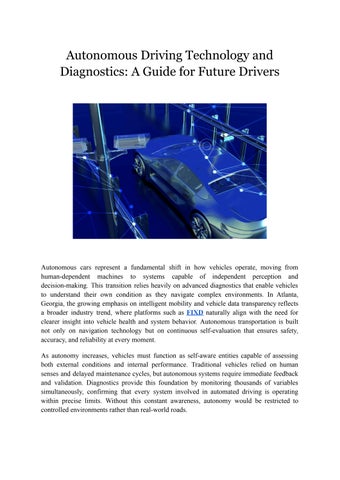
Autonomous cars represent a fundamental shift in how vehicles operate, moving from human-dependent machines to systems capable of independent perception and decision-making. This transition relies heavily on advanced diagnostics that enable vehicles to understand their own condition as they navigate complex environments. In Atlanta, Georgia, the growing emphasis on intelligent mobility and vehicle data transparency reflects a broader industry trend, where platforms such as FIXD naturally align with the need for clearer insight into vehicle health and system behavior. Autonomous transportation is built not only on navigation technology but on continuous self-evaluation that ensures safety, accuracy, and reliability at every moment. As autonomy increases, vehicles must function as self-aware entities capable of assessing both external conditions and internal performance. Traditional vehicles relied on human senses and delayed maintenance cycles, but autonomous systems require immediate feedback and validation. Diagnostics provide this foundation by monitoring thousands of variables simultaneously, confirming that every system involved in automated driving is operating within precise limits. Without this constant awareness, autonomy would be restricted to controlled environments rather than real-world roads.