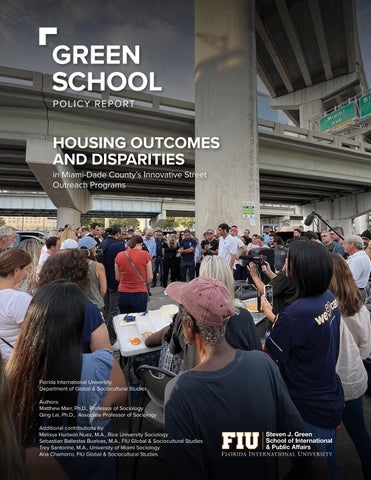
HOUSING OUTCOMES AND DISPARITIES
in Miami-Dade County’s Innovative Street Outreach Programs
Florida International University Department of Global & Sociocultural Studies
Authors:
Matthew Marr, Ph.D., Professor of Sociology
Qing Lai, Ph.D., Associate Professor of Sociology
Additional contributions by:
Melissa Hurtado Nuez, M.A., Rice University Sociology
Sebastian Ballestas Buelvas, M.A., FIU Global & Sociocultural Studies
Trey Santorine, M.A., University of Miami Sociology
Ana Chamorro, FIU Global & Sociocultural Studies
Please scan the
Acknowledgments
We are tremendously grateful to the staff and clients of the street outreach programs who have taken the time and effort to allow us to conduct observations and interviews. We admire and are inspired by their life-saving work. We thank the staff of the Miami-Dade County Homeless Trust for facilitating our research and their efforts to support innovative street outreach. We are also very appreciative of the National Alliance to End Homelessness’s support of this project, and their commitment to the goal of ensuring that everyone is housed countrywide.
Abstract
This report examines housing outcomes and disparities associated with three innovative street outreach programs in Miami-Dade County between 2023 and 2025. Two programs received funding through the U.S. Department of Housing and Urban Development’s Unsheltered Special Notice of Funding Opportunity (SNOFO), while a third relied on a mix of public and private support. Drawing on several months of observation and interviews with outreach staff and clients, as well as analysis of 10,795 street outreach episodes recorded in the County’s Homeless Management Information System (HMIS), we compare these programs to traditional outreach programs across three outcomes: permanent housing placements, time to placement and returns to homeless services.
All innovative programs outperformed traditional outreach in higher rates of permanent housing placement and lower returns to homeless services, and two of three had faster placements in permanent housing. The assertive outreach program achieved the highest and fastest rates of placement, largely through use of shared housing and relocation, but also showed some evidence of comparatively higher overall returns to homeless services. The lived experience program, staffed entirely by individuals with lived experience of homelessness or behavioral health challenges, produced strong placement outcomes with the lowest returns from permanent housing, bolstered by provision of aid after placement. The housing-focused program, which included the most robust long-term care, produced the next lowest returns to homeless services from permanent housing, despite more modest placement rates.
Significant racial, ethnic and gender disparities persisted across the system. Black clients had a lower net probability of permanent housing placement, took longer to place in permanent housing and had a higher net probability of returning to homeless services. It took longer to place women in permanent housing, and they were slightly more likely to return. Disparities varied widely by program, suggesting that staff composition and geographic focus shape inequities in housing outcomes, and that programs can learn from and complement each other’s cultural sensitivities.
The findings highlight the promise of outreach innovations, particularly when paired with expanded housing resources. They also underscore the need for a targeted universalism approach, including strategies to improve outcomes for all groups and reduce persistent disparities in pathways from unsheltered homelessness to stable housing.
Executive Summary
This report analyzes the housing outcomes and disparities associated with three innovative street outreach programs in Miami-Dade County. Two of the outreach programs were provided with special funding by the U.S. Department of Housing and Urban Development beginning in 2023 (from a source often referred to as the Unsheltered Special Notice of Funding Opportunity, or “Unsheltered SNOFO”), and a third program has used a mix of private and public funding.
First, we draw on several months of observation and interviews among the three outreach programs between 2023 and 2025 to succinctly characterize their distinguishing innovations and approaches. Although there is substantial overlap, the three organizations can be categorized as emphasizing particular approaches to street outreach, including being housing focused, rooted in lived experience, and assertive in placing the unsheltered in housing. Some of the specific innovations they have employed are adding a housing navigator to the housing-focused program, creating a program entirely composed of staff with lived experience, and using assertive placements in shared housing and relocations. We also consider other aspects of these organizations, especially the geographic area covered and the ethnic and racial composition of staff. The housing focused program operated county-wide and had a multiracial and multiethnic staff, the lived experience program was focused on suburban areas and had a non-Hispanic and Hispanic White staff, and the assertive program concentrated on the urban core and had a Hispanic White staff.
Second, we analyze local Homeless Management Information System (HMIS) data from all street outreach programs in the County from January 1, 2023, to December 4, 2025 (10,795 episodes), to understand how these varying approaches to street outreach shape three different housing outcomes—housing placements, time to placement and returns to homeless services. We also examine variations in these housing outcomes by race and ethnicity and gender, considering impacts of age, disability and veteran status. We compare the three innovative outreach programs and an additional program funded by the Unsheltered SNOFO but not included in our qualitative research to all other “traditional” outreach programs in the County.
We find that all three innovative outreach programs have more positive housing outcomes than traditional outreach. As shown in Figure 1, the three programs, as well as the other SNOFO program, place people in housing at higher rates than other, traditional outreach programs.
Figure 2 shows that two of the three innovative programs, and the other SNOFO program, had faster moves to permanent housing than traditional housing programs.
Figure 3 shows that all three of the innovative programs, and the other SNOFO program, had lower levels of returns to homeless services than traditional street outreach.
The three innovative outreach programs produced different housing outcomes, demonstrating the varying potential of innovations like shared rental housing, lived experience, housing navigation and long-term case
Fig 3. Returns to
management. The assertive outreach program had the highest percentage of permanent housing placements at the fastest rate among the three innovative programs. Many of these placements were in shared rental housing or relocations to friends and relatives. Returns to homeless services from shared rental housing were low, and most returns to homelessness from relocations are likely undetected in the data. But among placements in rentals with subsidy, for which long-term care was transferred to another organization, the assertive program had high levels of returns to homeless services compared to other innovative programs. The lived-experience program had the second highest placements in permanent housing and the lowest level of returns to homeless services from permanent housing, likely bolstered by its peer support after placement. However, permanent housing placements took longer than traditional outreach, possibly due to the newness of the organization. The housing-focused program had the lowest level of permanent housing placements, yet these were at the second fastest rate of the three organizations. The housing-focused program also had the second lowest rate of return to homeless services from permanent housing, also likely supported by its long-term case management.
Additionally, the scale and geographic focus of outreach seem to influence housing placements. The lower placement in permanent housing by the housing-focused group was possibly influenced by the large scale and the broad geographic focus of its operations. By recording the most episodes and working across the entire county, staff may have been stretched thin with high caseloads over a wide geographic area, making it difficult to maintain contact and causing many episodes to be recorded as moving to a place not meant for habitation. As the lived experience and assertive outreach programs expand in number-served and geography, planning and coordination should account for potential impacts on staff ability to produce permanent housing placements. As demands on outreach workers increase, efforts to reduce pressure and retain experienced staff, such as competitive compensation and fostering worklife balance, are essential.
For all outreach projects in Miami-Dade County, there were racial, ethnic and gender inequalities in housing outcomes, most starkly to the disadvantage of Black people experiencing homelessness, calling for more commitment to equity. Net of other characteristics, episodes with street outreach teams were less likely to end in permanent housing, took longer, and were more likely to result in a return to services for Blacks compared to Whites. Net of other variables, placement in permanent housing took longer for women than men, and women were moderately more likely to return to services. Additionally, there were net disadvantages for non-veterans compared to veterans, for people with disabilities compared to those without, and for older people compared to younger people, except for those over 65 years of age when public assistance is more readily available.
Innovative outreach program staff ethnic and racial composition and geographic area shape the demographics of populations served and racial and ethnic inequalities in housing outcomes. In particular, the assertive program, which had an all-Hispanic White staff, served a population that was disproportionately Hispanic and White, young and female (although still majority male). This program focused on the urban core, where many migrants tend to gravitate due to concentration of transportation, economic opportunities and other resources. Additionally, the assertive program produced higher likelihood for placement in permanent housing for Hispanics than non-Hispanics (Figure 4), for Whites than Blacks (Figure 5) and for men than women (Figure 6). There were similar demographic disparities for returns to homeless services from permanent housing. These ethnic and racial disparities reversed smaller and opposite tendencies in the other outreach programs, but the assertive program’s gaps were the largest for any demographic group among the three innovative programs. This shows the effectiveness of cultural sensitivity for Hispanics, Whites, and men, but less effectiveness for other groups.
The lived-experience program, with a non-Hispanic and Hispanic White staff targeting suburban areas, stood out
Fig 4. Net probability of
Fig 5. Net
Fig 5. Net probability of
Fig 6. Net probability
Fig
Fig
by serving a population that was disproportionately White with high levels of disabling conditions and long-term homelessness. Its housing outcomes were somewhat more favorable to non-Hispanics than Hispanics, Blacks than Whites and women than men. These disparities were lower than those of the assertive program, and possibly attributable to the substantial presence of non-Hispanic Whites on the lived experience program’s staff.
The housing-focused program, with a multiracial and multiethnic staff covering the entire county, served a population that was more non-Hispanic and Black than any other organization. The housing outcomes of the housing-focused group showed small advantages for non-Hispanics, Blacks and women. The higher level of service to and housing outcomes for Blacks could be driven by the presence of Black outreach workers on staff, as well as coverage of low-income, predominantly Black neighborhoods in south, central and north Miami Dade County.
Since racial, ethnic and gender disparities varied across innovative outreach programs and persisted across the system, a targeted universalism approach could help address inequalities. Targeted universalism acknowledges both the need to improve outcomes for all groups, and that disadvantaged groups need targeted assistance to reach the overall elevated goal. For street outreach, this could include further attention to cultural sensitivity for all groups, diversification of staff and collaborations between teams.
Broadly, our analysis demonstrates the effectiveness of innovative street outreach supported by the Unsheltered SNOFO, as well as other innovations, showing a need for further investment in street outreach innovations as well as expanded access to housing resources. Outreach programs do not only need to be more innovative, they also need access to more housing resources. Use of shared housing shows some promise in quickly moving people off the streets in a durable way but
needs more diverse cultural sensitivity to meet the needs of all groups.
Key data points
• Two innovative street outreach programs had placements in permanent housing destinations that were over two (lived experience approach at 13.5%) and six (assertive approach at 33.0%) times higher than traditional outreach programs (5.1%).
• The assertive street outreach program placed people in permanent housing destinations at a pace three times (32.9 days) faster than traditional street outreach (101.3 days).
• The lived-experienced outreach program had relatively high placements in permanent housing (13.5%), especially rental with subsidies (7.1%), and the lowest levels of returns to homeless among these groups (8.3% and 10.5% respectively).
• After controlling for other factors, in comparison to Whites, Black people experiencing homelessness are 16.2% less likely to be placed in permanent housing, wait significantly longer to enter permanent housing, and are 12.1% more likely to return to homeless services from permanent housing.
• The racial and ethnic disadvantages for Blacks across all street outreach episodes were countered by two innovative street outreach programs. The housing-focused program, with a multiracial and multiethnic staff, produced a small advantage (1%) in the net probability of permanent housing placements for Blacks over Whites. The lived-experience program, with a non-Hispanic White and Hispanic White staff, produced a larger (7%) advantage in the net probability of permanent housing placements for Blacks over Whites.
• In the entire sample, placements in all categories of permanent housing were 54% less likely to return to homeless services than placements in shelter, of which 87% result in returns.
Introduction
In 2023, the Miami-Dade County Homeless Trust (the Trust) was awarded competitive funding from the U.S. Department of Housing and Urban Development through a Special Notice of Funding Opportunity aimed at reducing unsheltered homelessness, commonly referred to as the “Unsheltered SNOFO” (Hanks 2023). Of the $315 million nationwide investment, Miami-Dade County’s $21 million, spread over three years, was the largest grant for a metropolitan area. These funds were targeted to address elevated levels of unsheltered homelessness and included support for street outreach innovations, housing vouchers and programs, and technical assistance. Housing assistance to the County included approximately 116 Stability Vouchers, which had more flexible paperwork requirements and allowed organizations to select clients to be assigned vouchers. Technical assistance supported targeted aid to “cohorts” of specific geographic or demographic groups, which emphasized provision of permanent housing assistance over longer periods of time rather than abrupt sweeps. Also, local governments, including the County, the City of Miami and the City of Miami Beach together contributed approximately $40 million to be used to purchase properties to increase the housing supply dedicated to addressing homelessness. While not sufficient to house everyone experiencing unsheltered homelessness in Miami-Dade County, these and other resources provided a surge of assistance and an opportunity to help growing numbers of people facing
homelessness amid skyrocketing rents in the wake of the Covid-19 pandemic.
To understand the impacts of these investments, especially in innovative street outreach, we (Marr, PI and Lai, co-PI) were awarded funding from the National Alliance to End Homelessness to conduct a study entitled “Equitable Pathways from Unsheltered to Housing: A Mixed Methods Participatory Study of Street Outreach Innovations in Miami-Dade County.” Other components of the research include observations and interviews with street outreach staff and clients and a PhotoVoice project with people who have recently moved from unsheltered homelessness into housing in the county.
In this report, we analyze the housing outcomes of three innovative street outreach organizations, two supported by the Unsheltered SNOFO and another by local public and private sources. In the first part of this report, we draw on our observation and interviews with street outreach teams to summarize their innovations. Although there are substantial overlaps, we categorize the organizational approaches as primarily centered on one of three different approaches to street outreach—being housing focused, rooted in lived experience, and assertive in securing housing for the unsheltered. The organizations also vary in terms of geographic focus and racial and ethnic diversity of staff. The housing-focused program is county-wide with a multiracial and multiethnic staff, the lived-experience
program is suburban with a non-Hispanic White and Hispanic White staff, and the assertive program is focused on the urban core with an entirely Hispanic White staff.
Then, in the second part of this report, we show how these innovative outreach programs and their approaches have produced different housing outcomes for their clients. We also compare them with traditional street outreach programs in Miami-Dade County and with another innovative street outreach program that was funded by the Unsheltered SNOFO, but which we did not observe. To do so, we analyze data from Miami-Dade County’s Homeless Management Information System (HMIS), which tracks persons through the local system of aid to address homelessness, from January 1, 2023, to December 1, 2025. Given the personal and social costs of homelessness, we are particularly interested in how the three street outreach programs create pathways to housing that are expedient and durable. Therefore, we examine how outreach programs characterized by specific innovations produce three different housing outcomes— housing placements, time to permanent housing and returns to the local homeless aid system.
Drawing on the approach of targeted universalism (powell, Menendian and Ake, 2022), we recognize the importance of improving housing outcomes for all people experiencing homelessness in Miami-Dade County, but also the need to focus on disparities among groups to better assess how to lift their outcomes up to a higher standard. To address our concerns about pathways to housing that are equitable, we pay special attention to racial, ethnic and gender variations in the populations served and disparities in their housing outcomes. We also pay attention to other important factors such as age, disability, length of homelessness and veteran status.
We address the following questions and sub-questions with our quantitative analysis.
1. How do street outreach programs vary in producing permanent housing placements?
a) How do the populations street outreach programs serve vary in terms of race, ethnicity and gender?
b) How do housing placements from all street outreach vary by race, ethnicity and gender?
c) How do street outreach programs vary in permanent housing placements by race, ethnicity and gender?
2. How do street outreach programs vary in the length of time to permanent housing placements?
a) How does the length of time to permanent housing placements for all street outreach episodes vary by race, ethnicity and gender?
3. How do street outreach programs vary in returns from permanent housing to the local system of aid?
a) How do returns to homeless services from permanent housing for all street outreach programs vary by race, ethnicity and gender?
b) How do street outreach programs vary in returns to homeless services from permanent housing by race, ethnicity and gender?
Section 1.
Categorizing Innovative Street Outreach Teams
Table 1 depicts characteristics of the three outreach teams that are the focus of our study. Two organizations, housing focused and lived experience, were selected because they received funding from HUD through the 2023 Unsheltered SNOFO to implement outreach innovations. The assertive organization did not receive this funding but was selected for this study because of its high level of involvement in street outreach in downtown Miami, the county’s highest concentration of unsheltered homelessness. Their work has included helping people living unsheltered apply for and use vouchers made available by the Unsheltered SNOFO.
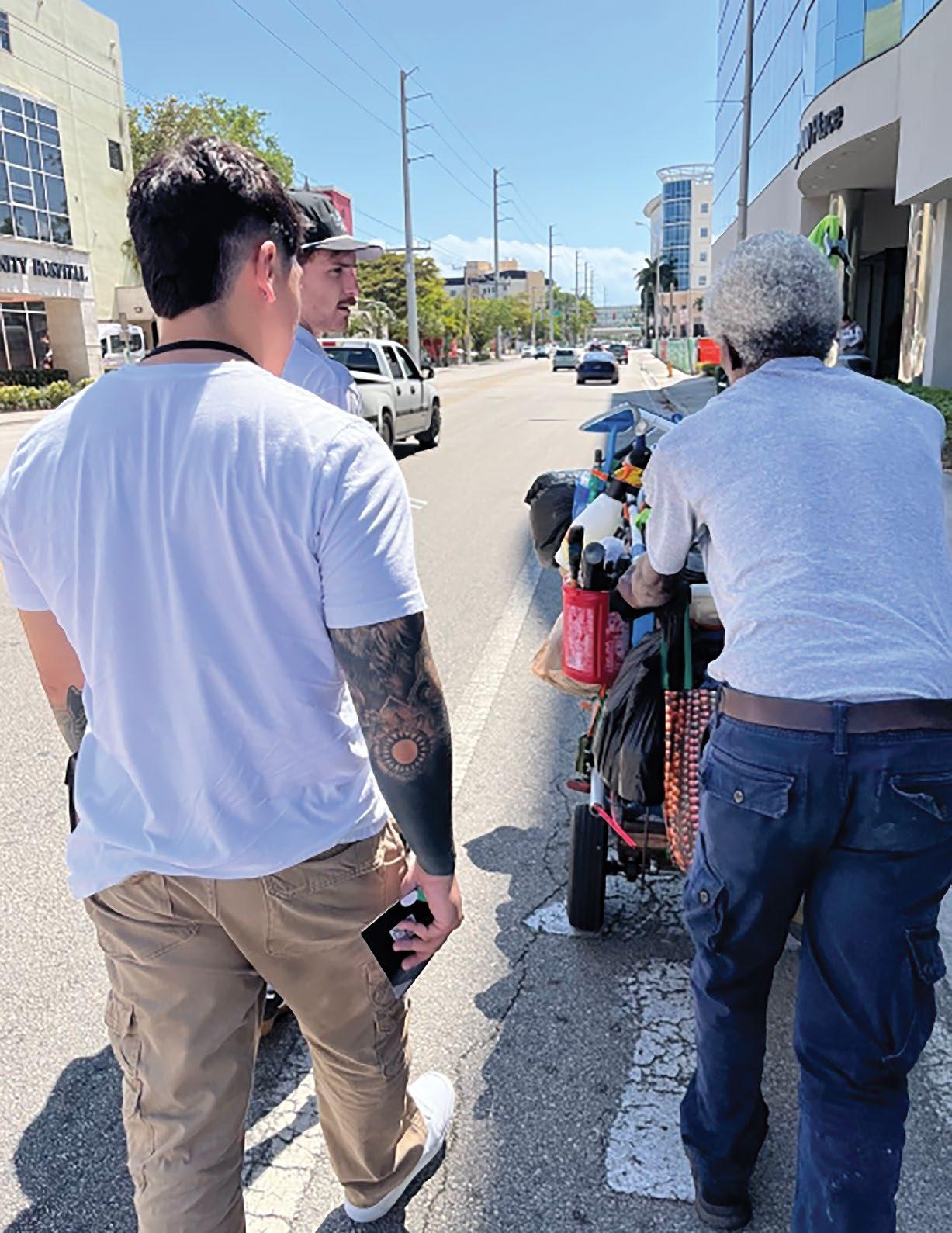
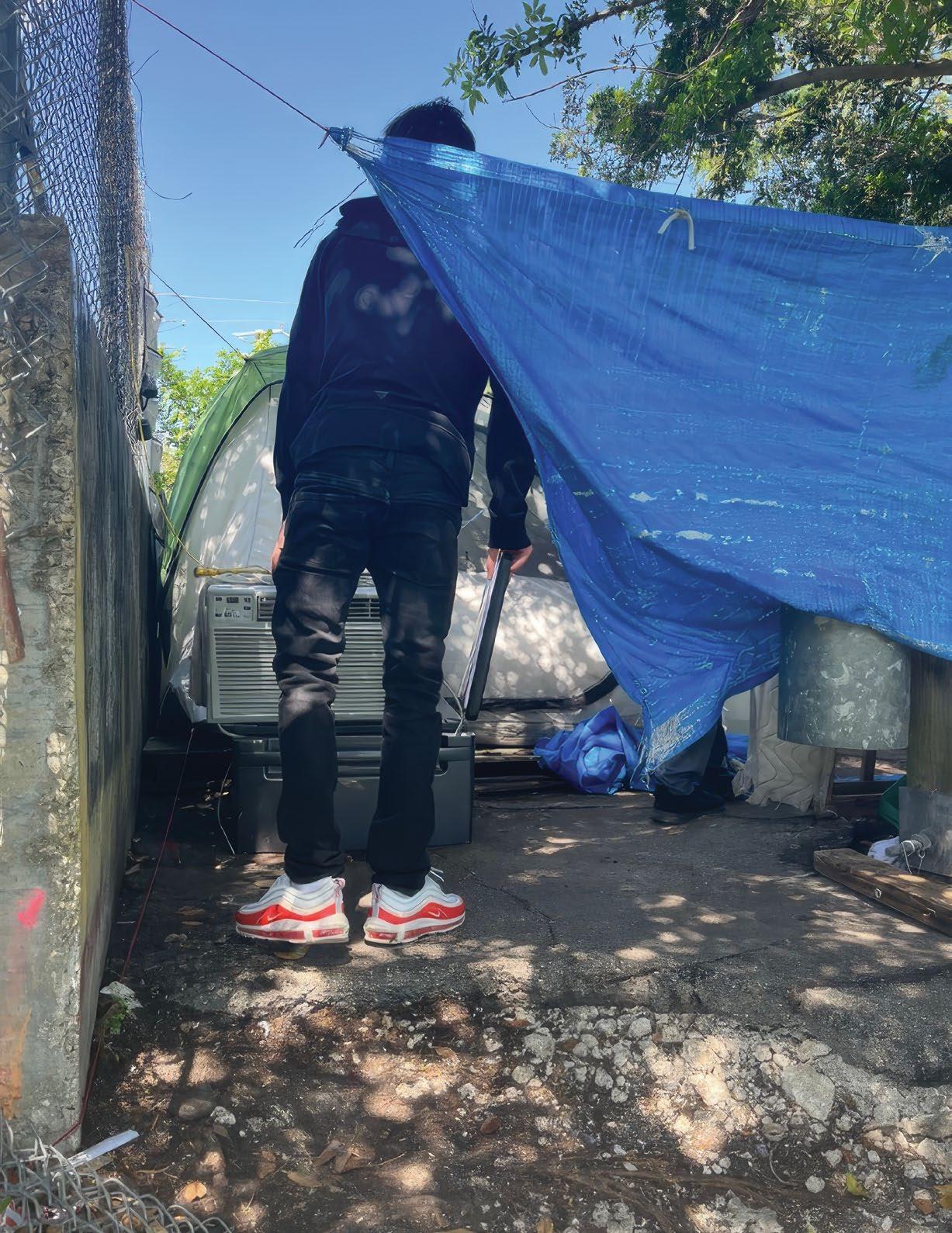
Between the Fall of 2023 and the Fall of 2025, this project’s principal investigator (Marr) and three graduate research assistants (Hurtado, Santorine and Ballestas Buelvas) collectively observed outreach activities of each of these three organizations at least 15 times, resulting in more than 100 hours of observation and over 100,000 words of field notes. Also, we conducted semi-structured interviews with five to twelve staff and clients of each organization. To gain understanding of perspectives outside of formal street outreach, we also observed at large group feedings and interviewed five people living unhoused who were not clients of any of the outreach teams. Two graduate researchers bilingual in English and Spanish (Hurtado and Ballestas Buelvas) conducted observation and interviews in Spanish, appropriate given Miami-Dade County’s large Spanish-speaking population. Another English and Spanish bilingual research assistant
(Chamorro) assisted in preparing interview transcripts for analysis. In this report, we draw on this qualitative research to broadly differentiate how each outreach team applies its innovations and approach. Future analysis will focus on other dynamics of street outreach in more depth with this rich qualitative data.
Each outreach team in our analysis is using some combination of innovative capacities and practices—staff with lived experience of homelessness and substance misuse, staff with other cultural competencies like Spanishlanguage ability and co-ethnicity with clientele (especially identifying as Black or African American), staff with specific professional experience such as being a real estate agent or a licensed counselor, intensive technical assistance, an assertive approach combined with private funding and shared housing, and long-term case management after housing. Depicting each organization as using a single, distinct approach is also complicated by local efforts to improve street outreach, which include collaborations among these groups to share best practices. While not perfectly delineated, each of the three organizations can be described as exemplifying a particular innovative approach—being housing focused, rooted in lived experience, or assertive in securing housing. Other important variations in the organizations that likely shape their housing outcomes include geographic focus (entire county, suburbs or the central core) and ethnic and racial diversity of the outreach teams.
Table 1. Characteristics of Innovative Street Outreach Organizations During
Observation
Org 1 Housing focused Yes 10-17
Housing navigation, technical assistance, lived experience Hispanic White, Black/ African American, Non-Hispanic White
Org 2 Lived experience Yes Less than 5 to 10 Lived experience non-Hispanic White and Hispanic White
competent
Org 3 Assertive No
Less than 5 to 10
ORGANIZATION 1: HOUSING FOCUSED
competent
Assigned 75 County-wide (Miami-Dade County)
but increasing Did not assign
Private funding, shared housing, relocation Hispanic White Predominant Moderate and increasing Did not assign, supported applicants
According to national best practices, housing focused street outreach is “an engagement strategy that prioritizes connecting people experiencing unsheltered homelessness to lifesaving, person-centered, and culturally responsive services and resources while actively working towards securing stable and permanent housing solutions” (National Alliance to End Homelessness, 2025:4). Although founded as a residential treatment facility, this organization has conducted street outreach in Miami-Dade County for the longest time of the three organizations in this study. In 2015, the organization developed its housing-first approach to street outreach, de-emphasizing benchmarks for housing readiness and focusing on moving clients into housing as soon as possible, while still using treatment and shelter as interim housing. In 2019, it added a Critical Time Intervention (CTI) component which includes nine months of follow-up case management and services after housing. With the funds from the SNOFO, the organization hired a real estate agent to work with the outreach team by
Suburban, Southwest Miami-Dade County (Kendall, South Miami, etc.)
Urban core, Downtown Miami (later City of Hialeah)
providing housing navigation, further enhancing its housing focused approach.
Given the organization’s high level of outreach activity, the Trust provided it access to flexible housing vouchers made available in Miami-Dade County through the Unsheltered SNOFO. This organization had access to 75 housing vouchers, including 39 Stability Vouchers, from the fall of 2023. Stability vouchers are housing vouchers that are more flexible than those usually used to house persons experiencing homelessness (Emergency Housing Vouchers), with Public Housing Authorities (PHAs) easing requirements for documentation (allowing photographs of documents, processing applications before some documentation is provided, etc.). In MiamiDade County, in some cases these vouchers did not require documentation of chronic homelessness (having a disability and being homeless for a year or four occasions in the past three years). The program director who oversaw the allocation of the 75 vouchers described them as “game changers” given the ability of staff to identify
clients who struggled to obtain traditional rental subsidies, often project based, and refer them to coordinated entry to be assigned the vouchers. This allowed outreach workers to avoid long waiting times in applying for housing subsidies.
Relatedly, in the period of observation, the organization was a “go-to” resource for the Trust’s targeted efforts to address unsheltered homelessness. In early 2024, intensive technical assistance was provided to the Trust to address encampments. This technical assistance, provided by a national provider of housing assistance after disasters, was used to house people living in encampments and targeted populations that had been difficult to serve. So, the housing-focused program worked closely with technical assistance in efforts to house specific “cohorts” in Miami-Dade County, as identified by the Trust. This process involved technical assistance providers identifying bottlenecks in the housing process, working with outreach workers to come up with ways to address them and sharing this knowledge with other outreach teams. In some instances, the cohort approach included use of the vouchers allocated to the organization or collaborating organizations, which helped move people directly and rapidly from unsheltered homelessness into housing. This approach was implemented at two encampments and with a cohort of high utilizers of the local public hospital. Other cohorts were planned during the period of observation but were cancelled, likely due to the loss of federal technical assistance at the beginning of 2025. While these targeted outreach efforts make up a small portion of the housingfocused program’s efforts, it has played a key role in their implementation, and its participation has served to enhance its housing-focused approach.
Enabled by its somewhat larger size (10 to 17 outreach staff during our observation), its possession of multiple vans and its close working relationship with the Trust, the housing-focused program conducts outreach and case management throughout the entire county. Its main offices are in South Miami-Dade, but outreach teams work daily in areas ranging from the rural City of Homestead,
inner suburban areas such as the City of South Miami, and central urban areas such as Liberty City, Downtown Miami and the City of Miami Beach. It has a formal working relationship with the City of Miami Beach and the City of South Miami.
The housing-focused team is the most racially and ethnically diverse of the three covered in this study. During our observation and interviews, the housingfocused program was the only outreach team with African American or Black outreach workers (including a Haitian American who spoke Creole and a Spanish-speaking African American worker) on staff. The housing focused program’s other outreach members were primarily Hispanic White. Nearly all Hispanic staff were bilingual in Spanish and English. Around half of staff were men and the other half women. Most of its outreach workers were young, in their 20s, with a few in their 30s and 40s and one who was 60 years old. The organization also had many outreach staff with lived experience of homelessness and substance misuse and other mental health issues.
ORGANIZATION 2: LIVED EXPERIENCE
The second organization is similar in many ways to the first in its housing-focused approach, but it is smaller and less integrated into the local Continuum of Care. Although the housing focused program has a similarly high number of persons with lived experience on staff, for Organization 2, lived experience is more embedded in its philosophy and identity. The organization is deeply committed to the idea that people with direct experiences of homelessness and mental health issues have unique insights and capacity to build trust with clients and help them secure housing and improve their lives. It received funding from the SNOFO to provide outreach services with staff who have lived experience of homelessness. All the program’s outreach staff have lived experience of homelessness, substance misuse or other mental health issues. It was founded as a recovery
community organization (RCO) focused on providing community-based peer support to persons recovering from substance misuse and other mental health issues. Since many of its clients also experienced homelessness, it began conducting street outreach and eventually began working with the Miami-Dade County Homeless Trust in 2023. The organization applies its RCO approach in providing several months of services after placement in housing. The SNOFO funding was its first major grant through the Trust and provided an opportunity to work more closely with the local Continuum of Care.
One major distinction from the housing-focused program is that, due to its newness and early internal administrative issues, the lived-experienced program has been later in scaling up its outreach team. First, likely because it had not been fully integrated into the local Continuum of Care, the lived-experience program was not provided direct access to Stability Vouchers. Thus, they did not have the capacity to choose clients for whom they would pursue the vouchers as was the case for the housing-focused program in late 2023. Then, in the beginning of 2024, the organization temporarily paused outreach efforts due to administrative issues. Thus, they were not involved in the early “cohorts” or targeted housing efforts led by the Trust.
But by the Fall of 2024, the organization had resumed street outreach and was collaborating more with the Trust. Like the other innovative outreach programs in this study, it was assigned an area to cover for a newly developed “homeless reporting tool.” This internal tool was created by the County to respond to an anticipated increase in reports of unhoused people sleeping in public and private spaces with the implementation of the state’s anticamping legislation (Florida HB 1365). The lived-experience program staff began training to work with the Trust to house a “cohort” of unhoused people in Miami Beach, until those efforts were abruptly terminated in early 2025. In late summer of 2025, it nearly doubled its staff and further expanded its outreach and long-term case management.
The lived-experience program’s geographic focus has expanded but has been far more limited than the housing-focused program. Originally, the organization focused on inner suburban areas such as Kendall and the cities of South Miami, Pinecrest and Coral Gables. The organization formalized a working relationship with the City of South Miami to provide street outreach and to work with the city police department’s homeless outreach coordinator. With their expansion of staff, they have extended their outreach efforts to focus on the entire county, including Downtown Miami and North Miami. The organization’s expansion has enabled them to purchase an SUV for outreach, but during our observation staff often used their own cars or the director’s car.
All lived-experience program outreach workers we encountered during our observation and interviewing had lived experience of homelessness or behavioral health issues. Also, about half of the lived-experience program’s staff were Certified Recovery Peer Specialists (CRPS), a Florida certification for people with lived experience of mental health challenges, including substance misuse, to help people effectively draw on personal experience when aiding others in recovery. This training includes modules on recovery support, advocacy, mentoring and personal responsibility, and covers cultural and linguistic competence, motivational interviewing and trauma informed care.
It is important to note that both the CRPS program and the organizations in this study view lived experience in broad terms. This includes the lived experience of having family members who have grappled with homelessness or substance misuse and other mental health issues. In both the housing-focused and lived-experience programs, three of ten outreach staff had lived experience of homelessness, having lived in shelters, cars or places not meant for habitation. However, none had been unsheltered for long periods of time, nor had they been chronically homeless. Most outreach staff in both organizations who had lived experience had either
experienced substance misuse and other mental health issues or had a relative who had such experiences.
Also, the lived-experience outreach team staff differed from the housing-focused team in terms of race and ethnicity. The lived-experience team was majority Hispanic White, and nearly all staff were bilingual in English and Spanish, but leadership and other members were non-Hispanic White with limited or no Spanish ability. It had no African American or Black outreach staff during our observation and interviews. In comparison to the housing-focused program, it had a slightly larger presence of non-Hispanic Whites and men on its staff. Like the housing-focused program, staff of the livedexperience program were in their 20s, with a few in their 30s and 40s.
ORGANIZATION 3: ASSERTIVE
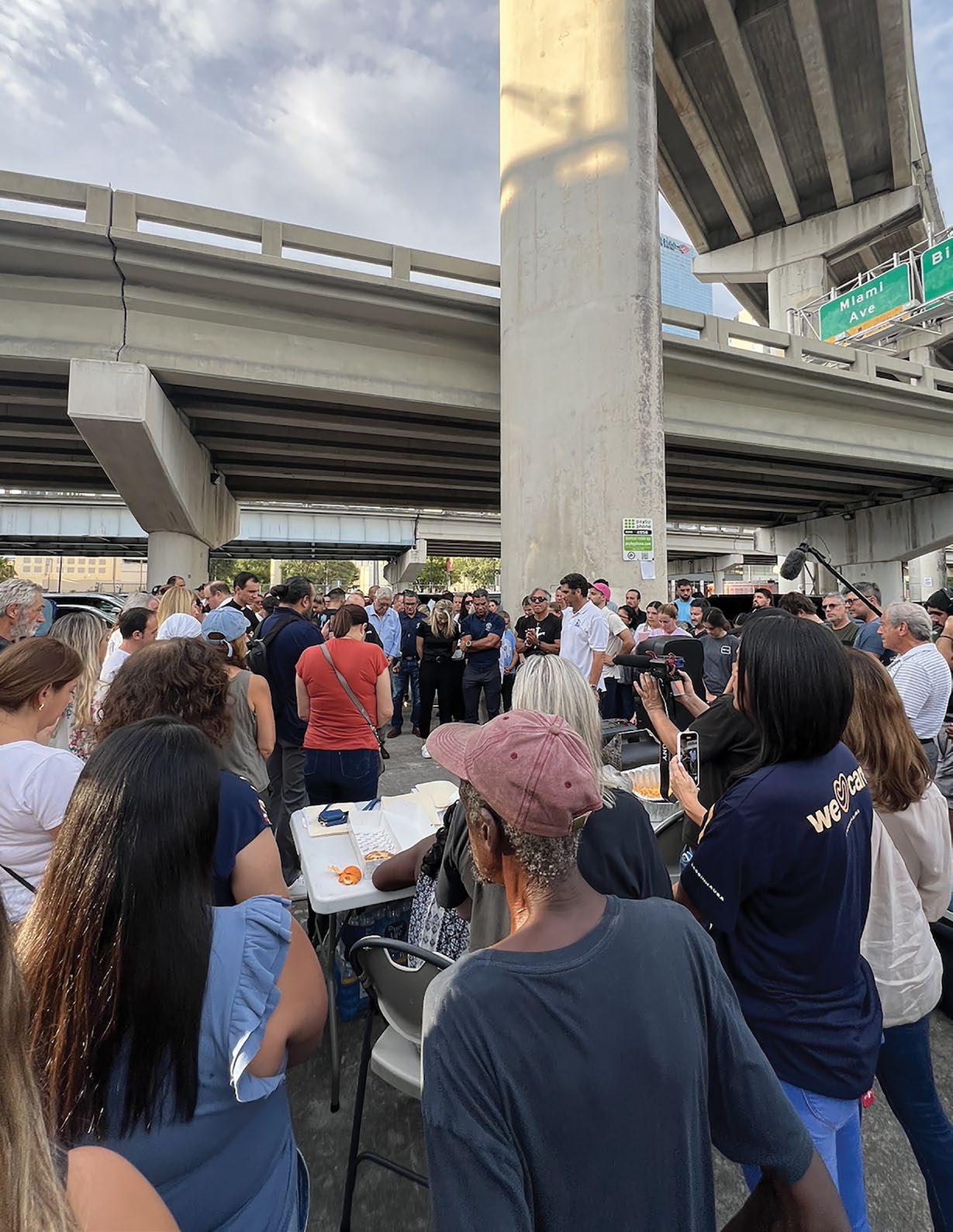
This organization originated with a couple and their children handing out food in Downtown Miami on Friday nights. Their activities expanded to include volunteers from their Catholic congregation, and they incorporated as a nonprofit organization. They were approached by the Trust, which funded them starting in 2021. They did not apply for outreach funds in the Unsheltered SNOFO but, given their high levels of street outreach in the Downtown area, they were brought in to help the SNOFO-funded organizations with outreach and case management. This included helping some clients who had been assigned Stability Vouchers by other organizations and providing some aid in the Trust’s cohort efforts. They continue their biweekly Friday evening “Love Attack” with large numbers of volunteers and have become a core contributor to Miami-Dade’s Continuum of Care.
The director of the organization used the term “intrepid” to describe how they aggressively pursue resources for clients, working all hours of the day, attempting to deliver aid as quickly as possible, with compassion as
a core practice. The two other organizations also made considerable efforts to assist their clients. Although this organization does take a housing-focused approach and does have a staff member with lived experience, it differs from the other two organizations largely in how it has assertively sought out new opportunities to provide housing, shelter and other forms of aid to the unsheltered. One example of what could be called an entrepreneurial approach is the use of shared housing for people who have an income and refrain from using drugs or alcohol. Using private funding, they have rented 26 houses in which approximately 170 people live at a given time. Residents pay $450 per month in rent and receive case management services. These include homes for pregnant women and their children. Around 75% of costs is paid with resident rent, and the remainder by private funds, which has included contributions from an annual gala hosted by the mayor of the City of Miami. This organization also is very active on social and traditional media and has coordinated events such as fundraisers and a “Night of Compassion” (conceptualized as a “giant Love Attack”) that brought in various outreach teams, the City of Miami Police Department, the City of Miami mayor and many volunteers for a night of targeted outreach and engagement.
The assertive program helps unhoused clients it engages in street outreach pursue housing first opportunities such as Rapid Rehousing and Permanent Supportive Housing, as well as interim shelter. However, compared to other organizations, it has a more assertive approach towards getting people out of unsheltered situations immediately. In our observations, volunteers gathered outside a marble-covered church in Key Biscayne for a brief orientation before heading to Downtown Miami for the Love Attack. The volunteers, who are primarily Catholic congregants including high school students, were told by an organization leader with urgency, “What we do today, has to be done today.” Volunteers were encouraged to ask unsheltered people they encounter about whether they have a relative in another city to take
them in. While other organizations also use a program to relocate people after confirmation that a relative or friend has a place for them, this organization is unique in its assertive use of relocation. The organization also has developed relationships with organizations that help relocate migrants, including to out-of-state employers facing labor shortages.
The assertive program’s main geographic focus of outreach has been the largest clusters of unsheltered homelessness in Downtown Miami around Government Center, and at the edges of the nearby neighborhood of Overtown. However, they have recently expanded their outreach through a formal arrangement with the City of Hialeah, a predominantly Hispanic inner suburban community, and they have provided supportive services for a hostel-turnedemergency shelter in the City of Miami Beach.
In our observation and interviewing, the assertive housing program’s staff was entirely Hispanic White. While all staff also speak English, many staff have immigrated to the U.S. and Spanish is the language most used in organization activity. Thus, they have a very strong capacity for cultural responsivity towards Hispanic immigrants, a sizeable group among Downtown Miami’s unhoused. Compared to the other organizations in this study, there tend to be more women on staff and staff is generally older (a few in their 50s and 60s), although they have added younger outreach workers recently. Staff across all three organizations mentioned spiritual and religious motivations for their individual work, and the housing-focused organization had spiritual messages on its t-shirts. But religion is perhaps most visible in the assertive program’s biweekly outreach efforts with Catholic volunteers (praying with unhoused people they encounter and handing out rosaries, for example), although perhaps less so in the day-to-day efforts of staff.
Section 2.
Homeless Management Information System (HMIS) Data Analysis of Housing Outcomes from Street Outreach
Next, we analyzed all street outreach entries to the Miami-Dade County HMIS from January 1, 2023, to December 4, 2025, to understand the housing outcomes for street outreach programs during the period of the Unsheltered SNOFO, which began providing resources to these outreach teams in the fall of 2023.
The three organizations operate a variety of programs within the local Continuum of Care and thus have multiple projects in to which people are enrolled in HMIS. Instead of including all the projects associated with each organization in our analysis, we narrowed our analysis to focus on their street outreach (SO) projects. This includes “follow up” street outreach projects in which clients are receiving longer-term assistance from the three innovative organizations after a shelter or housing placement. We also included the outreach project of the SNOFO-funded street outreach organization that we did not observe (which we call the other SNOFO program).
We assessed these four organizations’ effectiveness broadly by comparing them to all other street outreach programs in Miami-Dade County’s HMIS data, which we refer to as traditional outreach.
We focused on three outcomes to explore the extent to which these organizations produce housing outcomes that are higher than all other outreach, as well as to explore how the innovative street outreach programs differ amongst themselves. The outcomes we analyzed are housing placement, number of days to housing placement and returns to homeless services from
permanent housing. We also analyzed variations in these housing outcomes by race, ethnicity and gender, across the system as well as within the innovative outreach projects, controlling for age, disability status, length of homelessness and veteran status.
Our unit of analysis is an “episode” or “spell” in the HMIS system rather than individual-level longitudinal experiences. An episode begins with an entry into a street outreach program and ends with recording of a housing outcome from that episode. Therefore, an individual can have more than one episode within the timeframe of analysis. Between January 1, 2023, and December 4, 2025, 30,297 clients created a total of 70,272 non-same-day enrollments in Miami-Dade County’s HMIS system. About 20% of these enrollments (13,934) were registered with street outreach projects. Cases with missing information for the analytical variables were deleted, resulting in a valid sample containing 10,795 enrollment episodes. If the episode did not conclude with a recorded housing outcome by December 4, 2025, its status was defined as “to be determined” and treated as censored data in survival analysis. However, in analyzing subsequent return to homelessness, the censored episodes were excluded as they were not at risk of returning without a valid exit status by the end of the observational window. Consequently, our analysis of returning to homelessness is based on a smaller analytic sample of 9,488 enrollments.
HOUSING PLACEMENTS
Table 2 presents the housing placements for episodes from the three innovative street outreach programs that are our focus (housing focused, lived experience and assertive), another innovative street outreach program funded by the Unsheltered SNOFO (other SNOFO), and all other outreach programs in the county (which
we call “traditional” outreach). The frequencies for the various housing outcomes reveal distinct patterns among the organizations. First, all innovative street outreach programs have higher percentages of episodes ending in permanent housing (from 5.8% to 33.0%) than traditional outreach (5.1%). Also, all innovative street outreach programs have lower percentages of episodes ending in
Table 2. Housing outcomes by street outreach organization
Source: HMIS (street outreach enrollments in Miami-Dade County between Jan 1, 2023 and Dec 4, 2025).
homeless situations (from 61.0% to 70.7%) than traditional street outreach (77.6%).1 This shows that the innovative street outreach programs produced more moves out of homelessness and fewer homeless exits than traditional street outreach programs.
The assertive outreach program has the highest percentage by far of moves to permanent housing (33.0%), around two and a half times the next highest organization (the lived-experience program, at 13.5%). These two organizations also have the lowest percentages exiting to homeless situations, with the lived-experience program (57.7%) slightly lower than the assertive program (61.01%). The housing-focused program (5.8%) and the other SNOFO outreach program (12.2%), which we did not observe, while still higher than traditional street outreach, have lower rates of moves into permanent housing than the two other innovative outreach programs. Similarly, the housing-focused program (70.7%) and the other SNOFO program (65.3%)
have rates of exits to homeless destinations that are lower than traditional outreach (73.5%), yet higher than the two other innovative outreach programs.
Figure 7 shows that the specific destinations within the broader categories differ across the organizations. The assertive program has a large percentage of episodes ending in people moving into rental housing with no subsidy (11.8% compared to a range of 0.3% to 3.7% for other innovative programs). This is likely due to its assertive and entrepreneurial approach of moving street outreach clients into its shared housing, a resource not available to other organizations. The housing-focused program has shared recovery housing, but clients are required to stay in treatment first, which means they are coded as exiting to an institution and any subsequent move into their recovery shared housing is not recorded in HMIS.
Variation in permanent housing placements across innovative street outreach is also visible in the “with
1 HUD generally considers emergency shelter as a positive outcome for street outreach projects. However, we use a narrower definition of permanent housing destinations and do not include shelter placements, because placement in shelter alone does not end homelessness, as evident later in Table 9, which shows a return rate to homeless services from shelter of 86.5%. In future analyses, we will examine housing outcomes in a way that includes the extent to which shelter placements lead to permanent housing destinations.
Fig 7. Permanent housing placement (percent) by type and outreach program
Fig 8. Probability of return to homeless services from permanent housing by ethnicity and organization
family” and “with friends” permanent categories. Again, the assertive program stands out here, with 9.7% moving in with family, and 4.0% moving in with friends. The other SNOFO program also has relatively high percentages in these categories, with 6.7% moving in with family and 3.0% moving in with friends. These rates are 3 to 5 times higher than the other innovative outreach programs. As noted in Section 1, the assertive program frequently inquires if unsheltered people have relatives or friends in another location who will take them in. If staff can confirm so, they use funding to pay for relocation (usually bus or air travel), and the housing outcome is recorded in HMIS in one of these two categories. The other SNOFO street outreach program operates in a city that has high levels of tourism and is known for assertively relocating people.
The bottom rows of Table 2 show other characteristics of the street outreach episodes that shed light on differences in housing outcomes across the organizations. The assertive housing program has a fast turnaround in producing housing outcomes from street outreach enrollments, with a 23.7-day average episode length. While not presented in the table, 63.5% of the assertive program’s street outreach episodes ended within two weeks. This reflects the organization’s intrepid and assertive approach of providing relocation, shelter or shared housing as soon as possible. The housingfocused program stands out as having the longest time until exit, possibly reflecting challenges emerging from a very large geographic area, or serving a population with distinct disadvantages. Later in this report, we further explore the length of time to housing outcomes and how it varies by organizations and demographic characteristics.
While the assertive approach shows high levels of housing placements and an overall quick turnover rate, this approach also produces a high rate of returns to HMIS homeless projects (61.0%), the highest among innovative street outreach programs, but still slightly lower than traditional outreach projects (62.7%). Additionally, the housing-focused approach had the
lowest percentage of returns (45.2%), followed by the lived-experience program (49.8%). We will also further explore returns to homelessness later in this report.
Demographics and Other Sample Characteristics
Next, Table 3 shows demographic characteristics attributed to the outreach episodes recorded by the various outreach programs. The total percentages of outreach episodes for various demographic groups reflect the extent to which certain groups are vulnerable to homelessness. While Blacks/African Americans make up around 17% of the total county population,2 they account for around 48.1% of all outreach episodes. Conversely, Hispanics make up 70.3% of the total local population, but only 37.4% of outreach episodes. Also, men (69.9%) account for more episodes than women (29.9%) and other gender identities (0.8%).
The data shows that each program tends to serve specific demographic groups more than others. The assertive program, with an entirely Hispanic White staff, stands out with the highest percentage of episodes attributed to Hispanics (50.3%) and females (43.0%), both groups around 10% higher than in any other street outreach program or category. It served a disproportionately White population (53.7%), greater than the total (48.6%) but nearly the same as the lived-experience program (53.6%) and lower than the other SNOFO program (57.6%). The assertive program also has the lowest age at enrollment (41.1 years), driven by a large percentage under 18 (17.4%, not presented in the table), a proportion four times higher than any other organization. This, along with a large percentage of females, suggests a high level of engagement with families. Also, perhaps due to its high level of engagement with Hispanics, who are more likely to be immigrants than non-Hispanics, and with femaleheaded households, it has the lowest percentage of US military veterans (2.2%). In contrast, the housing-focused program, with a multiracial and multiethnic staff covering
2 From the US Census website at https://www.census.gov/quickfacts/fact/table/miamidadecountyflorida/POP060210.
Table 3. Demographic and other characteristics by outreach program
Source: HMIS (street outreach enrollments in Miami-Dade County between Jan 1, 2023 and Dec 4, 2025).
the entire county, including low-income, predominantly Black areas in south, central and northern Miami-Dade County, tended to work with a population that was disproportionately Black (54.4% versus 48.1% of the total).
The bottom rows of Table 3 show the distribution of characteristics related to long-term or chronic homelessness. The assertive program stands out again in having the lowest percentage of spells by people
with self-reported disabling conditions (43.2%) and the largest percentage of episodes by people who are newly homeless (41.6% for one month or less). The livedexperience group had the highest percentage of spells by people with disabilities (77.5%), likely reflecting its high level of engagement with people with substance misuse disorders, and by far the largest percentage (66.3%) with 13 months or more of homelessness at the time of enrollment in an HMIS project.
In sum, the assertive program stands out with high and fast levels of placement into shared housing, relocation, and emergency shelter, but also apparently high levels of return to the HMIS system. Also, it served a population that included larger numbers of Hispanics, Whites and women with children; that was younger; and that included people without disabilities and longterm homelessness, possibly contributing to their positive outcomes. The lived-experience program had the next highest productivity in terms of permanent housing placements while maintaining a low rate of return to homelessness. It did so while serving a disproportionately White population with high levels of disabling conditions and long-term homelessness. The housing-focused approach had lower rates of placement into permanent housing and spells were the longest of all street outreach organizations. But returns to homelessness were the lowest of all organizations. This group serves more Blacks, a population that is less likely to exit homelessness to permanent housing.
To understand if demographic and other characteristics account for the differences in housing placements that appear in Table 2, we applied a multinomial logit model to the data (Appendix Table 1). This model predicts relative odds of the various housing placements (compared to homelessness) by outreach organization, controlling for other variables in the analysis. Table 4 presents the predicted housing outcome probabilities from this model.
The patterns in the descriptive data above hold. Net of demographic and other characteristics, the assertive program has the highest likelihood of exit to permanent housing and lowest likelihood to enter a homeless situation. This shows that its effectiveness is not solely due to differences in population served. It is likely that the assertive approach to relocating and placing people in shared housing is driving its higher housing outcomes. The other tendencies of these street outreach organizations, including the overall higher rate of placement in permanent housing destinations by all innovative street outreach programs compared to traditional outreach, also persist.
Note: The probabilities are predicted based on the multinomial logit model summarized in Appendix Table 1.
Table 4. Predicted housing outcome probabilities by organization
Housing Placements by Demographic Characteristics
To provide context for analysis within the innovative street outreach programs, Appendix Table 2 presents housing placements for all street outreach spells in the county by program, demographic and homeless experience characteristics. These are frequencies by demographic and other characteristics, without controlling for other variables in the analysis. These show clear gaps by ethnicity and race, with more placements in permanent housing for Hispanics (15.9%) than non-Hispanics (11.6%), and for Whites (15.2%) than Blacks (11.5%).3 A similar gap occurs between females (15.7%) and males (12.2%). While not the central foci of this study, there are also advantages for younger people, veterans and people without disabilities. Also, those with longer lengths of homelessness and longer spells in outreach programs are more likely to move into rentals with subsidy, a category that includes permanent supportive housing for people documented with chronic homelessness.
Next, we analyzed how the organizational effects on housing placements depend on clients’ demographic characteristics, including Hispanic ethnicity, race and gender. The analysis is enabled by allowing outreach programs to interact with each demographic variable based on the previous multinomial logit model. To make the interpretation more straightforward, Tables 5-7 summarize the predicted probabilities of various housing outcomes by outreach programs and demographic characteristics, net of other variables used in the models. The findings show variation in housing outcomes by demographics for the programs in this study.
Table 5 presents the housing outcomes for Hispanics and non-Hispanics by program, net of other factors. Again, the assertive outreach program, with an entirely Hispanic White staff, stands out from other organizations,
in this case with more positive housing outcomes for Hispanics, with a predicted probability of 0.349 for entering a permanent housing destination, compared to 0.296 for non-Hispanics. The other innovative street outreach teams show an opposite but smaller tendency, in which non-Hispanics have higher probabilities of exiting to positive housing outcomes than Hispanics.
Table 6 shows housing outcomes by race for each organization. A similar pattern of contrasting racial outcomes is apparent. Whereas other innovative outreach programs produce moderately higher outcomes for Black clients, there is a large racial gap in outcomes for clients of the assertive outreach program, to the benefit of Whites. Within the assertive outreach program, whereas Whites have a predicted probability of exiting to permanent housing of 0.392, Blacks have a predicted probability of 0.263. In other words, among clients of the assertive program, Whites are 13% more likely to exit to permanent housing destinations than Blacks, net of other demographic characteristics. This is the largest racial or ethnic gap in housing outcomes of any organization.
Housing outcomes by gender for each organization are displayed in Table 7. All street outreach programs have higher probability of permanent housing placements for women than for men, except the assertive outreach program. Also, this gap is the widest of all organizations, with a predicted probability of 0.369 for men served by this organization and a predicted probability of 0.260 for women. This could be driven by the assertive use of shared housing, which is predominantly used by men.
In sum, not only do the organizations serve different demographic populations, as shown in earlier Table 3, their outcomes for different groups also vary. For example, the assertive program with a White Hispanic staff serves many Hispanics and women, and Hispanics fare better than non-Hispanics, yet women fare worse
3 Appendix Table 1 shows that for all street outreach episodes in the county, being Black has a statistically significant and substantial negative net effect on the likelihood of being placed in permanent housing compared to homeless situations. Thus, when then this and other effects are controlled, the positive effect of being Hispanic disappears and the negative effect of being Black persists. This is likely due to the tendency of Hispanics in Miami-Dade County to identify as White and the impact of controlling for outreach program in the model.
Table 5. Predicted housing outcome probabilities by organization and ethnicity
Focused
Lived Experience
Other SNOFO
Note: The probabilities are predicted based on the multivariate model with organization interacting with ethnicity.
Source: HMIS (street outreach enrollments in Miami-Dade County between Jan 1, 2023 and Dec 4, 2025).
Note: The probabilities are predicted based on the multivariate model with organization interacting with race.
Source: HMIS (street outreach enrollments in Miami-Dade County between Jan 1, 2023 and Dec 4, 2025).
than men. Also, the assertive program serves a similar proportion of Blacks to other organizations, but their placements for Black clients are much lower than for White clients. These tendencies run counter to the other innovative outreach programs, housing focused and lived experience, which produce smaller but substantial advantages for non-Hispanics, Blacks and women. However, it should be noted that despite the wide disparities, the predicted probabilities for permanent housing outcomes for the assertive program are higher for all ethnic, racial and gender groups.
TIME TO PERMANENT HOUSING
Table 8 shows the average number of days to the various housing destinations by organization. Here, we narrow our focus on time to permanent housing, given the Unsheltered SNOFO’s objective of moving people out of homeless situations into housing as quickly as possible. All but one innovative outreach program (lived experience, 118.9 days) had shorter times to permanent housing than other outreach. The assertive program’s mean time to permanent housing was 32.9 days, followed by the other SNOFO program mean of 50.4 days, a third and a half the length of time of the average for other outreach (101.3 days). The housing-focused program had a shorter length of time to permanent housing (91.1 days) than traditional outreach.
The assertive program’s use of relocations and shared housing seems to impact the program’s time to housing. The assertive program’s destinations that include relocations are the shortest for any category of permanent
housing (14.8 days for with family, and 16.2 days for with friends). Notably, the medians for these categories are very short (4 and 7 days, respectively). Also notable is the assertive program’s short time to rental with no subsidy, which includes shared housing placements, with a mean of 18.2 days and a median of 10 days.
The other SNOFO program, which uses relocations in its tourist area, also has very short averages to living with friends, with a mean of 11.8 days and a median of 3 days.
To understand if these differences in length of time to permanent housing destinations are driven by differences in populations served, we applied a Cox hazard model to the data. The results, presented in Appendix Table 3, show that the higher pace of placement into permanent housing by the assertive program is not completely driven by serving different populations. Additionally, the analysis shows that across all outreach programs, certain groups face advantages and disadvantages in the time it takes to move into permanent housing destinations. While there is very little difference attributable to Hispanic ethnicity, Blacks and women are disadvantaged in terms of longer times to permanent housing. Also, veterans and those who have been homeless for less than one month have much shorter times to permanent housing destinations.
In sum, the assertive program and the other SNOFO program demonstrate the fastest times to permanent housing. Like the percentage of episodes ending in permanent housing, it is likely that this result is influenced by the assertive program’s exclusive access to its shared housing whenever there is an opening, as well as both organizations’ use of assertive relocation.
Table 7. Predicted housing outcome probabilities by organization and gender
Housing Focused
Lived Experience
Assertive
Other SNOFO
Note: The probabilities are predicted based on the multivariate model with organization interacting with gender.
Source: HMIS (street outreach enrollments in Miami-Dade County between Jan 1, 2023 and Dec 4, 2025).
Table 8. Number of days between system entry and destinations (or Dec 4, 2025 if
2023-2025
Source: HMIS (street outreach enrollments in Miami-Dade County between Jan 1, 2023 and Dec 4, 2025).
RETURNS TO HOMELESS SERVICES
Last, we explore the extent to which housing placements of street outreach teams result in durable exits from homelessness and how these durable exits vary by demographic characteristics. We do not have data on all returns to any form of homelessness, such as becoming homeless again locally but not re-entering the HMIS system or becoming homeless again outside of MiamiDade County (after a relocation, for example). Therefore, we use a return to the county’s HMIS system as a proxy for returns to homelessness. Specifically, for each enrollment, if the same client ever registered back with any local HMIS homeless services (not permanent supportive housing) within the window of observation, a return to homelessness was established. The homeless services were identified by the type of HMIS project—namely, emergency shelter, transitional housing, street outreach and safe haven. Unlike the previous analyses, the ongoing enrollments by December 4, 2025, are excluded, as they do not come with a valid housing outcome and therefore are not yet eligible for returning to HMIS homeless services.
Table 9 presents the percentage of returns to HMIS by program and housing outcome. It shows that all innovative outreach programs produce lower levels of return to homeless services than traditional outreach programs (69.8%). The housing-focused program stands out with the overall lowest level of returns to homeless services, with 50.7%.
For placements in permanent housing, all innovative outreach programs have lower levels of return than traditional street outreach (33.6%). The lived-experience program stands out with the lowest level of return (8.3%). Within types of permanent housing exits, the assertive program stands out as having a very high rate of return among those who move into rental housing with a subsidy (40.3%). Importantly, many of these returns are cases in which the assertive program facilitated entry into housing with a subsidy, but another organization was responsible for ongoing supportive services. Also, the housingfocused program has a high rate of return for people
who move in with friends (31.6%). This high rate of return could be due to serving a more locally based population vulnerable to homelessness, rather than frequent use of relocations out of the county.
However, the assertive program has a low rate of return for rental with no subsidy (15.8%, compared 28.2% for traditional outreach), which includes those who are placed in its shared housing. Other innovative outreach programs had very small placements in this category, given their lack of access to shared housing and high rents in MiamiDade County.
To test if these organizational differences are driven by differences in demographics and other characteristics of episodes, we applied a logit model to predict future returns to the HMIS homeless services from placements in permanent housing. The results are presented in Table 10. When other variables are controlled, all three innovative programs, as well as the other SNOFO program, have lower likelihood of return to homeless services than traditional outreach. The lived-experience program has the lowest rate of returns, followed by the housing-focused program. This reflects the effectiveness of their peer support program and critical time intervention program after placement. The assertive program shows a higher likelihood of return net of other factors, likely due to complications in hand-offs to other organizations for placements in subsidized housing.
In terms of disparities, Blacks are more likely to return across all outreach, net of other factors. Women face a similar but smaller disadvantage.
To reveal the demographic nuances of the organizational effects, we further included interactions in the logit model to produce net predicted probabilities of return within each organization for different demographic groups. Figure 8 presents the predicted probabilities of return by organization and ethnicity. In contrast to traditional street outreach, which has a much higher tendency for Hispanics to return to homeless services than non-Hispanics, the innovative outreach group show smaller tendencies.
Table 9. Percent returning to HMIS homeless projects by Dec 4, 2025 (among enrollments initiated in 2023-2025 with exit records)
Source: HMIS (street outreach enrollments in Miami-Dade County between Jan 1, 2023 and Dec 4, 2025). Analytic N is 9,488.
The lived-experienced program, with a non-Hispanic and Hispanic White staff, stands out with a high tendency for Hispanic clients to return. While this is consistent with a non-Hispanic advantage in placements by the livedexperience program, the disparity, especially its size, is likely impacted by the overall small number of episodes and returns for that program. The other innovative programs show slightly higher tendencies for nonHispanics to return to homelessness.
Figure 9 presents the predicted probabilities for return to homeless services from permanent housing by organization and race. The lived-experience group has a large racial gap, to the advantage of Blacks, but that is also likely driven by the program’s small number of episodes and returns. The housing-focused program and assertive program have racial disparities of similar size, but with the opposite groups seeing advantages and disadvantages. But overall, the innovative outreach programs have smaller gaps than traditional and the other SNOFO program.
The predicted probabilities for return by gender are presented in Figure 10. Whereas the lived-experience program shows a very minimal disparity, the housingfocused program produces more returns to the system for
men, while the assertive program produces more returns for women.
In sum, the assertive approach demonstrates the highest tendency for its clients to return to homelessness when population characteristics are controlled. This tendency seems to be concentrated in those who exit homelessness to rental locations with a subsidy. The housing-focused and lived-experience programs have formalized long-term case management, whereas the assertive program often hands off clients to subsidized housing providers that provide long-term care. This highlights the importance of long-term care and warm hand-offs in which a continuity of care and trust is established. Also, there are important ethnic, racial and gender variations in returns by organization. The assertive housing program with a Hispanic White staff tends to see more returns to homelessness among non-Hispanics, Blacks and women. The lived-experience program with a non-Hispanic White and Hispanic White staff tends to see more returns to homelessness among Hispanics, Whites and men, but these disparities may be driven by the low number of episodes and returns for this program. The housing-focused program, with the most multiracial and multiethnic staff, had modest gaps in returns by race, ethnicity and gender.
Fig 7. Permanent housing placement (percent) by type and outreach program
Fig 8. Probability of return to homeless services from permanent housing by ethnicity and organization
Table 10. Logit model predicting future return to HMIS homeless projects by Dec 4, 2025 (Analytic N = 1,424)
programs (ref.=traditional)
(ref.=1 month)
Note: All coefficients are reported on odds ratio metric. † p < 0.10, * p < 0.05, ** p < 0.01, *** p < 0.001. The analysis is restricted to enrollments initiated in 2023-2025 exited to permanent housing. Source: HMIS (street outreach enrollments in Miami-Dade County between Jan 1, 2023 and Dec 4, 2025).
race and organization
Fig 10. Probability of return to homelessness by gender and organization
Fig 9. Probability of return to homeless services from permanent housing by
Conclusion
The objective of this research project is to understand how innovative street outreach programs can create pathways out of homelessness that are fast, long-lasting and equitable.
Our analysis of HMIS data shows that innovative street outreach programs, including all three funded by the Unsheltered SNOFO, produced more positive housing outcomes than traditional street outreach programs. They produced higher levels of moves into permanent housing and lower levels of moves into homeless situations. All but one innovative street outreach program also produced faster moves into permanent housing. All innovative outreach programs produced lower levels of returns to homeless services from permanent housing than traditional outreach programs. This demonstrates that the investment of resources from the Unsheltered SNOFO and other private and public sources has had important positive impacts on Miami-Dade County’s Continuum of Care.
The programs differ in innovative approach, producing different results in terms of pathways to housing. The high rate of return in the assertive housing program was concentrated in relatively rapid placements in rental housing with subsidies, for which supportive services were provided by another organization, and many rapid placements in shelter. The innovative street outreach
programs with lower levels of returns had formalized long-term case management programs, highlighting their value. Fidelity to the housing-first concept, which emphasizes the importance of long-term support in housing for those who need it, is crucial to create durable exits from homelessness.
The high performance of the lived-experience program, as well as the housing-focused program which had many staff with lived experience, demonstrates the effectiveness of this approach. Staff with lived experience, expertise and insights can gain the trust and meet the needs of people living unsheltered by effectively employing street outreach approaches and peer support.
Shared housing was effective in producing large numbers of fast placements in housing with apparently low levels of return to homeless services. It is important to note that the assertive outreach program continued to provide supportive services in shared housing after placement. But shared housing tended to best serve a particular population—most specifically Hispanic White men who are younger and have fewer disabilities. Also, some organizations achieved high placements in permanent housing by using relocations. These are often to places far away from the county and are thus likely highly underrepresented in returns to the local HMIS
system. To better understand the extent to which those who are relocated return to homelessness, a national analysis of HMIS data is necessary.
Additionally, the scale and geographic focus of outreach may have influenced housing placements. The lower level of placement in permanent housing by the housingfocused group was possibly influenced by the large scale and broad geographic focus of its operations. By recording the most episodes and working across the entire county, staff may have been stretched thin with high caseloads over a wide geographic area, making it difficult to maintain contact and causing many episodes to be recorded as moving to a place not meant for habitation. As the lived-experience and assertive outreach programs expand in number-served and geography, planning and coordination should account for potential impacts on staff ability to produce permanent housing placements. As demands on outreach workers increase, efforts to reduce pressure and retain experienced staff, such as competitive compensation and enhancing work-life balance, are essential.
Next, there were overall system-wide disparities in housing outcomes, mostly to the disadvantage of Black people experiencing homelessness, but also gender disparities, calling for more commitment to equity. Organizational differences did not account for systemwide net disparities in permanent housing placements, speed to placement, or returns to homeless services for Blacks. There were also system-wide net disadvantages for women in length of time to permanent housing and returns to homeless services. Using a targeted universalism approach, the barriers facing these groups should be better understood and addressed. Staff diversification could promote cultural responsiveness and decrease outcome disparities. A staff with diverse experiences and expertise can be well suited to assisting a population with diverse needs. Last, the role of coordinated entry in sorting people by race, ethnicity and
gender into different housing programs, likely of different quality, should also be examined to understand its impact on housing disparities.
Given the varying and divergent tendencies in racial and ethnic outcomes of the organizations, furthering collaborative efforts across street outreach and other organizations could be a productive start to addressing disparities. There is a need to consider how to capitalize on and compensate for each organization’s cultural sensitivities to create an equitable overall system. For example, while shared housing suggests one promising measure to address unsheltered homelessness, when expanding this approach planners should consider how to make such housing culturally sensitive to all groups. The assertive program may benefit from insights from the other programs about accessing resources to meet the needs of Blacks and non-Hispanics. The lived-experience and housing-focused programs may find insights from the assertive program about resources to better help Hispanic immigrants. Such collaboration should also include a diversity of community groups, including culturally specific organizations that can help fill gaps in knowledge about certain groups and ways to help them, fostering trust and belonging among clients.4
In our interviews and observations with outreach staff, they consistently described a need for more interim and long-term housing resources (both housing subsidies and emergency shelter) to improve their capacties to house clients. Thus, the positive impacts of the Unsheltered SNOFO funds through these programs calls for not only continued investment in innovative street outreach, but also for increased investment in housing resources to enable their work to be effective.
4 Page 30 of the National Alliance to End Homelessness’s Housing-Focused Street Outreach Framework provides examples of collaborations among culturally specific groups.
Sources Cited
Hanks, Doug. 2023. “Miami’s Homeless Crisis Worsens, but There’s a Wave of Money Coming to Help.” Miami Herald, February 2.
National Alliance to End Homelessness. 2025. “Housing Focused Street Outreach Framework.” National Alliance to End Homelessness. https://endhomelessness.org/resources/toolkits-and-training-materials/ housing-focused-street-outreach-framework/.
powell, john, Stephen Menendian and Wendy Ake. 2022. “Targeted Universalism: Policy & Practice.” Othering & Belonging Institute.
Appendices
Table 1. Multinomial logit models predicting housing outcome in 2023-2025 (Analytic N = 10,795)
Appendix
6544.19(95)
LR χ 2 ( df )
Note: All coefficients are reported on odds ratio metric. † p < 0.10, * p < 0.05, ** p < 0.01, *** p < 0.001.
Source: HMIS (street outreach enrollments in Miami-Dade County between Jan 1, 2023 and Dec 4, 2025).
Appendix Table 2. Conditional
Gender
Age at enrollment
Disabling condition
Source: HMIS (street outreach enrollments in MDC between Jan 1, 2023 and Dec 4, 2025). Analytic sample contains 10,795 enrollments.
Appendix Table 3. Cox Hazard model predicting time to permanent housing (Analytic N = 10,795) s.e.
Outreach programs (ref.=traditional)
Race (ref.=white)
Year at enrollment (ref.= 2023)
Disabling condition (ref.=no)
No. of months homeless in past 3 years (ref.=1 month)
LR χ2 (df )
Note: † p < 0.10, * p < 0.05, ** p < 0.01, *** p < 0.001.
2040.62(18)
Source: HMIS (street outreach enrollments in MDC between Jan 1, 2023 and Dec 4, 2025).
FLORIDA INTERNATIONAL UNIVERSITY
Florida International University (FIU) is a top public university that drives real talent and innovation in Miami and globally. Very high research (R1) activity and high social mobility come together at FIU to uplift and accelerate student success in a global city by focusing in the areas of environment, health and innovation. Today, FIU has two campuses and multiple centers. FIU serves a diverse student body of more than 56,000 and 300,000 Panther alumni. FIU is ranked No. 4 Best Public University by the Wall Street Journal, and U.S. News & World Report places dozens of FIU programs among the best in the nation, including international business at No. 2. Washington Monthly magazine ranks FIU among the top 20 public universities contributing to the public good, and Degree Choices places it among the top 10 in the nation on return on investment.
STEVEN J. GREEN SCHOOL OF INTERNATIONAL & PUBLIC AFFAIRS
The Steven J. Green School of International & Public Affairs educates the leaders and changemakers of tomorrow through innovative teaching and research that advances global understanding, contributes to policy solutions, and promotes international dialogue. One of the leading schools of its kind in the world, the Green School is a full member of the prestigious Association of Professional Schools of International Affairs (APSIA), one of only 25 in the U.S. and 40 in the world. The school, which offers programs at the bachelor’s, master’s and doctoral levels, encompasses eight departments that bridge the social sciences and humanities, and is home to some of the university’s most prominent international centers, institutes, and programs.
MATTHEW MARR
Matthew Marr is an associate professor of sociology in the Department of Global & Sociocultural Studies and the Asian Studies Program at Florida International University’s Steven J. Green School of International & Public Affairs. His research focuses on homelessness in the U.S. and Japan, exploring how urban marginality is shaped by social conditions operating at multiple levels, from the global to the individual. He is originally from Long Beach, California. You can contact him at mmarr@fiu.edu.
QING LAI
Qing Lai is an associate professor of sociology in the Department of Global & Sociocultural Studies at Florida International University’s Steven J. Green School of International & Public Affairs. His research focuses on social demography and survey methodology, with particular attention to the Chinese society and comparative global contexts. He is originally from Anhui, China. You can contact him at qlai@fiu.edu.