Supply
Melbourne’s CBD office market increased by 100,618 square metres over the six months to January 2026, an all-time high. The CBD now comprises 5.28 million square metres, its size second only to the Sydney CBD of all office markets in Australia. The Melbourne CBD office market is now projected to be Australia’s largest office market by 2030.
While the size of Melbourne’s CBD office market increased through the year to January 2026, this was driven by completion of refurbished stock rather than new developments. Major refurbishments finalised were: 111 Bourke Street (44,000 square metres), 800 Collins Street (28,650 square metres) and 85 Spring Street (10,377 square metres). New development additions included: Perri Group/Pellicano development at 17 Bennetts Lane and Golden Age’s strata office development at 130 Little Collins Street.
As at January 2026, A-Grade space accounted for half of all office space across the Melbourne CBD. Over the past 10 years, A-grade office stock has grown the most with 486,063 square metres being delivered. In contrast, both C-Grade and D-Grade office stock have declined over the past decade as the flight to quality has led to the withdrawal of several obsolete buildings.
The Western precinct continues to hold the most office space in the Melbourne CBD with 33% followed by the Docklands which comprises 1.2 million square metres having increased by 57% over the past 10 years. Looking forward, there are only six (6) new developments which are under construction or have begun siteworks. Looking ahead through to 2028, the pipeline of new supply is expected to deliver 175,000sqm of new office space across the Melbourne CBD, less than half the long-term average. With the constrained development pipeline, the location of new supply is relatively evenly spread being delivered in the Western, Docklands and Eastern precincts.
Melbourne CBD Office Supply by Grade
Source: Property Council of Australia
Melbourne CBD New Office Supply
pre-commitmentS
Pre-commitment levels for buildings under construction are lower compared to previous years with currently 34% pre-leased. With development activity projected to remain below average levels for the medium term, (adversely impacted by the elevated high vacancy rates and cost of construction) pre-leasing activity is anticipated to increase, as tenants are incentivised even further to commit to new developments prior to completion.
Beyond offices currently under construction, there are a number of projects at various stages of development approval proposed for the Melbourne CBD including: Dexus's 60 Collins Street (42,182sqm), Charter Halls' Stage 2 of 555 Collins Street (35,000sqm) and Walker Corporation’s twin tower office development at 707 Collins Street (140,000sqm) in Docklands.
Source: Property Council of Australia
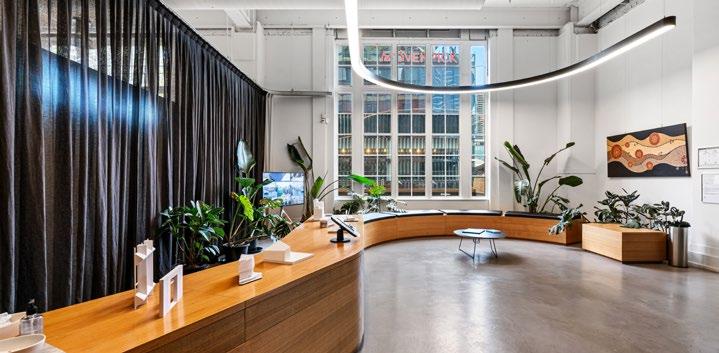
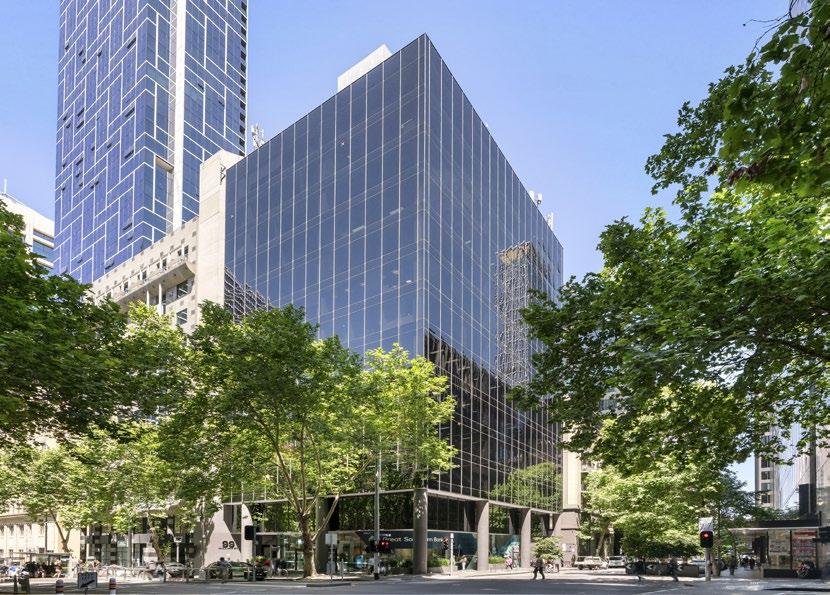
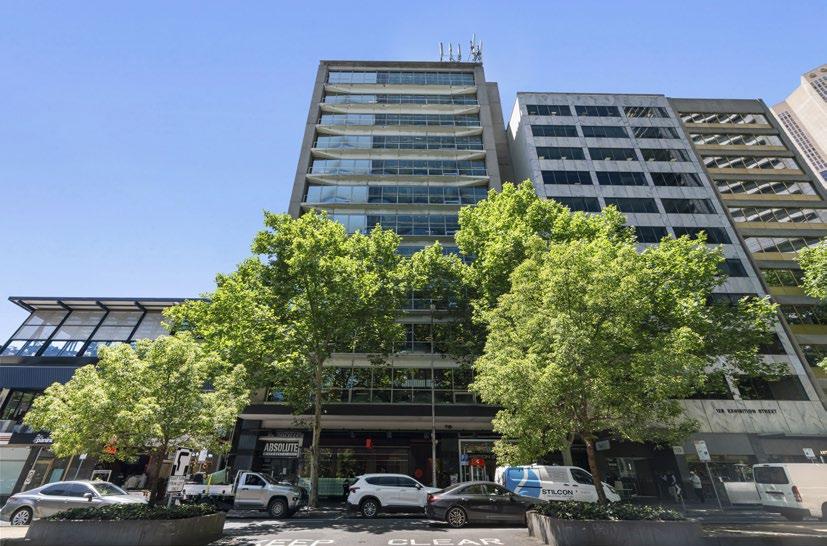
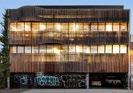
99 William Street, Melbourne
DemanD
The Melbourne CBD office market recorded its strongest level of net absorption in the six months to January 2026 in four years as tenants relocated into the CBD, capitalising on the attractive lease terms.
According to the PCA, the Melbourne CBD office market recorded positive net absorption of 28,029 square metres in the six months to January 2026, leading to a total of 29,475 square metres absorbed over the whole 2025 calendar year.
Melbourne CBD office tenant demand is showing clear, yet uneven, signs of stabilisation as of early 2026, transitioning from a period of downsizing to a more settled "flight-to-quality" trend.
Demand is heavily concentrated on tenants seeking A & Premium grade office buildings. Tenants are prioritising modern work spaces with high-end amenities supporting productivity and advanced technology.
Consequently, for the first time since January 2023, both Premium and A-grade offices recorded positive net absorption over the six months to January 2026.
In the six months to January 2026, A-grade space outperformed all other grades in the Melbourne CBD with 42,532 square metres absorbed. Premium grade offices recorded positive net absorption over the six months to January 2026 with 7,471 square metres absorbed. In contrast during the same period, B-grade and C-grade offices both recorded negative net absorption, equating to negative net absorption of 21,974 square metres.
Melbourne CBD Net Absorption
DemanD
Victoria’s employment rate of increase is moderating, having increased by 60,600 new jobs over the year, lower than the 112,000 jobs created in the previous 12-month period. Despite this easing employment growth rate, Victoria’s unemployment rate remains at 4.2% as at January 2026, below the 20-year average of 5.2%. Looking ahead, Victoria’s employment is projected to increase further through 2026, albeit in select industries.
Over the six months to January 2026, the Docklands precinct recorded net absorption of 32,485 square metres boosted by the Department of Defence’s relocation into 800 Collins Street, Docklands. Other precincts to record positive net absorption over the six months to January 2026, were the Eastern and North Eastern precincts with 16,389 square metres and 12,243 square metres absorbed respectively. In contrast, Flagstaff, Western and Spencer precincts all recorded negative net absorption over the six months to January 2026.
Source: ABS / Fitzroys
Annual Victorian Employment Change by Sector
tenant enQuIry
Tenant enquiry levels (both in terms of size requirements and number of tenant briefs) rose to their highest levels in five years over 2025, underpinned by SME's seeking space up to 1,000 square metres. Tenant briefs seeking more than 3,000 square metres also increased in 2025, reaching their highest levels in 10 years boosted by the elevated vacancy levels. For occupiers less than 400 square metres, fitted space and spec suites continue to be preferred, as smaller occupiers increasingly value minimal upfront fitout costs and using rental abatement incentives as much as possible.
Demand remains elevated for Premium and A grade space particularly in the Eastern and North Eastern precincts, driven by proximity to public transport, quality amenities and buildings providing high sustainability targets. ESG credentials are now a core requirement for tenants, particularly for overseas based and Government enterprises.
Tenant enquiry for Melbourne CBD office accommodation remains historically diverse with demand led by Professional Services (29%), followed by Finance & Insurance (21%) Retail Trade (12%) Government (9%), and IT & Telecommunications (6%). Other sectors active in the Melbourne CBD office market over the past 12 months have been the Healthcare and Logistics sectors.
As hybrid workplaces evolve and companies better understand how offices will be used, tenant enquiry levels are expected to continue to gain momentum through 2026. Occupiers have improved insight into workplace attendance and space needs leading to greater confidence in planning for their office accommodation.
leaSInG tranSactIonS
Vacancy
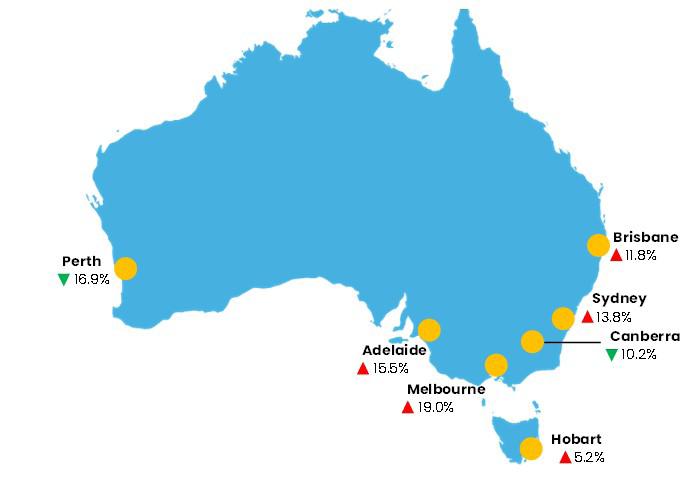
The vacancy rate of the Melbourne CBD office market rose slightly to 19.0% over the six months to January 2026, driven by the reintroduction of several fully refurbished office buildings including (eg: 226 Flinders Lane, 419 Flinders Lane, 800 Collins Street, 85 Spring Street & 111 Bourke Street). According to the Property Council, the total Melbourne CBD office vacancy rate has now risen to its highest rate since January 1997. In comparison Sydney’s CBD vacancy rate is now sitting at 13.8% and Brisbane at 11.8%. Elsewhere, the office vacancy rate fell in Perth, and Canberra in the six months to January 2026.
Overall, the total Australian CBD office vacancy rate increased to 14.8% as at January 2026, the highest rate since 1995. Outside of the CBD office markets, the overall vacancy rate of the Australian non-CBD office markets remained at 18.5%, its highest rate since 1993.
The vacancy rate of the St Kilda Road office market rose to an all-time high of 31.6% in January 2026, while the vacancy rate in the Southbank office market fell to 15.0% with vacancy rising to a three-year high in the East Melbourne office market at 10.1%.
Source: Property Council of Australia
Vacancy
Vacancy By
GraDe
Despite the trend of tenants to upgrade their office accommodation, the vacancy rate of A-grade offices increased to 20.6%, its highest rate since 1994 with the Premium office
vacancy rate sitting at 15.8%, almost double its 10-year average. Meanwhile, B-grade and C-grade offices vacancies increased to 20.5% and 13.8% respectively.
Melbourne CBD Vacancy by Grade
Source: Property Council of Australia
The sub-lease vacancy rate of the Melbourne CBD office market appears to be stabilising having trended down since 2022. As at January 2026, sub-lease vacancy totalled 64,004 square metres however, still remains above its 10year average, resulting in a sub-lease vacancy rate of 1.2%. Collectively, Premium and A-grade office space account for 94% of total sub-lease vacancy across the Melbourne CBD office market as at January 2026.
Most precincts are now under 1.5%, with the North Eastern precinct still recording the highest level of sub-lease space with more than 23,100 square metres, accounting for 36% of the Melbourne CBD office market’s total sub-lease vacancy.
SuB-leaSe Vacancy
Vacancy By precinct
Across Melbourne’s CBD office market, by precinct, there were mixed results in the six months to January 2026. The Civic, Docklands and North Eastern precincts recorded decreases in their vacancy rates in the six months to January 2026. In contrast,
the vacancy rates of the Eastern, Flagstaff, Spencer and Western precincts increased over the six months to January 2026, sitting at 20-year high's. Collectively, the Western and Docklands precincts account for 59% of the Melbourne CBD office market.
Vacancy Rate Per Precinct
Precincts
Source: Property Council of Australia
Although tenant enquiry levels have increased, the total vacancy rate of the Melbourne CBD office market is likely to remain elevated through 2026. As a result of the elevated vacancy rate, leasing terms will remain highly
competitive encouraging more tenants to relocate into the CBD. Tenants are attracted to the CBD due to the premier amenity and connectivity boosted recently with the completion of the Metro Tunnel.
Vacancy proJection
Melbourne CBD Vacancy Projection
Source: Property Council of Australia / Fitzroys
Source: Property Council of Australia / Fitzroys
rentS & IncentiVeS
Gross face rents continue to increase, albeit marginally as outgoings and incentives rise. While incentive levels remain at historical highs due to the elevated vacancy rate, there is increasing variability with incentive levels depending upon the availability of contiguous prime floors. Incentives are projected to remain at their relatively high levels throughout this year.
Looking ahead, prime Melbourne CBD offices are projected to record net effective rental growth from early 2027 as incentive levels begin to finally ease. Rental growth for secondary offices will stay subdued until the vacancy rates peak, as tenants remain very selective.
rental proJectIon
Source: Fitzroys
Source: Fitzroys
office leaSinG SucceSS



Hamish Dennis Manager 0406 500 232 dennish@fitzroys.com.au

Analyst 0499 047 997 flockarts@fitzroys.com.au